THE LEGEND OF THE LAKE OF ISSARLÈS
Martha Ward Carey translation
NORTHWEST of Ardèche, on the limits of Haute-Loire and Lozère, in the commune of Issarlès, may be seen one of the largest lakes formed by the volcanic craters of the Northern Cévennes. The origin of the lake is thus told in a legend heard from an old woman of Sainte Eulalie, the next commune to Issarlès.
There was, in old times, not far from where I live, a large parish with houses scattered far apart in the rural portions, and containing only one town, named Issarlès. One day a poor man came to this parish to ask for alms. He began in the country. At the first house to which he came, he cried, “Give me something, for I am hungry.” “Oh! my friend, I have nothing for you,” answered the woman, pityingly. “Have you not even a few potatoes in your pot?” said he. “Yes,” replied the woman, “there are two, if you want them.” The poor man took one and departed. Then he walked on, and came to another house. “Give me something, for the love of God,” he cried. The woman rose, and said, “My friend, we have no bread, but the dough is in the tray all ready; the oven is almost warm enough; we shall soon bake it, and then we will give you some sweet bread; sit down and wait.” The poor man said, “Your bread is baked.” The woman said to her husband, “My husband, the poor man says that our bread, which is in the tray, is already baked. How can that be? We have not yet put it in the oven.” The husband looked into the tray and saw the bread already baked, and near the large loaves he saw a small sweet loaf. “What you have declared is really so,” said he to the poor man; “the bread is baked without having been in the oven. It is God’s doing. Sit down at our table, and eat with us.” The poor man refused. “Then take,” said the husband, “the loaf that my wife wished to prepare for you, and which is already baked as well as the large loaves.” The poor man took the loaf, and before leaving, said to the husband, “In a little while you will hear a great noise; don’t be frightened.”
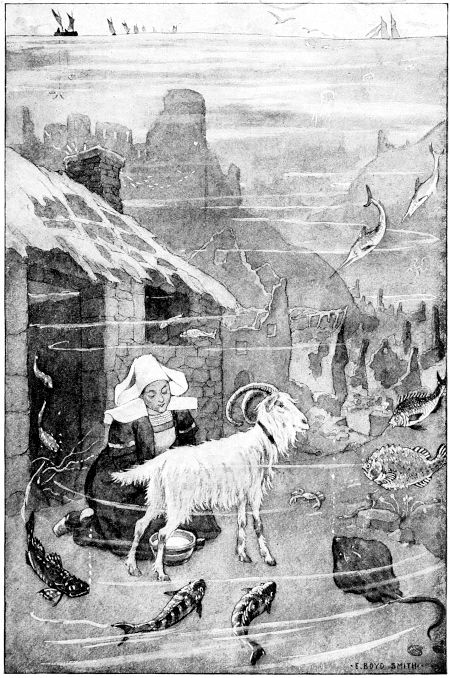
THE BOTTOM OF THE LAKES OF ISSARLÉS.
At some distance from the house, the poor man met two little children playing by the roadside. “What are you doing, my children?” “We are playing.” “Are you hungry?” “No.” “If you want some sweet bread, I will give you some.” “Hungry or not, we can eat it very well,” said the children. The poor man divided his sweet loaf, and gave half of it to each of the children, who ran off with it to their mother. “Mamma, a poor man gave us each half a sweet loaf,” they cried. Their mother scolded them. “Never take bread from beggars,” she said; “it is not clean; I forbid your eating it.” “Mamma, it is very good; it is better than our bread.” “I forbid your eating it; I do not know the person who gave it to you,” and saying this, she took the pieces of bread from the children’s hands and threw them into the chicken coop.
A few moments after, the poor man appeared at the door of this woman’s house, which was at the entrance of the town. The children pointed him out to their mother, who said, “You begging! you, who can give bread to the children you find on the road! You had better keep your bread; it is not fit food for my children. For me, I have nothing to give to those who themselves can give.” The poor man went away; he entered the town, begging from house to house, and everywhere was driven away. He was about to leave the town, when in the suburbs, he saw two little houses, and thought he would make one more attempt, by applying there. A woman came out of the first house to which he went, and said, “I have no bread, I have only leaven; do you want some? I will give you some.” “I cannot eat leaven,” replied the poor man. Now, this woman told a lie, for she had bread, but did not wish to give him any.
The poor man went a few steps further on, and soon came to the second house. A woman was seated by the wall, milking a goat. “I am very thirsty,” said the beggar; “would you give me a little milk?” “Ah! my friend,” she answered, “I will give you all my goat’s milk, if you want it.” “I do not want all the milk of your goat; a little will be enough for me.” The woman went to get a glass; filled it with milk, and offered it to the beggar, saying, “Will you dip some bread in it?” “No; I am not hungry; I am only thirsty, and I have more than enough to drink.” Then he drank, and as the woman continued to milk her goat, Jesus drew near to her (for the beggar was Jesus), and said: “You will soon hear a great noise, but no matter how loud it may be, or from what direction it may come, do not move; continue milking your goat.”
At that very moment, a tremendous noise burst upon them. It was the town of Issarlès sinking down into the yawning earth. The woman half turned her head to see whence the noise came; she had no sooner done so than she was swallowed up with the town. The ruins were immediately covered up by a sheet of water.
On a clear day one may see to the bottom of the lake the ruins of the town of Issarlès, and distinguish clearly by the side of a small house, the last in the town, a woman, who with both her hands is milking a goat. I have seen her many a time when I was passing along the shore.
Victor Smith.