THE COUNTESS DE MURAT. (continued 3)
J. R. (James Robinson) Planché translation
Zephyr, after he had seen Alidor, was less surprised at the constancy of Young and Handsome; but he did not make himself visible to the shepherd until he had restored him to the charming Fairy.
Who could describe the perfect joy of Alidor and Young and Handsome at seeing each other once more? How lovely each appeared, and how fondly was each beloved! What thanks did not these fortunate lovers render to the Deity who had secured their happiness. He left them shortly afterwards to return to Flora.
Young and Handsome was anxious that all her Court should share in her felicity. They celebrated it by a thousand festivities throughout her empire, despite the vexation of the princes, her less fortunate lovers, who were the spectators of the triumphs of the beautiful shepherd.
In order to have nothing more to fear for Alidor from the wrath of Mordicante, Young and Handsome taught him the Fairy Art, and presented him with the gift of continual youth. Having thus provided for his happiness, she next considered his glory. She gave him the Castle of Flowers, and caused him to be acknowledged king of that beautiful country, over which his ancestors had formerly reigned. Alidor became the greatest monarch in the universe, on the same spot where he had been the most charming shepherd. He loaded all his old friends with favours; and, retaining for ever his charms, as well as Young and Handsome, we are assured that they loved each other eternally, and that Hymen would not disturb a passion which formed the happiness of their existence.
THE PALACE OF REVENGE.
Once on a time there was a King and Queen of Iceland, who, after twenty years of married life, had a daughter. Her birth gave them the greatest pleasure, as they had so long despaired of having children to succeed to their throne. The young Princess was named Imis; her dawning charms promised from her infancy all the wonderful beauty which shone with so much brilliancy when she arrived at a maturer age.
No one in the universe would have been worthy of her had not Cupid, who thought it a point of honour to subject to his empire, some day, so marvellous a person, taken care to cause a Prince to be born in the same Court equally charming with that lovely Princess. He was called Philax, and was the son of a brother of the King of Iceland. He was two years older than the Princess, and they were brought up together with all the freedom natural to childhood and near relationship. The first sensations of their hearts were mutual admiration and affection. They could see nothing so beautiful as themselves, consequently they found no attraction in the world that could interfere with the passion each felt for the other, even without yet knowing its name.
The King and Queen saw this dawning affection with pleasure. They loved young Philax. He was a Prince of their blood, and no child had ever awakened fairer hopes. Everything seemed to favour the designs of Cupid to render Prince Philax some day the happiest of men. The Princess was about twelve years old when the Queen, who was exceedingly fond of her, desired to have her daughter's fortune told by a Fairy, whose extraordinary science was at that time making a great sensation.
She set out in search of her, taking with her Imis, who, in her distress at parting with Philax, wondered a thousand and a thousand times how anybody could trouble themselves about the future when the present was so agreeable. Philax remained with the King, and all the pleasures of the Court could not console him for the absence of the Princess.
The Queen arrived at the Fairy's castle. She was magnificently received; but the Fairy was not at home. Her usual residence was on the summit of a mountain at some distance from the castle, where she lived all alone and absorbed in that profound study which had rendered her famous throughout the world.
As soon as she heard of the Queen's arrival, she returned to the castle. The Queen presented the Princess to her, told her her name and the hour of her birth, which the Fairy knew as well as she did, though she had not been present at it. The Fairy of the Mountain knew everything. She promised the Queen an answer in two days, and then returned to the summit of the mountain. On the morning of the third day she came back to the castle, bade the Queen descend into the garden, and gave her some tablets of palm leaves closely shut, which she was ordered not to open except in the presence of the King.
The Queen, to satisfy her curiosity in some degree, asked her several questions respecting the fate of her daughter. "Great Queen," replied the Fairy of the Mountain, "I cannot precisely tell you what sort of misfortune threatens the Princess. I perceive only that love will have a large share in the events of her life, and that no beauty ever inspired such violent passions as that of Imis will do." It was not necessary to be a fairy to foresee that the Princess would have admirers. Her eyes already seemed to demand from all hearts the love which the Fairy assured the Queen would be entertained for her. In the meanwhile Imis, much less uneasy about her future destiny than at being separated from Philax, amused herself by gathering flowers; but thinking only of his love, and in her impatience to depart, she forgot the bouquet she had begun to compose, and unconsciously flung away the flowers she had amassed at first with delight. She hastened to rejoin the Queen, who was taking her leave of the Fairy of the Mountain. The Fairy embraced Imis, and gazing on her with the admiration she deserved—"Since it is impossible for me," she exclaimed, after a short silence, which had something mysterious in it—"since it is impossible for me, beautiful Princess, to alter in your favour the decrees of destiny, I will at least endeavour to enable you to escape the misfortunes it prepares for you." So saying, she gathered with her own hands a bunch of lilies of the valley, and addressing the youthful Imis—"Wear always these flowers which I give to you," said she; "they will never fade, and as long as you have them about your person, they will protect you from all the ills with which you are threatened by Fate." She then fastened the bouquet on the head-dress of Imis, and the flowers, obedient to the wishes of the Fairy, were no sooner placed in the hair of the Princess, than they adjusted themselves, and formed a sort of aigrette, the whiteness of which seemed only to prove that nothing could eclipse that of the complexion of the fair Imis.
The Queen took her departure, after having thanked the Fairy a thousand times, and went back to Iceland, where all the Court impatiently awaited the return of the Princess. Never did delight sparkle with more brilliancy and beauty than in the eyes of Imis and of her lover. The mystery involved in the plume of lilies of the valley was revealed to the King alone. It had so agreeable an effect in the beautiful brown hair of the Princess, that everybody took it simply for an ornament which she had herself culled in the gardens of the Fairy.
The Princess said much more to Philax about the grief she felt at her separation from him than about the misfortunes which the Fates had in store for her. Philax was, nevertheless, alarmed at them; but the happiness of being together was present, the evils, as yet, uncertain. They forgot them, and abandoned themselves to the delight of seeing each other again.
In the meanwhile, the Queen recounted to the King the events of her journey, and gave him the Fairy's tablets. The King opened and found in them the following words, written in letters of gold:—
Fate for Imis hides despair Under hopes that seem most fair; She will miserable be, Through too much felicity.
The King and Queen were much distressed at this oracle, and vainly sought its explanation. They said nothing about it to the Princess, in order to spare her an unnecessary sorrow. One day that Philax was gone hunting, a pleasure he indulged in frequently, Imis was walking by herself in a labyrinth of myrtles. She was very melancholy because Philax was so long absent, and reproached herself for giving way to an impatience which he did not partake. She was absorbed in her thoughts, when she heard a voice, which said to her, "Why do you distress yourself, beautiful Princess? If Philax is not sensible of the happiness of being beloved by you, I come to offer you a heart a thousand times more grateful—a heart deeply smitten by your charms, and a fortune sufficiently brilliant to be desired by any one except yourself, to whom the whole world is subject." The Princess was much surprised at hearing this voice. She had imagined herself alone in the labyrinth, and, as she had not uttered a word, she was still more astonished that this voice had replied to her thoughts. She looked about her, and saw a little man appear in the air, seated upon a cockchafer. "Fear not, fair Imis," said he to her; "you have no lover more submissive than I am; and although this is the first time that I have appeared to you, I have long loved you, and daily gazed upon you." "You astonish me!" replied the Princess. "What! You have daily beheld me, and you know my thoughts? If so, you must be aware that it is useless to love me. Philax, to whom I have given my heart, is too charming ever to cease being its master, and although I am displeased with him, I never loved him so much as I do at this moment. But tell me who you are, and where you first saw me." "I am Pagan the Enchanter," replied he, "and have power over everybody but you. I saw you first in the gardens of the Fairy of the Mountain. I was hidden in one of the tulips you gathered. I took for a happy omen the chance which had induced you to choose the flower I was concealed in. I flattered myself that you would carry me away with you; but you were too much occupied with the pleasure of thinking of Philax. You threw away the flowers as soon as you had gathered them, and left me in the garden the most enamoured of beings. From that moment I have felt that nothing could make me happy but the hope of being loved by you. Think favourably of me, fair Imis, if it be possible, and permit me occasionally to remind you of my affection." With these words he disappeared, and the Princess returned to the palace, where the sight of Philax dissipated the alarm she had felt at this adventure. She was so eager to hear him excuse himself for the length of time he had been hunting, that she had nearly forgotten to inform him of what had occurred to her; but at last she told him what she had seen in the labyrinth of myrtles.
The young Prince, notwithstanding his courage, was alarmed at the idea of a winged rival, with whom he could not dispute the hand of the Princess upon equal terms. But the plume of lilies of the valley guaranteed him against the effect of enchantments, and the affection Imis entertained for him would not permit him to fear any change in her heart.
The day after the adventure in the labyrinth, the Princess, on awaking, saw fly into her chamber twelve tiny nymphs, seated on honey-bees, and bearing in their hands little golden baskets. They approached the bed of Imis, saluted her, and then went and placed their baskets on a table of white marble, which appeared in the centre of the apartment. As soon as the baskets were set upon it, they enlarged to an ordinary size. The nymphs having quitted them, again saluted Imis, and one of them, approaching the bed nearer than the rest, let something fall upon it, and then they all flew away.
The Princess, despite the astonishment which so strange a sight occasioned, took up what the nymph had dropped beside her. It was an emerald of marvellous beauty. It opened the moment the Princess touched it, and she found it contained a rose leaf, on which she read these verses.
Let the world learn, to its surprise, The wondrous power of thine eyes. Such is the love I bear to thee, It makes e'en torture dear to me.
The Princess could not recover from her astonishment. At length she called to her attendants, who were as much surprised as Imis at the sight of the table and the baskets. The King, the Queen, and Philax hastened to the spot on the news of this extraordinary event. The Princess, in her relation of it, suppressed nothing except the letter of her lover. She considered she was not bound to reveal that to any one but Philax. The baskets were carefully examined, and were found to be filled with jewels of extraordinary beauty, and of so great a value as to double the astonishment of the spectators.
The Princess would not touch one of them, and having found an instant when nobody was listening, she drew near to Philax and gave him the emerald and the rose leaf. He read his rival's letter with much disquietude. Imis, to console him, tore the rose leaf to pieces before his face; but ah! how dearly did they pay for that act!
Some days elapsed without the Princess hearing anything of Pagan. She fancied that her contempt for him would extinguish his passion, and Philax flattered himself by indulging in a like belief. That Prince returned to the chase as usual. He halted alone by the side of a fountain, to refresh himself. He had about him the emerald which the Princess had given him, and recollecting with pleasure the little value she set on it, he drew it from his pocket to look at it. But scarcely had he held it a moment in his hand when it slipped through his fingers, and, as soon as it touched the ground, changed into a chariot. Two winged monsters issued from the fountain and harnessed themselves to it. Philax gazed on them without alarm, for he was incapable of fear, but he could not avoid feeling some emotion when he found himself transported into the chariot by an irresistible power, and at the same moment raised into the air, through which the winged monsters caused the chariot to fly with a prodigious rapidity. In the meanwhile night came, and the huntsmen, after searching throughout the wood in vain for Philax, repaired to the Palace, whither they imagined he might have returned alone; but he was not to be found there, nor had any one seen him since he had set out with them for the chase.
The King commanded them to go back and renew their search for the Prince. All the Court shared in his Majesty's anxiety. They returned to the wood, they ran in every direction around it, and did not retrace their steps to the Palace before daybreak, but without having obtained the least intelligence of the Prince. Imis had passed the night in despair at her lover's absence, of which she could not comprehend the cause. She had ascended a terrace of the Palace to watch for the return of the party that had gone in search of Philax, and flattered herself she should see him arrive in their company; but no words can express the excess of her affliction when no Philax appeared, and she was informed that it had been impossible to ascertain what had become of him. She fainted; they carried her into the Palace, and one of her women, in her haste to undress and put her to bed, took out of the hair of the Princess the plume of lilies of the valley which preserved her from the power of enchantments. The instant it was removed a dark cloud filled the apartment, and Imis disappeared. The King and Queen were distracted at this loss, and nothing could ever console them.
The Princess, on recovering from her swoon, found herself in a chamber of various-coloured coral, floored with mother-of-pearl, and surrounded by nymphs, who waited upon her with the most profound respect. They were very beautiful, and magnificently and tastefully attired. Imis first asked them where she was. "You are in a place where you are adored," said one of the nymphs to her. "Fear nothing, fair Princess, you will find in it everything you can desire." "Philax is here, then!" exclaimed the Princess, her eyes sparkling with joy. "I desire only the happiness of seeing him again." "You cherish too long the recollection of an ungrateful lover," said Pagan, at the same moment rendering himself visible to the Princess, "and as that Prince has deserted you, he is no more worthy your affection. Let resentment and respect for your own pride combine with the passion I entertain for you. Reign for ever in these regions, lovely Princess; you will find in them immense treasures, and all imaginable delights will attend your steps." Imis replied to Pagan's address with tears alone. He left her, fearing to embitter her grief. The nymphs remained with her, and used all their endeavours to console her. A magnificent repast was served up to her. She refused to eat; but at length, on the following morning, her desire to behold Philax once more made her resolve to live. She took some food, and the nymphs, to dissipate her sorrow, conducted her through various portions of the Palace. It was built entirely of shining shells, mixed with precious stones of different colours, which produced the finest effect in the world; all the furniture was of gold, and of such wonderful workmanship that you might easily see it could only have come from the hands of Fairies.
After they had shown Imis the Palace, the nymphs led her into the gardens, which were of a beauty not to be described. She found in them a very brilliant car, drawn by six stags, who were driven by a dwarf. She was requested to enter the car. Imis complied; the nymphs seated themselves at her feet. They were driven to the seaside, where a nymph informed the Princess that Pagan, who reigned in this island, had made it by the power of his art the most beautiful in the universe. The sound of instruments interrupted the narration of the nymph. The sea appeared to be entirely covered with little boats, built of flame-coloured coral, and filled with everything that could be required to compose a brilliant aquatic entertainment. In the midst of the small craft, there was a barque of much larger size, on which the initials of Imis were seen in every part, formed with pearls. It was drawn by two dolphins. It approached the shore. The Princess entered it, accompanied by her nymphs. As soon as she was on board, a superb collation appeared before her, and her ears were regaled at the same time by exquisite music which proceeded from the boats around her. Songs were sung, of which her praise alone was the theme. But Imis paid no attention to anything. She remounted her car, and returned to the Palace overwhelmed with sadness. In the evening Pagan again presented himself. He found her more insensible to his love than ever; but he was not discouraged, and trusted to the effect of his constancy. He had yet to learn that in love the most faithful are not always the most happy.
Every day he offered the Princess entertainments worthy of exciting the admiration of all the world, but which were lost upon her for whom they were invented. Imis thought of nothing but the absence of her lover.
That unhappy Prince had been transported in the meanwhile, by the winged monsters, into a forest which belonged to Pagan. It was called the Dismal Forest. As soon as Philax had arrived in it, the emerald chariot and the monsters disappeared. The Prince, surprised by this adventure, summoned up all his courage to his assistance, and it was the only aid on which he could reckon in that place. He first explored several of the roads through the forest. They were dreadful, and the sun never penetrated their gloom. No human being was to be found in them; not an animal even of any description; it seemed as though the beasts themselves had a horror of this dreary dwelling.
Philax lived upon the wild fruit he found in it. He passed his days in the deepest sorrow. The loss of the Princess distracted him, and sometimes, with his sword, which he had retained, he occupied himself with carving the name of Imis on the trunks of the trees, which were not adapted for so tender a practice; but when we are truly in love we frequently make things serviceable to our passion which appear to be least favourable for the purpose.
The Prince continued daily to travel through the forest, and he had been nearly a year on his journey, when one night he heard some plaintive voices, but could not distinguish any words. Alarming as these wailing sounds were at such an hour and in a place where the Prince had never yet met with mortal soul, the desire to be no longer alone, and to find at least some one as wretched as himself with whom he could weep over the misfortunes that had befallen them, made him wait with impatience for morning, when he might seek out the persons whose voices he had heard. He walked towards that part of the forest whence he fancied the sounds had proceeded, but hunted all day in vain; at length, however, towards evening, he discovered, in a spot which was clear of trees, the ruins of a castle which appeared to have been of great size and magnificence. He entered a court-yard, the walls of which were of green marble, and seemed still tolerably perfect. He found in it nothing but trees of prodigious height, standing irregularly in various parts of the enclosure. He advanced towards a spot where he perceived something elevated upon a pedestal of black marble. It proved to be a confused pile of armour and weapons, heaped one upon the other: helmets, shields, and swords of an ancient form, which composed a sort of ill-arranged trophy. He looked for some inscription which might inform him to whom these arms had formerly appertained. He found one engraved on the pedestal. Time had nearly effaced the characters, and it was with much difficulty that he deciphered these words:—
To the Immortal Recollection of the Glory of the Fairy Ceora. It was here That on the same day She triumphed over Cupid And punished her faithless lovers.
This inscription did not afford Philax all the information he desired; he therefore would have continued his search through the forest if night had not overtaken him. He seated himself at the foot of a cypress, and scarcely had been there a moment, before he heard the same voices which had attracted his attention the previous evening. He was not so much surprised at this as at perceiving that it was the trees themselves which uttered these complaints, just as if they had been human beings. The Prince arose, drew his sword, and struck with it the cypress which was nearest to him. He was about to repeat the blow, when the tree exclaimed, "Hold! hold! Assault not an unhappy Prince who is no longer in a state to defend himself!" Philax stayed his hand, and becoming accustomed to this supernatural circumstance, inquired of the cypress by what miracle it was thus a man and a tree at the same time. "I am willing to inform you," replied the cypress; "and as, during two thousand years, this is the first opportunity Fate has afforded me of relating my misfortunes, I will not lose it. All the trees you behold in this court-yard were princes, renowned in their time for the rank they held in the world, and for their valour. The Fairy Ceora reigned in this country. She was beautiful, but her science rendered her more famous than her beauty. She therefore made use of other charms to subject us to her sway. She had become enamoured of the young Oriza, a prince, whose admirable qualities rendered him worthy of a better fate. I should premise to you," added the cypress, "it is the oak which you see beside me." Philax looked at the oak, and heard it breathe a heavy sigh, drawn from it, no doubt, by the recollection of its misfortune. "To attract this prince to her Court," continued the cypress, "the Fairy caused a tournament to be proclaimed. We all hastened to seize this opportunity of acquiring glory. Oriza was one of the princes who disputed the prize. It consisted of fairy armour which would render the wearer invulnerable. Unfortunately, I was the conqueror. Ceora, irritated that Fate had not favoured her inclinations, resolved to avenge herself upon us. She enchanted the looking-glasses, with which a gallery of her castle was entirely lined. Those who saw her reflected but once in these fatal mirrors, could not resist feeling for her the most violent passion. It was in this gallery she received us the day after the tournament. We all saw her in these mirrors, and she appeared to us so beautiful, that those amongst us who had hitherto been indifferent to love, ceased to be so from that instant; and those who were in love with others became as suddenly faithless. We no longer thought of leaving the Fairy's palace: our only anxiety was to please her. In vain did state affairs demand our presence in our own dominions; nothing seemed of consequence to us save the hope of being beloved by Ceora. Oriza was the only one she favoured, and the passion of the other princes but gave the Fairy opportunities of sacrificing them to this lover who was so dear to her, and caused the fame of her beauty to be spread throughout the world. Love appeared for some time to have softened the cruel nature of Ceora; but at the end of four or five years she displayed her former ferocity. She revenged herself on the kings, her neighbours, for the smallest slight by the most horrible murders, and abusing the power which her enchantments gave her over us, she made us the ministers of her cruelties. Oriza strove in vain to prevent her injustice. She loved him; but she would not obey him. Having returned one day from fighting and subduing a giant whom I had challenged by her orders, I caused the arms of the vanquished to be brought into her presence. She was alone in the Gallery of Looking-glasses. I laid the giant's spoils at her feet, and pleaded my passion to her with inconceivable ardour, augmented, no doubt, by the power of the enchantment by which I was surrounded. But far from evincing the least gratitude for the success of my combat, or for the love I felt for her, Ceora treated me with the utmost contempt; and, retiring into a boudoir, left me alone in the gallery, in an indescribable state of despair and rage. I remained there some time, not knowing what resolution to take; for the enchantments of the Fairy did not permit us to fight with Oriza. Careful of the life of her lover, the cruel Ceora excited our jealousy, but took from us the natural desire to revenge ourselves on a fortunate rival. At length, after having paced the gallery for some time, I remembered that it was in this place I had first fallen in love with the Fairy, and exclaimed, 'It is here that I first felt that fatal passion which now fills me with despair; and you, wretched mirrors, who have so often represented the unjust Ceora to me, with a beauty which has enslaved my heart and reason, I will punish you for the crime of offering her to my view with too great attraction.' At these words, snatching up the giant's club, which I had brought to present to the Fairy, I dashed the mirrors to pieces. No sooner were they broken than I felt even greater hatred for Ceora than I had formerly felt love for her. The princes, my rivals, felt at the same moment their charms broken, and Oriza himself was ashamed of the love which the Fairy had for him. Ceora in vain attempted to retain her lover by her tears; he was insensible to her grief, and in spite of her cries, we set out all together, determined to fly from the terrible place, but in passing through the court-yard, the sky appeared to be on fire; a frightful clap of thunder was heard, and we found it was impossible for us to move. The Fairy appeared in the air, riding on a great serpent, and addressing us in a tone of voice which betrayed her rage,—'Inconstant princes,' said she, 'I am about to punish you, by a torture which will never end, for the crime you have committed in breaking my chains, which were too great an honour for you to bear; and as for you, ungrateful Oriza, I triumph after all in the love you have felt for me. Content with this victory, I shall visit you with the same misfortune as your rivals; and I command,' added she, 'in memory of this adventure, that when the use of mirrors shall be known to all the world, the breaking of these fatal glasses shall always be a certain sign of the infidelity of a lover.' The Fairy disappeared in the air after having pronounced these words. We were changed into trees; but the cruel Ceora, no doubt with the idea of increasing our suffering, left us our reason. Time has destroyed the superb castle, which was the victim of our misfortune; and you are the only visitor we have seen during the two thousand years that we have been in this frightful forest."
Philax was about to reply to this speech of the cypress tree, when he was suddenly transported into a beautiful garden; he there found a lovely nymph, who approached him with a gracious air, saying, "If you wish it, Philax, I will allow you in three days to see the Princess Imis."
The Prince, transported with joy at so unexpected a proposition, threw himself at her feet to express his gratitude. At that same moment Pagan was in the air, concealed in a cloud with the Princess Imis: he had told her a thousand times that Philax was unfaithful, but she had always refused, on the word of a jealous lover, to believe it. He now conducted her to this spot, he said, to convince her of the fickleness of the Prince she so unjustly preferred to him. The Princess saw Philax throw himself, with an air of extreme delight, at the feet of the nymph; and was in despair that she could no longer deceive herself on a point which she feared to believe more than anything in the world. Pagan had placed her at a distance from the earth, which prevented her hearing what Philax and the nymph said; and it was by his orders that the latter had presented herself to him.
Pagan led Imis back to his island, where after having convinced her of the infidelity of Philax, he found he had only redoubled the grief of that beautiful Princess without rendering her at all more favourable to himself.
In despair at finding this pretended infidelity, from which he had expected so much success, was useless to him, he resolved to be revenged on the constancy of the lovers: he was not cruel, like the Fairy Ceora, his ancestress, so he bethought him of a different punishment to that with which she had visited her unfortunate lovers. He did not wish to destroy either the Princess, whom he had so tenderly loved, nor even Philax, whom he had already made suffer so much; so, confining his revenge to the destruction of a passion which had so opposed his own, he erected in his island a Crystal Palace, and took care to put into it everything that would render life agreeable but the means of leaving it; he shut up in it nymphs and dwarfs to wait on Imis and her lover; and, when everything was prepared for their reception, he transported them both there. They at first thought themselves on the summit of happiness, and blessed Pagan a thousand times for the mildness of his anger. As for Pagan, although at first he could not bear to see them together, he expected that this spectacle would one day be less painful to him. But in the meanwhile, he departed from the Crystal Palace, after having, with a stroke of his wand, engraved on it this inscription:—
Absence, danger, pleasure, pain, Were all employ'd, and all in vain, Imis' and Philax' hearts to sever. Pagan, whose power they dared defy, Condemned them, for their constancy, To dwell together here for ever!
They say that at the end of some years, Pagan was as much avenged as he desired to be; and that the beautiful Imis and Philax fulfilled the prediction of the Fairy of the Mountain, by wishing as fervently to recover the aigrette of lilies in order to destroy the agreeable enchantment, as they had formerly desired to preserve it as a safeguard against the evils which had been foretold would befal them.
Until that moment a fond pair, so blest, Had cherished in their hearts Love's constant fire: But Pagan taught them by that fatal test, That e'en of bliss the human heart could tire.
THE PRINCE OF LEAVES.
In one of those parts of the world, commonly called Fairyland, on which poets alone have the right to bestow names, there formerly reigned a King so renowned for his rare qualities, that he attracted the esteem and admiration of all the Princes of his time. He had, many years past, lost his wife, the Queen, who had never brought him a son; but he had ceased to desire one since the birth of a daughter of such marvellous beauty, that from the moment she was born he lavished all his affection and tenderness upon her. She was named Ravissante, by a Fairy, a near relative of the Queen, who predicted that the wit and the charms of the young Princess would surpass all that had ever before been known or even could be expected from her present beauty; but she added to this agreeable prediction, that the perfect felicity of the Princess would depend entirely on her heart remaining faithful to its first love. In such a case, who can feel assured of a happy destiny? The King, who desired nothing so much as the happiness of Ravissante, heartily wished that it had been attached to any other condition,—but we cannot command our own fates. He begged the Fairy, a thousand times, to bestow on the young Ravissante the gift of constancy, as he had seen her give to others the gifts of intelligence and of beauty. But the Fairy, who was sufficiently wise not to deceive him respecting the extent of her power, frankly informed the King that it did not extend to the qualities of the heart. She, however, promised to use her utmost endeavour to impress the young Princess with the sentiments that would be likely to ensure her happiness. Upon the faith of this promise, the King confided Ravissante to her care from the time she attained her fifth year, preferring to deprive himself of the pleasure of seeing her rather than run any risk of marring her fortune. The Fairy therefore carried off the little Princess, who was very soon consoled for leaving the Court of her father, by the delight and novelty of passing through the air in a brilliant little car.
On the fourth day after her departure the flying car stopped in the middle of the sea, upon a rock of a prodigious size—it was one entire shining stone, the colour of which was exactly that of the sky. The Fairy remarked with pleasure that the young Ravissante was enchanted with this colour, and she drew from it a happy omen for the future, as it was the colour which signifies fidelity. Shortly after they had landed on it, the Fairy touched the rock with a golden wand which she held in her hand. The rock immediately opened, and Ravissante found herself with the Fairy, in the most beautiful palace in the world; the walls were of the same material as the rock, and the same colour prevailed in all the paintings and furniture, but it was so ingeniously mixed with gold and precious stones, that far from wearying the eye, it equally pleased in all. The young Ravissante dwelt in this agreeable palace, with several beautiful maidens, whom the Fairy had transported from various countries to attend on and amuse the Princess, and she passed her infancy in the enjoyment of every pleasure suited to her age. When she had attained her fourteenth year the Fairy again consulted the stars, in order to learn precisely when the heart of Ravissante would be touched with a passion which pleases even more than it alarms, however formidable it may appear to some; and she read distinctly in the stars that the fatal time approached when the destiny of the young Princess would be fulfilled. The Fairy had a nephew who was indescribably dear to her: he was of the same age as Ravissante, born on the same day and at the same hour. She had found, in consulting the stars also for him, that they promised him the same fate as the Princess—that is to say, perfect happiness, provided he possessed fidelity which nothing could vanquish. In order to make him both loving and faithful she had only to let him behold Ravissante. No one could resist her eyes, and the Fairy hoped that the attentions of the young Prince would one day touch her heart. He was the son of a King, brother of the Fairy; he was amiable; and the young Princess not only had never had a lover, she had not even seen a man since she had lived on the rock. The Fairy consequently flattered herself that the novelty of the pleasure of being tenderly beloved would perhaps inspire the Princess with a feeling of love in return. She therefore transported the Prince, who was named Ariston, to the same rock which served both as palace and prison for the beautiful Ravissante. He there found her amusing herself with the young maidens of her Court, by weaving garlands of flowers in a forest of blue hyacinths, where they were then walking, for the Fairy, in bestowing on the rock the power of producing plants and trees, had limited the colour of them to that of the rock itself. She had already, some time since, apprised the Princess that Prince Ariston would soon visit the island, and she had added, in speaking of the Prince, everything that she thought likely to prejudice her in his favour; but she deceived herself this time; and on the arrival of Ariston, she observed nothing of that emotion or surprise which is the usual presage of a tender passion. As for the Prince, his sentiments were in perfect accordance with the wishes of the Fairy: he became passionately in love from the moment he first set eyes on Ravissante; and it was not possible to see her without adoring her, for never were grace and beauty so perfectly united as in the person of this amiable princess. She had the most exquisite complexion, and her dark brown hair added to its dazzling whiteness; her mouth had infinite charms, her teeth were more purely white than pearls; her eyes, the most beautiful in the world, were deep blue, and they were so brilliant, and at the same time so touching in their expression, that it was hardly possible to sustain their glances without yielding the heart at once to the fatal power which love had bestowed on them. She was not very tall, but perfectly beautiful, and all her movements were peculiarly graceful. Everything she did and said pleased invariably, and often a smile or a single word sufficed to prove that the charms of her mind equalled those of her person.
Such, and a thousand times more amiable than I can paint her, it had indeed been difficult for Ariston not to have become distractedly in love; but the Princess received his attentions with indifference, and did not appear in the least touched by them. The Fairy remarked it, and felt a grief which was only surpassed by that of the Prince. She had remarked in the stars that he who was destined to possess Ravissante would extend his power not only over the earth, but even over the sea. Therefore her ambition made her wish that her nephew should touch the heart of the Princess as much as he desired the same effect from his love. She thought, however, that if the Prince were as learned as she was in the magic art, he might perhaps find some mode of rendering himself more attractive in the eyes of Ravissante; but the Fairy, who had never loved, was ignorant that the art of pleasing is not always to be discovered, although sought for with the utmost ardour and eagerness. She taught the Prince, therefore, in a short time, all those sciences which are known only to the fairies. He had no pleasure in learning them, nor had he any idea of employing them but with regard to his passion for Ravissante. He began to make use of them by giving every day a new fête to the Princess. She admired the wonders produced, she deigned even sometimes to praise what appeared the most gallant in these efforts of the Prince to please her; but after all, she received his devotion and his attentions as the just homage due to her beauty, and she considered them amply repaid by her condescending to receive them without anger.
Ariston began to despair of the success of his passion, but he was too speedily obliged to confess that this very time, which he complained of so justly, and in which he felt so keenly the hopelessness of his love, had, notwithstanding, been the most happy period of his life. A year after his arrival on the island he celebrated the return of that memorable day on which he had first beheld Ravissante. In the evening he gave her a fête in the forest of hyacinths. Marvellous music was heard in every part of the forest without any one being able to discover from whence the sounds proceeded. All that was sung by these invisible musicians tenderly expressed the love of Ariston for the Princess; they concluded their admirable concert by these words, which were repeated several times:—
Nor reason nor relentless Fate My sufferings can terminate! Without one ray of hope to cheer, I feel my heart consuming here. How great his power Love never knew Till from those eyes his arrows flew.
After the music, there appeared suddenly an elegant collation under a tent of silver gauze, elegantly looped up with ropes of pearls; it was open on the side towards the sea, which bounded the forest in that direction; and was illuminated by a great number of chandeliers formed of brilliants, which emitted an effulgence nearly equal to that of the sun. It was by this light that the nymphs of the court of Ravissante pointed out to her an inscription at the entrance of the pavilion, written in letters of gold upon a ruby of immense magnitude, supported by twelve little cupids, who flew away as soon as the Princess had heard this inscription read, which consisted of these lines:—
Where'er throughout the world those lovely eyes May the devoted hearts of men enchain, For one as true as in this desert sighs Those lovely eyes may search, sweet maid, in vain. But through that world your glory to proclaim, And every mortal to your altar bring, Princess, we haste to bid the trump of Fame With praise of beauty so divine to ring.
The fête continued, and Prince Ariston had at least the pleasure of engrossing the leisure of the Princess, if he could not occupy her heart. But he was deprived even of this gratification by a surprising spectacle which appeared far out at sea, and attracted the curiosity and attention of Ravissante and of all the court. The object approached, and they distinguished that it was an arbour formed of interlaced myrtle and laurel branches, closed on all sides, and propelled with great rapidity by an infinite number of winged fish. This sight was the more novel to Ravissante as she had never before seen anything of the colour of this arbour. The Fairy having foreseen that it would cause some misfortune to her nephew, had absolutely banished it from her island. The Princess watched for the approach of the strange object with an impatience which appeared to Ariston a bad omen for his love. She had not long to wait, for the winged fish brought the arbour in a few moments to the foot of the rock, and the attention of the young Princess and of all the Court was redoubled.
The arbour opened, and out of it came a young man of marvellous beauty, who appeared about sixteen or seventeen years of age. He was clothed in branches of myrtle, curiously interlaced, with a scarf composed of various-coloured roses. This handsome stranger experienced as much astonishment as he occasioned. The beauty of Ravissante did not leave him at liberty to amuse himself by observing the rest of the splendid scene, the brilliancy of which had attracted him from a distance. He approached the Princess with a grace which she had never observed but in herself. "I am so surprised," said he to her, "at all I find on these shores, that I have lost the power of expressing my astonishment. Is it possible," continued he, "that such a goddess (for a goddess you surely must be) has not temples throughout the universe?" "I am not a goddess," said Ravissante, colouring; "I am an unfortunate princess banished from the states of the King, my father, to avoid I know not what misfortune, which they assure me has been predicted from the moment of my birth." "You appear to me much more formidable," replied the handsome stranger, "than those stars which may have some evil influence on your fate, and over what misfortune could not such perfect beauty triumph! I feel that it can vanquish everything," he added, sighing, "since it has conquered in a moment a heart which I had always flattered myself should remain insensible; but, Madam," continued he, without giving her time to reply, "I must, against my will, withdraw from this charming place, where I see you only, and where I have lost my peace of mind; I will return soon, if Cupid prove favourable to me." After these words, he re-entered the arbour, and in a few moments he was lost to sight.
Prince Ariston was so astounded and distressed by this adventure, that he had not at first the strength to speak; a rival had appeared in a manner as wonderful as unexpected; this rival had seemed to him only too charming, and he thought he had observed in the beautiful eyes of the Princess, whilst the stranger addressed her, a languor which he had often desired to see, but which till then he had never detected. Agonized by a despair which he dared not betray, he conducted Ravissante to the Palace, where she passed part of the night, occupied by the recollection of her agreeable adventure, and made her nymphs relate each circumstance over and over again, as though she had not been herself present. As for Prince Ariston, he went to consult the Fairy, who, he hoped, might possess some charm to allay the violent grief under which he laboured; but she had no antidote for jealousy, and they do say none has ever been discovered to this day. The Prince and the Fairy, however, redoubled their enchantments to defend the entrance to the rock from this formidable stranger, whom they took for a magician. They surrounded the island with frightful monsters, who occupied a great space on the sea, and who, excited by their own natural ferocity, and by the power of the spell, seemed to assure Ariston and the Fairy that it would be an impossibility to take from them the beautiful Princess whom they so jealously guarded. Ravissante seemed to feel more vividly the power of the charms of the handsome stranger by the grief which she experienced at the obstacles opposed to his return to the island; and she resolved, at all events, to be revenged on Prince Ariston. She began to hate him, and that alone was ample vengeance. Ariston was inconsolable at finding he had provoked the hatred of Ravissante by a passion which it appeared to him should have produced just the contrary effect. The Princess mourned in secret the forgetfulness of the stranger: it appeared to her that love should have ere this made him keep his promise to return. Sometimes, also, she ceased to desire it, when she remembered the dangers with which Ariston and the Fairy had surrounded the approach to the island. One day that she was occupied in these various reflections whilst walking alone on the sea-shore—for Ariston dared not, as formerly, follow her, and the Princess refused even to attend the fêtes with which he was accustomed to entertain her,—she arrived at the same spot which the adventure with the unknown visitor had rendered so remarkable, and was struck by the appearance of a tree of extraordinary beauty floating towards the rock. The colour, which was the same as that of the myrtle arbour of the stranger, gave her a sensation of joy. The tree approached the rock, and the monsters attempted to defend the entrance, but a little breeze agitated the leaves of the tree, and having blown off a few, and driven them against the monsters, they yielded to these light and harmless weapons, and even ranged themselves with a show of respect in a circle around the tree, which approached the rock without further impediment, and opened, disclosing to view the stranger seated on a throne of verdure; he rose precipitately at the sight of Ravissante, and spoke to her with so much eloquence and so much love, that after she had in a few words acquainted him with her history, she could not conceal from him that she was touched by his devotion, and rejoiced at his return. "But," said she, "is it fair that you should know the sentiments with which you have inspired me before I am informed of the name even of him who has called them forth?"
"I had no intention of concealing it from you," replied the charming unknown; "but when near you, one can speak of nothing but you; however, as you wish to know, I obey you, and beg to acquaint you that I am called the Prince of Leaves: I am the son of Spring and of a sea nymph, a relation of Amphitrite, which is the cause of my power extending over the sea: my empire comprises all parts of the earth which recognise the influence of Spring; but I chiefly inhabit a happy island where the gentle season which my father bestows reigns perpetually. There the air is always pure, the fields ever covered with flowers; the sun never scorches, but only approaches sufficiently near to illuminate it; night is banished, and it is therefore called the Island of Day. It is inhabited by a people as amiable as the climate is agreeable. It is in this place that I offer you an empire, sweet and calm, and where my heart above all things will acknowledge your sovereignty. You must, however, beautiful Princess, consent to be carried off from this rock, where you are retained in veritable bondage: notwithstanding the honours they pay you with a view to disguise the real state of the case." Ravissante could not, however, make up her mind to follow the Prince of Leaves into his empire, in spite of the fear which she had of the power of the Fairy, and the suggestions of her love; she hoped that her perseverance in rejecting the vows of Ariston, would at length cause him to resolve to conquer his passion, and that the Fairy would then restore her to her father, from whom the Prince of Leaves might demand her hand.
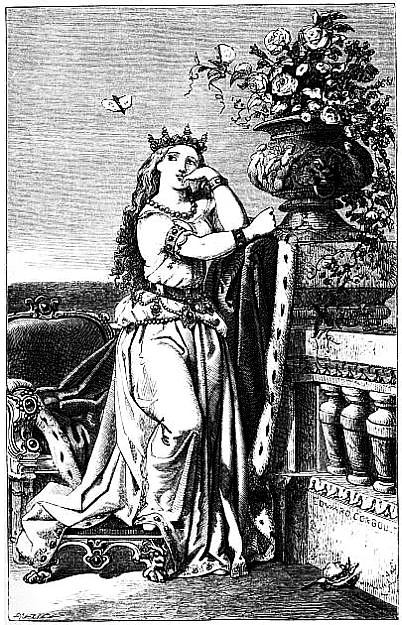
The Prince of Leaves.—P. 152.
"But I should at least wish," said she to him, "to be able to send you word of what happens in this island, and I know not how that is possible, as everything I do is suspected and watched." "I will leave with you here," said the Prince, "the subjects of a friend of mine, who is also a prince. They will constantly attend on you, and by them you can often send me intelligence; but remember, beautiful Princess, with what impatience I shall wait for it!" After these words, he approached the tree which had conveyed him, and having touched some of the leaves, two butterflies appeared, the one white and flame-colour, the other yellow and light-grey—the most beautiful in the world. As Ravissante gazed on them, the Prince of Leaves said, smiling, "I see you are surprised at the appearance of the confidants I give you; but these butterflies are not merely what they appear to be; it is a mystery which they will explain if you will permit them to talk to you." As he spoke, Ravissante perceived in the distance some of her nymphs, who came to seek her in her solitude, and she begged the Prince of Leaves to re-embark; he obeyed, notwithstanding the infinite regret he felt at quitting her, but he did not depart quickly enough to avoid observation; they informed Ariston and the Fairy of his return to the island, and from that moment, in order to take away from the beautiful Ravissante the means, and even the hope of seeing him again, they erected a tower on the summit of the rock formed of the same stone; and in order to render it more entirely secure, as the guard of living monsters had proved insufficient, they caused the tower and rock to be invisible to all those who should come to seek her, not daring again to trust to ordinary enchantments. Ravissante was in despair at being immured in so cruel and impregnable a prison. Prince Ariston had not concealed from her that he had rendered it invisible; he had even attempted to make her accept this care for her safety as a proof of his tender devotion; but Ravissante felt her hatred and contempt for him increase daily, and he dared no longer enter her presence. The butterflies, however, had not quitted her, and she often regarded them with pleasure as having come from the Prince of Leaves. One day that she was still more sad than usual, and musing, on a terrace at the top of the tower, the flame-coloured butterfly flew on to one of the vases filled with flowers, which ornamented the balustrade. "Why," said he, all of a sudden to the Princess, "do you not send me to the Prince of Leaves, he will undoubtedly come to your relief?" Ravissante was at first so astonished at hearing the butterfly speak, although her lover had prepared her for the novelty, that she was for some minutes unable to answer; however, the name of the Prince of Leaves assisting to dissipate her surprise, "I was so astonished," said she at length, "to hear a butterfly speak like ourselves, that I could not sooner reply to you. I can well believe that you could go to apprise the Prince of Leaves of my misfortune, but what can he do?—only distress himself uselessly. He cannot find me in a place which the cruelty of my enemies has taken care to render invisible."
"It is less so than you think," replied the yellow butterfly, flying round the Princess in order to join in the conversation: "a little while ago, I surveyed your prison, I flew and even swam round it; it disappears when one is on the water, but when one is elevated in the air it ceases to be invisible. No doubt the Fairy did not consider that road so easy as to require the same defence as that by the sea. I was about to give you this hint," continued the butterfly, "when my brother broke the silence which we have hitherto preserved." This agreeable piece of news restored hope to the Princess. "Is it possible," said she, "that Ariston can have neglected any precaution which could gratify his cruelty and his love? No doubt his power, like that of the Fairy, which is unbounded over earth and sea, does not extend to the air." This was precisely the reason which had prevented the Prince and the Fairy from rendering the tower and the rock invisible from the sky. "But," added Ravissante, after some minutes' reflection, "can the Prince of Leaves have any power in the air?" "No, Madam," replied the flame-coloured butterfly, "he can do nothing, and your prison would be invisible to him though he be a demi-god, as it would be to a mortal; but—" "The Prince will then be as miserable as myself," interrupted the sorrowful Ravissante, bursting into a flood of tears, which added to her beauty, and which affected extremely the two butterflies; "and I feel I shall be more distressed at his sorrows than at my own! What ought I, then, to do?" continued she, sighing. "Send me off at once," replied the flame-coloured butterfly, briskly; "I will go and apprise the Prince of Leaves of your misfortunes, and he will come to the rescue: although his power does not extend to the air, he has a prince amongst his friends who can do anything in it, and of whom he can dispose as of himself—but my brother can inform you of all this during my absence. Adieu, beautiful Princess," continued the butterfly, flying over the balustrade; "cease to weep, and count on my diligence, I will fly as rapidly as your wishes." After these words, the butterfly was lost in the air; and the Princess felt that charming and lively sensation of joy which the hope of soon beholding a beloved one inspires. She returned to her apartment, and the yellow butterfly followed her; she was extremely impatient to know from what prince her lover hoped for assistance; to end her doubts, she begged the yellow butterfly to tell her all that could contribute to augment or flatter her hopes. She placed him on a little basket of flowers, which she carried to a table near her, and the butterfly, who considered it an honour to please her, commenced his recital.
"Near the Island of Day, where the Prince of Leaves reigns, there is another, smaller but equally agreeable; the ground there is always covered with flowers, and they affirm that it is a boon granted to our country by Flora, to immortalize the memory of the happy days when she came there to find Zephyr: for they contend that it was on our island that they used to meet, when their love was still new and secret. It is called the "Island of Butterflies." The inhabitants are not of the form that you see me under. They are little winged men, very pretty, very gallant, very amorous, and so volatile that they hardly love the same thing for even one day. Whilst the golden age reigned on the earth, Cupid, who at that time flattered himself that the hearts of all mankind would be ever fond and faithful, feared that by the facility with which we flew about the world, we might teach mortals the agreeable art of changing in love, which this god called an error capable of utterly destroying the happiness of his empire. In order to interdict all communication between us and the rest of the universe, he came to our island, touched the ground with one of his arrows, and rising again upon a brilliant cloud which had borne him thither, 'If again,' said he, to the inhabitants of the island, 'you wish to traverse the air, like the gods, I have taken sure means of vengeance; you can no longer, by your dangerous society, trouble the happiness of my empire.' After these words he disappeared. The threats of Cupid did not, however, take from the Butterflies the desire for change, nor even for flying, if it was only for the pleasure of occasionally quitting the earth. Some of them mounted into the air, and found that they had the same facility as they possessed before Cupid had forbidden them to do so; but as soon as they passed the limits of the Island they were changed into little insects, such as you now behold me, all of different colours, avenging Cupid having intended to mark by this variety how much they were given to inconstancy. Surprised at their metamorphosis, they returned to our island, and as soon as they touched the ground they were restored to their original form. Since that fatal time the vengeance of Cupid has always continued amongst us; when we quit the earth, nothing of our nature, as men, remains, except our mind and the liberty of speaking like them; but we have never made use of it out of our island, not choosing to make this act of vengeance celebrated by publishing it ourselves to the universe, or to alarm those who, like us, are inclined to inconstancy. We have, however, the pleasure of seeing, in our travels through the world, that fate has revenged us on Cupid without our assistance; for Inconstancy reigns with equal power to his own in the whole extent of his empire. Some centuries after this change took place in the realm of the butterflies, the Sun, that seemed to take pleasure in making it bring forth flowers, was so enchanted with his handiwork, that he fell in love with a rose of extraordinary beauty; he was tenderly beloved by her, and she sacrificed to him all the care bestowed on her by the zephyrs. At the end of some time the rose became of a different form to the rest; the Sun immediately caused others to blow, resembling her, in order that she might be less remarked in this quantity of flowers, which then appeared a new kind of plant. It has since been called 'the rose of a hundred leaves.' At length, from the Sun and this rose sprung a demi-god, whom the Sun destined to reign for ever in our island. Until then we had had no sovereign, but the son of a god who favoured so constantly our earth was received as our ruler with extreme joy; they called him the Prince of the Butterflies. It is this Prince, beautiful Princess, who can assist you in the air, and whom the adventure I am about to relate has rendered such a fast friend of the Prince of Leaves.
"In a country far removed from that of the butterflies there reigns a Fairy, who dwells in a very dark cavern: they call her the Fairy of the Grotto. She is of an immense size; her complexion is a mixture of blue, green, and yellow. Her face is almost as formidable as her power, and she is so dreaded by mortals that there is not one bold enough to approach the country which she inhabits. One day the Prince of the Butterflies, travelling for his pleasure in the neighbourhood of his empire, perceived the Fairy, and surprised at this rencontre he followed her for some time to see what would become of so fearful a monster. She did not remark that she was observed, for the Prince, although the offspring of the Sun, had not been able to obtain from fate the liberty of travelling under any other form than that which we all took on leaving the kingdom, because he was born since the time when Cupid had made us feel his vengeance. However, he was not inconstant, like all his subjects, and Cupid, by way of showing him a little favour on that account, had permitted him, when he changed his form, to be of one colour only, and that colour should be the one which signifies Fidelity. Under this form he followed the Fairy as far as he pleased, and he saw her enter her dismal abode. Impelled by curiosity, he flew in after her; but what a sight awaited him at the bottom of this cavern! He there saw a young lady, more beautiful and more brilliant than the day, reclining on a bed of turf, and who appeared in extreme grief. From time to time she dried the tears which fell from her lovely eyes; her distress and the languor of her appearance added to her charms. The Prince of the Butterflies remained so entranced by this spectacle, that he forgot the form under which he appeared, and only remembered that he was desperately in love, and that he was burning to say so. He was roused from this sweet reverie by the awful voice of the Fairy, who spoke to the young lady with frightful severity. This filled his heart with sorrow and anger, as well as with despair, at not daring to express either one or the other. The Fairy, who by a natural restlessness could not remain long in the same place, went out of the cavern; the Prince then approached the young person with whom he was so charmed; he flew round her, and wishing to enjoy the only liberty which his form permitted, he alighted on her hair, which was the fairest in the world, and at length upon her cheek. He was dying to tell her how much he was touched with her beauty and her grief, but by what means could he convince her that he was son of the Sun, without being able to appear before her in his own form; and how could he inform her of the vengeance of Cupid, and the inconstancy so natural to the inhabitants of the island, at the very time that he wished to persuade her that he would never cease to love her? He remained several days in the cavern, or in the forest with which it was surrounded; he could not resolve to quit this beauty that he so adored, and although he dared not speak to her, he saw her, and that was enough to make him prefer this hideous abode to the agreeable scenes where he had the pleasure of reigning, and of being acknowledged the most beautiful Prince in the world.
"During the time he remained with this young creature he always saw the Fairy treat her with incredible inhumanity, and he learnt from their conversation that this beautiful person was the Princess of the Linnets, whom the Fairy, being a relative, had carried off at a tender age, in order more easily to usurp her kingdom, which was a little island situated near to that of the Butterflies. He had heard of the Princess having been carried away, and that no one knew what had become of her. This country was called the Land of the Linnets, on account of the great quantity of those little birds that was found there. The Prince of the Butterflies pitied sincerely this unfortunate Princess, and, in the hope of being able to deliver her, he determined at length to tear himself away from her. He flew to the Island of Day without resting for a moment; he there found the Prince of Leaves, with whom he was united in the most tender bond of friendship, and who was about to pass a part of the year in the Island of Butterflies. He related his adventure to the Prince, and after discussing every means by which it would be possible to set the young Princess at liberty, the Prince of Leaves resolved to go himself into the forest of the Fairy, to inform the Princess of the Linnets of the violent love which the Prince of the Butterflies felt for her, and the reason which would always prevent that unfortunate sovereign from appearing before her under his proper form, unless she consented to be transported to the Island of Butterflies. But the Prince of Leaves appeared to his friend too formidable a rival to be entrusted with the commission; for he feared, with reason, that the Princess might be more touched by the charms of so perfect a prince than by the recital of the love entertained for her by another prince whom she had never seen nor even heard speak. He deplored the cruelty of his destiny, and sought some other mode of declaring his love to the Princess, but without success.
"None but a demi-god could approach the dwelling of the Fairy without feeling immediately the direful effect of her fury. He embarked, therefore, with the Prince of Leaves, agitated by a jealous fear. It appeared to him that this Prince could not preserve for a single moment, on beholding the beautiful Princess, the insensibility on which he had always piqued himself.
"Cupid, touched at the sad state to which he was reduced, wished at least to re-assure him on this point, and at the same time triumph over the insensible heart of the Prince of Leaves. It was by you, beautiful Princess," continued the Butterfly, "that the God expected to gain this victory, and you alone are worthy of it.
"It was on the same day that the two princes embarked that they saw from afar, upon this rock, an illumination so brilliant, that the Prince of Leaves, impelled by his destiny more than by curiosity, ordered the winged fish which conducted the arbour of myrtle in which he travelled, to approach the spot from which the bright light emanated. You know the remainder of this adventure. The Prince of Leaves found you in the forest of hyacinths, and left at your feet the liberty which he had held so dear, and which, till that moment, he had always preserved. Hurried away by the impatience of the Prince of the Butterflies, who had suffered nothing but regret at the delay, he tore himself, with infinite pain, from a spot where his heart and his wishes would have made him desire to remain for ever. They continued their voyage, and the Prince of the Butterflies was so delighted to see that the Prince of Leaves was so deeply in love, and so far from being likely to become his rival, that he did not doubt of its being a happy omen, and that he might count on a successful issue to his enterprise.
"They arrived in the forest of the Fairy of the Grotto; they entered her dreary abode, and Cupid, who had resolved to favour them, caused them to find the Princess of the Linnets alone and asleep. There was no time to be lost—the Prince of Leaves carried her off in the myrtle arbour, whilst the Prince of the Butterflies followed.
"The Fairy returned at this moment; she uttered the most horrible shrieks at the sight of this abduction; she thought she could prevent it by her art, and revenge herself on those who had thus dared to rescue the Princess of the Linnets. But her enchantments were powerless over the Prince of Leaves, who soon was far away from the dismal shore. In the meanwhile the Princess awoke, and was agreeably surprised at finding herself where she was, and at the presence of the Prince of Leaves. But it was an agreeable surprise, which increased when that Prince conversed with her, and informed her of the effect of her beauty, and that she would henceforth, being delivered from the tyranny of the Fairy, reign in her own empire, and in one also even finer than her own. The Prince of the Butterflies then spoke of his love with so much vivacity and tenderness, that the Princess felt excessive curiosity to see him in his true form, of which she confessed to have formed a very exalted idea from the time she heard his voice. They continued to float on, and after some days arrived at the Island of Butterflies, when the Prince hastened to land, in order to appear at length in his own person to the Princess. The Princess of Linnets then sent to inform her subjects in her own island of her adventures: they flocked to see her, and it was in their presence that she accepted the heart and empire of the happy Prince of the Butterflies. The Prince of Leaves, however, left her immediately that he had safely conducted her to that island, in order to return hither, beautiful Princess, where his anxiety and his ardent love made him impatient to be."
Ravissante listened with extreme attention to the Butterfly, when she saw Prince Ariston enter her chamber with such fury in his countenance, that she dreaded its effects. "Fate threatens me," he cried, on entering; "and as it is with some great misfortune, it must, no doubt, be that of losing you; none other would affect my heart, or be worthy of being so predicted. See, Madam," he continued, addressing Ravissante, "the colour which the walls of this tower are assuming—it is a certain sign of approaching misfortune!"
As the misfortunes of Ariston were a happiness to Ravissante, she looked without distress at that which he pointed out to her notice, and perceived, indeed, that the blue stones were losing their original colour, and beginning to turn green. She was delighted to see this, as she augured from it the certain approach of the Prince of Leaves. The joy which the unhappy Ariston remarked in her eyes redoubled his despair. What did he not then say to Ravissante? And rendered sincere by the excess of his grief, he told her that his love was so great as not to allow of his ceasing to adore her, although he was sure of being miserable all his life. "I cannot doubt it," said he to the Princess, "for the Fates foretold to me as to you—that I should always be miserable if I were not always faithful to the first impressions love made on my heart. And by what means could I ever obey this cruel mandate? After one has seen you, however he may have loved before, he must forget everything—even the preservation of his own happiness in loving and seeking to please you. A young princess of the Court of the King, my father, once appeared to me worthy of my regard. I thought fully that I should be sighing to return to her after remaining here for a short time; but the first sight of you subverted all my previous plans. My reason and my heart were equally inclined for the change, and I thought nothing impossible to the tender love with which you inspired me. I flattered myself even that it might overcome fate; but your austerity, which never relaxed, has taught me that I was deceived, and that there remains for me no other hope but that of dying speedily for your sake."
The Prince Ariston finished speaking these words, which made Ravissante even think him worthy of some pity, when they saw in the air a throne of foliage, supported by an immense number of butterflies. One amongst them, which was entirely blue, and by whose colour Ravissante recognised the son of the Sun, flew to her, and said, "Come, beautiful Princess, to-day you shall resume your liberty, and make the most amiable Prince in the world happy."
The butterflies placed the throne near Ravissante; she seated herself on it, and they bore her away. Ariston, distracted at the loss of the Princess, in a paroxysm of despair, flung himself into the sea. The Fairy immediately abandoned the rock which this suicide had rendered so fatal and melancholy; and to mark her fury, she shivered both it and the tower into a thousand pieces by a clap of thunder, and the fragments were carried by the wind and waves to different sea-coasts. It is of this species of stone that they now make rings, which they call turquoise. Those which are still called "de la Vieille Roche" are made of the remains of this shattered rock, and the others are only stones which resemble them. The remembrance of the misfortune predicted to Prince Ariston by the change of colour in the walls of the tower has descended to our time. They say still that these rings become green when any misfortune is about to happen to the wearers, and that these misfortunes are generally connected with love affairs.
Whilst the Fairy gave vent to her grief by the destruction of the island, the Prince of the Butterflies, satisfied at having rendered to the Prince of Leaves a similar service to that he had received from him, conducted the beautiful Ravissante, flying before her, to a boat of rushes, ornamented with garlands of flowers, in which the Prince of Leaves awaited her with all the impatience which the violence of his love inspired. It is impossible to convey an idea of the pleasure he felt at the arrival of the Princess; never were joy and love so apparent as in the heart and language of this Prince. He sailed immediately to the Island of Day. The Prince of the Butterflies flew off to rejoin the amiable Princess of Linnets as speedily as possible. Ravissante sent two butterflies to the King, her father, to inform him of her good fortune; the good King thanked the Fates, and set out as soon as he could for the Island of Day, where the Prince of Leaves and Ravissante reigned with all imaginable felicity, and were always happy, because they never ceased to be fond and faithful.
The lot of Ravissante with envy view— Born to be blest could she prove only true. How many hapless lovers had succeeded, Had constancy been all their idols needed!
THE FORTUNATE PUNISHMENT.
There was once upon a time a King, who fell desperately in love with a Princess of his Court. As soon as he loved her he told her so. Kings are more privileged than common lovers. The Princess was not offended at a love which might place her on the throne, and the King found her as virtuous as she was charming. He married her: the wedding was incredibly magnificent; and what was even more remarkable, he became a husband without ceasing to be a lover. The felicity of this love-match was only disturbed by the fact of their having no children to succeed to their happiness and to their kingdom. The King, in order to obtain at least the comfort of hope on this point, resolved to consult a fairy, whom he believed to be particularly friendly. She was called Formidable, although she had not always been so to the King. It is said even that in the old collections of the time in that country are to be found ballads which tell a great deal about them. So bold have poets been in all ages! For the Fairy was very much respected, and appeared so stern that it was almost impossible to imagine she could ever have felt the power of love; but where are the hearts that escape? The King, who had always been very gallant, and who had a great deal of discernment, was well aware that appearances are often very deceptive. He had first met with Formidable in a wood where he had been hunting; she appeared to his eyes under a form so graceful, and with so charming an air, that the King did not doubt for a moment her desire to please: it is seldom such charms are displayed without that intention. The King fell in love with her; the Fairy felt more pleasure in being loved than in always inspiring terror. This affection lasted several years; but one day when she reckoned on the heart of her lover as on a property it was impossible for her to lose, she let the King see her in her real form: she was no longer young or handsome. She repented immediately when she perceived by the altered expression of the King's face that she had been too confident of her power, and discovered that, however tender hearts may be, they cannot excite or retain love if they are not united with an agreeable person. The King was ashamed at finding he had been in love with only an imaginary beauty; he ceased to love the Fairy, and thenceforth only treated her with attention and respect. Formidable, with a pride that was natural to her, assumed so well the appearance of being contented with the esteem of the King, that she persuaded him she was one of his best friends. She even went to his wedding, in company with all the other fairies of the country, who were invited, in order not to give any one reason to fancy from her refusal that she had any dislike to the marriage.
The King, therefore, counting on the friendship of his old mistress, went to visit her in her residence, which was a palace of flame-coloured marble in the midst of a vast forest. The approach to it was by an avenue of immense length, bordered on both sides by a hundred flame-coloured lions. Formidable liked only this colour, and she had therefore by her magic art caused all the animals born in the forest to be of the same hue. At the end of the avenue was a large square, wherein a troop of Moors, clothed in flame-colour and gold, magnificently armed, kept perpetual guard.
The King traversed the forest alone; he knew the way perfectly well; he even passed through the avenue of lions without danger, for he threw them, as he entered, some ranunculuses, which the Fairy had formerly given him to use when passing those terrible beasts. As soon as the King had thrown them those beautiful flowers, they became gentle and quiet. He at length reached the Moorish guard, who at first bent their bows at him, but the King threw them some pomegranate blossoms, which he had received from the Fairy with the ranunculuses, and the Moors shot their arrows into the air, and drew themselves up in line to allow him to pass. He entered the palace of Formidable: she was in a saloon, seated on a throne of rubies, in the midst of twelve Moorish women, clothed in flame-coloured gauze and gold. The Fairy's dress was of the same fashion and colour, but so covered with precious stones that it shone like the sun; yet it did not make her appear any the more beautiful. The King looked and listened for a few minutes before he entered the saloon. Near the Fairy was a quantity of books on a table of red marble: he saw that she took one and began to instruct the slaves in those secrets which render fairies so powerful; but Formidable taught them none but such as would be inimical to the happiness and comfort of mankind; she took good care to prevent their learning anything that would contribute to human felicity. The King felt he hated the Fairy; and entering the apartment, interrupted the fatal lesson, and surprised Formidable by his appearance; but recovering herself immediately, she dismissed her Moors, and regarding the King with an air of pride and anger,—"What seek you here, inconstant Prince?" she exclaimed. "Wherefore do you come to disturb by your odious presence the repose I endeavour to obtain in this seclusion?" The King was quite surprised by so unexpected a mode of address; and the Fairy, opening one of the books, continued: "I see clearly what you want. Yes, you shall have a daughter by this Princess whom you have so unjustly preferred to me, but do not hope to be happy: it is time for me to be avenged. The daughter that shall be born to you ere long shall be as much hated by all the world as I formerly loved you!" The King did everything in his power to soften the anger of the Fairy; but it was useless; hatred had succeeded to love, and nothing but love could soften the Fairy's heart; for pity and generosity were sentiments quite unknown to her. She haughtily commanded the King to leave the palace, and opening a cage, a flame-coloured parrot flew out. "Follow this bird," said she to the King, "and bless my clemency for not delivering you to the fury of my lions and guards."
The bird flew off, and the King followed, and was conducted by a road hitherto unknown to him, and much shorter than the one he had come by, into his own kingdom. The Queen, who on his return remarked his extreme sadness, begged to know the reason so importunately, that the King at length told her of the cruel prediction of the Fairy, but without informing her of all that had occurred between them in former times, in order not to add to the troubles of his beautiful wife. This young Princess knew that one fairy could not positively prevent anything predicted by another of her own class, but that she might mitigate the punishment which that other had inflicted.
"I shall go," said the Queen, "in search of Lumineuse, Sovereign of the Happy Empire; she is a celebrated fairy who delights in protecting the unfortunate. She is a relation of mine; she has ever favoured me, and she even predicted the good fortune to which love would lead me." The King quite approved of the expedition of the Queen, and hoped much from it. Her equipage being ready, she set off to seek Lumineuse. The Fairy bore this name because her beauty was so dazzling that it was hardly possible to endure the brilliancy of it, and the grandeur of her soul quite equalled her extreme loveliness. The Queen arrived in a vast plain, and perceived, at a great distance, a large tower; but although it was in sight, it was very long before she could approach it, owing to the many windings in the road. It was built of white marble, and had no doors, but arched windows of crystal; a beautiful river, of which the waves appeared of liquid silver, bathed the foot of the tower, and wound nine times around it. The Queen, with all her Court, arrived on the bank of the river, at the point where it began its first circle round the dwelling of the Fairy. The Queen crossed it on a bridge of white poppies, which the power of Lumineuse had rendered as safe and as durable as if it had been built of brass. But although it was only made of flowers, it was nevertheless to be feared, for it had the power of putting people to sleep for seven years who attempted to pass it contrary to the wish of the Fairy. The Queen perceived on the other side of the bridge, six young men, magnificently attired, sleeping on beds of moss, under tents of foliage. These were princes enamoured of the Fairy: and as she never would hear love spoken of, she had not allowed them to pass any farther. The Queen, after having crossed the bridge, found herself in the first spot which the river left free; it was occupied by a charming labyrinth of laurestinus and jasmine; there were none but white, for that was the colour Lumineuse preferred. After having admired this lovely maze, and easily threaded its paths, which were only difficult for those the Fairy did not wish should enter her agreeable dwelling, the Queen again crossed the river by a bridge of white anemones; it took at this place its second turn, and the space which it left before it made its third circle was occupied by a forest of acacias always in full bloom; the roads through it were charming, and so overshadowed that the rays of the sun never penetrated; a number of white doves whose plumage might have put the snow to shame were seen in all directions, and the trees were covered with countless white canary-birds, that made a delicious concert. Lumineuse, with a touch of her wand, had taught them the most beautiful and charming songs in the world. They left this lovely forest by a bridge of tube-roses, and they then entered a fair plain, wooded with trees laden with such fine and delicious fruit, that the least of them would have put to shame the famous gardens of the Hesperides. Every evening the Queen found the most beautiful tents in the world prepared for her, and a magnificent repast was served as soon as she arrived, without her seeing any of the skilful and active officers who prepared it. The Fairy, who had learnt by her books of the arrival of the Queen, took care that her journey should not be in the least degree fatiguing to her. The Queen, leaving this marvellous spot, passed the river again, by a bridge of white pinks, and entered the park of the Fairy. It was as beautiful as all the rest. The Fairy sometimes came to hunt there; it was filled with an infinite number of white stags and does, with other animals of the same colour; a pack of white greyhounds were scattered over the park, and lying on the turf with the deer and white rabbits, and other animals usually wild, but they were not so in this place, the art of the Fairy had tamed them; and when the dogs chased some beast for the amusement of Lumineuse, it appeared as if they understood it was only in play, for while they hunted it in the best style, they never did the animal any harm. In this place, the river made its fifth circuit round the dwelling of the Fairy. The Queen, in quitting the park, crossed the water on a bridge of white jasmine, and found herself in a charming hamlet. All the little cottages were built of alabaster. The inhabitants of this pleasant place were subjects of the Fairy, and tended her flocks; their garments were of silver gauze; they were crowned with chaplets of flowers; and their crooks were brilliantly studded with precious stones. All the sheep were of surprising whiteness; all the shepherdesses were young and handsome; and Lumineuse loved the colour of white too well to have forgotten to bestow on them a complexion so beautiful that even the sun itself seemed to have only helped to render it more dazzling. All the shepherds were amiable, and the sole fault that could be found with this agreeable country was that there was not a single brunette to be seen there. The shepherdesses came to receive the Queen, and presented her with porcelain vases, filled with the most beautiful flowers in the world. The Queen and all her Court were charmed with their agreeable journey, and drew from it a happy presage of obtaining what she desired of the Fairy.
As she was about to leave the hamlet, a young shepherdess advanced towards the Queen, and presented her with a little white greyhound on a cushion of white velvet, embroidered with silver and pearls: it was hardly possible to distinguish the dog from the cushion, the colour was so exactly the same. "The Fairy Lumineuse, Sovereign of the Happy Empire," said the young shepherdess to the Queen, "has commanded me to present you, in her name, with 'Blanc-blanc,' which is the name of this little greyhound; she has the honour of being beloved by Lumineuse, whose art has made a marvel of her, and who has commanded her to conduct you to the tower. You will have nothing to do, Princess, but to let her go, and follow."
The Queen received the little dog with much pleasure, and was charmed at the attentions shown her by the Fairy. She caressed Blanc-blanc, who, after having returned her endearments with much intelligence and grace, jumped lightly to the ground, and began to frisk before the Queen, who followed her with all her Court. They arrived at the bank of the river, which there made its sixth turn, and were surprised to find no bridge by which to cross it. The Fairy did not wish to be troubled by the shepherds in her retreat, so there was never a bridge at that point, except when she desired herself to pass or to receive any of her friends. The Queen was pondering on this adventure, when she heard Blanc-blanc bark three times; immediately a light breeze agitated the trees on the banks of the river, and shook from them such a great quantity of orange-flowers into the water, that they formed a bridge of themselves, and the Queen crossed the river by it. She rewarded Blanc-blanc by caresses, and found herself in an avenue of myrtles and orange-trees, which having traversed without any feeling of fatigue, although it was an immense length, she found herself again on the bank of the river, which made its seventh turn at that spot. She saw no bridge, but the adventure of the morning re-assured her. Blanc-blanc struck the ground three times with her little paw, and in a moment there appeared a bridge of white hyacinths. The Queen crossed it, and entered a meadow enamelled with flowers. Her beautiful tents were already pitched in it. She rested a short time, and then resumed her journey, till she again found herself on the bank of the river. There was again no means of crossing it; but Blanc-blanc advanced and drank a little of the beautiful stream, whereupon a bridge of white roses appeared, and the Queen was thereby enabled to enter the garden of the Fairy. It was so filled with wonderful flowers, extraordinary fountains, and statues of superior beauty, that it is impossible to give an exact description of it. If the Queen had not felt the utmost impatience to avert the evils with which the cruel Formidable menaced her, she would have lingered some time in this charming place. All the Court left it with regret; but they were obliged to follow Blanc-blanc, who conducted the Queen to the spot where the river made its last circuit round the dwelling of Lumineuse. The Queen then saw the Palace of the Fairy quite near to her. Nothing but the river divided her from it. She gazed on it with pleasure as the goal of her journey, and read this inscription, written on the tower in letters of gold:—