MADEMOISELLE DE LA FORCE.
J. R. (James Robinson) Planché translation
FAIRER THAN A FAIRY.
There was once upon a time, in Europe, a King, who having already several children by a princess whom he had married, took it into his head to travel from one end of his kingdom to the other. He passed his time in visiting one province after another very pleasantly; but while he was staying in a beautiful castle at the extremity of his dominions, the Queen, his wife, was brought to bed there of a daughter, who appeared so exceedingly lovely at the moment of her birth, that the courtiers, either on account of the child's beauty, or to ingratiate themselves with the parents, named her "Fairer than a Fairy;" and it will be seen how well she merited so illustrious a title. The Queen had scarcely recovered, when she was obliged to follow the King, her husband, who had departed in haste to defend a distant province which his enemies had invaded.
Little Fairer than a Fairy was left behind with her governess and the ladies who attended on her; they brought her up with the utmost care, and as her father was involved in a long and cruel war, she had plenty of time during his absence to increase in stature and beauty. That beauty rendered her famous in all the surrounding countries; nothing else was spoken of, and at twelve years old she might more easily be taken for a divinity than for a mortal. One of her brothers came to see her during a truce, and conceived the most perfect affection for her.
Meanwhile, however, the fame of her beauty and the name she bore so irritated the fairies against her, that there was nothing they did not think of to revenge themselves on her, for the presumption implied by such a title, and to destroy a beauty of which they were so jealous.
The Queen of the Fairies was not one of those good fairies who are the protectors of virtue, and who have no pleasure but in doing good. Many centuries having elapsed since she had attained royalty by her profound learning and art, her great age had caused her to dwindle in stature, and she was now only called by the nickname of Nabote. Nabote accordingly summoned a council, and made known to them her resolution to avenge, not only the beauties of her own court, but those of the entire world; that she had determined to go and see for herself, and carry off this paragon whose reputation was so injurious to their charms. It was no sooner said than done. She set out, and, clothed in a very plain garb, transported herself to the castle which contained this marvellous creature. She soon made herself at home in it, and induced by her cunning the ladies of the Princess to receive her amongst them. But Nabote was struck with astonishment when, after having carefully examined the castle, she discovered by means of her art that it had been constructed by a great magician, and that he had endowed it with a virtue by the power of which no one could leave its walls or the surrounding pleasure-grounds but of their own free will, and that it was not possible to use any sort of enchantment against those persons who inhabited it. This secret was not unknown to the governess of Fairer than a Fairy, who, well aware of the invaluable treasure committed to her charge, still felt no alarm on her account, knowing that no one in the world could take from her this young princess, so long as she should not go outside the castle or the gardens. She had expressly forbidden her to do so, and Fairer, who had already a large share of discretion, had never failed in taking this precaution. A thousand lovers had made fruitless efforts to carry her off; but knowing herself secure within those limits, she did not fear their violence.
Nabote did not require much time to insinuate herself into her good graces; she taught her to do beautiful kinds of work, and rendered her lessons agreeable by recounting pleasant stories. She neglected nothing which could divert her, and naturally pleased her so much, that at length one was never seen without the other.
Amidst all her attentions, however, Nabote was not less occupied with her schemes of revenge; she sought for an opportunity of inducing Fairer than a Fairy, by some cunning pretence, only to put her foot over the threshold of one of the castle gates. She was always prepared to pounce on and fly away with her. One day that she had led her into the garden, and the young maidens of her Court, having gathered some flowers, had crowned with them the beautiful head of Fairer than a Fairy, Nabote opened a little door which led into the fields, and passing out at it, played an hundred antics, which caused the Princess and the young folks who surrounded her to laugh heartily. All at once the wicked Nabote pretended to be taken ill, and the next minute she fell down, as if swooning away. Some of the young maidens ran to assist her, and Fairer flew also to her side. But hardly had the unhappy child passed the fatal gate than Nabote sprang up, seized her with a powerful arm, and making a circle with her wand, a thick black fog arose, which dispersing again almost immediately, the ground was seen to open and two moles emerged, with wings formed of rose-leaves, drawing an ebony car, and Nabote placing herself in it with Fairer than a Fairy, it ascended into the air, and cleaving it with incredible velocity, disappeared entirely from the sight of the young maidens, who by their cries and tears soon announced to all the castle the loss they had sustained.
Fairer than a Fairy only recovered from her first astonishment to fall into another still more fearful; the rapidity with which the car passed through the air had so bewildered her that she almost lost consciousness; at length, reviving a little, she cast down her eyes. What was her alarm to find nothing beneath her but the vast extent of the shoreless ocean. She uttered a piercing cry, turned round, and seeing near her her dear Nabote, she embraced her tenderly and held her close in her arms as one naturally would to re-assure oneself. But the Fairy repulsed her rudely:—"Off! audacious child," said she. "Behold in me your mortal foe. I am the Queen of the Fairies, and you are about to pay to me the penalty of your insolence in assuming the proud name which you bear."
Fairer, trembling at these words more than if a thunderbolt had fallen at her feet, felt greater alarm at them than at the dreadful road she was travelling. At length, however, the car alighted in the midst of the magnificent court-yard of the most superb palace that ever was seen. The sight of so beautiful a palace somewhat re-assured the timid Princess, especially when she descended from the car, and she saw an hundred young beauties, who came with much deference to pay their respects to the Fairy. So charming a residence did not appear to announce misfortune to her. She had also one consolation which does not fail to flatter one in similar situations: she remarked that all those beautiful persons were struck with admiration on beholding her, and she heard a confused murmur of praise and envy which gratified her marvellously.
But how speedily was this little feeling of vanity extinguished! Nabote imperiously commanded them to strip Fairer of her beautiful clothes, thinking thereby to take from her a portion of her charms. They pulled them off, accordingly, but only to increase the fury of Nabote, for what beauties were then disclosed to view, and to what shame did they put all the fairies in the world! They re-clothed her in old shabby garments. But in this state, one would have said her natural and simple loveliness was determined to show how independent it was of the assistance of the most costly ornaments; never did she appear more charming! Nabote then ordered them to conduct her to the place which she had prepared for her, and to set her her task. Two fairies took her and made her pass through the most beautiful and sumptuous apartments that could possibly be seen. Fairer noticed them, in spite of her misery, and said to herself, "Whatever torments they may prepare for me, my heart tells me I shall not always be miserable in this beautiful palace."
They made her descend a large staircase of black marble, which had more than a thousand steps: she thought she was going into the bowels of the earth, or rather, that they were conducting her into the infernal regions. At length they entered a small cabinet, wainscoted with ebony, where they told her she would have to sleep on a little straw, and that there was an ounce of bread with a cup of water for her supper. From thence they made her pass into a great gallery, the walls of which were entirely composed of black marble, and which had no light but that afforded by five lamps of jet, which threw a sombre glare over the place, more alarming than cheering. These gloomy walls were hung with cobwebs from top to bottom, and such was their peculiarity, that the more they were swept away the more they multiplied. The two fairies told the Princess that this gallery must be swept clean by break of day, or that she would be made to suffer the most frightful torments, and after placing a ladder, and giving her a broom of rushes, they bade her set to work, and left her.
Fairer than a Fairy sighed, and not knowing the peculiarity of those cobwebs, courageously resolved, notwithstanding the great length of the gallery, to execute the task imposed on her. She took her broom, and mounted the ladder nimbly, but, O Heavens! what was her surprise when, as she endeavoured to sweep the marble and clear off the cobwebs, she found they increased in proportion to her exertions! She fatigued herself by persevering for some time, but perceiving sorrowfully, at length, that it was all in vain, she threw down her broom, descended the ladder, and seating herself on the last step of it, began to weep bitterly, and to foresee the extent of her misfortune. Her sobs came at length so fast that she could no longer support herself, when, raising her head a little, her eyes were dazzled by a brilliant light. The gallery was in an instant illuminated from end to end, and she saw kneeling before her a youth so beautiful and charming, that at the first glance she took him for Cupid, but she remembered that Love is always painted naked, and this handsome youth was dressed in a suit of clothes covered with jewels. She was not sure, also, that all the light she perceived did not proceed from his eyes, so beautiful and brilliant did they appear to her. This young man continued to gaze upon her, still kneeling. She felt inclined to kneel too. "Who art thou?" she exclaimed, in amazement. "Art thou a God? Art thou Love?" "I am not a God," he replied, "but I have more love in me than is to be found in heaven or earth beside. I am Phratis, son of the Queen of the Fairies, who loves you and will aid you." Then, taking up the broom which she had thrown down, he touched all the cobwebs, which immediately turned to cloth-of-gold of marvellous workmanship, the lamps becoming bright and shining; Phratis then, giving a golden key to the Princess, said, "In the principal panel of your cell you will find a lock; open it gently. Adieu, I must retire for fear of being suspected: go to rest; you will find all that is necessary for your repose." Then placing one knee on the ground, he respectfully kissed her hand and disappeared.
Fairer, more surprised at this adventure than at anything else which had happened to her during the day, re-entered her little apartment, and looked about for the lock of which he had spoken, when, on approaching the wainscot, she heard the most gentle voice in the world apparently deploring some misfortune, and she imagined it must proceed from some wretched being persecuted as she was. She listened attentively. "Alas! what shall I do?" said the voice. "They bid me change this bushel of acorns into oriental pearls!" Fairer than a Fairy, less astonished than she would have been two hours before, struck two or three times on the panel, and said pretty loudly, "If they impose hard tasks in this place, miracles are at the same time performed here—therefore, hope! But tell me, I pray, who you are, and I will tell you who I am." "It is more agreeable to me to satisfy your curiosity than to continue my employment," replied the other person. "I am the daughter of a King; they say I was born charming, but the fairies did not assist at my birth, and you know they are cruel to those whom they have not taken under their protection directly they come into the world." "Ah! I know it too well," replied Fairer; "I am handsome, like yourself, the daughter of a King, and unfortunate, because I am agreeable without the assistance of their gifts." "We are, then, companions in misfortune," returned the other. "But are you in love?" "Not far from it," said Fairer, in a low voice; "but continue your story," said she aloud, "and do not question me more." "I was considered," continued the other, "the most charming creature that had ever existed, and everybody loved me and wished to possess me: they called me Désirs; my will was law, and I was treasured in all hearts. A young prince, the most enthusiastic of my adorers, abandoned everything for me. My encouragement of his hopes transported him with delight. We were about to be united for ever, when the fairies, jealous at beholding me the object of universal admiration, and detesting the sight of attractions which they had not bestowed, carried me off one day in the midst of my triumphs, and consigned me to this horrid place. They have threatened that they will strangle me to-morrow morning if I have not performed a preposterous task which they have imposed upon me. Now, tell me quickly, who are you?" "I have told you all," replied Fairer, "but my name. They call me Fairer than a Fairy." "You must, then, be very beautiful," replied the Princess Désirs; "I should like excessively to see you." "I am quite as anxious to see you," replied Fairer. "Is there a door hereabouts, for I have a little key which perhaps may be of use to you." Looking narrowly round, she discovered one which she was able to open, and pushing it, the two Princesses met face to face, and were equally surprised at the marvellous beauty of each other.
After embracing affectionately, and saying many civil things to one another, Fairer began to laugh at seeing the Princess Désirs continually rubbing her acorns with a little white stone, as she had been ordered to do. She told her of the task which they had imposed upon her, and how miraculously she had been assisted by a charming unknown being! "But who can it be?" said the Princess Désirs. "I think it is a man," replied Fairer. "A man!" cried Désirs. "You blush—you love him!" "No, not yet," replied Fairer; "but he has told me he loves me; and if he loves me as he says, he shall assist you." Hardly had she uttered these words, when the bushel measure began to shake, and agitating the acorns, as the oak on which they had grown might have done, they were instantly changed into the most beautiful pear-shaped pearls of the first water. It was one of these which Cleopatra dissolved in wine at the costly banquet she made for Mark Antony.
The two Princesses were delighted at the exchange, and Fairer than a Fairy, who began to be accustomed to wonders, leading Désirs by the hand, returned into her own chamber, and finding the panel containing the lock of which the stranger had spoken, she opened it with her golden key, and entered an apartment, the magnificence of which both surprised and affected her, as she saw in everything it contained the attention of her lover. It was strewn with the most beautiful flowers, and exhaled a divine perfume. At one end of this charming room there was a table covered with all that could gratify the most refined taste, and two fountains of liqueurs which flowed into basins of porphyry. The young Princesses seated themselves in two ivory chairs, enriched with emeralds; they ate with a good appetite, and when they had supped, the table disappeared, and in its place arose a delicious bath, into which they stepped together. At a few paces from them they observed a superb toilet-table, and large baskets of gold wire full of linen of such exquisite purity that it made them long to make use of it. A bed of singular form and extraordinary richness, occupied the further end of this marvellous chamber, which was lined with orange-trees in golden boxes studded with rubies, while rows of cornelian columns sustained the sumptuous roof, divided only by immense crystal mirrors which reached from the ground to the ceiling. Several consoles, of rare materials, supported vases of precious stones, filled with all sorts of flowers.
The Princess Désirs admired the good fortune of her companion, and, turning to her, observed, "Your lover is indeed gallant; he can do much, and he will do everything for you; your happiness is extraordinary." A clock striking midnight repeated at each stroke the name of Phratis. Fairer than a Fairy coloured, and threw herself on the couch. She trusted to repose, but her sleep was troubled by the image of Phratis.
The next morning there was great astonishment in the Court of the Fairies at seeing the gallery so richly decorated, and the bushel-measure full of beautiful pearls. They had hoped to punish the young Princesses: their cruelty was disappointed. They found each alone in her little chamber. After consulting together again, in order to devise some tasks which could not possibly be accomplished, they told Désirs to go to the sea-shore and write on the sand, with express orders to take care that what she wrote there could never be effaced. And they commanded Fairer to go to the foot of Mount Adventurous, to fly to the top, and bring them a vase full of the water of immortality. For this purpose they gave her a quantity of feathers and wax, in hopes that, by making wings for herself, she might perish like another Icarus. Désirs and Fairer looked at each other on hearing these dreadful commands, and, embracing tenderly, they separated, as if taking an eternal farewell. The fairies conducted one to the sea-shore and the other to the foot of Mount Adventurous.
When Fairer was left by herself she took the feathers and wax, and made some vain attempts to form wings with them. After having worked for some time most ineffectually, her thoughts reverted to Phratis. "If you loved me," said she, "you would come to my assistance." Hardly had she finished the last word when she saw him stand before her, looking a thousand times more beautiful than on the preceding night. The full light of day was an advantage to him. "Do you doubt my affection?" said he. "Is anything difficult to him who loves you?" He then requested her to take off some portion of her dress, and having kissed her hand as a recompense, he transformed himself suddenly to an eagle. She was rather sorry to see so charming a person thus metamorphosed, but, placing himself at her feet, he extended his wings, and made her easily comprehend his design. Reclining upon him, she encircled his proud neck with her beautiful arms, and he rose with her gently into the air. It would be difficult to say which was the most gratified—she, at escaping death in the execution of the order given her, or he, at being permitted to bear such a precious burden.
He carried her gently to the summit of the mountain, where she heard an harmonious concert warbled by a thousand birds that came to render homage to the divine bird which bore her. The top of this mountain was a flowery plain, surrounded by fine cedars, in the midst of which was a little stream, whose silvery waves rolled over golden sands strewn with brilliant diamonds. Fairer than a Fairy knelt down, and first of all took some of this precious water in her hand, and drank it. After this she filled her vase, and, turning towards her eagle, said, "Ah, how I wish that Désirs had some of this water!" Scarcely had she spoken these words than the Eagle flew down, took one of the slippers of Fairer, and returning with it, filled it with water, and carried it to the sea-shore, where the Princess Désirs was occupied in fruitless attempts to write indelibly on the sand.
The Eagle returned to Fairer, and resumed his beautiful burden. "Alas!" said she, "what is Désirs doing? Take me to her." He obeyed. They found her still writing, and as fast as she wrote, a wave came and effaced what she had written. "What cruelty," said the Princess to Fairer, "to command what it is impossible to accomplish! I imagine, from the strange mode of your conveyance, that you have succeeded." Fairer alighted, and, moved by the misfortune of her companion, she turned towards her lover, and thus addressed him, "Give me proof of your omnipotence." "Or rather of my love," interrupted the Prince, resuming his proper form. Désirs, observing the beauty and grace of his person, cast on him a look of surprise and delight. Fairer coloured, and by a movement over which she had no control, placed herself before him so as to hide him from her companion. "Do as you are told," continued she, with a charming air of uneasiness. Phratis knew his happiness, and wishing to terminate as speedily as possible her trouble, "Read," said he, and disappeared swifter than a flash of lightning.
At the same instant a wave broke at the feet of Fairer, and in retiring left behind a brazen tablet, as firmly fixed in the sand as if it had been there from all eternity, and would remain immovable to the end of the world. As she looked at it, she perceived letters forming on it, deeply engraved, which composed these lines:—
The vows of common love in sand are traced, And, even 'graved in brass, may be effaced; But those which are inspired by your bright eyes, In starry words are written in the skies. Nought can destroy those characters divine, Eternal as the heavens in which they shine.
"I understand," cried Désirs: "he who loves you, must always love! How well your charming swain expresses his feelings." She then embraced Fairer than a Fairy, who soon, in her arms, recovered from the confusion occasioned by the little feeling of jealousy she had experienced, and confessed it to her friend, who accused her of it; and both, confirmed in their friendship, abandoned themselves to the pleasure of an agreeable and affectionate conversation.
Queen Nabote sent messengers to the foot of the mountain to find what was become of Fairer than a Fairy. They found the scattered feathers, and a part of her clothes, and consequently believed she had been dashed to pieces, as they desired.
Full of this idea, the fairies ran to the sea-shore; they exclaimed at the sight of the brazen tablet, and were overwhelmed at perceiving the two Princesses calmly seated in conversation on a jutting piece of rock. They called to them. Fairer presented her vase full of the water of immortality, and laughed in secret with Désirs at the fury of the fairies.
The Queen was not to be jested with. She knew that a power as great as her own must have assisted them, and her rage increased to such a pitch, that without hesitating an instant, she determined on effecting their ruin by a final and most cruel trial.
Désirs was condemned to go on the morrow to the Fair of Time, to fetch the Rouge of Youth, and Fairer than a Fairy to proceed to the Wood of Wonders, and capture the Hind with Silver Feet.
The Princess Désirs was conducted to a vast plain, at the end of which was an immense building, divided into galleries full of shops so superb that no comparison could be found for them but in the recollections of the magnificent entertainments at Marly.[11] These shops were kept by young and agreeable fairies, assisted by their favoured lovers.
As soon as Désirs appeared, her charms fascinated everybody. She took possession of all hearts. In the first shops she entered she excited much commiseration by asking for the Rouge of Youth. None would tell her where to find it, because, when it was not a fairy who came in search of it, it was a sure sign of torment to the person who was charged with this dangerous commission. The good fairies told Désirs to return, and to inquire no further for what she sought. She was so beautiful that they ran before her wherever she went, in order to gaze at her. Her ill-luck, however, led her to the shop of a wicked fairy. Hardly had she asked for the Rouge of Youth, on the part of the Queen of the Fairies, than, darting a terrible glance at her, she told her that she had it, and that she would give it her the next morning, and ordered her to enter a room and wait till it was prepared for her. They led her into a dark and pestilential place, where she could not see her hand before her. She was overcome with terror. "Ah!" she exclaimed, "charming lover of Fairer than a Fairy, haste to my rescue, or I am lost!"
But he was deaf to her appeal, or unable to act as he had done in other places. Désirs tormented herself half the night and slept the remainder, when she was awakened by a good-looking girl, who brought her a little food, telling her that it was sent her by the favourite of the Fairy, her mistress, who was resolved to assist her, and that it would be fortunate for her if such were the case, because the Fairy had sent for an evil spirit, who, by breathing on her face, would make her hideous, and in that frightful state she would be ignominiously sent back to the Queen of the Fairies, who, with all her Court, would triumph in her misfortunes.
The Princess Désirs felt frightened to death at this threat of losing in a moment all her beauty, and wished rather to die outright. Her agony was horrible; she groped about her dark prison in vain hope of discovering some mode of escape, when some one took her by the arm, and she felt in her heart a sensation of pleasure. She was gently led towards a spot where she began to perceive a little light, and when her eyes became accustomed to it, she was struck by the appearance of what was to her the most charming object in the world, for she recognised that dear Prince who loved her so truly, and from whom they had separated her on the eve of her wedding. Her transport, her delight, was extreme. "Is it you?" she exclaimed a hundred times. At length, when fully persuaded of the fact, and forgetting all her own troubles—"But are you the favourite of this wretched Fairy?" she continued. "Is it with this fine title that I again behold you." "Undoubtedly," replied he; "and we shall owe to it the end of our troubles, and the certainty of our happiness."
He then recounted to her how, in despair at her being carried off, he had gone to seek a wise old man, who had informed him where she was, and assured him that he would never recover her but in the Kingdom of the Fairies; that he had furnished him with the means of finding it, but that he had been arrested in his pursuit of her by this cruel Fairy, who had fallen in love with him; that, following the advice of the sage, he had dissembled, and by his docility had obtained such an influence over her, that he had the care of all her treasure, and was the minister of all her power; that she had just departed on a journey of six thousand leagues; that she would not return for twelve days; and that, therefore, they should lose no time in escaping; that he was going into his cabinet to fetch a part of the gem of the ring of Gyges[12]; that she should put it on, and thereby becoming invisible, she could pass anywhere: as for himself, he could show himself as he pleased. "Do not forget," said she, "the Rouge of Youth; I wish to put some on, and to give some to one of my companions."
The Prince smiled. "Whither shall we go?" continued she. "To the Queen of the Fairies," he replied. "No, that will never do," she exclaimed; "we shall perish there!" "The sage who counselled me," pursued he, "told me to lead you back to the place from whence you came last, if I wished to be assured of happiness: he has never yet deceived me in anything whatever." "Well, then, so be it," said Désirs; "we will go there."
The Prince brought her a valuable box, in which was the Rouge of Youth; and with the hope of making herself appear more beautiful still in the eyes of her lover, she rubbed some hastily all over her face, forgetting that she was invisible by means of the gem which he had given her. She took him by the arm. They traversed in this manner the whole of the Fair, and were soon close to the palace of the Queen. There the Prince resumed the gem of Gyges. The beautiful Désirs became visible, and he became invisible, to the great regret of the Princess, whom he took by the arm in his turn, and presented her before Nabote and her Court. All the fairies looked at each other in excessive astonishment at seeing Désirs return with the Rouge of Youth, and the Queen, frowning awfully, desired them to guard her strictly. "Our arts are vain," said she. "We must put her to death, without trying any more experiments."
The sentence was pronounced. Désirs trembled with fear; her lover re-assured her as much as he could.
But we must return to Fairer than a Fairy. They had conducted her to the Wood of Wonders, and here is the reason why they had condemned her to chase the Silver-footed Hind:—
Once upon a time there had been a Queen of the Fairies who had succeeded in due course to that grand title; she was beautiful, good, and wise. She had had several lovers, whose affections and attentions had, however, been lost upon her. Entirely occupied in protecting virtue, she found no amusement in listening to the sighs of her adorers. There was one whom her coldness rendered the most unhappy, because he loved her better than any of the others.
One day, seeing that he could not move her to pity him, he protested, in his despair, that he would kill himself. She was not affected even at this threat, considering it merely as one of those extravagances in which lovers sometimes indulge, but which never have any serious result. However, some time after, he really did throw himself into the sea.
A sage, who had brought up this young man, complained to the supreme authorities, and the insensible Fairy was condemned to do penance for her severity in the form of a hind, for the term of one hundred years, unless an accomplished beauty could be found, who, by venturing to hunt her for ten days in the Wood of Wonders, could take her and restore her to her original shape. Forty years had already elapsed since she had been first transformed.
At the commencement of her penance several beauties had risked the trial of this fine adventure, from which so much honour was to be derived. Each hoped to be the fortunate huntress; but as they lost themselves in the pursuit, and at the end of ten days were no more heard of, this ardour began to cool, and for some time past no beauty had voluntarily offered herself; those who had recently undertaken the task being condemned to it by the Fairies, in order to ensure their destruction. It was, thus, to get rid of Fairer that they led her to the Wood of Wonders. They gave her a small portion of food, for form's sake, and placed in her hand a silken cord, with a running noose to catch the deer. That was all her outfit for the chase. She deposited what they gave her at the foot of a tree, and when she found herself alone she cast a look round this vast forest, in the profound silence and solitude of which she saw nothing but despair.
She was anxious to remain at the skirt of the forest, and not to enter it too far, so in order to know the spot again, she placed a mark at the point from which she started. But, alas! how did she deceive herself! Every one lost themselves in this forest, without being able to issue from it. In one of the paths she caught sight of the Silver-footed Hind walking slowly. She approached it, with her silken cord in her hand, thinking to take it; but the deer, feeling itself pursued, started off at full speed, stopping from time to time, and turning its head towards Fairer. They were in sight of each other all day without being any nearer. At last night separated them.
The poor huntress was very tired and very hungry, but she no longer knew where to find the little provision she had had given her, and there was nothing but the hard ground for her to repose upon. She lay down, therefore, very sadly, under a tree; she could not sleep for a long time—she was frightened; the least thing alarmed her: a leaf shaken by the wind made her tremble. In this miserable state she turned her thoughts on her lover, and called him several times; but finding him fail her in her great distress, she exclaimed, with tears in her eyes, "Phratis! Phratis! you have abandoned me!" She was just dropping asleep, when she felt a movement beneath her, and it seemed to her as though she was in the best bed in the world. She slept soundly for a considerable time, without any interruption. She was awoke in the morning by the song of a thousand nightingales, and, turning her beautiful eyes around, she found she was raised two feet from the earth, the turf having sprung up under her lovely form, and thus made a delicious couch. A large orange-tree threw its branches over her like a tent, and she was covered with flowers. By her side were two turtle-doves, who announced to her, by their love for each other, what she might hope for with Phratis. The ground was entirely covered with strawberries and all sorts of excellent fruits; she ate of them, and found herself as well satisfied and as much strengthened by them as though they had been the richest and best kind of meats. A stream which flowed close by served to allay her thirst. "Oh, ye tender cares of my lover," cried she, when she had refreshed herself, "how much I needed you! I murmur no longer. Give me less, dearest, and let me see you!"
She would have continued in this strain had she not perceived, stretched close to her, the Silver-footed Hind, quietly gazing at her. She thought this time she must catch it: with one hand she held out to it a bunch of grass, and with the other grasped the cord; but the deer bounded lightly away, and when it had gone a short distance, it stopped, and looked back at her. It kept up this game all day. Another night came, and passed like the one before it. She awoke under similar circumstances, and four days and nights elapsed in the like manner. At length, on the fifth morning, Fairer than a Fairy, on opening her eyes, thought she saw a light more brilliant than that of day, when she perceived, in those of her lover, seated near her, all the affection with which she had inspired him. He fervently kissed one of her feet; his presence and this respectful action gratified her greatly. "You are there, then," said she. "If I have not beheld you all these days, I have, at all events, received the proofs of your goodness." "Say of my love, Fairer than a Fairy," replied he. "My mother suspects that it is I who assist you: she has placed me in confinement. I have escaped a moment, by means of a fairy of my acquaintance. Adieu! I came only to encourage you. You shall see me this evening, and if fortune smiles, to-morrow we shall be happy." He departed, and she hunted again all day. When night came, she perceived near her a little light, which sufficed to show her her lover. "Here is my illuminated wand," said he: "place it before you, and go without fear wherever it will lead you. Where it stops you will perceive a great heap of dry leaves; set fire to it, enter the place; you will see and you will find the skin of a beast; burn it. The stars, our friends, will do the rest. Adieu!"
Fairer than a Fairy would have desired far more ample instructions; but seeing there was no remedy, she placed the wand before her, which showed her the way. She followed it nearly two hours, very much vexed at doing nothing else. It stopped at last, and there, truly enough, she perceived a large heap of dried leaves, to which she did not fail to set fire. The light was soon so great that she could see a very high mountain, in which she observed an opening half hid by brambles. She separated them with her wand, and entered a dark hole; but soon after she found herself in a vast saloon, of admirable architecture, and lighted with numberless lamps. But what struck her with the greatest astonishment was the sight of the skins of several wild and terrible beasts, hung on golden hooks, which at first she mistook for the beasts themselves. She turned away her eyes with horror, and they were arrested in the centre of the saloon by the sight of a beautiful palm-tree, upon one of the branches of which was suspended the skin of the Hind with the silver feet. Fairer than a Fairy was enchanted at seeing it, and taking it down with the aid of her wand, she carried it quickly to the fire which she had lighted at the entrance of the cavern. It was consumed in a moment, and re-entering joyfully the saloon, she penetrated into several magnificent apartments. She stopped in one, where she saw several small couches placed upon Persian carpets, and one more beautiful than the rest under a canopy of cloth-of-gold. But she had not much time to contemplate arrangements which appeared to her singular, for she heard hearty peals of laughter and several persons in loud conversation. Fairer than a Fairy turned her steps in the direction from which the sounds proceeded, and entered a wonderful place, where she found fifteen young ladies of celestial beauty.
She did not surprise them less than she was surprised herself: the extreme loveliness of her appearance took away their breath, and a deep silence succeeded to cries of admiration. But one of these beautiful persons, more beautiful than all the rest, advanced, with a smiling air, towards our charming Princess. "You are my deliverer," said she, addressing her; "I cannot doubt it; no one can enter here who is not clothed in the skin of one of the beasts which you saw at the entrance of the cavern; that has been the fate of all these beautiful persons whom you see with me. After ten days of useless pursuit of me, they were changed into so many animals during the day; but at night we resume our human forms: and you, charming Princess, if you had not delivered me, would have been changed into a white rabbit." "A white rabbit!" exclaimed Fairer. "Ah, Madam, it is indeed better that I should preserve my ordinary form, and that so wonderful a person as you should be no longer a deer." "You have restored us all to liberty," replied the Fairy; "let us now pass the rest of the night as joyously as may be, and to-morrow we will go to the Palace, and fill all the Court with astonishment."
It is impossible to express the joy which resounded in this charming spot, and the delight which all these young persons felt at the sweet sensation of finding themselves once more in the land of the living, so to speak—they were all still of the same age as when they commenced their unfortunate chase in the Wood of Wonders, and the eldest was not yet twenty.
The Fairy desired to take three or four hours' repose. She made Fairer lie down beside her, and relate her adventures. She did so with so touching a voice, her discourse was so unaffected and so full of truth, that she engaged the Fairy without reserve to assist her love and render her happy. She did not forget to speak to her of Désirs, and the Fairy was immediately interested in her favour.
They went to sleep, after a long conversation, which they had agreeably interrupted, from time to time, by the interchange of affectionate caresses.
The next day they all set out for the Palace, wishing pleasantly to surprise the fairies. They quitted, without regret, the Wood of Wonders, and quickly arrived at the Palace. As they approached the inner court, they heard a thousand melodious sounds, which composed an excellent concert. "Here is a fête going on," said the Fairy; "we have arrived à propos;" and advancing, they found the court filled with an incredible number of people. The Fairy caused the gate to be opened, and entered with her train. The first persons who recognised her, uttered the loudest exclamations of delight, and the cause of this great joy was quickly made known to the multitude. But on advancing, the Fairy was struck by a strange spectacle. She saw a young girl more lovely than the Graces, and with the form of Venus, bound to a stake near a pile of wood, where apparently she was about to be burnt to death.
Fairer than a Fairy uttered a loud cry, as she recognised Désirs; but she was much astonished when, at the same moment, she lost sight of her, and a young man appeared in her place, so handsome and so well made that one might never be tired of looking at him. At this sight Fairer uttered a still louder cry, and running towards him, without any regard to appearances, she flung herself on his neck, exclaiming a thousand times, "It is my brother! it is my brother." It was her brother, who was also the fortunate lover of Princess Désirs, and who, fearing they would put her to death, had given her the Gem of Gyges to rescue her from the cruelty of Queen Nabote, and by so doing, became himself visible.
The brother and sister lavished a hundred caresses on each other; the invisible Désirs added hers, and her voice was heard, although she was not to be seen, whilst the fairies, in unparalleled astonishment, expressed in every variety of manner their rapture at again beholding their virtuous Queen. The good fairies came and threw themselves at her feet, kissing her hand and her garments. Some wept, some were unable to speak; each testified her joy according to her peculiar character. The bad fairies, the partisans of Nabote, also pretended to be delighted, and policy gave an air of sincerity to their hypocritical demonstrations. Nabote herself, in despair at this return, controlled herself with an art of which she alone was capable. She offered at once to resign her power to the rightful sovereign, who, with a grave and majestic air, demanded of her why the young girl whom she had seen bound to the stake merited such a punishment, and since when they had been accustomed to celebrate a cruel execution by fêtes and sports. Nabote excused herself very lamely, and the Queen listened impatiently when the lover of Désirs spoke thus: "They punish this Princess," said he, "because she is too amiable; they torment for the same reason the Princess my sister. They were both born as handsome as you now behold them." He then begged his lady-love to cover up the Gem of Gyges, and she immediately appeared again. Désirs charmed all who saw her. "They are beautiful," pursued he; "they possess a thousand virtues which they do not derive from the fairies; that is why they are roused up to persecute them. What injustice, to tyrannize over all those whose charms do not emanate from yourselves." The Prince paused: the Queen turned towards the assembly with an agreeable air. "I demand," said she, "that these three persons shall be given up to me; they shall enjoy the most happy fate that can fall to the lot of mortals. I owe much to Fairer than a Fairy, and she shall be rewarded for the service she has done me by uninterrupted felicity. You shall continue to reign, Madam," added she, turning to Nabote: "this empire is sufficiently large for you and me. Go to the Beautiful Islands, which belong to you. Leave me your son; I will share my power with him, and I will marry him to Fairer than a Fairy; this union will reconcile us to one another."
Nabote was enraged at all these decisions of the Queen, but it was of no use to complain, she was not the strongest. She had but to obey. She was about to do so with a bad grace, when the beautiful Phratis arrived, followed by a gallant train of youths who composed his Court; he came to pay his homage to the Queen, and manifest his joy at her return. But in passing, he cast a look at Fairer than a Fairy, and made her comprehend by his passionate glances that she was the first object of his devotion.
The Queen embraced him, and presented him to Fairer, begging him to accept her at her hands. There is no need to say he obeyed joyfully, exclaiming with transport,
"Oh Love! for all my tender care and aid, By this rich guerdon I am overpaid!"
The two marriages were celebrated on the same day. Both couples were so happy, that 'tis said they are the only pairs who have ever really gained the golden Vine,[13] and that those who have been since named as having done so are purely fabulous personages.
Thus innocence triumphs over the misfortunes with which it is assailed. Envy and jealousy only serve to increase its lustre; and often the justice of Heaven renders its possessors happier for the trials they have undergone. There is a Providence which watches over the conduct of mortals, and delights in rewarding the worthy, even in this world.
FOOTNOTES:
THE GOOD WOMAN.
There was once upon a time a Good Woman, who was kind, candid, and courageous. She had experienced all the vicissitudes which can agitate human existence.
She had resided at Court, and had endured all the storms to which it is so subject:—treasons, perfidies, infidelities, loss of wealth, loss of friends. So that, disgusted with dwelling in a place in which dissimulation and hypocrisy have established their empire, and weary of an intercourse wherein hearts never appear as they really are, she resolved to quit her own country and go to a distance, where she could forget the world, and where the world would hear no more of her.
When she believed herself far enough off, she built a small house in an extremely agreeable situation. All she could then do was to buy a little flock of sheep, which furnished her with food and clothing.
She had hardly made trial of this mode of life before she found herself perfectly happy. "There is, then, some state of existence in which one may enjoy content," said she; "and the choice I have made leaves me nothing to desire." She passed each day in plying her distaff and tending her flock. She would sometimes have liked a little society, but she feared the danger of it. She was insensibly becoming accustomed to the life she led, when one day, as she was endeavouring to collect her little flock, it began to scatter itself over the country and fly from her. In fact, it fled so fast that in a very short time she could scarcely see one of her sheep. "Am I a devouring wolf?" cried she: "what means this wonder?" She called to a favourite ewe, but it appeared not to know her voice. She ran after it, exclaiming, "I will not care for losing all the rest of the flock if thou dost but remain to me!" But the ungrateful creature continued its flight, and disappeared with the rest.
The Good Woman was deeply distressed at the loss she had sustained. "I have now nothing left," cried she; "maybe I shall not find even my garden; or my little cottage will be no longer in its place." She returned slowly, for she was very tired with the race she had had. She lived upon fruit and vegetables for some time after exhausting a small stock of cheese.
She began to see the end of all this. "Fortune," said she, "thou hast in vain sought to persecute me even in this remote spot; thou canst not prevent me from being ready to behold the gates of death without alarm, and after so much trouble I shall descend with tranquillity into those peaceful shades."
She had nothing more to spin, she had nothing more to eat: leaning on her distaff, she bent her steps towards a little wood, and looking round for a place to rest in, she was astonished at seeing run towards her three little children, more beautiful than the fairest day. She was delighted to see such charming company. They loaded her with a hundred caresses, and as she seated herself on the ground, in order to receive them more conveniently, one threw its little arms round her neck, the other encircled her waist from behind, and the third called her "mother." She waited a long time, to see if some one would not come to fetch them, believing that those who had led them thither would not fail to return for them. All the day passed without her seeing any one.
She resolved to take them to her own home, and thought Heaven had sent her this little flock instead of the one she had lost. It was composed of two girls, who were only two or three years old, and a little boy of five. Each had a little ribbon round its neck, to which was attached a small jewel. One was a golden cherry enamelled with crimson, and engraved with the name of "Lirette." She thought that this must be the name of the little girl who wore it, and she resolved to call her by it. The other was a medlar, on which was written "Mirtis;" and the little boy had an almond of green enamel, around which was written "Finfin." The Good Woman felt perfectly satisfied that these were their names.
The little girls had some jewels in their head-dresses, and more than enough to put the Good Woman in easy circumstances. She had very soon bought another flock, and surrounded herself with everything necessary for the maintenance of her interesting family. She made their winter clothing of the bark of trees, and in the summer they had white cotton dresses of the finest bleaching.
Young as they were, they tended their flock. And this time the flock was faithful, and was more docile and obedient to them than towards the large dogs which guarded them; and these dogs were also gentle, and attached to the children. They grew visibly, and passed their days most innocently; they loved the Good Woman, and were all three excessively fond of each other. They occupied themselves in tending their sheep, fishing with a line, spreading nets to catch birds, working in a little garden of their own, and employed their delicate hands in cultivating flowers.
There was one rose-tree, which the young Lirette was especially fond of; she watered it often, and took the greatest care of it; she thought nothing so beautiful as a rose, and loved it above all other flowers. She had a fancy one day to open a bud, and try to find its heart, when in so doing she pricked her finger with a thorn. The pain was sharp, and she began to cry; the beautiful Finfin, who very seldom left her, approached, and began to cry too, at seeing her suffer. He took her little finger, pressed it, and squeezed the blood gently from it.
The Good Woman, who saw their alarm at this accident, approached, and learning the cause of it, "Why so inquisitive" said she; "why destroy the flower you loved so much?" "I wanted its heart," replied Lirette. "Such desires are always fatal," replied the Good Woman. "But, mother," pursued Lirette, "why has this flower, which is so beautiful, and which pleases me so much, thorns?" "To show you," said the Good Woman, "that we must distrust the greater part of those things which please our eyes, and that the most agreeable objects hide snares which may be to us most deadly." "How?" replied Lirette. "Must one not then love everything which is pleasant?" "No, certainly," said the Good Woman, "and you must take good care not to do so." "But I love my brother with all my heart," replied she; "he is so handsome and so charming." "You may love your brother," replied her mother; "but if he were not your brother you ought not to love him."
Lirette shook her head, and thought this rule very hard. Finfin meanwhile was still occupied with her finger; he squeezed on the wound the juice of the rose-leaves, and wrapped it in them. The Good Woman asked him why he did that? "Because I think," said he, "that the remedy may be found in the same thing which has caused the evil." The Good Woman smiled at this reason. "My dear child," replied she, "not in this case." "I thought it was in all cases," said he; "for sometimes, when Lirette looks at me, she troubles me greatly; I feel quite agitated; and the moment after those same looks cause me a pleasure which I cannot express to you. When she scolds me sometimes, I am very wretched; but let her speak at length one gentle word to me, I am all joy again."
The Good Woman wondered what these children would think of next; she did not know their relation to each other, and she dreaded their loving each other too much. She would have given anything to learn if they were brother and sister; her ignorance on this point caused her great anxiety, but their extreme youth re-assured her. Finfin was already full of attention to the little Lirette; he loved her much better than Mirtis. He had at one time given her some young partridges, the prettiest in the world, which he had caught. She reared one, which became a fine bird, with very beautiful plumage; Lirette loved it excessively, and gave it to Finfin. It followed him everywhere, and he taught it a thousand diverting tricks. He had one day taken it with him when going to tend his flock; on returning home he could not find his partridge; he sought for it everywhere, and distressed himself greatly at its loss. Mirtis tried to console him, but without success. "Sister," he replied, "I am in despair. Lirette will be angry; all you say to me does not diminish my grief." "Well, brother," said she, "we will get up very early to-morrow and go in search of another; I cannot bear to see you so miserable." Lirette arrived as she said this, and having learnt the cause of Finfin's sorrow, she began to smile. "My dear brother," said she to him, "we will find another partridge; it is nothing but the state in which I see you that gives me pain." These words sufficed to restore serenity and calm to the heart and countenance of Finfin.
"Why," said he to himself, "could Mirtis not restore my spirits, with all her kindness, while Lirette has done it with a single little word? Two is one too many—Lirette is enough for me." On the other hand, Mirtis saw plainly that her brother made a difference between her and Lirette. "We are not enough here, being three," said she. "I ought to have another brother, who would love me as much as Finfin does my sister."
Lirette was now twelve years old, Mirtis thirteen, and Finfin fifteen, when one evening, after supper, they were all seated in front of the cottage with the Good Woman, who instructed them in a hundred agreeable things. The youthful Finfin, seeing Lirette playing with the jewel on her neck, asked his dear mamma what it was for? She replied that she had found one on each of them when they fell into her hands. Lirette then said, "If mine would but do as I tell it, I should be glad." "And what would you have it do?" asked Finfin. "You will see," said she; and then taking the end of the ribbon, "Little cherry," she continued, "I should like to have a beautiful house of roses."
At the same moment they heard a slight noise behind them. Mirtis turned round first, and uttered a loud cry; she had cause; for instead of the cottage of the Good Woman, there appeared one of the most charming that could possibly be seen. It was not lofty, but the roof was formed of roses that would bloom in winter as well as in summer. They entered it, and found the most agreeable apartments, furnished magnificently. In the midst of each room was a rose-tree in full flower, in a precious vase; and in the first which they entered, they found the partridge Finfin had lost, which flew on to his shoulder and gave him an hundred caresses.
"Is it only to wish?" said Mirtis; and taking the ribbon of her jewel in her hand, "Little medlar," she continued, "give us a garden more beautiful than our own." Hardly had she finished speaking, when a garden was presented to their view of extraordinary beauty, and in which everything that could be imagined to delight the senses appeared in the highest perfection.
The young folks began immediately to run through the beautiful alleys, amongst the flower-beds and round about the fountains.
"Do you wish something, brother," said Lirette. "But I have nothing to wish for," said he; "except to be loved by you as much as you are loved by me." "Oh," replied she, "my heart can satisfy you on that point. That does not depend on your almond." "Well, then," said Finfin, "almond, little almond, I wish that a great forest should rise near here, in which the King's son shall come to hunt, and that he shall fall in love with Mirtis."
"What have I done to you," replied the beautiful girl. "I do not wish to leave the innocent life which we lead." "You are right, my child," said the Good Woman, "and I admire the wisdom of your sentiments; besides which, they say that this King is a cruel usurper, who has put to death the rightful sovereign and all his family: perhaps the son may be no better than his father."
The Good Woman, however, was quite astonished at the strange wishes of these wonderful children, and knew not what to think of them. When night was come, she retired into the house of roses, and in the morning she found that there was a large forest close to the house. It formed a fine hunting ground for our young shepherds. Finfin often hunted down in it deer, harts, and roebucks.
He gave a fawn whiter than snow to the lovely Lirette; it followed her as the partridge followed Finfin; and when they were separated for a short period, they wrote to each other, and sent their notes by these messengers. It was the prettiest thing in the world.
The little family lived thus tranquilly, occupied with different employments, according to the seasons. They always attended to their flocks, but in the summer their occupations were most pleasant. They hunted much in the winter; they had bows and arrows, and sometimes went such long distances that they returned, with slow steps and almost frozen, to the house of roses.
The Good Woman would receive them by a large fire; she did not know which to begin to warm first. "Lirette, my daughter Lirette," she would say, "place your little feet here." And taking Mirtis in her arms,—"Mirtis, my child," continued she, "give me your beautiful hands to warm; and you my son, Finfin, come nearer." Then, placing them all three on a sofa, she would pay them every attention in the most charming and gentle manner.
Thus they passed their days in peace and happiness. The Good Woman wondered at the sympathy between Finfin and Lirette, for Mirtis was as beautiful, and had no less amiable qualities; but certainly Finfin did not love her as fervently as the other. "If they are brother and sister, as I believe," said the Good Woman, "by their matchless beauty, what shall I do? They are so similar in everything, that they must assuredly be of the same blood. If it be so, this affection is very dangerous; if not, I might render it legitimate by letting them marry; and they both love me so much, that their union would ensure joy and peace to my declining days."
In her uncertainty, she had forbidden Lirette, who was fast advancing to womanhood, to be ever alone with Finfin, and for better security she had ordered Mirtis to be always with them. Lirette obeyed her with perfect submission, and Mirtis did also as she had commanded her. The Good Woman had heard speak of a clever fairy, and resolved to go in search of her, and endeavour to enlighten herself respecting the fate of these children.
One day, when Lirette was slightly indisposed, and Mirtis and Finfin were out hunting, the Good Woman thought it a convenient opportunity to go in search of Madam Tu-tu, for such was the name of the fairy. She left Lirette, therefore, at the House of Roses; but she had not got far on her way before she met Lirette's fawn, which was going towards the forest, and at the same time she saw Finfin's partridge coming from it. They joined each other close to her. It was not without astonishment that she saw round the neck of each a little ribbon, with a paper attached. She called the partridge, which flew to her, and taking the paper from it, she read these lines:—
To Lirette, dear bird, repair— Absent from her sight I languish,— All my love to her declare— Secret joy and silent anguish. Much too cold her heart, I fear, Such a passion e'er to know Were I to her but half as dear, No greater bliss I'd crave below.
"What words!" cried the Good Woman,—"what phrases! Simple friendship does not express itself with so much warmth." Then stopping the fawn, which came to lick her hand, she unfastened the paper from its neck, opened it, and found in it these words:—
The sun is setting,—you are absent yet, Although you left me by its earliest light! Return, dear Finfin; surely you forget— Without you, day to me is endless night!
"Just as they did when I was in the world," continued the Good Woman; "who could have taught Lirette so much in this desert? What can I do to cut betimes the root of so pernicious an evil?" "Eh, Madam, what are you so anxious about?" said the partridge; "let them alone—those who conduct them know better than you."
The Good Woman remained speechless: she knew well that the partridge spoke by means of supernatural art. The notes fell from her hands in her fright; the fawn and the partridge picked them up: the one ran and the other flew; and the partridge called so often "Tu-tu," that the Good Woman thought it must be that powerful fairy who had caused it to speak. She recovered herself a little after this reflection, but not feeling equal to the journey she had undertaken, she retraced her steps to the House of Roses.
Meanwhile Finfin and Mirtis had hunted the livelong day, and, being tired, they had placed their game on the ground, and sat down to rest under a tree, where they fell asleep.
The King's son also hunted that day in the forest. He missed his suite, and came to the place where our young shepherd and shepherdess were reposing. He contemplated them for some time with wonder. Finfin had made a pillow of his game-bag, and the head of Mirtis reclined on the breast of Finfin.
The Prince thought Mirtis so beautiful, that he precipitately dismounted from his horse to examine her features with more attention. He judged, by their scrips and the simplicity of their apparel, that they were only some shepherd's children. He sighed from grief, having already sighed from love, and this love, even, was followed in an instant by jealousy. The position in which he found these young people made him believe that such familiarity could only result from the affection which united them.
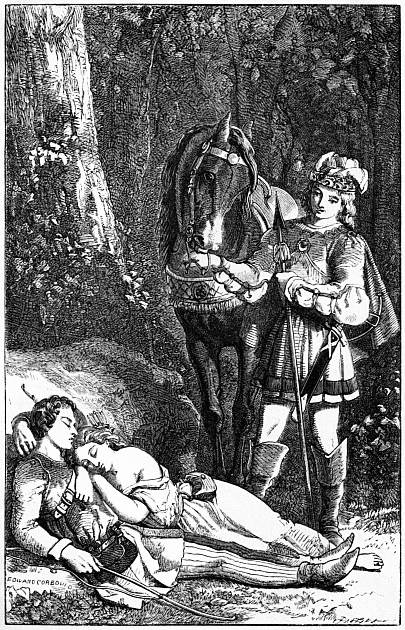
The Good Woman.—P. 210.
In this uneasy state of mind, not being able to tolerate their prolonged repose, he touched the handsome Finfin with his spear. He started up, and, seeing a man before him, he passed his hand over the face of Mirtis, and awoke her, calling her "sister," a name which dissipated in a moment the alarm of the young Prince.
Mirtis rose up, quite astonished; she had never seen any one but Finfin. The young Prince was the same age as herself. He was superbly attired, and had a face full of charming expression.
He began saying many sweet things to her. She listened to him with a pleasure which she had never before experienced, and she responded to them in a simple manner, full of grace. Finfin saw that it was getting late, and the fawn having arrived with Lirette's letter, he told his sister it was time to go home. "Come, brother," said she to the young Prince, giving him her hand, "come with us into the House of Roses." For as she believed Finfin to be her brother, she thought that every one who was handsome, like him, must be her brother also.
The young Prince did not require much pressing to follow her. Finfin threw on the back of his fawn the game he had shot, and the handsome Prince carried the bow and the game-bag of Mirtis.
In this order they arrived at the House of Roses. Lirette came out to meet them. She gave the Prince a smiling reception, and turning towards Mirtis, "I am delighted," said she, "that you have had such good sport."
They went all together to seek the Good Woman, to whom the Prince made known his high birth. She paid due attention to so illustrious a guest, and gave him a handsome apartment. He remained two or three days with her, and this was long enough to complete his conquest by Mirtis, according to Finfin's request to his little almond.
Meanwhile, the suite of the Prince had been much surprised at his absence. They had found his horse, and they believed that some frightful accident had befallen him. They sought him everywhere, and the wicked King, who was his father, was in a great fury at their not being able to find him. The Queen, his mother, who was very amiable, and sister of the King whom her husband had cruelly murdered, was in an inconceivable state of grief at the loss of her son.
In her extreme distress, she sent secretly in search of Madam Tu-tu, who was an old friend of hers, but whom she had not seen for some time, because the King hated her, and had done her much injury with a person she dearly loved. Madam Tu-tu arrived, without being perceived, in the cabinet of the Queen. After they had embraced each other affectionately—for there is not much difference between a Queen and a Fairy, they having almost equal power,—the Fairy Tu-tu told her that she would very soon see her son. She begged her not to make herself uneasy, and not to be at all distressed at anything that might happen—that either she was very much deceived, or she could promise her a delight which was quite unexpected by her, and that she would be one day the happiest of creatures.
The King's people made so many inquiries for the Prince, and sought him with so much care, that at length they found him at the House of Roses.
They led him back to the King, who scolded him brutally, as though he were not the most beautiful youth in the world. He remained very sad at the Court of his father, and thinking of his beautiful Mirtis. At length his grief was so visible on his countenance, that he was obliged to take his mother into his confidence, who consoled him extremely. "If you will mount your beautiful palfrey," said he, "and come to the House of Roses, you will be charmed with what you will see." The Queen consented willingly, and took her son with her, who was enchanted at seeing his dear mistress again.
The Queen was astonished at the great beauty of Mirtis, and also at that of Lirette and Finfin. She embraced them with as much tenderness as if they had been all her own children, and conceived an immense friendship from that moment for the Good Woman. She admired the house, the garden, and all the curiosities she saw there. When she returned, the King desired her to give an account of her journey; she did so naturally, and he took a great fancy to go also and see the wonders which she described. His son asked permission to accompany him; he consented with a sullen air, for he never did anything with a good grace. As soon as he saw the House of Roses he coveted it; he paid not the least attention to the charming inhabitants of this beautiful place, and, by way of commencing to take possession of their property, he said that he would sleep there that evening.
The Good Woman was very much vexed at such a resolution. She heard an uproar, and saw a disorder in her household, which frightened her. "What has become," cried she, "of the happy tranquillity which I once enjoyed here! The least breath of fortune destroys all the calm of life!"
She gave the King an excellent bed, and withdrew into a corner of the dwelling with her little family. The wicked King went to bed, but found it impossible to go to sleep, and opening his eyes, he saw at the foot of his couch a little old woman, who was not half a yard high, and about as broad; she had great spectacles, which covered all her face, and she made frightful grimaces at him. The base are generally cowards. He was in a terrible fright, and felt at the same time a thousand points of needles pricking him all over. In this tormenting state of body and mind, he was kept awake the entire night, and made a great noise about it. The King stormed and swore in language which was not at all consistent with his dignity. "Sleep, sleep, sire," said the partridge, "or let us sleep: if the condition of royalty is so full of anxiety, I prefer being a partridge to being king." The King was more than ever alarmed at these words; he commanded them to seize the partridge, which roosted in a porcelain vase; but she flew away at this order, beating his face with her wings. He still saw the same vision, and felt the same prickings; he was dreadfully frightened, and his anger became more furious. "Ah!" said he, "it is a spell of this sorceress, whom they call the Good Woman. I will rid myself of her and all her race by putting them to death!"
He got up, not being able to rest in bed; and as soon as day broke, he commanded his guards to seize all the innocent little family, and fling them into dungeons. He had them dragged before him, that he might witness their despair. Those charming faces, bedewed with tears, touched him not; on the contrary, he felt a malignant joy at the sight. His son, whose tender heart was rent by so sad a spectacle, could not turn his eyes upon Mirtis without an agony which nothing could exceed. A true lover, on such occasions, suffers more than the person beloved.
They seized these poor innocents, and were leading them away, when the young Finfin, who had no arms with which to oppose these barbarians, took the ribbon on a sudden from his neck. "Little almond," cried he, "I wish that we were out of the power of the King!" "And with his greatest enemies, my dear cherry!" continued Lirette. "And that we might take away with us the handsome Prince, my medlar!" added Mirtis. They had hardly uttered these words when they found themselves with the Prince, the partridge, and the fawn, all together in a car, which rising with them in the air, they soon lost sight of the King and the House of Roses.
Mirtis had no sooner expressed her wish than she repented of it. She knew well that she had inconsiderately allowed herself to be carried away by an impulse of which she was not the mistress; therefore, during all the journey, she kept her eyes cast down, and felt much abashed. The Good Woman gave her a severe glance. "My daughter," said she, "you have not done well to separate the Prince from his father; however unjust he may be, he ought not to leave him." "Ah, Madam," replied the Prince, "do not complain that I have the happiness of following you. I respect the King, my father; but I should have left him a hundred times had it not been for the virtue, the kindness, and tenderness of the Queen, my mother, which have always detained me."
As he finished these words, they found themselves in front of a beautiful palace, where they alighted and were received by Madam Tu-tu. She was the most lovely person in the world—young, lively, and gay. She paid them a hundred compliments, and confessed to them that it was she who had given them all the pleasures which they had enjoyed in their lives, and had also bestowed on them the cherry, the almond, and the medlar, the virtues of which were at an end, as they had now arrived in her dominions. Then, addressing the Prince in private, she told him that she had heard speak a thousand times of the annoyance he had met with from his father; but, in order that he should not attribute to her any evil that might hereafter befal the King, she frankly admitted she had played him some tricks, but that was the full extent of her vengeance.
After that, she assured them that they would be all very happy with her; that they should have flocks to keep, crooks, bows, arrows, and fishing-rods, in order that they might amuse themselves in a hundred different ways. She gave them shepherds' dresses of the most elegant description, including the Prince with the others,—their names and devices being on their crooks; and that very evening the young Prince exchanged crooks with the charming Mirtis.
The next day Madame Tu-tu led them to the most delightful promenade in the world, and showed them the best pasturage for their sheep, and a fine country for the chase.
"You can go," said she, "on this side as far as that beautiful river, but never to the opposite shore; and you may hunt in this wood; but beware," said she, "of passing a great oak, which is in the midst of the forest; it is very remarkable, for it has roots and trunk of iron. If you go beyond it, misfortunes may happen to you, from which I cannot protect you; and, besides that, I should not perhaps be in a position to assist you promptly, for a fairy has plenty of occupation."
The young shepherds assured her that they would do exactly as she prescribed; and all four, leading their flocks into the meadows, left Madam Tu-tu alone with the Good Woman. She remarked some anxiety in her manner. "What is the matter, madam?" said the Fairy; "what cloud has come over your mind?" "I will not deny," said the Good Woman, "that I am uneasy at leaving them all thus together. I have for some time perceived with sorrow that Finfin and Lirette love each other more than is desirable, and here, to add to my trouble, another attachment springs up: the Prince and Mirtis do not dislike each other, and I fear to leave their youth exposed to the wandering of their hearts."
"You have brought up these two young girls so well," replied Madam Tu-tu, "that you need fear nothing: I will answer for their discretion; I will enlighten you as to their destiny."
She then informed her that Finfin was the son of the wicked King, and brother of the young Prince; that Mirtis and Lirette were sisters, and daughters of the deceased King, who had been murdered, and who was the brother of the Queen, whom the cruel usurper had married,—so that these four young persons were near relations; that the wicked King had ascended the throne after having committed a hundred atrocities, which he wished to crown by the murder of the two Princesses; that the Queen did all she could to prevent him, and not being able to succeed, she had called her (the Fairy) to her assistance; that she then told the Queen she would save them, but that she could only do so by taking with them her eldest son; that she undertook to promise she should see them again some day in happiness; that on those conditions, the Queen had consented to a separation, which appeared at first very hard; that she had carried them all three off, and that she had confided them to the care of the Good Woman as the person most worthy of such an office.
After this the Fairy begged her to be at ease, assuring her that the union of these young Princes would restore peace to the kingdom, wherein Finfin would reign with Lirette. The Good Woman listened to this discourse with great interest; but not without letting fall some tears. Madam Tu-tu was surprised at this emotion, and asked the cause. "Alas!" said she, "I fear they will lose their innocence by this grandeur to which they will be elevated, and that so brilliant a fortune will corrupt their virtue."
"No," replied the Fairy, "do not fear so great a misfortune; the principles you have instilled into them are too excellent. It is possible to be a king and yet an honest man. You know that there is one in the universe who is the model of perfect monarchs.[14] Therefore set your mind at rest; I shall be with you as much as possible, and I hope you will not be melancholy here."
The Good Woman believed her, and after a short time felt perfectly satisfied. The young shepherds were so happy also that they desired nothing but the continuance of their agreeable mode of life. Their pleasures, although tranquil, were not without interest: they saw each other every day, and the days only appeared to them too short.
The bad King learnt that they were with Madam Tu-tu, but all his power could not take them away from her. He knew by what magic spells she protected them; he saw clearly that he could only get the better of them by stratagem; he had not been able to inhabit the House of Roses in consequence of the continual tricks played on him by Madam Tu-tu; he hated her more than ever, as well as the Good Woman; and his hatred now extended also to his son.
He employed all kinds of artifice in order to get into his power some one of the four young shepherds, but his art did not extend to the dominions of Madam Tu-tu. One unlucky day (there are some which we cannot avoid), these amiable shepherds had bent their steps in the direction of the fatal oak, when the beautiful Lirette perceived upon a tree, about twenty paces distant, a bird of such rare plumage, that she let fly an arrow at it on the impulse of the moment, and seeing the bird fall dead, ran to pick it up. All this was done instantaneously, and without reflection; but the poor Lirette found, to her cost, that she was caught herself. It was impossible for her to return; she desired, but had no power to do so. She discovered her error, and all she could do was to extend her arms for pity to her brothers and sisters. Mirtis began to cry, and Finfin, without hesitation, ran to her. "I will perish with you," he cried, and in a moment had joined her.
Mirtis wished to follow them, but the young Prince detained her. "Let us go and apprise Madame Tu-tu of this," said he; "that is the best assistance we can render them." At the same moment they saw the people of the wicked King seize them, and all they could do was to cry adieu to each other.
The King had caused this beautiful bird to be placed there by his hunters, to serve as a snare for the shepherds: he fully expected what had come to pass. They led Lirette and Finfin before the cruel monarch, who abused them terribly, and had them confined in a dark and strong prison: it was then they began to lament that their little cherry and almond had lost their virtue. The fawn and the partridge sought for them, but the fawn not being able to see them, shed some tears of grief, and finding the King had given orders that she should be taken and burnt alive, she saved herself by running fast to Mirtis. The partridge was more fortunate, for she saw them every day through the grating of their prison: happily for them, the King had not thought of separating them. When one loves, it is a pleasure to suffer together.
The partridge flew back every day, and came to tell the news to Madame Tu-tu, the Good Woman, and Mirtis. Mirtis was very unhappy, and without the handsome Prince she would have been inconsolable. She resolved to write to these poor captives by the faithful partridge, and hung a little bottle of ink to her neck, with some paper, and put a pen in her beak. The good partridge, thus loaded, presented herself at the bars of the prison, and it was a great delight to our young shepherds to see her again. Finfin put out his hand and took from her all she brought him, after which they began to read as follows:[15]
Mirtis and the Prince to Lirette and Finfin.
"Know you how we languish during this cruel separation; that we sigh incessantly, and that perhaps it may kill us. We should already have died, had we not been sustained by hope. That hope has supported us ever since Madam Tu-tu has assured us that you still lived. Believe us, dear Lirette and Finfin, we shall meet again, despite of malice, and be happy."
This letter had a powerful effect on the minds of Lirette and Finfin. They were filled with joy, and wrote immediately this reply:—
Lirette and Finfin to Mirtis and the Prince.
"We have received your letter with extreme pleasure. It has rejoiced us more than we could have anticipated. In these regions of horror our torments would be insupportable, but for the sweet consolation we derive from each other's presence. Near the object of our affections, we are insensible to pain, and love renders everything delightful. Adieu, dear Prince, adieu, Mirtis. Encourage your mutual passion. Be always inspired by a tender fidelity. You hold out a hope to us in which we participate. The greatest blessing which can occur to us will be accompanied by your presence."
Finfin having attached this note to the neck of the partridge, she flew away with it very quickly. The young shepherds received great consolation from it, but the Good Woman could not be comforted from the moment she had been separated from those so dear to her, and whom she knew to be in so much peril. "How quickly my happiness has vanished," said she to Madame Tu-tu; "I seem to have been born only to be continually agitated. I thought I had taken the only means for ensuring my repose; how purblind are mortals!" "And do you not know," replied the Fairy, "that there is no state of existence in this world in which one can live always happily." "I do," replied the Good Woman, mournfully; "and if one cannot find happiness in one's self, it is seldom found elsewhere. But, Madam, consider the fate of my children, I beg of you!" "They have not remembered the orders I gave them," replied Madame Tu-tu; "but let us think of a remedy."
Madame Tu-tu entered her library with the Good Woman. She read nearly all the night, and having at length taken down and opened a large book, which she had frequently passed over, although its sides were covered with plates of gold, she appeared plunged, on a sudden, into a state of excessive sadness. After some time, and just as day was breaking, the Good Woman observing a few tears fall on the leaves of the book, took the liberty to ask the cause of the Fairy's sorrow. "I grieve," said she, "at the irrevocable decree of Fate, which I have learned from these pages, and which I shudder and tremble to acquaint you with." "Are they dead?" cried the Good Woman. "No," pursued Madame Tu-tu; "but nothing can save them, unless you or I go and present ourselves to the King, and satisfy his vengeance. I confess the truth to you, Madam," continued the Fairy, "that I do not feel sufficient affection for them, nor enough courage, to go thus and expose myself to his fury, and I question, also, if any one could be found capable of such a sacrifice." "Pardon me, Madam," replied the Good Woman, with great firmness; "I will go seek this King; no sacrifice is too great for me that will save my children. I will pour out for them, with all my heart, every drop of blood which I have in my veins."
Madam Tu-tu could not sufficiently admire so grand a resolution; she promised to assist her in every way in her power; but that she found herself limited in this instance, in consequence of the fault which they had committed. The Good Woman took leave of her, and would not acquaint Mirtis or the Prince with her design, for fear of affecting them and weakening her own determination. She set out with the partridge flying by her side; and as they passed the iron oak, the partridge snatched with her beak a little moss from its trunk, and placed it in the hands of the Good Woman. "When you are in the greatest peril which can befall you," said she to her, "throw this moss at the feet of the King." The Good Woman treasured up these words, and hardly had she advanced some steps when she was seized by some of the wicked King's soldiers, whom he always kept in readiness on the outskirts of the domain of Madam Tu-tu. They led her before him. "I have thee at last, wicked creature!" said he; "I will put thee to death by the most cruel torture!" "I came but for that purpose," replied she, "and thou mayst exercise thy cruelty as thou wilt on me, only spare my children, who are so young and incapable of having offended thee. I offer thee my life for theirs." All who heard these words were filled with pity at her magnanimity; the King alone was unmoved. The Queen, who was present, shed a torrent of tears. The King was so indignant with her that he would have killed her, if her attendants had not placed themselves between them. She fled, uttering piercing cries.
The barbarous King caused the Good Woman to be shut up, ordering them to feed her well, in order to render approaching death more frightful to her. He commanded them to fill a pit with snakes, vipers, and serpents, promising himself the pleasure of precipitating the Good Woman into it. What a horrible mode of execution! It makes one shudder to think of it!
The officers of this unjust Prince obeyed him with regret; and when they had fulfilled this frightful order, the King came to the spot. They were about to bind the Good Woman, when she begged them not to do so, assuring them that she had sufficient courage to meet death with her hands free; and, feeling she had no time to lose, she approached the King, and threw the moss at his feet. He was at that moment close to the frightful gulf, and stepping forward to inspect it again with pleasure, his feet slipped on the moss, and he fell in. Hardly had he reached the bottom of the pit, when the sanguinary reptiles darted upon him, and stung him to death, and the Good Woman, at the same instant, found herself in company with her dear partridge in the House of Roses.
Whilst these things were happening, Finfin and Lirette were almost dead with misery in their fearful prison; their innocent affection alone kept them alive. They were saying very sad and very affecting things to each other, when they perceived on a sudden the doors of their dungeon open and admit Mirtis, the handsome Prince, and Madam Tu-tu, who threw themselves on their necks, and who, though speaking all at once, failed not, in the midst of this joyful confusion, to announce the death of the King. "He was your father, Finfin, as well as that of the Prince," said Madam Tu-tu; "but he was unnatural and tyrannical, and would a hundred times have put the Queen, your dear mother, to death. Let us go to seek her." They did so. Her amiable nature made her feel some regret at the death of the King, her husband. Finfin and the Prince also paid all decent respect to his memory. Finfin was acknowledged King, and Mirtis and Lirette Princesses. They went all together to the House of Roses, to see the generous Good Woman, who thought she should die of joy in embracing them. They all acknowledged that they owed their lives to her, and more than their lives, as they were indebted to her for their happiness also.
From that moment they considered themselves perfectly happy. The marriages were celebrated with great pomp. King Finfin espoused the Princess Lirette, and Mirtis the Prince. When these splendid nuptials were over, the Good Woman asked permission to retire to the House of Roses. They were very unwilling to consent to this, but yielded to her sincere wish. The widowed Queen also desired to pass the rest of her life with the Good Woman, and the partridge and the fawn did likewise. They were quite disgusted with the world, and found tranquillity in that charming retreat. Madam Tu-tu often went to visit them, as did the King and Queen, the Prince and Princess.
Happy those who can imitate the actions of the Good Woman. Such grandeur of soul must ever meet due reward. Little do they fear being wrecked on the shoals of Fortune, who can give up all with so much courage. Discretion, Sense, Virtue—what may not mortals owe to you, their truest friends in need.
FOOTNOTES:
MADAME DE VILLENEUVE.
THE STORY OF THE BEAUTY AND THE BEAST.
In a country very far from this is to be seen a great city wherein trade flourishes abundantly. It numbered amongst its citizens a merchant, who succeeded in all his speculations, and upon whom Fortune, responding to his wishes, had always showered her fairest favours. But if he had immense wealth, he had also a great many children, his family consisting of six boys and six girls. None of them were settled in life: the boys were too young to think of it; the girls, too proud of their fortunes, upon which they had every reason to count, could not easily determine upon the choice they should make. Their vanity was flattered by the attentions of the handsomest young gentlemen. But a reverse of fortune which they did not at all expect, came to trouble their felicity. Their house took fire; the splendid furniture with which it was filled, the account books, the notes, gold, silver, and all the valuable stores which formed the merchant's principal wealth, were enveloped in this fatal conflagration, which was so violent that very few of the things could be saved. This first misfortune was but the forerunner of others. The father, with whom hitherto everything had prospered, lost at the same time, either by shipwreck or by pirates, all the ships he had at sea; his correspondents made him a bankrupt, his foreign agents were treacherous; in short, from the greatest opulence, he suddenly fell into the most abject poverty. He had nothing left but a small country house, situated in a lonely place, more than a hundred leagues from the city in which he usually resided. Impelled to seek a place of refuge from noise and tumult, he took his family to this retired spot, who were in despair at such a revolution. The daughters of this unfortunate merchant were especially horrified at the prospect of the life they should have to lead in this dull solitude. For some time they flattered themselves that, when their father's intention became known, their lovers, who had hitherto sued in vain, would be only too happy to find they were inclined to listen to them. They imagined that the many admirers of each would be all striving to obtain the preference. They thought if they wished only for a husband they would obtain one; but they did not remain very long in such a delightful illusion. They had lost their greatest attractions when, like a flash of lightning, their father's splendid fortune had disappeared, and their time for choosing had departed with it. Their crowd of admirers vanished at the moment of their downfall; their beauty was not sufficiently powerful to retain one of them. Their friends were not more generous than their lovers. From the hour they became poor, every one, without exception, ceased to know them. Some were even cruel enough to impute their misfortunes to their own acts. Those whom the father had most obliged were his most vehement calumniators: they reported that all his calamities were brought on by his own bad conduct, his prodigality, and the foolish extravagance of himself and his children.