THE COUNTESS DE MURAT. (continued 2)
J. R. (James Robinson) Planché translation
On returning to his own apartments in the evening, the Prince was presented with a note by an unknown messenger. He opened it hastily, and found in it these words:—
"I yield to a passion a thousand times stronger than my reason. Since I can no longer attempt to conceal sentiments which chance has revealed to you, come, Prince, come, and learn the determination to which I am driven by the love you have inspired me with. Oh, how happy will it be for me if it cost me but my life!"
The bearer of the note informed the Prince that he was commissioned to conduct him to the spot where the Princess Ilerie awaited him. Atimir did not hesitate a moment to follow him, and after several turnings, he was introduced into a little pavilion at the end of a very dark avenue. The interior of the pavilion was sufficiently lighted. He found in it Ilerie with one of her attendants; the rest were walking in the gardens. When she had retired to this apartment, no one entered it without her orders. Ilerie was seated on a pile of cushions of crimson and gold embroidery. Her dress was rich and elegant, the material being of yellow and silver tissue. Her hair, which was black and exceedingly beautiful, was ornamented with ribbons of the same colour as the dress, and ties of yellow diamonds. At her sight, Atimir could not persuade himself that infidelity was a crime. He knelt at her feet, and Ilerie, gazing upon him with a tenderness sufficiently indicative of the emotion of her heart, said, "Prince, I have not caused you to come hither in order to persuade you to break off your marriage; I know too well it is determined upon, and the expressions with which you have endeavoured to alleviate my misfortune and flatter my affection do not induce me to believe that you would abandon Hebe for me; but," she continued, with a gush of tears, which completed the conquest of the heart of Atimir, "I will not endure the life which you have rendered so wretched. I will sacrifice it without regret to my love, and this poison," she added, showing a little box which she had in her hand, "will save me from the fearful torment of seeing you the husband of Hebe."
"No, beautiful Ilerie!" exclaimed the fickle Prince, "I will never be her husband. I will abandon all for your sake; I love you a thousand times better than I loved Hebe; and despite my duty and my faith so solemnly plighted, I am ready to fly with you to a spot where no obstacle shall exist to our happiness." "Ah, Prince!" said Ilerie, with a sigh, "can I confide, then, in one so faithless?" "He will never be faithless to you," rejoined Atimir. "And the King, your father, who gave Hebe to me, will not refuse to sanction my union with the lovely Ilerie, when she is already mine." "Away, then, Atimir," said the Princess, after a few minutes' silence. "Let us hasten whither our destiny leads us. Whatever misery the step entails on me, nothing can weigh against the sweet delights of loving and being beloved."
After these words, they consulted together respecting their flight. There was no time to lose. They determined to depart the following night. They separated with regret, and, notwithstanding the vows of Atimir, Ilerie still feared the power of Hebe's attractions. The rest of that night and all the next day she was a prey to that anxiety.
In the meanwhile, the Prince hurriedly gave all the necessary orders for keeping his departure secret, and the next day, as soon as everybody in the palace had retired to their apartments, he hastened to join Ilerie in the pavilion in the garden, where she awaited him, attended only by Cléonice. They set out, and made incredible haste to pass the frontiers of the kingdom.
The following morning the news was made public, by a letter which Ilerie had written to the Queen, and another which Atimir had addressed to the King. They were couched in touching language, and it was easy to perceive that love had dictated them. The King and Queen were extremely enraged; but no words can express the agony of the unfortunate and charming Hebe. What despair! what tears! what petitions to the Fairy Anguillette to terminate torments equal to the most cruel she had predicted! But the Fairy kept her word. In vain did Hebe seek the riverside. Anguillette did not appear, and she abandoned herself to all the horrors of desperation. The Princes who had been discouraged by the success of the ungrateful Atimir now felt their hopes revive; but their attentions and professions only increased the torture of the faithful Hebe.
The King ardently desired that she should select for herself a husband, and had several times urged her to do so; but that duty appeared too cruel to her affectionate heart. She determined to fly from her father's kingdom; but, before her departure, she went once more in search of Anguillette. The Fairy could no longer resist the tears of the beautiful Hebe. She appeared to her, and at her sight the Princess wept still more, and had not the power to speak to her.
"You have now experienced," said the Fairy, "what that fatal pleasure which I would never willingly have accorded to you is; but Atimir has too severely punished you, Hebe, for your neglect of my advice. Go! Fly these scenes, where everything recalls to you the remembrance of your love. You will find a vessel on the coast, which will bear you to the only spot in the world where you can be cured of your unfortunate attachment; but take care," added Anguillette, raising her voice, "when your heart shall have regained its tranquillity, that you never seek to behold again the faithless Atimir, or it will cost you your life!" Hebe wished more than once to see that Prince again at whatever price Love might compel her to pay for that gratification; but a whisper of Reason, and respect for her own honour, induced her to accept the Fairy's offer. She thanked her for this last favour, and departed the next morning for the sea-coast, followed by such of her women as she had most confidence in.
She found the vessel Anguillette had promised her. It was gilt all over. The masts were of marqueterie of the most admirable pattern; the sails, of rose-colour and silver tissue; and in every part of it was inscribed the word "Liberty." The crew were attired in dresses of the same colours as the sails. All appeared to breathe in this atmosphere the sweet air of freedom.
The Princess entered a magnificent cabin. The furniture was admirable, and the paintings perfect. She was as much a prey to sorrow in this new abode as she was in her father's Court. They strove in vain to amuse her by a thousand pleasures; she was not yet in a state of mind to pay the slightest attention to them.
One day while she was contemplating a painting in her cabin, which represented a landscape, she remarked in it a young shepherd, who, with a smiling countenance, was depicted cutting nets to set at liberty a great number of birds that had been caught in them, and some of these little creatures seemed to be soaring to the skies with marvellous velocity. All the other pictures displayed similar subjects. None suggested an idea of love, and all appeared to boast the charms of Liberty. "Alas!" exclaimed the Princess, sorrowfully, "will my heart never enjoy that sweet happiness which reason prays for so often in vain?"
The unfortunate Hebe thus passed her days, struggling between her love and her desire to forget it. The ship had been a month at sea without touching anywhere, when one morning that the Princess was on deck she saw land at a distance, which appeared to be that of a very lovely country. The trees were of surprising height and beauty, and as the vessel neared them, she perceived they were covered with birds of the most brilliant plumage, whose songs made a charming concert. Their notes were very soft, and it appeared as if they were afraid of making too much noise. They landed on this beautiful shore. The Princess descended from the vessel, followed by her women, and from the moment she breathed the air of this island, some unknown power seemed to set her heart at rest, and she fell into an agreeable slumber, which for a short time sealed up her beautiful eyes.
This pleasant country, to which she was a stranger, was the Peaceful Island. The Fairy Anguillette, a near relation of the Princes who reigned in these parts, had conferred upon it, for two thousand years, the happy power of curing unfortunate attachments. It is confidently asserted that it still possesses that power; but the difficulty is to find the island.
The Prince who reigned in it at that period, was descended in a right line from the celebrated Princess Carpillon and her charming husband, of whom a modern Fairy, wiser and more polished than those of ancient times, has so gracefully recounted the wonderful adventures.[8]
While the fair Hebe enjoyed a repose, the sweetness of which she had not tasted for six months, the Prince of the Peaceful Island was taking an airing in the wood that fringed the shore. He was seated in his car, drawn by four young white elephants, and surrounded by a portion of his Court. The sleeping Princess attracted his attention. Her beauty astonished him. He descended from his car with a haste and vivacity unusual to his nature. He felt at the sight of her all the love which the charms of Hebe were worthy to inspire. The noise awoke her, and on opening her lovely eyes, she was struck by a thousand beauties in the young Prince. He was of the same age as Hebe—just nineteen. He was perfectly handsome, his figure full of grace, his height above the ordinary standard, and his hair, which fell in rich curls down to his waist, was of the same colour as Hebe's. His dress was composed of feathers of a thousand different colours, over which he wore a sort of mantle, with a train all made of swan's-down, and fastened on his shoulders by the finest jewels in the world. His girdle was of diamonds, from which hung by golden chains a small sabre, the hilt and sheath of which were entirely covered with rubies. A sort of helmet, made of feathers like the rest of his attire, crowned his handsome head, and on one side of it, fastened by a diamond of prodigious size, was a plume of heron's feathers, which added greatly to the effect of his appearance.
The Prince was the first object that presented itself to the eyes of the young Princess at her waking. He appeared worthy of her observation, and for the first time in her life she looked upon another than Atimir with some interest.
"Everything assures me," said the Prince of the Peaceful Island to the Princess, "that you can be no other than the divine Hebe. Alas! who else could possess so many charms?" "Who, my Lord," replied the young Princess, blushing, as she rose to her feet, "could have so soon informed you of my having landed on this island?" "A powerful Fairy," answered the young monarch, "who, desirous of making me the happiest Prince in the world, and this country the most fortunate, had promised to lead you hither, and had even permitted me to indulge in the proudest hopes; but I am too well aware," he added, with a sigh, "that my fate depends much more upon your favour than upon hers."
After this speech, to which she replied with much propriety, the Prince requested her to enter his car, that she might be conducted to the palace; and out of respect to her, he would have declined taking his place in it, but as she had gathered from his language and his attendants that he was the sovereign of the island, she insisted on his seating himself beside her. Never had two such beautiful persons been seen in the same car. All the Prince's courtiers at the sight involuntarily burst into a tumult of applause. On the road, the young Prince entered into conversation with Hebe, with great animation and tenderness; and the Princess, happy to find her heart once more at ease, had recovered all her natural vivacity.
They reached the palace; it was not far from the sea-coast. It was approached through long and beautiful avenues, bordered by canals of running water. It was built entirely of ivory and roofed with agate.
The Prince's guards were drawn up in line in all the courts. In the first, they were clothed with yellow feathers, and carried quivers, bows and arrows of silver. In the second, they were all clothed with flame-coloured feathers, and wore sabres with golden hilts, and sheaths ornamented with turquoises. The royal party entered the third court, in which the guards were dressed in white feathers, and held in their hands demi-lances painted and gilt, and entwined with garlands of flowers. There was never any war in that country, so that they did not carry any formidable weapons.
The Prince, descending from his car, led the lovely Hebe to a magnificent apartment. His Court was numerous, the ladies were beautiful; the men gallant and graceful; and although everybody in the Island was dressed in feathers only, they evinced so much taste in the arrangement of the colours, that the effect was very agreeable.
That evening, the Prince of the Peaceful Island gave a superb banquet to the beautiful Hebe, which was followed by a concert of flutes, lutes, theorbos and harpsichords. In that country they were not fond of any noisy instruments. The music was very charming; when it had lasted some time, a very sweet voice sang the following words:—
Ever to be thy beauty's slave I swear, Nor can my heart conceive a happier state Than constant bondage in a chain so fair— Faithful as fond—on thee depends my fate.
The Prince gazed on Hebe while this tender air was sung, with an expression which persuaded her that the verses but declared his own sentiments.
When the concert was over, the Prince of the Peaceful Island, as it was late, led the Princess to the apartment selected for her. It was the most beautiful room in the palace. She found in it a great many ladies, who had been chosen by the Prince to have the honour of attending upon her.
The Prince quitted the beautiful Hebe the most enamoured of men. The Princess retired to rest, the ladies of the Court withdrew, and no one remained in the bed-chamber except the attendants she had brought with her. "Who could have believed it?" said she to them, as soon as they were left together, "my heart is tranquil. What deity has appeased my sufferings? I no longer love Atimir. I can think that he is the husband of Ilerie without dying of grief. Is not all this a dream which passes around me? No," she continued, after a moment's pause; "for even my dreams were never so free from agitation." She then returned thanks a thousand times to Anguillette, and fell asleep.
When she awoke the next morning the Fairy appeared to her with a gracious smile upon her countenance, which she had not seen her wear since the fatal day she had requested the gift of love. "At length," said the kind Fairy, "I have fortunately brought you hither. Your heart is free, and therefore it may be happy. I have cured you of a baneful passion; but, Hebe, may I trust that the fearful torments to which you have been exposed will sufficiently induce you to shun for ever those places in which you might chance to meet the ungrateful Atimir." What promises did not the young Princess make to the Fairy! How repeatedly did she abjure love and her faithless lover! "Remember, at least, your promises," rejoined the Fairy, with an air that inspired respect. "You will perish with Atimir should you ever seek again to behold him; but everything around you here ought to prevent your entertaining a desire so fatal to your existence. I will no longer conceal from you what I have determined upon in your favour. The Prince of the Peaceful Island is my kinsman. I protect him and his empire. He is young, he is amiable, and no Prince in the world is so worthy of being your husband. Reign, then, fair Hebe, in his heart and over his realm. Your royal father consents to your union. I was in his palace yesterday. I informed him and the Queen of your present position, and they gave me full power to care for your future fortunes."
The Princess was greatly tempted to ask the Fairy what news had been heard of Atimir and Ilerie since her departure, but she dared not, after so many favours, run the risk of displeasing her. She employed to thank her all the eloquence the Fairy had gifted her with.
Her attendants now entered the chamber, and the Fairy disappeared. As soon as Hebe had arisen, twelve children of the most perfect beauty, dressed as Cupids, brought to her from the Prince twelve crystal baskets, filled with the most brilliant and fragrant flowers in the world. These flowers covered sets of jewels of all colours and of marvellous beauty. In the first basket presented to her, she found a note containing these lines:—
To the Divine Hebe. That I adored thee yesterday I swore An hundred times; and broken ne'er can be The vows I uttered from my fond heart's core; For Love himself dictated them to me, And beauty such as thine ensureth constancy.
After what the Fairy had ordained, the Princess comprehended that she ought to receive these attentions from her new admirer as those of a Prince who was shortly to be her husband.
She received the little Cupids very graciously, and they had scarcely taken their departure, when twenty-four dwarfs, fancifully, but magnificently attired, appeared, bearing other presents. They consisted of dresses made entirely of feathers; but the colours, the work, and the jewels with which they were ornamented were so beautiful, that the Princess admitted she had never seen anything so elegant.
She chose a rose-coloured dress to wear that day. Her head-dress was composed of plumes of the same colour. She appeared so charming with these new ornaments, that the Prince of the Peaceful Island, who came to see her as soon as she was dressed, felt his passion for her redoubled. All the Court hastened to admire the Princess. In the evening the Prince proposed to the fair Hebe to descend into the palace gardens, which were admirably laid out.
During the promenade, the Prince informed Hebe that the Fairy had, for the last four years, led him to expect that Princess's arrival in the Peaceful Island; "but shortly after that period," added the Prince, "on my pressing her to fulfil her promise, she appeared distressed, and said to me, 'The Princess Hebe is destined by her father to another; but if my science does not deceive me, she will not marry the Prince who has been chosen for her husband. I will let you know the issue.' Some months afterwards the Fairy returned to the island. 'Fate favours you,' said she to me: 'the Prince who was to have married Hebe will not be her husband, and in a short time you will behold here the most beautiful Princess in the world.'"
"It is true," replied Hebe, blushing, "that I was to have married the son of a King whose dominions were adjacent to those of my father; but, after several events, the love he conceived for the Princess, my sister, induced him to fly with her from my father's kingdom."
The Prince of the Peaceful Island said a thousand tender things to the beautiful Hebe respecting the happy destiny which, in accordance with the Fairy's desire, had brought the Princess into his dominions. She listened to him with greater pleasure, as it interrupted her account of her own adventures, for she feared she could not speak of her faithless lover without the Prince's observing how great had been her affection for him.
The Prince of the Peaceful Island led Hebe into a grotto, highly decorated, and embellished by wonderful fountains. The further end of the grotto was dark; there were a great many niches in it, filled with statues of nymphs and shepherds, but they could scarcely be distinguished in the obscurity. As soon as the Princess had remained a few minutes in the grotto, she heard some agreeable music. A sudden and very brilliant illumination disclosed to her that it was a portion of these statues who were performing this music, whilst the rest advanced, and danced before her a very elegant and well-conceived ballet. It was intermixed with sweet and tender songs.
They had placed all the actors in this divertissement in the depths of the grotto, to surprise the Princess more agreeably.
After the ballet wild men appeared, and served up a superb collation under an arbour of jasmine and orange flowers.
The entertainment had nearly reached its termination, when suddenly the Fairy Anguillette appeared in the air, seated in a car drawn by four monkeys. She descended, and announced to the Prince of the Peaceful Island a delightful piece of good fortune, by apprising him that it was her desire he should become the husband of Hebe, and that that beautiful Princess had promised her consent.
The Prince, transported with joy, was uncertain at the moment whether his first thanks were due to Hebe or to Anguillette; and although joy does not inspire one with such affecting expressions as sorrow, he nevertheless acquitted himself with much talent and grace.
The Fairy determined not to leave the Prince and Princess before the day fixed for their union. It was to be in three days. She made superb presents to the fair Hebe and to the Prince of the Peaceful Island, and at length, on the day she had named, they repaired, followed by their whole Court and an infinite number of the inhabitants of the Island, to the temple of Hymen.
It was constructed simply of branches of olive and palmtrees interlaced, and which, by the power of the Fairy, never withered.
Hymen was therein represented by a statue of white marble, crowned with roses, elevated on an altar, decorated only with flowers, and leaning on a little Cupid of exquisite beauty, who, with a smiling countenance, presented to him a crown of myrtle.
Anguillette, who had erected this temple, resolved that everything in it should be marked by the greatest simplicity, to show that love alone could render Hymen happy. The difficulty is to unite them. As it was a miracle worthy the power of a Fairy, she had joined them indissolubly in the Peaceful Island, and, contrary to the custom in other kingdoms, one could there be married, and remain fond and faithful.
In this temple of Hymen the fair Hebe, led by Anguillette, plighted her troth to the Prince of the Peaceful Island, and received his vows with pleasure. She did not feel for him the same involuntary inclination which she had done for Atimir; but her heart, being at that moment free from passion, she received this husband, by command of the Fairy, as a Prince worthy of her by his personal merit, and still more so by the affection he bore to her.
The marriage was celebrated by a thousand splendid entertainments, and Hebe found herself happy with a Prince who adored her.
In the meanwhile the King, Hebe's father, had received some ambassadors from Atimir, who sent them to request permission for him to espouse Ilerie. The King, Atimir's father, was dead, and that Prince was consequently absolute master in his own country. The hand of the Princess he had carried off was accorded to him with joy. After the marriage Queen Ilerie sent other ambassadors to her royal parents to request permission for her to revisit their Court, and to obtain their forgiveness for the fault which love had caused her to commit, and which the merit of Atimir might be pleaded in excuse of. The King consented, and Atimir proceeded to the Palace with his bride. A thousand entertainments marked the day of their arrival. Shortly afterwards the fair Hebe and her charming husband sent ambassadors also to the King and Queen, to announce their marriage to them. Anguillette had already informed them of the event, but they did not on that account receive the ambassadors with less delight or distinction.
Atimir was with the King when they were introduced to their first audience. The lovely form of Hebe could never be effaced from a heart in which she had reigned with such supreme power. Atimir sighed, in spite of himself, at the recital of the happiness of the Prince of the Peaceful Island. He even accused Hebe of being inconstant, forgetting how much reason he had given her for becoming so.
The ambassadors of the Prince of the Peaceful Island returned to their sovereign laden with honours and presents. They related to the Princess how much delight the King and Queen had manifested at the tidings of her happy marriage. But, oh! too faithful chroniclers, they informed her at the same time that the Princess Ilerie and Atimir were at the Court. These names, so dangerous to her peace, renewed her anxiety. She was happy; but can mortals command uninterrupted felicity?
She could not resist her impatience to return to the Court of the King, her father. It was only, she said, to see once more him and her mother. She believed this herself; and how often, when we are in love, do we mistake our own feelings!
Notwithstanding the threats uttered by the Fairy, in order to prevent her from revisiting the spot where she might again behold Atimir, she proposed this voyage to the Prince of the Peaceful Island. At first he refused. Anguillette had forbidden him to let Hebe go out of his dominions. She continued to press him. He adored her, and was ignorant of the passion she had formerly entertained for Atimir. Is it possible to refuse anything to those we love?
He hoped to please Hebe by his blind obedience. He gave orders for their departure, and never was there seen such magnificence as was displayed in his equipage and on board his vessels.
The sage Anguillette, indignant at the little respect paid by Hebe and the Prince of the Peaceful Island to her instructions, abandoned them to their destiny, and did not make her appearance to renew the prudent advice by which they had so little profited.
The Prince and Princess embarked, and after a very prosperous voyage, arrived at the Court of Hebe's father. The King and Queen were extremely delighted to behold once more that dear Princess. They were charmed with the Prince of the Peaceful Island: they celebrated the arrival of the royal pair by a thousand entertainments throughout the kingdom. Ilerie trembled on hearing of the return of Hebe. It was decided that they should meet, and that no reference whatever should be made to past events.
Atimir requested to be allowed to see Hebe. It appeared to Ilerie, indeed, that he preferred his request with a little too much eagerness.
The Princess Hebe blushed when he entered her apartment, and they both felt an embarrassment out of which all their presence of mind could not extricate them.
The King, who was present, remarked it. He joined in their conversation; and to render the visit shorter, proposed to the Princess to descend into the Palace Gardens.
Atimir dared not offer his hand to Hebe. He bowed to her respectfully, and retired.
But what thoughts and what feelings did he not carry away with him in his heart! All the deep and tender passion he had formerly felt for Hebe was rekindled in a moment. He hated Ilerie; he hated himself. Never was infidelity followed by so much repentance, nor by so much suffering.
In the evening he went to the Queen's apartments. The Princess Hebe was there. He had no eyes but for her. He sought assiduously for an opportunity of speaking to her. She continued to avoid him; but her glances were too clearly comprehended by him for his peace. He persisted for some time in compelling her to observe that her eyes had regained their former empire over him.
Hebe's heart was alarmed by it. Atimir appeared to her still too charming. She determined to shun him as carefully as he sought her. She never spoke to him but in presence of the Queen, and then only when she could not possibly avoid it. She resolved also to advise the Prince of the Peaceful Island to return speedily to his own kingdom. But with what difficulty do we endeavour to fly from those we love!
One evening that she was reflecting on this subject, she shut herself up in her cabinet, in order to indulge in her musings without interruption. She found in her pocket a note, which had been slipped into it unperceived by her, and the handwriting of Atimir, which she recognised, threw her into an agitation which cannot be described. She considered she ought not to read it; but her heart triumphed over her reason, and opening it she found these lines:—
No more my love can to your heart appeal— For me indifference alone you feel. Your heart, fair Hebe, faithless is in turn, So soon my fatal falsehood could it learn. Alas, why can you not, with equal speed, Back to its early faith the truant lead? The happy time is past when Hebe fair, Love's pains and pleasures deigned with me to share. Both have their fetters broken, it is true, But I my bondage hasten to renew. Alas! for my sad fault must I atone, By languishing in this sweet chain alone?
"Ah, cruel one!" exclaimed the Princess. "What have I done to you that you seek to rekindle in my soul a passion which has cost me so much agony?" The tears of Hebe interrupted her utterance.
In the meanwhile Ilerie was tortured by a jealousy which was but too well founded. Atimir, carried away by his passion, lost all control over himself. The Prince of the Peaceful Island began to perceive his attachment to Hebe; but he was desirous of examining more narrowly the conduct of Atimir before he spoke to the Princess on the subject. He adored her with unabating constancy, and feared by his remarks to draw her attention to the passion of his rival.
A few days after Hebe had received Atimir's note, a tournament was proclaimed. The Princes, and all the young noblemen of the Court, were invited to break a lance in honour of the ladies.
The King and Queen honoured the tournament with their presence. The fair Hebe and the Princess Ilerie were to confer the prizes with their own hands. One was a sword, the hilt and sheath of which were entirely covered with jewels of extraordinary beauty. The other, a bracelet of brilliants of the finest water.
All the knights entered for the lists made their appearance with marvellous magnificence, and mounted on the finest horses in the world. Each wore the colours of his mistress, and on their shields were pictured gallant devices, expressive of the sentiments of their hearts.
The Prince of the Peaceful Island was superbly attired, and rode a dun-coloured horse with black mane and tail of incomparable beauty. In all his appointments rose colour was predominant. It was the favourite colour of Hebe. An ample plume of the same hue floated above his light helmet. He drew down the applause of all the spectators, and looked so handsome in his brilliant armour, that Hebe mentally reproached herself a thousand times for entertaining such feelings as the unhappiness of another had inspired her with.
The retinue of the Prince of the Peaceful Island was numerous. They were all attired according to the fashion of their country. Everything around him was elegant and costly. An esquire bore his shield, and all were eager to examine the device.
It was a heart pierced with an arrow; a little Cupid was depicted shooting many others at it to inflict fresh wounds, but all except the first appeared to have been shot in vain. Beneath were these words:—
"I fear no others."
The colour and the device of the Prince of the Peaceful Island, rendered it obvious that it was as the champion of the fair Hebe he had chosen to enter the lists.
The spectators were still admiring his magnificent array, when Atimir appeared, mounted on a proud and fiery steed, entirely black. The prevailing colour of the dress he had assumed for that day was what is usually termed "dead-leaf," unadorned with gold, silver, or jewels; but on his helmet he wore a tuft of rose-coloured feathers, and although he affected great negligence in his attire, he was so handsome, and bore himself so proudly, that from the moment he entered the lists no one looked at anything else. On his shield, which he carried himself, was painted a Cupid trampling upon some chains, while at the same time he was loading himself with others that were heavier. Around the figure were these words:—
"These alone are worthy of me."
The train of Atimir were attired in dead-leaf and silver, and on them he had showered jewels. It was composed of the principal noblemen of his Court, and although they were all fine-looking men, it was easy to see by the air of Atimir that he was born to command them. It is impossible to describe the various emotions which the sight of Atimir awakened in the hearts of Hebe and Ilerie, and the poignant jealousy which the Prince of the Peaceful Island felt when he saw floating over the helmet of Atimir, a plume of the same colour as his own.
The motto of his device kindled his anger into a fury, which he controlled for the moment, only to choose a better time to vent it on his rival.
The King and Queen saw clearly enough the audacity and imprudence of Atimir, and were exceedingly angry with him; but it was not the time to show it.
The tilting was commenced amidst a flourish of trumpets which rent the air. It was exceedingly good. All the young knights made proof of their skill. The Prince of the Peaceful Island, although a prey to his jealousy, signalized himself particularly, and remained conqueror.
Atimir, who was aware that the prize for the first encounter would be given by Ilerie, did not present himself to dispute the victory with the Prince of the Peaceful Island. The judges of the field declared the latter victor; and, amidst the acclamation and applause of all the spectators, he advanced with the greatest possible grace to the spot where the Royal Family were seated, to receive the diamond bracelet.
The Princess Ilerie presented it to him. He received it with due respect, and having saluted the King, Queen, and Princesses, returned to his place in the lists.
The mournful Ilerie had too clearly observed the contempt with which the fickle Atimir had treated the prize destined to be accorded by her hand. She sighed sadly, while the fair Hebe felt a secret joy which reason vainly endeavoured to stifle in her heart. Other courses were run with results similar to those which had preceded them. The Prince of the Peaceful Island, animated by the presence of Hebe, performed wonders, and was a second time conqueror; but Atimir, weary of beholding the glory of his rival, and flattered by the idea of receiving the prize from the hand of Hebe, presented himself at the opposite end of the lists.
The rivals gazed at each other fiercely, and the impending encounter between two such great Princes was distinguished by the fresh agitation which it excited in the two Princesses. The Princes ran their course with equal advantage. Each broke his lance fairly without swerving in his saddle. The acclamations were redoubled, and the Princes, without giving their horses time to breathe, returned to their places, received fresh lances, and ran a second course with the same address as the first. The King, who feared to see Fortune give the victory to either of these rivals, and in order to spare the feelings of both, sent in all haste to them to say that they ought to be satisfied with the glory they had acquired, and to request them to let the tilting terminate for that day with the course they had just run.
The King's messenger having approached them, they listened with impatience to the royal request, particularly Atimir, who, seizing the first opportunity to reply, said, "Go, tell the King that I should be unworthy the honour he does me in taking an interest in my glory, if I could remain satisfied without conquest."
"Let us see," rejoined the Prince of the Peaceful Island, clapping spurs to his horse, "who best deserves the esteem of the King and the favours of Fortune!"
The King's messenger had not retraced his steps to the royal balcony before the two rivals, animated by stronger feelings than the mere desire to carry off the prize of the joust, had met in full career.
Fortune favoured the audacious Atimir: he was the conqueror. The horse of the Prince of the Peaceful Island, fatigued with the many severe courses he had run, fell, and rolled his master in the dust.
What joy for Atimir! and what fury for the unfortunate Prince of the Peaceful Island! Leaping to his feet again instantly, and advancing to his rival before any one could reach to part them,—"Thou hast conquered me in these games, Atimir," said he, with an air which sufficiently expressed his wrath, "but it is with the sword that our quarrel must be decided." "Willingly," replied the haughty Atimir. "I will await thee to-morrow at sunrise in the wood that borders the palace gardens." The Judges of the Field joined them as these last words were uttered, and the Princes mutually affected unconcern, for fear the King should suspect and frustrate their intentions. The Prince of the Peaceful Island remounted his horse, and rode with all the speed he could urge it to, from the fatal spot where he had been defeated by Atimir. In the meanwhile that Prince proceeded to receive the prize of the joust from the hand of Hebe, who presented it to him with a confusion sufficiently betraying the conflicting emotions in her bosom; while Atimir, in receiving it, displayed all the extravagancies of a passionate lover.
The King and Queen, who kept their eyes upon him, could not fail to observe this, and returned to the Palace much discontented with the termination of the day. Atimir, occupied only by his passion, left the lists, forbidding any of his train to accompany him; and Ilerie, smarting with grief and jealousy, retired to her apartments.
What then were the feelings of Hebe! "I must depart," she said to herself. "What other remedy is there for the evil I anticipate?"
In the meanwhile, the King and the Queen determined to request Atimir would return to his own dominions, to avoid the painful consequences which his love might entail upon them. They resolved also to make the same proposition to the Prince of the Peaceful Island, in order not to show any preference for either; but ah! too tardy prudence! whilst they were deliberating how best to secure the departure of the two Princes, the rivals were preparing to meet in mortal combat.
Hebe, on returning from the lists, immediately inquired for the Prince of the Peaceful Island. She was answered that he was in the palace gardens; that he had desired he might not be followed, and that he appeared very melancholy. The fair Hebe thought it was her duty to seek and console him for the slight mischances which had happened to him, and therefore, without staying a moment in her own apartment, descended into the gardens, followed only by a few of her women.
In the course of her search for the Prince of the Peaceful Island, she entered a shady alley, and came suddenly on the enamoured Atimir, who, transported by his passion, and listening only to its promptings, threw himself on his knees at a short distance from the Princess, and drawing the sword which he had that day received from her hand, exclaimed, "Hear me, beautiful Hebe! or see me die at your feet!"
Hebe's attendants, terrified by the actions of the Prince, rushed upon him, and endeavoured to force from his grasp the sword, the point of which he had directed towards himself with desperate resolution. Hebe, the unhappy Hebe, would have flown from the spot; but how many reasons concurred to detain her near him she loved!
The desire to suppress the scandal this adventure might create; the intention to implore Atimir to endeavour to stifle a passion which was so perilous to them; the pity naturally awakened by so affecting an object,—everything, in short, conspired to arrest her flight. She approached the Prince. Her presence suspended his fury. He let fall his sword at the feet of the Princess. Never was so much agitation, so much love, so much anguish, displayed in an interview that lasted but a few minutes. No words can express the feelings of those wretched lovers during that brief period. Hebe, alarmed at finding herself in the company of Atimir, almost, perhaps, in sight of the Prince of the Peaceful Island, made a great effort to depart, and left him with a command never to see her more. What an order for Atimir! But for the recollection of the combat to which he had been challenged by the Prince of the Peaceful Island, he would have turned his sword an hundred times against his own breast; but he trusted to perish in revenging himself on his rival.
In the meanwhile, the fair Hebe shut herself up in her own chamber, to avoid more surely the sight of Atimir. "Relentless Fairy," she cried, "thou didst only predict my death as the consequence of my again beholding this unhappy Prince; but the tortures I suffer are a much more dreadful penalty." Hebe sent her attendants to seek for the Prince of the Peaceful Island in the gardens, and throughout the Palace; but he was nowhere to be found, and she became extremely anxious on his account. They hunted for him all night long, but in vain, for he had concealed himself in a little rustic building in the middle of the wood, to be more certain that no one could prevent his proceeding to the spot fixed on for the combat. He was on the ground at sunrise, and Atimir arrived a few minutes afterwards. The two rivals, impatient for revenge and victory, drew their swords. It was the first time the Prince of the Peaceful Island had wielded his in earnest, for war was unknown in his island.
He proved, however, not a less redoubtable antagonist on that account to Atimir. He had little skill, but much bravery, and great love. He fought like a man who set no value on his life, and Atimir worthily sustained in this combat the high reputation he had previously acquired. The Princes were animated by too many vindictive feelings for their encounter not to terminate fatally. After having fought with equal advantage for a considerable period, they dealt each other at the same instant so furious a blow, that both fell to the earth which was speedily red with their blood.
The Prince of the Peaceful Island fainted with the loss of his; and Atimir, mortally wounded, uttered but the name of Hebe as he expired for her sake.
One of the parties in search of the Prince of the Peaceful Island arrived on the spot, and were horror-struck at the sight of this cruel spectacle.
The Princess Hebe, urged by her anxiety, had descended into the gardens. She hastened towards the place from whence she heard the exclamations of her people, who uttered in confusion the names of the two Princes, and beheld these fatal and affecting objects. She believed the Prince of the Peaceful Island was dead as well as Atimir, and at that moment there was little difference to be distinguished between them. "Precious lives," exclaimed Hebe, despairingly, after gazing for an instant on the unfortunate Princes,—"precious lives, which have been sacrificed for me; I hasten to avenge you by the termination of my own!" With these words she flung herself upon the fatal sword Atimir had received from her hands, and buried the point in her bosom before her people, astonished at this dreadful scene, had power to prevent her.
She expired, and the Fairy Anguillette, moved by so much misery despite of all the obstacles her science had enabled her to raise, appeared on the spot which had witnessed the destruction of these beautiful beings. The Fairy upbraided Fate, and could not restrain her tears. Then hastening to succour the Prince of the Peaceful Island, who she knew was still breathing, she healed his wound, and transported him in an instant to his own island, where, by the miraculous power she had conferred on it, the Prince consoled himself for his loss, and forgot his passion for Hebe.
The King and Queen, who had not the advantage of such assistance, gave themselves up entirely to their sorrow; and time only brought them consolation. As to Ilerie, nothing could exceed her despair. She remained constant to her grief, and to the memory of the ungrateful Atimir.
Meanwhile, Anguillette, having transported the Prince of the Peaceful Island to his dominions, touched with her wand the sad remains of the charming Atimir and the lovely Hebe. At the same instant they were transformed into two trees of the most perfect beauty. The Fairy gave them the name of Charmes,[9] to preserve for ever the remembrance of the charms which had been so brilliantly displayed in the persons of these unfortunate lovers.
FOOTNOTES:
YOUNG AND HANDSOME.
Once on a time there was a potent Fairy, who endeavoured to resist the power of Love; but the little god was more potent than the Fairy. He touched her heart without even employing all his power. A handsome Knight arrived at the Court of the Fairy in search of adventures. He was amiable, the son of a king, and had acquired renown by a thousand noble achievements. His worth was known to the Fairy. Fame had wafted the report of it even into her dominions.
The person of the young Prince corresponded so entirely with his high reputation, that the Fairy, moved by so many charms, accepted in a very short time the proposals which the handsome Knight made to her. The Fairy was beautiful, and he was sincerely in love with her. She married him, and by that marriage made him the richest and most powerful King in the world. They lived a long time most happily together after their union.
The Fairy grew old, and the King, her husband, although he kept pace with her in years, ceased to love her as soon as her beauty had departed. He attached himself to some young beauties of his Court, and the Fairy was tormented by a jealousy which proved fatal to several of her rivals. She had had but one daughter by her marriage with the handsome Knight. She was the object of all her tenderness, and was worthy of the affection lavished on her.
The Fairies, who were her relations, had endowed her from her birth with the finest intelligence, the sweetest beauty, and with graces still more charming than beauty. Her dancing surpassed anything that had ever been seen, and her voice subdued all hearts.
Her form was perfect symmetry. Without being too tall, her appearance was noble. Her hair was of the most beautiful black in the world. Her mouth small and exquisitely formed, her teeth of surprising whiteness. Her lovely eyes were black, sparkling, and expressive, and never did glances so piercing and yet so tender awaken love in the bosoms of all beholders.
The Fairy had named her Young and Handsome. She had not as yet endowed her herself. She had postponed that favour in order to judge the better in process of time by what sort of benefit she could ensure the happiness of a child that was so dear to her.
The King's inconstancies were an eternal source of affliction to the Fairy. The misfortune of ceasing to be loved induced her to believe that the most desirable of blessings was to be always lovely. And this, after a thousand reflections, was the gift she bestowed on Young and Handsome. She was then just sixteen: and the Fairy employed all her science in the formation of a spell which should enable the Princess to remain for ever exactly as she appeared at that moment. What greater benefit could she bestow on Young and Handsome than the happiness of never ceasing to be like herself? The Fairy lost the King, her husband, and although he had been long unfaithful to her, his death caused her such deep sorrow, that she resolved to abandon her empire, and to retire to a castle which she had built in a country quite a desert, and surrounded by so vast a forest that the Fairy alone could find her way through it.
This resolution sadly afflicted Young and Handsome. She wished not to quit her mother; but the Fairy peremptorily commanded her to remain; and before she returned to her wilderness, she assembled in the most beautiful palace in the world all the pleasures and sports she had long banished, and composed from them a Court for Young and Handsome, who in this agreeable company gradually consoled herself for the absence of the Fairy.
All the Kings and Princes who considered themselves worthy of her (and in those days people flattered themselves much less than they do now) came in crowds to the Court of Young and Handsome, and endeavoured by their attentions and their professions to win the heart of so lovely a Princess.
Never had anything equalled the magnificence and amusements of the palace of Young and Handsome. Each day was distinguished by some new entertainment. Everybody composing it was happy, except her lovers, who adored her without hope. She looked with favour upon none; but they saw her daily, and her most indifferent glances were sufficiently attractive to detain them there for ever.
One day Young and Handsome, content with the prosperity and popularity of her reign, wandered into a pleasant wood, followed only by some of her nymphs, the better to enjoy the charm of solitude. Absorbed by agreeable reflections, (what could she think of that would not be agreeable?) she emerged from the wood unconsciously, and walked towards a charming meadow enamelled with thousands of flowers.
Her beautiful eyes were occupied in contemplating a hundred various and pleasing objects, when they lighted in turn on a flock of sheep which was quietly feeding in the meadow on the bank of a little brook that murmured sweetly as it rippled over the pebbles in its path. It was overshadowed by a tuft of trees. A young shepherd, stretched on the grass beside the rivulet, was calmly sleeping; his crook was leaning against a tree, and a pretty dog, which appeared to be more a favourite of its master than the guardian of his flock, lay close to the shepherd.
Young and Handsome approached the brook, and cast her eyes upon the youth. What a beautiful vision! Cupid himself sleeping in the arms of Psyche did not display such charms.
The young Fairy stood gazing, and could not restrain some gestures of admiration, which were quickly succeeded by more tender emotions. The handsome shepherd appeared to be about eighteen, of a commanding form; his brown hair, naturally curling, fell in wavy locks upon his shoulders, and was in perfect harmony with the most charming face in the world. His eyes, closed in slumber, concealed from the Fairy, beneath their lids, new fires reserved by Love to redouble her passion for the shepherd.
Young and Handsome felt her heart agitated by an emotion to which it had hitherto been a stranger, and it was no longer in her power to stir from the spot.
Fairies possess the same privilege as goddesses. They love a shepherd when he is loveable, just as if he were the greatest monarch in the universe. For all classes of mortals are equally beneath them.
Young and Handsome found too much pleasure in her new sensations to endeavour to combat them. She loved fondly, and from that moment only indulged in the happy idea of being loved in return. She did not dare to wake the handsome shepherd, for fear he should remark her agitation; and pleasing herself with the notion of discovering her love for him in a gallant and agreeable manner. She rendered herself invisible to enjoy the astonishment she was about to cause him.
Immediately arose a strain of enchanting music. What an exquisite symphony! It went straight to the heart. The delicious sound awoke Alidor (such was the name of the handsome shepherd), who for some moments imagined he was in an agreeable dream; but what was his surprise when, on rising from the grass on which he had been lying, he found himself attired in the most tasteful and magnificent fashion. The colours of his dress were yellow and grey, laced with silver. His wallet was embroidered all over with the initials of Young and Handsome, and suspended by a band of flowers. His crook was of the most marvellous workmanship, ornamented with precious stones of different colours set in elegant devices. His hat was composed entirely of jonquils and blue hyacinths most ingeniously woven together.
Delighted and astonished at his new attire, he gazed at himself reflected in the neighbouring stream. Young and Handsome, meanwhile, feared an hundred times for him the fate of the beautiful Narcissus.
The wonder of Alidor was still further increased at seeing his sheep covered with silk whiter than snow, in lieu of their ordinary fleeces, and adorned with a thousand knots of ribbons of various colours.
His favourite ewe was more decorated than any of the others. She came skipping over the grass to him, appearing proud of her ornaments.
The shepherd's pretty dog had a golden collar, on which bands of small emeralds formed these four lines:—
Alas! how many fears and doubts alarm The maiden who on love her hopes would rest; A look, a word, her youthful heart may charm, But constancy alone can make it blest.
The handsome shepherd judged by these verses that he was indebted to Love for his agreeable adventure. The sun, by this time, had set. Alidor, absorbed in a delightful reverie, bent his steps towards his cottage. He did not observe any change in its exterior, but he had scarcely crossed the threshold when a delicious fragrance announced to him some agreeable novelty. He found the walls of his little hut hung with a tissue of jasmine and orange flowers. The curtains of his bed were of the same materials, looped up by garlands of pinks and roses. An agreeable atmosphere kept all these flowers perfectly fresh and beautiful.
The floor was of porcelain, on which were represented the stories of all the goddesses who had been in love with shepherds. Alidor observed this;—he was very intelligent. The shepherds of that country were not ordinary shepherds. Some of them were descended from Kings or great Princes, and Alidor could trace his pedigree up to a Sovereign who had long sat on the throne of those realms before they became a portion of the dominions of the Fairies.
Up to this period the handsome shepherd had been insensible to the charms of Love; but he now began to feel, even without having as yet distinguished the particular object, that his young heart burned to surrender itself a prisoner. He was dying with impatience to become acquainted with the Goddess or Fairy who had bestowed upon him such tasteful and beautiful proofs of her affection. He paced his chamber with a sweet anxiety which he had never before experienced. As night fell, an agreeable illumination appeared to shed a new daylight throughout the cottage. The musings of Alidor were interrupted by the sight of a rich and delicate banquet, which was served up to him by invisible hands. "What!" exclaimed the shepherd, smiling; "still new pleasures, and no one to partake them with me?" His little dog attempted to play with him, but he was too much pre-occupied to encourage his gambols.
Alidor seated himself at the table. A little Cupid appeared and presented him with wine in a cup made of one entire diamond. The shepherd made a tolerable supper for the hero of such adventures. He endeavoured to question the little Cupid; but, instead of answering, the boy shot arrows at him, which, the moment they struck, became drops of exquisitely scented water. Alidor comprehended clearly by this sport that the little Cupid was forbidden to explain the mystery. The table disappeared as soon as Alidor had ceased eating, and the little Cupid flew away.
A charming symphony stole upon the ear, awaking a thousand tender sensations in the heart of the young shepherd. His impatience to learn to whom he was indebted for all these pleasures increased every instant, and it was with great joy he heard a voice sing the following words:—
Under what form, Love, wilt thou cast thy dart At the young shepherd who enthrals my heart? Once should he know he is the master there, Will he my form and face account less fair? Of my affection he will be too sure, But that may not his love for me secure. With greater power to charm, my smiles endue, I need no aid to make me fond or true.
"Appear, thou charming being!" exclaimed the shepherd; "and by your presence crown my happiness. I believe you to be too beautiful to fear that I should ever be faithless."
No answer was returned to this adjuration. The music ceased shortly afterwards; a profound silence reigned in the cottage and invited the shepherd to sweet repose. He threw himself on his bed, but it was some time before he could sleep, agitated as he was by his curiosity and his new-born passion.
The song of the birds awoke him at daybreak. He quitted his cottage and led his pretty flock to the same spot where the preceding day his good fortune had commenced. Scarcely had he seated himself beside the brook, when a canopy, composed of a most brilliant stuff of flame-colour and gold was attached to the branches of the nearest trees to shelter Alidor from the rays of the sun. Some young shepherds and pretty shepherdesses of the neighbourhood arrived at the spot. They were in search of Alidor. His canopy, his flock, and his dress excited in them great astonishment.
They advanced hastily, and eagerly asked him the origin of all these marvels. Alidor smiled at their surprise, and recounted to them what had occurred to him. More than one shepherd felt jealous, and more than one shepherdess reddened with mortification. There were few of the latter in those parts who had not had designs upon the heart of the handsome shepherd, and a goddess or a fairy appeared to them by far too dangerous a rival.
Young and Handsome, who rarely lost sight of her shepherd, endured with considerable impatience the conversation of the shepherdesses. Some amongst them were very charming, and one so lovely that she might be a formidable rival even to a goddess.
The indifference with which Alidor treated them all re-assured the young Fairy. The shepherdesses quitted Alidor reluctantly, and led their flocks further into the meadow.
Shortly after they had departed, leaving only a few shepherds with Alidor, a delicious banquet appeared, set out upon a marble table. Seats of green turf arose around it, and Alidor invited his friends, the shepherds who had come to join him, to share his repast. On seating themselves at the table, they discovered that they were all attired in handsome dresses, though less magnificent than that of Alidor, which at the same moment became dazzling with jewels.
The neighbouring echoes were suddenly awakened by rustic, but graceful, music, and a voice was heard singing the following words:—
Of Alidor, envy the pleasure supreme, He only could love to this bosom impart; Ye shepherds, who beauty and worth can esteem, Do honour to him as the choice of my heart.
The astonishment of the shepherds increased every moment. A troop of young shepherdesses approached the banks of the rivulet. The melody of the music was not so much the attraction which led them to this spot, as the desire to see Alidor. They began to dance beneath the trees, forming an agreeable little bal-champêtre.
The young Fairy, who was present all the time, but invisible, assumed in an instant, with six of her nymphs, the prettiest shepherdesses' dresses that had ever been seen. Their only ornaments were garlands of flowers. Their crooks were adorned with them, and Young and Handsome, with a simple wreath of jonquils, which produced a charming effect in her beautiful black hair, appeared the most enchanting person in the world. The arrival of these fair shepherdesses surprised the whole company. All the beauties of the district felt mortified. There was not a shepherd who did not eagerly exert himself to do the honours of the fête to the new-comers.
Young and Handsome, though unknown to them as a Fairy, did not receive less respect or attract less attention. The sincerest homage is always paid to beauty. Young and Handsome felt flattered by the effect of her charms unaided by the knowledge of her dignity.
As to Alidor, the instant she appeared amongst them, forgetting that the love which a goddess or a fairy bore to him bound him to avoid anything that might be displeasing to her, he flew towards Young and Handsome, and accosting her with the most graceful air in the world:—"Come, beautiful shepherdess," said he, "come and occupy a place more worthy of you. So exquisite a person is too superior to all other beauties to remain mingled with them." He offered his hand, and Young and Handsome, delighted with the sentiments which the sight of her had begun to awaken in the breast of her shepherd, allowed herself to be led by Alidor beneath the canopy which had been attached to the trees as soon as he had arrived at the spot that morning. A troop of young shepherds brought, by his orders, bundles of flowers and branches, and constructed with them a little throne, on which they seated Young and Handsome. Alidor laid himself at her feet. Her nymphs seated themselves near her, and the rest of the party formed a large circle, in which everybody took their places according to their inclinations.
This spot, adorned with so much beauty, presented the most agreeable spectacle in the world. The murmur of the brook mingled with the music, and it seemed as if all the birds in the neighbourhood had assembled there to take their parts in the concert. A great number of shepherds advanced, in separate groups, to pay their court to Young and Handsome. One amongst them, named Iphis, approaching the young Fairy, said to her, "However distinguished may be the place Alidor has induced you to accept, it is one, perhaps, very dangerous to occupy." "I believe so," answered the Fairy, with a smile that had power to captivate all hearts. "The shepherdesses of this village will find it difficult to forgive me the preference which Alidor appears to have accorded to me amongst so many beauties more deserving of it." "No," rejoined Iphis; "our shepherdesses will be more just; but Alidor is beloved by a goddess." And thereupon Iphis related to Young and Handsome the adventure which had befallen the beautiful shepherd. When he had finished his story, the young Fairy, turning towards Alidor with a gracious air, said to him, "I do not desire to provoke so terrible an enemy as the goddess by whom you are beloved. Evidently she did not intend me to occupy this position, and therefore I resign it to her."
She rose as she said these words, but Alidor, gazing fondly upon her, exclaimed, "Stay, lovely shepherdess; there is no goddess whose love I would not sacrifice for the delight of adoring you; and she of whom Iphis speaks is not over wise, at least in matters of the heart, since she has permitted me to behold you!" Young and Handsome could not make any reply to Alidor. The shepherds at that moment came to request her to dance, and never was more grace displayed than on this occasion. Alidor was her partner, who surpassed himself. Never had the most magnificent fêtes at the Court of Young and Handsome afforded her so much pleasure as this rural entertainment. Love embellishes every spot in which we behold the object of our affections. Alidor felt his passion increasing every instant, and made a thousand vows to sacrifice all the goddesses and fairies in the world to the ardent love with which his shepherdess had inspired him. Young and Handsome was delighted with the evident attachment of the beautiful shepherd; but she wished to make a momentary trial of his affection. Iphis was amiable, and, if Alidor had not been present, would no doubt have been much admired. The young Fairy spoke to him twice or thrice very graciously, and danced several times with him.
Alidor burned with a jealousy as intense as his love. Young and Handsome observed it, and feeling more sure of her shepherd's heart, she ceased paining it, spoke no more to Iphis during the rest of the day, and bestowed on Alidor her most encouraging glances. Heavens! what glances! they would have filled the most insensible hearts with love.
Evening having arrived, the lovely company separated with regret. A thousand sighs followed Young and Handsome, who forbade any of the shepherds to accompany her; but she promised Alidor, in a few brief words, that he should see her again in the meadows the next morning. She departed, followed by her nymphs and watched by the shepherds, who were in hopes that, by following her at a distance, they might discover, without her perceiving them, the village to which these divine beings belonged; but the moment that Young and Handsome had entered a little wood which concealed her from the sight of the shepherds, she rendered herself and her nymphs invisible, and they amused themselves for some time in seeing the shepherds vainly endeavouring to trace the road they had taken. Young and Handsome observed with pleasure that Alidor was amongst the most eager of the party.
Iphis was in despair that he had not followed them closely enough, and several of the shepherds, who had been captivated by the nymphs, passed half of the night in hunting the woods and the neighbourhood. Some authors have asserted that the nymphs, following the example of the young Fairy, thought some of these shepherds more charming than all the kings they had ever seen in their lives.
Young and Handsome returned to her palace, and, although a Fairy, always occupied by a thousand different affairs, might absent herself without causing much surprise, she found all her lovers exceedingly uneasy at not having seen her the whole day, but not one of them ventured to reproach her for it. It was necessary to be a very submissive and respectful suitor in the palace of Young and Handsome, or she would speedily issue an order for him to quit her Court. Her admirers did not even dare to speak to her of their passion. It was only by their attentions, their respect, and their constancy, that they could hope eventually to touch her heart.
Young and Handsome appeared little interested in what was passing around. She ate scarcely any supper, fell into frequent fits of musing, and the princes, her lovers, attentive to all her actions, imagined that they heard her sigh several times. She dismissed all the Court very early, and retired to her apartments.
When one is looking forward to a meeting with those we love, everything that presents itself in the interim appears very poor and very troublesome.
The young Fairy, with the nymphs who had followed her all the day, concealed in a cloud, were transported in an instant to the hut of the handsome shepherd. He had returned to it, very much vexed at not being able to ascertain the road his divine shepherdess had taken. Everything in his cottage was as charming as when he had left it; but as in musing he cast his eyes upon the floor of his little chamber, he perceived a change in it. In lieu of paintings from the stories of goddesses who had been in love with shepherds, he perceived the subjects were composed of terrible examples of unfortunate lovers who had proved unworthy of the affection of those divinities.
"You are right," exclaimed the handsome shepherd, on observing these little pictures; "you are right, Goddess. I deserve your anger; but wherefore did you permit so lovely a shepherdess to present herself to my sight? Alas! what divinity could defend a heart from the effects of such charms!" Young and Handsome had arrived in the cottage when Alidor uttered these words. She felt all the tenderness of them, and her affection was redoubled by them.
As on the previous day, a magnificent repast appeared, but Alidor did not enjoy it as he did the first. He was in love, and even a little jealous; for it often recurred to him that his shepherdess had spoken with some interest to Iphis. The promise, however, that she had made him, that he should see her the next day in the meadow, soothed a little his vexation.
The little Cupid waited on him during his repast, but Alidor, occupied by his new anxiety, spoke not a word to him. The table disappeared, and the child, approaching Alidor, presented him with two magnificent miniature cases, and then flew away.
The handsome shepherd opened one of the cases hastily. It contained the portrait of a young female of such perfect beauty, that imagination can scarcely conceive it. Under this marvellous miniature was written, in letters of gold—
"Thy happiness depends on her affection."
"One must have seen my shepherdess," said Alidor, gazing on this beautiful portrait, "not to be enchanted by so lovely a person." He closed the case, and flung it carelessly on a table.
He then opened the other case which the little Cupid had given to him; but what was his astonishment at the sight of the portrait of his shepherdess, resplendent with all the charms that had made so lively an impression on his heart!
She was painted as he had seen her that very day—her hair dressed with flowers, and the little that appeared of her dress was that of a shepherdess. The handsome shepherd was so transported with his love, that he gazed on it for a long time without perceiving that the following words were written beneath the portrait:—
"Forget her attractions, or thy love will be fatal to thee."
"Alas!" exclaimed Alidor, "without her could there be any happiness?" This ecstasy delighted Young and Handsome. The beautiful face he had contemplated unmoved was only a fancy portrait. The young Fairy was desirous of ascertaining whether her shepherd would prefer her to so beautiful a person, and who appeared to be a goddess or a fairy.
Convinced of the love of Alidor, she returned to her palace, after having assembled her nymphs by a signal that had been agreed upon. It was the illumination of the sky by some harmless lightning, and since that time such is often to be seen on a summer evening, unaccompanied by thunder. The nymphs rejoined her: they had also desired to hear something more of their lovers. Some of them were sufficiently pleased. They had found their swains occupied with recollections of them, and speaking of them with ardour, but others were less satisfied with the effect of their beauty. They found their shepherds fast asleep. A man may sometimes appear very much in love during the day, who is not sufficiently so for his passion to keep him awake all night.
The young Fairy retired to rest as soon as she arrived at her palace, charmed with the sincere affection of her shepherd. She had no other anxiety than the agreeable one arising from her impatience to see him again. As to Alidor, he slept a little, and without alarming himself at the warnings which he had read beneath the two miniatures. He thought only of returning to the meadow: he hoped to see his shepherdess there during the day. It seemed to him that he could not get there soon enough.
He led his charming flock to the fortunate spot where he had seen Young and Handsome; his pretty dog took good care of it. The comely shepherd could think of nothing but his shepherdess.
Young and Handsome was, much against her will, occupied that morning receiving the ambassadors of several neighbouring monarchs. Never were audiences so short; yet, notwithstanding, a considerable portion of the day passed in the performance of these tiresome ceremonies. The young Fairy suffered as much as her shepherd, whose keen impatience caused him a thousand torments.
The sun had set. Alidor had no longer any hope of seeing his shepherdess that day. How great was his grief!
He deplored his fate. He sighed incessantly. He made verses on her absence, and with the ferrule of his crook engraved them on the trunk of a young elm.
You on whom Venus looks with envious eyes, While round your steps her truant Graces play,— You on whose glances Cupid so relies That he has thrown all other darts away; How wretched in your absence must I be Who prize you ev'ry earthly bliss above!— And yet my sorrow has a charm for me, Its gloom is but the shadow of my love.
As he finished carving these lines, Young and Handsome appeared in the meadow at a distance, with her nymphs all still attired as shepherdesses. Alidor recognised her a long way off. He ran—he flew towards Young and Handsome, who received him with a smile so charming, that it would have increased the felicity of the gods themselves.
He told his love to her with an ardour capable of persuading a heart less tenderly inclined towards him than that of the young Fairy. She desired to see what he had carved on the tree, and was charmed with the talent and affection of her shepherd. He related to her all that happened to him the preceding evening, and offered a thousand times to follow her to the end of the world to fly from the love which a goddess or a fairy had unfortunately conceived for him. "My loss would be too great should you fly from that fairy," replied Young and Handsome, in her sweetest manner. "It is no longer necessary for me to disguise my sentiments from you, as I am convinced of the sincerity of yours. It is I, Alidor!" continued the charming Fairy—"It is I who have given you these proofs of an affection which, if you continue faithful to me, will ensure your happiness and mine for ever!"
The handsome shepherd, transported with love and joy, flung himself at her feet, his silence appeared more eloquent to the young Fairy than the most finished oration. She bade him rise, and he found himself superbly attired. The Fairy then touching the ground with her crook, there appeared a magnificent car, drawn by twelve white horses of surpassing beauty. They were harnessed four abreast. Young and Handsome stepped into the car, and caused the comely shepherd to take his seat beside her. Her nymphs found room in it also, and as soon as they had all taken their places, the beautiful horses, who had no occasion for a driver to intimate to them the intentions of their mistress, swiftly conveyed the whole party to a favourite château belonging to the young Fairy. She had adorned it with everything that her art could furnish her with in the way of wonders. It was called the Castle of Flowers, and was the most charming residence in the world.
The young Fairy and her happy lover arrived with the attendant nymphs in a spacious court-yard, the walls of which were formed out of thick hedges of jasmines and lemon-trees. They were only breast-high. Beneath them ran a lovely river, which encompassed the court-yard; beyond it a charming grove, and then fields stretching as far as the eye could see, through which the said river made a thousand windings, as unwilling to quit so beautiful a home.
The castle was more to be admired for its architecture than for its size. It contained twelve apartments, each of which had its peculiar beauty. They were very spacious; but there was not room enough in them for the residence of Young and Handsome, and all her Court, which was the most numerous and magnificent in the universe. The young Fairy used this castle but as a place of retreat. She was accompanied thither generally by only her most favourite nymphs and the officers of her household.
She led the shepherd into the Myrtle Room. All the furniture was made of myrtles in continual blossom, interlaced with an art that displayed the power and good taste of the young Fairy, even in the most simple things. All the rooms in the castle were furnished in the same manner, with flowers only. The air breathed in them was always fragrant and pure.
Young and Handsome, by her power, had banished for ever from the spot the rigours of winter, and if the heats of summer were ever permitted to penetrate these agreeable bowers, it was only to render more enjoyable the beautiful baths attached to the building, which were delicious.
The apartment was of white and blue porphyry, exquisitely sculptured; the baths being of the most curious and agreeable forms. That in which Young and Handsome bathed, was made out of a single topaz, and placed on a platform in an alcove of porcelain. Four columns, composed of amethysts of the most perfect beauty, supported a canopy of magnificent yellow and silver brocade, embroidered with pearls. Alidor, absorbed by the happiness of beholding the charming Fairy, and remarking her affection for him, scarcely noticed all these marvels.
A delightful and tender conversation detained these happy lovers for a long time in the Myrtle Room. A splendid supper was served in the Jonquil Saloon. An elegant entertainment followed. The nymphs acted to music the loves of Diana and Endymion.
Young and Handsome forgot to return to her palace, and passed the night in the Narcissus Chamber. Alidor, entranced with love, was long before he tasted the sweets of slumber in the Myrtle Room, to which he was conducted by the nymphs, on the termination of the entertainment. Young and Handsome, who forbore to use her power to calm such agreeable emotions, also laid awake till nearly daybreak.
Alidor, impatient to behold again the charming Fairy, awaited the happy moment for some time in the Jonquil Saloon. He had neglected nothing in his attire which could add a grace to his natural attractions. Young and Handsome appeared a thousand times more lovely than Venus. She passed a part of the day with Alidor and the nymphs in the garden of the castle, the beauties of which surpassed the most marvellous description. There was an agreeable little fête champêtre in a delicious grove, wherein Alidor, during a favourable opportunity, had the sweet pleasure of professing his ardent love to Young and Handsome.
She desired, that same evening, to return to her palace; but promised Alidor to come back to him the next day. Never has an absence of a few hours been honoured by so many regrets. The handsome shepherd passionately desired to follow the young Fairy, but she commanded him to remain in the Castle of Flowers. She wished to hide her attachment from the eyes of all her Court. No one entered this castle without her order, and she had no fear that her nymphs would disclose her secret. The secrets of a Fairy are always safe. They are never divulged; the punishment would follow the offence too swiftly.
Young and Handsome asked Alidor for the pretty dog which had always followed him, that she might take it with her. Everything is dear to us that pleases those we love.
After the departure of the young Fairy, the shepherd, to indulge in his anxiety, rather than to dissipate it, plunged deeper into the woods to muse on his adorable mistress. In a little meadow, enamelled with flowers, and watered by an agreeable spring, which arose near the middle of the wood, he perceived his flock gambolling in the grass. It was watched by six young female slaves, with handsome features, dressed in blue and gold, with golden chains and collars. His favourite sheep recognised her master and ran to him. Alidor caressed her, and was deeply touched by the attentions of Young and Handsome to everything which concerned him.
The young slaves showed Alidor their hut. It was not far from the spot, at the end of a beautiful and very shady alley. This little dwelling was built of cedar. The initials of Young and Handsome and Alidor entwined together, appeared in every part of it, formed with the rarest woods. The following inscription was written in letters of gold upon a large turquoise:—
Let the flock of him I love In these meads for ever rove. By that Shepherd loved, the lot Of the Gods I envy not.
The handsome shepherd returned to the Castle of Flowers, enchanted by the kindness of the young Fairy. He declined any entertainment that evening. When absent from those we love, what care we for amusements!
Young and Handsome returned the next day, as she had promised, to her happy lover. What joy was theirs to behold each other again! All the power of the young Fairy had never procured for her so much felicity.
She passed nearly all her time at the Castle of Flowers, and rarely now appeared at Court. In vain did the princes, her suitors, grieve almost to death at her absence, everything was sacrificed to the fortunate Alidor.
But could so sweet a happiness last long untroubled? Another Fairy, besides Young and Handsome, had seen the beautiful shepherd, and felt her heart also touched by his charms.
One evening that Young and Handsome had gone to show herself for a few moments to her Court, Alidor, engrossed by his passion, sat deeply musing in the Jonquil Saloon, when his attention was awakened by a slight noise at one of the windows, and on looking towards it he perceived a brilliant light, and the next moment he saw on a table, near which he was seated, a little creature about half a yard high, very old, with hair whiter than snow, a standing collar, and an old-fashioned farthingale. "I am the Fairy Mordicante," said she to the handsome shepherd; "and I come to announce to thee a much greater happiness than that of being beloved by Young and Handsome." "What can that be?" inquired Alidor, with a contemptuous air. "The gods have none more perfect for themselves!" "It is that of pleasing me," replied the old Fairy, haughtily. "I love thee, and my power is far greater than that of Young and Handsome, and almost equals that of the Gods. Abandon that young Fairy for me. I will revenge thee on thine enemies, and on all whom thou wouldst injure."
"Thy favours are useless to me," answered the young shepherd, with a smile; "I have no enemies, and I would injure no one; I am too well satisfied with my own lot; and if the charming Fairy I adore were but a simple shepherdess, I could be as happy with her in a cottage as I am now in the loveliest palace in the world." At these words the wicked Fairy became suddenly as tall and as large as she had hitherto been diminutive, and disappeared making a horrible noise.
The next morning, Young and Handsome returned to the Castle of Flowers. Alidor related his adventure. They both knew the Fairy Mordicante. She was very aged, had always been ugly, and exceedingly susceptible. Young and Handsome and her happy lover made a thousand jokes upon her passion, and never for a moment felt the least uneasiness as to the consequences of her fury.
Can one be a happy lover and think of future misfortunes?
A week afterwards, Young and Handsome and the lovely shepherd took an excursion in a fine barge, gilt all over, on the beautiful river which encircled the Castle of Flowers, followed by all their little Court in the prettiest boats in the world. The barge of Young and Handsome was shaded by a canopy formed of a light blue and silver tissue. The dresses of the rowers were of the same material. Other small boats, filled with excellent musicians, accompanied the happy lovers, and performed some agreeable airs. Alidor, more enamoured than ever, could gaze on nothing but Young and Handsome, whose beauty appeared that day more charming than can be described.
In the midst of their enjoyment they saw twelve Syrens rise out of the water, and a moment afterwards twelve Tritons appeared, and joining the Syrens, encircled with them the little barque of Young and Handsome. The Tritons played some extraordinary airs on their shells, and the Syrens sang some graceful melodies, which for a while entertained the young Fairy and the beautiful shepherd. Young and Handsome, who was accustomed to wonders, imagined that it was some pageant which had been prepared by those whose duty it was to contribute to her pleasure by inventing new entertainments; but all on a sudden these perfidious Tritons and Syrens, laying hold of the young Fairy's boat, dragged it under water.
The only danger which Alidor feared was that which threatened the young Fairy. He attempted to swim to her, but the Tritons carried him off despite his resistance, and Young and Handsome, borne away by the Syrens in the meanwhile, was transported into her palace.
One Fairy having no power over another, the jealous Mordicante was compelled to limit her vengeance to the making Young and Handsome endure all the misery so cruel a bereavement would necessarily occasion. In the meanwhile Alidor was conveyed by the Tritons to a terrible castle guarded by winged dragons. It was there that Mordicante had determined to make herself beloved by the beautiful shepherd, or to be revenged on him for his disdain. He was placed in a very dark chamber. Mordicante, blazing with the most beautiful jewels in the world, appeared to him, and professed her affection for him. The shepherd, exasperated at being torn from Young and Handsome, treated the wicked Fairy with all the contempt she deserved. What could equal the rage of Mordicante? But her love was still too violent to permit her to destroy the object of it. After detaining Alidor several days in this frightful prison, she resolved to endeavour to conquer the faithful shepherd by new artifices. She transported him suddenly to a magnificent palace. He was served with a sumptuousness which had not been exceeded in the Castle of Flowers. Endeavours were made to dissipate his grief by a thousand agreeable entertainments, and the most beautiful nymphs in the universe, who composed his Court, appeared to dispute with each other the honour of pleasing him. Not a word more was said to him respecting the passion of the wicked Fairy; but the faithful shepherd languished in the midst of luxury, and was in no less despair at his separation from Young and Handsome, when witnessing the gayest entertainments, than he had been whilst immured in his dreadful prison.
Mordicante trusted, however, that the absence of Young and Handsome, the continual round of pleasures provided for Alidor's amusement, and the presence of so many charming women, would at length overcome the fidelity of the shepherd; and her object in surrounding him with so many beautiful nymphs, was but to take herself the figure of the one which might most attract his attention. With this view, she mingled amongst them in disguise, sometimes appearing as the most charming brunette, and at others as the fairest beauty in the universe.
Love, who is all-powerful in human hearts, had subdued for a time her natural cruelty; but desperation at being unable to shake the constancy of Alidor re-awakened her fury so powerfully, that she determined to destroy the charming shepherd, and make him the victim of the faithful love he cherished for Young and Handsome. One day, without being seen, she was watching him in a beautiful gallery, the windows of which opened upon the sea; Alidor, leaning over a balustrade, mused in silence for a considerable time. But, at length, after a heavy sigh, he uttered such tender and touching lamentations, depicting so vividly his passion for the young Fairy, that Mordicante, transported with fury, appeared to him in her natural shape; and, after having loaded him with reproaches, caused him to be carried back to his prison, and announced to him that in three days he should be sacrificed to her hatred, and that the most cruel tortures should avenge her slighted affection.
Alidor regretted not the loss of a life which had become insupportable to him, deprived of Young and Handsome; and satisfied that he had nothing to fear on her account from the wrath of Mordicante, the power of the young Fairy being equal to hers, he calmly awaited the death he had been doomed to.
In the meanwhile, Young and Handsome, as faithful as her shepherd, mourned over his loss. The Syrens who had wafted her back to her palace had disappeared as soon as their task was accomplished, and the young Fairy was convinced that it was the cruel Mordicante who had bereft her of Alidor. The excess of her grief proclaimed at the same time to all her Court, her love for the young shepherd, and her loss of him.
How many monarchs were envious of the misery even into which the wicked Fairy had precipitated Alidor? What vexation for these enamoured princes to learn that they had a beloved rival, and to behold Young and Handsome occupied only in weeping for this fortunate mortal! His loss, however, revived their hopes. They had discovered at last that Young and Handsome could feel as well as inspire affection. They redoubled their attentions. Each flattered himself with the sweet hope to occupy some day the place of that fortunate lover; but Young and Handsome, inconsolable for the absence of Alidor, and worried by the advances of his rivals, abandoned her Court, and retired to the Castle of Flowers. The sight of those charming scenes, where everything recalled to her heart the recollection of the lovely shepherd, increased her melancholy and her affection.
One day, as she was walking in her beautiful gardens, and gazing on the various objects with which they were adorned, she exclaimed aloud, "Alas! ye were formerly my delight; but I am now too much absorbed by my sorrow to take any further interest in your embellishment." As she ceased speaking, she heard the murmur of a gentle breeze that, agitating the flowers of this beautiful garden, arranged them instantaneously in various forms. First, they represented the initials of Young and Handsome; then those of another name, which she was not acquainted with; and a moment afterwards, they formed distinctly entire words, and Young and Handsome, astonished at this novelty, read these verses, written in so singular a fashion:—
Bid fond Zephyr tend thy bowers, At his breath awake the flowers. Thus for Flora, every morn, Doth he mead and grove adorn. How much more his pride 'twould be, Fairer Nymph, to sigh for thee!
Young and Handsome was pondering on these verses, when she saw the Deity named in them appear in the air, and hasten to declare his passion to her. He was in a little car of roses, drawn by a hundred white canary birds, harnessed ten and ten, with strings of pearl. The car approached the earth, and Zephyr descended from it close to the young Fairy. He addressed her with all the eloquence of a very charming and very gallant Divinity; but the young Fairy, in lieu of feeling flattered by so brilliant a conquest, replied to him like a faithful lover. Zephyr was not disheartened by the coldness of Young and Handsome. He hoped to soften her by his attentions. He paid his court to her most assiduously, and neglected nothing that he thought could please her.
The glory of Alidor was now complete. He had a God for his rival, and was preferred to him by Young and Handsome.
Nevertheless, this fortunate mortal was on the point of being destroyed by the fury of Mordicante. A year had nearly elapsed since the young Fairy and the beautiful shepherd had been torn from each other, when Zephyr, who had given up all hopes of shaking the constancy of Young and Handsome, and was moved by the tears which he saw her unceasingly shed for the loss of Alidor, exclaimed one day, on finding her more depressed than usual, "Since it is no longer possible for me to flatter myself, charming Fairy, that I shall ever have the good fortune to gain your affections, I am desirous of contributing at least to your felicity. What can I do to make you happy?"
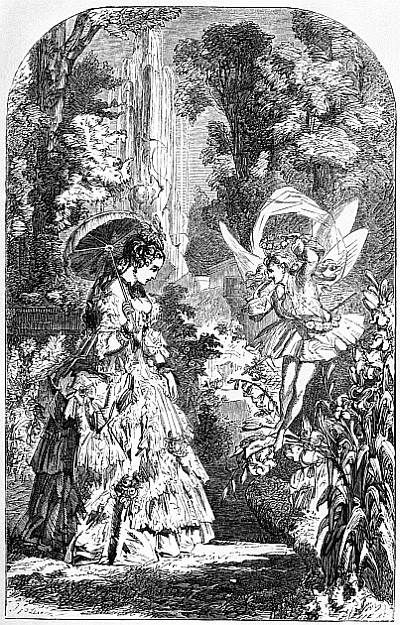
Young and Handsome.—P. 128.
"To make me happy," replied Young and Handsome, with a look so full of tenderness that it was enough to revive all the love of Zephyr, "you must restore to me my Alidor. I am powerless against another Fairy, but you, Zephyr, you are a God, and can destroy all the spells of my cruel rival!" "I will endeavour," rejoined Zephyr, "to subdue the tender sentiments you have inspired me with sufficiently to enable me to render you an agreeable service." So saying, he flew away, leaving Young and Handsome to indulge in a sweet hope. Zephyr did not deceive her. He was not in the habit of loving for any length of time, without the certainty of eventual success; and it was evident to him that the young Fairy was too constant for him to hope that he could ever make her forget Alidor; he therefore flew to the horrible prison where the beautiful shepherd awaited nothing less than death. An impetuous wind, swelled by six northern breezes, that had accompanied Zephyr, blew open in an instant the gates of the dungeon, and the beautiful shepherd, enveloped in a very brilliant cloud, was wafted to the Castle of Flowers.