MADEMOISELLE DE LA FORCE. (continued 3)
J. R. (James Robinson) Planché translation
"Thou shouldst not take counsel from thine eyes alone," said he to her. "Thou hast been unceasingly exhorted to let thyself be guided by gratitude. By following her inspirations thou art assured thou wilt be happy. It is true these warnings are only given thee in dreams; but these dreams are too significant and too frequent to be attributed to chance. They promise thee great advantages, enough to conquer thy repugnance. Therefore, the next time that the Beast asks thee if thou wilt marry him, I advise thee not to refuse him. Thou hast admitted to me that he loves thee tenderly: take the proper means to make thy union with him indissoluble. It is much better to have an amiable husband than one whose only recommendation is a handsome person. How many girls are compelled to marry rich brutes, much more brutish than the Beast, who is only one in form, and not in his feelings or his actions."
Beauty admitted the reason of all these arguments; but to resolve to marry a monster so horrible in person and who seemed as stupid as he was gigantic, appeared to her an impossibility. "How can I determine," replied she to her father, "to take a husband with whom I can have no sympathy, and whose hideousness is not compensated for by the charms of his conversation? no other object to distract my attention, and relieve that wearisome companionship; not to have the pleasure of being sometimes absent from him; to hear nothing beyond five or six questions respecting my health or my appetite, followed by a 'Good-night, Beauty,' a chorus which my parrots know by heart, and repeat a hundred times a day. It is not in my power to endure such a union, and I would rather perish at once than be dying every day of fright, sorrow, disgust, and weariness. There is nothing to plead in his favour, except the consideration he evinces in paying me very short visits, and presenting himself before me but once in four-and-twenty hours. Is that enough to inspire one with affection?"
The father admitted that his daughter had reason on her side, but observing so much civility in the Beast, he could not believe him to be as stupid as she represented him. The order, the abundance, the good taste that was discernible through his palace, were not, according to his thinking, the work of a fool. In fact, he found him worthy of the consideration of his daughter, and Beauty might have felt more inclined to listen to the Monster, had not her nocturnal lover's appearance thrown an obstacle in the way. The comparison she drew between these two admirers could not be favourable to the Beast. The old man himself was fully aware of the great distinction which must be made between them. Notwithstanding, he tried by all manner of means to overcome her repugnance. He recalled to her the advice of the lady who had warned her not to be prejudiced by appearances, and whose language seemed to imply that this youth would only make her miserable.
It is easier to reason with love than to conquer it. Beauty had not the power to yield to the reiterated requests of her father. He left her without having been able to persuade her. Night, already far advanced, invited her to repose, and the daughter, although delighted to see her father once more, was not sorry that he left her at liberty to retire to rest. She was glad to be alone. Her heavy eyelids inspired her with the hope that in slumber she would soon again behold her beloved Unknown. She was eager to enjoy this innocent pleasure. A quickened pulsation evinced the joy with which her gentle heart would greet that pleasant vision; but her excited imagination, while representing to her the scenes in which she had usually held sweet converse with that dear Unknown, had not sufficient power to conjure up his form to her as she so ardently desired.
She awoke several times, but on falling asleep again no cupids fluttered round her couch. In a word, instead of a night full of sweet thoughts and innocent pleasures, which she had counted on passing in the arms of sleep, it was to her one of interminable length and endless anxiety. She had never known any like it in the Palace of the Beast, and the day, which she at last saw break with a mingled feeling of satisfaction and impatience, came opportunely to relieve her from this weariness.
Her father, enriched by the liberality of the Beast, had quitted his country house, and in order to facilitate the establishment of his daughters, resided in a very large city, where his new fortune obtained for him new friends, or rather new acquaintances. Amidst the circle who visited him the tidings soon spread that his youngest daughter had returned. Everybody evinced an equal impatience to see her, and were each as much charmed with her intellect as with her beauty. The peaceful days she had passed in her desert palace, the innocent pleasures which a gentle slumber had invariably procured her, the thousand amusements which succeeded, so that dullness could never take possession of her spirit,—in brief, all the attentions of the Monster had combined to render her still more beautiful and more charming than she was when her father first parted from her.
She was the admiration of all who saw her. The suitors to her sisters, without condescending to excuse their infidelity by the slightest pretext, fell in love with her, and attracted by the power of her charms, deserted, without a blush, their former mistresses. Insensible to the marked attentions of a crowd of adorers, she neglected nothing that could discourage them and induce them to return to the previous objects of their affection; but, notwithstanding all her care, she could not escape the jealousy of her sisters.
The inconstant lovers, far from concealing their new passion, invented every day some fresh entertainment, with the view of paying their court to her. They entreated her even to bestow the prize in the games which took place in her honour; but Beauty, who could not be blind to the mortification she was causing her sisters, and yet was unwilling to refuse utterly the favour they implored so ardently, and in so flattering a manner, found means to satisfy them all, by declaring that she would, alternately with her sisters, present the prize to the victor. What she selected was a flower, or some equally simple guerdon. She left to her elder sisters the honour of giving, in their turn, jewels, crowns of diamonds, costly weapons, or superb bracelets, presents which her liberal hand supplied them with, but for which she would not take the slightest credit. The treasures lavished on her by the Monster left her in want of nothing. She divided between her sisters everything she had brought that was most rare and elegant. Bestowing nothing but trifles herself, and leaving them the pleasure of giving largely, she counted on securing for them the love as well as the gratitude of the youthful combatants. But these lovers sought only to gain her heart, and the simplest gift from her hand was more precious to them than all the treasures that were prodigally heaped upon them by the others.
The amusements she partook of amongst her family, though vastly inferior to those she enjoyed in the Palace of the Beast, entertained her sufficiently to prevent the time hanging heavily on her hands. At the same time, neither the gratification of seeing her father, whom she tenderly loved, nor the pleasure of being with her brothers, who in a hundred ways studied to prove to her the extent of their affection, nor the delight of conversing with her sisters, of whom she was very fond, though they were not so of her, could prevent her regretting her agreeable dreams. Her Unknown (greatly to her sorrow) came not, when she slumbered under her father's roof, to address her in the tenderest language; and the court paid to her by those who had been the admirers of her sisters, did not compensate for the loss of that pleasing illusion. Had she even been of a nature to feel flattered by such conquests, she would still have distinguished an immense difference between their attentions, or those of the Beast, and the devotion of her charming Unknown.
Their assiduities were received by her with the greatest indifference; but Beauty perceiving that, notwithstanding her coolness, they were obstinately bent on rivalling each other in the task of proving to her the intensity of their passion, thought it her duty to make them clearly understand they were losing their time. The first she endeavoured to undeceive was one who had courted her eldest sister. She told him that she had only returned for the purpose of being present at the marriage of her sisters, particularly that of her eldest sister, and that she was about to press her father to settle it immediately. Beauty found that she had to deal with a man who saw no longer any charms in her sister. He sighed alone for her, and coldness, disdain, the threat to depart before the expiration of the two months—nothing, in short, could discourage him. Much vexed at having failed in her object, she held a similar conversation with the others, whom she had the mortification to find equally infatuated.
To complete her distress, her unjust sisters, who looked upon her as a rival, conceived a hatred to her which they could not dissemble; and whilst Beauty was deploring the too great power of her charms, she had the misery of learning that her new adorers, believing each to be the cause of the other's rejection, were bent, in the maddest way, on fighting it out amongst themselves. All these annoyances induced her to determine upon returning sooner than she had contemplated.
Her father and brothers did all they could to detain her; but the slave of her word, and firm in resolution, neither the tears of the one nor the prayers of the others could prevail upon her. All that they could extort from her was, that she would defer her departure as long as she could. The two months had nearly expired, and every morning she determined to bid adieu to her family, without having the heart when night arrived to say farewell. In the combat between her affection and her gratitude, she could not lean to the one without doing injustice to the other. In the midst of her embarrassment, it needed nothing less than a dream to decide her. She fancied she was at the Palace of the Beast, and walking in a retired avenue, terminated by a thicket full of brambles, concealing the entrance to a cavern, out of which issued horrible groans. She recognised the voice of the Beast, and ran to his assistance. The Monster, who, in her dream, appeared stretched upon the ground and dying, reproached her with being the cause of his death, and having repaid his affection with the blackest ingratitude. She then saw the lady who had before appeared to her in her sleep, and who said to her in a severe tone, that it would be her destruction if she hesitated any longer to fulfil her engagements; that she had given her word to the Beast that she would return in two months; that the time had expired; that the delay of another day would be fatal to the Beast; that the trouble she was creating in her father's house, and the hatred of her sisters, ought to increase her desire to return to the Palace of the Beast, where everything combined to delight her. Beauty, terrified by this dream, and fearing to be the cause of the death of the Beast, awoke with a start, and went immediately to inform her family that she could no longer delay her departure. This intelligence produced various effects. Her father's tears spoke for him; her brothers protested that they would not allow her to leave them; and her lovers, in despair, swore they would not suffer the house to be robbed of its brightest ornament. Her sisters alone, far from appearing distressed at her departure, were loud in praise of her sense of honour; and affecting to possess the same virtue themselves, had the audacity to assure her that if they had pledged their words to the Beast as she had done, they should not have suffered his ugliness to have interfered with their feelings of duty, and that they should have long ere that time been on their road back to the marvellous palace. It was thus they endeavoured to disguise the cruel jealousy that rankled in their hearts. Beauty, however, charmed by their apparent generosity, thought only of convincing her brothers and her lovers of the obligation she was under to leave them; but her brothers loved her too much to consent to her going, and her lovers were too infatuated to listen to reason. All of them being ignorant of the mode in which Beauty had arrived at her father's house, and never doubting but that the horse which first conveyed her to the Palace of the Beast would be sent to take her back again, resolved amongst themselves to prevent it.
Her sisters, who only concealed their delight by the affectation of a sentiment of horror, as they perceived the hour approach for Beauty's departure, were frightened to death lest anything should occur to delay her; but Beauty, firm in her resolution, knowing whither duty called her, and having no more time to lose, if she would prolong the existence of the Beast, her benefactor, at nightfall took leave of her family, and of all those who were interested in her destiny.
She assured them that whatever steps they took to prevent her departure, she should, nevertheless, be in the Palace of the Beast the next morning before they were stirring; that all their schemes would be fruitless; and that she had determined to return to the Enchanted Palace. She did not forget, on going to bed, to turn her ring. She slept very soundly, and did not awake until the clock in her chamber, striking noon, chimed her name to music. By that sound she knew that her wishes were accomplished. As soon as she evinced a disposition to rise, her couch was surrounded by all the animals who had been so eager to serve her, and who unanimously testified their gratification at her return, and expressed the sorrow they had felt at her long absence.
The day seemed to her longer than any she had previously passed in that Palace, not so much from regret for those she had quitted as from her impatience again to behold the Beast, and to say everything she could to him in the way of excuse for her conduct. She was also animated by another desire,—that of again holding in slumber one of those sweet conversations with her dear Unknown, a pleasure she had been deprived of during the two months she had passed with her family, and which she could not enjoy anywhere but in that Palace. The Beast and the Unknown were, in short, alternately the subjects of her reflections. One moment she reproached herself for not returning the affection of a lover who, under the form of a monster, displayed so noble a mind; the next she deplored having set her heart upon a visionary object, who had no existence except in her dreams. She began to doubt whether she ought to prefer the imaginary devotion of a phantom to the real affection of the Beast. The very dream in which the Unknown appeared to her was invariably accompanied by warnings not to trust to sight. She feared it was but an idle illusion, born of the vapours of the brain, and destroyed by light of day.
Thus undecided, loving the Unknown, yet not wishing to displease the Beast, and seeking repose from her thoughts in some entertainment, she went to the French Comedy[24], which she found exceedingly poor. Shutting the window abruptly, she hoped to be better pleased at the Opera. She thought the music miserable. The Italians were equally unable to amuse her. Their comedy appeared to her to want smartness, wit and action. Weariness and distaste accompanied her everywhere, and prevented her taking pleasure in anything.
The gardens had no attractions for her. Her Court endeavoured to entertain her, but the monkeys lost their labour in frisking, and the parrots and other birds in chattering and singing. She was impatient for the visit of the Beast, the noise of whose approach she expected to hear every instant. But the hour so much desired came without the appearance of the Monster. Alarmed, and almost angry at his delay, she tried in vain to account for his absence. Divided through hope and fear, her mind agitated, her heart a prey to melancholy, she descended into the gardens, determined not to re-enter the Palace till she had found the Beast. No trace of him could she discover anywhere. She called him. Echo alone answered her. Having passed more than three hours in this disagreeable exercise, overcome by fatigue, she sank upon a garden seat. She imagined the Beast was either dead or had abandoned the place.
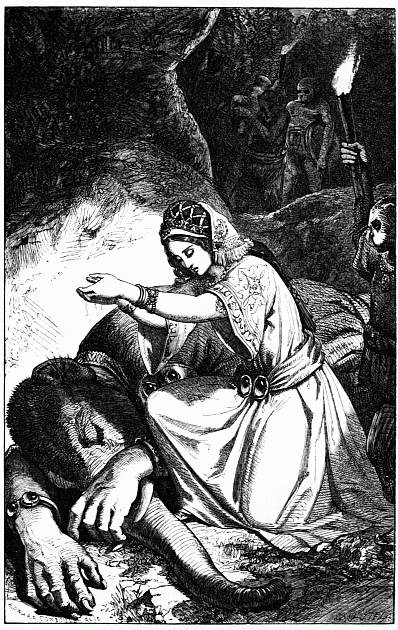
Beauty and the Beast.—P. 273.
She saw herself alone in that Palace, without the hope of ever leaving it. She regretted her conversations with the Beast, unentertaining as they had been to her, and what appeared to her extraordinary, even to discover she had so much feeling for him. She blamed herself for not having married him, and considering she had been the cause of his death (for she feared her too long absence had occasioned it), heaped upon herself the keenest and most bitter reproaches. In the midst of her miserable reflections she perceived that she was seated in that very avenue in which, during the last night she had passed under her father's roof, she had dreamed she saw the Beast expiring in some strange cavern. Convinced that chance had not conducted her to this spot, she rose and hurried towards the thicket, which she found was not impenetrable. She discovered another hollow, which appeared to be that she had seen in her dream. As the moon gave but a feeble light, the monkey pages immediately appeared with a sufficient number of torches to illuminate the chasm, and to reveal to her the Beast stretched upon the earth, as she thought, asleep. Far from being alarmed at his sight, Beauty was delighted, and, approaching him boldly, placed her hand upon his head, and called to him several times; but finding him cold and motionless, she no longer doubted he was dead, and consequently gave utterance to the most mournful shrieks and the most affecting exclamations.
The assurance of his death, however, did not prevent her from making every effort to recall him to life. On placing her hand on his heart she felt, to her great joy, that it still beat. Without further delay, Beauty ran out of the cave to the basin of a fountain, where, taking up some water in her joined hands, she hastened back with it, and sprinkled it upon him; but as she could bring very little at a time, and spilt some of it before she could return to the Beast, her assistance had been but meagre if the monkey courtiers had not flown to the Palace, and returned with such speed that in a moment she was furnished with a vase for water, as well as with proper restoratives. She caused him to smell them and swallow them, and they produced so excellent an effect that he soon began to move and show some kind of consciousness. She cheered him with her voice and caressed him as he recovered. "What anxiety have you caused me?" said she to him, kindly; "I knew not how much I loved you. The fear of losing you has proved to me that I was attached to you by stronger ties than those of gratitude. I vow to you that I had determined to die if I had failed in restoring you to life." At these tender words the Beast, feeling perfectly revived, replied, in a voice which was still feeble, "It is very kind of you, Beauty, to love so ugly a monster, but you do well. I love you better than my life. I thought you would never return: it would have killed me. Since you love me I will live. Retire to rest, and assure yourself that you will be as happy as your good heart renders you worthy to be."
Beauty had never before heard so long a speech from the Beast. It was not very eloquent, but it pleased, from its gentleness and the sincerity observable in it. She had expected to be scolded, or at least to have been reproached. She had from this moment a better opinion of his disposition. No longer thinking him so stupid, she even considered his short answers a proof of his prudence, and, more and more prepossessed in his favour, she retired to her apartment, her mind occupied with the most flattering ideas. Extremely fatigued, she found there all the refreshments she needed. Her heavy eyelids promised her a sweet slumber. Asleep almost as soon as her head was on her pillow, her dear Unknown failed not to present himself immediately. What tender words did he not utter to express the pleasure he experienced at seeing her again? He assured her that she would be happy; that it only remained to her to follow the impulse of her good heart. Beauty asked him if her happiness was to arise from her marriage with the Beast. The Unknown replied that it was the only means of securing it. She felt somewhat annoyed at this. She thought it even extraordinary that her lover should advise her to make her rival happy. After this first dream, she thought she saw the Beast dead at her feet. An instant afterwards the Unknown re-appeared, and disappeared again as instantly, to give place to the Beast. But what she observed most distinctly was the Lady, who seemed to say to her, "I am pleased with thee. Continue to follow the dictates of reason, and trouble thyself about naught. I undertake the task of rendering thee happy." Beauty, although asleep, appeared to acknowledge her partiality to the Unknown and her repugnance to the Monster, whom she could not consider loveable. The Lady smiled at her objections, and advised her not to make herself uneasy about her affection for the Unknown, for that the emotions she felt were not incompatible with the resolution she had formed to do her duty; that she might follow her inclinations without resistance, and that her happiness would be perfected by espousing the Beast.
This dream, which only ended with her sleep, furnished her with an inexhaustible source of reflection. In this vision, as in those which had preceded it, she found more coherence than is usually displayed in dreams, and she therefore determined to consent to this strange union. But the image of the Unknown rose unceasingly to trouble her. It was the sole obstacle, but not a slight one. Still uncertain as to the course she ought to take, she went to the Opera, but without terminating her embarrassment. At the end of the performance she sat down to supper. The arrival of the Beast was alone capable of deciding her.
Far from reproaching her for her long absence, the Monster, as if the pleasure of seeing her had made him forget his past distresses, appeared, on entering Beauty's apartment, to have no other anxiety but that of ascertaining if she had been much amused, if she had been well received, and if her health had been good. She answered these questions, and added politely that she had paid dearly for all the pleasures his care had enabled her to enjoy, by the cruel pain she had endured on finding him in so sad a state on her return.
The Beast briefly thanked her, and then being about to take his leave, asked her, as usual, if she would marry him. Beauty was silent for a short time, but at last making up her mind, she said to him, trembling, "Yes, Beast, I am willing, if you will pledge me your faith, to give you mine." "I do," replied the Beast, "and I promise you never to have any wife but you." "Then," rejoined Beauty, "I accept you for my husband, and swear to be a fond and faithful wife to you."
She had scarcely uttered these words when a discharge of artillery was heard, and that she might not doubt it being a signal of rejoicing, she saw from her windows the sky all in a blaze with the light of twenty thousand fireworks, which continued rising for three hours. They formed true-lovers' knots, while on elegant escutcheons appeared Beauty's initials, and beneath them, in well-defined letters, "Long live Beauty and her Husband." After this display had terminated, the Beast took his departure, and Beauty retired to rest. No sooner was she asleep than her dear Unknown paid her his usual visit. He was more richly attired than she had ever seen him. "How deeply am I obliged to you, charming Beauty," said he. "You have released me from the frightful prison in which I have groaned for so long a time. Your marriage with the Beast will restore a king to his subjects, a son to his mother, and life to a whole kingdom. We shall all be happy."
Beauty, at these words, felt bitterly annoyed, perceiving that the Unknown, far from evincing the despair such an engagement as she had entered into should have caused him, gazed on her with eyes sparkling with extreme delight. She was about to express her discontent to him, when the Lady, in her turn, appeared in her dream.
"Behold thee victorious," said she. "We owe everything to thee, Beauty. Thou hast suffered gratitude to triumph over every other feeling. None but thou would have had the courage to keep their word at the expense of their inclination, nor to have perilled their life to have saved that of their father. In return for this, there are none who can ever hope to enjoy such happiness as thy virtue has won for thee. Thou knowest at present little, but the rising sun shall tell thee more." When the Lady had disappeared, Beauty again saw the unknown youth, but stretched on the earth as dead. All the night passed in such dreams; but they had become familiar to her, and did not prevent her from sleeping long and soundly. It was broad daylight when she awoke. The sun streamed into her apartment with more brilliancy than usual: her monkeys had not closed the shutters. Believing the sight that met her eyes but a continuation of her dreams, and that she was sleeping still, her joy and surprise were extreme at discovering that it was a reality, and that on a couch beside her lay, in a profound slumber, her beloved Unknown, looking a thousand times more handsome than he had done in her vision. To assure herself of the fact, she arose hastily and took from off her toilet-table the miniature she usually wore on her arm; but she could not have been mistaken. She spoke to him, in the hope of awaking him from the trance into which he seemed to have been thrown by some wonderful power. Not stirring at her voice, she shook him by the arm. This effort was equally ineffectual, and only served to convince her that he was under the influence of enchantment, and that she must await the end of the charm, which it was reasonable to suppose had an appointed period.
How delighted was she to find herself betrothed to him who alone had caused her to hesitate, and to find that she had done from duty that which she would have done from inclination. She no longer doubted the promise of happiness which had been made to her in her dreams. She now knew that the Lady had truly assured her that her love for the Unknown was not incompatible with the affection she entertained for the Beast, seeing that they were one and the same person. In the meanwhile, however, her husband never woke. After a slight meal she endeavoured to pass away the time in her usual occupations, but they appeared to her insipid. As she could not resolve to leave her apartments, nor bear to sit idle, she took up some music, and began to sing. Her birds hearing her, joined their voices to hers, and made a concert, the more charming to her as she expected every moment it would be interrupted by the awakening of her husband, for she flattered herself she could dissolve the spell by the harmony of her voice. The spell was soon broken, but not by the means she imagined. She heard the sound of a chariot rolling beneath the windows of her apartment, and the voices of several persons approaching. At the same moment the monkey Captain of the Guard, by the beak of his parrot Interpreter, announced the visit of some ladies. Beauty, from her windows, beheld the chariot that brought them. It was of an entirely novel description, and of matchless beauty. Four white stags, with horns and hoofs of gold, superbly caparisoned, drew this equipage, the singularity of which increased Beauty's desire to know who were the owners of it.
By the noise, which became louder, she was aware that the ladies had nearly reached the ante-chamber. She considered it right to advance and receive them. She recognised in one of them the Lady she had been accustomed to behold in her dreams. The other was not less beautiful. Her high and distinguished bearing sufficiently indicated that she was an illustrious personage. She was no longer in the bloom of youth, but her air was so majestic that Beauty was uncertain to which of the two strangers she ought first to address herself. She was still under this embarrassment, when the one with whose features she was already familiar, and who appeared to exercise some sort of superiority over the other, turning to her companion, said, "Well, Queen, what think you of this beautiful girl? You owe to her the restoration of your son to life, for you must admit that the miserable circumstances under which he existed could not be called living. Without her, you would never again have beheld this Prince. He must have remained in the horrible shape to which he had been transformed, had he not found in the world one only person who possessed virtue and courage equal to her beauty. I think you will behold with pleasure the son she has restored to you become her husband. They love each other, and nothing is wanting to their perfect happiness but your consent. Will you refuse to bestow it on them?" The Queen, at these words, embracing Beauty affectionately, exclaimed, "Far from refusing my consent, their union will afford me the greatest felicity! Charming and virtuous child, to whom I am under so many obligations, tell me who you are, and the names of the sovereigns who are so happy as to have given birth to so perfect a Princess?"
"Madam," replied Beauty, modestly, "it is long since I had a mother; my father is a merchant more distinguished in the world for his probity and his misfortunes than for his birth." At this frank declaration, the astonished Queen recoiled a pace or two, and said, "What! you are only a merchant's daughter? Ah, great Fairy!" she added, casting a mortified look on her companion, and then remained silent; but her manner sufficiently expressed her thoughts, and her disappointment was legible in her eyes.
"It appears to me," said the Fairy, haughtily, "that you are discontented with my choice. You regard with contempt the condition of this young person, and yet she was the only being in the world who was capable of executing my project, and who could make your son happy." "I am very grateful to her for what she has done," replied the Queen; "but, powerful spirit," she continued, "I cannot refrain from pointing out to you the incongruous mixture of that noblest blood in all the world which runs in my son's veins with that of the obscure race from which the person has sprung to whom you would unite him. I confess I am little gratified by the supposed happiness of the Prince, if it must be purchased by an alliance so degrading to us, and so unworthy of him. Is it impossible to find in the world a maiden whose birth is equal to her virtue? I know many excellent princesses by name; why am I not permitted to hope that I may see him the possessor of one of those?"
At this moment the handsome Unknown appeared. The arrival of his mother and the Fairy had aroused him, and the noise they had made was more effective than all the efforts of Beauty; such being the nature of the spell. The Queen held him a long time in her arms, without speaking a word. She found again a son whose fine qualities rendered him worthy of all her affection. What joy for the Prince to see himself released from a horrible form, and a stupidity more painful to him because it was affected and had not obscured his reason. He had recovered the liberty to appear in his natural form by means of the object of his love, and that reflection made it still more precious to him.
After the first transports which nature inspired him with at the sight of his mother, the Prince hastened to pay those thanks to the Fairy which duty and gratitude prompted. He did so in the most respectful terms, but as briefly as possible, in order to be at liberty to turn his attentions towards Beauty. He had already, by tender glances, expressed to her his feelings, and was about to confirm with his lips, in the most touching language, what his eyes had spoken, when the Fairy stopped him, and bade him be the judge between her and his mother. "Your mother," said she, "condemns the engagement you have entered into with Beauty. She considers that her birth is too much beneath yours. For my part, I think that her virtues make up for that inequality. It is for you, Prince, to say with which of us your own feelings coincide; and that you may be under no restraint in declaring to us your real sentiments, I announce to you that you have full liberty of choice. Although you have pledged your word to this amiable person, you are free to withdraw it. I will answer for her, that Beauty will release you from your promise without the least hesitation, although, through her kindness, you have regained your natural form; and I assure you also that her generosity will cause her to carry disinterestedness to the extent of leaving you at liberty to dispose of your hand in favour of any person on whom the Queen may advise you to bestow it.—What say you, Beauty?" pursued the Fairy, turning towards her; "have I been mistaken in thus interpreting your sentiments? Would you desire a husband who would become so with regret?" "Assuredly not, Madam," replied Beauty. "The Prince is free. I renounce the honour of being his wife. When I accepted him, I believed I was taking pity on something below humanity. I engaged myself to him only with the object of conferring on him the most signal favour. Ambition had no place in my thoughts. Therefore, great Fairy, I implore you to exact no sacrifice from the Queen, whom I cannot blame for the scruples she entertains under such circumstances." "Well, Queen, what say you to that?" inquired the Fairy, in a disdainful and displeased tone. "Do you consider that princesses, who are so by the caprice of fortune, better deserve the high rank in which it has placed them than this young maiden? For my part, I think she should not be prejudiced by an origin from which she has elevated herself by her conduct." The Queen replied with some embarrassment, "Beauty is incomparable! Her merit is infinite; nothing can surpass it; but, madam, can we not find some other mode of rewarding her? Is it not to be effected without sacrificing to her the hand of my son?" Then turning to Beauty, she continued, "Yes, I owe you more than I can pay. I put, therefore, no limit to your desires. Ask boldly, I will grant you everything, with that sole exception; but the difference will not be great to you. Choose a husband from amongst the nobles of my Court. However high in rank, he will have cause to bless his good fortune, and for your sake I will place him so near the throne that your position will be scarcely less enviable."
"I thank you, Madam," replied Beauty; "but I ask no reward from you. I am more than repaid by the pleasure of having broken the spell which had deprived a great prince of his mother and of his kingdom. My happiness would have been perfect if I had rendered this service to my own sovereign. All I desire is that the Fairy will deign to restore me to my father."
The Prince, who, by order of the Fairy, had been silent throughout this conversation, was no longer master of himself, and his respect for the commands he had received, failed to restrain him. He flung himself at the feet of the Fairy and of his mother, and implored them, in the strongest terms, not to make him more miserable than he had been, by sending away Beauty, and depriving him of the happiness of being her husband. At these words, Beauty, gazing on him with an air full of tenderness, but mingled with a noble pride, said, "Prince, I cannot conceal from you my affection. Your disenchantment is a proof of it, and I should in vain endeavour to disguise my feelings. I confess without a blush, that I love you better than myself. Why should I dissimulate? We may disavow evil impulses; but mine are perfectly innocent, and are authorised by the generous Fairy to whom we are both so much indebted. But if I could resolve to sacrifice my feelings when I thought it my duty to do so for the Beast, you must feel assured that I shall not falter on this occasion when it is no longer the interest of the Monster that is at stake, but your own. It is enough for me to know who you are, and that I am to renounce the glory of being your wife. I will even venture to say, that if, yielding to your entreaties, the Queen should grant the consent you ask, it would not alter the case, for in my own reason, and even in my love, you would meet with an insurmountable obstacle. I repeat that I ask no favour but that of being allowed to return to the bosom of my family, where I shall for ever cherish the remembrance of your bounty and your affection."
"Generous Fairy!" exclaimed the Prince, clasping her hands in supplication, "for mercy's sake, do not allow Beauty to depart! Make me, rather, again the Monster that I was, for then I shall be her husband. She pledged her word to the Beast, and I prefer that happiness to all those she has restored me to, if I must purchase them so dearly!"
The Fairy made no answer; she but looked steadily at the Queen, who was moved by so much true affection, but whose pride remained unshaken. The despair of her son affected her, yet she could not forget that Beauty was the daughter of a merchant, and nothing more. She, notwithstanding, feared the anger of the Fairy, whose manner and silence sufficiently evinced her indignation. Her confusion was extreme. Not having power to utter a word, she feared to see a fatal termination to a conference which had offended the protecting spirit. No one spoke for some minutes, but the Fairy at length broke the silence, and casting an affectionate look upon the lovers, she said to them, "I find you worthy of each other. It would be a crime to part two such excellent persons. You shall not be separated, I promise you; and I have sufficient power to fulfil my promise." The Queen shuddered at these words, and would have made some remonstrance, but the Fairy anticipated her by saying, "For you, Queen, the little value you set upon virtue, unadorned by the vain titles which alone you respect, would justify me in heaping on you the bitterest reproaches. But I excuse your fault, arising from pride of birth, and I will take no other vengeance beyond doing this little violence to your prejudices, and for which you will not be long without thanking me." Beauty, at these words, embraced the knees of the Fairy, and exclaimed, "Ah, do not expose me to the misery of being told all my life that I am unworthy of the rank to which your bounty would elevate me. Reflect that this Prince, who now believes that his happiness consists in the possession of my hand may very shortly perhaps be of the same opinion as the Queen." "No, no, Beauty, fear nothing," rejoined the Fairy. "The evils you anticipate cannot come to pass. I know a sure way of protecting you from them, and should the Prince be capable of despising you after marriage, he must seek some other reason than the inequality of your condition. Your birth is not inferior to his own. Nay, the advantage is even considerably on your side, for the truth is," said she, sternly, to the Queen, "that you behold your niece; and what must render her still more worthy of your respect is, that she is mine also, being the daughter of my sister, who was not, like you, a slave to rank which is lustreless without virtue.
"That Fairy, knowing how to estimate true worth, did your brother, the King of the Happy Island, the honour to marry him. I preserved this fair fruit of their union from the fury of a Fairy who desired to be her step-mother. From the moment of her birth I destined her to be the wife of your son. I desired, by concealing from you the result of my good service, to give you an opportunity of showing your confidence in me. I had some reason to believe that it was greater than it appears to have been. You might have relied upon me for watching over the destiny of the Prince. I had given you proofs enough of the interest I took in it, and you needed not to have been under any apprehension that I should expose him to anything that would be disgraceful to himself or to you. I feel persuaded, Madam," continued she, with a smile which had still something of bitterness in it, "that you will not object to honour us with your alliance."
The Queen, astonished and embarrassed, knew not what to answer. The only way to atone for her fault was to confess it frankly, and evince a sincere repentance. "I am guilty, generous Fairy," said she. "Your bounties should have satisfied me that you would not suffer my son to have formed an alliance unworthy of him. But pardon, I beseech you, the prejudices of my rank, which urged that royal blood could not marry one of humbler birth without degradation. I acknowledge that I deserve you should punish me by giving to Beauty a mother-in-law more worthy of her; but you take too kind an interest in my son to render him the victim of my error. As to you, dear Beauty," she continued, embracing her tenderly, "you must not resent my resistance. It was caused by my desire to marry my son to my niece, whom the Fairy had often assured me was living, notwithstanding all appearances to the contrary. She had drawn so charming a portrait of her, that without knowing you, I loved you dearly enough to risk offending the Fairy, in order to preserve to you the throne and the heart of my son." So saying, she recommenced her caresses, which Beauty received with respect.
The Prince, on his part, enraptured at this agreeable intelligence, expressed his delight in looks alone.
"Behold us all satisfied," said the Fairy; "and now, to terminate this happy adventure, we only need the consent of the royal father of the Princess; but we shall shortly see him here." Beauty requested her to permit the person who had brought her up, and whom she had hitherto looked upon as her father, to witness her felicity. "I admire such consideration," said the Fairy; "it is worthy a noble mind, and as you desire it, I undertake to inform him." Then taking the Queen by the hand, she led her away, under the pretext of showing her over the enchanted Palace. It was to give the newly-betrothed pair the liberty of conversing with each other for the first time without restraint or the aid of illusion. They would have followed, but she forbade them. The happiness in store for them inspired each with equal delight. They could not entertain the least doubt of their mutual affection.
Their conversation, confused and unconnected, their protestations a hundred times repeated, were to them more convincing proofs of love than the most eloquent language could have afforded. After having exhausted all the expressions that passion suggests under such circumstances to those that are truly in love, Beauty inquired of her lover by what misfortune he had been so cruelly transformed into a beast. She requested him also to relate to her all the events of his life preceding that shocking metamorphosis.
The Prince, whose recovery of his natural form had not lessened his anxiety to obey her, without more ado commenced his narrative in the following words:—
THE STORY OF THE BEAST.
The King, my father, died before I was born. The Queen would never have been consoled for his loss if her interest for the child she bore had not struggled with her sorrow. My birth caused her extreme delight. The sweet task of rearing the fruit of the affection of so dearly-beloved a husband was destined to dissipate her affliction. The care of my education and the fear of losing me occupied her entirely. She was assisted in her object by a Fairy of her acquaintance, who showed the greatest anxiety to preserve me from all kinds of accidents. The Queen felt greatly obliged to her, but she was not pleased when the Fairy asked her to place me entirely in her hands. The Fairy had not the best of reputations—she was said to be capricious in her favours. People feared more than they loved her; and even had my mother been perfectly convinced of the goodness of her nature, she could not have resolved to lose sight of me.
By the advice, however, of prudent persons, and for fear of suffering from the fatal effects of the resentment of this vindictive Fairy, she did not flatly refuse her. If voluntarily confided to her care there was no reason to suppose she would do me any injury. Experience had proved that she took pleasure in hurting those only by whom she considered herself offended. The Queen admitted this, and was only reluctant to forego the pleasure of gazing on me continually with a mother's eyes, which enabled her to discover charms in me I owed solely to her partiality.
She was still irresolute as to the course she should adopt, when a powerful neighbour imagined it would be an easy matter for him to seize upon the dominions of an infant governed by a woman. He invaded my kingdom with a formidable army. The Queen hastily raised one to oppose him, and, with a courage beyond that of her sex, placed herself at the head of her troops, and marched to defend our frontiers. It was then that, being compelled to leave me, she could not avoid confiding to the Fairy the care of my education. I was placed in her hands after she had sworn by all she held most sacred that she would, without the least hesitation, bring me back to the Court as soon as the war was over, which my mother calculated would not last more than a year at the utmost. Notwithstanding, however, all the advantages she gained over the enemy, she found it impossible to return to the capital so soon as she expected. To profit by her victory, after having driven the foe out of our dominions, she pursued him in his own.
She took entire provinces, gained battle after battle, and finally reduced the vanquished to sue for a degrading peace, which he obtained only on the hardest conditions. After this glorious success, the Queen returned triumphantly, and enjoyed in anticipation the pleasure of beholding me once more; but having learned upon her march that her base foe, in violation of the treaty, had surprised and massacred our garrisons, and repossessed himself of nearly all the places he had been compelled to cede to us, she was obliged to retrace her steps. Honour prevailed over the affection which drew her towards me, and she resolved never to sheathe the sword till she had put it out of her enemy's power to perpetrate more treachery. The time employed in this second expedition was very considerable. She had flattered herself that two or three campaigns would suffice; but she had to contend with an adversary as cunning as he was false. He contrived to excite rebellion in some of our own provinces, and to corrupt entire battalions, which forced the Queen to remain in arms for fifteen years. She never thought of sending for me. She was always flattering herself that each month would be the last she should be absent, and that she was on the point of seeing me again.
In the meanwhile, the Fairy, in accordance with her promise, had paid every attention to my education. From the day she had taken me out of my kingdom, she had never left me, nor ceased to give me proof of the interest she felt in all that concerned my health and amusement. I evinced by my respect for her how sensible I was of her kindness. I showed her the same deference, the same attention that I should have shown to my mother, and gratitude inspired me with as much affection for her.
For some time she appeared satisfied with my behaviour; but one day, without imparting to me the motive, she set out on a journey, from which she did not return for some years, and when she did return, struck with the effect of her care of me, she conceived for me an affection differing from that of a mother. She had previously permitted me to call her by that name, but now she forbade me. I obeyed her without inquiring what were her reasons, or suspecting what she was about to exact from me.
I saw clearly that she was dissatisfied; but could I imagine why she continually complained of my ingratitude? I was the more surprised at her reproaches as I did not feel I deserved them. They were always followed or preceded by the tenderest caresses. I was not old enough to comprehend her. She was compelled to explain herself. She did so one day when I evinced some sorrow, mingled with impatience, respecting the continued absence of the Queen. She reproached me for this, and on my assuring her that my affection for my mother in nowise interfered with that I owed to herself, she replied that she was not jealous, although she had done so much for me, and had resolved to do still more; but that, to enable her to carry out her designs in my favour with greater freedom, it was requisite, she added, that I should marry her; that she did not desire to be loved by me as a mother, but as an admirer; that she had no doubt of my gratitude to her for making this proposal, or of the great joy with which I should accept it, and that, consequently, I had only to abandon myself to the delight with which the certainty of becoming the husband of a powerful fairy, who could protect me from all dangers, assure me an existence full of happiness, and cover me with glory, must naturally awaken.
I was sadly embarrassed by this proposition. I knew enough of the world in my own country, to be aware that amongst the wedded portion of the community the happiest were those whose ages and characters assimilated, and that many were much to be pitied who, marrying under opposite circumstances, had found antipathies existing between them which were the source of constant misery.
The Fairy being old and of a haughty disposition, I could not flatter myself that my lot would be so agreeable as she predicted. I was far from entertaining for her such feelings as one should for the woman with whom we intend to pass our days; and besides, I was not inclined to enter into any such engagement at so early an age. My only desire was to see the Queen again, and to signalize myself at the head of her forces. I sighed for liberty; that was the sole boon that would have gratified me, and the only one the Fairy would not grant.
I had often implored her to allow me to share the perils to which I knew the Queen exposed herself for the protection of my interests, but my prayers had hitherto been fruitless. Pressed to reply to the astounding declaration she had made to me, I, in some confusion, recalled to her that she had often told me that I had no right to dispose of my hand without the commands of my mother, and in her absence. "That is exactly my opinion," she replied; "I do not wish you to do otherwise; I am satisfied that you should refer the matter to the Queen."
I have already informed you, beautiful Princess, that I had been unable to obtain from the Fairy permission to seek the Queen, my mother. The desire she now had to receive her sanction, which she never doubted she should obtain, obliged her to grant, even without my asking, that which she had always denied me; but it was on the condition, by no means agreeable to me, that she should accompany me. I did what I could to dissuade her, but found it impossible, and we set out together with a numerous escort. We arrived upon the eve of a decisive action. The Queen had manœuvred with such skill that the next day was certain to decide the fate of the enemy, who would have no resource if he lost the battle. My presence created great pleasure in the camp, and gave additional courage to our troops, who drew a favourable augury from my arrival. The Queen was ready to die with joy; but this first transport of delight was succeeded by the greatest alarm. Whilst I exulted in the hope of acquiring glory, the Queen trembled at the danger to which I was about to expose myself. Too generous to endeavour to prevent me, she implored me by all her affection, to take as much care of myself as honour would permit, and entreated the Fairy not to abandon me on that occasion. Her solicitations were unnecessary. The too susceptible Fairy was as much alarmed as the Queen, for she possessed no spell which could protect me from the chances of war. However, by instantly inspiring me with the art of commanding an army, and the prudence requisite for so important an office, she achieved much. The most experienced captains were surprised at me. I remained master of the field. The victory was complete. I had the happiness of saving the Queen's life, and of preventing her from being made prisoner of war. The enemy was pursued with such vigour that he abandoned his camp, lost his baggage, and more than three-fourths of his army, while the loss on our side was inconsiderable. A slight wound which I had received was the only advantage the foe could boast of; but the Queen, fearing that if the war continued some more serious mischief might befal me, in opposition to the desire of the whole army, to which my presence had imparted fresh spirit, made peace on more advantageous terms than the vanquished had ventured to hope for.
A short time afterwards we returned to our capital, which we entered in triumph. My occupation during the war, and the continual presence of my ancient adorer, had prevented me from informing the Queen of what had occurred. She was, therefore, completely taken by surprise when the Fairy told her, in so many words, that she had determined to marry me immediately. This declaration was made in this very Palace, but which was at that time not so superb as it is at present. It had been a country residence of the late King, which a thousand occupations had prevented his embellishing. My mother, who cherished everything that he had loved, had selected it in preference to any other as a place of retirement after the fatigues of the war. At the avowal of the Fairy, unable to control her first feelings, and unused to dissemble, she exclaimed, "Have you reflected, Madam, on the absurdity of the arrangement you propose to me!" In truth it was impossible to conceive one more ridiculous. In addition to the almost decrepit old age of the Fairy, she was horribly ugly. Nor was this the effect of time. If she had been handsome in her youth, she might have preserved some portion of her beauty by the aid of her art; but naturally hideous, her power could only invest her with the appearance of beauty for one day in each year, and that day ended, she returned to her former state.
The Fairy was surprised at the exclamation of the Queen. Her self-love concealed from her all that was actually horrible in her person, and she calculated that her power sufficiently compensated for the loss of a few charms of her youth. "What do you mean," said she to the Queen, "by an absurd arrangement! Consider, that it is imprudent in you to make me remember what I have condescended to forget. You ought only to congratulate yourself on possessing a son so amiable that his merit induces me to prefer him to the most powerful Genii in all the elements; and as I have deigned to descend to him, accept with respect the honour I am good enough to confer on you, and do not give me time to change my mind."
The Queen, as proud as the Fairy, had never conceived that there was a rank on earth higher than the throne. She valued little the pretended honour which the Fairy offered her. Having always commanded every one who approached her, she by no means desired to have a daughter-in-law to whom she must herself pay homage. Therefore, far from replying to her, she remained motionless, and contented herself with fixing her eyes upon me. I was as much astounded as she was, and fixing my eyes on her in the same manner, it was easy for the Fairy to perceive that our silence expressed sentiments very opposite to the joy with which she would have inspired us.
"What is the meaning of this?" said she, sharply. "How comes it that mother and son are both silent? Has this agreeable surprise deprived you of the power of speech? or are you blind and rash enough to reject my offer? Say, Prince," said she to me, "are you so ungrateful and so imprudent as to despise my kindness? Do you not consent to give me your hand this moment?"
"No, Madam, I assure you," replied I, quickly. "Although I am sincerely grateful to you for past favours, I cannot agree to discharge my debt to you by such means; and, with the Queen's permission, I decline to part so soon with my liberty. Name any other mode of acknowledging your favours, and I will not consider it impossible; but as to that you have proposed, excuse me if you please, for——" "How! insignificant creature!" interrupted the Fairy, furiously. "Thou darest to resist me! And you, foolish Queen! you see, without anger, this conduct—What do I say? without anger! It is you who authorize it! For it is your own insolent looks that have inspired him with the audacity to refuse me!"
The Queen, already stung by the contemptuous language of the Fairy, was no longer mistress of herself, and accidentally casting her eyes on a looking-glass, before which we happened to be standing at the moment, the wicked Fairy thus provoked her: "What answer can I make you," said she, "that you ought not to make to yourself? Deign to contemplate, without prejudice, the object this glass presents to you, and let it reply for me." The Fairy easily comprehended the Queen's insinuation. "It is the beauty, then, of this precious son of yours that renders you so vain," said she to her, "and has exposed me to so degrading a refusal! I appear to you unworthy of him. Well," she continued, raising her voice furiously, "having taken so much pains to make him charming, it is fit that I should complete my work, and that I should give you both a cause, as novel as remarkable, to make you remember what you owe to me. Go, wretch!" said she to me; "boast that thou hast refused me thy heart and thy hand. Give them to her thou findest more worthy of them than I am." So saying, my terrible lover struck me a blow on the head. It was so heavy that I was dashed to the ground on my face, and felt as though I were crushed by the fall of a mountain. Irritated by this insult, I struggled to rise, but found it impossible. The weight of my body had become so great that I could not lift myself; all that I could do was to sustain myself on my hands, which had in an instant become two horrible paws, and the sight of them apprised me of the change I had undergone. My form was that in which you found me. I cast my eyes for an instant on that fatal glass, and could no longer doubt my cruel and sudden transformation.
My despair rendered me motionless. The Queen at this dreadful sight was almost out of her mind. To put the last seal upon her barbarity, the furious Fairy said to me, in an ironical tone, "Go make illustrious conquests, more worthy of thee than an august Fairy. And as sense is not required when one is so handsome, I command thee to appear as stupid as thou art horrible, and to remain in this state until a young and beautiful girl shall, of her own accord, come to seek thee, although fully persuaded thou wilt devour her. She must also," continued the Fairy, "after discovering that her life is not in danger, conceive for thee a sufficiently tender affection to induce her to marry thee. Until thou canst meet with this rare maiden it is my pleasure that thou remain an object of horror to thyself and to all who behold thee. As for you, too happy mother of so lovely a child," said she to the Queen, "I warn you that if you acknowledge to any one that this monster is your son, he shall never recover his natural shape. Neither interest, nor ambition, nor the charms of his conversation, must assist to restore him to it. Adieu! Do not be impatient; you will not have long to wait. Such a darling will soon find a remedy for his misfortune." "Ah, cruel one!" exclaimed the Queen, "if my refusal has offended you, let your vengeance light on me. Take my life, but do not, I conjure you, destroy your own work." "You forget yourself, great Princess," replied the Fairy, in an ironical tone, "you demean yourself too much. I am not handsome enough for you to condescend to entreat me; but I am firm in my resolutions. Adieu, powerful Queen; adieu, beautiful Prince; it is not fair that I should longer annoy you with my hateful presence. I withdraw; but I have still charity enough to warn thee," addressing herself to me, "that thou must forget who thou art. If thou sufferest thyself to be flattered by vain respects or by pompous titles, thou art lost irretrievably! And thou art equally lost if thou shouldst dare to avail thyself of the intellect I leave thee possessed of, to shine in conversation."
With these words she disappeared, and left the Queen and me in a state which can neither be described nor imagined. Lamentations are the consolation of the unhappy; but our misery was too great to seek relief in them. My mother determined to stab herself, and I to fling myself in the adjacent canal. Without communicating our intentions to each other, we were on the point of executing these fatal designs, when a female of majestic mien, and whose manner inspired us with profound respect, appeared, and bade us remember that it was cowardice to succumb to the greatest misfortunes, and that with time and courage there was no evil that could not be remedied. The Queen, however, was inconsolable; tears streamed from her eyes, and not knowing how to inform her subjects that their sovereign was transformed into a horrible monster, she abandoned herself to the most fearful despair. The Fairy (for she was one, and the same whom you have seen here), knowing both her misery and her embarrassment, recalled to her the indispensable obligation she was under to conceal from her people this dreadful adventure, and that in lieu of yielding to despair, it would be better to seek some remedy for the mischief.
"Is there one to be found," exclaimed the Queen, "which is powerful enough to prevent the fulfilment of a Fairy's sentence?" "Yes, Madam," replied the Fairy, "there is a remedy for everything. I am a Fairy as well as she whose fury you have just felt the effects of, and my power is equal to hers. It is true that I cannot immediately repair the injury she has done you, for we are not permitted to act directly in opposition to each other. She who has caused your misfortune is older than I am, and age has amongst us a particular title to respect. But as she could not avoid attaching a condition upon which the spell might be broken, I will assist you to break it. I grant that it will be a difficult task to terminate this enchantment; but it does not appear to me to be impossible. Let me see what I can do for you by the exertion of all the means in my power."
Upon this she drew a book from under her robe, and after taking a few mysterious steps, she seated herself at a table, and read for a considerable time with such intense application that large drops of perspiration stood on her forehead. At length she closed the book and meditated profoundly. The expression of her countenance was so serious that for some time we were led to believe that she considered my misfortune irreparable; but recovering from a sort of trance, and her features resuming their natural beauty, she informed us that she had discovered a remedy for our disasters. "It will be slow," said she, "but it will be sure. Keep your secret; let it not transpire, so that any one can suspect you are concealed beneath this horrible disguise, for in that case you will deprive me of the power of delivering you from it. Your enemy flatters herself you will divulge it; it is for that reason she did not take from you the power of speech."
The Queen declared that the condition was an impossible one, as two of her women had been present at the fatal transformation, and had rushed out of the apartment in great terror, which must have excited the curiosity of the guards and the courtiers. She imagined that the whole Court was by this time aware of it, and that all the kingdom, and even all the world, would speedily receive the intelligence; but the Fairy knew a way to prevent the disclosure of the secret. She made several circles, now solemnly, now rapidly, uttering words of which we could not comprehend the meaning, and finished by raising her hand in the air in the style of one who is pronouncing an imperative order. This gesture, added to the words she had uttered, was so powerful, that every breathing creature in the Palace became motionless, and was changed into a statue. They are all still in the same state. They are the figures you behold in various directions and in the very attitudes they had assumed at the instant the Fairy's potent spell surprised them. The Queen, who at that moment cast her eyes upon the great court-yard, observed this change taking place in a prodigious number of persons. The silence which suddenly succeeded to the stir of a multitude, awoke a feeling of compassion in her heart for the many innocent beings who were deprived of life for my sake; but the Fairy comforted her by saying that she would only retain her subjects in that condition as long as their discretion was necessary. It was a precaution she was compelled to take, but she promised she would make up to them for it, and that the period they passed in that state would not be added to the years allotted to their existence. "They will be so much the younger," said the Fairy to the Queen; "so cease to deplore them, and leave them here with your son. He will be quite safe, for I have raised such thick fogs around this Castle, that it will be impossible for any one to enter it but when we think fit. I will convey you," she continued, "where your presence is necessary. Your enemies are plotting against you. Be careful to proclaim to your people that the Fairy who educated your son retains him near her for an important purpose, and keeps with her also all the persons who were in attendance on you."
It was not without shedding a flood of tears that my mother could force herself to leave me. The Fairy renewed her assurances to her that she would always watch over me, and protested that I had only to wish, and to see the accomplishment of my desires. She added that my misfortunes would shortly end, provided neither the Queen nor I raised up an obstacle by some act of imprudence. All these promises could not console my mother. She wished to remain with me, and to leave the Fairy, or any one she might consider the most proper person, to govern the kingdom; but fairies are imperious, and will be obeyed. My mother, fearing by a refusal to increase my miseries and deprive me of the aid of this beneficent spirit, consented to all she insisted on. She saw a beautiful car approach; it was drawn by the same white stags that brought her here to day. The Fairy made the Queen mount by her side. She had scarcely time to embrace me, her affairs demanded her presence elsewhere, and she was warned that a longer sojourn in this place would be prejudicial to me. She was transported with extraordinary velocity to the spot where her army was encamped. They were not surprised to see her arrive with this equipage. Everybody believed her to be accompanied by the old Fairy, for the one who was with her kept herself unseen, and departed again immediately to return to this place, which, in an instant, she embellished with everything that her imagination could suggest and her art supply.
This good-natured Fairy permitted me also to add whatever I fancied would please me, and after having done for me all she could, she left me with exhortations to take courage, and promising to come occasionally and impart to me such hopes as she might entertain of a favourable issue to my adventure.
I seemed to be alone in the Palace. I was only so to sight. I was served as if I were in the midst of my courtiers, and my occupations were nearly the same as those which were afterwards yours. I read, I went to the play, I cultivated a garden which I had made to amuse me, and found something agreeable in everything I undertook. What I planted arrived at perfection in the same day. It took no more time to produce the bower of roses to which I am indebted for the happiness of beholding you here.
My benefactress came very often to see me. Her presence and her promises alleviated my distresses. Through her, the Queen received news of me, and I news of the Queen. One day I saw the Fairy arrive with joy sparkling in her eyes. "Dear Prince," said she to me, "the moment of your happiness approaches!" She then informed me that he whom you believed to be your father had passed a very uncomfortable night in the forest. She related to me, in a few words, the adventure which had caused him to undertake the journey, without revealing to me your real parentage. She apprized me that the worthy man was compelled to seek an asylum from the misery he had endured during four-and-twenty hours.
"I go," said she, "to give orders for his reception. It must be an agreeable one. He has a charming daughter. I propose that she shall release you. I have examined the conditions which my cruel companion has attached to your disenchantment. It is fortunate that she did not ordain that your deliverer should come hither out of love for you. On the contrary, she insisted that the young maiden should expect no less than death, and yet expose herself to it voluntarily. I have thought of a scheme to oblige her to take that step. It is to make her believe the life of her father is in danger, and that she has no other means of saving him. I know that in order to spare her father any expense on her account, she has asked him only to bring her a rose, whilst her sisters have overwhelmed him with extravagant commissions. He will naturally avail himself of the first favourable opportunity. Hide yourself in this arbour, and seizing him the instant he attempts to gather your roses, threaten him that death will be the punishment of his audacity, unless he give you one of his daughters; or, rather, unless she sacrifice herself, according to the decree of our enemy. This man has five daughters besides the one I have destined for you; but not one of them is sufficiently magnanimous to purchase the life of their father at the price of their own. Beauty is alone capable of so grand an action."
I executed exactly the Fairy's commands. You know, lovely Princess, with what success. The merchant, to save his life, promised what I demanded. I saw him depart without being able to persuade myself that he would return with you. I could not flatter myself that my desire would be fulfilled. What torment did I not suffer during the month he had requested me to allow him. I longed for its termination only to be certain of my disappointment. I could not imagine that a young, lovely, and amiable girl would have the courage to seek a monster, of whom she believed she was doomed to be the prey. Even supposing her to have sufficient fortitude to devote herself, she would have to remain with me without repenting the step she had taken, and that appeared to me an invincible obstacle. Besides, how could she behold me without dying with affright? I passed my miserable existence in these melancholy reflections, and never was I more to be pitied. The month, however, elapsed, and my protectress announced to me your arrival. You remember, no doubt, the pomp with which you were received. Not daring to express my delight in words, I endeavoured to prove it to you by the most magnificent signs of rejoicing. The Fairy, ceaseless in her attentions to me, prohibited me from making myself known to you. Whatever terror I might inspire you with, or whatever kindness you might show me, I was not permitted to seek to please you, nor to express any love for you, nor to discover to you in any way who I was. I could have recourse, however, to excessive good-nature, as, fortunately, the malignant Fairy had forgotten to forbid my giving you proof of that.
These regulations seemed hard to me, but I was compelled to subscribe to them, and I resolved to present myself before you only for a few moments every day, and to avoid long conversations, in which my heart might betray its tenderness. You came, charming Princess, and the first sight of you produced upon me a diametrically opposite effect to that which my monstrous appearance must have done upon you. To see you was instantly to love you. Entering your apartment, tremblingly, my joy was excessive to find that you could behold me with greater intrepidity than I could behold myself. You delighted me infinitely when you declared that you would remain with me. An impulse of self-love, which I retained even under that most horrible of forms, led me to believe that you had not found me so hideous as you anticipated.
Your father departed satisfied. But my sorrow increased as I reflected that I was not allowed to win your favour in any way except by indulging the caprices of your taste. Your demeanour, your conversation, as sensible as it was unpretending, everything in you convinced me that you acted solely on the principles dictated to you by reason and virtue, and that consequently I had nothing to hope for from a fortunate caprice. I was in despair at being forbidden to address you in any other language than that which the Fairy had dictated, and which she had expressly chosen as coarse and stupid.
In vain did I represent to her it was unnatural to expect you would accept my proposition to marry you. Her answer was always, "Patience, perseverance, or all is lost." To recompense you for my silly conversation, she assured me she would surround you with all sorts of pleasures, and give me the advantage of seeing you continually, without alarming you, or being compelled to say rude and impertinent things to you. She rendered me invisible, and I had the gratification of seeing you waited on by spirits who were also invisible, or who presented themselves to you in the shapes of various animals.
More than this, the Fairy caused you to behold my natural form in your nightly slumbers, and in portraits by day, and made it speak to you in your dreams as I should have spoken to you myself. You obtained a confused idea of my secret and my hopes, which she urged you to realize, and by the means of a starry mirror I witnessed all your interviews, and read in it either all you imagined you uttered or all that you actually thought. This position, however, did not suffice to render me happy. I was only so in a dream, and my sufferings were real. The intense affection with which you had inspired me obliged me to complain of the restraint under which I lived; but my state was much more wretched when I perceived that these beautiful scenes had no longer any charms for you. I saw you shed tears, which pierced my heart, and would have destroyed me. You asked me if I was alone here, and I was on the verge of discarding my feigned stupidity, and assuring you by the most passionate vows of the fact. They would have been uttered in terms that would have surprised you, and caused you to suspect that I was not so coarse a brute as I pretended to be. I was on the point even of declaring myself, when the Fairy, invisible to you, appeared before me. By a threatening gesture, which terrified me, she found a way to close my lips. O, heavens! by what means did she impose silence upon me? She approached you with a poniard in her hand, and made signs to me that the first word I uttered would cost you your life. I was so frightened that I naturally relapsed into the stupidity she had ordered me to affect.
My sufferings were not yet at an end. You expressed a desire to visit your father. I gave you permission without hesitation. Could I have refused you anything? But I regarded your departure as my death-blow, and without the assistance of the Fairy I must have sunk under it. During your absence that generous being never quitted me. She saved me from destroying myself, which I should have done in my despair, not daring to hope that you would return. The time you had passed in this Palace rendered my condition more insupportable than it had been previously, because I felt I was the most miserable of all men, without the hope of making it known to you.
My most agreeable occupation was to wander through the scenes which you had frequented, but my grief was increased by no longer seeing you there. The evenings and hours when I used to have the pleasure of conversing with you for a moment, redoubled my afflictions, and were still more painful to me. Those two months, the longest I had ever known, ended at last, and you did not return. It was then my misery reached its climax, and that the Fairy's power was too weak to prevent my sinking under my despair. The precautions she took to prevent my attempting my life were useless. I had a sure way which eluded her power. It was to refrain from food. By the potency of her spells she contrived to sustain me for some time, but having exhausted all her secrets, I grew weaker and weaker, and finally had but a few moments to breathe, when you arrived to snatch me from the tomb.
Your precious tears, more efficacious than all the cordials of the disguised Genii who attended on me, delayed my soul upon the point of flight. In learning from your lamentations that I was dear to you, I enjoyed perfect felicity, and that felicity was at its height when you accepted me for your husband. Still I was not permitted to divulge to you my secret, and the Beast was compelled to leave you without daring to disclose to you the Prince. You know the lethargy into which I fell, and which ended only with the arrival of the Fairy and the Queen. On awaking I found myself as you behold me, without being aware of how the change took place.
You have witnessed what followed, but you could only imperfectly judge of the pain which the obstinacy of my mother caused me in opposing a marriage so suitable and so glorious for me. I had determined, Princess, rather to be a monster again than to abandon the hope of being the husband of so virtuous and charming a maiden. Had the secret of your birth remained for ever a mystery to me, love and gratitude would not less have assured me that in possessing you I was the most fortunate of men!
The Prince thus ended his narration, and Beauty was about to speak, when she was prevented by a burst of loud voices and warlike instruments, which, however, did not appear to announce anything alarming. The Prince and Princess looked out of the window, as did also the Fairy and the Queen who returned from their promenade. The noise was occasioned by the arrival of a personage who, according to all appearances, could be no less than a king. His escort was obviously a royal one, and there was an air of majesty in his demeanour which accorded with the state that accompanied him. The fine form of this sovereign, although of a certain age, testified that there had been few who could have equalled him in appearance when in the flower of his youth. He was followed by twelve of his body-guard, and some courtiers in hunting-dresses, who appeared as much astonished as their master to find themselves in a castle till now quite unknown to them. He was received with the same honours that would have been paid to him in his own dominions, and all by invisible beings. Shouts of joy and flourishes of trumpets were heard, but no one was to be seen.
The Fairy, immediately on beholding him, said to the Queen, "Here is the King your brother, and the father of Beauty. He little expects the pleasure of seeing you both here. He will be so much the more gratified, as you know he believes that his daughter has been long dead. He mourns her still, as he also does his wife, of whom he retains an affectionate remembrance." These words increased the impatience of the Queen and the young Princess to embrace this monarch. They reached the court-yard just as he dismounted. He saw, but could not recognize them; not doubting, however, that they were advancing to receive him, he was considering how and in what terms he should pay his compliments to them, when Beauty, flinging herself at his feet, embraced his knees, and called him "Father!"
The King raised her and pressed her tenderly in his arms, without comprehending why she addressed him by that title. He imagined she must be some orphan Princess, who sought his protection from some oppressor, and who made use of the most touching expression in order to obtain her request. He was about to assure her that he would do all that lay in his power to assist her, when he recognized the Queen his sister, who, embracing him in her turn, presented her son to him. She then informed him of some of the obligations they were under to Beauty, and especially of the frightful enchantment that had just been terminated. The King praised the young Princess, and desired to know her name, when the Fairy, interrupting him, asked if it was necessary to name her parents, and if he had never known any one whom she resembled sufficiently to enable him to guess them. "If I judged only from her features," said he, gazing upon her earnestly, and not being able to restrain a few tears, "the title she has given to me is legitimately my due; but notwithstanding that evidence, and the emotion which her presence occasions me, I dare not flatter myself that she is the daughter whose loss I have deplored; for I had the most positive proof that she had been devoured by wild beasts. Yet," he continued, still examining her countenance, "she resembles perfectly the tender and incomparable wife whom death has deprived me of. Oh, that I could but venture to indulge in the delightful hope of beholding again in her the fruit of a happy union, the bonds of which were too soon broken!"
"You may, my liege," replied the Fairy; "Beauty is your daughter. Her birth is no longer a secret here. The Queen and Prince know who she is. I caused you to direct your steps this way on purpose to inform you; but this is not a fitting place for me to enter into the details of this adventure. Let us enter the Palace. After you have rested yourself there a short time I will relate to you all you desire to know. When you have indulged in the delight which you must feel at finding a daughter so beautiful and so virtuous I will communicate to you another piece of intelligence, which will afford you equal gratification."
The King, accompanied by his daughter and the Prince, was ushered by the monkey officers into the apartment destined for him by the Fairy, who took this opportunity of restoring to the statues the liberty of relating what they had witnessed. As their fate had excited the compassion of the Queen, it was from her hands that the Fairy desired they should receive the benefit of re-animation. She placed her wand in the Queen's hand, who, by her instructions, described with it seven circles in the air, and then pronounced these words: "Be re-animated. Your King is restored to you." All the statues immediately began to move, walk, and act as formerly, retaining only a confused idea of what had happened to them.
After this ceremony the Fairy and the Queen returned to the King, whom they found in conversation with Beauty and the Prince, caressing each in turn, and most fondly his daughter, of whom he inquired a hundred times how she had been preserved from the wild beasts who had carried her off, without remembering that she had answered him from the first that she knew nothing about it, and had been ignorant even of the secret of her birth.
The Prince also talked without being attended to, repeating a hundred times the obligations he was under to Princess Beauty. He desired to acquaint the King with the promises which the Fairy had made him, that he should marry the Princess, and to beg he would not refuse his cheerful consent to the alliance. This conversation and these caresses were interrupted by the entrance of the Queen and the Fairy. The King, who had recovered his daughter, fully appreciated his happiness, but was as yet ignorant to whom he was indebted for this precious gift.
"It is to me," said the Fairy; "and I alone can explain to you the adventure. I shall not limit my benefits to the recital of that alone. I have other tidings in store for you, not less agreeable. Therefore, great King, you may note this day as one of the happiest of your life." The company, perceiving that the Fairy was about to commence her narration, evinced by their silence the great attention they were anxious to pay to it. To satisfy their curiosity the Fairy thus addressed the King:—
"Beauty, my liege, and perhaps the Prince, are the only persons present who are not acquainted with the laws of the Fortunate Island. It is necessary I should explain those laws to them. The inhabitants of that island, and even the King himself, are allowed perfect liberty to marry according to their inclinations, in order that there may be no obstacle whatever to their happiness. It was in virtue of this privilege that you, Sire, selected for your wife a young shepherdess whom you met one day when you were hunting. Her beauty and her good conduct were considered by you deserving of that honour. You raised her to the throne, and placed her in a rank from which the lowliness of her birth seemed to have excluded her, but of which she was worthy, by the nobleness of her character and the purity of her mind. You know that you had continual reasons to rejoice in the selection you had made. Her gentleness, her obliging disposition, and her affection for you, equalled the charms of her person. But you did not long enjoy the happiness of beholding her. After she had made you the father of Beauty you were under the necessity of travelling to the frontiers of your kingdom, to suppress some revolutionary demonstrations of which you had received intimation. During this period you lost your dear wife, an affliction which you felt the more sensibly because, in addition to the love with which her beauty had inspired you, you had the greatest respect for the many rare qualities that adorned her mind. Despite her youth and the little education she had received, you found her naturally endowed with profound judgment, and your wisest ministers were astonished at the excellent advice she gave you, and the policy by which she enabled you to succeed in all your undertakings."
The King, who still brooded over his affliction, and to whose imagination the death of that dear wife was ever present, could not listen to this account without being sensibly affected, and the Fairy, who observed his emotion, said, "Your feelings prove that you deserved that happiness. I will no longer dwell on a subject that is so painful to you, but I must reveal to you that the supposed shepherdess was a Fairy, and my sister, who, having heard that the Fortunate Island was a charming country, and also much praise of its laws and of the gentle nature of your government, was particularly anxious to visit it. The dress of a shepherdess was the only disguise she assumed, intending to enjoy for a short time a pastoral life. You encountered her in her new abode. Her youth and beauty touched your heart. She yielded to a desire to discover whether the qualities of your mind equalled those she found in your person. She trusted to her condition and power as a Fairy, which could place her at a wish beyond the reach of your assiduities if they became too importunate, or if you should presume to take advantage of the humble position in which you found her. She was not alarmed at the sentiments with which you might inspire her, and persuaded that her virtue was sufficient to guarantee her against the snares of love, she attributed her sensations to a simple curiosity to ascertain if there were still upon the earth men capable of loving virtue unembellished by exterior ornaments, which render it more brilliant and respectable to vulgar souls than its own intrinsic merit, and frequently, by their fatal attractions, obtain the reputation of virtue for the most abominable vices.
"Under this illusion, far from retreating to our common asylum, as she had at first proposed, she chose to inhabit a little cottage she had raised for herself in the solitude in which you met her, accompanied by a phantom, representing her mother. These two persons appeared to live there upon the produce of a pretended flock that had no fear of the wolves, being, in fact, genii in that form. It was in that cottage she received your attentions, which produced all the effect you could desire. She could not resist the offer you made her of your crown. You now know the extent of the obligations you were under to her at a time when you imagined she owed everything to you, and were satisfied to remain in that error.