Chapter XXXIX
Reading edition
CYCADOPHYTAN FRONDS.
Occasional reference is made to Cycadean fronds in the account of flowers and stems but it is seldom that genera or species founded on leaves can be definitely correlated with particular types of reproductive organs or stems. As in the case of Ferns and Pteridosperms so also with detached leaves believed to be Cycadean, a large number of generic names have been employed for impressions which afford no information with regard to anatomical characters except, in some of the more favourably preserved specimens, a few facts as to the epidermal cells. Though association often suggests original connexion it is inadvisable except in well established cases to extend to fronds generic terms based on reproductive shoots. The designation Zamites has long been used for fronds that are clearly not closely related to recent species of Zamia, and were it not an old established genus the significance of which is not likely to be misunderstood, it would be wiser to substitute for it some name implying no affinity with any existing type. On the other hand the employment by some authors of such generic names as Encephalartos and Ceratozamia is not warranted by the evidence furnished by the imperfect material. Prof. Newberry[1424] described as Encephalartos? denticulatus a piece of a frond from Rhaetic beds in Honduras characterised by lanceolate pinnae (30 × 6 mm.) gradually narrowed towards the acute apex and abruptly contracted at the base: the method of attachment of the pinnae appears to agree with that in the genus Zamites. In this case there is no valid reason for assuming a relationship with Encephalartos or with any recent type. An impression from Lower Cretaceous, Dakota, beds in Kansas described as Encephalartos cretaceus Knowlt. ex Lesq. ms.[1425] consists of a piece of lamina, 9 × 4 cm., obovate-oblong and with a cuneate base, a serrate margin and thick diverging veins: the specimen is too incomplete to serve as a record of any Cycadean genus. The generic name Encephalartopsis was applied by Fontaine[1426] to some imperfect pinnae from the Potomac beds characterised by a linear-elliptical lamina with a spinous margin and slightly diverging and occasionally anastomosing veins. The figured examples of the type-species, E. nervosa, suggest pinnae like those of Ctenis; but in the absence of a rachis the method of attachment of the segments cannot be ascertained. Saporta[1427] named a specimen from the Miocene flora of Koumi, Greece, Encephalartos Gorceixianus because of its resemblance in habit to some species of the recent genus; but the designation Zamites would be more appropriate. Ettingshausen recorded an imperfect impression of a pinna from Tertiary rocks in Styria as Ceratozamia Hofmanni[1428] although it is by no means certain that the fragment is even Cycadean. The genus Taeniopteris was described in the second volume of this book as probably a Pteridophyte, though of uncertain systematic position: it has, however, been shown by Mr Thomas[1429] that the Jurassic species T. vittata was almost certainly borne on a stem with reproductive organs constructed on the Bennettitalean plan. Further research may enable us to fix the position of other species but as yet T. vittata is the only representative of the genus which there is good reason for assigning to the Bennettitales.
It is undoubtedly true that Cycadean plants, using the term in a wide sense to include the Bennettitales as well as the Cycadales, bulked largely in Upper Triassic, Rhaetic, Jurassic-Wealden floras; the Bennettitales probably reached their maximum development as regards wealth of form and geographical range in the latter part of the Jurassic period and in the earliest phase of the Cretaceous epoch. In Triassic floras Cycadean plants are represented almost solely by fronds but the very close resemblance between Keuper species and forms that in Jurassic rocks are found in association with fertile shoots leaves little doubt as to the affinity of Keuper and Rhaetic species.
The evidence obtained from Permo-Carboniferous strata is much more meagre, at least as regards Cycadean leaves: the occurrence of certain morphological Cycadean features is revealed by petrified vegetative organs of Palaeozoic plants, and the Cycadean plan of organisation is conspicuous in many Carboniferous and Permian seeds. The discovery of frond-impressions identical in external characters with Mesozoic genera may be accepted as a substantial indication that genera already existed possessing foliage of the Cycadean type, though we have no certain information with regard to the nature of the other organs of the parent-plants. A few examples of Palaeozoic species are included among those selected in illustration of the different genera, namely Plagiozamites Planchardi, Sphenozamites Rochei, Pterophyllum Fayoli, P. Cambryi: among other recorded instances of Palaeozoic species are Pterophyllum Cottaeanum Gutb.[1430], a Permian type similar in habit to Ctenis but without anastomosing veins, a feature in which it resembles Pseudoctenis; the Carboniferous species Pterophyllum inflexum Eich.[1431] from the Altai mountains, transferred by Zeiller to Dioonites; P. blechnoides Sand.[1432] from the Stephanian of Oppenau; Pterophyllum Grand’Euryanum[1433] from Upper Carboniferous beds in France, and P. gonorrachis Goepp.[1434] from Silesia. An examination of the type-specimens of the Carboniferous species Cycadites gyrosus Goepp. and C. taxodinus Goepp.[1435] in the Breslau Museum led me to regard the material as too imperfect to determine.
A conclusion that is forced upon us by a consideration of the geological range of Cycadean fronds is that at the close of the Wealden period, a period very closely linked in the character of the vegetation with the preceding Jurassic floras, there appears to have been a relatively sudden decrease in the number of members of the Cycadophyta: the decline in the fortunes of Cycadean plants is coincident with the rise and remarkably rapid extension of the Angiosperms. From Middle and Upper Cretaceous and from Tertiary beds very few Cycadean remains have been obtained and many of them are represented by fragmentary fossils that afford no definite evidence of affinity to recent genera. The antiquity of the Cycadales, that is the section represented by existing Cycads, cannot be determined; but it would seem probable that if the Cycads apart from the Bennettitales existed in Jurassic and Lower Cretaceous floras they occupied a very subordinate position in comparison with the extinct Bennettitales. There are no data pointing to any widespread occurrence of the Cycadales in the Northern Hemisphere in Tertiary times at all comparable with the geographical range of Tertiary ancestors of the solitary survivor of the Ginkgoales.
The following records of Tertiary Cycadean fronds illustrate the paucity of the records. Reference has already been made to Encephalartos Gorceixianus Sap. of Miocene age, a species that has no claim to be regarded as an example of the recent South African genus. The specimen described by Saporta and Marion as ? Zamites palaeocenicus[1436] from the Eocene of Gelinden is too imperfect to serve as a trustworthy record. A more satisfactory species, similar in habit to Zamites gigas, is that on which Saporta founded the species Zamites epibius[1437] from Lower Miocene beds at Bonnieux (Vaucluse), France. Another Tertiary species is mentioned by Krasser[1438] from Pliocene strata in Brazil as Zamia praecedens Krass. ex Ett. MS. Ettingshausen has described a Tertiary species from New South Wales, either Lower Miocene or Upper Eocene in age, as Anomozamites Muelleri[1439], characterised by truncate segments with simple veins and set obliquely to the rachis.
While certain form-genera of fronds can only be referred to the Cycadophyta, in other cases it is possible to assign fronds to a section of this comprehensive group characterised by a particular type of fertile shoot and by certain well defined epidermal features.
The investigation of the cuticular structure of various Cycadean fronds by Nathorst[1440] and especially by Mr Thomas[1441] has supplied a basis of classification which affords the best criterion of affinity so far available. The majority of fronds are placed in the Bennettitales while the three genera Ctenis, Nilssonia, and Ctenopteris (or Ptilozamites[1442]) are placed in the Nilssoniales.
I. Bennettitales. Epidermal cells characterised by sinuous walls and generally rectangular; the cuticle is thin; the stomata, confined to the lower surface of the pinnae, tend to be arranged at right-angles to the veins and are on a level with the epidermis or very slightly depressed; two large laterally placed subsidiary cells more or less surround the guard-cells and these are provided with thickenings of a definite shape (figs. 594, 609).
Genera: Ptilophyllum, Zamites, Otozamites, Dictyozamites, Pterophyllum and Anomozamites, Taeniopteris, Pseudocycas.
II. Nilssoniales. Epidermal cells with straight walls, not sinuous, irregular in form, rounded, hexagonal, or rectangular; the stomata are below the level of the epidermis; the cuticle may be thin or thick. There is no regular arrangement of the stomata; the guard-cells are surrounded by 6–8 subsidiary cells (fig. 625) which often form an overarching canopy; thickening lamellae like those on the guard-cells of the Bennettitales are seldom present.
Genera: Nilssonia, Ctenis, Ctenopteris.
It is a noteworthy fact that the representatives of the smaller group, the Nilssoniales, in their cuticular features, are more akin than the Bennettitales to modern Cycads. Until definite evidence is obtained as to the nature of the reproductive organs of Nilssonia, Ctenis, and Ctenopteris it is impossible to say how closely these genera agree in essential characters with existing members of the Cycadales. If, as has been suggested, the fertile shoots known as Beania[1444] belong to Nilssonia their resemblance in plan of construction to the cones of recent genera, much greater than in the case of the flowers of the Bennettitales, is in accordance with the evidence of the epidermal characters.
Reference was made in the second Volume of this book to several genera founded on fronds which through lack of evidence as to the nature of the reproductive organs cannot be assigned with certainty either to Ferns or Cycads: it was stated that the genera Ptilozamites and Ctenopteris are probably Cycadean, and the structure of the epidermal cells in the latter genus lends support to this view[1445]. Among other genera of doubtful position not included in the following descriptions of fronds is Zamiopsis of Fontaine[1446] founded on large compound fronds from the Potomac formation: the venation and form of the pinnae are more Fern-like than in Ctenopteris, but in general habit the two genera are not very dissimilar. The generic name Zamiopsis is misleading as the species bear no resemblance to Zamia or Zamites.
I. Bennettitales.
PTILOPHYLLUM. Morris.
The generic name Ptilophyllum was instituted in 1840 for some specimens of pinnate fronds from Cutch: in this genus Morris[1447] included with the Indian leaves the English Jurassic species Pterophyllum pecten Lind. and Hutt.[1448] (figs. 587, etc.) and some other forms. He defined Ptilophyllum as follows: ‘Fronds pinnate; pinnae closely approximated, linear, lanceolate, more or less elongate, imbricate at the base, attached obliquely; base semicircular or rounded; veins equal, slender, parallel.’ Morris adds that he instituted a new genus in preference to Zamites because of the ‘oblique insertion of the pinnae and their overlapping each other at the base.’ In a later paper Morris[1449] states that the pinnae of Ptilophyllum fronds are ‘sometimes auriculed in the upper and sometimes in the lower part’ of the base of the lamina. In his catalogue[1450] he adopted Endlicher’s genus Palaeozamia instead of Ptilophyllum. Without discussing the generic nomenclature adopted by various authors for the Indian types and similar fronds it is important to refer briefly to the treatment of Morris’s species by Oldham and Morris and by Feistmantel. In the first of the series of Memoirs on Gondwana floras[1451] Ptilophyllum is retained for a section of Palaeozamia together with Otozamites and Sphenozamites as other sectional subdivisions: in the subgenus Ptilophyllum are included Palaeozamia acutifolia and P. cutchensis (fig. 588, A, C), also P. affinis, P. rigida, and P. bengalensis. The last species is in all probability an Otozamites: P. affinis and P. rigida are almost certainly indistinguishable from P. cutchensis. Feistmantel[1452] dealt in detail with the genus Ptilophyllum: he wrote, ‘with Schimper and Schenk I therefore look upon this genus as an Indian type especially characterised by its ... more or less slender leaves, angustate towards the apex and base, and petiolate, with regularly adfixed leaflets.... The leaflets are equal to each other, for the most part elongate linear, and auriculate and free at the upper angle at the base, but adfixed at the lower angle, and each is decurrent behind the upper angle of the leaflet next below it, thus the leaflets are almost imbricate. The veins are rather numerous, simple, and forked, and more or less divergent[1453].’ Feistmantel distinguishes certain varieties of P. cutchense (fig. 588, A, C), none of which appear to be well defined. A specimen from the Rajmahal Hills with unusually long pinnae, the frond having a breadth of 8 cm., is described as Ptilophyllum acutifolium var. maximum[1454], but it differs in no important feature from the smaller and commoner form. The next point to be considered is the variability of certain species referred by Feistmantel to Otozamites. He figures specimens from the Jabalpur group as O. Hislopi Feist. ex Old. MS., O. gracilis (Kurr), O. angustatus Feist. (fig. 588, B) and O. distans[1455]. An examination of the figured specimens leads me to regard O. Hislopi and O. gracilis as identical with the Ptilophyllum fronds: the pinnae exhibit no distinguishing features and there is no reason for a specific, still less a generic, separation. Otozamites angustatus is indistinguishable from Otozamites sp. as figured from the Madras coast and from Ptilophyllum cutchense, P. cutchense var. curvifolium and var. minimum. The drawings reproduced in fig. 6a, Pl. x. of the Madras flora[1456] and in fig. 8a, Pl. vi. of the Jabalpur flora[1457] showing auriculate bases are inaccurate: in all the fronds named the pinnae are straight with rounded edges precisely as in Ptilophyllum. The conclusion forced upon me by a comparison of the actual specimens is that the Indian fronds are not separable into well-defined species and should all be included in Ptilophyllum cutchense. Moreover in this comprehensive species should be included the specimens described by Feistmantel as Otozamites Hislopi (fig. 589), O. angustatus, and O. gracilis. It may well be that a more detailed investigation of the numerous forms comprised in this protean species, particularly if specimens are obtained from which cuticular preparations can be made, may lead to the recognition of additional species or well-defined varieties. The resemblance between the various forms of P. pecten from the Jurassic strata of Yorkshire and those of P. cutchense from India is very striking, and at least in many cases no specific separation is possible so far at least as the form of the fronds and pinnae is concerned. The occasional close association of Ptilophyllum fronds and Williamsonia flowers is an important agreement between the English and Indian fronds (fig. 590).
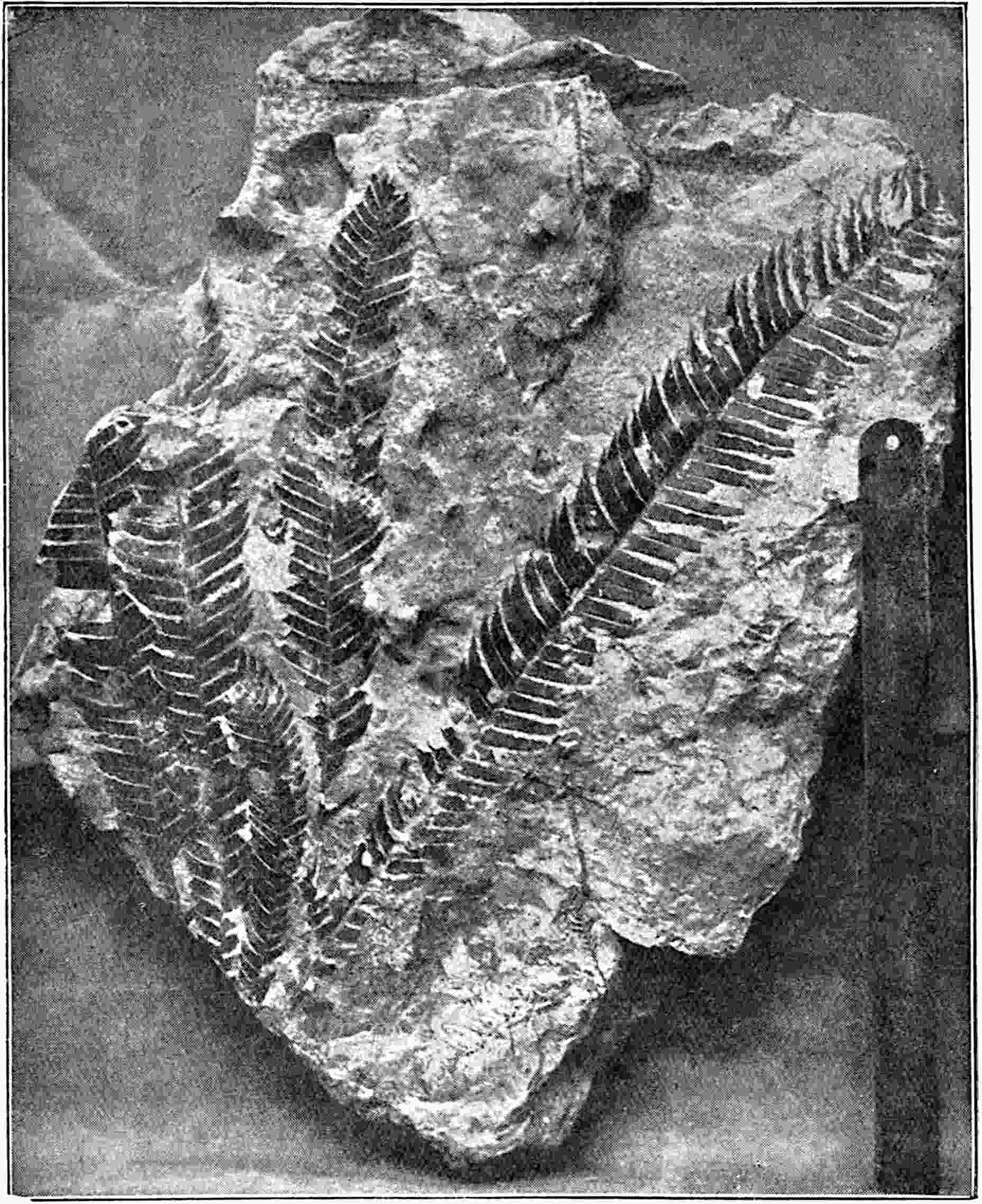
Fig. 587.
Ptilophyllum pecten.
(British Museum, V. 3795; ¼ nat. size.)
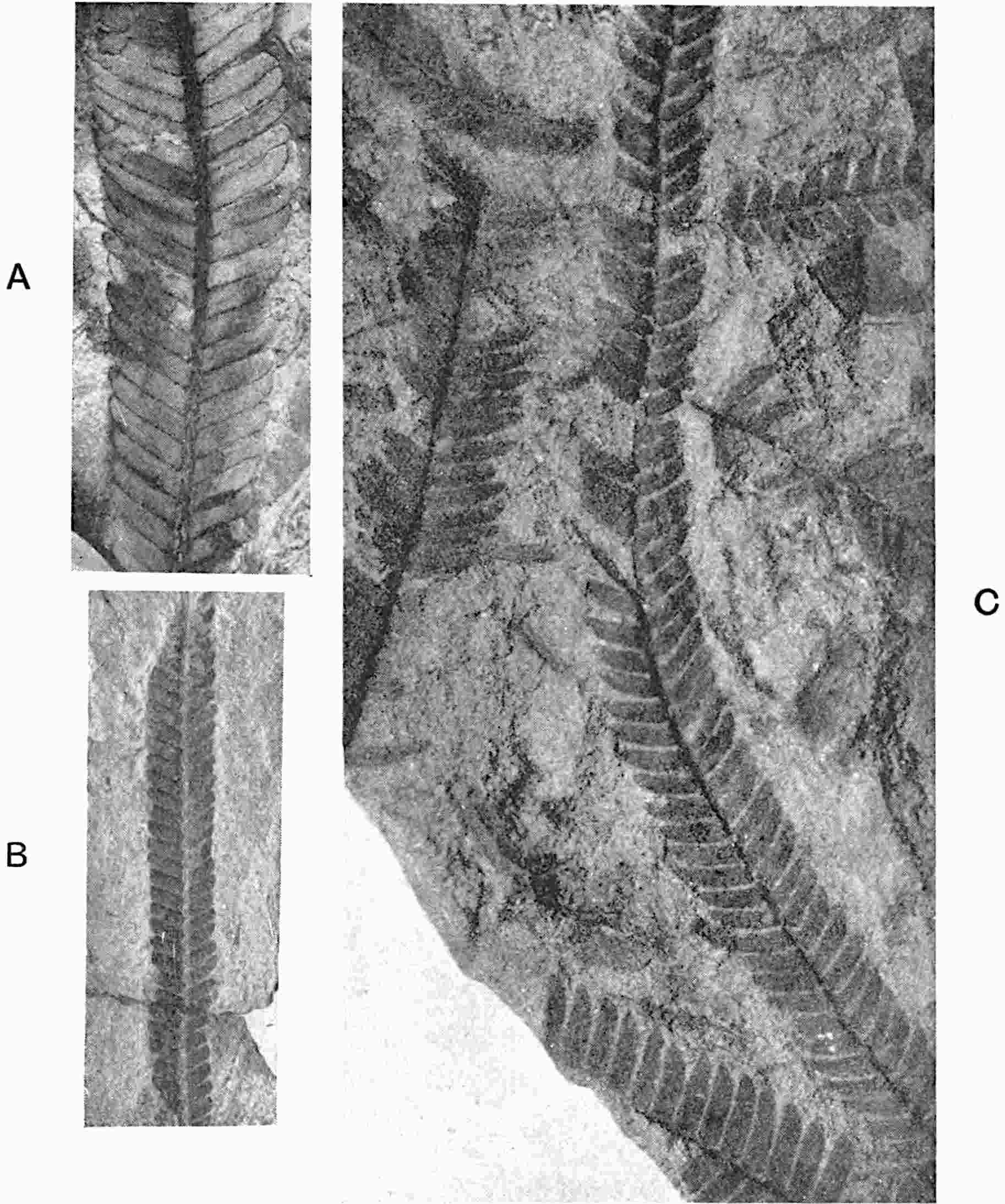
Fig. 588.
Ptilophyllum pecten.
A, C, specimens figured by Feistmantel as
Ptilophyllum cutchense
. B, Feistmantel’s
Otozamites angustatus
. (⅚ nat. size; Calcutta Museum.)
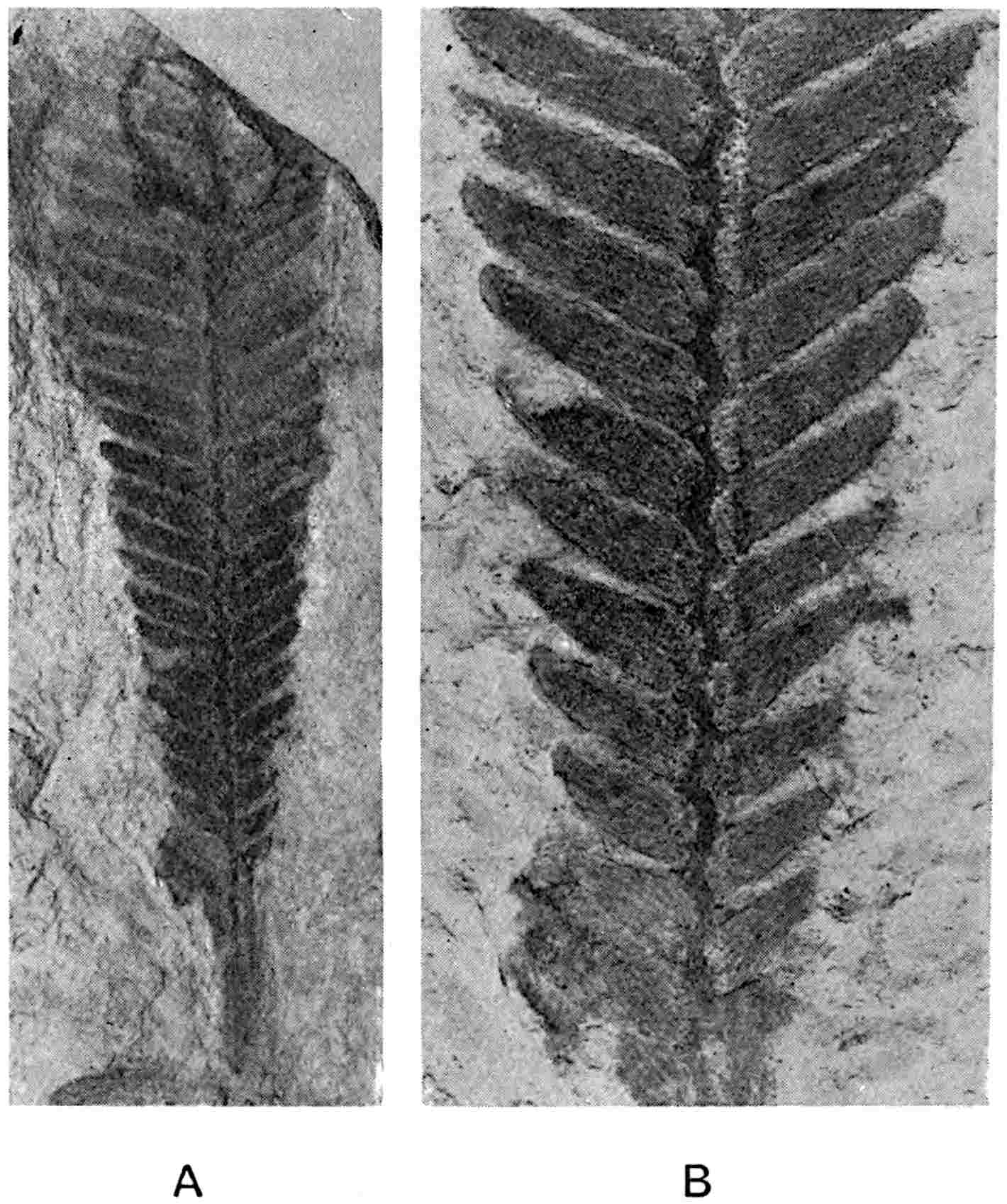
Fig. 589.
Ptilophyllum pecten.
A frond figured by Feistmantel as
Otozamites Hislopi
. A, ⅚ nat. size; B, enlarged (Calcutta Museum).
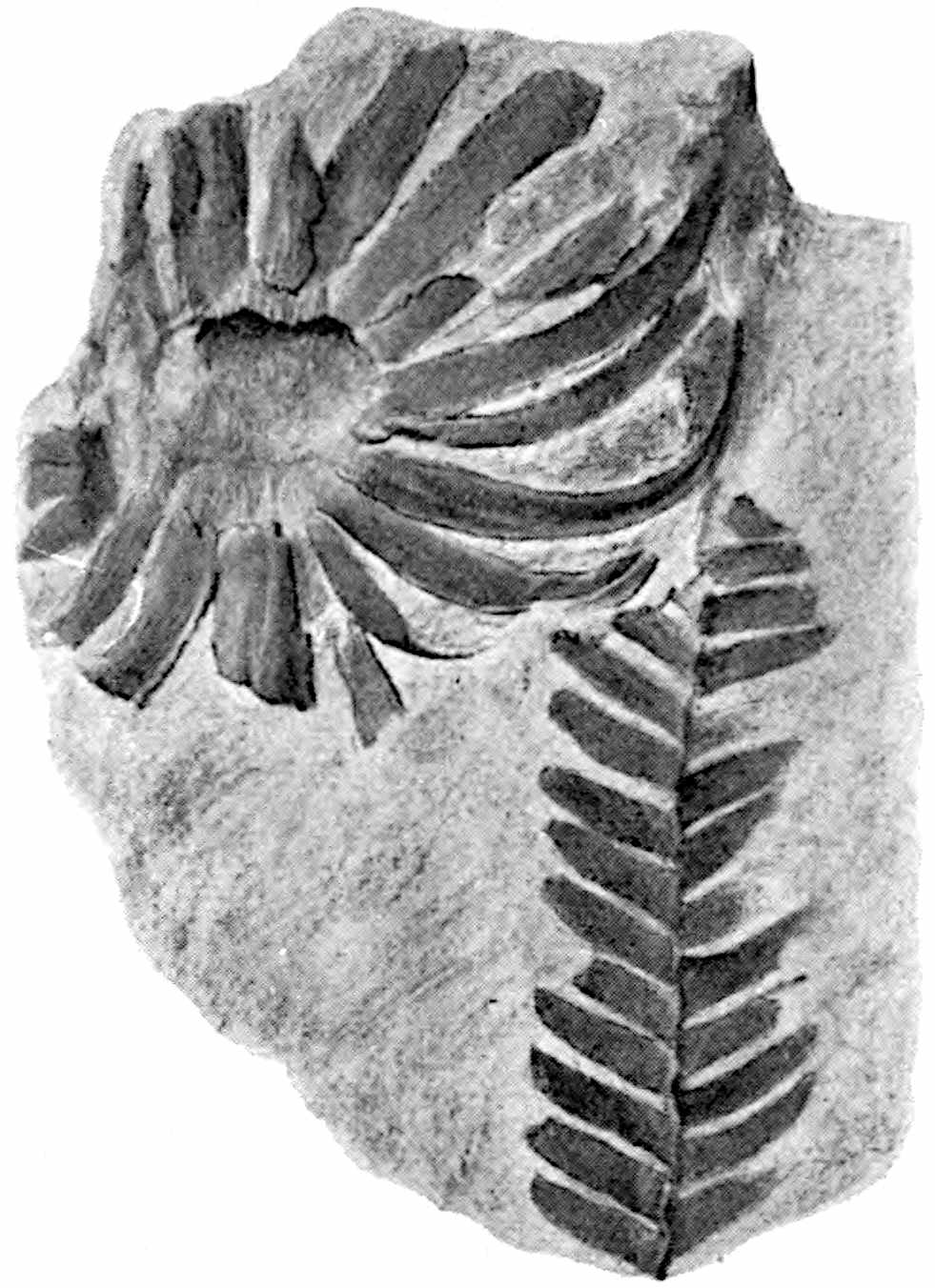
Fig. 590.
Ptilophyllum pecten
(
P. cutchense
) and
Williamsonia Blanfordi
. [Drawn from a specimen figured by Feistmantel (76
2
) Pl.
xii.
fig. 6.]
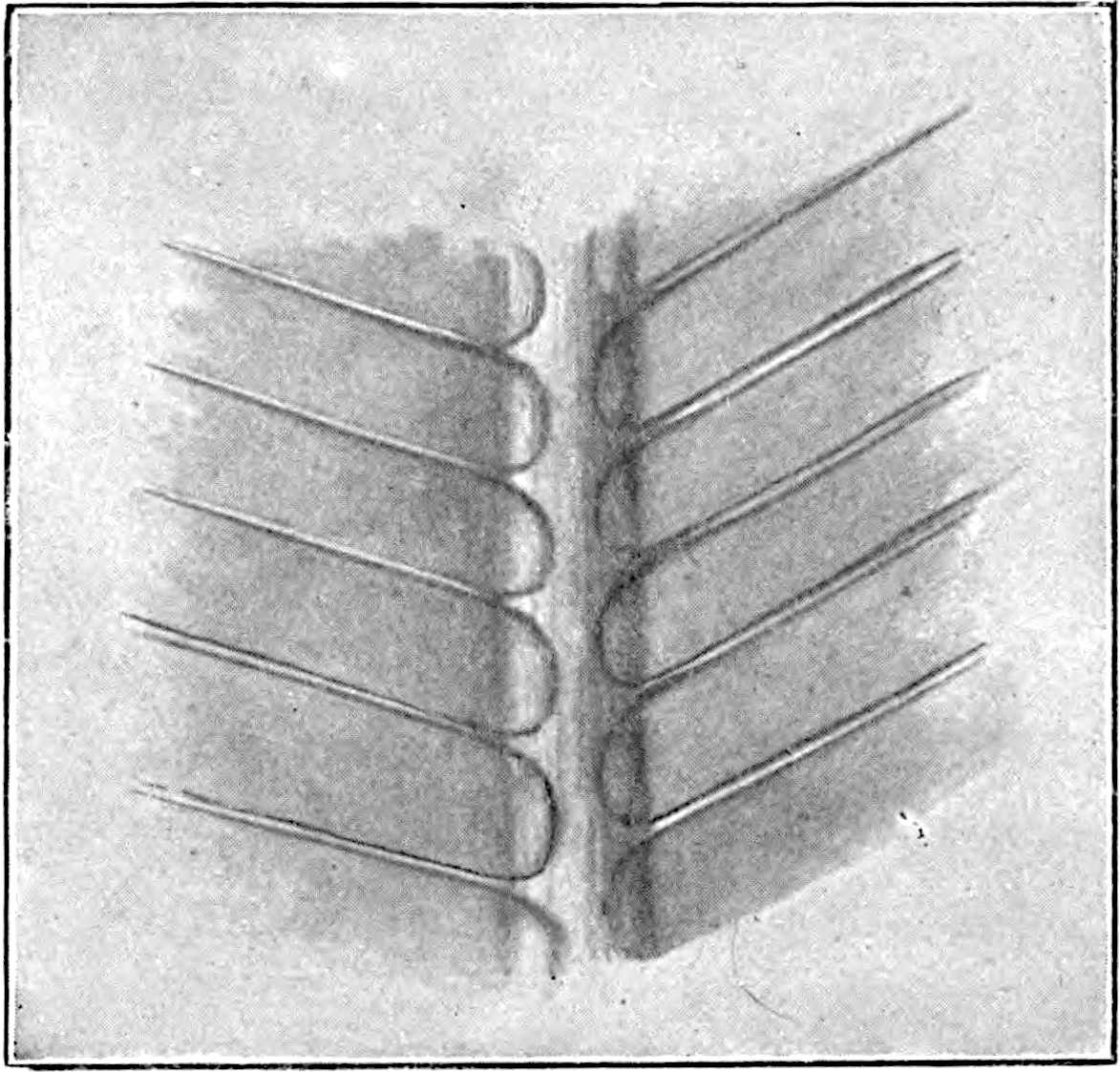
Fig. 591.
Part of the type-specimen of
Ptilophyllum cutchense
Morris. (British Museum; × 3.)
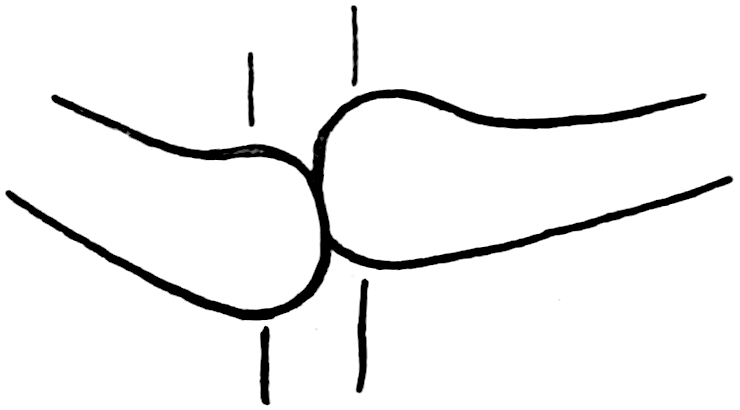
Fig. 592.
Ptilophyllum pecten.
(Manchester Museum, Williamson Coll. 3726.)
In the first part of the Catalogue of Jurassic plants from Yorkshire the opinion was expressed[1458], based on an examination of Morris’s type-specimen of Ptilophyllum cutchense and of a large number of English and other fronds identical with or closely allied to Pterophyllum pecten Lind. and Hutt., that the Indian and European fronds belong to the same genus. In a later paper[1459] it was maintained that P. cutchense and P. acutifolium are probably identical with the English type, and a drawing was published—reproduced in fig. 591—of Morris’s type-specimen. Dr Halle[1460] has discussed the genus Ptilophyllum and his investigations lead him to a different conclusion; he, like Zeiller and some other authors, employs Ptilophyllum in Feistmantel’s sense. The pinna-base is said to agree in its asymmetrical form with that in Otozamites, while it differs from the symmetrical base of Zamites pinnae. In Ptilophyllum both edges of the pinna-base are said to bend down in joining the rachis; at the upper corner the base thus becomes rounded and for some distance free from the rachis; it is also sometimes a little auriculate; at the lower edge the pinna is decurrent on the upper surface of the rachis. In a subsequent paper Halle[1461] repeats the view that the decurrence of the pinnae by their lower edges is an important distinguishing feature of Ptilophyllum, thus agreeing with Feistmantel whose illustrations appear to be confirmatory. The drawings in Feistmantel’s memoirs are, however, misleading and in some cases incorrect. An examination of a photograph of Morris’s type-specimen of P. cutchense led Halle to conclude that the two edges of the pinna-base bend downwards on joining the rachis as described by Feistmantel. This feature is not shown in the drawing reproduced in fig. 591: it is clear that either the drawing is incorrect or that there has been some mistake in the interpretation of the photograph. Through the courtesy of Dr Halle I have been able to examine the actual print: when viewed in its correct position the two edges of the pinnae appear to bend down as described by Halle, but if it is examined in the reverse position the lower angle of the pinnae is seen to be slightly rounded as in fig. 591, the apparent decurrence being due to a confusion between the appressed lower edge of one pinna, which is faintly shown, and the stronger downward trend of the upper edge of the pinna next below. The upper edges of the pinnae are more prominent because they are less appressed to the rachis while the lower half of the base is closer to the rachis and is frequently, though not in Morris’s specimen, overlapped by the upper edge of the next lower pinna. A re-examination of the type-specimen in the British Museum confirms this interpretation. The pinnae of Ptilophyllum are characterised by their attachment to the upper face of the rachis which they almost completely cover; the upper angle is rounded and in a few cases auriculate (fig. 592); the lower angle of the base is slightly rounded and not infrequently hidden by the imbrication of the adjacent pinna; it is occasionally auriculate (fig. 593). The pinnae are attached by nearly the whole base, but the upper angle is free. The veins are parallel, sub-parallel or, especially in the proximal portion of the lamina, oblique. The pinnae are linear, varying considerably in relation of length to breadth and in the form of the apex; they are straight or more or less falcate. The epidermal cells of such Ptilophyllum fronds as have been examined are characterised by strongly looped or sinuous walls; the stomata, confined to the lower surface, are roughly circular and the guard-cells are at right-angles to the veins and not appreciably sunk. Fig. 594 represents the appearance of a stoma in surface-view: ‘on either side of the central slit-like pore are two elliptical or hemispherical structures; they are somewhat flattened when they abut on the pore, and have rounded ends.... Between these and the subsidiary cells lie two other thickened patches, more or less hemispherical in shape, and apparently overlying the central structures.’ On the analogy of similar appearances in recent Cycads Mr Thomas[1462] interprets the two pairs of thickened patches as belonging to the upper and lower sides of the highly inclined guard-cells. This author calls special attention to the abundance on some of the fronds included in the aggregate species P. pecten of regular rows of circular hair-scars preserved as small annulate projections, ·03–·04 mm. in diameter. A comparison of the cuticles of different forms of Ptilophyllum pecten enabled Thomas to recognise more than one type: for one of these the name Ptilophyllum hirsutum is proposed. It is by such work as this that we may hope to discover differentiating characters.
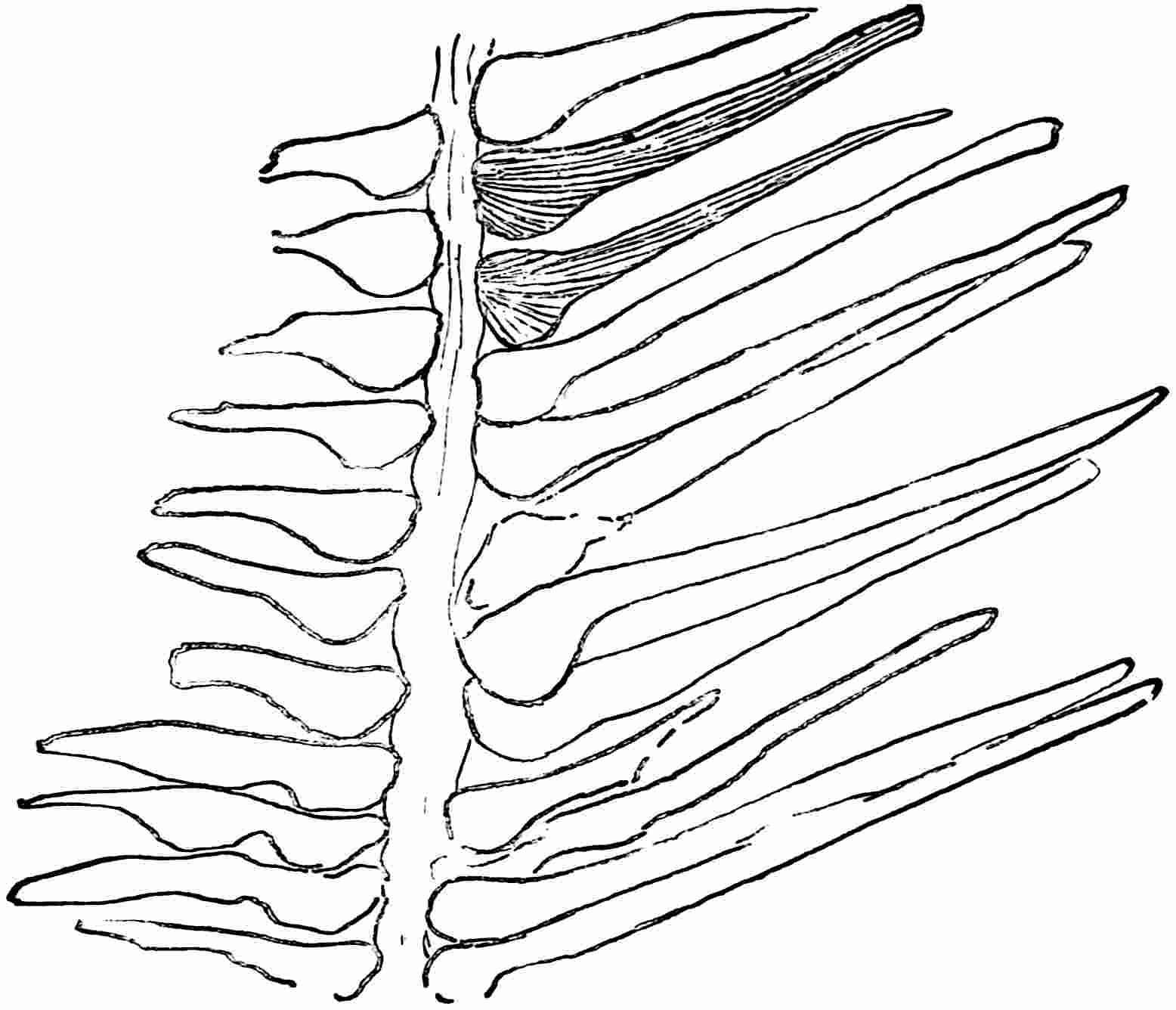
Fig. 593.
Ptilophyllum pecten.
From the Lower Estuarine beds, Cleveland, Yorkshire. (After Thomas; nat. size.)
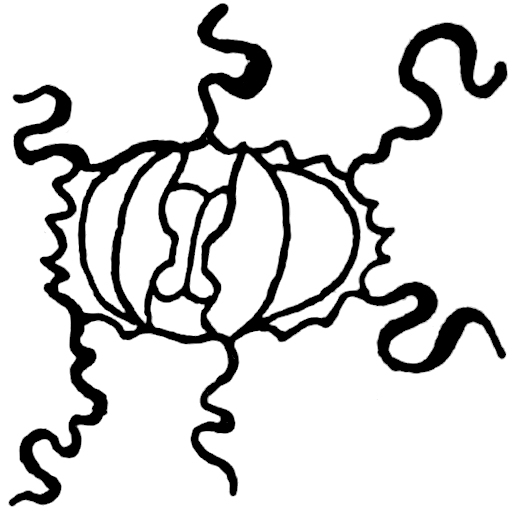
Fig. 594.
Ptilophyllum pecten
; stoma. (After Thomas and Bancroft.)
The different forms of Williamsonia flowers found in association with fronds of the Ptilophyllum habit also point to the inclusion of more than a single species under the group-species P. pecten. As additional evidence is obtained further analysis will be possible, but in dealing with impressions which include specimens transitional from one form of frond to another, the most convenient and to my mind the most logical course is to treat a species as an aggregate- or group-species. Some authors believe that the two fronds described by Phillips as Cycadites pecten and C. pectinoides are distinct species[1463], but there would seem to be no adequate reason for this view. The fronds described by Heer[1464] from the Lower Cretaceous of Greenland as species of Zamites and similar leaves from Graham Land included in that genus by Halle[1465] are in my opinion inseparable from Ptilophyllum, and this applies equally to Otozamites Hislopi (Old.) (fig. 589) and O. abbreviatus as figured by Feistmantel and by Halle. The nomenclature of Cycadean fronds having the habit of Ptilophyllum pecten is a great difficulty: after carefully reconsidering the whole question and comparing Feistmantel’s figured specimens with the large series of English fronds the conclusion reached is that the characters exhibited by ordinary impressions do not admit of any satisfactory grouping under well-defined specific types. In the first place, as already indicated, the use by some authors of the generic names Ptilophyllum, Otozamites, and Zamites creates a false impression of the degree of difference between the numerous forms of frond agreeing more or less closely with the specimens on which were founded the species Ptilophyllum acutifolium, P. cutchense, P. pecten, and P. pectinoides (figs. 587, 591, 595, etc.). In his important memoir on the Jurassic flora of Graham Land Halle[1466] discusses the limitation of Ptilophyllum, Zamites, and Otozamites. He employs Zamites for fronds with linear pinnae attached to the upper face of the rachis by a base which is more or less, but often very little, rounded and always asymmetrical, with or without a basal callosity: fronds of the type Z. gigas he includes in the section Euzamites, while Z. borealis and similar forms (fig. 597) are referred to a second section, Subzamites. It is in the sense of Halle’s section Euzamites that the generic name Zamites is employed in this chapter. On the other hand the fronds grouped by Halle as Subzamites have pinnae with the basal angles of the lamina very slightly rounded precisely as in Ptilophyllum as seen in fig. 596 (cf. fig. 598 which represents fronds referred by Halle to Zamites); and they are not distinguished by any feature of generic importance from Ptilophyllum as defined on page 519. The species Zamites pusillus, Z. Anderssoni, and Z. antarcticus (fig. 598) described by Halle from Graham Land as well as Heer’s Arctic forms[1467] Z. borealis (fig. 597), Z. speciosus, Z. brevipennis, and others are transferred to Ptilophyllum as types agreeing very closely with P. pecten and in some cases not clearly distinguishable from it even specifically.
Otozamites is the name employed by Halle for fronds with pinnae having contracted, asymmetrical and auriculate, bases, the anterior lobe being more developed than the posterior. The asymmetry of the pinna-base is considered an essential feature. As Halle states it is very difficult in some instances to draw a distinction between Otozamites and Ptilophyllum. As used in this chapter Otozamites signifies fronds with pinnae characterised by an auriculate base, a lamina usually broader than in Ptilophyllum, and by more spreading veins (fig. 604). The not infrequent occurrence of auriculate pinnae on fronds (fig. 603, A) which cannot be separated from typical examples of P. pecten illustrates the narrow dividing line as regards the form of the pinna-base between Ptilophyllum and Otozamites. The Indian species O. Hislopi (fig. 589) and O. abbreviatus, to which Halle refers some Antarctic fronds, cannot be distinguished from the English P. pecten or Feistmantel’s and Morris’s Indian fronds described as P. cutchense and P. acutifolium: these forms are therefore included in Ptilophyllum.
Ptilophyllum (Williamsonia) pecten (Phillips).
This designation is employed in a wide sense for a group of fronds exhibiting a considerable range in size, in the relative breadth and length of the linear pinnae, and in other features. Under P. pecten are included (i) the English fronds from Yorkshire first described by Phillips[1468] as Cycadites pecten and C. pectinoides, the former from the Middle shale, the latter from the Lower shale of the Yorkshire coast, together with the Stonesfield slate specimens named by Sternberg[1469] Polypodiolites pectiniformis (fig. 595) and by Brongniart[1470] and Lindley and Hutton[1471] Zamia pectinata; (ii) the Indian specimens already considered and (iii) numerous examples recorded under different names from Jurassic strata in many countries. Fronds from the Yorkshire coast named by Brongniart[1472] Zamia Goldiei, though regarded by some authors as examples of Otozamites, are probably referable to P. pecten. Andrae’s Pterophyllum rigidum[1473] (fig. 596) from Steierdorf is almost certainly a form of Ptilophyllum pecten. The specimen shown in fig. 587 is one of the few examples of fronds apparently preserved in their original position attached in a cluster to a Williamsonia (Bucklandia) type of stem. The range in size and form of the pinnae is illustrated in figs. 588, 592, 593.
Fig. 595. Ptilophyllum pecten. The specimen figured by Sternberg as Polypodiolites pectiniformis. (Oxford Museum; ⅚ nat. size.)
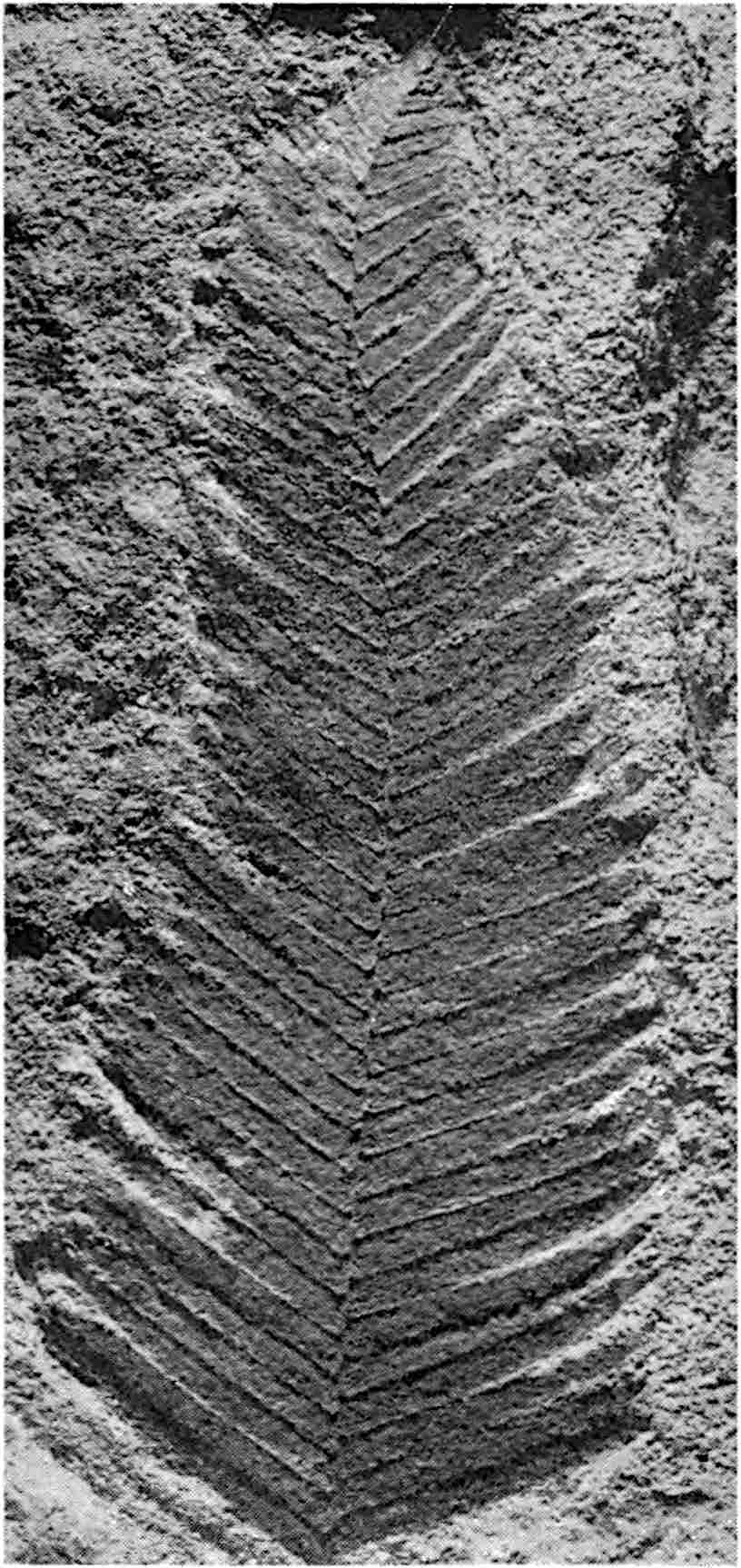
Fig. 596. Ptilophyllum pecten. Andrae’s Pterophyllum rigidum from Steierdorf, Banat. (British Museum, No. 41438; nat. size.)
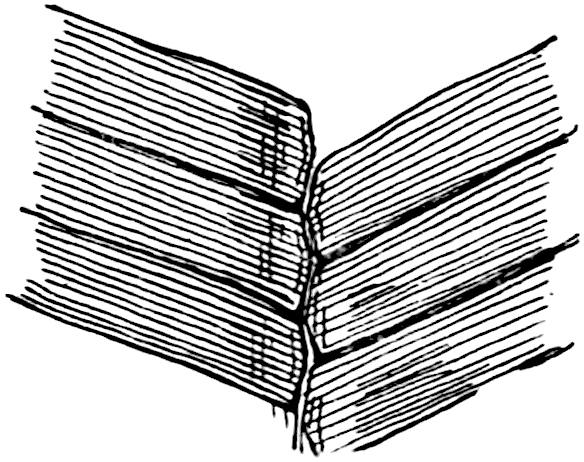
Fronds linear, tapering gradually towards the base and apex, often characterised by a marked uniformity in breadth. The pinnae, short or comparatively broad or long and narrow, are straight or more or less falcate; the apex is obtuse or acute or the upper margin of the lamina may be almost straight and the lower edge curved abruptly upwards at the apex; the pinnae are usually attached obliquely to the rachis but may be almost at right-angles; with the exception of the upper angle, the whole of the base is attached to the frond-axis; the base of the lamina may be symmetrical, both angles being slightly rounded, or asymmetrical, the upper or less frequently the lower corner being auriculate (figs. 592, 593). There is no basal callosity on the lamina nor is there a median sinus. The veins are more or less spreading at the base but for the most part parallel. The features of the epidermal cells and stomata are mentioned in the general account of the genus. Fertile shoots of plants with this type of frond are described under Williamsonia. Very little is known of the stems which bore Ptilophyllum fronds, but as stated on page 488 Indian specimens show leaves of Ptilophyllum cutchense attached to a piece of stem (fig. 579) having the characters of Bucklandia and characterised by a xylem-cylinder denser than in recent Cycads; the structure of the wood at least in the Indian stem is rather pycnoxylic than manoxylic.
The fronds grouped under Ptilophyllum pecten are very widely distributed in Jurassic floras; they are recorded from many localities in Europe, from Turkestan[1474], India, Graham Land[1475], Patagonia[1476], and elsewhere.
As thus defined this ‘species,’ or more correctly this group of forms, undoubtedly includes more than one species in the strict sense, but without additional data it is maintained that the recognition of clearly defined specific types or varieties is beyond our power. It may be urged that in view of the wide geographical range of the Ptilophyllum pecten type of frond and the admitted probability that several species in the narrower sense are represented, distinctive specific names should be retained even though under such designations are included forms that, so far as can be seen from impressions, exhibit no constant distinguishing features. My purpose is to emphasise the futility of attempting to found well-marked species on the available material. The student must decide for himself what course to pursue, whether to retain such a specific name as cutchense for the Indian fronds or to employ that and other specific names as designations of geographical types differing in no clearly defined or constant characters from examples of the English Ptilophyllum pecten. A comparative examination of the cuticular membranes in the comparatively few cases where that is possible would probably furnish a basis for a satisfactory subdivision of the group-species.
The names Ptilophyllum Anderssoni, P. boreale, and P. antarcticum are retained for certain forms selected from a number of closely allied types partly on the ground that these fronds exhibit some more or less well-marked distinctive characters and in part as a recognition of the existence of geographical forms.
Ptilophyllum boreale (Heer).
Heer[1477] described numerous well-preserved impressions of pinnate fronds from the Lower Cretaceous plant-beds of Kome, Greenland, which he referred to several species of Zamites though the differences between them are hardly of specific rank. An inspection of several of the figured specimens in the Stockholm Museum showed that Heer’s drawings are in the main accurate. Zamites borealis (fig. 597) is characterised by small linear pinnae attached to the upper face of the rachis, the stoutness of which is a noteworthy feature; the veins are parallel and simple. In the shape of the pinnae, including the base-characters, this species agrees closely with P. pecten. The slightly falcate or straight pinnae are 1·7–2 mm. broad and reach a length of 15 mm.; in Z. speciosum Heer, probably specifically identical with P. boreale, the pinnae are relatively longer, and in Z. brevipennis Heer they resemble the shorter pinnae of some of the narrow fronds of P. pecten.
A preparation of the cuticle of a pinna of P. boreale made by Mr Thomas from a specimen in the Stockholm Museum shows a marked difference between the upper and lower epidermis: the cells on the upper surface of the lamina have very thick and sinuous walls precisely as in P. pecten, but the cells are often broader than long and not elongated parallel to the long axis of the pinna; those of the lower epidermis are thinner and less clearly preserved: the stomata, which appear to be like those of P. pecten, are scattered and not in rows.
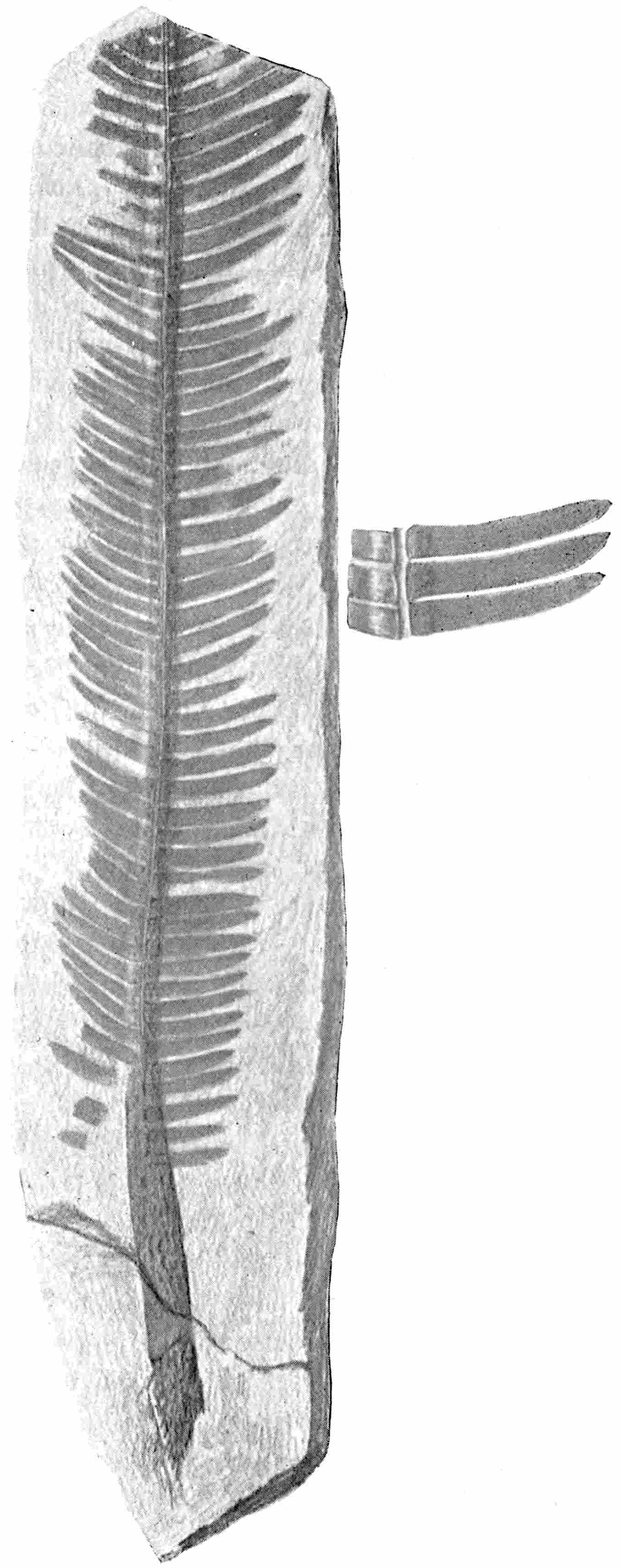
Fig. 597.
Ptilophyllum boreale
(Heer). Drawn from one of the specimens from the Lower Cretaceous beds at Ekkorfat, Greenland, figured by Heer. (Stockholm Museum; nat. size and a few pinnae enlarged.)
Ptilophyllum antarcticum (Halle).
The fronds from the Jurassic rocks of Graham Land, described by Halle as Zamites antarcticus[1478], are very similar to some forms of P. pecten and to P. boreale and other Greenland forms; the linear subacute pinnae are attached to the upper face of the rachis at a wide angle and the base of the lamina is truncate and may be very slightly constricted. The veins are dense, as many as 5 in 1 mm., and they are occasionally forked near the base (fig. 598, A).
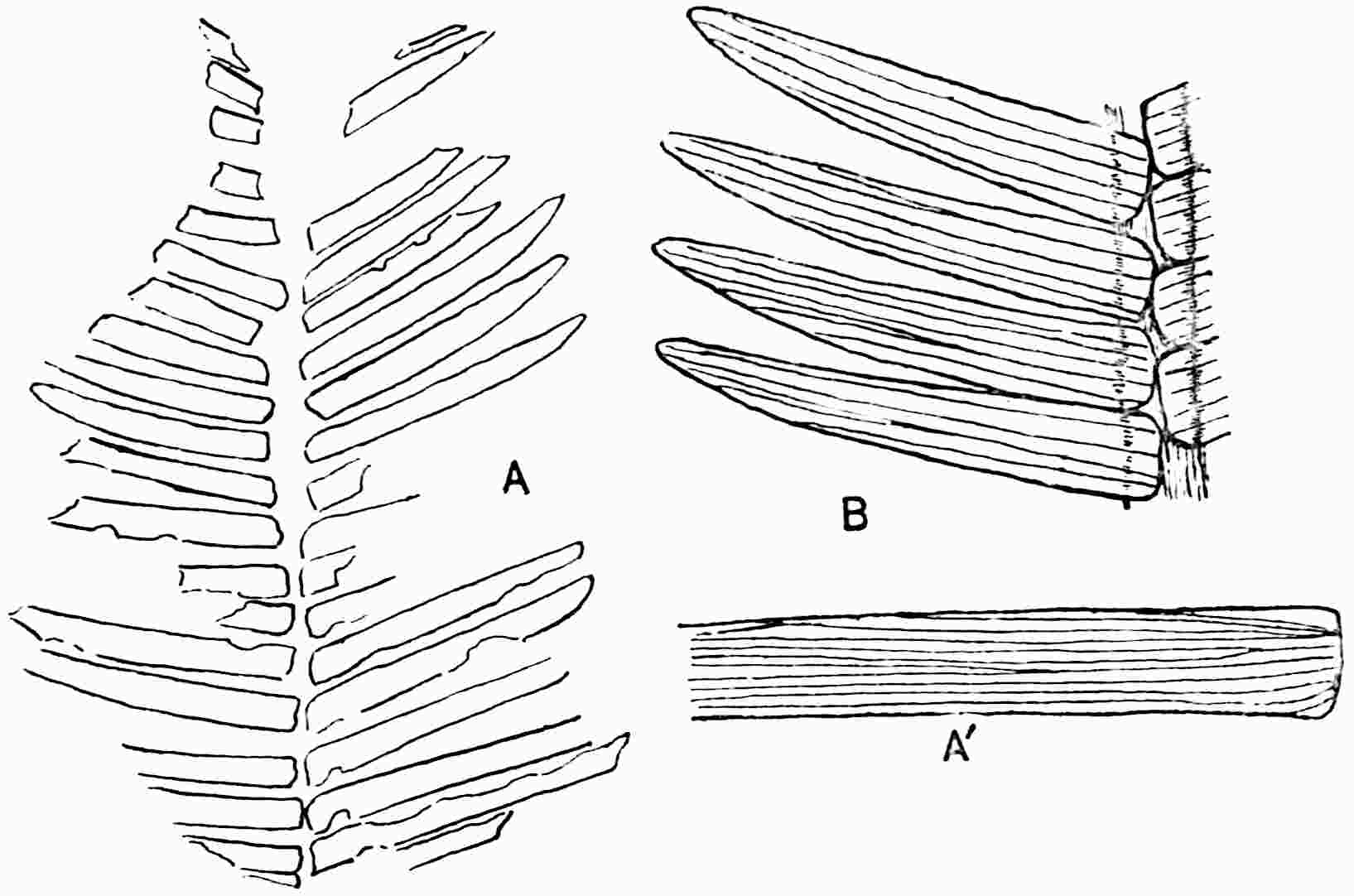
Fig. 598.
A, A′,
Ptilophyllum antarcticum
. B,
P. Anderssoni
. (After Halle.)
Ptilophyllum Anderssoni (Halle).
This Graham Land species (fig. 598, B), referred by Halle to Zamites[1479], is of the same general type as P. pecten, but is characterised by a coarser venation and by the wider angle of attachment of the pinnae.
Ptilophyllum Dunkerianum (Goeppert).
Goeppert[1480] proposed the name Pterophyllum Dunkerianum for some specimens from the Wealden of North Germany which were afterwards figured by Dunker[1481]. Miquel[1482] included the species in his genus Dioonites and this name has been adopted by other authors. Attention has been drawn to the inconsistent use of the title Dioonites[1483], and I have previously employed the name in a sense similar to that in which it has been adopted by Nathorst, that is for fronds with long and narrow pinnae without any basal constriction and not auriculate, attached more or less at right-angles to the upper face of the rachis; but so defined Dioonites differs in no essential particular from forms of Ptilophyllum or from fronds referred by authors to Schimper’s genus Ctenophyllum. The name Ctenophyllum[1484] was instituted for certain fronds differing in some points from Otozamites and Dioonites. One such type is Ctenophyllum (Ptilophyllum) pecten (Lind. and Hutt.): this is quoted in Zittel’s Handbuch as a typical representative of the genus. Schimper followed Feistmantel in his definition of Ptilophyllum, a definition which is not in accordance with the characters of the fronds on which it was founded by Morris. Fontaine, on the other hand, has applied Ctenophyllum to fronds of a different type which are now included in the genus Pseudoctenis. There would seem to be no adequate ground for the retention of Ctenophyllum as a generic designation.
The Wealden species P. Dunkerianum is characterised by the following features: rachis fairly stout, pinnae approximate, linear 2–3 mm. broad and reaching a length of 11 cm. or more, gradually narrowed towards the apex, attached in two almost contiguous rows to the upper face of the frond-axis: the lower margin of the lamina may be slightly decurrent, e.g. in the apical part of the frond or very slightly broadened and bluntly rounded. The pinnae are attached at right-angles or, near the apex, obliquely; veins 5–6, parallel. The epidermal cells as figured by Schenk[1485] have very sinuous walls and are identical with those of the English and Indian forms of the group-species P. pecten; the stomata are confined to the lower surface. If Schenk’s drawings of the stomata are correct they differ from those of other species of the genus in their simpler structure; there are no subsidiary cells and the guard-cells show no cuticularised bands. In habit this species resembles Encephalartos Ghellinckii Lehm. (fig. 382). The superficial resemblance of the narrow linear pinnae to those of Cycadites led Dunker and Schenk to refer to that genus some specimens which have since been described as identical with P. Dunkerianum.
ZAMITES. Brongniart.
In the first instance the generic name Zamites was used in addition to Zamia for certain pinnate fronds including species[1486], such as Z. Bechei, which are now regarded as typical examples of Otozamites. Subsequently Brongniart gave up Zamia for fossil fronds and applied Zamites to fronds with entire pinnae, not truncate at the apex and not decurrent but slightly constricted at the base. Braun’s two genera Podozamites and Pterozamites were relegated to the position of subgenera. The name Podozamites has been employed by Schenk[1487] for specimens now included in Zamites, and Zamites is used by him[1488] for some fossils which are examples of Podozamites as generally understood. Goeppert’s definition[1489] of Zamites includes fronds with pinnae of the Otozamites type, and this author pertinently compares Zamites with recent Encephalartos leaves. Pomel[1490] proposed the name Crossozamia for certain fronds of the Zamites type, but this genus with several others instituted by the same author has not been adopted. Bornemann[1491] described Zamites as comprising species with a greater or less resemblance to the fronds of recent Zamias.
As defined below, Zamites fronds may be compared with those of some species of Encephalartos, Ceratozamia, and Macrozamia. There has been considerable difference of opinion with regard to the range of form in the pinnae that it is advisable to include in Zamites. The name Zamiophyllum was proposed by Nathorst[1492] for a Wealden species, described by Ettingshausen as Pterophyllum Buchianum (fig. 601, A–C), characterised by a decrease in the breadth of the linear pinnae towards the point of attachment and, according to Nathorst’s description, by the lateral attachment of the pinnae. An examination of specimens of this type from English rocks[1493] enabled me to show that the pinnae are attached to the upper face of the rachis. Zeiller[1494] has also included Zamiophyllum in Zamites, but Halle’s recent definition[1495] of the latter genus excludes fronds of the Zamiophyllum type. Schimper instituted the name Glossozamites[1496] for fronds bearing pinnae with rounded and slightly contracted bases and borne on grooves on the upper surface of the rachis (fig. 601, F). In venation the pinnae agree with those of Otozamites but the base is not auriculate. Kurr’s Liassic species Pterophyllum oblongifolium[1497] included by Schimper in Glossozamites is probably an Otozamites. Another species referred to this genus is Schenk’s Podozamites Zitteli[1498] from the Urgonian of Austria (fig. 601, F): in this species the slightly falcate pinnae with obtuse apices have rounded and not auriculate bases and there is some evidence of a basal callosity. This species agrees so closely with such a typical Zamites as Z. gigas that it is difficult to see on what grounds the retention of Glossozamites is desirable. A Portuguese specimen referred by Saporta[1499] to Glossozamites, G. brevis, is founded on a single specimen very like a leaflet of Otozamites Klipsteinii (Dunk.); and G. parvifolia Yok.[1500] from China has no claim to be included among Cycadean fronds. Feistmantel’s Glossozamites Stoliczkanus[1501] is almost certainly a leaf of Cordaites. For certain fronds originally described as Zamites Zeiller[1502] has instituted the genus Plagiozamites. An important question as to the type of frond which may conveniently be included in the genus Zamites was raised by the application of this name by Heer to some Lower Cretaceous fronds from Greenland, Z. borealis (= Ptilophyllum boreale, fig. 597), and others which differ in the form of the pinnae from species usually regarded as typical of the genus. Halle[1503] accepts the Greenland species as examples of Zamites though he distinguishes them by a sectional name Sub-Zamites; he defines Zamites as including fronds with pinnae attached to the upper face of the rachis with a contracted and always symmetrical base though in some cases the basal contraction is exceedingly small; there is a more or less distinct basal callosity. He recognises two types, (i) Eu-Zamites, e.g. Zamites gigas (fig. 599), in which the pinnae are strongly contracted basally and have a callosity, and (ii) Sub-Zamites, e.g. Z. borealis[1504], etc., in which the pinnae are not so broadly rounded at the base and retain the same breadth to the point of insertion where they are ‘very rapidly and very little contracted,’ with or without a basal callosity. The basal callosity in these forms is not shown in many of the pinnae and is at most but a slight rounding of the angles of the truncate base. The specimens referred by Halle to Sub-Zamites do not appear to differ in any feature worthy of generic rank from Ptilophyllum.
In the following definition Zamites is employed in a sense more or less in accordance with Brongniart’s usage but with the inclusion of such forms as Z. Buchianus, the type of Nathorst’s Zamiophyllum, and the exclusion of Heer’s Arctic and Halle’s Antarctic fronds referred by them to Zamites.
Fronds broadly lanceolate reaching a length of over 60 cm.; pinnae more or less oblique or at right-angles to the rachis (fig. 599), attached to the upper surface but not completely covering it, linear or linear-lanceolate, acuminate or obtuse, usually abruptly contracted at the rounded base and more rarely (e.g. Z. Buchianus, fig. 601) gradually tapering to the proximal end, with or without a callosity at the symmetrical base; veins divergent at the base, simple or dichotomously branched, for the most part parallel to the edges of the lamina and slightly divergent in the apical region. The presence of a basal callosity, such as is best seen in the pinnae of recent species of Macrozamia, is not a feature of great importance and cannot be easily recognised in many impressions. In the process of fossilisation the pinnae are often flattened against the surface of the rachis and this may produce transverse wrinklings of the lamina suggestive of a basal thickening. In some cases stems of the Bucklandia type occur in connexion with Zamites fronds (fig. 541). An account of these stems, and of inflorescences of Williamsonia which were borne by some at least of the plants with Zamites leaves is given in Chapter xxviii. In such examples of Zamites as have been examined the epidermal cells have sinuous walls and the stomata[1505], confined to the lower face of the lamina, occur in rows with their long axis at right-angles to that of the pinnae.
Zamites ranges from Rhaetic to Lower Cretaceous strata.
Zamites truncatus Zeiller.
A Rhaetic species from Tonkin[1506] characterised by oval linear pinnae given off at a wide angle, alternate and not contiguous; apex obtusely truncate, gradually narrowed to a cuneate base which is rounded or elliptical and has a more or less definite callosity. The pinnae vary from 3 to 5 cm. in length and from 5 to 13 mm. in breadth.
Zamites gigas (Lindley and Hutton).
The specific name gigas is retained in preference to that of Mantelli employed by Brongniart[1507] on the ground that he afterwards discarded it in favour of the designation proposed by Lindley and Hutton[1508], and because their name has been generally adopted.
Fronds large, exceeding 60 cm.; broadly linear lanceolate; the comparatively slender rachis bears alternate linear lanceolate pinnae with a rounded and usually slightly swollen base and an acuminate apex. At the apex of the frond the pinnae are narrow and linear (fig. 599) and almost parallel to the rachis; in the lower part they are shorter and relatively broader and attached approximately at right-angles. The numerous veins diverge from the centre of the base but for the most part are parallel to the edge of the lamina. The form of the epidermal cells and the structure of the stomata have recently been described by Mr Thomas. The external features of the stem (fig. 541) are described under the genus Williamsonia. In the case of fronds of this type from English Jurassic rocks it would be legitimate to speak of them as Williamsonia gigas, but in view of the fact that such fronds usually occur as detached specimens and without any associated flowers it is advisable, as Nathorst maintains, to retain the non-committal genus Zamites.
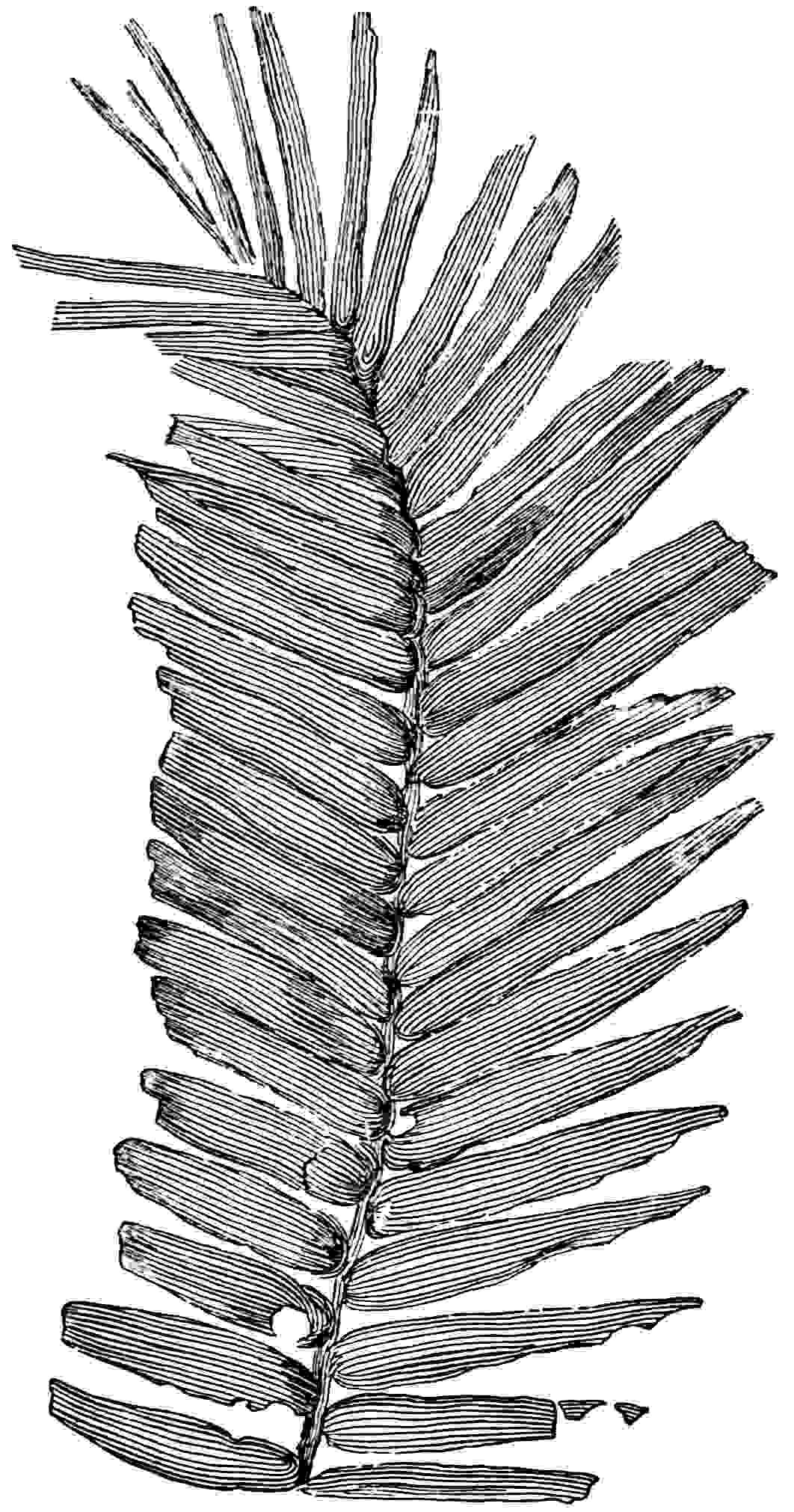
Fig. 599.
Zamites gigas
. (British Museum, V. 2723
a
; ½ nat. size.)
This type of frond is widely distributed in Jurassic strata. The occurrence of many forms agreeing generally with the type-specimen but differing from it in features that are not constant or of real morphological importance renders accurate specific delimitation very difficult. Species that appear to be indistinguishable from Zamites gigas by any well-marked characters are, Zamites Feneonis[1509] Brongn., Z. Moreaui[1510] Brongn., Z. Renevieri[1511] Heer, and Z. claravallensis[1512] Sap.; similarly Z. Schmiedelii And.[1513] is probably identical with Z. gigas. The Lower Cretaceous species Zamites bohemicus[1514] Vel. and Z. iburgensis[1515] Hos. and von d. Marck represent very similar forms.
Zamites recta (Tate).
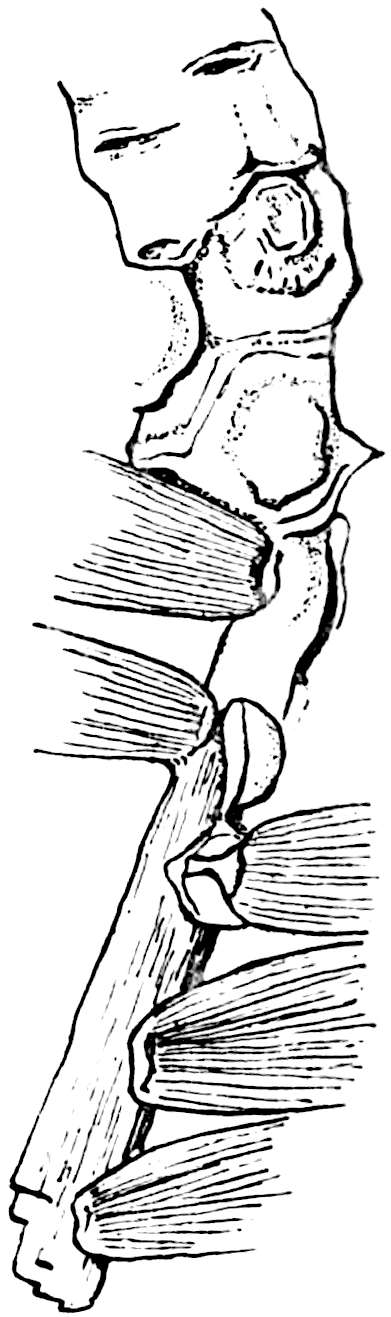
Fig. 600.
Zamites recta
. (Uitenhage series, S. Africa.)
This species was originally described by Tate[1516] as Palaeozamia (Otozamites) recta from Wealden strata in South Africa and subsequently transferred to Zamites[1517]; it bears a very close resemblance to Z. gigas. The fronds bear alternate linear pinnae attached to the upper face of the rachis by a slightly contracted and swollen base. The lamina has an acuminate asymmetrical apex and the upper edge is slightly falcate; the larger pinnae are over 6 cm. long and nearly 1 cm. broad; the veins are frequently forked as they converge towards the base of the lamina. No clear evidence of association of these fronds in the Uitenhage series of South Africa with Williamsonia flowers has been discovered, but a specimen[1518] in the Tate collection in the British Museum may be a badly preserved cluster of bracts belonging to a Williamsonia. The rachis of this species shows some peculiar features in the form of two rows of alternate cushions in some partially decayed specimens. One of these is shown in fig. 600; the cushions are raised oval projections with a flat top, and pieces of the rachis without pinnae might easily be mistaken for a Coniferous stem.
Zamites Carruthersi Seward.
A species founded on specimens from the Wealden of Sussex[1519] and recorded from Kimmeridge beds in Scotland[1520], characterised by linear or linear-elliptical pinnae attached obliquely to the outer part of the upper surface of the rachis, somewhat abruptly narrowed at the proximal end but slightly broadened at the actual base (fig. 601, D, E). The pinnae appear to have been caducous and, as in fig. 601, D, the position of an absciss-layer is occasionally visible. In habit the fronds bear a close resemblance to those of Encephalartos longifolius Lehm. The veins diverge from the base and are for the most part parallel, though divergent at the bluntly rounded apex. If, as may be the case, a specimen figured by Hugh Miller[1521] from Scotland as Zamites and subsequently named by Richards[1522] Podozamites Milleri is identical with Z. Carruthersi, the specific name Milleri has priority.
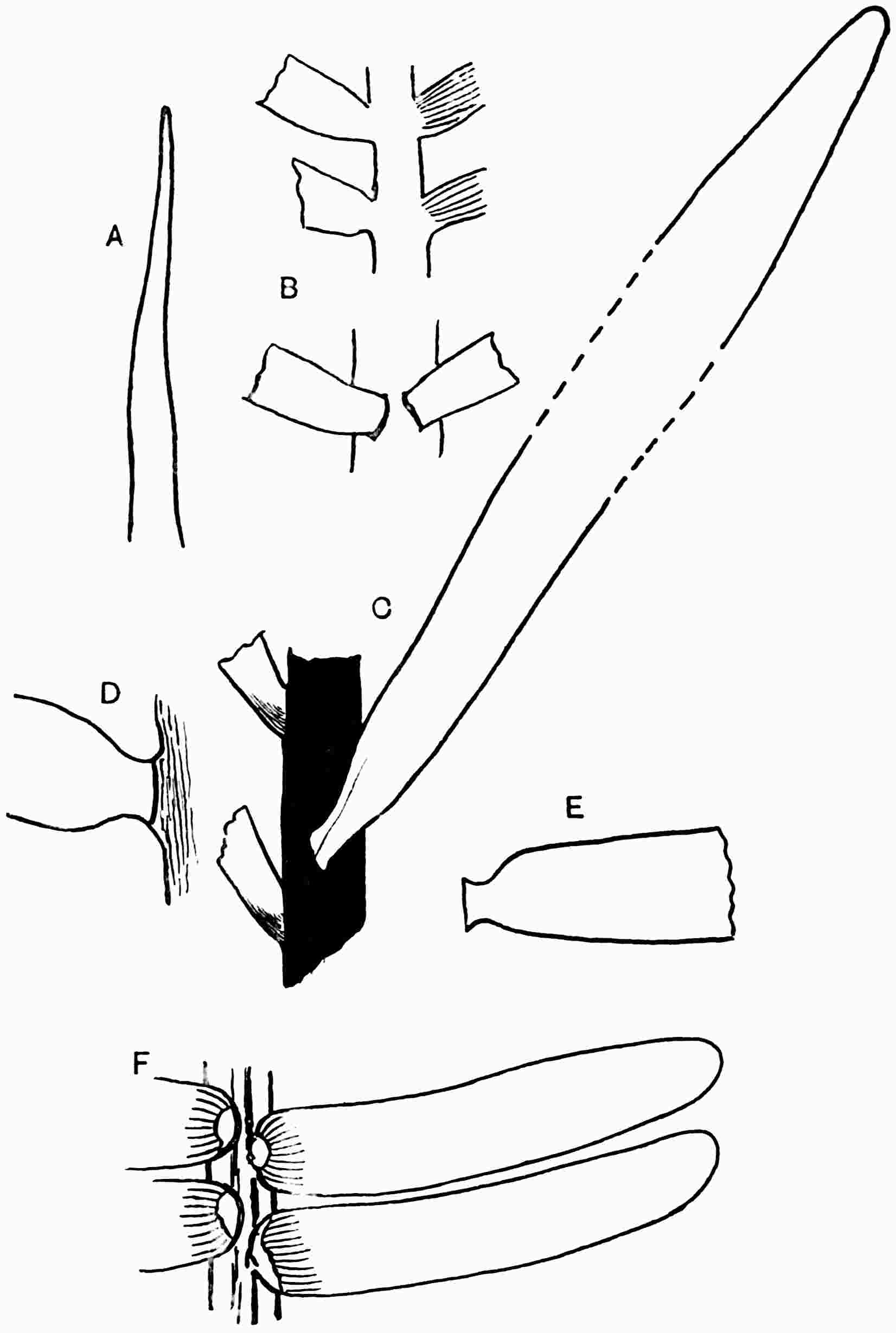
Fig. 601.
A–C,
Zamites Buchianus
. D, E,
Zamites Carruthersi
. F,
Zamites Zitteli
. (A–C after Seward; British Museum; A, V. 2363; B, V. 2123
a
; C, V. 2227; F, after Schenk.)
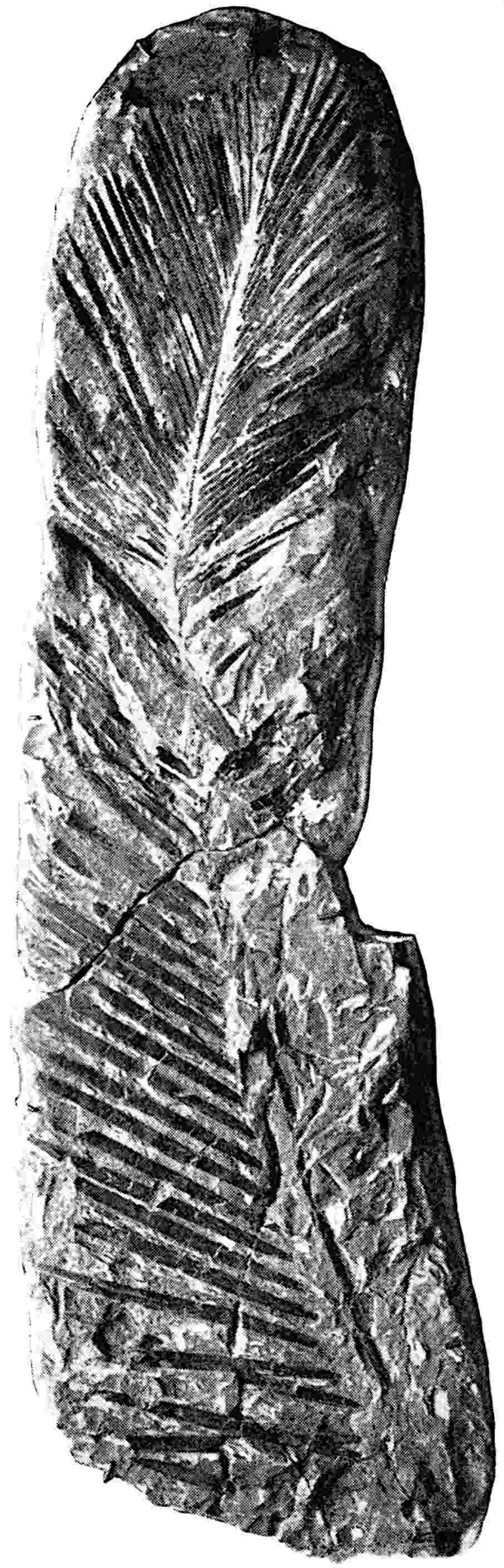
Fig. 602.
Zamites Buchianus
. (British Museum, V. 2120; ⅙ nat. size.)
Zamites Buchianus (Ettingshausen).
A Wealden and Lower Cretaceous species[1523] (figs. 601, A–C; 602) represented in several European localities, also in North America and Japan, reaching a length of over 70 cm.; in habit very similar to Ceratozamia mexicana, Macrozamia Macleayi and some other recent Cycads. The rachis has a fairly broad median groove on the upper surface; pinnae alternate, opposite or sub-opposite, from 3 to 20 cm. long and from 1·5 to 2 cm. broad, linear, generally narrowed towards the base, but in the more slender segments the reduction in breadth is less obvious; attached obliquely to the rachis, slightly thickened and broadened at the base (fig. 601, C), separated from the rachis by a distinct absciss-layer and leaving an elliptical scar; usually inclined at about 45° but the angle varies considerably in different parts of a frond (fig. 602); apices generally tapering to a point, or more or less obtusely rounded; veins numerous, parallel, and not as a rule prominent. It is by no means unlikely that specimens figured by Goeppert[1524] and some other authors as Pterophyllum saxonicum or Dioonites saxonicus are examples of this species. Fontaine[1525] speaks of Dioonites Buchianus as one of the most widely distributed and characteristic members of the Potomac flora and it is described from Japan by Yokoyama[1526] and Nathorst[1527]. This type appears to be especially characteristic of Wealden strata.
OTOZAMITES. Braun.
Braun[1528] proposed the name Otozamites for certain Mesozoic fronds formerly included in Zamites, one of his types being Otozamites obtusus (Lind. and Hutt.) (fig. 603, B) originally regarded by Brongniart as a Fern and named Filicites Bucklandi[1529]. The auriculate form of the base of the pinnae and the spreading veins were emphasised in the definition of the genus. As in the case of many other Cycadean fronds the limits of the genus are not always easy to define, but as described below the genus is on the whole fairly distinctive. It is a very widely spread Jurassic type and extends from Triassic to Lower Cretaceous rocks. The supposed Cretaceous species from Greenland, O. groenlandica Heer[1530], is probably not a plant-impression but a polished groove in the rock.
Fronds pinnate, reaching a length of 50 cm. or more in some species; pinnae alternate, separate or contiguous and imbricate, attached by a portion of the base to the upper surface of the rachis, long and narrow (fig. 603, A), broadly oval or almost orbicular, apex acute or obtuse, base auriculate and asymmetrical[1531], the anterior lobe being more prominent than the posterior edge of the lamina which is usually rounded. The veins radiate from the base and pass obliquely with occasional branching to the edge of the pinna; in the more linear pinnae the veins may be parallel or nearly so. Zigno[1532] figured a piece of an Otozamites frond from Jurassic Italian strata in connexion with a Williamsonia and the actual specimen in the Padua Museum amply justifies the impression produced by the published drawing. Wieland’s investigations[1533] in Mexico have brought to light many cases of association of Otozamites fronds and Williamsonia flowers.
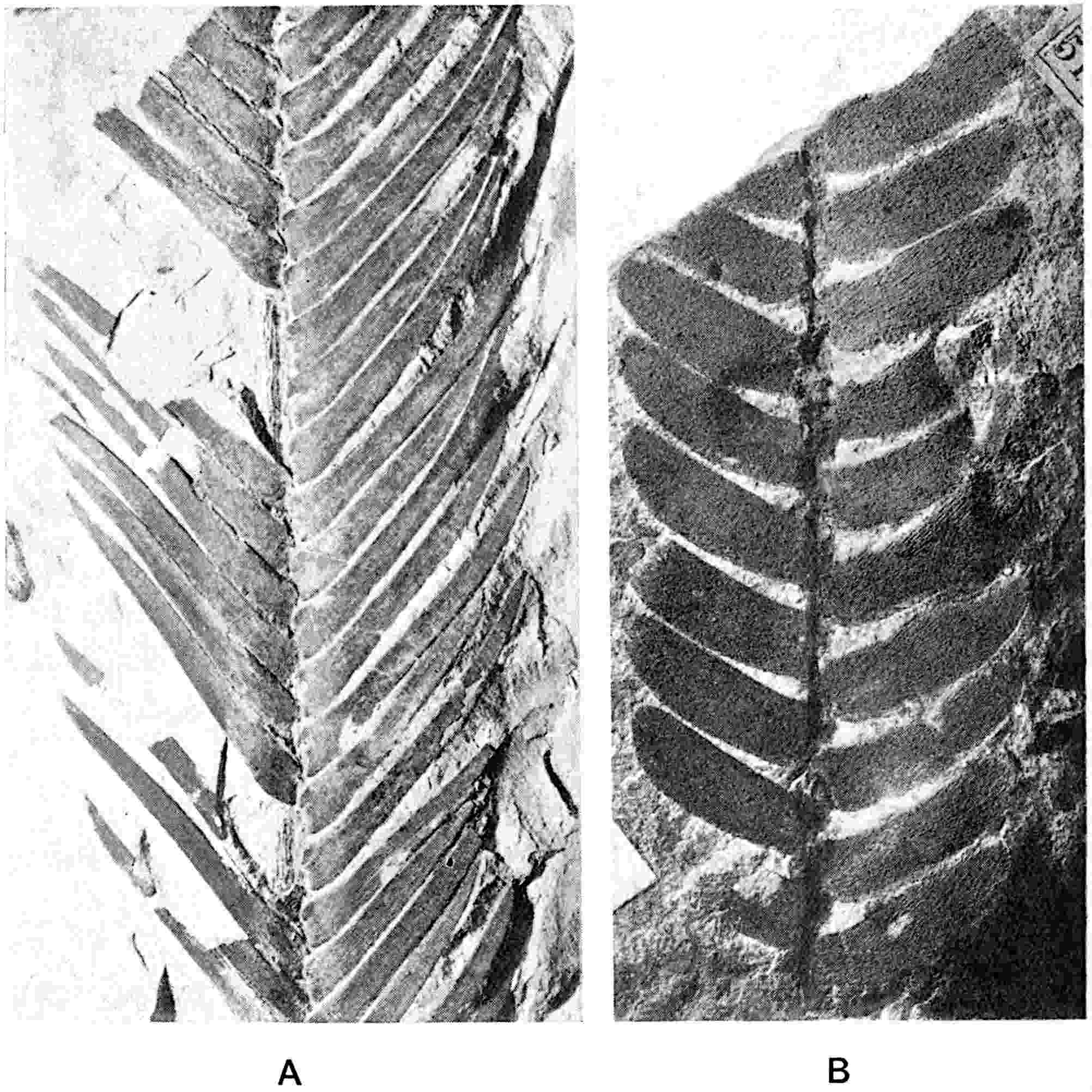
Fig. 603.
A,
Otozamites Goeppertianus
. B,
Otozamites obtusus
(=
O. Bechei
); type-specimen. (A, British Museum, V. 2360; B, Oxford Museum.)
The structure of the epidermis is partially described by Schenk[1534] and more fully by Thomas[1535]: the epidermal cells have sinuous walls and the stomata, apparently confined to the lower surface, have guard-cells with hemispherical or spindle-shaped thickened patches like those of some Zamites fronds. In one species, O. Feistmanteli Zig., Thomas found about 100 stomata in 1 sq. mm. of lamina forming almost contiguous lines between the veins. In the account of the genus Ptilophyllum reference is made to the occurrence of pinnae with asymmetrical and auriculate bases, and it is only by the comparison of a large number of specimens that a distinction can be drawn between fronds that should be assigned to Otozamites and forms of Ptilophyllum which exhibit a well-marked tendency towards the Otozamites type of pinna (cf. figs. 592, 593). The variation in the form of the apices of pinnae and the relative position of the pinnae in different parts of the same frond are features worthy of notice in the determination of species[1536]. The different appearance presented by an Otozamites frond as viewed from the upper and lower face is illustrated in fig. 604. There are no recent Cycads in which the segments have auriculate bases, but in this feature as in the sinuous epidermal walls Otozamites agrees with some species of the Fern Aneimia, e.g. A. rotundifolia Schrad. (fig. 223, Vol. ii. p. 288).
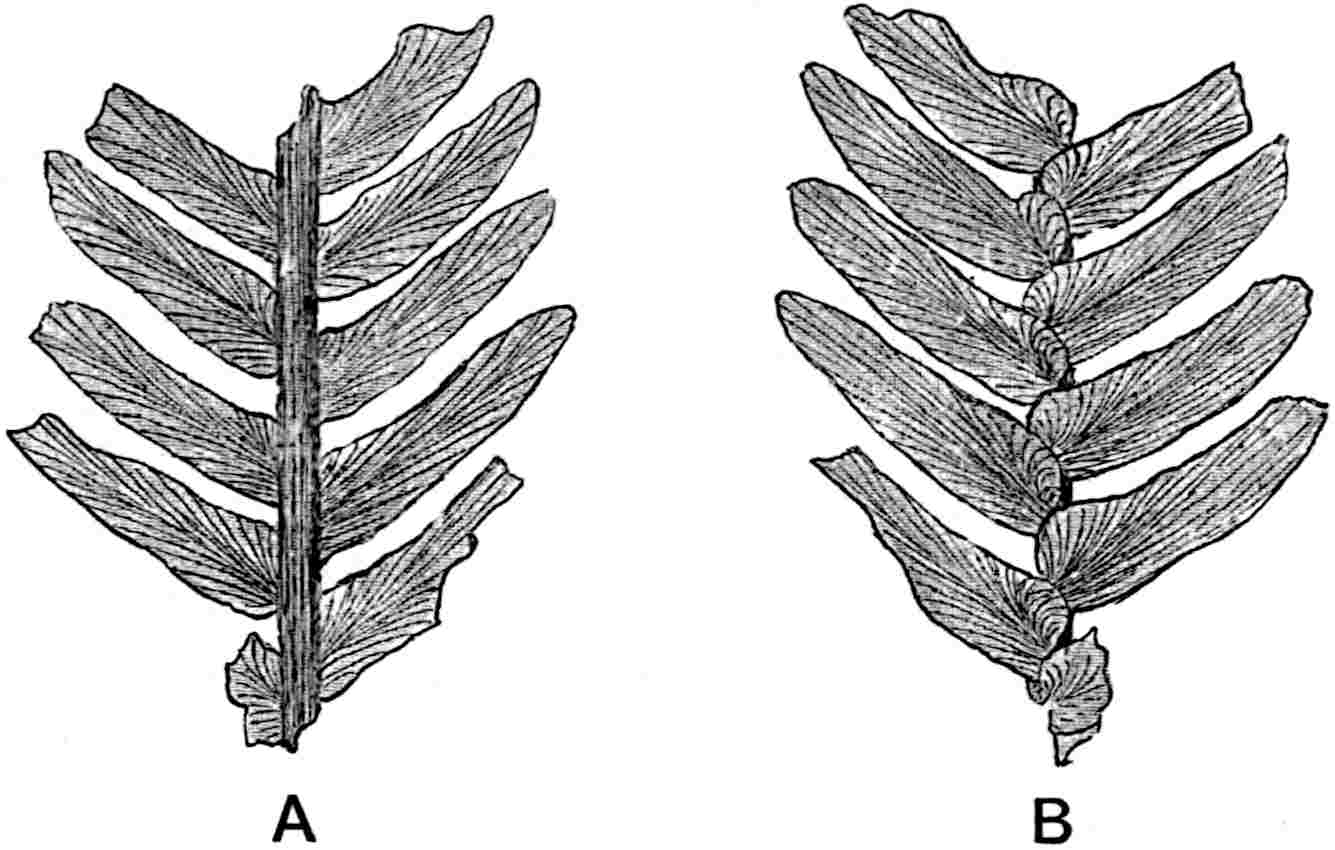
Fig. 604.
Otozamites Bechei.
A specimen in the Bristol Museum seen from below (A) and above (B). M. S.
Otozamites Bechei Brongniart.
There is considerable confusion in the nomenclature of this species described by Brongniart[1537] from Jurassic strata as Filicites Bechei: in it Brongniart included a specimen from the Lias of Axminster (Dorsetshire) previously figured by De la Beche as a fossil Fern. It was on the Axminster specimen that Lindley and Hutton founded the species Otopteris obtusa[1538], and as there is no doubt as to the specific identity of their type-specimen (fig. 603, B) and De la Beche’s fossil, Brongniart’s designation has prior claim[1539]. Otozamites Bechei is, perhaps, best regarded as a comprehensive type or a group-species in which numerous Otozamites fronds described by authors, on inadequate grounds, as distinct species may well be included. Fronds agreeing generally with O. Bechei were very widely spread in Rhaetic and Jurassic floras.
Specimens from the Middle Jurassic rocks of Yorkshire have been described as Otozamites obtusus var. ooliticus[1540] to denote a slight difference in the form of the pinnae from the Liassic fronds from Dorsetshire; but the distinctive features of the variety ooliticus are unimportant and hardly worthy of consideration in a general account of the species interpreted in a wide sense.
Fronds pinnate; pinnae usually more or less falcate, occasionally straight and with parallel sides, attached obliquely to the upper side of the rachis; imbricate or separate, the upper edge of the base of the lamina strongly auriculate, the lower edge rounded; apex obtuse; veins strongly divergent especially in the lobed base and extending obliquely to the upper and lower edge of the lamina.
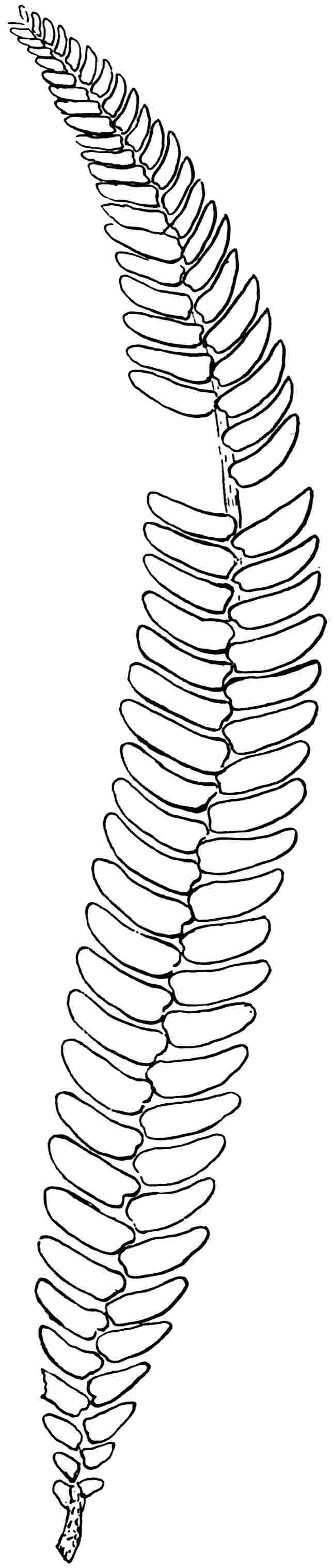
Fig. 605.
Otozamites Bechei.
(British Museum, 40672; ⅔ nat. size.)
The specimen, from the Lias of Lyme Regis, drawn in outline in fig. 605, is an almost perfect frond: the pinnae are obtusely pointed, slightly falcate, and there is a prominent lobe on the upper edge of the base of the laminae.
The Jurassic species Otozamites graphicus[1541] (Leck. ex Bean MS.), O. vicetinus Zig.[1542], O. Hennocquei[1543] (Pom.), O. recurrens Sap., O. Terquemi[1544] Sap., O. linearis[1545] Halle, are some of many examples of fronds agreeing closely with O. Bechei, or in the case of O. Terquemi with O. graphicus. The fronds described by Halle from Graham Land as O. linearis afford a good illustration of the range of variation in the pinnae: a characteristic feature is the considerable length, exceeding 20 cm., of the narrow linear fronds. The impressions from the Kome (Cretaceous) beds of Greenland described by Heer as Glossozamites Schenkii[1546] are probably closely allied to O. Bechei. The Rhaetic species O. Bucklandi Schenk[1547], O. indosinensis Zeill.[1548], and O. Polakii Krass[1549], illustrate older examples of closely allied types. Zeiller records Otozamites pinnae similar to those of O. indosinensis from Rhaetic beds in Persia[1550].
Otozamites Beani (Lindley and Hutton).
Founded on a specimen in the Scarborough Museum from the Middle Jurassic of Yorkshire[1551] which is indistinguishable from Leckenby’s type-specimen of Otopteris mediana[1552] in the Sedgwick Museum, Cambridge. Long and narrow fronds exceeding 20 cm. in length, characterised by the broadly oval, deltoid or sub-orbicular pinnae, separate or partially imbricate and attached by a broad auriculate base; apex bluntly rounded; veins numerous and spreading from the base of the lamina. The pinnae, which may be 3·5 cm. long and nearly 2 cm. broad, are narrower and longer in the distal part of the frond (fig. 606).
The Italian Jurassic species Otozamites molianus Zig.[1553], recorded also from Bornholm, is a very similar type. The generic name Cyclozamia suggested by Pomel for this form of frond has not been adopted though it is applied by Schimper to O. Bunburyanus Zig.
Otozamites Bunburyanus Zigno.
A Jurassic species[1554] similar in the long and narrow form of the frond to O. Beani but distinguished by the much smaller segments and by their more orbicular lamina (fig. 606, B). In habit the fronds agree closely with the Fern Nephrolepis Duffi. Leckenby’s species, Otopteris tenuata[1555], is probably the same as Zigno’s O. Bunburyanus, the type-specimen of which in the Padua Museum consists of a long and narrow frond with leaflets not exceeding 8 cm. in length; the rachis is hidden by the imbricate auriculate bases of the leaflets. Feistmantel[1556] refers to this species some pieces of very narrow fronds with overlapping pinnae from Upper Gondwana beds in India. A still smaller form is described by Möller[1557] from Bornholm as O. tenuissimus, and O. Bunburyanus is recorded from the same flora. O. Feistmanteli Zig.[1558] agrees in the form of the frond and in its short and broad pinnae with O. Bunburyanus.
Fig. 606. A, Otozamites Beani. B, Otozamites Bunburyanus.
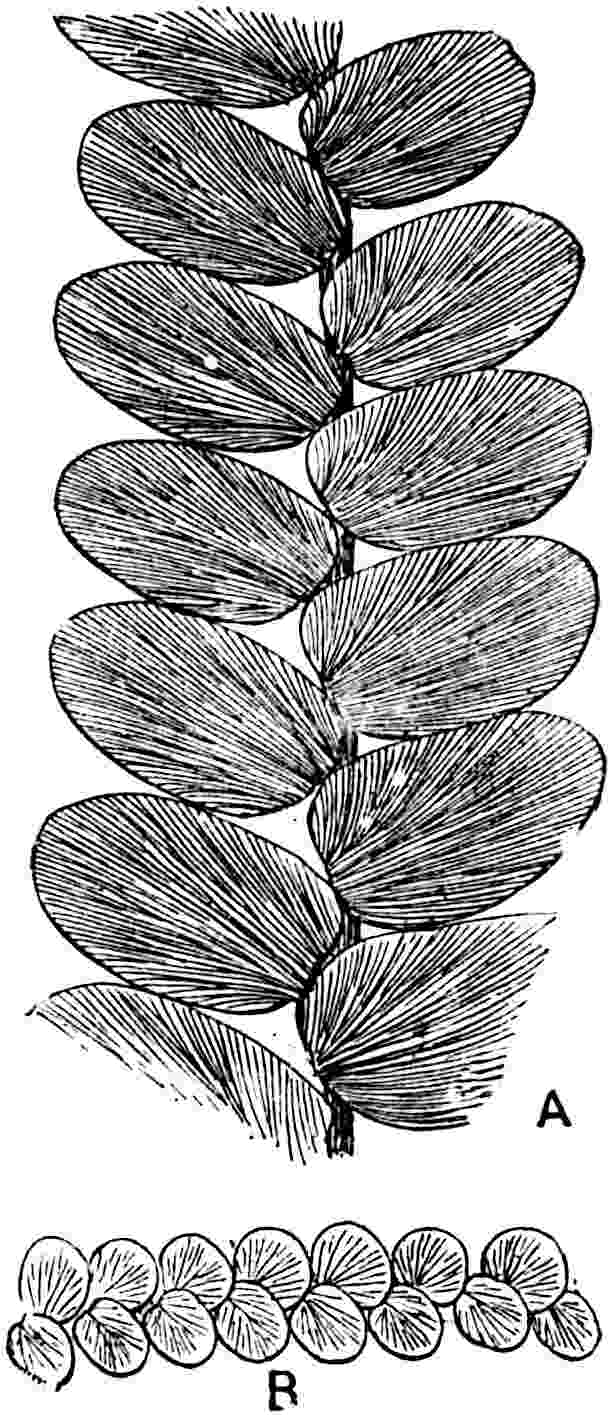
Fig. 607. Otozamites bengalensis. (Indian Geological Survey, Calcutta; ⅔ nat. size.)

Otozamites bengalensis (Oldham and Morris).
This Indian species from the Rajmahal Hills[1559] and specimens of the same type from the Cutch flora described as O. contiguus Feist. afford another illustration of long and narrow fronds with short and relatively broad pinnae. The drawings published by Oldham and Morris accurately represent the specimens: the longest frond is 21 cm. long and neither end is complete (fig. 607); it is 9 mm. broad at the narrower end and 1·5 cm. at the broader end. The rachis is represented by a deep and broad groove; the actual bases of the leaflets are not preserved, but their position shows that they were attached to the upper face: this is clearly seen in the specimen described by Feistmantel as O. contiguus which shows also that the lamina is auriculate at the upper edge of the base. The pinnae vary in shape; the smaller ones are characterised by a strongly curved lower margin and the upper edge is slightly curved or straight, while the larger leaflets have more parallel edges and blunter rounded apices: the latter form is well shown in the specimens unnecessarily distinguished by Oldham and Morris as var. obtusa.
Otozamites Klipsteinii (Dunker).
This Wealden species, first described by Dunker as Cyclopteris Klipsteinii[1560], is remarkable for the large pinnae. The rachis is fairly stout; the broadly oval or oblong pinnae vary considerably in size and in the relation of breadth to length, in rare cases reaching a length of over 8 cm. and a breadth of 2·4 cm.; apex obtuse, base slightly auriculate and asymmetrical; veins numerous, radiating from the point of attachment to the margin of the lamina. The occurrence of finer lines between the more prominent veins may indicate the presence of hypodermal stereome strands. Fig. 608 illustrates the striking variation in the size of the pinnae on a single frond and their attachment to the upper face of the rachis. In the breadth of the segments O. Klipsteinii resembles O. Beani (Lind. and Hutt.), O. decorus Sap.[1561], O. lagotis Brongn.[1562] and two species from South Russia described by Thomas[1563] as O. Izuimensis and O. giganteus. The pinnae of O. giganteus exceed 10 cm. in length and 3 cm. in breadth, thus surpassing the largest segments of O. Klipsteinii. Some pinnae from the Jurassic flora of Oregon made by Fontaine the type of a new species, O. oregonensis[1564], may be fragments of O. Klipsteinii. Nathorst[1565] records the occurrence in Lower Cretaceous or Wealden beds in Spitzbergen of Cycadean leaflets very like those of O. Klipsteinii.
Otozamites Goeppertianus (Dunker).
This Wealden species, named by Dunker[1566] Pterophyllum Goeppertianum, agrees in habit with some of those to which reference is made under O. Bechei, e.g. O. linearis Halle, and represents a type of the genus with unusually narrow pinnae (fig. 603, A). The auriculate form of the lamina is feebly developed; the linear-lanceolate pinnae are occasionally falcate and have acute apices; as in many other species they were apparently deciduous. It is by no means easy to distinguish some of these fronds from specimens included in Ptilophyllum pecten.
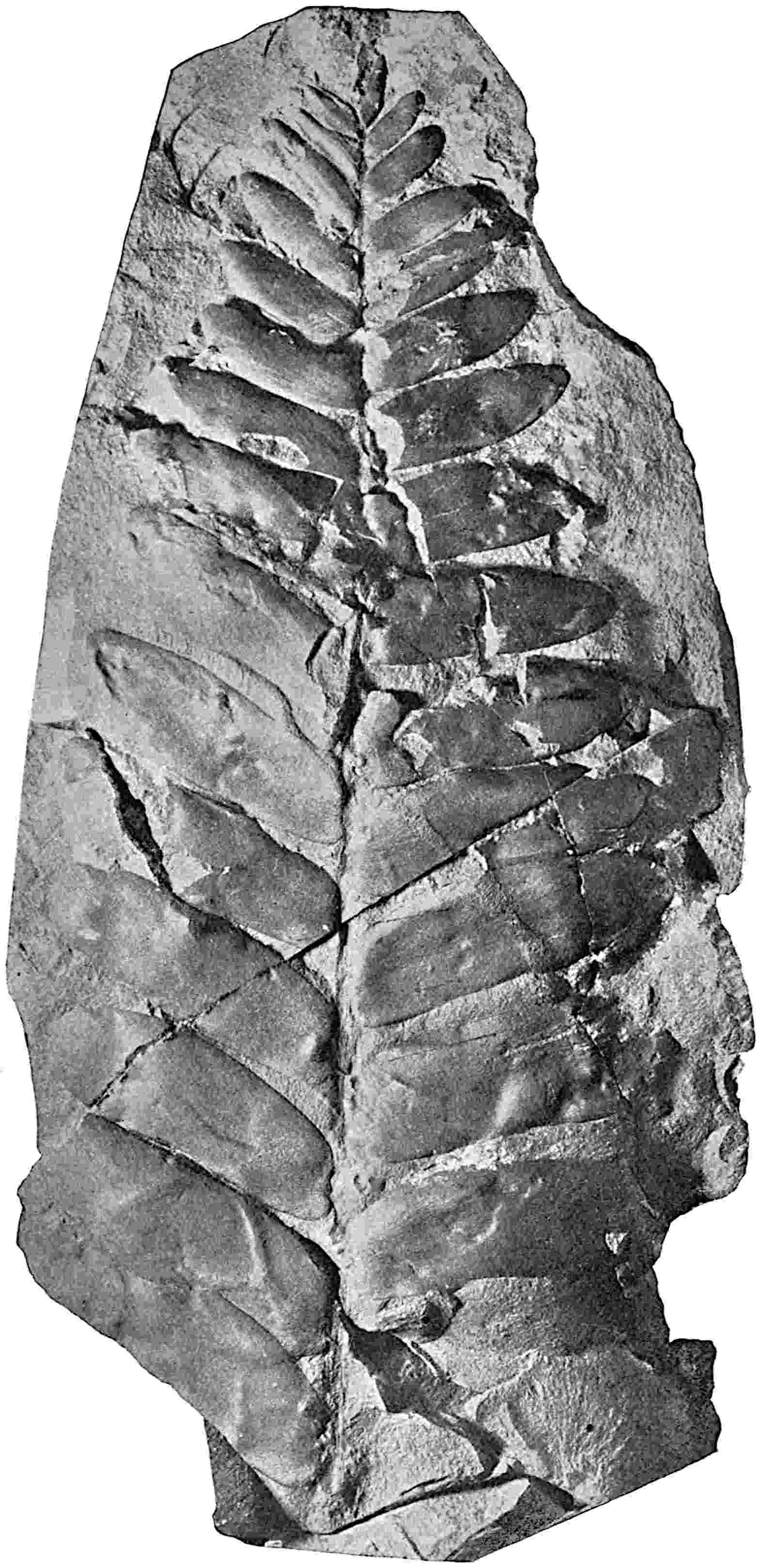
Fig. 608.
Otozamites Kliptsteini
. (British Museum, V. 3709; nat. size.)
DICTYOZAMITES. Oldham.
This generic name was instituted[1567] for pinnate fronds from the Rajmahal series of India, assigned by Feistmantel to a Lower Jurassic horizon, but probably nearer in age to the Middle Jurassic series. Morris, joint author with Oldham of the Memoir on the Rajmahal plants, adopted the name Dictyopteris. Dictyozamites agrees very closely with Otozamites but is readily distinguished by the anastomosing veins (fig. 609), while the absence of a midrib differentiates it from the Palaeozoic genus Dictyopteris. The genus is recorded also from Jurassic strata in England, Bornholm, Japan[1568], Korea[1569], and from a locality 60 nautical miles N.W. of Cape Horn in Tierra del Fuego[1570]: the specimens from these localities differ only in unimportant details from the Indian type. Dictyozamites is confined to Jurassic floras and appears to be especially characteristic of Middle Jurassic floras. In India[1571] fronds occur in close association with stems of the Bucklandia type and, although there is no proof of any connexion with stems or flowers, it is probable that the fronds of this generic type were borne on stems similar to those of Bucklandia and that the flowers were constructed on the Williamsonia plan.
Dictyozamites falcatus (Morris).
Morris[1572] described this Rajmahal species under the names Dictyopteris falcata and D. falcata var. obtusa; the specimens were included by Feistmantel under the designation Dictyozamites indicus, the original term falcata being discarded without adequate reason. An examination of several of the figured fronds enables me to confirm the accuracy of the published drawings and to extend the description in a few particulars. Fronds pinnate of the habit of Otozamites; pinnae comparatively thick, broadly linear, alternate, varying considerably in size and in the form of the apex which may be obtuse or acute. The pinnae are attached by the middle part of the lamina only; the upper edge of the base is slightly rounded or auriculate; the lower angle is generally more definitely lobed. The imbricate bases completely cover the upper face of the comparatively slender rachis. The longest pinna seen on an Indian frond is 6 cm. with a breadth of 2 cm. Some of the pinnae on magnification exhibit a finely tuberculate appearance, due no doubt to the presence of papillae on the epidermal cells like those on the pinnae of English and Bornholm specimens. This species is recorded by Yokoyama[1573] from Japan as D. falcatus var. distans, and a similar form, referred by him to a distinct species, D. grossinervis, may be more appropriately named D. falcatus var. grossinervis[1574]. The Indian type occurs also in Jurassic rocks of Korea, and Halle has discovered some Dictyozamites leaves in Tierra del Fuego[1575] which he describes as Dictyozamites sp. cf. D. falcatus: this record is of special interest from a phytogeographical point of view.
Dictyozamites Johnstrupi Nathorst.
This species[1576], from rocks usually spoken of as Liassic but not improbably Middle Jurassic in age, differs from D. falcatus in the slightly more falcate form of the pinnae and in the more strongly auriculate upper angle of the base of the lamina. The stomata[1577] are confined to the lower epidermis and the strongly cuticularised guard-cells frequently lie at right-angles to the course of the veins. The epidermal cells have very sinuous walls (fig. 609, C) and in the middle of each is a prominent papilla.
Dictyozamites Hawelli Seward.
This Middle Jurassic type from Marske[1578], Yorkshire, differs from D. falcatus in the relatively broader segments, their straighter form (fig. 609, B), and in the attachment to the rachis being slightly below the middle of the pinna base. Fig. 609, A, shows the base of a pinna and an oval scar similar to those on the rachis of some recent Cycads (cf. fig. 387). The epidermis is like that in D. Johnstrupi and as in that species the stomata are confined to the lower surface. There are approximately 120 stomata per square millimetre; each with two subsidiary cells (fig. 609, C) of elongated form, and the guard-cells have small thickened outgrowths or papillae as in D. Johnstrupi.
The epidermal features are described under D. Johnstrupi and D. Hawelli (fig. 609, C): a fuller account of those in the latter species will be found in the paper by Mr Thomas and Miss Bancroft.
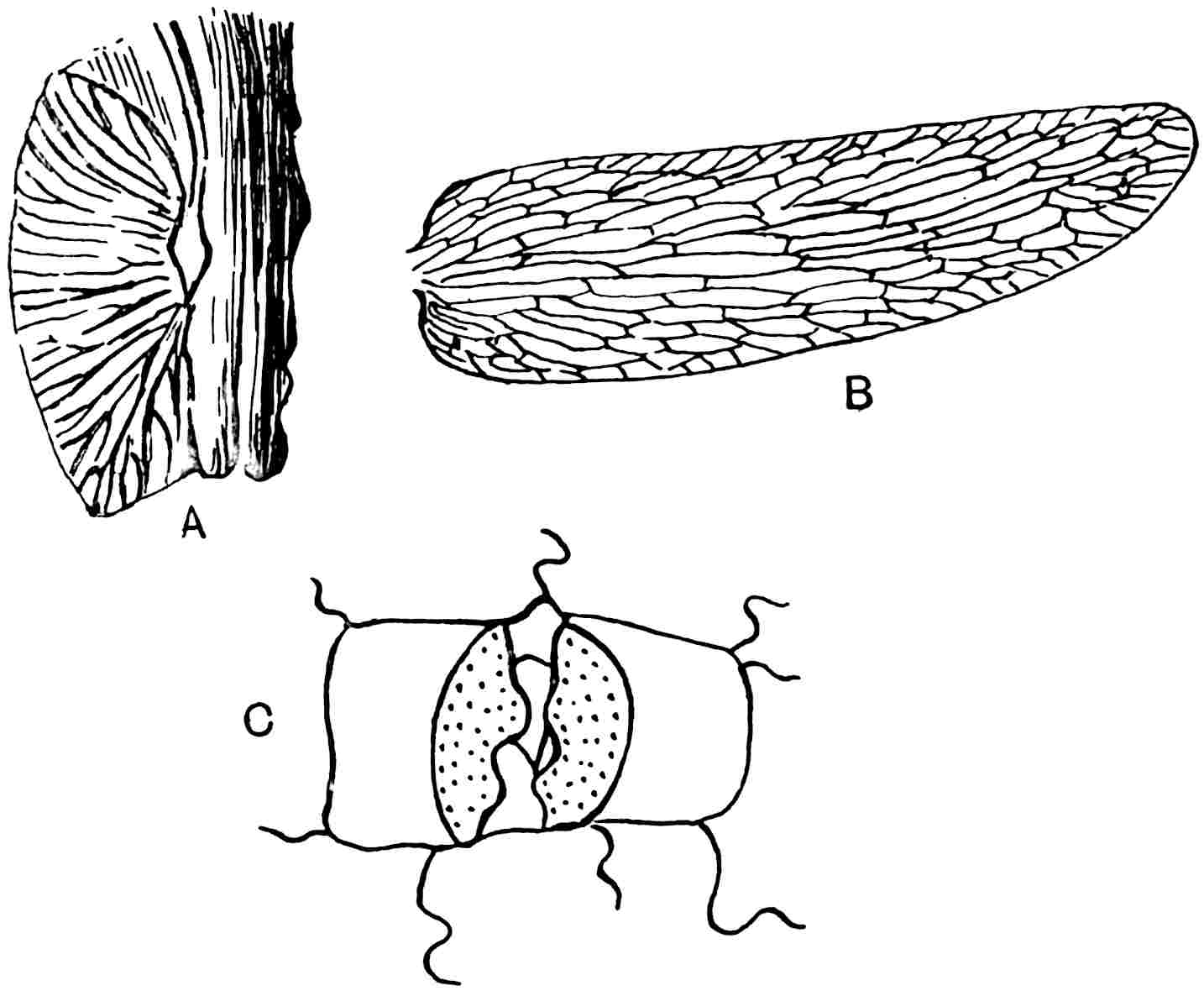
Fig. 609.
Dictyozamites Hawelli.
(A, B, British Museum; C, after Thomas and Bancroft.)
PTEROPHYLLUM. Brongniart.
The name Pterophyllum was first applied by Brongniart[1579] to some fronds from the Lias of Höör, which he named P. majus and P. minus, species subsequently removed by Nathorst[1580] to Schimper’s genus Anomozamites. Brongniart[1581] defined Pterophyllum fronds, e.g. P. Jaegeri (fig. 610), as pinnate, bearing pinnules of almost equal breadth attached by the whole width of the base and with a truncate apex; veins slender, equal, simple and slightly arched. There has been considerable confusion and laxity in regard to the application of the name Pterophyllum and in many cases no clear distinction has been recognised between this genus and Nilssonia. In Nilssonia the distinctive feature is the complete absence of any rachis uncovered by the lamina on the upper face of well-preserved specimens, while in Pterophyllum the continuity of the lamina is broken by a greater or less breadth of rachis in the middle line of the frond; the lamina does not cover the rachis but is attached laterally, or at least the two laminae of the frond, whether entire or deeply dissected, do not meet in the middle of the rachis. A specimen from the Cretaceous of Greenland described by Heer as Pterophyllum concinnum[1582] and now in the Stockholm Museum is probably a piece of a Nilssonia; the rachis is not exposed on the surface of the frond. In Nilssonia the veins are with few exceptions simple; in Pterophyllum they are often branched especially near their origin from the rachis: in Nilssonia the segments are of unequal breadth; in Pterophyllum they are usually equal. It has been the practice of several authors to follow Schimper[1583] in the employment of the generic name Anomozamites for fronds with a more or less entire or irregularly pinnatisect lamina which bear a very close resemblance to Nilssonia except that a portion of the rachis is exposed on the upper face. Potonié[1584] used Pterophyllum in a wider sense including both fronds with equal pinnae and those of the Anomozamites type: this more extended use of Pterophyllum is adopted by Zeiller[1585] who prefers to retain Anomozamites only as a sub-genus. It is in this sense that the following definition is framed.
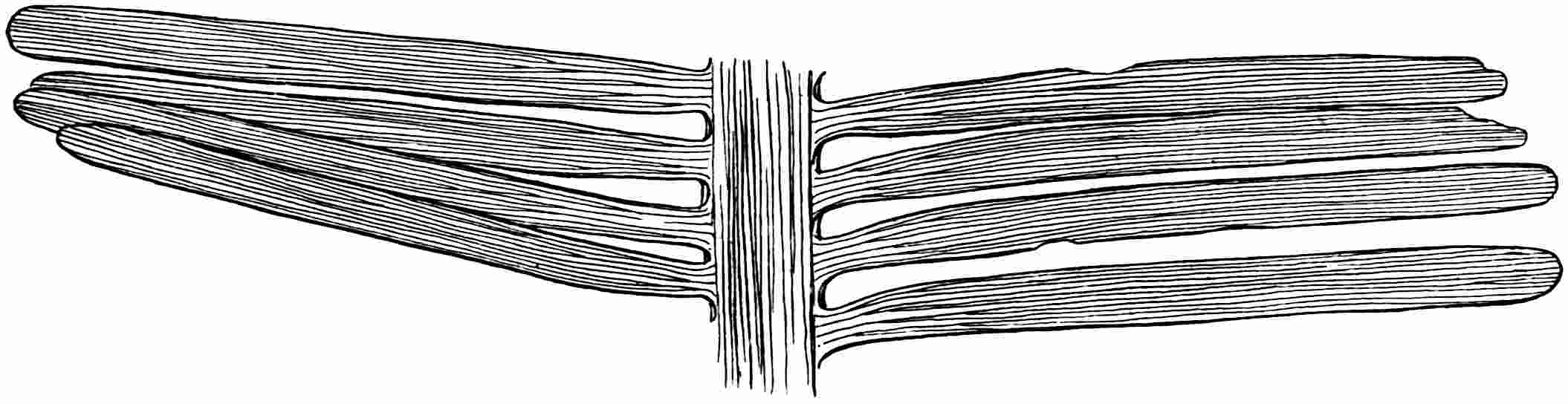
Fig. 610.
Pterophyllum Jaegeri.
From the Keuper of Lunz; part of a frond 23·5 cm. long and incomplete. (British Museum, V. 1044; nat. size.)
Fronds pinnate; pinnae linear, attached by the whole base, which may be enlarged; the apex is truncate, rounded, or occasionally pointed; the veins are simple or dichotomously branched and parallel to the edge of the lamina. In some fronds (sub-genus Anomozamites) the segments are unequal (fig. 615), short, broad and truncate, and the lamina may be entire or divided into a few very unequal segments. The surface of the rachis is never completely covered by the lamina on the upper face of the frond and is often characterised by transverse wrinklings, possibly due to the presence of ramental scales.
Some interesting xerophilous features have recently been described by Halle[1586] in the lamina of Pterophyllum (Anomozamites) marginatum, a Rhaetic species figured by Schenk and Nathorst from Franconia and Scania. The pinnae were thick and succulent. Stomata are confined to the lower surface and the edges of the upper face of the lamina form a rounded curve causing the thick upper cuticle to abut on the thinner stomatiferous lower cuticle, thus producing in impressions the appearance of thickened margins.
There is no satisfactory evidence as to the nature of the reproductive organs or stems of the plants which bore fronds of the type represented by P. Jaegeri (fig. 610) and other forms with equal segments. A stem referred by Heer[1587] and by Leuthardt[1588] to Pterophyllum was not found in connexion with leaves, and there is the same absence of any convincing evidence in the case of the imperfect specimens from the Keuper of Basel believed by Leuthardt to be male and female inflorescences. On the other hand leaves of Anomozamites are known to have been borne on comparatively slender stems with dichasial branching, and the reproductive shoots are of the same general type as those known as Bennettites. This discovery is due to Nathorst who founded the genus Wielandiella[1589] on fertile stems with Anomozamites fronds. Mr Thomas[1590] has recently obtained evidence from Yorkshire Jurassic material pointing to a similar connexion between Anomozamites fronds and Wielandiella stems. Pterophyllum is further distinguished from Nilssonia by the folded walls of the epidermal cells and by the presence of two crescentic subsidiary cells (fig. 611, A) instead of the ring of cells which surrounds the guard-cells in Nilssonia (fig. 611, B). Schenk[1591] figured a few pieces of cuticle from fronds referred to Pterophyllum in which the walls are more or less sinuous, but the cells of Pterophyllum crassinerve Goepp.[1592] appear to have straight walls: this species is, however, probably a Nilssonia. The stoma represented in fig. 611, A, is from the lower epidermis of Pterophyllum (Anomozamites) Nilssoni (Phill.)[1593].
Pterophyllum extends from Upper Carboniferous to Lower Cretaceous strata and is especially characteristic of Keuper and Rhaetic floras. A possible representative of the sub-genus Anomozamites is described by Ettingshausen from Tertiary beds in New South Wales as Anomozamites Muelleri[1594].
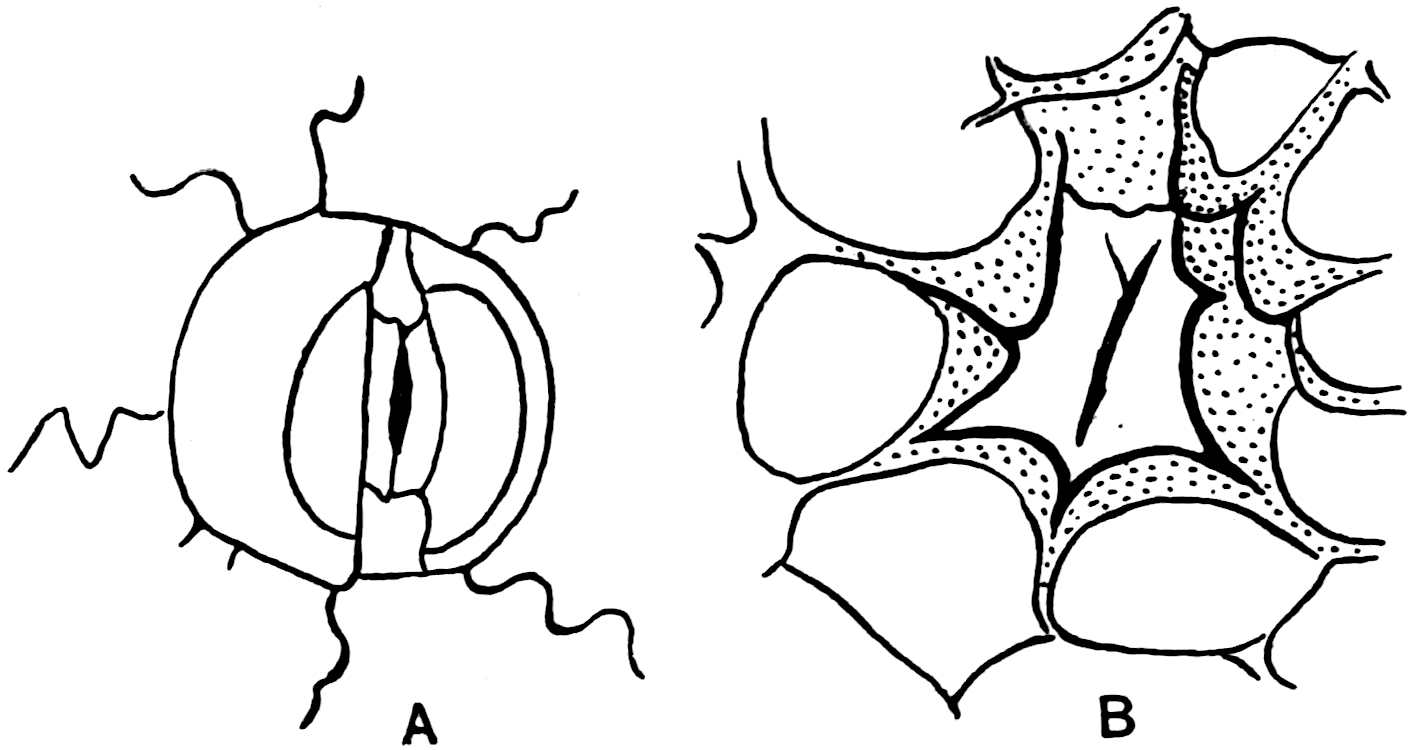
Fig. 611.
A,
Pterophyllum Nilssoni
; B,
Nilssonia mediana
. (After Thomas and Bancroft.)
Pterophyllum Fayoli Renault and Zeiller.
This species[1595] was founded on a large frond from the Commentry coalfield with a stout rachis bearing linear pinnae, attached along a narrow groove on its outer edge, reaching a length of 12 cm. and a breadth of 1 cm.; adjacent pinnae are united at the base. The apices are pointed and there are 10–12 unbranched veins in the lamina. Fig. 612 shows a small piece of the large specimen in the Natural History Museum, Paris.
Pterophyllum sp. Arber.
The only representative of a Carboniferous frond of Cycadean habit discovered in Britain is that recorded by Arber[1596] from Westphalian strata at a depth of 1834 ft at Barfreston in Kent. A fairly stout rachis bears incomplete pinnae the longest of which is slightly more than 1 cm. in length and 1–1·5 cm. broad; each segment, very slightly contracted at the base, has 3–4 occasionally forked veins. Arber compares the fragments with Pterophyllum blechnoides Sand. from Germany[1597].
Pterophyllum Cambryi Renault.
This Permian species from Autun[1598] is similar to P. Fayoli, but differs in the more slender rachis and in the finer venation of the linear, acute, pinnae. The pinnae in Renault’s specimen reach a length of 4·8 cm. and are from 3·5–4 mm. broad; they are slightly confluent at the base and the veins occasionally fork.
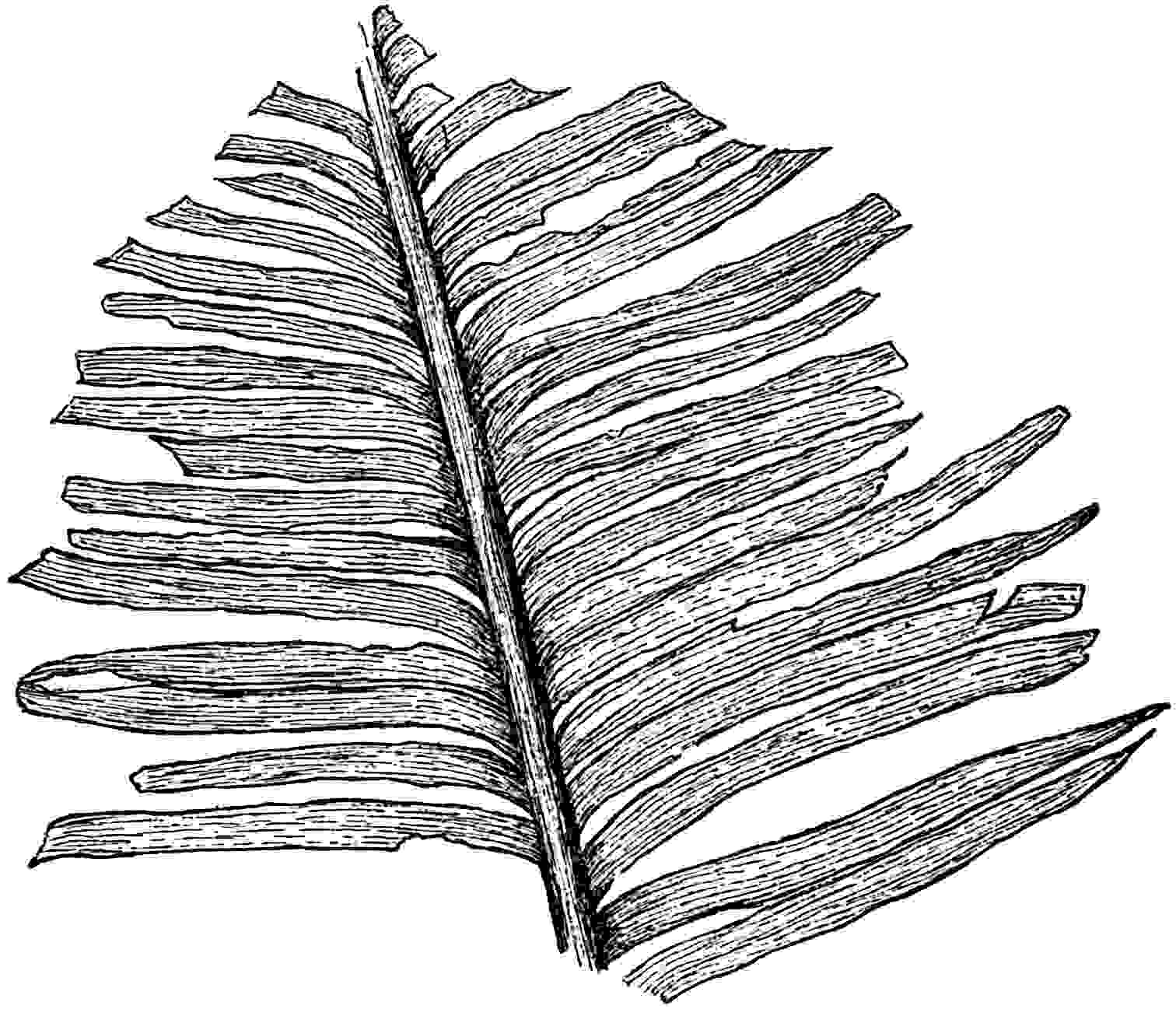
Fig. 612.
Pterophyllum Fayoli
. (From the type-specimen, Paris; ⅓ nat. size.)
Among other Palaeozoic species are Pterophyllum Grand’Euryanum Sap. and Mar.[1599] discovered by Grand’Eury in the Coal Measures of France, P. blechnoides Sand.[1600] from the Upper Coal Measures of Oppenau and recorded by Geinitz[1601] from the Middle Permian of Germany, P. Cottaeanum Gutb.[1602], a similar type, also from Permian rocks, but with coarser venation. The specimens figured by Geinitz as P. blechnoides and P. Cottaeanum are in the Dresden Museum: the former species is represented by a good impression on shale which shows the generic characters very clearly.
Pterophyllum Jaegeri Brongniart.
Brongniart[1603] founded this species (fig. 610) on material from the Keuper of Stuttgart. The fronds are characterised by the relatively narrow parallel-sided pinnae with rounded or truncate apices and little or no basal contraction; the pinnae may be contiguous or separate. There are 14–16 veins in each pinna. Leuthardt[1604], who figures several examples of this species from Keuper strata at Basel, speaks of the breadth-index of the pinnae as 12, a term employed to denote the relation of the breadth to the length of a segment. Pterophyllum longifolium[1605] is a very similar Keuper type: in this species the pinnae are rather shorter and broader than in P. Jaegeri and contracted at the base; the apex is truncate or obtuse. The differences between these species is, however, very trifling. The imperfectly preserved fossils figured by Leuthardt[1606] as the inflorescences of Pterophyllum have not been found in connexion with fronds and their nature is problematical. This and other species are recorded by Krasser[1607] from the Lunz beds in Austria.
Pterophyllum Bronni Schenk.
A Keuper species[1608] from Raibl in Carinthia distinguished by its large pinnae, 15 cm. or more in length and 0·5 cm. broad, and by their almost digitate disposition on the rachis. The fronds appear to be relatively short: the upper pinnae are highly inclined while the lower are given off at an obtuse angle; they are obcuneate or more or less oblanceolate, with a truncate asymmetrical apex and rounded angles; the base is slightly contracted. Arber[1609] has figured some specimens from the Munich Museum in one of which there are five spreading pinnae and a portion of the rachis; one pinna is undoubtedly attached and the others, though probably in place, are not in actual connexion with the axis. There is a close resemblance between this species and Sphenozamites Rogersianus Font.[1610]: in the American type the fronds must have been 1 met. long; the leaflets, 19 × 9 cm., are elliptical, broadest near the apex and attached by the middle of the rounded base. Between the divergent and forked veins there is a fine granulation probably due to the presence of papillae. Pterophyllum Bronni and P. Rogersianum might be placed in Schimper’s genus Macropterygium[1611], though another Raibl species, originally described by Schenk as Pterophyllum giganteum[1612] and referred by Schimper to Macropterygium, has much longer and relatively narrow pinnae and agrees more closely with Pterophyllum as the genus is usually defined. In order to emphasise the distinctive features of Pterophyllum Bronni and Fontaine’s Virginian species they may conveniently be spoken of as Pterophyllum (Macropterygium) Bronni and Pterophyllum (Macropterygium) Rogersianum.
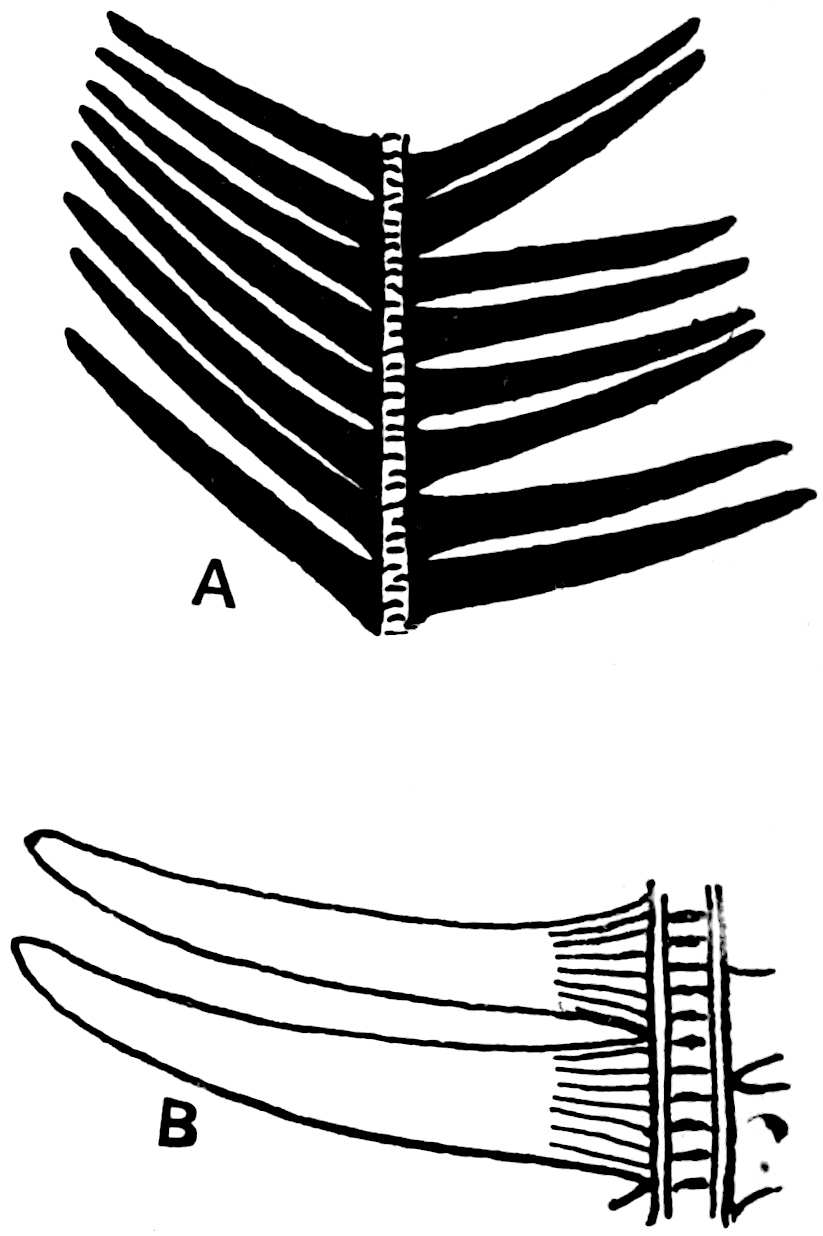
Fig. 613.
Pterophyllum Braunianum.
(A, nat. size; B, enlarged; after Schenk.)
Pterophyllum Braunianum Goeppert.
In this Rhaetic species[1613] (fig. 613) the narrow linear pinnae, contiguous or more or less distant, are 1–2 mm. broad and may exceed 5 cm. in length though they are usually shorter; they are attached more or less at right-angles to the sides of a transversely wrinkled rachis. The base of the lamina is broadened and the veins are parallel, simple or forked. The epidermal cells have sinuous walls.
Pterophyllum Tietzei Schenk.
A Rhaetic species founded[1614] on specimens from Persia and described also by Zeiller[1615] from Tonkin represented by fronds 1 met. long and at least 15 cm. broad. The segments, 3–7 cm. long and 8–18 mm. broad, are often set at right-angles to the rachis; the edges are parallel but the lower edge bends upwards at the apex. The veins are simple or forked and approximately 0·3 mm. apart.
Pterophyllum Bavieri Zeiller.
This Rhaetic species from Tonkin[1616] and Persia[1617] is interesting as affording an example of a frond with exceptionally narrow and contiguous pinnae. The frond is narrow and lanceolate, 15–20 cm. long with pinnae normal to the rachis, ·5–1 mm. broad and 7–25 mm. long attached by the whole base which is sometimes slightly enlarged. The veins are simple or forked, ·15–·25 mm. apart: the apices of the segments are rounded or truncate and the form of the whole is similar to that of Pterophyllum aequale but narrower.
Pterophyllum (Anomozamites) inconstans Braun.
In habit this Rhaetic species[1618] resembles Nilssonia compta. The linear-lanceolate fronds, as described by Zeiller[1619] in his Tonkin memoir, attain a length of 20 cm. and a breadth of 4 cm. The rachis, characterised by numerous transverse ridges, bears alternate or sub-opposite leaflets often at right-angles; they are almost rectangular and hardly longer than broad, attached by the whole of the base, which may be broadened, to the upper face of the rachis, but the lamina does not cover the whole of the rachis as in Nilssonia. The pinnae vary in breadth on the same frond and occasionally the lamina is continuous as in some forms of Nilssonia. Schenk[1620] figures examples from the Rhaetic of Franconia in which the lamina is very irregularly dissected and may be entire for a considerable distance. The epidermal cells have slightly sinuous walls. A similar type is represented by Pterophyllum (Anomozamites) Schenki Zeill.[1621], but the segments are contracted basally and become wider towards the apex where, as in P. inconstans, the edges are parallel. Feistmantel’s species Platypterygium Balli[1622], though superficially similar to Pterophyllum, appears to agree more closely with Pseudoctenis.
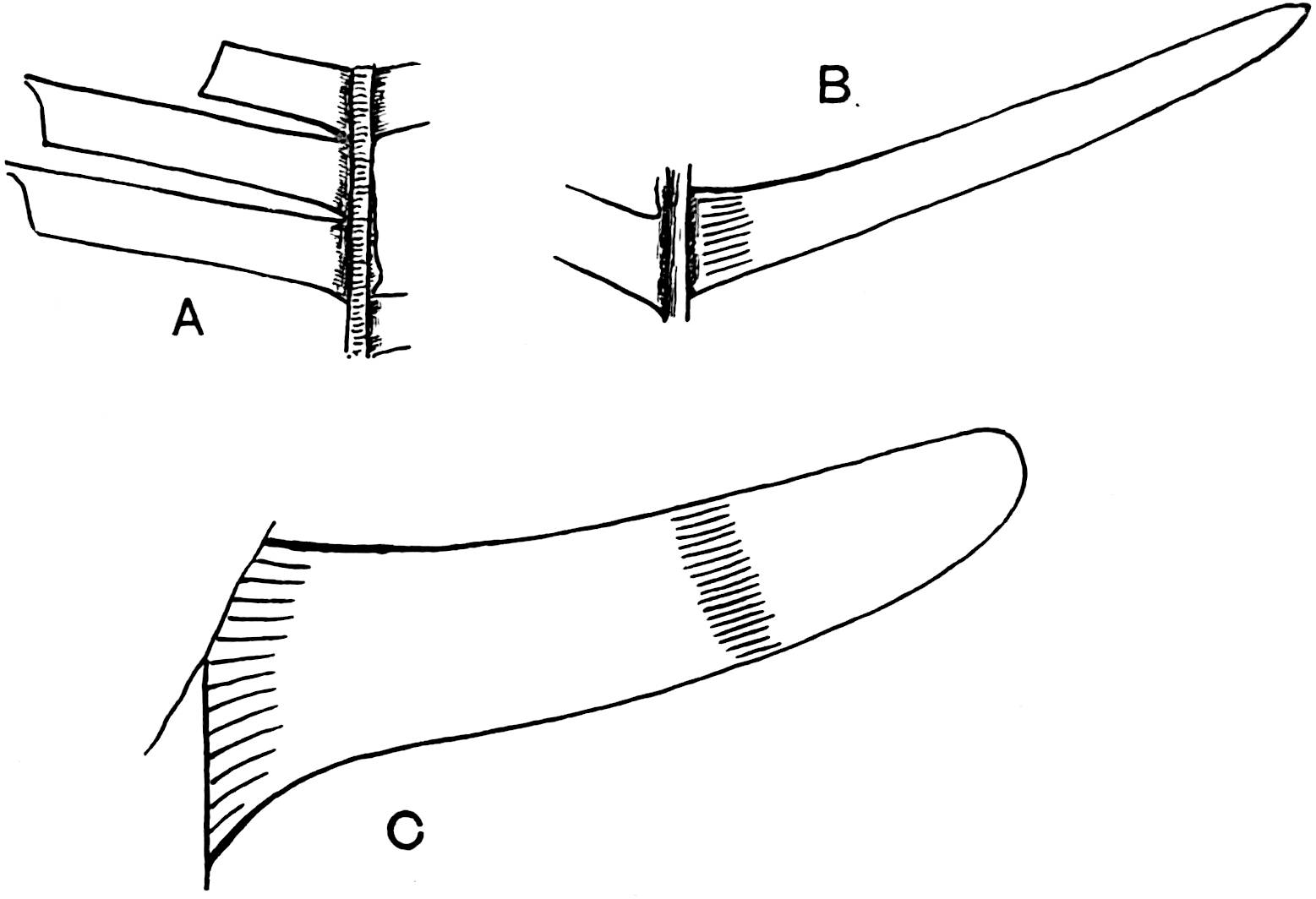
Fig. 614.
A, B,
Pterophyllum Nathorsti
; A from below; B from above. C,
Nilssonia tenuicaulis
. (A, B, Gunn Collection, British Museum; C, Arber Coll. Sedgwick Museum, 539; nat. size.)
Pterophyllum Nathorsti Seward.
This species, founded on a specimen in the Sedgwick Museum, Cambridge, from the Middle Jurassic beds of Yorkshire, was formerly referred to the genus Dioonites[1623], but since the Yorkshire specimens were supplemented by material from Kimmeridge strata in Scotland[1624] affording more definite information with regard to the attachment of the pinnae it has been transferred to Pterophyllum. Pinnae laterally attached to the rachis which in some specimens shows a transverse wrinkling, narrow, linear, 3–4 mm. wide and reaching a length of 9 cm. The base of the segments is slightly expanded; the apex is acuminate or bluntly pointed: there are approximately three veins in 1 mm. of lamina. This type (fig. 614, A, B) is similar to Pterophyllum aequale Brongn. as figured by Zeiller[1625] from the Rhaetic of Tonkin and agrees closely with some of the large Rhaetic specimens referred by Schenk to P. Braunianum. The Jurassic fronds from Oregon described by Fontaine[1626] as Ctenophyllum angustifolium are similar forms and a specimen from the Wealden of Germany included by Schenk in P. Dunkerianum[1627] should probably be included in this species. Other closely allied forms are represented by P. distans Old. and Morr.[1628] and P. Footeanum from India.
Fig. 615. Pterophyllum (Anomozamites) Nilssoni. (British Museum, 39,306; nat. size.)
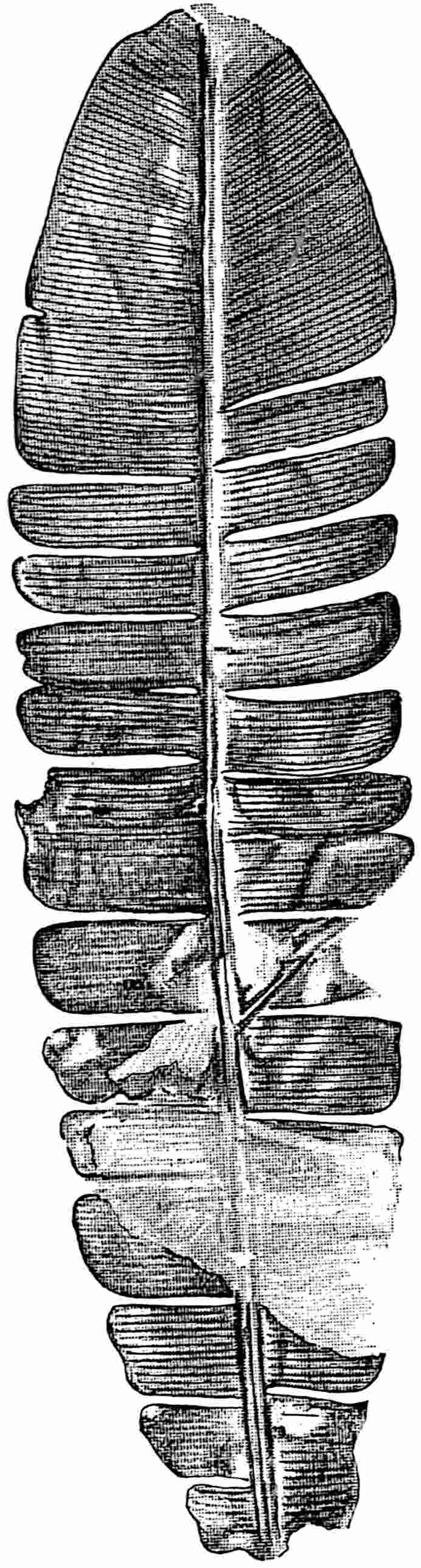
Fig. 616. Pterophyllum (Anomozamites) Lyellianum. (Geological Survey Museum, 6396; nat. size.)
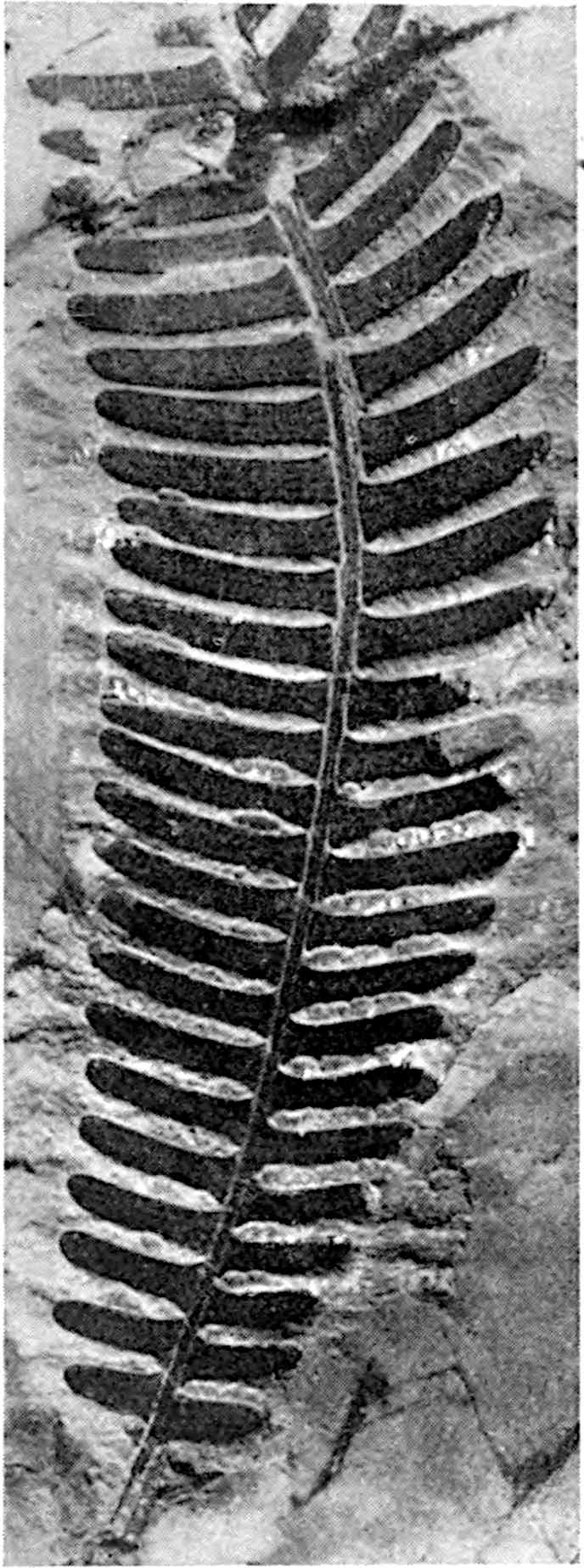
Pterophyllum (Anomozamites) Nilssoni (Phillips).
The type-specimen, from the Jurassic beds on the Yorkshire coast and now in the York Museum, was described by Phillips[1629] as Aspleniopteris Nilssoni and placed in Pterophyllum by Lindley and Hutton and many other authors[1630]. The fronds are linear; the lamina may be almost entire or divided into unequal deep truncate segments; the veins are simple or dichotomously branched (fig. 615). The leaves are very similar to those of Nilssonia; they were probably borne on stems similar to those described by Nathorst as Wielandiella. Reference is made to the structure of the epidermal cells in the account of the genus.
Pterophyllum (Anomozamites) Lyellianum (Dunker).
This Wealden species, originally referred by Dunker[1631] to Pterophyllum, was afterwards transferred to Anomozamites[1632]. The fronds, in habit resembling the larger Rhaetic species P. Braunianum Goepp., are characterised by the narrow linear pinnae of almost equal breadth attached approximately at right angles; there is a narrow line of rachis separating the two rows of segments (fig. 616).
{ CYCADITES. Sternberg. PSEUDOCYCAS. Nathorst.
The generic name Cycadites was first used by Sternberg[1633] though it has since been shown that the specimens for which he proposed it belong to other genera. As employed by Brongniart[1634] and other authors Cycadites stands for fossil fronds agreeing in habit with the pinnate leaves of recent species of Cycas (fig. 387, A); the presence of a single median in the linear pinnae is generally regarded as an essential feature. Cycadites may be defined as follows: Fronds pinnate; pinnae alternate or opposite, linear entire, with a midrib and no lateral veins, attached to the rachis by the entire base, the lower margin of which may be slightly decurrent or narrowed near the point of attachment. Epidermal cells with straight walls and stomata agreeing in structure with those of the recent genus. As thus defined, including the characters of the epidermal cells, the genus has no representatives; but the generic name should also be applied, as Miss Holden[1635] has recently suggested, to fronds of the Cycas form which afford no information with regard to the structure of the epidermis. The resemblance of Cycadites fronds to those of Cycas, coupled with the fact that impressions superficially resembling megasporophylls of the recent genus are recorded from Mesozoic strata, was considered sufficient justification for the employment of a name implying close affinity to or even generic identity with Cycas. A fuller knowledge of the epidermal characters of some of the fronds hitherto included in Cycadites has necessitated the substitution of a new genus for Cycadites. An examination by Nathorst[1636] of Heer’s Lower Cretaceous Greenland species Cycadites Steenstrupi and of other fronds showed that the epidermal cell-walls are sinuous and the stomata arranged differently from those of Cycas. For these and other reasons Nathorst proposed a new name Pseudocycas. He also pointed out that the pinnae in the fossil fronds have as a rule a double ‘midrib.’ Nathorst’s discovery raised the question whether other fronds described as Cycadites should be transferred to Pseudocycas. Miss Holden’s investigation of other supposed Mesozoic representatives of Cycas leads to the conclusion that ‘it is not impossible that all Mesozoic specimens of Cycadites will turn out to be Pseudocycas.’ This observer shows that Cycadites Saportae Sew. and C. Roemeri Schk. agree in the sinuous walls of the epidermal cells with Pseudocycas; and so far no species of Cycadites, in which it was possible to examine the cuticular membrane, has been found that does not conform to Nathorst’s definition of Pseudocycas at least as regards the structure of the epidermal cells. Nathorst defined Pseudocycas in the following sense: Fronds similar to those of Cycadites and Cycas but with pinnae characterised by a double ‘midrib,’ the stomata being confined or almost confined to the groove between the two ‘midribs.’ Nathorst also notes that in Pseudocycas the bases of the pinnae are not contracted as is often the case in Cycadites and Cycas, but this is a feature of secondary importance. Miss Holden has, however, expressed the opinion that the double ‘midrib’ is an untrustworthy character and that the stomata are not always arranged as in the fronds examined by Nathorst. Nathorst states that in Pseudocycas Steenstrupi and P. insignis the midrib though usually double may be single: the same variation occurs in P. Saportae. Miss Holden found that an impression made from a pinna of Cycas siamensis showed a double line on the upper face and a single rib on the lower; that is Pseudocycas and Cycas characters occur on a single pinna. On drying, the ridge on the lower face of the lamina collapses and a groove is formed bounded by two ridges.
In a recently published and interesting paper on ‘Some Xerophytic Leaf-structures in Mesozoic Plants,’ Dr Halle[1637] makes some important additions to our knowledge of Pseudocycas. He agrees with Miss Holden’s views with regard to the use of the generic names Pseudocycas and Cycadites, but dissents from her interpretation of the median groove as the result of shrinkage of a midrib. Part of the evidence presented by Halle is based on the structure of the leaf-cuticle as shown in microtome sections[1638]. He found that a distinct median groove is always present on the pinnae of Pseudocycas insignis and other species. If the groove were due to collapse of the tissue of a true median rib the presence of stomata—which in P. insignis are confined to the middle line of the lamina—below the vein would be an unusual feature. He found no indication of a median vein or of any vascular tissue. All that is revealed by an examination of the cuticle is that the lamina has a well-defined groove bounded by prominent ridges, and in Pseudocycas Roemeri the groove is deeper and is formed by the bending-back of the lamina. The stomata are practically confined to the groove and in P. insignis and P. Steenstrupi an additional protection against excessive transpiration was afforded by elongated papillae.
In the sinuous walls of the epidermal cells and in the structure of the stomata Pseudocycas agrees with the Bennettitalean type as defined by Thomas and Bancroft[1639]. The ‘midrib’ of the pinnae marks the position of a pronounced groove and we have no information with regard to the venation. As Halle says, protection against drought is afforded by ‘other means than those usual among existing Cycads,’ which provide against excessive transpiration by the sinking of the individual stomata below the surface. The epidermal features of Pseudocycas afford a striking example of the danger of basing conclusions on mere impressions and they further emphasise the great difference between Mesozoic Cycadean fronds and those of recent genera.
We have no knowledge of the nature of the reproductive organs of the plants which bore Pseudocycas fronds, but the agreement of the stomata and epidermal cells with those in some Bennettitalean types favours the inclusion of the genus in that class. It has previously been pointed out that the impression figured by Heer[1640] in close association with the Greenland specimens of Pseudocycas Steenstrupi as a carpellary leaf of the Cycas type is much too imperfect to be identified and has no claim, as an examination of the actual specimen in the Copenhagen Museum convinced me, to be compared with a megasporophyll of Cycas. This view is shared by Nathorst.
In some cases the name Cycadites has been applied to fragments that might equally well belong to Conifers or other plants, and not infrequently a careful examination of fossils referred to Cycadites shows that the pinnae afford no evidence of a true midrib. Casts of revolute pinnae like those of the recent species Encephalartos Ghellinckii (fig. 382) would present an appearance closely resembling a strong midrib. Heer’s Siberian Jurassic species Cycadites sibiricus[1641] is probably a piece of a Taeniopteris or Nilssonia frond, and C. gramineus Heer[1642] should be referred to Taxites. An examination of the Indian fronds described by Oldham and Morris and Feistmantel as species of Cycadites leads me to discard all of them as trustworthy records of the genus: in Cycadites confertus[1643] and C. Blandfordianus[1644] there appear to be several veins in the pinnae and not a single midrib. Cycadites constrictus[1645] is almost certainly a Conifer as Nathorst has also suggested. No satisfactory example of Cycadites has been described from Palaeozoic strata; Goeppert’s Cycadites gyrosus[1646] is founded on material too imperfect to determine, and an examination of his Culm species C. taxodinus in the Breslau Museum led me to refer it to a Conifer. The specimens figured[1647] by Zeiller from Lower Gondwana rocks in India as Cycadites? sp. are portions of linear leaves or leaflets 5 mm. broad with a median rib but they can hardly be accepted as evidence of the presence of a Cycadean plant.
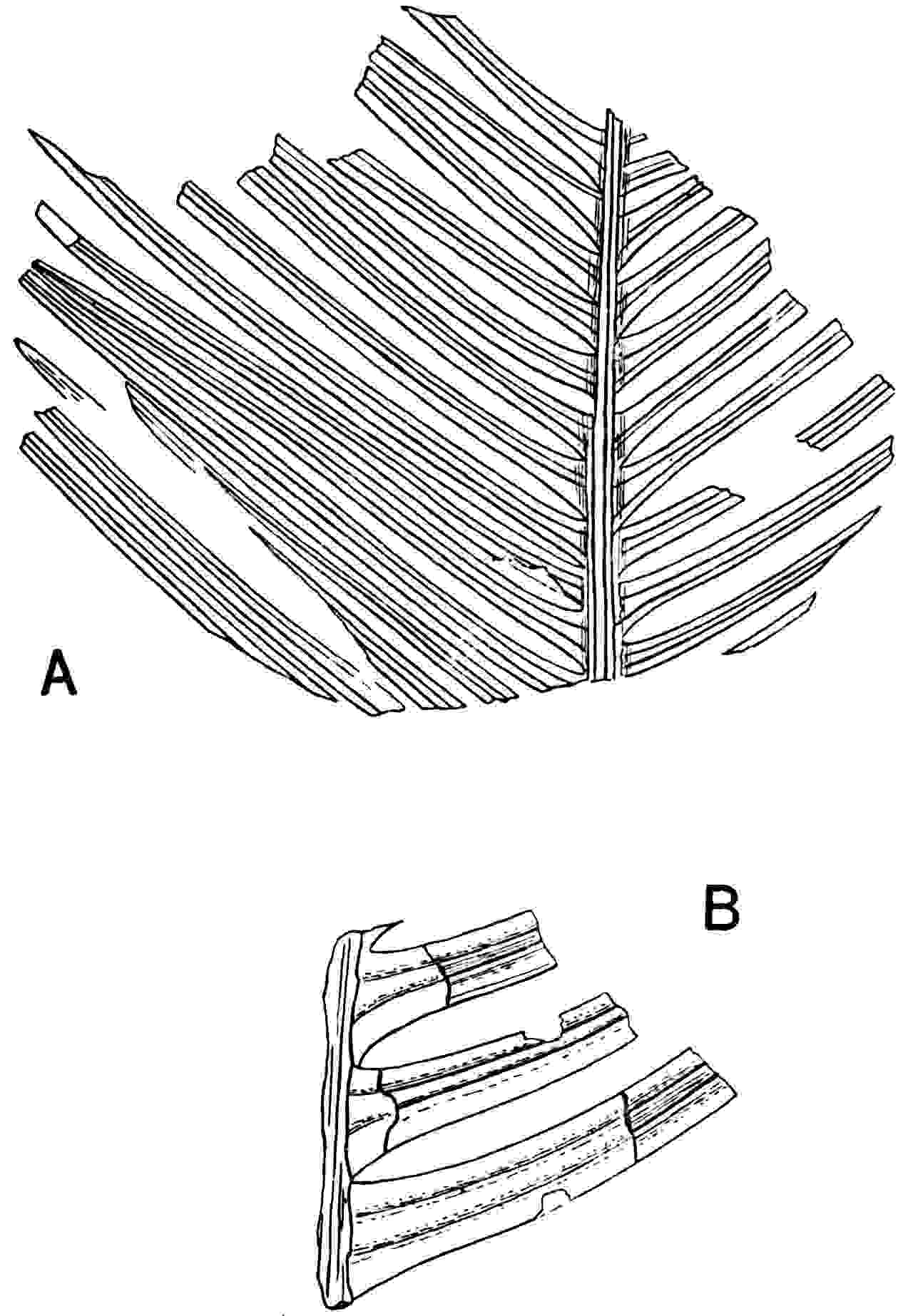
Fig. 617.
Pseudocycas insignis.
From the Lias of Höör. A, ⅚ nat. size; B,
ca.
× 2. (After Nathorst.)
Pseudocycas insignis Nathorst.
The fronds of this Cenomanian species from the West of Greenland reach a breadth of 16 cm.; the rachis, 1 cm. broad, has two parallel ridges on the upper surface and to these are attached at a wide angle the broad bases of narrow linear pinnae reaching a length of 9 cm. and a breadth of 2–3 mm. (fig. 617). The pinnae are thick and separate and each has a double ‘midrib’ consisting of two parallel lines (fig. 617, B) which are occasionally replaced by one. The so-called double ‘midrib’ represents the two prominent ridges bordering the groove. The stomata, confined to the median groove, are approximately circular and the short epidermal cells have sinuous walls[1648].
Pseudocycas Steenstrupi (Heer).
Nathorst refers this species, described by Heer as Cycadites, from the Cenomanian of Greenland, to Pseudocycas on the ground that the epidermal cells are like those of P. Steenstrupi and the stomata are confined to a median groove. Heer figures an impression in close association with the frond of this species which he identifies, without any adequate reason, as a carpellary leaf like that of a Cycas.
Pseudocycas Saportae (Seward).
It has recently been shown by Miss Holden that this Wealden English species[1649] has the epidermal characters of Pseudocycas. In external form it agrees closely with Cycadites tenuisectus Sap.[1650] from Lower Cretaceous rocks in Portugal, but nothing is known of the epidermal features of the latter type. The rachis is broad and flattened and bears alternate or sub-opposite pinnae of uniform breadth attached at right-angles or obliquely to its upper surface (fig. 618). The pinnae are 6–7 cm. long and about 1 mm. broad; their bases are slightly expanded and the apices sharply pointed. Miss Holden[1651] finds that the median rib is sometimes double and that the middle region of the lamina is covered with stomata; the epidermal cells have sinuous walls and stomata occasionally occur on each side of the main median stomatal area. Dr. Halle[1652] of Stockholm, who has examined cuticular preparations made from English specimens, confirms Miss Holden’s observations as regards the stomata, but he shows that there is no evidence of the existence of a midrib in the strict sense, the appearance of a single or double median vein being due to the presence of a dorsal stomatiferous groove, the edges of which would produce an impression on the matrix of a double vein or, if the groove became narrower, the impression would suggest a single midrib.
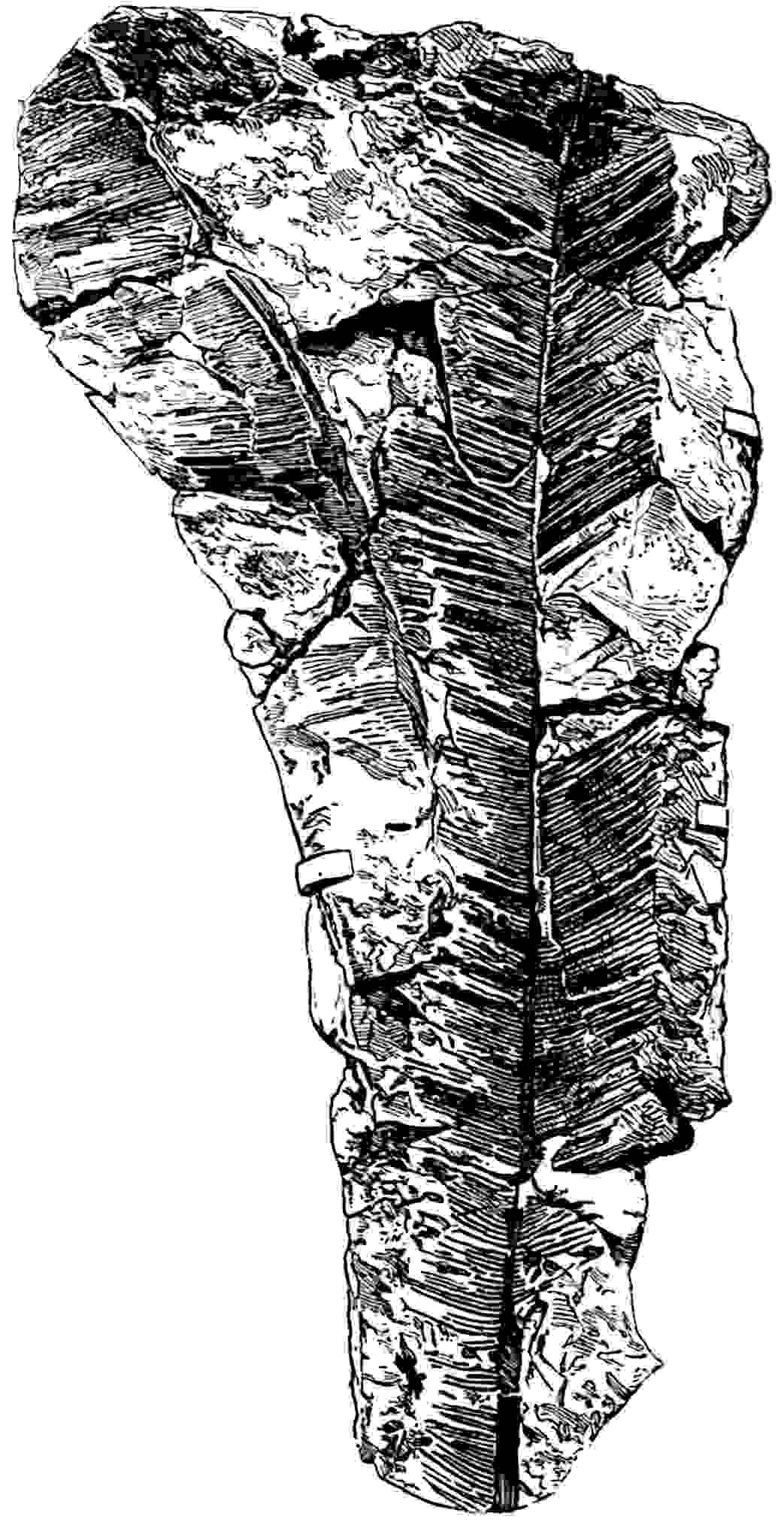
Fig. 618.
Pseudocycas Saportae.
From the Wealden, near Hastings. (British Museum, V. 2777; ⅕ nat. size.)
Pseudocycas Roemeri (Schenk).
This Wealden species recorded from North Germany[1653] and the Sussex coast[1654] has broader pinnae laterally attached to the rachis. Miss Holden describes the stomata as covering the whole lower surface of the pinnae except over the midrib. This description must be revised in the light of Halle’s results obtained from an examination of the cuticle of the type-specimen of the species in the Berlin Museum. He finds that the edges of the pinnae are strongly revolute and thus form a deep dorsal canal which is almost closed[1655], a form of lamina, as seen in section, very similar to that of an Empetrum leaf. The stomata are confined to the groove. It may be that the specimen examined by Miss Holden is specifically distinct or, as Halle also suggests, the cuticle obtained from the English fossil may not represent the whole surface but only the walls of the canal with possibly a portion of the cuticle of the outer dorsal surface. This type of leaf described by Halle is similar to that of P. insignis with the xerophilous character intensified.
Cycadites Saladini Zeiller.
This species was founded by Zeiller[1656] on fronds from the Rhaetic of Tonkin reaching a length of 40 cm. and 2–8·5 cm. broad with a rachis 3–4 mm. wide bearing contiguous linear pinnae 1·5–4·5 cm. long and 1·5–3 mm. broad with a more or less contracted base and a rounded or obtusely pointed apex. The pinnae are attached almost at right-angles or at an angle of 60°–80°. There is a clearly defined midrib.
It is not improbable that were the structure of the epidermal cells known this species would be found to be another example of Pseudocycas.
Cycadites rectangularis Brauns.
This species[1657], first recorded from Rhaetic strata in Germany, differs in the narrower and more acutely pointed pinnae from C. Saladini. Miss Holden describes the midrib as double, but until specimens are found which admit of an examination of the cuticles it is impossible to decide whether it should be transferred to Pseudocycas. The species is widely distributed in Rhaetic and Jurassic strata and specimens are recorded from the Lias of Lyme Regis on the south coast of England.
Cycadites Renaulti Lignier.
This species, from the Middle Lias of Normandy[1658], is founded on fronds 2·2–2·6 cm. broad with a rachis 3 mm. in breadth bearing laterally-inserted pinnae almost at right-angles 11–12 mm. long and 1·25–1·50 mm. broad; it is very similar to C. rectangularis which occurs in the same beds.
II. Nilssoniales.
NILSSONIA. Brongniart.
This genus[1659] was named after the Swedish naturalist Nilsson who had figured certain plants from the Lias of Höör referred by Fries to the Ferns: these were named by Brongniart Nilssonia brevis and N. elongata and classed with the Cycads. The type-specimens of the latter species are regarded by Nathorst as a form of N. brevis. The history of the genus is fully discussed in Nathorst’s able monograph[1660]. Nilssonia, founded on fronds which with one exception are known only as casts or impressions, may be thus defined: Fronds with circinate vernation, at least in the type-species Nilssonia brevis (fig. 619, C, D), similar in shape to the leaves of Scolopendrium vulgare and Polypodium irioides and to such unusual forms of Cycas fronds as those reproduced in figs. 384, 387, I[1661], in which the laminae of the pinnae are concrescent and form a continuous or deeply cut lamina. They may reach a length of 60 cm. and a breadth of 10 cm. and some specimens are known in which the leaf is less than 1 cm. in width. The lamina is occasionally entire, but in the great majority of cases it is more or less deeply cut into segments of unequal breadth varying considerably in size and shape even in the same species, usually deep and truncate and sometimes long and narrow (e.g. N. pterophylloides, fig. 619, B). An important distinguishing feature is the attachment of the lamina to the upper face of the rachis which it covers: the extension of the lamina over the surface of the frond axis and the rare occurrence of branching of the veins are characters in which Nilssonia differs from Taeniopteris. The veins are given off at right-angles or obliquely from a very narrow groove occupying the median line of the rachis; they are nearly always simple and in some of the more fleshy leaves, e.g. N. brevis, they are seldom visible. The surface of the lamina may be smooth or transversely corrugated. The rachis forms a prominent rib on the under surface of the frond (fig. 620, A) and may be continued beyond the lamina as a short petiole. Epidermal cells polygonal or rectangular, with straight walls in contrast to the sinuous walls of Taeniopteris; some of the cells bear strongly cuticularised papillae, possibly the bases of hairs (compare the hairs on the fronds of Acrostichum crinitum, a Fern with leaves similar in shape to some of the large entire fronds of N. orientalis though relatively broader and with anastomosing veins). Stomata usually confined to the lower epidermis and not very numerous; guard-cells of rounded contour and without any special thickening surrounded by 6–8 accessory cells with thickened walls (fig. 611, B) forming a chimney slightly raised over the stomatal pore[1662]. In Nilssonia the guard-cells do not exhibit that regularity of orientation which characterises the stomata of Ptilophyllum, Otozamites, and other Bennettitalean fronds. Little is known of the anatomy of the leaves: in a petrified leaf of N. orientalis[1663] from Upper Cretaceous rocks in Japan there is no palisade-tissue and small groups of sclerenchyma occur above and below the veins. The xylem appears to be centripetal, but the preservation is far from satisfactory. A few secretory canals were found near the edge of the leaf. We have no certain knowledge of the reproductive organs. The small circular projections figured by Schenk[1664] on some leaves of Nilssonia polymorpha as sporangia have no claim to be so regarded. In the description of N. brevis reference is made to some seeds discovered by Nathorst which may belong to that species. Nathorst suggests the possibility that the Rhaetic fossil Stenorrachis scanicus Nath. may be the seed-bearing shoot of a Nilssonia, either N. brevis or N. polymorpha, and if this surmise is correct it almost necessarily involves the genus Beania[1665] which has been tentatively referred to the Ginkgoales though without any convincing evidence to support such connexion. Nothing is known of the stems: the occasional occurrence of leaves converging towards a common support points to a Cycadean habit. It is possible, as Nathorst suggests, that the Rhaetic species Bucklandia Saportana[1666] may be the stem of a Nilssonia.
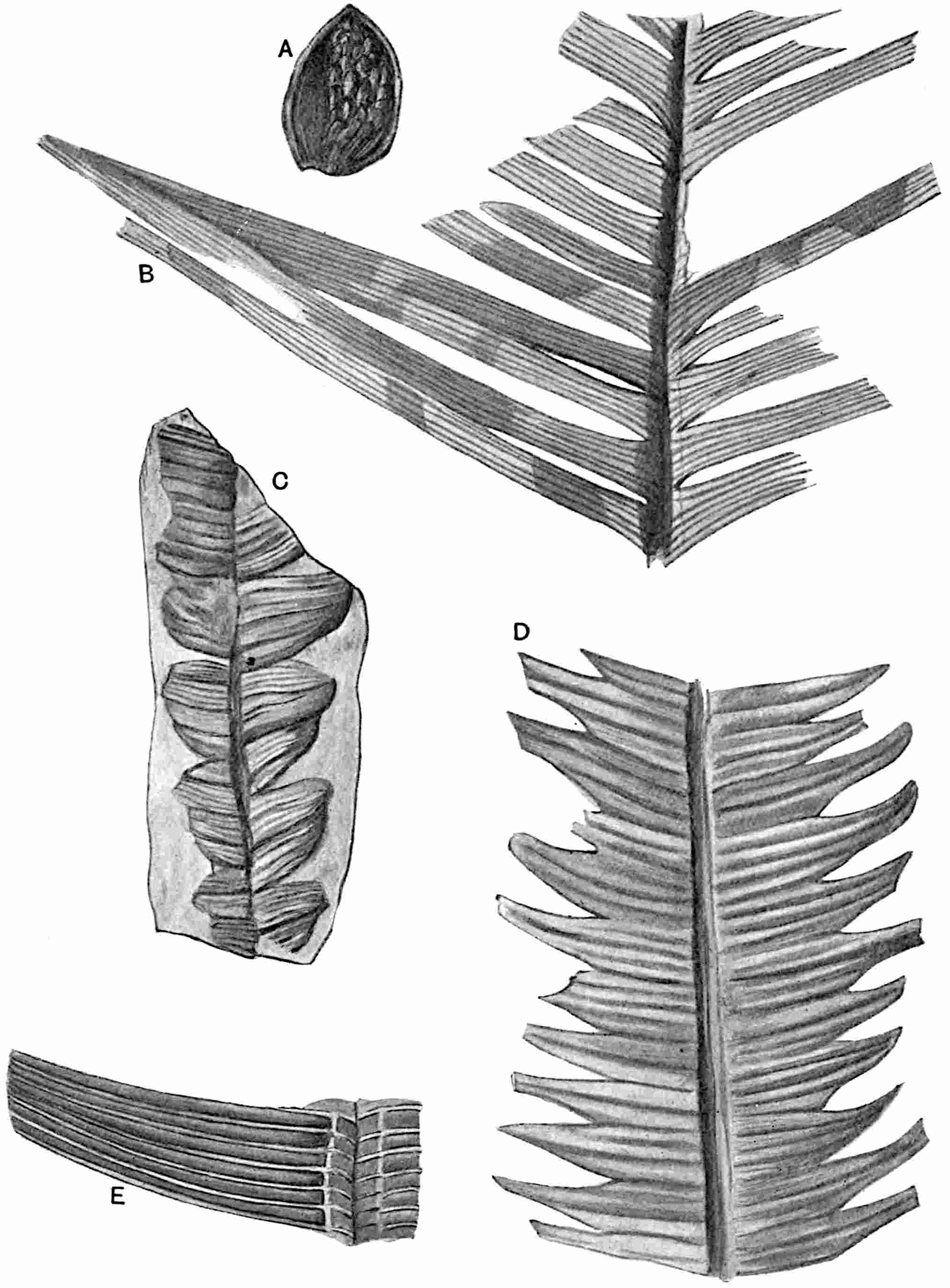
Fig. 619.
A, seed (
Nilssonia
?); B,
Nilssonia pterophylloides
; C, D,
Nilssonia brevis
; E,
N. polymorpha
. (A–D ⅚ nat. size; E, slightly enlarged; after Nathorst.)
Nilssonia is especially characteristic of Jurassic and Rhaetic floras; it occurs also in Triassic beds and extends into Cretaceous floras.
Nathorst instituted the genus Nilssoniopteris[1667] for some specimens from the Yorkshire coast which he believed to be examples of Nilssonia tenuinervis on the ground that the veins are dichotomously branched and the epidermal cells have sinuous walls. Mr Hamshaw Thomas[1668] has, however, shown by an examination of the specimens in the Stockholm Museum that they belong to Taeniopteris vittata, and Prof. Nathorst agrees with this conclusion. The name Nilssoniopteris must therefore be abandoned. Miquel[1669] proposed the name Hisingera for some Nilssonia fronds, but it has not been adopted.
Nilssonia polymorpha Schenk.
Linear fronds varying considerably in breadth and in the degree of dissection of the lamina, which may be entire; the margin may show broad and shallow crenulations or there may be a few narrow and deep sinuses cutting the otherwise entire lamina into long and narrow segments. More usually the lamina is divided to the rachis into numerous truncate segments traversed by parallel, simple, veins extending from a narrow groove in the middle of the rachis on the upper surface of the frond (fig. 619, E). The veins run in very narrow grooves in the generally flat but occasionally corrugated lamina[1670].
This species agrees very closely in habit with N. compta and N. brevis and, as Nathorst points out, it is in some cases almost impossible to distinguish Nilssonia polymorpha from N. brevis. Some of the fronds from the Rhaetic of Franconia described by Schenk as N. polymorpha are examples of N. brevis. In N. polymorpha the distal ends of the segments are blunter, the lamina is much less folded and when folds or corrugations occur they are less regular than in N. brevis. The epidermal cells are polygonal and have thick, straight, walls: oval or circular papillae occur both on the lamina and rachis. The stomata, confined to the lower surface, are between the veins and each is accompanied by a ring of subsidiary cells (cf. fig. 611, B). N. polymorpha is a member of Rhaetic floras and is recorded also from Liassic rocks at Höör[1671].
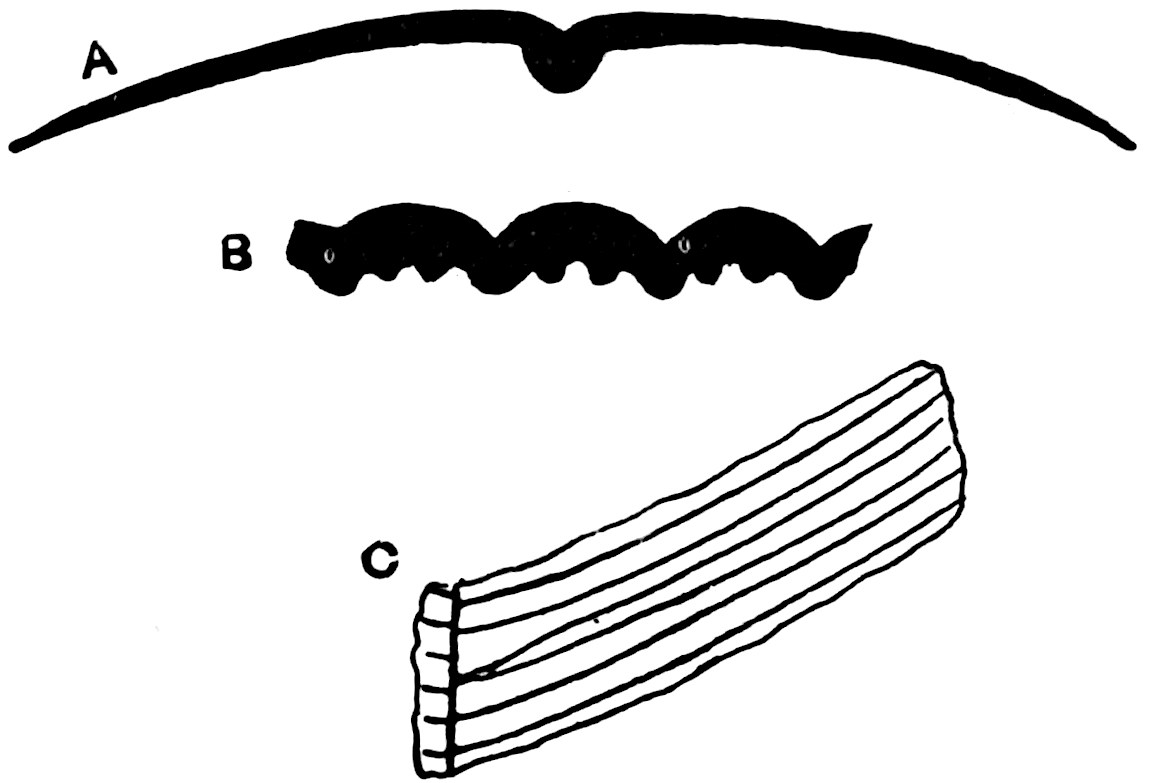
Fig. 620.
A, B,
Nilssonia brevis
; A, section of the frond; B, section of the lamina parallel to the rachis. C,
N. saighensis
. (A, B, after Nathorst.)
Nilssonia brevis Brongniart.
This species[1672] (fig. 619, C, D), one of those from Höör on which the genus was founded, has been very fully investigated by Nathorst[1673] whose researches have cleared up many obscure features. The young fronds are circinate like those of Ferns and Cycas. The linear fronds agree generally in habit with those of N. polymorpha and N. compta, but the lamina is thicker and is characterised by regular transverse corrugations; the veins are very rarely visible except in young leaves which have not reached their full thickness. The fronds may be 50 cm. long and vary in breadth from 1·5 to 12 cm.; the petiole is very short or the frond may be sessile. Between the regular grooves on the upper surface the lamina is more or less convex; seen from below the grooves are represented by ridges and between each pair of ridges there are parallel folds, sometimes three (fig. 620, B) or as many as six; and where the segments are narrow, that is the strips of lamina between two grooves (or ridges), there may be only a single fold which gives the appearance of linear segments with a single midrib as in Cycadites, a misleading resemblance of special interest in reference to the Nilssonia fronds described by Oldham and Morris[1674] and by Feistmantel[1675] as Cycadites rajmahalensis. Owing to the fleshy nature of the leaf the difference between the upper and lower side is particularly well marked in this species. The lamina may be more or less entire, but is usually divided by deep sinuses extending to the rachis into truncate or distally tapered segments varying in breadth (fig. 619, C, D), the narrow segments being characterised by a more pointed apex than in N. polymorpha. The structure of the stomata and epidermal cells is of the type described in the definition of the genus. Strongly cuticularised papillae, incorrectly described by Schenk[1676] in N. polymorpha as stomata, occur on some of the epidermal cells: these may be the bases of hairs. In some preparations Nathorst found patches of a resinous substance, an interesting discovery in view of the occurrence of secretory canals in the petrified leaf of Nilssonia orientalis described by Dr Stopes[1677].