Chapter XXXIII · (continued 2)
Reading edition
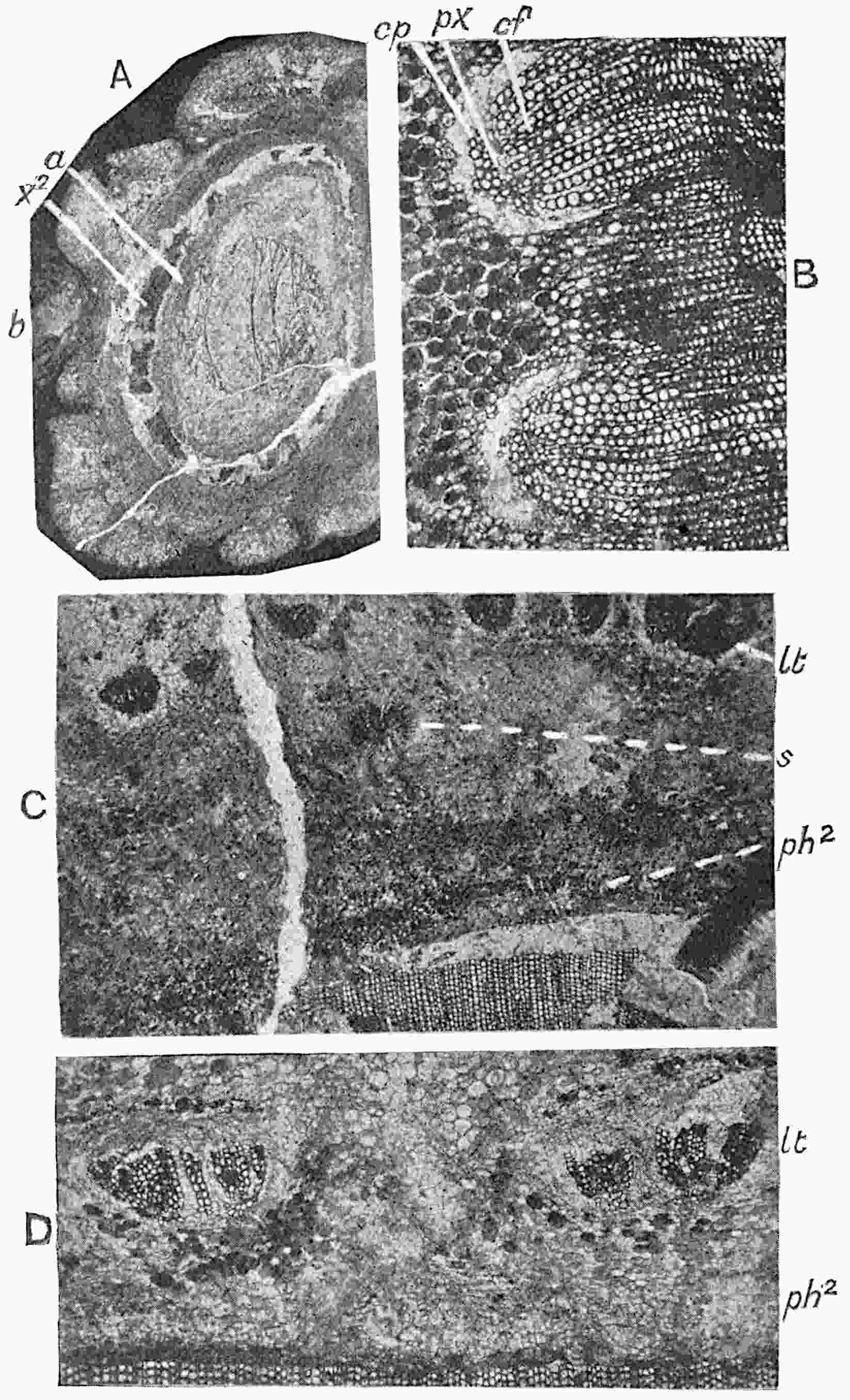
Fig. 483.
Mesoxylon Sutcliffii
. Transverse sections of stem. A.
a
, outer pith;
b
, axillary bud;
x
2
secondary xylem. B.
cp
,
cf
, centripetal and centrifugal xylem;
px
, protoxylem. C.
lt
, leaf-traces in the cortex;
s
, stele of axillary branch;
ph
2
, secondary phloem. D. Leaf-trace bundles,
lt
, external to the phloem,
ph
2
. (A, C, D, sections in the Manchester Collection, 717
b
; B, Cambridge Botany School, 530.)
Among other species of Mesoxylon mention may be made of M. Lomaxi and M. poroxyloides. M. Lomaxi Scott and Maslen[718] generally resembles M. Sutcliffii but shows the following distinctive features: the leaves are more scattered and less crowded; the twin-bundles of the leaf-traces fuse immediately on entering the pith, thus appearing for the most part as single and not double strands in the perimedullary zone; the centripetal xylem is well developed, the medullary rays are deeper and the outer cortex has shorter bands of mechanical tissue.
In Mesoxylon poroxyloides Scott and Maslen[719], the twin-bundles of the traces unite soon after reaching the pith as in M. Lomaxi, the secondary tracheids have only two rows, or sometimes a single row, of bordered pits and the tracheids are rather smaller than in M. Lomaxi (20–40μ as compared with 30–60μ) and the medullary rays are shallower. There is a particularly broad zone of spiral and reticulate transitional tracheids at the inner edge of the wood as in Cordaites and in Dadoxylon Pedroi (fig. 476). The leaves of this species are believed to be represented by the type described by Dr Benson as Cordaites Felicis (fig. 465)[720], but, as already suggested, it is very probable that many or possibly nearly all the leaves from British Coal Measures described as Cordaites may belong to Mesoxylon.
The chief interest of the genus Mesoxylon is its close resemblance in certain characters to Cordaites and Poroxylon: the presence of strands of centripetal xylem in the perimedullary region is an important feature in which Mesoxylon differs from stems assigned (under the generic name Dadoxylon) to Cordaites. Mesoxylon differs from Poroxylon in having a discoid pith like that of Cordaites, but a more important difference is the absence in the leaf-trace xylem of Mesoxylon of bordered pits of the Araucarian type, whereas in Poroxylon Araucarian pits occur in both the centripetal and centrifugal tracheids. In Poroxylon the secondary xylem is manoxylic; in Mesoxylon, as in Cordaites, it is pycnoxylic.
The range of Cordaites and a consideration of other imperfectly known genera.
An increased precision in knowledge derived from anatomical investigation often tends to demonstrate the untrustworthiness of criteria based on external features previously employed with confidence. This inevitable though, from the point of view of the systematist, inconvenient result of intensive study is well illustrated by the recent discovery of the stems named by Scott and Maslen Mesoxylon[721]. A separation of Cordaites from Mesoxylon, which no doubt extended far beyond the British area, is possible only if well-preserved petrified material is available. The leaves of Mesoxylon, so far as our imperfect knowledge of them enables us to express an opinion, are constructed on a plan almost identical with those of Cordaites and, as already stated, it is almost certain that many of the impressions referred to Cordaites were borne on Mesoxylon stems. An additional source of confusion is supplied by the Cordaites-like leaves of Poroxylon. It is evident, therefore, that even within the limits of the Carboniferous and Permian formations the recognition of true Cordaites leaves must often be attended with considerable risk of error. Apart from the possible confusion between the foliage of Cordaites and Mesoxylon there are other difficulties as regards detached leaves which depart more or less widely from the typical Cordaitean form. Leaves such as C. circularis (fig. 468, B) and C. grandifolius emphasise the lack of any thoroughly satisfactory dividing line separating single pinnules of Cardiopteris or Cyclopteris on the one hand and leaves of Psygmophyllum on the other from Cordaites. The petrified buds described as Dolerophyllum[722] have been quoted by several authors as examples of unexpanded shoots of Cordaites though anatomical evidence warrants a generic separation. In the case of species founded on leaves described in this chapter as Cordaites it should be remembered that further research may necessitate an alteration in nomenclature.
Among the species included in Cordaites is Noeggerathiopsis Hislopi[723] (figs. 470–472), a type widely spread in India and in other parts of Gondwana-Land: if the change of generic name is accepted it involves the extension of the geographical range of Cordaites from Northern Europe and North America to the southern botanical province. We have as yet no proof of the existence of Cordaites in the Arctic regions. The range in time of Cordaites or of the Cordaitales has generally been stated to be from the Upper Devonian to the Permian. It is, however, by no means certain that the genus flourished before the Carboniferous period, though it is clear that closely allied types must have lived in pre-Carboniferous floras. The strata in New Brunswick from which Dawson recorded his supposed Devonian Cordaites have been shown to be Upper Carboniferous in age[724]. As regards the length of time during which the Cordaitales existed we have no decisive evidence. In recent years the tendency has been to extend their range into the Mesozoic era, and there are several pieces of evidence in favour of this. There is no doubt that considerations of age based on the arbitrary divisions of the geological scale sometimes insinuate themselves too thoroughly into questions connected with the duration of plant-types whether represented by families or genera. We have been accustomed to regard Cordaites as a genus confined to the Palaeozoic period, a type which with many others carried on the tradition of Upper Carboniferous forests to the Permian floras and then made way for the precursors of Mesozoic types. There is, however, no valid reason for supposing that Cordaites and other Palaeozoic genera did not survive as less prominent members in succeeding floras. It must be admitted that evidence in support of Mesozoic Cordaitales is not above suspicion, though the probability is that Cordaites or some allied genera still flourished in the earlier stages of the Mesozoic era. The data on which this opinion is based cannot be fully discussed in a general treatise, but a few of the facts may be briefly considered. Zeiller[725] and other authors have expressed the view that the Cordaitales were not exclusively Palaeozoic. In addition to Cordaites (Noeggerathiopsis) Hislopi recorded from Rhaetic floras, other possible representatives of the group are illustrated by specimens included in such genera as Yuccites, Bambusium and Krammera.
Pelourdea gen. nov.
The name Yuccites[726] was given to some detached, broad, linear leaves from the Bunter sandstone of the Vosges which were compared with the foliage of Yucca and classed among Monocotyledons. The authors of the genus also described a cylindrical cast as a Yuccites stem, including both stem and leaves in Yuccites vogesiacus. The supposed stem, as Fliche[727] has shown, is a pith-cast and is appropriately named by him Endolepis vogesiacus. The Vosges leaves are assigned by this author to the genus Cordaites, a change of name which may eventually be justified though as yet based on insufficient evidence. There are objections to the institution of a new name in place of Yuccites, but it is undesirable to retain a designation suggesting false ideas with regard to affinity. A new name Pelourdea (after M. Pelourde of Paris, whose recent death deprives Palaeobotany of an able and promising investigator) is therefore proposed for leaves of the Yuccites type which in form, venation, and spiral phyllotaxis agree with those of Cordaites but cannot confidently be assigned to that genus or even to the Cordaitales. For linear leaves, especially from Jurassic strata, resembling those of Phoenicopsis the name Desmiophyllum[728] is employed: these are very similar to those of Pelourdea; they are characterised by their fairly uniform breadth and afford no indication of their arrangement on the supporting axis.
Pelourdea vogesiaca (Schimper and Mougeot).
The linear-lanceolate leaves described by Schimper and Mougeot as Yuccites vogesiacus and transferred by Fliche to Cordaites are probably specifically identical with specimens described by Mr Wills[729] from Lower Keuper rocks in Worcestershire. The English leaves were described by Arber[730] as Zamites grandis,—the name Zamites vogesiacus having been previously used by Schimper and Mougeot,—on the ground that the supposed leaves were probably pinnae of a cycadean frond, a view in agreement with an opinion previously expressed with regard to similar leaves from Stonesfield[731]. A later discovery by Wills of specimens, on which the drawing reproduced in fig. 484 is based, of the same type of leaf showing the foliar nature of the fossils necessitated the abandonment of the pinna-hypothesis, and the original name Yuccites vogesiacus was resuscitated[732]. The leaves reach a length of 50 cm. and a maximum breadth of 6·5 cm.; the lamina is entire, lanceolate or linear-lanceolate, the apex acuminate, and the lower part rather abruptly contracted and attached by a broad crescentic base; veins numerous, parallel, and occasionally forked. Fliche records the occurrence of a small Artisia-like pith-cast and pieces of stem with leaf-scars (4 × 3 mm.) in association with leaves of Pelourdea vogesiaca in Triassic strata in Lorraine. An imperfectly preserved specimen described by Fliche as Cordaianthus Minieri[733] resembles an inflorescence of Cordaites. It consists of an axis 15 cm. long, the lower part forming a peduncle, and on the upper portion are linear bracts subtending oblong bodies which may be lateral fertile shoots.
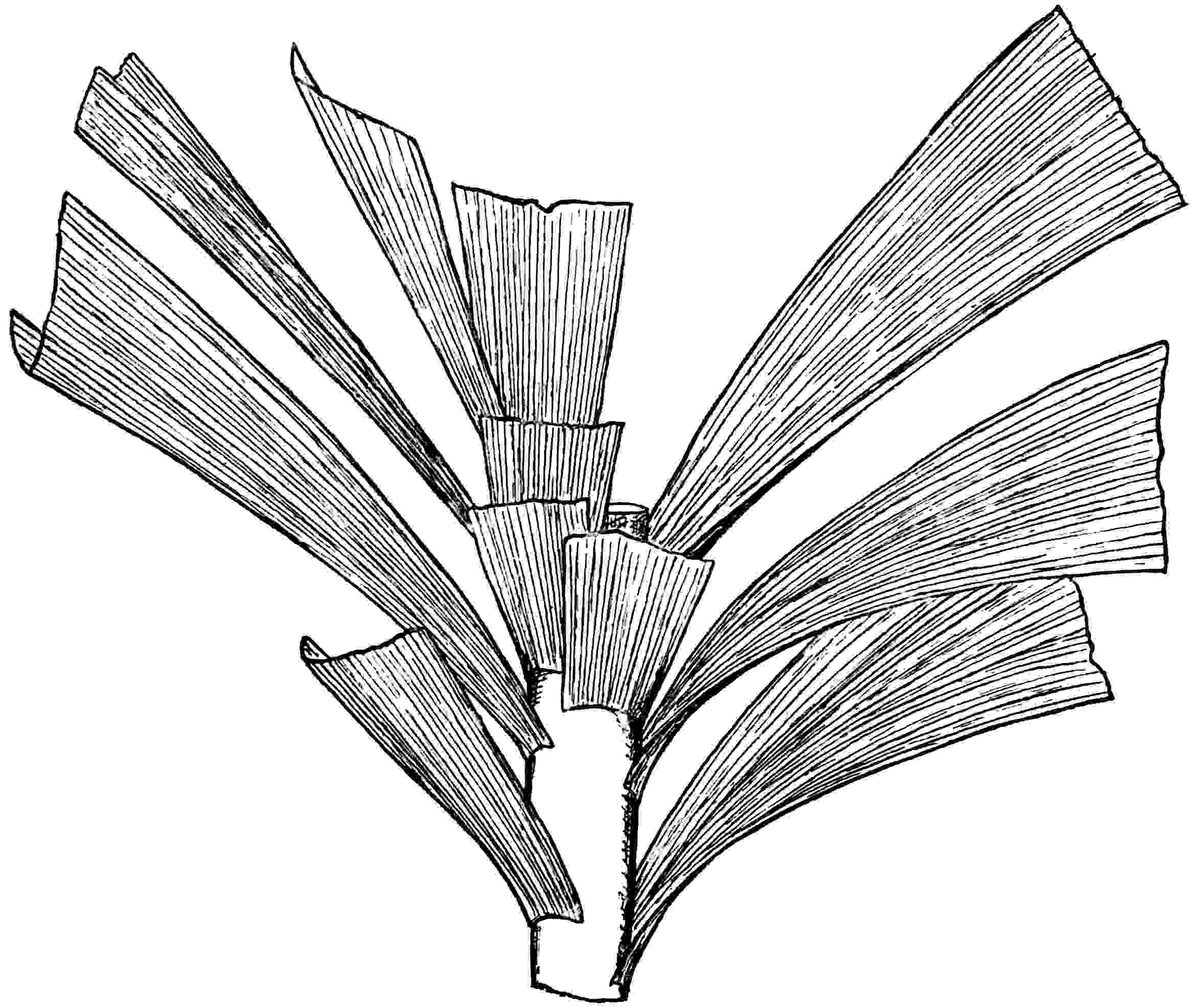
Fig. 484.
Pelourdea vogesiaca
. Reconstruction of a foliage-shoot. (After Wills.)
Pelourdea hadroclada (Halle).
Dr Halle[734] recently published an account of some imperfect leaves and stem-fragments from the Rhaetic of Scania which he named Phyllotenia (?) hadroclada, the generic name provisionally adopted having been proposed by Salfeld[735] for some rather obscure remains from the Corallian of Germany. It appears to have escaped the notice of both authors that Saporta[736] in 1894 had adopted the designation Phyllotenia for some examples of broad parallel-veined leaves from Lower Cretaceous rocks in Portugal very similar to Velenovský’s Krammera mirabilis[737]. Some other generic name must therefore be used. For the Rhaetic species the name Pelourdea would seem appropriate. The type-specimen consists of an axis 10–12 mm. in diameter with spirally disposed transversely elongated leaf-scars bearing sessile linear leaves similar to Poa-Cordaites; none of them are complete, the largest is 6 cm. long and 5–7 mm. broad with 8–12 parallel veins. An examination of the original specimens in the Stockholm Museum satisfied me that Dr Halle is justified in the opinion that they may be fragments of some Cordaitalean plant and that he was well advised to avoid the use of the name Cordaites. Salfeld’s species, Phyllotenia longifolia, may be an imperfectly preserved example of Phoenicopsis[738], but the material is too incomplete to be identified with any degree of confidence.
Pelourdea Imhofi (Heer).
The Triassic leaves from Switzerland described by Heer[739], and more recently by Leuthardt[740], as Bambusium Imhofi, were referred by Fliche[741] to the genus Cordaites. The lamina is ensiform, 25 cm. long with a maximum breadth of 2·4 cm. Leuthardt’s photograph of aerial stems and rhizomes of this supposed Monocotyledon are far from convincing.
Pelourdea keuperiana (Compter).
The leaves from the Lower Keuper of Thuringia assigned by Compter[742] to Cordaites without adequate evidence resemble those of P. vogesiaca, but there is no evidence as to their manner of attachment; they are 30–40 cm. long and from 1·5 to 2 cm. broad.
Pelourdea megaphylla (Phillips).
This species was first described by Phillips[743] from the Middle Jurassic Stonesfield Slate and afterwards referred to Zamites[744]: the leaves bear a striking resemblance to foliage of the type Cordaites borassifolius; the lamina is 30 cm. long and attains a breadth of 3 cm., the apex is acuminate and slightly contracted towards the broad concave base. My former comparison of these Stonesfield leaves with the long pinnae of Ceratozamia mexicana seemed to be supported by Phillips’s type-specimen of Palaeozamia longifolia. It may be that the supposed pinnae in Phillips’s type are spirally disposed leaves: if this is the case the specimen may be a fragment of a Podozamites; its specific identity with the larger detached specimens, though probable, cannot be demonstrated. Some leaves figured by Zigno[745] from Jurassic rocks of Italy as Yuccites Schimperianus may be identical with P. megaphylla.
Pelourdea mirabilis (Velenovský ex Corda MS.).
The generic name Krammera, suggested by Corda, was employed by Velenovský[746] for large Cordaites-like leaves from the Lower Cretaceous of Bohemia, for casts of cones regarded by him as stems, and for fruit-like bodies. The leaves, previously described as Flabellaria chamaeropifolia Goepp., Dammara albens Presl, etc., bear a close resemblance to the large broadly linear leaves of Cordaites; the lamina reaches a length of 40 cm. and between the veins occur 1–4 finer striations. The fossils identified by Velenovský as stems bearing crowded imbricate scales, which he regarded as the persistent bases of Krammera leaves, are probably cones; they agree very closely in size and shape, also in the form of the scales, with cones of Agathis and some other recent Conifers. As the designation Krammera was instituted primarily for cones and not leaves the name Pelourdea is substituted for it.
Niponophyllum. Stopes and Fujii.
Niponophyllum cordaitiforme Stopes and Fujii.
The generic name Niponophyllum[747] was proposed for some petrified specimens of leaves or possibly leaflets from Upper Cretaceous beds in Japan which, though not definitely assigned to a group or family, are considered by the authors of the genus ‘to lie [anatomically] somewhere between Cordaites and Cycadeoidea’ ‘with a closer similarity to the former than to the latter if we compare the whole Cordaites leaf with our blade.’ The data on which this conclusion is based are, however, insufficient to justify a reference of Niponophyllum to the Cordaitales or indeed to lend any substantial support to the opinion that the Japanese specimens are anatomically more akin to Cordaites than to other plants. The type-species is represented by two specimens of leaf-fragments about 0·4 mm. thick and from 6 to 9 mm. broad containing from 21 to 33 vascular bundles; the upper part of the mesophyll is composed of palisade tissue and the stomata appear to be confined to the lower epidermis. Each bundle is accompanied by an I-shaped girder, and small patches of sclerenchyma occur next the upper epidermis between the girders; there are no resin-canals: the vascular bundles are collateral, the xylem is said to be almost entirely centripetal and exarch, but in the absence of evidence afforded by longitudinal sections the details of structure cannot be definitely determined. A comparison is made with Cycadean leaves and with leaves of Araucarineae and Podocarpeae, also with Cordaites; another type with which Niponophyllum may be compared is Desmiophyllum Solmsi[748].
The genus is interesting as an example of a petrified gymnospermous type of leaf characterised by the absence of resin-ducts and transfusion-tracheids, the possession of collateral, apparently exarch, bundles enclosed in a double sheath; but the data supplied are insufficient to enable us to allocate the specimens to a position within the class.
A specimen described by Schenk[749] as Eolirion primigenium from Lower Cretaceous beds in the Carpathian mountains closely resembles in habit a foliage-shoot of Poa-Cordaites; the leaves are narrow and linear with obtuse apices and attached, apparently, in a close spiral. Schenk assigns the plant to the Monocotyledons, but its systematic position must be left unsettled.
The list of Mesozoic specimens resembling Cordaites leaves might be extended. Apart from some Triassic and Rhaetic examples which may well be Cordaitalean, there are many others which, though similar in form and venation to Cordaites, are in all probability more closely related to Agathis and other genera; the species Dammarites Bayeri recently described by Zeiller[750] from the Upper Cretaceous of Bulgaria is a case in point. The Araucarian character of the wood of Cordaites precludes any satisfactory discrimination between Mesozoic Araucarian stems and those of Cordaitalean species, at least in the case of such material as is usually available.
Titanophyllum. Renault.
Titanophyllum Grand’Euryi Renault. The remarkable leaves on which this genus and species are founded[751] were discovered in the Commentry coalfield; they occur as detached specimens and cannot be correlated with any known stem. Renault suggests that the Autun stems referred to Colpoxylon may have borne the Titanophyllum leaves, but this correlation rests only on the dimensions of the stems and the occurrence of transversely elongated scars on the surface. The lamina is thick and coriaceous, 70–75 cm. long and 20–25 cm. in breadth; the veins are parallel but not branched; numerous longitudinal striations on the upper surface indicate the presence of hypodermal stereome-strands; stomata are abundant on the lower surface and the more or less rectangular cells in the neighbourhood of the stomata appear to be papillose (fig. 485, A, B). The distal region of the lamina is often torn into strips (fig. 485, A); the approximately rectangular leaf has a broad elliptical base 9–10 × 3–4 cm.
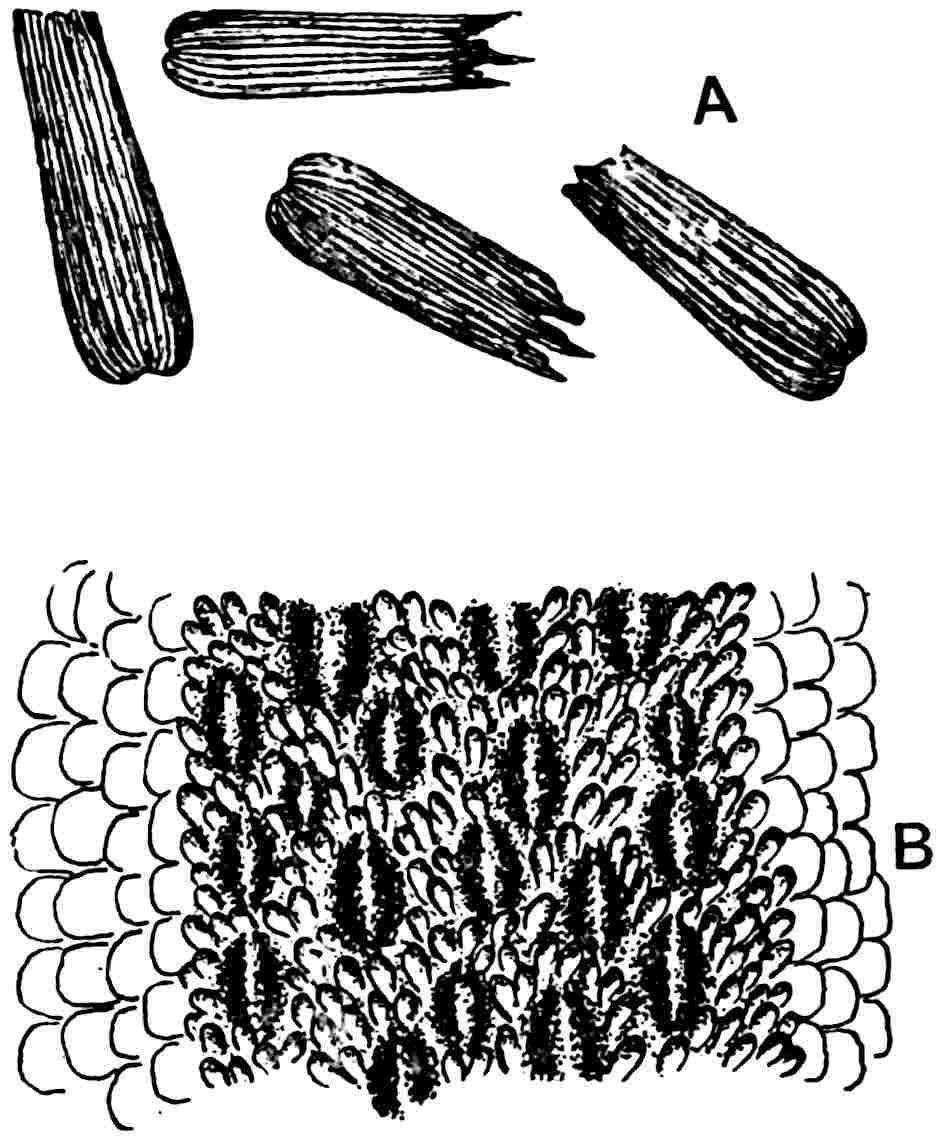
Fig. 485.
Titanophyllum Grand’Euryi.
A, leaves ¹⁄₃₀ nat. size; B, stomata on the lower surface of the lamina. (After Renault and Zeiller.)
Dr White[752] describes a specimen from the Lower Coal Measures of Missouri as ? Titanophyllum Brittsii which he speaks of as the thick base of a leaf similar to that described by Renault but, as White says, no formal diagnosis is possible without more satisfactory material. Such evidence as is available suggests that Titanophyllum is a type of Cordaitalean leaf probably closely allied to Cordaites.