Chapter XXXIX · (continued 2)
Reading edition
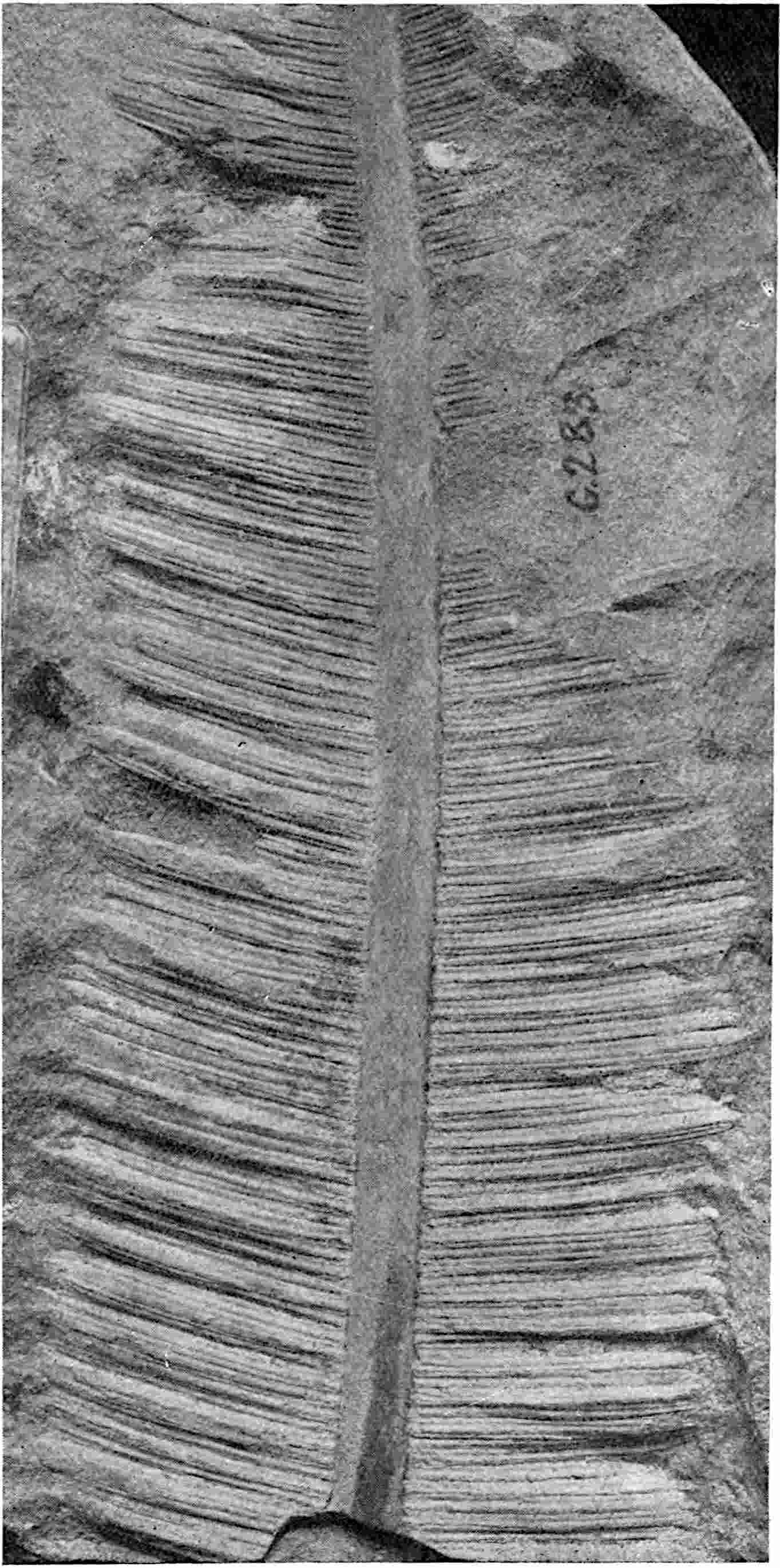
Fig. 621.
Nilssonia rajmahalensis
(=
Cycadites rajmahalensis
). (Indian Geological Survey, Calcutta; nat. size.)
Nilssonia brevis occurs in Upper Rhaetic and Lower Liassic strata.
Nilssonia pterophylloides Nathorst.
A Rhaetic Scanian species originally referred by Nathorst[1678] to Nilssonia but later removed by him to Dioonites[1679] and in 1909 reinstated in Nilssonia[1680] on the ground that the lamina covers the upper face of the rachis. The segments are fairly uniform in breadth and linear; they reach 10 cm. in length and are usually 5–7 mm. broad; the lamina is slightly tapered towards the apex (fig. 619, B). There are 3–10 parallel grooves on the upper face of the segments and between each pair is a single unbranched vein. In close association with portions of three fronds of this species Nathorst found several oval bodies, 1 cm. × 7 mm., which he at first regarded as ‘antherangia’ comparable with the sporocarps of the Hydropterideae, but an examination of the carbonised tissue demonstrated that the small rounded bodies contained in each of the ‘antherangia,’ originally believed to be pollen-sacs, are grains of resin internal to a cuticle of thick-walled cells and probably formed by secretory sacs in a fleshy tissue. Internal to the resin-bodies is a second cuticle which may be the remains of a nucellus, the outer cuticle and the resin belonging to the sarcotesta. Nathorst’s careful examination of these fossils shows that they are seeds (fig. 619, A) and were probably borne on plants of N. pterophylloides, though an accidental association is not improbable.
Nilssonia compta (Phillips).
Broadly linear fronds varying considerably in size and in the breadth and number of the truncate segments. In some cases the fronds exceeded 40 cm. in length and had a breadth of 9 cm. (fig. 622). The veins are simple, parallel, and fairly prominent and the lamina shows clearly the attachment to the upper surface of the rachis which is covered by it as in all species of the genus[1681]. The structure of the epidermis and stomata has recently been described by Thomas[1682]. Brongniart mentioned in the Prodrome a species from the Lower Oolite of Yorkshire under the name Pterophyllum Williamsonis[1683], but in a later work this is given as a synonym of N. compta. Nilssonia compta bears a close resemblance in habit to N. polymorpha; it agrees also with the large fronds described from the Upper Gondwana of India as Pterophyllum princeps[1684]. Since attention was first called to this similarity an examination of several of the figured specimens has convinced me that the Indian fronds are either identical with or at least closely allied to the European leaves. The apparent lateral attachment of the lamina in the drawings published by Oldham and Morris and Feistmantel is due to imperfect preservation; the lamina ends in two raised ridges, and the discovery of a specimen in which the lamina completely covers the rachis confirmed the impression made by the other specimens. The Amurland Jurassic species Nilssonia Schmidtii[1685] Heer though probably not identical with N. compta is a very similar type; it was originally described by Heer as Anomozamites Schmidtii and transferred by Nathorst[1686] to Nilssonia: the veins are occasionally forked near the rachis and are rather farther apart (·5 mm.) than in N. compta and the segments are broader and deeper than in the English species. Nilssonia nipponensis Yok.[1687] a Jurassic species recorded from Japan and North America is another similar type.
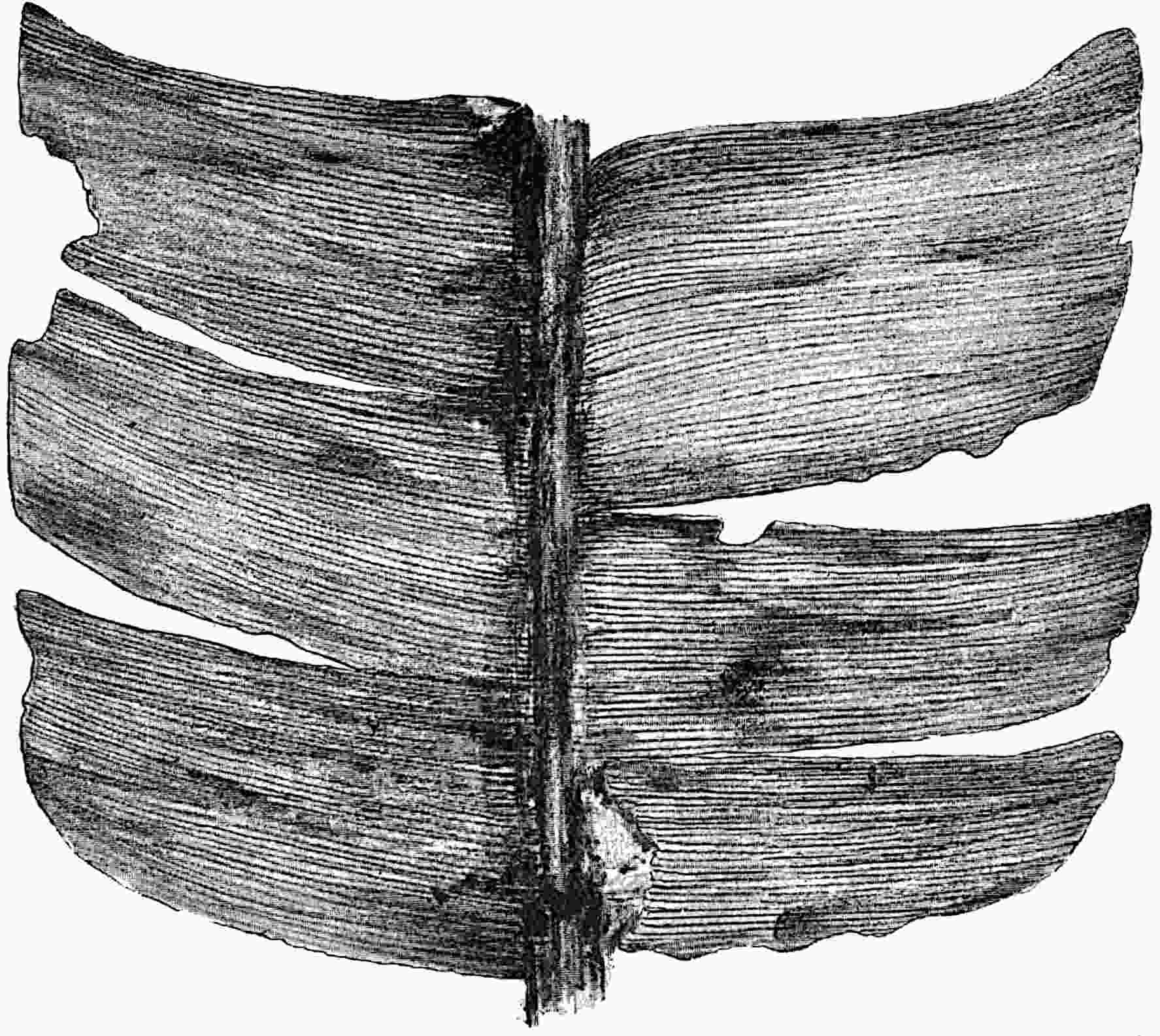
Fig. 622.
Nilssonia compta.
(Whitby Museum; nat. size.)
Nilssonia orientalis Heer.
In this Jurassic and Lower Cretaceous species, founded on material from Jurassic rocks in Siberia[1688], the lamina is generally entire. The fronds exhibit a wide range in size and shape; they may have the form of very narrow linear leaves barely 1 cm. across or may reach a breadth of nearly 10 cm. The leaves from Middle Jurassic British strata named by Nathorst N. tenuinervis[1689] are probably identical with Heer’s type, and N. Johnstrupi[1690] Heer from the Lower Cretaceous of Greenland may also be referred to N. orientalis.
The veins are at right-angles or oblique to the rachis and are very numerous, three or more in a breadth of 1 mm.[1691] A species recently described by Halle[1692] from Graham Land as N. taeniopteroides agrees closely in habit with N. orientalis: in the southern form the frond may have a length of 40–50 cm. and a breadth of 3 cm. The entire lamina of N. taeniopteroides tapers gradually towards the base and is more rapidly narrowed in the distal region; the petiole is at least 6–7 cm. long: the simple or branched veins, 15–20 in 1 cm., are given off from the axis at a wide angle. The more crowded veins in N. orientalis constitute one of the few features in which it differs from Halle’s species, but the fact that the degree of closeness of the veins is inconstant within the same species renders this distinction of doubtful value. Halle compares his species also with N. densinervis (Font.) originally described as Platypterigium densinerve from the Potomac beds[1693] and afterwards transferred by Berry[1694] to Nilssonia and considered by him to be identical with Fontaine’s Platypterigium Rogersianum. An examination of some of Fontaine’s specimens in the Washington Museum led me to refer the fronds to Nilssonia[1695].
It is impossible to speak with confidence as to the absolute specific identity of N. orientalis Heer, N. Johnstrupi Heer, N. taeniopteroides Halle, and some similar forms; but it is clear that the linear fronds of this type characterised by an entire or occasionally pinnatisect lamina were widely distributed in Jurassic and Lower Cretaceous strata and persisted to the Upper Cretaceous series in Japan. This form of frond is recorded from England, Scotland, North America, Greenland, Spitzbergen[1696], Siberia, Russia, Afghanistan[1697], Japan[1698], Graham Land, and elsewhere. Reference has already been made to a petrified specimen of N. orientalis described by Dr Stopes from Japan[1699].
Specimens described by Salfeld[1700] from the Corallian of Germany as Taeniopteris sp. may be N. orientalis; Bartholin’s N. polymorpha from Bornholm, Velenovský’s Lower Cretaceous N. bohemica and Yokoyama’s N. ozvana from Japan are other examples of fronds which may be identical with N. orientalis[1701].
Nilssonia tenuicaulis (Phillips).
This Jurassic species, while agreeing generally in habit with N. compta, is characterised by the narrow and numerous linear segments with a more acuminate apex. The fronds reached a length of more than 20 cm.[1702] Leckenby’s name Pterophyllum medianum[1703] was given to a specimen from the Yorkshire coast and now in the Sedgwick Museum, Cambridge, which, with Pterophyllum angustifolium, is clearly identical with Cycadites tenuicaulis Phillips. The specific name mediana frequently used[1704] for this type should be given up in favour of the older term tenuicaulis. A species of similar habit is described but not figured by Krasser[1705] as N. Sturii from the Lunz beds. N. tenuicaulis is fairly common in the Middle Jurassic beds near Scarborough and is recorded from the Kimmeridgian of Scotland under the name N. mediana (fig. 614, C)[1706].
Nilssonia princeps (Oldham and Morris).
Oldham and Morris speak of Pterophyllum princeps[1707] as one of the commonest plants in the Rajmahal beds in India. The fronds are characterised by their large size and by the very broad oblong and distally truncate pinnae with parallel and occasionally branched veins. In the specimens figured by Oldham and Morris and Feistmantel the pinnae are cut off at their bases (fig. 623), which form ridges parallel to the rachis: this feature is not clearly shown in the published drawings. By breaking some pieces of rock from a slab containing figured specimens other pieces were found in which the laminae of the bases of segments meet in the middle of the upper face of the rachis. The pinnae vary in breadth from 1 cm. to 3·5 cm. and reach a length of 8 cm.; the distal end is truncate, the lower edge being strongly curved: the segments are slightly broadened at the base. The veins are prominent and parallel, from 0·5 to 0·8 mm. apart. The Rajmahal fronds described as Pterophyllum Morrisianum[1708] appear to be indistinguishable from this species.
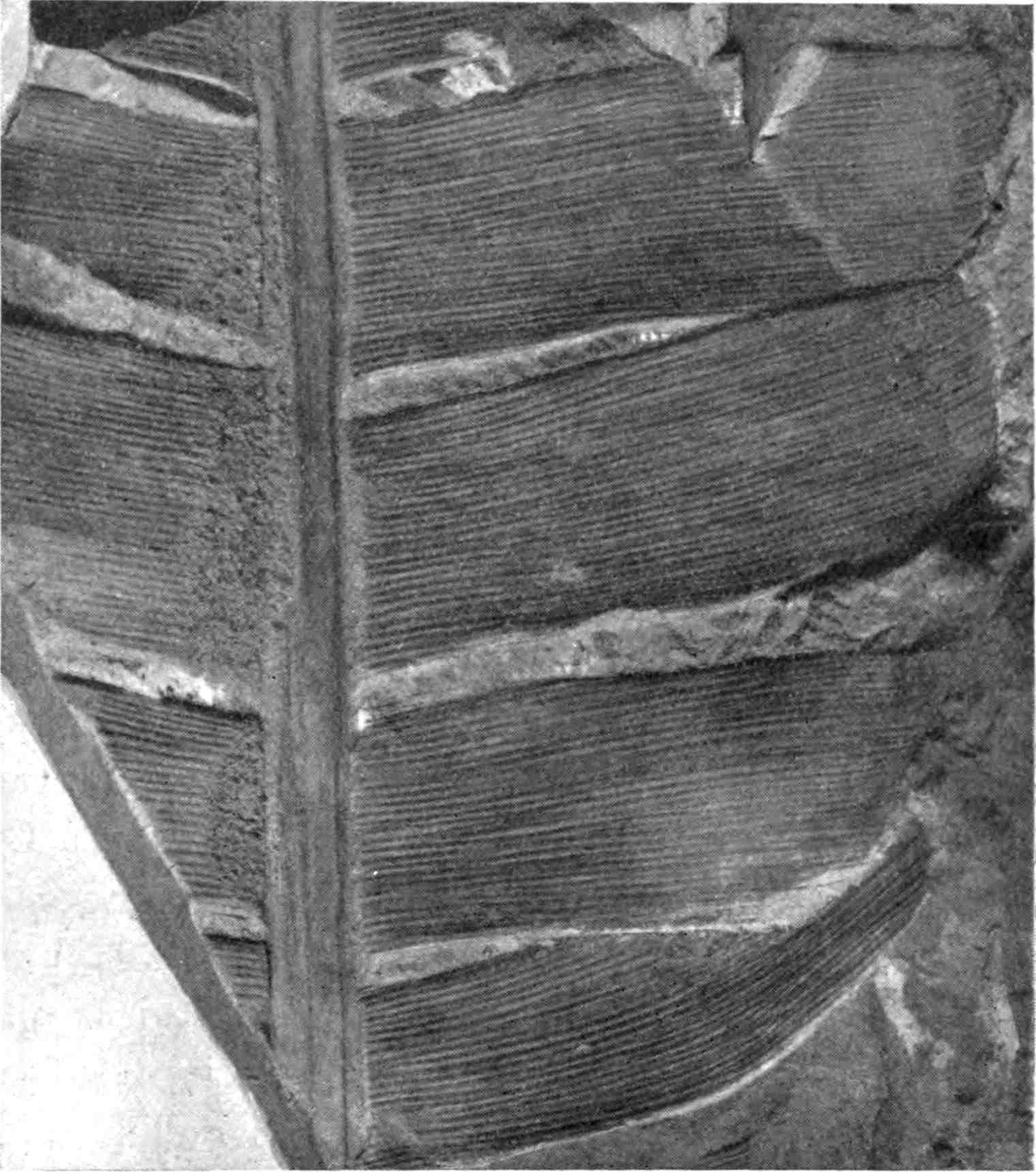
Fig. 623.
Nilssonia princeps.
(Slightly reduced; Indian Geological Survey, Calcutta.)
Nilssonia Schaumburgensis (Dunker).
This species, first described as Pterophyllum Schaumburgense[1709] from the Wealden of Germany, affords a good illustration of a small type of frond closely resembling the much larger species N. compta. Examples from English Wealden rocks seldom exceed 1 cm. in breadth and are often much narrower; the linear lamina is almost entire or divided into short and broad truncate segments of unequal breadth: the veins are parallel and simple. For figures of this species, recorded from different European localities and from Japan, reference should be made to the accounts by Schenk[1710], Nathorst, Yokoyama, Yabe, and Fontaine.
CTENIS. Lindley and Hutton.
The genus Ctenis[1711] was founded on a piece of pinnate frond from the Middle Jurassic rocks of the Yorkshire coast previously figured by Phillips as Cycadites sulcicaulis. Lindley and Hutton regarded the plant as probably Cycadean and proposed to apply the name Ctenis to all leaves having the general characters of Cycadeae, but with ‘the veins connected by forks or transverse bars.’ While many authors have accepted Ctenis as a Cycadean genus, by others[1712] it has been placed among the Ferns, on the ground that some small circular elevations on the lamina of the segments of certain species are believed to be sori or sporangia. Since Ettingshausen[1713] and Schenk[1714] first noticed this feature Raciborski[1715] has figured several examples from Poland and Staub[1716] records similar circular bodies on a Liassic Hungarian species. In no single instance have sporangia been found. Nathorst[1717] proposed the designation Anthrophyopsis (because of the resemblance of the lamina in form and venation to the leaves of the Fern Anthrophyum) for some Rhaetic specimens from Scania, but as they were subsequently found to be segments of a pinnate frond he adopted the name Ctenis. An example in the Manchester Museum[1718] (fig. 624) from Yorkshire, mentioned by Nathorst in an early paper as probably a new species of Anthrophyopsis, afforded good preparations of the cuticle (fig. 625) which revealed the existence of circular elevations on the outer walls of the epidermal cells: these may explain the nature of some at least of the supposed sporangia. The walls of the epidermal cells are straight. The name Ctenis is applied to pinnate fronds which are probably Cycadean though we have no evidence as to the nature of the stem or the reproductive organs. Ctenis fronds are among the largest Cycadean leaves from Mesozoic floras; in Ctenis hungarica Staub the frond is said to have reached a length of 2 met. and in other species the dimensions exceed those of most pinnate leaves. The stout rachis bears linear or broad-oblong pinnae attached at a wide angle and varying considerably in size and shape; the pinnae are attached by the whole base which is usually broadened and decurrent but in a few cases slightly contracted (e.g. C. Zeyschneri Rac.[1719]). For some fronds bearing broad and basally narrowed segments Raciborski proposed the name Ctenidiopsis in distinction from Euctenis which he applies to the typical forms. The pinnae may be long and narrow reaching a length of over 12 cm., or short and broad: in some cases the frond would be more correctly described as deeply pinnatisect; the apex of the segments is acute, bluntly rounded or truncate. Several veins pass into the base of each pinna and pursue a course approximately parallel to the edge of the lamina; a characteristic feature is the occasional occurrence of oblique cross-connexions between the veins. It is possible that in some species the pinnae had spinous margins as in the pinnae of uncertain affinity figured by Fontaine[1720] as Encephalartopsis nervosa from the Potomac series. Our knowledge of the epidermal cells is very meagre: in the specimen represented in fig. 625 the epidermal cells have straight walls and a central papilla. The genus extends from Triassic to Upper Jurassic rocks.
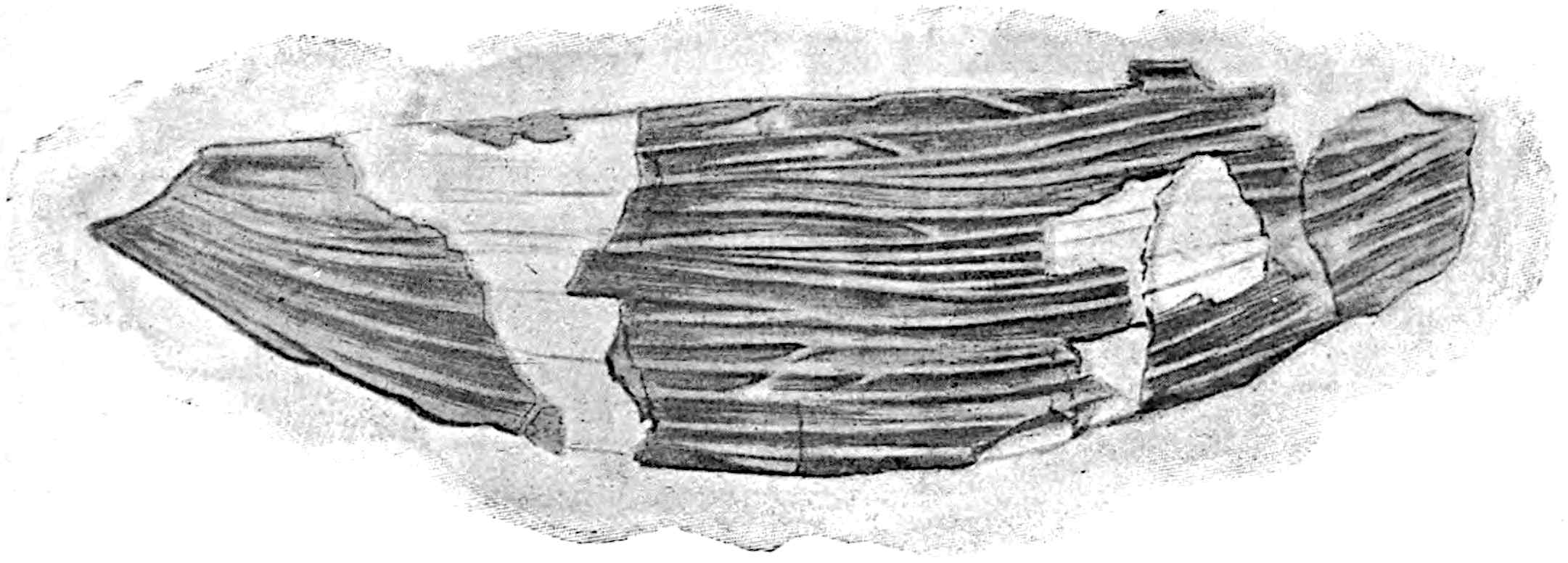
Fig. 624.
Ctenis
sp. Single pinna. (Manchester Museum, No. 53.)
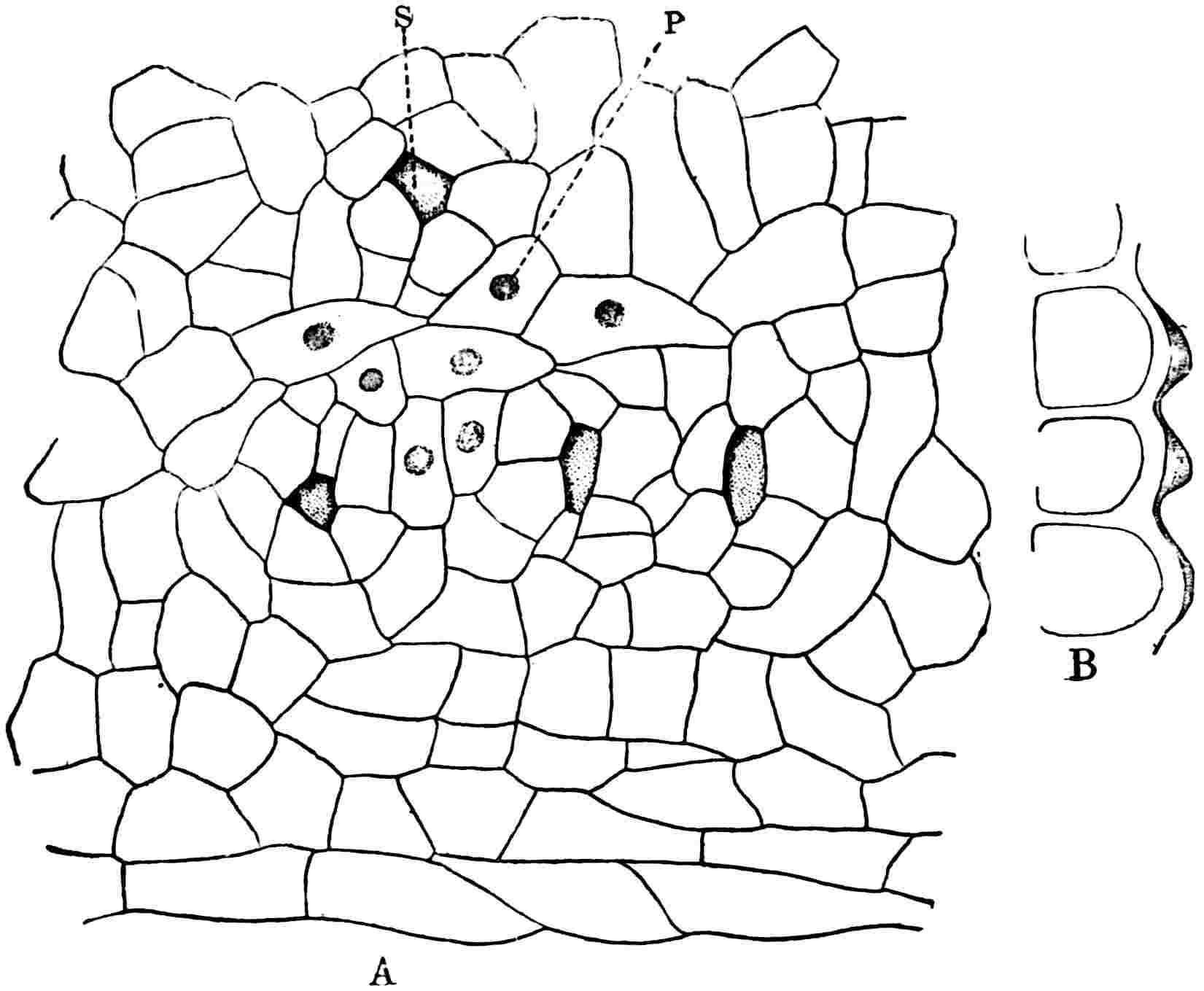
Fig. 625.
Ctenis
sp. The epidermis of the pinna shown in
fig. 624
. A, surface-view;
p
, papillae;
s
, stomata. B, side-view. (Manchester Museum, No. 53.)
Ctenis lunzensis Stur.
This species, first recorded by Stur from the Lunz Upper Triassic flora, has recently been examined by Krasser[1721] and compared with the Jurassic species Ctenis sulcicaulis (Phill.) (= C. falcata Lind. and Hutt.) and C. Potocki Rac. No figures or detailed descriptions have been published.
Ctenis fallax Nathorst.
This Scanian Rhaetic type[1722], including Anthrophyopsis crassinervis, A. Nilssoni, and probably A. obovata Nath., is characterised by very large obtusely pointed pinnae reaching at least 20 cm. in length and over 3 cm. in breadth. The veins are often 2 mm. apart and form long polygonal meshes. Nathorst figures small circular patches on the surface of the lamina. Raciborski[1723], on slender evidence, refers a fragment from the Jurassic of Cracow to this species.
Ctenis hungarica Staub.
A species[1724] characterised by very large fronds reaching 2 met., bearing broad linear pinnae almost at right-angles and attached to the rachis by decurrent bases, attaining a length of 21 cm. and a breadth at the base of the lamina of 3·5 cm. and 4 cm. a short distance from the acute apex. The veins are parallel to the edge of the lamina, but Staub does not appear to have seen distinct anastomoses. It is not improbable that Staub’s species may be identical with C. asplenioides (Ett.) from the Lias of Hungary, specimens of which are preserved in the École des Mines, Paris.
Ctenis asplenioides (Ettingshausen).
This species was first described by Ettingshausen[1725] from Liassic strata in Austria as Taeniopteris asplenioides and compared by him to large simple fronds of Asplenium nidus but distinguished by a deeply dissected lamina. Schenk[1726] found that the veins anastomose and adopted the name Ctenis. In habit very similar to C. sulcicaulis, but the pinnae are much broader, exceeding 4 cm., and the veins are 3–5 mm. apart. Only the basal part of the segments is figured by Ettingshausen. Specimens in the École des Mines, Paris, from Hungary have pinnae nearly 40 cm. long and 2·5 cm. in breadth, the parallel veins being connected by a few oblique branches. Both Ettingshausen and Schenk speak of small circular sori on the lower epidermis, though these are not figured nor were any sporangia obtained. This species and other examples of large Ctenis fronds are described by Raciborski from Lower Jurassic rocks in Poland. He figures part of a leaf of C. Zeyschneri[1727] 40 cm. long bearing alternate pinnae approximately 10 cm. long and nearly 4 cm. broad, characterised by obtuse apices, a decurrent lamina, and anastomosing veins closer together (16–24 per 1 cm.) than those of C. asplenioides. In one Polish specimen, C. remotinervis[1728], with pinnae 5 cm. broad the lamina is represented in the upper part of the frond as continuous over the face of the rachis, and—if the drawing is accurate—the frond in this respect differs from typical examples of Ctenis and agrees with Nilssonia. A species of Ctenis with broad pinnae is described by Yokoyama[1729] from the Jurassic of China as C. Kaneharai.
Ctenis sulcicaulis (Phillips).
This type[1730] is more familiar under the name Ctenis falcata given to it by Lindley[1731], but if we follow Lester Ward[1732] in strict observance of the rule of priority, a course from which I have frequently deviated on the ground of long usage, the less familiar designation must be adopted. Fronds pinnate; long and tapered linear pinnae sometimes exceeding 12 cm. in length and 1 cm. in breadth attached obliquely or almost at right-angles to a fairly broad rachis (fig. 626). The lamina is broadest at the base and the lower margin is strongly decurrent, tapering distally to an acute apex. The parallel and frequently anastomosing veins diverge slightly in the basal region of the pinnae. Though usually separate to the base, the laminae of adjacent pinnae may be continuous as in a pinnatisect leaf[1733]. This species is recorded also from North America, and fronds of similar habit are figured by Fontaine[1734] from the Jurassic of Oregon as Ctenis orovillensis: a fragment recorded from Jurassic rocks in Afghanistan as Ctenis sp. may belong to C. sulcicaulis[1735].
Ctenis latifolia (Brongniart).
This species[1736], originally referred to Taeniopteris, was transferred to Ctenis as the result of the discovery of anastomosing veins in the type-specimen in the Oxford Museum. The segments are shorter and broader than in C. sulcicaulis and very similar to those of C. orovillensis Font.
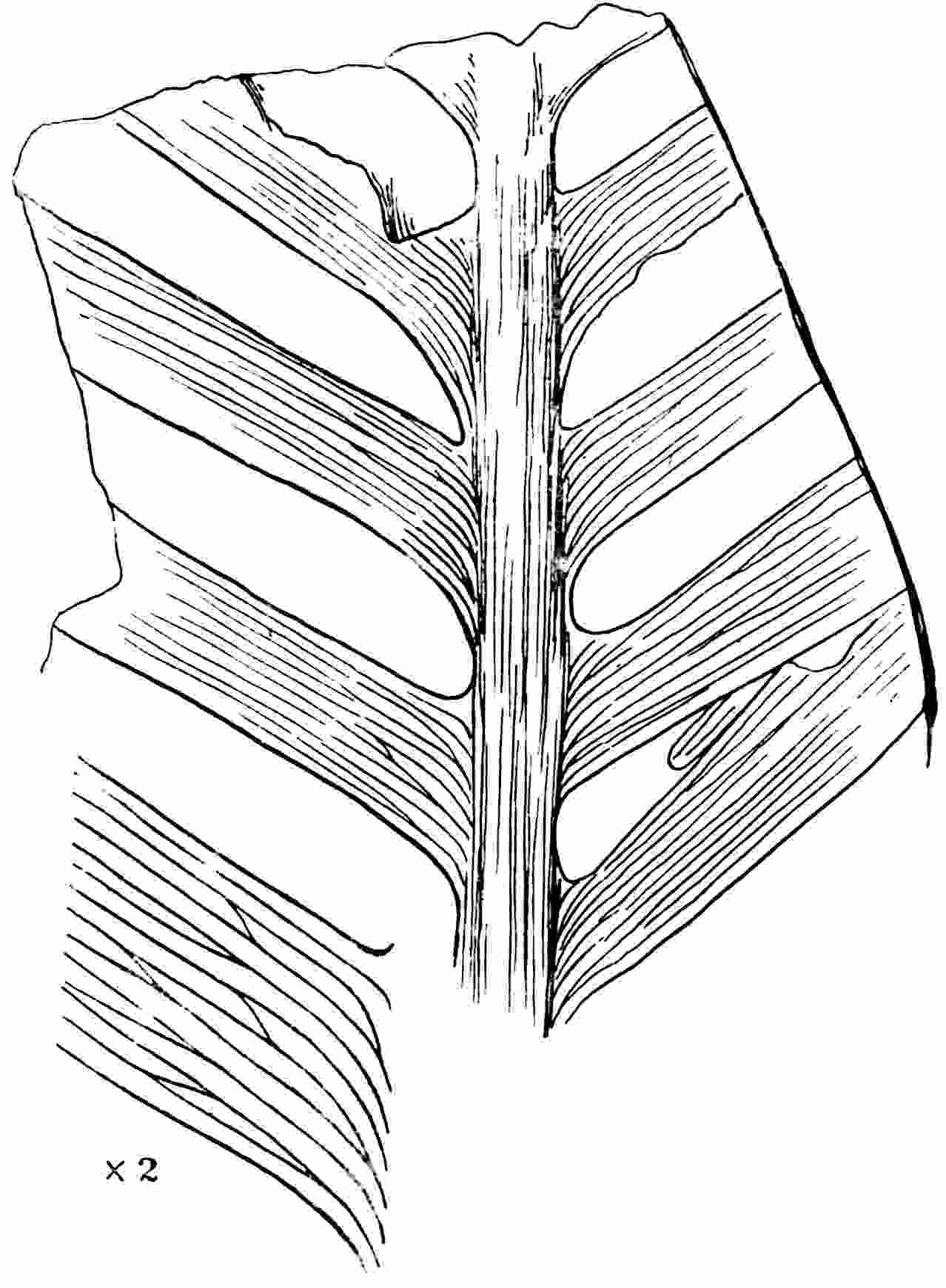
Fig. 626.
Ctenis sulcicaulis.
(British Museum, V. 9012.)
Ctenis sp.
The pinna shown in fig. 624 from the Jurassic beds in Yorkshire[1737] is interesting as one of the few examples of the preservation of the cuticular membrane. The straight or curved walls of the epidermal cells agree with those of recent Cycads except Stangeria, and each cell bears a large central papilla that gives to the lamina the finely punctate appearance which has been regarded as evidence of sporangia. The gaps in the cuticle probably mark the position of sunken stomata.
PSEUDOCTENIS. Seward.
This genus[1738] was established for certain pinnate fronds agreeing in habit with Ctenis sulcicaulis but distinguished by the almost complete absence of any cross-connexions between the veins. Some of the forms with narrow pinnae closely resemble species of Zamites, the distinguishing feature being the decurrent lower margin of the leaflets. Though such fronds might not unreasonably be included in Ctenis, it is more convenient on the analogy of the occasional occurrence of Glossopteris fronds with very few anastomoses to employ a distinctive designation.
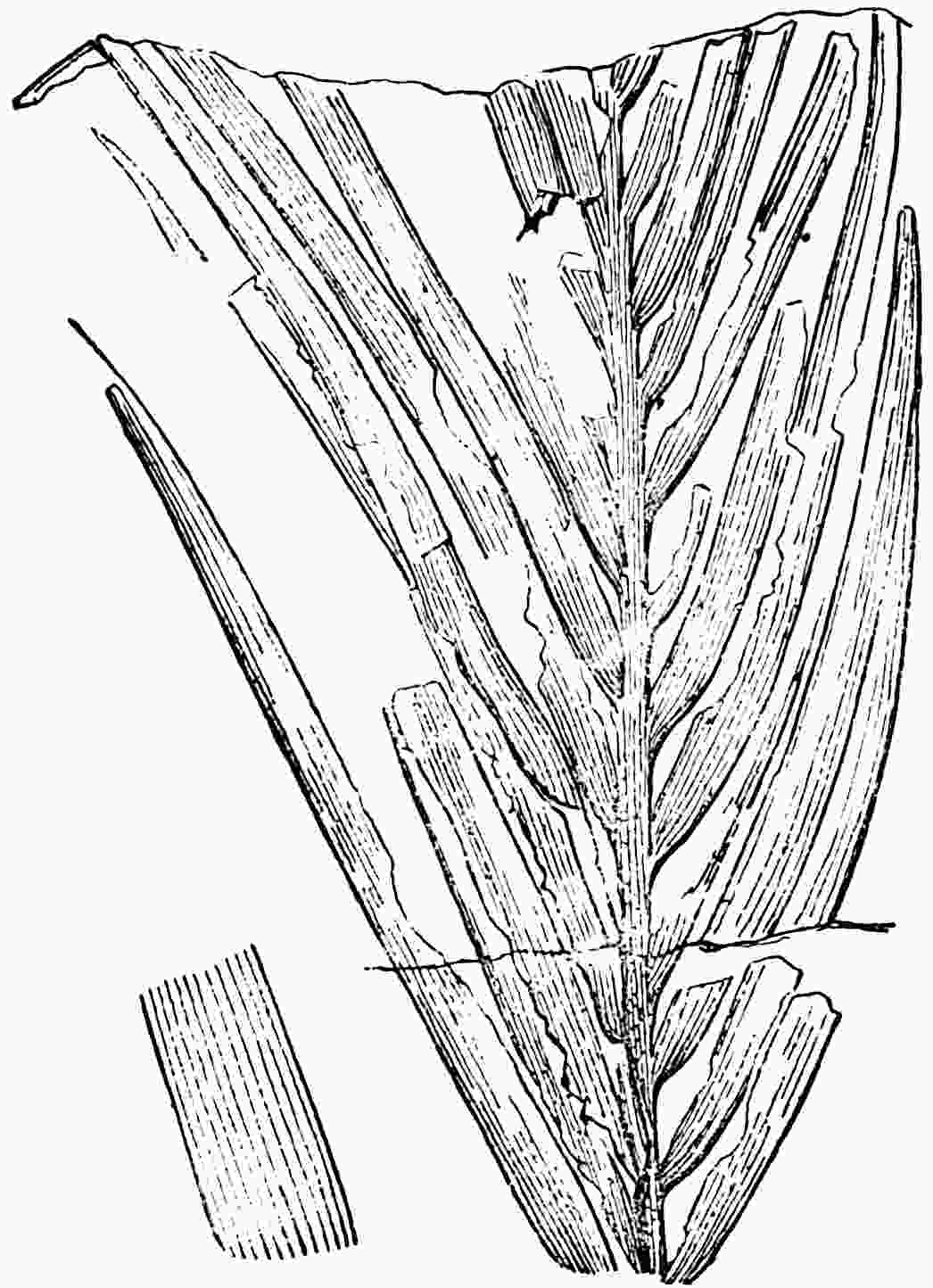
Fig. 627.
Pseudoctenis eathiensis.
(British Museum, No. V. 2744; ½ nat. size.)
Pseudoctenis eathiensis (Richards).
Some of the specimens on which this species[1739] is founded were originally figured by Miller[1740] from Upper Jurassic strata in Scotland and afterwards named by Richards[1741] Zamites eathiensis. The general appearance of the fronds is very like that of Ctenis sulcicaulis; the pinnae vary in breadth from about 3 mm. to 1·5 cm.; they are attached at right-angles or, in the apical region, may be almost parallel to the rachis. The longest pinna recorded is 17 cm. and the lamina tapers to a slender apex; the veins are parallel and occasionally forked, but cross-connexions are rare. The partially petrified rachis of one specimen showed hypodermal stereome and some secretory canals as in recent Cycads. The specimen from Wealden rocks near Hastings (fig. 627), originally described as Zamites sp.[1742], is probably specifically identical with Pseudoctenis eathiensis. The South African Wealden species, originally described by Tate as Palaeozamia Rubidgei[1743], agrees closely with Pseudoctenis and is probably an example of that genus. This type bears a close resemblance in the form of the frond to Ctenophyllum grandifolium Font.[1744] and C. Wardi[1745] Font. from American Trias and Jurassic rocks respectively. Pseudoctenis crassinervis Sew.[1746] is another Scotch form with coarser veins.
A frond very similar in habit to P. eathiensis is represented by Pseudoctenis ensiformis Halle[1747] from the Jurassic strata of Graham Land originally referred by Nathorst to Pterophyllum. An examination of the type-specimen in the Stockholm Museum revealed its resemblance to the Scotch species P. eathiensis: a single anastomosis was noticed in one of the pinnae. The broadly ensiform obtuse pinnae, reaching a length of 7 cm. with a maximum breadth of 3 cm. at their expanded bases, vary in breadth and are attached at right-angles to a slender rachis. The veins, 1–1·5 mm. apart, are parallel and strong. The varying breadth of the pinnae irrespective of their position on the rachis is a distinctive feature. Halle draws attention to a resemblance of this Antarctic species to Ctenophyllum latifolium Font. a Potomac type referred by Berry[1748] to the genus Ctenopsis on the rather slender ground that the veins are arranged in pairs. Berry in a footnote expresses the opinion that Ctenopsis is very closely related to or possibly identical with Pseudoctenis.
If the bases of the pinnae in the specimen of P. ensiformis figured by Halle are complete, as they appear to be, the frond agrees very closely with Pterophyllum Carterianum Old. and Morr.[1749] from India. A comparison of the Rajmahal specimen with Halle’s figure leads me to regard the two fronds as probably identical. The veins in the Indian species, which should also be referred to Pseudoctenis, are prominent and from ·5 to 1 mm. apart; the base of the lamina is slightly broadened and the veins curve downwards towards the rachis in the lower decurrent portion. The other Indian type, Pterophyllum Morrisianum[1750], with which Halle compares his species is, however, not a Pseudoctenis but should be included in Nilssonia and is probably identical with Pterophyllum princeps Old. and Morr.
Pseudoctenis Lanei Thomas.
This species[1751], recently described from Middle Jurassic beds at Marske, Yorkshire, has narrower linear lanceolate pinnae. The linear pinnae reach a length of 10 cm. and a breadth of 9 mm. The veins are numerous, 10 in a breadth of 6 mm., and only one cross-vein was noticed. In the decurrent lower edge of the laminae the fronds are identical with Ctenis sulcicaulis. A very good example of this species[1752] in the York Museum is reproduced by Mr Thomas in his account of Cleveland Jurassic plants.
Pseudoctenis Balli (Feistmantel).
A species described originally by Feistmantel[1753] as Anomozamites Balli from the Barakar group of the Damuda series and afterwards transferred to the genus Platypterygium, characterised by broadly linear segments of unequal breadth attached obliquely or at right-angles to a slender rachis. The apices of the segments though usually imperfect appear to be truncate; the bases of the pinnae are decurrent by their lower edge. The veins are approximately 3 per millimetre; they are generally forked at the base and in one or two places show cross-connexions. In the middle of the frond the narrow rachis is exposed but in the apical region it is covered by the laminae. The occurrence of two divergent pinnae at the apex of the frond is a feature met with also in Ctenis sulcicaulis. This description is based on an examination of the specimens figured by Feistmantel.
III. Cycadean Fronds which cannot be assigned to a family-position.
SPHENOZAMITES. Brongniart.
This name was proposed by Brongniart[1754] as a subgenus of Otozamites denoting pinnate fronds bearing leaflets without an auriculate base: he suggested that the subgenus might eventually be raised to generic rank and this was done by Zigno[1755] though in too wide a sense. In the case of Otozamites Beani (Lind. and Hutt.), quoted by Brongniart in illustration of Sphenozamites, the latter designation is inapplicable as the pinnae are auriculate. Another species, Zamites undulatus Sternb., to which Brongniart applied his new subgeneric term, is probably identical with Otozamites acuminatus (L. and H.)[1756].
Although the distinction between Sphenozamites and Otozamites is often ill defined the former name may be conveniently adopted for pinnate fronds similar to those of Zamia Skinneri and some species of Encephalartos characterised by leaflets of an asymmetrical, obovate, or rhomboidal form with a contracted or cuneate base and numerous branched divergent veins. Nothing is known of the structure or reproductive organs of Sphenozamites, and the genus, though serving a useful descriptive purpose, is founded solely on form, and in the absence of other data it would be rash to assume that its use implies close natural affinity. In the case of many other genera of Cycadean fronds there is additional evidence of relationship, but this is not the case with Sphenozamites. The pinnae resemble those of such recent Cycadean fronds as Zamia Skinneri and Z. muricata. The genus ranges from Lower Permian to Jurassic rocks.
Sphenozamites Rochei Renault.
This species[1757], from the Lower Permian of the Autun district, is founded on a pinnate frond bearing alternate pinnae, 2·5 × 1 cm., with an asymmetrical oblong lamina attached obliquely near the edge of the rachis with a cuneate base slightly decurrent below and a broadly rounded apex; the veins dichotomise once or twice as they diverge from the narrow base (fig. 628). The pinnae resemble the leaflets of Noeggerathia foliosa Sternb. and are similar in shape to those of the Jurassic species Sphenozamites Geylerianus Zig.
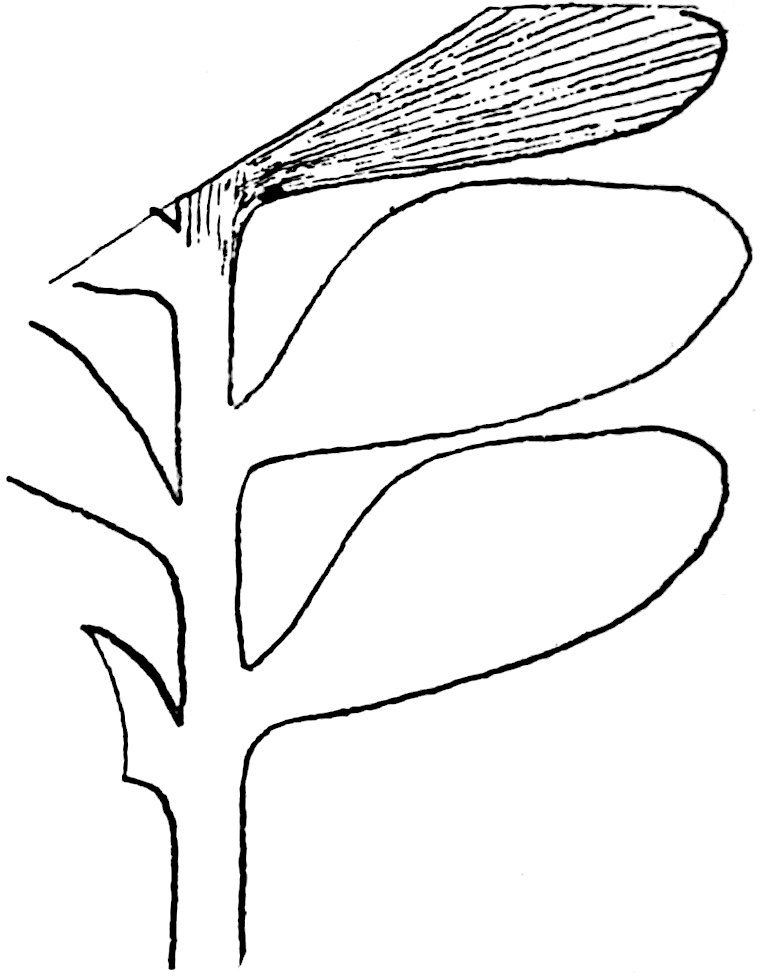
Fig. 628.
Sphenozamites Rochei.
(After Renault; nat. size.)
Sphenozamites Belli Seward.
This Middle Jurassic species from Stonesfield[1758] is founded on detached pinnae possibly identical with a specimen figured by Buckman as ?Naiadea obtusa[1759]. The pinnae are wedge-shaped, tapering gradually to an acute apex and attached by a narrow base: the leaflet shown in fig. 629 is 9 cm. long; the veins are numerous and more divergent than in some leaves of similar form referred to the genus Podozamites. With this species may be compared several Italian Jurassic specimens described by Zigno[1760] as four distinct species but more appropriately assigned to a single type S. Geylerianus. An examination of Zigno’s fronds in the Padua Museum, which he named S. Rossii, leads me to regard the irregularly serrate edge of the pinnae as the result of tearing of an originally entire lamina and to compare the specimens with Otozamites Beani (L. and H.). An imperfect ovoid pinna recalling S. Belli is figured by Newberry from the Rhaetic of Honduras as Sphenozamites robustus[1761]. A French Upper Jurassic species figured by Saporta as Sphenozamites latifolius bears a very close resemblance in the form of the leaflets to the Wealden plant Sewardia latifolia[1762]. Kurtz records the occurrence of Sphenozamites, S. Geinitzianus, from Rhaetic strata in Argentina[1763], but I have not seen any figures of this species.
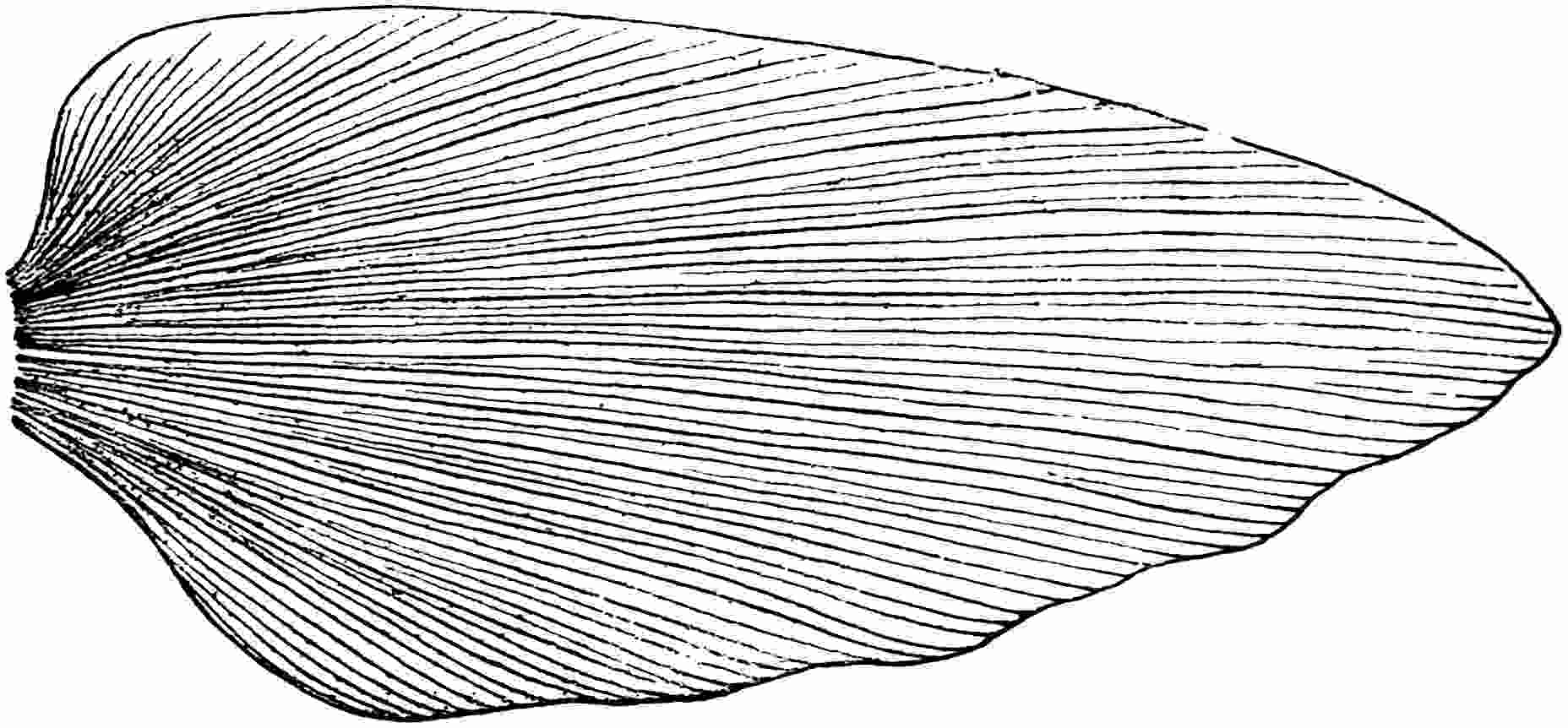
Fig. 629.
Sphenozamites Belli.
(Oxford Museum; nat. size.)
PLAGIOZAMITES. Zeiller.
The name Plagiozamites was proposed by Zeiller[1764] for some pinnate fronds and detached leaflets from the Stephanian of Commentry and the Lower Permian of the Vosges. The better preservation of the Vosges material enabled him to recognise certain features which led to the substitution of Plagiozamites for Zamites, the name originally employed by Renault for the Commentry specimens. Plagiozamites bears a superficial resemblance to Zamites and Otozamites and differs but little from Sphenozamites and Noeggerathia; it stands for pinnate fronds bearing ovate pinnae with a sub-amplexicaul oblique attachment to the rachis as is clearly shown in the species P. Planchardi (Ren.)[1765]. In the case of Palaeozoic fronds assigned to the Cycadophyta on the ground of the resemblance of their pinnae to those of undoubted Cycadean species, it is particularly important to recognise the fact that decisive evidence as to systematic position is lacking. We know nothing of the stem, the reproductive organs, or the epidermal and stomatal characters of Plagiozamites, and it is by no means certain that the genus is a true representative of the group in which it is provisionally included.
Plagiozamites Planchardi (Renault).
Fronds pinnate; pinnae ovate-lanceolate reaching 5 cm. in length and 1·6 cm. in breadth, inserted obliquely on the rachis, but not along a line parallel to the long axis of the rachis as in Zamites, and partially embracing it: the edge of the lamina is finely denticulate; veins slightly divergent and occasionally branched. The leaflets are narrow and more acute than those of Noeggerathia and Sphenozamites Rochei Ren. Plagiozamites is recorded from the Stephanian of Commentry, the Coal Measures of Manchuria[1766], and the Lower Permian of the Vosges. Renault described six species of Zamites from Commentry all, except Z. carbonarius, based on detached pinnae. The type-specimen of Z. carbonarius consists of a piece of stout rachis bearing ovate acute pinnae, 2·2 × 1 cm. Potonié[1767], who refers a piece of pinnate frond from the Permian of Thuringia to Z. carbonarius, includes the other species of Renault under that name. Whether or not the differences in the venation and form of the pinnae are of specific significance cannot be definitely settled without better material, but the important point is that these Permo-Carboniferous fronds are sufficiently distinct from Zamites to be placed in a separate genus. Plagiozamites carbonarius is recorded also by Zalessky[1768] from the Permian of Manchuria though the examples figured do not afford satisfactory evidence of the mode of insertion of the segments on the rachis. P. Planchardi has recently been recorded from the Coal Measures of Maryland; the discovery is interesting both on phytogeographical grounds and as the first satisfactory record of a Palaeozoic Cycadophyte from North America[1769].
Cycadorachis. Saporta.
The employment of this generic name may serve a useful purpose if used for specimens, whether preserved as petrifactions or impressions, believed to be portions of Cycadean frond-axes, but which in the absence of pinnae cannot be assigned to one of the recognised genera of fronds. Saporta[1770] describes two species from Kimmeridgian beds in France, Cycadorachis abscissa and C. armata: the first may be the winged base of a Cycadean petiole, but it agrees equally well with the broad base of an Osmundaceous leaf and should not be referred to a genus implying affinity with a particular class. The other species, C. armata, is probably a piece of a spinous axis like that of the Wealden plant Sewardia latifolia (Sap.). A fragment figured by Fliche and Bleicher[1771] from the Jurassic of Nancy as C. tuberculata is another example of a fossil which cannot be referred with any certainty to the Cycads.
Dr Stopes[1772], inadvertently overlooking the previous institution of Cycadorachis, has recently proposed the name Cycadeorachis for pinnately branched rachises of Cycadean fronds which, ‘while indicating the general character of the frond, do not show the shape of the pinnae well enough to be associated with any of the many foliage-genera.’