Chapter X · (continued 2)
Reading edition
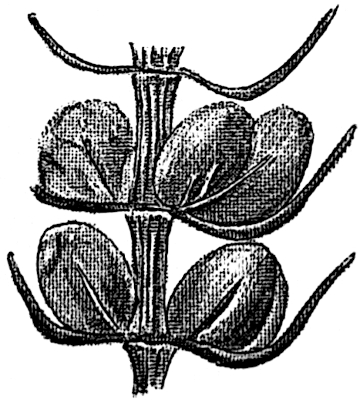
Fig. 97. Palaeostachya pedunculata Will. Part of a cone, × 3. (After Weiss.)
It is practically impossible to distinguish between cones of the Calamostachys and Palaeostachya type in the case of imperfectly preserved impressions; indeed we cannot assume that all long and narrow cones with spirally disposed verticillate bracts are Calamitean. We must have the additional evidence of internal structure or of the direct association of the cones with Calamitean foliage.
Palaeostachya vera sp. nov. Fig. 98.
In 1869 Williamson[714] described a fragment of a strobilus which showed certain anatomical features indicative of a close relationship or even identity with Calamites. Some years later[715] a much more perfect example was obtained from the Coal-Measures of Lancashire, and the additional evidence which it afforded definitely confirmed the earlier views of Williamson. The cone was more fully described by Williamson in 1888, as “the true fruit of Calamites.” It is clearly a form of Weiss’ genus Palaeostachya; Williamson and Scott[716] refer to it in their Memoir as Calamites pedunculatus. It is preferable, however, to retain the generic designation Palaeostachya for cones of this type. As the name P. pedunculata has previously been adopted by Weiss[717] for a cone figured by Williamson[718] in 1874, and afterwards referred to by that author in writing as P. pedunculata, it is proposed to substitute the specific name vera; this specific name being chosen with a view to put on record the fact that it was this type of cone that Williamson first proved to be the true fructification of the Calamite.
The axis of P. vera is practically identical in structure with a Calamitean twig. There is a hollow pith in the centre of the stele surrounded by a ring of 16–20 collateral bundles, each of which is accompanied by a carinal canal as in a vegetative shoot. As the pedicel of the strobilus passes into the cone proper it undergoes some modification in structure, but retains the characteristic features of a Calamite. The diagrammatic longitudinal section of fig. 98, which is copied from a drawing by Williamson[719], shows the broadening of the vascular strands at the nodes, and here and there a carinal canal is seen internal to the wood.
The axis of the cone bears whorls of bracts at right angles to the central column. Each whorl consists of about 30–40 segments coherent basally into a disc of prosenchymatous and parenchymatous tissue. The free linear bracts curve sharply upwards from the periphery of the disc, approximately parallel to the axis of the cone. From each of these sterile whorls there are given off 16–20 long and slender obliquely-inclined sporangiophores, sp, which arise from the upper surface of the disc close to the axis. Each sporangiophore no doubt bore four sporangia, S, containing spores of one size,—about ·075 mm. in diameter. The specimens of Palaeostachya vera so far obtained do not show the actual manner of attachment of the sporangia, but more complete examples of other species of Palaeostachya[720] enable us to assume with certainty that the sporangiophores terminated in a distal peltate expansion bearing four sporangia on its inner face.
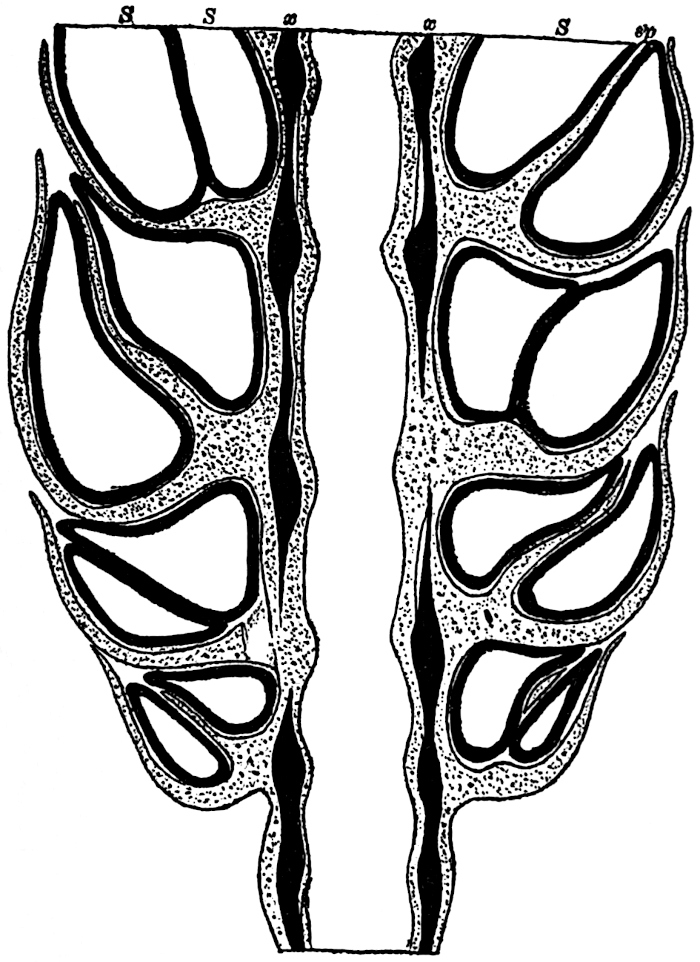
Fig. 98. Diagrammatic longitudinal section of Palaeostachya vera, sp. nov. S, S, S, sporangia; x, xylem; sp, sporangiophore. (After Williamson.)
A transverse section of the axis of the cone in the region of the sterile and fertile appendages shows the vascular bundles arranged in pairs. In a section through the peduncle of the cone, below the lowest whorl of bracts, the bundles of the stele are situated at equal distances apart. The cortical tissue of the peduncle is traversed by a ring of large canals[721] similar to the vallecular canals of an Equisetum stem.
Isospory is not a constant characteristic of Palaeostachya; some forms have been found with macrospores and microspores[722].
Other Calamitean cones, and examples illustrating the connection between Cones and Vegetative Shoots.
It would be out of place in an introduction to Palaeobotany to attempt an exhaustive account of the various cones which were probably borne by Calamitean plants, but there are a few general points to which the attention of the student should be directed. The examples dealt with in the foregoing description illustrate the fact, that plants included under the comprehensive genus Calamites bore cones possessing distinct morphological features. There are, however, other types of strobili which have been found in organic connection with Calamites; and some of these must be taken into account in dealing with Calamarian plants. The genera Volkmannia, Brukmannia, Huttonia, Macrostachya, in addition to Calamostachys and Palaeostachya and others, have been applied by different writers to Calamitean cones. As Solms-Laubach[723] has suggested, it is wiser to discard Volkmannia and Brukmannia, as they have been made to do duty for cones of widely different forms. It is better to adhere to the provisional generic names used by Weiss, as they enable us to conveniently systematise the various Calamarian strobili.
The following classification may be given of the better known cones, some of which we are able to describe in considerable detail, while others are still very imperfectly known. We have good evidence that all these strobili were borne by vegetative shoots of the type of Calamites, Calamocladus or Annularia.
1. Calamostachys[724] (including Paracalamostachys and Stachannularia).
Cones long and narrow, consisting of a central axis bearing alternate whorls of sterile and fertile appendages, the latter having the form of sporangiophores attached at right angles to the axis midway between the sterile verticils, and bearing four sporangia on the inner face of a peltate distal expansion.
Calamostachys Binneyana Schimp., C. Ludwigi Carr., C. Casheana Will., may be referred to as examples of this type of cone; also some of the strobili described by different authors as species of Volkmannia[725], Brukmannia[726], &c.
Although one cannot make out the detailed structure of a Calamite cone in the absence of internal structure, it is often possible to recognise the essential features in specimens preserved in ironstone nodules, such as those from Coalbrook Dale in Shropshire, or by carefully examining the carbonised impressions on shale under a simple microscope.
Weiss applies the term Paracalamostachys[727] to cones of the Calamostachys form, but in which the manner of attachment cannot be made out. Such a cone as that of fig. 93 should probably be referred to this sub-type of Calamostachys in the absence of definite evidence as to the position of the sporangia.
Another term Stachannularia, originally used by Weiss as a genus[728], was afterwards[729] applied to cones of the same general type as Calamostachys, in which the sporangiophores have the form of thorn-like structures bearing on their upper side a lamellar expansion. There is however some doubt as to the correct interpretation of the features associated with cones included in Stachannularia; for an account of such forms reference must be made to the writings of Weiss, Renault[730], Solms-Laubach[731] and others[732].
Calamostachys cones have been found in organic union with branches bearing leaves of the Annularia type, also with Calamocladus foliage, and the branches bearing such cones have been found in actual connection with Calamitean stems. The association of cones and vegetative stems and branches is shown in tabular form on p. 363.
2. Palaeostachya[733].
In this genus the general habit agrees with that of Calamostachys, and in imperfectly preserved specimens it may be impossible to discriminate between Calamostachys and Palaeostachya. The latter form is characterised by the attachment of the sporangiophores in the axil of the sterile bracts, or immediately above them, as shown in figs. 97 and 98.
Examples. Palaeostachya vera sp. nov., P. pedunculata Will. afford examples of this form of strobilus. The genus Palaeostachya includes several species previously described under the genus Volkmannia[734].
Strobili of this generic type are known in organic association with Annularian branches, as well as with Calamocladus and Calamites.
3. Macrostachya.
This generic name was originally applied by Schimper[735] to certain forms of Calamitean stems, of the type afterwards referred to the sub-genus Calamitina by Weiss, bearing long and thick cones. The name is, however, more appropriately restricted to strobili, which differ from the two preceding genera in their greater length (14–16 cm.) and in the more crowded and imbricating whorls of bracts. The internodes of the cones are very short, and each whorl of bracts consists of about 20 coherent members separated at the periphery of the disc into short pointed teeth. The internal structure of Macrostachya has not been satisfactorily determined. An account by Renault[736] of a petrified specimen does not present a very clear idea as to the structural features of this form of Calamitean strobilus.
The association of Calamitean vegetative shoots and cones.
Strobilus Foliage-shoot Stem
Calamostachys (Stachannularia) ramosa Weiss[737] Annularia ramosa Weiss Calamites ramosus Artis
C. (Stachannularia) calathifera Weiss[738] A. sphenophylloides Zenk. Stem bearing verticils of long and narrow leaves[739]. Probably a young Calamites
C. (Stachannularia) tuberculata (Stern.) A. stellata(Schloth.)[740] (A. longifolia Brongn.) Calamites sp.[741]
C. Solmsi[742] Weiss Calamocladus sp. Calamites (Calamitina) sp.
C. longifolia (Stern.)[743] Calamocladus sp.
Palaeostachya pedunculata Will.[744] Calamocladus
P. arborescens (Stern.)[745] Calamites (Stylocalamites) arborescens (Stern.)
Macrostachya[746] Calamocladus equisetiformis (Schloth.) Calamites (Calamitina) sp.
HUTTONIA.
The generic name Huttonia, suggested by Sternberg[747] in 1837, is applied to cones which closely resemble Macrostachya in habit, but differ—so far as our scanty knowledge enables us to judge—in the arrangement of the members. The student must refer to Weiss[748], Solms-Laubach[749] and other writers[750] for a further account of these types, and of another rare and little-known form of cone, called by Weiss Cingularia[751].
Macrostachyan cones have been found attached to stems of Calamites which are included in the sub-genus Calamitina (p. 367). The larger size of Macrostachya as a distinguishing feature is not always a safe test; some cones which belong to Palaeostachya [e.g. P. arborescens Sternb.] and Calamostachys (e.g. C. Solmsi) are much thicker and larger than the majority of species of these two genera.
It would appear from the examples selected to illustrate the connection between strobili and vegetative shoots, that the Annularia type of branch usually bears cones which conform to the genus Calamostachys (Stachannularia); while the Asterophyllitean branches—Calamocladus—are associated with Palaeostachya and Macrostachya. But this rule is not constant, and we are not in a position to speak of cones of a particular type as necessarily characteristic of definite types of Calamitean shoots.
•••••
Although it is admitted by the great majority of Palaeobotanists that the Calamites were all true Vascular Cryptogams, the older view that some members of the Calamarieae are gymnospermous has not been given up by Renault[752]. This observer has recently described some seeds which he believes were borne by Calamitean stems; he admits, however, that no undoubted female cones of Calamodendron have so far been found. In view of the unsatisfactory evidence on which Renault’s opinion is based, we need not further discuss the questions which he raises.
[The following specimens in the Williamson Cabinet in the British Museum, may be found useful in illustration of the structure of Calamites.
Stems. (i. Arthropitys.) Young twigs and small branches 1, 2, 6, 10, 14, 19, 116*, 1002, 1007, 1020.
Older stems (transverse sections) 15–17, 62, 77–87, 115 a, 117*, 118*, 120, 122*–124*, 1933 A, 1934, 1941.
(Tangential sections) 20, 24, 26, 37, 38, 49, 90, 91, 130, 138, 1937, 1943.
(Radial sections) 20, 20 A, 21, 22, 48, 65–68, 83–91, 137*, 138*, 1937.
(ii. Arthrodendron) 36, 37, 38, 52, 54.
Roots. 1335, 1347, 1350, 1356.
Strobili. i. Calamostachys Binneyana. 991, 996, 997, 1000, 1003, 1005, 1007, 1008, 1011, 1013, 1016, 1017, 1022, 1023, 1037 A, 1043.
ii. C. Casheana. 1024, 1025, 1587, 1588.
iii. Palaeostachya vera. 110, 1564, 1567, 1569, 1579, 1583.]
III. Pith-casts of Calamites.
A. Calamitina. B. Stylocalamites. C. Eucalamites.
Palaeobotanical literature contains a large number of species of Calamites founded on pith-casts alone. Many of these so-called species are of little or no value botanically, but while we may admit the futility of attempting to recognise specific types in the same sense as in the determination of recent plants, it is necessary to pay attention to such characters as are likely to prove of value for descriptive and comparative purposes. From the nature of the specimens it is clear that many of the differences may be such as are likely to be met with in different branches of the same species, while in others the pith-casts of distinct species or genera may be almost identical.
The most striking differences observable in Calamite casts are in the character of the internodes, the infranodal canals, the number and disposition of branch-scars, and other surface features. Occasionally it is possible to recognise certain anatomical characters in the coaly layer which often surrounds a shale- or sandstone-cast, and the surface of a well preserved cast may give a clue to the nature of the wood in the faint outlines of cells which can sometimes be detected on the cast itself[753]. The breadth of the carbonaceous envelope on a cast has been frequently relied on by some writers as an important character. It has been suggested[754] that we may arrive at the original thickness of the wood of a stem by measuring the coaly layer and multiplying the breadth by 27; the explanation being that a zone of wood 27 mm. in thickness is reduced in the process of carbonisation to a layer 1 mm. thick.
The breadth of the coal on the same form of cast may vary considerably; on this account, and for various other reasons, such a character can have but little value. Our knowledge of anatomy may often help us to interpret certain features of internal casts and to appreciate apparently unimportant details. One occasionally notices that a Calamite pith-cast has large infranodal canals, and in some specimens each internodal ridge may be traversed by a narrow median line or small groove; large infranodal canal casts suggest the type of stem referred to the subgenus Arthrodendron, and the median line on the ridges may be due to bands of hard tissue in each principal medullary ray.
In attempting to identify pith-casts the student must keep in view the probable differences presented by the branching rhizome, the main aerial branches and the finer shoots of the same individual. The long internodal ridges of some casts may be mistaken for the parallel veins of such a leaf as Cordaites, a Palaeozoic Gymnosperm, if there are no nodes visible on the specimen. The fossil figured by Lindley and Hutton[755] as Poacites, and regarded by them as a Monocotyledon, is no doubt a portion of a Calamite with very long internodes. An interesting example of incorrect determination has recently been pointed out by Nathorst[756] in the case of certain casts from Bear Island, originally described by Heer as examples of Calamites; the vertical rows of leaf-trace casts on a Knorria were mistaken for the ribs of a Calamite stem. The specimens in the Stockholm Museum fully bear out Nathorst’s interpretation. The undulating course of internodal ridges and grooves is not in itself a character of specific value. If a Calamite stem were bent slightly, the wood and medullary-ray tissues on the concave side might adapt themselves to the shortening of the stem by becoming more or less folded, and a cast of such a stem would show undulating ridges and grooves on one side and straight ones on the other[757].
A convenient classification of Calamite casts was proposed by Weiss in 1884, founded chiefly on the number and manner of occurrence of branch-scars—or rather branch-depressions—on the surface of pith-casts. Weiss[758] recognised the imperfection of his proposed grouping, and Zeiller[759] has also expressed reasonable doubts as to the scientific value of such group-characters. Weiss instituted three subgenera—Calamitina, Eucalamites and Stylocalamites, which are made use of as convenient terms in descriptive treatment of Calamite casts. The following account of a few of the more typical casts may serve to illustrate the methods employed in the description of such specimens; the synonomy given for the different species is not intended to be complete, but it is added with a view to drawing attention to the necessity for careful comparison in systematic work.
A. Calamitina.
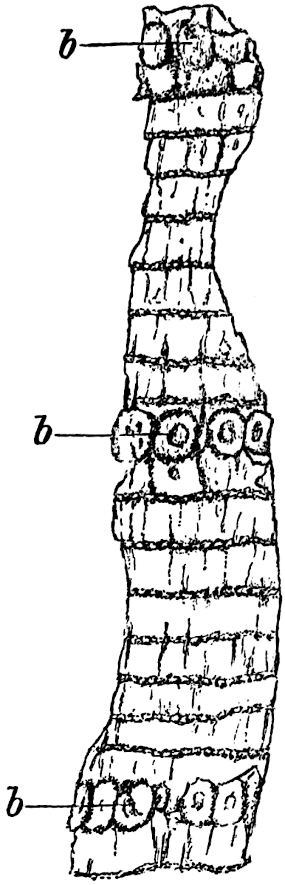
Fig. 99. Calamites (Calamitina) Göpperti (Ett.). b, branch scars. From a specimen in the Manchester Museum, Owens College. ¼ nat. size.
This sub-genus of Calamites, as instituted by Weiss[760], includes Calamitean stems or branches, which are characterised by the periodic occurrence of branch-whorls usually represented by fairly large oval or circular scars just above a nodal line (figs. 99, 100 and 101). The branch-scars may form a row of contiguous discs, or a whorl may consist of a smaller number of branches which are not in contact basally. A form described by Weiss as C. pauciramis, Weiss[761], has only one branch in each whorl, as represented by a single large oval scar on some of the nodes of the cast. A stem of this form is by no means a typical Calamitina, but it serves to show the existence of forms connecting Weiss’ sub-genera Calamitina and Eucalamites. The number of internodes and nodes between the branch whorls varies in different specimens, and is indeed not constant in the same plant. Each nodal line bears numerous elliptical scars which mark the points of attachment of leaves; each branch-whorl is situated immediately above a node, and in some forms this nodal line pursues a somewhat irregular course across the stem, following the outlines of the several branch-scars[762]. The surface of the internodes is either perfectly smooth or it is more frequently traversed by short longitudinal ridges or grooves probably representing fissures in the bark of the living stem; these are indicated by lines in fig. 99 and by elongated elliptical ridges in fig. 101. On young stems the leaves are occasionally found in place, as for example in an example figured by Weiss[763] (C. Göpperti), or we may have leaf-verticils still in place in much older and thicker branches[764] (cf. fig. 85, p. 330).
It occasionally happens that the bark of Calamitina stems has been preserved as a detached shell[765] reminding one of the sheets of Birch bark often met with in forests, the separation being no doubt due in the fossil as in the recent trees to the manner of occurrence of the cork-cambium.
In a few cases branches have been preserved still attached to a stem or branch of higher order; examples of such specimens are figured by Lindley and Hutton[766], Stur[767], and others. Grand’Eury[768] has given an idealised drawing of a typical Calamitina bearing a whorl of branches with the foliage and habit of Asterophyllites equisetiformis. The specimen on which this drawing is based is in the Natural History Museum, Paris; it shows Asterophyllitean branches in organic connection with a Calamitean stem, but it is not quite clear if the stem is a true Calamitina. A large drawing of this interesting specimen is given by Stur[769] in his monograph on Calamites, also a smaller sketch by Renault[770] in his Cours de botanique fossile. Similar branches of the Asterophyllites type attached to an undoubted Calamitina are figured also by Lindley and Hutton. There is, in short, good evidence that stems of this sub-genus bore branches with Asterophyllitean shoots.
The wood of stems of the Calamitina group of Calamites, in some instances at least, was of the Arthropitys type; this has been shown to be the case in some French specimens from the Commentry coal-field[771] and in others described by Stur[772]. The pith-casts of Calamitina are characterised by comparatively short internodes separated by deep nodal constrictions, as shown in fig. 100. From Permian specimens from Neu Paka in Bohemia, described by Stur[773], we learn that there were the usual Calamite diaphragms bridging across the wide pith-cavity at each node. Such a cast as that shown in fig. 100 is often referred to as Calamites approximatus Brongn.; the length of the internodes and the periodic occurrence of branch-scars in the form of circular or oval depressions along a nodal line enable us to recognise the Calamitina casts. Weiss[774] points out that in pith-casts of this form the branch-scars occur on the nodal constriction, and not immediately above the node as is the case on the surface of a typical Calamitina. This distinction is however of little or no value; the point of attachment of a branch may be above the nodal line, while on the pith-cast of the same stem the point of origin of the vascular bundles of the branch is on the nodal constriction[775].
The specimen shown in fig. 100 illustrates the appearance of a Calamitina cast. There is a verticil of branch-scars on the lowest nodal constriction; on the right of the pith-cast the broad band of wood is faintly indicated by the smooth surface of the rock (x). Other examples demonstrating the existence of a broad woody cylinder in Calamitina stems have been figured by Weiss[776] and other writers, and some good examples may be seen in the British Museum.
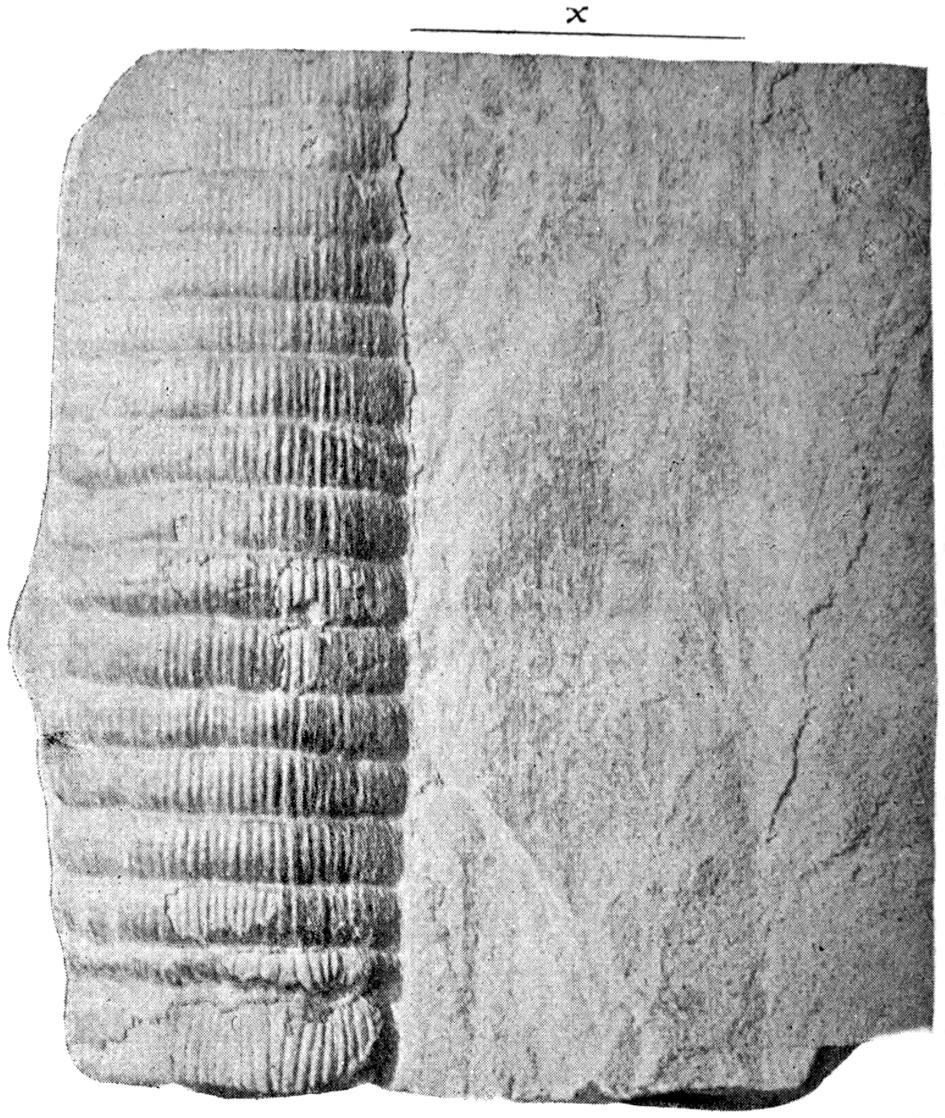
Fig.
100.
Calamites
(
Calamitina
)
approximatus
Brongn. Lower Coal-Measures of Ayrshire.
x
, impression of the wood.
(From a specimen in the collection of Mr R. Kidston.)
We have so far noticed the connection of certain forms of pith-casts (e.g. Calamites approximatus), and Asterophyllitean shoots with stems of the sub-genus Calamitina.
As regards the strobili our knowledge is far from satisfactory. Stur[777] figures some fertile branches bearing long and narrow strobili, either Palaeostachya or Calamostachys, in close association with Calamitina stems, and Renault and Zeiller[778] give illustrations of the association of Calamitina stems with large strobili of the Macrostachya form.
Before Weiss proposed the term Calamitina, various authors had figured this form of Calamite under a distinct generic name (e.g. Hippurites of Lindley and Hutton[779], Cyclocladia[780], Macrostachya[781], &c.). Stems of this type have also been described by more recent writers under different names, and considerable confusion has been caused by the use of numerous generic designations for forms of Calamitina. Some small fragments of Calamitina stems were described by Salter[782] in 1863 as portions of a new species of the Crustacean Eurypterus (E. mammatus). In 1869 Grand’Eury proposed the generic name Calamophyllites[783] for stems bearing verticils of Asterophyllites shoots; his description of such stems agrees with Weiss’ Calamitina, but as Grand’Eury’s name is used in a narrower sense as implying a connection with Asterophyllites, it is more convenient to adopt Weiss’ term in spite of the priority of Calamophyllites. In the Fossil flora of Commentry we find some flattened stems of the Calamitina type described under different generic names, as Arthropitys approximatus[784] and as Macrostachya[785].
The determination of distinct species of the sub-genus Calamitina is rendered almost hopeless by the variation in the different branches of the same individual, and by the difficulty of connecting surface-impressions with casts of the pith-cavity.
A typical example of the Calamitina type of Calamites was figured by Sternberg[786] in 1821 as Calamites varians. This has been adopted by Weiss[787] as a comprehensive species including several different ‘forms’ of stems, which differ from Sternberg’s fossil in such points as the number of nodes between the branch-whorls and the number of branches in each whorl. The result of this system of nomenclature is the separation of portions of one specific type under different form-names. It must be clearly recognised that accurate specific diagnoses are practically impossible when we have to deal with fragments of plants, some of which are mere pith-casts, while others show the surface features. The specimen represented in fig. 99 agrees with a stem described by Ettingshausen[788] in 1855 as Calamites Göpperti, and as a matter of convenience a member of the Calamitina group showing such characters may be referred to as Calamites (Calamitina) Göpperti (Ett.). The following list, which includes a few synonyms of this form, may suffice to illustrate the difficulties connected with accurate systematic determinations.
Calamites (Calamitina) Göpperti (Ett.). Fig. 99.
1855. Calamites Göpperti, Ettingshausen[789].
1869. Calamites (Calamophyllites) Göpperti, Grand’Eury[790].
1874. Cyclocladia major, Feistmantel[791].
1874. Calamites verticillatus, Williamson[792].
1876. Calamitina Göpperti, Weiss[793].
1884. Calamites (Calamitina) varians abbreviatus, Weiss[794].
1884. Calamites (Calamitina) varians inconstans, Weiss[795].
1887. Calamites Sachsei, Stur[796].
1888. Calamophyllites Göpperti, Zeiller[797].
This species is characterised by the smooth bark, which may be traversed by a few irregular longitudinal fissures; most of the nodes bear a series of small leaf-scars, and at fairly regular intervals a node is immediately succeeded by a circle of contiguous branch-scars, 8–12 in a whorl. The pith-cast of this type of stem has short ribbed internodes separated by rather deep nodal constrictions; the branch-whorls being represented by a series of pits on the nodal constrictions recurring at corresponding intervals to the whorls of branch-scars on the surface of the stem. Leaves narrow and linear in form, like those on Asterophyllitean branches, are occasionally associated with this type of stem.
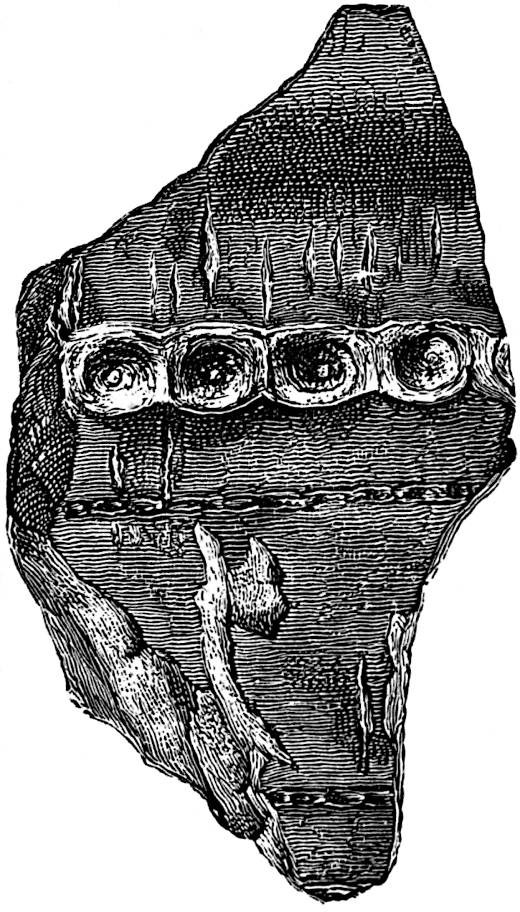
Fig. 101. Calamites (Calamitina) sp. From a specimen in the British Museum. (After Carruthers.) Slightly reduced.
The fragment of a Calamitina stem shown in fig. 101 is the counterpart of a specimen originally figured by Steinhauer[798] in 1818 as a species of Phytolithus. This may be specifically identical with C. Göpperti; but it is better to speak of so small a specimen as merely one of the Calamitina stems, to be compared with Calamites (Calamitina) Göpperti. The specimen measures 14·5 cm. in length and 7 cm. in breadth.
The form of pith-cast represented in fig. 100 is no doubt that of one of the Calamitina species, but as it is seldom possible to determine the connection between such casts and the particular species of stems to which they belong, they are often referred to as Calamites (Calamitina) approximatus (Brongn.). The specimen of which fig. 100 is a photograph was originally described and figured by Mr Kidston[799] from the lower Coal-Measures of Ayrshire. Both Calamites (Calamitina) Göpperti (Ett.) and C. (Calamitina) approximatus (Brongn.) are recorded from the Transition, Middle and Lower Coal-Measures[800].
B. Stylocalamites.
In the members of this sub-genus the branch-scars are either irregular in their occurrence or absent. In some Calamites the branch-scars are very few and far between, and other species appear to have been almost without branches; pith-casts of such stems may be referred to the sub-genus Stylocalamites[801].
An exceedingly common Calamitean cast, C. Suckowi Brongn. (fig. 82) affords a good illustration of this type of stem. In the specimen shown in fig. 82 we have a cast of a rhizome, which is rather exceptional in showing three branches in connection with one another. The appearance of the fossil suggests a rhizome, rather than an aerial shoot, bearing lateral branches; the narrowing of the branches and the rapid decrease in the length of the internodes towards the point of attachment being features associated with rhizomes rather than with aerial branches.
Calamites (Stylocalamites) Suckowi, Brongn. Fig. 82.
1818. Phytolithus sulcatus, Steinhauer[802].
1825. Calamites decoratus, Artis[803].
1828. Calamites Suckowi, Brongniart[804].
1833. Calamites cannaeformis, Lindley and Hutton[805].
For more complete lists of synonyms of this species reference should be made to Kidston[806], Zeiller[807], and other authors.
Casts of Calamites Suckowi are characterised by flat or slightly convex internodal ridges separated by shallow depressions, the ridges are rounded at the upper end of each internode, and usually bear circular casts of infranodal canals. There are some unusually large examples of casts of this species in the British Museum from the Radstock Coal-Measures; one of these has a length of 81 cm., and a diameter of 27 cm. Specimens are not infrequently found with verticils of slender roots in close proximity to the nodes of the cast; figures of such root-bearing casts have been given by Lindley and Hutton[808], Weiss[809], and other authors.
Renault[810] has drawn attention to the thinness of the layer of wood which is often associated with large casts of C. Suckowi; he concludes that the stems must have possessed little or no secondary wood. In a more recent work by Grand’Eury[811] Calamites Suckowi is spoken of as having had wood of the Calamodendron type, but as wood of this kind has not been found in England, it is suggested that the plant may not have assumed an arborescent habit until late in the Coal-Measure period. During the Lower and Middle Coal-Measures, at which horizon it commonly occurs in England, it may have been herbaceous. This suggestion has little to commend it; the close agreement between C. Suckowi from English and French localities points to a plant of the same form, and we have no satisfactory evidence as to any difference in stem-structure in the two cases.
Stur has figured a specimen of a Calamite cast, which he compares with C. Suckowi, surrounded by a band of silicified wood apparently of the Arthropitys type. From this and other facts it would appear probable that some of the English stems with the Arthropitys structure possessed casts referable to Calamites (Stylocalamites) Suckowi.
We are not in a position to speak with confidence as to the strobili of C. Suckowi, but Stur adduces evidence in support of a connection between this species of Calamite and certain Asterophyllitean branches (Calamocladus equisetiformis) bearing Calamostachyan cones. He does not appear to have found the foliage-shoots and stems in organic contact, but draws this conclusion from the association of the fertile branches and stems in the same rocks[812]. This species is abundant in the Lower, Middle and Upper Coal-Measures; it has also been recorded from the Millstone Grit[813].
C. Eucalamites.
In this sub-genus branch-scars occur on every node; the scars never form a contiguous whorl as in Calamitina, but there may be from 3 to 10 on each node. The scars of successive nodes often alternate in position, and thus form more or less regular vertical series as shown in fig. 102. The most obvious feature as regards the arrangement of the branch-scars is their spiral disposition on the surface of the pith-cast. The internodes are fairly uniform in length, and there is no periodic recurrence of narrower internodes as in Calamitina. From an examination of specimens of Eucalamites in which the pith-cast is covered with a coaly layer representing the carbonised remains of the wood and cortex, it would appear that the surface of the stems was practically smooth. The coaly investment on Eucalamites casts varies considerably in thickness[814]; it is very unsafe to make use of the thickness of this layer as a test of the breadth of the wood in Calamitean stems. The branch-scars as seen in a surface-view of a stem are situated a little above the nodal lines, while depressions on the pith-casts occur in the slight nodal constriction or immediately above it. Small leaf-scars have been described as occurring on the nodes between the branch-scars in specimens showing the surface features[815].
The species long known as Calamites cruciatus Sternb. is usually taken as the type of the sub-genus Eucalamites. Weiss[816] has subdivided this species into several ‘forms,’ which he bases on the number of branch-scars on each node and on other characters; a more extended subdivision of C. cruciatus has recently been made by Sterzel[817], who admits the impossibility of separating the specific forms by means of the data at our disposal, but for purposes of geological correlation he prefers to express slight differences by means of definite ‘forms’ or varieties. The more comprehensive use of the specific name cruciatus as adopted by Zeiller in his Flore de Valenciennes[818] is, I believe, the better method to adopt. The specimen shown in fig. 102 affords a good example of a typical Calamites cruciatus, it was found in the Middle Coal-Measures near Barnsley, Yorkshire.
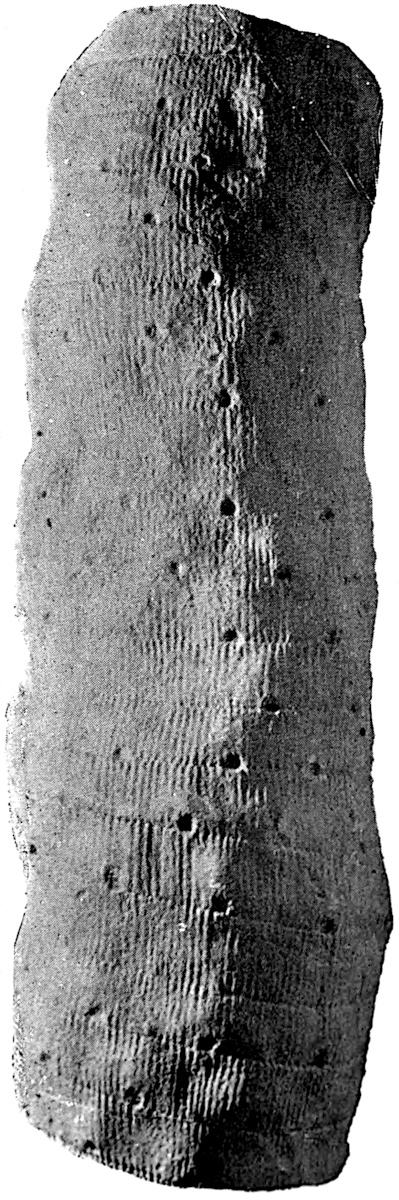
Fig. 102. Calamites (Eucalamites) cruciatus, Sternb. From a specimen in the Barnsley Museum, Yorkshire. ½ nat. size.
Calamites (Eucalamites) cruciatus (Sternb.). Fig. 102.
1826. Calamites cruciatus, Sternberg[819].
1828. Calamites cruciatus, Brongniart[820].
1831. Calamites alternans, Germar and Kaulfuss[821].
1837. Calamites approximatus, Lindley and Hutton[822].
1877. Calamodendrofloyos cruciatus, Grand’Eury[823].
1878. Calamodendron cruciatum, Zeiller[824].
1884. Calamites (Eucalamites) cruciatus ternarius, Weiss[825].
1884. „ „ „ quaternarius, Weiss[825].
1884. „ „ „ genarius, Weiss[825].
1884. „ „ multiramis, Weiss[825].
1888. Calamites (Calamodendron) cruciatus, Zeiller[826].
This species occurs in the Upper, Middle and Lower Coal-Measures[827]. The casts of the cruciatus type have been found associated with wood possessing the structural features of the sub-genus Calamodendron[828], but our knowledge of the structure of the stem, and of the fertile branches of C. cruciatus is very imperfect. A restoration of Calamites (Eucalamites) cruciatus is given by Stur[829] in his classic work on the Calamites, but he does not make quite clear the supposed connection with the stems and the fertile shoots of the Asterophyllites type[830] which he describes. Another member of the Eucalamites group, which is better known as regards its foliage-shoots, is Calamites ramosus, a species first described by Artis[831] in 1825. Stems of this species have been found in connection with the branches and leaves of the Annularia[6] type, bearing Calamostachys[832] cones. In all probability pith-casts included in the sub-genus Eucalamites belonged to stems with foliage-shoots and probably also with cones of more than one form.
NOMENCLATURE.
In the above account of a few common pith-casts it has been pointed out that there is occasionally satisfactory evidence for connecting certain casts with wood of a particular structure, and with sterile and fertile foliage-shoots of a definite type. It is, however, impossible in many cases to recognise with any certainty the leaf-bearing branches and strobili of the different casts of Calamites; it is equally impossible to determine what type of pith-cast or what type of foliage-shoots belongs to petrified stem-fragments in which it is possible to investigate the microscopical features. The scattered and piece-meal nature of the material on which our general knowledge of Calamitean plants is based, necessitates a system of nomenclature which is artificial and clumsy; but the apparent absurdity of attaching different names to fragments, which we believe to be portions of the same genus, is of convenience from the point of view of the geologist and the systematist. As our material increases it will be possible to further simplify the nomenclature for Calamarian plants, but it is unwise to allow our desire for a simpler terminology to lead us into proposals which are based rather on suppositions than on established fact. If it were possible to discriminate between pith-casts of stems having the different anatomical characters designated by the three sub-genera, Arthropitys, Arthrodendron and Calamodendron, the genus Calamites might be used in a much narrower and probably more natural sense than that which we have adopted. The tests made use of by some authors for separating pith-casts of Calamodendron and Arthropitys stems do not appear to be satisfactory; we want some term to apply to all Calamitean casts irrespective of the anatomical features of the stems, or of the precise nature of the foliage-branches. As used in the present chapter, Calamites stands for plants differing in certain features but possessing common structural characters, which must be defined in a broad sense so as to include types which may be worthy of generic rank, but which for convenience sake are included in a comprehensive generic name. The attempts to associate certain forms of foliage with Arthropitys on the one hand and with Calamodendron on the other, cannot be said to be entirely satisfactory; we still lack data for a trustworthy diagnosis of distinct Calamarian genera which shall include external characters as well as histological features. If we restricted the genus Calamites to stems with an Arthropitys structure and an Asterophyllitean foliage, we should be driven into unavoidable error. Within certain limits it is possible to distinguish generically or even specifically between petrified branches, and we already possess material enough for fairly complete diagnoses founded on internal structure; but it is not possible to make a parallel classification for pith-casts and foliage-shoots. For this reason, and especially bearing in mind the importance of naming isolated foliage-shoots and stem-casts for geological purposes, I believe it is better to admit the artificially wide application of the name Calamites, and to express more accurate knowledge, where possible, by the addition of a subgeneric term. In dealing with distinctions exhibited by Calamitean stems it may be advisable to make use of specific names, but we must keep before us the probability of the pith-cast and petrified stem-fragment of the same plant receiving different specific names. If the structural type is designated by a special sub-genus, this will tend to minimise the anomaly of using more than one binominal designation for what may be the same individual.
CALAMITES AND EQUISETUM.
The following summary may serve to bring together the different generic and subgeneric terms which have been used in the foregoing account of Calamites.
CALAMITES.
Subgenera having reference to the method of branching as seen in casts or impressions of the stem-surface or in pith-casts. Calamitina, Eucalamites, Stylocalamites. Subgenera founded on anatomical characters in stems and branches. Arthropitys, Calamodendron, Arthrodendron (new sub-genus substituted for Calamopitys). Genus proposed for roots of Calamites before their real nature was recognised. The name refers to anatomical characters. Astromyelon.
Genera of which some species, if not all, are the leaf-bearing branches of Calamites. Calamocladus (including Asterophyllites), Annularia. Generic names applied to strobili belonging to Calamites. Calamostachys, Palaeostachya, Macrostachya, etc. Genus including impressions of Calamite roots. Pinnularia.
IV. Conclusion.
A brief sketch of the main features of Calamites suffices to bring out the many points of agreement between the arborescent Calamite plants and the recent Equisetums. The slight variation in morphological character among the present-day Horse-tails, contrasts with the greater range as regards structural features among the types included in Calamites. The Horse-tails probably represent one of several lines of development which tend to converge in the Palaeozoic period; the Calamite itself would appear to mark the culminating point of a certain phylum of which we have one degenerate but closely allied descendant in the genus Equisetum. We shall, however, be in a better position to consider the general question of plant-evolution after we have made ourselves familiar with other types of Palaeozoic plants. Grand’Eury’s[833] striking descriptions of forests of Calamites in the Coal-Measures of central France, enable us to form some idea of the habit of growth of these plants with their stout branching rhizomes and erect aerial shoots.
By piecing together the evidence derived from different sources we may form some idea of the appearance of a living Calamite. A stout branching rhizome ascended obliquely or spread horizontally through sand or clay, with numerous whorls or tufts of roots penetrating into swampy soil. From the underground rhizome strong erect branches grew up as columnar stems to a height of fifty feet or more; in the lower and thicker portions the bark was fissured and somewhat rugged, but smoother nearer the summit. Looking up the stem we should see old and partially obliterated scars marking the position of a ring of lateral branches, and at a higher level tiers of branches given off at regular or gradually decreasing intervals, bearing on their upper portions graceful green branchlets with whorls of narrow linear leaves. On the younger parts of the main shoot rings of long and narrow leaves were borne at short intervals, several leaf-circles succeeding one another in the intervals between each radiating series of branches. On some of the leaf-bearing branchlets long and slender cones would be found here and there taking the place of the ordinary leafy twigs. Passing to the apical region of the stem the lateral branches given off at a less and less angle would appear more crowded, and at the actual tips there would be a crowded succession of leaf-segments forming a series of overlapping circles of narrow sheaths with thin slender teeth bending over the apex of the tree.
Thus we may feebly attempt to picture to ourselves one of the many types of Calamite trees in a Palaeozoic forest, growing in a swampy marsh or on gently sloping ground on the shores of an inland sea, into which running water carried its burden of sand and mud, and broken twigs of Calamites and other trees which contributed to the Coal Period sediments. The large proportions of a Calamite tree are strikingly illustrated by some of the broad and long pith-casts occasionally seen in Museums; in the Breslau Collection there is a cast of a stem belonging to the sub-genus Calamitina, which measures about 2 m. in length and 23 cm. in breadth, with 36 nodes. In the Natural History Museum, Paris, there is a cast nearly 2 metres long and more than 20 cm. wide, which is referred to the sub-genus Calamodendron.
E. Archaeocalamites.
In the Upper Devonian and Culm rocks casts of a well-defined Calamitean plant are characteristic fossils; stems, leaf-bearing branches, roots and cones have been described by several authors, and the genus Archaeocalamites has been instituted for their reception. Although this genus agrees in certain respects with Calamites, and as recent work has shown this agreement extends to internal structure, it has been the custom to regard the Lower Carboniferous and Devonian plants as genetically distinct. The surface features of the stem-casts, the form of the leaves, and apparently the cones, possess certain distinctive characters which would seem to justify the retention of a separate generic designation.
We may briefly summarise the characteristics of the genus as follows:—
Pith-casts articulated, with very slightly constricted nodes; the internodes traversed by longitudinal ribs slightly elevated or almost flat, separated by shallow grooves. The ribs and grooves are continuous from one internode to another, and do not usually show the characteristic alternation of Calamites[834]. Along the nodal line there are occasionally found short longitudinal depressions, probably marking the points of origin of outgoing bundles. Branches were given off from the nodes without any regular order; a pith-cast may have branch-scars on many of the nodes, or there may be no trace of branches on casts consisting of several nodes. The leaves[835] are in whorls; in some cases they occur as free, linear, lanceolate leaves, or on younger branches they are long, filiform and repeatedly forked. The structure of the wood agrees with that of some forms of Arthropitys. The strobili consist of an articulated axis bearing whorls of sporangiophores, and each sporangiophore has four sporangia. Our knowledge of the fertile shoots is, however, very imperfect.
Renault[836] has recently described the structure of the wood in some small silicified stems of Archaeocalamites from Autun. A large hollow pith is surrounded by a cylinder of wood consisting of wedge-shaped groups of xylem tracheids associated with secondary medullary rays; at the apex of each primary xylem group there is a carinal canal. The primary medullary rays appear to have been bridged across by bands of xylem at an early stage of secondary thickening, as in the Calamite of fig. 83, D.

Fig. 103. Archaeocalamites scrobiculatus (Schloth.). From a specimen in the Woodwardian Museum, Cambridge. From the Carboniferous limestone of Northumberland. ½ nat. size.
Our knowledge of the cones of Archaeocalamites is far from satisfactory. Renault[837] has recently described a small fertile branch bearing a succession of verticils of sporangiophores; each sporangiophore stands at right angles to the axis of the cone and bears four sporangia, as in Calamostachys. It is not clear how far there is better evidence than that afforded by the association of the specimen with pith-casts of stems, for referring this cone to Archaeocalamites, but the association of vegetative and fertile shoots certainly suggests an organic connection. The cone described by the French author agrees with Equisetum in the absence of sterile bracts between the whorls of sporangiophores. It is an interesting fact that such a distinctly Equisetaceous strobilus is known to have existed in Lower Carboniferous rocks.
Stur[838] has also described Archaeocalamites at considerable length; he gives several good figures of stem-casts and foliage-shoots bearing long and often forked narrow leaves. The same writer describes specimens of imperfectly preserved cones in which portions of whorls of forked filiform leaves are given off from the base of the strobilus[839]. Kidston[840] published an important memoir on the cones of Archaeocalamites in 1883, in which he advanced good evidence in support of the view that certain strobili, which were originally described as Monocotyledonous inflorescences, under the generic name Pothocites[841], are the fertile shoots of this Calamarian genus. Kidston’s conclusions are based on the occurrence on the Pothocites cones, of leaves like those of Archaeocalamites, on the non-alternation of the sporangiophores of successive whorls, and on the close resemblance between his specimens and those described by Stur. Good specimens of the cones, formerly known as Pothocites, may be seen in the Botanical Museum in the Royal Gardens, Edinburgh; as they are in the form of casts without internal structure it is difficult to form a clear conception as to their morphological features.
The fossils included under Archaeocalamites have been referred by different authors to various genera, and considerable confusion has arisen in both generic and specific nomenclature. The following synonomy of the best known species, A. scrobiculatus (Schloth.) illustrates the unfortunate use of several terms for the same plant.
Archaeocalamites scrobiculatus
(Schloth.). Fig. 103.
1720. Lithoxylon, Volkmann[842].
1820. Calamites scrobiculatus, Schlotheim[843].
1825. Bornia scrobiculata, Sternberg[844].
1828. Calamites radiatus, Brongniart[845].
1841. Pothocites Grantoni, Paterson[846].
1852. Calamites transitionis, Göppert[847].
—— Stigmatocanna Volkmanniana, ibid.
—— Anarthrocanna tuberculata, ibid.
—— Calamites variolatus, ibid.
—— C. obliquus, ibid.
—— C. tenuissimus, ibid.
—— Asterophyllites elegans, ibid.
1866. Calamites laticulatus, Ettingshausen[848].
—— Equisetites Göpperti, ibid.
—— Sphenophyllum furcatum, ibid.
1873. Asterophyllites spaniophyllus, Feistmantel[849].
1880. Asterocalamites scrobiculatus, Zeiller[850].
For other lists of synonyms reference may be made to Binney[851], Stur[852], Kidston[853] and other authors.
Some of the best specimens of this species are to be seen in the Museums of Breslau and Vienna, which contain the original examples described by Göppert and Stur. An examination of the original specimens, figured by Göppert under various names, enables one to refer them with confidence to the single species, Archaeocalamites scrobiculatus. The generic name Archaeocalamites, which has been employed by some authors, was suggested by Schimper[854] in 1862, as a subgenus of Calamites, on account of the occurrence of a deeply divided leaf-sheath, attached to the node of a pith-cast, which seemed to differ from the usual type of Calamitean leaf. The specimens described by Schimper are in the Strassburg Museum; the leaf-sheath which he figures is not very accurately represented.
The example given in fig. 103 shews very clearly the continuous course of the ribs and grooves of the pith-cast. Each rib is traversed by a narrow median groove which would seem to represent the projecting edge of some hard tissue in the middle of each principal medullary ray of the stem. The specimen was found in a Carboniferous limestone quarry, Northumberland; there is a similar cast from the same locality in the Museum of the Geological Survey.
Affinities of Archaeocalamites.
This genus agrees very closely with Calamites both in the anatomical structure of the stem and in the verticillate disposition of the leaves. The strobili appear to be Equisetaceous in character, and there is no satisfactory evidence of the existence of whorls of sterile bracts in the cone, such as occur in Calamostachys and in other Calamitean strobili. The continuous course of the vascular bundles of the stem from one internode to the next is the most striking feature in the ordinary specimens of the genus; but it sometimes happens that the grooves on a pith-cast shew the same alternation at the node as in Calamites. This is the case in a specimen in the Göppert collection in the Breslau Museum, and Feistmantel[855] has called attention to such an alternation in specimens from Rothwaltersdorf. In the true Calamites, on the other hand, the usual nodal alternation of the vascular strands is by no means a constant character[856]. Stur[857], Rothpletz[858], and other authors have pointed out the resemblance of Archaeocalamites to Sphenophyllum. The deeply divided leaves of some Sphenophyllums and those of Archaeocalamites are very similar in form; and the course of the vascular strands in Sphenophyllum may be compared with that in Archaeocalamites. But the striking difference in the structure of the stele forms a wide gap between the two genera. We have evidence that the Calamites and Sphenophyllums were probably descended from a common ancestral stock, and it may be that in Archaeocalamites, some of the Sphenophyllum characters have been retained; but there is no close affinity between the two plants.
On the whole, considering the age of Archaeocalamites and the few characters with which we are acquainted, it is probable that this genus is very closely related to the typical Calamites, and may be regarded as a type which is in the direct line of development of the more modern Calamite and the living Equisetum. Weiss[859] includes Archaeocalamites as one of his subgenera with Calamitina and others, and it is quite possible that the genus has not more claim to stand alone than other forms at present included in the comprehensive genus Calamites.
The student will find detailed descriptions of this genus in the works which have been referred to in the preceding pages.