Chapter IX
Reading edition
THE TRAFFIC IN GIRLS.
By Charles Nelson Crittenton, President of the National Florence Crittenton Mission.
Twenty-six years ago in New York City when I first began to feel an interest in unfortunate girls and established the first Florence Crittenton Home, now known as the Mother Mission, one of the things which surprised and impressed me most in coming close in touch with the subject, was that almost every girl that I met in a house of sin was supporting some man from her ill-gotten earnings. Either the man was her husband, who had driven her on the street in order that he might live in luxury and ease, or else he was her paramour, upon whom with a woman's self-forgetful devotion she delighted to shower everything that she could earn. In addition to this form of slavery I also found that the majority had to pay a certain percentage of their earnings to some individual or organization who had promised them immunity from arrest and to whom they looked for protection.
These were well recognized facts. Every policeman and every judge of the police court knew the true conditions and no one thought of denying them. Although frequently the poor girls would be kept at their trade by slaps and blows and threats of death, the authorities would contend that they were "willing slaves" and that they therefore deserved no consideration or sympathy.
But when we began to get closer to the hearts of the girls, to know their true history, we discovered that the commencement of this form of slavery had been even in a baser form—that before the girls had become so-called "willing slaves" they were "unwilling slaves." Many of them had fought for their liberty and had submitted only because they had been overcome by superior force. Some of them had been drugged; others kept under lock and key until such time when either their better nature had been drugged into unconsciousness or hardened into a devil-may-care recklessness. Some had had their clothes taken from them, others had been cajoled into quietness by promise of great rewards or by intimidation, which with this young and inexperienced class is one of the most potent methods. But when we, who knew, made these statements, people began to think those interested in the welfare of these girls were going too far, that no such conditions existed. They pointed to the fact that it was beyond human possibility. Many times in those early days, when I would talk to my friends and business associates and tell them of the conditions which existed in New York City, although upon ordinary subjects they had the greatest respect for my truthfulness and conservativeness, having known me in business for a good many years, they would look at me with pity for my misguided opinions. While they would mildly express unbelief at my statement to my face, when they got behind my back they would shake their heads and say, "Crittenton has gone crazy, do you know he even believes now that girls are held in slavery in New York City, against their wills, for immoral purposes."
But I have been familiar with so many cases of this form of slavery that they are too numerous even to recall. I remember well one night, being on one of the streets in lower New York, when a girl came down a flight of steps leading from a disreputable house where rooms were rented. At the foot of the steps stood a man waiting to receive her earnings. As she stepped upon the pavement in full light of the gas above the entrance, she handed him the money. He looked at it, and finding it was less than he expected or needed, with a terrible oath he felled her to the ground and said, "I will show you how to bring me such a little amount of money as this, you ought to have gotten a great deal more."
Among those who came to take shelter at the Florence Crittenton Home in those early days were beautiful twins, not sixteen years old, from a country village. We called them "Mary and Martha." Both of them had been brought to New York under a promise of marriage and sold into a life of sin. We did all we could to free them from their masters, but it was impossible. They were determined that they would not be robbed of their prey which was so valuable a financial investment. Time and time again they were hunted down by their masters and lost their positions through the interference of these men. In two years one of the girls died from the mistreatment and shame she had endured. It is not unusual for me to see the other one in New York whenever I am there, still under the bondage of her so-called husband, and for her to tell me that it is no use trying to escape. Long since she has given up all hope, and that she expects to die where she is, earning money to supply her master with the luxuries of life, by selling her poor little body.
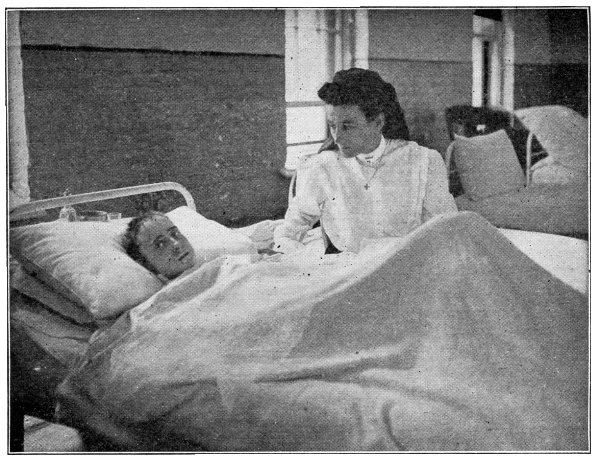
DAISY UNDER TWENTY, DYING IN THE POOR-HOUSE Less than three years after leaving her home she was found in the poor-house, forgotten by family and friends, and dying of a loathsome disease
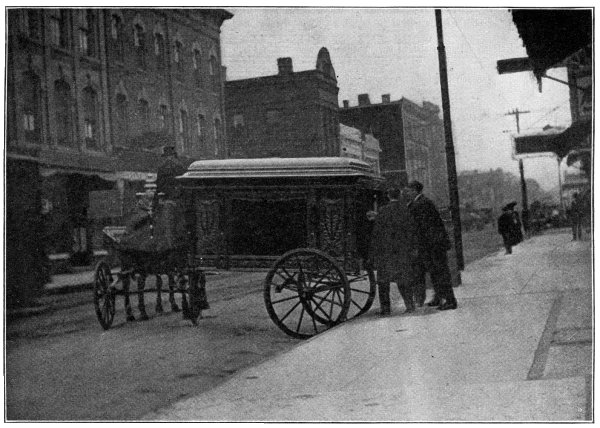
DAISY'S LONELY FUNERAL PAID FOR BY CHARITY The charity nurses took up a subscription and saved her from the potter's field. No flowers. No friends. No relatives. Only the undertaker and his assistants
Among the many methods used by these fiends in human form to trap girls into houses of sin, is courtship and false marriage. These men go into the country districts and, under the guise of commercial men, board at the best hotels, dress handsomely, cultivate the most captivating manners, and then look for their prey. Upon the streets they see a pretty girl and immediately lay plans to become acquainted. Then the courtship begins. In the present condition of society it is a very easy thing for well reared girls to begin a promiscuous acquaintance, with ample opportunity for courtship. There was never a time when the bars were so low. With the public dance, or even the more exclusive german, the skating rink and the moving picture arcades, all of which lend themselves to the making of intimate and promiscuous acquaintances under questionable surroundings, it is easy for a man to come into a community and in a few days meet even the best class of girls, to say nothing of the girls who are earning a living and who have no home influence. These girls are flattered by the handsome, well-dressed stranger paying them marked attention, and are quick to accept invitations to the theater or to walk or drive with him. If the girl is religious, he is not above using the cloak of religion, expressing fondness for church and prayer meetings and is frequently to be found at such places. When a girl's confidence and affection have been won, it is a comparatively easy thing to accomplish her ruin, by proposing an elopement. Her scruples and arguments are easily overcome by the skilled deceiver, and trusting him implicitly as her accepted lover, she unwittingly goes to her doom. When they arrive in the city a mock marriage is performed, for there are accomplices on every hand, and the child wife is taken into a house of sin, which she has been told by her pretended husband is an elegant boarding house.
Can you imagine any greater horror than that of this trusting child wife, when she realizes she is a prisoner and a slave in that den of shame? And such slavery! the blackest that has ever stained human history. Shut up beyond the reach of friends—for no letter she may write finds its way beyond the doors of her prison house. Should she call a police officer the chances are he is receiving bribes from her keeper and he will not help her to freedom. Is it strange that soon she eagerly drinks the wine that is constantly offered her, and sometimes actually forced down her throat, and smokes the cigarette with its benumbing effect of opium and tobacco, so that under the influences of these fatal drugs she may forget her awful fate and hasten her early death, for surely no hell in the other world can be more dreadful than a house of shame in this world.
And then good women and good men who see her poor painted face later peering out between the lace curtains of her dread abode, or, if meeting her on the street, draw away from her and say, "Oh! I guess she is there because she wants to be."
This expression is one of the reasons that this condition has existed so long unchanged. It is frequently made because of the ignorance of the general public upon the subject. But the thought that when one sees a woman in a life of sin, she is there because she likes it and wants to be, has become so deeply engraved upon the human mind that it is difficult to change it. Some people are conscientious in thinking this, because they are ignorant. Others know better, but in order that they may not feel called upon to take an active part against these conditions, try to salve their conscience by saying that a fallen girl cannot be helped—nothing can be done for them. And so it goes—anything to remove the responsibility of bettering conditions from their shoulders.
But today we are facing a very different condition from that which has existed ever since I have been interested in rescue work, and for centuries before. The International Agreement for the Abolition of the White Slave Traffic between the civilized nations of the world, which was entered into some ten years ago by all of the civilized nations except the United States, and which was subscribed to by the United States last June, has put an entirely different aspect upon the whole subject. The abolition of the white slave traffic is now no longer to be considered as the feverish dream of enthusiastic reformers, but its effacement has become a part of a great international agreement between nations of the world, and takes its place along with other great international questions which are adjudicated by the same process.
The recent splendid immigration laws which have been passed by the United States, protecting immigrant girls until they have been in this country three years, has been the law under which most of the cases of white slave traffic have been prosecuted. The records of the Federal courts, wherever the authorities have taken cognizance, are full of the records of cases which have been brought to trial. Many of the guilty parties have been prosecuted and are now behind prison bars. Others are awaiting trial, and many others have escaped because of the difficulty of getting people to testify against them. One of the most dangerous leaders in the traffic has recently forfeited handsome holdings of real estate in Chicago, which she had put up for her bond, and escaped to France. Although fleeing from the United States into France, which is also one of the countries co-operating in the abolition of the white slave traffic, her passion for the business was so great that, when recently arrested in France, under a similar charge, she was found to have several young women from America in her clutches.
But as this law protects only immigrant girls, all the cases brought have been in the interest of these foreign girls. Thus far no one has undertaken to prosecute the offenders against American-born girls. When the curtain is drawn back upon the iniquitous system in which they have been the victims, a new chamber of horrors will be opened to the public gaze. But, thank God, good will follow, as is always the case when the light is turned on. Already laws have been presented before a number of state legislatures looking to the prosecution of those guilty of this inhuman traffic in native-born girls, and it will not be long before every state in the Union will have laws under which they can prosecute any man or woman guilty of this crime.
One of the great troubles in fighting this evil is the prejudice against fallen girls and the fact that because a woman is fallen seems to be just cause to convict her of every other crime in the decalogue, thus removing her from the pale of helpful sympathy which is extended to almost every other class of unfortunate beings. Even convicted murderers and kidnapers are treated with more intelligent sympathy. Every statement which she makes is at once considered to be untrue. So far has this prejudice gone that in the state of Missouri, in a decision by its supreme court, made some years ago, it was declared that a woman of immoral life was debarred from giving testimony in the courts of that state, as the fact of her immorality prevented her from being a credible witness. It declared at the same time that immorality did not in the same way unfit or debar a man. The difficulty of convicting a person under trial for such a crime as this is largely increased because of this attitude of the public mind. The evidence must be so overwhelming against the person that all of the quibbles and questions and flaws which is possible for the human mind to make, are answerable, and even then many will feel the guilty person has been unjustly punished, and that if the girl had really wanted to make her escape from her captors she could have done so.
The prosecuting of any other character of cases where the sex question does not enter is very much easier. Take the two last cases of kidnaping, which have interested the entire public and press of the country, as an example of what I mean. In the well-known Philadelphia case of 1908, in which an unusually bright boy of ten years was the victim, it was found that the kidnaper, a man, had taken the boy with him to lunch at several restaurants, had left him alone for hours in a vacant house, from the window of which he might at any moment have called to a passer-by and told him of his sad plight; had even sat several hours with him in the crowded Broad Street Station in Philadelphia, and yet, with all of these opportunities of making his trouble known, and escaping from the clutches of the man, the boy had taken advantage of none of them, but had sat silent and apparently a willing victim. In spite of these extenuating circumstances, it only took the jury a few moments to convict and send the guilty man to the penitentiary for a long period. Had the boy been a girl, and had she not made any more effort than he did to escape from her captor, and had the fact been known that the man had taken advantage of her innocence not only to kidnap her, but also rob her of her virtue, it would have been absolutely impossible to convict him of kidnaping. A recent case prosecuted in Baltimore, of a similar character, with these added features, proves the truth of this statement, the child being a girl eleven years old. The man was given a sentence of twenty-one years only, and that upon the ground of the child being under the age of consent. Even this verdict was considered extreme by many who believed that the child was willing to go with him because she had written a letter to her father and mother, in which she had not complained of ill treatment. It was proven that the little girl was made to write the letter by the man, who took it out and mailed it himself, and who forced her to write just what he said. Had little Billy Whitla been a little girl, and it was proven that she had sat in a buggy and had taken candy and accepted favors, and had been perfectly happy, as a child might, with her captor, it would have been a very much more difficult case to prosecute than that when the victim was a boy. In one the sex question would almost certainly have been introduced to the further undoing of the punishment for the crime.
Such work as the Woman's World is doing, as well as the Ladies' Home Journal and other well-known magazines, in giving publicity to these facts, will be of inestimable value in the protection of youth. Soon it will be impossible for human ingenuity to devise schemes for the undoing of girls that have not already been exposed by the daily papers and magazines, thus warning girls and their parents or guardians of the conditions under which they are placed. Had this information been given to the mothers alone, many of them are so ignorant of the present conditions that they would not have seen the necessity of informing their daughters. But coming, as it does, through the avenues of daily reading, it reaches the daughter as well as the mother, thus giving her the knowledge gleaned at a frightful cost by others, to protect her.