Chapter XVII
Reading edition
HOW SNAKES CHARM CANARIES: METHODS OF PROCURERS.
At the end of May, 1907, Rev. Melbourne P. Boynton, pastor of the Lexington Avenue Baptist Church, was requested by the Chicago Examiner to make a tour of the vice district at Twenty-second street and write against its iniquities for the columns of that newspaper. Pastor Boynton stipulated that I should accompany him, as a recognized worker in the slums and superintendent of the Midnight Mission. Rev. E. L. Williams, a Methodist pastor, also accompanied us, with Detectives Considine and Thomas of the Chicago police.
As we went out I prayed God to give us a thunderbolt to alarm the people of Chicago. We did not foresee the answer to this prayer, but I have always felt that it was answered very quickly and in the following manner:
Shortly after one o'clock on the morning of May 31, we entered a resort on Dearborn street, whose former owner had come to me at midnight to tell me that he had not had one happy minute since he took up that terrible business and that he would quit it, which he did. In this place among the half-dressed inmates we noticed a modestly gowned young woman, sitting at a small drinking table opposite something that ought to have been a man. The thing's name was Neil Jaeger; the girl's name was Macdonald. I asked the girl if she were an inmate or leading a life of that sort and she said no. She told me her true name and address and lied only about her age, as Jaeger had taught her to say she was twenty, when she was only sixteen, that he might sell her in the white slave market. The keeper of the resort, convinced that she was under age, had refused to deal with him. When I began to question the snake, it hissed, "Mind your own business." I replied that this was my business, and asked the detectives to investigate. Discerning quickly what it was that we had discovered, they promptly locked the thing in an iron cage, like any other wild beast. The girl was cared for. Her anxiety was expressed in her words, "What will my mother say?"
At the trial of Jaeger before Judge Fake, he himself told brazenly how he had brought this young girl from her own home in an Illinois town, her mother supposing that she was going to work in Rockford. While the girl was giving her testimony I heard the click of a camera, to my sorrow—for we were doing our utmost to keep the girl's secret and to send her quietly to her mother. More than half a million copies of her photograph went out in the great daily papers of Chicago. When the truth was known, other young girls told what they had escaped by the capture and exposure of this reptile, for he was luring several of them to Chicago, one of them only fifteen years old. About half a million pages were published in the Chicago newspapers at this time against the traffic in girls. Such, it seemed to me, was the thunderbolt, for which I had prayed.
LETTERS OF A DESTROYER OF GIRLS.
In a letter written from Rockton, Illinois, on May 27, the hypocrite Jaeger had said to one of his intended victims: "I have learned to love you as I never loved a girl before and probably never will again. Now, sweetheart, I want you to get away from this town and the life you are leading there as soon as you possibly can. When you are ready let me know, and I will send you plenty of money to start out on, and will meet you wherever you say and then we can be together as much as we please and can live happy ever afterward—that is, of course, if you like me that well and I certainly hope you do. Be a good girl and God bless you and keep you from harm. Lovingly, Neil M. Jaeger."
In another letter he wrote: "From our last conversation I feel determined not to give you up, but to do all in my power to aid you to free yourself from the bondage that undermines your health and temper and open to you a life free from care and strife, where you can go where, when and with whom you please without being kept like a girl in a convent. Your natural vivacious and care-free nature rebels against the shackles, which fate has placed upon you, and I am willing to give you physical, mental, moral and financial support, to give you a life where none of the troubles which now harass you will be manifest, but instead will be a life where love will rule supreme. I will further try to prove myself worthy of your esteem if you will allow me to do something in a financial way. I am a man of character, honesty and uprightness, possess an estate valued at $50,000, own an automobile and a private yacht, have an income of some $2,500 a year and am thoroughly independent. I come from one of the best families in the west. I am willing to take you to Chicago, support you, and if you desire, secure employment for you at Marshall Field & Co.'s, besides taking you to dances, theatres, automobiling and yachting. Surely anything would be better than the life you are leading there."
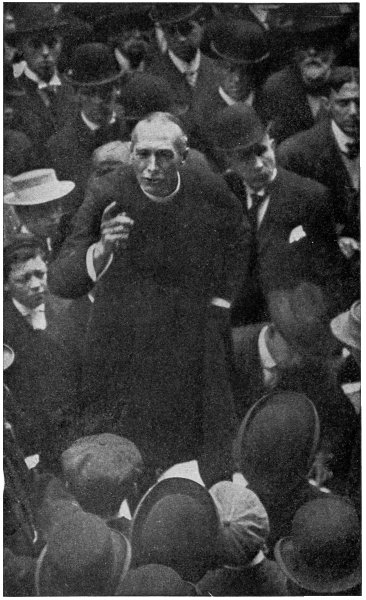
BISHOP OF LONDON PREACHING IN WALL STREET NEW YORK The best loved man in England. He preaches in the slums at midnight, and in his cathedral he pleads with the leaders of his church and nation against the false modesty which keeps young people in ignorance of the wages of sin.

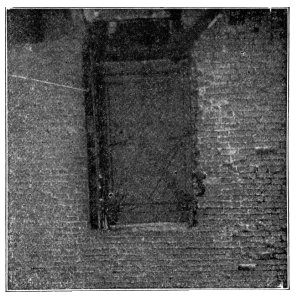
BARRED WINDOW AND DUNGEON DOOR No state prison is more securely barred than was this house where many white slaves were kept. This dive was a rendezvous for thieves and other disreputable characters.
Denying rumors of his evil character, he wrote: "I did not go to Davis to see another girl. I went to sign up some policies which I wrote up there a couple of weeks ago. And if you heard anything I said about you, it was some lie those kids made up, like the one about the girl in Davis. I never spoke to the girl in my life and probably wouldn't know her if I met her on the street. I do care very much for you and I love you much more than I profess and I don't run after other girls. I would like to take you with me, but since you say that was impossible, I will be true to you. If you ever want to come to me I will send you the money and will take as good care of you as if you were my own sister."
In another letter the wretch complains: "Say, why did you tell Effie about my writing to you and wanting you to come to Chicago? Please keep these things to yourself if you value love."
Needless to say, the scoundrel had no wealth, and when Judge Fake fined him two hundred dollars, all the punishment our backward laws provided at that time, he had to go to prison until his father could send the money from his home in the state of Washington.
The letters quoted above were obtained by Miss Niblo, a missionary, from the intended victims, and were published by the editor of the Freeport Evening Standard, July 31, 1907.
A very young girl who just escaped this tiger's claws wrote this letter of inquiry and gratitude:
"—— Street. ——, Illinois, August 8, 1907.
Rev. Ernest Bell:
Dear Sir:—Could you tell me if Neil Jaeger is in the bridewell yet or has he been released? I am a girl that he tried to persuade to go away with him, but he did not succeed in getting me to go. You have my heartiest congratulations for capturing such a wretch.
Yours Truly, ———"
There are hundreds of such smooth scoundrels occupied all the time in replenishing the dens of shame in Chicago. They travel, to our positive knowledge, as far as Ohio and Tennessee and in all the nearer states. Fathers and mothers and brothers of girls, and the girls themselves, should be ceaselessly vigilant against these murderous deceivers. They always profess to be in some legitimate business and are apt to transact some honest deals as a blind. Every city that keeps up a red light district breeds these destroyers of girls. Every divekeeper employs such agents, and the principal is worse than the employee.
Mrs. Charlton Edholm, in her book "Traffic in Girls," writes the following confession made to her by a converted bartender: "Mrs. Edholm, I believe I am a converted man now, and that the Lord Jesus Christ has accepted me and I will dwell with him forever, but when I realize how many girls I have sent to houses of shame, I wonder if God ever can forgive me, and I would give my life if I could undo it.
"When I was a bartender for years in a saloon with wine rooms, these procurers used to come there, and often I've seen one of these men bring a beautiful girl to the ladies' entrance, and of course he would try to get her to drink wine or beer, but oftentimes having been brought up in a Christian home, or having signed the total abstinence pledge in the Sunday school,—for you W. C. T. U. women have done so much for the children by having temperance taught in the day schools and Sunday schools,—and she would refuse to touch the wine or beer, then he would wink at me, and I knew that meant an extra dollar for me, and I would drop a little drug into whatever that girl had to eat or drink, and in a few moments she would be unconscious and that fellow would have a carriage drive to the door, that girl would be placed in it and driven straight to a haunt of shame; he would receive his twenty-five or fifty dollars, and that girl would be as surely lost as if the earth had opened and swallowed her. Hundreds of times I've done this, and, Mrs. Edholm, do you think God can forgive me?"
Young men, and older men, who patronize houses of shame should be made to see and feel that all this hellish traffic goes on at their instance and at their expense. The keepers and procurers are the paid agents of the men who foot the bill. Every dollar, with the burning name of God upon it, that any man spends there makes him a stockholder in the white slave market and a partner in the traffic in girls. The men who support the hideous business are the ultimate white slave traders, and when their hired men, the divekeepers and procurers, come to judgment and condemnation, the men who supported them in crime will be arraigned beside them and punished with them.
PERIL OF STAGE-STRUCK GIRLS.
The corruption of the present day theatre is generally admitted. Archbishop Farley, in a sermon at St. Patrick's Cathedral, New York, on Sunday, February 7, 1909, said that "the stage is worse today then it was in the days of paganism." He added: "We see today men and women—old men and old women—who ought to know better bringing the young to these orgies of obscenity. Instead of that they should be exercising a supervision over the young and should look carefully after their companionship."
Actresses of character are among the foremost to warn young women of the perils of the modern stage. Shakespeare and the older dramatists taught virtue, often with the spirit and energy of a prophet. Multitudes of present day plays are of such moral character and tendency that no one can defend or excuse them. President Taft recently walked out of a theatre to express his disapproval of the play.
Low theatres exist merely to inflame those who visit them. They go to the awful length of naming the vice district as part of the merriment of the performances. Other so-called theatres are a part of the combined saloon and den of shame. I have conversed personally many times with girls who were deceived into going to such places, thinking they were going on the reputable stage.
Mr. Arthur Burrage Farwell, Chicago's well-known reformer, here tells briefly the story of two young girls, whom I have often met in his office, who were lured by a false theatrical agency to go to a vile resort. The agency of a wicked woman, or two of them, will be noted in this case, along with the base deeds of an unscrupulous man. The keen eyes and wise head of a good hearted Scotch woman saved the girls from a terrible doom. Mr. Farwell writes as follows:
"About December 1, 1907, I received a special delivery letter from the managing editor of one of the oldest daily papers in Springfield, Illinois, informing me that two girls had been sent back to Chicago and suggesting that the police department be informed of the facts. I immediately communicated with the assistant general superintendent of police, Hon. Herman F. Schuettler, and the girls were located. The theatrical agent who had sent them from Chicago was arrested and work was started against some of the evil practices of false theatrical agents.
Taking the story from the girls and from their testimony in court, it is as follows: These two girls worked in a large department store in the city of Chicago. One of them was approached one day by a well-dressed woman who requested the judgment of this young lady upon some material to be used in theatrical work. The result was that this woman gave the name of a theatrical agent and told the girl that she could make $25.00 a week by going on the stage, as she had a good voice, etc., etc.
This girl spoke to another friend, working in the same store, and together they called upon this theatrical agent whose name was given them by the woman. After being taken to a saloon, an attempt being made to compromise them, they were given tickets to the city where they were supposed to go upon the stage. They reached the city and providentially were guided to a boardinghouse of a Scotch woman who lived next door to the alleged theatre, which proved to be a saloon in the front and a vaudeville in the rear and upstairs a most awful place.
The proprietor of the alleged theatre declined to employ the young ladies unless they would stay in the rooms over the saloon or theatre. On the advice of the Scotch woman they declined to stay over the theatre, and the woman furnished them tickets and they returned to Chicago.
The preliminary hearing of the People vs. —— was held in the Municipal Court of Chicago before Judge Wells, January 14, 1908, and lasted about five days, and twenty-seven witnesses were heard, the testimony covering 373 pages. The theatrical agent ——, was held to the grand jury. His license to operate a theatrical agency was revoked by the state.
The sworn testimony showed a condition of affairs that would be a disgrace to the most ignorant, vicious and debased people. That such things are allowed in a republic where the people rule, as were allowed in Springfield and in other cities, is a sad commentary upon the average indifference of the authorities and the people, which should be called criminal indifference.
The theatrical agent and one of the owners of the property in Springfield were indicted for conspiracy, but in the criminal court these charges were not sustained.
The two girls were living with a woman and one day when they were needed as witnesses it was found they were not there. A letter with no signature was received by the president of the Chicago Law and Order League, informing him that the two girls were living under assumed names in Milwaukee, and immediately representatives of the Chicago Law and Order League and of the State of Illinois, went to Milwaukee and found the girls and brought them back.
The men who were responsible for sending these state's witnesses away were indicted and were found guilty and the woman re-indicted.
The expense in this one case to the Chicago Law and Order League and the State of Illinois was probably not less than $2,000.
If the young girls who are seeking a living upon the stage could know of the pitfalls that are in their way, I believe many of them would seek other employment. One of the girls is now married and living very happily.
Arthur Burrage Farwell, President Chicago Law and Order League."
E. A. B.