Chapter XIV
Reading edition
BARRED WINDOWS: HOW WE TOOK UP THE CAUSE OF THE WHITE SLAVES.
This afternoon, August 26, 1909, between half past two and half past three o'clock, Mr. Ralph Radnor Earle took photographs of various places in Chicago's principal vice district. Among these were several photographs of barred windows of resorts, positively known to myself and Miss Dedrick, who both accompanied the photographer, as disorderly, flagrant, infamous houses. Some of these barred windows on the dens of crime are here reproduced from the photographs. The bars are on the windows of both floors of these buildings; these are the back windows of these dives, and look towards Clark street, a great Chicago thoroughfare, from which the upper windows are plainly seen.
Five years ago barred windows on a house of sin, which had been turned into a mission, alarmed some of us and gave us almost our first ideas of the fate of the white slaves. The house was a notorious place, the most notorious in Chicago a dozen years ago. The name of the woman who kept it was known and is still spoken in the circles of the immoral throughout Chicago and far beyond it. Stories are told of princes of European houses, pouring out wine and money like water in this glittering palace of mirrored walls and brilliant lights.
The woman died and the probate court would not allow her estate to use the property for immoral purposes. It was leased for a mission and rescue home by Mr. O. H. Richards, founder and superintendent of Beulah Home. Many of the windows were barred, and whatever explanations might be offered, we were never satisfied that they were not barred to keep in girls who at least at times would gladly escape. When we learned that many other houses in the vice district had windows similarly barred we were obliged to conclude that girls were constantly detained against their will.
To this refuge which had been a dive, Edith E—— fled one morning, having escaped from a resort on Custom House Place. She ran first to a drug store, telephoned to the police to get her street clothes from the dive, and then came to the rescue home. She explained that she had heard the midnight missionaries two nights before singing, in a gospel meeting which they were holding in front of the den where she was:
"Throw out the life-line to danger-fraught men, Sinking in anguish where you've never been."
So deep an impression was made upon her that she was wretched all the next day, quite unfitted for her old life. Next morning she escaped. She told me that she had been a very wicked girl, that her young husband had committed suicide because of her sin. She never went back to her evil life. Her physical heart was seriously weakened from her addiction to drugs, liquor and vice.
In October, 1906, the National Purity Federation, of which Mr. B. S. Steadwell of La-Crosse, Wisconsin, is president, held a conference in Chicago, at Abraham Lincoln Center. Among the speakers was the late Rev. Sidney C. Kendall, whose whole soul was torn and bleeding over the shame of making commerce of women. He told us of the crimes of the French traders, of their systematized traffic in girls and of their organization for defense when any of them is under prosecution in the courts. Mr. Kendall was sick when he was here and died the next summer. With his latest strength and his dying breath he antagonized the loathsome white slave trade. He was a member of the National Vigilance Committee for the Suppression of the White Slave Traffic. Mr. Kendall's most conspicuous work was done in Los Angeles. Some of his spirit remained with a few of us in Chicago and we could not rest until some effort was made here to rid us of the shame of slavery in the twentieth century under the flag of the free.
On January 30, 1907, Mr. O. H. Richards told me how he had rescued a girl, with the help of the police, from a resort after the woman who kept the place had refused to surrender the girl to her mother and stepfather, on the claim that the girl owed twenty dollars for clothes. As there were three good witnesses to the illegal detention—the mother, the stepfather and Mr. Richards—I saw that this was a good case to bring into court. I asked the mother if, for the sake of other mothers' girls, she would take the witness stand. She heartily consented, as did her husband, and with strong crying and tears, she gave her testimony when the offending woman was arraigned, January 31, before Judge Newcomer at Harrison street. She was convicted, fined, and sent up to the bureau of identification—"rogue's gallery"—to leave her picture and measurements. This broke her pride and she came down wilted. She immediately abandoned her wicked business and is a good woman today. Last September when the midnight workers had some annoyance from dive-keepers, she visited the district at midnight to express her sympathy with the missionaries. She told me, "I remember what you said to me in court. You said, 'I love your soul, but I hate your devilish business.'"
As it was now publicly shown that girls were held in houses against their will, we printed the statute of Illinois against such detention, as a leaflet, and placed a copy in the hand of every keeper and inmate of disorderly resorts in the vice district at Twenty-second street. Captain Harding posted a copy of the leaflet in the police station. Beneath the statute we printed a note saying, "No white slave need remain in slavery in this state of Abraham Lincoln, who made the black slaves free. For freedom did Christ set us free; be not entangled again in the yoke of bondage, which is the yoke of sin and evil habit." Pastor Boynton tells in another chapter how Deaconess Hall, himself and I, with Policeman Cullet, went from house to house in the great vice district with this leaflet, which proved so powerful.
Thereafter the cause of the white slaves lay heavy on the hearts of a number of men and women, particularly Deaconess Lucy A. Hall, whose insistence that something be done led, ultimately, to the organization of the vigilance work in Chicago.
In the autumn of 1907, Mrs. Ida Evans Haines obtained a copy of a report of the Episcopal Diocese, of Massachusetts, on Social Purity and the ravages of the diseases that are the wages of sin. At Mrs. Haines' request, Rev. Morton Culver Hartzell organized a committee of ministers of various denominations, of which Rev. Dr. Swift, of Austin, was chairman, and Rev. Dr. Cain, of Edgewater, secretary. Under authority of this committee, a meeting was held at the Y. M. C. A. lecture room in November, 1907, which was addressed by Miss Rose Johnson, of Panama. Out of this meeting came the "Committee for Suppression of Traffic in Vice," of which Dr. Cain was chairman. This committee employed an investigator and was appalled by the revelation of conditions in Chicago, existing not only in so-called red light districts, but also in residence districts. The activity of this committee for the suppression of traffic in vice attracted a much larger number of persons, who promoted numerous meetings, which culminated in the union meeting of ministers to consider the suppression of the white slave traffic in Chicago and Illinois, on February 10th, 1908.
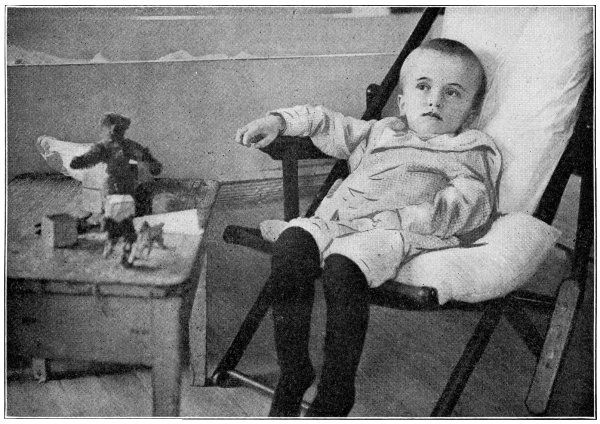
BLIND BABY IN THE POOR-HOUSE This baby's condition is the direct result of disease in the parents. Probably 25 per cent of the blindness of children is caused by illicit sexual relation. (Dr. Wm. T. Belfield, page 299.)
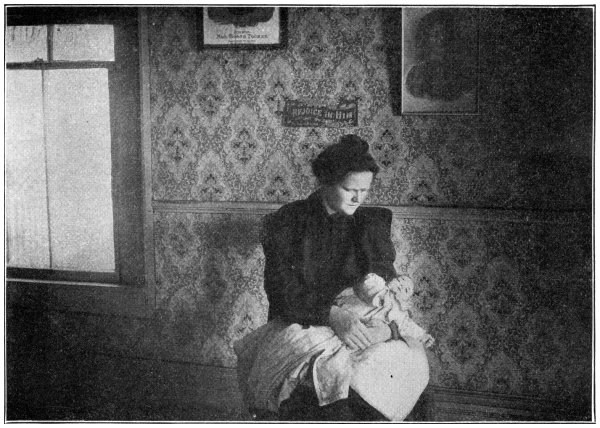
IN THE REFUGE Alone in the world with no one but her baby she comes to the refuge to save herself from starvation. She has no husband. She was tempted and fell
The purpose of that meeting was to enlist the ministers, as the moral leaders of the community, in the effort to rid our city of this shame, and by holding a public convention to give the newspapers opportunity to tell the facts to the public.
Bishop Wm. F. McDowell presided; the devotional service was led by Rev. A. H. Harnly; prayer was offered by Rev. A. C. Dixon. Addresses were made as follows: "Chicago's White Slave Market; the Illegal Red Light District," by Rev. Ernest A. Bell. "The White Slaves and the Law," by Mr. Clifford G. Roe. "The International White Slave Traffic," by Dr. O. Edward Janney, of Baltimore, chairman of the National Vigilance Committee. "The Lost," by Mrs. Raymond Robins.
Judge Fake spoke briefly, and a letter was read from Judge Sadler.
At that meeting, it was determined to proceed with the organization of a State Association for the suppression of the white slave traffic in Illinois. That same afternoon, February 10th, 1908, a largely attended meeting representing ministers' meetings, settlements, clubs, temperance and other reform organizations, set themselves to establish the "Illinois Vigilance Association."
The publicity given by the conference just mentioned to the testimony of ministers, judges and prosecutors, led the Chicago Tribune to inquire very carefully into the truth of these statements, and finding them true, that newspaper committed itself in numerous editorials to antagonize the White Slave Traffic.
The same conference helped to enlist Hon. Edwin W. Sims, the United States district attorney at Chicago, in the prosecution of the traffickers in foreign girls under the Immigration Act of February 20, 1907. Mr. Sims has repeatedly stated in public meetings that we brought to his notice the appalling traffic in alien girls, which he has since done so much to suppress.
Much has been done, we rejoice to say. Still, today we photographed the barred windows in Chicago's principal market for girls.
LATER—On September 3, in an interview with Hon. LeRoy T. Steward, chief of police, Mr. Arthur Burrage Farwell and the writer submitted photographs of barred windows to the chief. He examined them carefully and said he saw no need of such bars on houses of infamy. The explanation of divekeepers that the bars were "to keep out burglars," was not satisfactory. Assistant Chief Schuettler, who was present, said, "Give it to me, I'll tend to it." He took one of the photographs and in a few days the bars were all removed.
Similar barred windows were found and photographed in Los Angeles during the crusade of the decent people of that city against its white slave market. It's wonderful how carefully these slavers everywhere protect themselves against "burglars."
We reproduce in this book two flashlight pictures of a dungeon door and a steel screen found in Custom House Place, the former white slave market of Chicago. These are taken by permission from "Chicago's Soul Market," by Dr. Jean Turner Zimmermann. She writes concerning these views as follows:
"In the south wall of the basement of 114 Federal street (Custom House Place) that congested, central Redlight District of three years ago, now given over to slum and immigrant habitation, is a great steel door about the size and shape of the door of a railway freight car. On the outside, this door opens into a narrow, blind passageway between 114 and 116 Custom House Place, formerly the notorious dive 'The ——.' On the inside this door opened into a large closet, windowless, sound proof (about 4×7 feet) and it is alleged that it was through the alley and into this blind passage way that the unwilling victims of White Slavers were carried into this little solitary cell.
"The accompanying photograph, secured by the writer, gives at least a faint idea of this frightful trap against whose pitiless walls have, no doubt, beat the agonized shrieks of more than one innocent girl.
"For two years we occupied the premises at 114 Custom House Place as a mission. Upon moving into the place we found every window incased in heavy iron bars, while between the bars and the glass of each window was mortised a one-half inch steel screen (see cut). Entrance or exit from the building was as utterly impossible as from a penitentiary, excepting by the front door."
Certain policemen, from motives best known to themselves, attempted to prevent Dr. Zimmermann from taking these photographs. Scorning their despicable threats of arrest, she took the pictures with her own hands.
—E. A. B.