Chapter XVIII
Reading edition
PROCURESSES AND THE CONFESSION OF ONE OF THEM.
Here is a story from the London Times, which might easily be repeated in the New York Herald or the Chicago Tribune:
"I was standing on a railway platform at —— with a friend waiting for a train, when two ladies came into the station. I was acquainted with one of them, the younger, well. She told me she was going to London, having been fortunate enough to get a liberal engagement as governess in the family of the lady under whose charge she then was, and who had even taken the trouble to come into the country to see her and her friends, to ascertain that she was likely in all respects to suit. The train coming in sight, the fares were paid, the elder lady paying both. I saw them into the car, and the door being closed, I bowed to them and rejoined my friend, who happened to be a London man about town. 'Well, I will say,' said he, 'you country gentlemen are pretty independent of public opinion. You are not ashamed of your little transactions being known!' 'What do you mean?' I asked. 'Why, I mean your talking to that girl and her duenna on an open platform.' 'Why, that is Miss ——, an intimate of friend of ours.' 'Well, then, I can tell you,' said the Londoner to me coolly, 'her friend is Madam ——, one of the most noted procuresses in London, and she has got hold of a new victim, if she is a victim, and no mistake.' I saw there was not a minute to lose; I rushed to the guard of the train and got him to wait a moment. I then hurried to the car door where the ladies were. 'Miss ——, you must get out; that person is an unfit companion for you. Madam ——, we know who you are.' That one victim was rescued, but how many are lost?"
With "Prisoner Number 503," whose story follows, I have conversed personally and I have not the slightest doubt that her story is true. It surprised me to hear her say that she was and is a member of a Baptist church, with an implication in her words and manner that members of other churches are not quite so safe as members of her denomination. Her story was published January 28, 1909. She was brought to justice by the Chicago Law and Order League.
BY PRISONER NUMBER 503.
I am writing this message to the readers of The National Prohibitionist and to the world from behind the bars in that gloomy pile of buildings alongside the Drainage Canal, where Chicago every year spends some millions of dollars to protect herself from the criminal classes which she constantly creates and breeds.
It may shock the respectable people who read these lines to find that their author is an imprisoned criminal. I lay emphasis on the word "imprisoned," because my not very long experience with the world has taught me that violation of the law is not particularly offensive to the mass of the world's inhabitants so long as it is not attended with the "pains and penalties" that are prescribed for the law's violation.
I may as well shock my readers still more at once by the frank confession that I am in prison convicted of being what is commonly known as a "white slave trader" and I was justly convicted and was guilty of the offense charged.
And having made this confession, let me introduce myself.
Behold me, a very common sort of a woman, twenty nine years old, an ex-schoolteacher, born and piously brought up in the good state of Arkansas, fairly well educated, and, until within the last few months, almost wholly inexperienced in the ways of the wicked world.
Six years ago, in my Arkansas home, I married a man whom I believed to be in every way worthy of the respect and love that I gave him and, bidding goodby to my mother and my childhood friends in the old home, went with him to St. Louis.
I wonder if the good men who let the saloons flourish in all our cities and excuse themselves with the assertion that if a man will drink it is his own business, and if he makes a fool of himself, he is the only one that suffers—I wonder if those men really know what they are doing for thousands of women who do not drink but who SUFFER?
Years ago, somewhere I read an article about the saloons written by some great minister or bishop, whose name I have forgotten, and, indeed, I have forgotten most of what he said, but I remember he did say that the victims of the saloon are willing victims.
Great God! I have been a victim and God knows that I never was willing!
I found that my husband was a drunkard. A railroad man with a good "job," able to earn a comfortable living for himself and me; he never for a day could be depended upon. Many a morning did he kiss me goodby, leaving me the impression that he had gone to his work, when it would be three days, a week, a month, sometimes three months before I saw or heard from him again, though I might be in the sorest straits for the necessities of life. Three times he did this when he knew that I was soon to become a mother. Once, after three months' absence, I heard from him in a hospital in another city. I went to him, nursed him, brought him home and when he was able to work, gave him out of my own earnings money to pay his board until payday (for his work would oblige him to board in another town) and he went away and I never saw him again for months.
Forced to work for a living, I came to Chicago, finding a position in a legitimate business, although, unfortunately, it was the sort of a business that brought me into contact with many people of bad morals, and tended to deteriorate my own moral ideals.
Here in Chicago, while I was buying a railroad ticket one day in a ticket broker's office, I was introduced by the clerk to a man who appeared to be a gentleman, with the suggestion that he would be willing to do for me a slight service which I needed at the moment, regarding my baggage. A few weeks after, this man, whom I had no reason to suspect of any evil motive, sought me with the offer of a good place to work. He promised me a good salary, and the offer was specially attractive in view of the fact that I was then without work, and I accepted the place in perfect good faith.
I want to emphasize what I now say for the benefit of those who may read these lines who are parents of young girls.
I suppose I may claim to be a reasonably intelligent woman, with a fair education, some years of observation of the world and a little opportunity to know of the world's wickedness, but I was at that time absolutely ignorant of the existence of such a thing as a business in vice.
I had never heard that girls were bought and sold.
I did not know the character of what are called "disorderly houses."
It seems to me that good people, pious fathers and mothers, who let their girls grow up and go out into the world without a word of real instruction that will protect them in such crises which may come in life to any woman, are not wholly innocent—I am tempted to say are frightfully guilty of the destruction of their own daughters.
To make a long story short, and to tell a hideous tale in a few very plain words, I accepted the proposition and found myself installed in one of the protected vice dens of Chicago as housekeeper and the special personal slave of this man, whom I now found to be a slave trader, the practical owner of other women and girls in various dives, as well as the driver of gangs of procurers. This man almost owned me. My salary—such small parts of it as I got—went into his pocket upon one excuse and another, while I was subject to his brutal will constantly.
I will not shock my readers by telling the details of my horrid life in that place, but I must give them some facts that ought to be in possession of the unsuspecting decent people who sit quietly and virtuously in their own homes while a slaughter more terrible than Herod ever dreamed of goes on unceasingly.
I am asked to say whether the unfortunate girls in these places are slaves in the sense that they can not get away. My answer to that must depend upon your interpretation of "can not."
In my own case there never was a time when I could not have walked out of the building, had I chosen to do so, but my promised salary was always in arrears and I was penniless, with nowhere to go and no friends.
To walk out on a winter's day into the streets of Chicago, with nothing with which to buy a meal and no shelter and no friend under the wide, pitiless sky, is a heroic course to which some resolute Spartan matron might be driven in protection of her virtue, but it's a course which can hardly be expected from a mistreated, deluded, ignorant, disgraced, modern American girl.
And it must be understood that my situation was very different from that of the "girls." I was in the position of a superintendent. They were under me. What would have been possible for me was practically impossible for them.
To begin with: No inmate of these vice dens is allowed to have clothing with which she could appear on the street. It is taken away from her by fraud or by force, as soon as she arrives, and is locked up. She never sees it again until she is regarded as thoroughly trustworthy and sure to come back if she does get out.
Then, too, she is in debt. As soon as she arrives at the house, an account is opened with her, although, perhaps, she never sees the books. She is charged with the railroad fare that has been paid to bring her to the city; she is charged with the price that was paid for her to the thief who betrayed and stole her; she is charged for the alleged garments that are given her in exchange for her clothing—charged four times the price that they cost.
Of course, the police will tell you nowadays that the old debt system has been abolished, and that girls are not allowed to be in debt to the house where they are kept, and it may be that a sort of fiction is maintained, by which, if an investigation were forced, the divekeeper would pretend to be an agent for the storekeeper that sells the supplies. But the condition of debt is none the less real, although as always it be fraudulent. The divekeeper, the storekeeper and the police are all partnership in it.
Of course, it is not lawful to keep a girl a prisoner because she happens to be in debt, but she is made to believe that it is. She is told strange stories about laws that are enacted for the government of her "class," and she recognizes, all too plainly, the power of the arm of the police always outstretched in behalf of the divekeeper.
Police officers come and go in the dive. They register all "inmates" upon arrival and give formal, though, of course, unlawful sanction to the business. If a girl becomes refractory and the divekeeper threatens her with the vengeance of the police, she has every reason to believe that the threat is well founded, whether it is or not.
If, in spite of all this, a girl should be brave enough or rash enough to try to make her way out of the dive, and escape, almost nude, as she is kept, into the street, perhaps she would be allowed to go. Perhaps, too, the police might not bring her back, but they certainly would not assist her escape; and if they did not force her back into the den from which she had escaped they would certainly send her to prison.
I have seen dozens of girls who wanted to get out from these dives, wanted to leave the life that they were living, but who, under the conditions that I have enumerated, did not—I think I may fairly say—could not do it.
I had been in my position as housekeeper but a little while when my owner discovered that I could be profitably employed in another line, that is, in importing slaves from other cities.
Some months before, the firm for which I was then working had sent me to Milwaukee to sell toilet preparations, and this business had brought me in contact with a considerable number of foolish young women. I knew that some of them were anxious to come to Chicago and I was sent to Milwaukee to induce them to come and bring them with me.
I made several such journeys to Milwaukee and other cities, bringing a number of victims for Chicago's slave market. I attempt no defense for this infamous work. I ask for no moderation of judgment against me, but I feel that I have a right to call the attention of the public to the glaring injustice of the situation that puts me behind these bars, with long months of imprisonment before me, and leaves others who were equally guilty with me, and who are equally well known in their guilt, to go on with their wicked work.
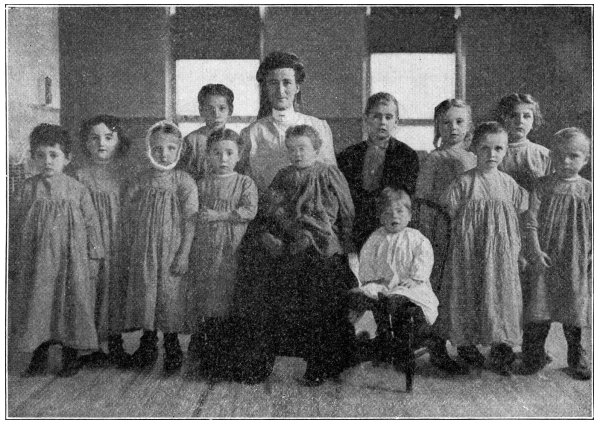
IN THE HOSPITAL—SINS OF THE FATHERS VISITED UPON THE CHILDREN These poor mites of humanity are brought into the world with the double handicap of poverty and disease—a charge upon the county
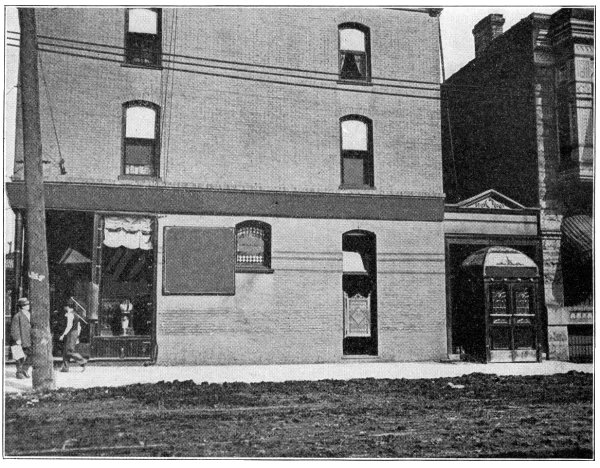
THE DEVIL'S SIAMESE TWINS Tough saloon and dive combined. Into this place Mona M. was sold
I know that ignorance of law is no excuse for its violation, but I was certainly ignorant that I was breaking any law. I never dreamed of it until, just before my arrest, the proprietress of one of the houses from which a girl whom I had brought to the city had run away, told me of my danger. I asked her why she was not also in danger, and she replied that it was because she carefully followed the instructions of the police and maintained an ignorance concerning the sources from which the girls were brought who came to her house.
I may or may not be believed, but I state the truth when I say that I never brought to this slavery a girl whom I believed to be an innocent girl. I brought only girls whom I found in bad surroundings, usually in disorderly saloons, and girls who claimed to be and appeared to be beyond the protection of that extremely virtuous law, which our wise lawmakers have given us, known as the "age of consent" law. How any sane person must hate such cursed nonsense as such a law!
Now, let me ask why—why, when I was sent as a mere agent of others, when I brought girls from well-known dens where they had been ruined, brought them into a recognized slave market, delivered them to well-known slave owners, where they were used to enrich their owners and the police—why, while the slave market goes on and while the slave owners drive their new gangs, and while the police keep up their system of protection and graft—WHY AM I LOCKED UP HERE ALONE?
Now, let me make it perfectly clear on just what ground I have been sentenced to prison. I was convicted under what is known as the "pandering act," which makes it an offense to secure an inmate for a disorderly resort in the state of Illinois.
I was guilty and the protest I make is the protest of a convict, but I cry out to the good people to know why, if I must be behind prison walls for procuring an inmate for such a place, they walk free and grow rich and hold offices who allow such places to be.
IF IT BE A CRIME WORTHY OF THE PRISON TO PROCURE AN INMATE FOR A VICE RESORT, IS IT A SURE PROOF OF PUBLIC AND PRIVATE VIRTUE THAT VICE RESORTS COVER SQUARE MILES OF THIS CITY AND THE CITY GOVERNMENT "REGULATES" THEM?
Ten long months hence, when, broken, disgraced, without a cent, without a friend, they turn me out into Chicago's cold November storms, will justice have been vindicated, will some great and good ends have been attained by the punishment of me—a tool, a cat's-paw—while seven thousand saloons and square miles of houses of prostitution have gone on in their bloody, damning work under sanction of the government run by you pious men?
E. A. B.