Chapter X
Reading edition
WARFARE AGAINST THE WHITE SLAVE TRADE.
By Clifford G. Roe, Assistant State's Attorney of Cook County, Ill.
There is a problem of slavery today for the people to solve. The question is: "How shall the warfare against White Slavery be waged to blot out this cloud upon civilization expeditiously?" Over two years ago I learned that there was a gigantic slave trade in women, and with a handful of people we began to fight the traders. That a system of slavery, debasing and vile, had grown to enormous proportions before our very doors seemed beyond belief, an impossibility, and even romantic. Most people were skeptical of the existence of a well defined and organized traffic in girls, and they seemed to think that those advocating the abolition of this nefarious trade were either visionists or fanatics. The struggle against this trade in women was a hard one at first. The ministry, although dazed, were finally aroused to an appreciation of the truth.
Having faith in the people, and believing that this republic lauds and honors the chastity and sanctity of women, I believed in bringing this hideous traffic in girls to the public notice, and when our citizens fully realized its importance they would rise to the occasion and aid in the warfare to exterminate white slavery. The result has been most gratifying, for churches, clubs, associations, newspapers, men and women in all walks of life have taken up the cause. Great armies like those of a generation ago cannot uproot this slavery, but the slavery of today must be eliminated by publicity, education, legislation and law enforcement. That is the reason magazines have brought to their readers facts concerning this hideous trade. The results of this heroic work have been wonderful, for thousands of letters inquiring about white slavery have been received, and associations and clubs have formed to fight white slavery, and legislation upon the subject has been introduced in many states. If this great good to our social life could not be brought about by publicity, there would not be any reason for bringing before the people and into the midst of the family circle facts which are so black and revolting. But to know and understand we must cast aside false modesty, take off our kid gloves and handle this great social problem with our naked hands.
The trade in women is domestic and foreign, local and international. The Honorable Edwin W. Sims, United States District Attorney at Chicago, and Harry A. Parkin, his Assistant, have been waging valiant warfare against the foreign and international trade during the past year. Articles in leading magazines which were written by them have dealt chiefly with that phase of the white slave trade. They have explained, also, the debt system as a means of keeping the girls in resorts after they are procured and sold. It is with the domestic and local trade I have been mostly concerned. In Chicago alone there are more than 5,000 women leading a life of shame, and statistics show that the average life of a fallen woman is five years. One thousand persons must, therefore, be recruited every year in Chicago alone. How many voluntarily go into this life? It is estimated about forty per cent! This shows us that sixty per cent are led into it by some scheme or entrapped and sold, and at least two-thirds of this number are from our own country, being inveigled from farms, towns and cities. One may inquire, "How is it that girls are procured so easily without the public being aware of what is going on?"
The answer is that love and ambition are the baits which the procurers flaunt in the faces of their proposed victims. Often it happens that promises of positions on the stage, in stores, and various occupations alluring to young girls cause many to fall, captives in the great net set for them.
During the past two years there have been more than two hundred and fifty white slave cases tried in Chicago under the Illinois law, resulting in scores of confessions made by the procurers, and statements by hundreds of the girls who were procured as to the methods employed by the traders.
To show how easily it is done, let me tell you a story of a girl from Elgin, Illinois, who was caught by the love scheme. One day this pretty little German lass was in a Chicago store buying sheet music when a well-dressed, handsome, young man, apparently looking at music, too, asked her the names of some of the latest popular songs, as he wanted to buy them. At first she turned away and did not heed him, but he was not to be repulsed, and pressing his attentions further upon her, he finally engaged her in conversation. A luncheon at a nearby restaurant, in which she joined him, was the result, and there he told her how at first sight he had fallen in love with her beauty. After lunch he suggested a visit to his bachelor apartments, but this she refused. Seeing that this plan was a failure, he asked her to marry him then and there. The silly girl, believing he loved her, and enchanted by the picture he had painted of his father's wealth and fine home in New York City, consented, and they were married. After the ceremony he told her that he was about "broke," and said that he would take her to a place where she could make enough money in a few days to pay their way to New York, where everything would be lovely, and as they were married it would be no one's business how she got the money. Immediately accounts of white slave procurers which she had read came to her mind, and she then realized what she had fallen into. Lest she might arouse in him suspicion, she consented to do as he asked, but told him that before going out to the resort she wanted to buy some clothing, and arranged to meet him at a certain down-town corner toward evening. She hurried to the County Court, where an escort was given her, and she was brought to the court where I was prosecuting. I armed an officer with a warrant and he followed the girl to the appointed place of meeting. The young man was there waiting for his victim. The officer stepped up and put him under arrest, and the next day he was tried and convicted. It was then learned that he was a well known procurer of girls. Thus saved from a life of ruin, the Elgin girl went home heart-broken, but wiser for her experience. Recently she secured in the County Court an annulment of the marriage. Inquiry proved that the girl was from a very respectable home, and that she had always been a good, honest, industrious girl. Many similar cases have come out in the courts; however, the girls in most instances were not favored by the same good fortune which blessed the little girl from Elgin, and the outcome was much more disastrous. This is an illustration of the ease with which panderers make use of love as a means of securing girls for immoral houses.
The other method used by the traders is the one which appeals to the girl's ambitions. Sometimes the procurers have gained the parents' consent to allow their daughters to accompany the supposed theatrical or employment agent, as the case may be, to some city, thinking that through the daughter's success their station in life would be raised. A girl in a country community, or say factory town, is working for four or five dollars each week, when one of these procurers, traveling under the guise of an agent, meets her and promises ten to twenty dollars a week for work in the city. She may be perfectly sincere and honest in her intention to better her condition. She may want finer clothes, a wider knowledge of the world, or an education, and so she consents to go with him, and finally, against her will, ends up as an inmate in some immoral place.
One of the most recent cases shows how readily girls jump at an opportunity to better their station in life. This case first came before the court the day after last Christmas, when Frank Kelly was arrested for carrying a revolver, with which he tried to shoot an old man. During the trial the story developed as follows:
A year ago last summer fifteen-year-old Margaret Smith was working about the simple home near Benton Harbor, Michigan. The father, employed by the Pere Marquette Railroad, was away from home a good share of the time. One day a graphophone agent called at the house and the family became much interested in one of his musical machines. Shortly afterward this agent brought with him to the Smith home Frank Kelly, and introduced him to Maggie, as she was called by her folks. In a day or two Margaret was on her way to Chicago with Kelly, who promised her an excellent position in the city. Upon her arrival Margaret was sold into one of the lowest dives in Chicago, located in South Clark street, and owned by an Italian named Battista Pizza. Here she learned that her captor was not Frank Kelly, but an Italian whose real name is Alphonse Citro. For a year she was kept as a slave in this resort, which was over a saloon, and the entrance was through a back alley. The only visitors were Italians, who came for immoral purposes. Learning last summer that Margaret's father, who had been hunting relentlessly for his daughter, was on the track of her, the girl was taken by Alphonse Citro, alias Kelly, to Gary, Indiana. When the father came to the resort with a policeman he found that his daughter had gone. She was kept in Gary about two months, and then returned to this disreputable place, from which she escaped finally, the Monday before Christmas. A young barber took pity on her after hearing her sad story and enlisted the sympathy of his parents, who took her to their home. Alphonse Citro (Kelly) looked for her for almost a week, and at last saw her going from a store to this home, where she was staying. He went to the house and demanded at the point of a revolver that she be given up, as he said:
"I am losing money every day she is gone."
There was a quarrel over the girl, during which some people from the outside were attracted to the house by the commotion. Citro, becoming frightened, fled down the street, and as he ran threw the revolver, with which he tried to shoot the father of the barber during the quarrel, over a fence into a coal yard. After running two blocks, he was caught and arrested. Upon these facts this procurer, Citro, alias Kelly, was prosecuted and found guilty under the new pandering law in Illinois, and received a sentence of one year's imprisonment and a fine of five hundred dollars. The poor old father and mother, distressed and broken-hearted, were in court during the trial with their arms around each other, sobbing with joy because their little girl had been found. Pizza, the owner of the place, was indicted by the state grand jury, but escaped to Italy. This case is only one of the hundreds which might be told to show how the girls leave home upon the promise of securing employment and are in this way procured for places of ill-repute.
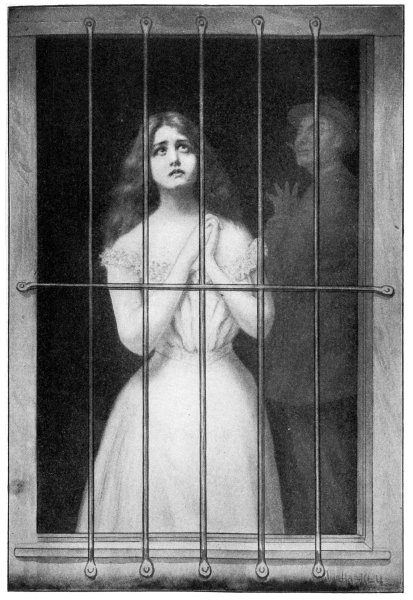
"MY GOD! IF ONLY I COULD GET OUT OF HERE." The midnight shriek of a young girl in the vice district of a large city, heard by two worthy men, started a crusade which resulted in closing up the dens of shame in that city. (See page 450.)
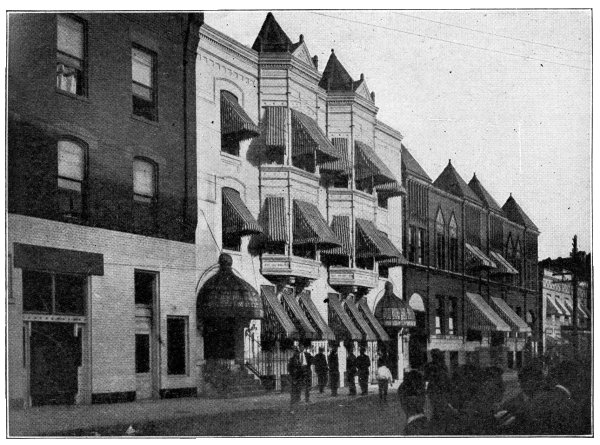
A GILDED PALACE OF SIN Showing the gay and attractive front entrance where the white slave trader sells young girls into a life of shame
The methods employed to entice young women are quite similar, but as to the particulars each case varies to some extent. After the girls are once within the resort, the stories are about the same. Their street clothes are seized and parlor dresses varying in length are put upon them. They are threatened, never allowed to write letters, never permitted the use of the telephone, never trusted outside the house without the escort of a procurer, until two or three months have elapsed, when they are considered hardened to the life and too ashamed to face parents and friends again. If they should ask some visitor to the house to help them, would he care to expose his name to the police, as he would have to, by reporting the matter? Would he want his friends, or the folks at home to know that he had visited such a place? No; he would let the girl get out the best way she could; even though he might promise to help her. Girls are told of or perhaps have witnessed others who tried to escape, have seen their failure and punishment, and are thereby cowed into submission. They are always held upon the pretense of being indebted to the house, and this indebtedness has long been the backbone of the white slave system. From the time the girl is first sold into the house she is constantly in debt. First, for the money the owner gave to the procurer for her, next, for her parlor clothes, then for the money her procurer borrows from the owner on her as his property, goods and chattel. The bonds of slavery are thus fastened upon these poor mortals by a system of debt and vice that the people of this great country little realized existed until lately.
Fighting against this slave trade under the archaic Illinois laws was quite disheartening because it was almost impossible to get more than a fine upon the charge of disorderly conduct. The laws were so full of loopholes that the traders laughed at the idea of being prosecuted. However, in Illinois, at least, we have choked the laugh. The features once wreathed in smiles begin to show the lines of worry and fear, for a new law called the Pandering Act has been passed. This went into force July 1st, 1908. The new law is good, but experience has shown where improvement is necessary. Without exception, in cases I have tried, certain wholesome-minded jurors have said after concluding the case, that the penalty was too light for the first offender. It should be made more severe. Therefore an effort is now being made to make the first offense punishable by imprisonment in the penitentiary from one to ten years. Then, also, there should be a new law covering the bringing a female person of any age into the state or taking her out of the state for immoral purposes. The age limit should be omitted from the present Illinois law, which does not punish those bringing girls over the age of eighteen into the state. While other states are sending for copies of the Illinois pandering and other white slave laws, the state legislation will soon be uniform upon this subject, the United States government should be alive to the situation also. At present it has only the immigration laws regulating the importation of immoral women to fall back upon. A federal law under the interstate and foreign commerce act should be passed at once. The federal government has better and more effective machinery for getting at the facts in the foreign and interstate traffic in girls than have the various states. Commerce consists in intercourse and traffic, including in these terms the transportation and transit of persons and property, as well as the purchase, sale and barter of persons and property and agreements therefor. A federal law might be enacted as follows:
"Be it Enacted by the Senate and the House of Representatives of the United States of America in Congress assembled, that whoever shall procure, entice or encourage any female person to leave one of the states of the United States of America to go into any other state in the United States of America for the purpose of prostitution or to become an inmate of a house of prostitution or to enter any place where prostitution is practiced or allowed, or shall attempt to procure or entice any female person to leave one of the states of the United States of America to go into any other state for the purpose of prostitution, or to become an inmate of a house of prostitution or to enter any place where prostitution is practiced or allowed, or shall receive or give, or agree to receive or give any money or thing of value for procuring or attempting to procure any female person to leave one of the states of the United States of America to go into any other state in the United States of America for the purpose of prostitution or to become an inmate of a house of prostitution, or to enter any place where prostitution is practiced or allowed, shall, in every case, be deemed guilty of a felony, and on conviction thereof be imprisoned not more than ten years and pay a fine of not more than ten thousand dollars."
Under the recent federal decisions what can prevent the enactment and enforcement of such a law making the traffic in women illegal? Of course, offenses committed solely within the state could not be reached by the federal government.
Other needed legislative regulations concerning the white slave traffic, such as laws against the procuring system and the indebtedness system, have been set forth in other articles in this magazine. However, besides these laws it will be necessary in each state to create a commission in the various cities, other than the police department, which shall keep a complete record of all houses of ill-fame and their inmates. A public bureau of information should be established by law where parents and friends could easily learn the whereabouts of girls who have not been heard from, and this bureau should have the names of every inmate of a disreputable house. Such a commission should have power to inquire carefully into the life of every girl. Statements should be made, under oath, and the right to ascertain whether or not these statements were true should be given the commission. Thereby the infected spots in every part of the country could be covered, and every girl and woman in immoral places could be accounted for. The fact that this has not been done heretofore has greatly aided the slave traders because their success is accomplished by secrecy. Let us drag the monster, white slavery, from under ground and let the light of day show upon it, and then we shall have gone a long way towards extermination of this traffic.
That secrecy is maintained as to who the girls are and where they are from is evidenced by one of the many letters I have received, of which the following is a copy:
Chicago, Ill., July 13, 1908.
Mr. Clifford G. Roe,
Dear Sir:—Did you receive a letter from my mother, Mrs. Effie ——, from Eloise, Mich. If so, I wish you would come and see me so I can tell you everything. I have not been out of the house for three months. I have not got any clothes to wear on the street because I owe a debt. I wish you could come and see me and I can tell you everything then. I am a White Slave for sure. Please excuse pencil, I had to write this and sneak this out. Please see to this at once and help me and oblige,
Viola ——.
With people passing back and forth on the street and in and out of the house every day it seems astonishing that girls can be kept as slaves. However, the above appeal for help tells the story, not alone of the writer, but of the thousands of girls whose lives are being crushed, the minds depraved, and the bodies diseased by outrageous bondage. It was discovered that Viola had been given a fictitious name, all avenues of communication with the outside world were cut off, and she had lived in constant fear of being beaten if she let anyone know who she was. At last through a ruse she succeeded in getting letters to her mother and myself, which brought about her rescue and the return of the girl to her mother, who is an invalid in Wayne County Hospital at Eloise, Michigan.
The owners of the resort where she was held were brought before the bar of justice and the judge in sentencing them said: "The levee resort keepers are murdering the souls of girls and women by binding them with ropes of illegal debt; this practice must be wiped out."
The next question which confronts us is what shall we do with the girls after they are liberated from the houses? Some have parents, some are ashamed to go back home, while others are diseased. Certainly it seems a pity to turn them out and let them battle against the prejudice of a "past life." Homes and institutions for girls are often filled or the doors are barred against fallen women. The solution of the problem is a home for white slaves in every large city in the country.
Such a home should be well equipped with a hospital to cure disease contracted in disreputable houses, and then there should be schools in the institute for training the girls for useful lives, where sewing, cooking, music, art, and other things are taught. In this way the girls would be fitted to earn honest and wholesome livelihoods when they go out to face the world.
Letters are sent me from all parts of the continent asking what can be done to help the white slaves. My answer is, form organizations everywhere to fight this traffic. Through these organizations educate the girls in the rural communities to be careful how they are enticed or persuaded to go to the cities. Demand proper legislation, write the senators and representatives about it, in all places see that the laws in regard to disorderly resorts are enforced, that the foregoing proposed commission is established and help build homes for training the girls for better lives.
What mockery it is to have in our harbor in New York the statue of Liberty with outstretched arms welcoming the foreign girl to the land of the free! How she must sneer at it and rebuke the country with such an emblematic monument at its very gate when she finds here a slavery whose chains bind the captive more securely than those in the country from which she has come!
What a travesty to wrap the flag of America around our girls and extol virtue and purity, freedom and liberty, and then not raise a hand to protect our own girls who are being procured by white slave traders every day!
Some ministers have said that the subject is too black to present to their congregations. It is a problem, they said, for the public authorities and slum workers, not a question for the high-minded citizen. It is the hope that the readers of this book, who are church members, will suggest that their pastors aid in the struggle against white slavery, and that through them, people everywhere may be awakened to a realization of its importance. No social problem is too unclean for the people to take hold of when the cause undermines the fairest heritage in life, our homes. For, after all, the home is the social unit and the very foundation of all government.