SUGGESTIONS FOR COLLECTING PENNSYLVANIAN PLANTS
Reading edition
Where to Look for Plant Fossils
Pennsylvanian plants are most commonly found in shales directly overlying coal beds. The shales are believed to be of nonmarine origin like the coals and may contain fossils either in ironstone concretions or on the bedding planes. The shale layers as well as the concretions should be examined. Where the bed directly overlying the coal consists of black slaty shale or limestone containing marine fossils, plant remains are rarely abundant or well preserved.
Beneath the coals there generally is an underclay that is interpreted as the material in which the coal forest grew. The underclay is in turn underlain by a sandstone, and both are believed to be mostly nonmarine. Stigmarian axes and “roots” are common in many of the underclays. Plant fossils are common in the sandstone but generally are poorly preserved, except in the local shaly lenses.
The best place to look for plant fossils in northern Illinois, except for the strip mines of the Mazon Creek area, is probably in the spoil heaps from shaft mines. The Colchester (No. 2) Coal has been extensively mined 31 by the longwall method. This technique causes the mine roof to settle when the coal is removed, and the haulage ways are kept open by removing the roof shale. Inasmuch as the roof shale is the Francis Creek Formation of the Mazon Creek area, it may contain abundant plant-bearing concretions. The shale is not everywhere fossiliferous, however, and in many spoil heaps fossils are rare.
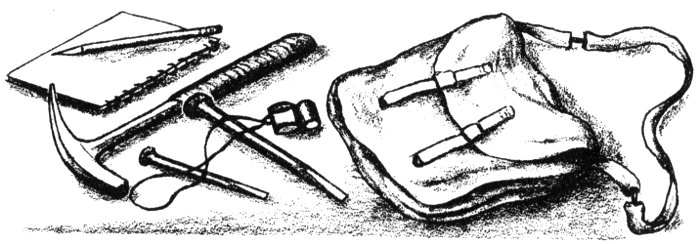
Tools for Collecting
Collecting Equipment
The collector of plant fossils should have the following tools and equipment:
① Hammer—a bricklayer’s hammer will work well. ② One or two chisels, preferably one large and one small. ③ Knapsack or basket in which to carry specimens. ④ Newspapers and a roll of tissue paper for protecting fragile specimens. ⑤ Pencil and paper for labeling specimens and making notes about the collecting locality from which the fossils came. Much of the value of a particular fossil lies in knowing precisely where it was found and the layer of rock it came from.
32
Rules of Courtesy
When entering a collecting area every collector should observe several rules carefully:
① For your own protection get permission to enter and collect on any private property. Such action also will help to assure your welcome if you wish to come back again.
② Leave the gates exactly as you find them, open or closed. Do not climb fences that may break or sag under your weight; crawl under or go around.
③ Don’t litter, even though far from any house or other buildings. Do not disturb the owner’s equipment, stock, or planted areas.
Handling Specimens
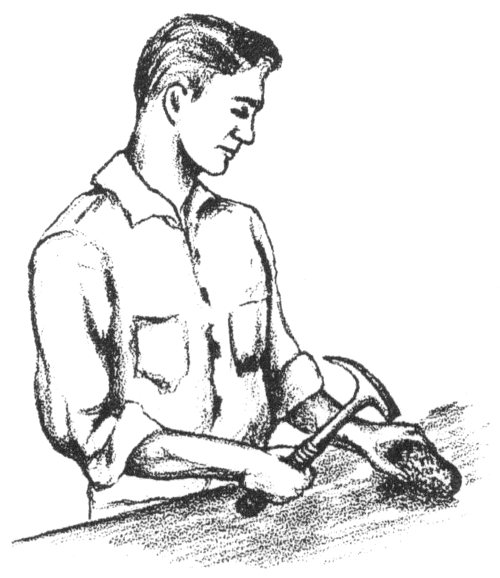
The most successful way to split an ironstone concretion is to set it on edge, long axis horizontal, on any fairly large rock and strike the upper edge with the hammer. If the concretion is one that developed around a fossil nucleus, it generally will split along the plane of weakness, revealing the fossil. Sometimes one side of the concretion will break off in the middle, in which case the remainder should be tapped firmly but gently on the upper edge until the fossil is completely uncovered. Pieces of the broken half should be glued together neatly with waterproof cement so that the entire specimen can be retained.
Fossils embedded in shale may be recovered by the same method or by repeatedly tapping a chisel inserted 33 along the bedding plane. If the fossil is exposed, the matrix can be chiseled away by slow, painstaking effort.
The usual method of wrapping plant-bearing nodules is to place the end of a sheet of newspaper between the two halves of the nodule, fold the paper over the nodule, and roll it up in the sheet.
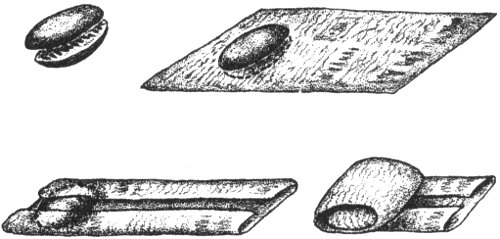
How to Wrap a Fossiliferous Concretion
When several localities are visited in one collecting trip, the fossils from each should be kept separate; cloth bags are convenient for this purpose. Notes about the locality should be put in the same bag as fossils from that locality so that there is no possibility of confusion.
Some fossils are so fragile or porous that they should be covered with a hardening protective coat of crude gum arabic solution. (Refined gum arabic will not serve.) This may be applied with a fine brush in successive layers, or sturdier fossils may be dipped in it.
When a fossil is so delicate that the surface tension of the gum arabic solution causes the fossil to “spread,” celluloid (not plastic) dissolved in acetone should be substituted. Before this solution is used, the specimen must be completely dry or the coating will become cloudy or opaque.
If the specimen is pyritized, it should be sprayed with lacquer or shellac to prevent disintegration. If these protective sprays are used they must be applied to dry specimens during dry weather or the coating will remain sticky.
34