FERNS (Plates 1 and 3)
Reading edition
FERNS (Plates 1 and 3)
True ferns, like those living in today’s woodlands, were common in the Pennsylvanian forests. Some species attained heights of 30 to 40 feet. Their fronds (compound leaves divided into segments or leaflets) commonly were five to six feet long.
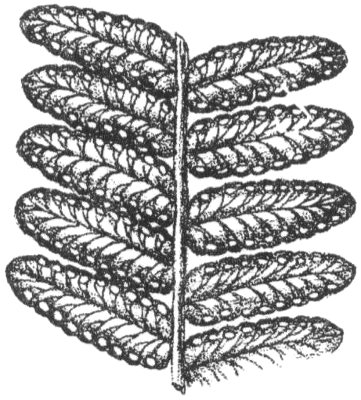
Portion of fern frond showing sori on lower side of leaflets
True ferns do not produce cones or seeds, but spores, which develop in cases called sporangia. The sporangia frond showing are attached in clusters (sori) to the lower side or margins of the leaves. In modern ferns the sporangia may also occur on fertile spikes.
The shape and position of the sori are used to identify modern ferns, but because leaves that bear sori (“fertile” leaves) are rare among fossil specimens, the number, shape, and attachment of the leaflets and the pattern of the veins are more commonly used for identification.
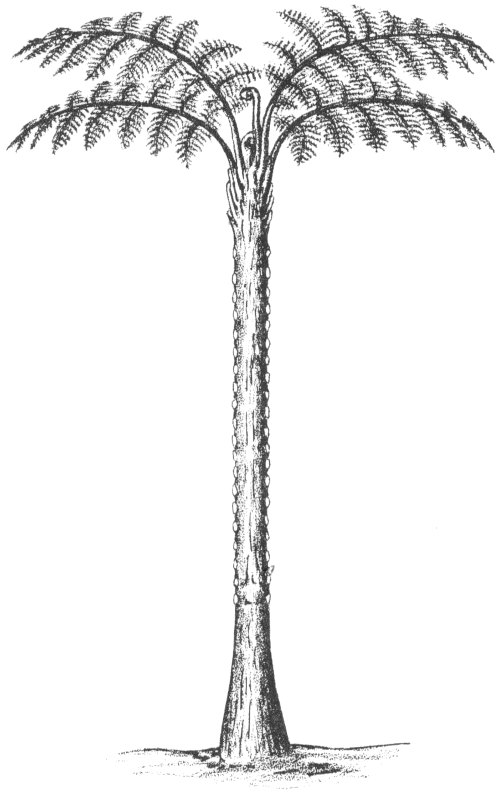
Reconstruction of Megaphyton (after Hirmer)
Because fossils of complete fern plants have not yet been found, separate names have been adopted for detached leaves, stems, and other parts. For example, the fossil stems of some Pennsylvanian ferns found in Illinois have been referred to two genera, Megaphyton, whose leaf attachment scars are arranged in two vertical rows, one on either side of the stem, and Caulopteris, 15 whose leaf scars are arranged in a steep spiral that becomes progressively flatter upward until near the top they appear to be whorled. When the stem is a petrifaction, with internal structures preserved, it is called Psaronius. The fronds are referred to a number of genera, but those most commonly found in Illinois are Pecopteris, Asterotheca, and Ptychocarpus.
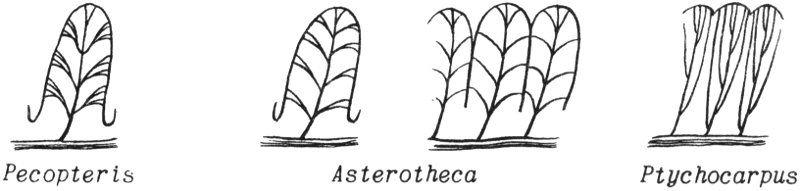
Venation of seed fern leaflets
Pecopteris
Asterotheca
Ptychocarpus