COLLECTING AREAS FOR PENNSYLVANIAN PLANTS Northern Illinois
Reading edition
Plant fossils can be found in almost any northern Illinois area where Pennsylvanian rocks are exposed (see back cover), but in some places they are much better preserved and more numerous than in others. Most of the well known collecting areas and a few of the lesser known ones are discussed below. Even though some of the localities were discovered many years ago, they may indicate areas that are still favorable for collecting.
Mazon Creek Area
Of all the fossils that have been found in Illinois, the most famous are the plant remains from the world-renowned Mazon Creek area in the northeastern part of the state. In this area in Grundy and Will Counties, plant fossils are found in ironstone concretions in the lower part of the Francis Creek Shale directly overlying the Colchester (No. 2) Coal.
Fossils were discovered in outcrops along Mazon Creek more than a century ago and collections later were made from scores of conical spoil heaps at underground mines. After coal stripping began in the 1920’s, great numbers of specimens were collected.
In the stripping operations, the concretion-bearing beds are commonly the last to be placed on the spoil heap. Weathering softens and removes the shales and leaves the nodules concentrated on the surface. Each season brings a new crop of concretions to the surface.
20
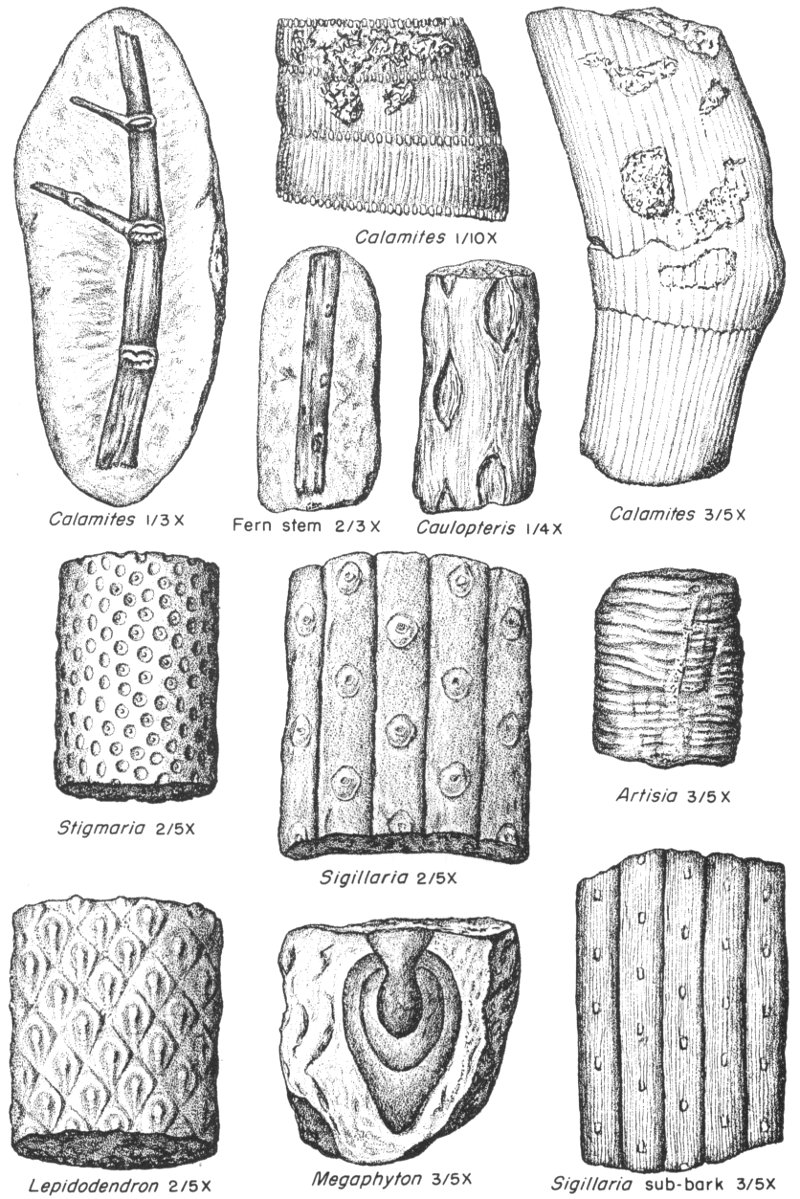
Plate 1
Calamites ⅓×
Stigmaria ⅖×
Lepidodendron ⅖×
Calamites ¹/₁₀×
Fern Stem ⅔×
Caulopteris ¼×
Sigillaria ⅖×
Megaphyton ⅗×
Calamites ⅗×
Artisia ⅗×
Sigillaria sub-bark ⅗×
21
The concretions generally are oval to elongate and range from less than an inch to a foot or more in maximum dimension. Only about one nodule in ten contains plant remains.
Approximately 25 to 30 species have been found in this region. The productivity of the area was shown by George Langford, Sr., a well known midwestern fossil collector. He and his son split about 250 thousand concretions during a 140-day period and obtained some 25 thousand plant specimens. Fine specimens still can be collected in a few hours.
The plant collecting localities in Will and Grundy Counties along Mazon Creek, four to six miles southeast of the town of Morris, were the first to be well known. Ferns are especially abundant. Fossils of insects, crustaceans, worms, and salamanders also have been found. Collecting conditions vary considerably from season to season, and fossils are not as easily obtained there as from the strip-mine spoil heaps.
Fossiliferous concretions may be found in a number of the strip mines in the area, although probably most have come from the Northern Illinois Coal Corporation mine between the towns of Braidwood and Wilmington.
In earlier years good collections were made from the spoil heaps of underground mines. Especially notable are the mine dumps of the Wilmington Star No. 7 mine, 2¼ miles west of Coal City, and Skinner No. 2 mine, two miles northeast of Braidwood.
In the vicinity of Morris on the northwest edge of the Mazon Creek area, fossil ferns have been found along the north side of the Illinois River and in the banks of the Illinois-Michigan Canal. About a mile north in an area of strip mining, fossil-bearing concretions have been found in shale and irregular sandstone layers.
22
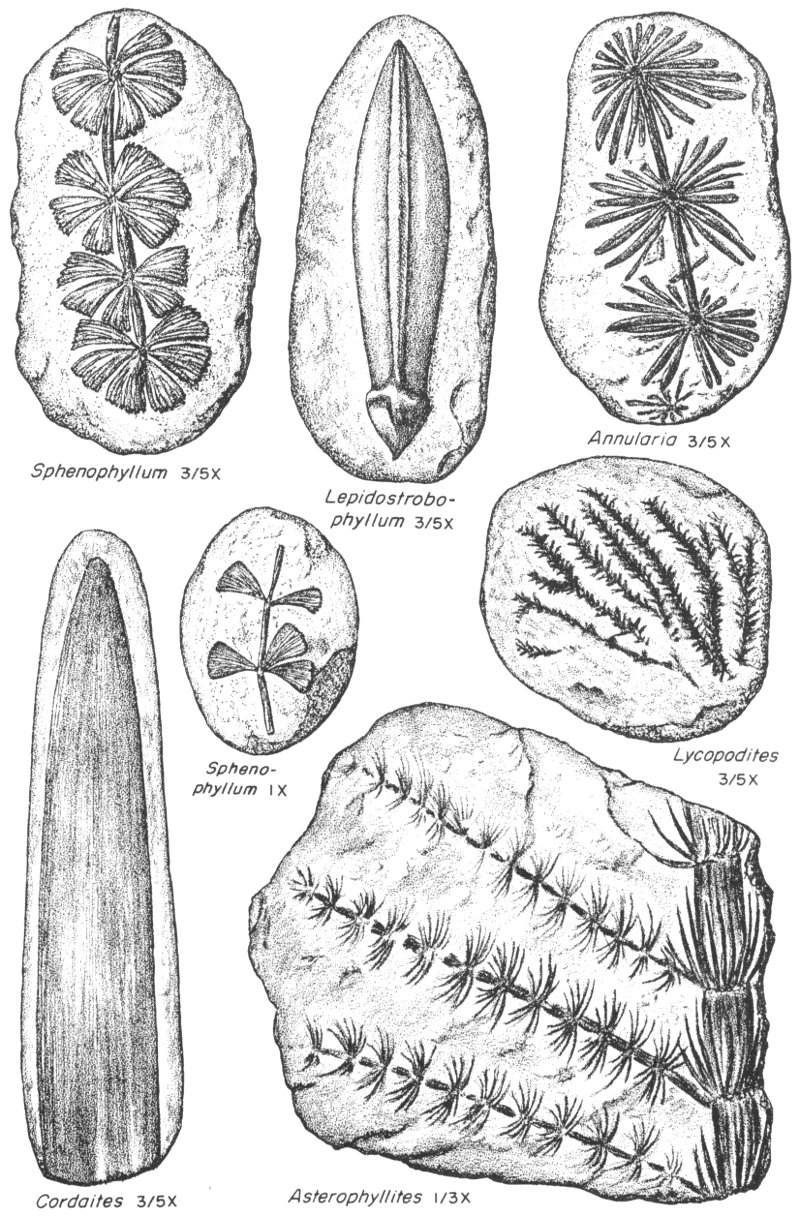
Plate 2
Sphenophyllum ⅗×
Lepidostrobophyllum ⅗×
Annularia ⅗×
Sphenophyllum 1×
Lycopodites ⅗×
Cordaites ⅗×
Asterophyllites ⅓×
23
Fossils in concretions also have been collected from a shaly limestone at the south end of the Kankakee River bridge along the Grundy and Will county line.
Bureau County
Some 40 miles downstream from Morris on the Illinois River, plant fossils have been discovered in waste from the Spring Valley Coal Co. mine 1. They also are found in black shale below the LaSalle Limestone in a small gully in the southwest part of town, but at neither place are they plentiful.
Knox County
A notable number and variety of well preserved plant fossils have been produced from a locality along Court Creek in East Galesburg. The Rock Island (No. 1) Coal is mined in the area and the fossils appear to have come from the shale overlying it.
Fossil plants also have been found in shales above the Colchester (No. 2) Coal in the vicinity of DeLong and with the Herrin (No. 6) Coal in mines southeast of Victoria.
Mercer and Warren Counties
In northern Warren and southern Mercer Counties the sandstone underlying the Rock Island (No. 1) Coal is termed the “Stigmarian” sandstone because of numerous siliceous casts found in the bed. Many of the fossils have been collected from an old mine dump and from ravines along the Edwards River northeast of Aledo.
A number of representatives of Sphenophyllum, Neuropteris, and Annularia have been collected from ironstone concretions occurring in shale that overlies the Colchester (No. 2) Coal about three miles southwest of Alexis. They were found in a gully about a third of a mile southeast of Center School.
24
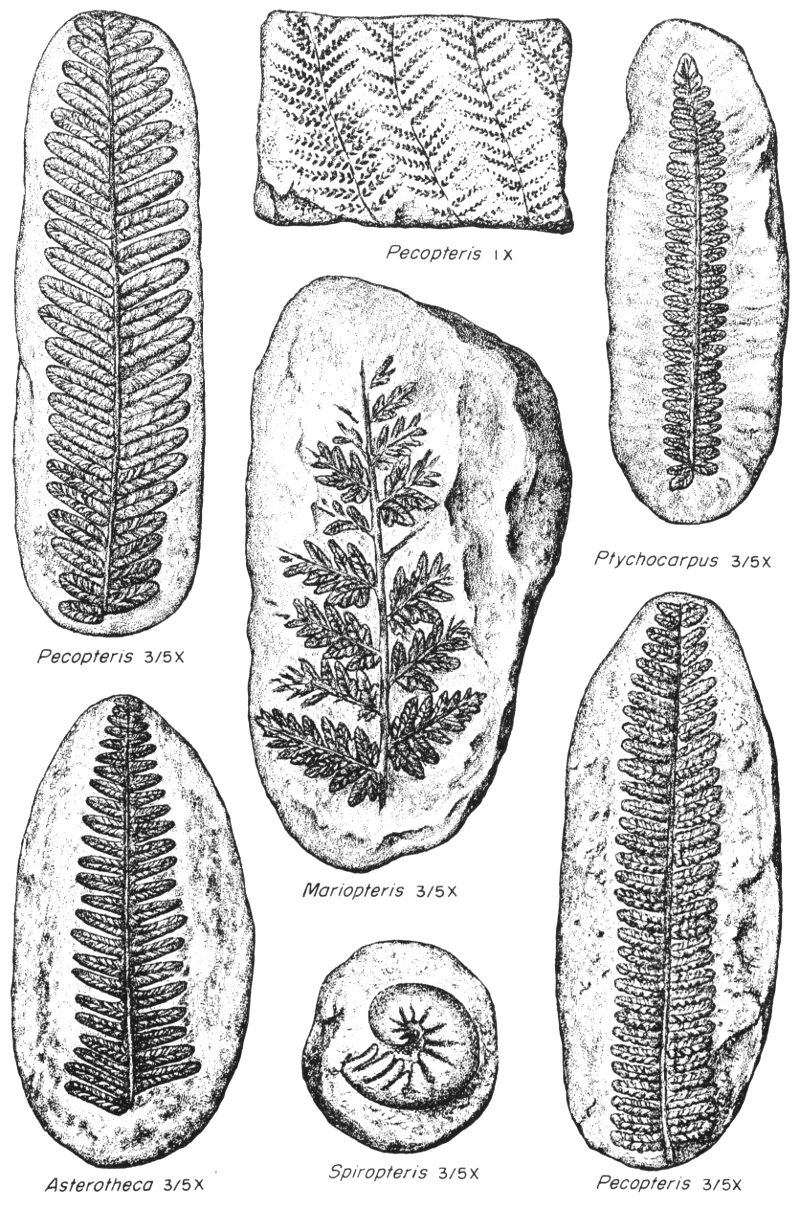
Plate 3
Pecopteris 1×
Ptychocarpus ⅗×
Pecopteris ⅗×
Mariopteris ⅗×
Asterotheca ⅗×
Spiropteris ⅗×
Pecopteris ⅗×
25
In the same general area but about three miles due south of Alexis, fossil plants also may be found in the clay pits of the Hydraulic-Press Brick Company and the Northwestern Clay Manufacturing Company.
Fulton County
Although there are numerous isolated occurrences of plant fossils throughout the extensive strip mines and outcrops in Fulton County, no exceptionally good collecting localities have been discovered.
Fern and cordaitean leaves have been collected along Mill Creek about a mile northeast of Pleasantview where the fossils occur in the shale overlying the Babylon Coal. In the same general area, impressions and casts of Stigmaria, Lepidodendron, and Cordaites have been found in the Babylon Sandstone.
Three miles north of Pleasantview, a quarter of a mile northwest of Union School, several species of leaves have been collected from the Browning Sandstone where it is exposed in a roadcut.
Farther east, there is a fairly good locality in the stream bluff of Kerton Creek about 3¼ miles north and a quarter of a mile west of Bluff City. There the plants are found about 18 feet below a coal bed.
Numerous fern impressions also are found in shale beds above the Herrin (No. 6) Coal along the Middle Branch of Copperas Creek, six miles west of Glasford. Other specimens may be found in these beds elsewhere in the area.
McDonough County
In some of the small underground mines near Colchester, the shale overlying the Colchester (No. 2) Coal contains ironstone concretions similar to those from northeastern Illinois. More than 50 species of plant fossils have been reported, but they were collected many years ago from spoil heaps at the mines. Beds of the same age crop out widely in other localities in western Illinois and may contain plant fossils.
26
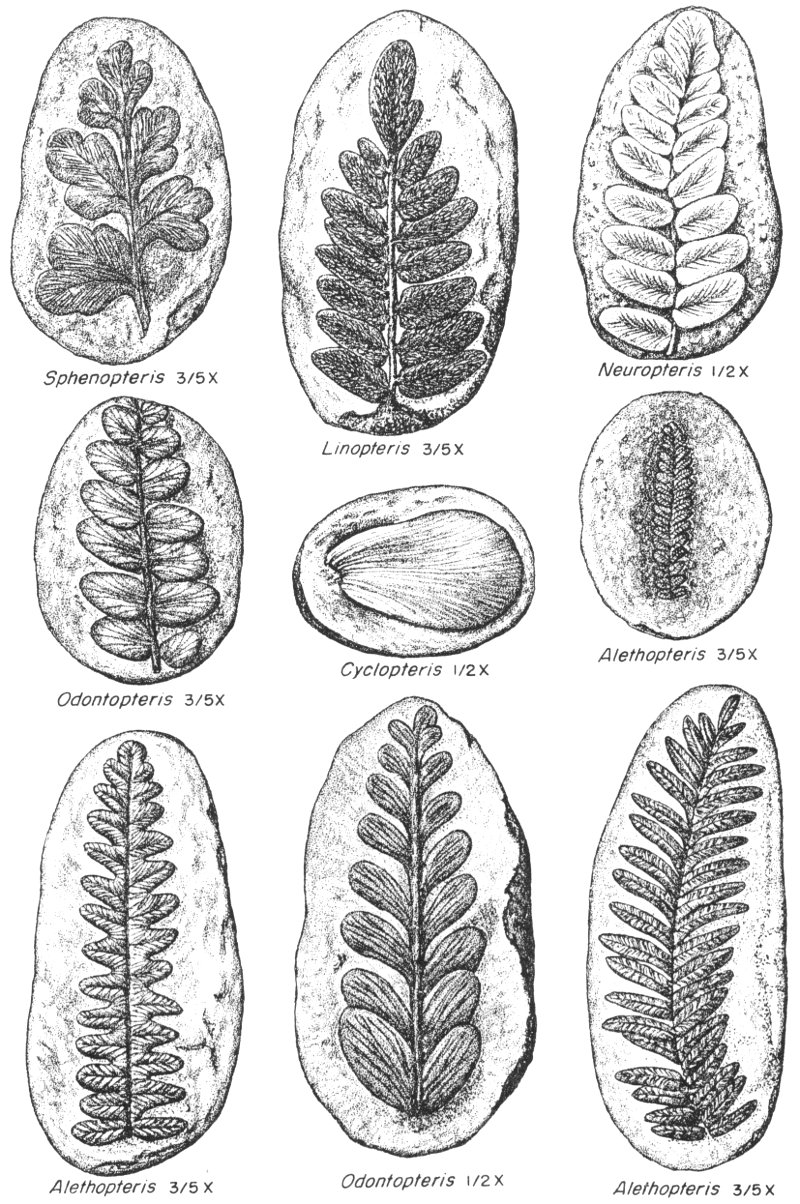
Plate 4
Sphenopteris ⅗×
Linopteris ⅗×
Neuropteris ½×
Odontopteris ⅗×
Cycopteris ½×
Alethopteris ⅗×
Alethopteris ⅗×
Odontopteris ½×
Alethopteris ⅗×
27
Vermilion County
In outcrops about three miles below Georgetown on the Little Vermilion River, a number of fossil plant species and one insect species have been collected from shales overlying the Herrin (No. 6) Coal, locally called the Grape Creek Coal. The fossils occur in concretions much like those from Mazon Creek.
An occasional stem replacement or impression is found in the concretionary shale above the No. 7 Coal in the strip mine area west of Hillery. In fact, isolated fragmentary plant specimens are fairly common in the Danville mining area, but no especially productive localities have come to light.
Other Northern Illinois Localities
In addition to the counties listed above, a number of others have produced plant fossils. For example, there are records of plant fossils found southeast of Franklin in Morgan County, at Neelys in Peoria County, and at a number of places in the southern and western parts of Rock Island County. Local exploration is certain to turn up numerous other collecting places at present unknown.
28
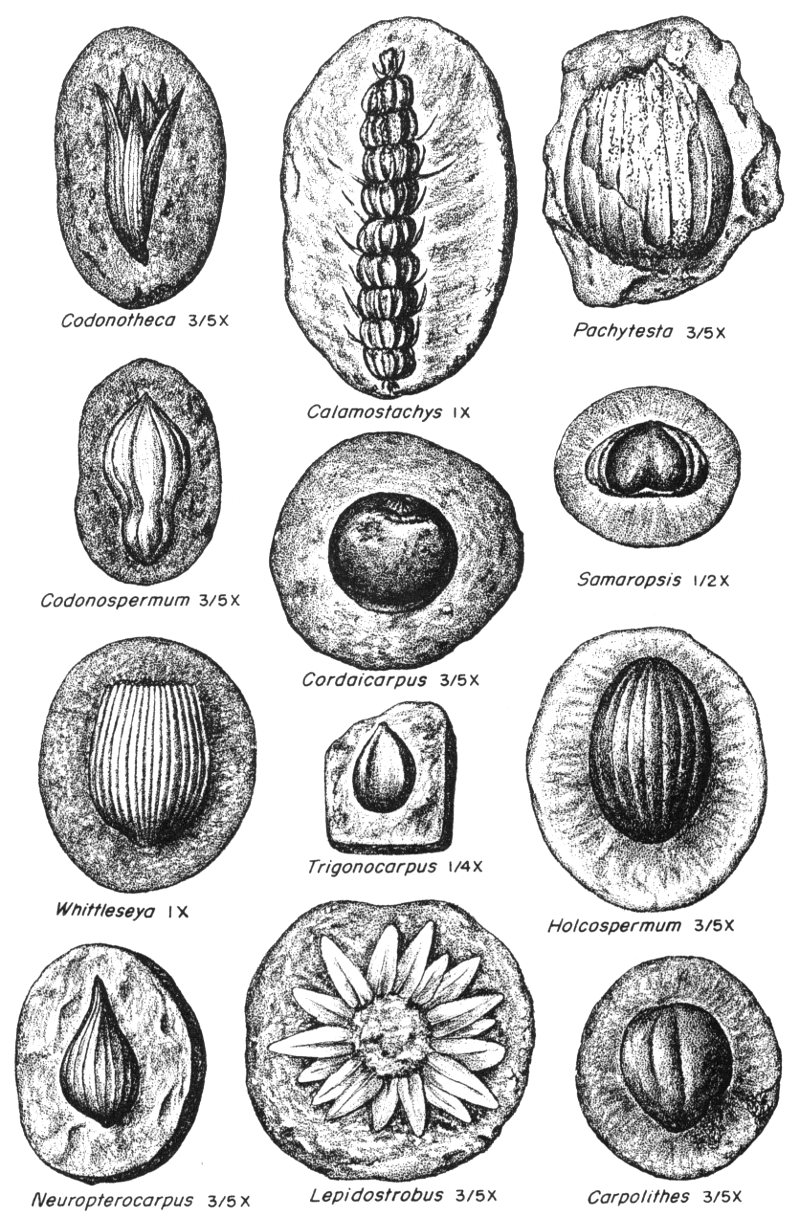
Plate 5
Codonotheca ⅗×
Calamostachys 1×
Pachytesta ⅗×
Codonospermum ⅗×
Cordaicorpus ⅗×
Samaropsis ½×
Whittleseya 1×
Trigonocorpus ¼×
Holcospermum ⅗×
Neuropterocarpus ⅗×
Lepidostrobus ⅗×
Carpolithes ⅗×
29