SCALE AND SEAL TREES (Plate 1)
Reading edition
SCALE AND SEAL TREES (Plate 1)
Scale and seal trees were abundant during the Pennsylvanian Period and were important contributors to coal beds. Although distantly related to the diminutive club-mosses and ground pines of the present, the trees grew on straight, slender trunks to heights of more than a hundred feet.
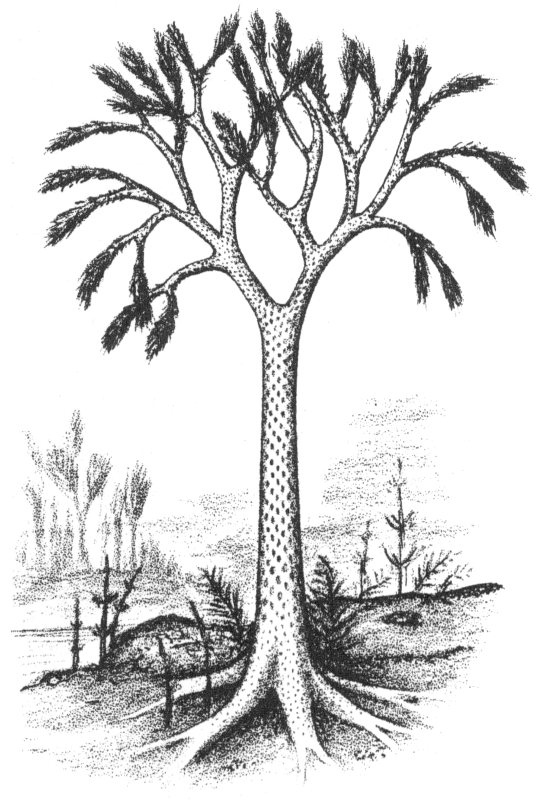
Reconstruction of Lepidodendron (after Hirmer)
Scale trees were so called because their numerous, closely set, spirally arranged leaves left scarred “cushions” on the branches and trunk, making them appear scaly. Seal trees derived their name from the signetlike appearance of their leaf cushions. The two best known types belong to the genera Lepidodendron (scale tree) and Sigillaria (seal tree), and fossils of both are common in Illinois.
11
Lepidodendron had long, slender, somewhat tapering trunks. Some of the trees reached heights of more than 100 feet and measured more than two feet in basal diameter. The trunk ended in a spreading crown formed by repeated dichotomous branching. The leaves were awl-shaped or linear, ranging from one to 30 inches long.
The leaf cushions of Lepidodendron are diamond-shaped, longer than broad, and arranged in spiral rows around the trunk and branches. A different name, Lepidophyllum, is used for fossils of the long, bladelike leaf when it is found detached.
Spores were borne in long cylindrical cones at the tips of the branches. Those cones referred, or assigned, to the genus Lepidostrobus bore both small spores (microspores) and large spores (megaspores) in the same cones. Those in which only a large single spore, a somewhat seedlike structure, was developed in a spore sac (sporangium) are referred to the genus Lepidocarpon.
The rather commonly found genus Stigmaria comprises so-called “appendages” which, although stemlike in structure, apparently served as roots for the scale and seal trees. These appendages are identified by irregular spirals of circular scars (pits) that mark the attachment points of former rootlets.
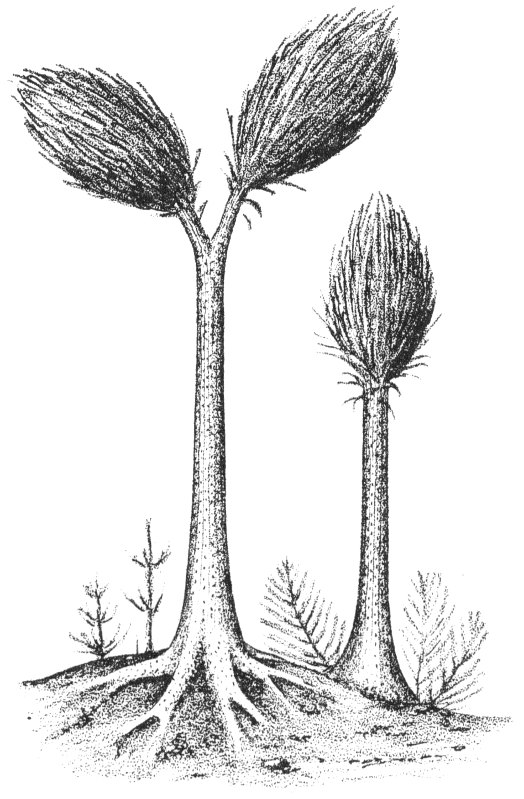
Reconstruction of Sigillaria (after Hirmer)
Sigillaria, although less common than Lepidodendron, was widely distributed during the Pennsylvanian Period. 12 It differed in growth habit from Lepidodendron in that it generally had fewer branches and not uncommonly was unbranched. Some species also possessed a thicker trunk, with hexagonal to elongate leaf cushions separated by vertical ribs. The trunk was crowned, in the manner of the modern palm tree, by a cluster of large, grasslike leaves.
The detached leaves of Sigillaria, extremely difficult to distinguish from Lepidophyllum (leaves of Lepidodendron), are referred to the genus Sigillariophyllum if preserved as compressions and to Sigillariopsis if preserved as petrifactions. Unbranched Sigillaria trunks have been found that are more than 100 feet long and six feet in diameter near the base, but the average height probably was closer to 50 feet.
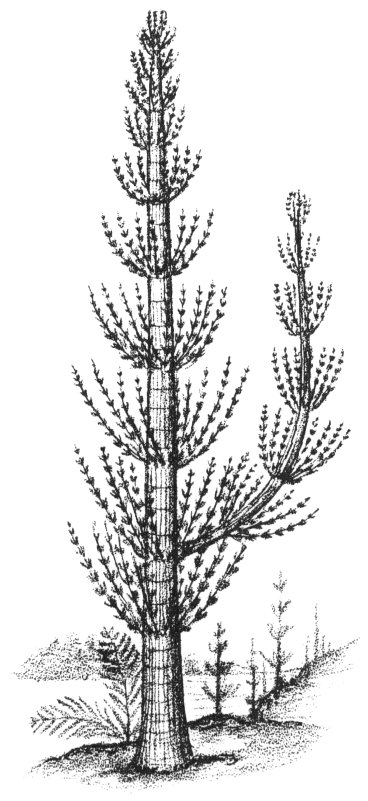
Reconstruction of Calamites (After Hirmer)
Not all Pennsylvanian trees were large, however. Small forms are known, including the important undergrowth genera Lycopodites and Selaginellites. In woody types the trunk consisted of an inner region of conducting and supporting tissues, surrounding concentric cortical layers, and an outer layer of corklike bark. Although the fossil impressions of the various bark layers have been given separate generic names, these are not commonly used.