KEY TO PLANTS ILLUSTRATED ON TIME CHART
Reading edition
1. Foerstia. These fossils may be the earliest known occurrence of bryophytes, although some authors have referred them to the brown algae. After Dawson. 2. Psilophyton. A primitive vascular plant. After Dawson. 3. Lepidodendron. After Hirmer. 4. Sigillaria. After Hirmer. 5. Calamites. After Hirmer. 6. Sphenophyllum. After Fuller and Tippo. 7. Equisetum. The only living genus of scouring rushes. After Fuller and Tippo. 8. Megaphyton. An ancient true fern. After Hirmer. 9. Modern tropical tree fern. After Fuller and Tippo. 10. Medullosa. An ancient seed fern. After Stewart. 11. Williamsonia. An extinct cycad-like tree. After Sahni. 12. Cycas. A modern cycad. After Chamberlain. 13. Baiera. A fossil leaf genus of ginkgo, whose only living representative is the species Ginkgo biloba, saved from extinction by careful cultivation in China. Several specimens of this “living fossil” were presented to this country by the Chinese and are now flourishing on many college campuses, including that of the University of Illinois. After Mägdefrau. 14. Cordaites. After Grand Eury. 15. Lebachia. A “transition conifer,” forerunner of present day conifers. After Mägdefrau. 16. Pinus. Modern pine. After Mägdefrau. 17. Acer. Common maple, an angiosperm whose leaves are also found among Tertiary fossils. After Mägdefrau. 18. Rosa. The prairie rose, an angiosperm. 19. Campsis. Trumpet vine, an angiosperm.
5
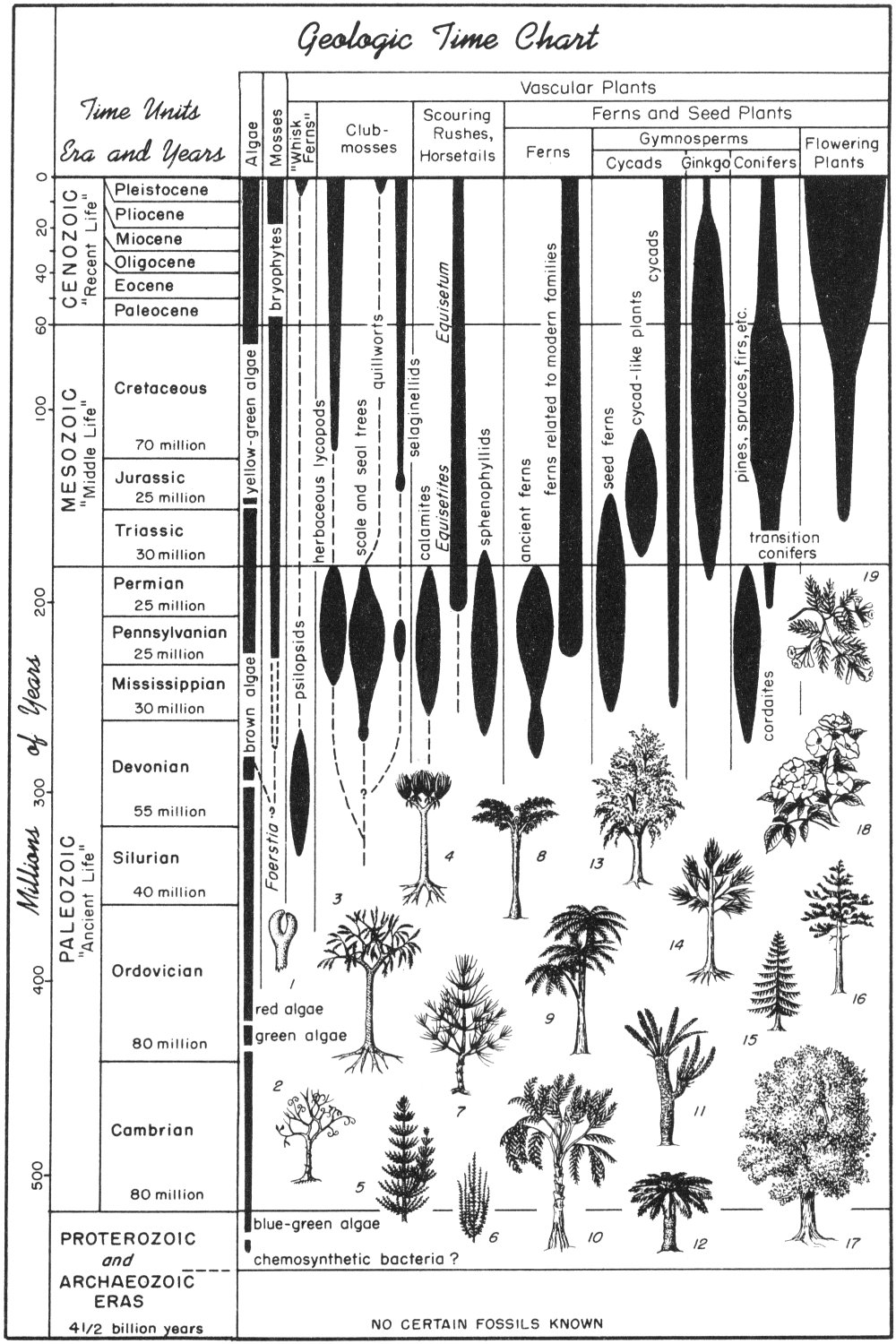
Geologic Time Chart
Time Units
Era and Years
CENOZOIC “Recent Life”
Pleistocene
Pliocene
Miocene
Oligocene
Eocene
Paleocene
MESOZOIC “Middle Life”
Cretaceous
70 million
herbaceous lycopods
Jurassic
25 million
yellow-green algae
selaginellids
Triassic
30 million
cycad-like plants
Equisetum
PALEOZOIC “Ancient Life”
Permian
25 million
transition conifers
pines, spruces, firs, etc.
Equisetites
Pennsylvanian
25 million
ferns related to modern families
bryophytes
Mississippian
30 million
seed ferns
calamites
cycads
Devonian
55 million
cordaites
sphenophyllids
ancient ferns
Silurian
40 million
psitopsids
Foerstia
Ordovician
80 million
red algae
green algae
Cambrian
80 million
PROTEROZOIC and ARCHAEOZOIC ERAS
4½ billion years
blue-green algae
chemosynthetic bacteria?
NO CERTAIN FOSSILS KNOWN
Plants
Algae
yellow-green algae
brown algae
red algae
green algae
blue-green algae
Mosses
bryophytes
Foerstia
Vascular Plants
“Whisk Ferns”
psitopsids
Club-mosses
scale and seal trees
quillworts
herbaceous lycopods
Scouring Rushes, Horsetails
Equisetites
Equisetum
calamites
selaginellids
Ferns and Seed Plants
Ferns
ancient ferns
ferns related to modern families
Gymnosperms
Cycads
seed ferns
cycads
cycad-like plants
Ginkgo
Conifers
cordaites
transition conifers
pines, spruces, firs, etc.
Flowering Plants
7
Field Book PENNSYLVANIAN PLANT FOSSILS OF ILLINOIS
Charles Collinson and Romayne Skartvedt
Plants that flourished 200 million years ago have made Illinois one of the best known fossil collecting sites in the world. The unusual abundance and preservation of these fossils in the northern part of the state have brought collectors to Illinois from many countries, and prized specimens from that area may be seen in science museums throughout the world.
The remarkable fossils represent plants that lived during the geologic period called the Pennsylvanian or Coal Age and are the result of special geologic conditions that occurred repeatedly during the period.
At the beginning of the Pennsylvanian Period, Illinois was part of a vast lowland that stretched for hundreds of miles to the north, south, and west, and was bordered on the east by highlands. At times much of the plain was swampy and, because the climate was relatively warm and moist, great jungles of fast growing trees, shrubs, and vines covered the landscape. As successive generations of plants lived and died, plant material fell into the swamp waters and, protected there from decay, accumulated.
Frequently during the period, seas spread over the swampy lowlands, submerging the forests and covering 8 them with mud. Each submergence lasted only a short time, geologically speaking. When the seas withdrew, the deposits of sand and mud left behind were cut by streams that carried fresh sand and mud from the eastern highlands. The streams eventually became clogged with sediments and when the lowland was again depressed swamp conditions returned and forests grew afresh. Such a cycle of deposition was repeated again and again during Pennsylvanian time, and after burial each layer of plant material gradually lost most of its liquids and gases and was slowly converted into one of the numerous coal beds presently found in Illinois.
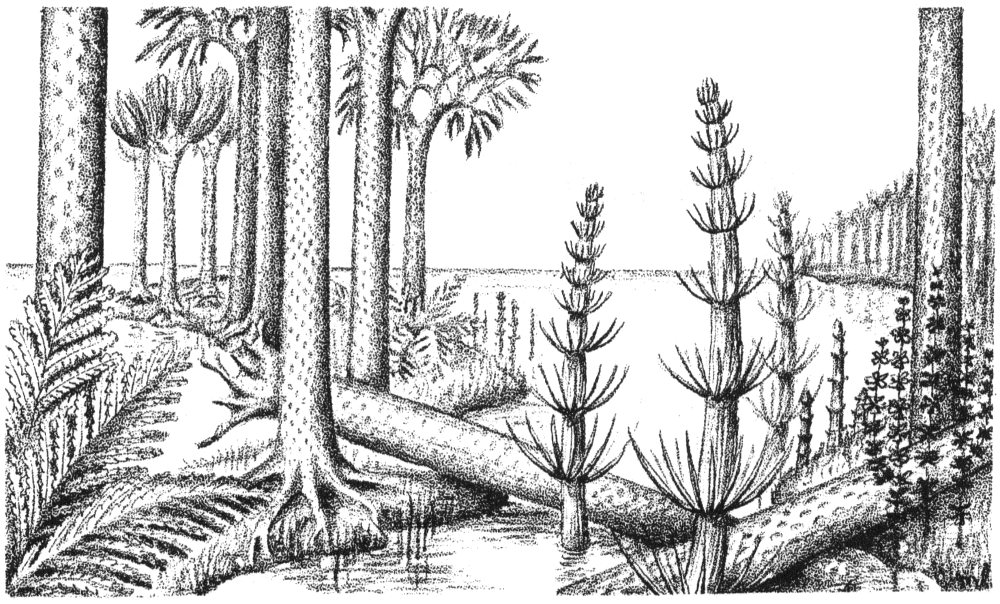
Reconstruction of Pennsylvanian Coal-forming Swamp
In some places in the state conditions existed that were especially favorable for preservation of plants, and there delicately preserved fossils are found in great numbers. In the most favorable areas, such as in northern Illinois, the plants are preserved in stony nodules called concretions, but they also may be found separately as molds, casts, or petrifactions.
Molds (concave surfaces) and casts (convex surfaces) are fossilization phenomena in which the actual plant, embedded in the surrounding background rock, was dissolved, leaving a hollow space (mold) that subsequently 9 filled with other material. A cast was thus formed that preserved the plant’s external features.
Most petrifactions are fossils in which silica, carbonate, or other material permeated or replaced the internal structures of the plant and preserved them so well that in most specimens the finest cellular details can be observed. Compressions, another kind of petrifaction, are the pressed carbonized remains of the plant itself.