Volume 29 / Part 2 — OREGON MISSIONS AN OUTLINE SKETCH OF OREGON TERRITORY AND ITS MISSIONS
Reading edition
The political discussion, which has been going on for years between the British government and that of the United States, in regard to the boundary which defines their respective portions of the Oregon territory, has turned upon this distant region a large share of public attention, and has won for it an interest which will increase in proportion to the advances of civilization and commerce within its borders. But it becomes an object of much deeper interest in the eyes of the philanthropist and Christian, when we look to the efforts which have been made, and which are still continued, in order to diffuse the blessings of religious truth among {14} its benighted inhabitants. To the Catholic, especially, does this remote country present the most pleasing scenes for contemplation, and by this reason we have been induced to lay before the reader, a brief account of its discovery and settlement, and of the missions undertaken for the spiritual welfare of its inhabitants.
Oregon territory is that important part of North America which extends from the 42d to the 50th degree of N. latitude, and from the Rocky Mountains to the Pacific Ocean.[115] It is bounded on the north by the Russian possessions, and on the south by California; forming a kind of parallelogram, about seven hundred and fifty miles in length and five hundred in breadth, and containing 375,000 square miles.
There appears no reason to doubt of the Spaniards having been the first to visit this country.[116] The documents we possess, and the tradition of the natives, concur to render this opinion incontestible. According to them a vessel made its appearance south of the Columbia river before 1792, and there is still living among them a woman whose father was one of the crew attached to the vessel, and whose mother belonged to the tribe of the Kilamukes.[117] When we add to this that crucifixes have been {15} found in their hands transmitted to them from their ancestors, that the island of Vancouver still exhibits the ruins of colonial habitations, that the strait which separates it from the mainland bears the name of Juan Fuca, and that the country itself is contiguous to California, where the Spanish missionaries had penetrated nearly two hundred years before, we cannot but look upon the Spaniards as the discoverers of Oregon.
After the voyage of Captain Cook in 1790, by which it was ascertained that the sea along the N. W. coast of America abounded in otters, this region was visited by vessels from almost every part of the world. The people of the United States were not behind others in enterprise; in 1792, Captain Gray sailed up an unknown river of that country, to the distance of eighteen miles, and the stream has since retained the name of Columbia, from the ship which he commanded. In leaving the river, Captain Gray passed the vessel of Captain Vancouver, who also navigated the Columbia river about one hundred miles, to the point which bears his name. In 1793 the country was visited by Sir Alexander McKenzie, after discovering the river which retains his name.[118] In 1804, Messrs. {16} Lewis and Clark were commissioned by the United States to explore the sources of the Columbia, and they descended the river as far as Gray’s Bay. A few years after, in 1810, Mr. Astor fitted out two expeditions to Oregon, for the purpose of securing the interest of the fur-trade in those parts. The party that had embarked by water arrived first, and erected a fort called Astoria, about nine miles from the mouth of the Columbia.[119] The company of the North-West (English) also considered the fur-trade of Oregon as well worthy of attention, and they immediately despatched an agent by land for the purpose of securing it; but he arrived at Astoria several months after the first expeditions from the United States.
During the war of 1812, a British vessel sailed to the Columbia, in order to take possession of Astoria and its treasure; but the captain was cruelly disappointed in discovering that the place was already held by an agent of the North-West Company, who had purchased it in anticipation of the future war with the United States.[120] The Canadians who had settled there under its original owners, were employed by the new proprietors, and their numbers increased in proportion as the Company extended its {17} operations. In this way the country was visited in every direction, and many of the Indian tribes heard from them of the Catholic religion and the worship of the true God. In 1821, the North-West and Hudson Bay Companies united their interests, and gave a new impulse to the fur-trade. Mr. John McLaughlin, who went to Oregon in 1824, was chiefly instrumental in promoting the prosperity of the country.[121] He added to the business posts, and gave employment to a greater number of Canadians and Iroquois. They commenced at the same time the cultivation of wheat. One of the settlers having undertaken, in 1829, to till the soil in the valley of Willamette, his example was soon followed by others, and the colony became so numerous that in 1834 an application was made to Dr. Provencher, Vicar Apostolic of Hudson Bay, to procure a clergyman for the service of the people.[122] The colonists, however, did not succeed in obtaining a favorable answer to their petition, until the following year, when two clergymen were appointed for the mission; but, owing to the arrival of a Methodist preacher and of an Episcopalian minister in Oregon, the former in 1834, and the latter in 1837,[123] the departure of the Catholic clergymen was considerably {18} delayed. Rev. Mr. Demers went as far as the Red River in 1837, and arrangements having been made for himself and fellow-laborer to pass into Oregon the following year, Rev. F. N. Blanchet left Canada at the appointed time, and joined his companion at Red River, whence they both started on the 10th of July, and after a perilous journey of between four and five thousand miles, and the loss of twelve of their fellow-travellers in the rapids of Columbia River, they arrived at Fort Vancouver, the 24th of November, of the same year.[124] On their route the two missionaries were treated with the utmost courtesy by the traders whom they met, and at Vancouver they were received with every demonstration of respect by James Douglas, Esq., who commanded that post during the absence of Mr. McLaughlin in England.[125] On seeing the missionaries at length among them, the Canadians wept for joy, and the savages assembled from a distance of one hundred miles, to behold the black gowns of whom so much had been said.
Before we follow the ministers of God in their apostolic labors, we shall allude as briefly as possible to the aspect of the country, to the difficulties and dangers it presents to the missionary, {19} and to its commercial and agricultural resources.
We shall observe, in the first place, that the Columbia River stretches from its mouth about 290 miles to the east, as far as Fort Walla Walla; it then takes a northerly direction 150 miles, to Fort Okanagan; thence it extends 170 miles easterly to Colville. Fort Vancouver, the principal post in Oregon, is situated in 45° 36′ N. latitude, about one hundred miles from the mouth of the Columbia, and on its western bank, in ascending the river. The Willamette is a tributary of the Columbia, falling into it four miles below Vancouver on the opposite side. Twenty miles up the stream is a cascade of about twenty-five feet, and thirty miles further is a Canadian establishment, which in 1838 numbered twenty-six Catholic families, besides the settlers from the United States. The residence of the Methodist minister was ten miles higher up.[126] The River Cowlitz falls into the Columbia thirty miles below Vancouver, on the same side. Forty-five miles from its mouth is seen the establishment which bears its name. Four Catholic families resided here on the arrival of the missionaries. From this place to {20} Nesqualy at the southern extremity of Puget Sound, the distance is nearly seventy miles, and it is equally far from the latter point to the island of Whitby.[127] Two days’ journey further north will bring you to the River Frazer, on which Fort Langley is situated.[128] This river falls into Puget Sound or the Gulf of Georgia.
The mission of St. Mary’s among the Flatheads is ten days’ journey from Colville, towards the south-east, and about five hundred miles from Vancouver.[129] The most distant to which Mr. Demers has penetrated as yet, is Bear Lake in New Caledonia,[130] seven hundred miles from Vancouver. The reader may form some idea of the almost insurmountable difficulties to be encountered by our two missionaries, in visiting their various posts, so widely distant from each other, especially in a country overrun in every direction by lofty mountains. These mountains generally extend from north to south. From the Valley of Willamette are seen three elevated peaks, which have the form of a cone, and are covered with perpetual snow; hence called Snowy Mountains. One of them Mt. St. Helena, stands opposite Cowlitz to the east, and for some years past has been noted for its volcanic {21} eruptions.[131] Besides the rivers we have mentioned, there are several others, the principal of which are the Clamet, Umpqua, and the Chikeeles.[132] The Columbia is navigable as far as the cascade, fifty-four miles above Vancouver.
The immense valleys in Oregon Territory, covered with extensive and fertile prairies, follow the course of the mountains from north to south, and are crossed in different directions by rivulets bordered with trees. They easily yield to the plough, and though the first crop is not very abundant, the second is generally sufficient to repay the labor of tillage. The soil is for the most part fertile, particularly in the south. Every kind of grain is successfully cultivated near Cowlitz, Vancouver, in the Willamette Valley, and further south. The same may be said of the neighborhood of Fort Walla Walla, Colville; the mission of St. Mary’s; the mission of the Sacred Heart, of St. Ignatius, and St. Francis Borgia, among the Pend-d’oreilles; of St. Francis Regis, in the valley to Colville; of the Assumption and the Holy Heart of Mary, {22} amongst the Skalsi. Other districts that are not tillable, afford an excellent pasture for cattle.
As to the climate of Oregon, it is not so severe as might be supposed from its elevated latitude. The snow never falls to a greater depth than three or four inches in the lower portions of the territory, and seldom remains long on the ground. When the snows, after having accumulated on the mountains and their vicinity in consequence of extreme cold, begin to melt, and the heavy rains supervene, the plains around are covered with water, and sometimes considerable damage is caused by the inundation. The rains commence in October, and continue until March with little interruption. The very cold weather lasts only for a few weeks. In the month of June the Columbia always overflows its banks, from the thaw which takes place on the mountains, and every four or five years its waters rise to an extraordinary height, and do much injury in the vicinity of Vancouver.
Until the year 1830, the Territory of Oregon was thickly settled by numerous tribes of Indians; but at that period the country bordering on the Columbia was visited by a fatal scourge which carried off nearly two-thirds of {23} the inhabitants.[133] It showed itself in the form of an infectious fever, which threw the individual into a state of tremor, and produced such a burning heat throughout the body, that the patient would sometimes cast himself into the water to obtain relief. The population of entire villages was cut off by this terrible pestilence. Other villages were burnt in order to arrest the infection which would have arisen from the pile of dead bodies that were left unburied. During this fearful visitation, which attacked the colonists as well as the natives, Dr. McLaughlin displayed the most heroic philanthropy, in his laborious attention to the sick and dying. The Indians superstitiously attributed this scourge to a quarrel between some agents of the Hudson Bay Company and an American captain, which led the latter to throw a species of charm into the river by way of revenge. The fever, however, made its appearance annually, though in a less malignant form; and the inhabitants have discovered both its preventive and its remedy. The smallpox is the principal disease that alarms the natives; they are in continual dread of it, and imagining that they have a short time to live, they no longer build the large and convenient cabins to {24} which they were formerly accustomed. Notwithstanding the ravages above mentioned, the population of Oregon amounts to nearly 110,000 souls, residing chiefly in the north. This part of the country, fortunately, escaped the diseases which decimated the inhabitants of Willamette and the Columbia, and still rages from time to time in the south.
The tribes of this territory differ much in character and personal appearance. The savages who frequent the coast, especially towards the north, are of a much more barbarous and ferocious temperament than those of the interior; nor are they less dissimilar in their manners, customs, language, and external features. The tribes and languages are almost as numerous as the localities. From twenty-five to thirty different idioms have been distinguished among them, a circumstance which increases in no small degree the labors of the missionary. In the interior of the country, the natives are of a mild and sociable disposition, though proud and vindictive; intelligent though inclined to indolence. Their belief in the immortality of the soul consists in admitting a future existence, happy or unhappy, that is, a state of plenty or want, according to the merits or demerits of {25} every individual. The morals of this savage race can scarcely be termed corrupt, considering their very limited means of “enlightenment.” They have distinct ideas of right and wrong, and recognize many leading principles of the natural law. Theft, adultery, homicide, and lying, are condemned as criminal, and if polygamy is tolerated, it is not approved; it is principally confined to the chiefs, by way of maintaining peace with the neighboring nations. Laxity of morals is far short of what might be supposed inevitable, in their rude and uneducated state. Modesty, indeed, would require more; but its rules are for the most part respected. But little intercourse is carried on among young persons of different sex, and even in regard to matrimonial unions, the engagement is arranged by the parents of the parties. When a man of comfortable means takes to himself a wife, he is obliged to compensate the parents of the latter by considerable presents. But upon the death of the woman, these presents may be reclaimed. If in consequence of harsh treatment she puts an end to her existence, the circumstance reflects disgrace upon the husband, who is compelled, in this case, to propitiate her parents by additional gifts.
{26} Most of the work among these savages is performed by slaves, who are well treated, except in case of old age or other inability, when they are left to perish of want. Besides those who are born in this unhappy state, there are others who become so, by the fortunes of war. All prisoners are considered slaves by their conquerors, though, in general, only their children experience this hard lot. Wars are sometimes engaged in for the express purpose of acquiring slaves, which is considered a great advantage among the savages. The white population have little to fear from their attacks, except on the northern coast, where life is far from being safe, and where the natives, in some cases anthropophagi, do not hesitate to feast upon the flesh of their prisoners.
Throughout the whole country, the habitations of the Indians are rather huts than houses, from fifteen to twenty-five feet long, proportionably wide, and verging into a conical form. Cross pieces of wood are suspended in the interior for the purpose of drying their salmon and other articles of food. Fire is kindled on the ground in the centre of the cabin, the smoke escaping through the roof above. The dress of the Indians is not more recherché than their {27} dwellings. Formerly they clothed themselves very comfortably and neatly, with the furs which they possessed, but since the trade in skins has become so extensive, the natives of Oregon are much worse provided for in this respect, and the poor can scarcely protect themselves against the severity of the seasons. To this circumstance, in part, is attributed the decrease of the population, which has been observed within a few years past. Hunting and fishing are the resources on which the Indian depends for subsistence. His principal food is salmon, sturgeon, and other kinds of fish, with the ducks, wild turkeys and hares, in which the country abounds. The fruits of spontaneous growth, and particularly the root of the cammas, also afford them nourishment.[134]
Among the aborigines of Oregon there is no trace of any religious worship. They have a belief which consists in certain obscure traditions;[135] but no external forms of religion are visible among them. The juggler exercises his {28} profession, though it is almost universally done in behalf of the sick, for the purpose of curing them. If he fail in his attempt, he is suspected of having used some evil influence, and is made to pay the forfeit of his supposed offence. Though nearly all these tribes, of whom we are speaking, possess no particular form of worship, they are naturally predisposed in favor of the Christian religion, especially those who live in the interior. We shall find the most ample evidence of this in the sequel of our narrative.
At the period when the two Catholic missionaries arrived in Oregon territory, the Hudson Bay Company possessed from ten to twelve establishments for the fur-trade, in each of which there was a certain number of Canadians professing our holy faith, and in addition to these there were twenty-six Catholic families at Willamette, and four at Cowlitz. It is easy to imagine to how many dangers they had been exposed of losing their faith, deprived as they were of religious instruction and of every external incentive to the practice of piety, and surrounded by individuals who were not inactive in their efforts to withdraw them from the fold of Catholicity.
The Methodist missionaries had already formed {29} two establishments, one in the Willamette, where they had a school, and another about fifty miles from the cascade. An Anglican minister, who resided at Vancouver two years, left it before the arrival of the Catholic clergy. The Presbyterians had a missionary post at Walla Walla, and among the Nez-percés, and in 1839 they established a third station on the river Spokane, a few days’ journey south of Colville.[136] In 1840, the Rev. Mr. Lee brought with him fellow-laborers for the vineyard, with their wives and children, and a number of husbandmen and mechanics. It was a real colony. The preachers stationed themselves at the most important posts, as at Willamette Falls, the Clatsops below fort George, and Nisqualy, and thence visited the other settlements: they even penetrated as far as Whitby.[137] Nothing short of the most arduous toil and constant vigilance on the part of the Catholic clergymen, could have withdrawn so many individuals from the danger of spiritual seduction. Our two missionaries were indefatigable in their exertions, almost always journeying from one post to another, to begin or to consolidate the good work they had in view.
{30} Vancouver was the first place that experienced the happy influence of their apostolical zeal. Many of the settlers had lost sight of the religious principles they had imbibed in their youth, and their wives were either pagans in belief, or, if baptized, but superficially acquainted with the nature of that holy rite. In this state of things, which had given rise to many disorders, the missionaries found it necessary to spend several months at Vancouver, and to labor with united energies in instructing the people, baptizing children, performing marriages, and inspiring a greater respect for the Christian virtues. With this view they remained at Vancouver until the month of January, 1839, when Mr. Blanchet visited the Canadians at Willamette. It would be difficult to describe the joy which his arrival awakened among them. They had already erected a chapel seventy feet in length, which was dedicated by the missionary under the invocation of St. Paul. His ministry at this place was attended with the most signal success. Men, women and children, all seemed to appreciate the presence of one who had come, as a messenger from Heaven, to diffuse among them the {31} consolations of religion. Before his departure, Mr. Blanchet rehabilitated a good number of marriages, and baptized seventy-four persons. In April he started for Cowlitz, where he remained until the latter end of June. Here also his efforts were most successful. He had the happiness of instructing twelve savages of Puget sound, who had come from a distance of nearly one hundred miles in order to see and hear him. It was on this occasion he conceived the idea of the Catholic ladder, a form of instruction which represents on paper the various truths and mysteries of religion in their chronological order, and which has proved vastly beneficial in imparting catechetical instruction among the natives of Oregon.[138] These twelve Indians having remained at Cowlitz long enough to acquire a knowledge of the principal mysteries of our faith, and to understand the use of the ladder which Mr. Blanchet gave them, set about instructing their tribe as soon as they returned home, and not without considerable success; for Mr. Blanchet, the following year, met, in the vicinity of Whitby island, with several Indians who had never seen a priest, and yet were acquainted with the sign of the cross, and knew several pious canticles.
{32} While Mr. Blanchet was at Cowlitz,[139] his fellow-laborer visited Nisqualy, where he found the savages in the best dispositions. Having but a short time, however, to pass among them, he merely laid the foundation of a more important mission, and returned to Vancouver by the month of June,—the time when the agents from New Caledonia, Upper Columbia, and other different posts assemble there to deposite their furs. After spending a month at Vancouver, availing himself of the favorable opportunity for instruction which the concourse of visitors afforded, he set out for Upper Columbia, where he visited Walla Walla, Okanagan and Colville,[140] baptizing all the children that were brought to him in the course of his journey. He spent three months in this excursion, during which Mr. Blanchet attended to the wants of the faithful at Vancouver, Willamette, and {33} Cowlitz. Though these stations afforded ample occupation for a missionary, Mr. B. paid another visit to Nisqualy, where he was again met by a considerable number of savages from Puget sound, who hastened to Nisqualy as soon as they heard of his arrival, and listened with joy and profit to the words of life.
In October the two missionaries met at Vancouver, which was their place of residence through the courtesy of James Douglas, Esq., and on the 10th of the same month they again separated, Mr. Blanchet starting for Willamette, and Mr. Demers for Cowlitz. Their object was to spend the winter months at these points in the further instruction of their flocks. During the first year they baptized three hundred and nine persons. The following spring Mr. Demers visited the Chinouks, a tribe living below fort George.[141] From the Chinouks he repaired to Vancouver, to meet the concourse of traders who assemble there in the month of June, after which he set out for his stations at Walla Walla, Okanagan and Colville, as he had done the preceding year. About this time Father De Smet, S. J., was sent on a visit by his superior to the Flathead Indians, who had implored this favor by repeated deputations from their country to {34} the bishop of St. Louis. He found, to his great surprise, that Oregon already possessed two Catholic missionaries; he wrote to Mr. Demers, informing him that he would return to St. Louis, according to the order of his superiors, to procure further aid for the promising missions of the Rocky Mountains.
Mr. Blanchet having visited the people at Nisqualy, was soon called away by a special embassy from the Indians of Puget sound, who requested his ministry. It was on this occasion at Whitby that he met with the savages already acquainted with certain practices of the Catholic church, though they had never seen a missionary.[142] His labors among the Indians at this place were most consoling. A large cross was erected as a rallying-point, many children were {35} baptized, and two tribes, who were at war with each other, were reconciled. The Catholic ladder was passed from one nation to another, and all prayed to be instructed still more fully in the truths of salvation. After baptizing one hundred and four persons, the missionaries returned to Vancouver, and thence repaired to their respective stations during the winter season. A wide field was here opened to their zeal, not only among the catechumens who solicited baptism, but among the settlers, who were anxious to repair by their fervor the neglect of former years. In the summer of 1840 the Columbia was visited by Captain Belcher, from England, for the purpose of surveying the river.[143]
In the spring of 1841, Mr. Demers, after giving the usual mission at Vancouver, went to Nisqualy, and with the aid of Indian guides penetrated as far as Fort Langley on the river Fraser. Here he was surrounded by an immense number of savages, to whom he announced without delay the tidings of salvation. His appeal was not in vain, all permitting their children to be baptized, and soliciting the residence of a priest among them. Seven hundred children received, on this occasion, the sacrament {36} of regeneration. While Mr. Demers was thus occupied in gathering the first fruits of the mission at Puget sound, Mr. Blanchet was equally engaged at Willamette, Vancouver, Cowlitz and the Cascades. At the last mentioned place several children were baptized, and a number of adults instructed in the faith.
During the year 1841, Oregon Territory was visited by two expeditions, one from England under Sir George Simpson,[144] and the other from the U. States, under the command of Captain Wilkes.[145]
{37} Faithful to his word, Father De Smet returned among the Flatheads in the autumn of the same year, accompanied by the Rev. Fathers Point and Mengarini, and three lay brothers.[146] The mission of St. Mary’s was at once established, and the most abundant harvest collected, (see Indian sketches).[147] About the same time Messrs. Blanchet and Demers retired to their usual winter stations, where they had the pleasure of learning that two other missionaries, Messrs. John B. Bolduc and Ant. Langlois had {38} set out from Canada to join them in their labor of love.[148] During the winter, Mr. Blanchet narrowly escaped a watery grave, in ascending the river Willamette on a visit to his friend Mr. Demers. In the spring of 1842, Father De Smet unexpectedly made his appearance at Vancouver, after a providential escape from shipwreck, in descending the river Columbia. Fortunately he had left the barge in which his fellow-travellers and his baggage were; and by this means he was saved, while his effects and five of his companions were swallowed up in the rapids.[149]
The three missionaries met together, first at Willamette, and then at Vancouver, and formed their plans for a concert of action in the great work of evangelizing the natives of Oregon. The Indians of New Caledonia had repeatedly asked for Catholic missionaries, and Mr. Demers started for that country. Having embarked in a boat of the Hudson Bay Company, he reached his destination after a travel of two months. The journey, though fatiguing, was most consoling in its results. He was received by the savages with open arms, and it is impossible to describe the ardor with which they drank in the words of heavenly life as they fell from his {39} lips. The Indians in this region appear to be no less predisposed to receive the truths of Christianity than the Flatheads, who have evinced a peculiar propensity to virtue.
While Mr. Demers was so successfully occupied among the tribes of New Caledonia, Father De Smet was bending his steps back to St. Louis, to procure additional laborers for the mission. Two clergymen, the Rev. Fathers De Vos and Hoeken,[150] with three lay brothers, were immediately sent out, but they did not reach their destination until the autumn of 1843. Mr. De Smet was at the same time despatched to Europe, to make further provision for the conversion and civilization of Oregon. In this way Mr. Blanchet found himself charged with the care of all the stations, except those among the Flatheads, and upper Indians of the Columbia, and was continually moving about to meet the wants of the various missions. Fortunately Messrs. Langlois and Bolduc, after a journey of one year since their departure from Canada, arrived at Willamette on the 16th of September. They at once set themselves to work, Mr. Langlois remaining at Willamette during the winter season, while Mr. Blanchet was at Vancouver, {40} and Mr. Bolduc at Cowlitz. In the spring of 1843, Mr. Demers returned from New Caledonia, much exhausted by the labors he had undergone, and the privations he had suffered during his journey; but these causes were not capable of diminishing his missionary ardor. His fellow-laborers and himself found ample occupation, during the summer months, at the three principal stations, and in fact such was the call upon their services at these posts, and in the vicinity, in consequence of the increasing numbers of their flock, that they were unable to visit the more distant points, and were obliged to defer to a later period the execution of their design, for some time contemplated, of forming a mission at Whitby.
In addition to his numerous cares, Mr. Blanchet undertook the erection of an academy at Willamette, for which funds had been given by a Mr. Joseph Laroque of Paris, and which is called St. Joseph’s College, in honor of that gentleman.
A teacher of French, and another of the English language, were employed in the institution, which was opened in the month of October, and numbered from the very commencement {41} twenty-eight boarders. Rev. Mr. Langlois, who attended to the Willamette mission, also superintended the Academy.
About a year after, a public examination of the students was held, and the inhabitants who attended, appeared much gratified at the progress made by the pupils in the study of French and English, in writing, arithmetic, and other branches.
In the spring of 1844, Mr. Blanchet withdrew Mr. Demers from Cowlitz and placed him at the Falls or Oregon City, an important post, which contained already sixty houses. The parsonage where Mr. Demers resided could not be rented at less than ten dollars a month. Mr. Bolduc remained at Cowlitz, and Mr. Blanchet went from one station to another, to ascertain and provide for the wants of the different localities.
During the vacation of the college Mr. Blanchet remained at Willamette, to replace Mr. Langlois, who had set out upon a visit to the Jesuit fathers, among the Flatheads, with a view to obtain some assistance for his school. Mr. Demers was at this time at Vancouver. The missionaries, not aware of Mr. De Smet’s voyage to Europe, had been long and anxiously awaiting his arrival in Oregon. About fifteen {42} months had elapsed since his departure for the east, and the vessel of the Hudson Bay Company, which had reached Oregon in the spring, brought no intelligence respecting his movements. Under these circumstances, Mr. Blanchet and his companions began to be alarmed, when, in the midst of their apprehensions, the indefatigable Jesuit made his appearance suddenly at Vancouver, about the beginning of August. On the 9th of January, he had left Belgium, with four priests, Rev. Fathers Accolti, Nobili, Ravalli, and Vercruysse and Huybrechts a lay brother,[151] and six religious ladies of Notre Dame of Namur, and after doubling Cape Horn the vessel touched at Valparaiso and Lima, for the purpose of obtaining some information regarding the entrance of the Columbia River and to leave a part of a cargo.[152] Not having received a satisfactory answer to their inquiries, they set out again for the north, and continued their course until they found themselves in latitude 46° 19′, and longitude 123° 54′. Here the captain passed three days in discovering the mouth of the river, which was at length made known to him by the sight of a vessel going out. Though it was growing dark, he immediately despatched an officer towards the sail to make inquiries concerning {43} the mode of entering the Columbia; but he did not return with the required information, and the captain, being thrown upon his own resources, at once made preparations for entering the river, and proceeded from east to west through a channel altogether unknown to him. It was the 31st of July, feast of St. Ignatius of Loyola. As he advanced, by the soundings, he found that the vessel was in very shallow water, having only two and a half feet under her keel, although at a considerable distance from the mainland. At this moment, the safety of the vessel and crew seemed hopeless; but while shipwreck was staring them in the face, they fell unexpectedly into deeper soundings; the bar was crossed, and two hours after, the vessel anchored off Fort George or Astoria.[153] {44} Mr. Blanchet and the people of Willamette no sooner heard of Mr. De Smet’s arrival at Vancouver than they hastened to meet him. The good father and the colony that accompanied him, were received with every demonstration of civility by Dr. McLaughlin and Mr. Douglas, who also tendered one of the company’s boats to convey the missionary band to Willamette. Their journey to this place was a real triumph, such was the joy and excitement produced among the inhabitants by the accession of these new laborers to the vineyard. The sisters [of] Notre Dame soon occupied the building which had been undertaken for their purposes, and in the month of December it was opened as a boarding academy for girls. Father De Smet, about the same time, directed his course towards the Flatheads, Father Devos having come to supply his place in the south. The labors of the Jesuits among the tribes of the north have been crowned with the most abundant success. In 1842, a new mission, the Sacred Heart of Jesus, was founded about eight days’ journey south of St. Mary’s.[154] In addition to the increased resources {45} which the mission received in 1844, we must mention also the arrival of two other Jesuit Fathers and one lay brother, who went to Oregon, by the way of the Rocky Mountains.[155]
Such was the state of the country, and such the progress of religion among the natives and colonists, when Mr. Blanchet received letters from Canada in November last, informing him that, upon the application of the Fifth Provincial Council of Baltimore, he had been appointed Vicar Apostolic of Oregon Territory, and that bulls to that effect, dated the 1st December, 1843, had been despatched to him. He was immediately solicited by his fellow-laborers to accept the charge, and at first determined to go to California for the ceremony of consecration. But desirous of obtaining a further reinforcement for his extensive mission, he concluded to visit Europe. Having appointed Rev. Mr. Demers his Vicar General and administrator of the Vicariate during his absence, he left Vancouver towards the end of November, arrived on the 22d of May at London, and thence embarking for this country the 4th of June, in the Cunard line of steamers, he reached Canada on the 24th of the same month, after a journey of more than 22,000 miles. Mr. Blanchet recently received {46} the episcopal consecration in Montreal, and has gone to Europe on business connected with his mission. Six thousand savages brought within the fold of the Christian church, form, indeed, but a small number among the 100,000 who inhabit that immense region; but this success, achieved in a few years, by a missionary force so limited, and compelled to grapple with so many difficulties, is a bright and consoling evidence of what can and will be accomplished by those who have been commissioned to “go and teach all nations.”
On the 1st of December, 1843, his Holiness, Gregory XVI, erected Oregon Territory into an Apostolic Vicariate, and the Rev. Francis N. Blanchet, was appointed to the episcopal charge of this extensive mission. His consecration took place in Montreal, C. E., about the middle of the year 1844. He immediately repaired to Europe, with a view to increase the resources of his mission, and to devise means for promoting the interests of religion in Oregon. At his request, and by a recent act of the Holy See, the Territory of Oregon, from the 42d to the 54th degree of N. latitude, has been divided into eight diocesses, viz: Oregon City, Nesqualy, Vancouver’s Island, and Princess Charlotte, {47} on the coast, and Walla Walla, Fort Hall, Colville, and New Caledonia, in the interior. These diocesses form an ecclesiastical province, of which Oregon City is the Metropolitan See. For the present, only three bishops are appointed for the province, viz: those of Oregon City, Walla Walla, and Vancouver’s Island, who will have a provisional jurisdiction over the other diocesses. The episcopal districts of Vancouver’s Island, Princess Charlotte, and New Caledonia, are not included within the territory belonging to the United States. The Rt. Rev. Modest Demers, one of the missionaries that visited Oregon in 1838, has been charged with the See of Vancouver’s Island, and the administration of the two other districts in the British portion of the territory. The region within the limits of the United States embraces the five other diocesses above-mentioned.
ARCHDIOCESS OF OREGON CITY
This district is under the jurisdiction of the Rt. Rev. F. N. Blanchet, who has also the administration of Nesqualy.
DIOCESS OF WALLA WALLA
This diocess is under the charge of the Rt. {48} Rev. Magloire Blanchet, who was consecrated in Montreal, on the 27th of September, 1846. He has also the present administration of Fort Hall and Colville.[156]
The following clergymen are engaged in the missions of Oregon:—
Rev. Accolti, Michael,
” De Smet, Peter J.,
” De Vos, Peter,
” Hoecken, Adrian,
” Joset, Joseph,
” Mengarini, Gregory,
” Nobili, John,
” Point, Nicholas,
” Ravalli, Anthony,
” Vercruysse, Aloysius,
” Langlois, Anthony,
” Bolduc, John Baptist,
Who are all, with the exception of the last two, members of the Society of Jesus.
Archbishop Blanchet lately embarked from Europe, on his way to Oregon, with ten secular priests and two regulars, three lay brothers of the Society of Jesus, and seven female religious, for the wants of the mission. The total number of clergymen is twenty-six.
{49} Our information is not sufficiently detailed, to allow us to present the religious statistics of the different diocesses into which Oregon has been divided. We can only state in general, that since the year 1845, several new stations have been formed, new churches erected, and a large number of the aborigines of various tribes converted to the true faith.
The state of religion is as follows: there are eighteen chapels, viz.: five in the Willamette Valley; St. Paul’s Cathedral; St. Mary’s at the Convent of the Sisters; St. Francis Xaverius’ Chapel; the new Church in the Prairie; St. John’s Church in Oregon City; one at Vancouver; one at Cowlitz; one at Whitby; four in New Caledonia, to wit: at Stuart’s Lake, at Fort Alexandria, at the Rapids, and at the Upper Lake; St. Mary’s Church among the Flatheads; the Church of the Sacred Heart among the Pointed-Hearts; the Church of St. Ignatius among the Pend-d’oreilles of the Bay; the Chapel of St. Paul among the Kettle-Fall Tribe near Colville. The following are stations of 1846, where chapels are to be erected, to wit: St. Francis Borgia among the Upper Kalispels; St. Francis Regis in Colville Valley; St. Peter’s at the great Lakes of the Columbia; the Assumption {50} among the Flatbow Indians; the Holy Heart of Mary among the Koetenais.
The institutions that have been commenced in Oregon, consist: 1st, of the school of St. Mary’s among the Flatheads; 2d, of a college at St. Paul’s, Willamette; and 3d, of an academy for girls at the same place, under the charge of six sisters of Notre Dame. Other establishments are soon to be commenced.
The total number of Indians in the territory is about 110,000, of whom upwards of 6,000 have been converted to the true faith. The number of Catholics among the Canadians and settlers amounts to about 1,500.
No. I LETTER OF MR. BOLDUC, APOSTOLICAL MISSIONARY
To Mr. Cayenne.
Cowlitz, 15th Feb., 1844.
Sir,—Nearly a year has elapsed since I had the satisfaction of addressing you. During that period, I have made many new excursions, of which I now intend giving you an account.
From the observations made by the first English navigators who visited the coasts of America towards the north of the Columbia River, it appears that the territory bearing the same name, was formerly discovered and peopled by Spaniards. Even at the present day, we find ruins of birch edifices, constructed for the purpose of drawing the savage nations to the knowledge of the gospel. Among the natives, relics have been found attesting this fact; a certain tribe has possessed for ages a brazen crucifix, bearing the appearance of great antiquity, when, how, and by whom it was brought thither, none can tell. It is probable it {52} may have been introduced at that period, when the Spaniards seized on California, and formed a settlement on Vancouver’s Island, separated from Terra Firma by the strait of Juan de Fuca.[157] Gray discovered the Columbia River; Vancouver ascended it to the point whereon is built the fort that bears his name, and took possession of the surrounding country.
The vast territory extending between the Rocky Mountains and the Pacific Ocean is divided into two zones, differing in their climate, soil and productions. The line of separation runs parallel to the coasts of the South Sea, from which it is distant about 200 miles. Less woody than the regions of the West, the eastern part rises into table-land, which forms the basis of the Mounts Hood, St. Helena, Reignier, and Baker.[158] The summits of these mountains rise to the height of 15 or 16,000 feet, and are crowned with eternal snow. Last year, Mounts St. Helena and Baker became volcanoes. The latter, within the last few months, has undergone considerable changes on the side where the crater was formed.
In the oriental zone the climate is dry and salubrious; in winter as well as summer, rain is very rare. Snow never covers the earth {53} more than a foot deep; no marshy land is to be found; and the air being neither foggy nor misty every species of fever is totally unknown. In the inferior part, from October to March, the rains are continual; thick clouds envelope the atmosphere, and hide the sun for entire weeks. When the vapours no longer obscure the air, a mild and vivifying heat is diffused around. This winter has been quite remarkable by the small quantity of rain. During the greater part of February and the beginning of March, the weather was delightful, we could have imagined ourselves in May. The grass was verdant in the meadows, and strawberries were in full bloom.
In March, rain seldom falls; a glowing sun reanimates nature, which soon appears in her gayest attire. Wheat sown in autumn surpasses in April, that which we are accustomed to behold in Canada in the month of June.
During summer, the weather is clear and sultry, sometimes, however, thick clouds gather around, and appear as if they would burst in torrents over our heads, but they are soon dissipated without thunder, and without shedding on the earth a drop of that moisture which she seems to require to perfect her harvest.
{54} In June, the rivers, swollen by the melted snow, inundate the plains, and increase the stagnant water formed by the rains of winter. The vapors arising from the influence of a meridian sun, cause fever and ague, which are more frequent when the rivers overflow their banks. This malady reigns throughout the country from the end of August to the middle of October, and persons once attacked generally suffer from its baneful effects for several years; and as I have not escaped this year, I have every reason to dread a recurrence in the future. You could scarcely credit the relation of the terrible ravages which this epidemic causes among the numerous tribes inhabiting the shores of the Columbia. Entire camps have been swept away by this fatal scourge. When the savages find themselves attacked by it, they hasten to plunge into the cold rivers, and die immediately. The whites with proper attention baffle the distemper.
I informed you last year, that I intended opening a mission at Puget Sound; and hoped, if possible, to reach Vancouver’s Island; this project has been executed, and I will now give you a few details.
To attain this object, I thought it better not {55} to go alone on the island; no priest had as yet trodden the soil, and the savages were little familiarized with the whites. Happily, the Hon. Hudson Bay Company was about constructing a fort at the southern extremity of the island. Mr. Douglas, the director of this expedition, generously invited me to take my passage on board his vessel. Most willingly did I accept the kind offer, and quitted Cowlitz 7th of March, for Shwally.[159] The Steamboat Beaver awaited us some days; for, having several preparations to make, we did not get on board before the morning of the 13th. After having pursued our course during the day, towards evening we cast anchor in still water, at a place named Pointe Perdrix, formed by a projection of the Isle Whitby.[160] Fishing lines were soon prepared, and we had the satisfaction of procuring an excellent dinner for the next day. We caught a quantity of beautiful fish, not unlike the cod of Canada, some of them were four feet in length.
The waters of Puget Bay are richly stocked; salmon abound, and form one of the principal resources of the natives. In July, August and September, more are taken than can be consumed. A small fish, peculiar to the north-western {56} coast is here found; it comes up the rivers in spring, and contains such a quantity of oil, that when dried and lit by the tail it burns like a candle. From this fish the savages extract excellent oil, which they use for seasoning their food.[161] Early on the 14th we raised anchor and directed our course towards Juan de Fuca Strait. We landed, and after having visited a small camp of savages, belonging to the Tribe of Klalams,[162] we bore away for the southern point of Vancouver’s Island, whither we arrived about 4 o’clock in the afternoon.[163] At first, only two canoes were perceived; but, after a discharge of cannon, we saw the natives issuing from their haunts and surrounding the steamboat. Next morning, the pirogues (Indian boats) came from every side. I went on shore with the commander of the expedition and the captain of the vessel; having received unequivocal proofs of the good-will of the Indians, I visited their village situated six miles from the port, at the extremity of the bay.
Like the surrounding tribes, this one possessed a little fortress, formed by stakes enclosing about 150 square feet.[164] The inhabitants endeavor to secure themselves in this manner from the incursions of the Toungletats, a powerful {57} and warlike tribe; one part of which encamps on Vancouver’s Island, the other on the continent, north of Frazer’s River.[165] These ferocious enemies enter the villages by night, massacre all the men, and carry off the women and children whom they reduce to slavery. On my arrival, all the tribe, men, women and children, assembled to shake hands with me; a ceremony which these savages never omit. They repaired to the great lodge belonging to their chief, where I spoke to them concerning the existence of a God, the Creator of all things; of the recompense promised to good actions, and the eternal chastisements which await the commission of crime. My instructions were often interrupted by the harangues of my auditors. The following one may prove interesting: “Chief, listen to my words; ten years ago, I heard that there was a Master above, who hated evil; and that among the French, men were to be found who taught the knowledge of this Master. I also heard that men of this description would come to our home. Since that time, my heart, which was formerly very wicked, has become good; I no longer do evil; and since you are come, all hearts are filled with joy.”
{58} Another day, whilst I was speaking of baptism, and recounting to them that several nations had caused their children to be baptized, a man arose and said: “Thy words are good, but we have been told that all who were baptized among the Kwaitlens, and the Kawitskins (near Frazer River), died immediately;[166] however, since thou sayest it is a good thing, we believe thee. If the sacred water will cause us to see the Great Master after death, baptize all our camp; perform this charity, for they nearly all die.” I promised I would return the following Sunday, and confer the sacrament.
My arrival being noised abroad, several neighboring nations came hither in crowds. Saturday, the 18th, was employed in constructing a kind of repository, whereon to celebrate mass the ensuing morn. Mr. Douglas gave me several of his men to aid in the work. Branches of fir-trees formed the sides of this rustic chapel; and the awning of the boat, its canopy. Early Sunday morning, more than twelve hundred savages, belonging to the three great tribes, Kawitskins, Klalams, and Isanisks, were assembled in this modest sanctuary.[167] Our commander neglected nothing that could render the ceremony imposing; he gave me liberty to {59} choose on board, all that could serve for its decoration. He assisted at the mass with some Canadians, with two Catholic ladies. It was in the midst of this numerous assembly, that, for the first time, the sacred mysteries were celebrated; may the blood of the Spotless Lamb, fertilize this barren land, and cause it to produce an abundant harvest. This being the day fixed for the baptism of the children, I repaired to the principal village accompanied by all who had assisted at the divine service. On arriving, I was again compelled to present my hand to about 600 persons. The children were arranged along the sea-coast; I distributed to each a small piece of paper with a name written thereon; and immediately commenced the ceremony. It was about ten o’clock in the morning, and I did not finish before night, the new Christians numbered 102. Though much exhausted, I was obliged to walk two leagues to rejoin the steamboat.
According to the plan traced out for our voyage, we were to remain here but a few days; and then continue our course from fort to fort, until we arrived at the Russian establishment at Sitka,[168] but the little vessel bearing the provisions, came not. This delay grieved me {60} much, for the grand vicar had communicated to me his intention of establishing at the beginning of summer, a mission in Whitby Isle, and also of employing me in this work of zeal. Fearing I would not return in time if I delayed my departure, I resolved immediately to retrace my steps. I purchased a canoe, and engaged the chief of the Isanisks and ten of his men to conduct me direct to Whitby Isle. I quitted Vancouver the 24th of March, bearing with me the most lively sentiments of gratitude towards the commander of the expedition and Captain Brotchie, for all their kind and delicate attentions. The sea was calm, but the atmosphere clouded; luckily, I took with me a compass, otherwise I should have strayed from my course, having twenty-seven miles to traverse. The first day we reached a little island between the extremity of Vancouver and the continent where we passed the night.[169] My Indians, having shot a sea-wolf, made a great feast. You would scarcely believe how much a savage can devour at a repast; but if he is voracious in time of plenty, he knows how to fast several successive days without enduring much fatigue.
The 25th there arose a strong north-westerly breeze. The rowers, before quitting the coast, {61} ascended a hill to ascertain if the sea was much agitated in the middle of the strait; they were some time before they could decide the point; at last they declared, that with the aid of a sail, we might brave the danger. A mast was prepared, a blanket affixed to it, and thus equipped we confided ourselves to the mercy of the waves. Towards three o’clock we landed at the isle of Whitby; not, however, without experiencing some danger.
A great number of savage Klalams and Skadjats came to meet us; I knew, by reputation, the chief of the Skadjats, and asked to see him.[170] They replied that he had left two days previously, to meet me at Vancouver’s island. His two sons presented themselves; one of them, pressing my hand, said, “My father, Netlan, is not here, he is gone to Ramoon (this is the name of the southern point of Vancouver’s island); when he learns thou art here he will soon return. He will be delighted if thou wilt remain among us, for he is tired saying ‘Mass’ every Sunday, and preaching to these people.” Later, I was informed that his Mass consisted in explaining to the savages of his tribe the chronological history of religion (traced on a map), in teaching them to make {62} numberless signs of the cross, and singing a few canticles with the Kyrie Eleison.
I pitched my tent near the cross planted by Mr. Blanchet when he first landed in the island, in 1840. The next morning all the camp of the Skadjats surrounded me to hear the word of God. You may form some idea of the population of this tribe when I tell you, that I gave my hand to a file of 650 persons, besides 150 others who had passed the night near my tent not included in this number: and nearly all the old men and women, besides the children, had remained in their huts. After the instruction, several canticles were chanted in such full chorus that the sound was deafening.
Several parents had begged me to baptize their children. I repaired to the village and requested to see all the children, under seven, who had not received the grace of regeneration. Not one was forgotten; there were 150 present. The ceremony took place in a little meadow, surrounded by lofty and antique fir-trees. It was not 12 o’clock when I began the administration of the sacrament, and I did not finish before sun-set. The day was most beautiful, but the ardent rays of the sun, joined to the want of a substantial breakfast, caused me to {63} suffer much by a violent headache. The 27th, the chief of the Skadjats declared to me that I ought not to be lodged in a cotton house (under a tent); “for this reason,” added he, “to-morrow thou must tell me in what place we shall construct thee an abode, and thou wilt see how powerful is the effect of my words when I speak to my people.” Beholding the good-will of the chief, I pointed out a little eminence. Immediately afterward I saw two hundred workmen, some having hatchets to fell the trees, others preparing to remove them; four of the most skilful undertook the arrangement of the edifice. In two days all was terminated, and I found myself installed in a house 28 feet long by 25 in width. The wood was rough, the roof covered with cedar-bark, and the interior overlaid with rush mats. During the week I gave them several instructions, and taught them some canticles—for without singing, the best things are of little value; noise is essential to their enjoyment.
I had terminated the exercises of the mission, when several savages arrived from the continent; as soon as they perceived me, they cast themselves on their knees, exclaiming, “Priest, priest, during four days we have travelled to {64} behold thee, we have walked night and day, and have scarcely tasted any food; now that we see thee our hearts are joyful, take pity on us; we have learned that there is a Master on high, but we know not how to speak to him. Come with us, thou wilt baptize our children as thou didst those of the Skadjats.” I was moved by these words, and would willingly have followed them to their forests, but it was impossible to do so, my intended arrival having been announced at Skwally. I quitted these good Indians the 3d April; during my abode among them I experienced nothing but consolations which surpassed all my expectations.
By this relation you will perceive, sir, that the savages of Puget Bay show much zeal for religion, yet they do not understand the full extent of the term. If to be a Christian it were but necessary to know some prayers, and sing canticles, there is not one among them who would not adopt the title; but a capital point still to be gained is, a reformation of morals. As soon as we touch this chord, their ardor is changed into indifference. In vain the chieftains harangue their inferiors; how can they expect to make any impression where they are themselves the more guilty!
{65} I do not mistrust Divine Providence, but I may say, without exposing myself to illusion, that our best hopes are centred in the tribes inhabiting the coasts of the ocean, or which are settled at the mouth of the numerous tributaries.
Sir, I have the honor to remain,
Your very humble and obedient servant in Jesus Christ,
J. B. Z. Bolduc, Apostolical Missionary.
No. II A. M. D. G.
Sainte Marie du Willamette, 9th October, 1844.
My Dear Brother,—On the 28th July, after a tedious navigation of nearly eight months, we came in sight of the Oregon Territory. Oh! with what transports of delight we hailed these long-desired shores. What heartfelt thanksgivings burst from every tongue. All, with one accord, entoned that magnificent hymn of praise, the “Te Deum.” But these moments of happiness were not of long duration; they were succeeded by others, of deep anxiety, as the remembrance of the perils yet to be encountered flashed upon our minds. We were approaching the “Columbia.” The entrance into this river is difficult and dangerous, even for seamen provided with good charts; and our captain, unable to procure any, was, we know, entirely unacquainted with the rocks and breakers, which, at this season, render it almost impracticable.
We soon perceived Cape Disappointment,[171] which seems to point out to travellers the course {67} they are to pursue. It was growing late, and the captain resolved to steer out into the open sea, to avoid the danger of running aground during the night. As the vessel moved slowly onward, leaving the shore in the distance, we stood upon deck, contemplating from afar the high mountains and vast forests of Oregon. Here and there we could distinguish the clouds of smoke curling upwards from the huts of our poor Indians. This aspect filled my very soul with indescribable emotions. It would be necessary to be placed in the same position, to understand fully what were then our feelings. Our hearts palpitated with joy as we gazed on those boundless regions, over which were scattered so many abandoned souls—the young, the aged—dying in the shades of infidelity, for want of missionaries; an evil which we were about to alleviate, if not for all, at least for a great number.
The 29th all the fathers celebrated the Holy Sacrifice, wishing to offer a last violence to heaven, and force, as it were, a benediction on our mission. The morning was dark and gloomy: so were our spirits. About 10 o’clock the sky cleared, and allowed us to approach, with caution, the vast and fearful mouth of the {68} Columbia. We soon discovered immense breakers, several miles in extent—the infallible sign of a sand bank. The shoals crossed the river, and seemed to oppose an invincible barrier to our entrance. This sight filled us with consternation. We felt that to attempt a passage would be exposing ourselves to an almost certain death. What was to be done? What become of us? How extricate ourselves from so perilous a situation?
On the 30th our captain, from the topmast, caught the glimpse of a vessel, slowly rounding the Cape, on its way out of the river. This cheering sight was in a moment snatched from our eager view by an intervening rock, under the shade of which it cast anchor, to await a favourable wind. Its appearance, however, led us to conclude that the passage of the river was yet practicable, and we hoped to be directed by its course. About 3 o’clock the captain sent the lieutenant, with three sailors, to sound the breakers, and seek a favorable opening for our entrance on the morrow, which happened to be the 31st July, feast of the great “Loyola.” This auspicious coincidence re-animated our hopes, and roused our drooping courage. Full of confidence in the powerful protection of our {69} glorious founder, we prostrated ourselves, and fervently implored him not to abandon us in our extreme need. This duty accomplished, we hastened on deck, to await the return of the shallop. It was not until 11 o’clock that their little vessel came alongside the “Indefatigable.” No one dared interrogate the sailors, for their dejected countenances foreboded discouraging tidings. However, the lieutenant assured the captain that he had found no obstacle, and that he had passed the bar the preceding night, at 11 o’clock, with five fathoms (30 feet) of water. Immediately were the sails unfurled, and the “Indefatigable” slowly resumed her majestic course, under the favor of a rising breeze. The sky was serene, the sun shone with unwonted brilliancy. For a long time we had not beheld so lovely a day; nothing but the safe entrance into the river was wanting, to render this the most beautiful day of our voyage. As we approached, we re-doubled our prayers. All appeared recollected, and prepared for every event. Presently our wary captain gave orders to sound. A hardy sailor fastened himself to the side of the vessel, and lowered the plummet. Soon was heard the cry, “Seven fathoms.” At intervals the cry was repeated: “Six fathoms,” {70} “Five fathoms.” It may be imagined how our hearts palpitated at each reiteration. But when we heard the thrilling cry of “Three fathoms,” all hope vanished. At one moment it was thought the vessel would be dashed against the reefs. The lieutenant said to the captain, “We are between life and death; but we must advance.” The Lord had not resolved on our destruction, but He wished to test the faith of his servants. In a few moments the tidings of four fathoms roused our sinking spirits: we breathed once more, but the danger yet impended over us; we had still to sail two miles amidst these fearful breakers. A second time is heard the chilling cry of “Three fathoms!” “We have mistaken our route,” exclaimed the lieutenant. “Bah!” exclaimed the captain, “do you not see that the Indefatigable passes over everything? Keep on.” Heaven was for us; otherwise, neither the skill of our captain, nor the sailors’ activity, could have rescued us from inevitable death. We were amidst the southern channel, which no vessel had ever crossed. A few moments after we learned that our escape had been miraculous.
Our vessel had, at first, taken the right course for entering the river, but, not far from its mouth, the Columbia divides into two branches, {71} forming, as it were, two channels. The northern, near Cape Disappointment, is the one we should have followed; the southern is not frequented, owing to the tremendous breakers that obstruct its entrance over which we had passed, the first, and probably the last. We also learned, that the deputy of Fort Astoria, having descried our vessel two days before, hastened, with some savages, to the extremity of the cape, and endeavored, by means of large fires, hoisted flags, and the firing of guns, to warn us of danger. We had, indeed, perceived these signals, but without suspecting they were intended for us. God, no doubt, wished to show us that he is sufficiently powerful to expose us to peril, and to withdraw us from it unharmed. Glory to His holy name! glory, also, to St. Ignatius, who so visibly protected his children on this, his festal day.
About 4½, a canoe approached us: it contained Clatsop Indians, commanded by an American resident of the coast.[172] The whoop of these wild men of the forest much astonished our fathers, and the sisters of Notre Dame. The only word we could distinguish was “Catche,” which they vociferated countless times. Our captain made them a sign to approach, and permitted them to {72} come on board. The American immediately accosted me, and spoke of our perilous situation, saying, that he would have come to our aid, but his Indians refused to brave the danger. The Indians, on their side, endeavored by signs to make us comprehend how great had been their terror, for, at every moment, they expected to see our vessel dashed into a thousand pieces. They had wept for us, convinced, that without the intervention of the “Great Spirit,” we could never have escaped the dangers. Verily, these brave savages were not mistaken. All who know the history of our passage affirm the same; they cease not to congratulate us on so miraculous an escape.
The second visit we received, was from some Tchinouks, a small tribe, inhabiting the immense forests of the northern shore. The Clatsops, whose number amounts to not more than one hundred and fifty men, occupy the southern shore. The Tchinouks inhabit three villages beyond the forest. The men wrap themselves in blankets when they appear before the “whites,” and are excessively vain of their collars and ear-rings. Their disposition is extremely sociable, and we found it necessary to be on the reserve, to prevent their too great familiarity. {73} They are content, provided they be not driven away, and they require no further attention paid them. They are of a peaceable temper, and, as their wants are easily supplied, they lead an inactive and indolent life. Fishing and the chase form their sole occupation. Game abounds in their forests, and their rivers are teeming with salmon. After providing for their daily wants, they spend entire hours motionless, basking in the sun; it is needless to add, they live in the most profound ignorance of religion. These are the Indians who have the custom of flattening their children’s heads.
The following morning we perceived a small skiff making its way towards us. It belonged to Mr. Burney, the gentleman who, in our recent danger, had acted so friendly a part.[173] He accosted us with the utmost kindness, and invited us to return with him to Fort Astoria, of which he is the Superintendant, that his wife and children might have the pleasure of seeing us. Persuaded, that after so tedious a voyage, the visit would be agreeable to all parties, I readily consented. Whilst this hospitable family were preparing dinner we made a little excursion into the neighboring forest. We were in admiration of the immense height and prodigious {74} bulk of the fir trees, many of which were two hundred feet high, and four and a half in diameter. We beheld one which measured forty-two feet in circumference.
After a ramble of two hours, Mr. Burney re-conducted us to the fort.
In a second promenade several of our company greatly admired the tombs of the savage. The deceased is placed in a sort of canoe, or hollow trunk of a tree; the body is then covered with mats or skins; and the savage entombing consists in thus suspending the corpse to the branches of trees, or exposing it on the banks of the river. In one place we saw about twelve of these sepulchres; they are ordinarily found in places of difficult access, the better to secure them from the rapine of wild beasts.[174] Not far from this cemetery one of our fathers, more curious than the others, wandered a little distance into the woods; he speedily hastened back, apparently in a panic, saying that he had seen the muzzle of a bear, which did not look very tame.
I set out for Fort Vancouver the 2d August, wishing to reach there before my companions, that I might inform the Rev. Mr. Blanchet of our happy arrival. As to our fathers, the remainder {75} of their voyage may be summed up in few words. On the 3d and 4th their vessel was almost stationary, for want of a favorable wind. At a glance, their three days’ voyage might be measured. Towards evening a gentle breeze sprung up, and thus permitted them to pursue their course. In a few hours they passed the rocks, extending the distance of six leagues. They were then enabled to keep the centre of the river, where the numerous windings of the stream compelled them to make continual manœuvres.
In this place the river is most magnificent: the smooth polished surface of the waters—the rapid current, almost concealed from view by the contraction of its rocky bed—the sullen roaring of the waterfalls and cascades—produce upon the mind an effect of sublimity and grandeur not to be described. One is never weary admiring the richness, beauty, and variety of these solitary regions. The shores on either side are bordered by lofty forests, and crowned with thickly-wooded forests. It is more especially in the forest that the grand, the picturesque, the sublime, the beautiful, form the most singular and fantastic combinations. From the loftiest giants of the forest down to the humblest {76} shrubs, all excite the spectator’s astonishment. The parasites form a characteristic feature of these woodlands. They cling to the tree, climb it to a certain height, and then, letting their tops fall to the earth, again take root—again shoot up—push from branch to branch—from tree to tree, in every direction—until tangled, twisted, and knotted in every possible form, they festoon the whole forest with drapery in which a ground-work of the richest verdure is diversified with garlands of the most varied and many-colored flowers. In ascending the Columbia we meet, from time to time, with bays of considerable extent, interspersed with handsome little islands, which, thrown, as it were, like groups of flowers and verdure, present a charming spectacle. Here the painter should go to study his art—here would he find the loveliest scenery, the most varied and brilliant coloring. At every step the scene becomes more ravishing; the perspective more noble and majestic. In no other part of the world is nature so great a coquette as here.
At length, on the 5th August, the vessel arrived at Fort Vancouver, about 7 o’clock in the evening. The governor, an excellent and truly pious man, together with his lady, and the most {77} respectable personages of the place, were assembled on the shore to receive us. As soon as the ship had cast anchor we landed, and hastened to the fort, where we were received and treated with all possible cordiality. Here we were obliged to tarry eight days, for the Rev. Mr. Blanchet, who did not arrive till the 12th, not having received my letter, informing him of our arrival. No sooner was he aware of it than he hastened to join us, bringing with him a considerable number of parishioners. He had travelled the entire night and day, and we were delighted to meet this indefatigable clergyman. Though so comfortably situated at the fort, yet we were anxious to arrive as soon as possible at the place destined us by Divine Providence. The pious religious likewise sighed after their convent home of Willamette. Monsieur Blanchet accordingly made the necessary arrangement for our departure, and we left Fort Vancouver on the 14th.
An affecting adieu awaited us. Our worthy captain stood upon the shore. The emotion was sensibly felt by each one of us. For eight months we had shared the same dangers, and so often stood together, gazing in the very face of death: could we then restrain the parting {78} tear, which seemed to gush from the fountain of the heart, as we remembered his kindness.
Our little squadron consisted of four canoes, manned by the parishioners of Mr. Blanchet, and our own sloop. We sailed up the river, and soon entered the Willamette, whose waters flow into the Columbia.
As night approached we moored our vessels and encamped upon the shore. There, grouped around the fire, we partook of our evening meal. The night was calm and serene—all nature was hushed in profound silence—all invited us to repose; but the swarms of musquetoes with which these woods abound, prevented our slumber. The religious, to whom we had yielded the tent, suffered equally with those who had nothing but the star-spangled canopy of heaven above them. You will not, consequently, be surprised, that the night appeared somewhat long, and that the morning’s dawn found us on foot. It was the festival of the glorious Assumption of the Mother of God, which, in these regions, is usually solemnized on the following Sunday. Aided by the religious, I erected a small altar. Mr. Blanchet offered the Holy Sacrifice, at which all communicated.
Finally, the 17th, about 11 o’clock, we came {79} in sight of our dear mission of Willamette. Mr. Blanchet charged himself with the transportation of our baggage. A cart was procured to conduct the religious to their dwelling, which is about five miles from the river. In two hours we were all assembled in the chapel of Willamette, to adore and thank our Divine Saviour, by the solemn chanting of the Te Deum, in which all hearts and lips joined with lively emotion.
Early in the morning of Sunday, the 18th, the day on which the Assumption is celebrated here, we saw the Canadian cavaliers arriving in crowds with their wives and children, whom they had brought from great distances, to assist at the solemn services of the church.
At 9 o’clock all were arranged in perfect order in the church; the men on one side, the women on the other. The Rev. Mr. Blanchet celebrated the August Sacrifice, assisted by twenty acolytes. The piety of his parishioners contributed much to our edification.
On arriving at the mission of St. Paul, of Willamette, we proceeded at once to the residence of the Very Rev. Mr. Blanchet, who received us with the greatest kindness, and immediately placed at our disposal everything on {80} the place. My first care was, to seek some convenient locality where, according to the plan of our Very Rev. Father General, a mother mission could be established. For this purpose I made several unsuccessful excursions into the adjacent country. The most eligible situations were already occupied. The Methodists, indeed, offered to sell me their Academy, which is a sufficiently large and handsome house, but entirely destitute of wood and arable land.[175] In this perplexity Mr. Blanchet relieved me, by a generous and disinterested offer. He proposed to examine the property belonging to the mission, and take such portions of it as I should judge most proper for our projected establishment. We accordingly set out on this new excursion; but we had scarcely proceeded two miles when we came to a point uniting every desirable advantage. Picture to yourself an immense plain extending as far as the eye can reach; on one side the snowy crests of the gigantic Hood, Jefferson, and St. Helena (the three highest peaks of Oregon), towering majestically upwards, and losing themselves in the clouds; on the east a long range of distant hills, their blue-tinged summits melting, as it were, into the deep azure of the sky; on the west the {81} limpid waters of two small lakes, on whose beautiful shores the beaver, the otter, and the musk-rat, sport in careless security, heedless of our presence. The elevation on which we were standing, gradually sloping downward, and forming a charming amphitheatre, extended to the borders of one of the lakes. I hesitated not a moment in selecting this spot for the mother mission. The sweet recollections of our first establishment on the Missouri returned to my mind; and the remembrance of the rapid progress of the Mission of St. Stanislaus, near St. Ferdinand, whose branches now extend over the greater part of Missouri, Ohio, Louisiana, reaching even the Rocky Mountains, and penetrating to the eastern boundary of America, led me to breathe a fervent prayer, that here, also, might be formed a station, whence the torch of faith would diffuse its cheering light among the benighted tribes of this immense Territory. We have also a fine view of the Willamette River, which, in this place, makes a sudden bend, continuing its course amidst dense forests, which promise an almost inexhaustible supply of materials for the construction of our mission house. In no part of this region have I met with a more luxuriant growth of pine, fir, elm, {82} oak, buttonball, and yew trees. The intervening country is beautifully diversified with shadowy groves and smiling plains, whose rich soil yields abundant harvests, sufficient for the maintenance of a large establishment. Besides these advantages, there are a number of springs, on one side of the hill, one of which is not more than 100 feet from the house, and it will probably be of great use hereafter.[176] Having now made choice of the locality, we commenced without delay the erection of the buildings. The first thing to be done was to clear the ground by cutting away the under-brush and isolated trees, after which, with the aid of the inhabitants, we constructed three wooden buildings, covered by a single roof of 90 feet; these were to serve as workshops for the brother blacksmith, carpenter, etc.
Besides these, a house, 45 by 35 feet, is now under way. It is to be two stories, and will be the dwelling-house of the missionaries.
We arrived in the Oregon Territory during the prevalence of a disease (bloody flux) which was considered contagious, though the physicians attributed it to the unwholesome properties of the river-water. Numbers of savages fell victims to it, especially among the Tchinouks, {83} and the Indians of the Cascades, large parties of whom encamped along the banks of the river, on their way to Vancouver, to obtain the aid of a physician. Those who could not proceed were abandoned by their friends; and it was truly painful to see these poor creatures stretched out, and expiring on the sand. The greater part of our sailors, and three of the sisters, were attacked by the pestilence; the Rev. Father Accolti also experienced its terrible effects; for myself, I was obliged to keep my bed during 15 long days, and to observe a rigorous diet. But the captain of our vessel was the greatest sufferer. The disease attacked him so violently, that I seriously fear he will never again return to the cherished family—the affectionate wife and children of whom he used daily to speak with so much tenderness. He was a worthy man—an experienced and skilful navigator; I esteemed him highly, although I could not forbear blaming him for the little courage he had shown in repressing the profane language of one of the passengers, who, from the time of his embarkation until we landed him at Fort Vancouver, had never ceased to offend our ears by his horrid oaths. The Almighty has denounced his curse against the blasphemer; {84} and sooner or later it will fall upon him. Poor “Indefatigable,” I tremble for thy fate.
The winter was rapidly approaching, and, notwithstanding my weak state, I could not resist my pressing desire to visit, once more, my dear Indians of the mountains, who, on their side, await my return with the greatest impatience, as I was informed by the Rev. F. Mengarini, who had come to meet me.[177] To-day I shall have the happiness to set out for the Rocky Mountains.
I am, &c.,
P. J. De Smet.
P. S.—On the 9th September the good sisters commenced instructing the women and children, who were preparing for their first communion. As their house was not yet habitable, they were obliged to give their instructions in the open air. In three days’ time they had already 19 pupils, from 16 to 60 years of age, all of whom came from a distance, bringing with them provisions for several days, and sleeping in the woods, exposed to all the inclemencies of the weather. It is easy to conceive by this how eager these poor people are for instruction. Each day the sisters devote six hours to teaching {85} them the usual prayers, and manner of making the sign of the cross. On one occasion, it was discovered that a woman had remained two days without food; the dogs had devoured her little provision, and, lest she should miss the instruction, she was unwilling to go home for another supply.
24th.—The convent having as yet neither doors nor sashes, owing to the scarcity of mechanics, some of these good Sisters were seen endeavoring to handle the plane, others glazing, painting the windows and doors, &c. They were the more ardently desirous for the completion of their new habitation, as already thirty Canadian pupils had been offered them; and thus would they be enabled to procure the means of giving a gratuitous support and protection to the hapless orphans of the forests. These poor children, rescued from their destitute condition, and placed under the benign care of the kind Sisters, would enjoy the blessings of a Christian education, and become, one day, co-operators in the mission. But, to effect this, and to realize the cheering hopes it holds forth, funds must be raised to provide the necessary clothing for the orphans, as the profits arising from the school will not be more than sufficient to defray {86} the expenses of their board. I here give you the brilliant prospectus of their Academy. Per quarter, 100 lbs flour, 25 lbs pork, or 36 of beef, 1 sack of potatoes, 4 lbs hogs’ lard, 3 gallons peas, 3 doz. eggs, 1 gallon salt, 4 lbs candles, 1 lb tea, 4 lbs rice.
The Sisters took possession of their convent in the month of October; a few days after, their chapel was solemnly consecrated by the Rev. Mr. Blanchet; and they have since enjoyed the happiness of assisting every day at the Holy Sacrifice of the Mass, offered up at their simple altar by one of the missionaries, stationed at St. Francis Xavier.[178] They have also twice had the consolation of presenting at the table of the Lord the little band of fervent neophytes, whom they had prepared with so much care, for this solemn action. This success, in so short a time, has induced us to conceive the project of founding another house of this order in the village of Cuhute.[179] Monsieur Blanchet and Father De Vos think, that the departure of the Protestant ministers, on account of their fruitless labors, renders this an auspicious moment for the establishment of a religious house. The station of Willamette would furnish occupation sufficient for twelve Sisters, but unfortunately they are but six in number.
{87} We learn with pleasure that it is the intention of Monseigneur Blanchet to visit Europe immediately after his consecration, in order to obtain, if possible, twelve more of these zealous and devoted religious, for the mission. God grant he may succeed; and that the want of pecuniary means may not oppose an insurmountable obstacle to the generous sacrifice, which, we are all well-assured, the pious Sisters of the Congregation of Notre Dame are disposed to make again in our behalf.
No. III A. M. D. G.
At the Foot of the Great Glaciere, one of the Upper Sources of the Athabasca River, May 6th, 1846.
Monseigneur,—I am late, but not forgetful of my duty and promises, for I will remember the many obligations I have contracted, and the happy hours I passed, when travelling in your paternity’s company. I now come to redeem them, by troubling you with a dozen Rocky Mountain letters,[180] including a narrative of my last year’s excursions and missions among several Indian tribes; of what I have seen and heard; and of what happened, as I was travelling along. I hope my letters may be consoling to you, and serve as a proof that the work of God is progressing among the long-benighted children of the Oregon desert, and among the lonely tribes on the northern waters of the great Mackenzie River. Four priests from Red River will soon find ample employment in the dreary regions of the Hudson Bay Territory. How lamentable it is, that the great western desert alone, extending from the States to the eastern {89} base of the Rocky Mountains, and south to the Mexican lines, should be lying waste. This would, indeed, present an extensive field to the zeal of Catholic missionaries; and, from my personal observations, and those of all the priests who have passed this desert, their efforts would be crowned with the greatest success. Indians are, in general, carelessly judged and little known in the civilized world; people will form their opinions from what they see among the Indians on the frontiers, where the “fire water,” and all the degrading vices of the whites have caused the greatest havoc. The farther one penetrates into the desert the better he finds the aborigines; and, in general, I found them most willing and anxious to receive religious instruction, and to hear the good tidings of salvation.
A bishop, and two or three priests, who would make it their business to visit the different tribes of this vast land, remaining among each of the tribes a reasonable and sufficient time to instruct the Indians, would most certainly meet with the most abundant harvest; the scalping-knife might thus soon be laid aside, and where the Indian war-whoop has for centuries resounded, might be heard in its stead, {90} the canticles and praises of the true and only living God. The idea of collecting and settling these wandering nations, would, in my humble opinion, be impossible, or, at least, a very slow work. The Indians might be made good Christians, and still continue, at the same time, to lead a hunter’s life, as long as buffalo and deer will supply their wants.
Nothing, but the interest I feel for these poor people, and the assurance I have that they will find a patron and friend in your paternity, make me bold enough to make an appeal to you in their favor, so that a speedy remedy may be applied to the existing and most distressing want of this large district of the United States. Thousands of whites are well cared for and are straying from the true path—the Indians have likewise souls to be saved, redeemed by the Saviour’s precious blood, and thousands of these bereft children are most anxious to enjoy the salutary blessings with which their white brethren are favored.
I remain, with the greatest esteem and respect, recommending myself at the same time to your holy sacrifices and prayers.
Your very humble and obedient servant in Christ,
P. J. De Smet, S. J.
No. IV A. M. D. G.
St. Francis Xavier, Willamette, June 20th, 1845.
Right Rev. Bishop,[181]
Sir,—In the beginning of February, I set out to visit our different settlements and stations, and to form new ones among the neighboring tribes of our reductions. The entire surface of this region was then covered with snow, five feet deep; and I was compelled to go from the Bay of Pends-d’oreilles to the Horse Plain, in a bark canoe, a distance of 250 miles.[182]
I was among my dear Flatheads and Pends-d’oreilles[183] (ear-rings) of the mountains, during the Paschal time, and had the great consolation of finding them replete with zeal and fervor in fulfilling the duties of true children of prayer. The solemn feast of Easter, all the Flatheads at St. Mary’s devoutly approached the most blessed sacrament during my mass; and about three hundred Pends-d’oreilles, (the greater number adults), belonging to the station of St. Francis {92} Borgia,[184] presented themselves at the baptismal font. Five chiefs were among the number; the most distinguished are Stiettiedloodsho, or chieftain of the Tribe Valiant; Selpisto, the head chieftain, and Chalax, that is to say the White Robe, surnamed the Juggler or great medicine man.[185] The word medicine man, in their language, is synonymous with juggler.
How consoling it is to pour the regenerating waters of baptism on the furrowed and scarified brows of these desert warriors,—to behold these children of the plains and forests emerging from that profound ignorance and superstition in which they have been for so many ages deeply and darkly enveloped; to see them embrace the faith and all its sacred practices, with an eagerness, an attention, a zeal, worthy the pristine Christians.
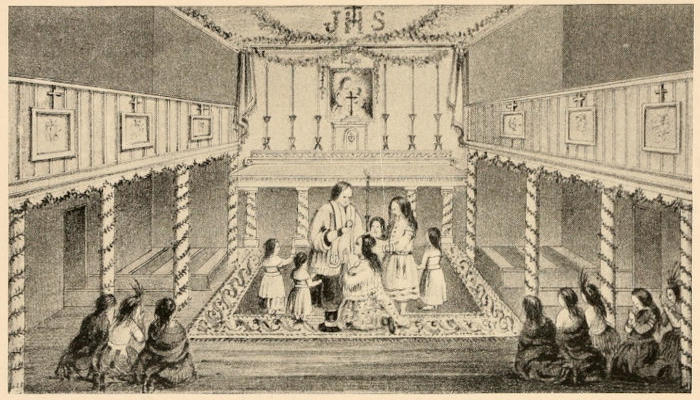
Interior of St. Mary’s Church, Flat-head Mission: Communion at Easter
(See Letter 4th)
Were I to give you the history of these chiefs, I should greatly exceed the limits I have proposed. Suffice it to say, that these heroes of the Rocky Mountains have been for years the terror of their enemies. Chalax had acquired great celebrity as a juggler, and in predicting future events; if we may credit the Kalispels and the whites who have travelled in company with him, these prophecies have been verified. {93} He indicated the day, the place, and the number of Blackfeet who would attack their camp. Having interrogated him relative to this affair, he, with great simplicity and candor, replied: “I am called the Great Doctor, yet, never have I given myself up to the practices of juggling, nor condescended to exercise its deceptions. I derive all my strength from prayer; when in a hostile country, I address myself to the Master of life, and offer Him my heart and soul, entreating him to protect us against our enemies. A voice had already warned me of coming danger; I then recommend prudence and vigilance throughout the camp; for the monitory voice has never deceived me. I have now a favor to request: the mysterious voice calls me by the name of Chalax, and, if you will permit, I desire to bear that name until my death.” I willingly consented, and then explained to him the ceremony of the White Garment he was about to receive, in the holy sacrament of baptism. To the name of Chalax I affixed that of the Prince of the Apostles. This is the same chief, who on my first visit to the mountains, aided by only sixty men, sustained during five days, an obstinate struggle against 200 lodges of Blackfeet, whom he put to flight, {94} leaving on the ground eighty men, whilst among the Flatheads only one man was wounded. He died three months after.
With regret I parted from these good Indians, and my beloved brothers in Jesus Christ, the Rev. Fathers Mengarini, Zerbinati, and four coadjutor brothers; who are laboring with indefatigable zeal in this portion of our Lord’s vineyard.
As the snow was fast disappearing, the Kalispels of the bay were awaiting my arrival. I re-entered my fragile canoe, guided by two Indians, and made all possible haste to descend Clarke’s River. You may judge of its impetuosity when I inform you, that we were sixteen days ascending the river, and but four in descending the same. On returning to the bay, accompanied by Rev. Father Hocken and several chiefs, my first care was to examine the lands belonging to this portion of the Tribe of Kalispels, and select a fit site for erecting the new establishment of St. Ignatius.[186] We found a vast and beautiful prairie, three miles in extent, surrounded by cedar and pine, in the neighborhood of the cavern of New Manrese,[187] and its quarries, and a fall of water more than two hundred feet, presenting every advantage {95} for the erection of mills. I felled the first tree, and after having taken all necessary measures to expedite the work, I departed for Walla Walla, where I embarked in a small boat and descended the Columbia, as far as Fort Vancouver. The melting of the snow had occasioned a considerable freshet, and our descent was very rapid. The place was indicated to me where a few months previously, four travellers from the United States had miserably perished, victims of their own temerity and presumption. When advised to provide themselves with a guide, they answered they had no need of any; and when warned that the river was dangerous and deceptive, the pilot, with a scoffing boast, replied, “I am capable of guiding my barge, were it even across the infernal gulf.” The monitor wished them a fortunate voyage, but at the same time trembled for their fate, saying: “This pilot is not a native Indian, he is not an Iroquois, nor even a Canadian.” The turbulent stream soon engulfed its presumptuous and daring victims. They steered out into the midst of the river, and in an instant the canoe was borne along with the rapidity of lightning, leaving in its train a thick foam, caused by the violent plying of oars. Approaching the rapids, {96} they fearlessly hurried onward—alas, their fate was soon to be decided. Drawn by the eddy into the centre of a whirlpool, vainly they struggled to extricate themselves—they beheld the dread abyss yawning to receive its prey! Yet, an instant, the ill-fated barge twirled upon the surface, and then sank, amidst the despairing shrieks of the helpless crew, which the roaring waves rendered the more appalling, whilst the dismal sounds re-echoing from shore to shore, proclaimed the new disaster of the “Columbia.” Soon the waters resumed their wonted course, and left no trace of the sad catastrophe. This fatal spot might appropriately be designated, Presumptive’s Rapids; doubtless, it will be a lesson to future boasters, not to venture, without pilot or guide, upon this formidable tributary of the western ocean.
After a prosperous voyage of five days, I debarked at Vancouver, where I had the happiness of meeting Father Nobili, who, during eight months, had applied himself to study the Indian language, while he exercised his sacred ministry among the Catholics of the fort and the Indians of the neighborhood. More than a tenth of the latter had been swept off by a mortal disease; happily, they all had the consolation {97} of receiving baptism before they expired.