Volume 29 / Part 2 — OREGON MISSIONS AN OUTLINE SKETCH OF OREGON TERRITORY AND ITS MISSIONS (continued 4)
Reading edition
The term medicine is commonly employed by the whites, to express whatever regards the {267} juggling, idolatrous practices of the savages; probably, because the Indian feeling his ignorance of the proper remedies in sickness, and almost wholly dependent upon chance for his subsistence, merely demands of his manitous some relief in these distressing situations. This something that the Indians call Power, is at times limited, say they, to the procuring of only one object, as the cure of some disease. Some other Power, again, is not so limited, it extends to many objects, as success in hunting, fishing, waging war, and avenging injuries. All this, however, varies according to the degree of confidence reposed in it by the individual, the number of his passions or the intensity of his malice. Some of the Powers are looked upon even by the savages themselves, as wicked in the extreme, the sole object of such Powers is to do evil. Moreover it is not at all times granted, even when those professing to be most powerful medicine-men, earnestly desire it. It comes only during sleep, in a fainting fit, during a loud clap of thunder, or in the delirious excitement of some passion; but never without some definite purpose, as to foment dissensions, or exasperate to deeds of violence, or to obtain some corporal advantage; favors which are always {268} purchased at the expense of the soul. Much exaggeration is, of course, clearly characteristic of those misnamed effects of preternatural power. Most of those that came under my notice, and which the Indians attributed to preternatural agency, were the effects of causes purely natural. Notwithstanding these deplorable disorders of the soul, it is my greatest consolation to reflect, that these superstitious practices, in consequence of the many palpable contradictions they admit, become a spiritual malady, the least difficult to cure.
On the 5th of August, I left the Mission of the “Sacred Heart of Jesus,” accompanied by the Rev. Father Point. Three Indian families, desirous of visiting St. Mary’s, served us for guides. Our journey for some days, lay along the serpentine course of the river St. Ignatius, in the valley of the North. The soil of this valley is for the most part rich, and well adapted to cultivation, but subject to frequent inundations. Grain and potatos are here cultivated by the Indians with great success. Father Joset, assisted by the savages, has already enclosed and prepared for cultivation, a large field, capable of affording sustenance to several Indian families. Our hopes, then, of seeing {269} these poor Indians furnished with a plentiful supply of provisions, and their wandering habits thereby checked, will with the blessing of God, be realized at no very distant day. To attain the desirable object of uniting them in villages, and thus forming them to habits of industry, we need, however, more means than we possess at present—we are very much in want of seeds of various kinds, and of agricultural implements.
Before arriving at the snow-capped chain of mountains, which separates the Cœur d’Alenes from the Flat-Heads, we wound our way for two days, through forests almost impenetrable and over immense beds of rock, always following the course of the river, except where its tortuous windings would lead us too circuitous a route.[299] So tortuous indeed is its course here, that in less than eight hours, we crossed it no less than forty-four times. The majestic cedars that shade the gorge at this point are truly prodigious, most of them measure from twenty to thirty feet in circumference, with a proportionate height, and so numerous, that as the rays of the sun cannot penetrate the dense mass, perpetual night may be said, without exaggeration, to reign here. I doubt whether the {270} owl could have selected a more fitting abode, certainly none so majestic or mysterious. The death-like silence of this glen, broken only by the passing breeze, the occasional visit of some wild animal, or the constant murmuring of the rills from the rocky banks, impress the beholder with feelings of a most unearthly yet pleasing nature.
With much difficulty and fatigue we forced a passage through this dense mass of forest, stooping half the time upon the neck of the horse, to avoid the low thorny branches, so thickly crossed together, that one is inclined at first sight, to abandon all hope of wedging his way through them. Its termination brought us to the foot of the great chain of mountains. It occupied us nearly another day to ascend this by a narrow winding path, which is shaded by one of the finest forests in Oregon. Towards sunset we reached the top, where we pitched our camp, within a few paces of one of those immense snow masses, that perpetually shroud this lofty chain. Here we enjoyed a most magnificent view—the horizon for some hundred miles around presented a spectacle of surpassing grandeur: as far as the eye could reach, a long succession of mountains, towering cliffs, {271} and lofty pinnacles, exhibited their dazzling snow-capped summits to our astonished vision. The very silence of this vast wilderness strikes the beholder with feelings of deep sublimity; not even a breeze stirred to break the charm of this enchanting view. I shall never forget the splendor of the scene we witnessed, as the last rays of the setting sun were throwing their full lustre upon the myriads of pinnacles that ranged far away towards the distant horizon.
The descent on the eastern side of this mountain is less abrupt, presenting slopes of rich verdure, adorned with a great variety of plants and flowers. This descent also occupied us an entire day. We next arrived at a forest, a twin-sister, if I may be allowed the expression, of the one I have just described. Here the river St. Francis Regis meanders through innumerable hoary cedars, pine trees, and an impenetrable thicket of bushes of every species. With the happiest recollections, we finally encamped on the banks of the St. Mary’s river, in the Flat-Head valley—the nursery of our first missionary operations in the Far West.[300]
In my next, I propose giving you some details of the present condition of our first children in God, the good and deserving Flat-Heads. {272} I recommend myself to God in your prayers.
I remain, with profound respect and esteem, reverend and dear Father, your very humble servant, and brother in Christ,
P. J. De Smet, S. J.
No. XXII Letter of the Rev. Father Point, S. J., Missionary in Oregon
Village of the Sacred Heart of Jesus, ⸺, 1845.
I learn by letters from Europe, that you take a lively interest in our dear missions. From this, I conclude that you will be very glad to learn some of those things which are passing amongst us. I take the more pleasure, because I can detail what my own eyes have witnessed, and because I can give a new proof of a truth, which you love to extend, viz., that it is to their devotion to the Sacred Heart of Jesus, that the pastors of souls are indebted for the consolations they enjoy: this will explain the wonders of mercy of which they are witnesses.
You know already the history of the Flat-Heads; truly their conversion is the result of a wonderful outflowing of the riches of grace; but I do not hesitate to say, that the conversion {274} of the Pointed-Hearts is a still more striking indication of God’s love to man. What were these savages less than a quarter of a century ago? They had hearts so hard, that if their first visitors have undertaken to give a true description of them, they could not find an expression more just, than is the singular name which they bear to this day. Their knowledge was so limited, that, giving themselves up to the worship of animals they had no idea of the true God nor of their soul, much less of a future life; finally they were a race of men, so degenerate that they had barely two or three notions of the whole natural law, and almost all were strangers to it in practice.
What a different aspect they now present! I will not say that they are perfect: that would be an exaggeration even in the eyes of persons little versed in the knowledge of the human heart. Everybody knows, that people who are converted, always retain something of their primitive character, and that the defects of education are not corrected except by a long course of years; but I say to the glory of Him, who can change the hardest rocks into children of Abraham, that, at this day, our Pointed-Hearts are true believers.
{275} It is only two years since the cross was planted on their soil, and all, with a very few exceptions, have made their first communion.
About fifteen years ago, several missionaries begged to be employed among the savages. A new doctrine was soon spread among the Pointed-Hearts, telling them that there is but one God, who has, beyond the earth we see, two things which we do not see:—a place for the good, and a place for the bad; that the Son of God, in all respects like his Father, seeing all men running in the bad road, came down from Heaven to put them in the right way; but that in order to effect this, it was necessary for him to die upon a cross. One evening, all the families, who were dispersed in different directions, for fishing, for hunting, and gathering roots, assembled upon the ground of an old chief called Ignatius,[301] to see the author of this news. Regardless of fatigue, they prolonged their sitting to the silence of the night, and listened to all the details of the glorious message.
God is great—Jesus Christ is good:—two truths the admission of which seemed to be the result of the first sitting: was this, indeed, the case? Not so much, perhaps, as would have been desirable: for before the families separated, {276} Heaven sent a scourge, which struck with death a great number of them. At the moment it raged with the greatest violence, one of the dying—since named Stephen—heard a voice from above, which said: “Cast down thy idols; adore Jesus Christ, and thou shalt be cured.” The dying man believed the word, and was cured. He went about the camp and related what had taken place: all the sick who heard him imitated his example, and recovered their health. I have this fact from the mouth of the savage who heard the voice from heaven, and the same has been confirmed by eye-witnesses, who could say, “I, myself, have been the object of that wonder, and my eyes have seen the mountain at the foot of which the idols were cast down.”
The savage takes little notice of an event which does not strike him in a sensible manner; but what I have related was marked by two such peculiar characters, that it left traces in the memory of all. However, neither constancy nor reflection is to be found in the savage. After some years of fidelity to the impressions received, the greater part returned to their former idolatry. This retrograde movement was accelerated by the medicine-men—a kind {277} of charlatans, who set themselves up for physicians and prophets, and pretend to perform wonderful things, especially, to cure the sick by their skill and supernatural power. At the word of one of the chiefs, who, probably, had not ceased to be an idolater, the men convoked an assembly of those who were called believers, in which it was resolved to return to their ancient practices; and, from that moment, the animals of the country, now become again divine, re-entered into possession of their ancient honors. The mass of the tribe, had, indeed, no confidence in them; but, either through fear of the medicine-men, or by natural curiosity, they took part, at least by their presence, in the sacrilegious worship paid to them. Happily, choice souls were always among them to intercede with Heaven for their deluded brethren; I know many, who, from the time in which God was pleased to manifest himself among them, have not the least faults upon their consciences, with which to reproach themselves.
Such was pretty nearly the condition of the people when Providence sent among them the Rev. Father De Smet. His visit, the circumstances of which have been related elsewhere, {278} disposed them so much in favor of the Black-gowns, that it was determined I should be sent to their aid. Three months after, that is, at the close of the hunting expeditions of the autumn of 1842, I left St. Mary’s to place the new converts under the protection of the Sacred Heart of Jesus.
The same day I entered their territory, the first Friday of November, I made with three chiefs who came to seek me, the promised consecration, and on the first Friday of December, in the midst of chants and prayers, the cross was raised on the borders of a lake, where the poor savages had united for fishing. Thanks be to God, we can say, that the miraculous draught of St. Peter was spiritually renewed. For they spoke no more of their assemblies of impostors, their diabolical visions, nor superstitious ceremonies, which had before been so common; and most important of all, gambling, which had always occupied a great portion of their time, was two weeks afterwards, abandoned; the conjugal bond, which for centuries, perhaps, had known among them neither unity nor indissolubility, was brought back to its primitive character. A beautiful sight was presented by the medicine-men themselves, {279} who with their own hands, did justice to the wretched instruments hell had used to deceive them. During the long nights of that period, it will not be necessary to tell how many sacrifices were made of feathers, wolves’ tails, stags’ feet, deer’s hoofs, wooden images, &c.
Scarcely was the bad tree cut down and thrown into the fire, than a blessing on their temporal affairs was united to that of their spiritual. In one day three hundred deer became the prey of the hunters.
The first days of spring, the reunion of the people at the place agreed on for the construction of a village was more numerous than the first. It was formed upon the ancient plans in Paraguay, and each one, according to his strength and industry, contributed towards its construction. Trees were felled, roads opened, a church erected, and the public fields were sown; and, thanks to the piety of our savages, Holy Week, Easter, Ascension, and Pentecost were celebrated with becoming solemnity. In truth, things went so well, that the enemy of men, perceiving his prey escape him, redoubled his efforts. We experienced some loss in consequence of a storm; but after a partial destruction, {280} the storm only resulted in purifying the atmosphere.
Towards the end of October, 1844, one hundred families of the Pointed-Hearts reunited in one village. The sight of their little lodges around the house of God, brought to mind the touching idea of the pelican in the desert. Young and old united to make their first communion, or renew it. Many had already acquired a certain degree of instruction, but the greater portion, especially of the old, were far from being sufficiently instructed; and the time the Black-gown had to prepare them before the great winter chase, was November and December, for the chase could not be put off, it is essential to the life of a savage. It was necessary, then, to hasten, and choose the shortest method of instructing them.
Everybody knows the savage has the eye of a lynx, and never forgets what he has once seen; therefore when he attaches any idea to a sensible sign, he can always recall it as soon as he sees the sign under his eyes; thus they have a wonderful facility in speaking by signs, and a great inclination to render their thoughts by images: upon this faculty I based my system of instruction. I made images, representing {281} what they ought to believe. Some of these represented the faults and vices they ought to shun, others the virtues they should practice. After this, with a little stick in my hand, I explained my representations, and tried to adapt myself to the understanding of all.
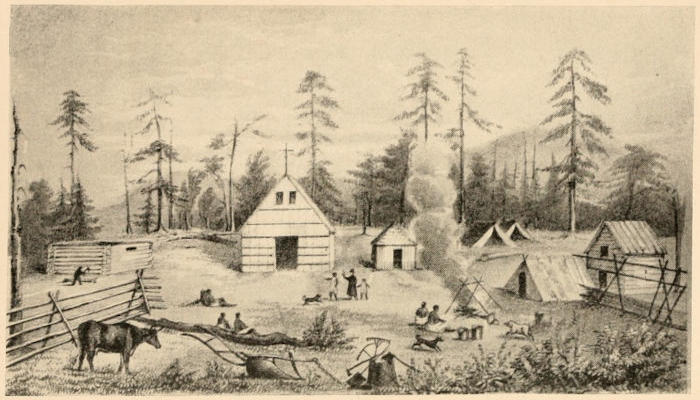
View of the new mission Establishment in 1846, among the Pointed-Hearts
(See Letter 21)
The success of this method surpassed my expectation: for, having made the most intelligent repeat what I had said, I had the pleasure to see that they lost nothing of what was essential, and immediately I formed classes for repetition. The first repetition was made immediately after the instruction; the second in their lodges, the third by the chiefs in their harangues, and the fourth at the beginning of the next instruction.
The plan was insisted upon, and rapid progress made, not only in their instruction, but also in their morals. Those who exhorted joined to their exhortations the force of private example, so that the mass of the people seemed to be led on, by attraction.
From the 9th of September to the time in which I write—a period of six months—not one single fault, which can be called serious, so far as my knowledge extends, has been committed in the village of the Sacred Heart of Jesus; and a great many, who reproached themselves {282} with light failings, cease not to make public confession in terms of grief, which it would be desirable to see the greater culprits exhibit at the tribunal of penance. I have seen husbands come after their wives, and mothers after their daughters, not to excuse the accusations which they had made, but to acknowledge that their want of patience and humility were the cause of the failings of the others.
It is worthy of remark that [of] all the adults, who had not yet received baptism, and all who united to prepare for their first communion, not one was judged unworthy to receive the sacraments. Their simplicity, piety, charity, and especially their faith, were admirable. And truly all these virtues were necessary for these good old men, who, for the sake of learning their prayers, had to become the scholars of their children, and for the children to enable them to do violence to their natural vivacity, while they slowly communicated to their old parents and grandparents, a part of what they had learned; and the chiefs would rise at the dawn of day, and sometimes in the middle of the night, to exhort their people to weep over their sins.
I have spoken of their faith. How pure and {283} above all, how confiding it was! The first idea, necessary to impress on their minds was, that the goodness of God is not less great than his power, and they were so convinced of it, that they begged God to perform miracles, as they would beg their daily bread. They were told, that the sacrament of extreme unction had the power not only to purify the soul, but to restore health to the body; it did not occur to them to doubt of the one more than of the other.
They have great faith in the sign of the cross. They are accustomed to make it at the beginning of their prayers, and of all their principal actions. Not satisfied with making it themselves, their children can scarcely pronounce a word, before they teach them to articulate the words of the sign of the cross. I saw a father and mother bending over the cradle of an only son, who was about to die. They made their best efforts to suggest to him to make the sign of the cross, and the child having raised his little hand to his forehead, made the consoling sign and immediately expired.
A woman, sitting near the grave of her only daughter, was conversing with her little boy, whom she had that day presented at the baptismal font. “See,” said she, “my child, how {284} happy it is to die after being baptized! If you should die to-day, you would see again our little Clementia.” And the pious mother exhibited such a calmness in her tone of voice and countenance, that she seemed to have a foretaste of the happy abode of which she spoke.
Our infant church presented the picture of the purest virtues, when the happy period for which she sighed was approaching. The week preceding the celebration of the Immaculate Conception of the blessed Virgin Mary, was devoted to prepare the people for the reception of holy communion. The time, of course, did not admit of frequent instructions, long prayers and general confessions. The good Father Joset gave instructions. Their prayers were fervent, and experience had already taught them the necessity of true sorrow for past sins, which they exhibited in a lively manner at the confessional. I used all the exertions I could to prepare those whose understandings appeared more limited than the others; and their piety, calmness and perseverance, have put to flight all the fears which rested on my mind. The church was small; it measured in length fifty feet, and in breadth twenty-four. It was indeed, {285} poor, but from every part of the wall and ceiling, were suspended rich festoons of leaves. While the stars were still shining in the firmament, the chant, Lauda Sion, was heard. But who sung that divine canticle? The savages, who lately addressed their prayers only to the animals of their mountains. Go to the foot of the altar and see the new adorers, bowing their heads before the Eternal One. The representation of the Sacred Heart of Jesus and of the Cross on which he expired, raised their thoughts to the abode of glory, and caused them to center there all their affections. They approached the altar to receive holy communion with the greatest order and devotion. It was Father Joset who had happiness to distribute to them the bread of life, a happiness, so much the more felt, as he had just arrived among them. Before they approached the holy table, he addressed them a few words; but the tender piety apparent in all at the moment of communicating, made him fear to spoil the work of God by adding more words of his own, and he left them to their own devotion.
We recited the usual prayers for the intentions of the Church, and closed the morning services {286} by chanting again the Lauda Sion. The high mass was celebrated at ten o’clock.
In the evening took place the renovation of the promises of baptism. The church was illuminated, at least as well as our poverty would permit. The sacrament of baptism was conferred on twelve adults. After a preparatory instruction, instead of the ordinary formulas, which were a little difficult to be translated into the Indian language, all of them, to show their constant fidelity, recited three acts of love to God. In hearing them, we remarked, that like the prince of the Apostles, they replied to the three-fold enquiry of their Saviour. The holy sacrament was exposed. To the expression of unanimous and forcible love, their looks of piety directed towards the altar, seemed to add: O beauty! always ancient, always new! too late have we loved thee; but we will love thee forever! The benediction of the blessed sacrament followed, and closed that great and beautiful day, which had been so rich in every kind of spiritual gifts. It was with difficulty that these good souls left the place, which had, that day, been the witness of their prayers and promises. The Pointed-Hearts exhibited by their prayers, their canticles, and {287} their holy conversations, a foretaste of heavenly joys. They often came to visit the Black-gowns. Some days, I was surrounded by these visitors. They all waited in profound silence, till I had finished my office. One of them then chanted the first verse of Lauda Sion, in which all the voices joined. Thus, it is a consoling truth, that, at the extremities of the heathen world, as well as in the centre of civilization, the church puts forth a united effort for the conversion and salvation of mankind.
I am, devotedly yours, in Christ,
N. Point.
No. XXIII A. M. D. G.
Flat-Head Camp, Yellowstone River, September 6th, 1846.
Rev. and Dear Father Provincial,—After an absence of about eighteen months, employed in visiting the various distant tribes, and extending among them the kingdom of Christ, I returned to the nursery, so to speak, of our Apostolic labors in the Rocky Mountains. Judge of the delight I experienced, when I found the little log church, we built five years ago, about to be replaced by another which will bear comparison with those in civilized countries, materials, everything ready to commence erecting it, the moment they can procure some ropes to place the heavy timbers on the foundation. Another agreeable surprise, however, yet awaited me; a mill had been constructed, destined to contribute largely to the increasing wants of the surrounding country. It is contrived to discharge {289} the two-fold charitable object of feeding the hungry and sheltering the houseless. The flour mill grinds ten or twelve bushels in a day; and the saw mill furnishes an abundant supply of plank, posts, etc., for the public and private building of the nation settled here.[302] Indeed, the location stood much in need of so useful a concern. The soil yields abundant crops of wheat, oats and potatos—the rich prairie here is capable of supporting thousands of cattle. Two large rivulets, now almost useless, can, with a little labor, be made to irrigate the fields, gardens, and orchards of the village. The stock at present on this farm, consists of about forty head of cattle, a fast-increasing herd of hogs and a prolific progeny of domestic fowl. In addition to the mill, twelve log houses, of regular construction, have been put up. Hence, you can form some idea of the temporal advantages enjoyed by the Flat-heads of St. Mary’s village.
St. Mary’s, or Bitter-Root valley, is one of the finest in the mountains, presenting, throughout its whole extent of about two hundred miles, numerous grazing, but few arable tracts of land. Irrigation, either by natural or artificial means, is absolutely necessary to the cultivation {290} of the soil, in consequence of the long summer drought that prevails in this region, commencing in April and ending only in October. This difficulty, however, if the country should be ever thickly settled, can be easily obviated, as the whole region is well supplied with numerous streams and rivulets. These remarks apply to the valleys contiguous to St. Mary’s, the general aspect of them differing perhaps but slightly in regard to the heights of the mountains, the colossal dimensions of the rocks, or the vast extent of the plains.
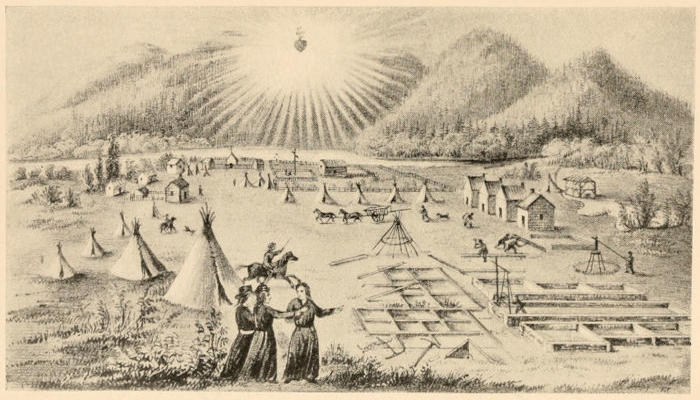
St. Mary’s, among the Flat-heads
(See Letter No. 23)
After what has been said in my former letters in relation to religion, little now remains that has a direct reference to it; but you will learn with much pleasure, that the improvements made in the Flat-head village, afford the missionary stationed there great facilities for prosecuting successfully the grand object of his desires, viz., the eternal happiness of the poor benighted Indian tribes, placed beyond the reach of his immediate influence. The village is now the centre of attraction to all the neighboring, and many of the distant tribes. The missionary always avails himself of these occasional visits, to convey to them the glad tidings of salvation. Among the recent visitors were, {291} the great chief of the Snake Indians with his band of warriors; the Banax and Nez-Percés, conducted by several of their chiefs,—even several bands of Black-Feet;[303] besides these, there were also, on their return from the great hunt, almost the whole tribe of the Pends-d’Oreilles, belonging to the station of St. Francis Borgia. These last in particular, the greater part of whom I baptized last year, may be said to rival the zeal of the Flat-Heads in the practice of their religious duties.
After the festival of Easter, the abundant supply of provisions, in the granaries and cellars of the village, enabled the minister to invite all the visitors present to a feast, consisting of potatos, parsnips, turnips, beets, beans, peas, and a great variety of meats, of which the greater portion of the guests had never before tasted. Among the industrial products which are mainly owing to the skill and assiduity of their present pastor, Father Mengarini, I must not forget to mention a kind of sugar, extracted from the potato.
Let us next turn to the improved condition of the people themselves. Polygamy—or rather a connection, if possible, still more loose—is now, thank God, entirely abolished among our newly-converted {292} Indians; there is, consequently, an evident increase of population. The reckless abandonment of the helpless infant—the capricious discarding of wife and children—the wanton effusion of human blood—are no longer known amongst them. Our feelings are not outraged by the brutal practice, heretofore so commonly witnessed, of a father considering a horse a fair exchange for his daughter; the justice of allowing the young Indian maiden to choose her future partner for life is now universally allowed;—the requisite care of their offspring is regarded in its proper light, as a Christian duty;—attention is paid to the wants of the sick;—changes of treatment, with the remedies administered according to our advice, have probably been the means, under Providence, of rescuing many from premature death. The long-cherished vindictive feelings which so frequently led to depopulating wars, are now supplanted by a Christian sense of justice, which, if unfortunately compelled to take up arms, does so only to repel unjust aggression or defend their inherent rights, but always with the fullest confidence in the protecting arm of Heaven.
Indeed their unbounded confidence in the God of battle, is well rewarded; a truth which the {293} enemies of the Flat-Heads invariably acknowledge. “The medicine of the Black-gowns,” (an expression synonymous with the true religion,) “is,” say they, “the strongest of all.” Did time permit, I could adduce almost innumerable instances to confirm the belief universally entertained here, that Almighty God visibly protects them in the wars they are compelled to wage with the hostile tribes. A few of these, for the authenticity of which I can vouch, may suffice for the present.
In 1840, when threatened by a formidable band of Black-Feet, amounting to nearly eight hundred warriors, the Flat-Heads and Pends-d’Oreilles, scarcely numbering sixty, betook themselves to prayer, imploring the aid of Heaven, which alone could save them in the unequal contest. Confident of success, they rose from their knees in the presence of their enemies, and engaged the overwhelming odds against them. The battle lasted five days. The Black-Feet were defeated, leaving eighty warriors dead upon the field; while the Flat-Heads and Pends-d’Oreilles sustained a loss of only one man; who, however, survived the battle four months, and had the happiness of receiving baptism the day before his death.
{294} In 1842, four Pends-d’Oreilles and a Pointed Heart were met and immediately attacked by a party of Black-Feet. At the first onset, the Black-Feet had to deplore the loss of their chief. Aroused by the noise of the musketry, the camp of the Pends-d’Oreilles rushed to the assistance of their companions, and without losing a single man, completely routed the enemy. Their escape is the more remarkable, as rushing into the entrenchments of the Black-Feet, they received a volley of shot poured in upon them by the enemy.
The Flat-Heads were again attacked, during the winter hunt of 1845, by a party of the Banax, which, though outnumbering them nearly three times, they soon put to flight, with the loss of three of the Banax party. The Flat-Heads acknowledge that the Banax are the bravest of their enemies; yet this did not deter them, though but seven in number, from fighting a whole village of the latter, that had rashly violated the rights of hospitality.
During the summer hunt of the same year, the united camp of Flat-Heads and Pends-d’Oreilles, when threatened, hesitated not a moment to engage with a band of Black-Feet four times their number. The latter, fearing the “medicine {295} of the Black-gowns,” skulked around their enemies, avoiding an open fight. The former perceiving this, pretended flight, in order to draw the Black-Feet into the open plain: the snare succeeded; and the Flat-Heads and Pends-d’Oreilles suddenly wheeling, attacked and repulsed them with considerable loss, driving the enemy before them in hot pursuit, as they would a herd of buffaloes. Twenty-three Black-Feet warriors lay dead on the field, after the engagement, while the Pends-d’Oreilles lost but three, and the Flat-Heads only one.
I shall close these sketches of Indian warfare, so remarkably evincing, as they do, the special protection of Heaven, with an account of an engagement which, as it was the occasion of my first interview with the Black-Feet, and by its consequence contributed much towards my favourable reception among them, will not, I trust, prove entirely devoid of interest, if given a little more in detail.
In 1846, while engaged in one of these hunting excursions, the camp of the Flat-Heads was reinforced by thirty lodges of the Nez-percés, and a dozen lodges of the Black-Feet at their own solicitation. The Flat-Heads encamped in the neighbourhood of the Crows,[304] purposely to renew {296} the terms of peace, if the latter felt so disposed. The Crows, perceiving in the united camp, the Nez-Percés and Black-Feet, with whom they were at war, and knowing their own superiority both in numbers and bodily strength, (they are the most robust of the Indian tribes) rushed into it like a torrent, evidently more anxious to provoke a contest than to make overtures of peace. The calm remonstrances of the Flat-Heads, and the wise admonitions of their own chief, were lost upon the now almost infuriated mutinous band of the Crows.
If the threatened outbreak had occurred at that moment, it is probable that the whole united camp would have been massacred in the hand-fight, for which evidently the Crows came prepared, with loaded guns and other destructive weapons, while the Flat-Heads and the others were totally unprovided. At this critical juncture, fortunately, indeed I may say providentially, my interpreter Gabriel, and a Pend-d’Oreille named Charles, forced their way breathless into the disordered camp, and announced the arrival of the Black-gown who had visited them four years ago. The alarming scene they witnessed was indeed what they had expected for as we travelled to overtake the Flat-Head {297} camp at the place designed for their interview with the Crows, we perceived from the marks of their daily encampments, that some Black-Feet and Pends-d’Oreilles were with the Flat-Heads; we accordingly feared a collision would result from the interview. I therefore despatched with all possible speed, Gabriel and Charles, to announce my arrival. Well did they execute the commission—they rode almost at full gallop during a whole day and night, performing in this short period a journey which occupied the camp fourteen days. This intelligence roused the Crow chiefs to an energetic exercise of their authority. They now seized the first missiles at hand, and enforced the weight of their arguments upon their mutinous subjects, as long as there was left in the united camp the back of a Crow on which to inflict punishment. This forced separation, though it may have checked the present ebullition, could not be of long duration. It needed but a spark to rekindle their hostile dispositions into open war. The next day, as if to provoke a rupture, the disaffected Crows stole thirty horses from the Flat-Heads. Two innocent persons were unfortunately charged with the crime, and punished. The mistake being discovered, the amende honorable was {298} made, but to no purpose. The Flat-Heads, aware of their dangerous position, employed the interval in fortifying their camp, stationing their women and children in a place of safety, and arming themselves for the contest. An immense cloud of dust in the neighborhood of the Crow camp at ten o’clock, announced the expected attack. On they came, with the impetuosity of an avalanche, until within musket shot of the advanced guard of the allied camp, who had just risen to their feet to listen to a few words addressed them by their chief, Stiettietlotso, and to meet the foe. “My friends,” said Moses, (the name I gave him in baptism) “if it be the will of God, we shall conquer—if it be not his will, let us humbly submit to whatever it shall please his goodness to send us. Some of us must expect to fall in this contest: if there be any one here unprepared to die, let him retire; in the meanwhile let us constantly keep Him in mind.” He had scarcely finished speaking, when the fire of the enemy was returned by his band, with such terrible effect as to make them shift their mode of attack into another, extremely fatiguing to their horses. After the battle had raged for some time in this way, Victor, the grand chief of the Flat-Heads,[305] {299} perceiving the embarrassed position of the enemy, cried out: “Now, my men, mount your best horses, and charge them.” The manœuvre was successful. The Crows fled in great disorder, the Flat-Heads abandoning the pursuit only at sun-down, when they had driven the enemy two miles from their camp.
Fourteen warriors of the Crows fell in the engagement, and nine were severely wounded, as we subsequently learned from three Black-Feet prisoners, who availed themselves of their capturers’ defeat to recover their liberty. On the part of the allied camp, only one was killed, the son of a Nez-Percé chief, who fell by the hand of a Crow chief, in so cowardly a manner, that the indignation of the allied camp was at once raised into immediate action—it was in fact, the first shot fired and the first blood drawn on either side; the boy was yet quite a child. Besides this loss, though the engagement lasted for several hours, only three were wounded, two of them so slightly that by application of the remedies I brought with me, they recovered in a short time; the third died a few days after my arrival in the camp.
This defeat was the more mortifying to the Crows, as they had been continually boasting {300} of their superior prowess in war, and taunting their enemies with the most insulting, opprobrious epithets. They had besides, forcibly and most unjustly drawn on the engagement.
Indeed, I look upon the miraculous escape of our Christian warriors, in this fierce contest, as further evidence of the peculiar protection of Heaven; especially when I consider the numerous instances of individual bravery, perhaps I should say reckless daring, displayed on the part of the allied camp. The son of a Flat-Head chief named Raphael, quite a youth, burning to engage in the contest, requested his father to let him have his best horse. To this the father reluctantly consented, as the boy had been rather weak from sickness. When mounted, off he bounded like an arrow from the bow, and the superior mettle of his steed soon brought him close upon the heels of a large Crow chief, who, turning his head round to notice his pursuer, pulled up his horse to punish the temerity of the boy, at the same time bending to escape the arrow then levelled at him. The boy must have shot the arrow with enormous force, for it entered under the lower left rib, the barb passing out under the right shoulder, leaving nothing but the feathers to be seen where it entered. {301} The chief fell dead. In an instant a volley was poured in upon the boy—his horse fell perfectly riddled, with the rider under him.—He was stunned by the fall, and lay to all appearance dead. According to the custom of the Indians, of inflicting a heavy blow upon the dead body of their enemy, he received while in this position, a severe stroke from each individual of the several bands of Crows that passed him.—He was taken up half dead, by his own tribe, when they passed in pursuit of the enemy. The ardour and impetuosity of the young man belonging to the Flat-Head camp amazed the oldest warriors present, and formed the theme of universal admiration, as well as the dread of their enemies. Even the women of the Flat-Heads mingled in the fray. One, the mother of seven children, conducted her own sons into the battlefield. Having perceived that the horse of her eldest son was breaking down in a single combat with a Crow, she threw herself between the combatants, and with a knife put the Crow to flight. Another, a young woman perceiving that the quivers of her party were nearly exhausted, coolly collected, amidst a shower of arrows, those that lay scattered around her, and brought them to replenish the {302} nearly exhausted store. The celebrated Mary Quille, already distinguished in numerous battles, pursued, with axe in hand, a Crow, and having failed to come up with him, returned, saying: “I thought that these great talkers were men. I was mistaken: it is not worth while even for women to attempt to chase them.”
The little party of Black-Feet, animated by a spirit of revenge, for the loss of half their tribe, massacred the preceding year by the Crows, and probably influenced by a feeling of their safety while they fought in company with the Flat-Head Christians, did signal service in the combat.
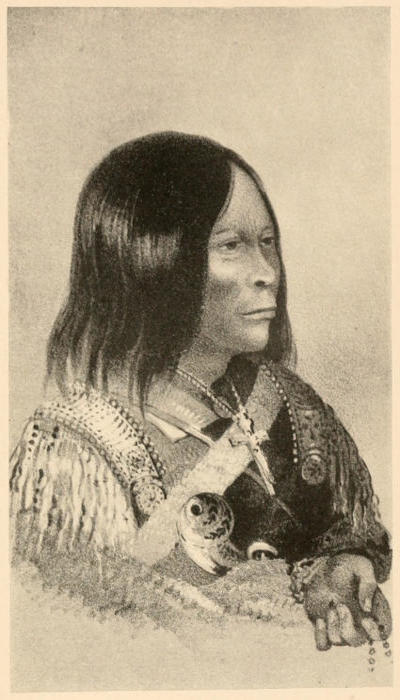
Insula or Red Feather (Michel), Great Chief and Brave among the Flat-heads
In the meantime, Gabriel and Charles, fearing the threatened outbreak, immediately started back to meet me and hasten my arrival, my presence being considered necessary to prevent the effusion of blood. I arrived at the Flat-Head camp the day after the battle. I found everything ready to repel a second attack, should that be attempted. I immediately sent an express to the Crows, to announce my arrival, and at the same time, to convey to them the great desire I had to see them, especially for the purpose of effecting a reconciliation between the {303} contending parties. But it appeared that after having buried their dead, they retreated precipitately; so that no account of their destination could be had. My express told me that there must have been excessive grief in the camp of the Crows, as the usual marks of it could be traced in every direction, such as the dissevered joints of fingers, and the numerous stains of blood, caused by the wounds which the parents of the deceased inflict upon themselves on such occasions.
Shortly after my arrival, the Black-Feet came in a body to my lodge, to express in a manner truly eloquent, their admiration of the Flat-Heads, with whom in future they desired to live on terms of the closest friendship. “To their prayers,” said they, “must this extraordinary victory be attributed. While the battle lasted, we saw their old men, their women, and children, on their knees, imploring the aid of Heaven; the Flat-Heads did not lose a single man—one only fell, a young Nez-Percé, and another mortally wounded. But the Nez-Percés did not pray. We prayed morning and evening with the Flat-Heads, and heard the instructions of the chiefs.” They then begged of me in their own affecting way, to take pity on them and be {304} charitable to them: they now determined to hear the words of the Great Manitou of the whites, and to follow the course which the Redeemer had marked out on earth. Having addressed them on the nature of the life they had proposed to adopt, they all without exception presented their children for baptism, to the number of eighty.
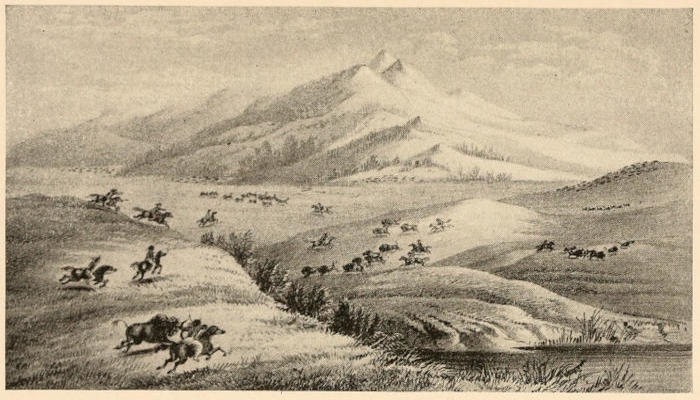
Great Buffalo Hunt—View of Muscle-Shell Mountains
(See Letter 24)
The day after this sacred ceremony, they called on me, requesting to be allowed to express in their own way, the excess of joy which they felt on account of this twofold victory. On returning from the late field of battle, the warriors, at the head of whom was a young chief, chanted songs of triumph, accompanied with the beating of drums; at each beat, they sent forth a wild and piercing shout; then followed the song, and so on alternately;—wild as the music was, it was not without harmony. It continued thus, during almost the whole of our route. We marched along the right bank of the Yellow-Stone River, having on our left a chain of mountains resembling those old portals to which history has given the name of “ancient chivalry.”[306] We had scarcely arrived at the encampment, when the Black-Feet commenced, under the shade of a beautiful cluster of pines, their {305} arrangements for a dance, insisting, at the same time, upon showing the Black-gowns how highly they valued their presence among them, and how gratified they would be to have them witness this display. There was, indeed, nothing in it that could give occasion to offended modesty to turn aside and blush. I need not tell you it was not the polka, the waltz, or anything resembling the dances of modern civilized life. The women alone figure in it, old and young; from the youngest child capable of walking, to the oldest matron present. Among them I have seen several old women upwards of eighty years, whose feeble limbs required the aid of a staff in their movements through the dance. Almost all appeared in the best costume of the warriors, which, however, was worn over their own dress, a sort of tunic they always wear, and which contributed also not a little to the modesty of their appearance. Some carried the arms that had done most execution in battle, but the greater part held a green bough in the hand. In proportion as the dresses increase in singularity, the colors in variety, and the jingling of the bells in sound, in the same degree is the effect upon the rude spectator heightened. The whole figure is surmounted by {306} a casket of plumes, which by the regular movements of the individual is made to harmonize with the song, and seems to add much gracefulness to the whole scene. To lose nothing of so grand a spectacle, the Indians mount their horses, or climb the neighboring trees. The dance itself consists of a little jump, more or less lively, according to the beat of the drum. This is beaten only by the men, and all unite in the song. To break the monotony, or lend some new interest to the scene, occasionally a sudden, piercing scream is added. If the dance languishes, haranguers and those most skilful in grimaces, come to its aid. As in jumping the dancers tend towards a common centre, it often happens that the ranks become too close, then they fall back in good order to form a large circle, and commence anew in better style.
After the dance, followed the presentation of the calumet. It is borne by the wife of the chief, accompanied by two other women, on the breast of one of whom rests the head of the pipe, and upon that of the other, the stem handsomely adorned with feathers. The most distinguished personage of the nation precedes the calumet bearers, and conducts them around the circle of dancers. The object, probably of the {307} last part of the ceremony, the termination of the rejoicings, is to indicate, that the best fruit of the victory they celebrate is the peace which follows. To establish this peace upon a better foundation, is a thought constantly uppermost in my mind. May God grant that our efforts to plant the crop of peace among these wild children of the forest, be not unavailing; I earnestly recommend these poor souls to the prayers of the faithful.
Having thus, more fully perhaps than the limits of a single letter would seem to justify, redeemed the promise given in my last, of recounting some of the advantages, spiritual and temporal, which the Flat-Heads enjoy, it may now be proper to resume the course of events up to the present date. On the 16th of August, we left St. Mary’s by a mountain gap, called the “Devil’s gate,” a name which it has probably received from the fact of its forming the principal entrance of the marauding parties of the Black-Feet.[307] We encamped the first night, at the foot of the Black-Foot forks. Innumerable rivulets, and several beautiful lakes contribute largely to this river. Towards its head, to the north-east, there is an easy pass for cars and wagons.[308] The valley we ascended, is watered {308} by a beautiful stream called the Cart River. It was through this valley we wound our way in former days, with all our baggage, to the spot where St. Mary’s now stands.[309] We crossed the mountains in the vicinity of the Arrowstone fork, another easy pass, and descended a tributary of the Jefferson as far as its outlet, through rather a wild, broken, and mountainous country, with here and there an extensive, open plain, the ordinary resort of innumerable herds of buffalo.[310] The seventh day found us encamped in the immense plain through which the forks of the Missouri diverge, ascending to the source at the very top of the main chain of the Rocky Mountains.[311] In travelling through these wilds, great care is to be had in order to avoid the sudden attack of some of those straggling war-parties that infest this neighborhood purposely to search for scalps, plunder, and the fame of some daring exploit. We halted every evening for a few hours, to take a bite, as the trapper would say, and to give some food and rest to our animals. When it was quite dark, we would kindle a brisk fire as if to last until morning; then under cover of the night, proceed on our journey for about ten miles, to some unsuspected place, thus eluding {309} our enemies, should any have followed in our track, or be lurking in the neighborhood, awaiting the midnight hour to execute their murderous designs. From the three forks we went easterly, crossing by an easy pass the mountain chain which separates the head waters of the Missouri from the Yellow-Stone River, a distance of about forty miles.[312] We followed in the track of the Flat-Head camp for several days, when I sent Gabriel, my interpreter, with a Pend-d’Oreille Indian in advance to discover what direction the camp had taken, and to bring back speedy news regarding their movements; and also to learn the dispositions of the Crows, whom I designed to visit. Four days later I was met by a few Flat-Heads on their way to find me, when I was apprised of the treachery of the Crows, and the severe chastisement they had so deservedly received. I travelled the whole of that night, and arrived next day in the allied camp, as I have already informed you. Having failed to obtain the desired interview with the Crows, our attention will be now turned towards the Black-Feet, with whose favorable disposition to receive the gospel you are already acquainted. The result of this determination will form the subject of my next {310} letter. I recommend myself to God in your prayers.
I remain, with sentiments of profound respect and esteem, reverend, dear father, your very humble servant and brother in Christ,
P. J. De Smet, S. J.
No. XXIV A. M. D. G.
St. Louis University, January 1st, 1847.
Very Rev. and Dear Father Provincial,—You are already acquainted with our determination to accompany the Black-Feet in returning to their country. In the sequel of this letter you will learn, with pleasure, how far Almighty God has blessed our humble efforts in carrying this resolution into effect. After the battle, described in my letter from the Yellow-Stone camp, the Crows, it appears, fled to the Wind River Mountains, determined, however, to avenge themselves on the Black-Feet, whom they now designed to follow into their own country.[313] The latter, probably through fear of this assault, resolved to remain with the Flat-Head camp, until it reached the head waters of the Muscle-shell River. In leaving the Yellow-Stone our direction lay towards the north, {312} through a broken and undulating, dry and woodless country, destitute of any water fit to drink—stagnant pools of brackish water being the only kind found here to satiate the thirst.[314] Only a few straggling bulls were seen or killed, scarcely sufficient, indeed, to supply the wants of our numerous camp. The great variety of matter incidental to this journey with the united Indian camp, will appear, perhaps, more satisfactory if given in the same order in which it was entered in my diary; I therefore present you with an extract from it:—
8th Sept., 1846. The elements of discord existing between the Nez-Percés and Black-Feet, there is every appearance of an open rupture. The Nez-Percés being evidently in the wrong, the Flat-Heads, following our example, endeavor to convince them of the impropriety of their conduct; but to no purpose, the principal men among them refusing, for the second time, to smoke the calumet of peace.
9th. Towards night a touching incident occurred in our lodge. A Nez-Percé chief, who declares himself our friend, entered, accompanied by three Black-Feet, a warrior, an interpreter, and a young man about twenty years of age. This youth, when about one year old, lost {313} both his parents; his mother, a captive among the Black-Feet, died the first days of her captivity; his father, whose country is far distant from the Black-Feet, is altogether lost to him. The poor orphan became the adopted child of a Black-Foot woman, who brought him up as she would her own offspring. The adopted son grew up, imbibing all the notions and customs of his new friends, knowing no other relations than those around him. To-day, the woman whom he believed to be his real mother, declared to him that she was not; and that his father, whom he had not seen since he was one year old, was now sitting beside him. “Who is my father?” he anxiously enquired. “There,” said the woman, pointing to the Nez-Percé chief, who entered the lodge with him. The doubts of the father were soon removed, as he hastily stripped the youth’s garments from his back, and there discovered the mark of a burn received in the parental lodge while yet an infant. The sudden burst of feeling elicited from these children of nature at this unexpected meeting, can be better imagined than described. The chief has no grown children, he is therefore the more eloquent in endeavoring to persuade his son to return to his native country, presenting him, at {314} the same time, with one of the best and most beautiful of his steeds. I joined to the entreaties of the father, the strongest motives I could urge. The son, whose heart is divided between nature and grace, begged to be allowed to bid farewell to the companions and friends of his youth, who were now absent—he could not, he declared, thus abruptly leave her who, with motherly care and anxiety, had watched over him so many years, and whom he had always so tenderly loved, and looked upon as his mother. “Now that the Black-gowns are with us,” he said, “I desire to be of the happy number of those who are about to introduce them to my friends, and to listen to the words of the Great Spirit, whom they have come to announce. After that, but not before, shall I follow my father.”
10th. The Nez-Percés announce their determination of leaving the united camp. The Flat-Heads, who dread more the presence of a friend capable of injuring their souls, than that of an enemy who can only hurt the body, are excessively rejoiced at this announcement. The Black-Feet also are highly pleased to see them go. The separation took place about 8 o’clock; but they had gone only a short distance from the {315} camp, when, fearing an attack from the Crows, they rejoined the main body, determined to remain as long as the great hunt shall last. To avoid the outbreak, evidently threatened by the ill-will of the Nez-Percé, the Black-Feet have resolved to leave the camp on the morrow. This day I baptized a Nez-Percé, who had been shot in the late battle with the Crows—he cannot survive much longer.
11th. Farewell to the Flat-Heads. All came to shake hands with us, the grief of their hearts was depicted in their countenances; we all perceived how deeply they felt the separation. A great number of their cavaliers accompany us for a considerable distance; six go as far as our encampment, not less than twenty-five miles.
Our course lay through an extensive level plain, at the very base of the Muscle-shell mountains.[315] These rise abruptly from the plain around, resembling broken, elevated islands in the midst of the ocean, and their tops tufted with a heavy growth of cedar and pine. While admiring the singular appearance of the scenery, my attention is called off to a very distressing accident. An old Indian is seen falling from his horse, receiving in the fall a severe wound between his eyes; he remains senseless, all efforts {316} to revive him are fruitless. It was the old Black-Foot chief, Nicholas, whom I baptized five years ago; he acted, ever since, the part of a most effective missionary, in preparing the way for the introduction of the gospel among his tribe.[316] To-day he entered what he called his own country, chanting hymns of praise and thanksgiving in the happy anticipation of soon presenting us to his brethren. He dies! not even a sigh escapes him. Oh, how profound are the designs of God. Happily he leaves a son worthy of so excellent a sire. His attachment to religion equals that of his father. Having resided several years among the Flat-Heads, he has acquired a perfect knowledge of their language—acting in the capacity of interpreter, he has already rendered me considerable assistance. Notwithstanding his great grief, he performs the last sad offices near the tomb of his father with the composure and firmness of a Christian. It is customary among the Black-Feet to express their grief by wailings and lacerations of the body, calculated only to afflict those around, though intended by them as a mark of respect towards the lamented dead. The son of Nicholas, himself a chief and a great brave, knowing the Christian practice, {317} passes the night in prayer, with his wife and children, near the funeral couch of his father. His friends and brother, Pegans[317] (pagan in name and in fact), would now and then gather around him, kneeling beside the mourner, pour forth, Christian-like, many a pious ejaculation on behalf of their deceased chieftain. The remains of the venerable chief were placed in the grave by the hands of his own son, and over his tomb the emblem of salvation was raised—the cross of the Saviour, whose words were now for the first time announced to the lonely tribes of this long-benighted wilderness. At the very moment the last prayers of the funeral service were uttered, “May he rest in peace,” a busy stir breaks the death-like silence of the surrounding crowd of Indians. A Flat-Head approached in full gallop, announcing the pleasing intelligence that two Black-Feet had reached their camp, and informed them that the tribe of Nicholas was within two days march of us.
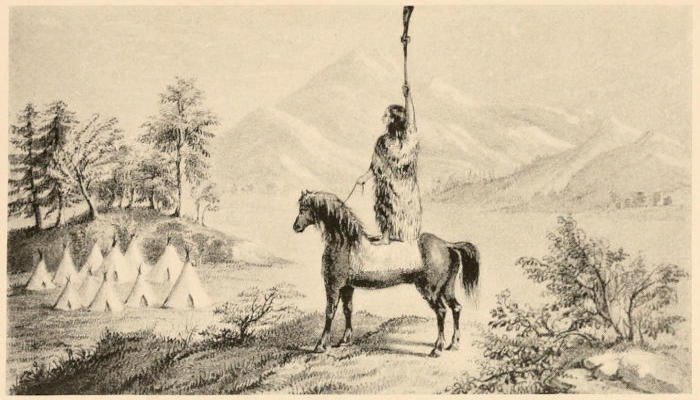
Announcement of the Discovery of Buffalos
(See Letter 2nd)
12th. The very evening of the day on which Nicholas was interred, immense herds of buffalo are seen in the neighborhood of the camp. All are preparing for the chase—hunters throwing the lasso over their buffalo horses, already prancing and capering for a race—all ready to {318} start; but before they separate, they halt for a moment, and, in imitation of the Flat-Heads, all are seen on their knees to beg of Almighty God their daily bread; when again mounted, off they bound at full speed, each for one, two, or three fat cows, according to the strength of his favorite steed. The supper was abundant in every lodge, regiments of steaks were paraded before all the fires. My fire was encircled with tongues, or other dainty dishes reserved for the Black-gown; and all who visited our lodge were of course invited to partake of the superabundant supply. Among my visitors, one in particular distinguished himself by his originality and good sense—his words were accompanied with expressive signs, which rendered his conversation very agreeable; he related to me what he observed while in the Flat-Head camp:—“When we first arrived,” said he, “we had abundance of provisions with us, while the Flat-Heads and Nez-Percés were fasting; we were visited, and all partook of what we had. The Flat-Head differed from the Nez-Percés; the former prayed before he ate, the latter did not. On the Lord’s-day, the Flat-Heads remained quiet in the lodges, they frequently prayed, and spoke to us words of the Great Spirit to make us good; but {319} the Nez-Percés, painted, and proud of their feathers, were seen going here and there, more for evil than good, without reserve, before our young people. But then came the battle with the Crows, and the Nez-Percés, though the least brave of us all, and the least exposed, have had to weep over the loss of one of their men, and another is dying of his wounds. This made me believe the words I had heard the Flat-Head say, ‘that the Great Spirit is good to the good, but that he can find the wicked at pleasure to punish them as they may deserve.’”
The wonderful success of the Flat-Heads in the different wars they have been compelled to wage, has confirmed their enemies in the persuasion entertained for some years, that the medicine of the Black-gowns is stronger than their own. Two Indians of the Pegan camp have just arrived, apprising us of their approach.
13th. Sunday.—We are obliged to move camp;—every dry stick had been burned where we passed the night, and the rain has rendered the only other substitute for fuel, buffalo dung, unfit for use;—the rain which was falling as we travelled, changed into sleet and hail. After a long day’s march we encamp for the night, in a beautiful cotton grove, on the margin of the Judith river.[318]
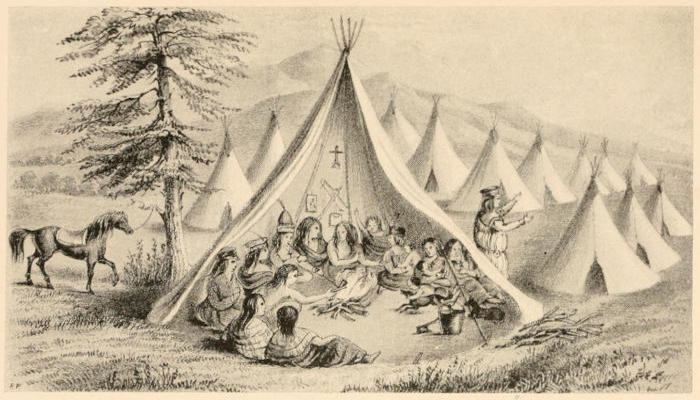
Chief reports to his Camp that Buffalos are in sight
(See Letter 3rd)
{320} The bad weather prevented the re-union of the two camps; it will be so much the more remarkable, as to-morrow will be the feast of the Exaltation of the Cross. The chief enquires, if it would please us to see the Black-Feet manifest their joy in their own way, that is, by painting, singing and dancing; the answer was: “Do the best you can to show your friends that you are pleased.” We learn by an express, just arrived, that the Big Lake, the great chief of the Pegans, harangued his people, exhorting them to behave orderly, and to listen with attention to all that the Fathers would say to them. He is accompanied by the great Tail-Bearer, a kind of orator, or aid-de-camp to the chief. His tail, composed of buffalo and horse-hair, is about seven or eight feet long, and instead of wearing it behind, according to the usual fashion, it is fastened above his forehead, and there formed into a spiral coil, resembling a rhinoceros’ horn. Such a tail, among the Black-Feet, is a mark of great distinction and bravery—in all probability, the longer the tail, the braver the person.
14th. An agreeable disappointment. The Flat-Head camp, from which we separated four days ago, is only about ten miles from us. They sent an invitation to the Big Lake, desiring, at the same time, to trade with him on friendly {321} terms. Opinions are divided among the people of the Big Lake. The chief is for postponing the trade until the meeting with the Black-gowns takes place; the Tail-Bearer gives the preference to trade. The chief’s voice prevails. An Indian from the camp arrives about ten o’clock, to herald their approach; all the horses are immediately saddled, and the two Black-gowns, at the head of a numerous band of cavaliers, forming one extensive line, in single file, proceed through a beautiful open plain, the air resounding with songs of triumphal joy. We are soon in sight of each other—a loud discharge from all the guns was the signal to dismount, when the Big-Lake and Tail-Bearer, followed by the whole tribe, walked up to give us a warm and affectionate shake of the hand. Smoking came next; and after the friendly pipe had passed from mouth to mouth, and had made several rounds, they communicate to each other the news since parting. I made to them my preparatory address, to dispose their minds and hearts to listen with attention to the word of God. To this appeal they responded with a loud and cheerful expression of the satisfaction they felt in listening to the Black-gown. We had scarcely introduced our new friends into the {322} camp, before the Flat-Heads and Nez-Percés were seen approaching. Their meeting was still more joyful and cordial than the one we had just witnessed among the people of the Big-Lake. This is not astonishing, when you know them; the savage is naturally reserved towards men he does not know. The candid, open ways of acting which distinguish our neophytes soon communicate themselves to the Black-Feet, and before the sun went down, Black-Feet, Flat-Heads, young and old, all show equal pleasure to find us, on such an occasion, in the midst of them.
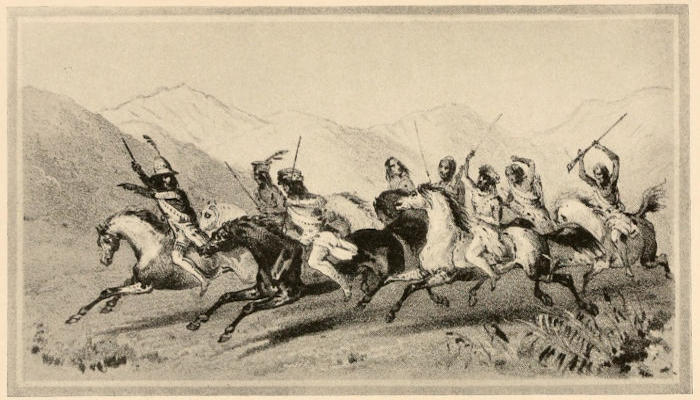
The Chief at the head of his Hunters
After evening prayers were said in the Black-Foot and Flat-Head languages, I addressed to them a short discourse on the happy re-union and peaceful disposition that now existed between the two nations. What a pleasing sight! What a consoling triumph for religion, to behold those warriors, whose deep-scarred faces told of the many bloody battles they had had together,—who could never meet before but with feelings of deadly enmity, thirsting for each other’s blood,—now bending the knee before their common Father in prayer, as with one heart, and listening with delight to the words of the peaceful Redeemer. The chiefs and the principal {323} men of both nations passed the evening in my lodge. Victor, the great Flat-Head chief, gains the good-will of all—charms everybody by the suavity and dignified simplicity of his manners. He relates some of his exploits, not indeed to appear conspicuous, as is evident from the modest and simple way in which he speaks, but to make them fully sensible of the protection which the Great Spirit extends to those who are devoted to His holy cause. The Black-Feet who were engaged in the late battle with the Crows, confirm the statements of Victor, and recount many edifying circumstances which they had witnessed in the Flat-Head camp. The making of the sign of the cross was highly extolled, as a certain sign of victory to those who had already given their hearts to the true God. It is truly to-day the Exaltation of the Holy Cross.
15th. The Octave of the Nativity of the Blessed Virgin. The new disciples of the cross assist at a solemn Mass, sung in the open plain, under the canopy of green boughs, to beg for the blessings of God upon this wilderness and its wandering tribes, and unite them in the bond of peace. Flat-Heads, Nez-Percés, Pegans, Blood Indians, Gros-Ventres and Black-Feet,[319] numbering {324} about two thousand, all surround the altar of the living God, on which “the clean oblation is offered,” in their behalf. It is a thing unheard of, that among so many different savage nations, hitherto so inimical to one another, unanimity and joy, such as we now witness, should exist,—it appears as if their ancient deadly feuds had been long since buried in oblivion; and this is the more remarkable in an Indian who, it is well known, cherishes feelings of revenge for many years. How long will this last? May Heaven strengthen their present good-will, and grant them perseverance. Mention is already made of baptizing all the Pegan children, but the ceremony is postponed on account of the general rejoicing, and the affairs of business that now occupy the camp.
16th. The engaging simplicity and cordiality of the Flat-Head chiefs have gained them the affections of all the principal men of the Black-Feet tribe,—conduct the more remarkable, when contrasted with the turbulent disposition of the Nez-Percés, who are kept in check only by the presence of the Flat-Heads. At this second separation, they came again to renew their affection towards us. The Flat-Head chiefs remain last in the camp to see everything pass off {325} orderly and amicably. In the evening the Black-Feet assemble around our fire, where the first canticle is composed in their language; the subject of the composition is the consecration of their persons to the “Supreme Ruler of all things.” Apistotokie Nina, Pikanniai tokanakos akos pemmoki tzagkoma Achziewa ziekamolos.
17th. Nothing very remarkable took place. We received the visit of a war party of Blood Indians, the most cruel among the Black-Feet. From them we learn that their tribe will be delighted to receive a visit from us,—that our persons are considered sacred among them,—that we need apprehend no danger, and, to remove all uneasiness on this head, that sixty of their children had already received baptism at the hands of a Black-gown,[320] whom they met on the Sascatshawin, and that these children constantly wear the crosses and medals which the Black-gown gave them.
18th. News in great variety. Two Gros-Ventres have been killed by the Crows. Seven families of Pegans have been followed by a numerous band of Crees, and have probably been destroyed. A chief, just arrived, informs us that Black-Feet of different tribes are assembling in the neighborhood of Fort Lewis to receive {326} their annual supplies, and that the traders who bring up the goods are distant only three days’ journey, with three large canoes (Mackinaw boats).[321] About two o’clock in the afternoon the camp prepares for another great hunt.
19th. Baptism was this day conferred on upwards of one hundred children and two old men, with all the usual ceremonies. To enter into a full description of these, calculated, as they are, to leave a deep and lasting impression upon the minds of all present, would be but a repetition of what has been already stated in my former letters on the like occasions.
20th. Arrival of a great war party of Blood Indians. They are returning from an expedition against the Crows, having carried off twenty-seven horses belonging to the latter. The leaders of this party, one a son, the other a brother of the great chief, exhibit towards us particular marks of friendship. The elder, who worshiped the sun and moon, has long since ceased to invoke these deities—he confirms the statement of the other party, that we shall meet with a hearty welcome among his tribe. The Black-Feet nation consists of about fourteen thousand souls, divided into six tribes, to wit: the Pegans, the Surcees, the Blood Indians, the Gros-Ventres {327} (descendants of the Rapahos), the Black-Feet (proper), and the Little Robes.[322] These last were almost entirely destroyed in 1845.
21st. A feast is given in my lodge to the new-comers. It is preceded by the baptism of a Pegan, who had been an old chief, but who, on account of age, resigned the dignity of his title in favor of his brother. He possesses the gift of speech in an eminent degree. He is daily here, repeating and commenting on the instructions given by us. He exercises over his flock a very happy influence, and it is, doubtless, owing to his exertions that the Pegans are the first among the Black-Feet tribe to manifest favorable dispositions, and they will probably be the first also to embrace and put in practice the saving truths of Christianity. He presents, in his own person, a rare exception among his people, and indeed the only instance I have met with in my intercourse with the Indians, especially in one of his age—of an Indian having lived with one and the same wife, and with her also in perfect peace and harmony. He received in baptism the united name of Ignatius Xavier, the medal having that impress—which he constantly wears, to remind him of the virtues which distinguish those saints. Let us hope {328} that the first graces bestowed on this tribe may soon produce fruits of salvation to all.
22d. A day of great rejoicing—a dance. All the Indian fineries are produced, all the war-caps, adorned with eagle feathers, figure in the dance—a thousand voices join in the song—the rejoicing prolonged till evening. The common prayers have all been translated—already several know what is to be believed. May the practice of good soon take deep root in their hearts. Sata, our interpreter, acts the part of an Apostle[323]—after each interpretation, he resumes his discourse, and speaking from the abundance of his heart, produces a powerful effect upon his audience. The word Sata does not differ in signification from Satan, and as the Indian generally receives his name from the natural disposition he manifests, we may safely conclude, when such a name is given to a Black-Foot, that the grace of God has operated most powerfully in converting this savage to what he is at present.
23d. Nothing remarkable happened, except a trial given to faith of the new catechumens. A theft of two horses was committed in the camp by a stranger, residing among the Flat-Heads. Some individuals from the western side of the {329} mountains, occasionally forget what they should be; but a few isolated misdeeds, highly disapproved of by the entire nation, show to the best advantage the good spirit that animates the great mass of them. The critical position of the robber serves in some degree as an extenuation of his guilt. He had advanced a considerable distance from the Flat-Head camp, on his way to join us about the time we should reach the Black-Foot Indians; when he was given to understand that his life was in great danger from the war parties prowling in the rear. The poor fellow did not feel much inclined to meet death in this way, and his meagre horse not being very well able to avoid the meeting, proprio motu he left his, in exchange for two other horses, fully equal to the task of sweeping him past the danger. These horses will, however, be returned to the owner. This is not the first instance of restitution among the Indians.
Sept. 24th. The missionaries, accompanied by a great number of Indians, precede the camp on its way to Fort Lewis, now only a few miles off. I am accosted by a little Pegan chief, who invites me to smoke. He tells me that he has come to the determination of settling at the Fort an unfortunate personal difficulty between himself {330} and another chief of the Blood Indian tribe. “I am going to meet,” said he, “my mortal enemy, a Blood Indian chieftain, renowned for his courage, but much more for his wicked heart. He treacherously murdered a Nez-Percé, while under my protection. I should be dishonored forever if I did not avenge this shameful act, and wash the stain from my nation in his blood. I shot the murderer in his own lodge—he did not die—his wound is healed—he awaits my arrival, resolved to kill me. I dread him not, for I also am a chief. I have heard your words, and other feelings have crept over my heart. Black-gown, hear what I am about to do: I will present to him the best horse of my band to cover his wound; if he accepts it, well and good, if not, I must kill him.” I offered myself as a mediator between them, before any steps should be taken, and promised him a favorable issue, according to the conviction of my own heart; for, as I had never witnessed the spilling of one drop of human blood, I felt assured that Almighty God would spare me the painful sight on the present occasion. We continue our route. The little chief and his Pegan friends prepare their arrows and load their guns. When in sight of the Fort, two {331} Black-Feet came running up towards us, to tell the little chief that if he approached any further, or any of his people, their lives would be in danger; and they returned as they came, running to announce the arrival of the Black-gowns. The bell of the Fort is sending forth a solemn peal, to honor, as it subsequently appeared, the arrival of the Black-gowns—a mark of respect generally paid to a priest by its inmates, who are chiefly French Canadians and Spaniards. Heedless of the admonition we had received, we proceeded to the Fort in full gallop. The gates were thrown open. We received a hearty welcome from every white man in the Fort; the bourgeois being absent, soon returned, to add by their kindness and politeness to the warm reception we had already received at the hands of their tenants.[324] The first compliments over, two horses were saddled for Father Point and myself, when we went over to an island formed by the waters of the Missouri, where the murderer and his band were encamped. The great neatness in the lodge of the latter, to whom I had already sent word, showed that it was prepared for our reception. We entered first, followed by our Pegan friends; then came the Blood Indians, and last of all the murderous {332} chief, with a countenance far from serene—savage vengeance visibly lurking in his breast. He shook hands only with the Black-gowns, and sat down silent and surly. I explained to him the object of my visit, and pleaded strongly for a reconciliation, declaring, at the same time, that I would not leave his lodge until I should see them reconciled. He listened with much attention, made a very appropriate reply, and in finishing, he exclaimed: “all is forgiven and forgotten. How could my heart remain angry whilst I listened to thy words?” Confidence was quickly restored in the assembly, and his short but eloquent reply showed that there was eloquence everywhere when the heart speaks. The little chief who had first spoken of reconciliation ended his remarks by an action that was really moving; stepping up to the man who had been his mortal enemy, he tenderly embraced him, and then, in addition to other gifts, presented him with a beautifully-painted robe, wrought in porcupine. The calumet of peace was cheerfully lighted, and passed around several times. Conversation became animated and friendly, and each one left the council-house with a light and glad heart, more easily felt than described. The chiefs who were present on this {333} occasion were: Amakzikinne, or the Big Lake; Onistaistamik, or White Bull; Masléistamik, or Bull-Crow; Aiketzo, or Grande roulette; Sata, or the wicked; Akaniaki, or the man who was beaten.
27th. Sunday, I offered up the Holy Sacrifice of the Altar, followed by an instruction on the end of man, at which all the inmates of Fort Lewis attended, together with as many Black-Feet as the large room and passage could contain. Many a tear escaped from the Canadian, the Creole, and the Spaniard, at the remembrance, no doubt, of the innocent and happy days they spent when young, in attending regularly to their religious duties. Many a pious resolution was lowly made on the present occasion, and their strict attention and devout feelings during divine service, showed that the germ of faith in them still gave promise of fructifying, however far they may have wandered from the strict line of Christian rectitude. In the afternoon I administered, with all the ceremonies, the sacrament of baptism to thirty children.
From what I have seen, I am firmly convinced of the great good a missionary establishment would produce among the Black-Feet. {334} Assuredly it is a work well worthy the zeal of an apostle: to reclaim these savages from their cruel and bloody wars; to wrest them from the soul-destroying idolatry in which they are plunged, for they are worshippers of the sun and moon: and to teach them the consolatory truths of the Divine Redeemer of mankind, to which they seemed to listen with the utmost attention, and heartfelt satisfaction. Allow me the reflection, the ultimate fate of these fierce and lonely tribes is fixed at no distant date, unless looked to in time. What will become of them? The buffalo-field is becoming narrower from year to year, and each succeeding hunt finds the Indians in closer contact. It is highly probable that the Black-Feet plains, from the Sascatshawin to the Yellow-Stone, will be the last resort of the wild animals twelve years hence. Will these be sufficient to feed and clothe the hundred thousand inhabitants of these western wilds? The Crees, Black-Feet, Assiniboins, Crows, Snakes, Rickaries, and Sioux, will then come together and fight their bloody battles on these plains, and become themselves extinct over the last buffalo-steak. Let those, who have the power and the means, look to it in time. Let some efforts be made to rescue them from the threatened {335} destruction, lest, by guilty negligence, the last drop of aboriginous blood indelibly stain the fair fame of the Spread Eagle, under whose protecting wing they are said to live. Justice makes the appeal.
After mature deliberation upon the various plans devised for the contemplated establishment, it was deemed more advisable that the Reverend Father Point should remain with the Black-Feet, and continue the instructions; while I should go to St. Louis and endeavor to procure the means necessary to establish a permanent mission among them. Accordingly, on the 28th, I took final leave of my companions, of the kind and polite gentlemen of the Fort, of all the Black-Feet then present, who ceased not, during my stay among them, to give me the most marked tokens of affectionate attachment. Our departure was honored by the Fort with a discharge of the guns, and amidst a thousand farewells we glided down the Missouri, from a point 2850 miles above its mouth.
We left the Fort about noon, and encamped 25 miles below, near Bird Island. Next day, while passing the bluffs, on whose steep declivities numerous groups of the big-horn were browsing, we stole a march upon an old buck {336} that came to drink at the water’s edge—the first of the many victims sacrificed to our necessities during this long trip. After passing the Maria and Sandy rivers, we reached the remarkable formation, the yellow sandstone walls, on both sides of the Missouri, exhibiting most fantastic shapes and fissures—urns, of various sizes and forms—tables of every description—rostrums, surrounded by mushrooms, pillars, forts, castles, and a multitude of other figures, which, for the greater part of this, and the whole of the following day, furnished to our almost bewildered fancies ample scope for comparisons and theories.[325] We passed, on the 8th of October, the great Elk-horn steeple, near Porcupine Fork. I could not learn what extraordinary event this remarkable tower was intended to commemorate. Several thousand elk-horns have been here piled up, which formerly constituted, I have little doubt, the grand resort of numerous groups of these animals.[326] On the 11th we arrived at Fort Union, 600 miles distant from Fort Lewis, this making about 50 miles a day. Here we met with a very warm reception. We availed ourselves of the kind offer given to us of resting a day at the Fort; while there I baptized five children.[327] We left the Fort on the {337} 13th, with two companions. Large herds of buffalo were seen on both sides of the river, and bears, deer and elks appeared at every bend, so that there is little danger of suffering from want at this season. On the 16th our ardor to press forward, in spite of a strong head-wind, was suddenly cooled by a side wind, which upset the skiff and ourselves in four feet of water. We were now satisfied that we had better wait for a more favorable wind, and improve the time by drying our clothes. We started quite refreshed in the afternoon, and made up for the lost time by running sixty miles the next day. On the 17th we met six lodges of Assiniboins; they received us very kindly in their little camp,—gave us a feast and abundance of provisions. The same day we met eight Gros-Ventres, who were also exceedingly kind to us, insisting on our accepting a lot of buffalo tongues.[328] A favorable wind on the 18th, induced us to unfurl our sail. We were thus enabled to run about ten miles an hour, and early next day we reached Fort Berthold, where we were kindly entertained by Mr. Brugere.[329] The Gros-Ventres have a village here. I found but a few families;—one of the chiefs invited me to a feast. On the 20th we were hailed by several {338} bands of Indians, and kindly received. We proceeded, and encamped for the night near Knife river; but our fire discovered our encampment to a band of Indians.[330] The discovery would have been fatal to us, had I not been fortunately recognized by them; for they came armed for destruction, and took us by surprise. As soon as the two leaders knew who I was, they embraced me affectionately; our alarm was soon quieted, and we passed the evening very agreeably in their company; a good smoke, a cup of well sweetened coffee, a few humps and buffalo tongues, put them in a very good humour. They made me a solemn promise, that they would, in future, never molest a white man. They were Arikaras. The next day we breakfasted at Fort Madison, with the good and kind-hearted Mr. Des Autel.[331] Shortly after leaving this Fort, we passed under a scalp attached to the end of a long pole, which projected over the river. This was probably an offering to the sun, to obtain either fresh scalps or a good hunt. We were hailed by a large village of Arikaras, encamped and fortified on a point of land well timbered.[332] They treated us with great kindness, earnestly pressing me to accept invitations to several buffalo feasts; and as time did not admit of such delay, {339} their liberality fell little short of sinking the skiff, with the most dainty pieces of the hunt. Though late, we proceeded on our journey, principally, indeed, to avoid passing the night in feasting. Having had very favorable weather during the five following days, we reached, on the 26th, the encampment of Mr. Goule, an agent in the service of the American Fur Company.[333] I baptized several half-breed children at this place.
Availing ourselves of the favorable weather the four following days, we kept on the river, drifting down every night, so that early on the 30th, we arrived at Fort Pierre. Mr. Picotte, of St. Louis, received us with the utmost cordiality and politeness.[334] He forced me to remain three days under his hospitable roof. This delay enabled me to see a great number of Sioux, and baptize fifty-four children. Meanwhile Mr. Picotte ordered a large and convenient skiff to be made, and stored it with all sorts of provisions. In all my travels, I have never met one to surpass, perhaps to equal, the overflowing kindness with which this gentleman confers a favor. I cannot sufficiently express my gratitude to him. May God bless and reward him. And, indeed, I must here add, as a token of my {340} sincere gratitude, that in all the forts of the American Fur Company, the charitable liberality and kindness of the gentlemen were unbounded.
Late on the 3d November we renewed our journey, but had not proceeded far when we found it necessary to refit our skiff, which, being quite new, leaks considerably. We landed at a large farm belonging to the company on Fleury’s Island. We freely used the permission given to us, and committed great havoc among the poultry. On the 5th we breakfasted at Mr. Bouis’ Fort, where I baptized thirteen half-breed children—the day was beautiful and we made the whole of the Grande Detour.[335] We arrived at Fort Look-Out, of which I found Mr. Campbell in charge.[336] I baptized here sixteen half-breed children. I was kindly received by a great number of Sioux. We encamped nine miles lower down at a trading post held by two Canadians, where I baptized four children. On the 10th we passed the entrance of Running-water river, a fine stream with a strong current.[337] Two miles above its mouth were encamped one hundred families of the unhappy and much-abused Mormons—met several Sioux about Great Island, where we encamped.[338] A favorable {341} wind enabled us to reach Fort Vermilion on the 13th, four hundred miles below Fort Pierre. I baptized seven half-breed children. Mr. Hamilton liberally supplied us with provisions.[339] On the 14th we saw a Mormon along the beach, who fled at our approach. We met two Canadians who had shot a fine turkey, which they gave me: in return I presented them with some coffee and sugar, rare articles in that country. A fine breeze brought us in sight of the old Council Bluffs on the 18th.[340] The river has made considerable changes since my former visit to this place; entirely new beds have been formed. For several hundred miles, all the forests along the south side of the river were filled with cattle belonging to the Mormons. On the 18th we passed the ancient trading post, Lisel de Cabanne’s—a few miles below is the new temporary settlement of the Mormons, about ten thousand in number.[341] I was presented to their president, Mr. Young, a kind and polite gentleman. He pressed me very earnestly to remain a few days, an invitation which my limited time did not permit me to accept.[342] The persecutions and sufferings endured by this unhappy people, will one day probably form a prominent part of the history {342} of the Far-west. At sun-set we encamped at Mr. Sarpy’s trading post,[343] among the upper Potawotomies, where I met several of my old Indian friends, and among them Potogojecs, one of their chiefs, whose Indian legend of their religious traditions will form the subject of my next letter.
20th. A beautiful day—we visited our old friends in Bellevue, the good Mr. Papin[344] and others. We passed the Papillion, the Mosquito, and the Platte rivers, and encamped near Table Creek.[345]
On the 23d we arrived at St. Joseph’s, the highest town in Missouri.[346] It is now in a most thriving and prosperous condition; much improved indeed since I last saw it.
28th. We arrived at West-Port,[347] from which I proceeded by stage to St. Louis, the termination of a trip which occupied just two months. I recommend myself to your prayers.
I remain, with sentiments of profound respect and esteem, your obedient servant and brother in Christ.
P. J. De Smet, S. J.
No. XXV A. M. D. G. Legend of the Potawotomie Indians
St. Louis University, January 10, 1847.
Very Rev. and Dear Father Provincial,—Agreeably to my promise, I send you the account given by the Potawotomies, residing at Council Bluffs, respecting their own origin, and the causes which gave rise to their “great medicine,” and juggling, considered by them as of the highest antiquity. Such superstitions, indeed, are found to exist among all the tribes of the American continent, differing only in the form and the accompanying ceremonies. The Nanaboojoo of the Potawotomies, the Wieska of the Objibbeways, the Wizakeshak of the Crees, the Sauteux and the Black-Feet, the Etalapasse of the Tchinouks on the coast of the Pacific, can, among these different tribes, be traced up to the same personage.
{344} I send it verbatim, as it was communicated to me by Potogojecs, one of the most intelligent chiefs of the Potawotomie nation. Though fabulous, it is not entirely devoid of interest; it should excite us to offer up our prayers the more fervently to the Great Father of Light, for these poor benighted children of the forest, and beg of Him to send good and worthy laborers into this vast vineyard. Having enquired of this chief what he thought of the Great Spirit, of the Creator, and of the origin of his religion, or great medicine, he replied as follows: “I will give you a faithful account of what my tribe believes in these matters. We have not, like you, books to transmit our traditions to our children; it is the duty of the old men of the nation to instruct the young people in whatever relates to their belief, and their happiness.
“Many among us believe, that there are two Great Spirits who govern the universe, but who are constantly at war with each other. One is called the Kchemnito, that is, the Great Spirit, the other Mchemnito, or the Wicked Spirit. The first is goodness itself, and his beneficent influence is felt everywhere; but the second is wickedness personified, and does nothing but evil. Some believe that they are equally {345} powerful, and, through fear of the Wicked Spirit, offer to him their homage and adoration. Others, again, are doubtful which of them should be considered the more powerful, and accordingly endeavor to propitiate both, by offering to each an appropriate worship. The greater part, however, believe as I do, that Kchemnito is the first principle, the first great cause, and consequently ought to be all-powerful, and to whom alone is due all worship and adoration; and that Mchemnito ought to be despised and rejected!
“Kchemnito at first created a world, which he filled with a race of beings having nothing but the appearance of men—perverse, ungrateful, wicked dogs—that never raised their eyes to heaven to implore the assistance of the Great Spirit. Such ingratitude aroused him to anger, and he plunged the world in a great lake, where they were all drowned. His anger thus appeased, he withdrew it from the waters, and created anew a beautiful young man, who, however, appeared very sad, and being dissatisfied with his solitary condition, grew weary of life. Kchemnito took pity on him, and gave him, during sleep, a sister, as a companion to cheer his loneliness. When he awoke and saw {346} his sister he rejoiced exceedingly—his melancholy instantly disappeared. They spent their time in agreeable conversation and amusement, living for many years together in a state of innocence and perfect harmony, without the slightest incident to mar the happiness of their peaceful solitude.
“The young man had a dream, for the first time, which he communicated to his sister. ‘Five young men,’ said he, ‘will come this night, and rap at the door of the lodge—the Great Spirit forbids you to laugh, to look at them, or give an answer to any of the first four, but laugh, look, and speak, when the fifth presents himself.’ She acted according to his advice. When she heard the voice of the fifth, she opened the door to him, laughing at the same time very heartily; he entered immediately, and became her husband. The first of the five strangers, called Sama, (tobacco,) having received no answer, died of grief; the three others, Wapekone, (pumpkin,) Eshketamok, (watermelon,) and Kojees, (the bean,) shared the fate of their companion. Taaman, (maize,) the bridegroom, buried his four companions, and from their graves there sprung up, shortly after, pumpkins, water-melons, beans, and tobacco-plants {347} in sufficient abundance to supply their wants during the whole year, and enable them to smoke to the manitous, and in the council. From this union are descended the American Indian nations.