Volume 29 / Part 2 — OREGON MISSIONS AN OUTLINE SKETCH OF OREGON TERRITORY AND ITS MISSIONS (continued 2)
Reading edition
Father Nobili accompanied me in a Tchinouk canoe, up the beautiful River of Multonomah or Willamette, a distance of about sixty miles, as far as the village of Champois,[188] three miles from our residence of St. Francis Xavier. On our arrival all the fathers came to meet us, and great was our delight in being again reunited after a long winter season. The Italian fathers had applied themselves chiefly to the study of languages. Father Ravalli, being skilled in medicine, rendered considerable services to the inhabitants of St. Paul’s Mission; for every dwelling contained several sick. Father Vercruysse, at the request of Right Rev. Bishop Blanchet, opened a mission among the Canadians who were distant from St. Paul’s, and he succeeded in causing them to contribute to the erection of a new church, in a central location. Father De Vos is the only one of our fathers of Willamette who speaks English. He devotes his whole attention to the Americans, whose number already exceeds 4,000. There are several Catholic families, and our dissenting brethren seem well disposed; many among them are eager to be instructed in the Catholic faith.
{98} Nowhere does religion make greater progress, or present brighter prospects for the future, than in Oregon Territory. The Very Rev. Mr. Demers, Vicar General and Administrator of the diocess in the absence of the bishop, is preparing to build a brick cathedral. There is now being built, under his superintendence, a fine church at the Falls of Willamette, where, three years ago, was commenced the first town of Oregon.[189] This rising village numbers more than 100 houses. Several lots have been selected for a convent and two schools. A Catholic church has been erected at Vancouver.
The Convent of the Sisters of Notre Dame is fast progressing, and it will be the finest building of Willamette. The church is eighty feet long, and proportionably wide; it is under the invocation of the Blessed Virgin. The religious have already fifty boarders. The Bishop’s College, under the management of the Very Rev. Mr. Bolduc, is very prosperous. The number of pupils has augmented; forty young men, chiefly Metis, are receiving a Christian education. Some years ago, a church was erected at Cowlitz, and the inhabitants are now preparing to construct a convent under the direction of Rev. Mr. Langlois.
{99} Our residence of St. Francis Xavier is completed; it will hereafter serve for a novitiate and seminary, to prepare young men for the missions.
Measures, which I trust will be realized, have been taken by our fathers for visiting, during this year, the numerous tribes inhabiting the Pacific coast north and south of the Columbia; where, already, the visits of the bishop and his grand vicar have been so productive of favorable results. The 17th Feb., 1842, Bishop Blanchet thus wrote to the Bishop of Quebec: “God has deigned to bless our labors, and to fructify the divine word. The adorable name of Jesus has been announced to new nations of the north. Mr. Demers bent his steps to Fort Langley on Frazer’s River, in which place he administered baptism to upwards of 700 children. Many of them already enjoy the precious fruits of regenerating grace.”
In my preceding letters, I gave you the details of our missions among the mountains of the higher Oregon; of the conversion of two tribes, the Flatheads and the Cœurs-d’Alène or Pointed Hearts; of the first communion of the latter, and conversion of several Kalispels of the Bay, on the solemn festival of Christmas. From {100} 1839, when the mission was established, to July, 1845, the reverend Canadian missionaries baptized 3,000 persons. The number of Catholics residing at the different stations of the Hon. Hudson Bay Co. in Oregon, together with the colonists of the same nation, amounts to several hundreds. By adding to these 2857 baptized since 1841 in the different mountain missions, it gives us a total of more than 6,000 Catholics in Oregon. The diminutive grain of mustard is fast extending far and wide its branches, over this once sterile and neglected region. In the month of June, Father Nobili, accompanied by a brother novice, left Willamette to visit the tribes of New Caledonia. The Very Rev. Mr. Demers saw the following named tribes: Kameloups, the Atnans or Shouwapemot, the Porteurs or Ltavten, which names vary according to the different places where the tents are pitched.[190] They affix the word ten which signifies people, i. e., Stelaoten, Nashkoten, Tchilkoten, Nazeteoten.[191] Rev. Mr. Demers had the consolation of baptizing 436 children among these tribes.
Such has since been the fervor and zeal of these poor Indians; who, though deprived of a priest, have built three churches, hoping that a {101} nepapayattok, or father would settle among them.
Many Catholics reside in the different forts of this country. The honorable gentlemen of the Hudson Bay Co., although Protestants, were strongly interested in favor of these savages, and did all in their power to facilitate the introduction of a clergyman into this portion of their jurisdiction.
I have the honor to be, with the most profound respect and esteem, Monseigneur, your most humble and obedient servant in Jesus Christ.
P. J. De Smet, S. J.
No. V A. M. D. G.
Kalispel Bay, Aug. 7th, 1845.
Monseigneur,—A few days after the departure of Father Nobili, who obtained a place in a barge belonging to the Hon. Hudson Bay Co., I started from St. Francis Xavier’s with eleven horses laden with ploughs, spades, pickaxes, scythes, and carpenters’ implements. My companions were the good Brother McGill,[192] and two metis or mongrels. We encountered many obstacles and difficulties among the mountains, owing to the cascades formed by the water, which, at this season, descends on every side in torrents, and with irresistible fury upon the rocks, over which we were compelled to cross. In the narrow valleys between these mountains, the rhododendron displays all its strength and beauty; it rises to the height of fifteen or twenty feet. Entire groves are formed by thousands of these shrubs, whose clustering branches entwine themselves in beautiful green {103} arches, adorned with innumerable bouquets of splendid flowers, varying their hues from the pure white, to the deepened tint of the crimsoned rose.
Our path was strewed with the whitened bones of horses and oxen, melancholy testimonies of the miseries endured by other travellers through these regions. We passed the foot of Mt. Hood, the most elevated of this stupendous chain. It is covered with snow, and rises 16,000 feet above the level of the sea.[193] Capt. Wyeth, on beholding this ridge from the summit of the Blue Mountains, thus speaks of it in his journal:—“The traveller on advancing westerly, even at the distance of 160 miles, beholds the peaks of the Cascade Mountains. Several of them rise 16,000 feet above the level of the sea. Every other natural wonder seems to dwindle, as it were, into insignificance when compared to this.”[194] From one single spot I contemplated seven of these majestic summits extending from north to south, whose dazzling white and conic form resemble a sugar loaf.
We were twenty days going from Willamette to Walla Walla, across desert and undulating lands, abounding in absinthium or wormwood, cactus, tufted grass, and several species of such {104} plants and herbs as are chiefly found in a sterile and sandy soil.
Game is scarce in these latitudes; however, we found large partridges and pheasants, aquatic fowls, small birds of various kinds, hares and rabbits. Salamanders swarm in sandy places, and armadilloes are not rare in the vicinity of the great Dalles. Fort Walla Walla is situated in latitude 46° 2′, and longitude 119° 30′. The sandy neighborhood of this settlement likens it to a little Arabia. The River Walla Walla pours its waters a mile distant from the fort. The lowlands, when watered, are tolerably fertile, and produce maize, wheat, potatoes, and pulse of every kind. Cows and hogs are easily raised, and horses abound in this part of the country.
Having already spoken to you of the desert Nez-Percé and Spokane, I have nothing further to add relative to this dreary region. On advancing easterly towards the Blue Mountains, we find beautiful and fertile plains, interspersed with limpid and wholesome streams. The valleys are picturesque, covered with luxuriant prairies, and forests of pine and fir. The Nez-Percé Kayuses inhabit these delightful pastures.[195] They are the most wealthy tribes in Oregon; {105} even some private families possess 1500 horses. The savages successfully cultivate potatoes, pease, corn, and several kinds of vegetables and fruits. No situation affords finer grazing for cattle; even in winter they find an abundance, nor do they need shelter from the inclemency of the weather. Snow is never seen, and the rains are neither destructive nor superabundant.
About the middle of July, I arrived safely with all my effects, at the Bay of Kalispels. In my absence the number of neophytes had considerably increased. On the feast of the Ascension, Father Hocken had the happiness of baptizing more than one hundred adults. Since my departure in the spring, our little colony has built four houses, prepared materials for constructing a small church, and enclosed a field of 300 acres. More than four hundred Kalispels, computing adults and children have been baptized. They are all animated with fervor and zeal; they make use of the hatchet and plough, being resolved to abandon an itinerant life for a permanent abode. The beautiful falls of the Columbia, called the Chaudières,[196] in the vicinity of Fort Colville, are distant two days’ journey from our new residence of St. Ignatius.
From eight to nine hundred savages were {106} there assembled for the salmon fishery. I repaired thither in time to spend with them the nine days preceding the feast of our holy founder. Within the last four years, considerable numbers of these Indians were visited by the “black-gowns,” who administered the sacrament of baptism. I was received by my dear Indians with filial joy and tenderness. I caused my little chapel of boughs to be placed on an eminence in the midst of the Indians’ huts, where it might not inaptly be compared to the pelican of the wilderness surrounded by her young, seeking with avidity the divine word, and sheltering themselves under the protection of their fostering mother. I gave three instructions daily; the Indians assisted at them with great assiduity and attention.
Last year, the feast of St. Ignatius proved for me a day of danger, trial, and uneasiness. I love to recall it to my mind, for it terminated joyfully, and so gloriously, that I know my companions can never forget it, and they will return lasting thanks to the Almighty, for the display of His mercy. Without a chart or any knowledge of the mouth of the Columbia, we traversed, as if borne on angels’ wings, this formidable river. This year, I passed the feast {107} of St. Ignatius amidst many occupations, but they were of such a nature as to console the missionary’s heart, and repay him a hundred-fold, for the trifling privations, pains, and fatigues he endures.
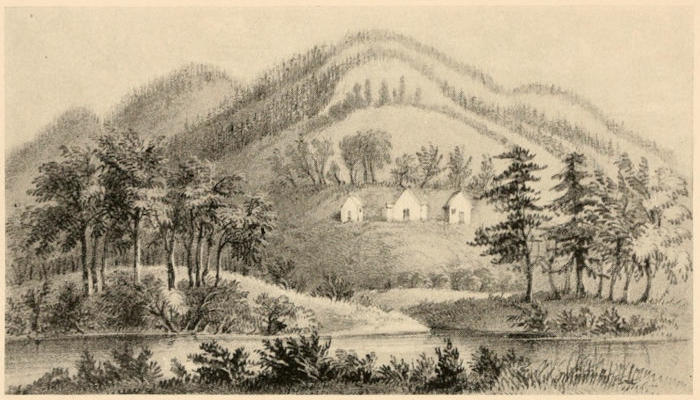
Mission of St. Ignatius at Kalispel Bay, among the Pends d’Oreilles
(See Letter 5th)
More than one hundred children were presented for baptism, and eleven old men borne to me on skins, seemed only awaiting regenerating waters, to depart home and repose in the bosom of their divine Saviour. The eldest among them, apparently about one hundred, and blind, addressed me in the following pathetic words:—My life has been long on earth, and my tears have not ceased to flow; even now I daily weep, for I have beheld all my children and early associates disappear. I find myself isolated among my own nation, as if I were in a strange land, thoughts of the past alone occupy me, and they are of a mournful and bitter nature. Sometimes I find consolation in remembering that I have avoided the company of the wicked. Never have I shared in their thefts, battles or murders. This blessed day, joy has penetrated the inmost recesses of my soul; the Great Spirit has taken pity on me, I have received baptism, I return him thanks for this favor, and offer him my heart and life.
{108} A solemn mass was celebrated, during which the Indians chanted canticles in praise of God. The ceremonies of baptism followed, and all terminated in the most perfect order, to the great delight and gratification of the savages. It was indeed a most imposing spectacle, all around contributed to heighten the effect. The noble, and gigantic rock, the distant roar of the cataracts breaking in on the religious silence of that solitude, situated on an eminence overlooking the powerful Oregon River, and on the spot where the impetuous waters freeing themselves from their limits, rush in fury, and dash over a pile of rocks, casting upwards a thousand jets d’eau, whose transparent columns reflect, in varied colors, the rays of the dazzling sun.
There were besides the Shuyelphi or Chaudière Indians, the Sinpoils, the Zingomenes and several Kalispels, accompanied me in the capacity of singers and catechists.[197]
I gave the name of St. Paul to the Shuyelphi nation, and placed under the care of St. Peter the tribe inhabiting the shores of the great Columbia lakes, whither Father Hocken is about to repair, to continue instructing and baptizing their adults. My presence among the Indians did not interrupt their fine and abundant {109} fishery. An enormous basket was fastened to a projecting rock, and the finest fish of the Columbia, as if by fascination, cast themselves by dozens into the snare. Seven or eight times during the day, these baskets were examined, and each time were found to contain about 250 salmon. The Indians, meanwhile, were seen on every projecting rock, piercing the fish with the greatest dexterity.
They who know not this territory may accuse me of exaggeration, when I affirm, that it would be as easy to count the pebbles so profusely scattered on the shores, as to sum up the number of different kinds of fish, which this western river furnishes for man’s support; as the buffalo of the north, and deer from north to east of the mountains, furnish daily food for the inhabitants of those regions, so do these fish supply the wants of the western tribes. One may form some idea of the quantity of salmon and other fish, by remarking, that at the time they ascend the rivers, all the tribes inhabiting the shores, choose a favorable location, and not only do they find abundant nutriment during the season, but, if diligent, they dry, and also pulverize and mix with oil a sufficient quantity for the rest of the year. Incalculable shoals of {110} salmon ascend to the river’s source, and there die in shallow water. Great quantities of trout and carp follow them, and regale themselves on the spawn deposited by the salmon in holes and still water. The following spring the young salmon descend towards the sea, and I have been told, (I cannot vouch for the authenticity,) that they never return until the fourth year. Six different species are found in the Columbia River.[198]
I left Chaudière or Kettle Falls, August 4th, accompanied by several of the nation of the Crees to examine the lands they have selected for the site of a village. The ground is rich and well suited for all agricultural purposes. Several buildings were commenced; I gave the name of St. Francis Regis to this new station, where a great number of the mixed race and beaver hunters have resolved to settle, with their families.[199] The 6th I traversed the high mountains of the Kalispels, and towards evening reached the establishment of St. Ignatius. The Rev. Fathers Hocken and Ravalli, with two lay brothers, superintend this interesting little settlement. These fathers likewise visit the different neighboring tribes, such as the Zingomenes, Sinpoils, Okinaganes, the stations of St. Francis {111} Regis, of St. Peter, and that of St. Paul, the Flat-bows, and the Koetenays.[200] I purpose visiting these two tribes, who have never yet had the consolation of beholding a “black gown” among them. All these tribes comprehend, on an average, about five hundred souls.
I am, with profound respect and esteem,
Your lordship’s most obedient servant,
P. J. De Smet, S. J.
No. VI A. M. D. G.
Station of the Assumption, Arcs-a-plats, August 17th, 1845.
Monseigneur,—The 9th of August I continued my route towards the country of the Arcs-a-plats. The roads were still inundated by the great freshet. I preferred ascending the Clark or Flathead River, in my bark canoe, and sent my horses across the forests bordering the river, to await me at the great lake of the Kalispels.[201] I had here a very agreeable and unexpected interview; as we approached the forests, several horsemen issued forth in tattered garments. The foremost gentleman saluted me by name, with all the familiarity of an old acquaintance. I returned the gracious salutation, desiring to know whom I had the honor of addressing. A small river separated us, and, with a smile, he said, “Wait until I reach the opposite shore, and then you will recognise me.” He is not a {113} beaver hunter, said I to myself; yet under this tattered garb and slouched hat, I could not easily descry one of the principal members of the Hon. Hudson Bay Co., the worthy and respectable Mr. Ogden. I had the honor and good fortune of making a voyage with him, and in his own barge, from Colville to Fort Vancouver, in 1842; and no one could desire more agreeable society.[202] It would be necessary for you to traverse the desert, to feel yourself insulated, remote from brethren, friends, to conceive the consolation and joy of such an rencounter.
Mr. Ogden left England in the month of April last, accompanied by two distinguished officers. It was a source of great pleasure to receive recent news from Europe. The Oregon question appeared to me somewhat alarming. It was neither curiosity nor pleasure that induced these two officers to cross so many desolate regions, and hasten their course towards the mouth of the Columbia. They were invested with orders from their government to take possession of “Cape Disappointment,” to hoist the English standard, and erect a fortress for the purpose of securing the entrance of the river, in case of war.[203] In the Oregon question, “John Bull,” without much talk, attains his {114} end, and secures the most important part of the country; whereas “Uncle Sam,” displodes a volley of words, inveighs and storms! Many years have been passed in debates and useless contention, without one single practical effort to secure his real or pretended rights. The poor Indians of Oregon, who alone have a right to the country, are not consulted. Their future destiny will be, undoubtedly, like that of so many other unfortunate tribes, who, after having lived peaceably by hunting and fishing, during several generations, will finally disappear, victims of vice and malady, under the rapacious influence of modern civilization.
The route from the great Kalispel lake to the Arcs-a-plats, or Flatbow country, is across dense forests, and much obstructed by fallen trees, morasses, frightful sloughs, from which the poor horses with much difficulty extricate themselves; but, having finally surmounted all these obstacles, we contemplate from an eminence a smiling and accessible valley, whose mellow and abundant verdure is nourished by two lovely lakes, where the graceful river of the Arcs-a-plats or McGilvray, winds in such fantastic beauty, that it serves to make the weary traveller not only forget his past dangers, but {115} amply compensates him for the fatigues of a long and tiresome journey.[204]
This section of the valley of Arcs-a-plats greatly resembles the two valleys of the Pointed Hearts; same fertility of soil, lakes, pastures, willow and pine groves; elevated mountains covered to the very summit with dense forests of trees, low lands, in which the towering cedar displays all its majesty and splendid foliage; and, as Racine says:—
“Elevent aux cieux Leurs fronts audacieux!”
The river is, in this place, deep and tranquil; moving along with a tardy pace until aroused from its inertness by the universal thaw; it then descends with such astounding impetuosity that it destroys the banks, and in its furious course, uproots and bears along trees, fragments of rocks, &c., which vainly oppose its passage. In a few days the entire valley is overflowed, and it presents to view immense lakes and morasses, separated by borders of trees. Thus does the kind providence of God, assist his poor creatures who inhabit these regions, by the liberality with which he ministers to their wants.
{116} These lakes and morasses, formed in the spring, are filled with fish; they remain there inclosed as in natural reservoirs, for the use of the inhabitants. The fish swarm in such abundance that the Indians have no other labor than to take them from the water and prepare them for the boiler. Such an existence is, however, precarious; the savages, who are not of a provident nature, are obliged to go afterwards in quest of roots, grain, berries and fruits; such as the thorny bush which bears a sweet, pleasant, blackberry; the rose-buds, mountain cherry, cormier or service berry, various sorts of gooseberries and currants of excellent flavor; raspberries, the hawthorn berry, the wappato, (sagitta-folia,) a very nourishing, bulbous root; the bitter root, whose appellation sufficiently denotes its peculiar quality, is, however, very healthy; it grows in light, dry, sandy soil, as also the caious or biscuit root.[205] The former is of a thin and cylindrical form; the latter, though farinaceous and insipid, is a substitute for bread; it resembles a small white radish; the watery potatoe, oval and greenish, is prepared like our ordinary potatoe, but greatly inferior to it; the small onion; the sweet onion, which bears a lovely flower resembling the {117} tulip. Strawberries are common and delicious. To this catalogue I could add a number of detestible fruits and roots which serve as nutriment for the Indians, but at which a civilized stomach would revolt and nauseate. I cannot pass over in silence the camash root, and the peculiar manner in which it is prepared. It is abundant, and, I may say, is the queen root of this clime. It is a small, white, vapid onion, when removed from the earth, but becomes black and sweet when prepared for food. The women arm themselves with long, crooked sticks, to go in search of the camash. After having procured a certain quantity of these roots, by dint of long and painful labor, they make an excavation in the earth from twelve to fifteen inches deep, and of proportional diameter, to contain the roots. They cover the bottom with closely-cemented pavement, which they make red hot by means of a fire. After having carefully withdrawn all the coals, they cover the stones with grass and wet hay; then place a layer of camash, another of wet hay, a third of bark overlaid with mould, whereon is kept a glowing fire for fifty, sixty, and sometimes seventy hours. The camash thus acquires a consistency equal to that of the jujube. {118} It is sometimes made into loaves of various dimensions. It is excellent, especially when boiled with meat; if kept dry, it can be preserved a long time.[206]
As soon as their provisions are exhausted the Indians scour the plains, forests, and mountains, in quest of game. If they are unsuccessful in the chase, their hunger becomes so extreme, that they are reduced to subsist on moss, which is more abundant than the camash. It is a parasite of the pine, a tree common in these latitudes, and hangs from its boughs in great quantities; it appears more suitable for mattresses, than for the sustenance of human life. When they have procured a great quantity, they pick out all heterogeneous substance, and prepare it as they do the camash; it becomes compact, and is, in my opinion, a most miserable food, which, in a brief space, reduces those who live on it to a pitiable state of emaciation.[207]
Such are the Arcs-a-plats. They know neither industry, art, nor science; the words mine and thine are scarcely known among them. They enjoy, in common, the means of existence spontaneously granted them by Nature; and as they are strangely improvident, they often pass from the greatest abundance to extreme scarcity. {119} They feast well one day, and the following is passed in total abstinence. The two extremes are equally pernicious. Their cadaverous figure sufficiently demonstrates what I here advance. I arrived among the Arcs-a-plats in time to witness the grand fish festival, which is yearly celebrated; the men only have the privilege of assisting thereat. Around a fire fifty feet long, partially overlaid with stones of the size of a turkey’s egg, eighty men range themselves; each man is provided with an osier vessel, cemented with gum and filled with water and fish. The hall where this extraordinary feast is celebrated is constructed of rush mats, and has three apertures, one at either extremity for the entrance of guests; the middle one serves for transporting the fish. All preparations being completed, and each man at his post, the chief, after a short harangue of encouragement to his people, finishes by a prayer of supplication to the “Great Spirit,” of whom he demands an abundant draught. He gives the signal to commence, and each one armed with two sticks flattened at the extremity, makes use of them instead of tongs, to draw the stones from the embers, and put them in his kettle. This process is twice renewed, and in {120} the space of five minutes the fish are cooked. Finally, they squat around the fire in the most profound silence to enjoy the repast, each trembling lest a bone be disjointed or broken,—an indispensable condition (a sine quâ non) of a plentiful fishery. A single bone broken would be regarded as ominous, and the unlucky culprit banished the society of his comrades, lest his presence should entail on them some dread evil.
A species of sturgeon which measures from six to ten, and sometimes twelve feet in length, is taken by the dart in the great lake of Arcs-a-plats.[208]
Since my arrival among the Indians, the feast of the glorious Assumption of the Blessed Virgin Mary has ever been to me a day of great consolation. I had time to prepare for the celebration of this solemn festival. Thanks be to the instructions and counsels of a brave Canadian, Mr. Berland,[209] who for a long time has resided among them in the quality of trader, I found the little tribe of Arcs-a-plats docile, and in the best disposition to embrace the faith. They had already been instructed in the principal mysteries of religion. They sang canticles in the French and Indian tongues. They number about ninety families. I celebrated the first Mass ever offered in their {121} land; after which ten adults already advanced in age and ninety children received baptism. The former were very attentive to all my instructions. In the afternoon, the erection of the cross was as solemn as circumstances would admit. There was a grand salute of ninety guns, and at the foot of the lowly standard of the God-Saviour, the entire tribe made a tender of their hearts to Him, with the promise of inviolable attachment to all the duties of true children of prayer, availing themselves of this occasion to renounce the remains of their ancient juggling and superstition. The cross was elevated on the border of a lake, and the station received the beautiful name of the Assumption. Under the auspices of this good Mother, in whose honor they have for many years sung canticles, we hope that religion will take deep root and flourish amidst this tribe, where union, innocence, and simplicity, reign in full vigor. They ardently desire to be taught agriculture, the advantages of which I have explained, and promised to procure the necessary seed and implements of husbandry.
I have the honor to be, monseigneur, your most humble and obedient servant in Jesus Christ,
P. J. De Smet, S. J.
No. VII A. M. D. G.
Ford of Flat-Bow River,[210] Sept. 2d, 1845.
Monseigneur,—The Flat-bows and Koetenays now form one tribe, divided into two branches. They are known throughout the country by the appellation of the Skalzi.—Advancing towards the territory of the Koetenays we were enchanted by the beautiful and diversified scenery. We sometimes traversed undulatory woods of pine and cedar, from which the light of day is partially excluded. We next entered sombre forests, where, axe in hand, we were forced to cut our way and wind about to avoid hosts of trees that had been levelled by the autumnal blasts and storms. Some of these forests are so dense that, at the distance of twelve feet, I could not distinguish my guide. The most certain way of extricating one’s-self from these labyrinths, is to trust to the horse’s sagacity, which, if left unguided, will follow the track of other animals. This expedient has saved me a hundred times.
{123} I cannot refrain from communicating to your lordship the gloomy and harrowing thoughts which imagination conjures up in these dismal regions. The most fearful apprehensions dismay the bravest heart and cause an involuntary shudder, as some dire apparition of a bear or panther stalks in fancy before the mind, whilst groping our way amidst these dark and frightful haunts, from which there is no egress. We caught a transitory glimpse of many charming spots covered with vegetation as we pursued our winding path near the river, wherever it deviated from its natural course. At a place called the Portage, the river crosses a defile of mountains, or rather of precipitous and frightful rocks; and the traveller is compelled, for the distance of eight miles, to risk his life at every step, and brave obstacles that appear, at first sight, insuperable.[211]
Whatever can be imagined appalling seems here combined to terrify the heart—livid gashes of ravines and precipices, giant peaks and ridges of varied hue, inaccessible pinnacles, fearful and unfathomable chasms filled with the sound of ever-precipitating waters, long, sloping and narrow banks, which must be alternately ascended, and many times have I been obliged {124} to take the attitude of a quadruped and walk upon my hands; often during this perilous passage did I return fervent thanks to the Almighty for his protection from impending danger. Amid these stern, heaven-built walls of rocks, the water has forced its way in varied forms, and we find cataracts and whirlpools engulfing crags and trees, beneath their angry sway. Whilst the eye rests with pleasure on the rich and russet hues of distant slopes, upland turf and rock-hung flower—the ear is stunned by the confused sounds of murmuring rills, rushing streams, impetuous falls, and roaring torrents.
An extensive plain at the base of the Portage mountain presents every advantage for the foundation of a city. The mountains surrounding this agreeable site are majestic and picturesque. They forcibly recalled to my memory the noble Mapocho Mountains that encompass the beautiful capital of Chili (Santiago). Innumerable little rills, oozing from the mountain’s stony bosom, diffuse a transparent haze over the valleys and lower slopes. The fine river Des Chutes comes roaring down and crosses the plain before it joins its waters to the McGilvray, which tranquilly pursues its course.[212] The quarries and forests appear inexhaustible; and having remarked {125} large pieces of coal along the river, I am convinced that this fossil could be abundantly procured. What would this now solitary and desolate land become, under the fostering hand of civilization? Indeed, the entire tract of the Skalzi seems awaiting the benign influence of a civilized people. Great quantities of lead are found on the surface of the earth; and from the appearance of its superior quality, we are led to believe there may be some mixture of silver.[213]
Poor, unfortunate Indians! they trample on treasures, unconscious of their worth, and content themselves with the fishery and chase. When these resources fail, they subsist upon roots and herbs; whilst they eye, with tranquil surprise, the white man examining the shining pebbles of their territory. Ah! they would tremble, indeed, could they learn the history of those numerous and ill-fated tribes that have been swept from their land, to make place for Christians who have made the poor Indians the victims of their rapacity. After a few days’ journey we arrived at the Prairie du Tabac, the usual abode of the Koetenays.[214] Their camp is situated in an immense and delightful valley, bounded by two eminences, which, from their gentle and regular declivity, covered with {126} smooth pebbles, appear to have originally bounded an extensive lake.
On my arrival, I found about thirty lodges of Koetenays; hunger had forced many families to cross the great mountain. They came in quest of the buffalo, elk, antelope, and stag. I was received with every demonstration of joy and filial affection by those who remained in the lodges. They hailed me with a long and boisterous discharge of musketry. Several showed me their journal, consisting of a square stick on which they had notched the number of days and weeks elapsed since I abode with them in the neighborhood of the great lake Teteplatte.[215] They had computed forty-one months and some days.
Mr. Berland had exerted his zeal to maintain the Koetenays and their brethren in the good dispositions in which I had the consolation of finding them. Since my last visit they have followed, to the very letter, all they remembered of my recommendations. I was obliged to decide some controversial points, which they had misinterpreted or misapprehended. They habitually assembled for morning and evening prayer, continued the practice of singing canticles, and faithfully observed the Sabbath precept.
{127} On the feast of the Holy Heart of Mary I sang High Mass, thus taking spiritual possession of this land, which was now for the first time trodden by a minister of the Most High. I administered the Sacrament of Baptism to one hundred and five persons, among whom were twenty adults. An imposing ceremony terminated the exercises of the day. Amidst a general salute from the camp, a large cross was elevated. The chiefs, at the head of their tribe, advanced and prostrated themselves before that sacred ensign, which speaks so eloquently of the love of a Man-God, who came to redeem a fallen race. At the foot of that sacred emblem, they loudly offered their hearts to him who has declared himself our Master, and the Divine Pastor of souls. This station bears the name of the Holy Heart of Mary. One of our Fathers will soon visit the two branches of this tribe.
Though these poor people were much in want of food, they pressed me to remain some days amongst them, whilst they listened with avidity to my instructions relative to their future conduct. After my departure they divided into small bands to go in search of provisions among the defiles of the mountains.
The 30th August I bade adieu to the Koetenays. {128} Two young men of their tribe offered to conduct me to the country of the Black-feet, and a third Indian, an expert hunter and good interpreter, completed the number of my little escort. I then journeyed on towards the sources of the Columbia.—The country we traversed was highly picturesque and agreeably diversified by beautiful prairies, from which poured forth spicy odors of flower, and shrub, and fresh spirit-elating breezes, smiling valleys and lakes, surrounded by hoary and solemn pines, gracefully waving their flexible branches. We also crossed magnificent dark Alpine forests, where the sound of the axe has never resounded; they are watered by streams which impetuously rush over savage crags and precipices from the range of mountains on the right.[216] This stupendous chain appears like some impregnable barrier of colossal firmness.
I am, with every sentiment of the most profound respect, your lordship’s humble and obedient servant in Jesus Christ,
P. J. De Smet, S. J.
No. VIII A. M. D. G.
Head of the Columbia, September 9th, 1845.
All hail! Majestic Rock—the home, Where many a wand’rer yet shall come, Where God himself from his own heart, Shall health, and peace, and joy impart.[217]
Monseigneur,—The 4th September, towards noon, I found myself at the source of the Columbia. I contemplated with admiration those rugged and gigantic mountains where the Great River escapes—majestic, but impetuous even at its source; and in its vagrant course it is undoubtedly the most dangerous river on the western side of the American hemisphere. Two small lakes from four to six miles in length, formed by a number of springs and streams, are the reservoirs of its first waters.[218]
I pitched my tent on the banks of the first fork that brings in its feeble tribute, and which we behold rushing with impetuosity over the inaccessible rocks that present themselves on {130} the right. What sublime rocks! How varied in shape and figure! The fantastic in every form, the attractive, the ludicrous, and the sublime, present themselves simultaneously to the view; and by borrowing ever so little the aid of the imagination, we behold rising before our astonished eyes, castles of by-gone chivalry, with their many-embattled towers—fortresses, surrounded by their walls and bulwarks—palaces with their domes—and, in fine, cathedrals with their lofty spires.
On arriving at the two lakes, I saw them covered with swarms of aquatic birds—coots, ducks, water-fowl, cormorants, bustards, cranes, and swans; whilst beneath the tranquil water lay shoals of salmon in a state of exhaustion. At the entrance of the second lake, in a rather shallow and narrow place, I saw them pass in great numbers, cut and mutilated, after their long watery pilgrimage among the rapids, cataracts, valleys, and falls; they continue this uninterrupted procession during weeks and months.[219]
Perhaps I shall scarcely be believed when I affirm that the salmon fish are quarrelsome. I witnessed with surprise the sharp and vengeful bites they mutually inflicted. These two lakes {131} form an immense tomb, for they there die in such numbers as frequently to infect the whole surrounding atmosphere.
In the absence of man, the grey and black bear, the wolf, the eagle, and vulture assemble in crowds, at this season of the year. They fish their prey on the banks of the river, and at the entrance of the lakes;—claws, teeth and bills serving them instead of hooks and darts. From thence, when the snow begins to fall, the bears, plump and fat, resume the road back to their dens in the thick of the forests, and hollows of rocks, there to pass the four sad wintry months in complete indolence, with no other pastime or occupation, than that of sucking their four paws.
If we may credit the Indians, each paw occupies the bear for one moon,(a month,) and the task accomplished, he turns on the other side, and begins to suck the second, and so on with the rest.
I will here mention, en passant, all the hunters and Indians remark that it is a very uncommon incident for a female bear to be killed when with young, and, notwithstanding, they are killed in all seasons of the year. Where they go—what becomes of them during the period {132} they carry their young—is a problem yet to be solved by our mountain hunters.
When emigration, accompanied by industry, the arts and sciences, shall have penetrated into the numberless valleys of the Rocky Mountains, the source of the Columbia will prove a very important point. The climate is delightful; the extremes of heat and cold are seldom known. The snow disappears as fast as it falls; the laborious hand that would till these valleys, would be repaid a hundred fold. Innumerable herds could graze throughout the year in these meadows, where the sources and streams nurture a perpetual freshness and abundance. The hillocks and declivities of the mountains are generally studded with inexhaustible forests, in which the larch tree, pine of different species, cedar and cypress abound.
In the plain between the two lakes, are beautiful springs, whose waters have re-united and formed a massive rock of soft sandy stone, which has the appearance of an immense congealed or petrified cascade. Their waters are soft and pellucid; and of the same temperature as the milk just drawn from the cow.[220] The description given by Chandler of the famous fountain of Pambouk Kalesi, on the ancient Hieropolis of {133} Asia Minor, in the valley of Meander, and of which Malte Brun makes mention, might be literally applied to the warm springs at the source of the Columbia.[221] The prospect unfolded to our view was so wonderful, that an attempt to give even a faint idea of it, would savor of romance, without going beyond the limits of fact.
We contemplated with an admiring gaze, this vast slope, which, from a distance, had the appearance of chalk, and when nearer, extends like an immense concreted cascade, its undulating surface resembling a body of water suddenly checked or indurated in its rapid course.
The first lake of the Columbia is two miles and a half distant from the River des Arcs-a-plats, and receives a portion of its waters during the great spring freshet. They are separated by a bottom land.[222] The advantages Nature seems to have bestowed on the source of the Columbia, will render its geographical position very important at some future day. The magic hand of civilized man would transform it into a terrestrial paradise.
The Canadian! Into what part of the desert has he not penetrated? The monarch who rules at the source of the Columbia is an honest emigrant {134} from St. Martin, in the district of Montreal, who has resided for twenty-six years in this desert. The skins of the rein and moose deer are the materials of which his portable palace is composed; and to use his own expressions, he embarks on horseback with his wife and seven children, and lands wherever he pleases. Here, no one disputes his right, and Polk and Peel, who are now contending for the possession of his dominions, are as unknown to our carbineer, as the two greatest powers of the moon. His sceptre is a beaver trap—his law a carbine—the one on his back, the other on his arm, he reviews his numerous furry subjects the beaver, otter, muskrat, marten, fox, bear, wolf, sheep, and white goat of the mountains, the black-tailed roe-buck, as well as its red-tailed relative, the stag, the rein and moose deer; some of which respect his sceptre—others submit to his law. He exacts and receives from them the tribute of flesh and skins. Encircled by so much grandeur, undisturbed proprietor of all the sky-ward palaces, the strong holds, the very last refuge which Nature has reared to preserve alive liberty in the earth—solitary lord of these majestic mountains, that elevate their icy summits even to the clouds,—Morigeau (our Canadian) {135} does not forget his duty as a Christian. Each day, morning and evening, he may be seen devoutly reciting his prayers, midst his little family.
Many years had Morigeau ardently desired to see a priest; and when he learned that I was about to visit the source of the Columbia, he repaired thither in all haste to procure for his wife and children the signal grace of baptism. The feast of the Nativity of the Blessed Virgin, this favor was conferred on them, and also on the children of three Indian families, who accompany him in his migrations. This was a solemn day for the desert! The august sacrifice of Mass was offered; Morigeau devoutly approached the Holy Table;—at the foot of the humble altar he received the nuptial benediction; and the mother, surrounded by her children and six little Indians, was regenerated in the holy waters of baptism. In memory of so many benefits, a large cross was erected in the plain, which, from that time, is called the Plain of the Nativity.
I cannot leave my good Canadian without making an honorable mention of his royal cuisine a la sauvage. The first dish he presented me contained two paws of a bear. In Africa, {136} this ragout might have given some alarm; in effect, it bears a striking resemblance to the feet of a certain race. A roast porcupine next made its appearance, accompanied by a moose’s muzzle; the latter I found delicious. Finally, the great kettle containing a sort of hotch-potch, or salmagundi, was placed in the midst of the guests, and each one helped himself according to his taste.
Some remains of beef, buffalo, venison, beavers’ tails, hare, partridges, &c., made an agreeable, substantial, famous soup.
I am, monseigneur, your most humble and obedient servant in Jesus Christ,
P. J. De Smet, S. J.
No. IX A. M. D. G.
Foot of the Cross of Peace, September 15th, 1845.
“——Here Poplars and birch trees ever quivering played, And nodding cedars formed a vagrant shade; On whose high branches, waving with the storm, The birds of broadest wings their mansion form; The jay, the magpie, the loquacious crow, And soar aloft and skim the deeps below. Here limpid fountains from the clefts distil, And every fountain forms a noisy rill, In mazy windings wand’ring down the hill.”
Monseigneur,—We bade adieu to the Morigeau family on the 9th, and to their companions of the chase, the Sioushwaps.[223] We quitted the upper valley of the Columbia by a small footpath, which soon conducted us to a narrow mountain defile, where the light of day vanished from view, amidst the huge, bold barriers of colossal rocks. The grand, the sublime, the beautiful, here form the most singular and fantastic {138} combinations. Though gray is the prevailing color, we find an immense rock of porphyry, or white-veined granite. Here and there, from the fissures of the rock, or wherever there is a handful of dust, the heavy and immortal pine enroots itself, adding its gloomy verdure to the variegated hues of the torpid rocks. These circuitous paths often present the most ravishing and picturesque vistas; surrounded by colossal walls, the greatest diversity and most beautiful scenery in nature is spread out before the eye, where the plush and cedar rise majestically in these venerable woods, the graceful poplar waves on high its emerald plumes, and fights its battles with the howling storm, whilst over the precipitous and jagged rocks, the scarcely-waving pine fills the brown shade with religious awe. The birch springs from an earth carpetted with moss, and shines like magnificent silver columns, supporting diadems of golden autumnal leaves, amidst the redolent purple-berried juniper and azure turpentines, of these humid dells and forests.
After a day’s journey through these primeval scenes, we reached the banks of the river Arcs-a-plats, where innumerable torrents rush headlong, with a thousand mazes from the mountain’s {139} brow, and in their union form this noble river. From afar is heard the deafening and continuous sound of its own dashes, as it traverses a rocky bed with extraordinary rapidity. We crossed the river in order to attempt the passage of another defile, still more wonderful, where the waters of the Vermillion have forced an opening.[224] Here, everything strikes the eye; all is wild sublimity, in this profound but turbulent solitude. Projecting mountains rise like holy towers where man might commune with the sky;—terrible precipices hang in fragments overhead—the astounding noise of the deep-tongued waves, in their unconfined flow, resembles that of the angry tempest, sweeping wild and free, like the spirit of liberty. Now the breaking waves play low upon the rock-ribbed beach, and madly plunge into an abyss—anon it returns foaming to its sedgy bed, apparently sporting with the sedges for diversion—falling from slope to slope, from cascade to cascade, passing in its course a long train of rapids—now concealing itself under the tufted foliage of cedar and pine—again pouring its brilliant and crystalline waters into a capacious basin, as if to take breath before quitting the ravine, and {140} finally precipitating its wandering course with renovated vigor.
From this almost impenetrable forest issues a harmonious sound. ’Tis the whistling or lowing of the noble stag, calling its companion. The moose, the most vigilant of animals, gives the signal of alarm. He has heard the crackling branch—he has inhaled the hunter’s deadly breath; a confused noise is heard from the mountain; the sportsman raises his eager eye to its summit, and scans a flock of rein-deer perched upon the snow; they are startled at the approach of man; in an instant they are lost among the inaccessible pinnacles, the
“Palaces where Nature thrones Sublimity in icy halls.”
We often catch a glimpse of the graceful forms and nimble feats of the roe-bucks, as they caper and gallop, or tarry an instant to look around, with their lancet ears distended to catch every sound; these wild, forest stragglers resume their course, and finally penetrate into the sombre forest. Flocks of wild goats gambol carelessly and tranquilly beside herds of mountain sheep above overhanging precipices and peaked rocks, chequered by patches of snow, far beyond the reach of human footsteps.
{141} A monstrous animal, the grey bear, which replaces on our mountains, the African lion, is not content with growling and menacing the intrepid venturer, who dares infringe on his cavernous dominions, but grinds his teeth, expressive of his rage. Suddenly, a well-aimed gun-shot forces him to make a lowly reference; the formidable beast rolls in the dust, biting the sand saturated with his blood, and expires.
The ordinary music of the desert is, the shrill cry of the panther, and the howling of the wolf. The diminutive mountain hare, six inches high, and whose biography has not yet found a place in natural history, amuses itself amidst the stony rubbish, and exhibits wonderful activity; whilst his neighbor, the lubberly porcupine, clambers up, seats himself upon a branching cypress and gnaws the bark. He views the eager huntsman with a careless and indifferent air, unconscious that his tender flesh is regarded as a most delicious morsel. The industrious beaver, like a wary sentinel, warns his family of man’s approach by striking the water with his tail. The muskrat, or musquash, plunges immediately into the water. The otter quits his sports and slides upon his belly among the reeds—the timid squirrel leaps from bough to {142} bough, until it reaches the topmost shade of the cypress; the marten jumps from tree to tree, and buries itself in the foliage—the whistler and weasel repair to their respective domicils:—a precipitous flight alone saves the fox his rich silvery pelisse—the badger, or the groundhog, too remote from his dwelling, digs the sandy soil, and buries himself alive, to avoid pursuit—his magnificent skin is destined to adorn the loins of an Indian—it requires the joint efforts of two men to force him from his hiding place, and to kill him.
The evening previous to our egression from the blind mazes of this tangled wood, our eyes were recreated by a ravishing scene. When it presents itself after a disastrous combat, the spectacle consoles the afflicted heart of the savage warrior. From the mountain’s top we contemplated the “dance of the manitous or spirits, and the glorious entrance of departed champions into the country of souls.” Vast columns of light varying in splendor, appeared to divert and balance themselves in the heavens:—some of perpendicular form; others resembling undulatory waves; now concealing, now exhibiting themselves under diversified aspects until the entire hemisphere seemed brilliantly {143} illuminated. All these masses united at the zenith, and then separated under a variety of forms.
Mysterious, solemn, cold and clear, Their steps majestic rise, Like barriers round this earthly sphere, Like gates of Paradise. Well may imagination faint Before your sacred blaze, And baffled science fail to paint The source of heaven-lit rays.
The aurora borealis, is a phenomenon which I always contemplate with mingled admiration and pleasure. All that is seen, all that is heard in this unfathomable solitude, is both agreeable and instructive. It strikes, captivates, and elevates the mind towards the Author of nature. Mirabilia opera Domini!
After much fatigue, labor, and admiration, on the 15th we traversed the high lands separating the waters of Oregon from those of the south branch of the Sascatshawin, or the ancient Bourbon river, so called before the Canadian conquest by the British.[225] It is the largest tributary of the Winnepeg, which flows into Hudson’s Bay by the River Nelson, 58 deg. north latitude.[226]
{144} The Christian’s standard, the cross, has been reared at the source of these two rivers: may it be a sign of salvation and peace to all the scattered and itinerant tribes east and west of these gigantic and lurid mountains.
On the cypress which serves for constructing the cross, the eagle, emblem of the Indian warrior, perches himself. The huntsman aims—the noble bird lies prostrate, and even in his fall, seems to retain his kingly pride. It so forcibly recalls to memory the beautiful lines of the illustrious Campbell, that I quote them in full:—
Fallen as he is, the king of birds still seems Like royalty in ruins. Though his eyes Are shut, that looked undazzled on the sun, He was the sultan of the sky, and earth Paid tribute to his eyrie. It was perched Higher than human conqueror ever built His bannered fort.... ... He cloved the adverse storm And cuffed it with his wings. He stopped his flight As easily as the Arab reins his steed, And stood at pleasure ’neath heaven’s zenith, like A lamp suspended from its azure dome; Whilst underneath him the world’s mountains lay Like mole-hills, and her streams like lucid threads.
We breakfasted on the bank of a limpid lake at the base of the “Cross of Peace,” from whence {145} I have the honor of dating my letter, and of giving you the renewed assurance of my profound respect and veneration; recommending to your fervent prayers, in a special manner, this vast desert, which contains so many precious souls still buried in the shades of death.
Monseigneur, your very humble and devoted servant in Jesus Christ,
P. J. De Smet, S. J.
No. X A. M. D. G.
Camp of the Assiniboins, Sept. 26th, 1845.
“Here bloomy meads with vivid greens are crown’d, And glowing violets throw sweet odors round.”
Monseigneur,—By a steep declivity we entered a rich valley, agreeably diversified by enamelled meads, magnificent forests, and lakes—in which the salmon-trout so abound, that in a few minutes we procured sufficient for an excellent repast. The valley is bounded on either side by a succession of picturesque rocks, whose lofty summits, rising in the form of pyramids, lose themselves in the clouds. The far-famed Egyptian monuments of Cheops and Cephren dwindle into nought, before this gigantic architectural cliff of nature. The natural pyramids of the Rocky mountains seem to deride the artificial skill of man; they serve as a resting place for the clouds that come hither to seek repose, and to encircle their giant brows. The Lord’s omnipotent {147} hand has laid the foundations—he has permitted the elements to form them, and in every age they proclaim His power and glory!
We emerged from this delightful valley, on the 18th of September, after a three days’ excursion, and recommenced our mountainous peregrination, which presented nothing but obstacles and contusions, both to men and horses. For the space of six hours we were compelled to trace our route across fragments of broken rocks, through an extensive and parched forest, and where millions of half-consumed trees lay extended in every direction. Not a trace of vegetation remained, and never had I contemplated so dismal and destructive a conflagration!
We reached the River des Arcs or Askow, in the evening, and pitched our solitary tent upon the shore.[227] Here we discovered some vestiges of a savage party. Five days previous, nine lodges of Indians had encamped upon the very spot. We made a careful search, and my guides imagined they were the formidable Black-feet![228] We, the same day, saw two smokes at the extremity of the plain over which these barbarians had travelled. My companions seemed to hesitate, as we drew near the vicinity {148} of these fearful Black-feet. They recounted to me their inauspicious dreams, and wished to deter me from proceeding. One said: “I saw myself devoured by a wild bear;” another, “I saw ravens and vultures, (ill-omened birds), hovering over the head of our father;” a third saw a bloody spectacle. I gave them, in my turn, the history of one of my sentries, the archetype of vigilance, courage and simplicity.
“Midst the dark horrors of the sable night (No idle dream I tell nor fancy’s strain) Thrice rose the red man’s shade upon my sight, Thrice vanished into dusky air again. With courage high my panting bosom swells, Onward I rushed upon the threatening foe, When, hark! Horrific rise the spectre’s yells He points the steel and aims the fatal blow; Guard, sentinel! to arms! to arms! to arms! Indians! Indians! my voice swelled loud and deep: The camp is roused at dread of my alarms, They wake and find—that I am sound asleep!”
They were greatly amused at the recital of his imaginary fancies, and seemed to understand how little import I attached to such visions. “Happen what may,” said they, “we shall never quit our father until we see him in a place of safety.” This was precisely what I desired. I could not, however, deceive myself. {149} I had finally entered a land, the theatre of so many sanguinary scenes. I was now on the very confines of these barbarous people, from which, possibly, I should never return! It not unfrequently happens, that, in their unbridled fury when they hear some relative has been killed, the Black-feet despatch the first stranger they meet, scalp him—and then abandon to the wolves and dogs, the palpitating limbs of the unfortunate victim of their vengeance, hatred, and superstition. I declare to you, I was beset by a thousand disquietudes concerning the fate that awaited me. Poor nature! this timid and fragile meus homo is sometimes terrified. He would wish to look back and listen to dreams. My longing desires repeated incessantly—Advance! I placed my whole confidence in God—the prayers of so many fervent souls encouraged and re-animated me; I resolved not to be deterred by an uncertain danger. The Lord can, when he pleases, mollify these pitiless and ferocious hearts. The salvation of souls is at stake, and the preservation of the mission of St. Mary’s depends on my proceeding; for there, the incursions of the Black-feet are very frequent. What consideration could deter me from a project {150} which my heart had cherished, since my first visit among the mountains?
The 19th and 20th, we followed the tracks of our unknown predecessors, and they appeared more and more recent. I despatched my two guides to reconnoitre, and ascertain whom we were so closely pursuing.—One of them returned the same evening, with the news that he had found a small camp of Assiniboins of the forest; that they had been well received; that a disease reigned in the camp, of which two had lately died, and that they expressed great desire to see the Black-gown. The following morning we joined them, and journeyed several days in company.
The Assiniboins of the forest do not amount to more than fifty lodges or families, divided into several bands.[229] They are seldom seen in the plains; the forest is their element, and they are renowned huntsmen and warriors. They travel over the mountains and through the woods, over the different forks and branches of the sources of the Sascatshawin and Athabaska. Agriculture is unknown to this tribe; they subsist exclusively on small animals, such as big-horns, goats, bucks; but especially on the porcupine, which swarms in this region. When pressed by {151} hunger, they have recourse to roots, seeds, and the inner bark of the cypress tree. They own few horses, and perform all their journeys on foot.
Their hunters set out early in the morning, kill all the game they meet, and suspend it to the trees, as they pass along,—their poor wives, or rather their slaves, often bearing two children on their backs, and dragging several more after them, tardily follow their husbands, and collect what game the latter have killed. They had a long file of famished dogs, loaded with their little provisions, etc. Every family has a band of six to twelve of these animals, and each dog carries from 30 to 35 lbs. weight. They are the most wretched animals in existence; from their tender-hearted masters and mistresses they receive more bastinados than morsels, consequently they are the most adroit and incorrigible rogues to be found in the forest. Every evening we find it necessary to hang all our property upon the trees, beyond the reach of these voracious dogs. We are even compelled to barricade ourselves within our tents at night, and surround them with boughs of trees; for, whatever is of leather, or whatever has pertained to a living being, these crafty rogues bear away, and devour. You will say I have little charity {152} for these poor brutes—but be not astonished. One fine evening, having neglected the ordinary precaution of blocking up the entrance of my tent, I next morning found myself without shoes—with a collarless cassock—and minus one leg to my culottes de peau!!! One of the chiefs of this little camp recounted to me, that last winter, one of his nation, having been reduced to extreme famine, (and such cases are not rare,) had eaten successively, his wife and four children. The monster then fled into the desert, and he has never been heard of since.
The Oregon missionary, Rev. Mr. Bolduc, related in his journal, that at Akena, one of the Gambia Isles, he saw an old dame, who, having had eight husbands, had eaten three of them, during a time of famine!! I add this last fact to give you a reverse to the above horrible picture.
The Assiniboins have the reputation of being irascible, jealous, and fond of babbling; in consequence of these bad qualities, battles and murders are not unfrequent among them, and of course continual divisions. Every evening I gave them instruction, by means of an interpreter. They appeared docile, though somewhat timorous: for they had frequently been visited {153} by persons who defamed both priests and religion. I rendered all the little services in my power to their invalids, baptized six children and an old man who expired two days after, he was interred with all the funeral ceremonies and prayers of the church.
Cleanliness is a virtue which has no place in the Indian catalogue of domestic or personal duties. The Assiniboins are filthy beyond conception; they surpass all their neighbours in this unenvied qualification. They are devoured by vermin, which they, in turn, consume. A savage, whom I playfully reprehended for his cruelty to these little invertebral insects, answered me: “He bit me first, I have a right to be revenged.” Through complacency, I overcame natural disgust, and assisted at their porcupine feast. I beheld the Indians carve the meat on their leathern shirts, highly polished with grease—filthy, and swarming with vermin, they had disrobed themselves, for the purpose of providing a table-cloth!—They dried their hands in their hair—this is their only towel—and as the porcupine has naturally a strong and offensive odor, one can hardly endure the fragrance of those who feast upon its flesh and besmear themselves with its oil.
{154} A good old woman, whose face was anointed with blood, (the Indians’ mourning weeds,) presented me a wooden platter filled with soup; the horn spoon destined for my use was dirty and covered with grease; she had the complaisance to apply it to the broad side of her tongue, before putting it into my unsavory broth.
If a bit of dried meat, or any other provision is in need of being cleansed, the dainty cook fills her mouth with water and spirts it with her whole force upon the fated object. A certain dish, which is considered a prime delicacy among the Indians, is prepared in a most singular manner, and they are entitled to a patent for the happy faculty of invention. The whole process belongs exclusively to the female department. They commence by rubbing their hands with grease, and collecting in them the blood of the animal, which they boil with water; finally, they fill the kettle with fat and hashed meat. But—hashed with the teeth! Often half a dozen old women are occupied in this mincing operation during hours; mouthful after mouthful is masticated, and thus passes from the mouth into the cauldron, to compose the choice ragout of the Rocky mountains. Add to this, by way of an exquisite desert, an immense dish of crusts, {155} composed of pulverized ants, grass-hoppers and locusts, that have been dried in the sun, and you may then be able to form some idea of Indian luxury.
The American porcupine, the Hystrix dorsata, is called by modern Zoologists, the Prickly Beaver. In fact there is great similarity between the two species in size and form, and both inhabit the same region. The porcupine, like the beaver, has a double peltry or fur; the first is long and soft; the second, is still softer, and greatly resembles down or felt. They both have two long sharp, strong tusks, at the extremity of the jaw-bone. The Flat-heads affirm that the porcupine and beaver are brothers, and relate that anciently they abode together; but that, having frequently been discovered by their enemies, through the indolence, idleness and extreme aversion of the porcupines for the water, the beavers met in council and unanimously agreed upon a separation. The latter availed themselves of a fine day and invited their spiny brethren to accompany them in a long ramble, among the cypress and juniper of the forest. The indolent and heedless porcupines, having copiously regaled themselves with the savory buds of the one, and the tender rind {156} of the other, extended their weary limbs upon the verdant moss, and were soon lost in profound sleep. This was the anticipated moment for the wily beavers to bid a final adieu to their porcupine relatives.
The Assiniboins inhabiting the plains are far more numerous than their mountain brethren. They number about six hundred lodges; they own a greater number of horses, and the men, in general, are more robust, and of a commanding stature. They are more expert in thieving, are greater topers, and are perpetually at war. They hunt the buffalo in the great plains between the Sascatshawin, the Red river, Missouri, and Yellow Stone.[230]
The Crows, Black-feet, Arikaras and Sioux are their most inveterate enemies.—They speak nearly the same language as the Sioux, and have the same origin.
I have the honor to be, with the most profound respect and veneration, monseigneur, your very humble and very obedient servant in Christ Jesus,
P. J. De Smet, S. J.
No. XI A. M. D. G.
Fort of the Mountains, October 5, 1845.
Monseigneur,—The last few days we journeyed with the little Assiniboin camp, the aspect of the country offered nothing very interesting. We passed from valley to valley between two high chains of adamantine mountains, whose slopes are, here and there, ornamented with mounds of perpetual snow. A beautiful crystalline fountain issues from the centre of a perpendicular rock about five hundred feet high, and then pours its waters over the plain in foam and mist.
The 29th we separated from the Assiniboins; the path conducted us through a thick forest of cypress; I am told this is the last—Deo Gratias! These belts of tall firs are very numerous, and form great obstacles and barriers to land communications between the east and west of the mountains. I have a little word of advice to {158} give all who wish to visit these latitudes. At the entrance of each thick forest, one should render himself as slender, as short, and as contracted as possible, imitating the different evolutions in all encounters of an intoxicated cavalier, but with skill and presence of mind. I mean to say, he should know how to balance himself—cling to the saddle in every form, to avoid the numerous branches that intercept his passage, ever ready to tear him into pieces, and flay his face and hands. Notwithstanding these precautions, it is rare to escape without paying tribute in some manner to the ungracious forest. I one day found myself in a singular and critical position: in attempting to pass under a tree that inclined across the path, I perceived a small branch in form of a hook, which threatened me. The first impulse was to extend myself upon the neck of my horse. Unavailing precaution! It caught me by the collar of my surtout, the horse still continuing his pace.—Behold me suspended in the air—struggling like a fish at the end of a hook. Several respectable pieces of my coat floated, in all probability, a long time in the forest, as an undeniable proof of my having paid toll in passing through it. A crushed and torn hat—{159} an eye black and blue—two deep scratches on the cheek, would, in a civilized country, have given me the appearance rather of a bully issuing from the Black Forest, than a missionary.
To render a bad forest superlatively so, a great fall of snow is necessary. This special favor was lavished upon us in this last passage. Wo to the first pedestrians! The branches groan under the burden of their wintry shroud, and seem to present the motto: “Si tangas frangas!” and assuredly, at each rubbing of the hat, the least touching of the arm or leg, a deluge of snow showers down upon the shivering cavalier and horse. Immediately the branch rises proudly as if in derision. On such occasions, there is nothing better to be done than to form a rear guard, and walk in the track of the predecessor.
In pursuing our route, the 27th, on one of the branches of the river “a la Biche,” (Red Deer on the maps), we remarked several sulphurous fountains, which furnish great quantities of sulphur, and a coal mine, apparently very abundant.[231]
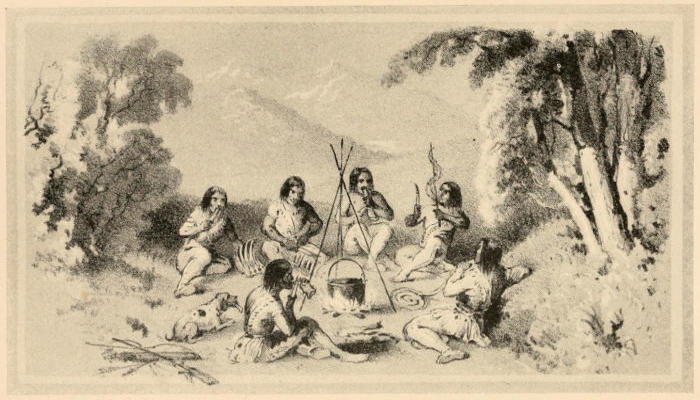
Hunters at the Buffalo Feast
I here beg the favor of a short digression from my subject. Coal abounds east of the Rocky {160} Mountains, on the borders of the Missouri and Yellow Rock, on the Sascatshawin and Athabaska. Saltpetre is found in abundance, and iron is not scarce in many parts of the mountains. I have already spoken of lead in the country of the “Koetenays,” the name of the river at the copper mine in the north, indicates its riches; bars of this precious metal are discovered among the rocks bordering the river. Rock salt is found in powder, and very plentiful in the Pays Serpent.[232]
The valley is picturesque and variegated; flocks of sheep and goats contribute to beautify the scenery. We find many tracks of the bears and buffaloes; on seeing the latter my party became animated; for the buffaloes’ flesh is, without contradiction, the most delicate of these regions. One is never tired of it. Hitherto, the animals of the mountains had abundantly satisfied our necessities, for the huntsmen killed no less than eighteen pieces, without counting the fowl and fish which are so plentiful in this country. The same evening the remainder of our provisions was consumed, and a buffalo chase was proposed for the following day. One of the sportsmen set out early, and at breakfast time we perceived him coming, with a round {161} fat cow; immediately the ribs, tripes, etc., honored the fire with their presence. The rest of the day was spent in seeking fresh provisions.
The 30th, we continued our route through the valley, where a rivulet of clear water meanders. It is similar to all the other valleys west of the mountains, agreeably diversified with meadows, lakes, and forests—the valley widens in proportion as one descends—the rocky banks disappear—the mountains decrease, and appear insensibly to commingle with one another. Some are covered with forests even to their tops, others present cones, elevated ramparts, covered with rich verdure.
The 4th October, after having traversed the great chain of mountains nineteen days in pursuit of the Black-Feet, we entered the vast plain, this ocean of prairies, inhabited by a multitude of roving savages, buried in the deepest superstition. The Black-Feet, Crows, Serpents, Arikaras, Assiniboins of the plains, the Sheyennes, Camanches, Sioux, Omahas, Ottos, Pawnees, Kants, Saucs, Ajouas,[233] etc., etc., are without pastors! We hope that Divine Providence has not deferred the epoch when the darkness now overwhelming these immense regions will give place to the beneficial light of {162} the gospel;—that worthy and zealous pastors will come to guide in the way of salvation these poor and unhappy children of the desert, who, during so many ages, have groaned under the dominion of the devil, and among whom the war-song and the cry of carnage never ceased to resound. There, we hope, will reign in their turn, peace and Christian charity, and the fragrance of divine love and praise ascend to the only true God.
The worthy Bishop of Juliopolis has established his See on the Red river, a tributary of the Winnepeg, amidst the possessions of the Anglo-Indians.[234] Already two of his zealous missionaries, Rev. Messrs. Thibault and Bourassa, have penetrated to the very foot of the Rocky Mountains, whilst other indefatigable priests have been employed, for many years, in extending the kingdom of God in this immense diocess. The population of Red River is about 5,500 souls, of whom 3,175 are Catholics. There are 730 houses inhabited. I had the honor of receiving a letter from the Rev. Mr. Thibault on my arrival in this latitude. He says:
“From the month of March to September last, I have labored among the mountain nations; they are well disposed to embrace the {163} faith. I cannot give you a better idea of these people than by comparing them to the Flatheads. I have baptized more than five hundred children and adults in the course of this mission. As soon as I find the opportunity of a water conveyance, I shall continue my labors among these good savages, and extend my route as far as McKenzie’s river. A rich harvest would be there found for many laborers in the sacred ministry, for this nation is populous and occupies a vast extent of country, without including several other nations I visited this summer. ‘Come, then, to us,’ said they, ‘we, also, shall be happy to learn the joyful news you have brought our brethren of the mountains; we are to be pitied, not knowing the word of the Great Spirit; be, therefore, charitable to us—come, teach us the way of salvation—we will listen to it.’
“My fellow-laborer, Bourassa, set out in September, to announce the Gospel to the Indians residing near the river de la Paix.”[235]
From Lake St. Anne, or Manitou, the ordinary residence of these two gentlemen, they extend their apostolic course to the different tribes on the rivers Athabaska and McKenzie, Peace river, and Slave lake.[236]
{164} Within the limits, as far as they have travelled, are found the Black-Feet, Crees, Assiniboins of the forest, of the mountains, Beaver Hunters, Flat-side Dogs, Slaves, and Deer-Skins.[237] (It is by these names that the different Indians are known among the whites and travellers.)
The great Indian district of the United States is (if I may say so) the only one deprived of spiritual succor and the means of salvation. It contains several hundred thousand savages. This vast territory is bounded on the north-west by the Anglo-Indian possessions—east by the Western States—south by Texas and Mexico—west by the Rocky Mountains. It contains many forts or trading houses, in which the greater number of persons employed are Canadian Catholics or French creoles. The principal of these forts are, Fort des Corbeaux, or Alexander, on the Yellow Stone, Fort la Ramee, on a branch of the river Platte, Fort Osage, on the river of the same name—Fort Pied-noir, or Lewis, at the mouth of the river Maria, Fort Union near the mouth of the Yellow Rock, Fort Berthold, Fort Mandan or Clark, near the mouth of the Little Missouri, Fort Pierre, Fort Look-out and Fort Vermillion at the mouth of this river, the other trading {165} houses among the Pottowatomies of Council Bluffs and of Belle-vue for the Ottos and Pawnees. The great depository which furnishes these Forts and receives all the peltry and buffalo hides, is kept at St. Louis.[238]
Monseigneur Loras, Bishop of Dubuque, has sent two priests among the Sioux, on the river St. Pierre, a tributary of the Mississippi.[239]
The Society of Jesus has a mission among the Pottowatomies on Sugar Creek, a tributary of the Osage river.[240] The Ladies of the Sacred Heart have an establishment here. During the summer of 1841, the late distinguished Madame de Galitzin, provincial of the Order in America, visited this section of the country for the purpose of founding, among these rude savages, a house of education, in which the hapless children of the desert now enjoy the benefit of being instructed in the Christian faith, of being formed to habits of industry and cleanliness, and acquiring a knowledge of those branches of education suited to their condition.—These two missions are located near the frontiers of the States, and are the only ones in this immense territory.
The upper Missouri, and all its branches as far as the Rocky Mountains, are without spiritual assistance {166}. Wherever the priest has passed in traversing the desert, he has been received with open arms among the tribes that rove over this country—alas! so long a time forgotten and neglected!
The evening of 4th October, I arrived at the Fort des Montagnes, belonging to the Hon. Hudson Bay Company, without having accomplished the object of my travels and my desires, namely, meeting the Black-feet.[241] The respectable and worthy commander of the Fort, Mr. Harriot, an Englishman by birth, is among the most amiable gentlemen I have ever had the pleasure of meeting. He invited, and received into his hospitable Fort the poor missionary, a Catholic and stranger, with politeness and cordiality truly fraternal. These qualities characterize all the gentlemen of the Hudson Bay Company, and although Mr. Harriot is a Protestant, he encouraged me to visit the Black-feet, who would soon arrive at the Fort, promising me to use all his influence with these barbarians to obtain me a friendly reception. He has resided many years among them, nevertheless he did not conceal from me that I should soon be exposed to great dangers. “We are in the hands of God—may His holy will be done.”
{167} I am, with the most profound respect and esteem, monseigneur, your very humble and obedient servant in Jesus Christ,
P. J. De Smet, S. J.
No. XII A. M. D. G.
Fort of the Mountains, October 30th, 1845.
Monseigneur,—A band of about twenty Crees, encamped near the Fort, came to shake hands cordially with me on my arrival. The joy my presence seemed to occasion them, proved that I was not the first priest they had seen. Moreover, the greater number wore medals and crosses. They informed me that they too had been so fortunate as to have a Black-Gown, (Rev. Mr. Thibault,) who taught them to know and serve the Great Spirit—and baptized all their little children, with the exception of three, who were absent on the occasion. These children were brought to me—I administered baptism to them, and at the same time to one of my guides, a Koetenay. During their stay at the Fort, I gave them instructions every evening.
Two Crees, of the same band and family, father and son, had been killed in a quarrel two {169} years since. The presence of the offending party for the first time since the perpetration of the murder, rekindled in the others that spirit of rancor and revenge so natural to an Indian’s breast, and there was every reason to apprehend fatal consequences from the old feud.
With the approbation of Mr. Harriot, I assembled them all in the Fort; the governor himself had the kindness to be my interpreter. He made a long discourse on the obligation and necessity of their coming to a sincere reconciliation; the matter was discussed in form, each Indian giving his opinion in turn, with a good sense and moderation that surprised me. I had the pleasure and satisfaction of seeing the calumet passed around the assembly. This is the solemn pledge of peace—the token of Indian brotherhood—the most formal declaration of the entire forgetfulness and sincere pardon of an injury.
The Cree nation is considered very powerful, and numbers more than six hundred wigwams. This tribe is one of the most formidable enemies of the Black-Feet, and continually encroaches upon the territory of its adversaries. The preceding year they carried off more than six hundred horses. The actual limit of the country {170} they traverse extends from the bases of the Rocky Mountains, between the two forks of the Sascatshawin, some distance beyond the Red River. Their turbulent and warlike spirit, and rapacity for plunder, especially for horses, are among the great obstacles which retard the conversion of the larger portion of this tribe.
The example of their brethren, who listen with docility to the exhortations of their zealous and indefatigable missionary will, we trust, produce fruit in due time, and be imitated by the entire nation.
To give you an idea of their military discipline, and of the profound superstition in which these unfortunate people are still immersed, I will relate to you some of their proceedings.
The Crees were meditating a deadly stroke upon the Black-Feet, and for this purpose they collected all their ready forces, amounting to more than eight hundred warriors. Before setting out in quest of the enemy, every species of juggling and witchcraft imaginable was resorted to, in order to secure the success of the expedition. It was decided that a young girl, with a bandage over her eyes, should be placed at the head of the Indian army, and thus blindfold, serve as a guide to the combatants. In case {171} of success, the heroine was destined to become the bride of the most valiant. According to the Oracle, none but the great chief himself had the privilege of shoeing or unshoeing her.
This concluded, they began their march, intoxicated with confidence and presumption, following this extraordinary guide over the hills and valleys, ravines, marshes, and swamps. One day she would direct her steps towards the north, the next to the south or west—the point of the compass mattered naught—the Manitou of war was supposed to guide her, and day after day the infatuated Crees continued to follow the steps of the blindfolded Indian. They had already penetrated far into the plain, when they were discovered by a party of seven Black-feet. The latter might easily have escaped under favor of the night, but the Partisan, or Black-foot Chieftain, a man of undaunted courage, determined to oppose this formidable force. With the aid of their poniards they made themselves a hollow, in which they took shelter.
The following morning, at day-break, the eight hundred champions surrounded their feeble prey. The first who pressed forward to dislodge them were driven back several times, with the loss of seven men and fifteen wounded. The failure of {172} ammunition at length put the Black-feet at the mercy of the Crees, by whom they were cut into pieces. The first engagement threw the victorious party into consternation, for they too numbered seven killed and fifteen wounded. They removed the bandage from the young heroine’s eyes, and the Manitous whom they had thought so propitious, being now judged unfavorable to their warlike projects, the warriors hastily dispersed, taking the nearest road back to their respective homes.
The Crees have rather a singular custom among them, and one contrary to the practice of other nations. They stain the faces of the warriors who fall in combat, clothe them in their richest ornaments, and thus expose them in places conspicuous to their enemies. They place near them their guns, bows and arrows, to show that in their death there was no cause for compassion; and this they do purposely that they may be cut into pieces—an opportunity which an enemy never suffers to escape, and which a Cree warrior regards as the height of his wishes. Other nations, on the contrary, carry off and conceal their dead, to save them from the rapacity and insults of their enemies, and to be cut into pieces, even after death, is {173} considered a great dishonor among them.—The Crees and Sauteux are allies, and considerably intermixed by reciprocal marriages. The latter form the most numerous and widely-diffused nation of these parts.—They are to be met with from the confines of Lower Canada even to the foot of the Rocky Mountains.[242]
This is also the nation of medicine, par excellence:—for all pretend to be jugglers, and sell their medicines and quackery at a high price. In consequence of this attachment to their old, superstitious practices, and the great profits they derive from them, the seed of the Divine Word has hitherto fallen upon an unprofitable soil. An adroit impostor who has been baptized, and who is, moreover, a great medicine man among them, has contributed not a little to keep his nation in an obstinate ignorance, which makes them prefer the shades of paganism to the beneficial light of the gospel. Falling one day into a species of lethargy, it was thought that he had expired—but recovering after a short time, he assembled his band, and told them the following story:
“Immediately after my death I repaired to the heaven of the white man, or Christians, where the Great Spirit and Jesus Christ dwell, {174} but they refused to admit me on account of my red skin. I then went to the country where the souls of my ancestors are, and there, too, I was refused admittance on account of my baptism. I am, therefore, come back to this earth, to renounce the promises I made in baptism and resume my medicine bag, hoping to expiate my former error by my sincere attachment to jugglery, and thus render myself once more worthy of the beautiful and spacious plains of that happy and delightful abode, where reigns everlasting spring, and numberless flocks and herds afford an abundant and everlasting subsistence to all the inhabitants of the Indian Elysium.”
This extravagant report which has been circulated throughout the whole tribe and among the neighboring people, has greatly contributed to attach them to their old customs and superstitions,—and make them turn a deaf ear to the instructions of their worthy missionary.
The Rev. Mr. Belcourt has, notwithstanding, succeeded in converting a considerable number, whom he has persuaded to renounce the illusions of their brethren, and united in a village at St. Paul des Sauteux, where they persevere fervently in all the practices of religion. The {175} number of faithful, in this spot, increases every year.[243]
At length, on the 25th October, thirteen Black-Feet arrived at the Fort. They saluted me with a politeness truly à la sauvage, rough and cordial, at the same time. The old chief embraced me quite tenderly when he learned the object of my journey. He was distinguished from his companions by his dress—being decorated from head to foot with eagles’ plumes, and wearing a large breast-plate in form of medallion, figured with blue, as a mark of distinction. He was profuse in attention to me, making me sit beside him whenever I went to visit them in their apartment—shaking me affectionately by the hand and amicably rubbing my cheeks with his scarlet-painted nose. He cordially invited me to his country, offering to be my guide and to introduce me to his people. The difference of physiognomy existing between the Indians inhabiting the plains east of the mountains and those near the upper waters of the Columbia, is as great as the stupendous rocks that separate them. The latter are remarkable for their mildness, serenity and affability, while cruelty, craft—the word blood, in fine, may be read in every feature of the Black-Foot Indian. {176} Scarcely could an innocent hand be found in the whole nation. The Lord, however, is all powerful—“from stones he can raise up children unto Abraham,” and, full of confidence in the treasures of His holy grace and mercies, I purpose to visit them. The essential point and my greatest perplexity is, to find a good and faithful interpreter; the only one now at the Fort is a suspicious and dangerous man:[244] all his employers speak ill of him—he makes fine promises. In the alternative of either renouncing my project or being of some utility to those poor, unfortunate Indians, I accept his services. May he be faithful to his engagement!
I have the honor to be, monseigneur, your very humble and very obedient servant in Jesus Christ,
P. J. De Smet, S. J.
No. XIII A. M. D. G.
Fort of the Mountains, October 30th, 1845.
The year 1845 will be a memorable epoch in the sad annals of the Black-Feet nation. It has been a year of disasters. In two skirmishes with the Flat-heads and Kalispels, they lost twenty-one warriors. The Crees have carried off a great number of their horses, and twenty-seven scalps. The Crows have struck them a mortal blow—fifty families, the entire band of the petite Robe, were lately massacred, and one hundred and sixty women and children have been led into captivity.[245]
What a dreadful state for these unfortunate beings. In the first excitement, numbers of the captives were sacrificed by the Crow squaws to the manes of their husbands, brothers, fathers, or children. The survivors were condemned to slavery. The smallpox shortly after made its appearance in the conquerors’ camp, and spread {178} rapidly from lodge to lodge. The Black-Feet had suffered from this scourge a few years previous, and thousands had fallen victims to it.
The Crows, therefore, interrogated their captives to know by what means they had escaped death. A dark spirit of vengeance seized the latter; they counselled cold baths as the only efficacious remedy, to stop the progress of the disease. The sick immediately plunged into the water, and mothers went to the river to bathe their little children. Some plunged into their graves; others gave up their last sigh while endeavoring to reach the shore—and disconsolate mothers returned to their cabins with dead or expiring infants in their arms. Cries of despair succeeded to the shouts of victory—desolation and mourning replaced the fanatic, barbarous joy of the Crows. Death visited every tent of the victorious camp!
The tradition of man’s creation and future immortality exists among most of the Indian tribes; I have had the opportunity of visiting and questioning them on the subject. Those who live by fishery, suppose their Heaven to be full of lakes and rivers, abounding in fish, whose enchanted shores and verdant islands produce fruits of every kind.
{179} I encamped on the banks of two lakes to the east of the Rocky Mountains, which the Black-Feet call the lake of men and the lake of women. According to their traditions, from the first of these issued a band of young men, handsome and vigorous, but poor and naked. From the second an equal number of ingenious and industrious young women, who constructed and made themselves clothing. They lived a long time separate and unknown to each other, until the great Manitou Wizakeschak, or the old man, (still invoked by the Black-Feet,) visited them; he taught them to slay animals in the chase, but they were yet ignorant of the art of dressing skins. Wizakeschak conducted them to the dwelling of the young women, who received their guests with dances and cries of joy. Shoes, leggins, shirts, and robes, garnished with porcupine quills, were presented them. Each young woman selected her guest, and presented him with a dish of seeds and roots; the men, desiring to contribute to the entertainment, sought the chase, and returned loaded with game. The women liked the meat, and admired the strength, skill, and bravery of the hunters. The men were equally delighted with the beauty of their trappings, and admired the industry of the women. {180} Both parties began to think they were necessary to each other, and Wizakeschak presided at the solemn compact in which it was agreed that the men should become the protectors of the women, and provide all necessaries for their support: whilst all other family cares should devolve upon the women.
The Black-Feet squaws often bitterly complain of the astonishing folly of their mothers in accepting such a proposition; declaring, if the compact were yet to be made, they would arrange it in a very different manner.
The Black-Foot heaven is a country composed of sandy hills, which they call Espatchekie, whither the soul goes after death, and where they will find again all the animals they have killed, and all the horses they have stolen. The buffalo, hind, and stag, abound there. In speaking of the departed, a Black-Foot never says, such a one is dead, but Espatchekie etape—to the Sand hills he is gone.
Fort Auguste, on the Saschatshawin, December 31st, 1846.
Monseigneur,—I arranged with the thirteen Black-Feet of whom I spoke in my last, that {181} they should precede me among their people, to pave the way, as it were, and prepare their minds to receive me.—Everything seemed propitious, and accordingly, on the 31st of October, I took leave of the friendly Mr. Harriot. I was accompanied by my interpreter, a young Metif of the Cree nation, who had charge of the horses. Notwithstanding his good resolutions, my interpreter did not long leave me in doubt of his true character. The wolf cannot remain concealed beneath the sheep’s clothing. He became sullen and peevish, always choosing to halt in those places where the poor beasts of burden could find nothing to eat, after their long day’s journey. The farther we penetrated into the desert, the more and more sulky he became. It was impossible to draw from him a single pleasant word, and his incoherent mutterings and allusions became subjects of serious apprehension. Thus passed ten sorrowful days; my last two nights had been nights of anxiety and watching; when fortunately, I encountered a Canadian, on whom I prevailed to remain with me some time. The following day my interpreter disappeared. Although my situation was extremely precarious in this dangerous desert, without interpreter, without guide, {182} yet I could not but feel relieved of a heavy burden by the departure of this sullen and gloomy fellow. Had it not been for my opportune meeting with the Canadian, it is probable I should not have escaped his deep laid scheme against me.
Friends and travellers in the desert, beware of choosing for your guide, or placing your dependence on a morose Metif, especially if he has been for some time a resident among the savages; for such men usually possess all the faults of the white man joined to the cunning of the Indian. I determined to continue my route in search of a Canadian interpreter, whom we understood was some distance in advance of us on the same road. For eight successive days we wandered on in that labyrinth of valleys, but in vain; although in the heart of their territory, neither the Canadian nor the Black-Feet were to be found. Large marauding parties of the Crees were beating the country at that time, and it appeared evident from the tracks, that they had carried everything before them. It snowed without intermission during four days;—our poor horses were nearly exhausted—my wallet contained nothing but crumbs—the passage from the east to the western {183} side of the mountains was become impracticable, and I had no alternative, but to repair to one of the forts of the Hudson Bay Company, and beg hospitality during the inclement season.