THE REASONS FOR WHICH OBJECTS ARE DECORATED.
Reading edition
In the Introduction I referred to what were termed certain needs which constrained man to artistic effort. These were art, information, wealth, and religion, and they will now be treated as briefly as may be, since it is impossible to deal adequately with them.
I. Art.
Æsthetics is the study and practice of art for art’s sake, that is, for the pleasurable sensations which are induced by certain combinations of form, line, and colour. It does not signify for our purpose how the feeling for art has been obtained, nor is an analysis of the sensations necessary. All men have this sense, varying from a rudimentary to an exalted extent. Though it is naturally the basis of all art work, it does not follow that the æsthetic sense has been the sole cause of decorative work. Religion and the desire to convey information have both imitated and controlled pictorial and decorative art, but the artistic sense has all along exerted its influence to a greater or less extent. The artistic feeling has endeavoured to cast a glamour of beauty over the crude efforts of religion and science.
In the scheme of the life-history of pictorial or decorative designs given on p. 8, I have considered only those which have originated from various combinations of originally solitary figures. Separate portraits whether of men or animals, either in the flat or in the round, have been omitted as they remain in the lowest place of development, though they may attain to the highest excellence of art. Those who have followed the brilliant researches in classical archæology will appreciate what I mean by the life-history of representations. The origin, rise, glorious consummation, and decadence of Greek statuary is a striking illustration of my theme.
Figures may be grouped not only to convey a sentiment, as in a picture, but merely for decorative effect. The artist in this case usually at once adopted a conventional treatment. In some instances strict realism may be appropriate, but in the greater number of conditions it is most inappropriate.
Walls, fabrics, and platters have from time immemorial been decorated in this manner. Many books have been written illustrating this branch of art and laying down principles of design, and the reader is referred to these, as this subject does not fall within the scope of the present essay.
I would like to point out in this place that there is a very instructive field for study in the consideration of the decorative methods of various peoples. The way in which areas are decorated, the idea of symmetry, and such-like subjects; for example, the essence of Japanese decorative art is asymmetry, and the results are charming to our eyes although we have been reared amongst symmetrical designing. Symmetry may be exhibited in the equal balancing of dissimilar designs, as is commonly done by Oriental artists, or in the mechanical duplication in relation to a median line which is so dear to European decorators.
The style of the decorative art of a savage or barbaric people is a legacy and its perpetuation is usually binding, not merely by custom but more frequently by religion. When all the various factors are taken into account, one finds that the æsthetic sense of a savage artist is not so very different after all from that of his civilised fellow-craftsman, and one can see in the disposition or the introduction of certain elements in a design, that both are actuated by the same æsthetic sense of what is suitable,—both are, in fact, artists.
In the section on Physicomorphs I allude to the rarity of landscape drawing among savage peoples, and give an illustration (Fig. 66) of one, from Torres Straits, which occurred casually on a bamboo pipe; there is another but poorer landscape from the same locality in the Oxford University Museum. Early attempts, such as these, at pictures are especially interesting as illustrating the working of the mind of the artists.
It is not within the scope of this book to trace the history either of pictorial art or of individual pictures. The genesis of a great picture is most interesting, and it may occasionally be traced owing to the fortunate preservation of the artist’s sketches and studies. It often happens that some of the figures in the finished picture have lost the vitality which they had in the sketch stage, even such a great artist as Raffael could not always reproduce the spirit of his own work.
If the originating artist lost something out of his own handiwork, it is no wonder that a copyist should lose more, especially when the latter may not have access to the original, but base his reproductions on copies several times removed from it. A late stage of degeneration of pictorial art, through more or less incompetent copying, is seen in the cheap lithographs which occupy, without adorning, the walls of houses of the country folk, many of which, like the analogous frescoes of Pompeii, are the pictorial echoes of the works of masters of the craft.
II. Information or Communication.
I have already referred to the difficulty of finding a term which will express all that might be dealt with in this section.
In order to convey information from one man to another, when oral or gesture language are impossible, recourse must be had to pictorial signs in some form or another.
Probably one of the earliest of this needs was that of indicating ownership, and it may be that many devices on primitive implements and utensils have this as one reason for their existence, although the nature of the ornamentation may be owing to quite a different reason.
As a matter of fact we know very little about owners’-marks, but it is possible that while an object may frequently be decorated with a clan or tribal device, the particular variety or delineation of that figure will serve to distinguish the ownership of the object.
Allied to owners’-marks are trade-marks; on this subject, too, information is lamentably deficient, but we know that these do occur amongst primitive folk (p. 48, Fig. 23).
Most savages employ a more elaborate method of conveying information, and this picture-writing, as it is called, has been of such importance in the history of the world, especially in its later developments; that it deserves a more detailed treatment.
Pictographs.
A pictograph is writing by means of a picture. It records and conveys a fact or an idea by graphic means, without the employment of words or letters. As pictography belongs to a low plane of culture, so far as the visual communication of information is concerned, the representations are generally very crude. By no means should they be regarded as typical examples of the artistic skill of the people who execute them. They are intended for picture-writing, not for pictures. An examination of pictographs shows at once that only essential or salient characters are noted, and when objects are frequently repeated they become conventionalised, and in their later forms cannot be regarded as in any sense objective portraitures.
Nowhere in the world are pictographs so much employed as in America, and fortunately it is possible to gain precise information respecting their signification. Colonel Mallery[115] has devoted himself to an exhaustive study of North American pictography, and I cannot do better than briefly detail a few of his deductions.
“A general deduction, made after several years of study of pictographs of all kinds found among the North American Indians, is that they exhibit very little trace of mysticism or of esotericism in any form. They are objective representations, and cannot be treated as ciphers or cryptographs in any attempt at their interpretation. A knowledge of the customs, costumes, including arrangement of the hair, paint, and all tribal designations, and of their histories and traditions, is essential to the understanding of their drawings. Comparatively few of their picture signs have become merely conventional. A still smaller proportion are either symbolical or emblematic. By far the larger part of them are merely mnemonic records, and are treated of in connection with material objects formerly and, perhaps, still used mnemonically.
“It is believed that the interpretation of the ancient forms is to be obtained, if at all, not by the discovery of any hermeneutic key, but by an understanding of the modern forms, some of which fortunately can be interpreted by living men; and when this is not the case the more recent forms can be made intelligible, at least in part, by thorough knowledge of the historic tribes, including their sociology, philosophy, and arts, such as is now becoming acquired, and of their sign language.
“It is not believed that any considerable information of value in an historical point of view will be obtained directly from the interpretation of the pictographs in North America. They refer generally to some insignificant fight or some season of plenty or famine.
“Ample evidence exists that many of the pictographs, both ancient and modern, are connected with the mythology and religious practices of their makers.
“Some of them were mere records of the visits of individuals to important springs or to fords on regularly established trails. In this respect there seems to have been, in the intention of the Indians, very much the same spirit as induces the civilised man to record his initials upon objects in the neighbourhood of places of general resort.
“One very marked peculiarity of the drawings of the Indians is that within each particular system, such as may be called a tribal system, of pictography, every Indian draws in precisely the same manner. The figures of a man, of a horse, and of every other object delineated, are made by every one who attempts to make any such figure with all the identity of which their mechanical skill is capable, thus showing their conception of motive to be the same” (pp. 15-17; all the quotations are from the Fourth Ann. Rep.).

Fig. 112.
Pictograph of a lasso, Dakota Winter Count, 1812-13; after Mallery.
The purposes for which pictography has been employed by the North American Indians are:—
1. Mnemonic.—For the remembrance of the order of songs, the figurative or representative pictures remind the singers of the order of the stanzas previously committed to memory; as well as for traditions, treaties, and the records of events. Among the most interesting of the latter are the Dakota Winter Counts. The Dakotas reckon time by winters, and apply names to them instead of numbering them from an era. Each name refers to some notable occurrence of the year to which it belongs, and ideographic records of these occurrences were formerly painted in colours on the hides of animals. A single example will suffice, it is for the year 1812-13. “Many wild horses caught,” or “catching wild-horses winter.” The wild horses were first run and caught by the Dakotas. The device is a lasso. The date is of value, as showing when the herds of prairie horses, descended from those animals introduced by the Spaniards, had multiplied so as to extend into the far northern regions. The Dakotas undoubtedly learned the use of the horse, and perhaps also of the lasso, from southern tribes ... in only two generations since they became familiar with the horse they have become so revolutionised in their habits as to be utterly helpless, both in war and the chase, when deprived of that animal” (p. 108).
2. Notification.—The pictographs of this division may be grouped as follows—(1) Notice of departure, direction, etc.; (2) notice of condition, suffering, etc.; (3) warning and guidance; (4) charts of geographical features; (5) messages or communications; (6) record of expedition, and so forth.
The following (Fig. 113) is an example of a notice of departure on a hunting expedition.[116] Similar ones are made by the natives to inform their visitors or friends of their departure for a certain purpose. They are depicted upon strips of wood, which are placed in conspicuous places near the doors of the habitations.

Fig. 113.—Alaskan notice of a hunt; from Mallery, after Hoffman.
1. The speaker, with the right hand indicating himself, and with the left pointing in the direction to be taken.
2. Holding a boat paddle—going by boat.
3. The right hand to the side of the head, to denote sleep, and the left elevated with one finger, to signify one—one night.
4. A circle with two marks in the middle, signifying an island with huts upon it.
5. Same as No. 1.
6. A circle to denote another island.
7. Same as No. 3, with an additional finger elevated, signifying two—two nights.
8. The speaker with his harpoon, making the sign of a sea-lion with the left hand. The flat hand is held edgewise with the thumb elevated, then pushed outward from the body in a slightly downward curve.
9. A sea-lion.
10. Shooting with bow and arrow.
11. The boat with two persons in it, the paddles projecting downward.
12. The winter, a permanent habitation of the speaker.
The following is a translation of the native account:—“I there go that island, one sleep there; then I go another that island, there two sleeps; I catch one sea-lion, then return place mine.”
“Hunters who have been unfortunate, and are suffering from hunger, scratch or draw upon a piece of wood characters similar to those figured (Fig. 114), and place the lower end of the stick in the ground on the trail where the greatest chance of its discovery occurs. The stick is inclined toward the locality of the habitation.
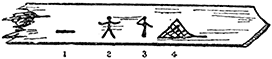
Fig. 114.—Pictograph of starving hunters, Alaska; after Mallery.
“1. A horizontal line, denoting a canoe, showing the persons to be fishermen.
“2. An individual with both arms extended, signifying nothing, corresponding with the gesture for negation.
“3. A person with the right hand to the mouth, signifying to eat, the left hand pointing to the house occupied by the hunters.
“4. The habitation.
“The whole signifies that there is nothing to eat in the house. This is used by natives of Southern Alaska.”
Lean-Wolf, of the Hidatsa, who drew the picture of which Fig. 115 is a fac-simile, made a trip on foot from Fort Berthold to Fort Buford, Dakota, to steal a horse from the Dakotas encamped there. The returning horse-tracks show that he attained the object in view and that he rode home. The following explanation of characters was made to Dr. Hoffman, at Fort Berthold, in 1881:—
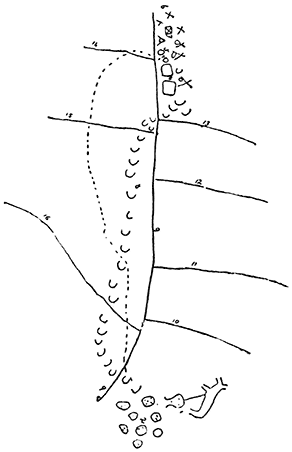
Fig. 115.—Lean-Wolf’s Map, Hidatsa; after Mallery.
1. Lean-Wolf, the head only of a man to which is attached the outline of a wolf.
2. Hidatsa earth lodges, circular in form, the spots representing the pillars supporting the roof. Indian village and Fort Berthold, Dakota.
3. Human footprints; the course taken by the recorder.
4. The Government buildings at Fort Buford (square).
5. Several Hidatsa lodges (round), the occupants of which had intermarried with the Dakotas.
6. Dakota lodges.
7. A small square—a white man’s house—with a cross marked upon it, to represent a Dakota lodge. This denotes that the owner, a white man, had married a Dakota woman who dwelt there.
8. Horse-tracks returning to Fort Berthold.
9. The Missouri River.
10-16. Tule Creek, Little Knife River, White Earth River, Muddy Creek, Yellowstone River, Little Missouri River, Dancing Beard Creek.
3. Designation.—This group embraces tribal, clan and personal names, marks, status of individual and signs of particular achievements.
The clan, or gentile, designations are totems; these are depicted in the funeral pictographs to the exclusion of the personal names; the latter are not indicative of an Indian’s totem.
In No. 1 of the last figure we have the usual signature of Lean-Wolf. During his boyhood he had another name.
4. Religious.—Comprising mythic personages, shamanism dances and ceremonies, mortuary practices, grave posts, charms, etc.
5. Customs, Daily Life and Habits.—The accompanying figure is from a carving made of a piece of walrus tusk and represents incidents in the life of an Alaskan native. The special purport of some of the characters and etchings is not apparent.
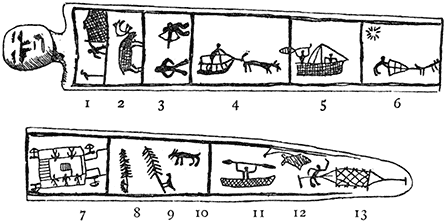
Fig. 116.—Ivory carving with records, Alaska; after Mallery.
1. A native with his left hand resting against a house. To the right is a “shaman stick” surmounted by the emblem of a bird, a “good spirit,” in memory of some departed friend (? of his wife).
2. A reindeer.
3. One man, the recorder, shot and killed another with an arrow.
4. A trading expedition with a dog sledge.
5. Is a sail boat, although the elevated paddle signifies that that was the manner in which the voyage was best made.
6. A dog-sled with the animal hitched up for a journey. Above is the sun.
7. A sacred lodge. The four figures at the outer corners of the square represent the young men placed on guard armed with bows and arrows, to keep away the uninitiated. Inside are the members of the band dancing; the fire-place is in the centre. The angled lines extending from the right side of the lodge to the partition line are a plan of the subterranean entrance to the lodge.
8. A pine tree, up which a porcupine is climbing.
9. A pine tree, from which a woodpecker is extracting larvæ for food.
10. A bear.
11. The recorder in his boat, holding aloft his double-bladed paddle to drive fish into a net.
12. An assistant fisherman driving fish into the net.
13. The net.
The figure over the man (No. 12) represents a whale, with harpoon and line attached, caught by the narrator.
6. Historical.—Colonel Mallery says: “It is very difficult, if not impossible, to distinguish in pictographs, or indeed orally, between historical and traditional accounts obtained from Indians.... The winter counts, while having their chief value as calendars, contain some material that is absolute and veritable tribal history.”
7. Biographic.—Pictographs are very common either of a continuous account of the chief events in the life of the subject of the sketch, or of separate accounts of some particular exploit or event in the life of the person referred to.
In this and in another memoir[117] Colonel Mallery calls attention to the fact that it is necessary to distinguish between different kinds of pictorial signs, but this becomes more difficult when the characters have become conventionalised. They may be classified under—1. Pictorial Signs; 2. Emblems; 3. Symbols.
1. The representation of any object when it is intended to express that object is a pictorial sign; for example, the figure of a fish in a pictograph would usually refer to fish in general or to some particular species of fish. The pictorial translation of a personal name, such as “Lean-Wolf” (Fig. 115, 1), comes under this heading.
2. Tribal signs, personal insignia, etc., are emblems; and these do not necessarily require any analogy between the objects representing and the objects or qualities represented, but may arise from pure accident. The representation of a totem belongs to this category, so that under certain conditions a drawing would not refer to any actual fish or that the individual was named “fish,” but that he belonged to the fish clan; it was emblematic of his clan or his family group, like most of our armorial bearings. Tribal signs among savage peoples are emblems in the same way that the rose, thistle, leek, and shamrock are the emblems of the main components of the British Islands. As Mallery points out, “After a scurrilous jest the beggar’s wallet became the emblem of the confederated nobles, the Gueux of the Netherlands; and a sling, in the early minority of Louis XIV., was adopted from the refrain of a song by the Frondeur opponents of Mazarin.”
3. “Symbols are less obvious and more artificial than mere signs, they are usually conventional, and are not only abstract but metaphysical, and often need explanation from history, religion, and customs. They do not depict but suggest objects; do not speak directly through the eye to the intelligence, but presuppose in the mind knowledge of an event or fact which the sign recalls. The symbols of the ark, dove, olive-branch, and rainbow would be wholly meaningless to people unfamiliar with the Mosaic or some similar cosmology, as would be the cross and the crescent to those ignorant of history. The last-named objects appeared in the class of emblems when used in designating the conflicting powers of Christendom and Islamism.” Among the North American Indians “the pipe is generally the symbol of peace, although in certain positions and connections it sometimes signifies preparation for war, and again subsequent victory. The hatchet is a common symbol for war, and closed hands or approaching palms denote friendship. The tortoise has been clearly used as a symbol for land.” Many pictorial signs can be used as emblems, and both can be converted into symbols or explained as such by perverted ingenuity. An interesting example of the last is seen in the early Christian conceit of the portraiture of a fish used for the name and title of Jesus Christ. This is based on the Greek word ιχθυς “an acrostic composed of the initials of the several Greek words signifying that name and title. This origin being unknown to persons whose religious enthusiasm was in direct proportion to their ignorance, they expended much rhetoric to prove that there was some true symbolic relation between an actual fish and the Saviour of men. Apart from this misapplication, the fish undoubtedly became an emblem of Christ and of Christianity.”[118]
An interesting example of the transformation of a symbol into an emblem is found in the case of the triskele or triquetra. This is now recognised to be a variant of the tetraskele, fylfot, gammadion, or swastika, as it is variously called. Originally this was a sun-symbol, but many other meanings were doubtless associated with it. The triskelion “first appears on the coins of Lycia, about B.C. 480; and then on those of Sicily, where it was adopted by Agathocles, B.C. 317-307, but not as a symbol of the morning, mid-day, and afternoon sun (‘the Three Steps of Vishnu’), but of the ‘three-sided’ or rather ‘three-ended’ or ‘three-pointed’ (triquetrous) land of Trin-akria, i.e., ‘Three-Capes,’ the ancient name of Sicily; and finally, from the seventeenth century, on the coins of the Isle of Man;”[119] where covered with chain armour, but without spurs, it was introduced by Alexander III. of Scotland in 1266, when that prince took over the island from the Norwegians; he having become familiar with the device at the English Court of Henry III. (1216-72), whose son Edmund was for a short time styled King of Sicily, and who quartered the Sicilian arms with the royal arms of England.[120] The triquetra is also met with in the armorial bearings of several noble families in England, Germany, Switzerland, and Poland, but now the legs are appropriately clothed in armour and spurs are added; probably these are relics of the Crusades. Truly “the Three Legs of Man” have run afar not only in historical time and geographical space, but also in the unseen world of symbolism.
In the section devoted to Religion I deal with the history and migration of the fylfot, one of the most widely distributed symbols, as this particular instance forms a good example of the method which should be adopted in studying symbols and their meaning.
Pictography is so obvious a means for conveying information that there is no difficulty in supposing it to have originated independently among different peoples. Its use is, and has been, very widely spread.
Petroglyphs are known from great antiquity in Europe and Asia. They are still employed in Australia; they are found in New Zealand, but most of these, like many of those which scattered throughout the continent of Australia, are comparatively ancient. They are common in some parts of South Africa, where they are due to the artistic impulses of the Bushmen; neither the Kafirs nor the Hottentots paint human and animal forms on the rocks. As petroglyphs are much more permanent than pictographs on more perishable materials, they are more likely to be preserved from ancient times, but it is probable that the latter were actually of more frequent occurrence.
There is no single system of pictography. Everywhere a figure of a man means a man, and that of a tree stands for a tree, and to this extent pictographs can be deciphered by any one. More precise information can be gleaned when the figures are provided with some unmistakable determinative, and are in a realistic attitude. In the vast majority of cases a native interpreter is required to explain the exact significance of the figures, or of the event which they commemorate. Once explained, the representations are usually found to be sufficiently appropriate. Although the meaning of simple pictographs may be guessed at readily enough, the elucidation of complex representations is a very different matter, as there are usually some signs, symbols, or determinatives of which the significance is unknown.
In attempting to decipher pictographs, not only is it necessary to have a thorough knowledge of the people who made them, but it must be borne in mind that characters substantially the same, or “homomorphs” (to use Colonel Mallery’s term) made by one set of people, have a different signification among others. Further, differing forms (“symmorphs”) for the same general conception or idea may occur. It is usually comparatively easy for any one to get a meaning out of a pictograph; but it is quite a different matter whether that was the meaning which the inscriber intended to convey.
I have dwelt at some length on pictographs, or ideograms, as they are used to so large an extent by backward peoples to convey ideas; but this is only the threshold of a much larger and more important matter, the Art of Writing.
These early steps, as has already been mentioned, have been traversed by various peoples, but fewer have attained the next stage, while the last has proved a laborious and tedious effort. “To invent and to bring to perfection the score or so of handy symbols for the expression of spoken sounds which we call our alphabet, has proved to be the most arduous enterprise on which the human intellect has ever been engaged. Its achievement tasked the genius of the three most gifted races of the ancient world. It was begun by the Egyptians, continued by the Semites, and finally perfected by the Greeks. From certain Egyptian hieroglyphic pictures, which were in use long before the Pyramids were erected, it is possible to deduce the actual outlines of almost every letter of our modern English alphabet.”[121]
The stages through which alphabetic writing has passed are as follow:—
1. Pictographs.—Pictures or actual representations of objects.
2. Ideograms.—Pictorial symbols, which are used to suggest objects or abstract ideas.
Phonograms.—Graphic symbols of sounds. They have usually arisen out of conventionalised ideograms, which have been taken to represent sounds instead of things.
3. (A.) Verbal signs, representing entire words.
4. (B.) Syllabic signs which stand for the articulations of which words are composed.
5. Alphabetic Signs or Letters, which represent the elementary sounds into which the syllable can be resolved.
1. The least advanced of men can convey information, that is, they can write by means of Pictographs.
2. Probably all of them also employ more or fewer symbols or Ideograms, such as the depicting of a turtle for “land” by the North American Indians.
The next stage is that in which from pictures which represent things or ideas were derived pictures which represent sounds or Phonograms.
Our children, of their own initiative, to amuse themselves, pass through the two earlier stages of writing. The stage we are now considering is a common amusement for children, in the kind of conundrum known as the rebus. “In the rebus the picture of an object is taken to denote any word or part of a word which has the same sound as the name of the thing pictured. As in the well-known rebus in which the sentence, ‘I saw a boy swallow a gooseberry,’ is represented by pictures of an eye, a saw, a boy, a swallow, a goose, and a berry. If, for instance, like the ancient Egyptians, we were to adopt a circle with a central dot as our ordinary written symbol for the sun, this would be an ideogram. But if we were to go on, and after the Egyptian or Chinese method, were to use the same symbol to express also the word ‘son,’ we should have a phonogram of that primitive type which has repeatedly served to bridge over the gap between picture ideograms and phonetic characters.”
3. In all languages there are certain monosyllabic words which are pronounced alike, but which have different significations, for example, stork, stalk (noun and verb). In order to indicate which was intended in phonography, it would be necessary to add a determinative or explanatory ideogram. Thus, if a figure of the bird represented the first, the same figure of a bird with a flower or some leaves by its side would indicate a stalk, and a pair of legs by the side of another bird would determinate the action of stalking. The Chinese to the present day write in this cumbrous way, as used to do the ancient Egyptians and Assyrians.
There is no need, however, to invent a rebus to show what one is when Egyptian hieroglyphics are full of them. I take the following from Dr. Isaac Taylor. The picture of a lute was used symbolically by the Egyptian scribes to denote “excellence.” It then came to stand as a phonogram to express the word nefer, “good.” But in the Egyptian language this sound represented two homophonic [similarly pronounced] words, nefer, “good,” and nefer, “as far as.” Hence we find that the character may be used as a pictorial ideogram [pictograph] to represent a lute, and as a symbolic ideogram to mean excellence; then as a phonogram for the preposition nefer, and lastly as a syllabic sign to denote ne, the first syllable of the word nefer.
4. The problem of phonetic denotation having thus been solved, the syllabic signs were combined so as to form compound phonograms on the principle of the rebus. For example, the name of lapis lazuli was khesteb. Now the word khesf meant to “stop,” and the syllable teb denoted a “pig.” Hence the rebus “stop-pig” was invented to express graphically the name of lapis lazuli, and this is figured by the picture of a man stopping a pig by pulling at its tail.
The Japanese system of writing illustrates the later development. They learnt the art of writing from the Chinese, but as their language is polysyllabic, while the Chinese is essentially monosyllabic, “the Chinese characters which are verbal phonograms could only be used for the expression of the polysyllabic Japanese words by being treated as syllabic signs. A number of characters sufficient to constitute a syllabary having been selected from the numerous Chinese verbal phonograms, it was found that the whole apparatus of determinatives (or ‘keys,’ radicals, or ‘primitives,’ as they are termed in describing Chinese writing) might be rejected, being no longer indispensable to the reader. By these two changes an almost incredible simplification of the Chinese writing was effected. But though syllabism is a great advance on a system of verbal phonograms, yet it is necessarily somewhat cumbrous, owing to the considerable number of characters which are required.”
Although the Japanese have invented one of the best syllabaries which has ever been constructed, the development stopped short there. “The fact that during more than a thousand years it should never have occurred to a people so ingenious and inventive as the Japanese to develop their syllabary into an alphabet, may suffice to show that the discovery of the alphabetic principle of writing is not such an easy or obvious a matter as might be supposed.”
5. The final step consists in employing a sign to represent a sound. It is a more refined analysis of a word, and this gives simple phonetic elements, few in number, but which can be indefinitely combined.
The ancient Egyptians curiously just stopped short of the final stage; they developed alphabetical signs more than four thousand years B.C., but failed to make independent use of them. Their innate conservatism appeared to paralyse further growth; truly the gods have not given all the gifts to any one man, for they (like Hannibal) did not know how to make use of their victory. When a word was alphabetically written a phonogram was added to explain it, and an ideogram (or pictograph) was added to explain the phonogram. The word as finally written was an accretion of various stages in its own evolution.
Those who would like to trace the processes by which one alphabet has been developed must be referred to Dr. Taylor’s great work, from which I have abstracted so much.
For the sake of convenience Egyptian scribes developed a hieratic writing from the hieroglyphics. Strangely enough this was twice accomplished, the early Hieratic was truly cursive and much bolder than the later and more delicate, though less modified Hieratic. The former was invented before the period of the Hyskos or Shepherd Kings, and the latter, or Theban Hieratic, arose in the succeeding Ramesidan dynasty.
The Semites, who dwelt in the Delta of Lower Egypt during the five or six centuries of the Hyskos dynasty, seized on the alphabetic symbols of the cursive Hieratic, which was the secular writings as opposed to the sacred hieroglyphs. Their language and mode of thought being different from that of the Egyptian scribe, and having no sacred traditions to hamper them, they were able to break away from the trammels of antiquity. They were wise enough to drop the useless lumber of the phonogram and ideogram, and so they dissected out, as it were, the alphabet from the cursive Hieratic. This was done in order to have a ready and simple method for recording business transactions. Along with their wares the Phœnicians distributed along the shores of the Mediterranean this far more valuable acquisition. The gift of the knowledge of letters with its vast potentialities more than counterbalanced the sharp practices of these keen traders.
It was reserved for yet another people, the Greeks, to perfect the alphabet they had learnt from the Phœnicians to an extent which the Semites were unable to accomplish, and this improvement in notation enabled them to register thoughts more ennobling than the records of commerce. It is scarcely conceivable that Greece could have risen to her intellectual pre-eminence if she had been shackled with phonographic writing. Evolution in notation is necessary for the evolution of mental processes.
The evolution of the art of writing clearly shows that it was expedient for the utilitarian to destroy the æsthetic, for it must be admitted that the hieroglyphics of Ancient Egypt were the most decorative of all known writing symbols. Professor Flinders Petrie, in a lecture delivered at the Royal Institute, in May 1894, stated that “the Egyptian treatment of everything was essentially decorative; the love of form and drawing was in Egypt a greater force than amongst any other ancient people. Babylon and China, from want of sufficient artistic taste, allowed their pictorial writing to sink into a mere string of debased and conventional forms; the Egyptians, on the contrary, preserve the purely pictorial and artistic character of their hieroglyphs to the end. The hieroglyphs were a decoration in themselves; their very position in the sentence was subordinated to the decorative effect; the Egyptian could not be guilty of the barbarism seen on some of the Assyrian sculpture, where inscriptions were scrawled right across the work without regard to design. So far was this idea carried that many words or ideas were represented by two distinct characters, one wide and the other narrow and deep, so that the harmony of the design should not be broken by an unsuitable element. The result was that the Egyptians were rewarded by having the most beautiful writing in the world.”[122] The less the picture became like what it was intended to represent the more useful it became as a means for conveying thought. But in the new-found method of expression æsthetics has vastly gained, and from our present point of view we may regard as the final term of the series, vivid written descriptions of scenes and events or word-pictures.
III. Wealth.
When dealing with the decorative transformation of artificial objects I referred (p. 78) to the large axes which are made in some of the islands in the archipelagoes off the south-east peninsula of New Guinea, and I pointed out how the desire for a reputation for wealth appears to have resulted in the production of a useless article, which took a great deal of time to fabricate.
Mr. H. Balfour[123] gives a parallel example in the case of “the development of our own civic and state maces. In these the end which was originally the handle end has now become the ‘clubbed’ end, through the small crown, which originally embellished the handle, having gradually developed into the enormous head so characteristic of the modern ceremonial mace; the two ends have changed places, and the sometime ‘business’ end is now the smaller.”
An analogous modification often occurs in votive objects. In prehistoric as well as in recent times objects are dedicated to certain shrines. Sometimes these may be objects in actual use, but frequently they are specially made, and in order to increase their value they are made in some more precious material or with more elaborate workmanship. For example, votive axes have the blade decorated and even often perforated, so that it comes to be an elegant fretwork axe-blade, artistic and valuable but utterly useless for material purposes. This has happened amongst many peoples and at various times.
But there is also a reverse process which operates in votive offerings, which may partly be due to the idea that the deities or powers to whom the offerings are made care more for the idea of offering than for the object offered, as at a later stage it was recognised that “to obey is better than sacrifice, and to hearken than the fat of rams” (1 Samuel xv. 22). It must, however, be confessed that another consideration has probably been operative, and that is economy, and it is conceivable that this motive has led to the reason being assigned that the idea of the gift, or the essence of the gift, was all that was necessary.
It is superfluous to detail many examples, as the following will suffice to illustrate this retrograde tendency. It was formerly a widely-spread custom to sacrifice attendants for the dead. “In the seventeenth century the practice is described as prevailing in Japan, where, on the death of a nobleman, from ten to thirty of his servants put themselves to death. The Japanese form of modern survival of such funeral sacrifices is the substitute for real men and animals, images of stone, or clay, or wood, placed by the corpse.[124] The ceremonies (in China) of providing sedan-bearers and an umbrella-bearer for the dead, and sending mounted horsemen to announce beforehand his arrival to the authorities of Hades, although these bearers and messengers are only made of paper and burnt, seem to represent survivals of a more murderous reality.”[125] The Chinese, too, on certain occasions make mock money in paper and then burn it as an offering.
Associated with wealth is the evolution of money. Money is essentially a symbol of value; coin is always of less intrinsic worth than its nominal value, and as money transactions increase the nominal value bears absolutely no relation to the real value, as in the case of paper money.
In some parts of British New Guinea we find at the present time a very interesting intermediate stage between mere barter and the evolution of money.
I have elsewhere[126] pointed out that there is no money in Torres Straits; but certain articles have acquired a generally recognised exchange value. Some of the objects necessitate a considerable amount of skilled labour; others, such as certain shell ornaments, vary in value according to the size of the shell, although, of course, the labour in fabricating a small shell is very little less than that expended over a large one. I noticed that, as with our precious stones, a comparatively small increase in size greatly enhances the value. In the first case it is the labour that gives the value, in the second it is the rarity. Thus these objects cannot be regarded as money as they have an intrinsic value. Those most generally employed are the dibidibi, a round polished disc worn on the chest, and formed from the apex of a large cone shell (Conus millepunctatus); the waiwi or wauri, a shell armlet formed of a transverse section of the same shell; a wap or dugong harpoon, a long elegantly shaped instrument cut out of a tree; a canoe.
A good waiwi, one which can be worn on the arm of a man, is a very valued possession, the exchange value is a canoe or a dugong harpoon. I gathered that ten or twelve dibidibi are considered of equal value to any of the above. The ornaments vary in size and finish, and the value varies correspondingly, thus no table of equable exchange can be drawn up.
A wife was formerly rated at the highest unit of exchange, her value being a canoe, or a wap, or a waiwi.
Macgillivray[127] states that in 1849 an iron knife or a glass bottle (which, when broken into fragments form so many knives) was considered a sufficient price for a wife. Now the natives usually give trade articles to their prospective parents-in-law. My friend Maino, the chief of Tud, informed me that he paid for his wife, who came from the mainland of New Guinea, a camphor-wood chest containing seven bolts (i.e., pieces) of calico, one dozen shirts, one dozen singlets (jerseys), one dozen trousers, one dozen handkerchiefs, two dozen tomahawks, one pound of tobacco, one long fish spear, two fishing lines, one dozen hooks, and two pearl shells, and he finished up by saying, “By golly, he too dear!” If the above price was actually paid, there was some foundation for his exclamation. Once when he sold me something he particularly demanded a tomahawk in exchange, as he had to give one to his mother-in-law to “pay” for his last baby, and he did too. It appears that babies have to be paid for as well.
At the opposite end of British New Guinea, Sir William MacGregor informs us that at Pannaet (Deboyne Island), in the Louisiades, the canoes for which this island is famous are cut out with adzes of hoop-iron, but “they sell the canoes when made at from ten to fifty stone axes. They do not use the stone axe as a tool in this part of the country, but it still represents the standard of currency in great transactions such as the purchase of a canoe, or a pig, or in obtaining a wife. The natives always carefully explain that, as concerns the wife, the stone axes are not given as a payment for her, but as a present to the father of the girl. Steel tomahawks will, however, now be accepted, at least in some cases, in payment of a canoe, and no doubt the days of the currency of the stone axe for these and all other purposes are numbered” (July 1890).[128] In Misima (St. Aignan Island) also “they have entered the iron age, and appear to have entirely given up the use of the stone axe except as a medium for purchasing wives” (October 1888).[129]
The evolution of the money symbol is a very interesting history, and I would refer those who would like to inquire further into it to the masterly work by Professor Ridgeway.[130] In the following brief sketch of this question I draw largely from that book.
Among the Bahnars of Annam, who border on Laos, “everything,” says M. Aymonier, “is by barter, hence all objects of general use have a known relationship; if we know the unit, all the rest is easy.” After enumerating certain exchange values, he continues, “1 muk = 10 mats, that is to say, ten of those hoes which are manufactured by the Cedans, and which are employed by all the savages of this region as their agricultural implement. The hoe is the smallest amount used by the Bahnars. It is worth 10 centimes in European goods, and is made of iron.”[131]
“The Chinese likewise used hoes as money; but in the course of time the hoe became a true currency, and little hoes were employed as coins in some parts of China” (tsin, agricultural implements).[132]
At Ras-el-Fyk, in Dafour, the hoe also serves as currency,[133] and in West Africa “axes serve as currency; these are too small to be really employed as an implement, but are doubtless the survival of a period not long past when real axes served as money.”[134]
At the time when the Chinese made their great invasion into South-Eastern Asia (214 B.C.), they still were employing a bronze currency under the form of knives, which were 135 millimetres (5⅖ ins.) in length, bearing on the blade the character Minh, and finished with a ring at the end of the handle for stringing them. Under the ninth dynasty (479-501 A.D.), they used knives of the same form and metal, but 180 mm. (7⅕ ins.) in length, furnished with a large ring at the end of the handle and inscribed with the characters Tsy Ku’-u Hoa. Next the form of the knife was modified, the handle disappeared, and the ring was attached directly to the blade; but now, as weight was regarded of importance, its thickness was increased to preserve the full amount of metal, and the ring became a flat round plate pierced with a hole for the string.[135] Later on these knives became really a conventional currency,[136] and for convenience the blade was got rid of, and all that was now left of the original knife was the ring in the shape of a round plate pierced with a square hole. This is a brief history of the sapec (more commonly known to us as cash), the only native coin of China, and which is found everywhere from Malaysia to Japan.[137]
“Among the fishermen who dwelt along the shores of the Indian Ocean, from the Persian Gulf to the southern shores of Hindustan, Ceylon, and the Maldive Islands, it would appear that the fish-hook, to them the most important of all implements, passed as currency. In the course of time it became a true money, just as did the hoe in China. It still for a time retained its ancient form, but gradually became degraded into a single piece of double wire. These larins, made both of silver and bronze, were in use until the beginning of the last century, and bear legends in Arabic character. Had the process of degradation gone on without check, in course of time the double wire would probably have shrunk up into a bullet-shaped mass of metal, just as the Siamese silver coins are the outcome of a process of degradation from a piece of silver wire twisted into the form of a ring and doubled up, which probably originally formed some kind of ornament. The bullet-shaped tical is now struck as a coin of European form. Just as, perhaps, the silver shells of Burmah became the multiple unit of a large number of real cowries, so the fish-hook made of real silver came into use as a multiple unit, when the bronze fish-hook had already become conventionalised into a true coin.”[138]
“Every medium of exchange either has an actual marketable value, or represents something which either has, or formerly had, such a value just as a five-pound note represents five sovereigns, and the piece of stamped walrus skin, formerly employed by Russians in Alaska in paying the native trappers, represented roubles or blankets. This is an interesting parallel to the ancient tradition that the Carthaginians employed leather money” (p. 47).
To employ the language of geology, we have found evidence pointing to certain general laws of stratification. In Further Asia we have found a section which presents us with an almost complete series of strata, whilst in other places where we have been only able to observe two or three layers, we have nevertheless found that certain strata are invariably found superimposed upon others just as regularly as the coal seams are found lying over the carboniferous limestone. As soon as the primitive savage has conceived the idea of obtaining some article which he desires but does not possess, by giving in exchange to its owner something which the latter desires, the principle of money has been conceived.
Shells or necklaces of shells are found everywhere to be employed in the earliest stages. When some men began to make weapons of superior material, as for instance, axes of jade instead of common stone, such weapons naturally soon became media of exchange; when the ox and the sheep, the swine and the goat are tamed, large additions are made to the circulating media of the more advanced communities; then come the metals; the older ornaments of shells and implements of stone are replaced by those of gold (and much later by silver), and by weapons of bronze as in Asia and Europe, and by those of iron in Africa.
Copper and iron circulate either in the form of implements and weapons, such as the axes of West Africa, the hoes of the early Chinese and modern Bahnars, and the ancient Chinese knives, all of which remind us of the axes and half-axes in Homer; or in the form of rings and bracelets, like the manillas of West Africa and the ancient Irish fibulæ, or else in the form of plates or bars of metal, ready to be employed for the manufacture of such articles, as in the case of the iron bars of Laos, the iron discs of the Madis, and the brass rods of the Congo. Again, we are reminded of the mass of pig-iron which Achilles offered as a prize.
It is of the highest importance to observe that such pieces of copper and iron are not weighed, but are appraised by measurement. We shall find that it is only at a period long subsequent to the weighing of gold that the inferior metals are estimated by weight.
The custom of capturing wives, which prevails among the lowest savages, is succeeded by the custom of purchasing wives. The woman is only a chattel on the same footing as the cow or the sheep, and she is accordingly appraised in terms of the ordinary media of exchange employed in her community, whether it be in cows, horses, beads, skins, or blankets. Presently male captives are found useful both to tend flocks, and, as in the East and in the modern Soudan, to guard the harem.
With the discovery of gold, ornaments made at first out of the rough nuggets supersede other ornaments, and presently either such ornaments or portions of gold in plates or lumps are added to the list of media, and the same follows with the discovery of silver. Such ornaments or pieces of gold and silver are estimated in terms of cattle, and the standard unit of the bars or ingots naturally is adjusted to the unit by which it is appraised. Thus we find the Homeric talent, the silver bar of Annam, the Irish unga all equated to the cow, and the Welsh libra, Anglo-Saxon libra, similarly equated to the slave.
With the discovery of the art of weaving, cloths of a definite size everywhere become a medium, as the silk cloth of ancient China, the woollen cloths of the old Norsemen, the toukkiyeh of the Soudan, and the blanket of North America. This fact once more recalls Homer and makes us believe that the robes and blankets and coverlets which Priam brought along with the talents of gold to be the ransom of Hector’s body, all had a definite place in the Homeric monetary system.
“We have seen the Siamese piece of twisted silver wire passing into a coin of European style, and the Chinese bronze knife ending by becoming cash, just as the Homeric talent of gold appears, in weight at least, as the gold stater of historical times. Thus in every point the analogy between what we find in the Homeric Poems and in modern barbarous communities seems complete.
“We may therefore with some confidence assume that we are at liberty to fill up the gaps in the strata of Greek monetary history which lie between Homer and the beginning of coined money on the analogy of the corresponding strata in other regions. This assumption, resting on a broad basis of induction and confirmed by a good deal of evidence special to Greece and Italy, will be found to explain the origin, not only of weight standards in those countries, but of the types on the oldest coins, such as the cow’s head of Samos, the tunny fish of Olbia and Cyzicus, the axe of Tenedos, the tortoise of Aegina, the shield of Bœotia, and the silphium of Cyrene” (pp. 49, 50).
Professor Ridgeway’s view is that while mythological and religious subjects do occur on Greek coins, it can be shown that certain coins, even in historical times, were regarded as the representations of the objects of barter of more primitive times.
The tunny fish continually passes in vast shoals through the sea of Marmora from the Black Sea to the Mediterranean. A representation of this fish appears invariably on the electrum coins of Cyzicus. “We know that the articles which form the staple commodities of a community in the age of barter virtually form its money. In a city like Cyzicus, whose citizens depended for their wealth on their fisheries and trade, rather than on flocks and herds and agriculture, the tunny fish singly or in certain defined numbers, as by the score or hundred and the like, would naturally form a chief monetary unit, just as the stock-fish (dried cod) were employed in mediæval Iceland. Are we not then justified in considering the tunny fish, which forms the invariable adjunct of the coins of Cyzicus, as an indication that these coins superseded a primitive system in which the tunny formed a monetary unit, just as the kettle and pot countermarks on the coins of Crete point back to the days when real kettles formed the chief medium of exchange?
“But far stronger evidence is at hand to show that the tunny fish was used as a monetary unit in some parts of Hellas. The city of Olbia, which lay on the north shore of the Black Sea, was a Milesian colony, and was the chief Greek emporium in this region. There are bronze coins of this city made in the shape of fishes and inscribed ΘΥ, which has been identified as the abbreviation of θύννος, tunny. When we recall the Chinese bronze cowries, the Burmese silver shells, the silver fish-hooks of the Indian Ocean, etc., we are constrained to believe that in those coins of Olbia, shaped like a fish, we have a distinct proof of the influence on the Greek mind of the same principle which has impelled other peoples to imitate in metal the older object of barter which a metal currency is replacing. The inhabitants of Olbia were largely intermixed with the surrounding barbarians, and may therefore have felt some difficulty in replacing their barter unit by a round piece of metal bearing merely the imprint of a fish, while the pure-blooded Greek of Cyzicus had no hesitation in mentally bridging the gulf between a real fish and a piece of metal merely stamped with a fish, and did not require the intermediate step of first shaping his metal unit into the form of a tunny.
The island of Tenedos, lying off the Troad, struck at a very early date silver coins bearing for device a double-headed axe. Pausanias, in the second century A.D., saw at Delphi axes dedicated by Periclytus of Tenedos. It is probable, according to Professor Ridgeway, that such double axes as those stamped on the coins of Tenedos formed part of the earliest Greek system of currency. The prizes offered in the funeral games of Patroclus are of course merely the usual objects of barter and currency, slavewomen, oxen, tripods, talents of gold, and the like. “But he (Achilles) set for the archers dark iron, and he set down ten axes and ten half-axes;”[139] that is, ten double and ten single-headed axes. That such axes were evidently an important article in Tenedos is proved by the dedication at Delphi, and may not the axe on their coins represent the local unit of an earlier epoch?
The “tortoise” on the coins of Aegina has been mythologised as an emblem of Aphrodite, but the connection is not very intimate. According to a fragment of Ephorus, the Aeginetans took to commerce on account of the barrenness of their island. But they must have had something to give in exchange to the people before they could have developed a carrying trade, and Professor Ridgeway suggests that the tortoise on the coins of Aegina simply indicates that the old monetary unit of that island was the shell of the turtle (“tortoise-shell”), which was considerably larger, and therefore more valuable for making bowls than that of the land or mountain tortoise. The earliest coins represent a turtle, for the feet are flippers quite distinct from the legs of the later tortoises; also the thirteen plates of the dorsal shield, or carapace, are not so distinct in the turtle as in the tortoise, and in the older coins these plates are not represented. The earliest coins, too, have the incuse on the reverse divided into eight triangular compartments, which may indicate the eight plates of the ventral shield, or plastron, of all these animals.
The same line of argument applies to the Bœotian shield, which has been confidently pronounced to be a sacred emblem, but which we must now regard as a numismatic symbol of a real shield. On the reverse of these coins the incuse forms a rude X, bounded by a circle of dots, which probably represents the back of the shield, as the frame of an ox-hide shield consists of a circular rod with two crossbars.
“The idea of making the incuse represent the other side of the object given in relief on the obverse seems to be just the stage between a complete representation of the object, as in the tunny of Olbia, and that evinced by the early coins of Magna Græcia, on which the reverse gives in the incuse exactly the same form as that in relief on the obverse.”
The silphium plant of Cyrene, which yielded a salubrious but somewhat unpleasant medicine, has also been held to have a mythological symbolism, and without any evidence it has been foisted on to the hero Aristacus, “the protector of the corn-field and the vine and all growing crops, and bees and flocks and shepherds, and the averter of the scorching blasts of the Sahara.” “It seems far more reasonable to treat it on the same principle as the others just discussed. The silphium formed the most important article produced in that region, and it is perfectly in accordance with all analogy that certain quantities of this plant, and of the juice extracted from it, should be employed as money. At the present moment tea is so employed on the borders of Tibet and China, and raw cotton in Darfur.”
Professor Ridgeway argues that the same holds good for representations of cattle on coins—the image of the cow or the ox indicates that the gold piece so marked is a substitute for that animal.
These researches of Professor Ridgeway’s have thrown a new light on some of the images on Greek coins. He has transferred the symbolism of this class of coinage from the domain of religion to that of merchandise—from god to mammon.[140]
IV. Magic and Religion.
For the sake of simplicity, in the Introduction I included in the term Religion the relation of man to unseen powers. These have always been recognised, and man has everywhere attempted to put himself into sympathetic relation with them. It is, however, preferable to distinguish between Sympathetic Magic and Religion proper, as the former is impersonal and the latter is essentially personal in its operation.
Sympathetic magic is, so to speak, the primitive protoplasm out of which natural science has been evolved, in much the same way as, together with ancestor-worship and totemism, it lies at the base of most religious systems.
1. Sympathetic Magic.
As Mr. J. G. Frazer has pointed out,[141] primitive man has the germ of the modern notion of natural law, or the view of nature as a series of events occurring in an invariable order without the intervention of personal agency. This germ is involved in that sympathetic magic which plays a large part in most systems of superstition.
One of the principles of sympathetic magic, or signature lore as it is sometimes called, is that any effect may be produced by imitating it. If it is wished to kill a person, an image of him is made and then destroyed; and it is believed that through a certain physical sympathy between the person and his image, the man feels the injuries done to the image as if they were done to his own body, and when it is destroyed he must simultaneously perish.
Sometimes the magic sympathy takes effect, not so much through an act as through a supposed resemblance of qualities. Some Bechuana warriors wear the hair of an ox among their own hair and the skin of a frog on their mantle, because a frog is slippery and the ox from which the hair has been taken has no horns and is therefore hard to catch; so the warrior who is provided with these charms believes that he will be as hard to hold as the ox and the frog.
“Thus we see,” continues Mr. Frazer, “that in sympathetic magic one event is supposed to be followed necessarily and invariably by another, without the intervention of any spiritual or personal agency. This is, in fact, the modern conception of physical causation; the conception, indeed, is misapplied, but it is there none the less. Here, then, we have another mode in which primitive man seeks to bend nature to his wishes. There is, perhaps, hardly a savage who does not fancy himself possessed of this power of influencing the course of nature by sympathetic magic.... Of all natural phenomena there are perhaps none which civilised man feels himself more powerless to influence than the rain, the sun, and the wind. Yet all these are commonly supposed by savages to be in some degree under their control.”
Magic practices are, as a rule, primarily a kind of mimetic representation combined with crude symbolism, or the latter alone may be employed, as in the previously mentioned Bechuana custom.
We may regard pictorial representation of magic as probably indicating a higher stage of culture.
Mr. H. Vaughan Stevens has recently made a number of valuable observations in the Malay Peninsula; these have been edited by A. Grünwedel,[142] and they throw a new light on the importance of decorative art in the psychic life of savages. The Sĕmang tribes are negritto in origin, that is, they belong to the short, dark, frizzly-haired stock which probably were the original inhabitants of that part of the world, and are consequently a more primitive people than the Malays.
The Sĕmang tribes, especially the Orang Panggang of East Malacca, possess a kind of picture writing which, on the one hand, serves to record mythological representations, name-marks, etc., upon objects made of bamboo; on the other hand it forms the foundation of complicated magic patterns which these tribes are accustomed to employ as a means of protection against illnesses. But in so far as these patterns are incised in the bamboo as prescriptions for the healing herbs to be employed, apart from the protecting charm which lies directly in them, those elements which go to make them up can also be described as a kind of writing.
The magic patterns of the pure Sĕmang from East Malacca are found on three classes of objects—
1. The bamboo combs (tîn-leig) of the women.
2. The bamboos (gor and gar) which serve as quivers for the blow-pipe arrows and the tube of the blow-pipe. These are the protective devices of the men.
3. The bamboos called gi, which contain all the ordinary patterns. With the exception of a remnant these have sunk into oblivion. No example is known.
The combs are worn throughout the whole Sĕmang district, but on the western side of the mountain chain of the Peninsula, from Kĕdah to Pêrak, these are used more as ornament, and the originals for the composition of the patterns are forgotten.
The patterns on the combs exhibit flowers, or the principal parts of flowers, which serve as simples against the disease. The combs are only used by women against invisible sickness, etc., such as fever; for injuries and wounds such as those caused by a falling bough in the jungle, or the bite of a centipede, other means are employed. The combs are not used for combing the hair. The women wear eight combs, sometimes even sixteen, which are placed horizontally with the teeth embedded in the hair and the handles projecting outwards; when eight are worn, two are inserted in the front, back, and sides of the head.
The choice of combs depends upon—(1) The diseases which are raging near the tribe; (2) the diseases which are most feared; and (3) the number of women there are together.
According to the Sĕmang, the winds bring these sicknesses with them as the punishment for some sin which Keii, the thunder-god, wishes to revenge. The wind-demon, which is sent by Keii on this message, blows over the head of the person and deposits the sickness on the forehead, from whence it spreads over the body. The god Plê, however, gives to the Sĕmang a magical remedy which the winds dare not approach, and so the impending punishment is turned aside. If a woman is protected by the right comb and the wind blows upon her head, the demon meets the odour of the wâs and falls down to the ground. If the wâs charm fails the pâwêr charm comes to the rescue, so that the demon cannot get any further, and recognising Plê’s power, it falls down and is carried away by the wind. If the illness comes from behind it is held back by mos, that is the representation which runs across the comb at the insertion of the teeth. The calyx of a flower is called mos, and exactly as the flower lies embedded in its calyx, so the parts of the handle named wâs and pâwêr reach under the mos line, although one cannot see them, and are there just as effective as above.
When several women meet they wear different combs to protect themselves and others from all kinds of diseases. Different wâs patterns are necessary, as each sickness has its own wind, and the wind does not bring any or all diseases. As a rule a wâs is necessary for each disease, without, however, excluding others, but sometimes it does for about six. It does not often happen that the Sĕmang carves upon a comb a pattern for any other than the one object in view.
The Sĕmang women usually possess from twenty to thirty combs, and they lend them to one another. When in the huts and at night they lay them under the roof. They are buried with the owner to keep the diseases from the spirit which have been averted during life.
As to the origin of the custom, the Sĕmang unanimously declare that the patterns of the combs were the invention of the god Plê for themselves, and were not borrowed from any other folk. In former times the combs had only three teeth. The teeth are merely a means for fastening. The men wear no combs as their hair is kept short. Their magical remedies are the gor’s and gar’s. They say that in very ancient times women carried bamboo sticks on which were cut the whole seventy disease patterns. The gi were stuck in the girdle.
The diseases for which the combs are effective attack women only, and these, the men say, are mostly imaginary. Illnesses which attack both men and women are kept off by the quivers and blow-pipes (sumpit) of the men, as the women are generally not very far off from the men.
The handle of a typical comb is divided into eight transverse bands, each of which has its own name. Above the broad central band (tîn-wêg) are four narrow bands, while below it are three narrow bands. The first and second band of the upper series are called respectively wâs and pâwêr. The uppermost line, above wâs, is called tĕpî, the lowest line below the eighth band (nos), and immediately above the teeth, is called mos.
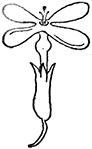
Fig. 117.—Blossom of an Ixora; from Stevens.
Wâs and pâwêr are the protecting figures, whose charm keeps off the diseases. Tĕpî, pâwêr and mos are also parts of a flower, wâs is the scent, the stamens and pistil are called tĕpî, the line in the comb above the wâs band has the same name, the lengthened tube above the green calyx is known as pâwêr and the calyx as mos. Two jungle flowers now serve as pâwêr, one a kind of Ixora, but the botanical name of the other has not been identified.
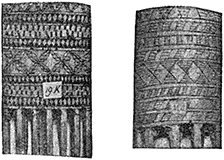
Figs. 118, 119.—Magic combs of the Orang Sĕmang; from Stevens.
In Figs. 118 and 119 we have two combs of the Orang Sĕmang, which illustrate the method of decoration. They are intended for two different diseases, the nature of either of which is obscure. The pattern in the tîn-wêg band of Fig. 118 evidently represents the magical flower. The wâs pattern in Fig. 119 is faulty, it is etched in the original comb as in the upper band of Fig. 120: Whereas the elements A, B, C should have been engraved, as in lower band of Fig. 120. Such slight mistakes as these in the decoration of a comb may render the magic pattern of no avail against the appropriate disease.
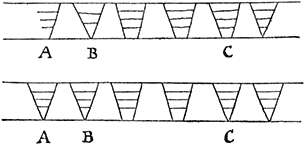
Fig. 120.—Diagram of the uppermost pattern of Fig. 119, with rectification of that pattern; from Stevens.
If one looks through the patterns which represent wâs and pâwêr one speedily finds that many are identical with each other, or are parts of the patterns in the fifth band (tîn-wêg) which represent the illness. The following account is given in explanation of this: as the magic patterns were made by Plê, he wished, as he settled one pattern for a definite disease, at the same time to make it known which flower blooms most freely at the time when the illness rages, and he gave to both a similar form. If wâs and pâwêr were obliged to get exactly the same figure, in order to prevent confusion of the patterns with one another, he ordained that differentiating marks should be added on the comb.
For us, who do not see the patterns with Sĕmang eyes, many deviations appear in the figures. One reason for this is that the patterns of the combs are mostly incised by young men and not by the older men, as is the case with the quivers and blow-pipes. The young men, unskilled in carving, and not always perfectly acquainted with the patterns, cut the combs for their sisters and future wives. One mistake in the pattern does not necessarily do away with the efficacy of a comb, as a Panggang man once said, “It is like a gap or hole in a bird-trap: the bird can hop through it, but it is always a question whether it sees the gap.”
All the figures of the combs, except the wâs, pâwêr, and tîn-wêg must be of the very simplest kind. The rule is that they are borrowed from a wâs or pâwêr pattern, but the special characters must be omitted. The youths who copy the combs overlook this and insert in the neighbouring bands the complete wâs and pâwêr patterns.
The magicians engrave various devices on pieces of bamboo, and, as will be seen from the following examples, these magic staves are supposed to be effectual for a great many difficulties and adversities.
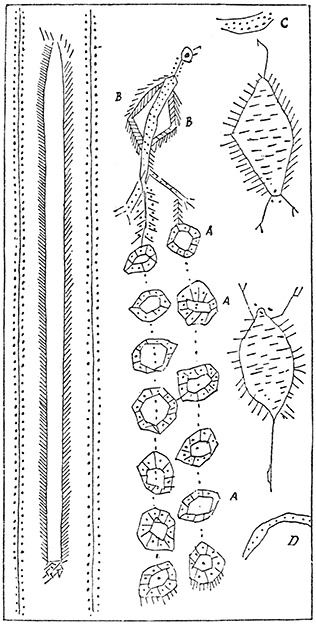
Fig. 121.—Magical pictograph of the Orang hûtan against the stings of scorpions and centipedes; size of original 9¾ inches; from Stevens.
Fig. 121.—This bamboo shows as its middle figure an Argus pheasant with its two long ocellated tail-feathers. The wheel-like patterns at A represent these eye-marks, the angular marks at B are the wings of the animal. Left of the Argus is a long, orange-coloured centipede. The head of the animal is drawn in the direction towards the tail of the Argus. The lines with little dots on each side to the right and left of the centipede are the tracks which that animal leaves on the skin of a man. Two blue scorpions are represented on the other side of the Argus. The figure at the end of their tails is a swelling in the flesh of a person who has been stung by them. The female of this kind of scorpion is more poisonous than the male, and is said to cause double stings. Therefore the marks with two rows of points at C denote the sting of the female, that with one row at D that of the male.
The significance of this bamboo is, “as the Argus pheasant feeds on centipedes and scorpions, so its help is invoked against them by striking the bamboo against the ground.”
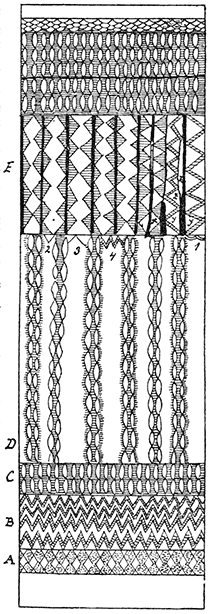
Fig. 122.—Magical device of the Orang Bĕlendas against a skin disease; size of original 19 inches; from Stevens.
Fig. 122 represents the devices etched on a piece of bamboo against two forms of a skin disease—the one exhibits leprous white ulcers, the other hard knots on and under the skin. The lowermost marking, A, when one holds the bamboo with the open end uppermost, represents the bank of a river, in which frogs have sunk holes. The dots and lines are these holes imprinted in the soft slime, some being under the water, others being above it. The zigzag lines at B represent frog’s legs; these limbs of the animal are abbreviations for the whole animal, which is always conventionalised. Over these frogs one sees at C a pattern which is used to represent different things; for example: (1) an ant-hill; (2) a Hantu of an illness in the human body, whose effect is felt like the crawling and biting of ants, and indeed this Hantu lives in forsaken ant-hills; (3) the skin marked by this disease; or (4) even the seeds of a melon, cucumber, etc. Here the figure represents an ant-hill on the ground. Out of the ground there grow climbing plants (D), whose winding round the trees is represented by the lines forming the ovals; the little lines between these egg-shaped figures represent the body of the partially very voluminous lianas. The little lines on the outside of the twists when they are long represent thorns; but when they are mere points they indicate the tracks of insects’ claws on the bark. In our picture, as the lines are midway between long streaks and dots, they represent ants in two groups, which are running up and down the lianas. Immediately under the line above D one sees four figures (1-4), which are respectively a bird, a butterfly, a caterpillar, and a tree-frog. The band at E indicates a tree. The figures are to be read off from right to left, commencing at the vertical line x, which represents the trunk of the tree without leaves; to the left are five similar figures, which are the fully developed leaves of the tree. To the left is a dark beam with leaf-marks on the right side only, these are the undeveloped young leaves at the top of the tree. Further to the left is a dark beam, on each side of which are zigzags (y y); these are branches.
The black line to the left at z, z, represents the end of the lianas which are drawn in D; these having sprung from the ground have reached the branches of the tree.
To the left of this is the topmost part of the tree, with undeveloped leaf-shoots on the left side. The sudden dwindling of this line is to show the tapering of the tree stem towards its top.
Above this the pattern C is repeated, and the three rows above the line show the spots on the skin, which are supposed to look like melon seeds; the rows respectively stand for the head, body, and feet which are thus affected.
Lastly, fish-scales are drawn to represent the leprous form of the disease; these are also in three rows for the head, body, and feet. They increase in size in order to show that they will gradually spread over the whole body if not cured in some way. Just at the place where the different rows of patterns end (when one reads from left to right) there is a group of dots on the scales, which represent the last stage of the disease; incurable holes out of which blood flows. They are supposed to be like the wounds caused by the stings of any kind of poisonous fish. These holes seldom appear on the legs.
The whole drawing is the remnant of an ancient pattern which was employed as a charm by the old magicians of the Orang Bĕlendas. The object of the pattern is even at the present time known to the laity, but the story is probably lost as to how the figures came to be put together in this way.
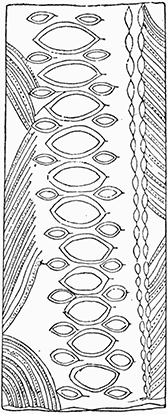
Fig. 123.—Rain-charm of the Orang Bĕlendas; size of the original 10½ inches; from Stevens.
Fig. 123 is a copy of a “toon-tong,” which the man who owned it would not sell to Mr. Stevens. Its use is to produce rain when the paddy-fields are suffering from an insufficient monsoon.
The oblique lines represent the rain driven by the wind, the lines being the downpour and the dots are the rain-drops. The lines from left to right stand for the north-east, and those from right to left for the south-west monsoon. The curved lines mean a storm. The repetition of the rain-figures means “much rain.”
Next to the rain on the right is a double row of tortoise[143] eggs (double=many), as indicative of the tortoise, which is a representative of dampness, moisture, and mud.
The middle row of figures represents young “piyung” fruit. The piyung has fruit when the rainy season begins, and loses the ripe fruit at its close. Hence it is drawn as symbolic of the rainy season. There now are, as a matter of fact, piyung trees that have fruit in the other months. Stevens showed some of these to the Orang Bĕlendas, and was informed that in the time of their ancestors the piyung trees had ripe fruit at the rainy season. Whether that was the case in their original home, or whether another variety existed, has yet to be settled. Probably the tradition of the Orang Bĕlendas is correct, even if it cannot be cleared up on all points.
The decoration of one bamboo is a formula to enable a man who wishes to build a house to easily find the necessary materials. Below is a band filled with cross-hatching, like trellis-work, meant for the wall of a house, and standing for the whole house; above this are several very diagrammatic representations of burnt trees which have remained after the firing of the jungle, a forked branch of tree which is used as a prop, palm leaves for thatching, etc. The rest of the bamboo is divided into longitudinal bands, most of which look like attempts at decorative patterns, but they really signify a liana with many leaves, the frame-work of the roof of the house, a ladder, split leaves interlaced for thatching rattans, while a zigzag line means the long path which goes from side to side, and thus indicates the obstacles which befall the leaves for the thatch whilst they are being carried through the jungle.
One design is supposed to protect the harvest and the plantations round the house from injurious animals. In it is represented a very diagrammatic house. On the one side are plants with tubers growing on the sides of a hill, for the Orang Bĕlenda generally clear the sides of a hill for their plantations and houses. On the other side of the house are depicted maize, the kĕlâdi (caladium) with its edible tubers, three sugar-canes with the edible shoots at the roots, another plant of maize, tapioca with its edible roots, a variety of yam with its tubers, and a banana; in addition there are six immature trees, and the punctate background denotes grass. The upper part of the bamboo represents those animals which may destroy the gifts of the soil. These are a caterpillar, a rat, two iguanas (monitors or lace-lizards, which go after hens’ eggs); next each lizard is a tree with leaves where they like to hide; a row of dots on each side of the tree-trunks denote the upward and downward tracks of the animals at night. There is also a tortoise with its young one, and a pair of crescentic lines indicate the pool where the reptile lives.
Another carved bamboo helps women to catch fish, and also protects them from poisonous ones.
To the uninitiated many patterns would appear to be simple decorative devices, but Mr. Stevens has found that they have definite meanings; for example, rattan may be conventionally represented by a straight or a waved line, or by two waved or zigzagged lines which, when applied together, form a series of ovals or diamonds. A cross-hatched band may stand for a house, the marking indicating a wall or the floor. Zigzags, like those in Fig. 122, B, indicate frogs’ legs, these stand for frogs themselves, and these again are symbolic of water.
From the foregoing it is evident that it is only by making careful inquiries from the natives themselves that the meaning of most of the devices of savages can be elucidated. What we are apt to consider as mere decoration may have a very definite magical or symbolic significance.
Mr. Goodyear states[144] that Lieutenant Frank Cushing informed him that the patterns which the Zuñis borrow from foreign ware are supposed to endow their own pottery with the virtues of the foreign material and manufacture, and that their use of borrowed patterns has this purpose.
The same author,[145] referring to the decorative art of Ancient Egypt, quotes as follows from Professor Maspero:—“The object of decoration was not merely to delight the eye. Applied to a piece of furniture, a coffin, a house, a temple, decoration possessed a certain magical property, of which the power or nature was determined by each word inscribed or spoken at the moment of consecration. Every object, therefore, was an amulet as well as an ornament.”
The tying of magic knots is a common expedient in sorcery, as the following extracts from a short paper by Dr. March[146] will prove. The malevolent tying of a knot brought mischief upon a man, to be averted only by counter-plotting and counter-knotting. Sickness was caused by the invasion of a demon, or by spells wrought by an enemy; and evil spirits had to be exorcised, and the knot of the spell-bound to be loosed.
The magical texts, found in a biliteral form, written in the Accadian and the Assyrian tongues, furnish examples of which the following are specimens:—
May the god of herbs Unloose the knot that has been knitted. Take the skin of a suckling that is still ungrown, Let the wise woman bind it to the right hand and double it on the left. Knit the knot seven times, Bind the head of the sick man. So may the guardian priest cause the ban to depart From him, and unloose the bond.
Amongst the Fins and the Norsemen evil spells could be wrought by malevolently twisting into a magic knot the fibres of certain trees, sometimes the birch, but more often the willow; and to unloose the knot was the surest way of undoing the mischief.
In the Sigurd Saga, Sigurd boasts to Eystein, “On the way to Palestine I came to Apulia, but, brother, I did not see thee there. I went all the way to Jordan and swam across the river. On the bank there grows a bush of willows, and there I twisted a knot of willows which is waiting there for thee. For this knot I said thou shouldst untie, brother, or take the curse that is bound up in it.”
Tying knots as a means of witchcraft is still in force in the British Islands, as may be seen in the publications of the Folk-Lore Society.[147] These practices need not necessarily be with evil intent, as the lovers’ knot had for an object the firm binding of the lovers’ affection to each other.
It is probable that many of the knots carved on ancient monuments in Northern Europe have reference to this magical practice, and it is conceivable from what is known to occur elsewhere that a representation of a knot might possess all the virtue of a real knot.
But knots in Scandinavian art have also a symbolic significance and may be associated with Midgarth’s Worm and the serpents in the Norse pit of perdition. On portals from Veigusdal Church, in Sœtersdal (now in the Christiania Museum), are carved incidents from the favourite legend of Sigurd. On one of them, according to Dr. March,[148] may be seen the avaricious and ill-fated Fafni slain and utterly dismembered, passing into a maze of beautiful scrollwork. The same story is illustrated on two sides of the Halton Cross; here, however, the writhing knotted throes that elsewhere signify Fafni’s death take the form of a knot, Fafni himself not being represented.
2. Totemism.
In the following brief account of totemism I borrow largely from a small but peculiarly valuable book by Dr. Frazer.[149] “A totem is a class of material objects which a savage regards with superstitious respect, believing that there exists between him and every member of the class an intimate and altogether special relation.... As distinguished from a fetich, a totem is never an isolated individual, but always a class of objects, generally a species of animals or plants.
“Considered in relation to men, totems are of at least three kinds:—(1) The clan totem, common to a whole clan, and passing by inheritance from generation to generation; (2) the sex totem, common either to all the males or to all the females of a tribe, to the exclusion in either case of the other sex; (3) the individual totem, belonging to a single individual and not passing to his descendants.” The first is by far the most important, and we will confine ourselves to it alone.
“The clan totem is reverenced by a body of men and women who call themselves by the name of the totem, believe themselves to be of one blood, descendants of a common ancestor, and are bound together by common obligations to each other and by a common faith in the totem. Totemism is thus both a religious and a social system. In its religious aspect it consists of the relations of mutual respect and protection between a man and his totem; in its social aspect it consists of the relations of the clansmen to each other and to men of other clans. In the later history of totemism these two sides tend to part company;” the social system sometimes survives the religious, or the reverse may obtain.
The members of a totem clan call themselves by the name of their totem, and commonly believe themselves to be actually descended from it. For example, I found that the following animals were totems in Torres Straits: dog, dugong, cassowary, crocodile, snake, turtle, king-fish, shark, sting-ray, giant-clam, etc. “No cassowary-man would kill a cassowary; if one was seen doing so his clansmen would ‘fight him, they feel sorry. Cassowary he all same as relation, he belong same family.’ The members of the cassowary clan were supposed to be especially good runners. If there was going to be a fight a cassowary man would say to himself, ‘My leg is long and thin, I can run and not feel tired; my legs will go quickly, and the grass will not entangle them.’... If a dog-man killed a dog his clansmen would ‘fight’ him, but they would not do anything if an outsider killed one. A member of this clan was supposed to have great sympathy with dogs, and to understand them better than other men.... No member of any clan might kill or eat the totem of that clan. This prohibition did not apply to the totem of any clan other than that to which the person belonged.”[150]
The reader is referred to Mr. Frazer’s book for analogous beliefs and practices among various peoples. The relation between a man and his totem is one of mutual help and protection. If a man respects and cares for the totem, he expects that the totem will do the same by him.
“In order, apparently, to put himself more fully under the protection of the totem the clansman is in the habit of assimilating himself to the totem by dressing in the skin or other part of the totem animal, arranging his hair and mutilating his body so as to resemble the totem, and representing the totem on his body by cicatrices, tattooing, or paint” (Frazer, p. 26). As a matter of fact, there are comparatively few definite statements that markings on the person represent the totem of that person, but there can be little doubt that this is of wide occurrence and probably has been universal. Some of the best authenticated examples come from North America. Hints have come from Australia. I have in Torres Straits seen four old women who had their totems cut into the small of their backs; these were the dugong (2), snake, and sting-ray (?), and I was informed that the men used to scarify the shoulder or the calf of the leg with the totem device, or they carried about with them pieces of their totems or effigies of them.
The latest information on this subject is that collected by H. Vaughan Stevens.[151]
The Orang Sinnoi, Orang Bersisi, Orang Kenaboi, Orang Tumior declare that they are descended from one and the same folk, but that each tribe inhabited a separate island before the general immigration into Malacca took place under Bertjanggei Besi. The Orang Tumior were an exception to this collective migration, as they had long before, independently, gone to Malacca.
The tradition of this tribe is very vague, but it is certain that they lived a long time separated from the other members of the group. It appears that they learnt at that time tattooing from another people, and confounded painting the face with tattooing.
For each of the three tribes, Orang Sinnoi, Orang Bersisi, and Orang Kenaboi, there was a distinct pattern, which was identical as regards the way it was laid on and the materials employed, but which varied in form. In each of the three tribes the chief and the ordinary man and woman have the same race-marks. Only among the Orang Sinnoi the women and ordinary men had a particular pattern for the breast. The sorcerer, or medicine-man, in each of the three tribes wore during an act of magic a painting suitable to the occasion; when not performing, he wore his usual painting.
The following is given as the origin of the pattern of the totem and its further development into the patterns of the different families:—In the olden time, when the people of the Orang Bĕlendas still lived under their chiefs and under-chiefs, paintings were made on the face for all assemblies, which were the old indigenous patterns for the peninsula. But as the group became broken up owing to the influx of the Malays, and intermarried with foreign and weakened folk, the patterns fell through and sub-divisions arose.
Among all the three tribes (Sinnoi, Kenaboi, and Bersisi) there was once a powerful clan, which bore the snake totem. Owing to the many changes they had to undergo, the members of this totem separated from one another and founded new families in different parts of the peninsula. The totem varied according to the practice of the folk, each newly-developed clan modified the ground pattern, one took a python, one a cobra, another a hamadryas, etc.; they all retained the snake and varied their pattern according to the species. Similarly arose the sub-divisions of the fish (sting-fish) and leaf clans.
These totem figures of the separated families then became used only to mark out objects appertaining to them; they were scratched on the blow-pipes and used as a face-painting when the whole family assembled together on festivals or on important debates. As the great assemblies of all the groups fell into disuse, the old stem-marks gradually became worthless, so that, to-day, but few know the appearance of the old stem-marks.
As regards the materials used, all the Orang Bĕlendas agree in saying that a red earth was employed, which is not to be found on the peninsula. The so-called “anatto” (Bixa orellana) is used as a substitute for this earth, but it is not worth much, as it fades away in about an hour. The black colour is made with charcoal, the white with lime. The red colour is always laid on with the finger, consequently the stripe is narrower with the women than with the men.
These observations of Mr. Stevens, together with hints, rather than definite statements, which have been made from various parts of the world, suggest the conclusion that the painting, tattooing, or scarifying of designs on the body is mainly due to totemism.
A good deal of body-painting has other significances, as when it is done for religious ceremonies or for inspiring terror among the enemy when on the war-path; but it would probably be fair to assume that the origin of what may be termed domestic tattooing or scarification belongs to totemism. Here, again, is a fascinating and unworked field for research.
There is a very practical reason for the custom of marking the body with the totem. The religious aspect of totemism has been briefly described, this is the relation between a man and his totem; but there is also the relation of the men of a totem to each other and to men of other totems, or the social aspect of totemism, which deserves a passing notice.
“All the members of a totem clan regard each other as kinsmen or brothers and sisters, and are bound to help and protect each other. The totem bond is stronger than the bond of blood or family in the modern sense.... To kill a fellow-clansmen is a heinous offence. In Mangaia [Hervey Islands] ‘such a blow was regarded as falling upon the god [totem] himself; the literal sense of “ta atua” [to kill a member of the same totem clan] being god-striking or god-killing.’”[152]