EXPLANATION OF THE PLATES.
Reading edition
PLATE I.—SKEUOMORPHS OF BINDING.
FIGS.
1. Part of the stone axe of Montezuma II., Ambras Museum, Vienna (J. Evans, The Ancient Bronze Implements of Great Britain and Ireland, 1881, Fig. 180, p. 148).
2. Socket of a bronze spear-head, Co. Galway, Ireland (Evans, loc. cit., Fig. 393, p. 320).
3. Socket of a bronze spear-head, Ireland (Evans, loc. cit., Fig. 402, p. 326).
4. Bronze palstave (socketed celt), Co. Meath, Ireland (Evans, loc. cit., Fig. 172, p. 140).
5. Bronze vessel, Lake of Bourget (F. Keller, The Lake Dwellings of Switzerland, 2nd ed., 1878, Plate CLIX., Fig. 1).
6. Pattern on an ebony comb, Assyria (G. Perrot and C. Chipiez, History of Art in Chaldæa and Assyria, ii., 1884, Fig. 227, p. 350).
7. Pattern on a sculptured stone cornice (Perrot and Chipiez, History of Ancient Egyptian Art, ii., 1883, Fig. 288, p. 361, from Prisse d’Avennes).
8. Pattern on a perforated bone needle, Tumulus, Holyhead (W. Owen Stanley, Arch, Journ., xxxiii., 1876, pp. 94, 133).
9. Back of a bronze knife, Estavayer (Keller, loc. cit., Plate XCVI., Fig. 12).
10. Bronze palstave, near Kingston-on-Thames (Evans, loc. cit., Fig. 141, p. 125).
11. Bronze palstave, Fornham, near Bury St. Edmunds (Evans, loc. cit., Fig. 133, p. 122).
a. “Angular Meander,” Wolvesey Castle, Winchester, temp. Stephen (Archæologia, xvi., 1812, p. 361, Plate LXII., Fig. 3).
b. Norman capital, “sections of branches” or billet ends, Peterborough Cathedral (Archæologia, xii., 1796, Plate XXXI., Fig. 4, p. 168).
c. Hut-urn, Etruscan, Monte Albano (Museo Kircheriano, Rome),
d-f. Skeuomorphs of the gable (Household Furniture).
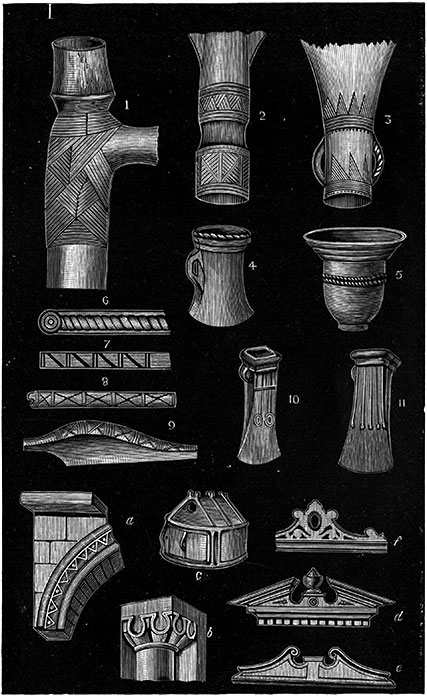
Plate I
PLATE II.—SKEUOMORPHS OF WATTLE-WORK.
FIGS.
1. Impression of wattle-work on clay, Ebersberg (Keller, loc. cit., Plate CXLIV., Fig. 16).
2. Bast twisted among willow rods, Robenhausen (Keller, loc. cit., Plate CXXXIV., Fig. 5).
3. Mat of bast, Robenhausen (Keller, loc. cit., Plate CXXXIV., Fig. 2).
4. Fabric of flax, Robenhausen (Keller, loc. cit., Plate CXXXVI., Fig. 4).
5. Fabric of bast, Robenhausen (Keller, loc. cit., Plate CXXXV., Fig. 3).
6. Corbula, Italy (W. Smith, Dict. Roman Antiq., p. 285).
7. Basket on ivory plaque, Boulak (Perrot and Chipiez, Egypt, ii., Fig. 321, p. 388).
8. Earthenware food-vessel, Stone Age, Denmark (Worsaae, Danish Arts, p. 36).
9. Bottom of a basket, Terramara Beds, Northern Italy (Keller, loc. cit., Plate CXVI., Fig. 11).
10. Fragment of Pottery, Terramara Beds, Northern Italy (Keller, loc. cit., Plate CXIII., Fig. 13).
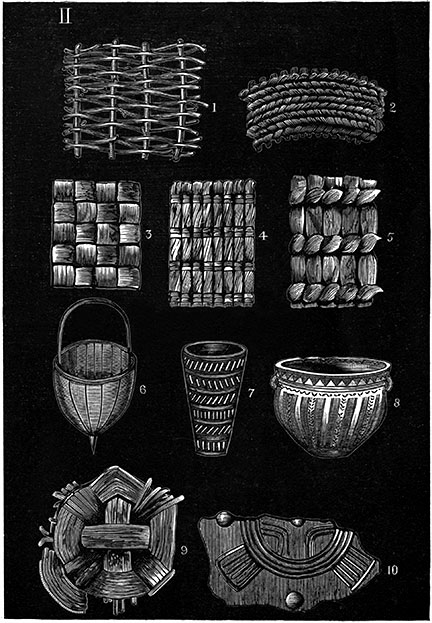
Plate II
PLATE III.—SKEUOMORPHS OF BASKETRY.
FIGS.
A. Hypothetical origin of a scroll from basket-work.
B. Hypothetical origin of a curvilinear fret from basket-work.
1. Marginal pattern of a bronze buckler from Amathus, Cyprus (G. Perrot and C. Chipiez, History of Art on Phœnicia and its Dependencies, ii., 1885, Fig. 363, p. 420).
2. Pattern on a bronze buckler from Dali, Cyprus (Perrot and Chipiez, loc. cit., Fig. 360, p. 418).
3. Greek guilloche (Wornum, Analysis of Ornament, 7th ed., p. 58).
4. Assyrian guilloche (Glazier, Notes on Ornament, p. 8).
5. Pattern on an enamelled Roman vase, Bartlow Hills (Arch. Journ., xii., 1855, p. 418).
6. Bowl of Ancient Pueblos, Tusayan (W. H. Holmes, Fourth Ann. Rep. Bureau Eth., Fig. 308, p. 331).
7. Handled vase of Ancient Pueblos, Tusayan (loc. cit., Fig. 336, p. 346).
8. Terra-cotta vase, Third Sepulchre of Mycenæ (Schliemann, Mycenæ, 1878, No. 324, p. 209).
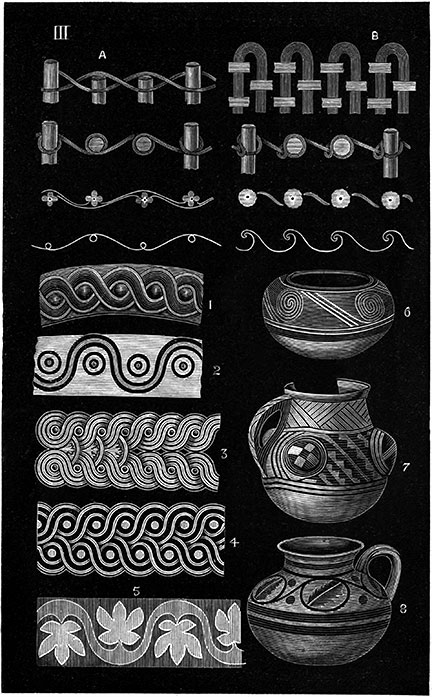
Plate III
PLATE IV.—SKEUOMORPHS OF THE WITHY-BAND.
1. “The Tarsus Seal” of hæmatite, Hittite (Nature, April 26, 1888, p. 610). The right-hand design strongly resembles a course of the twisted fibre of basketry when removed from the upright osier-sticks.
2. Detail on incised stone, Kirk Maughold, Isle of Man (Runic Remains, Fig. 24).
3. Detail on incised stone, Church of Mont Majour, Nimes, tenth century (Wright, Hist. of Caricature, p. 48).
4. Detail on incised stone, Malew, Isle of Man; “Leather or strap-work” (Runic Remains, Fig. 15).
FILIGREE.
5. Gold ornament, Lake Möringen (Keller, loc. cit., Plate LVII., Fig. 9).
6. Gold ornament, Denmark (Worsaae, Danish Arts, p. 62).
7. Bronze pin, Nidau—Steinberg (Keller, loc. cit., Plate XXXIV., Fig. 14).
SKEUOMORPHS OF FASCINING.
8. Floor of lake-dwelling, Niederwyl, 1864 (Keller, loc. cit., Plate XVI., Fig. 8).
9. Bottom of inside of an earthen vessel, Ueberlingen See (Keller, loc. cit., Plate XXX., Fig. 6).
10. Part of a crescent of red sandstone, Ebersberg (Keller, loc. cit., Plate CXLIII., Fig. 7).
11. Incised stone from Hadrian’s Wall.
SKEUOMORPHS OF WEAVING.
12. Greek fret (Birch, Ancient Pottery, Fig. 4, p. 305).
13. Greek fret (Glazier, Notes on Ornament, p. 8).
14. Japanese fret (Glazier, loc. cit., p. 8).
15. Anglo-Saxon fret, Lambeth Aldhelm (J. O. Westwood, “Early British Anglo-Saxon and Irish Ornamentation,” Arch. Journ., x. p. 290, 1853).
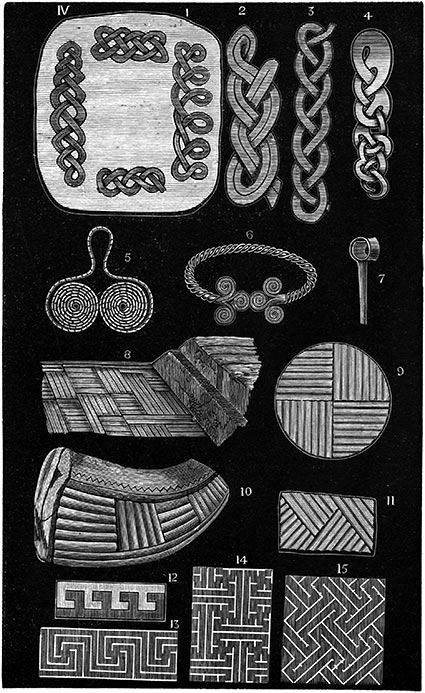
Plate IV
PLATE V.—SKEUOMORPHS OF TIMBERING.
FIGS.
1. Rock tomb, Antiphellus, Lycia (C. Fellows, A Journal written during an Excursion in Asia Minor, 1839, p. 220).
2. Rock tomb, Xanthus (Fellows, loc. cit., p. 226).
3. Rock tomb, Antiphellus (Fellows, loc. cit., p. 219).
4. Painting of a house, Pompeii (Gell, Plate 60).
5. Greek egg-and-dart, or Echinus pattern, from entablature, Erechtheium.
6. Similar pattern on Samian vase (Wornum, loc. cit., p. 58).
7. Greek anthemion, Apollo Epicurius (Wornum, loc. cit., p. 58).
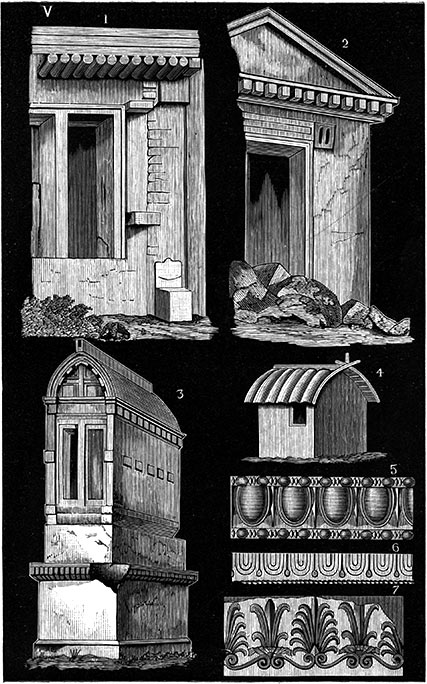
Plate V
PLATE VI.—ZOOMORPHS.
FIGS.
1. Detail on a vase from Roman villa, Chesterford, Essex (R. C. Neville, “Roman Remains at Ickleton and Chesterford,” Arch. Journ., vi., 1849, p. 19).
2. Part of iron sword of Gaulish workmanship, Marin Lake (Keller, loc. cit., Plate CXXVIII., Fig. 6).
3. Detail of mural decoration, Pompeii (Art Journal, 1877, p. 233).
4. Decoration of an ancient pot of New Mexico (J. Stevenson, “Illust. Cat. of Collections obtained from Indians of New Mexico and Arizona,” Second Ann. Rep. Bureau Ethnol., 1883, Fig. 363, p. 344).
5. Lombardic gold ornament, Chiusi, Tuscany (S. T. Baxter, Arch. Journ., xxxiii., 1876, Plate I., p. 105).
6. Decoration in Greek terra-cotta (Wornum, loc. cit., p. 28).
7. Top of bench-end, Ormskirk Church (Manchester Guardian, 10th November 1888).
8. Engraved silver plate, Tumulus, Norrie’s Law, Scotland (R. Dundas, “Silver Ornaments in Tumulus at Largo, Fifeshire,” Arch. Journ., vi., 1849, p. 253).
9. Incised stone, Dunnichen, Scotland (Boyd Dawkins, Early Man in Britain, p. 435).
10-12. Carving on New Zealand clubs, in the collection of Mr. Charles Heape.
13. Part of carved handle of Hervey Island paddle, in the collection of Mr. Charles Heape.
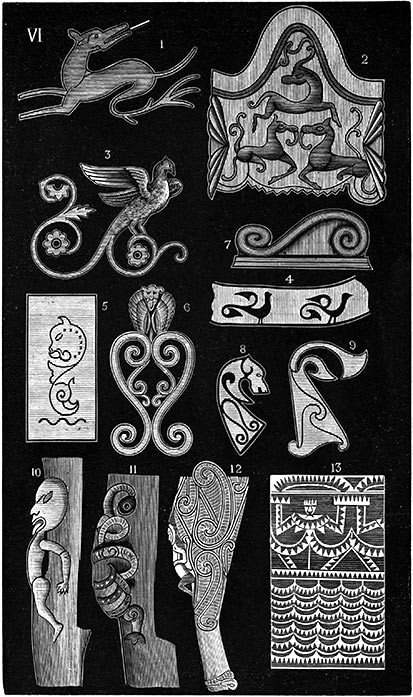
Plate VI
PLATE VII.—ZOOMORPHS.
FIGS.
1. Detail on incised-stone, Isle of Man (Runic Remains, Fig. 15).
2. Figure from King Gorm’s stone, Jellinge, Jutland (J. Ferguson, Rude Stone Monuments, 1872, Fig. 105, p. 296).
3. Detail on carved cross, Gosforth, W. Cumberland (W. S. Calverley, Arch. Journ., xl., 1883, p. 146).
4. Panel in illumination, Gospels of Mac Regol, at Oxford (Arch. Journal, x., 1853, p. 291, Fig. 6).
5. Detail on incised stone, Kirk Michael, Isle of Man (Runic Remains, Fig. 17).
6, 7. Figures on rock sculpture, Crichie, Scotland (Arch. Journ. xiv., 1857. p, 193, Figs. 13, 14).
8. Saxon silver ear-ring, Thetford (Arch. Journ. ii., 1846, p. 402).
9. Saxon gold ring, Bormer, Sussex (Arch. Journ. xi., 1854, p. 28).
10. Detail on Saxon tomb, Bedale, Yorks (Arch. Journ. iii., 1846, p. 258).
WITHY BAND.
11. Detail on lid of a stone coffin, Cambridge Castle (T. Kerrich, Arch. xvii., 1814, Plate XVI., p. 228).
12. Scandinavian triskele.
13. Reefing knot on Britanno-Roman altar, Cohors quarta Gallorum equitata, Risingham, Northumberland (Arch. Journ. xii., 1855, p. 219).
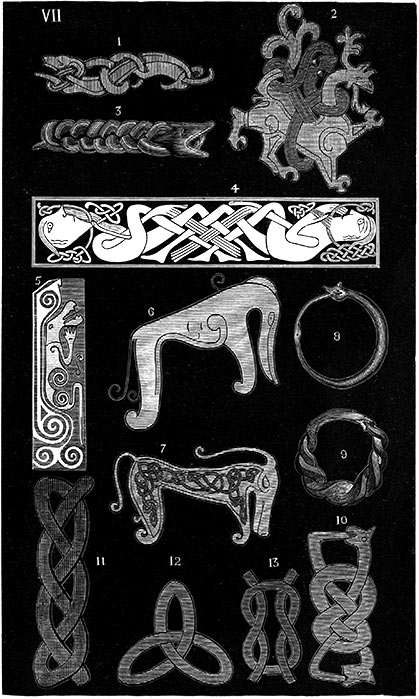
Plate VII
PLATE VIII.—PHYLLOMORPHS.
FIGS.
A, B. Diagrams of Mats.
1. Fringe on King Sargon’s tunic, in alabaster, Khorsabad (Perrot and Chipiez, Chaldæa and Assyria, i., Fig. 22, p. 97).
2. Tabernacle, bronze Gates of Balawat (Perrot and Chipiez, Chaldæa, etc., i., Fig. 68, p. 194).
3. Painting of a tree in a garden from a Theban tomb (Perrot and Chipiez, Egypt, ii., Fig. 1, p. 3, after Champollion, Plate 174).
4. Ornament painted on plaster, Assyria (Perrot and Chipiez, Chaldæa, etc., i., Fig. 118, p. 276, after Layard).
5. Tassel on a king’s tunic, on enamelled brick from Nimroud (Perrot and Chipiez, Chaldæa, etc., ii., Plate XIV., p. 294, after Layard).
6. Tasselled canopy over the king, on enamelled brick from Nimroud (loc. cit. ii., Plate XIV., after Layard).
7. Pavilion carved in stone, Nimroud (loc. cit. i., Fig. 67, p. 193).
8. Border pattern of incised stone door sill, Khorsabad (loc. cit. i., Fig. 96, p. 240).
9. Enamelled brick, Nimroud (loc. cit. ii., Plate XIII., p. 294, after Layard).
10. Pattern on ivory panel, Assyrian anthemion (loc. cit. ii., Fig. 201, p. 321).
11. Anthemion on Sindh pottery (G. Birdwood, Indust. Arts of India, ii. 424).
12. Egyptian anthemion, Necropolis, Thebes (xviii-xx. Dyn.) (Perrot and Chipiez, Chaldæa, etc., i., Fig. 134, p. 306, after Prisse d’Avennes).
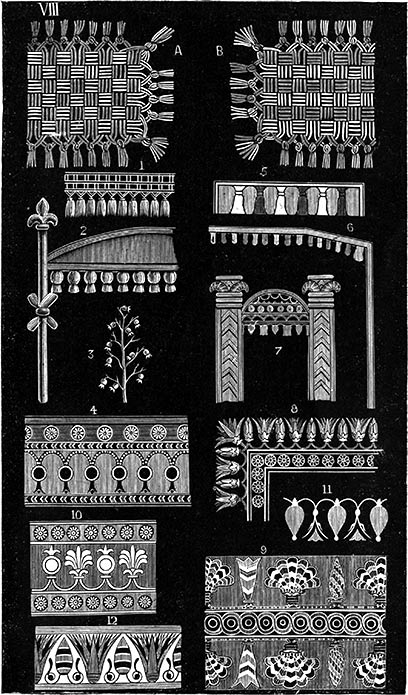
Plate VIII