THE MATERIAL OF WHICH PATTERNS ARE MADE. (continued 3)
Reading edition
One frequently finds on early Christian sculptured stones that the field on each side of the central cross is occupied by a writhing animal; of these numerous examples occur in the Isle of Man, where they are undoubtedly due to Scandinavian influence. This animal may be recognised in some cases as being a wolf, as on a cross at Michael (Plate VII., Fig. 5).
Two skeuomorphs attack the wolf. The influence of thong-work is seen in Plate VII., Fig. 1; this may be compared with Plate IV., Fig. 4, which is copied from a sculptured stone at Malew, also in the Isle of Man. The latter is one of several Manx skeuomorphs of leather or strap-work.
The withy-band is even more frequently depicted, and on a cross at Gosforth (Plate VII., Fig. 3) the wolf is being strangled by it.
The serpent or dragon also is frequently represented, indeed it seems as if the wolf and the serpent passed insensibly into one another, and nothing is easier than to confound the latter with twisted bands. So the animal fades away, till finally the skeuomorph triumphs, and only the ghost of a zoomorph remains in what, to ordinary eyes, is only an entwisted fibre (Plate VII., Fig. 11).
What then is the significance of this remarkable cycle? The explanation must be sought in the pagan-Christian overlap, at the time when the symbols of Norse mythology were being homologised with those of the Christian faith.
“Three mighty children to my father Lok Did Angerbode, the giantess, bring forth— Fenris the wolf, the serpent huge, and me. Of these the serpent in the sea ye cast, Who since in your despite hath wax’d amain, And now with gleaming ring enfolds the world. Me on this cheerless nether world he threw, And gave me nine unlighted realms to rule. While, on his island in the lake, afar, Made fast to the bored crag, by wile not strength Subdued, with limber chains lives Fenris bound.”
So, in the words of Matthew Arnold, spoke Hela to Hermod on his quest for the restoration of the slain Balder.
At the crack of doom, the Ragnaroks, Frey, Woden, Thor, and Tyr, are predestined to perish. A wolf shall devour the sun, and another shall swallow the moon, and the stars shall vanish out of heaven. Woden shall go first, and shall encounter Fenriswolf, but the wise, one-eyed god shall die. The hammer of the “friend of man” shall not avail against the sea-dragon, and though Thor fights Midgarthsorm, and shall slay him, he himself shall fall dead from the serpent’s venom. Garm, the hell-hound, shall fasten upon the one-handed Tyr, and each shall kill the other. Frey shall fall before Swart, the giant with the flaming sword. Then shall Vidar spring forward, the mighty son of the Father of Victory, and shall rend the wolf asunder. “Vidar shall inhabit the city of the gods when all is over,” as the giant said to Woden. “Vidar, who outlived the earth-fall, became,” says Professor Stephens,[113] “a fitting emblem for that Almighty Lord who overcame Sin and Death,” and he is represented on some sculptured stones as a divine Hart, trampling on Fenriswolf and Midgarthsorm.
These strangled wolves and writhing snakes of Scandinavian art represent the portentous struggle of the powers of darkness with the gods when “the Wolf shall devour the Sire of Men; but Vid shall avenge him, and shall rend the cold jaws of the Beast.” But the new religion possessed a somewhat analogous imagery, and the symbolism of the one readily passed into that of the other. Whether pagan or Christian, the symbolic animal was attacked by the plaited thong or twisted fibres, and the secular handicraft choked the religious idea. Such a hold had this technique on the mind of the people that it predominated all their art, and even led to the extinction of religious symbolism.
There was, however, another means by which the pagan dragon crept into Christian art. I refer to the legend of Sigurd and Fafni, which was introduced into sepulchral and ecclesiastical carving as late as the fourteenth century by followers of the new faith. I cannot now detail the foundation story of the Nibelungen Lied; the point which at present concerns us is the slaying of Fafni in the form of a dragon or serpent by Sigurd with his magic sword.
This and other incidents of the legend are carved on wooden portals or door-pillars of churches, on fonts, and on Christian crosses of stone in many parts of Sweden and Norway, and also in some parts of England, as on the Hatton Cross in Lancaster.
Fafni is often seen passing into a maze of beautiful scroll-work, and in the Hatton Cross he is solely represented by a twisted knot.
Under monkish influence, no doubt, the whole story came by degrees to be looked upon as containing types and proofs of the younger religion. Sigurd became the Christian soldier, forging the sword of the spirit, and his defeat of the serpent could readily be adopted into Christian symbolism.[114]
“When the Anglo-Saxon had almost forgotten Midgarth’s Orm, and the ancient Egyptian snake-symbol, as old as the Rameside period, had been introduced as a new design (Plate VII., Fig. 8), this itself fell a prey to the dominant skeuomorph, and was doubled and entangled in obedience to the over-mastering expectancy of the day.”
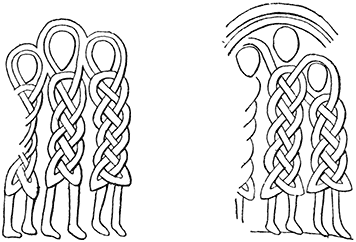
Figs. 110, 111.—Modified human figures on the shaft of a cross at Ilam, near Ashbourne; after Browne.
“It must be clear,” continues Dr. Colley March, “that such transformations as these were due to something more than the successive copying of a copy by ignorant and slovenly artificers, as in those degenerate changes wrought by Gaulish imitators of the stater of Philip of Macedon. In that case the original coin was not before them; they had no artistic impulse or intention, their only object was to fabricate passable pieces of money. But the men whose ‘taste’ is disclosed by the work we have just considered were swayed by an influence they could not have understood. The expectancy that controlled them they inherited. The withy-band had wrapped itself round all their conceptions.” But the result was enrichment and not degradation, and the curious designs their art produced show us the only portal through which the animal form can enter into ornament, by resolving itself, namely, into the angles, curves, and scrolls of symmetrical repetition.
“Many pauses took place ere the process was completed. Now one part of the body was surrendered to the skeuomorph and anon another. Conventionalism established a temporary truce, but the war of structure against nature broke out afresh, and the grotesque appeared. We look upon the death-grasp of a writhing quadruped, the knotted convolutions of a serpent, the spectral gleam of a vanishing face. And then, when all was over, when the battle on the ornamental field was lost and won, nothing was left but a zoomorph of contrasted curves and symmetrical scrolls.”
The human form is not exempt from the skeuomorphic inroad. The two men in Fig. 4, Plate VII., which is taken from an illuminated page of the Gospel of Mac Regol, at Oxford, are suffering from but a mild attack, but the men on the Pre-Norman font at Checkley, near Uttoxeter, and similar figures (Figs. 110, 111) on a cross at Ilam, five miles from Ashbourne, have all but succumbed.