THE REASONS FOR WHICH OBJECTS ARE DECORATED. (continued 2)
Reading edition
Persons of the same totem may not marry or have sexual intercourse with each other. Amongst some peoples this rule is rigidly adhered to; the penalty for infringing this rule may be the vengeance of supernatural powers, but most frequently the clan steps in and punishes the offenders. Amongst the more primitive totemistic peoples the death penalty is usually enforced, but in any case the punishment is always severe. When other social conditions modify totemism these sexual restrictions are weakened and the punishment for offences is diminished.
There are some Australian tribes in which the members of any clan are free to marry members of any clan but their own; but more frequently an Australian tribe is divided into groups of clans, and a person can marry only into certain of these groups; an exogamous clan-group is known as a phratry. Thus a man is a possible husband to all the women of one or more phratries of his tribe, but he is brother to all the women of the remaining phratries.
“A remarkable feature of the Australian social organisation is that divisions of one tribe have their recognised equivalent in other tribes, whose languages, including the names for the tribal divisions, are quite different. A native who travelled far and wide through Australia stated that ‘he was furnished with temporary wives by the various tribes with whom he sojourned in his travels; that his right to these women was recognised as a matter of course; and that he could always ascertain whether they belonged to the division into which he could legally marry, though the places were one thousand miles apart, and the languages quite different.’”[153]
I am not aware that any one has attempted to study the totem and divisional body-marks of the Australian tribes. This can only be done through careful and laborious investigations conducted among the natives; it cannot be accomplished in the study or in museums. If Australian anthropologists do not bestir themselves without delay this information will be irrevocably lost. Every year passed makes it more difficult to do, and soon it will be too late.
The origin of tattooing or scarifying of the person receives a fresh significance from these Australian customs. The marks appear to be, not so much tribal distinctions for political purposes, but clan badges of social significance with the object of preventing persons from falling into the sin of unwitting clan incest; they are, in fact, religious symbols which make for social purity.
It is obvious that the knowledge of these symbols has to be learnt by the young people, and hence this forms an important part of the information of lads imparted during the initiation ceremonies. The main religious object of these initiation ceremonies is the assimilation of the youth with his totem, and the consequent formal adoption into the clan of that totem. Thence follows the social aspect of that adoption, and the newly-made man is instructed in his social duties; he is taught the code of sexual permissions and prohibitions, and the knowledge of personal marks and gestures by means of which he can communicate his totem to, or to ascertain the totems of, strangers whose language he does not understand.
It is a common, possibly a universal custom, for totemistic peoples to decorate their belongings with their totems. This is well known to occur in North America. The Thlinkets paint or carve their totem on shields, helmets, canoes, blankets, household furniture, and houses. In single combats between chosen champions of different Thlinket clans, each wears a helmet representing his totem. In front of the houses of the chiefs and leading men of the Haidas are erected posts carved with the totems of the inmates. As the houses sometimes contain several families of different totems, the post often exhibits a number of totems, carved one above the other. Or these carvings one above the other represent the paternal totems in the female line, which, descent being in the female line, necessarily change from generation to generation. The totem is painted or carved on the clansman’s tomb or grave-post, the figure being sometimes reversed to denote death. It is always the Indian’s totem name, not his personal name, which is thus recorded. Other examples will be found in Mr. Frazer’s valuable little book.
I have already (p. 17) referred to the delineation of totem animals on drums, pipes, and other objects from Torres Straits and the adjoining coast of New Guinea. Two representations of a totem are usually placed symmetrically on the object; I rather suspect that this is the rule. The cassowary is the most frequent animal on the drums, and I have reason to believe that only a certain clan, or clans, can beat the drums, in which case it is evident that the cassowary men are the chief if not the sole musicians.
When the totem representations are realistic in character there is no difficulty in recognising them; but this is by no means the usual case. Abundant evidence has been given in this book of the degeneration of animal forms into simple decorative devices.
Many savages, however, lay no stress upon realism. A certain simple or complex mark represents a given object, it may not in the very least resemble that object any more than the written or printed name of an animal bears any relation to that animal. The mark is a sign for that object, and if it can be recognised, it answers its purpose. In many cases it can be shown that the mark is in reality a degraded picture of the object, in a vast number of examples we have no evidence.
On looking through collections of Australian weapons in museums, or in glancing over the illustrations to works on Australia, one is struck by the fact that a large number of objects are decorated with simple devices, and further that there is a very great deal of uniformity in the designs. Considering the size of that continent and the numerous tribes of its sparse native population, the paucity of artistic motives is very remarkable. The conclusion is pretty obvious, these designs must be representations of totems. At present we have no proof of this, nor are there sufficient data for the collation and assignation of the designs.
Dr. E. Grosse[154] is the sole anthropologist who has studied Australian art, but he has not been able to do more than enunciate general principles, owing to the absence of authoritative information from the natives. It is to be hoped that residents in Australia will learn all they can from the natives about their art before the knowledge is lost.
A slight acquaintance with decorated objects from Australia will reveal the very common occurrence of angular designs—zigzags, chevrons, diamonds, and so forth. As Dr. Grosse truly says:[154] “One is accustomed to describe these primitive ornaments as geometrical; and then it is not difficult to confound the name with the thing, so one quotes the geometric pattern occasionally as evidence for the natural predilection of the simplest people for the simplest æsthetic motive, but no proof is advanced for this peculiar predilection, because in the bulk of the philosophy of art the a priori method remains unshaken. All primitive ornaments are not what they seem to be. We shall see that they have at bottom nothing whatever in common with geometric figures.... It is certainly not always easy to recognise the original form of a primitive ornament. When one considers the zigzag or the diamond pattern of an Australian shield, it appears that our assertion is without doubt that this is destitute of animal forms, and it will appear doubly certain when we acknowledge that in most cases we cannot directly know it. It was certainly a wonder to us when we knew it. The ornament of the Australians has been by no means systematically investigated. Even in the comprehensive work of Brough Smyth it is dismissed in some very general and very superficial remarks. In fact, no one has so much as taken the pains to ask the natives the meaning of the different patterns.”
Dr. Grosse then goes on to point out that “most of the ornament of the lower folk, as far as it has been investigated and as the Australian should be studied, is known to be imitations of animal or human forms. Nowhere has ornament so markedly a geometrical character as among the Brazilian tribes. Their rectilinear patterns suggest to a European, who contemplates them in a museum, anything else rather than natural forms. But Ehrenreich, who has studied them on the spot, has irrefutably demonstrated that they represent neither more nor less than animals or parts of animals.” In the section which deals with zoomorphs I describe some of these remarkable patterns, and to avoid repetition I would refer the reader to that description.
We must now review all the evidence which is before us, and slender though it is, there is sufficient to justify Dr. Grosse in arriving at his general conclusions.
P. Chauncy, in Appendix A. to Brough Smyth’s work (ii. p. 251), writes: “Some of the ancients took much delight in ornamenting their shields with all sorts of figures—birds, beasts, and the inanimate works of Nature. In like manner, the natives of Western Australia—at least some tribes north from Perth—adorn their narrow shields.” Brough Smyth (i. p. 294) says: “In ornamenting their rugs they copied from nature. One man told Mr. Bulmer[155] that he got his ideas from the observation of natural objects. He had copied the markings on a piece of wood made by the grub known as Krang; and from the scales of snakes and the markings of lizards he derived new forms. The natives never, in adorning their rugs or weapons, as far as Mr. Bulmer knows, imitate the forms of plants or trees.” On p. 284 he says: “On a few of the weapons appear rude figures of men and four-footed animals. One figure of a man shown by lines on a club is in the dress and attitude of a native dancing in a corroborree. The carvings are confined to their weapons of wood. Not one of the bone implements in my possession has a single line engraven on it. There are peculiarities in the arrangement of the lines on the ornamented shields of the West Australian natives which suggest that some meaning—understood only by the warriors themselves—is conveyed by such representations. The natives of Victoria often used forms the meaning of which is discoverable now.... In like manner, the natives of the Upper Darling represented on their shields figures in imitation of the totems of their tribes. One in my possession has engraven on it the figure of an iguana. Collins[156] states that in ornamenting their weapons and instruments, each tribe used some peculiar form by which it was known to what part of the country they belonged.” In the Introduction (p. liv.) we read, “There are, amongst some tribes, conventionalised forms, evidently; and it is of the utmost importance to ascertain to what extent these are used, and by what tribes they are understood.” These remarks are as applicable to the designs on weapons and other objects as to the message-sticks to which our author was then more particularly referring. After contrasting the drawings of the native human figure by the Australians with the rude drawings of men made by European children, he continues (i. p. 285): “In like manner the natives have conventional forms for trees, lakes, and streams; and in transmitting information to friends in remote tribes they use the conventional forms, but in many cases modified, and in some cases so simplified as to be in reality rather symbols than diagrams or pictures.” “They often record events deemed worthy of note on their throwing-sticks” (ii. p. 259).
Brough Smyth describes the various kinds of angular patterns delineated by the natives of Australia, and concerning the figures cut on certain boomerangs and other missiles from Queensland, he says (i. p. 285), “All these forms have a meaning intelligible to the blacks of that part of the continent.”
“The information which Bulmer has preserved,” writes Dr. Grosse, “solves the problem of Australian ornament. It does not tell us how we can interpret it, but it does tell us why we can know next to nothing about it. If the whole form of an animal is represented as an ornamental motive, it is possible to recognise it even in a diagrammatic distorted representation, for this at least, as a rule, approaches the original form; but in most Australian patterns only portions of animals occur, and the natives most frequently delineate their signs for skins; in this case it is next to impossible for a European to elucidate their signification, especially as the implicated natural forms are almost always conventionally rendered. Our explanation is, as we previously stated, not strictly proved; but the old doctrine, which takes primitive ornament for freely constructed geometrical figures, is just as little so.”
Dr. Grosse maintains that his interpretation is in harmony with what is known of the nature of primitive folk, and reminds us that Ehrenreich has shown us that appearances may be deceptive. He then goes on to suggest that the decoration on a certain shield that he figures is an imitation of a snake’s skin, that on another shield the representation of a bird, and the diamonds and zigzags scored on other shields as conventional representations of feathers, hairs, or scales. Those interpretations may or may not be correct, and the reader should be on his guard not to take suppositions for facts. Dr. Grosse may have more evidence than he has been able to present to his readers; but, while adopting his main thesis, I do not think that, without such evidence, we can identify the originals of the designs.
“Besides such skin-patterns,” continues Dr. Grosse, “Australian ornament makes use of representations of entire men and animals. On clubs and throwing-sticks one frequently finds the engraved outlines of kangaroos, lizards, snakes, and fish, and especially frequently the figure of a corroborree-dancer in a characteristic attitude. The delineation of these figures is mainly crude and conventional; but in spite of this their meaning is nearly always quite intelligible.”
“The Australian warrior stands in the same relation to his kobong [totem] animal as the European knight did towards his heraldic animal ... and as the European warrior paints a bear or an eagle on his shield, so the Australian ornaments his with a representation of a kangaroo or a snake’s skin. The knowledge that the ornaments on Australian weapons are to a large extent heraldic designs, clears up at the same time two points which we have already mentioned, but have not yet elucidated—the frequent employment of animal skin-patterns, and their peculiar conventional rendering. The native whose kobong [totem] is perhaps a very large animal—and in this position most find themselves—manifestly can decorate his shield with no more suitable clan-mark and no more efficacious fetich than the skin of his heraldic animal. The actual skin may or may not have been employed, and in this latter case an engraved or painted representation was substituted. These representations are scarcely ever true to nature, most of them remind one in their angular and stiff regularity more of a plait-work than of a pelt or plumage.” Dr. Grosse goes on to point out that this conventional treatment is intentional on the part of the Australian native, and is not due to lack of skill either in the delineation of animals or in wood-carving. “The fact is these skin-markings are heraldic designs; but heraldic drawing aims at truth to nature as little in Australia as in Europe. It therefore by no means happens that the actual pattern of a kangaroo or of a snake should be drawn true to nature, but it comes about that a kangaroo or snake-pattern represents a definite clan.”
Although the greater part of Australian decorative art is probably totemistic in origin, there is a residue, the elucidation of which must be sought in other directions, but these do not at present concern us.
Mr. Andrew Lang has turned his attention to many anthropological subjects, and that of “the art of savages”[157] has not been passed over by him; but he has perhaps plunged into it without due consideration. Doubtless he himself would now modify the statement that “the absence of the rude imitative art of heraldry among a race which possesses all the social conditions that produce this art is a fact worth noticing, and itself proves that the native art of one of the most backward races we know is not essentially imitative.” Instead of “the patterns on Australian shields and clubs, the scars which they raise on their own flesh,” being “very rarely imitations of any objects in nature,” we may now regard most of them as probably indicating such objects.
It is, perhaps, scarcely going too far to assert that a very considerable part of the decorative and glyptic art of many primitive peoples has been inspired by totemism; but it must be remembered that we have no positive evidence of totemism among a very considerable number of peoples. As animals are the most frequent totems, so zoomorphs and their derivatives are as constantly in evidence in the art of these people.
The artistic representations become modified as totemism itself becomes modified. I can only very briefly allude to some of the probable stages in the later evolution of totemism. The attribution of human qualities to the totem is the essence of totemism, and the tribal totem tends to pass into an anthropomorphic god. Mr. Frazer points out that there are often numerous sub-totems associated with each of the main totems, and suggests that there is a sort of life-history of totems, “as sub-totems they are growing; as clan totems they are grown; as sub-phratric and phratric totems they are in successive stages of decay.” He also puts forward the view that these subordinate totems are regarded as incarnations of the gods or god in process of evolution, and as the latter rise more and more into human form, so the former “sink from the dignity of incarnations into the humbler character of favourites and clients; until, at a later age, the links which bound them to the god having wholly faded from memory, a generation of mythologists arises who seek to patch up the broken chain by the cheap method of symbolism. But symbolism is only the decorous though transparent veil which a refined age loves to throw over its own ignorance of the past.”
So far I have mainly referred to the employment of the representation of totem animals as badges, but they are also made use of to indicate descent. Ancestor worship is an important element in the religion of many peoples, and the art which illustrates this naturally varies according to the plane of culture at which a given people have arrived. When a people are in a totemistic plane of culture their ancestors will usually be represented as animals, the same holds good for those that have but recently emerged from this phase. This we know is the explanation of some of the well-known totem-posts and animal carvings of the natives of British Columbia, and it probably holds good for many of the intricate grotesque carvings from New Ireland.
When the totem has been evolved into an anthropomorphic god, human (i.e. god) forms are represented in the genealogy, as occurs on the decorated adzes of the Hervey Islands (pp. 270-274).
It is incorrect to term all worship of or attention paid to animals as “Totemism.” In a great number of cases this may have been the origin of a cult, but it is a mistake to apply the lower term when the cult is sublimated into a higher form of religion. That a considerable part of the religion of ancient Greece had its origin in Totemism is generally admitted; but the animal attributes of most of their deities would not characterise the religion of the most cultured Greeks as totemistic.[158] The ox, the bear, the mouse, wild beasts and birds, and similar associates of the Olympian hierarchy, whatever they were to the ancients, are to us milestones which marked the road traversed by Hellenic religion; the Egyptian had been petrified at an earlier phase.
In the sacred bird of Western Oceania, we can probably trace the commencement of totemistic sublimation.
The cult of the frigate-bird is characteristic of Melanesia, and apparently also extends to the Pelew Islands. Dr. Codrington (The Melanesians, 1891, p. 145) informs us that at Florida in the Solomon Group they pray as follows to “Daula, a tindalo generally known and connected with the frigate-bird [a tindalo is the ghost or spirit of a man endowed with mana, that is superhuman power or influence]: ‘Do thou draw the canoe, that it may reach the land; speed my canoe, grandfather, that I may quickly reach the shore whither I am bound,’ etc. Daula is invoked to aid in fishing ... after a good catch he is praised.” On p. 180 we read, “The sacred character of the frigate-bird is certain; the figure of it, however conventional, is the most common ornament employed in the Solomon Islands, and is even cut upon the hands of the Bugotu people; the oath by its name of daula is solemn and binding in Florida; where Daula is a tindalo, many and powerful to aid at sea are the ghosts which abide in these birds.” Who Daula was, when he was a living man, has “passed far away from any historical remembrance” (p. 126).
In his interesting little book on The Evolution of Decorative Art, Mr. H. Balfour gives illustrations of conventional representations of the frigate-bird in the Solomon Islands (Figs. 11, 26). In Figs. 26, 27, 25, he shows a gradation between a “bird-like canoe charm,” through a “human-headed bird canoe-charm,” to a “canoe fetich,” the latter having a very prognathous human head.[159] The mergence of a frigate-bird’s into a human head may be due, as Mr. Balfour suggests, to one design acting upon the other, or it may be the artistic expression of the cult described by Dr. Codrington.
The canoes of the Solomon Islands often have as a figure-head the carved representation of the upper part of a man who holds in his hands another human head.[160] The human figure is possibly an image of the tindalo in Daula. (Dr. Codrington states that a tindalo is always the spirit of a real deceased man.[160]) The carvings of birds on the bow of a canoe are practically invocations to the sacred and powerful frigate-bird.
The face or head carried in the hands of the human figure-heads (“canoe god,” “charm,” or “fetich”) “represents that taken when the canoe was first used.” A canoe of importance “required a life for its inauguration.” Dr. Codrington (loc. cit., p. 296) alludes to other adjuncts to the bow of canoes which give protection and success.
3. Religion.
The opening remarks in the section dealing with sympathetic magic were largely borrowed from Dr. Frazer, and I again have recourse to that author for the following sketch of the incipient religion of primitive folk.
The savage fails to recognise those limitations to his power over nature which seem so obvious to us. In a society where every man is supposed to be endowed more or less with powers which we should call supernatural, it is plain that the distinction between gods and men is somewhat blurred, or rather has scarcely emerged.
The conception of gods as supernatural beings entirely distinct from and superior to man, and wielding powers to which he possesses nothing comparable in degree and hardly even in kind, has been slowly evolved in the course of history.
At first the world is regarded as a great democracy; but with the growth of his knowledge man realises more clearly the vastness of nature and his own feebleness; this, however, enhances his conception of the power of those supernatural beings with which his imagination peoples the universe. If he feels himself to be so frail and slight, how vast and powerful must he deem the beings who control the gigantic machinery of nature!
Thus, as his old sense of equality with gods slowly vanishes, he resigns at the same time the hope of directing the course of nature by his own unaided resources, that is, by magic, and looks more and more to the gods as the sole repositories of those supernatural powers which he once claimed to share with them.
With the first advance of knowledge, therefore, prayer and sacrifice assume the leading place in religious ritual; and magic, which once ranked with them as a legitimate equal, is gradually relegated to the background, and sinks to the level of a black art. It is now regarded as an encroachment, at once vain and impious, on the domain of the gods, and as such encounters the steady opposition of the priests, whose reputation and influence gain or lose with those of their gods. Hence, when at a late period the distinction between religion and superstition has emerged, we find that sacrifice and prayer are the resource of the pious and enlightened portion of the community, while magic is the refuge of the superstitious and ignorant.
Throughout the whole of this slow evolution ornamental art has attempted to visualise the religious conceptions of the period. It would probably be more correct to regard the pictorial representations of religion as usually illustrating a past rather than a present aspect of belief. For a drawing, like a creed, fixes a type, and the form has a tendency to be repeated unconscious of the fact that the spirit may have burst its bonds and soared into a higher region.
Not only does the motive of religious art vary according to the stage of evolution of the religion which it illustrates, but the art itself is subject to modification as it enters into new phases of what I have termed its life-history.
Totemism is one phase of religion, but owing to its great importance in the economy of primitive peoples I have treated it in an independent section. As totemism gradually shades off into god-worship so its artistic symbolism is merged into that of divinities, but it often persists to an unexpected extent.
It is only possible for me to touch lightly on a few of the aspects of religious art from the anthropologist’s point of view.
As the gods were being evolved it was very important for men to retain the remembrance of those family ties between them and mankind which were in danger of being snapped through the length to which they were drawn and the degree of attenuation which consequently ensued.
The statements of tradition as to the descent of mortals from gods are re-enforced by the representations of artists of the unlettered races, just as they are enshrined in the written cosmogonies of more cultured folk; the main difference being that any one may understand the one if he knows the written characters, whereas the other is practically a pictograph, and requires the interpretation of the natives who have the traditional knowledge of the symbols.
We are probably justified in assuming that very early in time (and it is still widely spread among backward peoples) was the custom of carving or painting the pedigree of the man from the god—of the human from the divine. As the god is lost down the ages in the totem so too his eikon is merged into the resemblance of some animal-form. In the intermediary stage we have those monstrous forms which the enlightened pagans endeavoured to rationalise and even to spiritualise. “Yet half a beast is the great god Pan.”
The beautiful wood-carving formerly executed by the natives of the Hervey Group in the South Pacific affords an excellent example of the relation of religion to decorative art.
The Rev. Dr. W. Wyatt Gill states that a significance is “invariably attached to ancient Polynesian carving,” and he and a few other missionaries have given suggestive hints, but without reference to the actual designs.
Dr. H. Stolpe, of Stockholm, was the first ethnographer to study Polynesian art from a scientific point of view, and his paper[161] on Evolution in the Ornamental Art of Savages is a model of this particular kind of research. He asserts “That the carved ornament in Polynesia always had a meaning.... Polynesians cling tenaciously to ancient customs, though often they are no longer capable of accounting for their original meaning.... If one asks the reason of a device or a custom, one usually gets no satisfactory information.... Should any one, therefore, to-day, ask a native of these islands whether the ornamentation here delineated has any significance, and the reply should be ‘no,’ I could not recognise in it any decisive evidence. Our previous investigations suffice of themselves to prove that the forms of development of the old primitive images, highly conventionalised, must have a symbolic significance. They symbolise, they stand in place of, the primitive image. They are to be considered as a sort of cryptograph. By means of perpetual reiteration of certain ornamental elements, they suggest the divinity to whose service the decorated implement was in some way dedicated.” A dozen years ago Dr. Stolpe stated that the linear ornaments on the carved Mangaian adzes were for the most part to be regarded as transformed figures of human beings, or especially as divine beings. (Fig. 124.)
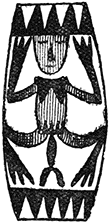
Fig. 124.—Stretching-cleat of a drum from Mangaia, in the Berlin Museum; from March, after Stolpe. Two-thirds natural size.
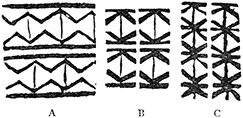
Fig. 125.—Rubbings from the handles of symbolic adzes from the Hervey Islands. A, Free Library Museum, Belfast; B, C, Belfast Nat. Hist. Mus. One-third natural size.
Mr. C. H. Read, of the British Museum, independently[162] arrived at a similar conclusion to Dr. Stolpe’s, and Dr. March[163] has carried the argument a step further. Dr. Stolpe proved that a design generally known as the K pattern, but which it is better to call the tiki-tiki pattern, sometimes interrupted, but generally continuous, is in reality a string of human figures, the two horizontal zigzags being limbs, and the vertical bars that join them being the headless bodies. (Fig. 125, A.)
These figures, which almost cover the handle of a Mangaian paddle or adze, are obviously related to the female forms that are carved on the terminal of its shaft (Figs. 127, 128), and are morphologically derived from them by a process of evolution.
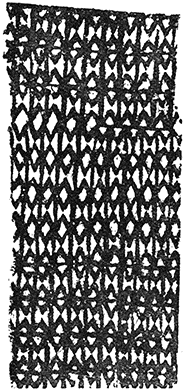
Fig. 126.—Rubbing of part of the decoration of a Mangaian symbolic paddle, Norwich Museum. Natural size.
The headless figures are quite recognisable in Fig. 125, A, but the fore-arms and shanks of each of them are absent, their places being taken by the upper arms and thighs of the contiguous figures. In B the serial individuals are separated by narrow vertical clefts; the latter persist in C, but the two boundary lines between the rows of figures are fused into a single line.
In Fig. 126 we have a large area (the blade of a paddle) divided into a number of parallel lines between which are diamonds, which may or may not be connected by horizontal lines. A careful inspection will show that the vertical lines are continuous body-lines; the horizontal lines are the same as those in Fig. 125, A, but the two lines are fused into one; the zigzags are clearly limbs. The absence of the horizontal lines simplifies the pattern, and so each diamond consists in its upper part of the leg, and in its lower part of the arms of human figures whose bodies are represented by the vertical lines.
The pattern in the lower half of Fig. 127 can be derived from the last by the introduction of an intermediate series of vertical lines.
Curvilinear patterns, as in the lower part of Fig. 128, are common on objects from these islands; they are evidently derived from the thighs of serial human forms, as in Fig. 127, and Plate VI., Fig. 13.
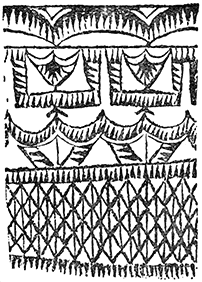
Fig. 127.—Rubbing of part of the carving of the handle of a symbolic paddle from the Hervey Islands, in the Natural History Museum, Belfast. One-half natural size.
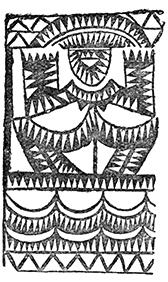
Fig. 128.—Rubbing of “part of the terminal of a paddle-shaped implement in the Vienna Museum”; from March, after Stolpe. Two-thirds natural size.
“It is abundantly certain,” adds Dr. March, “that the forms that crown the shaft are those of women, for they are invariably distinguished by pendant-pointed breasts. The solitary exception that Dr. Stolpe has been able to find is one in appearance only, for in his Fig. 23 the breasts are really fused into a single cone, exactly as are the legs in his Fig. 24” (p. 322).
Dr. March’s contribution is that these carved shafts of sacred paddles and adzes were pedigree-sticks. Descent is traced through the male line as a rule among the Polynesians, but it is certain that some tribes traced their descent through the female line. Dr. Gill states that this was in some places simply a matter of arrangement. Dr. Gill tells us that the designs on these shafts were called “tiki-tiki-tangata;” tangata means a man, or in this combination connotes human, for in a Polynesian word compounded of two nouns, that which comes last has a secondary, explanatory, or adjectival force. Tiki was the first man, and when he died, ruled the entrance of the under-world. The name signifies a “fetched” soul; the spirit of a dead man the frequentative or plural tiki-tiki must mean spirits in succession, or “ancestors.” “The conclusion now drawn is that tiki-tiki-tangata were the multitudinous human links between the divine ancestor and the chief of the living tribe. But to what ancestry did these pedigrees of female lineage assert a claim? From what goddess was it the pride of Mangaians to be descended, unless from the mother, the wife and the daughter-wife of Rongo—from Tu-metua, Taka, and Tavake.
“In Mangaia all the gods were called the children of Vatea, and of these Tane was one. His name indicates the generative principle in Nature. In Mangaia he was especially the drum-god and the axe[164]-god; he presided over the erotic dance as well as over the war-dances. Gill observes[165] that ‘Tane mata ariki,’ Tane with the royal face, was enshrined in a sacred triple axe,[164] which symbolised the three priestly families on the island of Mangaia. This axe was buried in a cave, and has disappeared. The K pattern which covers the shafts of the sacred Mangaian axe,[164] is an assertion of a Tane pedigree, the tiki-tiki-tangata of the clan. ‘Awake Tane!’ was the invocation,[166] ‘Awake unnumbered progeny of Tane!’” (March, p. 331).
4. Religious Symbolism.
The study of religious symbols[167] is not only a very extensive and extremely attractive undertaking, but it is one of peculiar difficulty, for with it is combined, not a danger, but a certainty of falling into errors. There is hardly a subject upon which such diverse views can be proposed and even maintained with a fair amount of presumptive evidence.
The danger of making mistakes is, however, considerably lessened if a scientific method of study is adopted, and if speculation is reduced to a minimum. No better example of the method of such a study is to be found than in Count Goblet d’Alviella’s book on The Migration of Symbols.[168] It is upon this valuable book that I have largely drawn in compiling the following account.
The meaning of the term Symbol, like the objects we connote by it, has undergone a transformation from a concrete reality to an abstraction. Originally applied amongst the Greeks to the two halves of the tablet they divided between themselves as a pledge of hospitality, in the manner of our contract form, detached along a line of perforations from the counterfoil record, it was gradually extended to the engraved shells by which those initiated in the mysteries made themselves known to each other, and even to the more or less esoteric formulas and sacramental rites that may be said to have constituted the visible bond of their fellowship. Then the meaning became amplified, and “the term came to gradually mean everything that, whether by general agreement or by analogy, conventionally represented something or somebody.”[169]
I have previously (p. 212) given Colonel Garrick Mallery’s definition of the word, which sufficiently indicates the meaning generally applied to it.
A pictorial symbol has the following life-history:—
First, it is simply a representation of an object or a phenomenon, that is, a pictograph. Thus the zigzag was the mark or sign of lightning.
Secondly, “the sign of the concrete grew to be the symbol of the abstract. The zigzag of lightning, for example, became the emblem of power, as in the thunderbolts grasped by Jupiter; or it stood alone for the supreme God; and thus the sign developed into the ideograph.”[170]
Thirdly, retrogression set in when new religions and new ideas had sapped the vitality of the old conceptions, and the ideograph came to have no more than a mystical meaning. A religious or sacred savour, so to speak, still clung about it, but it was not a living force within it; the difference is as great as between the dried petals of a rose and the blooming flower itself. “The zigzag, for instance, was no longer used as a symbol of the deity, but was applied auspiciously, or as we should say, for luck.”[170]
The last stage is reached when a sign ceases to have even a mystical or auspicious significance, and is applied to an object as a merely ornamental device.
“By symbolism,” writes Count Goblet d’Alviella, “the simplest, the commonest objects are transformed, idealised, and acquire a new and, so to say, an illimitable value. In the Eleusinian mysteries, the author of Philosophoumena relates that, at the initiation to the higher degree, ‘there was exhibited as the great, the admirable, the most perfect object of mystic contemplation, an ear of corn that had been reaped in silence; and two crossed lines suffice to recall to millions of Christians the redemption of the world by the voluntary sacrifice of a god.’”
As that author points out, “We live in the midst of symbolic representations, from the ceremonies celebrating a birth to the funeral emblems adorning the tomb; from the shaking of hands all round of a morning to the applause with which we gratify the actor, or lecturer, of the evening. We write as we speak in symbols.
“It is sentiment, and above all, religious sentiment, that resorts largely to symbolism; and in order to place itself in more intimate communication with the being, or abstraction, it desires to approach. To that end men are everywhere seen either choosing natural or artificial objects to remind them of the Great Hidden One, or themselves imitating in a systematic manner the acts and deeds they attribute to Him—which is a way of participating in His life.” The symbols with which we will here occupy ourselves are not those of acts or rites, but those of objects or emblems.
In all but the last stages of its career a symbol is a living sign, now this vitality is very real, and by virtue of it, strange modifications take place.
For example, when a nation that employed a particular symbol came into contact with another nation that had a somewhat similar symbol, the two symbols, if quite alike, were indistinguishable, and one passed for the other; but if there were slight differences between the symbols a process of amalgamation took place, and they approximated more and more towards one another. In either case the meanings of both would doubtless commingle, and a more energetic vitality would ensue from the cross-fertilisation.
St. Anthony’s cross, T (croix potencée, “gibbet-cross”), is found, with almost the same symbolic signification, in Palestine, in Gaul, and in ancient Germany, in the Christian Catacombs, and amongst the ancient inhabitants of Central America.
Among the Phœnicians and kindred peoples this cross was an alphabetical sign, tau, and it was also used separately as a symbol. From a passage in Ezekiel[171] we learn that it was accounted a sign of preservation, and was marked upon the forehead, like its corresponding Indian symbol.[172] The symbolic signification of the tau is explained by its resemblance to the Key of Life, or crux ansata of Egypt, so widely diffused throughout all Western Asia.
“This tau was unquestionably the emblem of life, and, therefore, of the greatest virtue. M. Letronne, in his researches on the Christian monuments of Egypt, has shown in the most conclusive manner that the first Christians of that country adopted this sign, possibly to establish that Christ was pre-eminently the source of life, or as a prophetic sign. All the gods of the ancient Egyptian mythology bore in their hand the sign of Christianity, the monogram of Christ; they were, according to the first Christians of Egypt, supposed to announce the coming of Jesus.”[173]
The Double Hammer of the Celtic Tarann and of the Teutonic and Scandinavian Thor is a symbol of the lightning. “Thor was the sun-god proper; god of the sun in its active aspect; the thunder-god likewise, and thus the wielder of the hammer or axe (named Mjolnir, ‘the crusher’) representative of the thunderbolt, rendered in the form T. Thor was also lord of the Under-World, and guardian against the monsters that infested its precincts; he was likewise a protector against sickness, and was much worshipped by the franklin and peasant classes.”[174]
“To this day a representation of the hammer of the God of Thunder may be found on the barns and stable-doors of some German villages. It is stated that in the northern, midland, and eastern counties of this country—wherever, in fact, the Teutonic element has made its strongest imprint—some old church bells still bear the same sign as a charm against the tempest.
“As applied to Thor, this tree-shaped cross symbol sustains his double quality as the fiery Cleaver of the Clouds, who even as such represents the principle of fertility and the Sanctifier of the fruitful union of hearts.”[175]
Karl Blind has also drawn attention to a mediæval German church legend which affords a good example of the persistence of pagan ideas and of the pagan-christian overlap. “Thus Trauenlob makes the Virgin Mary say of God the Father—‘The Smith from the Upper-Land (Heaven) threw his hammer into my lap (schôz).’”[176]
Amongst the early Christians it was a form sometimes given to the Cross of Christ, itself called the Tree of Life; but if they made of it a symbol of life, it was spiritual life that it typified to them; and if they sometimes gave it the form of the patibulum (gallows), it was because such was the instrument employed among the Romans in the punishment by crucifixion.
In Central America, where, according to M. Albert Réville, the Cross was surnamed the Tree of Plenty, it assumed also the form of the tau. This pre-Columbian American Cross, T, was a symbol of fertility because it represented the rain-god; it is, in fact, an abbreviated rain-shower (as will be seen on reference to Figs. 62-64). Similarly the four-rayed cross represented the four quarters whence comes the rain, or rather the four main winds which bring rain, and it thus became the symbol of the Tlaloc, god of rain and waters, fertiliser of earth and lord of paradise, and lastly, of the mythical personage known by the name of Quetzacoatl. From North to South America the Latin cross symbolises “the Father of the four winds” (Argentine Republic), “the old man in the sun who rules the winds” (Blackfeet Indians), or similar personages. But all crosses are not the four quarters of the wind, as will be seen on reference to Figs. 100 D, E, 102 A. For an account of the American cross, Colonel Mallery should be consulted, Tenth Ann. Rep., p. 724.
Mr. Beal, in the same number of the Indian Antiquary, which contains Mr. Thomas’s remarks on the Svastika (March 1880), has shown that in Chinese is the symbol for an enclosed space of earth, and that the simple cross + occurs as a sign for earth in certain ideographic groups.[177]

The four-rayed cross, separate or inscribed within a circle, is a very common symbol of the sun in prehistoric Europe.
As different waves of culture drifted across Europe, as new religions permeated the mass of the people, the stream-borne symbols found physical and spiritual analogues among the indigenous symbolism, and union naturally took place. In some cases, at all events, the cross fertilisation, as I have termed it, resulted in a higher or more spiritual meaning animating the old symbols; thus the symbol of the Avenger, the crushing Hammer of God, became that of the God Redeemer of the world.
When symbols become merely the dry-bones of defunct religions they may retain a certain magical quality, but then they pass out of religion and enter the domain of magic, where in fulness of time they may be born anew and start a fresh career as the symbols of modern science.
Besides this natural approximation of analogous symbols and symbolism, there is a more conscious and complex amalgamation, a heteromorphism. As Count Goblet d’Alviella says,[178] “At other times the symbolic syncretism is intentional and premeditated; whether it be in the desire to unite for the sake of greater efficacy, the attributes of several divinities in a single figure, as is shown in certain pantheistic figures of Gnostic origin; or a wish to state, by the fusion of symbols, the unity of the gods and the identity of creeds, as in the mystic monogram wherein the Brahmaists of contemporary India have testified to their religious eclecticism by interweaving the Om of the Hindus with the Trident, the Crescent, and the Cross.
“Sometimes, too, the sacerdotal interest must have tended towards accentuating the analogies rather than the dissimilarities of symbols, in order to assist the absorption or unification of the doctrines which they represented. Finally, we must take into consideration the popular tendency towards syncretism, which, when not held in check by a rigorous orthodoxy, acts upon symbols, as well as upon creeds, by introducing into the new form of worship the images consecrated by a long veneration. Or else it is the innovators themselves who take advantage of symbolism in order to disguise, through borrowing from antique forms, the newness of their doctrine and, if need be, to transform into allies the emblems or traditions which they are unable to boldly extirpate.
“Need I recall to mind Constantine choosing as a standard that labarum which might be claimed both by the religion of Christ and the worship of the sun? The Abbé Ansault has shown, firstly, that heathen nations used as religious emblems Greek, Latin, Maltese, pattées, gammées, potencées, ansées, trêflées, and other crosses; and, secondly, that the Christian Church has always accepted these different forms of the cross as the representation of its own symbol.
“Buddhism was even less scrupulous. In some of its sanctuaries it did not hesitate to preserve the images of the worship paid by the natives of India to the sun, to fire, or to serpents, whilst ascribing these rites to its own traditions. The Solar Wheel thus became easily the Wheel of the Law; the Cosmic Tree represented the Tree of Knowledge, under which Sakya Muni attained the perfect illumination; the seven-headed serpent Naga was transformed into the guardian of the impression left by the Feet of Vishnu, itself to be attributed henceforth to Buddha, and so on.”
The learned author from whom I have borrowed so much gives numerous examples of this process of the transference and amalgamation of symbols, and I must refer the reader for these details to the book itself.
A. The Meaning and Distribution of the Fylfot.
The fylfot, or “fully- or many-footed” cross, is the Anglo-Saxon name for that form of cross whose extremities are bent back at right angles (Fig. 130). It is otherwise known as the “gammadion,” “tetraskele,” “croix gammée,” “croix cramponnée,” not to mention various other names, and in India “svastika”; but when the feet are turned to the left it is called “sauvastika”; both these words have much the same meaning, and signify “it is well.” At the present day in Asia, this “mystical mark made on persons or things to denote good-luck” (as Monier Williams describes it in his Sanscrit dictionary) is clearly in the third stage of its life-history, and its meaning must have been introduced after its primary significance was lost.
At the risk of being somewhat tedious I will give a brief account of the distribution of this ancient symbol, than which there are very few others so widely distributed.
Dr. Schliemann found it represented exceeding numerously on objects (Fig. 130, A, E) from the “second” or “burnt city” of the mound at Hissarlik.
In Greece, as in Cyprus and at Rhodes, it first appears on pottery with painted “geometrical” ornamentation (Fig. 130, F), that is in the second period of Greek ceramics. Later it is found on the vases, with decorations taken from living objects (Fig. G) which appear to coincide with the development of Phœnician influences on the shores of Greece. Lastly, it became a favourite symbol on coins not only of Greece proper and the Archipelago, but also of Macedon, Thrace, Crete (Fig. 130, M), Lycia (Fig. 130, I), and Paphlagonia (Fig. 130, H).
From Corinth, where it figures amongst the most ancient mint marks, it passed to Syracuse under Timoleon, to be afterwards spread abroad on the coins of Sicily and of Magna Græcia.
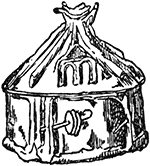
Fig. 129.—Hut-shaped ossuary; I. Taylor, Origin of the Aryans, p. 176.
In Northern Italy it was known even before the advent of the Etruscans, for it has been met with on pottery dating from the terramara civilisation. It appears also on the roof of some of those ossuaries in the form of a hut (Pl. I., Fig. C), which reproduce on a small scale the wicker huts of the people of that epoch. In the Villanova period it adorns vases with geometrical decoration found at Cære, Chiusi, Albano, and at Cumæ. Finally, it appears in Roman mosaics.
It is singular that at Rome itself it has not been met with, so Count Goblet d’Alviella informs us, on any monument prior to the third, or perhaps the fourth century of our era. About that period the Christians of the Catacombs had no hesitation in including it amongst their representations of the Cross of Christ, and they used it to ornament priestly garments. At Milan it forms a row of curved crosses round the pulpit of St. Ambrose.
It was widely distributed throughout the provinces of the Roman Empire (Fig. 130, S, T), especially among the Celts, from the Danubian countries to the West of Ireland (Fig. 130, K, U); but in many cases it is difficult to decide whether it is connected with imported civilisation or with indigenous tradition.
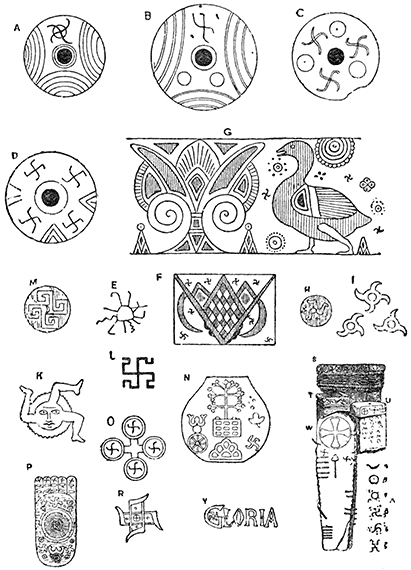
Fig. 130.—Various forms of the Fylfot or Svastika. A. Whorl from Hissarlik (1987), 7 m., third city, The Burnt City or Ilios; B. Do. (1861), 3½ m., fifth city; C. Do. (1990), 4 m., fifth city; D. Do. (1873); E. Detail from whorl (1993), 5 m., fourth city; F. Lotus derivative on a large amphora, with “geometric” decoration, Cyprus; G. Solar goose and lotus design on a Rhodian vase, from Salzmann, Nécropole de Camire; H. Coin from Selge, Pamphylia; I. Symbols on Lycian coins; K. Triskelion on a Celtiberian coin; L. On a silver bowl, Etruria; also on Chinese ware; M. Coin from Cnossus, Crete; N. Ancient Indian coin; O. On coin from Ujjan, Central India; P. Footprint of Buddha (so-called), Amarávati Tope, India; R. Thibetian symbol; S. Roman altar at High Rochester, dedicated to Minerva by Lucius Cæcilius Optatus; T. Roman altar at High Rochester, dedicated to the standards of the faithful of the Varduli by Titus Licinius Valerianus; U. Celto-Roman altar at Birdoswald, dedicated to Jupiter Optimus Maximus (IOM), apparently by Dacians garrisoned in Ambloganna; the four-rayed wheels were solar symbols among the Gauls; W. Ogham stone, Aglish, County Kerry; X. Ancient Scandinavian symbols; Y. Legend on church bell, Hathersage, Derbyshire, 1617. A-E, P. H. Schliemann, Ilios; F, G. Goodyear, Grammar of the Lotus; H, L, O, X. R. P. Greg, Archæologia, xlviii., 1885; I, K, M, N, R. Count Goblet d’Alviella, The Migration of Symbols; S, T, U, W, Y. H. Colley March, Trans. Lanc. and Cheshire Ant. Soc., 1886. For further details the reader is referred to these authors.
In England it not unfrequently occurs on Roman votive altars. In Ireland, however, and in Scotland, the fylfot seems to have marked Christian sepulchres. For example, a fylfot occurs on either side of an arrow on an ogham stone (Fig. 130, W) in an abandoned graveyard at Aglish, County Kerry, which is believed to belong to the sixth century.
In Pagan Scandinavia it occurs with other symbols (Fig. 130, X), but it there ended by combining with, doubtless (as Count Goblet d’Alviella points out) under the influence of Christianity, the Latin Cross. It ornaments early Danish baptismal fonts, and according to Mr. J. A. Hjaltalin, it “was still used a few years since as a magic sign, but with an obscured or corrupted meaning,” in Iceland. It arrived in that island in the ninth century, A.D.[179]
“Amongst the Slavs and Fins it has not yet been found save in a sporadic state, and about the period of their conversion to Christianity only. We may remark, by the way, that it is very difficult to determine the age and nationality of the terra-cotta or bronze objects on which it has been observed in countries of mixed or superposed races, such as Hungary, Poland, Lithuania, and Bohemia.
“In the Caucasus, M. Chantre has met with it on ear-drops, ornamental plates, sword-hilts, and other objects found in burial-places dating back to the bronze period and the first iron age.
“Amongst the Persians its presence has been pointed out on some Arsacian and Sassanian coins only.
“The Phœnicians do not seem to have known, or, at least, to have used it, except on some of the coins which they struck in Sicily in imitation of Greek pieces.
“It is not met with either in Egypt, in Assyria, or in Chaldæa.”[180]
The svastika is of common occurrence in India, and is employed alike by Hindus and Buddhists. It was used for ear-marking cattle, appears on the oldest known Indian coin (Fig. 130, N), on which are other interesting symbols, and occurs frequently at the beginning and the end of the most ancient Buddhist inscriptions; similarly it initials the legend SCA. MA. RIA. O.P.N. at Appleby, in Lincolnshire; and at Hathersage, Derbyshire, a fylfot occurs on a church bell in the initial G of the legend Gloria in Excelsis Deo, 1617. (Fig. 130, Y.) The svastika represents, according to Buddhist tradition, the first of the sixty-five marks which distinguished the Master’s feet, and the sauvastika is the fourth and the third, a kind of labyrinth which is akin to the latter. It is inscribed thrice on each sole and on each digit of the famous sculptured footprints of Gautama at Amarávati. (Fig. 130, P.)
“Even at the present day, according to Mr. Taylor, the Hindus, at the time of the new year, paint a svastika in red at the commencement of their account books, and in their weddings and other ceremonies they sketch it in flour on the floors of their houses. It also figures at the end of manuscripts of a recent period—at least under a form which, according to M. Kern, is a development of the tetraskele”[181] (i.e., a variety with rounded angles).
The Buddhist women of Thibet ornament their skirts with it, and it is placed on the breast of the dead. A Thibetian form is seen in Fig. 130, R.
The Buddhists introduced it into China (Fig. 130, L) and Japan, where it adorns vases, caskets, and the representations of divinities; it is even figured upon the breasts of certain statues of Buddha. According to M. G. Dumoutier, it is nothing else than the ancient Chinese character che, which implies the idea of perfection, of excellence, and would seem to signify the renewal and the endless duration of life. This suggests that the symbol was brought by the Chinese across Asia in their wandering from the West to their present home; but against this view must be put the fact of its absence in Chaldea and Assyria; and we know it has been introduced by the Buddhist missionaries. In Japan, according to M. de Milloué, it represents the number 10,000, which symbolises that which is infinite, perfect, excellent, and is employed as a sign of felicity.
Schliemann[182] also records the fylfot in Africa, on bronzes brought from Coomassie by the English Ashantee expedition in 1874. It is known from South America, on a calabash from the Lenguas tribe; in North America, on pottery from the mounds; and from Yucatan, on Zuñi pottery, as also on the rattles made from a gourd which the Pueblos Indians use in their religious dances. I have heard that bronze representations of the fylfot have been obtained from excavations in Ohio, the details of which will shortly be published.
There can be no doubt that the fylfot throughout Eur-Asia had a symbolic significance, which in many places it still retains. Its longevity is due to this cause alone; occasionally, when it was copied by peoples who did not understand or appreciate its symbolism, it degenerated into a mere ornamental device.
Although all phases of symbolic meaning are interesting, I must restrict myself to origins and to a few of the later developments of this particular symbol.
The interpretations of the fylfot have been particularly varied, and these have been further complicated by this sign having been confounded with the crux ansata of the Egyptians, the tau of the Phœnicians, the vajra of India, the Hammer of Thor, or the Arrow of Perkun. All these have a clearly defined form and meaning, and even if the fylfot “ever replaced one of them—as in the catacombs it sometimes takes the place of the Cross of Christ—it only did so as a substitute, as the symbol of a symbol.”[183]
Some archæologists have ascribed a phallic import to the fylfot, others recognise in it the symbol of the female sex; “but it may very well have furnished a symbol of fecundity, as elsewhere a common symbol of prosperity and of salvation, without therefore being necessarily a phallic sign.”[184] These are probably secondary meanings superadded to a primitive and less abstract conception.
It has been held to indicate water, storm, lightning, fire, or even the Indian fire-drill, the “mystic double arani,” mentioned in one of the Vedic hymns to Agni, the fire-god. These views have been combated by Greg,[185] Colley March,[186] and Goblet d’Alviella.[187] Mr. Greg contends that the fylfot is a symbol of the air or sky, or rather of the god who rules the phenomena of the atmosphere, by whatever name men may call him. Dr. March’s theory is that it symbolises axial rotation, and not merely gyratory motion; in fact, the axis of the heavens, the celestial pole, round which revolve all the stars of the firmament once in twenty-four hours. This appearance of rotation is especially impressive in the Great Bear, the largest and brightest of the Northern constellations.... About four thousand years ago, the apparent pivot of rotation was not where it is now, but occupied a point at a Draconis much nearer to the Great Bear, whose rapid circular sweep must then have been far more striking than it is at present. In addition to the name Ursa Major, the Latins called this constellation Septentriones, ‘the seven ploughing oxen’ that dragged the stars round the pole, and the Greeks called it ἕλικη, from its vast spiral movement.”[188]
There is no need to follow Dr. March in his explanation, and we must now turn to the view which has been supported by the greatest number of investigators, who “have succeeded, by their studies of Hindu, Greek, Celtic, and ancient German monuments, in establishing the fact that the gammadion has been, among all these nations, a symbolic representation of the sun or of a solar god.” Count Goblet d’Alviella reinforces this theory by the following considerations:—
1. The form of the fylfot.—To be convinced that the branches of the fylfot are rays in motion it is only necessary to cast one’s eyes on the manner in which, at all times, the idea of solar movement has been graphically expressed. Thus on a whorl from Troy, crooked rays, turned towards the right, alternate with straight and undulating rays, all of which proceed from the same disc (Fig. 130, E).
2. The triskele, formed by the same process as the tetraskele, was an undeniable representation of the solar movement.—On coins from Asia Minor the triskele is frequently represented as three legs, and on Celtiberian coins (Fig. 130, K) the face of the sun appears between the legs. On the coins of Aspendus in Pamphylia the three legs are combined with animal representations of the sun, the eagle, the wild boar, and the lion; and on certain coins of Syracuse the triskele permutes with the solar disc above the quadriga and the winged horse. In various places transition occur between the tetraskele and triskele (Fig. 130, I). I have already (p. 213) referred to the ultimate fate of the triskele.
3. The images oftenest associated with the fylfot are representations of the sun and the solar divinities.—The fylfot and the solar disc are, in a way, counterparts, not only amongst the Greeks, the Romans, and the Celts, but also with the Hindus, the Chinese, and the Japanese. The two are often combined into one figure, and the rays have been converted into horses’ heads, as on Gallo-Belgic coins, or into cocks’ heads and lions’ busts which take the place of the rays of the triskele on Lycian coins. Professor Goodyear points out that the fylfot is associated on Cyprian and Rhodian pottery with the goose (Fig. 130, G), deer, antelope, ibex, ram, horse, lion, etc. All of these are solar animals. It is associated with the lotus (Fig. 130, F), which is also a solar symbol.
4. In certain symbolic combinations the fylfot alternates with the representation of the sun.—Among the Jains of modern India, a considerable Hindoo sect, the sun appears to be represented by the svastika, and this symbol and the solar disc constantly replace each other on the ancient coins of Ujjain in Central India (Fig. 130, O), and Andhra in the Deccan. Another proof of the equivalence between the fylfot and the sun, or, at least, the light of the sun, is found amongst the coins of the ancient city of Mesembria in Thrace. Professor Percy Gardner states, “Mesembria, as it stands, is simply the Greek word for “noon” or mid-day (μεσημβρία); and there can be no doubt that the Greek inhabitants would suppose their city to be the place of noon; and among the coins of Mesembria occurs ΜΕΣ.” Five-rayed and three-rayed (triskele) sun symbols were associated with Apollo on coins of Megara, now Mesembria was founded by a colony of Megarians.

Sometimes three solar discs or three fylfots, or combinations of both, occur (Figs. 130, B, C), and in these Count Goblet d’Alviella sees a symbolic representation of the three diurnal positions of the sun, and suggests that when four symbols occur crosswise, as frequently happens (Fig. 130, D), they “relate to four different positions of the luminary, which would, perhaps, suggest no longer its daily course, but its annual revolution marked by the solstices and equinoxes.”[189]
The fylfot would seem to occasionally replace the moon. On coins of Cnossus, in Crete (Fig. 130, M), the Lunar Crescent takes the place of the solar disc in the centre of the fylfot; in such instances it may have been applied to the revolutions or even the phases of the moon.
Various suggestions have been made with regard to the reversed fylfot or sauvastika, but it is still uncertain whether this is of primary (Max Müller, Birdwood, Colley March) or secondary importance (Greg, d’Alviella).[190]
The last theory of the origin of the fylfot that I need mention is that propounded by Professor Goodyear[191] in the following words:—“There is no proposition in archæology which can be so easily demonstrated as the assertion that the swastika is originally a fragment of the Egyptian meander, provided Greek geometric vases are called in evidence.” Professor A.S. Murray long since suggested that the “crosses which Dr. Schliemann calls svastikas, but which, in fact, appear to be only the simplest form or element of the meander pattern.”[192] Sir G. Birdwood says: “I believe the Buddhist swastika to be the origin of the key-pattern ornament of Chinese decorative art.”[193] Professor Goodyear makes him say that of Greek decorative art as well.
It is a pity that Mr. Goodyear has pledged himself so fully as in the statement just quoted, as it is apt to make critics more captious as to his main thesis. If the fylfot is a detached intersection of the meander pattern, why did not the Egyptians hit on it? Granting that the meander may have had an indirect origin from a natural object in the Mediterranean countries, there is no proof that any religious or magical meaning was attached to it. The manner in which the fylfot was employed proves that it certainly had a symbolic signification. The strongest argument adduced by Professor Goodyear is in the case of some “geometrically” decorated Greek vases, in which between solar geese and other symbols occurs a small panel, which is variously decorated with a fylfot, or an element or varietal detail of the meander pattern.[194] But this, after all, may prove to be nothing more than that the Greeks noticed that the fylfot occurred in certain varieties of the meander pattern which had been arrived at from quite a different source. This occurrence of the fylfot in these patterns was quite accidental; it would be better to say that a fylfot design could be picked out from these patterns rather than to suggest that it was inherent in them. Granting the sacred associations of the fylfot, the fact that it could be separated from a pattern which itself may have had a recognised association with the symbolic lotus would probably appeal to a symbol-loving people. If they recognised that the fylfot on the one hand, and the lotus on the other, were sun-symbols, the isolation of the associate of a sun-symbol into another sun-symbol would be a pleasing exercise of ingenuity. I do not pretend to say that this has occurred, but it is to me quite a possible alternative. The sequence which Professor Goodyear seeks to establish appears to me to be nothing more than the birth of an analogy.
Before a judgment upon the Chinese meander pattern can be pronounced it would be necessary to make a detailed study of that pattern on objects from that part of the world, and I have not access to the requisite data.
We now come to the interesting question of the birthplace of this important symbol.
It was long ago remarked that the fylfot is almost exclusively an Aryan symbol. It is completely absent among the Egyptians, the Chaldeans, the Assyrians, and even the Phœnicians, although these middle-men traded useful objects and sacred symbols indiscriminately. The Semites did not employ it.
Although widely spread and venerated among the Tibetians (Fig. 130, R), the Chinese (Fig. 130, L), and the Japanese, it can be proved that these Mongolian peoples have adopted it along with Buddhism from India.
As a recognised religious symbol it is unknown among all the other peoples of the globe.
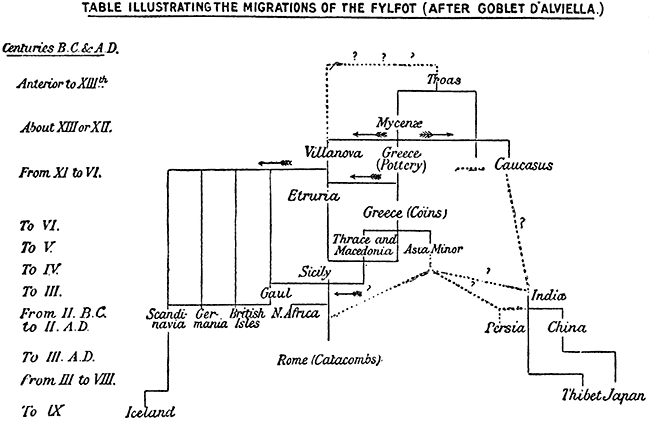
The conclusion is evident that the fylfot was a symbol before the swarming-off of the Aryan hordes. There seems little doubt that it was originally an emblem of the sun. It may, in certain combinations, have come to symbolise the apparent daily movement of the sun, and perhaps also the annual change of seasons. Some see in it the symbol of a sun-god, others believe it to be the god of the sky, or air, who in the course of time was variously known as Indra, Zeus, Jupiter, Thor, etc. Lastly, it has been promoted to signify “the emblem of the divinity who comprehended all the gods, or, again, of the omnipotent God of the universe.” This latter is certainly not a primitive conception, and we have no evidence that this meaning was ever read into the symbol.
Count Goblet d’Alviella points out that in Europe the geometric style of ornamentation embraces two periods, that of painted and that of incised decoration. “Now in this latter period, which is everywhere the most ancient, the gammadion is only found on the whorls of Hissarlik and the pottery of the Terramares. We have, therefore, two early homes of our symbol, one on the shores of the Hellespont, the other in the north of Italy.
“Was it propagated from one country to another by the usual medium of commerce? It must be admitted that at this period the relations between the Troad and the basin of the Po were very doubtful. Etruria certainly underwent Asiatic influences; but whether the legendary migration of Tyrrhenius and of his Lydians be admitted or not, this influence was only felt at a period subsequent to the ‘palafittes’ [pile dwellings] of Emilia, if not to the Necropolis of Villanova.
“There remains, therefore, the supposition that the gammadion might have been introduced into the two countries by the same nation.
“We know the Trojans came originally from Thrace. There is, again, a very plausible tradition to the effect that the ancestors, or predecessors, of the Etruscans, and, in general, the earliest known inhabitants of northern Italy, entered the peninsula from the north or north-east, after leaving the valley of the Danube. It is, therefore, in this latter region that we must look for the first home of the gammadion. It must be remarked that when, later on, the coinage reproduces the types and symbols of the local religions, the countries nearest the Danube, such as Macedon and Thrace, are amongst those whose coins frequently exhibit the gammadion, the traskele, and the triskele. Besides, it is especially at Athens that it is found on the pottery of Greece proper, and we know that Attica is supposed to have been primitively colonised by the Thracians. ‘The nations who had invaded the Balkan peninsula and colonised Thrace,’ writes M. Maspero, ‘crossed, at a very early period, the two arms of the sea which separated them from Asia, and transported there most of the names which they had already introduced into their European home. There were Dardanians in Macedon, on the borders of the Axios, as in the Troad, on the borders of the Ida, Kebrenes at the foot of the Balkans, and a town, Kebrene, near Ilium.’[195] Who will be astonished that these emigrants had taken with them, to the opposite shore of the Hellespont, the symbols as well as the rites and traditions which formed the basis of their creed in the basin of the Danube?
“Even when it occurs in the north and west of Europe, with objects of the bronze period, it is generally on pottery recalling the vases with geometric decorations of Greece and Etruria, and later, on coins reproducing, more or less roughly, the monetary types of Greece. It seems to have been introduced into Germany, Denmark, Sweden, Norway, and Iceland, in the same manner as that in which the runic writing was brought from the Danube valley to the shores of the Baltic and the ocean. It may have penetrated into Gaul, and from there into England and Ireland, either through Savoy, from the time of the ‘palafittes,’ or with the pottery and jewelry imported by sea and by land from the East, or, lastly, with the Macedonian coins which represent the origin of Gallic coinage.
“We have already seen how it was brought among the islands of the Mediterranean, and into Greece proper, then from Greece to Sicily and even Southern Italy. It must be observed that even at Rome it seems to have always been connected with the traditions of the East. We must not forget that the Christianity of the Catacombs was likewise a religion of Oriental origin.”
So much for the western fylfot. The oriental form even in the extreme east of Asia can be traced without difficulty to the svastika of India. There can be no doubt that the fylfot and the svastika are genetically allied, but it is not at present very easy to demonstrate all the links of the chain. Here again I quote from Count Goblet d’Alviella.
“The svastika does not appear on the coins struck in Bactriana, or in India, by Alexander and his Indo-Greek successors. Even amongst the Indo-Scythians, whose coinage copies the Greek types, it is only visible on barbarous imitations of the coins of Basu Deva. On the other hand, as we have shown, it adorns the coins of Krananda and the most ancient monetary ingots of India. Moreover, Panina, who already makes mention of the svastika, is sometimes considered to have lived in the middle of the fourth century B.C. It might therefore be possible that the Hindus had known the svastika before feeling in their arts, and even in their symbolism, the influence of the Greek invasion.
“Yet, for the best of reasons, it is neither the Chaldæans, the Assyrians, the Phœnicians, nor even the Egyptians, who can have imported the gammadion to Hindustan.
“There only remain, then, the Persians, whose influence on the nascent arts of India was certainly felt before Alexander. But in Persia itself the gammadion only appears as an exception on a few rare coins approaching our era.
“Perhaps we would do well to look towards the Caucasus, where the antique ornaments with gammadions, collected by M. Chantre, lead us back to a civilisation closely enough allied, by its industrial and decorative types, to that of Mycenæ.
“Until new discoveries permit us to decide the question, this gap in the genealogy of the svastika will be equally embarrassing for those who would like to make the gammadion the common property of the Aryan race, for it remains to be explained why it is wanting amongst the ancient Persians. It is right, too, to call attention to its absence on the most ancient pottery of Greece and the Archipelago, where it only appears with geometric decoration.
“If the gammadion is found amongst none of the nations composing the Egypto-Semetic group; if, amongst the Aryans of Persia, it never played but a secondary and obliterated part, might it not be because the art and symbolism of these different nations possess other figures which discharge a similar function, whether as a phylactery, or else as an astronomical, or a divine symbol? The real talismanic cross of the countries stretching from Persia to Lybia is the crux ansata, the key of life of the Egyptian monuments. As for their principal symbol of the sun in motion, is it not the Winged Globe? There would seem to be between these figures and the gammadion, I will not say a natural antipathy, but a repetition of the same idea. Where the gammadion predominates—that is to say, in the whole Aryan world, except Persia—the Winged Globe and the crux ansata have never succeeded in establishing themselves in good earnest. Even in India, granting that these two last figures really crossed the Indus with the Greek, or the Iranian symbolism, they are only met within an altered form, or with a new meaning.
“In brief, the ancient world might be divided into two zones, characterised, one by the presence of the gammadion, the other by that of the Winged Globe as well as of the crux ansata; and these two provinces barely penetrate one another at a few points of their frontier, in Cyprus, at Rhodes, in Asia Minor, and in Lybia. The former belongs to Greek civilisation, the latter to Egypto-Babylonian culture.
“As for India, everything, so far, tends to show that the svastika was introduced into that country from Greece, the Caucasus, or Asia Minor, by ways which we do not yet know. However that may be, it is owing to its adoption by the Buddhists of India that the gammadion still prevails amongst a great part of the Mongolian races, whilst, with the exception of a few isolated and insignificant cases which still survive amongst the actual populations of Hindustan, and, perhaps, of Iceland, it has completely disappeared from Aryan symbolism and even folk-lore.”
B. The Psychology of Symbolism.
Signor G. Ferrero[196] has investigated the psychological laws of symbolism, using that term in its widest aspect. After giving a sketch of the history of the Fylfot, which is largely borrowed from that by Count Goblet d’Alviella, he proceeds to give its psychological interpretation in the following words (p. 148):—
“I believe that this symbol of the motion of the sun became transformed into a mystic symbol, precisely because it was a metaphorical symbol. The signification of a pictographic symbol can not be forgotten, for the sensation of the symbol directly recalls the image or the idea of the object; there are not in that case intermediate states of consciousness which can be eliminated. But when it concerns a metaphorical symbol, these intermediate states of consciousness exist, for the symbol must be interpreted, especially if a very imperfect and rude delineation is in question, whose relation to the object represented is of the slightest. The figure of a tree directly recalls to me the idea or image of the tree; but a circle drawn with three or four legs does not directly suggest to me in itself the precise idea of the motion of the sun; there is at least the possibility of different interpretations, and at all events there must be an original and independent act of interpretation. The significance of the symbol, finally, can only be known if one undertakes an investigation of induction and interpretation, or if one associates with an inspection of the symbol the remembrance of an explanation which has been given, or of an interpretation which we had formerly discovered for ourselves.
“Now this state of consciousness, which serves for the interpretation of the symbol, would have been necessary if the symbol of the cross had ministered to the needs of existence, to commerce or politics, for example; but as it was a religious symbol whose use did not vary according to the truth and the exactness of its interpretation, it is evident that this state of consciousness would become useless in the long run, and the brain would relieve itself of it in a short time. The croix gammée (fylfot) was, like genuflexions and the other mimic symbols of ceremonial, a symbol employed in relation with the divinity; accordingly, the same cause which rendered useless in the ceremonial the state of consciousness, which we have called γ,[197] has rendered useless the state of consciousness which could interpret the solar signification of the cross. It was, in short, a religious symbol employed in relation to God; rightly or wrongly interpreted as it may be, prayer and other propitiations tended to the same result; the state of consciousness which served for its interpretation was then not necessary, and the brain little by little relieved itself from it. This state of consciousness being eliminated, it was forgotten that the sign of the cross represented the sun, because this was a metaphorical symbol too vague to directly recall the idea of solar movement.
“When the state of consciousness which served for the interpretation of the design was gradually eliminated, all the religious sentiments which had the sun and its cult for their object were addressed to the cross; that is why it has become the object of so profound a veneration, without any one knowing its signification or origin; the cross reaps for its profit the inheritance of the solar cult of which it has ceased to be a symbol, in order to become almost a divinity by itself. The cross thus became a mystic symbol of which the applications became very numerous, and even very confused.
“All this, I repeat, is only a supposition, but it may enable us to affirm that, whatever may be the origin of the cross, its evolution, very probably, can only be explained from the point of view of the theory of the ideo-emotional arrest.”
A. Note on Mental Inertia.
Signor G. Ferrero has studied what he terms “mental inertia” and “the law of least effort,” as applied to the mind, and he finds that the mental operation may stop short at certain points; thus he distinguishes (1) mental arrest, (2) emotional arrest, and (3) ideo-emotional arrest.
(1.) The first is due to a deficiency in logic; as, for example, when machinery was first introduced, the workmen smashed the machines, regarding them as the cause of the fall in wages, and being ignorant of the fact that the altered conditions were caused by complicated economic conditions, and not by the machines.
(2.) An analogous phenomenon occurs in the domain of the emotions. An emotion is not isolated, it is always one link of a chain. The emotions are always associated with a more or less great number of images or ideas which define them. But the image or the idea of the thing which should define the emotion sometimes dwindles or entirely disappears; it then follows that the emotion, instead of being associated with the image or with the idea of this thing, is associated with the symbol which represents this thing; it stops short at the symbol instead of projecting itself beyond the symbol towards the thing represented.
This is the emotional arrest. It is notorious that in religion the adoration which should be paid to God in heaven is often arrested at the images which represent the divinity, as when the elders of Israel said, “Let us fetch the ark of the covenant of the Lord out of Shiloh unto us, that, when it cometh among us, it may save us out of the hand of our enemies ... and the Philistines were afraid, for they said, God is come into the camp.”[198]
(3.) There is yet a third psychological process by which the confusion between the symbol and the thing symbolised is possible; it is the ideo-emotional arrest. In an analysis of the mental state of a man who performs acts of social ceremonial, this author finds (p. 133) that “to each completed act there corresponds, in the spirit of man, three states of consciousness, quite distinct and associated:—
“1. The desire to cause the man to be favourable to him in whose presence the ceremonial act is accomplished (α);
“2. The idea that the ceremonial act can serve this purpose (β);
“3. The idea that the act can serve this purpose because the suppliant understands that he who has put himself in the position where he is unable to do harm cannot have any dangerous intention (γ).
“The mental state of those who entreat the gods was, in this primitive period, composed of the same three states of consciousness, quite distinct but inter-related:—
“1. The desire to make the divinity favourable to oneself (α);
“2. The idea that certain acts or practices (prayers, visits, etc., etc.) conduce to this result (β);
“3. The idea of the reason for which these acts have this power—that is to say, the conviction that they are adapted to the character attributed to the divinity (γ).
“It is evident that if we compare the mental state of men who are in harmony with ceremonial observances in this primitive period of ceremonial with the mental state of civilised men who still observe ceremonial, social, and religious rules, we find that in the mental state of civilised men the third state of consciousness—that is to say γ, has been eliminated. In fact, we have remarked that, among civilised man, the performance of a ceremonial act is determined by the desire to render himself favourable to, or at least not to offend another person or a God (α), and from the idea that these acts can produce this effect (β); without knowing why (that is to say that γ has been eliminated).
“We have seen that by the law of mental inertia, a state of consciousness—image, idea, emotion—cannot last for ever, after the exciting cause has ceased to act, for a state of consciousness is a transformation of energy, and it finishes when it has exhausted its initial quantity of force.
“Only the states of consciousness which, being necessary for the needs of existence, are preserved by permanent excitation,—be this excitation simple and direct or complex and indirect—can have an apparently eternal persistence; the duration of useless states of consciousness is limited.
“This is true for individuals or bodies of men. To each institution, to each custom, etc., there correspond in the mind of man a certain number of associated ideas, which have determined alike its birth and transformation; but, according to this law, only the ideas which are necessary should be preserved in this association of ideas; the others should be gradually eliminated.
“This interesting psychological phenomenon of ideo-emotional arrest concludes by profoundly modifying ideas and feelings. It modifies ideas, for it induces what I have termed a mental arrest; the ideation, in fact, by the loss of the state of consciousness γ, is arrested at β; and the mind is contented to know that a certain act will produce a certain effect, or will express a certain sentiment, without troubling itself with the cause, without seeking for an explanation. It modifies, and, so to speak, displaces the feelings, for it produces that what I call an emotional arrest: in fact, when the idea of the true character of the ceremonial act is lost, the act is no longer a sign of certain inclinations of sentiment, but itself becomes an object of veneration. We see men who pay attention only to ceremonial and who neglect the feelings on which it should be based ... they believe they have fulfilled their religious duties, even if love and devotion are wanting, if they have not neglected the ceremonies. It is the same with the social ceremonial; for the majority of men, social duty does not consist in loyalty, in mutual affection, in a spirit of justice towards others, but in ceremonial observances; and when the ceremonial code is not violated they are persuaded that they have nothing for which to reproach themselves. It is a true emotional arrest, for the sentiments of social and religious duty are, so to speak, arrested midway in purely external acts.”[199]