DECORATIVE ART OF BRITISH NEW GUINEA.
Reading edition
As stated in the Introductory section, we will commence our studies of the art of existing savages by a brief account of the decorative art of a limited area rather than wander over the earth’s surface in order to cull random examples of ornamentation. It is not sufficient to collect patterns or designs in illustration of a theory; in pursuing such a course one is, so to speak, as likely to gather tares as wheat, and they may become inextricably mixed. In my studies I have preferred to limit myself for a time to one particular district, and to gather together all the available material from that locality. The region selected was British New Guinea. By putting together all the objects in our possession known to come from any one locality, I found that the technique of the decoration and the style of the ornamentation were characteristic. It soon became apparent that British New Guinea could be divided into several artistic regions; and so it became possible to allocate to a definite district objects in museums whose exact locality was unrecorded. But this is not sufficient; it is one thing to allocate a particular pattern or group of patterns and designs to their place of origin, but quite a different matter to trace out the history or significance of the ornamentation.
In some cases the origin of a design is obvious on the face of it; in most it is easy to suggest an origin; in others even the most fertile imagination is at fault. In studies such as these the investigator should restrain from theorising as far as possible; it is a dangerous game, for more than one can play at it, and the explanation is as likely to be wrong as right. The most satisfactory plan is to gather together as much material as possible, and it will generally be found that the objects tell their own tale, and all that has to be done is to record it. When the meaning is not plain, the fault lies in the imperfection of the series, unless very great conventionalisation has already occurred, and it is wiser to wait for authoritative information than to theorise.
One great advantage in the method of confining attention to a limited area is that similar designs very probably have a genetic connection, whereas this is by no means the case if objects from different regions are compared together.
I have recently[4] published a somewhat detailed study of the decorative art of British New Guinea, to which I may refer the reader who desires to enter into more minute details. In the following account I shall first sketch the main characteristics of the art of each æsthetic region, and finally I shall discuss the influences which act on the decorative art of these and other districts of New Guinea.
I.—Torres Straits and Daudai.
The natives who inhabit the islands of Torres Straits are a black, frizzly-haired, excitable people, and therefore belong to the Papuan, as opposed to the Australian stock.
Daudai is the native name for the contiguous coast of New Guinea, and it forms with the islands one ethnographical province. Between their respective inhabitants was a regular trade, chiefly in canoes, bows and arrows from the mainland, and in turtle-shell, pearl shell, and other marine shells from the islands.

Fig. 1.—Bamboo tobacco-pipes; one-tenth natural size. Torres Straits. Drawn by the author from specimens in the British Museum.
Unless otherwise stated, the following description applies to objects from the Torres Straits islands, the natives of which appear to be rather more artistic than those of Daudai.
There are two methods of decorating smooth surfaces—(1) by carving the pattern, the intaglio portion of which is often filled up with powdered lime (Fig. 2); or (2) the design is engraved on the surface of the object by means of fine punctate or minutely zigzag lines (Fig. 5). The former method is alone applied to wooden objects, and also mainly to those made of turtle-shell (“tortoise-shell”); the latter is that employed on bamboo pipes and on many turtle-shell objects. Unbroken lines are very rarely engraved.
It is characteristic of this district that the patterns are inscribed within parallel lines, whether it be a comb (Fig. 2) or a bamboo pipe (Fig. 1) which is to be decorated. The parallel lines are first drawn, and then the pattern is delineated. A noticeable peculiarity is the preponderance of straight or angled lines to the exclusion of curved lines. Simple semicircular curves and circles are common, it is true, but they are not combined into curved patterns; reversed or looped coils and complex curved lines, such as scrolls, are completely absent.
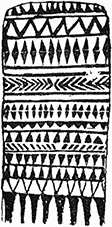
Fig. 2.—Rubbing of the handle of a wooden comb; one-half natural size. Torres Straits. In the author’s possession.
The most common pattern is the ubiquitous zigzag, and this is pre-eminently characteristic of this region. The zigzag may appear as an angular wavy line, or each alternate triangle may be left in relief or emphasised by parallel lines, thus forming a series of alternate light and dark triangles, or what is sometimes termed a tooth pattern. It is obvious that when several rows of this pattern are drawn, a triangle of one row will so coincide with that of the contiguous row as to form a diamond or lozenge. Strange as it may seem, it appears that this is the actual way in which even such a simple form as the lozenge was discovered in this district. Even now, after generations upon generations of designers carving the same simple patterns, the lozenge is very frequently made by drawing a median horizontal line parallel to the boundary lines and then cutting a more or less symmetrical triangle on each side of it (Fig. 2, third and fifth bands). A herring-bone pattern (Fig. 2, fourth band) and a few simple combinations of straight or angled lines complete the decorative attempts of these people.
We often find that a feeling for symmetry prompts the artist to more or less design his patterns with regard to the middle-line, although the latter may not be indicated as such. The same comb offers examples of this.
It must not be imagined that these people do not employ curved lines in their patterns because they cannot draw them. On the contrary, when they wish to represent animals, they can do so with spirit and truthfulness. The accompanying illustration (Fig. 3) demonstrates a fair amount of skill and a faculty for seizing upon the salient features of the animal to be drawn. The diversity of animals is also noteworthy. Nearly every great group of animals is represented in native art, and often so faithfully that it is possible for the naturalist to give the animals their scientific names.
Fig. 3 illustrates some of the animals delineated by the natives of Torres Straits. On looking over the rubbings and tracings of animal drawings from this district which I have collected, I find that over twenty different kinds of animals are represented. Like the ancient Peruvians, they have not disdained to copy jelly-fish (A) and star-fishes (B); the former appears to be a medusoid belonging to the Leptomedusæ. The remarkable hammer-headed shark (C) is often represented by these people; the group of two sharks and a turtle (D) occurs on one of a series of pearl shells which are fastened to a band; (E) is probably an eagle-ray; the strange sucker-fish, which is used in fishing, is shown in (F), the mouth, however, is on the opposite side of the body to the dorsal-sucker; (G) is a green tree-frog, the sucker-bearing toes are indicated in a generalised manner; this is one of two frogs which are placed in the same position on a bamboo tobacco-pipe, as are the two snakes (H) on another pipe (cf. Fig. 1); the black disc between them indicates the hole in which the bowl is inserted. A crocodile is seen walking along the ground at (I), and a cassowary (K) is pecking at a seed; its three-rayed tracks are also shown (cf. Fig. 4); (L) is a cleverly drawn dolphin, and (M) is a dugong spouting, and below it the waves are indicated. The native dog, or dingo, is shown at (N), and (O) is a man who has caught a large mackerel-like fish; his belt, arm- and leg-bands are indicated.
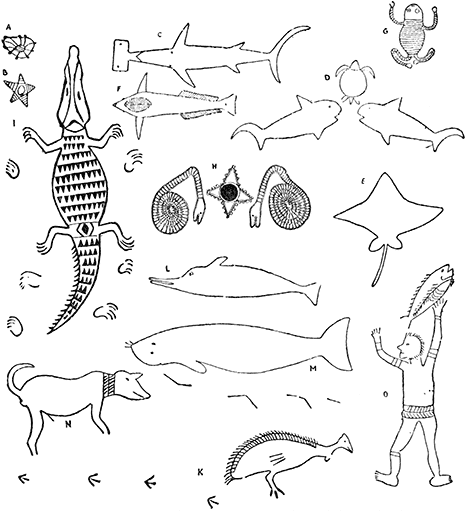
Fig. 3.—Drawings of animals by the natives of Torres Straits; one-quarter natural size.
A. Jelly-fish; B. Star-fish; C. Hammer-headed shark (Zygæna); D. Group of two sharks (Charcarodon) and a turtle; E. Eagle-ray (Aëtobatis); F. Sucker-fish (Echineis naucrates); G. Tree-frog (Hyla cœrulea); H. Two snakes on a tobacco-pipe, between them is the hole in which the bowl is inserted; I. Crocodile (Crocodilus porosus), with foot-prints; K. Cassowary (Casuarius) pecking at a seed [the latter is unfortunately omitted in the figure], and footprints, cf. Fig. 4; L. Dolphin (Delphinus); M. Dugong (Halicore australis) spouting, and indications of waves; N. Native dog (Canis dingo); O. Man with a large mackerel-like fish.
A, B, G, H, L, occur on bamboo tobacco-pipes; C, E, I, K, M, N, O, on drums; D, F, on pearl shells.
A, B, H, I, L, N, O, British Museum; C, E, K, Cambridge; G, Oxford; D, F, Berlin.
As is to be expected among an insular people who are continually on the sea, there is a preponderance of marine forms.
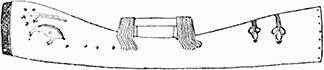
Fig. 4.—Drum from Daudai; 37½ inches long. Sketched by author from a specimen in the Cambridge Museum.
It is somewhat remarkable that no case is known of the delineation of animals in a linear series, or grouped in any way. They are all scattered about on the objects decorated with them. The only exceptions to this rule are in the cases of the drums, pipes, or in a few other objects; in these two precisely similar animals are symmetrically disposed with regard to the middle line. For example, in the lower pipe of Fig. 1 a snake will be seen near the left-hand end, immediately below the orifice, for the insertion of the bowl of the pipe, and there is a corresponding snake on the opposite side. I have also noticed a similar paired arrangement on the backs of four old women. Two women had scarified upon them a pair of dugong, one a pair of snakes, and the fourth a pair of objects, which I believe indicated the sting-ray; now these are three of their totem animals, and the scars upon the women’s backs indicated the clans to which they severally belonged. As the paired animals on the drums (Fig. 4) and pipes (Fig. 1, B), etc. (Fig. 3), are known to be totem animals, it appears probable that the symmetrical disposition of two animals among these people indicate that they are totem animals, and marks the object, or rather its owner, as belonging to a particular clan. This paired arrangement strangely recalls the “supporters” of our armorial bearings, and there is reason to believe that these perpetuate in some instances the totem animals of our savage forefathers.
Another point is worth mentioning. Many of the drums have engraved on each of their sides the representation of a cassowary (Fig. 4). I understood that in Mer (Murray Island) only certain people could beat the drum; thus it would appear that throughout this district the men of the cassowary clan, at all events, were the musicians.
Like many other savages, these people are more expert in depicting animals than men, and the human form is rarely copied. Human faces are, however, very frequently represented in the wooden and turtle-shell masks for which the Torres Straits natives are famous, and small wooden human figures were carved on arrows from the mainland, or as wooden or stone images to act as charms. For analogous purposes models of dugong and turtle were carved in wood, and many of these are really skilfully executed works of art, while others are merely conventional renderings, with a minimum amount of labour expended upon them.
The great dance-masks, to which mention has just been made, are sometimes very elaborate objects, and the animal forms, which are often used in combination with the human face, are doubtless symbolic, but of their meaning we are ignorant. Various sharks, such as the hammer-headed shark and the saw-fish, the crocodile and a sea-bird, are very commonly represented.
The association of a human being and crocodile is shown in Fig. 5, which is taken from a rubbing of a bamboo tobacco-pipe (the white spot in the centre indicates the hole for the insertion of the bowl). Only the face and arms of the man are represented. This design is repeated four times on the same object. The figure also illustrates a concentric treatment of designs which appears to be characteristic of the mainland near the mouth of the Fly River.
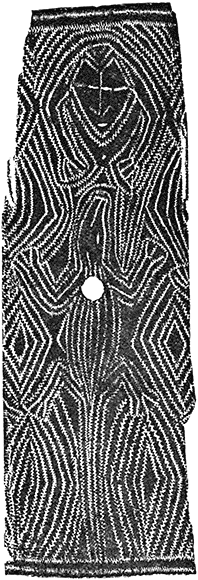
Fig. 5.—Rubbing of part of the decoration of a bamboo tobacco-pipe, probably from the mouth of the Fly River; one-third natural size, in the Liverpool Museum. In the original the lines show dark on a light ground.
From about the same district where the last object came from are made the carved wooden arrows, which are traded by the natives to the islanders of Torres Straits, and which may be found in many of our ethnographical museums. All the arrows formerly used in Torres Straits were imported from the mainland of New Guinea. Of these there were many kinds: some were quite plain, others had simple wooden barbs, while others again had bone barbs; it is only with these latter that I am now dealing.
No two of these arrows are precisely alike, but they fall into four main groups—(1) undecorated, or with an occasional simple band pattern below the barbs; (2) those with the figure of a man carved upon them; (3) those with a representation of a crocodile; and finally (4) those with simple patterns, which usually have a longitudinal direction.
I will confine myself to the third group, and will illustrate only a few of the numerous variations which occur; these will suffice to indicate what sort of modifications take place, and will enable any one to interpret the carving on the majority of arrows belonging to this class which may be met with in a museum.
The Crocodile Arrow and its Derivatives.—This class of arrows forms a very interesting series, as it becomes greatly modified. At one end of the series we have an easily recognisable crocodile; at the other we have a lizard, or a well-marked snake; and possibly even this may degenerate into the simplest patterns.
(a.) The Crocodile and its Degenerate Forms.—In front of the main design there are usually a few barbs, much as in the “man-arrow,” but these barbs may be considerably increased in number in the more degenerate type, or they may be altogether absent.
It is desirable to first describe a typical crocodile-arrow; and it will be necessary to call attention to certain well-marked divisions of the total representation: these are the snout, the head and neck (from the eyes, inclusive, to the fore-limbs), the fore-limbs, the trunk, the hind-limbs, and the tail.
(1.) The snout is plain; above, at the anterior extremity, are two elevations, which are meant for the prominent valvular nostrils of the crocodile. Occasionally one is placed behind the other (Fig. 6, A), instead of their being side by side, or even but one may be present. Laterally the jaws and teeth are usually characteristically rendered. In one arrow (Fig. 6, B), the teeth of the upper jaw on one side have, by an easy transition, been transformed into a zigzag line. The underside of the snout and head is ornamented with lines and dots which may have a longitudinal or transverse arrangement, or both may occur, as in Fig. 6, B.
(2.) The head and neck, like the snout, are plain above, except for an occasional representation of scales on the neck (Fig. 6, C), and the ventral ornamentation is a continuation of that of the underside of the snout. The eye is triangular, with the apex behind, rarely oval, as in Fig. 6, C; a band-pattern, usually a zigzag, which is always distinguishable from the ventral ornamentation, extends from the eye to the fore-limb.
(3.) The region of the fore-limb has generally the greatest thickness of the whole arrow. The limbs often arise from an ornamental band (Fig. 6, A), which represents the prominent scutes in this region of the real animal. The fore-limbs first project backwardly, and then run forwards towards the middle ventral line. The toes are usually indicated by transverse lines.
(4.) The trunk has usually a row of chevrons or diamonds running along the dorsal and ventral median lines; the lateral ornamentation usually consists of transverse lines, separated by rows of spots; sometimes these run longitudinally.
(5.) The hind-limbs may be separated dorsally by a triangular area (Fig. 6, A), or by a row of tubercles (Fig. 6, E). The limbs invariably bend forwards, and then backwards. The enclosed angle contains a row of spots or rarely a plain ridge.
(6.) Typically the tail is ornamented with three, occasionally two, dorsal rows of tubercles. The median row is a continuation of the median series, or the triangular area above noted; sometimes the median row is directly continuous with the central series on the back of the trunk. The lateral rows start from the insertions of the hind-limbs (Fig. 6, A, E, D). Beneath there is a large quadrangular plate, ornamented with concentric lines, the sides of which often extend up to the dorso-lateral angle of the tail.
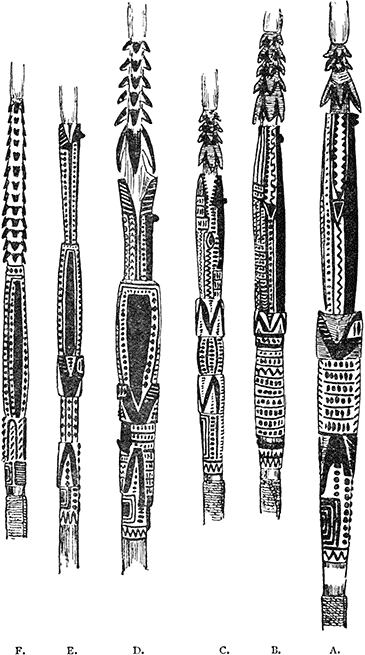
Fig. 6.—Series of arrows from Torres Straits, collected and sketched by the author, and presented by him to the Cambridge Museum; one-third natural size.
On comparing a number of crocodile-arrows with the animal itself, one is struck with the numerous realistic details which have survived the decorative treatment of the design. It must be remembered that one is dealing with a work of decorative art, and not an attempt at realistic carving. In one arrow several anatomical characteristics of the crocodile will be suggestively rendered; in a second other details will be more accurately carved; but in the great majority of arrows belonging to this series, variation has occurred to such an extent that the crocodile becomes almost unrecognisable as such.
A very typical crocodile arrow is to be seen in Fig. 6, A; the chief variation in this is the placing of one nostril behind the other.
In Fig. 6, B, the nostrils are side by side, and the teeth of the upper jaw are represented by a zigzag line. The hind-limbs and the tail are entirely absent.
Fig. 6, C, is important in several respects. The nostril is single, the mouth is partially closed; but the teeth have not, as yet, entirely disappeared from the hinder closed moiety. The eye is oval, a rare feature, and the dorsal scales of the neck are represented; this is also rare. The fore-limbs have been converted into a raised zigzag band, which encircles the arrow. The hind-limbs do the same, except that the pattern is interrupted in the median dorsal line by a double row of tubercles, which represent the prominent dorsal scutes of this region in the living animal. The thigh is carved with a curved upper border and a straight lower border.
There is rather a gap in the series between Fig. 6, C and D; but it is easy to see that the hinder part of the mouth is closed, and the teeth of both jaws are represented by different patterns; the front part of the mouth is widely open, but edentulous. The nostril is single. The eye has become enormously enlarged, and constitutes what I propose to term an eye-panel; it extends backwardly to the fore-limb. The plain upper surface of the head and neck has become much reduced, owing to the encroachment of a double row of spots on each side. The artist mistook the upper for the lower surface when he carved the fore-limbs, for it will be seen that the toes are above and the dorsal scutes are placed below. Another point of interest is the replacing of the central row of caudal scutes by a plain ridge; so far as I am aware this is unique.
Fig. 6, E, is a type of a large number of arrows. The front open part of the mouth is quite small, and the surfaces of the jaws are scored by oblique lines. The median dorsal plain band of the snout is no wider than the lateral bands which indicate the closed hinder part of the mouth. In the gape of the mouth an elongated triangle is very generally present; this is doubtless intended to represent a tongue. Sometimes it is notched. The eye-panels are elongated and narrow, and the dorsal median band of the head and neck extremely reduced. The rest of the body in this arrow calls for no special mention. Sometimes eyes are carved on the dorsal surface of the gaping end of the upper jaw.
In the last arrow (Fig. 6, F) of the series which I figure, the front part of the mouth has disappeared; but the hinder part of the head is much the same as in the last arrow. The fore-limbs and body are absent. The hind-limbs are narrow, but retain their characteristic forward bend; the dorsal caudal scutes are replaced by numerous parallel transverse lines.

Fig. 7.
Snake-arrow from Torres Straits (cf. Fig. 6).
Two features of the innumerable modifications of this design are worthy of special allusion, the one is the remarkable retention of the projecting nostril, which may often be found as a slight prominence in very degraded arrows; and the other is the still greater persistence of the tail and hindquarters of the crocodile. I suspect that the striking decorative effect of the concentrically marked cloacal plate has led not only to the retention of that part, but also to that of the neighbouring organs.
(b.) The Snake Variety.—We now pass on to a small group in which the open front part of the mouth of such an arrow as Fig. 6, E, has suggested a complete head, and so eyes are added (Fig. 7); the rest of the snout, the head and fore-limbs are omitted; the body is much elongated, but the hind legs and tail are usually quite normal, or subject to merely minor variations; the patterns may run transversely as in the figure, or longitudinally. Such a carving irresistibly calls to mind a snake; the natives themselves told me it was a snake.
The tail and hindquarters, however, proclaim the crocodilian original. In this group of arrows we have a very interesting example of the transition from one kind of animal into another; but hitherto I have not seen a snake-arrow which has lost all trace of its saurian ancestry.
(c.) The Lizard Variety.—A few arrows are known to me which pretty closely resemble Fig. 6, E, except that the hind-limbs are elongated and slender, and the tail is not crocodilian. The body is depressed and lozenge-shaped in section. In other words, the body, hind legs, and tail are lacertilian in character. In these arrows, the crocodile has been confounded with a lizard.
Other illustrations of the decorative art of these people will be found in Figs. 44, 66; but as these examples illustrate other aspects of the subject, I have described them in the relating sections of this book and refrain from repeating them here.
II.—The Fly River.
The Fly River is the largest river in New Guinea. It rises from about the area where the Dutch, German, and British territories abut, and flows into the western side of the Gulf of Papua. For a great part of its course it flows through low-lying and often swampy country, which is but sparsely inhabited, except in the delta region. For our present purpose we need only consider the delta and the middle region of the river. Owing to the carelessness of collectors, it is very difficult to determine from what exact district many objects labelled “Fly River” actually come.
The largest island in the delta of the Fly River is Kiwai, and this contains several villages. Almost the only objects which can be safely referred to Kiwai are the tubular drums with “jaws” at one end. There can be but little doubt that the carving represents the head of the crocodile, just as in the large Torres Straits and Daudai drum the “jaws” probably are derived from the same reptile. The carving on the Kiwai drums is boldly executed, and usually filled in with red and white pigment.
So far as I can discover, the etching on the bamboo tobacco-pipes is similar in many respects to that on those from the previous district, but the zigzag lines are usually much coarser, and the punctate line is either rare or absent.
In some of the islands in the delta of the Fly River, at Daumori for example, carved wooden slabs, more or less ovoid in contour, are suspended on the front of a house for good luck; some of these are also employed as figure-heads for canoes to ensure successful voyages. They have carved upon them conventional human faces, and occasionally whole figures, accompanied by simple patterns.[5]
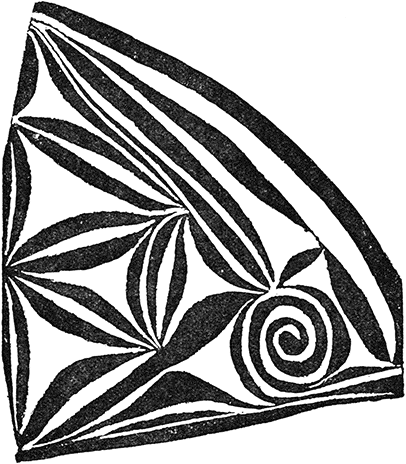
Fig. 8.—Rubbing of one side of the decoration of a drum from the Fly River, in the Museum at Rome; one-fourth natural size.
Middle District of the Fly River.—The most extensive collection of objects at present in Europe from the interior of New Guinea along the Fly River is that in the museum in Rome. These were “collected” by Signor d’Albertis, mainly at what he named “Villaggio dei cocchi,” which is probably the same place reached by Sir William MacGregor on January 7th, 1890; it is situated about 380 miles from the mouth of the river.
The drums from this district differ in shape from those from other parts of the Possession, and a somewhat elaborate ornamentation is carved on them in low relief. The means do not at present exist for elucidating the significance of these designs (Fig. 8), which are compounded of crescentic lines, leaf-like and triradiate elements and spirals. Some of the figures certainly look as if they were intended to represent leaves; if this is the case, it may be due to some influence from the north, for we find that leaf-designs are employed in the north of Netherlands New Guinea. Dr. M. Uhle[6] states that “the influence of the plant ornamentation of the East Indian Archipelago is also found in West New Guinea. Although it is essentially characteristic of the western portion of the East Indian Archipelago, isolated examples are not wanting in the ornamentation of the eastern.” He thinks he can trace the plant motive in South-West New Guinea as far as Wamuka River.
The bamboo pipes are also decorated in a characteristic manner, the pattern being caused by a local removal of the skin of the bamboo, so that it shows darker against a light background. There is usually considerably more regularity in the decoration than occurs on the drums.
III.—The Papuan Gulf.
We have no information concerning the decorative art of the greater portion of the littoral of the Papuan Gulf, but from two rubbings sent to me by my friend, Mr. Robert Bruce, in 1894, it appears that the human face is largely represented. In Fig. 9 we see that simplified faces constitute a pattern which adorns a canoe.
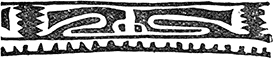
Fig. 9.—Rubbing of part of a carved pattern, along a canoe from near Cape Blackwood. Taken by R. Bruce, 1894. One-sixth natural size.
At the eastern side of the bight of the Gulf of Papua there is a very energetic, boisterous people of dark complexion, who inhabit the vicinity of Freshwater Bay. Their best known village is Toaripi (Motu Motu); the term Elema includes this and other tribes in the neighbourhood.
The district is fertile, wooded, and well-watered. Sago is abundant, and fleets of trading canoes sail annually to and from the Motu tribe of Port Moresby to exchange pottery for sago.
The decorative art of this district is so characteristic that it is impossible to mistake it. Objects of wood are cut in flat relief, and those made of bamboo are similarly treated, the design being emphasised by the colouring of the intaglio. The vast majority of the designs are derived from the human figure, and most particularly the face. There are very few designs which cannot be traced to this origin; occasionally a crocodile or a lizard may be introduced.
The employment of masks during sacred ceremonies, which was such a notable feature of Torres Straits, recurs here also to an equal degree, but instead of the masks being made in wood or turtle-shell, they are constructed of a light framework on which is stitched the inner bark of a tree. The device is outlined by cloissons of the midrib of a leaf, and the figures are picked out in red and black, and the background is usually painted white. This cloissonée technique is peculiar to this district, and it appears to have affected also the method of carving patterns in wood.
The form and decoration of these masks is so varied that it would be tedious to describe them. In the majority of them a human face is readily recognisable, but in some of the larger examples it has practically become lost. In nearly all, instead of a human mouth, the mask is provided with a long snout, the jaws of which are usually numerously toothed. There can be little doubt that this represents a crocodile’s snout. Almost wherever it occurs, the crocodile or alligator, as the case may be, enters into the religion of people, doubtless, primarily, on account of its size and predatory habits. It is very frequently a totem, as, for example, in Torres Straits, and it is very probable that here also its presence in conjunction with the human form is symbolic of a totemistic relation between the man and the reptile. We know extremely little about the use, and nothing of the significance, of the masks of this region, but it appears that their use is in connection with the initiation of the lads into manhood, and a common feature of initiation is the association of the totem with the individual. Some masks represent what appears to be intended for a pig’s head; a bird and other forms may also be introduced. Occasionally a human head may be given to a grotesque animal form.
The shields are oblong or ovoid in shape, and have a central slit cut out at the top. Most of the former are decorated with an easily recognisable human face; sometimes the face is doubled, but in these cases it is only the nose and mouth that are repeated, a single pair of eyes having to do duty for the two faces. The faces are subject to considerable modification, the two eyes, or even only a single eye may alone be recognisable.
Characteristic of typical New Guinea villages are large houses which men alone may enter. Here the lads who are being initiated into manhood are lodged, here the masks and other sacred objects are kept; they combine the offices of clubs, guest-houses, and religious edifices. In this district, as well as in the Fly River delta, they are usually decorated with human and animal carvings, and in them are suspended wooden slabs of an elongated oval shape, which are carved in a similar manner to the shields. These tablets appear to be employed as charms for good-luck, but we do not know whether they are also used in the initiation ceremonies; they are decorated with extremely conventional representations of the human form, or may be only a face; sometimes monstrous combinations of a man and animal may be carved.
When men have passed through all the stages of initiation, they are entitled, so Mr. Chalmers informs us, to wear broad, carved wooden belts. These belts encircle the body thrice, and like many other symbols of distinction must be extremely inconvenient to wear. I have made rubbings of quite a considerable number of these belts, and have come across only a few in which human faces could not be distinguished.
The design is so engraved that the pattern is in flat relief; this is kept dark in colour, and shows up against the whitened background. Certain details of the design are often picked out in red, the exposed uncarved portion of the belt and most usually the narrow plain border above and below the pattern are painted red. The design commences at one end of the belt, and terminates when one circumference is nearly attained.
There is a wonderful diversity of pattern in these belts, yet, at the same time, there is a fundamental similarity in the style of the designs which clearly indicates a community of origin. A very considerable proportion of the belts known to me exhibit a true decorative taste on the part of artists, and in some cases pleasing and ingenious patterns have been evolved. It may not be superfluous to point out that, whereas “eye-spots” are usually intended for eyes, they are sometimes employed as an appropriate decorative device; similarly toothed lines may represent human teeth, rarely hair, and not infrequently they are purely ornamental.
I have made a selection of ten of these belts which sufficiently illustrate their character and the sort of modification which occurs. Figs. 11 to 19 are photographed from rubbings of part of the decoration of wooden belts from the Papuan Gulf. Fig. 10 represents the whole of the ornamentation. All are one-fourth natural size.
Classification of Carved Patterns on Wooden Belts from the Gulf of Papua.
Human Face Derivatives.
Series I.—Uniserial, Vertical.
1. Faces looking the same way.
2. Faces alternately looking up and down.
Series II.—Uniserial, Horizontal.
1. Faces looking the same way.
2. Faces alternately looking towards and away from one another.
(a) All faces separate.
(b) Faces looking towards one another grouped together.
(c) Faces looking away from one another grouped together.
Series III.—Biserial, Vertical.
1. Faces only looking towards one another.
2. Faces only looking away from one another.
3. Faces alternately looking towards and away from one another.
(A) All faces of equal size.
(B) Faces looking towards one another most prominent.
(C) Faces looking away from one another most prominent.
Series IV.—Biserial, Horizontal.
Series V.—Triserial (II. + III.).
I. Vertical faces looking towards one another.
1. Horizontal faces looking the same way.
2. Horizontal faces alternately looking towards or away from one another.
(A) All faces of equal size.
(B) Vertical faces monopolising pattern.
(a) Horizontal faces separate.
(b) Horizontal faces looking towards one another grouped together.
(c) Horizontal faces looking away from one another grouped together.
(C) Horizontal faces monopolising pattern.
(a) Horizontal faces separate.
(b) Horizontal faces looking towards one another grouped together.
(c) Horizontal faces looking away from one another grouped together.
II. Vertical faces looking away from one another.
I. Single row of faces disposed vertically, the faces alternately looking up and down.
Fig. 10 is a reduced rubbing of the whole of the ornamentation of a belt; to the left will be seen a face with two eyes, a nose, and a large red mouth beset with teeth. The next face has only one eye, while the other two faces are eyeless, and there is nothing distinctive about their noses.

Fig. 10.—Cambridge Museum.
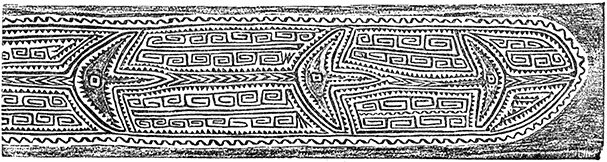
Fig. 11.—Glasgow Museum.
II. Single row of faces disposed horizontally.
(1.) The faces looking the same way.—The belt of Fig. 11 has four faces, which are as degenerate as those in the last example; three of these look one way, and the fourth, which is at one end of the pattern, looks in the opposite direction. It is not unusual for a face to be carved at each end of the decorated portion of a belt, and as these faces almost always look towards the pattern, the anomaly of one face in this belt looking a different way from the remainder is apparent rather than real. But the most interesting feature in this belt is the meander or fret pattern. The extremely degenerate face appears to be, as in. Fig. 10, a red mouth containing an eye-spot; the central chevron also occurs in Fig. 19, where it represents the nose.
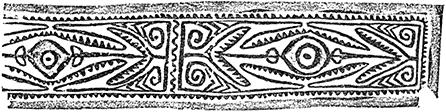
Fig. 12.—Kerrama, Berlin Museum.
(2.) The faces alternately looking towards and away from one another.—I will omit examples in which (a) all the faces are separate, and (b) the faces looking towards one another are grouped together, and pass on to (c) the faces looking away from one another are grouped together. An elegant example of this is seen in Fig. 12. The two pairs of eyes of the two faces which are turned away from each other are represented by a single eye from which a horizontal line extends on either side to the two mouths; each line represents a nose, the nostrils of which are placed quite close to the eye. The eyes are surrounded by simple red areas. The spaces between the mouths, above and below the eye (speaking in terms of the belt, and not of the faces), are occupied by additional mouths, which are evidently inserted from a sense of symmetry; that they are supplemented, and not essential, is proved by the absence of any nasal line connecting them with the eye. The spirals below each mouth occur on several shields.
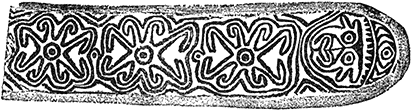
Fig. 13.—British Museum.
An interesting belt (Fig. 13) exhibits quite a different modification of the same motive. The pattern consists of a series of eight-rayed figures with bent arms, and a central eye-spot. A comparison of these figures with the eyes on masks, and other objects from this district, proves that the six rays are but a symmetrical coalescence of two pairs of eye-areas.[7] The angled double lines are clearly those prolongations of the eye-area which in many cases tend to enclose the mouth, and which probably represent the cheek-folds; and thus they demonstrate the interpretation that each star is derived from two horizontal faces which are looking away from each other, and of which nothing remains but a confluent eye-area, enclosing a single eye. The terminal faces are sufficiently normal; but if two such faces were placed back to back, and the eye-areas were confluent, and the four eyes fused into one, and finally the nose and mouth were eliminated, we should have star-like figures resembling those which do occur. If a reflector is placed across the eyes in the terminal face in Fig. 13 (at right angles to the plane of the paper, and across the long axis of the belt) a star-like figure can be seen, which is very similar to those in the rest of the belt. This is one of the few belts that have no border pattern.
III. Double row of faces disposed vertically.
(1.) The faces only looking towards one another.—In the belt represented in Fig. 14 there is a double row of faces which are placed vis-à-vis. The figure illustrates varying degrees of degeneracy in the faces; each space between a pair of faces is occupied by a large red star with a central eye-spot. The representation of a lizard on this belt is noteworthy.
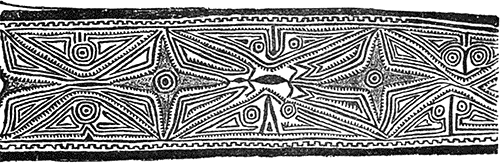
Fig. 14.—British Museum.
(2.) The faces only looking away from one another.—In Fig. 15 it is evident that we have a double series of faces which are placed back to back; the two pairs of eyes are represented by a central eye. The noses and mouths of the different faces are joined together and constitute a fairly regular pattern.
(3.) The faces alternately looking towards and away from one another.—In this series the faces may all be equally developed, or those facing one another may be most prominent, or, on the other hand, those looking away from one another may monopolise the design.
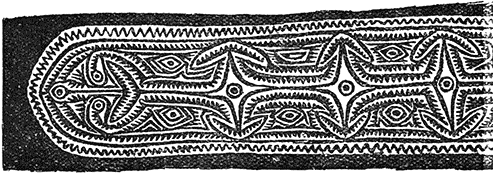
Fig. 15.—Toaripi (Author’s Collection).
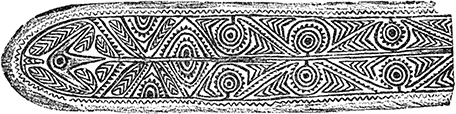
Fig. 16.—Berlin Museum.
A simple modification of the subdivision in which the faces are all equal is to be found in Fig. 16. In this case the two eyes of each face have amalgamated, and a short line represents the nose; but their disposition is still typical. The oblique lines uniting the noses are evidently the remains of the mouths of their respective faces; a tooth-pattern may be present or absent. The chevrons merely fill up the vacant angles. The terminal face is represented by a red three-rayed area, containing an eye-spot.
IV. Double row of faces disposed horizontally.
No example of this arrangement is known to me.
V. Treble row of faces.
This is a composite series which is composed of Series II. and III. It resolves itself into two main groups, the second of which, so far as I am aware, is represented by only a single specimen.
(I.) Vertical faces looking towards one another.—Owing to the variety of their component elements the patterns in this series of belts are liable to considerable variation, but there is no need to enter into an analysis of the possible modifications.
In Fig. 17 we have an example of the preponderance of the horizontal faces, while some of the vertical faces are extremely degraded.
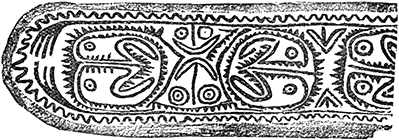
Fig. 17.—Maiva, Berlin Museum.
Fig. 18 represents a condition in which the vertical faces are monocular; the line beneath the eye is evidently the suggestion of a nose, and the angled dentate line indicates the mouth with its teeth. All these faces are equally developed. The horizontal series of faces belong to Series II., 2, b, as the faces looking towards one another are grouped together. In the centre of each space between a pair of vertical faces is a mouth which has to do duty for two horizontal faces; on each side of this is a horizontal line which is a vestigial nose, the arrow-head figure on which indicates the nostrils. The eye between the mouths of the vertical faces represents two pairs of eyes of the horizontal series.
(II.) Vertical faces looking away from one another.—The only belt with which I am acquainted which probably belongs to this subdivision of the series is that reproduced in Fig. 19. The design is more regular and sustained than is usually the case on these belts. The vertical series of faces is represented by a median series of fused mouths and eyes; the chevron band indicates the nose, on which nostrils may be located close to the mouth or close to the eye. The eyes of the vertical series of faces are enclosed within confluent eye-areas; the median nose-line runs to the border pattern of the belt, but there is no trace of a mouth. The border pattern is, I believe, unique on belts.
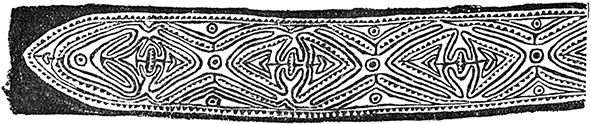
Fig. 18.—Edinburgh Museum.
The bamboo tobacco-pipes are ornamented by scraping away some of the rind of the bamboo and colouring the intaglio portions with brown pigment; in these also the designs are based on human faces and their derivatives; sometimes the human form is employed, and occasionally zoomorphs are depicted.
It would be tedious to describe all the objects which are decorated by these artistic people; enough examples have been given to illustrate the style of their art. We cannot at present say why anthropomorphs should predominate in so marked a degree. I suspect it has something to do with the importance of initiation ceremonies combined with the ancestor cult, which is a marked feature of the true Papuans. I would also hazard the conjecture that animal totemism is not of such prominence amongst these people as it was recently in Torres Straits, and still is on the neighbouring coast of New Guinea and in Australia.
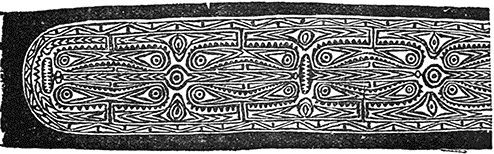
Fig. 19.—Museum of the London Missionary Society.
IV.—The Central District.
In Yule Island, and in the vicinity of Hall Sound, and right away down the coast of New Guinea as far as Cloudy Bay, we come across a fairly uniform and rather uninteresting type of decorative art.
The designs are burnt into bamboo tobacco-pipes or gourds, “with a glowing slice of the sheathing leaf of the coco-nut kept almost at a white heat by the native artist blowing upon it. The end of the glowing ember forms a fine point, which on being slowly moved along the desired lines leaves indelible tracks.” (Lindt, Picturesque New Guinea, 1888, p. 34.) In Cloudy Bay the natives scratch the design on the rind of the bamboo before charring it; this tends to limit the burning, and to give a hard edge to the lines. Here also the designs run along the length of the pipes in distinct bands; in other parts of the Central District longitudinal bands are broken by encircling bands, and are often replaced by panels.
The employment of isolated, rectangular panels is very characteristic of this district. On such objects as tobacco-pipes the panels must from necessity follow one another more or less serially, but they need not be co-ordinated into a definite pattern. When larger surfaces are ornamented, as, for example, the bodies of women (Fig. 20, A, B), the panels may also be somewhat irregularly disposed; but there is a tendency, at all events in some places (as in the figure), for the designs to have an orderly and symmetrical arrangement, but in no case is there absolute symmetry.
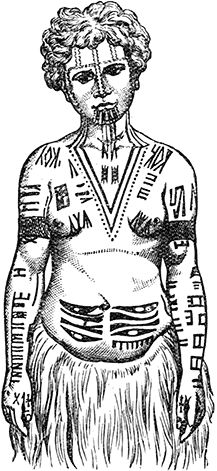
Fig. 20, A.—Drawing of Tabuta, a Motu girl, by Rev. W. Y. Turner, M.D. (from Journ. Anth. Inst., vii., 1878, Fig. 4, p. 480).
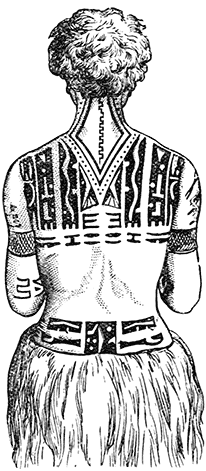
B.—Back view of the same. (The hair of this girl is incorrectly drawn, it should be frizzly and not wavy.)
A common form of panel is the Maltese cross (Fig. 21, H, I); perhaps it would be more accurate to describe it as a light St. Andrew’s cross on a dark rectangular panel. A combination of light St. George’s and St. Andrew’s crosses on dark fields is very frequent; the arms of the latter cross often become leaf-like, and may monopolise the field. (Fig. 21, E, F.) Some travellers have suggested that these designs are derived from the Union Jack, but this is not the case. Another kind of panel is that shown in Fig. 21, G. Fig. 21, D, illustrates one form of a common type of band pattern.
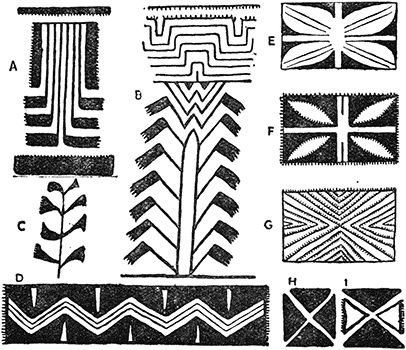
Fig. 21.—A. Design on a lime-gourd from Kerepunu; B. Part of the decoration of a pipe from Maiva; C. Detail on a pipe from Kupele, in the Berlin Museum; D-I. Designs on pipes—G from Kupele (Berlin), H, I, from Koiari (Berlin). All the Figs. are to different scales.
One of the most widespread of the isolated designs is that shown in Fig. 21, A, B, and Fig. 22, but it is subject to many variations. Similar designs are tattooed on people below the armpit or on the shoulder. Now that attention has been called to this and other designs, we shall probably learn what significance is attached to them. Occasionally we find what appear to be undoubted plant motives on pipes and other objects from this district, as, for example, on a pipe from Kupele in the Berlin Museum (Fig. 21, C), and it is probable that the designs just alluded to are also plant derivatives.

Fig. 22.
Part of the decoration of a pipe in the Cambridge Museum; one-sixth natural size.
Throughout this district, especially along the coast, the women are tattooed, and in some localities they are entirely covered with tattoo marks. The men are much less tattooed than the women.[8] The designs employed are for the most part the same as those used to decorate pipes and gourds. The angled design tattooed on the chests of women (Fig. 20, A, B) is found on a pipe in the Cambridge Museum. (Fig. 22.)
Noticeable features in the decorative art of this district are the preponderance of straight lines over curved lines; as well as the occurrence of dotted lines and of very short lines, which form a kind of fringe to many of the lines. (Figs. 21, 22, 51.)
Very remarkable also is the absence of the delineation of the human or of animal forms. Bounded on the north-west by a luxuriant art based on human faces and forms, and limited to the south-east by bird-scrolls and bird and crocodile derivatives, not to mention human effigies and representations of various animals, these central folk are unaffected by these two very distinct forms of artistic activity. The only exceptions, so far as my evidence goes, is in the transitional country north of Hall Sound, and a few carvings of crocodiles in certain tabu houses or dubus.
The rigid conservatism of the native mind is the sheet-anchor of the ethnographer; no better example of this mental rigidity is needed than is supplied by the Motu people who live in the vicinity of Port Moresby. The women make large quantities of pottery, which the men trade for sago up the Papuan Gulf even to a distance of two hundred miles. Three or more canoes lashed together and fitted with crates constitute a trading canoe or lakatoi. A fleet of twenty lakatoi carrying about six hundred men, each of whom would take about fifty pots, has been known to sail from Port Moresby. The 20,000 or 30,000 exported pots will bring in exchange a cargo of 150 tons, or more, of sago. Notwithstanding this great annual trading, the decorative art of the Motu is absolutely untouched by that of the Gulf natives, or vice versâ; the artistic motives, scheme of decoration, and technique are entirely different.
It seems probable that many of the decorated objects that are labelled in European museums as coming from this district are the work of the hill tribes, or of that coast population which does not belong solely to the Motu and allied tribes.
V.—The Massim District.
The country at the extreme south-east end of New Guinea round Milne Gulf, together with the neighbouring groups of islands, constitutes a natural province to which I have proposed to extend the name Massim. For the history of this term the reader is referred to Professor Hamy’s paper, “Étude sur les Papouas de la Mer d’Entrecasteaux” (Rev. d’Ethnogr., vii., 1888, p. 503). The various archipelagoes which collectively constitute this district are—(1) The Moresby Group, including all the islands between Milne Gulf and Wari (Teste Island); (2) the Louisiade Group, including Misima, Tagula (Sudest), and all neighbouring islands; (3) the D’Entrecasteaux Group, including Duau (Normanby Island), Goodenough, and the other islands; (4) the Trobriand Group, the largest island in which is Kiriwina; and (5) the Woodlark Group (Murua, etc.), and including Nada (the Laughlan Islands). There is a considerable amount of indigenous trade between these islands. For example, the Nada folk make annual trading voyages to Murua to exchange coco-nuts for taro. Dr. Finsch says (Samoafahrten, 1888, pp. 207-209), “A great many objects (such as the beautiful lime calabashes) are bartered from the Woodlark Islands, the inhabitants of which with their large sea-going canoes undertake extensive trading voyages.... At all events Trobriand is visited from Normanby, Welle [a small island close by the latter] and Woodlark Islands, for the Trobrianders themselves probably do not undertake trading voyages.” In describing the manufacture of earthen pots at Wari (Teste Island), Finsch says (Samoafahrten, p. 281) the upper border of these pots “exhibits various simple band patterns which are scratched with fork-like bamboo instruments, and which serve not for ornament but as trade marks. Thus here also each woman has her own mark with which she signs her fabrication. The pottery has an extended sale as far as the D’Entrecasteaux and to Chads Bay, South Cape, Woodlark Island, and perhaps also to the Louisiades.” In my Memoir (p. 223) I have included a MS. description of the manufacture of pottery in the same island, which was kindly placed at my disposal by Dr. H. O. Forbes, and I also copied Dr. Forbes’ sketches. (Fig. 23.) The Wari people have to import wood for their houses, and also, like the natives of the Engineer Group, who are great traders, they procure canoes from Pannaet (Deboyne Island). Owing to the trading which occurs amongst these islands and with the mainland, it is very difficult to determine from specimens of native work in European collections what style of work is characteristic of each of these groups, especially as comparatively few specimens are properly labelled. I have, however, but little doubt that each group has characteristic designs and forms, and possibly in some cases these may be peculiar to them.
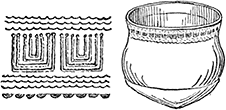
Fig. 23.—Clay pot with an incised pattern, from Wari (Teste Island), after a sketch by Dr. H. O. Forbes.
Throughout the whole of this district one finds lime-spatulas,[9] wooden clubs, canoe carvings, and other objects ornamented with scrolls. Nowhere else in British New Guinea do we find the continuous loop coil pattern, the guilloche, or loop coils. The spiral is absent from the Torres Straits and Daudai, but present up the Fly River and in the Papuan Gulf. It is absent again in the Central District, but reappears in the Massim Archipelagoes. It is only in the last district that we meet with a wealth of curved lines. What is the meaning of this?

Fig. 24.—Rubbing of the half of one side of the handle of a spatula in the author’s collection; one-third natural size.
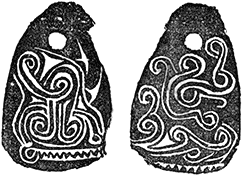
Fig. 25.—Rubbings of both sides of a float for a fishing-net; one-half natural size.
All over this district we find decorative art permeated with the influence of the frigate bird. This beautiful bird is the sacred bird of the West Pacific. I shall allude to it again in a later section. The bird, or its head only, is often carved more or less in the round, especially for the decoration of canoes. It must, however, be remembered that such representations are conventional and not strictly realistic.
The same head is repeated on the handle of a spatula (Fig. 24), the curved tip of the beak of one bird forming the head of the bird immediately in front of it. From this simple origin the varied and beautiful scroll patterns have been developed. One important factor in the evolution of this pattern has been the confining of the design within narrow bands. When a band happens to be exceptionally broad, one often finds that the pattern becomes erratic. Queer contorted designs also result from the attempt to cover a relatively broad area, as in Fig. 25. Here there is nothing to guide or restrain the artist, except the boundary of the float; but on canoe carvings and some other objects there are usually structural or vestigial features, round which the design may be said to crystallise, and in these cases the pattern is approximately or entirely symmetrical.
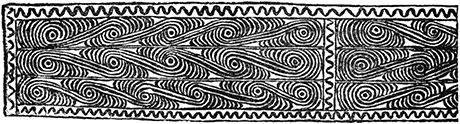
Fig. 26.—Rubbing of upper two-thirds of the decoration of a club, in the Glasgow Museum; one-third natural size.
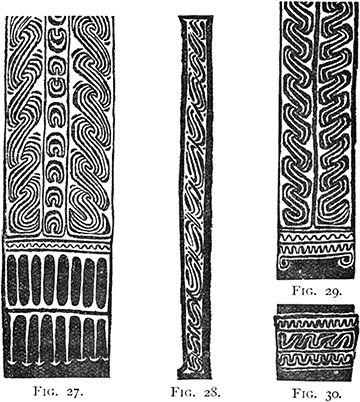
Rubbings of part of the decoration of clubs; one-third natural size. Figs. 27 and 28, D’Entrecasteaux, Edinburgh Museum; Figs. 29 and 30, Cambridge Museum.
The triangular spaces left above and below the beaks in the bird-scroll pattern are usually more or less filled up with crescentic lines, as in Fig. 26. Sometimes they are blank, and in this case the triangles may be coloured red instead of the white lime which is rubbed into the carving. The eyes of the birds are, as often as not, omitted altogether. (Figs. 27-30.) Their presence seems to have a conservative effect on the design, for where absent the elements of the design may slip upon or run into one another.
In Fig. 27 we have a good example of what I mean by the slipping of the elements of the design, with the result that a guilloche is arrived at. It will be noticed in this figure that the ends of the curved lines are mostly joined by an oblique bar. These oblique bars have become emphasised in Fig. 28, and a degeneration of the curved lines results in a simple pattern.
An example of the elements of the design running into one another is shown in Fig. 29, which, like the last two figures, is a reduced rubbing of part of the decoration of a sword-shaped wooden club. The band, shown in Fig. 30, is on the handle of the same club; the central pattern is clearly a simplification of that on the blade of the club, and it passes naturally into the zigzag carved below it.

Fig. 31.—Rubbing of the pattern round the upper margin of a betel-pestle in the Cambridge Museum; one-third natural size.
In a carved border round the top of a betel-pestle (Fig. 31) the bird’s-head scroll has become simplified, and at the same time developed into a more convolute scroll. A very degraded example is seen in the upper band of Fig. 32.
It would be easy to multiply examples of simple and complex derivatives of the bird’s-head motive, but these few will serve to demonstrate the kind of modifications which occur.
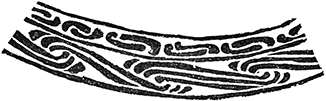
Fig. 32.—Rubbing of part of the carved rim of a wooden bowl from the D’Entrecasteaux Islands; one-third natural size.
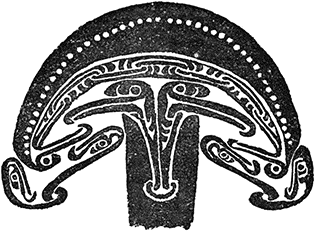
Fig. 33.—Rubbing of the handle of a turtle-shell spatula, from the Louisiades, in the British Museum; one-half natural size.
Instead of only the head with its beak, the neck of the bird may be introduced. Fig. 33 is from a rubbing of a beautiful spatula in the British Museum, carved in turtle-shell (tortoise-shell); in it will be seen the interlocking of birds’ beaks and of birds’ necks. If the interlocking beaks were isolated we should get the band pattern which runs along the concavity of the crescentic handle.
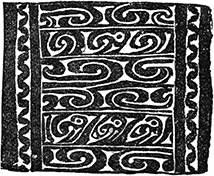
Fig. 34.—Rubbing of the decoration of one side of a club; one-third natural size. The block is turned round to show the pattern more clearly, the zigzag bands in reality run across the blade of the flat club.
The birds’ heads and necks are usually confined to bands, and the design becomes subject to a new set of influences. A careful inspection of Fig. 34 will give the key to many details that may be found in carved objects from this district. In the band immediately below the central band are seen the heads and necks of three birds which have already undergone a slight transformation. In the corresponding band above the central band a bird is readily recognisable, but those on each side of it have degenerated into looped coils. The other designs can easily be recognised as bird derivatives.
The birds’ heads and necks may be so arranged in a linear series that interlocking takes place. In some cases one can distinguish between the beaks and the necks; in others, as, for example, in the outer bands of Fig. 35, this is impossible. The interlocking of the beaks or necks, as the case may be, and the isolation of the involved parts, has given rise to the central pattern on this spatula. Simple or complex coils like the last are of frequent occurrence in decorated objects from these islands. Both kinds of coil are found in Fig. 34, and by far the greater number of them can be proved to be bird derivatives.

Fig. 35.—Rubbing of the handle of a spatula in the British Museum; one-third natural size.
The eyes of the heads in such a pattern as the two outer bands of Fig. 35 may disappear, and here also the elements of the design may fuse with each other. These two phases of decadence have overtaken the pattern shown in Fig. 36, A, which is the decoration of a spatula with a three-sided handle; on another side (B) the degeneration has advanced a stage, and on the third side (C) it has run its course, and again the bird-motive has degenerated into a zigzag.
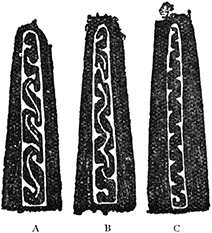
Fig. 36.—Rubbings of the three sides of the handle of a spatula from the D’Entrecasteaux, in the Dublin Museum; one-half natural size.
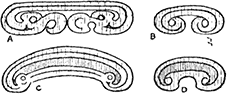
Fig. 37.—A, B. Sketches of two stages of the “bird bracket” of two spatulas, probably from the Woodlarks, in the author’s collection, C, D. Analogous details from canoe carvings—C. From a photograph; D. From a specimen in the Edinburgh Museum. Not drawn to the same scale.
Some spatulas have small lateral adjuncts or “brackets,” as I have elsewhere termed them. In spatulas which come, I believe, from the Trobriands and Woodlarks, these brackets are often carved to represent two birds’ heads, whose necks are united together over their heads (Fig. 37, A). I have examples of these showing a degeneration into a simple scroll (Fig. 37, B). The same is taking place on a club (Fig. 38), where several phases of modification are illustrated, one result of which is that the beaks break away from their respective heads; the design in the left-hand lower corner is clearly an extreme stage, where each beak is represented by two small marks. This can be compared with the design in the right-hand lower corner of Fig. 39, where further simplification has occurred. The mark in the centre of the design is the relic of the four which occur in the last figure, and these are the disrupted remains of the beaks of the two birds. The other spirals in this figure are serial repetitions of the involved bird’s eye of the lower design; the limitation of these within narrow bands causes their elongation, and from these we are led to the concentric ovals. All the concentric ovals met with in this district may not have been arrived at in this manner, but those in Fig. 39 appear to have had this origin.
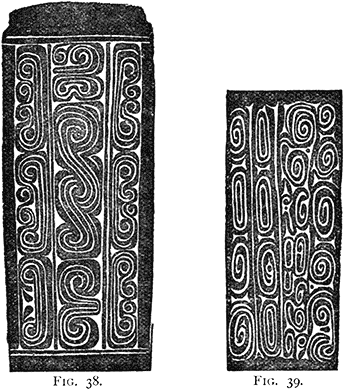
Figs. 38 and 39.—Rubbings of the decorations of clubs in the Dublin Museum; one-third natural size.
To return again to Fig. 37, in A and B we have two phases of the bird-bracket on spatulas; C and D are analogous designs in which the birds’ beaks are also united; these are details from canoe carvings.

Fig. 40.—Rubbing of the central longitudinal band of a club from the D’Entrecasteaux, in the Edinburgh Museum; one-third natural size.
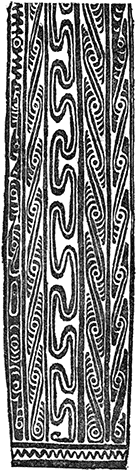
Fig. 41.—Rubbing of part of the decoration of a club from the D’Entrecasteaux, in the Edinburgh Museum; one-third natural size.
A simplified type of bird’s head and neck is seen in Fig. 40. Probably, owing to the narrow space at his disposal, the artist omitted the typical curvature of the beak. In the centre of the band a looped arrangement is to be seen. It is very tempting to imagine that the central band of Fig. 41 has had a similar origin. It is possible, however, that it may be an aberrant modification of the serial bird’s head design. I have no doubt that it is a bird derivative.
In this district, but principally, I believe, on the mainland and in the neighbouring islands, we find carvings which represent a bird and a crocodile; often this design forms the handles of paddles, spatulas, and axes (Fig. 45, A). I have not at present direct proof that the animal is a crocodile, but I have sufficient evidence to warrant the assumption.
With but very few exceptions the bird has a hooked beak; often it is provided with a crest. Normally it has a body and wings, but never any legs. Only the head with the eye, jaws, and tongue of the crocodile are carved. The bird is undoubtedly based on the frigate-bird, but the crest is a gratuitous addition; in a few instances it seems as if the artist had a hornbill in his mind.
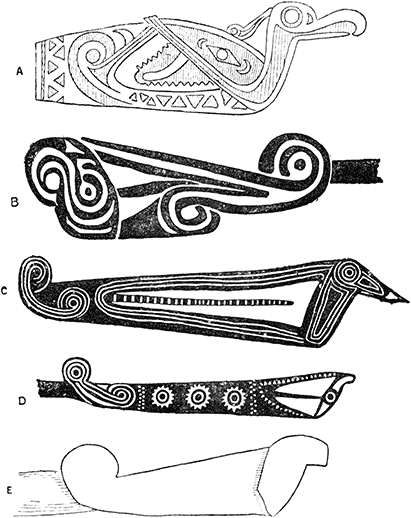
Fig. 42.—Bird and Crocodile designs, Massim Archipelago.
A. Canoe carving from Wari (Teste Island); about two-ninths natural size.
B. Handle of a paddle in the Cambridge Museum; one-half natural size.
C. Handle of a spatula in the Leiden Museum; three-sevenths natural size.
D. Handle of a spatula from Tubutubu (Engineer Group), in the Cambridge Museum; three-sevenths natural size.
E. Handle of a paddle in the Cambridge Museum; three-sevenths natural size.
The body and wings of the bird are frequently omitted, then the neck disappears; in some examples only the eye and hooked beak persist (Fig. 42, B, D), and in one or two examples known to me the eye alone remains of the vanished bird.
The eye of the crocodile may develop into a grooved sigmoid curve, or degenerate into a simple loop. One or both jaws may terminate in a loop; the teeth are more often absent than present; in one spatula they occur on the tongue only (Fig. 42, C). The tongue usually reaches the bird, but it may be quite short; though generally straight, it may be carved and may terminate in a small bird’s head; indeed, either jaw may occasionally have a similar termination. For a selection of characteristic modifications of this motive I would refer the reader to Plate XII. of my Memoir, from which I have borrowed the examples seen in Fig. 42. Of these A is a conventional but readily recognisable representation of both the bird and the crocodile; B, C, D are varieties which present no difficulty of interpretation, and E is a slightly carved handle of a paddle in which the design is very greatly simplified.
The decorative art of the outlying Trobriands (Kiriwina) and Woodlark (Murua) Groups appears to differ in many respects from that which is characteristic of the other groups of this district; this is especially noticeable in the lime-gourds, and on the oval-painted shields.
The north-east coast of British New Guinea is now being opened up by the Administrator, Sir William MacGregor, but as yet no specimens of its decorative art have found their way to British museums.
VI.—Relation of the Decorative Art to the Ethnology of British New Guinea.
A general survey of the decorative art of British New Guinea clearly reveals the fact that there are distinct æsthetic schools, if the term may be permitted, in each of which there is a characteristic set of motives and also of forms and technique. The boundaries of these districts are not sharply defined, but, although our knowledge is still imperfect, they can in most cases be traced with sufficient exactitude. I expect that the Papuan Gulf district will be found to extend from the Fly River to Cape Possession (long. 146° 25´ E.), and that the Fly River district proper must be confined to what I have termed its Middle Region, and perhaps the upper reaches of that river as well.
We may then take these five districts for granted. The question now presents itself: What is the meaning of their distinctness? I do not think we have at present sufficient evidence to enable us to do more than make suggestions as to possible causes, and naturally ethnology is first appealed to. Are these differences due to ethnic diversity?
Many of those who have written on the natives of British New Guinea have not sufficiently distinguished between the numerous tribes in our Possession, and they speak in vague terms of the Papuans as if they were all alike. Now this is by no means the case, and before we can gain an adequate comprehension of Papuan ethnography and ethnology we must clearly distinguish between the characteristics of the various tribes, their customs, languages, and handicrafts.
There is still much discussion concerning the limitation of the term Papuan as applied to people, and even whether it should not be dropped altogether, as Professor Sergi suggests. The Italian anthropologist extends the term Melanesian not only to comprise the natives of all the Western Oceanic islands, including New Guinea and the adjacent islands, but also Australia. At present I adhere to what Mr. Ray and myself[10] have considered to be the most convenient course, and to employ the term Papuan for what appear to be the autocthones of New Guinea. By Melanesians we understand the present inhabitants of the great chain of islands off the east of New Guinea, and extending down to New Caledonia. These terms are used to designate peoples, not races; neither are pure races, and at present we are unable to gauge the amount of race mixture in either, or even to state precisely what are their components.
From the boundary of Netherlands New Guinea to Cape Possession on the eastern coast of the Papuan Gulf, and inland from these coasts, the natives are dark, frizzly-haired Papuans; typically they are a dolichocephalic people, and rather short in stature.
The Papuans also occupy the greater part of the south-east peninsula of New Guinea; but along the southern coast-line, almost uninterruptedly from Cape Possession to the farthest island of the Louisiades, is an immigrant Melanesian population, about whom I shall have more to say presently.
I will now enumerate a few facts which will clearly bring out the essential distinction between these two peoples.
We have not at present a sufficient amount of data on the physical characters of the two peoples by skilled observers to enable us to formulate what differences there may be between them. There is no doubt that the Papuans are more uniformly dark than are the Melanesians (I am now referring solely to the Melanesians in British New Guinea), and their hair is as constantly frizzly. Among the Melanesians light-coloured people are constantly met with, as are also individuals with curly and occasionally straight hair. Their skulls exhibit many variations, and are occasionally brachycephalic. Judging from my experience of the Western Papuans, the Papuan men usually sit with their legs crossed under them like a tailor, whereas the Melanesians squat, like a Malay, usually with their haunches just off the ground. I do not know whether this rule holds good for the Papuans of the south-east peninsula.
The Western Papuans may or may not scarify their skin, as in Torres Straits, but they do not tattoo; the Melanesians tattoo themselves, especially the women. Tattooing has, however, spread to a certain extent among the Papuan hill tribes of the peninsula; the Koitapu women appear to have thoroughly followed the fashion of their Motu neighbours; amongst the Koiari and other hill tribes it occurs only occasionally. The V-shaped chest mark gado (Fig. 20) occurs among the Motu and Loyalupu, but not east of Keppel Bay. Among the two former the tattooing lacks symmetry, but in Aroma curved lines become more frequent and asymmetrical figures have a bilateral symmetry with regard to the body.
The houses of the Gulf and Western Papuans are often of great size and contain numerous families, and there appears to be more club-life among the men. The houses of the Melanesians are smaller, each family possessing one; those in the Trobriand Group are not built on piles. Very characteristic of the Papuans are the houses which are confined to the use of the men. These houses are the focus of the social life of the men, and as religion among savages is largely social usage, it is also in connection with these structures that most of their religious observances are held.
The initiation of lads into manhood is accompanied with sacred ceremonies in some of the Papuan tribes, but, so far as is known, by none of the Melanesians in New Guinea. Masks are usually, perhaps invariably, worn at these ceremonies, and the bull-roarer is swung and shown to the lads. There is no record of a bull-roarer among the Melanesian folk.
Masks are employed by many peoples during certain ceremonies; their distribution in New Guinea is interesting, as it will be found that in the British Possession they characterise the Papuan as opposed to the Melanesian elements. They were common in Torres Straits, have been obtained in Daudai, and are very abundant in the Papuan Gulf from Maclatchie Point to Cape Possession.
Dancing may be a secular amusement or a ceremonial exercise; in both aspects it is largely practised by the Papuans proper. We have very few accounts of dances among the Melanesians, and these do not appear to be of a specially interesting character.
Of their weapons the stone-club is alone common to all the tribes. The use of the bow and arrow is confined to the Papuans, and is universally employed to the west and in the Papuan Gulf. Heavy, sword-like, wooden clubs and wooden spears are common among the Melanesians, and the sling is employed in the D’Entrecasteaux Islands.
Only the Melanesians make pottery.
The Papuans earlier adopted tobacco, and grew their own tobacco before the white man came, but they do not chew the betel to any great extent; quite the reverse is the case with the Melanesians.
I have now enumerated a sufficient body of evidence to demonstrate that two groups of people inhabit British New Guinea. We have now to see whether a further analysis is possible.
Our knowledge of the Western Papuans is too imperfect for any definite generalisations to be made at present, but I venture to present the following tentative suggestions:—
The most typical Papuans in the British Protectorate are probably the bush tribes from the Dutch boundary to the back of the Gulf of Papua. They are gradually being pushed inwards by the coast people. Macfarlane contrasts the high and broad skull of the latter with the “long, narrow skull, with its low forehead and prominent zygomatic bones,” of the former, whom he also states are “greatly inferior, both mentally and physically.” The observations of d’Albertis of a racial mixture in this region are supported by de Quatrefages and Hamy. The Torres Straits islanders are also a mixed people. I do not think we have sufficient evidence before us to decide what are the component races of these Western Papuans. I suspect that the Fly River is to a slight extent what may be termed a “culture route,” and that the natives of the higher reaches have indirect communication with those of the north coast of New Guinea; for example, the rattan armour collected by d’Albertis high up the river is similar to that obtained by Finsch from Angriffs Haven, near Humboldt Bay, and recalls the coir armour of Micronesia; it is probable that this was the route by which tobacco found its way to Torres Straits and the Gulf district, and thence to the south-east.
The Papuans also extend down the south-east peninsula and into the adjacent island groups. On the mainland they have been conquered in certain places by Melanesian immigrants, and a mixture of these two peoples has taken place to a variable extent. In the islands the amalgamation has been more complete.
The immigrant people are by the majority of writers spoken of as Polynesians. This identification is apparently based solely on the lighter colour of some of the former than that of the Papuans proper, and on numerous words common to them and the Polynesians.
The light colour of the skin and the occasional presence of curly or even straight hair among some of the people of British New Guinea certainly proves a racial mixture, although Comrie and Finsch do not lay much stress on these points. The latter (Samoafahrten, p. 234) writes:—“The natives of Bentley Bay, as at East Cape, are of a tolerably light skin colour and belong to what the ignorant would explain as a Malay mixture. But wrongly, for they are true Papuans, amongst whom the individual occurrence of curly, even of smooth hair, is of no consequence.” The craniology of the natives of the south-eastern peninsula and neighbouring islands has been studied by Comrie, Flower, Mikloucho-Maclay, de Quatrefages, Hamy, and Sergi, most of whom admit with Flower “a considerable mixture of races among the inhabitants of this region of the world.” As at present anthropography cannot speak with precision concerning the racial elements in this immigrant people, we must turn to other branches of anthropology, and we will see what light ethnography and linguistics can throw on this ethnological problem.
A comparison of Papuan and Melanesian customs and handicrafts will prove that there is little of real importance in common, say, between the Motu or the South Cape natives and the Samoans. I need only allude to the almost total absence of a system of cosmogony or of a pantheon with a definite mythology; associated with this lack of a theology is the absence of an organised priestcraft. The democratic Papuans and Melanesians have no hereditary chieftainship, and the power of tabu is much more limited than in Polynesia. Strangely enough, these so-called “Polynesians” in South-East New Guinea make pottery and do not drink kava. There is also a well-marked distinction between the weapons, implements, etc., and the decorative art of the New Guinea people and those of the Polynesians.
For the linguistic evidence I have consulted my friend and colleague, Mr. S. H. Ray, who is our great authority on the languages of Western Oceania. In an essay in my Memoir[11] he discusses this question, and as most is known about the Motu language of the neighbourhood of Port Moresby, he takes this as a basis for comparison; what is proved for this applies, in all probability, to the other Melanesian languages of British New Guinea. “Much could be written to show that it is with the Melanesian tongues that the Motu of New Guinea should be included and not with the Polynesian. The same method applied to the Kerepunu, the Aroma, Suau, and other dialects akin to the Motu, points to the same relationship. The Motu grammar is entirely Melanesian and non-Polynesian. Such words as are common to it and the Eastern Polynesian are equally common to the whole of Melanesia. Melanesian words which are non-Polynesian are also found in Motu and the allied languages of New Guinea.”
I had long been puzzled by certain differences between the Motu and allied tribes on the coast of British New Guinea and the natives round Milne Gulf and of the neighbouring groups of islands, all of whom I speak of collectively as the Massim.
There is a difference in their physiognomy. The Motu and allied tribes are remarkably destitute of a religion, and are (or were) at the mercy of the sorcerers of the indigenous hill tribes, and, what is more remarkable, there is no trace of the cult of the sacred frigate-bird or of that of any other animal. They make their pottery by beating a lump of clay into a pot, whereas, according to the only descriptions we have, the Massim women build up their pots with bands of clay laid in spirals. A study of my Memoir on the decorative art of British New Guinea will clearly bring out the enormous difference between the Motu and the Massim in artistic feeling and execution.
My knowledge of Melanesia was too slight to enable me to proceed further with this problem, but in a recently published paper Mr. Ray says[12]:—“With regard to the place of origin of the Melanesian population of New Guinea it does not seem possible to ascertain the exact quarter from which it has come. There is at first sight much dissimilarity between the languages west and east, between the Motu and Kerepunu on the one side and the Suau of South Cape on the other. Though this dissimilarity disappears on closer examination, it may be stated that the language of Suau appears very similar to those of San Cristoval in the Solomon Islands, which lies almost due east of South Cape. The Motu and Kerepunu agree more with the languages of the Efate district in the Central New Hebrides.”
Further evidence must be collected before Mr. Ray’s suggestion can be definitely accepted. The decorative employment of the frigate-bird in the Massims and Solomon Islands supports his first proposition; but, on the other hand, inlaying with shell and nacre is very characteristic of the Solomon Islands, and this is absent from the Massims; there are besides many other points of difference. So far as I am acquainted with photographs of natives from the New Hebrides I do not see any resemblance between them and the Motu, but it must be borne in mind that there can be culture-drift without appreciable actual mixture, though amongst savage peoples the latter must to a certain extent be concurrent.
To return to the Papuan peoples of British New Guinea. It is probable that these are also a mixed people, and not a race in the ethnological sense of the term. Owing to continual inter-tribal warfare, or at least mutual distrust, there has not been much intercourse between the inhabitants of different districts; this may partly account for such distinct styles of art as occur in Daudai and the Papuan Gulf. I have already hinted that influences from North-Western New Guinea may have penetrated down the Fly River, but a discussion of the latter question opens up complicated problems of Malaysian ethnography into which I cannot now enter.
VII.—Note on the Scroll Designs of British New Guinea.
The occurrence of scrolls and spirals in South-East New Guinea, and their general resemblance to certain Maori patterns, have led several observers to believe that there may have been intercourse between New Guinea and New Zealand. As this problem raises some interesting questions I have thought it desirable to discuss it, but to do so adequately would take far more room than can here be spared.
Mr. Goodyear makes out a good case for the view that some, at least, of the spiral scroll motives in Malaysia are due to Mohammedan influence; but he probably goes too far in ascribing all the scrolls of the decorative art of the Malay Archipelago to that source. “The ornamental system of India was in the first instance, as known to us, Buddhist, under Greek influences; second, Arab-Mohammedan. The spiral scroll ornament of modern India is a mixture and survival of the two. (The more formal classic style of old Buddhist ornament has disappeared in India.) This is the ornamental system of the Malay Archipelago.... The present ornamental system of Malaysia is mainly the Mohammedan-Arab, which is derived from Byzantine Greek. The Malay alphabet, the Malay ornament, the Malay religion, and the Malay culture are all derived from India.... The spiral scroll is absolutely foreign to the ornamental systems of Polynesia.
“There only remains the case of New Guinea and New Zealand. Not only does New Guinea border directly on the Malay Islands, but it is geographically part of Malaysia. [Mr. Goodyear is wrong in this statement, as in its geology,[13] fauna, and flora New Guinea is essentially Australian.] The princes of the Island of Tidore have actually been the potentates of the Northern Coast of New Guinea. The New Guinea ornamental system shows degraded and barbaric forms of the Mohammedan spiral scrolls of Malaysia. From these once more are derived the spiral scroll ornaments of New Zealand.”[14]
The problem is by no means so simple as the reader might infer from Mr. Goodyear’s remarks. It does not appear that he sufficiently allows for ethnic influence in decorative art. My contention is that we must first try to obtain a definite conception of the racial elements in a given people before we can expect to thoroughly comprehend their art. According to my experience, the more backward the people, the less they borrow artistic motives. Why should they? Their ornament has to them a significance and associations which foreign decoration lacks; the latter appeals to them no more than does Mexican or Mangaian ornament to us. From their mental attitude they are far less likely to copy foreign designs than are we. I have already (p. 65) adduced an interesting example of this when I compared the art of the Motu folk with that of the Gulf Papuans.
Malaysia is peopled by various races, of which the Malay stock is undoubtedly predominant, but the latter is regarded as having been, comparatively speaking, a late wave of migration, and probably the advent of the Malay was the disturbing cause which initiated the wanderings of the Polynesians (or Sawaiori, as Mr. A. H. Keane terms them).
Even in Oceania the problem is complicated by the now generally received fact of an earlier population of many of the islands by Melanesians. Personally, I believe we can find distinct traces of their artistic skill in the decorative art which we are accustomed to put down as “Polynesian”; indeed, I suspect that most of the Oceanic wood-carving is due to Melanesian influence, although it now illustrates Sawaiori mythology.
I have not yet studied the decorative art of the Malay Archipelago; but as my friend, Professor Hickson, has, I will quote what he has said on the subject:—“From collections in museums it might be supposed that the Malays are very artistic; this is perhaps due to the fact that collectors frequently will only obtain implements and the like that are ornamented with curious coloured designs and figures, and leave behind all the spears, shields, and the like that are not so ornamented; the result being that an unfair proportion of ornamented things appear in the cabinets of the museum. I am inclined to believe that the Malays are not artistic, and that the few ornamented designs of their own are very poor and primitive.”[15] After alluding to the ruined temples in Sumatra and Java, and the complicated patterns on the people’s costumes, he continues, “but this is not Malay art. It is the art that was brought by Buddhist priests in the third century, according to Fa-hien, the Chinese pilgrim from Further India.
“Nor should we judge of Malay art from the specimens obtained in Timor, Aru, Timor Laut, and Ceram, for in these islands there is undoubtedly a very great influence from the mixture of the race with the Papuans. In Celebes, South Borneo, and the Moluccas, there is very little art; and this is due, I believe, to the fact that there has been very little Buddhist influence and very little Papuan influence.
“The chief character of Malay art, if it can be so called, is the absence of any good curves. Nearly all their designs are angular, and those that they have copied from other races have a tendency to become angular.” The implements, weapons, cloths, etc., “of the people are frequently, if not usually, unornamented, in striking contrast to similar things among the Papuans. Nothing could be more impressive than the contrast in this respect between a Malay and a Papuan village.”
There can be no doubt that the decorative art of North-West New Guinea has been affected by influences from Malaysia; but it is very doubtful whether this has penetrated very far inland, or even very far down the coast.
It must be remembered that the Papuans, and Melanesians generally, are a fierce people, and there is, as a rule, very little intercourse indeed between various tribes, in fact there is an almost continual condition of inter-tribal war. In a country containing great mountain ranges, dense jungles, or extensive swamps, with no roads, and innumerable tribes speaking different languages, and at enmity with one another, it is difficult to see how artistic motives could readily travel. There are only two possible routes, rivers and the coast-line.
I have elsewhere[16] stated that the Fly River “has been to a certain extent what may be termed a ‘culture route,’ and that the natives of the higher reaches have indirect communication with those of the north coast of New Guinea.”
If any one will take the trouble to study the evidence I have collected, it will, I think, be incontestable that the scroll designs of the extreme south-east point of New Guinea and of the adjacent islands could not have come overland. With the possible exception of the central region of the Fly River, about which we at present know very little, I can see no traces of “Malayan” culture in the decorative art of British New Guinea.
The evidence at our disposal certainly points to the conclusion that the bulk, at all events, of the natives of the Louisiades, D’Entrecasteaux, and neighbouring islands and mainland are sea-borne immigrants. And if their scroll designs have not been developed in the district where they now reside, we must seek for their origin in the ancestral home of these travellers. I have discussed this question in my Memoir (pp. 258-269), and have stated it in a more concise form in Science Progress, vol. ii. (1894), pp. 91-95, and have come to the conclusion, which is shared by Mr. S. H. Ray, on linguistic grounds, that no Malay influence can be shown, but that the people came from the great chain of Melanesian islands which stretches from the Admiralty Islands to New Caledonia, and possibly from the Solomon group. Nowhere in the Melanesian Archipelago do we find scroll designs comparable with those of the district of New Guinea now under consideration. The conclusion, then, seems inevitable, that until further evidence is adduced we must regard these scroll designs as having originated in this district, and in the manner I have demonstrated—i.e., from birds’ heads.
To pass on to New Zealand. Although we have innumerable specimens of the beautiful and very characteristic wood-carving of New Zealand in our museums and in private collections, yet no one has seriously studied the art, or has offered a satisfactory explanation of it.
It is generally admitted that there was a Melanesian population on the group before the Maoris arrived some six hundred years ago. The latter probably came from some of the islands between Samoa and Tahiti, probably mainly from Rarotonga.
The scroll designs have no resemblance to the patterns from the Rarotongan region of Oceania. The only examples of this particular technique occur in one or two weapons from Fiji; these are of typical Fijian shapes, but the carving is in the New Zealand manner. One of these is in Baron von Hügel’s collection in Cambridge, and another is in the British Museum. I have no explanation to offer for these facts that is satisfactory to myself. Apart from one or two isolated Fijian specimens, the wood-carving of New Zealand is unique.
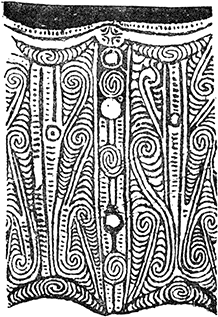
Fig. 43.—Rubbing of the decoration of a Maori flute, in the Natural History Museum, Belfast; one-half natural size.
Some of the New Zealand patterns (Fig. 43, and Plate VI., Fig. 12) certainly have a superficial resemblance to the more typical scroll patterns from the South-Eastern Archipelago of New Guinea, but there is no ground for comparing them except for this casual resemblance. The bird element is entirely lacking, and there is far less interlocking in the Maori than in the Papuan scrolls; there are also noticeable technical differences. My impression is that the carved designs have been derived mainly from tattooing, and possibly also partly from the dismemberment which so often befalls the conventionalised carvings of their ancestral figures. (Plate VI., Fig. 11.) When one looks at tattooed Maori heads or carvings of human figures one finds that rounded surfaces, such as the wings of the nose, the cheeks, the shoulders and thighs are usually decorated with spiral designs; this is in such places an appropriate device, as it accentuates the features which are ornamented, and personally I am inclined to believe that artistic fitness is the explanation of this employment of the spiral, and that it has been transferred to other objects as being a pleasing design, and that connecting lines have been made to give coherence to the decoration. It is worth noting that in early European art the shoulders and haunches of animals are often decorated with spirals.[17]