IX
Reading edition
IX
MAN'S NEWEST CO-LABORER: THE DYNAMO
As you stand waiting for your train at elevated or subway station you must have noticed the third rail. To outward appearance it is not different from the other rails. It seems a mere inert piece of steel. Yet you are well aware that a strange power abides there unseen—a power that pulls the train, and that lurks in hiding to strike a death-blow to any chance unfortunate whose foot or hand comes in contact with the rail. As the heavy train dashes up, dragged by this unseen power, probably you, in common with the rest of the world, have been led to remark, "Is it not marvelous?"
Marvelous it surely seems. Yet the cause of our astonishment is to be sought in the relative newness of the phenomena rather than in the nature of the phenomena themselves. At first glance it may seem that the intangible character of the electrical power gives it a unique claim on our wonderment. But a moment's reflection dispels this illusion. After all, electricity is no more intangible than heat. Neither the one nor the other can be seen or heard, but each alike may be felt. Yet we observe without astonishment a locomotive propelled by the power of heat—simply because the locomotive has become an old story. Again, electricity is far less intangible than gravitation. Not merely may electricity be felt, but it may be generated through transformation of other forms of energy; it may be stored away and measured; may be conducted at will through tortuous channels, or obstructed in its flight by the intervention of non-conductors. But gravitation submits to no such restrictions. It eludes all of our senses, and it absolutely disregards all barriers. To its catholic taste all substances are alike. It holds in bondage every particle of matter in the universe, and can enforce its influence over every kind of atom with an impartiality that is as astounding as it is inexorable. Moreover, this weird force, gravitation, has thus far evaded all man's efforts to classify or label it. No man has the slightest inkling as to what gravitation really is. If, as you glance at these lines, you should chance to release your hold and allow the volume to drop to the floor, you will have performed a miracle which no scientist in the world can even vaguely explain.
As regards our electric train, then, the fact that it stands there firmly, held fast to the rails by gravitation, is in reality as great and as inexplicable a marvel as the fact that the electric current gives it propulsion. Not only so, but the fact that the train goes forward of its own inertia, as we say, for a time after the current is shut off, presents to us yet another inexplicable marvel. It is a fundamental property of matter, we say, when once in motion to continue in motion until stopped by some counter-force; but that phrasing, expressive though it be of a fact upon which so many physical phenomena depend, is in no proper sense of the word an explanation.
Once for all, then, there is nothing unique, nothing preternaturally marvelous, about the phenomena of electricity. And indeed, it is interesting to note how quickly we become accustomed to these phenomena, and how little wonder they excite so soon as they cease to be novel. Even imaginative people have long since ceased to give thought to the trolley car; and within a week of the opening of New York's subway the average man came to regard it as much as a matter of course as if he had been accustomed to it from boyhood.
And yet, in another sense of the word, the electric motor is a wonderful contrivance. As an example of what man's ingenuity can accomplish toward transforming the powers of nature and adapting them to his own use, it is fully entitled to be called a marvel. Moreover, in the last analysis, we are as helpless to explain the nature of electricity as we are to explain the nature of gravitation. It is only the proximal phenomena of the electric current that can be explained. These phenomena, however, are full of interest. Let us examine them somewhat in detail, allowing them to lead us back from electric train to power-house and dynamo, and from dynamo as far toward the mystery of electric energy as present-day science can guide us.
THE MECHANISM OF THE DYNAMO
If we could look into the interior of a mechanism in connection with the trucks beneath the car, we should find an apparatus consisting essentially of coils of wire adjusted compactly about an axis, and closely fitted between the poles of a powerful electromagnet. These coils of wire constitute what is called an armature. When the current is switched on it passes through this armature, as well as through the electromagnet, and the mutual attractions and repulsions between the magnetic poles and the electric current in the coils of wire, cause the armature to revolve with such tremendous energy as to move the train—the motion of its axis being transmitted to the axle of the car-wheels by a simple gearing.
All this is simple enough if we regard only the how and not the why of the phenomena. Ignoring the why for the moment, let us seek the origin of the current which, by being conducted through the armature, has produced the striking effect we have just witnessed. This current reaches the car through an overhead or underground wire. All that is essential is that some conducting medium, such as an iron rail, or a copper wire, shall form an unbroken connection between the motor apparatus and the central dynamo where the power is generated—the return circuit being made either by another wire or by the ordinary rails.
The central dynamo in question will be found, if we visit the power-house, to be a ponderous affair, suggestive to the untechnical mind of impenetrable mysteries. Yet in reality it is a device essentially the same in construction as the motor which drives the train. That is to say, its unit of construction consists of a wire-wound armature revolving on an axis and fitted between the poles of an electromagnet. Here, however, the sequence of phenomena is reversed, for the armature, instead of receiving a current of electricity, is made to revolve by a belt adjusted to its axis and driven by a steam engine. The wire coils of the armature thus made to revolve cut across the so-called lines of magnetic force which connect the two poles of the magnet, and in so doing generate a current of induced electricity, which flows away to reach in due course the third rail or the trolley-wire, and ultimately to propel the motor.
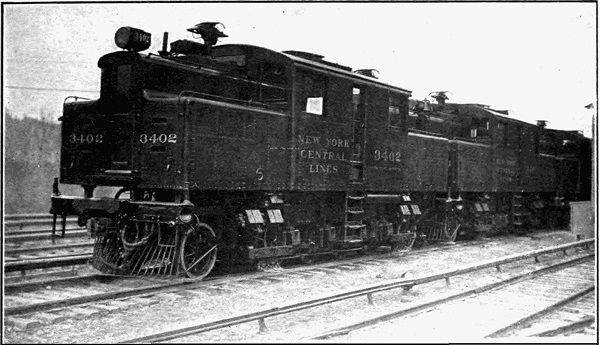
AN ELECTRIC TRAIN AND THE DYNAMO THAT PROPELS IT.
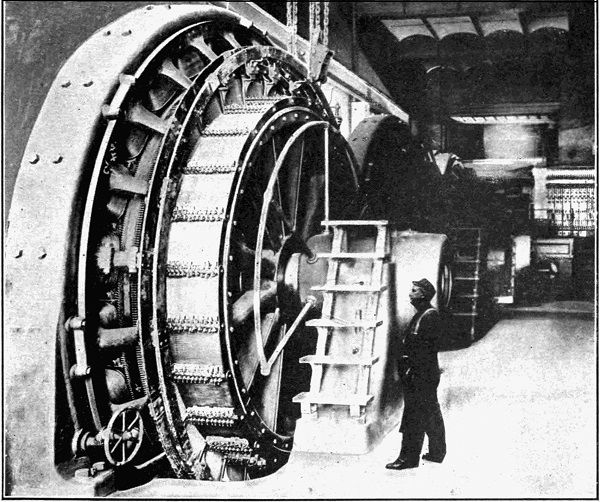
Lower figure copyrighted by N. Y. Edison Co.
The lower figure gives an interior view of a power house of the Manhattan Elevated Railway Company. The upper figure shows one of the electric engines operating on the New York Central Lines just outside of New York. The power is conveyed to the engine by a third rail clearly shown in the picture.
It is hardly necessary to state that in actual practice this generating dynamo is a complex structure. The armature is a complex series of coils of wire; the electromagnets surrounding the armature are several or many; and there is an elaborate system of so-called commutators through which the currents of electricity—which would otherwise oscillate as the revolving coil cuts the lines of magnetic force in opposite directions—are made to flow in one direction. But details aside, the foundation facts upon which everything depends are (1) that a coil of wire when forced to move so that it cuts across the lines of force in any magnetic field develops a so-called induced current of electricity; and (2) that such an induced current possesses power of magnetic attraction and repulsion. These facts were discovered more than sixty years ago, and carefully studied by Michael Faraday, Joseph Henry, and others. Faraday found that such an induced current could be produced not merely with the aid of an iron magnet, but even by causing a wire to cut the lines of force that everywhere connect the north and south poles of the earth,—the earth being indeed, as William Gilbert long ago demonstrated, veritably a gigantic magnet. Moreover, these relations are reciprocal; so that if a wire through which a current of electricity is passing is placed across a magnetic field, the wire is impelled to move in a plane at right angles to the direction of the lines of force. It is forcibly thrust aside. This side-thrust acting on coils of wire is what produces the revolution of the armature of the electric motor.
THE ORIGIN OF THE DYNAMO
The very first studies that had to do with the mutual relations of electricity and magnetism were made by Hans Christian Oersted, the Dane, as early as 1815. He discovered that a magnetic needle is influenced by the passage near it of a current of electricity, demonstrating, therefore, that the electric current in some way invades the medium surrounding any conductor along which it is passing. Oersted's experiments were repeated, and some new phenomena observed by the Frenchman André Marie Ampère and Dominique François Arago. Arago constructed an interesting device, in which a metal disk was made to revolve in the presence of a current of electricity; but neither he nor anyone else at the time was able to explain the phenomenon.
In 1824 an advance was made through the construction of the first electric magnet by Sturgeon. Hitherto it had not been known that a magnet could be made artificially, except by contact with a previously existing magnet. Sturgeon showed that any core of iron may be rendered magnetic if wound with a conducting wire, through which a current of electricity is passed. The experiments thus inaugurated were followed up in America by Joseph Henry of Albany who made enormous electromagnets, capable of sustaining great weights. One of his magnets, operated by a single cell, was able to lift six hundred and fifty pounds of metal.
It was this apparatus which was subsequently to make possible the utilization of electricity as a working force, but as yet no one suspected its possibilities in this direction.
It remained for Michael Faraday, in 1831, to make the final experiment which laid the secure foundation for the new science of electrodynamics. Faraday constructed a tiny apparatus, consisting of a magnet between the poles of which a metal disk was placed in such a way that it could revolve on an axis, the disk being connected with a wire conveying an electric current.
The details as to this most ingenious mechanism need not be given here. Suffice it that Faraday demonstrated the interrelations of magnetism and electricity and the possibility of causing a metal disk to revolve through this mutual interaction. In so doing he constructed the first dynamo-electric machine. In his hands it was a mere laboratory toy, but the principles involved were fully elaborated by the original experimenter, and stated in precise language which modern investigators have not been able to improve upon.
Several decades elapsed after Faraday's initial experiment before the phenomena of magneto-electricity were proved to have any considerable commercial significance. A vast amount of ingenuity was required to devise a mechanism which could advantageously utilize the principle in question for commercial purposes. Indeed the early experimenters did not at once get upon the right track, as their efforts were influenced disadvantageously by an attempt to follow the principle of the steam engine. Some interesting mechanisms were devised whereby the motion of an armature in being drawn toward an electromagnet could be translated into rotary motion through the use of crank-shafts and even of beams, precisely comparable to those employed in the steam engine. Such devices worked with a comparatively low degree of efficiency and were totally abandoned so soon as the idea of getting rotary motion directly from the magnet or armature was made feasible. The names of Saxton, Clarke, Woolrich, Wheatstone, and Werner Siemens are intimately connected with the early efforts at utilization of magneto-electric power. The shuttle-wound armature of Siemens, invented in 1854, marked an important progressive step.
PERFECTING THE DYNAMO
The first separately excited dynamos were constructed by Dr. Henry Wilde, F.R.S., between 1863 and 1865, and this invention paved the way for rapid progress. In 1866-7 Varley, Siemens, Wheatstone, and Ladd constructed machines with several iron electromagnets, self-excited, which were described as dynamo-electric machines, a term afterward contracted to dynamos. In 1867 Dr. Wilde improved the armature by introducing several coils arranged around a cylinder; the current from a few of the coils was rectified and used to excite the field magnet, while the main current as given off by the rest of the coils was taken off by ring-contacts, the machine being a self-exciting, alternating-current dynamo.
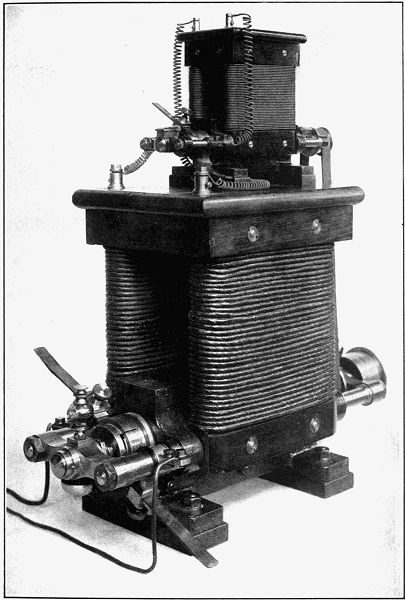
WILDE'S SEPARATELY EXCITED DYNAMO.
Dr. Wilde invented and patented (1863-5) the first separately excited dynamo, with which he demonstrated that the feeble current from a small magneto-electric machine would, by the expenditure of mechanical power, produce currents of great strength from a large dynamo.
The Italian, Picnotti, in 1864 invented a ring armature which, although provided with teeth was wound with coils in such a way as to obtain a very uniform current; but the practical introduction of the continuous-current machines dates from 1870, when Gramme re-invented the ring and gave it the form which is still in vogue. Von Alteneck in 1873 converted the Siemens shuttle armature along the same lines and so introduced the drum arrangement which has since been very extensively adopted.
Thus through the efforts of a great number of workers the idea of utilizing electromagnetic energy for the purposes of the practical worker came to be a reality. Numberless machines have been made differing only as to details that need not detain us here. Everyone is familiar with sundry applications of the dynamo to the purposes of to-day's applied science. It must be understood, of course, that the amount of electricity generated in any dynamo is precisely measurable, and that by no possibility could the energy thus developed exceed the energy required to move the coils of wire. Were it otherwise the great law of the conservation of energy would be overthrown. In actual practice, of course, there is loss of energy in the transaction. The current of electricity that flows from the very best dynamo represents considerably less working power than is expended by the steam engine in forcibly revolving the armature. In the early days of experiments the loss was so great as to be commercially prohibitive. With the perfected modern dynamo the loss is not greater than fifteen per cent; but even this, it will be noted, makes electricity a relatively expensive power as compared with steam,—except, indeed, where some natural power, like the Falls of Niagara, can be utilized to drive the armature.
A MYSTERIOUS MECHANISM
The efficiency of the modern dynamo is due largely to the fact that when the poles of the magnet are made to face each other, the lines of magnetic force passing between these poles are concentrated into a narrow compass. With the ordinary bar magnet, as everyone is aware, these lines of force circle out in every direction from the poles in an almost infinite number of loops, all converging at the poles, and becoming relatively separated at the equator in a manner which may be graphically illustrated by the lines of longitude drawn on an ordinary globe.
It is obvious that with a magnet of such construction only a small proportion of the lines of magnetic force could be utilized in generating electricity. But, as already mentioned, when the magnet is so curved that its poles face each other, the lines of force, instead of widely diverging, pass from pole to pole almost in a direct stream. The strength of this magnetic stream may be increased almost indefinitely by winding the iron core of the magnet with the coil of wire through which the electric current is passed, thus constituting the electromagnet which has replaced the old permanent magnet in all modern commercial dynamos.
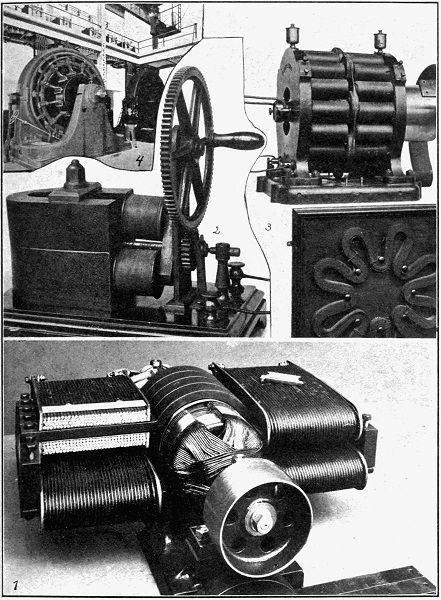
THE EVOLUTION OF THE DYNAMO.
Fig. 1.—A small example of the original commercial form of the drum armature machine, patented in 1873 by Dr. Werner Siemens and F. Von Hefner Alteneck. The armature is a development of the Siemens shuttle form of 1856, and gives a nearly continuous current. Fig. 2.—An early experimental dynamo. Fig. 3.—Ferranti's original dynamo, patented in 1882-1883. The field magnets are stationary and consist of two sets of electro-magnets each with 16 projecting pull pieces, between which the armature revolves. Fig. 4.—The gigantic rotary converters of the Manhattan Elevated Railway.
An electromagnet may be sufficiently powerful to lift tons of iron. The force it exerts, therefore, is very tangible in its results. Yet it seems mysterious, because so many substances are unaffected by it. You may place your head, for example, between the poles of the most powerful magnet without experiencing any sensation or being in any obvious way affected. You may wave your hand across the lines of force as freely as you may wave it anywhere else in space. Apparently nothing is there. But were you to attempt to pass a dumb-bell or a bar of iron across the same space, the unseen magnetic force would wrench it from your grasp with a power so irresistible as to be awe-inspiring.
Similarly, the armature, when its coils of wire are adjusted between the poles of the magnet, is held in a vise-like grip by the invisible but potent lines of magnetic force which tend to make it revolve. It requires a tremendous expenditure of energy—supplied by the steam-engine or by water power—to enable the coiled wires of the generating armature to stem the current of magnetic force, which is virtually what is done when the armature revolves in such a way as to produce electrical energy. Part of the mechanical energy thus expended is transformed into heat and dissipated into space; but the main portion is carried off, as we have seen, through the coiled wires of the armature in the form of what we term the current of electricity, to be re-transformed in due course into the mechanical energy that moves the car.
It appears, then, that the phenomena of the electric dynamo depend upon the curious relations that exist between magnetism and electricity. Granted the essential facts of magneto-electric induction, all the phenomena of the dynamo are explicable. But how explain these facts themselves? Why is an electric current generated in a coil of wire moving in a magnetic field? And why is a wire carrying a current of electricity, when placed across a magnetic field, impelled to move at right angles to the lines of magnetic force? No thoughtful person can consider the subject without asking these questions. But as yet no definitive answer is forthcoming. Some suggestive half-explanations, based on an assumed condition of torsion or strain in the ether, have been attempted, but they can hardly be called more than scientific guesses.
Meanwhile, it may be understood that the mutual relations of the magnetic and electrical forces just referred to are not at all dependent upon the manner in which the electric current is generated. The magneto-electric motor may be operated as well with a chemical battery as with such a mechanical generating dynamo as has just been described. The storage-batteries which have been employed in some street railways and those which propel the electric cabs about our city streets furnish cases in point. The only reason these are not more generally employed is that the storage battery has not yet been perfected so that it can produce a large supply of electricity in proportion to its weight, and produce it economically.