II
Reading edition
II
HOW WORK IS DONE
The word energy implies capacity to do work. Work, considered in the abstract, consists in the moving of particles of matter against some opposing force, or in aid of previously acting forces. In the last analysis, all energy manifests itself either as a push or as a pull. But there is a modification of push and pull which is familiar to everyone in practice under the name of prying. Illustrations may be seen on every hand, as when a workman pries up a stone, or when a housewife pries up a tack with the aid of a hammer. The principle here involved is that of the lever—a principle which in its various practical modifications is everywhere utilized in mechanics. Very seldom indeed is the direct push or pull utilized; since the modified push or pull, as represented by the lever in its various modifications of pulley, ratchet-wheel, and the like, has long been known to meet the needs of practical mechanics.
The very earliest primitive man who came to use any implement whatever, though it were only a broken stick, must have discovered the essential principle of the lever, though it is hardly necessary to add that he did not know his discovery by any such high-sounding title. What he did know, from practical experience, was that with the aid of a stick he could pry up stones or logs that were much too heavy to be lifted without this aid.
This practical knowledge no doubt sufficed for a vast number of generations of men who used the lever habitually, without making specific study of the relations between the force expended, the lengths of the two ends of the lever, and the weight raised. Such specific experiments were made, however, more than two thousand years ago by the famous Syracusan, Archimedes. He discovered—or if some one else had discovered it before him, he at least recorded and so gains the credit of discovery—the specific laws of the lever, and he also pointed out that levers, all acting on the same principle, may be different as to their practical mechanism in three ways.
First, the fulcrum may lie between the power and the weight, as in the case of the balance with which we were just experimenting. This is called a lever of the first class, and familiar illustrations of it are furnished by the poker, steelyard, or a pair of scissors. The so-called extensor muscles of the body—those for example, that cause the arm to extend—act on the bones in such a way as to make them levers of this first class.
The second type of lever is that in which the weight lies between the force and the fulcrum, as illustrated by the wheelbarrow, or by an ordinary door.
In the third class of levers the power is applied between weight and fulcrum, as illustrated by a pair of tongs, the treadle of a lathe, or by the flexor muscles of the arm, operating upon the bones of the forearm.
But in each case, let it be repeated, precisely the same principles are involved, and the same simple law of the relations between positions of power, weight, and fulcrum are maintained. The practical result is always that a weight of indefinite size may be moved by a power indefinitely long. If one arm of the lever is ten times as long as the other, the power of one pound will lift or balance a ten-pound weight; if the one arm is a thousand times as long as the other the power of one pound will lift or balance a thousand pounds. If the long arm of the lever could be made some millions of miles in length, the power that a man could exert would balance the earth.
How fully Archimedes realized the possibilities of the lever is illustrated in the classical remark attributed to him, that, had he but a fulcrum on which to place his lever, he could move the world. As otherwise quoted, the remark of Archimedes was that, had he a place on which to stand, he could move the world, a remark which even more than the other illustrates the full and acute appreciation of the laws of motion; since, as we have already pointed out, action and reaction being equal, the most infinitesimal push must be considered as disturbing even the largest body.
Tremendous as is the pull of gravity by which the earth is held in its orbit, yet the smallest push, steadily applied from the direction of the sun, would suffice ultimately to disturb the stability of our earth's motion, and to push it gradually through a spiral course farther and farther away from its present line of elliptical flight. Or if, on the other hand, the persistent force were applied from the side opposite the sun, it would suffice ultimately to carry the earth in a spiral course until it plunged into the sun itself. Indeed it has been questioned in modern times whether it may not be possible that precisely this latter effect is gradually being accomplished, through the action of meteorites, some millions of which fall out of space into the earth's atmosphere every day. If these meteorites were uniformly distributed through space and flying in every direction, the fact that the sun screens the earth from a certain number of them, would make the average number falling on the side away from the sun greater, and thus would in the course of ages produce the result just suggested. All that could save our earth from such a fate would be the operation of some counteracting force. Such a counteracting force is perhaps found in solar radiation. It may be added that the distribution of meteorites in space is probably too irregular to make their influence on the earth predicable in the present state of science; but the principle involved is no less sure.
WHEELS AND PULLEYS
Returning from such theoretical applications of the principle of motion, to the practicalities of every-day mechanisms, we must note some of the applications through which the principle of the lever is made available. Of these some of the most familiar are wheels, and the various modifications of wheels utilized in pulleys and in cogged and bevelled gearings. A moment's reflection will make it clear that the wheel is a lever of the first class, of which the axle constitutes the fulcrum. The spokes of the wheel being of equal length, weights and forces applied to opposite ends of any diameter are, of course, in equilibrium. It follows that when a wheel is adjusted so that a rope may be run about it, constituting a simple pulley, a mechanism is developed which gives no gain in power, but only enables the operator to change the direction of application of power. In other words, pound weights at either end of a rope passed about a simple pulley are in equilibrium and will balance each other, and move through equal distances in opposite directions.
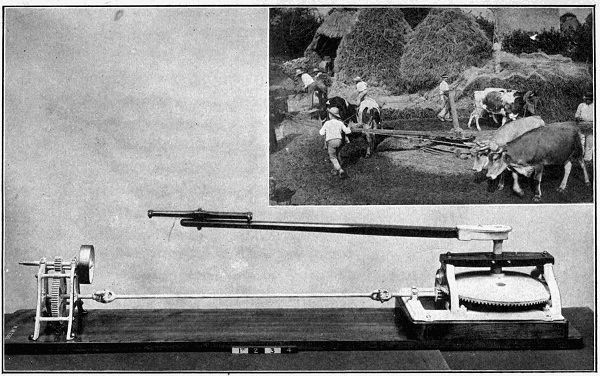
HORSE AND CATTLE POWER.
The large picture shows a model of a familiar mechanism for utilizing horse power. The small picture shows a similar apparatus in actual operation, actuated by cattle, in contemporary Brittany.
If, however, two or more pulley wheels are connected, to make the familiar apparatus of a compound pulley, we have accomplished by an interesting mechanism a virtual application of the principle of the long and short arm of the lever, and the relations between the weight at the loose end of the rope and the weight attached to the block which constitutes virtually the short end of the lever, may be varied indefinitely, according to the number of pulley-wheels that are used. A pound weight may be made to balance a thousand-pound weight; but, of course, our familiar principle still holding, the pound weight must move through a distance of a thousand feet in order to move a thousand-pound weight through a distance of one foot. Familiar illustrations of the application of this principle may be seen on every hand; as when, for example, a piano or a safe is raised to the upper window of a building by the efforts of men whose power, if directly expended, would be altogether inefficient to stir the weight.
The pulley was doubtless invented at a much later stage of human progress than the simple lever. It was, however, well known to the ancients. It was probably brought to its highest state of practical perfection by Archimedes, whose experiments are famous through the narrative of Plutarch. It will be recalled that Archimedes amazed the Syracusan general by constructing an apparatus that enabled him, sitting on shore, to drag a ponderous galley from the water. Plutarch does not describe in detail the apparatus with which this was accomplished, but it is obvious from his description of what took place, that it must have been a system of pulleys.
It will be observed that the pulley is a mechanism that enables the user to transmit power to a distance. But this indeed is true in a certain sense of every form of lever. Numberless other contrivances are in use by which power is transmitted, through utilization of the same principle of the lever, either through a short or through a relatively long distance. A familiar illustration is the windlass, which consists of a cylinder rotating on an axis propelled by a long handle, a rope being wound about the cylinder. This is a lever of the second class, the axis acting as fulcrum, and the rope operating about the circumference of the cylinder typifying the weight, which may be actually at a considerable distance, as in the case of the old-fashioned well with its windlass and bucket, or of the simple form of derrick sometimes called a sheerlegs.
OTHER MEANS OF TRANSMITTING POWER
Power is transmitted directly from one part of a machine to another, in the case of a great variety of machines, with the aid of cogged gearing wheels of various sizes. The modifications of detail in the application of these wheels may be almost infinite, but the principle involved is always the same. The case of two wheels toothed about the circumference, the teeth of the two wheels fitting into one another, illustrates the principle involved. A consideration of the mechanism will show that here we have virtually a lever fixed at both ends, represented by the radii of the two wheels, the power being applied through the axle of one wheel, and the weight, for purposes of calculation, being represented by the pressure of the teeth of one wheel upon those of the other. So this becomes a lever of the second class, and the relations of power between the two wheels are easily calculated from the relative lengths of the radii. If, for example, one radius is twice as long as the other, the transmission of power will be, obviously, in the proportion of two to one, and meantime the distance traversed by the circumference of one wheel will be twice as great as that traversed by the other.
A modification of the toothed wheel is furnished by wheels which may be separated by a considerable distance, and the circumferences of which are connected by a belt or by a chain. The principle of action here is precisely the same, the belt or chain serving merely as a means of lengthening out our lever. The relative sizes of the wheels, and not the length of the belt or chain, is the determining factor as regards the relative forces required to make the wheels revolve.
It is obvious all along, of course, since action and reaction are equal, that all of the relations in question are reciprocal. When, for example, we speak of a pound weight on the long end of a lever balancing a ten-pound weight on the short end, it is equally appropriate to speak of the ten-pound weight as balancing the one-pound weight. Similarly, when power is applied to the lever, it may be applied at either end. Ordinarily, to be sure, the power is applied at the long end, since the object is to lift the heavy weight; but in complicated machinery it quite as often happens that these conditions are reversed, and then it becomes desirable to apply strong power to the short end of the lever, in order that the relatively small weight may be carried through the long distance. In the inter-relations of gearing wheels, such conditions very frequently obtain, practical ends being met by a series of wheels of different sizes. But the single rule, already so often outlined, everywhere holds—wherever there is gain of power there is loss of distance, and we can gain distance only by losing power. The words gain and loss in this application are in a sense misnomers, since, as we have already seen, gain and loss are only apparent, but their convenience of application is obvious.
A familiar case in which there is first loss of speed and gain of power, and then gain of speed at the expense of power in the same mechanism, is furnished by the bicycle, where (1) the crank shaft turns the sprocket wheel that constitutes a lever of the second class with gain of power; where (2) power is further augmented through transmission from the relatively large sprocket wheel to the small sprocket of the axle; and where (3) there is great loss of power and corresponding gain of speed in transmitting the force from the small sprocket wheel at the axle to the rubber rim of the bicycle proper, this last transmission representing a lever of the third class. The net gain of speed is tangibly represented by the difference in distance traversed by the man's feet in revolving the pedals, and the actual distance covered by the bicycle.
INCLINED PLANES AND DERRICKS
A less obvious application of the principle of reciprocal equivalence of distance and weight is furnished by the inclined plane, a familiar mechanism with the aid of which a great gain of power is possible. The inclined plane, like the lever, has been known from remotest antiquity. Its utility was probably discovered by almost the earliest builders. Diodorus Siculus tells us that the great pyramids of Egypt were constructed with the aid of inclined planes, based on a foundation of earth piled about the pyramids. Diodorus, living at a period removed by some thousands of years from the day of the building of the pyramids, may or may not have voiced and recorded an authentic tradition, but we may well believe that the principle of the inclined plane was largely drawn upon by the mechanics of old Egypt, as by later peoples.
The law of the inclined plane is that in order to establish equilibrium between two weights, the one must be to the other as the height of the inclined plane is to its length. The steeper the inclined plane, therefore, the less will be the gain in power; a mechanical principle which familiar experience or the simplest experiment will readily corroborate.
In its elemental form the inclined plane is not used very largely in modern machinery, but its modified form of the wedge and the screw have more utility. The screw, indeed, which is obviously an inclined plane adjusted spirally about a cylinder or a cone, is familiar to everyone, and is constantly utilized in applying power.
The crane or derrick furnishes a familiar but relatively elaborate illustration of a mechanism for the transmission of power, in which all the various devices hitherto referred to are combined, without the introduction of any new principle.
Derricks have been employed from a very early day. The battering-rams of the ancient Egyptians and Babylonians, for example, were virtually derricks; and no doubt the same people used the device in raising stones to build their temples and city walls, and in putting into position such massive sculptures as the obelisks of Egypt and the monster graven bulls and lions of Nineveh and Babylon.
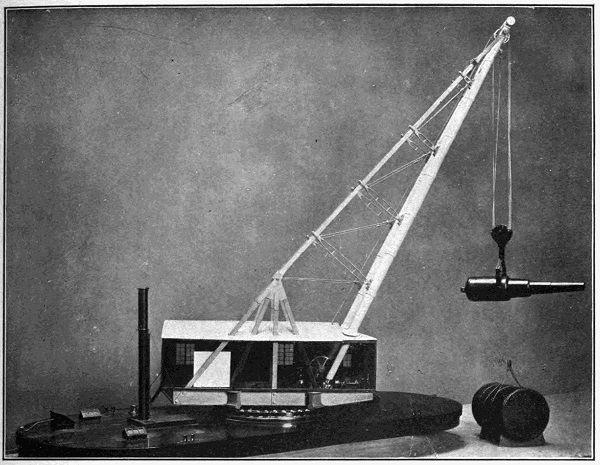
CRANES AND DERRICKS.
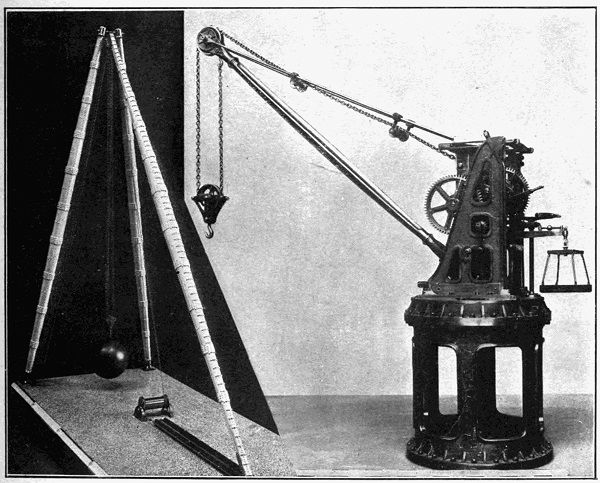
The upper figure shows a floating derrick, the lower right-hand figure a combined derrick and weighing machine, and the lower left-hand figure a so-called sheerlegs, which is a simple derrick and windlass operated by hand or by steam power with the aid of compound pulleys.
The modern derrick, made of steel, and operated by steam or electricity, capable of lifting tons, yet absolutely obedient to the hand of the engineer, is a really wonderful piece of mechanism. A steam-scoop, for example, excavating a gravel bank, seems almost a thing of intelligence; as it gores into the bank scooping up perhaps a half ton of earth, its upward sweeping head reminds one of an angry bull. Then as it swings leisurely about and discharges its load at just the right spot into an awaiting car, its hinged bottom swings back and forth two or three times before closing, with curious resemblance to the jaw of a dog; the similarity being heightened by the square bull-dog-headed shape of the scoop itself. Yet this remarkable contrivance, with all its massive steel beams and chains and cog wheels, employs no other principles than the simple ones of lever and pulley and inclined plane that we have just examined. The power that must be applied to produce a given effect may be calculated to a nicety. The capacities of the machine are fully predetermined in advance of its actual construction. But of course this is equally true of every other form of power-transmitter with which the modern mechanical engineer has to deal.
FRICTION
In making such calculations, however, there is an additional element which the engineer must consider, but which we have hitherto disregarded. In all methods of transmission of power, and indeed in all cases of the contact of one substance with another, there is an element of loss through friction. This is due to the fact that no substance is smooth except in a relative sense. Even the most highly polished glass or steel, when viewed under the microscope, presents a surface covered with indentations and rugosities. This granular surface of even seemingly smooth objects, is easily visualized through the analogy of numberless substances that are visibly rough. Yet the vast practical importance of this roughness is seldom considered by the casual observer. In point of fact, were it not for the roughened surface of all materials with which we come in contact, it would be impossible for any animal or man to walk, nor could we hold anything in our hands. Anyone who has attempted to handle a fish, particularly an eel, fresh from the water, will recall the difficulty with which its slippery surface was held; but it may not occur to everyone who has had this experience that all other objects would similarly slip from the hand, had their surfaces a similar smoothness. The slippery character of the eel is, of course, due in large part to the relatively smooth surface of its skin, but partly also to the lubricant with which it is covered. Any substance may be rendered somewhat smoother by proper lubrication; it is necessary, however, that the lubricant should be something which is not absorbed by the substance. Thus, wood is given increased friction by being moistened with oil, but, on the other hand, is made slippery if covered with graphite, soap, or any other fatty substances that it does not absorb.
Recalling the more or less roughened surface of all objects, the source of friction is readily understood. It depends upon the actual jutting of the roughened surfaces, one upon the other. It virtually constitutes a force acting in opposition to the motion of any two surfaces upon each other. As between any different materials, under given conditions, it varies with the pressure, in a definite and measurable rate, which is spoken of as the coefficient of friction for the particular substances. It is very much greater where the two substances slide over one another than where the one rolls upon the other, as in the case of the wheel. The latter illustrates what is called rolling friction, and in practical mechanics it is used constantly to decrease the loss—as, for example, in the wheels of wagons and cars. The use of lubricants to decrease friction is equally familiar. Without them, as everyone knows, it would be impossible to run any wheel continuously upon an axle at high speed for more than a very brief period, owing to the great heat developed through friction. Friction is indeed a perpetual antagonist of the mechanician, and we shall see endless illustrations of the methods he employs to minimize its influence. On the other hand, we must recall that were it rendered absolutely nil, his machinery would all be useless. The car wheel, for example, would revolve indefinitely without stirring the train, were there absolutely no friction between it and the rail.
AVAILABLE SOURCES OF ENERGY
We have pointed out that every body whatever contains a certain store of energy, but it has equally been called to our attention that, in the main, these stores of energy are not available for practical use. There are, however, various great natural repositories of energy upon which man is able to draw. The chief of these are, first, the muscular energy of man himself and of animals; second, the energy of air in motion; third, the energy of water in motion or at an elevation; and fourth, the molecular and atomic energies stored in coal, wood, and other combustible materials. To these we should probably add the energy of radio-active substances—a form of energy only recently discovered and not as yet available on a large scale, but which may sometime become so, when new supplies of radio-active materials have been discovered. It will be the object of succeeding chapters to point out the practical ways in which these various stores of energy are drawn upon and made to do work for man's benefit.