IV
Reading edition
IV
THE WORK OF AIR AND WATER
The store of energy contained in the atmosphere and in the waters of the globe is inexhaustible. Its amount is beyond all calculation; or if it were vaguely calculated the figures would be quite incomprehensible from their very magnitude. It is not, however, an altogether simple matter to make this energy available for the purposes of useful work. We find that throughout antiquity comparatively little use was made of either wind or water in their application to machinery.
Doubtless the earliest use of air as a motive power was through the application of sails to boats. We know that the Phœnicians used a simple form of sail, and no doubt their example was followed by all the maritime peoples of subsequent periods. But the use of the sail even by the Phœnicians was as a comparatively unimportant accessory to the galaxies of oars, which formed the chief motive power. The elaboration of sails of various types, adequate in extent to propel large ships, and capable of being adjusted so as to take advantage of winds blowing from almost any quarter, was a development of the Middle Ages.
The possibilities of work with the aid of running water were also but little understood by the ancients. In the days of slave labor it was scarcely worth while to tax man's ingenuity to invent machines, since so efficient a one was provided by nature. Yet the properties of both air and water were studied by various mechanical philosophers, at the head of whom were Archimedes, whose work has already been referred to, and the famous Alexandrian, Ctesibius, whose investigations became familiar through the publications of his pupil, Hero.
Perhaps the most remarkable device invented by Ctesibius was a fire-engine, consisting of an arrangement of valves constituting a pump, and operating on the principle which is still in vogue. It is known, however, that the Egyptians of a much earlier period used buckets having valves in their bottoms, and these perhaps furnished the foundation for the idea of Ctesibius. It is unnecessary to give details of this fire-engine. It may be noted, however, that the principle of the lever is the one employed in its operation to gain power. A valve consists essentially of any simple hinged substance, arranged so that it may rise or fall, alternately opening and closing an aperture. A mere flap of leather, nailed on one edge, serves as a tolerably effective valve. At least one of the valves used by Ctesibius was a hinged piece of smooth metal. A piston fitted in a cylinder supplies suction when the lever is raised, and pressure when it is compressed, alternately opening the valve and closing the valve through which the water enters the tube. Meantime a second valve alternating with the first permits the water to enter the chamber containing air, which through its elasticity and pressure equalizes the force of the stream that is ejected from the chamber through the hose.
SUCTION AND PRESSURE
In the construction of this and various other apparatus, Ctesibius and Hero were led to make careful studies of the phenomena of suction. But in this they were not alone, since numerous of their predecessors had studied the subject, and such an apparatus as the surgeon's cupping glass was familiarly known several centuries before the Christian era. The cupping glass, as perhaps should be explained to the reader of the present day—since the apparatus went out of vogue in ordinary medical practise two or three generations ago—consists of a glass cup in which the air is exhausted, so as to suck blood from any part of the surface of a body to which it is applied. Hero describes a method of exhausting air by which such suction may be facilitated. But neither he nor any other philosopher of his period at all understood the real nature of this suction, notwithstanding their perfect familiarity with numerous of its phenomena. It was known, for example, that when a tube closed at one end is filled with water and inverted with the open end beneath the surface of the water, the water remains in the tube, although one might naturally expect that it would obey the impulses of gravitation and run out, leaving the tube empty. A familiar explanation of this and allied phenomena throughout antiquity was found in the saying that "Nature abhors a vacuum." This explanation, which of course amounts to no explanation at all, is fairly illustrative of the method of metaphysical word-juggling that served so largely among the earlier philosophers in explanation of the mysteries of physical science.
The real explanation of the phenomena of suction was not arrived at until the revival of learning in the seventeenth century. Then Torricelli, the pupil of Galileo, demonstrated that the word suction, as commonly applied, had no proper application; and that the phenomena hitherto ascribed to it were really due to the pressure of the atmosphere. A vacuum is merely an enclosed space deprived of air, and the "abhorrence" that Nature shows to such a space is due to the fact that air has weight and presses in every direction, and hence tends to invade every space to which it can gain access. It was presently discovered that if the inverted tube in which the water stands was made high enough, the water will no longer fill it, but will sink to a certain level. The height at which it will stand is about thirty feet; above that height a vacuum will be formed, which, for some reason, Nature seems not to abhor. The reason is that the weight of any given column of water about thirty feet in height is just balanced by the weight of a corresponding column of atmosphere. The experiments that gave the proof of this were made by the famous Englishman, Boyle. He showed that if the heavy liquid, mercury, is used in place of water, then the suspended column will be only about thirty inches in height. The weight or pressure of the atmosphere at sea level, as measured by these experiments, is about fifteen pounds to the square inch.
Boyle's further experiments with the air and with other gases developed the fact that the pressure exerted by any given quantity of gas is proportional to the external pressure to which it is subjected, which, after all, is only a special application of the law that action and reaction are equal. The further fact was developed that under pressure a gas decreases at a fixed rate in bulk. A general law, expressing these facts in the phrase that density and elasticity vary inversely with the pressure in a precise ratio, was developed by Boyle and the Frenchman, Mariotte, independently, and bears the name of both of its discoverers. No immediate application of the law to the practical purposes of the worker was made, however, and it is only in recent years that compressed air has been extensively employed as a motive power. Even now it has not proved a great commercial success, because other more economical methods of power production are available. In particular cases, however, it has a certain utility, as a relatively large available source of energy may be condensed into a very small receptacle.
A very striking experiment illustrating the pressure of the air was made by a famous contemporary of Boyle and Mariotte, by the name of Otto von Guericke. He connected an air pump with a large brass sphere, composed of two hemispheres, the edges of which fitted smoothly, but were not connected by any mechanism. Under ordinary conditions the hemispheres would fall apart readily, but von Guericke proved, by a famous public demonstration, that when the air was exhausted in the sphere, teams of horses pulling in opposite directions on the hemispheres could not separate them. This is famous as the experiment of the Magdeburg spheres, and it is often repeated on a smaller scale in the modern physical laboratory, to the astonishment of the tyro in physical experiments.
The first question that usually comes to the mind of anyone who has personally witnessed such an experiment, is the question as to how the human body can withstand the tremendous force to which it is subjected by an atmosphere exerting a pressure of fifteen pounds on every square inch of its surface. The explanation is found in the uniform distribution of the pressure, the influence of which is thus counteracted, and by the fact that the tissues themselves contain everywhere a certain amount of air at the same pressure. The familiar experiment of holding the hand over an exhausted glass cylinder—which experiment is indeed but a modification of the use of the cupping glass above referred to—illustrates very forcibly the insupportable difficulties which the human body would encounter were not its entire surface uniformly subjected to the atmospheric pressure.
AIR IN MOTION
At about the time when the scientific experiments with the pressure of gases were being made, practical studies of the effects of masses of air in motion were undertaken by the Dutch philosopher, Servinus. The use of the windmill in Holland as a means of generating power doubtless suggested to Servinus the possibility of attaching a sail to a land vehicle. He made the experiment, and in the year 1600 constructed a sailing car which, propelled by the wind, traversed the land to a considerable distance, on one occasion conveying a company of which Prince Maurice of Orange was a member. But his experiments have seldom been repeated, and indeed their lack of practical feasibility scarcely needs demonstration.
The utility of the wind, however, in generating the power in a stationary mechanism is familiar to everyone. Windmills were constructed at a comparatively early period, and notwithstanding all the recent progress in the development of steam and electrical power, this relatively primitive so-called prime mover still holds its own in agricultural districts, particularly in its application to pumps. A windmill consists of a series of inclined planes, each of which forms one of the radii of a circle, or spokes of a wheel, to the axle of which a gearing is adjusted by which the power generated is utilized. The wheel is made to face the wind by the wind itself blowing against a sort of rudder which projects from the axis. The wind blowing against the inclined surfaces or vanes of the wheel causes each vane to move in accordance with the law of component forces, thus revolving the wheel as a whole.
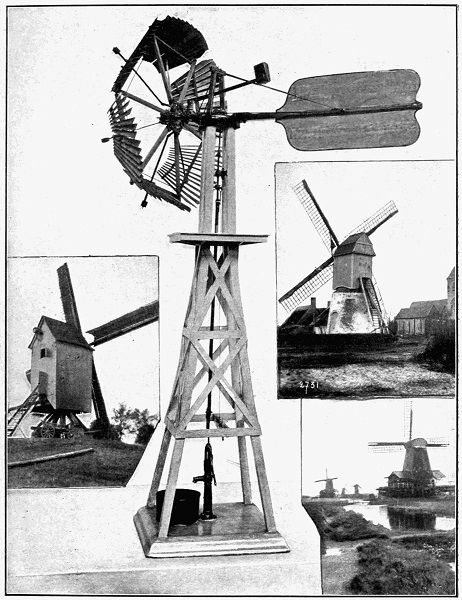
WINDMILLS OF ANCIENT AND MODERN TYPES.
The smaller figures show Dutch windmills of the present day, many of which are identical in structure with the windmills of the middle ages. It will be seen that the sails can be furled when desired to put the mill out of operation. In the mill of modern type (large figure) the same effect is produced by slanting the slats of the wheel.
It has been affirmed that the Romans had windmills, but "the silence of Vitruvius, Seneca, and Chrysostom, who have spoken of the advantages of the wind, makes this opinion questionable." It has been supposed by other writers that windmills were used in France in the sixth century, while still others have maintained that this mechanism was unknown in Europe until the time of the Crusades. All that is tolerably certain is that in the twelfth century windmills were in use in France and England. It is recorded that when they began to be somewhat common Pope Celestine III. determined that the tithes of them belonged to the clergy.
INHERENT DEFECTS OF THE WINDMILL
The mediæval European windmill was supplied with great sails of cloth, and its picturesque appearance has been made familiar to everyone through the famous tale of Don Quixote. The modern windmill, acting on precisely the same principle, is a comparatively small affair, comprising many vanes of metal, and constituting a far more practical machine. The great defect of all windmills, however, is found in the fact that of necessity they furnish such variable power, since the force of the wind is incessantly changing. Worst of all, there may be protracted periods of atmospheric calm, during which, of course, the windmill ceases to have any utility whatever. This uneradicable defect relegates the windmill to a subordinate place among prime movers, yet on the other hand, its cheapness insures its employment for a long time to come, and the industry of manufacturing windmills continues to be an important one, particularly in the United States.
RUNNING WATER
The aggregate amount of work accomplished with the aid of the wind is but trifling, compared with that which is accomplished with the aid of water. The supply of water is practically inexhaustible, and this fluid being much more manageable than air, can be made a far more dependable aid to the worker. Every stream, whatever its rate of flow, represents an enormous store of potential energy. A cubic foot of water weighs about sixty-two and a half pounds. The working capacity of any mass of water is represented by one-half its weight into the square of its velocity; or, stated otherwise, by its weight into the distance of its fall. Now, since the interiors of the continents, where rivers find their sources, are often elevated by some hundreds or even thousands of feet, it follows that the working energy expended—and for the most part wasted—by the aggregate water current of the world is beyond all calculation. Meantime, however, a portion of the energy which in the aggregate represents an enormous working power is utilized with the aid of various types of water wheels.
Watermills appear to have been introduced in the time of Mithridates, Julius Cæsar, and Cicero. Strabo informs us that there was a watermill near the residence of Mithridates; and we learn from Pomponius Sabinus, that the first mill seen at Rome was erected on the Tiber, a little before the time of Augustus. That they existed in the time of Augustus is obvious from the description given of them by Vitruvius, and the epigram of Antipater, who is supposed to have lived in the time of Cicero. But though mills driven by water were introduced at this early period, yet public mills did not appear till the time of Honorius and Arcadius. They were erected on three canals, which conveyed water to the city, and the greater number of them lay under Mount Janiculum. When the Goths besieged Rome in 536, and stopped the large aqueduct and consequently the mills, Belisarius appears to have constructed, for the first time, floating mills upon the Tiber. Mills driven by the tide existed at Venice in the year 1046, or at least in 1078.
The older types of water wheel are exceedingly simple in construction, consisting merely of vertical wheels revolving on horizontal axes, and so placed as to receive the weight or pressure of the water on paddles or buckets at their circumference. The water might be allowed to rush under the wheel, thus constituting an under-shot wheel; or more commonly it flows from above, constituting an over-shot wheel. Where the natural fall is not available, dams are employed to supply an artificial fall.
This primitive type of water wheel has been practically abandoned within the last generation, its place having been taken by the much more efficient type of wheel known as the turbine. This consists of a wheel, usually adjusted on a vertical axis, and acting on what is virtually the principle of a windmill. To gain a mental picture of the turbine in its simplest form, one might imagine the propelling screw of a steamship, placed horizontally in a tube, so that the water could rush against its blades. The tiny windmills which children often make by twisting pieces of paper illustrate the same principle. Of course, in its developed form the turbine is somewhat elaborated, in the aim to utilize as large a proportion of the energy of the falling water as is possible; but the principle remains the same.
The turbine wheel was invented by a Frenchman named Fourneyron, about three-quarters of a century ago (1827), but its great popularity, in America in particular, is a matter of the last twenty or thirty years. To-day it has virtually supplanted every other type of water wheel. To use any other is indeed a wasteful extravagance, as the perfected turbine makes available more than eighty per cent. of the kinetic energy of any mass of falling water. A turbine wheel two feet in diameter is able to do the work of an enormous wheel of the old type.
Turbine wheels are of several types, one operating in a closed tube to which air has no access, and another in an open space in the presence of air. The water may also be made to enter the turbine at the side or from below, thus serving to support the weight of the mechanism—a consideration of great importance in the case of such gigantic turbines as those that are employed at Niagara Falls, which we shall have occasion to examine in detail in a later chapter.
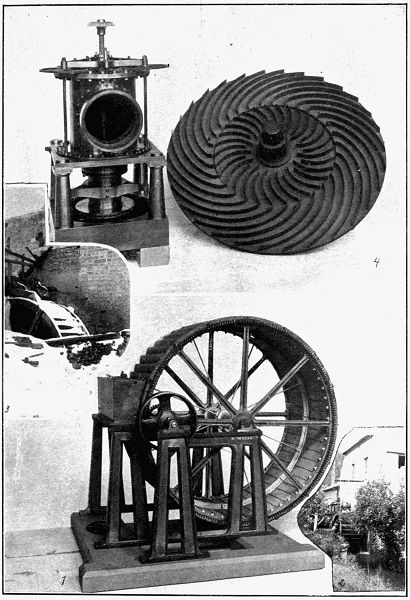
WATER WHEELS.
Fig. 1 shows a model of the so-called breast wheel, a familiar type of water wheel that has been in use since the time of the Romans. Figs. 2 and 3 show similar wheels as used to-day in Belgium. Fig. 4 shows a model of Fourneyron's turbine. This wheel was made in 1837, but the original turbine was introduced by Fourneyron in 1827. The turbine wheel has now almost supplanted the other forms of water wheel except in rural districts.
The power generated by a revolution of the turbine wheel may, of course, be utilized directly by belts or gearings attached to its axle, or it may be transferred to a distance, with the aid of a dynamo generating electricity. The latter possibility, which has only recently been developed, and which we shall have occasion to examine in detail in connection with our studies of the power at Niagara, gives a new field of usefulness to the turbine wheel, and makes it probable that this form of power will be vastly more used in the future than it has been in the past. Indeed, it would not be surprising were it ultimately to become the prime source of working energy as utilized in every department of the world's work.
Mr. Edward H. Sanborn, in an article on Motive Power Appliances in the Twelfth Census Report of the United States, comments upon the recent advances in the use of water wheels as follows:
"One notable advance in turbine construction has been the production of a type of wheel especially designed for operating under much higher heads of water than were formerly considered feasible for wheels of this type. Turbines are now built for heads ranging from 100 to 1,200 feet, and quite a number of wheels are in operation under heads of from 100 to 200 feet. This is an encroachment upon the field occupied almost exclusively by wheels variously known as the 'impulse,' 'impact,' 'tangential,' or 'jet' type, the principle of which is the impact of a powerful jet of water from a small nozzle upon a series of buckets mounted upon the periphery of a small wheel."
"The impact water wheel," Mr. Sanborn continues, "has come largely into use during the last ten years, principally in the far West, where higher heads of water are available than can be found in other parts of the country. With wheels of this type, exceedingly simple in construction and of comparatively small cost, a large amount of power is developed with great economy under the great heads that are available. With the tremendous water pressure developed by heads of 1,000 feet and upward, which in many cases are used for this purpose, wheels of small diameter develop an extraordinary amount of power. To the original type of impact wheel which first led the field have been added several styles embodying practically the same principle. Considerable study has been given to the designing of buckets with a view to securing free discharge and the avoidance of any disturbing eddies, and important improvements have resulted from the thorough investigation of the action of the water during, and subsequent to, its impact on the buckets. The impact wheel has been adapted to a wide range of service with great variation as to the conditions under which it operates, wheels having been made in California from 30 inches to 30 feet in diameter, and to work under heads ranging from 35 to 2,100 feet, and at speeds ranging from 65 to 1,100 revolutions per minute. A number of wheels of this type have been built with capacities of not less than 1,000 horse-power each."
HYDRAULIC POWER
A few words should be said about the familiar method of transmitting power with the aid of water, as illustrated by the hydrostatic press. This does not indeed utilize the energy of the water itself, but it enables the worker to transmit energy supplied from without, and to gain an indefinite power to move weights through a short distance, with the expenditure of very little working energy. The principle on which the hydrostatic press is based is the one which was familiar to the ancient philosophers under the name of the hydrostatic paradox. It was observed that if a tube is connected with a closed receptacle, such as a strong cask, and cask and tube are filled with water, the cask will presently be burst by the pressure of the water, provided the tube is raised to a height, even though the actual weight of water in the tube be comparatively slight. A powerful cask, for example, may be burst by the water poured into a slender pipe. The result seems indeed paradoxical, and for a long time no explanation of it was forthcoming. It remained for Servinus, whose horseless wagon is elsewhere noticed, to discover that the water at any given level presses equally in all directions, and that its pressure is proportionate to its depth, quite regardless of its bulk. Then, supposing the tube in our experiment to have a cross-section of one square inch, a pressure equal to that in the tube would be transmitted to each square inch of the surface of the cask; and the pressure might thus become enormous.
If, instead of a tube lifted to a height, the same tube is connected with a force pump operated with a lever—an apparatus similar to the fire-engine of Ctesibius—it is obvious that precisely the same effect may be produced; whatever pressure is developed in the piston of the force pump, similar pressure will be transferred to a corresponding area in the surface of the cask or receptacle with which the force pump connects. In practise this principle is utilized, where great pressure is desired, by making a receptacle with an enormous piston connecting with the force pump just described.
An indefinite power may thus be developed, the apparatus constituting virtually a gigantic lever. But the principle of the equivalence of weight and distance still holds, precisely as in an actual lever, and while the pressure that may be exerted with slight expenditure of energy is enormous, the distance through which this pressure acts is correspondingly small. If, for example, the piston of the force pump has an area of one square inch, while the piston of the press has an area of several square feet, the pressure exerted will be measured in tons, but the distance through which it is exerted will be almost infinitesimal. The range of utility of the hydrostatic press is, therefore, limited, but within its sphere, it is an incomparable transmitter of energy.
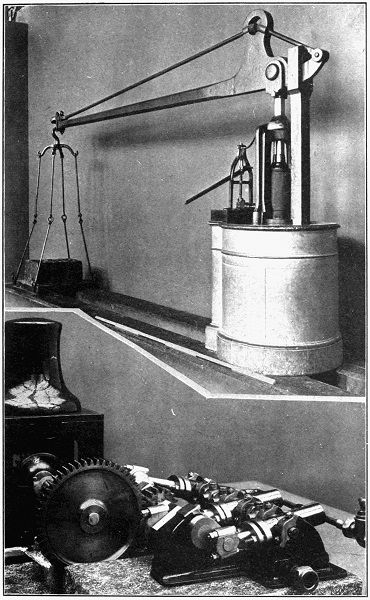
HYDRAULIC PRESS AND HYDRAULIC CAPSTAN.
The upper figure shows Bramah's original hydraulic pump and press, now preserved in the South Kensington Museum, London. The machine was constructed in 1796 by Joseph Bramah to demonstrate the principle of his hydraulic press. The discrepancy in size between the small lever worked by hand and the enormous lever carrying a heavy weight gives a vivid impression of the gain in power through the use of the apparatus. The lower figure shows the hydraulic capstan used on many modern ships, in which the same principle is utilized.
Moreover, it is possible to reverse the action of the hydraulic apparatus so as to gain motion at the expense of power. A familiar type of elevator is a case in point. The essential feature of the hydraulic elevator consists of a ram attached to the bottom of the elevator and extending down into a cylinder, slightly longer than the height to which the elevator is to rise. The ram is fitting into a cylinder with water-tight packing, or a cut leather valve. Water under high pressure is admitted to the cylinder through the valve at the bottom, and the pressure thus supplied pushes up the ram, carrying the elevator with it, of course. Another valve allows the water to escape, so that ram and elevator may descend, too rapid descent being prevented by the partial balancing of ram and elevator with weights acting over pulleys. The ram, to the end of which pressure is thus applied, need be but a few inches in diameter. Water pressure is secured by bringing water from an elevation. Such an elevator acts slowly, but is a very safe and in many ways satisfactory mechanism. Such elevators are still used extensively in Europe, but have been almost altogether displaced in America by the electric elevator.
The hydraulic elevator just described is virtually a water engine, the ram acting as piston. A veritable engine, of small size, to perform any species of mechanical work, may be constructed on precisely the same principle, the piston in this case acting in a cylinder similar to that of the ordinary steam engine. Such an engine operates slowly but with great power. It has special utility where it is desirable to apply power intermittently, as in various parts of a dockyard, or in handling guns and ammunition on shipboard. In the former case in particular, it is often inconvenient to use steam power, as steam sent from a central boiler condenses in a way to interfere with its operation. In such a case any number of small water-pressure engines may be operated from a single tank where water is at a high elevation, or where the requisite pressure is secured artificially. In the latter case, the water is kept under pressure by a large piston or ram heavily weighted, the entire receptacle being, of course, of water-tight construction and adapted to withstand pressure. The pump that supplies the tank is ordinarily made to work automatically, ceasing operation as soon as the ram rises to the top of the receptacle, and beginning again whenever, through use of water, the ram begins to descend. Such an apparatus is called an accumulator. Such water engines have come into vogue only in comparatively recent times, being suggested by the steam engine. As already pointed out, their utility is restricted, yet the total number of them in actual use to-day is large, and their share in the world's work is not altogether inconsiderable.