VI
Reading edition
VI
THE MASTER WORKER
We have already pointed out at some length that, in the hands of Watt, the steam engine came at once to be a relatively perfect apparatus, and that only three really important modifications have been applied to it since the day of its great perfecter. These modifications, as already named, are the doing away with the walking beam, the utilization of high pressure steam, and the development of the compound engine. Each of these developments requires a few words of explanation.
The retention of the heavy walking beam for so long a time after the steam engine of Watt had been applied to the various purposes of machinery, illustrates the power of a pre-conceived idea. With the Newcomen engine this beam was an essential, since it was necessary to have a weight to assist in raising the piston. But with the introduction of steam rather than air as the actual power to push the piston, and in particular with the elaboration of the double-chamber cylinder, with steam acting equally on either side of the piston, the necessity for retaining this cumbersome contrivance no longer existed. Yet we find all the engines made by Watt himself, and nearly all those of his contemporaries, continuing to utilize this means of transmitting the power of the piston. Even the road locomotive, as illustrated by that first wonderful one of Trevithick's and such colliery locomotives as "Puffing Billy" and "Locomotion," utilized the same plan. It was not until almost a generation later that it became clear to the mechanics that in many cases, indeed in most cases, this awkward means of transmitting power was really a needlessly wasteful one, and that with the aid of fly-wheel and crank-shaft the thrust of the piston might be directly applied to the wheel it was destined to turn, quite as well as through the intermediary channel of the additional lever.
The utility of the beam has, indeed, still commended it for certain purposes, notably for the propulsion of side-wheel steamers, such as the familiar American ferryboat. But aside from such exceptional uses, the beam has practically passed out of existence.
There was no new principle involved in effecting this change. It was merely another illustration of the familiar fact that it is difficult to do things simply. As a rule, inventors fumble for a long time with roundabout and complex ways of doing things, before a direct and simple method occurs to them. In other words, the highest development often passes from the complex to the simple, illustrating, as it were, an oscillation in the great law of evolution. So in this case, even so great an inventor as Watt failed to see the utility of doing away with the cumbersome structure which his own invention had made no longer a necessity, but rather a hindrance to the application of the steam engine. However, a new generation, no longer under the thraldom of the ideas of the great inventor, was enabled to make the change, gradually, but in the end effectively.
HIGH-PRESSURE STEAM
As regards the use of steam under high pressure, somewhat the same remarks apply, so far as concerns the conservatism of mankind, and the influence which a great mind exerts upon its generation. Just why Watt should have conceived an antagonism to the idea of high-pressure steam is not altogether clear. It has been suggested, indeed, that this might have been due to the fact that a predecessor of Watt had invented a high-pressure engine which did not use the principle of condensation, but exhausted the steam into open space. As early as 1725, indeed, Leupold in his Theatrum Machinarum, had described such a non-condensing engine, which, had it been made practically useful, would have required a high pressure of steam. Partly through the influence of this work, perhaps, there came to be an association between the words high pressure and non-condensing, so that these terms are considered to be virtually synonymous; and since Watt's great contribution consisted of an application of the idea of condensation, he was perhaps rendered antagonistic to the idea of high pressure, through this psychological suggestion. In any event, the antagonism unquestionably existed in his mind; though it has often enough been pointed out that this seems the more curious since high-pressure steam would so much better have facilitated the application of that other famous idea of Watt, the use of the expansive property of steam.
Curiously enough, however, the influence of Watt led to experiments in high-pressure steam through an indirect channel. The contemporary inventor, Trevithick, in connection with his partner, Bull, had made direct-acting pumping engines with an inverted cylinder, fixed in line with the pump rod, and actually dispensing with the beam. But as these engines used a jet of cold water in the exhaust pipe to condense the steam, Boulton and Watt brought suit successfully for infringement of their patent, and thus prevented Trevithick from experimenting further in that direction. He was obliged, therefore, to turn his attention to a different method, and probably, in part at least, in this way was led to introduce the non-condensing, relatively high-pressure engine. This was used about the year 1800. At the same time somewhat similar experiments were made by Oliver Evans in America.
Both Trevithick and Evans applied their engines to the propulsion of road vehicles; and Trevithick is credited with being the first man who ran a steam locomotive on a track,—a feat which he accomplished as early as the year 1804. We are not here concerned with the details of this accomplishment, which will demand our attention in a later chapter, when we come to discuss the entire subject of locomotive transportation. But it is interesting to recall that the possibilities of the steam engine were thus early realized, even though another generation elapsed before they were finally demonstrated to the satisfaction of the public. It is particularly interesting to note that in his first locomotive engine, Trevithick allowed the steam exhaust to escape into the funnel of the engine to increase the draught,—an expedient which was so largely responsible for Stephenson's success with his locomotive twenty years later, and which retains its utility in the case of the most highly developed modern locomotive.
Trevithick was, however, entirely subordinated by the great influence of Watt, and the use of high pressure was in consequence discountenanced by the leading mechanical engineers of England for some decades. Meantime, in America, the initiative of Evans led to a much earlier general use of high-pressure steam. In due course, however, the advantages of steam under high pressure became evident to engineers everywhere, and its conquest was finally complete.
The essential feature of super-heated steam is that it contains, as the name implies, an excess of heat beyond the quantity necessary to produce mere vaporization, and that the amount of water represented in this vapor is not the maximum possible under given conditions. In other words, the vapor is not saturated. It has been already explained that the amount of vapor that can be taken up in a given space under a given pressure varies with the temperature of the space. Under normal conditions, when a closed space exists above a liquid, evaporation occurs from the surface of the liquid until the space is saturated, and no further evaporation can occur so long as the temperature and pressure are unchanged. If now the same space is heated to a higher degree, more vapor will be taken up until again the point of saturation is attained. But, obviously, if the space were disconnected with the liquid, and then heated, it would acquire a capacity to take up more vapor, and so long as this capacity was latent, the vapor present would exist in a super-heated condition.
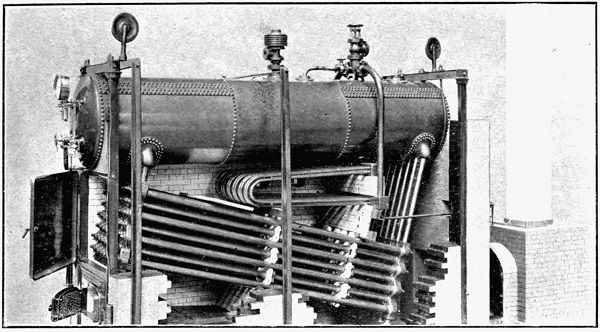
OLD IDEAS AND NEW APPLIED TO BOILER CONSTRUCTION.
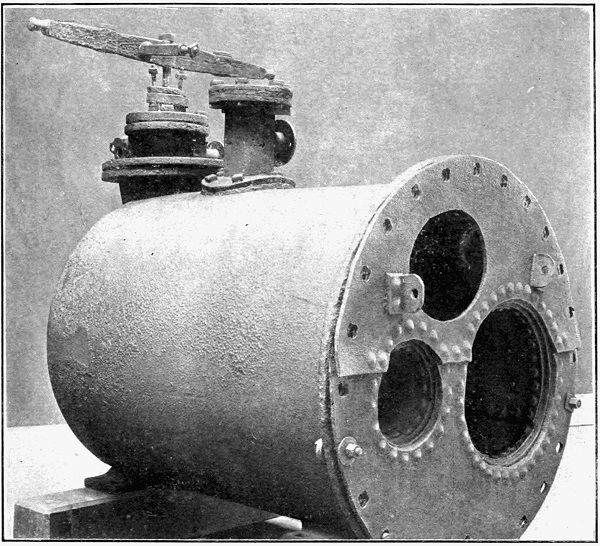
The lower figure shows Robert Trevithick's famous boiler, used in operating his locomotive about the year 1804. The original is preserved in the South Kensington Museum, London. The upper figure shows a modern tubular boiler, by way of contrast.
It will be understood from what has been said before, that with all accessions of heat, the expansive power of the vapor is increased,—its molecules becoming increasingly active; hence one of the very obvious advantages of super-heated steam for the purpose of pushing a piston. There are other advantages, however, which are not at first sight so apparent, having to do with the properties of condensation. To understand these, we must pay heed for a few moments to the changes that take place in steam itself in the course of its passage through the cylinder, where it performs its work upon the piston.
Many of these changes were not fully understood by the earlier experimenters, including Watt. Indeed the theory of the steam engine, or rather the general theory of the heat engine, was not worked out until the year 1824, when the Frenchman Carnot took the subject in hand, and performed a series of classical experiments, which led to a nearly complete theoretical exposition of the subject. It remained, however, for the students of thermo-dynamics, about the middle of the nineteenth century, with Clausius and Rankine at their head, to perfect the theory of the steam engine, and the general subject of the mutual relations of heat and mechanical work.
We are not here concerned with any elaboration of details, but merely with a few of the essential principles which enter practically into the operation of the steam engine. It appears, then, that when steam enters the cylinder and begins to thrust back the piston of the steam engine, a portion of the steam is immediately condensed on the walls of the cylinder, owing to the fact that previous condensation of steam has cooled these walls to a certain extent. We have already pointed out that Watt endeavored in his earlier experiments to overcome this difficulty, by equalizing the temperature of the cylinder walls to the greatest practicable extent.
Notwithstanding his efforts, however, and those of numberless later experimenters, it still remains true that under ordinary conditions, particularly if steam enters the cylinder at the saturation point, a very considerable condensation occurs. Indeed this may amount to from thirty to fifty per cent. of the entire bulk of water contained in the quantity of steam that enters the cylinder. This condensation obviously militates against the expansive or working power of the steam. But now as the steam expands, pushing forward the cylinder, it becomes correspondingly rarefied, and immediately a portion of the condensed steam becomes again vaporized, and in so doing it takes up a certain amount of heat and renders it latent. This disadvantageous cycle of molecular transformations is very much modified in the case of super-heated steam, for the obvious reason that such steam may be very much below the saturation point, and hence requires a very much greater lowering of temperature in order to produce condensation of any portion of its mass. Without elaborating details, it suffices to note that in all highly efficient modern engines, steam is employed at a relatively high pressure, and that sometimes this pressure becomes enormous.
COMPOUND ENGINES
As to the compound engine, that also, as has been pointed out, was invented by a contemporary of Watt, Jonathan Hornblower by name, whose patent bears date of 1781. In Hornblower's engine, steam was first admitted to a small cylinder, and then, after performing its work on the piston, was allowed to escape, not into a condensing receptacle, but into a larger cylinder where it performed further work upon another piston. This was obviously an instance of the use of steam expansively, and it has been pointed out that, in consequence, Hornblower was the first to make use of this idea in practise, although it is said that Watt's experiments had even at that time covered this field. The application of the idea to the movement of the second cylinder, however, appears to have been original with Hornblower. Certainly it owed nothing to Watt, who refused to accept the idea, and continued throughout his life to frown upon the compound engine.
Nevertheless, the device had great utility, as subsequent experiments were very fully to demonstrate. The compound engine was revived by Woolf in 1804, and his name rather than Hornblower's is commonly associated with it. The latter experimenter demonstrated that the compound engine has two important merits as against the simple engine. One of these is that the sum of the two forces exerted by the joint action results in a more even and continuous pressure throughout the cycle than could be accomplished by the action of a single cylinder.
To understand this it must be recalled that when using the expansive property of steam, the piston thrust could not possibly be uniform, since the greatest pressure exerted by the steam would be exerted at the moment before it was shut off from the boiler, and its pressure must then decrease progressively, as it exerts more and more work upon the piston and becomes more expanded, thus obviously retaining less elastic energy. The operation of the fly-wheel largely compensates this difference of pressure in practise, but it would be obviously advantageous could the pressure be equalized; and, as just stated, the compound engine tends to produce this result.
The second, and perhaps the more important merit of the compound engine is, that it is found in practise to keep the cylinders at a more uniform temperature. A moment's reflection makes it clear why this should be the case, since in a single-cylinder engine the exhaust connects with the cool condenser, whereas in the compound engine the exhaust from the first cylinder connects with the second cylinder at only slightly lower temperature.
In many modern engines a third cylinder and sometimes even a fourth is added, constituting what are called respectively triple-expansion and quadruple-expansion engines. The triple-expansion system is very generally employed, especially where it is peculiarly desirable to economize fuel, as, for example, in the case of ships.
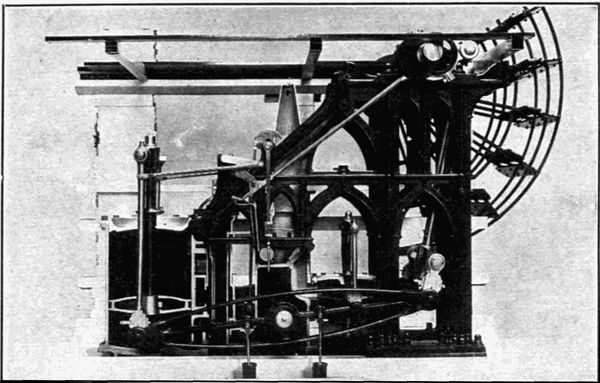
COMPOUND ENGINES.
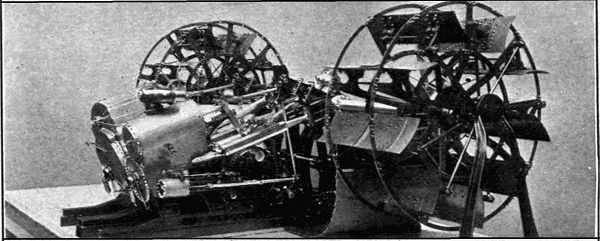
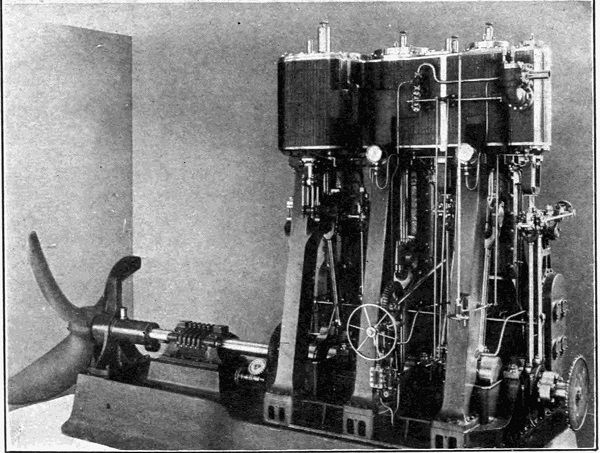
The lower figure illustrates the use of a modern compound engine, directly operating the propeller shaft of a steamship. The middle figure shows a similarly direct application of power to the axes of paddle wheels. The upper figure shows the application of power through a walking beam similar in principle to that of the original Newcomen and Watt engines.
ROTARY ENGINES
All these improvements, it will be observed, have to do with details that do not greatly modify the steam engine from the original type. The cylinder with its closely fitting piston, as introduced in the Newcomen engine, is retained and constitutes the essential mechanism through which the energy of steam is transferred into mechanical energy. But from a comparatively remote period the idea has prevailed that it might be possible to utilize a different principle; that, in short, if the steam instead of being made to press against a piston were allowed to rush against fan-like blades, adjusted to an axle, it might cause blades and axle to revolve, precisely as a windmill is made to revolve by the pressure of the wind, or the turbine wheel by the pressure of water.
In a word, it has been believed that a turbine engine might be constructed, which would utilize the energy of the steam as advantageously as it is utilized in the piston engine, and at the same time would communicate its power as a direct rotation, instead of as a straight thrust that must be translated into a rotary motion by means of a crank or other mechanism.
In point of fact, James Watt himself invented such an engine, and patented it in 1782, though there is no evidence that he ever constructed even a working model. His patent specifications show "a piston in the form of a closely-fitting radial arm, projecting from an axial shaft in a cylinder. An abutment, arranged as a flap is hinged near a recess in the side of the cylinder, and swings while remaining in contact with the piston. Steam is admitted to the chamber on one side of the flap, and so causes an unbalanced pressure upon the radial arm."
This arrangement has been re-invented several times. Essentially the same principle is utilized by Joshua Routledge, whose name is well known in connection with the engineer's slide-rule. A model of this engine is preserved in the South Kensington Museum, and the apparatus is described in the catalogue of the Museum as follows:
"The piston revolves on a shaft passing through the centre of the cylinder casing. The flap or valve hinged to the casing, with its free end resting upon the piston, acts like the bottom of an ordinary engine cylinder. The steam inlet port is on one side of the hinge, and the exhaust port on the other. The admission of steam is controlled by a side valve, actuated by an eccentric on the fly-wheel shaft, so that the engine could work expansively, and the steam pressure resisting the lifting of the flap would also be greatly reduced, so diminishing the knock at this point, which, however, would always be a serious cause of trouble. The exhaust steam passes down to a jet condenser, provided with a supply of water from a containing tank, from which the injection is admitted through a regulating valve. The air pump, which draws the air and water from the condenser and discharges them through a pipe passing out at the end of the tank, is a rotary machine constructed like the engine and driven by spur gearing from the fly-wheel shaft. Some efforts have been made to prevent leakage by forming grooves in the sides of the revolving piston and filling them with soft packing."
Sundry other rotary engines, some of them actual working models, are to be seen at the South Kensington Museum. There is, for example, one invented by the Rev. Patrick Bell, a gentleman otherwise known to fame as one of the earliest inventors of a practical reaping machine. In this apparatus, "A metal disc is secured to a horizontal axis carried in bearings, and the lower half of the disc is enclosed by a chamber of circular section having its axis a semi-circle. One end of this chamber is closed and provided with a pipe through which steam enters, the exhaust taking place through the open end. The disc is provided with three holes, each fitted with a circular plate turning on an axis radial to the disc, and these plates when set at right angles to the disc become pistons in the lower enclosing chamber. Toothed gearing is arranged to rotate these pistons into the plane of the disc on leaving the cylinder and back again immediately after entering, locking levers retaining them in position during the intervals. The steam pressure upon these pistons forces the disc round, but the engine is non-expansive, and although some provision for packing has been made, the leakage must have been considerable and the wear and tear excessive."
It is stated that almost the same arrangement was proposed by Lord Armstrong in 1838 as a water motor, and that a model subsequently constructed gave over five horse-power at thirty revolutions per minute, with an efficiency of ninety-five per cent.
Another working model of a rotary engine shown at the Museum is one loaned by Messrs. Fielding and Platt in 1888. "The action of this engine depends upon the oscillating motion which the cross of a universal joint has relative to the containing jaws when the system is rotated.
"Two shafts are set at an angle of 165 deg. to each other and connected by a Hooke's joint; one serves as a pivot, the power being taken from the other. Four curved pistons are arranged on the cross-piece, two pointing towards one shaft and two towards the other, and on each shaft or jaw are formed two curved steam cylinders in which the curved pistons work. The steam enters and leaves the base of each cylinder through ports in the shaft, which forms a cylindrical valve working in the bearing as a seating.
"On the revolution of the shafts the pistons reciprocate in their cylinders in much the same way as in an ordinary engine, and the valve arrangement is such that while each piston is receding from its cylinder the steam pressure is driving it, and during the in-stroke of each, its cylinder is in communication with the exhaust. There are thus four single-acting cylinders making each a double stroke for one revolution of the driving-shaft. The engine has no dead centres, and has been at 1,000 revolutions per minute."
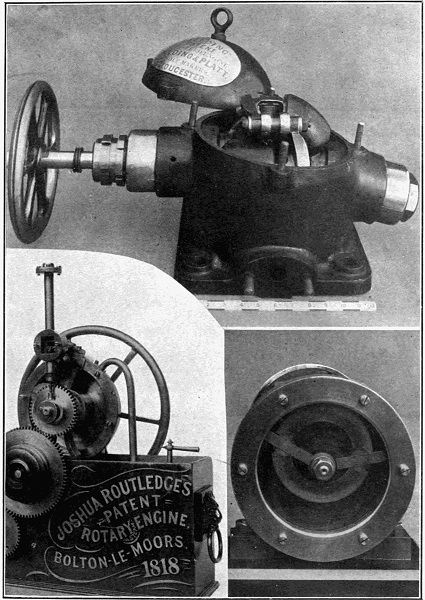
ROTARY ENGINES.
The three types of rotary engines here shown are similar in principle, and none of them is of great practical value, though the upper figure shows an engine that has met with a certain measure of commercial success.
It is not necessary to describe other of the rotary engines that have been made along more or less similar lines by numerous inventors, models of which are for the most part, as in the case of those just described, to be seen more commonly in museums than in practical workshops. Reference may be made, however, to a rotary engine which was invented by a Mr. Hoffman, of Buffalo, New York, about the beginning of the twentieth century, an example of which was put into actual operation in running the machinery of a shop in Buffalo, in 1905.
This engine consists of a solid elliptical shaft of steel, fastened to an axle at one side of its centre, which axis is also the shaft of the cylinder, which revolves about the central ellipse in such a way that at one part of the revolution the cylinder surface fits tightly against the ellipse, while the opposite side of the cylinder supplies a free chamber between the ellipse and the cylinder walls. Running the length of the cylinder are two curved pieces of steel, like longitudinal sections of a tube. These flanges are adjusted at opposite sides of the cylinder and so arranged that their sides at all times press against the ellipse, alternately retreating into the substance of the cylinder, and coming out into the free chamber. Steam is admitted to the free chamber through one end of the shaft of ellipse and cylinder and exhausted through the other end. The pressure of the steam against first one end and then the other of the flanges supplies the motive power. This pressure acts always in one direction, and the entire apparatus revolves, the cylinder, however, revolving more rapidly than the central ellipse.
For this engine the extravagant claim is made that there is no limit to its speed of revolution, within the limit of resistance of steel to centrifugal force. It has been estimated that a locomotive might be made to run two hundred or three hundred miles an hour without difficulty, with the Hoffman engine. Such estimates, however, are theoretical, and it remains to be seen what the engine can do in practise when applied to a variety of tasks, and what are its limitations. Certainly the apparatus is at once ingenious and simple in principle, and there is no obvious theoretical reason why it should not have an important future.
TURBINE ENGINES
Whatever the future may hold, however, it remains true that the first practical solution of the problem of securing direct rotary motion from the action of steam, on a really commercial scale, was solved with an apparatus very different from any of those just described, the inventor being an Englishman, Mr. C. A. Parsons, and the apparatus the steam turbine, the first model of which he constructed in 1884, and which began to attract general attention in the course of the ensuing decade. Public interest was fully aroused in 1897, when Mr. Parson's boat, the Turbinia, equipped with engines of this type, showed a trial speed of 32-3/4 knots per hour, a speed never hitherto attained by any other species of water craft. More recently, a torpedo boat, the Viper, equipped with engines developing about ten thousand horse-power, attained a speed of 35-1/2 knots. The success of these small boats led to the equipment of large vessels with the turbine, and on April first, 1905, the first transatlantic liner propelled by this form of engine steamed into the harbor of Halifax, Nova Scotia.
This first ocean liner equipped with the turbine engine is called the Victorian. She is a ship five hundred and forty feet long and sixty feet wide, carrying fifteen hundred passengers. The Victorian had shown a speed of 19-1/2 knots an hour on her trial trip, and it had been hoped that she would break the transatlantic record. On her first trip, however, she encountered adverse winds and seas, and did not attain great speed. Her performance was, however, considered entirely satisfactory and creditable.
In the ensuing half-decade several large ships were equipped with engines of the same type, the most famous of these being the Cunard liners, Carmania, Lusitania, and Mauretania. The two last-named ships are sister craft, and they are the largest boats of any kind hitherto constructed. The Lusitania was first launched and she entered immediately upon a record-breaking career, only to be surpassed within a few months by the Mauretania, which soon acquired all records for speed and endurance.
Fuller details as to the performance of these vessels will be found in another place. Here we are of course concerned with the Parsons turbine engine itself rather than with its applications.
This turbine engine constitutes the first really important departure from the old-type steam engine, thus realizing the dream of the seventeenth-century Italian, Branca, to which reference was made above. Mr. Parsons' elaboration of the idea developed a good deal of complexity as regards the number of parts involved, yet his engine is of the utmost simplicity in principle. It consists of a large number of series of small blades, each series arranged about a drum which revolves. Between the rings of revolving blades are adjusted corresponding rings of fixed blades, which project from the casing to the cylinder, and by means of which the steam is regulated in direction, so that it strikes at the proper angle against the revolving blades of the turbine.
In practise, three series of cylindrical drums are used, each containing a large number of rings of blades of uniform size; but each successive drum having longer blades, to accommodate the greater volume of the expanding steam. The steam is fed against the first series of blades in gusts, which may be varied in frequency and length to meet the requirements of speed. After impinging on the first circle of blades, the steam passes to the next under slightly reduced pressure, and the pressure is thus successively stepped down from one set of blades to another until it is ultimately reduced from say two hundred pounds to the square inch, to one pound to the square inch before it passes to the condenser and ceases to act.
There is thus a fuller utilization of the kinetic energy of the gas, through carrying it from high to low pressure, than is possible with the old type of cylinder-and-piston engine. On the other hand, there is a constant loss due to the fact that the blades of the turbine can not fit with absolute tightness against the cylinder walls. The net result is that the compound turbine, as at present developed, appears to have about the same efficiency as the best engine of the old type.
One capital advantage of the turbine is that it keeps the cylinder walls at a more uniform temperature than is possible even with a compound engine of the old type. Another advantage is that the power of the turbine is applied directly to cause rotation of the shaft, whereas no satisfactory means has ever been discovered hitherto of making the action of the steam engine rotary, except with the somewhat disadvantageous crank-shaft. This fact of adjustment of the turbine blades to the revolving shaft seems to make this form of engine particularly adapted to use in steamships. It is also highly adapted to revolving the shaft of a dynamo, and has been largely applied to this use. Needless to say, however, it may be applied to any other form of machinery. It would be difficult at the present stage of its development to predict the extent to which the turbine will ultimately supersede the old type of engine. Its progress has already been extraordinary, however, as an engineer pointed out in the London Times of August 14, 1907, in the following words:
"When the steam turbine was introduced by Mr. Parsons some 25 years ago, in the form of a little model, which is now in the South Kensington Museum, and the rotor of which may easily be held stationary by the hand against the full blast of the steam, who would have been rash enough to predict, except perhaps the far-seeing inventor himself, that a vessel 760 feet long, loaded to 37,000 tons displacement, drawing 32 ft. 9 in. of water, and providing accommodation for 2,500 people, could be propelled at a speed of 24.5 knots per hour, which it is hoped she may maintain over the 3,000 miles of the Atlantic voyage?
"From this small model, which will in time become as historic as the Rocket of Stephenson, and which is only some few inches in diameter, the turbine has been developed gradually in size. The cylindrical casings which take the place of the complicated machinery of the piston engine in the engine room of the Lusitania contain drums, which in the high-pressure turbines are 8 feet in diameter and in the low-pressure 11 ft. 8 in., and from which thousands of curved blades project, the longest of which are 22 inches, and against which the steam impinges in its course from the boiler to the condenser.
"Not only has the steam turbine justified the confidence of those who have labored so successfully in its development, but no other great invention has proceeded from the laboratory stage to such an important position in the engineering world in such a short space of time. This would not have happened if some inherent drawback, such as lack of economy in steam consumption, existed, and as the turbine has been proved to be, for land purposes, very economical, there seems to be no reason to doubt that marine turbines, working as they do at full load almost continually, will show likewise that the coal bill is not increased, but perhaps diminished by their use.
"The records of the vibrations of the hull which were taken during the trials by Schlick's instruments showed that the vertical vibration was 60 per minute on the run, which was due to the propellers, and which may be further modified. The horizontal vibration was almost unnoticeable, while the behavior of the ship in the heavy seas she encountered in her long-distance runs was good, the roll from side to side having a period of 18 seconds. The great length of this ship and the gyrostatic action of the heavy rotating masses of the machinery ought to render her almost insensible to the heaviest Atlantic rollers; certainly as far as pitching is concerned."
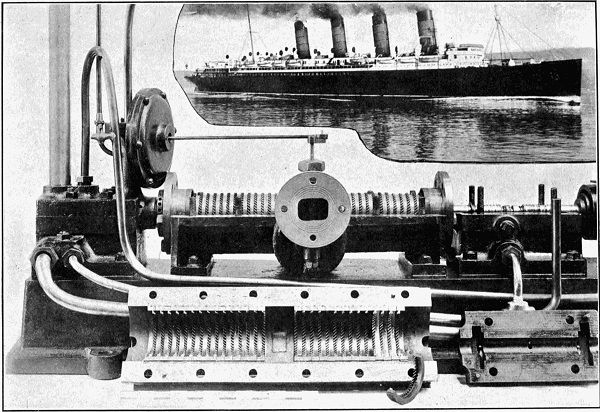
THE ORIGINAL PARSON'S TURBINE ENGINE AND THE RECORD-BREAKING SHIP FOR WHICH IT IS RESPONSIBLE.
This small turbine engine, with which Mr. Parson's early experiments were made in 1884, is preserved in the South Kensington Museum, London. At the time when it was made it seemed scarcely more than a toy, and engineers in general doubted that the principle it employed could ever be made commercially available. Yet within the lifetime of its inventor engines built on this model have come to be the most powerful of force transmuters. The "Mauretania," the largest, and thanks to her turbine engines the speediest, of ships, is here presented on the same page with the little original turbine model, as illustrating vividly the practical development of a seemingly visionary idea.
A more general comment upon the turbine engine, with particular reference to its use in America, is made by Mr. Edward H. Sanborn in an article on Motive Power Appliances, in the Twelfth Census Report of the United States, Vol. X. part IV.
"Apart from its demonstrated economy," says Mr. Sanborn, "other important advantages are claimed for the steam turbine, some of which are worthy of brief mention.
"There is an obvious advantage in economy of space as compared with the reciprocating engine. The largest steam turbine constructed in the United States is one of 3,000 horse-power, which is installed in the power house of the Hartford Electric Light Company, Hartford, Conn. The total weight of this motor is 28,000 pounds, its length over all is 19 feet 8 inches, and its greatest diameter six feet. With the generator to which it is directly connected, it occupies a floor space of 33 feet 3 inches long by 8 feet 9 inches wide.
"Friction is reduced to a minimum in the steam turbine, owing to the absence of sliding parts and the small number of bearings. The absence of internal lubrication is also an important consideration, especially when it is desired to use condensers.
"As there are no reciprocating parts in a steam turbine, and as a perfect balance of its rotating parts is absolutely essential to its successful operation, vibration is reduced to such a small element that the simplest foundations will suffice, and it is safe to locate steam turbines on upper floors of a factory if this be desirable or necessary.
"The perfect balance of the moving parts and the extreme simplicity of construction tend to minimize the wear and increase the life of a turbine, and at the same time to reduce the chance of interruption in its operation through derangement of, or damage to, any of its essential parts.
"Although hardly beyond the stage of its first advent in the motive-power field, the steam turbine has met with much favor, and there is promise of its wide use for the purposes to which it is particularly adapted. At present, however, its uses are restricted to service that is continuous and regular, its particular adaptability being for the driving of electrical generators, pumps, ventilating fans, and similar work, especially where starting under load is not essential.
"Steam turbines are now being built in the United States in all sizes up to 3,000 horse-power. Their use abroad covers a longer period and has become more general. The largest turbines thus far attempted are those of the Metropolitan District Electric Traction Company, of London, embracing four units of 10,000 horse-power each. Several turbines of large size have been operated successfully in Germany."
It should be added that the compound turbine wheel of Parsons is not the only turbine wheel that has proved commercially valuable. There is a turbine consisting of a single ring of revolving blades, the invention of Dr. Gustav De Laval, which has proved itself capable of competing with the old type of engine. To make this form of single turbine operate satisfactorily, it is necessary to have steam under high pressure, and to generate a very high speed of revolution. In practice, the De Laval machines sometimes attain a speed of thirty thousand revolutions per minute. This is a much higher rate of speed than can advantageously be utilized directly in ordinary machinery, and consequently the shaft of this machine is geared to another shaft in such a way as to cause the second shaft to revolve much more slowly.