V
Reading edition
V
CAPTIVE MOLECULES: THE STORY OF THE STEAM ENGINE
We come now to that all-important transformer of power, the steam engine. Everybody knows that steam is a state of water in which, under the influence of heat, the molecules have broken away from the mutual attraction of cohesion, and are flying about at inconceivable speed, rebounding from one another after collision, in virtue of their elasticity, exerting in the aggregate an enormous pressure in every direction. It is this consideration of the intimate character of steam that justifies the title of the present chapter; a title that has further utility as drawing a contrast between the manner of working with which we are now to be concerned, and the various types of workers that we have previously considered.
In speaking of the animal machine and of work accomplished by the air and the water, we have been concerned primarily with masses of matter, possessing and transmitting energy. Of course molecules—since they make up the substance of all matter—could not be altogether ignored, but in the main we have had to do with molar rather than with molecular motion. Now, however, we are concerned with a mechanism in which the molecular activities are directly concerned in performing work.
Even in the aggregate the molecules make up a mere intangible gas, which requires to be closely confined in order that its energy may be made available. Once the molecules have performed their work, they are so changed in their activities that they sink back, as it were, exhausted, into a relatively quiescent state, which enables their latent cohesive forces to reduce them again to the state of a liquid. In a word, we are concerned with the manifestation of energy which depends upon molecular activities in a way quite different from what has been the case with any of the previously considered mechanisms. The tangible manifestation of energy which we term heat is not merely a condition of action and a by-product, as it was in the case of the animal machine; it is the essential factor upon which all the efficiency of the mechanism depends.
It should perhaps be stated that this explanation of the action of the steam engine is a comparatively modern scientific interpretation. The earlier experimenters brought the steam engine to a high state of efficiency, without having any such conception as this of the nature of steam itself. For practical purposes it suffices to note that water when heated takes the form of steam; that this steam has the property of powerful and indefinite expansion; and thirdly, that when allowed to escape from a state of pressure, sudden expansion of the steam cools it sufficiently to cause the recondensation of part of its substance, thus creating a vacuum.
Stated in few words, the entire action of the steam depends upon these simple mechanical principles. The principles are practically applied by permitting the steam to enter the cylinder where it can act on a piston, to which it gives the thrust that is transmitted to an external mechanism by means of a rod attached to the piston. When the piston has been driven to the end of the desired thrust, the valve is opened automatically, permitting the steam to escape, thus producing a vacuum, and insuring the return thrust of the piston, which is further facilitated, ordinarily, by the admission of steam to the other side of the piston. Practical operation of this mechanism is familiar to everyone, though the marvel of its power and efficiency seems none the less because of its familiarity.
It is not too much to say that this relatively simple device, in its first general application, marked one of the most important turning points in the history of civilization. To its influence, more than to any other single cause, must be ascribed the revolutionary change that came over the character of practical life in the nineteenth century. From prehistoric times till well toward the close of the eighteenth century, there was scarcely any important change in carrying out the world's work. And in the few generations that have since elapsed, the entire aspect of the mechanical world has been changed, the working efficiency of the individual has been largely increased; mechanical tasks have become easy which hitherto were scarcely within the range of human capacity.
Before we go on to the detailed study of the machine which has produced these remarkable results, it is desirable to make inquiry as to the historical development of so important an invention.
The practical steam engine in its modern form dates, as just mentioned, from the latter part of the eighteenth century, and was perfected by James Watt, who is commonly thought of as being its inventor. In point of fact, however, the history of most inventions is duplicated here, as on examination it appears that various forerunners of Watt had been on the track of the steam engine, and some of them, indeed, had produced a workable machine of no small degree of efficiency.
The very earliest experiments were made away back in the Alexandrian days in the second century before the Christian era, the experimenter being the famous Hero, whose work in an allied field was referred to in the preceding chapter. Hero produced—or at least described and so is credited with producing, though the actual inventor may have been Ctesibius—a little toy mechanism, in which a hollow ball was made to revolve on an axis through the agency of steam, which escaped from two bent tubes placed on opposite sides of the ball, their orifices pointing in opposite directions. The apparatus had no practical utility, but it sufficed to establish the principle that heat, acting through the agency of steam, could be made to do mechanical work. Had not the age of Hero been a time of mental stasis, it is highly probable that the principle he had thus demonstrated would have been applied to some more practical mechanism in succeeding generations. As it was, however, nothing practical came of his experiment, and the steam turbine engine was remembered only as a scientific toy.
No other worker continued the experiments, so far as is known, until the time of the great Italian, Leonardo da Vinci, who, late in the fifteenth century, gave a new impulse to mechanical invention. Leonardo experimented with steam, and succeeded in producing what was virtually an explosion engine, by the agency of which a ball was propelled along the earth. But this experiment also failed to have practical result.
BEGINNINGS OF MODERN DISCOVERY
Such sporadic experiments as these have no sequential connection with the story of the evolution of the steam engine. The experiments which led directly on to practical achievements were not begun until the seventeenth century. In the very first year of that century, an Italian named Giovanni Battista della Porta published a treatise on pneumatics, in which the idea of utilizing steam for the practical purpose of raising water was expressly stated. The idea of this inventor was put into effect in 1624 by a French engineer and mathematician, Solomon de Caus. He invented two different machines, the first of which required a spherical boiler having an internal tube reaching nearly to the bottom; a fire beneath the boiler produced steam which would force the water in the boiler to a height proportional to the pressure obtained. In the other machine, steam is led from the boiler into the upper part of a closed cistern containing water to be elevated. To the lower portion of the cistern a delivery pipe was attached so that water was discharged under a considerable pressure. This arrangement was precisely similar to the apparatus employed by Hero of Alexandria in various of his fountains, as regards the principle of expanding gas to propel water. An important difference, however, consists in the fact that the scheme of della Porta and of de Caus embodied the idea of generating pressure with the aid of steam, whereas Hero had depended merely on the expansive property of air compressed by the water itself.
While these mechanisms contained the germ of an idea of vast importance, the mechanisms themselves were of trivial utility. It is not even clear whether their projectors had an idea of the properties of the condensation of vapor, upon which the working of the practical steam engine so largely depends. This idea, however, was probably grasped about half a century later by an Englishman, Edward Somerset, the celebrated Marquis of Worcester, who in 1663 described in his Century of Inventions an apparatus for raising water by the expansive force of steam. His own account of his invention is as follows:
"An admirable and most forcible way to drive up water by fire; not by drawing or sucking it upwards, for that must be as the philosopher calleth it, intra sphæram activitatis, which is but at such a distance. But this way hath no bounder, if the vessel be strong enough: for I have taken a piece of whole cannon, whereof the end was burst, and filled it three-quarters full of water, stopping and screwing up the broken end, as also the touch-hole; and making a constant fire under it, within twenty-four hours it burst and made a great crack; so that having a way to make my vessels so that they are strengthened by the force within them, and the one to fill after the other, I have seen the water run like a constant stream, forty feet high: one vessel of water, rarefied by fire, driveth up forty of cold water; and the man that tends the work is but to turn two cocks, that one vessel of water being consumed, another begins to force and refill with cold water, and so successively; the fire being tended and kept constant, which the self-same person may likewise abundantly perform in the interim, between the necessity of turning the said cocks."
It is unfortunate that the Marquis did not give a more elaborate description of this remarkable contrivance. The fact that he treats it so casually is sufficient evidence that he had no conception of the possibilities of the mechanism; but, on the other hand, his description suffices to prove that he had gained a clear notion of, and had experimentally demonstrated, the tremendous power of expansion that resides in steam. No example of his steam pump has been preserved, and historians of the subject have been left in doubt as to some details of its construction, and in particular as to whether it utilized the principle of a vacuum created through condensation of the steam.
THOMAS SAVERY'S STEAM PUMP
This principle was clearly grasped, however, by another Englishman, Thomas Savery, a Cornish mine captain, who in 1698 secured a patent for a steam engine to be applied to the raising of water, etc. A working model of this machine was produced before the Royal Society in 1699. The transactions of the Society contain the following: "June 14th, 1699, Mr. Savery entertained the Royal Society with showing a small model of his engine for raising water by help of fire, which he set to work before them: the experiment succeeded according to expectation, and to their satisfaction."
The following very clear description of Savery's engine is given in the introduction to Beckmann's History of Inventions:
"This engine, which was used for some time to a considerable extent for raising water from mines, consisted of a strong iron vessel shaped like an egg, with a tube or pipe at the bottom, which descended to the place from which the water was to be drawn, and another at the top, which ascended to the place to which it was to be elevated. This oval vessel was filled with steam supplied from a boiler, by which the atmospheric air was first blown out of it. When the air was thus expelled and nothing but pure steam left in the vessel, the communication with the boiler was cut off, and cold water poured on the external surface. The steam within was thus condensed and a vacuum produced, and the water drawn up from below in the usual way by suction. The oval vessel was thus filled with water; a cock placed at the bottom of the lower pipe was then closed, and steam was introduced from the boiler into the oval vessel above the surface of the water. This steam being of high pressure, forced the water up the ascending tube, from the top of which it was discharged, and the oval vessel being thus refilled with steam, the vacuum was again produced by condensation, and the same process was repeated. By using two oval steam vessels, which would act alternately—one drawing water from below, while the other was forcing it upwards, an uninterrupted discharge of water was produced. Owing to the danger of explosion, from the high pressure of the steam which was used, and from the enormous waste of heat by unnecessary condensation, these engines soon fell into disuse."
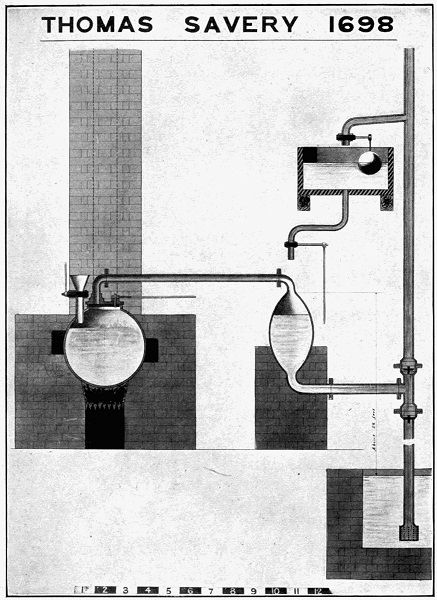
THOMAS SAVERY'S STEAM ENGINE.
The principle involved is that of the expansion of steam exerting a propulsive force and its subsequent condensation to produce a vacuum. These are the principles employed in the modern steam engine, but the only use to which they were put in Savery's engine was the elevation of water by suction.
This description makes it obvious that Savery had the clearest conception of the production of a vacuum by the condensation of steam, and of the utilization of the suction thus established (which suction, as we know, is really due to the pressure of outside air) to accomplish useful work. Savery also arranged this apparatus in duplicate, so that one vessel was filling with water while the other was forcing water to the delivery pipe. This is credited with being the first useful apparatus for raising water by the combustion of fuel. There was a great waste of steam, through imparting heat to the water, but the feasibility of the all-important principle of accomplishing mechanical labor with the aid of heat was at last demonstrated.
As yet, however, the experimenters were not on the track of the method by which power could be advantageously transferred to outside machinery. An effort in quite another direction to accomplish this had been made as early as 1629 by Giovanni Branca, an Italian mathematician, who had proposed to obtain rotary motion by allowing a jet of steam to blow against the vanes of a fan wheel, capable of turning on an axis. In other words, he endeavored to utilize the principle of the windmill, the steam taking the place of moving air. The idea is of course perfectly feasible, being indeed virtually that which is employed in the modern steam turbine; but to put the idea into practise requires special detailed arrangements of steam jet and vanes, which it is not strange the early inventor failed to discover. His experiments appear not to have been followed up by any immediate successor, and nothing practical came of them, nor was the principle which he had attempted to utilize made available until long after a form of steam engine utilizing another principle for the transmission of power had been perfected.
DENIS PAPIN INVENTS THE PISTON ENGINE
The principle in question was that of causing expanding steam to press against a piston working tightly in a cylinder, a principle, in short, with which everyone is familiar nowadays through its utilization in the ordinary steam engine. The idea of making use of such a piston appears to have originated with a Frenchman, Denis Papin, a scientific worker, who, being banished from his own country, was established as professor of mathematics at the University of Marburg. He conceived the important idea of transmitting power by means of a piston as early as 1688, and about two years later added the idea of producing a vacuum in a cylinder, by cooling the cylinder,—the latter idea being, as we have just seen, the one which Savery put into effect.
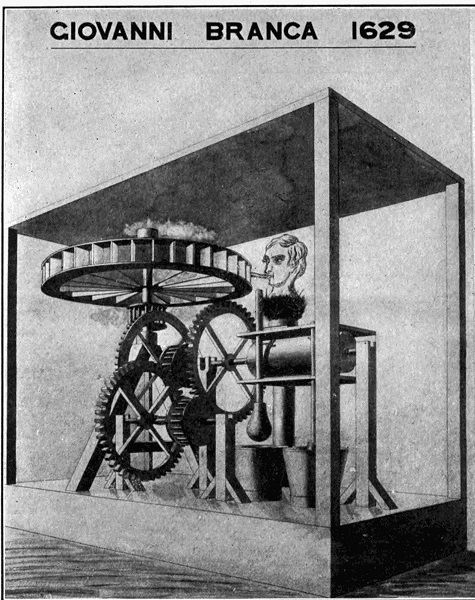
DIAGRAMS OF EARLY ATTEMPTS TO UTILIZE THE POWER OF STEAM.
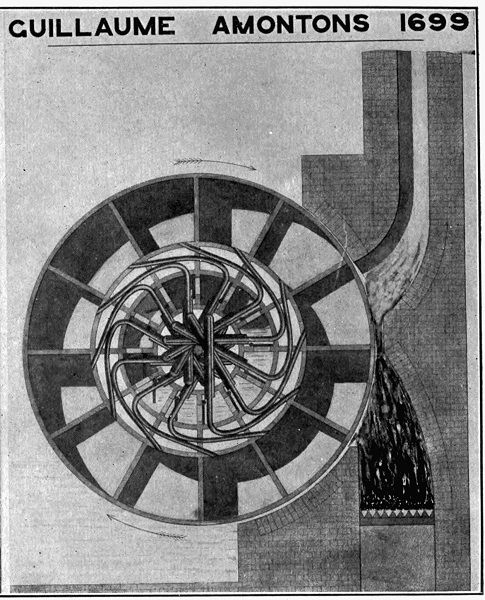
Two attempts to give rotation to a mechanical apparatus through the action of heated air or steam. Nothing practical came of either effort, but the mechanisms depicted are of historical interest.
It will be noted that Papin's invention antedated that of Savery; to the Frenchman, therefore, must be given the credit of hitting upon two important principles which made feasible the modern steam engine. Papin constructed a model consisting of a small cylinder in which a solid piston worked. In the cylinder beneath the piston was placed a small quantity of water, which, when the cylinder was heated, was turned into steam, the elastic force of which raised the piston. The cylinder was then cooled by removing the fire, when the steam condensed, thus creating a vacuum in the cylinder, into which the piston was forced by the pressure of the atmosphere.
Such an apparatus seems crude enough, yet it incorporates the essential principles, and required but the use of ingenuity in elaborating details of the mechanism, to make a really efficient steam engine. It would appear, however, that Papin was chiefly interested in the theoretical, rather than in the really practical side of the question, and there is no evidence of his having produced a working machine of practical power, until after such machines worked by steam had been constructed elsewhere.
THOMAS NEWCOMEN'S IMPROVED ENGINE
As has happened so often in other fields, Englishmen were the first to make practical use of the new ideas. In 1705 Thomas Newcomen, a blacksmith or ironmonger, and John Cawley, a plumber and glazier, patented their atmospheric engine, and five years later, in the year 1710, namely, Newcomen had on the market an engine which is described in the Report of the Department of Science and Arts of the South Kensington Museum, as "the first real pumping engine ever made."
The same report describes the engine as "a vertical steam cylinder provided with a piston connected at one end of the beam, having a pivot or bearing in the middle of its length, and at the other end of the beam pump rods for working the pump. The cylinder was surrounded by a second cylinder or jacket, open at the top, and cold water could be supplied to this outer cylinder at pleasure. The single or working cylinder could be supplied with steam when desired from a boiler below it. There was a drain pipe from the bottom of the working cylinder, and one from the outer cylinder. For the working of the engine steam was admitted to the working cylinder, so as to fill it and expel all the air, the piston then being at the top, owing to the weight of the pump rods being sufficient to lift it; then the steam was shut off and the drain cocks closed and cold water admitted to the outer cylinder, so that the steam in the working cylinder condensed, and, leaving a partial vacuum of pressure of the atmosphere, forced the piston down and drew up the pump rods, thus making a stroke of the pump. Then the water was drawn off from the outer cylinder and steam admitted to the working cylinder before allowing the piston to return to the top of its stroke, ready for the next down stroke."
It will be observed that this machine adopts the principle, with only a change of mechanical details, of the Papin engine just described. A later improvement made by Newcomen did away with the outer cylinder for condensing the steam, employing instead an injection of cold water into the working cylinder itself, thus enabling the engine to work more quickly. It is said that the superiority of the internal condensing arrangement was accidentally discovered through the improved working of an engine that chanced to have an exceptionally leaky piston or cylinder. Many engines were made on this plan and put into practical use.
Another important improvement was made by a connection from the beam to the cocks or valves, so that the engine worked automatically, whereas in the first place it had been necessary to have a boy or man operate the valves,—a most awkward arrangement, in the light of modern improvements. As the story is told, the duty of opening and closing the regulating and condensing valves was intrusted to boys called cock boys. It is said that one of these boys named Humphrey Potter "wishing to join his comrades at play without exposing himself to the consequences of suspending the performance of the engine, contrived, by attaching strings of proper length to the levers which governed the two cocks, to connect them with the beam, so that it should open and close the cocks as it moved up and down with the most perfect regularity."
This story has passed current for almost two centuries, and it has been used to point many a useful moral. It seems almost a pity to disturb so interesting a tradition, yet it must have occurred to more than one iconoclast that the tale is almost too good to be true. And somewhat recently it has been more than hinted that Desaguliers, with whom the story originated, drew upon his imagination for it. A print is in existence, made so long ago as 1719, representing an engine erected by Newcomen at Dudley Castle, Staffordshire, in 1712, in which an automatic valve gear is clearly shown, proving that the Newcomen engine was worked automatically at this early period. That the admirable story of the inventive youth, whose wits gave him leisure for play, may not be altogether discredited, however, it should be added that unquestionably some of the early engines had a hand-moved gear, and that at least one such was still working in England after the middle of the nineteenth century. It seems probable, then, that the very first engines were without the automatic valve gear, and there is no inherent reason why a quick-witted youth may not have been the first to discover and remedy the defect.
According to the Report of the Department of Science and Arts of the South Kensington Museum: "The adoption of Newcomen's engine was rapid, for, commencing in 1711 with the engine at Wolverhampton, of twenty-three inch diameter and six foot stroke, they were in common use in English collieries in 1725; and Smeaton found in 1767 that, in the neighborhood of Newcastle alone there were fifty-seven at work, ranging in size from twenty-eight inch to seventy-five inch cylinder diameter, and giving collectively about twelve hundred horse-power. As Newcomen obtained an evaporation of nearly eight pounds of water per pound of coal, the increase of boiler efficiency since his time has necessarily been but slight, although in other requisites of the steam generator great improvements are noticeable."
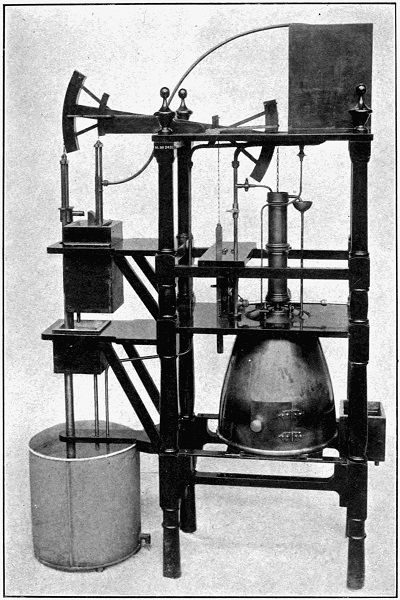
A MODEL OF THE NEWCOMEN ENGINE.
This engine has particular interest not only because it was a practical pumping engine, but also because it was while repairing an engine of this type that Watt was led to the experiments that resulted in his epoch-making discovery.
THE COMING OF JAMES WATT
The Newcomen engine had low working efficiency as compared with the modern engine; nevertheless, some of these engines are still used in a few collieries where waste coal is available, the pressure enabling the steam to be generated in boilers unsafe for other purposes. The great importance of the Newcomen engine, however, is historical; for it was while engaged in repairing a model of one of these engines that James Watt was led to invent his plan of condensing the steam, not in the working cylinder itself, but in a separate vessel,—the principle upon which such vast improvements in the steam engine were to depend.
It is impossible to overestimate the importance of the work which Watt accomplished in developing the steam engine. Fully to appreciate it, we must understand that up to this time the steam engine had a very limited sphere of usefulness. The Newcomen engine represented the most developed form, as we have seen; and this, like the others that it had so largely superseded, was employed solely for the pumping of water. In the main, its use was confined to mines, which were often rendered unworkable because of flooding. We have already seen that a considerable number of engines were in use, yet their power in the aggregate added but a trifle to man's working efficiency, and the work that they did accomplish was done in a most uneconomical manner. Indeed the amount of fuel required was so great as to prohibit their use in many mines, which would have been valuable could a cheaper means have been found of freeing them from water. Watt's inventions, as we shall see, accomplished this end, as well as various others that were not anticipated.
It was through consideration of the wasteful manner of action of the steam engine that Watt was led to give attention to the subject. The great inventor was a young man at the University of Glasgow. He had previously served an apprenticeship of one year with a maker of philosophical instruments in London, but ill health had prevented him from finishing his apprenticeship, and he had therefore been prohibited from practising his would-be profession in Glasgow. Finally, however, he had been permitted to work under the auspices of the University; and in due course, as a part of his official duties, he was engaged in repairing a model of the Newcomen engine. This incident is usually mentioned as having determined the line of Watt's future activity.
It should be recalled, however, that Watt had become a personal friend of the celebrated Professor Black, the discoverer of latent heat, and the foremost authority in the world, in this period, on the study of pneumatics. Just what share Black had in developing Watt's idea, or in directing his studies toward the expansive properties of steam, it would perhaps be difficult to say. It is known, however, that the subject was often under discussion; and the interest evinced in it by Black is shown by the fact that he subsequently wrote a history of Watt's inventions.
It is never possible, perhaps, for even the inventor himself to re-live the history of the growth of an idea in his own mind. Much less is it possible for him to say precisely what share of his progress has been due to chance suggestions of others. But it is interesting, at least, to recall this association of Watt with the greatest experimenter of his age in a closely allied field. Questions of suggestion aside, it illustrates the technical quality of Watt's mind, making it obvious that he was no mere ingenious mechanic, who stumbled upon his invention. He was, in point of fact, a carefully trained scientific experimenter, fully equipped with all the special knowledge of his time in its application to the particular branch of pneumatics to which he gave attention.
The first and most obvious defect in the Newcomen engine was, as Watt discovered, that the alternating cooling and heating of the cylinder resulted in an unavoidable waste of energy. The apparatus worked, it will be recalled, by the introduction of steam into a vertical cylinder beneath the piston, the cylinder being open above the piston to admit the air. The piston rod connected with a beam suspended in the middle, which operated the pump, and which was weighted at one end in order to facilitate the raising of the piston. The steam, introduced under low pressure, scarcely more than counteracted the pressure of the air, the raising of the piston being largely accomplished by the weight in question.
Of course the introduction of the steam heated the cylinder. In order to condense the steam and produce a vacuum, water was injected, the cylinder being thereby cooled. A vacuum being thus produced beneath the cylinder, the pressure of the air from above thrust the cylinder down, this being the actual working agent. It was for this reason that the Newcomen engine was called, with much propriety, a pneumatic engine. The action of the engine was very slow, and it was necessary to employ a very large piston in order to gain a considerable power.
The first idea that occurred to Watt in connection with the probable improvement of this mechanism did not look to the alteration of any of the general features of the structure, as regards size or arrangement of cylinder, piston, or beam, or the essential principle upon which the engine worked. His entire attention was fixed on the discovery of a method by which the loss of heat through periodical cooling of the cylinder could be avoided. We are told that he contemplated the subject long, and experimented much, before he reached a satisfactory solution. Naturally enough his attention was first directed toward the cylinder itself. He queried whether the cylinder might not be made of wood, which, through its poor conduction of heat, might better equalize the temperature. Experiments in this direction, however, produced no satisfactory result.
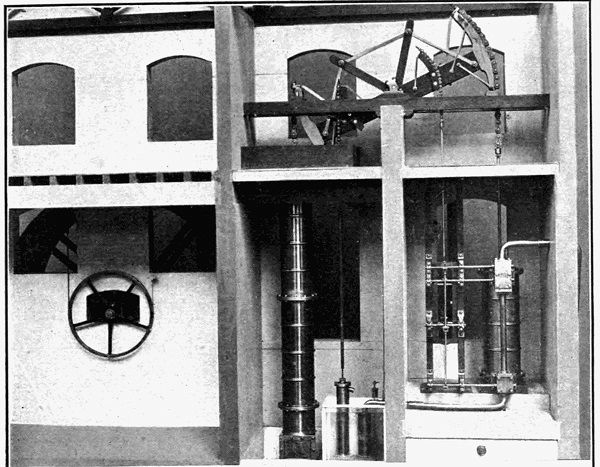
WATT'S EARLIEST TYPE OF PUMPING ENGINE.
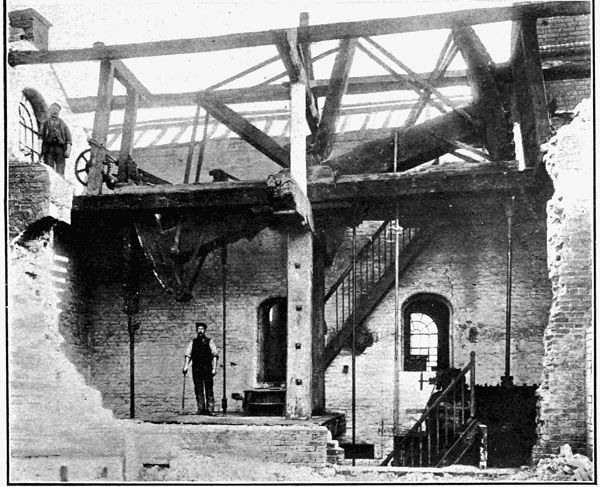
The lower figure shows the ruins of Watt's famous engine "Old Bess." The upper figure shows a reconstructed model of the "Old Bess" engine. It will be noted that the walking beam is precisely of the Newcomen type. In fact, the entire engine is obviously only a modification of the Newcomen engine. It had, however, certain highly important improvements, as described in the text.
Then at last an inspiration came to him. Why not connect the cylinder with another receptacle, in which the condensation of the steam could be effected? The idea was a brilliant one, but neither its originator nor any other man of the period could possibly have realized its vast and all-comprehending importance. For in that idea was contained the germ of all the future of steam as a motive power. Indeed, it scarcely suffices to speak of it as the germ merely; the thing itself was there, requiring only the elaboration of details to bring it to perfection.
Watt immediately set to work to put his brilliant conception of the separate condenser to the test of experiment. He connected the cylinder of a Newcomen engine with a receptacle into which the steam could be discharged after doing its work on the piston. The receptacle was kept constantly cooled by a jet of water, this water and the water of condensation, together with any air or uncondensed steam that might remain in the receptacle, being constantly removed with the aid of an air pump. The apparatus at once demonstrated its practical efficiency,—and the modern steam engine had come into existence.
It was in the year 1765, when Watt was twenty-nine years old, that he made his first revolutionary experiment, but his first patents were not taken out until 1769, by which time his engine had attained a relatively high degree of perfection. In furthering his idea of keeping the cylinder at an even temperature, he had provided a covering for it, which might consist of wood or other poorly conducting material, or a so-called jacket of steam—that is to say, a portion of steam admitted into the closed chamber surrounding the cylinder. Moreover, the cylinder had been closed at the top, and a portion of steam admitted above the piston, to take the place of the atmosphere in producing the down stroke. This steam above the piston, it should be explained, did not connect with the condensing receptacle, so the engine was still single-acting; that is to say it performed work only during one stroke of the piston. A description of the mechanism at this stage of its development may best be given in the words of the inventor himself, as contained in his specifications in the application for patent on his improvements in 1769.
"My method of lessening the consumption of steam, and consequently fuel, in fire-engines, consists of the following principles:
"First, That vessel in which the powers of steam are to be employed to work the engine, which is called the cylinder in common fire-engines, and which I call the steam vessel, must, during the whole time the engine is at work, be kept as hot as the steam that enters it; first by enclosing it in a case of wood, or any other materials that transmit heat slowly; secondly, by surrounding it with steam or other heated bodies; and, thirdly, by suffering neither water nor any other substance colder than the steam to enter or touch it during that time.
"Secondly, In engines that are to be worked wholly or partially by condensation of steam, the steam is to be condensed in vessels distinct from the steam vessels or cylinders, although occasionally communicating with them; these vessels I call condensers; and, whilst the engines are working, these condensers ought at least to be kept as cold as the air in the neighborhood of the engines, by application of water or other cold bodies.
"Thirdly, Whatever air or other elastic vapor is not condensed by the cold of the condenser, and may impede the working of the engine, is to be drawn out of the steam vessels or condensers by means of pumps, wrought by the engines themselves, or otherwise.
"Fourthly, I intend in many cases to employ the expansive force of steam to press on the pistons, or whatever may be used instead of them, in the same manner in which the pressure of the atmosphere is now employed in common fire-engines. In cases where cold water can not be had in plenty, the engines may be wrought by this force of steam only, by discharging the steam into the air after it has done its office.
"Sixthly, I intend in some cases to apply a degree of cold not capable of reducing the steam to water, but of contracting it considerably, so that the engines shall be worked by the alternate expansion and contraction of the steam.
"Lastly, Instead of using water to render the pistons and other parts of the engine air-and steam-tight, I employ oils, wax, resinous bodies, fat of animals, quicksilver and other metals in their fluid state."
ROTARY MOTION
It must be understood that Watt's engine was at first used exclusively as an apparatus for pumping. For some time there was no practical attempt to apply the mechanism to any other purpose. That it might be so applied, however, was soon manifest, in consideration of the relative speed with which the piston now acted. It was not until 1781, however, that Watt's second patent was taken out, in which devices are described calculated to convert the reciprocating motion of the piston into motion of rotation, in order that the engine might drive ordinary machinery.
It seems to be conceded that Watt was himself the originator of the idea of making the application through the medium of a crank and fly-wheel such as are now universally employed. But the year before Watt took out his second patent, another inventor named James Picard had patented this device of crank and connecting rod, having, it is alleged, obtained the idea from a workman in Watt's employ. Whatever be the truth as to this point, Picard's patent made it necessary for Watt to find some alternative device, and after experimenting, he hit upon the so-called sun and planet gearing, and henceforth this was used on his rotary engines until the time for the expiration of Picard's patent, after which the simpler and more satisfactory crank and fly-wheel were adopted.
In the meantime, Watt had associated himself with a business partner named Boulton, under the firm name of Boulton and Watt. In 1776 a special act of legislation extending the term of Watt's original patent for a period of twenty-five years had been secured. All infringements were vigorously prosecuted, and the inventor, it is gratifying to reflect, shared fully in the monetary proceeds that accrued from his invention.
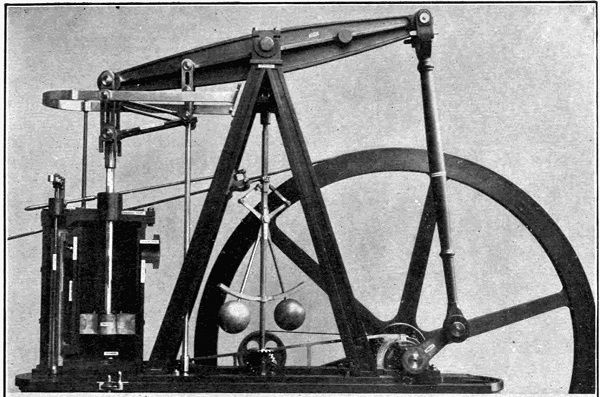
WATT'S ROTATIVE ENGINE.
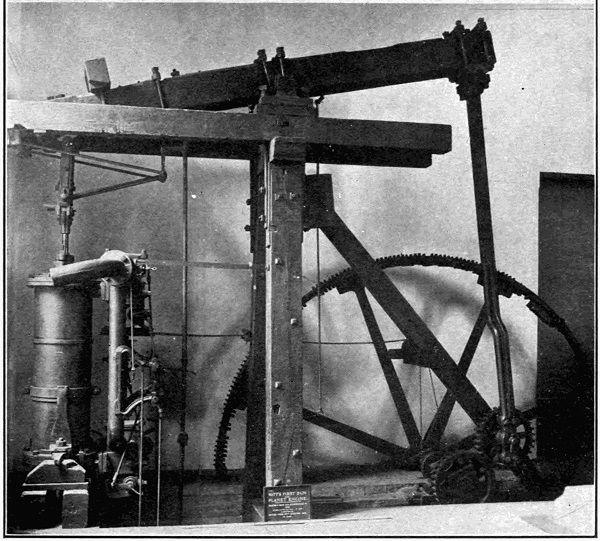
The lower figure shows the earliest type of mechanism through which Watt applied his engine to other uses than that of pumping. The so-called sun-and-planet gearing, through which rotary motion was attained, is seen at the lower right-hand corner of the figure. The upper figure shows a later and much improved type of the Watt engine, in which the sun-and-planet gearing has been supplanted by a simple crank.
Notwithstanding the early recognition of the possibility of securing rotary motion with Watt's perfected Newcomen engine, it was long before the full possibilities of the application of this principle were realized, even by the most practical of machinists. Watt himself apparently appreciated the possibilities no more fully than the others, as the use of his famous engines "Beelzebub" and "Old Bess" in the establishment of Boulton and Watt amply testifies. It appears that Boulton had been an extensive manufacturer of ornamental metal articles. To drive his machinery at Soho he employed two large water wheels, twenty-four feet in diameter and six feet wide. These sufficed for his purpose under ordinary conditions, but in dry weather from six to ten horses were required to aid in driving the machinery. When Watt's perfected engine was available, however, this was utilized to pump water from the tail race back to the head race, that it might be used over and over. "Old Bess" had a cylinder thirty-three inches in diameter with seven-foot stroke, operating a pump twenty-four inches in diameter; it therefore had remarkable efficiency as a pumping apparatus. But of course it utilized, at best, only a portion of the working energy contained in the steam; and the water wheels in turn could utilize not more than fifty per cent. of the store of energy which the pump transferred to the water in raising it. Therefore, such use of the steam engine involved a most wasteful expenditure of energy.
It was long, however, before the practical machinists could be made to believe that the securing of direct rotary power from the piston could be satisfactorily accomplished. It was only after the introduction of higher speed and heavier fly-wheels, together with improved governors, that the speed of rotation was so equalized as to meet satisfactorily the requirements of the practical engineer, and ultimately to displace the wasteful method of securing rotary motion indirectly through the aid of pump and water wheel. It may be added, that the centrifugal governor, with which modern engines are provided to regulate their speed, was the invention of Watt himself.
FINAL IMPROVEMENTS AND MISSED OPPORTUNITIES
In the year 1782 Watt took out patents which contained specifications for the two additional improvements that constituted his final contribution to the production of the steam engine. The first of these provided for the connection of the cylinder chamber on each side of the piston with the condenser, so that the engine became double acting. The second introduced the very important principle,—from the standpoint of economy in the use of steam—of shutting off the supply of steam from the cylinder while the piston has only partially traversed its thrust, and allowing the remainder of the thrust to be accomplished through the expansion of the steam. The application of the first of these principles obviously adds greatly to the efficiency of the engine, and in practise it was found that the application of the second principle produces a very great saving in steam, and thus adds materially to the economical working of the engine.
All of Watt's engines continued to make use of the walking beam attached to the piston for the transmission of power; and engineers were very slow indeed to recognize the fact that in many—in fact in most—cases this contrivance may advantageously be done away with. The recognition of this fact constitutes one of the three really important advances that have been made in the steam engine since the time of Watt. The other two advances consist of the utilization of steam under high pressure, and of the introduction of the principle of the compound engine.
Neither of these ideas was unknown to Watt, since the utilization of steam under high pressure was advocated by his contemporary, Trevithick, while the compound engine was invented by another contemporary named Hornblower. Perhaps the very fact that these rival inventors put forward the ideas in question may have influenced Watt to antagonize them; in particular since his firm came into legal conflict with each of the other inventors. At any rate, Watt continued to the end of his life to be an ardent advocate of low pressure for the steam engine, and his firm even attempted to have laws passed making it illegal—on the ground of danger to human life—to utilize high-pressure steam, such as employed by Trevithick.
Possibly the conservatism of increasing age may also have had its share in rendering Watt antagonistic to the new ideas; for he was similarly antagonistic to the idea of applying steam to the purposes of locomotion. Trevithick, among others, had, as we shall see in due course, made such application with astonishing success, producing a steam automobile which traversed the highway successfully. In his earlier years Watt had conceived the same idea, and had openly expressed his opinion that the steam engine might be used for this purpose. But late in life he was so antipathetic to the idea that he is said to have put a clause in the lease of his house, providing that no steam carriage should under any pretext be allowed to approach it.
These incidents have importance as showing—as we shall see illustrated again and again in other fields—the disastrous influence in retarding progress that may be exercised by even the greatest of scientific discoverers, when authority well earned in earlier years is exercised in an unfortunate direction later in life. But such incidents as these are inconsequential in determining the position among the world's workers of the man who was almost solely responsible for the transformation of the steam engine from an expensive and relatively ineffective pumping apparatus, to the great central power that has ever since moved the major part of the world's machinery.
THE SUPREME IMPORTANCE OF WATT
It is speaking well within bounds to say that no other invention within historical times has had so important an influence upon the production of property—which, as we have seen, is the gauge of the world's work—as this invention of the steam engine. We have followed the history of that invention in some detail, because of its supreme importance. To the reader who was not previously familiar with that history, it may seem surprising that after a lapse of a little over a century one name and one alone should be popularly remembered in connection with the invention; whereas in point of fact various workers had a share in the achievement, and the man whose name is remembered was among the last to enter the field. We have seen that the steam engine existed as a practical working machine several decades before Watt made his first invention; and that what Watt really accomplished was merely the perfecting of an apparatus which already had attained a considerable measure of efficiency.
There would seem, then, to be a certain lack of justice in ascribing supreme importance to Watt in connection with the steam engine. Yet this measure of injustice we shall find, as we examine the history of various inventions, to be meted always by posterity in determining the status of the men whom it is pleased to honor. One practical rule, and one only, has always determined to whom the chief share of glory shall be ascribed in connection with any useful invention.
The question is never asked as to who was the originator of the idea, or who made the first tentative efforts towards its utilization,—or, if asked by the historical searcher, it is ignored by the generality of mankind.
So far as the public verdict, which in the last resort determines fame, is concerned, the one question is, Who perfected the apparatus so that it came to have general practical utility? It may be, and indeed it usually is the case, that the man who first accomplished the final elaboration of the idea, made but a comparatively slight advance upon his predecessors; the early workers produced a machine that was almost a success; only some little flaw remained in their plans. Then came the perfecter, who hit upon a device that would correct this last defect,—and at last the mechanism, which hitherto had been only a curiosity, became a practical working machine.
In the case of the steam engine, it might be said that even a smaller feat than this remained to be accomplished when Watt came upon the scene; since the Newcomen engine was actually a practical working apparatus. But the all-essential thing to remember is that this Newcomen engine was used for a single purpose. It supplied power for pumping water, and for nothing else. Neither did it have possibilities much beyond this, until the all-essential modification was suggested by Watt, of exhausting its steam into exterior space.
This modification is in one sense a mere detail, yet it illustrates once more the force of Michelangelo's famous declaration that trifles make perfect; for when once it was tested, the whole practical character of the steam engine was changed. From a wasteful consumer of fuel, capable of running a pump at great expense, it became at once a relatively economical user of energy, capable of performing almost any manner of work.
Needless to say, its possibilities in this direction were not immediately realized, in theory or in practise; yet the conquest that it made of almost the entire field of labor resulted in the most rapid transformation of industrial conditions that the world has ever experienced. After all, then, there is but little injustice in that public verdict which remembers James Watt as the inventor, rather than as the mere perfecter, of the steam engine.
THE PERSONALITY OF JAMES WATT
The man who occupies this all-important position in the industrial world demands a few more words as to his personality. His work we have sufficiently considered, but before we pass on to the work of his successors, it will be worth our while to learn something more of the estimate placed upon the man himself. Let us quote, then, from some records written by men who were of the same generation.
"Independently of his great attainments in mechanics, Mr. Watt was an extraordinary and in many respects a wonderful man. Perhaps no individual in his age possessed so much, or remembered what he had read so accurately and well. He had infinite quickness of apprehension, a prodigious memory, and a certain rectifying and methodizing power of understanding which extracted something precious out of all that was presented to it. His stores of miscellaneous knowledge were immense, and yet less astonishing than the command he had at all times over them. It seemed as if every subject that was casually started in conversation had been that which he had been last occupied in studying and exhausting; such was the copiousness, the precision, and the admirable clearness of the information which he poured out upon it without effort or hesitation. Nor was this promptitude and compass of knowledge confined, in any degree, to the studies connected with his ordinary pursuits.
"That he should have been minutely and extensively skilled in chemistry, and the arts, and in most of the branches of physical science, might, perhaps, have been conjectured; but it could not have been inferred from his usual occupations, and probably is not generally known, that he was curiously learned in many branches of antiquity, metaphysics, medicine, and etymology, and perfectly at home in all the details of architecture, music, and law. He was well acquainted, too, with most of the modern languages, and familiar with their most recent literature. Nor was it at all extraordinary to hear the great mechanician and engineer detailing and expounding, for hours together, the metaphysical theories of the German logicians, or criticizing the measures or the matter of the German poetry.
"It is needless to say, that with those vast resources, his conversation was at all times rich and instructive in no ordinary degree. But it was, if possible, still more pleasing than wise, and had all the charms of familiarity, with all the substantial treasures of knowledge. No man could be more social in his spirit, less assuming or fastidious in his manners, or more kind and indulgent towards all who approached him. His talk, too, though overflowing with information, had no resemblance to lecturing, or solemn discoursing; but, on the contrary, was full of colloquial spirit and pleasantry. He had a certain quiet and grave humor, which ran through most of his conversation, and a vein of temperate jocularity, which gave infinite zest and effect to the condensed and inexhaustible information which formed its main staple and characteristic. There was a little air of affected testiness, and a tone of pretended rebuke and contradiction, which he used towards his younger friends, that was always felt by them as an endearing mark of his kindness and familiarity, and prized accordingly, far beyond all the solemn compliments that proceeded from the lips of authority. His voice was deep and powerful; though he commonly spoke in a low and somewhat monotonous tone, which harmonized admirably with the weight and brevity of his observations, and set off to the greatest advantage the pleasant anecdotes which he delivered with the same grave tone, and the same calm smile playing soberly on his lips.
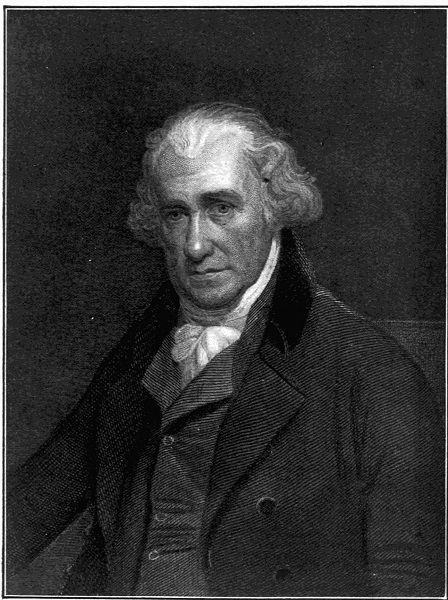
JAMES WATT.
"There was nothing of effort, indeed, or of impatience, any more than of pride or levity, in his demeanor; and there was a finer expression of reposing strength, and mild self-possession in his manner, than we ever recollect to have met with in any other person. He had in his character the utmost abhorrence for all sorts of forwardness, parade, and pretension; and indeed never failed to put all such impostors out of countenance, by the manly plainness and honest intrepidity of his language and deportment.
"He was twice married, but has left no issue but one son, associated with him in his business and studies, and two grandchildren by a daughter who predeceased him. He was fellow of the Royal Societies both of London and Edinburgh, and one of the few Englishmen who were elected members of the National Institute of France. All men of learning and of science were his cordial friends; and such was the influence of his mild character, and perfect fairness and liberality, even upon the pretender to these accomplishments, that he lived to disarm even envy itself, and died, we verily believe, without a single enemy."