IV. THE GENOESE COLONIES IN GREECE (continued 2)
Reading edition
When Manuel returned to Constantinople in 1403, he refused to carry out his promised gift of Salonika. Before the battle of Angora had decided the fate of Bayezid, and the issue between the Turks and the Mongols was still uncertain, John Palaiologos had agreed—it was said—to surrender Constantinople and become a tributary of the Sultan, in the event of a Turkish victory. This was Manuel’s, excuse for refusing to allow his nephew to reside at Salonika and for banishing him to Lemnos. John thereupon appealed to his father-in-law for assistance, and Francesco, early in 1403, sailed with five vessels to attack Salonika. Hearing that Boucicault, then French governor of Genoa, whose interest in Lesbos had just been evinced by the despatch of an embassy thither, was once more in the Levant on a punitive expedition against King Janus of Cyprus, who had besieged the Genoese colony of Famagosta, Francesco despatched a vessel to meet the Marshal, reminding him that he had been a witness of the Emperor’s promise and begging him to aid in taking Salonika[553]. Boucicault did not accede to this request; on the contrary, two vessels from Lesbos and two from Ænos went to assist him in his operations against the King of Cyprus, and remained with him till shortly before he reached the Venetian colony of Modon on his homeward voyage. Manuel ended by bestowing Salonika upon John Palaiologos, but the attacks made by Boucicault upon Venetian trade in the Levant and the consequent hostilities cost Nicolò Gattilusio, owing to his Genoese origin, the loss of 3000 ducats in gold, seized by the Venetians at Modon[554].
In October of this eventful year of Boucicault’s cruise, there arrived at Lesbos a mission, sent by Enrique III of Castile to Timour, the victor of Angora, whose court was then at Samarkand. The narrative of the Castilian ambassador, Ruy Gonzalez de Clavijo, gives us an interesting account of the island under the second Gattilusio. He found the town “built on a high hill near the sea,” and “surrounded by a wall with many towers,” outside of which was “a large suburb.” Besides the capital, Lesbos contained “several villages and castles,” while the neighbourhood of the city was well-cultivated and abounded in gardens and vineyards. At one time—probably before the earthquake—“very large houses and churches” had stood near the town, and at one end of the city were “the ruins of great palaces, and in the middle of the ruins about 40 blocks of white marble.” The local tradition was, that “on the top of these blocks there was once a platform, where those of the city met in council.” During the five days of their stay the envoys made the acquaintance of John Palaiologos, who was then residing in his wife’s old home, and heard the tragic story of the late lord’s death, of his successor’s marvellous preservation and of the recent expedition against Salonika[555]. Thus, in the reign of Francesco II, Lesbos was frequently visited by important personages from the West, and was their last stopping-place in Latin lands on their way to Constantinople or to Asia. Descended from the famous houses of Byzantium and Savoy, and connected with that of Austria, the lord of Mytilene and lessee of Foglia Vecchia was regarded by Western visitors as “a great baron”; Eastern potentates sought the hands of his daughters in marriage, and when one of them married the heir of the powerful Giovanni de’ Grimaldi[556], governor of Nice and usurper of Monaco, the dowry of 5000 gold ducats which she brought from Lesbos was considered a large sum on the Riviera. Although born in the Levant, he still kept up the family connexion with his paternal city. Both he and his uncle had financial transactions with Genoa[557], and Francesco was patron of the family church of San Giacomo at Sestri Ponente[558]. At the same time, while Latin archbishops held the see of Mytilene, his relations with the dignitaries of the Orthodox church were excellent. The Œcumenical Patriarch addressed him as “well-beloved nephew of the Emperor,” and his uncle Nicolò as the “Emperor’s kinsman by marriage[559], the most noble, glorious, and prudent archon of Ænos,” whose consent was sought for the appointment of a Metropolitan to that long vacant see[560]. With Venice the Gattilusj, as befitted Genoese, at times had difficulties. In 1398 corsairs, sallying forth from their dominions, did much damage to the Cretans who sailed under the Venetian flag; but the Republic none the less allowed the wax of Lesbos to be exported at certain seasons for sale in her dominions[561].
After an eventful reign of 20 years, Francesco II died, if we may believe an anonymous Greek chronologist[562], on October 26, 1404. His end was strangely similar to that of his father. On a journey through the island, while passing the night in one of the lofty towers then common in the Archipelago, he was stung by a scorpion. Alarmed at his cries, his attendants and nobles climbed up into his room in such numbers that the floor collapsed and he was killed on the spot leaving three sons, Jacopo, Palamede and Dorino, of whom the eldest Jacopo became his successor[563]. The heir was, however, still a minor, and accordingly once again Nicolò came and acted as regent. His friendly policy as regent and his support of her subjects in the Levant on more than one occasion called forth the warm praise of Venice; but his fortification of Tenedos provoked an indignant protest[564]. Moreover the Greeks of Lesbos can scarcely have been edified by the appointment of rival Latin bishops—the result of the schism in the Western Church—which occurred during his regency[565]. In the spring of 1409 he died[566], and Jacopo, then of age, assumed the government of Lesbos, while Francesco’s younger son, Palamede[567], succeeded his uncle and guardian at Ænos. Nicolò’s fame long lingered in the Levant. Kritoboulos[568] half a century later ascribed to him the achievements of Francesco I, the founder of the dynasty, whose wisdom, and education, whose courage and physical gifts he extols, whom all Syria and Egypt feared and propitiated with annual blackmail, for his numerous navy ravaged their coasts and even the Libyan littoral.
Jacopo’s policy was to favour Genoese interests where they conflicted with Venetian, but to co-operate with the two rival Republics when they showed signs of uniting against his dreaded neighbours, the Turks. Thus, he aided Centurione Zaccaria, the Genoese Prince of Achaia, in his campaign against the Tocchi of Cephalonia and Zante, who were thereby compelled to invoke the protection of Venice; while the Venetians threatened to sequestrate all Lesbian merchandise in Crete, unless he gave satisfaction for the seizure of a Cretan merchantman[569]. Venetian and Genoese subjects, however, suffered alike from the reprisals provoked by the attack of two Lesbian galleys upon the Saracens of Damietta; and Jacopo had a counter grievance in the illegal levy of toll upon his people by the Genoese of Chios[570]. Towards the Turks he was, from his position, obliged to be deferential, except when he saw prospect of common action against them. If the Knights of Rhodes complained that he had sheltered the Turks, and so saved them from destruction at the hands of those zealous champions of Christendom[571], he was ready, in 1415, to join the latter, the Genoese of Chios, and the Venetian Republic in an anti-Turkish league; while he did homage to Mohammed I and aided first that Sultan and then Murad II in the suppression of Djouneïd of Aïdin, when fortune smiled upon them[572]. In 1426, the threatened declaration of war by Venice upon Genoa, then under Milanese domination, caused him some embarrassment; but the Genoese Government bade him[573] not to be afraid of Venetian threats. Not long after this, probably in 1428, Jacopo died[574]. An anonymous Greek informs us that he had married Bonne, “the fair daughter of the lord of Nice near Marseilles” but this statement would appear to be due to a confusion with the marriage of his sister with Pietro de’ Grimaldi, for Bonne, the offspring of that union espoused Louis Cossa, lord of Berre, unless the Bonne mentioned was the daughter of Amedeo VIII of Savoy, in whose dominions Nice was then included[575]. In 1421, however, Valentina D’Oria is described as “lady of Mytilene[576].” At any rate, it seems probable that he left no issue, for his successor, Dorino I, is described in a Genoese document and by a traveller of this period as “brother” of Palamede, lord of Ænos[577], and therefore of Jacopo. Dorino, whose name was derived from the famous Genoese house of D’Oria, allied by marriage with many Gattilusj, had already had experience of ruling for several years over Foglia Vecchia as his appanage—a fact still commemorated by his coins and an inscription there[578], which describes him as its “lord” in 1423-4. This former possession of the Zaccaria is first mentioned as administered by the Gattilusj in 1402, and remained united with the Lesbian branch of the family till 1455.
Meanwhile, Ænos had prospered under the rule of Palamede. Six inscriptions, still extant there, proclaim the activity of the masons during the early years of his long reign—the erection of the churches of the Chrysopege and of St Nicholas by two private citizens and the completion of three other public works[579]. But Palamede not only embellished his domain; he also extended it. The neighbouring island of Samothrace, a Greek possession since the reconquest of Constantinople from the Latins, now owned his sway—for in 1433, when Bertrandon de la Brocquière[580] visited Ænos, he wrote that Samothrace also belonged to its lord. In that island, then known as Mandrachi and celebrated for its honey and its goats, Palamede erected on March 26, 1431, and extended in 1433, a new fortress for the protection of its numerous population, as two inscriptions in its walls, one in Greek, one in Latin[581] still remind us. The Genoese lord, we are told, was interested in the past history of his dominions; he “loved greatly to hear learned discussions,” and to him a contemporary scholar, John Kanaboutzes, applied the saying of Plato about philosophers and kings. To his desire to know what Dionysios of Halikarnassos had written about Samothrace we owe the brief commentary on that author, compiled at his command by that writer, a native of Foglia[582], whose family was connected with Ænos[583]—one of several instances, where Italian rulers of Greece showed a consciousness of that country’s great past. Like his brother Jacopo, Palamede was inclined to support the Genoese Prince of Achaia, and the Venetian admiral was ordered to remonstrate with him, should occasion require[584].
Although more than seventy years had by this time elapsed since Francesco I had left Genoa for the Levant, the connexion between the distant Republic and his descendants in the East was never closer than now. In 1428, and again in 1444, the Genoese Government, although it forbade the circulation of Lesbian ducats in Genoa and district, and repudiated responsibility for the harm done by the Gattilusj to the subjects of the Sultan of Egypt, specially consulted “the lords of Mytilene, Ænos and Foglia Vecchia” whether they desired to be included or no in the treaties of peace, which it had just concluded with King Alfonso V of Aragon. “The many services rendered to us and to the community of Genoa by you and your ancestors”—so runs one of these interesting despatches—“make us realise that in all treaties involving peace or war we ought to consider your honour and advancement. For your welfare, your misfortunes, are equally ours.” Dorino I replied that he wished to be so included, and his agents accordingly ratified the peace at Genoa on his behalf in 1429. When, two years later, Genoa was drawn into the war between her Milanese masters and Venice, the Archbishop of Milan, who was at that time the governor of Genoa, notified Dorino of the outbreak of hostilities, following the precedent set in the case of his father and grandfather, warned that “most distinguished of our citizens” to put his island in a state of defence and begged him to aid any Genoese colony that might require assistance[585]. So much importance was attached at Milan to his support, that Francesco Sforza, the Duke, accredited Benedetto Folco of Forlì to the Lesbian court, in order to urge Dorino against Venice[586]. At the same time, the Genoese Government, “remembering that in all its past victories the galleys of the Gattilusj had borne their part,” invited the lord of Lesbos to co-operate with Ceba, the Genoese commander who was to be despatched for the relief of Chios from the Venetians, and requested him to send a galley to that island. Dorino replied in a loyal strain, whereupon the Genoese Government thanked him for this display of fidelity, traditional in his family, and again urged him to equip his galley for the defence of Chios. Two other despatches, following in rapid succession, begged him to inform the Chians of the speedy arrival of the Genoese fleet and to see that his own galley was in Chian waters by the middle of May. Dorino was as good as his word, and gave orders that a Lesbian galley should join the expedition; but before the latter arrived, the Venetians had raised the siege. As a reward for his services, the commander of the Genoese fleet and the governors of Pera and Chios were instructed to provide for the safety of his little state, and the home government invited him to rely upon its unshakable affection in time of need. Influential Genoese marriages stimulated this feeling. Dorino had married a D’Oria; Palamede’s daughter Caterina now married another; while her sisters, Ginevra and Costanza, respectively espoused Ludovico and Gian Galeazzo de Campo-fregoso, relatives of the then reigning Doge, and the former soon to be Doge himself. Thus Lesbian interests were well represented at Genoa. In return, Genoa frequently requested Dorino to see that justice was done to her subjects in his dominions, even to the detriment of his own family[587].
Genoa found Dorino no less useful as a diplomatist than as an ally, for the lord of Lesbos and Foglia Vecchia had married his daughter Maria to Alexander, second son of Alexios IV, Emperor of Trebizond, in whose dominions the Genoese, owing to their Black Sea colonies, had important commercial interests, latterly greatly injured by the pro-Venetian policy of that sovereign. According to the Trapezuntine practice, Alexios had raised his eldest son John IV to the Imperial dignity in his own lifetime; but his unfilial heir conspired against him, was driven into exile, and replaced by his next brother Alexander. John IV was, however, as favourable to the Genoese as his father to the Venetians, and was restored with the assistance of a Genoese of Caffa. Alexios IV was murdered in 1429; but John IV was not allowed to reign undisturbed. His brother Alexander fled to Constantinople, where his sister was wife of the Emperor John VI, and contracted a marriage with Dorino’s daughter, in order that he might secure his support, and through him, that of Genoa, against the Emperor of Trebizond. When the Spanish traveller, Pero Tafur, visited Lesbos at this time he found Alexander there engaged in levying a fleet for his restoration. This did not, however, suit Genoese policy, and accordingly the Doge of Genoa requested Dorino in 1438 to act as peacemaker between the two brothers and to invite his son-in-law to reside at Constantinople or in Lesbos on an annuity chargeable on the revenues of Trebizond[588]. Another matrimonial alliance brought Dorino’s family into renewed relations with the Palaiologoi. In 1440, an old link between the two families had been snapped by the death of Eugenia Gattilusio, widow of the Emperor John VI’s cousin and namesake[589]—an event which was doubtless the occasion when the castle of Kokkinos on the coast of Lemnos, which had been her widow’s portion, passed into the hands of Dorino[590]. On July 27 of the following year, however, the Emperor’s brother, the Despot Constantine, afterwards the last Christian ruler of Byzantium, married Dorino’s daughter Caterina, a marriage arranged by the historian Phrantzes. This union did not last long; after a brief honeymoon in Lesbos, Constantine left his bride in her father’s care, and set out, accompanied by a Lesbian galley, for the Morea, nor did he see her again till his return in the following July. At Lesbos he took her on board his ship; but, when he reached Lemnos on his way to Constantinople, he had to take refuge behind the walls of Kokkinos from the attacks of a Turkish fleet. The Turks in vain besieged the castle of the Gattilusj for 27 days, and the strain and anxiety of the siege caused the death of his wife, which occurred at Palaiokastro in August. There the ill-fated second consort of the last hero of the Byzantine Empire was laid to rest[591].
Meanwhile, besides the acquisition of Kokkinos, thus courageously saved by his heroic son-in-law, Dorino had received from the Greek Empire the island of Thasos, which more than a century before had belonged to the Genoese family of Zaccaria. Indeed, if we may accept the two allusions to the Gattilusj in the Greek version of Bondelmonti[592] as the work of that traveller, Thasos, which was Byzantine in September, 1414, had been given to Jacopo as a fief before 1420. At any rate, a Thasian inscription of April 1, 1434, now preserved in the wall of the church of St Athanasios at Kastro, informs us that a tower was built there by Oberto de’ Grimaldi[593] a member of the well-known Ligurian family who is mentioned elsewhere[594] as a captain in the service of Dorino. Ten years later, the archæologist, Cyriacus of Ancona, upon visiting Thasos, found that Dorino had recently bestowed the island upon his son, Francesco III, who was still under the control of a preceptor, Francesco Pedemontano.
The indefatigable antiquary may have paid an earlier visit to Lesbos in 1431, but the accounts which he has left of the Gattilusj, their dominions, and the neighbouring islands of the Thracian Sea range from 1444 to 1447. In Lesbos he was well received by Dorino, who promised to aid him in exploring the whole island. He had, indeed, arrived at a fortunate moment, for the rumour of a threatened Turkish invasion had ceased, so that the lord of Lesbos had leisure for archæology, and his visitor could examine “the remains of the temple of Diana,” and “the baths of Jove,” whose name was carved in the midst of them[595]. With Dorino’s captain, Oberto de’ Grimaldi, he sailed to Foglia Vecchia, where the Gattilusj had a factory, as at Lesbos, for the production of alum, and made the acquaintance of “the Master Kanaboutzes,” probably the author of the commentary on Dionysios, who could tell him all about the Foglie, of which he was a native[596]. In Thasos, the third domain of the elder branch of the Gattilusj, he spent Christmas day, and composed a long Latin inscription as well as an Italian poem in honour of young Francesco. The enthusiastic guest prayed that the beginning of his host’s rule over Thasos might be of as good omen as “the yule log thrown on the fire in the turreted castle”; that the yoke of the barbarian Turks might be removed from Thrace, that the former dependencies of the island there might return to his sway, and that Francesco’s patron saint, St John the Evangelist, might protect this “native offspring of the Palaiologoi, this pride of the most noble Gatalusian race.” “What Thasian nymph,” he asks, “could have deprived Lesbos of her Francesco?” The attraction was the lordship of an island, which had been described by Bondelmonti as well-peopled, very fertile and containing three fair towns. Francesco had, indeed, begun well by restoring the principal city, thus earning a dedicatory inscription by the Thasian citizens and colonists, and by erecting at the entrance of the harbour some fine marble statues, which an ancient inscription showed to have represented the members of the Thasian council. At this time the island could boast of six other towns beside its “marble city,” whose walls attracted the admiration of the traveller. Under the guidance of Carlo de’ Grimaldi and “the learned Giovanni of Novara,” he inspected the numerous ancient tombs outside, the large amphitheatre with no less than 20 rows then standing intact, and the akropolis of the city[597].
The worthy Cyriacus was no less hospitably received by the junior branch of the Gattilusj. At Ænos he met Palamede with his two sons Giorgio and Dorino II, and was delighted to find there an old friend in the person of Cristoforo Dentuto, envoy extraordinary of Genoa in the Levant. Accompanied by “the prince of Ænos and Samothrace” as he calls Palamede, and by Francesco Calvi, the latter’s secretary, he was taken to see “the great tomb of Polydoros, son of Priam,” some five stadia beyond the walls, admired the sculptured figures of fauns and animals there, and copied an ancient Greek inscription from the marble base of a statue that stood before “the prince’s court.” Letters of introduction from Palamede and Francesco of Thasos secured for him a warm reception at the monastery of Hagia Laura on Mount Athos[598]. At Samothrace, Joannes Laskaris Rhyndakenos, Palamede’s prefect of the island, personally conducted the antiquary to the old city, where he saw “ancient walls and the remains of a marble temple of Neptune” (known to modern archæologists as “the Dorian marble temple”), “fragments of huge columns, epistylia and bases, and doorposts, adorned with the crowned heads of bulls and other figures”—now identified with the remains of a round building built by Arsinöe, daughter of Ptolemy Soter. Thence he went to “the new castle, founded by Palamede” some thirteen years before, and built to protect his new town of “Capsulum.” Close to the tower he saw to his delight “several ancient marbles, with dances of Nymphs sculptured and inscriptions in Latin and Greek”—the two reliefs of dancing Nymphs now in the Louvre[599]. From his accounts of the neighbouring islands, we learn that Imbros, where his guide was a noble and learned Imbriote, Hermodoros Michael Kritoboulos, the historian, in 1444 was still Byzantine, and “governed for the Emperor John Palaiologos” by that same noble, Manuel Asan, of whom inscriptions have been found there, and who had lately restored two-thirds of the akropolis[600]. We find, too, that in 1447 Theodore Branas was Byzantine governor of Lemnos, where the Gattilusj as yet held only the castle of Kokkinos[601].
The visit of the antiquary of Ancona to the Gattilusj was the calm before the storm, which was so soon to burst upon them. Even while Cyriacus was their guest, the fatal battle of Varna made Murad II master of the Near East. For a few years, indeed, the Gattilusj went on marrying and giving in marriage, as if the end of their rule were not at hand. In 1444, Dorino’s daughter Ginevra married Giacomo II Crispo, Duke of the Archipelago[602]; five years later the lord of Lesbos sent the Archbishop of Mytilene, at that time the celebrated Leonardo of Chios, to Rome to obtain from the Pope a dispensation for the marriage of his eldest surviving son, Domenico, and a daughter of Palamede. As the two young people were first-cousins, Ludovico de Campo-fregoso, Palamede’s son-in-law and at that time Doge of Genoa, begged the Pope not to grant the dispensation, and as an example of the iniquity of such an alliance he instanced the case of Dorino’s firstborn (presumably Francesco III of Thasos), who had married another daughter of Palamede and had died less than six months afterwards. The Pope refused his consent, and the marriage did not take place[603].
Hitherto the Gattilusj, partly by tribute paid ever since the reign of Murad I[604], partly by tact, had managed to keep the Turks at a distance. On one occasion, when Constantinople had been threatened, the Pope had offered to pay the expenses of the Lesbian galley, if Dorino would agree to sent it thither; but the Genoese Government, while transmitting his Holiness’ offer and praising the services of the Gattilusj to Christendom, recognised their natural unwillingness to offend the Sultan and advised Dorino, if he did send aid, to pretend that he was merely protecting Genoese interests at Pera. The Greek Emperor was able to raise a loan, if he received no actual assistance, at Ænos[605]; but in 1450, at last, Lesbos was attacked. Murad despatched a large fleet under Baltaoghli, the first in the list of Turkish admirals, against the island, and his men carried off more than 3000 souls, slaughtered many cattle, destroyed the flourishing city of Kallone, and inflicted damage to the amount of more than 150,000 ducats. It was probably on this occasion that the lady of Lesbos, Orietta d’Oria, performed the prodigy of valour that won her a niche in the literary Pantheon of her native city besides the men of her father’s house. At the time of the invasion, she seems to have been in the town of Molivos, the ancient Methymna, whose inhabitants, exhausted from lack of food, were on the point of surrendering, when she appeared among them in full armour, and led them to victory against the astonished Turks. Thereupon Dorino was able to secure by a timely present and the increase of his tribute to 2000 gold pieces a renewal of the peace which he protested that he had never broken. He was, however, under no illusions as to the durability of this truce. He wrote to Genoa, asking for assistance, reminding the Republic that he was of Genoese origin and that he had often aided her to the best of his power with men, ships, and money. Unless, therefore, she could protect him, he would be reluctantly compelled to look elsewhere for help. At the same time, after the fashion of the Christian princes of the Levant on the eve of the Turkish conquest, he announced his intention of sending an expedition to obtain his rights from the Emperor John IV of Trebizond, who had also maltreated the Genoese of Caffa, and begged the Republic to receive and revictual his galleys in her Black Sea ports. This last request was granted[606].
The Turkish conquest of Constantinople, although it sounded the death-knell of the Latin states in the Levant, was of momentary benefit to the Gattilusj. They had been close relatives and good friends of the Greek Imperial family, and one of them, a certain Laudisio, had distinguished himself in the defence of the city[607]; but, when all was over, they hastened to profit by its fall. The two islands of Lemnos and Imbros, from their position near the mouth of the Dardanelles, have always possessed great strategic importance. Under the Latin Empire, Lemnos had been the fief of the Lord High Admiral, who bore the title of Grand-duke; under the Palaiologoi it had been either the appanage of an Imperial prince, or had been entrusted to the government of some great noble. So greatly was it coveted, that Alfonso V of Aragon had made it the price of his aid for the relief of Constantinople[608], while during the siege Constantine had promised it to Giustiniani, if the Turks were repulsed[609]. When the news of the disaster reached these islands, the Byzantine authorities fled on board Italian ships, while many of the inhabitants sought refuge in Chios or in the Venetian colonies. There was, however, one leading personage in Imbros, who was resolved to remain and make terms with the victors. This was Kritoboulos, the future historian of Mohammed II, who bribed the Turkish Admiral, Hamza, not to attack the islands and through his mediation managed to send representatives of the Greek church and the local nobility with a present to the Sultan’s court at Adrianople, begging him to allow them to be administered as before. It chanced that at this moment envoys of the Gattilusj were at Adrianople, for on the fall of Constantinople both Dorino and Palamede had hastened to placate and congratulate the terrible Sultan, and to crave the grant of Lemnos and Imbros. Dorino, although he was still lord of Lesbos in name and continued to sign state documents, had been bed-ridden since 1449, and his eldest surviving son, Domenico, governed as regent. Domenico and one of Palamede’s councillors were supported by the two emissaries of Kritoboulos, and the Sultan was pleased to confer Lemnos upon the lord of Lesbos, Imbros upon him of Ænos. At the same time Mohammed ordered the former to pay an annual tribute of 3000 gold pieces for Lesbos and 2325 for Lemnos; that of Imbros was assessed at 1200 gold pieces. Thus, by the irony of fate, only nine years before its annihilation, the dominion of the Gattilusj reached its greatest extent. Indeed, there was a party in Skyros also which advocated annexation to Lesbos, but there the majority wisely preferred the nearer and more powerful lion of St Mark, which waved over Eubœa[610].
The Gattilusj were now well aware that they only existed on sufferance, and they were more careful than ever not to offend their master. Domenico paid more than one visit of obeisance to the Turkish court; and when, in June, 1455, the Turkish admiral, on his way to Rhodes, anchored off Lesbos, the historian Doukas[611], the prince’s secretary, was sent on board with a handsome present of garments of silk and of woven wool six in number, 6000 pieces of silver, 20 oxen, 50 sheep, more than 800 measures of wine, 2 bushels of biscuit and one of bread, more than 1000 lbs. of cheese, and fruit without measure, as well as gifts in proportion to their rank for the members of the admiral’s staff. Under these circumstances, it was no wonder that Hamza treated the lord of Lesbos “like a brother,” and refrained from entering the harbour, for fear of alarming the islanders.
Scarcely had the Turkish fleet left, when, on June 30, 1455, Dorino I died, leaving his dominion of Lesbos, Foglia Vecchia, Thasos, and Lemnos to his eldest surviving son, Domenico, for whom the younger, Nicolò, acted as governor in the last-named island. Before a month had passed, the fleet hove in sight of Mytilene on its homeward voyage, and was invited to anchor in the harbour, where the serviceable Doukas again visited the admiral, whom he kept in good humour by a sumptuous banquet and sped on his way with a sigh of relief on the morrow. But the historian had before him a more delicate mission—that of paying the annual tribute for Lesbos and Lemnos to Mohammed II. Starting from Lesbos on August 1, he found the Sultan at Adrianople, kissed hands in token of homage and remained seated in his presence, till His Majesty’s morning meal was over. When, however, he went to hand the money to the Sultan’s ministers next day, they ingeniously asked him after the health of his master. The historian replied that he was well and sent his greeting, whereupon the Ottomans answered, that they meant the old prince. Doukas explained that Dorino had been dead 40 days, and that his successor had already been practically prince for six years, during which time he had once or twice come in person to do homage and congratulate the Great Turk. The ministers thereupon cut short the conversation with the remark that no one had the right to assume the title of lord of Lesbos (borne till his death by Dorino), until he had come and received his principality from the hands of his Most Mighty suzerain. “Go therefore,” they said, “and return with thy master; for if he come not, he knows what the future has in store for him.” The terrified envoy hastened back to Lesbos, and set out with Domenico and several leading men of both races in the island to do homage to Mohammed. The Sultan had, however, meanwhile changed his headquarters, for the plague was then ravaging Thrace, and it was not till the Lesbian deputation reached the Bulgarian village of Zlatica that they came up with him. After the usual bakshîsh to the influential Pashas, Mahmûd and Said Achmet, they were admitted to the presence, and Domenico humbly kissed the hand of his suzerain. But on the morrow a message was conveyed to Domenico, that the Sultan wished to have the island of Thasos. Argument was useless, and the island, which had belonged for some 20, or perhaps even 35, years to the Gattilusj, was ceded to Mohammed. This sacrifice only whetted the appetite of the Sultan; on the morrow a second message announced that the tribute for Lesbos would be doubled. At this Domenico plucked up courage to reply, that, if the Sultan wished to take the whole of Lesbos, it was in his power to do so; but that to pay twice the previous tribute was beyond its present ruler’s resources. At the same time, he begged the Sultan’s ministers to intervene on his behalf. They represented the facts to their master, and the latter agreed to a compromise, by which Lesbos should thenceforth pay 4000 gold pieces, instead of 3000. Then, at last they decked Domenico with a gold-embroidered robe and his companions with silken garments; the Lesbians signed the oath of allegiance and set out on their homeward journey, “thanking God, who had delivered them out of the hands of the monster.”
But the year was not destined to close without further losses to the Gattilusj. While the deputation was still at Philippopolis, a second Turkish fleet, under Junis, set out to attack the Genoese colony of Chios. Off the Troad a storm arose, in which several of the Turkish vessels perished, while the rest of the fleet, except the flagship, took refuge in the harbour of Mytilene, where Nicolò was then representing his absent brother. It had been one of the treaty obligations of the lords of Lesbos, ever since they had been vassals of the Sultan, to warn the Turks who inhabited the opposite mainland between the mouth of the Kaïkos and the town of Assos, of the approach of Catalan corsairs, and the Gattilusj were bound to pay compensation for any loss caused by negligence in performing this service. Now it chanced that the scout, employed on this business, sailed into the harbour while the Turks were there, followed by the missing Turkish flagship. The admiral, a very different man from his predecessor, requited Nicolò Gattilusio’s generous hospitality by demanding that this vessel with all on board should be given up to him as a prize, including the wife of a very distinguished member of the Chian Chartered Company, Paride Giustiniani Longo, with all her jewelry. The lady in question was none other than Domenico’s mother-in-law, whom he had invited to Lesbos to keep his wife company while he was away—for Domenico’s love for his wife was proverbial, and it is narrated of him that he could never bear to be out of her sight and even shared her bed when she was afflicted with leprosy. Nicolò protested that the vessel was his brother’s and that the wealthy Chian dame had not been on board but had already been long in the island. At this, the Turkish commander complained to the Sultan, and sailed for Foglia Nuova, of which Paride Longo was then governor for the Chian Company. Arrived there, he summoned the governor and the chief men of the place to appear before him. Such was their alarm, that even before his summons arrived they had started to meet him, only to hear the Sultan’s written orders that they should all be imprisoned and their city levelled with the ground, unless they surrendered the fort. The citizens, without attempting to argue or reply, at once admitted the Turks; the Genoese merchants were plundered and led on board; the names of all the citizens were taken down, about a hundred of their children carried off, and a Turkish guard placed in the fort. Thus on October 31, 1455, fell the Genoese colony of Foglia Nuova, the old possession of the Zaccaria and of the Cattaneo families, and then for a century a dependency of the maona of Chios.
When Domenico returned home and learnt from his brother what had occurred, he sent Doukas to plead the case at Constantinople. The Lesbian envoy’s arguments and appeals to justice were, however, all in vain; Mohammed gave Domenico the alternative of paying 10,000 gold pieces or of war; and, when Doukas resisted this monstrous ultimatum, secretly despatched one of his servants to take Foglia Vecchia, which had been held by the Gattilusj of Lesbos ever since 1402 at least. This, their sole possession on the Asian main, was seized on December 24, 1455. As soon as the Sultan received the news of its capture, he ordered Doukas to be sent away free and declared the question settled. Well might Domenico, after this experience, write urgently to Genoa for succour[612].
It was now the turn of the younger branch of the Gattilusj. Palamede of Ænos had died in 1455; and, as his elder son Giorgio had predeceased him[613] in 1449, he had bequeathed his dominions to his second son, Dorino II, and to Giorgio’s widow and her children. While Giorgio was still alive, his father had given him all his estates, except his Lesbian property, which was the share of Dorino II, and even after Giorgio’s death, his widow and family had a preference in the old lord’s will, as representing the first-born. No sooner, however, was Palamede dead than Dorino, defying the dictates alike of justice and prudence, seized the whole of the estate. In vain Giorgio’s widow and his own advisers implored him not to drive her to appeal to the judgment-seat of the Sultan, his suzerain. Finding her arguments useless, she begged her uncle to lay her case before Mohammed, and that undiplomatic envoy, anxious to punish Dorino even at the price of annexation to Turkey, depicted the usurper as a faithless vassal, who was conspiring with the Italians, collecting arms, hiring soldiers, and preparing to increase the garrisons of Ænos and the two islands with the object of proclaiming his complete independence. His advocacy found a willing hearer, for Mohammed coveted Ænos because of its favourable situation, on the estuary of the Maritza, then navigable for a considerable distance, opposite the islands, of which it was the natural mart, and in close proximity to the lake of Jala Göl. Thanks to these natural advantages, to the river and lake fisheries, and above all to its valuable salt-beds, which supplied all Thrace and Macedonia, Ænos was then a very rich city, from which Palamede had received 300,000 pieces of silver. It was true, that two-thirds of the proceeds of the salt-beds and of the other revenues were already handed over to the Sultan; but it was suggested by the people of the neighbouring towns of Ipsala and Feredchik that the Gattilusj did not administer the salt-works honestly, while they gave refuge at Ænos to fugitive Turkish slaves.
Mohammed resolved to act at once. Despite the terrible Balkan winter, which made havoc with his troops, he left Constantinople on January 24, 1456, and marched against Ænos, while Junis with the fleet menaced it from the sea. Dorino was absent in Samothrace, whither he had gone to spend the winter in Palamede’s castle; and his subjects, thus left to themselves, made no attempt at resistance. They sent a deputation of leading citizens to the Sultan’s headquarters at Ipsala, and surrendered the city on condition that no harm was done to its inhabitants. Mohammed received them kindly, granted some of their requests, and sent Mahmûd Pasha back with them to take over the town. On the next day he came in person, carried off all the silver, gold and other valuables, which he found in Dorino’s palace and plundered the houses of that prince’s absent suite. Then, after a three days’ stay, during which he organised the future administration of the place and appointed a certain Murad as its governor, he marched away, taking 150 children, the flower of the youth of Ænos, with him, and entrusting Junis with the annexation of Samothrace and Imbros, the maritime dependencies of that city.
The Turkish admiral, on his arrival at Imbros, summoned Kritoboulos the historian, whose personality and opinions were already well-known at the Turkish court, and made him governor in the room of Dorino’s representative, at that time apparently Joannes Laskaris Rhyndakenos, whom he carried off on board. Meanwhile, a vessel had been despatched to Samothrace to fetch Dorino. But the latter, mistrusting the admiral, as he well might, preferred to throw himself upon the mercy of the Sultan. He therefore manned his yacht, crossed over to Ænos, and thence proceeded to Adrianople. Mohammed received him, and promised to restore to him his islands; but the malicious admiral, indignant at what he considered a slight upon himself, persuaded his sovereign to give Dorino instead some place on the mainland, on the ground that the islanders would not tolerate him and that he would be less able to plot at a distance from the sea. The Sultan thereupon changed his mind, and granted to the dethroned prince the district of Zichna in Macedonia. Dorino did not, however, long remain there; after slaying the Turkish officials, who were his guard of honour, he fled to Lesbos, and thence to Naxos, where he married his cousin, Elisabetta Crispo, daughter of the late Duke, Giacomo II, and settled down at the ducal court[614].
The Turkish annexation of Samothrace and Imbros and the appointment of a native governor had an immediate effect upon the neighbouring island of Lemnos. The Lemnians had had little more than two years of Gattilusian Government, and the experience had been unfortunate, for Domenico had entrusted their island to his brother Nicolò, against whose tyrannical conduct they made secret complaint to the Sultan, begging him to send one of his servants to rule over them. Mohammed gladly consented, and ordered Junis’ successor, Ismael, to sail for Lemnos, and install the amiable Hamza as governor. Before the Turks arrived, Domenico despatched a small force under Giovanni Fontana and Spineta Colomboto with orders to induce the Lemnians by promises to return to their allegiance, and failing that to escort his brother, then encamped behind the walls of Palaiokastro, back to Lesbos. His emissaries, however, disobeying his orders, resorted to force, with the result that the islanders routed them with considerable loss, and those who escaped had to content themselves with conveying Nicolò home. When the Turkish admiral arrived, he commended the Lemnians, landed the new governor and returned, in May, 1456, with the Lesbian prisoners on board, to the Dardanelles. The news of what had occurred so infuriated Mohammed against Domenico, that when in August Doukas came with the annual tribute and begged for their release, he commanded their heads to be cut off, and only repented when they had actually mounted the scaffold, ordering that they should be sold, instead of being beheaded[615].
Of the seven possessions of the Gattilusj Lesbos now alone remained; and Genoa, which a few months earlier had been mainly concerned lest rebellious citizens of the friendly Republic of Ancona should find shelter in Domenico’s ports, now sent a ship with arms and 200 men to his aid, purchased cannon and powder on his behalf, and appealed to Pope Calixtus III and to Kings Alfonso V of Portugal and Henry VI of England to join in a crusade against the enemy which threatened him. Meanwhile, the Pope organised a fund for the redemption of the captives of the two Foglie[616], plans were laid for the reconquest of the places lost, and a certain George Dromokaïtes, a noble Greek of Lemnos, offered to deliver that island and Imbros to Venice[617]. In the autumn of 1456 a papal fleet under the command of Cardinal Scarampi, the Patriarch of Aquileia, appeared in the Ægean; and, after vain attempts to make Domenico refuse to pay his tribute and fight, annexed Lemnos without opposition, thanks to the influence of George Diplovatatzes[618], the Greek archon of Kastro, occupied Samothrace, and took Thasos after an assault upon the harbour fort. Imbros was, however, saved by the diplomacy of Kritoboulos, its governor, who bribed and flattered the Cardinal’s lieutenant, a certain “Count,” whom we may identify with the Count of Anguillara. Garrisons were left in the three conquered islands, and the papal commander appointed governors in the name of the Holy Father—for these former possessions of the Gattilusj were not restored to their lawful owners, but retained by the Holy See. Both the Venetians and the Catalans in vain begged the Pope to give them the three islands; but, in 1459, Pius II offered to consign them to the Bank of St George, which then managed the Genoese colonies, on condition that it would hold them as his vicar. The papal offer was, however, unanimously declined, from fear of offending the Sultan, who might then attack the Black Sea colonies, and from considerations of expense. Besides, Genoa could scarcely have accepted Lemnos, Thasos and Samothrace without a breach of good faith towards her own children[619].
The indignation which Mohammed felt at the capture of the Thracian islands, he vented upon Domenico. Although Doukas, the person most likely to know, expressly tells us that the lord of Lesbos had continued to pay his tribute, and he had certainly not profited by the losses of his suzerain, nevertheless the Sultan accused him of being entirely responsible for what had occurred and the Turcophil Kritoboulos insinuates that he and his brother Nicolò, now resident in Lesbos, refused to send the usual tribute and harboured corsairs who preyed upon the opposite coast and plundered Turkish merchantmen. Domenico was, however, himself a sufferer from these raids, and had begged the Pope to excommunicate the pirates who had injured his subjects. But Mohammed was doubtless glad of an excuse for attacking Lesbos, and in August, 1457, sent Ismael, his admiral, with a large fleet against it. Ismael landed at Molivos, the scene of a former Turkish defeat; and, after ravaging all the countryside, besieged the castle. Such was the terror, inspired by the Turks, that a detachment of the papal fleet, which had been sent under a certain “Sergius,” perhaps Raymond de Siscar, to the relief of Lesbos, at once weighed anchor for Chios. But the garrison of Molivos resisted with such courage, that the Turkish commander was forced to retire on August 9 with much loss, after venting his rage on the defenceless portions of the island. As soon as he had gone, the papal lieutenant returned, only to be greeted with reproaches by the justly indignant Gattilusj. The Pope, indeed, described Lesbos as “Our island” and calmly stated that he had only allowed its lord to retain it on condition that he recognised the authority of the Holy See. But Domenico wrote to the “Office of Mytilene”—a body which then existed in Genoa for the promotion of trade with Lesbos—stating frankly that he could hold out no longer unless Genoa helped him, and threatening, that, in case of her refusal, he must perforce submit to some other rule. Meanwhile, he sent envoys to the Sultan to pay his tribute and obtain peace. The Bank of St George assured him that it would not desert him, and decided to appoint a committee of four shareholders in the Chian Chartered Company and two other Chians, who should raise 300 soldiers for the defence of Lesbos at the Bank’s expense. A new duty on merchandise exported to Chios was to defray the equipment of these men; their pay was to be provided by Domenico, if possible; or, if he could not find the ready money, he was to mortgage his property as security. Genoa was none too generous to her outpost in the Levant; she calculated her Lesbian policy by the maxims of the counting-house[620].
Domenico did not, however, live to fall by the hands of the Turks. He had a more sinister enemy in his own household. So long as Nicolò had been able to gratify his love of power at the expense of the unhappy Lemnians, he was harmless to his brother; but, when his intractable disposition had estranged the sympathies of the governed and caused the loss of that island, the two brothers were both restricted to Lesbos, the sole fragment of the Gattilusian dominions that remained. Nicolò was quarrelsome and ambitious; he chafed at the inferior position which he occupied, and resolved to usurp Domenico’s place. Accordingly, with the assistance of his cousin, Luchino, and a Genoese named Baptista (possibly the Baptista Gattilusio, who is described as a very influential person at Lesbos 14 years earlier[621]), he deposed his elder brother towards the end of 1458, and threw him into prison, on the pretext that he was plotting to surrender the island to the Turks. Soon afterwards the usurper strangled his prisoner, having, according to one account, first cut off his arms so that he could no longer embrace the faithful wife who still clung to him[622]. Her father demanded from the murderer repayment of the sums which Domenico had received as her dowry and of those which he had subsequently borrowed; and the Doge of Genoa threatened the lord of Lesbos with the forcible intervention of the Republic unless he liquidated these debts[623]. The fate of the widow is unknown; more fortunate, however, in one respect than other ill-fated heroines of Frankish Greece, she has given her name to the only modern poem, based upon the mediæval history of Sappho’s island, while her bust by Mino da Fiesole is in the National Museum at Florence[624].
The fratricide’s position was, indeed, unenviable. The papal fleet had returned to Italy upon the death of Calixtus III in the summer of 1458, leaving the Grand Master of the Knights of Rhodes as vicar of the three Thracian islands, and the new Pope, Pius II, was too busy with the internal politics of that country to provide for their defence, which the Bank of St George did not think it prudent to undertake, but contented himself with founding a new Order of the Knights of St Mary of Bethlehem with its seat at Lemnos[625]. Thus inadequately defended by the Italians and terrified at the possible advent of the Turkish fleet, the islanders had no option but to submit to the Sultan. Lemnos set the example. In the winter of 1458-9, Kritoboulos, ever ready to do the work of the Turk, entered into secret negotiations with the Lemnian leaders for the surrender of their island. The Greeks were nothing loth, for they found the papal yoke irksome, as it must naturally have been to “schismatics,” and above all they feared the vengeance of Mohammed. The Imbriote diplomatist thereupon wrote to Demetrios Palaiologos, the Despot of Mistra, suggesting that this was the moment to crave Lemnos and Imbros from the Sultan, which the Despot had already coveted as a peaceful retreat, and offering to drive the Italians out of the former island. Demetrios at once sent Matthew Asan, his brother-in-law, whose family was, as we saw, connected with Imbros, to ask Mohammed for the two islands. The Sultan consented, on condition that Demetrios paid 3000 gold pieces as tribute for them, and it then devolved upon Kritoboulos to carry out his mission. Evading the Italian guard-ships, he landed in Lemnos; his confederates at Kastro opened the gates of that fortress; the townsfolk of Kokkinos shut up the small Italian garrison in the public offices, till it surrendered unconditionally, whereupon Kritoboulos told them that they could go or stay as they pleased, and sent their Calabrian commander with presents to Eubœa. The fort of Palaiokastro, the strongest in the island, alike by its natural position and its triple wall of huge stones, contained provisions for a year and was commanded by a young and resolute soldier, named Michele. When Michele received a summons to surrender, his sole reply was a sword, drawn in blood, and an invitation to Kritoboulos to come and take the castle by force, if he were a man. He could not, however, trust the Greeks in the town below, whose vines and fields Kritoboulos was careful to respect; and, when he saw the superior forces drawn up against him, he begged for three months’ grace, till he had time to communicate with the Grand Master at Rhodes, the papal vicar of the islands. Later on, he surrendered Palaiokastro for 1000 gold pieces, and in 1460, after the Turkish conquest of the Morea, Lemnos and Imbros were bestowed by the Sultan upon the dispossessed Despot, Demetrios.
The other two islands shared the fate of Lemnos. In the autumn of 1459, Zaganos, Ismael’s successor in the command of the Turkish fleet, captured both Thasos and Samothrace, cutting to pieces the Catalan garrison placed by Scarampi in the former, and removing Thasians and Samothracians alike to recolonise Constantinople. In the following year the Sultan bestowed these two islands also, together with Ænos, upon Demetrios Palaiologos, who thus became the heir of the Gattilusj in Thrace and the four maritime dependencies[626]. In vain, Pius II urged Rhyndakenos, the former prefect of the Gattilusj, to release Samothrace from its captivity. In vain, he gave Turkish Imbros to Alexander Asan[627].
About the time that Lemnos fell, the learned Leonardo of Chios, who had held the Archiepiscopal see of Lesbos since 1444 and was on very intimate terms with the reigning family, was sent to ask the aid of Christendom for that sole remaining island. The Genoese Government early in 1459 appealed to the Christian Powers and more especially to Charles VII of France, whose viceroy, the Duke of Calabria, was then administering Genoa, reminding them of the recent attack of the Turks upon Lesbos, of the exiguous resources of its lord, and of the impossibility in which the exhausted Genoese now found themselves of supporting him without external assistance, as they had done before, against another and more serious invasion. The fall of Lesbos, it was added, might encourage the Sultan to direct his arms against Italy. Unfortunately this appeal met with no response. Indeed, one of the Christian Powers, England, was at that moment greatly incensed with the Gattilusj, owing to the piracies of Giuliano, a celebrated corsair of that family, whose depredations on the merchants of Bristol had caused the arrest of all the Genoese in the country and the confiscation of their goods. Accordingly, the Genoese Government, which had been glad to make use of him as a cousin, when it seemed convenient, now repudiated him as a Greek and an alien. The proceedings of this illegitimate descendant of Francesco II formed the subject of letters to Henry VI, to the Chancellor and the Privy Seal, to the Archbishops of Canterbury and York, to John Viscount Beaumont, the Great Chamberlain, and Humphry Duke of Buckingham. Indeed, it was owing to Giuliano Gattilusio, that “the office of English affairs” was founded at Genoa[628].
The new lord of Lesbos, as one Christian state after another fell, became more urgent in his requests for help, for he knew that even the payment of tribute would not save him. In 1460 he begged that the former practice might be revived of having a board of four commissioners in Chios, who could send 300 men to the relief of Lesbos, whenever the Sultan was preparing to attack it. It was decided to re-constitute this board, but not to impose any new duty for defraying the expense, and a certain number of men from Camogli on the Riviera di Levante were hired for the defence of Lesbos. Towards the close of 1461, he wrote imploring the Republic not to forget him in his distress. But, although the French had then been expelled from Genoa, and Lodovico de Campo-fregoso, husband of Nicolò’s first-cousin, Ginevra Gattilusio, was once more Doge, all the reply that he received was fair words, a futile assertion that in the season of 1462 the Turk would be occupied by land rather than at sea, and a promise to promote a good understanding between Lesbos and the Chartered Company of Chios, which was apt to forget the common danger in the private quarrels of its members—an allusion to the still outstanding dispute between Nicolò and Paride Longo. Weakened by faction at home, divided by rival interests abroad, the Genoese allowed Lesbos to succumb[629].
Mohammed’s conquest of Serbia, Greece, and Trebizond and his campaign in Wallachia had given Nicolò a brief respite, which he had wisely employed in strengthening the fortifications of his island-capital by deepening the moats and heightening the ramparts. To this may be referred his Latin inscription[630] in the castle, dated 1460. But on September 1, 1462, the long-threatened Turkish fleet hove in sight under the command of Mahmûd Pasha, himself a Greek, while the Sultan at the head of the land forces advanced across the plain of Troy, the sight of which is said to have inspired him with the belief that he was the chosen avenger of the Trojans upon the descendants of their conquerors. Mohammed had no difficulty in finding plausible excuses for his invasion of Lesbos. The island had become a receptacle of Catalan pirates, who issued thence to ravage the Turkish coast and returned thither to divide their prisoners, assigning a goodly proportion to their patron. A reluctance to pay his tribute and a secret understanding with the Italians formed further accusations against him, and Mohammed chose to regard himself as the instrument of the Almighty for the punishment of the Lesbian fratricide.
The great Turkish fleet, variously estimated at 67, 110, 125, 150, and even 200 sail, cast anchor in the old harbour of St George, whither Nicolò’s envoys went to enquire the justification of this attack upon an island, whose lords had paid, ever since the death of Dorino I seven years before, an annual tribute of 7000 gold ducats of Venice. Mahmûd replied, that his master wanted the castle and island of Mytilene—a demand repeated by the Sultan himself, when he crossed over from the mainland, with the addition that he would grant Nicolò a sufficient estate elsewhere. Nicolò replied, that he could not yield, except to force, whereupon Mohammed allowed himself to be persuaded by Mahmûd to return to the opposite coast, lest the Venetian fleet, then at Chios, to which Nicolò had appealed for help, should arrive and shut him up in the island. Thereupon the Greek renegade began the siege of the capital, whose walls contained more than 20,000 non-combatants, men, women and children, and were garrisoned by over 5000 soldiers, including 70 knights of Rhodes and 110 Catalan mercenaries from Chios.
After four days’ skirmishing, which resulted in a number of the Latins being cut off from the city and cut up by the Turks, the besiegers landed six large cannon, whose shot weighed more than 700 lbs. apiece, and planted them in favourable positions for bombarding the city—three at the soap works only a stone’s throw from the walls, one at St Nicholas’, another at St Bonne’s[631] near the place of public execution, and the sixth in the suburbs opposite a barbican tower, defended by a monk and a knight of Rhodes. Protected by a barrier of large stones from the fire of the besieged, the Turkish batteries did great execution. The tower of the Virgin and the adjacent walls were pounded till they were nothing but a mass of ruins; the cannon of St Nicholas’ riddled the tower of the harbour, built long before by a Gallego named Pedro de Laranda, so that no one durst defend it, and it fell on the eighth day into the hands of the Turks, whose red flags floated from its riven battlements. The besiegers then concentrated their efforts on the lower castle, called Melanoudion, and commanded by Luchino Gattilusio, who had helped Nicolò to the throne, and whose neglect caused the loss of this important position. It was proposed by the wiser members of his staff to set fire to the lower castle, as they had already burnt to the water’s edge their ships in the harbour, rather than that it should be taken by the Turks and used as a base for attacking the upper citadel. But Luchino boasted that he could hold the fort, and actually held it for five days, although the Turks once climbed the walls and carried off in triumph an Aragonese flag which had been planted there by the Catalan corsairs. At last a force of 20,000 men carried Melanoudion by storm, drove the defenders “like locusts” into the upper castle, and destroyed all that they found. Terrified and breathless, with his naked sword in his hand, Luchino rushed into the midst of the Italians, who had taken refuge in the upper castle, and his narrative struck them with such terror that they resolved to surrender. According to one account, Luchino and the commander of the city had intentionally made further resistance impossible by betraying to Mahmûd the weak points of the defences, and by then urging Nicolò to yield and to save their heads and property. The panic was increased by one huge mortar, whose heavy projectiles destroyed houses and the women inside and drove the terrified defenders from the walls to take shelter from a similar fate. Heavy sums had to be offered, to induce men to repair the breaches; while many, in their despair, flew to drink, and broke into the vast stores of wine and provisions, which, if the garrison had been properly led, would have enabled Mytilene to resist a whole year’s siege. But, though well provided with food and engines of war, the place lacked a brave and experienced soldier, who would have inspired the garrison with enthusiasm. Another council was held, and two envoys were sent to inform Mahmûd, that the inhabitants were ready to become his master’s vassals, if their heads and remaining property were guaranteed. The Turkish commander drew up a memorandum of the terms in writing, and swore by his girded sword and his sovereign’s head that no harm should befall them. The Sultan, on hearing the news, re-crossed to Lesbos, and a janissary was ordered to conduct Nicolò to his presence. Thither the last Latin lord of Lesbos proceeded with two horsemen, kissed the feet of his new master and tearfully handed to Mohammed the keys of the city, which the Gattilusj had held for well-nigh eleven decades. At the same time he pleaded that he had never violated his oaths, never harboured Turkish slaves, but had at once restored them to their owners; and, if he had perforce received pirates to save his own land from their ravages, he had never furnished them with the means of injuring that of the Turks. It was, he added, the fault of his subjects that he had not accepted the Sultan’s generous offer at once, and “I now,” he concluded with tears, “surrender the city and island, begging that my lord may reward me for my good disposition in the past towards him.” Mohammed censured him for his past ingratitude, but promised that it should not be remembered against him. Forthwith a subashi and two men took possession of the upper castle, whence the Frankish garrison was removed but no one else was allowed to issue. The conquerors celebrated their success by a Bacchanalian orgie and by burning the still standing houses of Melanoudion, while the Sultan, setting on one side the chief men among the Franks, bade saw asunder with exquisite cruelty some 300 of the others as pirates in one of the suburbs. Thus, it was said, he had literally carried out their conditions, that their heads should be spared.
The other fortresses in the island—Molivos (or Augerinos), the castle of the two SS. Theodores, and Eresos—now surrendered; for the wretched Nicolò, by the Sultan’s commands, sent a notary with instructions under his own seal, ordering his officers to open their gates. The countryfolk were left undisturbed, but any suspects found there were removed; and later on, one or two of these places were destroyed, and their inhabitants transported, like those of the Foglie, to Constantinople. On the second day after the occupation of the capital, a herald summoned all the citizens to file past the Sultan’s pavilion one by one. On September 17 the sorrowful procession took place; three clerks noted down the names of each, of the most pleasing maidens and the children several hundreds were picked out, and the rest of the population was divided into three classes—the worthless were left behind in the city, others were sold by public auction on the beach, and others again driven on board ship like so many sheep, to await slavery and fill the gaps at Constantinople. But of the 10,000 and more who were shipped from Lesbos a part perished on the overcrowded ships; and with brutal, if business-like precision, all disputes as to the ownership of these human cattle were obviated by cutting off the right ear of each corpse, before it was flung into the deep, and removing the victim’s name from the list. Some 200 janissaries and 300 infantry were left to garrison the city under Ali Bestami, a man of great courage and learning.
The fleet, bearing Nicolò, Luchino, the Archbishop Leonardo, and the rest of the captives, reached Constantinople on October 16, where some of them received houses, or sites in one quarter of the city. The two Gattilusj, however, were soon afterwards imprisoned in the “tower of the French.” Mohammed disliked Nicolò for what he had done in the past, and the chronique scandaleuse of the capital attributed his feelings to the fact that a lad attached to the Turkish court had fled to Lesbos, abandoned Islâm, and become the favourite of Nicolò. After the fall of Lesbos, this youth was sent as a present to the Sultan, and recognised by his comrades, who told their master and thus rekindled his indignation. The two prisoners, to save their lives and regain their freedom, offered to abjure Christianity, and were duly circumcised, gorgeously apparelled by the Sultan, and set free. But their liberty did not last long; they were again imprisoned, and executed, Nicolò being strangled with a bow-string, as he had strangled his own brother. His lovely sister Maria, widow of the Emperor Alexander of Trebizond, whom Mohammed had previously captured in Kolchis, entered the seraglio; her only son became one of the Conqueror’s favourite pages.
Thus ended the rule of the Gattilusj in Lesbos. Had Nicolò been bolder, had Genoa given more help, had Venice not played the part of a spectator, the island might have been saved, or at least its capture postponed. At the time of the siege, Vettor Capello was at Chios, and, in answer to Nicolò’s appeal, actually set out with 29 galleys towards Lesbos; but, although he could have burnt the Turkish fleet in the absence of its crews, he durst not disobey his instructions, which were to avoid giving any offence to the Sultan. Even after the capture of Mytilene, when the people of the castle of the two SS. Theodores begged him to accept them as Venetian subjects, he refused. Later on, when war broke out with Turkey, Venice repented her inaction, and tried in vain to make reparation for it. Even Genoa took the “calamity of Mytilene” with philosophy[632].
Christendom did not, however, abandon all hope of recovering what the Gattilusj had lost. The learned Archbishop of Lesbos, a second time the prisoner of the Turks, wrote to Pius II, as he had written to Nicholas V after the capture of Constantinople, a letter describing the sufferings of his flock and begging the Pope to make peace in Italy and war upon “the Cerberus” of the East. Pius responded by planning a new crusade, and the Genoese suggested that its first stage should be the recapture of Lesbos[633]. The Pope’s death ended his plans; but early in 1464 a Venetian fleet under Luigi Loredano occupied Lemnos with the assistance of a Moreote pirate, who bore the great name of Comnenos. This man had descended upon the island some time before with two galleys, had captured it from the officials who were governing it for Demetrios Palaiologos, and had established his authority over the citadel and the old city of Lemnos. But the pirate saw that he was not strong enough to hold his conquest single-handed, and therefore transferred it to the maritime Republic, which thence easily extended her sway over the rest of the island. Venice retained Lemnos for 15 years, and five Venetian nobles successively administered, with the title of “Rector,” this distant outpost[634]. In April of the same year Orsato Giustiniano, Loredano’s successor, laid siege to Mytilene, but, after six weeks spent before the walls and two battles, in which the Venetians sustained heavy losses, on the approach of the Turkish fleet withdrew to Eubœa with all the Christian islanders whom he could convey, only returning to SS. Theodores to remove a second cargo. Giustiniano died of grief at his failure, and the Turkish sway over Lesbos, despite three subsequent attempts, had never been broken till the Greek fleet took the island on November 22, 1912[635].
Two years later Vettor Capello obtained Imbros, Thasos, and Samothrace for Venice[636], and Bernardo Natale was sent as Rector to the last-named island. Imbros was, however, retaken by the Turks in 1470, owing to the unpopularity and incapacity of that official[637]. Lemnos resisted more than one Turkish attack; in view of its importance as a station for the fleet, Venice sent 200 stradioti to settle there, restored the walls of Kokkinos, and strengthened the fortifications of Palaiokastro, while Mohammed made its cession a condition of peace. At last this island, then inhabited by 6000 souls, or twice the population of Imbros, after having won romantic fame by the exploits of its heroic defender, the virgin Marulla, was ceded to Turkey by the peace[638] of 1479. At the same time, Samothrace with its 200 islanders, and Thasos, neither of them mentioned since their capture in 1466, were probably surrendered, and the whole of the Gattilusj’s former realm was thus irrevocably Turkish till 1912, with the exception of the Venetian occupation of Lemnos in 1656/7, and of the Russian occupation of part of that island in 1770—for Ænos, although laid in ashes by Nicolò da Canale in 1468, had not been occupied by the Venetians, and Foglia Vecchia had repulsed his attack[639].
Even after this apparently final Turkish conquest, one member of the family continued to cherish the remote hope that one day his ancestral dominions might be reconquered. Dorino II of Ænos was still alive at Genoa, and in 1488, as the sole representative of both branches of the Gattilusj—for Nicolò II had left no children—granted to his brother-in-law, Marco d’Oria, all his rights to their possessions in the Levant. It was agreed, that, should Lesbos be recovered—as was hoped, by the aid of the King of France—Dorino should nevertheless have his father’s former estates in that island, unless Ænos, Foglia Vecchia, Thasos and Samothrace were also recovered, in which case he should be entitled to Ænos, Thasos and Samothrace alone and have no claim to the Lesbian property[640]. Dorino II died childless, the last legitimate male of his race; but the pirate Giuliano, whose depredations continued to vex the Genoese Government[641], had progeny. Among his descendants were perhaps the Hector Gattilusio[642] whom we find receiving a small pension from Pope Innocent VIII, and the Stefano Gattilusio[643], who was bishop of Melos in 1563. Other Gattilusj occur at Naxos in the seventeenth century, and the name is reported to exist still not only there but at Smyrna and Athens[644], although the family is extinct at Genoa. Nine years ago a London lady claimed the Byzantine Empire as a descendant of the Palaiologoi through the Gattilusj. The family church at Sestri Ponente[645] was ceded by Dorino II to two other persons in 1483.
The rule of the Gattilusj has been described by a modern Greek writer as more favourable to his fellow-countrymen than that of other Frankish rulers. Chalkokondyles[646] praises the excellence of their administration, and one alone of them, the fratricide Nicolò, seems to have been unpopular. Hellenized by intermarriage with the Imperial houses of Byzantium and Trebizond, and proud to quarter the arms of the Palaiologoi with their own, they spoke Greek in the first generation, and thus early came to understand the feelings of their subjects, who scarcely regarded them as foreigners, certainly not as foreign conquerors. Two extant Greek letters of Dorino I and Domenico attest their familiarity with the language of their people. Moreover, they were not so much feudal lords as prosperous merchant princes, whose wealth is attested not only by the sums lent by Francesco II and Nicolò I, but by the extensive coinage of the Lesbian line. Coins of at least five of the lords of Mytilene are extant, while Dorino I, whose appanage was Foglia Vecchia before he succeeded to Lesbos, struck money for that emporium also[647]. Yet these Genoese nobles took an interest alike in history, literature, and archæology. Kanaboutzes wrote his commentary on Dionysios for Palamede; in 1446, the year of Cyriacus’ visit, Leonardo of Chios, the most famous of Lesbian divines, who owed his appointment to the patronage of Maria Gattilusio and was selected to accompany the papal legate, Cardinal Isidore, to Constantinople[648], wrote at the bidding of Dorino I’s brother, Luchino, his Treatise concerning true nobility against Poggio. This quaint tract took the form of a Platonic dialogue with Luchino in the presence of the Duke of the Archipelago, and gives us a pretty picture of Lesbian society at the time. “The prince,” we read, “protects religion; his senate is wise, his soldiers distinguished, and he lives in splendid state among his lovely halls, his gardens, his fish-ponds, and his groves.” The drama, if we may argue from the presence of an actor named Theodoricus, was patronised by Dorino[649]. Life in Lesbos must therefore have been pleasant, if it had not been lived on the edge of the Turkish volcano. But even in the last years of the Gattilusj the numbers of the Latins cannot have been large, for Calixtus III united the Archiepiscopal see of Methymna with that of Mytilene, and in 1456 the revenues which Leonardo derived from both together did not exceed 150 gold florins[650].
The Genoese sway over Lesbos and the Thracian islands has gone the way of all Latin rule in the Levant, of which it was so favourable a specimen. A few inscriptions, a few coats of arms, here and there a ruined fortress, still remind the now emancipated Greeks of their last Italian rulers.
Gattilusj.
I.
Lesbos (1355-1462).
Francesco I 1355, July 17.
” II 1384, August 6.
[Nicolò I of Ænos regent 1384-7.]
Jacopo 1404, October 26.
[Nicolò of Ænos regent 1404-9.]
Dorino I 1426/1428.
[Domenico regent 1449-55.]
Domenico 1455, June 30.
Nicolò II 1458-62.
[Turkish: 1462-1912; Greek: 1912, November 22.]
II.
Thasos (c. 1434 or ? c. 1419-55)
? Jacopo c. 1419.
Dorino I c. 1434.
[Oberto de’ Grimaldi governor 1434.]
Francesco III 1444-c. 1449.
Dorino I c. 1449.
[Domenico regent 1449-55.]
Domenico 1455, June 30-October.
[Turkish: 1455-6; 1459-60; 1479-1912; Papal: 1456-9; Demetrios Palaiologos: 1460-6; Venetian: 1466-79; Greek: 1912, October 30.]
III.
Lemnos (1453-6).
Dorino I 1453 (castle of Kokkinos from 1440).
[Domenico regent 1453-5.]
Domenico 1455-6.
[Nicolò II governor 1455-6.]
[Turkish: 1456; 1459-60; 1479-1656; 1657-1912; Papal: (autumn) 1456-8; Demetrios Palaiologos: 1460-4; Comnenos 1464; Venetian: 1464-79; 1656-7; Russian (except Palaiokastro): 1770; Greek: 1912, October 22.]
IV.
Foglia Vecchia (c. 1402-55).
With Lesbos: c. 1402-1455, December 24. (For several years c. 1423-8 appanage of Dorino I.)
[Turkish: 1455-1919; Greek: 1919- .]
V.
Ænos (c. 1384-1456).
Nicolò I c. 1384.
Palamede 1409.
Dorino II 1455-6.
[Turkish: 1456-60; 1468-1912; 1913, July 15; Demetrios Palaiologos: 1460-8; Bulgarian: 1912, Nov. 29-1913, July 15; Turkish: 1913-20; Greek: 1920- .]
VI.
Samothrace (c. 1431-56).
Palamede c. 1431.
[Joannes Laskaris Rhyndakenos governor 1444-55.]
Dorino II 1455-6.
[Turkish: 1456; 1459-60; 1479-1912; Papal: (autumn) 1456-9; Demetrios Palaiologos: 1460-6; Venetian: 1466-79; Greek: 1912, November 1.]
VII.
Imbros (1453-6).
Palamede 1453.
Dorino II 1455-6.
[Joannes Laskaris Rhyndakenos governor.]
[Turkish: 1456-60; 1470-1912; Demetrios Palaiologos: 1460-6; Venetian: 1466-70; Greek: 1912, October 30-1914; Turkish: 1914-20; Greek: 1920- .]
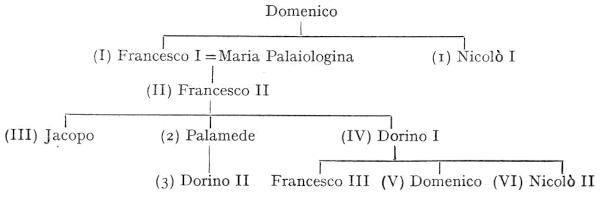
Genealogical Tree:
(The rulers of Lesbos are denoted by Roman, those of Ænos by Arabic numerals.)