IV. THE GENOESE COLONIES IN GREECE
Reading edition
I. THE ZACCARIA OF PHOCÆA AND CHIOS (1275-1329)
Genoa played a much less important part than Venice in the history of Greece. Unlike her great rival on the lagoons, she had no Byzantine traditions which attracted her towards the Near East, and it is not, therefore, surprising to find her appearing last of all the Italian Republics in the Levant. But, though she took no part in the Fourth Crusade, her sons, the Zaccaria and the Gattilusj, later on became petty sovereigns in the Ægean; the long administration of Chios by the Genoese society of the Giustiniani is one of the earliest examples of the government of a colonial dependency by a Chartered Company, and it was Genoa who gave to the principality of Achaia its last ruler in the person of Centurione Zaccaria.
The earliest relations between Genoa and Byzantium are to be found in the treaty between the two in 1155; but it was not till a century later that the Ligurian Republic seriously entered into the field of Eastern politics. After the establishment of the Latin states in Greece, the Genoese, excluded from all share of the spoil, endeavoured to embarrass their more fortunate Venetian rivals by secretly urging on their countryman, the pirate Vetrano, against Corfù, and by instigating the bold Ligurian, Enrico Pescatore, against Crete—enterprises, however, which had no permanent effect. But the famous treaty of Nymphæum, concluded between the Emperor Michael VIII and the Republic of Genoa in 1261, first gave the latter a locus standi in the Levant. Never did a Latin Community make a better bargain with a Greek ruler, for all the advantages were on the side of Genoa. The Emperor gave her establishments and the right to keep consuls at Anæa, in Chios, and in Lesbos, both of which important islands had been assigned to the Latin Empire by the deed of partition, but had been recaptured by Michael’s predecessor Vatatzes in 1225[450]. He also granted her the city of Smyrna, promised free trade to Genoese merchants in all the ports of his dominions, and pledged himself to exclude the enemies of the Ligurian Commonwealth, in other words, the Venetians, from the Black Sea and all his harbours. All that he asked in return for these magnificent concessions was an undertaking that Genoa would arm a squadron of fifty ships at his expense, if he asked for it. It was expressly stipulated that this armament should not be employed against Prince William of Achaia. Genoa performed her part of the bargain by sending a small fleet to aid the Emperor in the recovery of Constantinople from the Latins; but it arrived too late to be of any use. Still, Michael VIII took the will for the deed; he needed Genoese aid for his war against Venice; so he sent an embassy to ask for more galleys. The Genoese, heedless of papal thunders against this “unholy alliance,” responded by raising a loan for the affairs of the Levant[451]; and it was their fleet, allied with the Greeks, which sustained the defeat off the islet of Spetsopoulo, or Sette Pozzi, as the Italians called it[452], at the mouth of the Gulf of Nauplia in 1263. But the Emperor soon found that his new allies were a source of danger rather than of strength; he banished the Genoese of Constantinople to Eregli on the Sea of Marmara, and made his peace with their Venetian rivals. In vain Genoa sent Benedetto Zaccaria to induce him to revoke his decree of expulsion; some years seem to have elapsed before he allowed the Genoese to return to Galata, and it was not till 1275 that the formal ratification of the treaty of Nymphæum marked his complete return to his old policy[453], and that Manuele and Benedetto Zaccaria became the recipients of his bounty.
The Zaccaria were at this time one of the leading families of Genoa, whither they had emigrated from the little Ligurian town of Gavi some two centuries earlier. The grandfather of Manuele and Benedetto, who derived his territorial designation of “de Castro,” from the district of Sta Maria di Castello, in which he resided, had held civic office in 1202; their father Fulcho had been one of the signatories of the treaty of Nymphæum[454]. Three years before that event Benedetto had been captured by the Venetians in a battle off Tyre. Three years after it, he was sent as Genoese ambassador to Michael VIII and, though his mission was unsuccessful, the Emperor had the opportunity of appreciating his business-like qualities[455]. Early in 1275, the year when Genoa had returned to favour at the Imperial Court, the two brothers started from their native city upon the voyage to Constantinople, which was destined to bring them fame and fortune—to Manuele, the elder, the grant of the alum-mines of Phocæa at the north of the Gulf of Smyrna, to Benedetto the hand of the Emperor’s sister[456]. Phocæa at that time consisted of a single town, situated to the west of the alum-mountains; but, later on, the encroachments of the Turks led its Latin lords to build on the sea-shore at the foot of the mountain a small fortress sufficient to shelter about fifty workmen, which, with the aid of their Greek neighbours, grew into the town of New Phocæa, or Foglia Nuova, as the Italians called it. The annual rent, which Manuele paid to the Emperor, was covered many times over by the profits of the mines. Alum was indispensable for dyeing, and Western ships homeward-bound were therefore accustomed to take a cargo of this useful product at Phocæa[457]. The only serious competition with the trade was that of the alum which came from the coasts of the Black Sea, and which was exported to Europe in Genoese bottoms. A man of business first and a patriot afterwards, Manuele persuaded the Emperor to ensure him a monopoly of the market by prohibiting this branch of the Euxine trade—a protective measure, which led to difficulties with Genoa. He was still actively engaged in business operations at Phocæa in 1287, but is described as dead in the spring of the following year[458], after which date the alum-mines of Phocæa passed to his still more adventurous brother, Benedetto.
While Manuele had been accumulating riches at Phocæa, Benedetto had gained the reputation of being one of the most daring seamen, as well as one of the ablest negotiators, of his time. He was instrumental, as agent of Michael VIII, in stirring up the Sicilian Vespers and so frustrating the threatened attack of Charles I of Anjou upon the Greek Empire, and later in that year we find him proposing the marriage of Michael’s son and the King of Aragon’s daughter[459]. In the following years he was Genoese Admiral in the Pisan War, and led an expedition to Tunis; in 1288 he was sent to Tripoli with full powers to transact all the business of the Republic beyond the seas. After negotiating with both the claimants to the last of the Crusaders’ Syrian states, he performed the more useful action of conveying the people of Tripoli to Cyprus, when, in the following year, that once famous city fell before the Sultan of Egypt. In Cyprus he concluded with King Henry II a treaty, which gave so little satisfaction to the home government, that it was speedily cancelled. More successful was the commercial convention which he made with Leo III of Armenia, followed by a further agreement with that monarch’s successor, Hethum II. But his rashness in capturing an Egyptian ship compelled the Republic to disown him, and in 1291 he sought employment under a new master, Sancho IV of Castile, as whose Admiral he defeated the Saracens off the coast of Morocco[460]. From Spain he betook himself to the court of Philip IV of France, to whom, with characteristic audacity, he submitted in 1296 a plan for the invasion of England[461]. During his absence in the West, however, war broke out between the Genoese and the Venetians, whose Admiral, Ruggiero Morosini, took Phocæa and seized the huge cauldrons which were used for the preparation of the alum[462]. But upon his return he speedily repaired the walls of the city, and ere long the alum-mines yielded more than ever. Nor was this his only source of revenue, for under his brother and himself Phocæa had become a name of terror to the Latin pirates of the Levant, upon whom the famous Tartarin of the Zaccaria ceaselessly preyed, and who lost their lives, or at least their eyes, if they fell into the hands of the redoubtable Genoese captains[463]. The sums thus gained Benedetto devoted in part to his favourite project for the recovery of the Holy Land, for which he actually equipped several vessels with the aid of the ladies of his native city—a pious act that won them the praise of Pope Boniface VIII, who described him as his “old, familiar friend[464].” This new crusade, indeed, came to nought, but such was the renown which he and his brother had acquired, that the Turks, by this time masters of the Asian coast, and occupants of the short-lived Genoese colony of Smyrna, were deterred from attacking Phocæa, not because of its natural strength but because of the warlike qualities of its Italian garrison. Conscious of their own valour and of the weakness of the Emperor Andronikos II, the Genoese colonists did not hesitate to ask him to entrust them with the defence of the neighbouring islands, if he were unable to defend that portion of his Empire himself. They only stipulated that they should be allowed to defray the cost out of the local revenues, which would thus be expended on the spot, instead of being transmitted to Constantinople. Benedetto had good reason for making this offer; for Chios and Lesbos, once the seats of flourishing Genoese factories under the rule of the Greek Emperor and his father, had both suffered severely from the feeble policy of the central government and the attacks of corsairs. Twice, in 1292 and 1303, the troops first of Roger de Lluria and then of Roger de Flor had ravaged Mytilene and devastated the famous mastic-gardens of Chios—the only place in the world where that product was to be found, while a Turkish raid completed the destruction of that beautiful island[465].
Andronikos received Benedetto’s proposal with favour, but as he delayed giving a definite decision, the energetic Genoese, like the man of action that he was, occupied Chios in 1304 on his own account. The Emperor, too much engaged with the Turkish peril to undertake the expulsion of this desperate intruder, wisely recognised accomplished facts, and agreed to let him have the island for ten years as a fief of the Empire, free of all tribute, on condition that he flew the Byzantine standard from the walls and promised to restore his conquest to his suzerain at the expiration of the lease[466]. Thus, in the fashion of Oriental diplomacy, both parties were satisfied: the Italian had gained the substance of power, while the Greek retained the shadow, and might salve his dignity with the reflexion that the real ruler of Chios hoisted his colours, owed him allegiance, and was a near kinsman of his own by marriage.
This first Genoese occupation of Chios lasted only a quarter of a century; but even in that short time, under the firm and able rule of the Zaccaria, it recovered its former prosperity. Benedetto refortified the capital, restored the fallen buildings, heightened the walls, and deepened the ditch—significant proofs of his intention to stay. Entrusting Phocæa to the care of his nephew Tedisio, or Ticino, as his deputy, he devoted his attention to the revival of Chios, which at his death, in 1307, he bequeathed to his son, Paleologo, first-cousin of the reigning Emperor, while he left Phocæa to his half-brother, Nicolino, like himself a naval commander in the Genoese service. This division of the family possessions led to difficulties. Nicolino arrived at Phocæa and demanded a full statement of account from his late brother’s manager, Tedisio; the latter consented, but the uncle and the nephew did not agree about the figures, and Nicolino withdrew, threatening to return with a larger force, to turn Tedisio out of his post, convey him to Genoa, and appoint another governor, Andriolo Cattaneo della Volta, a connexion of the family by marriage, in his place. Nicolino’s son privately warned his cousin of his father’s intentions, and advised him to quit Phocæa while there was still time. At this moment the Catalan Grand Company was at Gallipoli, and there Tedisio presented himself, begging the chronicler Muntaner to enroll him in its ranks. The Catalan, moved by his aristocratic antecedents and personal courage, consented, and soon the fugitive ex-governor, by glowing accounts of the riches of Phocæa, induced his new comrades to aid him in capturing the place from his successor. The Catalans were always ready for plunder, and the alum-city was said to contain “the richest treasures of the world.” Accordingly, a flotilla was equipped, which arrived off Phocæa on the night of Easter 1307. Before daybreak next morning, the assailants had scaled the walls of the castle; then they sacked the city, whose population of more than 3000 Greeks was employed in the alum-manufactory. The booty was immense, and not the least precious portion of it was a piece of the true Cross, encased in gold and studded with priceless jewels. This relic, said to have been brought by St John the Evangelist to Ephesus, captured by the Turks when they took that place, and pawned by them at Phocæa, fell to the lot of Muntaner[467]. This famous “Cross of the Zaccaria” would seem to have been restored to that family, and we may conjecture that it was presented to the cathedral of Genoa, where it now is, by the bastard son of the last Prince of the Morea[468], when, in 1459, he begged the city of his ancestors to recommend him to the generosity of Pius II. Emboldened by this success, Tedisio, with the aid of the Catalans, conquered the island of Thasos from the Greeks and received his friend Muntaner and the Infant Ferdinand of Majorca in its castle with splendid hospitality. Six years later, however, the Byzantine forces recovered this island, whence the Zaccaria preyed upon Venetian merchantmen[469], and it was not for more than a century that a Genoese lord once again held his court in the fortress of Tedisio Zaccaria.
Meanwhile, Paleologo, in Chios, had continued the enlightened policy of his father, and reaped his reward in the renewed productiveness of the mastic-plantations. In 1314, when the ten years’ lease of the island expired, the strong fortifications, which his father had erected, and his near relationship to the Emperor procured him a renewal for five more years on the same terms[470]. He did not, however, long enjoy this further tenure, for in the same year he died, apparently without progeny. As his uncle, Nicolino, the lord of Phocæa and the next heir, was by this time also dead, the latter’s sons, Martino and Benedetto II, succeeded their cousin as joint-rulers of Chios, while Phocæa passed beneath the direct control of Nicolino’s former governor, Andriolo Cattaneo, always, of course, subject to the confirmation of the Emperor.
The two brothers, who had thus succeeded to Chios, possessed all the vigorous qualities of their race. One contemporary writer after another praises their services to Christendom, and describes the terror with which they filled the Turks. The Infidels, we are told, were afraid to approach within twelve miles of Chios, because of the Zaccaria, who always kept a thousand foot-soldiers, a hundred horsemen, and a couple of galleys ready for every emergency. Had it not been for the valour of the Genoese lords of Chios “neither man, nor woman, nor dog, nor cat, nor any live animal could have remained in any of the neighbouring islands.” Not only were the brothers “the shield of defence of the Christians,” but they did all they could to stop the infamous traffic in slaves, carried on by their fellow-countrymen, the Genoese of Alexandria, whose vessels passed Chios on the way from the Black Sea ports. Pope John XXII, who had already allowed Martino to export mastic to Alexandria in return for his services, was therefore urged to give the Zaccaria the maritime police of the Archipelago, so that this branch of the slave-trade might be completely cut off[471]. Sanudo[472], with his accurate knowledge of the Ægean, remarked that the islands could not have resisted the Turks so long, had it not been for the Genoese rulers of Chios, Duke Nicolò I of Naxos, and the Holy House of the Hospital, established since 1309 in Rhodes, and estimated that the Zaccaria could furnish a galley for the recovery of the Holy Land. Martino was specially renowned for his exploits against the Turks. No man, it was said, had ever done braver deeds at sea than this defender of the Christians and implacable foe of the Paynim. In one year alone he captured 18 Turkish pirate ships, and at the end of his reign he had slain or taken more than 10,000 Turks[473]. The increased importance of Chios at this period is evidenced by the coins, which the two brothers minted for their use, sometimes with the diplomatic legend, “servants of the Emperor[474].” Benedetto II was, however, eclipsed by the greater glories of Martino. By marriage the latter became baron of Damala and by purchase[475] lord of Chalandritza in the Peloponnese, and thus laid the foundations of his family’s fortunes in the principality of Achaia. He was thereby brought into close relations with the official hierarchy of the Latin Orient, from which the Zaccaria, as Genoese traders, had hitherto been excluded. Accordingly, in 1325, Philip I of Taranto, who, in virtue of his marriage with Catherine of Valois, was titular Latin Emperor of Constantinople, bestowed upon him the islands of Lesbos, Samos, Kos, and Chios, which Baldwin II had reserved for himself and his successors in the treaty of Viterbo in 1267,—a reservation repeated in 1294—together with those of Ikaria, Tenedos, Œnoussa, and Marmara, and the high-sounding title of “King and Despot of Asia Minor,” in return for his promise to furnish 500 horsemen and six galleys a year whenever the “Emperor” came into his own[476]. The practical benefits of this magnificent diploma were small—for Martino already ruled in Chios, with which Samos and Kos seem to have been united under the sway of the Zaccaria, while the other places mentioned belonged either to the Greeks or the Turks, over whom the phantom Latin Emperor had no power whatever. Indeed, this investiture by the titular ruler of Constantinople must have annoyed its actual sovereign, who had not, however, dared to refuse the renewal of the lease of Chios, when it again expired in 1319.
But Martino had given hostages to fortune by his connexion with the Morea. His son, Bartolommeo, was captured by the Catalans of Athens in one of their campaigns, sent off to the custody of their patron, Frederick II of Sicily, and only released at the request of Pope John XXII in 1318. As the husband of the young Marchioness of Boudonitza, he was mixed up also in the politics of Eubœa and the mainland opposite, while he is mentioned as joining the other members of his family in their attacks upon the Turks.
For a time Martino managed to preserve good relations with the Greek Empire. In 1324, the lease of Chios was again renewed, and in 1327 Venice instructed her officials in the Levant to negotiate a league with him, the Greek Emperor, and the Knights against the common peril[477]. But by this time the dual system of government in the island had broken down: Martino’s great successes had led him to desire the sole management of Chios, and he had accordingly ousted his brother from all share in the government and struck coins for the island with his own name alone, as he did for his barony of Damala[478]. His riches had become such as to arouse the suspicions of the Imperial Government that he would not long be content to admit himself “the servant of the Emperor”; the public dues of the island amounted to 120,000 gold pieces a year, while the Turks paid an annual tribute to its dreaded ruler, in order to escape his attacks. It happened that, in 1328, when the quinquennial lease had only another year to run and the usual negotiations for its renewal should have begun, that Andronikos III, a warlike and energetic prince, mounted the throne of Constantinople, and this conjunction of circumstances seemed to the national party in Chios peculiarly favourable to its reconquest. Accordingly, the leading Greek of the island, Leon Kalothetos, who was an intimate friend of the new sovereign’s Prime Minister, John Cantacuzene, sought an interview with the latter’s mother, whom he interested in his plans. She procured him an audience of the Emperor and of her son, and they both encouraged him with presents and promises to support the expedition which they were ready to undertake. An excuse for hostilities was easily found in the new fortress which Martino was then engaged in constructing without the consent of his suzerain. An ultimatum was therefore sent to him ordering him to desist from his building operations, and to come in person to Constantinople, if he wished to renew his lease. Martino, as might have been expected from his character, treated the ultimatum with contempt, and only hastened on his building. Benedetto, however, took the opportunity to lodge a complaint against his brother before the Emperor, claiming 60,000 gold pieces, the present annual amount of his half-share in the island, which he had inherited but of which the grasping Martino had deprived him.
In the early autumn of 1329, Andronikos assembled a magnificent fleet of 105 vessels, including four galleys furnished by Duke Nicolò I of Naxos, with the ostensible object of attacking the Turks but with the real intention of subduing the Genoese lord of Chios. Even at this eleventh hour the Emperor would have been willing to leave him in possession of the rest of the island, merely placing an Imperial garrison in the new castle and insisting upon the regular payment of Benedetto’s annuity. Martino, however, was in no mood for negotiations. He sank the three galleys which he had in the harbour, forbade his Greek subjects to wear arms under pain of death, and shut himself up with 800 men behind the walls, from which there floated defiantly the flag of the Zaccaria, instead of the customary Imperial standard. But, when he saw that his brother had handed over a neighbouring fort to the Emperor, and that no reliance could be placed upon his Greek subjects, he sent messengers begging for peace. Andronikos repulsed them, saying that the time for compromise was over, whereupon Martino surrendered. The Chians clamoured for his execution; but Cantacuzene saved his life, and he was conveyed a prisoner to Constantinople, while his wife Jacqueline de la Roche, a connexion of the former ducal house of Athens, was allowed to go free with her family and all that they could carry. Martino’s adherents were given their choice of leaving the island with their property, or of entering the Imperial service, and the majority chose the latter alternative. The nationalist leaders were rewarded for their devotion by gifts and honours; the people were relieved from their oppressive public burdens. To Benedetto the Emperor offered the governorship of Chios with half the net revenues of the island as his salary—a generous offer which the Genoese rejected with scorn, asserting that nothing short of absolute sovereignty over it would satisfy him. If that were refused, he only asked for three galleys to carry him and his property to Galata. Andronikos treated him with remarkable forbearance, in order that public opinion might not accuse an Emperor of having been guilty of meanness, and, on the proposal of Cantacuzene, convened an assembly of Greeks and of the Latins who were then in the island—Genoese and Venetian traders, the Duke of Naxos, the recently appointed Roman Catholic bishop of Chios and some other Frères Prêcheurs who had arrived—in order that there might be impartial witnesses of his generosity. Even those of Benedetto’s own race and creed regarded his obstinate refusal of the Imperial offer with disapprobation; nor would he even accept a palace and the rank of Senator at Constantinople with 20,000 gold pieces a year out of the revenues of Chios; nothing but his three galleys could he be persuaded to take. His object was soon apparent. Upon his arrival at Galata, he chartered eight Genoese galleys, which he found lying there, and set out to reconquer Chios—a task which he considered likely to be easy, as the Imperial fleet had by that time dispersed. The Chians, however, repulsed his men with considerable loss, the survivors weighed anchor on the morrow, and Benedetto II succumbed barely a week later to an attack of apoplexy, brought on by his rage and disappointment[479].
Martino, after eight years in captivity, was released by the intervention of Pope Benedict XII and Philip VI of France in 1337, and treated with favour by the Emperor, who “gave him a command in the army and other castles,” as some compensation for his losses[480]. In 1343, Clement VI appointed him captain of the four papal galleys which formed part of the crusade for the capture of the former Genoese colony of Smyrna from Omar Beg of Aïdin, the self-styled “Prince of the Morea[481]”—a post for which his special experience and local knowledge were a particular recommendation in the eyes of the Pope. Martino desired, however, to avail himself of this opportunity to reconquer Chios from the Greeks, and invited the Knights and the Cypriote detachment to join him in this venture, to which his friend, the Archbishop of Thebes, endeavoured to force the latter by threats of excommunication. The Pope saw, however, that this repetition on a smaller scale of the selfish policy of the Fourth Crusade would have the effect of alienating his Greek allies, and ordered the Latin Patriarch of Constantinople to forbid the attack[482]. Martino lived to see Smyrna taken in December, 1344, but on January 17, 1345, the rashness of the Patriarch, who insisted on holding mass in the old Metropolitan Church against the advice of the naval authorities, cost him his life. Omar assaulted the cathedral while service was still going on, Martino was slain, and his head presented to that redoubtable chieftain[483]. When, in the following year, the Genoese retook Chios, and founded their second long domination over it, his descendants did not profit by the conquest. But his second son, Centurione, retained his baronies in the Morea, of which the latter’s grandson and namesake was the last reigning Prince.
After the restoration of Greek rule in Chios and the appointment of Kalothetos as Imperial viceroy, Andronikos III had proceeded to Phocæa. By this time the Genoese had abandoned the old city and had strongly fortified themselves in the new town, purchasing further security for their commercial operations by the payment of an annual tribute of 15,000 pieces of silver and a personal present of 10,000 more to Saru-Khan, the Turkish ruler of the district. The Emperor, having placated this personage with the usual Oriental arguments, set out for Foglia Nuova. Andriolo Cattaneo chanced to be absent at Genoa on business, and the Genoese garrison of 52 knights and 400 foot-soldiers was under the command of his uncle, Arrigo Tartaro. The latter wisely averted annexation by doing homage to the Emperor, and handed the keys of the newly constructed castle to his Varangian guard. After spending two nights in the fortress, in order to show that it was his, Andronikos magnanimously renewed the grant of the place to Andriolo during good pleasure. But Domenico Cattaneo, who succeeded his father not long afterwards with the assent of the Emperor, lost, in his attempt to obtain more, what he already had.
Cattaneo, not content with the riches of Foglia Nuova, coveted the island of Lesbos, which had belonged for just over a century to the Greeks, and it seemed in 1333 as if an opportunity of seizing it had arisen. The increasing power of the Turks, who had by that time taken Nicæa and Brusa and greatly hindered Greek and Latin trade alike in the Ægean, led to a coalition against them; but, before attacking the common enemy, the Knights, Nicolò I of Naxos, and Cattaneo made a treacherous descent upon Lesbos, and seized the capital of the island. The crafty Genoese, supported by a number of galleys from his native city, managed, however, to outwit his weaker allies, and ousted them from all share in the conquered town, whither he transferred his residence from Foglia Nuova. Andronikos, after punishing the Genoese of Pera for this act of treachery on the part of their countrymen, set out to recover Lesbos. The slowness of the Emperor’s movements, however, enabled Cattaneo to strengthen the garrison, and Andronikos, leaving one of his officers to besiege Lesbos, proceeded to invest Foglia with the aid of Saru-Khan, whose son with other young Turks had been captured and kept as a hostage by the Genoese garrison. The place, however, continued for long to resist the attacks of the allies, till at last Cattaneo’s lieutenant prevailed upon them to raise the siege by restoring the prisoners to their parents and pledging himself to obtain the surrender of the city of Mytilene, which still held out, and which the Emperor, fearing troubles at home, had no time to take. Cattaneo, indeed, repudiated this part of the arrangement, and bribery was needed to seduce the Latin mercenaries and thus leave him unsupported. From Lesbos he retired to Foglia, which the Emperor had consented to allow him to keep on the old terms; but four years later, while he was absent on a hunting party, the Greek inhabitants overpowered the small Italian garrison and proclaimed Andronikos III[484]. Thus ended the first Genoese occupation of Phocæa and Lesbos—the harbinger of the much longer and more durable colonisation a few years later. Two gold coins, modelled on the Venetian ducats, of which the first of them is the earliest known counterfeit, have survived to preserve the memory of Andriolo and Domenico Cattaneo, and to testify to the riches of the Foglie under their rule[485].
APPENDIX
DIGEST OF GENOESE DOCUMENTS
22-24 Aug. 1285. Fourteen documents of these dates refer to the mercantile transactions of Benedetto and Manuele Zaccaria, such as their appointment of agents to receive their wares from “Fogia” and to send them to Genoa, Majorca, Syria, the Black Sea, and other places.
(Pandette Richeriane, fogliazzo ii. fasc. 10.)
17 April, 1287. “Benedetto Zaccaria in his own name and in that of his brother Manuele” gives a receipt at Genoa to “Percivalis Spinula.”
(Ibid. fasc. 20.)
24 Jan. 1287. “Nicolino” is mentioned as brother of Benedetto and Manuele Zaccaria.
(Ibid. fogliazzo i. fasc. 178.)
9 May, 1291. “Clarisia, wife of the late Manuele Zaccaria, in her own name and on behalf of her sons Tedisio, Leonardo, Odoardo and Manfred,” appoints an agent for the sale of a female slave.
(Ibid. fogliazzo ii. fasc. 27.)
14 April, 1304. “Paleologo Zaccaria” is cited as witness to a monetary transaction.
(Ibid. fogliazzo A. fasc. 7.)
31 May, 1311. Two documents executed at Genoa. In one Domenico Doria acknowledges receipt of monies from Andriolo Cattaneo, son of Andriolo; in the other Andriolo appoints Lanfranchino Doria and Luchino Cattaneo his agents.
(Ibid. fasc. 7.)
13 Aug. 1313. “Manuel Bonaneus” acknowledges receipt of monies from Andriolo Cattaneo.
(Ibid. fasc. 13.)
21, 24 Sept. 1316. Mention of “the galley of Paleologo Zaccaria, which was at Pera in 1307.”
(Ibid. fasc. 13.)
GENOESE COLONIES IN GREEK LANDS
I. Lords of Phocæa (Foglia).
Manuele Zaccaria. 1275.
Benedetto I ” 1288.
[Tedisio ” governor. 1302-7.]
Nicolino ” 1307.
Andriolo Cattaneo della Volta, governor, 1307; lord, 1314.
Domenico ” ” ” 1331-40.
[Byzantine. 1340-6.]
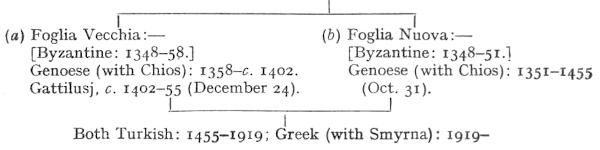
Genoese (with Chios). 1346-8.
II. Lords of Chios, Samos and Ikaria.
[Latin Emperors: 1204-25; Greek Emperors: 1225-1304.]
Benedetto I Zaccaria. 1304.
Paleologo ” 1307.
Benedetto II ”}
Martino ” } 1314-29.
[Byzantine. 1329-46.]
III. Lords of Lesbos.
[Latin Emperors: 1204-25; Greek Emperors: 1225-1333.]
Domenico Cattaneo. 1333-6.
[Byzantine. 1336-55.]
Francesco I Gattilusio. 1355.
Francesco II ” 1384.
[Nicolò I of Ænos, regent. 1384-7.]
Jacopo Gattilusio. 1404.
[Nicolò I of Ænos again regent. 1404-9.]
Dorino I Gattilusio: succeeded between March 13, 1426, and October 14, 1428.
[Domenico ” regent 1449-55.]
Domenico ” 1455.
Nicolò II ” 1458-62.
[Turkish: 1462-1912; Greek: 1912- .]
IV. Lords of Thasos.
Tedisio Zaccaria. 1307-13.
[Greek Emperors. 1313-c. 1434.]
Dorino I Gattilusio. c. 1434 or ? c. 1419.
? Jacopo Gattilusio. c. 1419.
[Oberto de’ Grimaldi, governor. 1434.]
Francesco III Gattilusio. 1444-c. 1449.
Dorino I ” again. c. 1449.
[Domenico, regent. 1449-55.]
Domenico. 1455. (June 30-October.)
[Turkish: 1455-6; Papal: 1456-9; Turkish: 1459-60; Demetrios Palaiologos: 1460-6; Venetian: 1466-79; Turkish: 1479-1912; Greek: 1912- .]
V. Lords of Lemnos.
[Navigajosi, Gradenighi, Foscari: 1207-69; Greek Emperors: 1269-1453.]
Dorino I Gattilusio. 1453. (Castle of Kokkinos from 1440.)
[Domenico, regent. 1453-5.]
Domenico. 1455-6.
[Nicolò II, governor. 1455-6.]
[Turkish: 1456; Papal: 1456-8; Turkish: 1459-60; Demetrios Palaiologos: 1460-4; Comnenos: 1464; Venetian: 1464-79; Turkish: 1479-1656; Venetian: 1656-7; Turkish (except for Russian occupation of 1770): 1657-1912; Greek: 1912- .]
VI. Lords of Samothrace.
[Latin Emperors: 1204-61; Greek Emperors: 1261-c. 1431.]
Palamede Gattilusio. c. 1431.
[Joannes Laskaris Rhyndakenos, governor: 1444-55.]
Dorino II Gattilusio. 1455-6.
[Turkish: 1456; Papal: 1456-9; Turkish: 1459-60; Demetrios Palaiologos: 1460-6; Venetian: 1466-79; Turkish: 1479-1912; Greek: 1912- .]
VII. Lords of Imbros.
[Latin Emperors: 1204-61; Greek Emperors: 1261-1453.]
Palamede Gattilusio. 1453.
[Joannes Laskaris Rhyndakenos, governor.]
Dorino II Gattilusio. 1455-6.
[Turkish: 1456-60; Demetrios Palaiologos: 1460-6; Venetian: 1466-70; Turkish: 1470-1912; Greek: 1912-14; Turkish: 1914-20; Greek: 1920- .]
VIII. Lords of Ænos.
Nicolò I Gattilusio. c. 1384.
Palamede ” 1409.
Dorino II ” 1455-6.
[Turkish: 1456-60; Demetrios Palaiologos: 1460-8; Turkish: 1468-1912; Bulgarian: 1912-3; Turkish: 1913-20; Greek: 1920- .]
IX. Smyrna.
Genoese. 1261-c. 1300.
[Turkish, c. 1300-44.]
Genoese. 1344-1402.
[Mongol: 1402; Turkish, interrupted by risings of Kara-Djouneïd: 1402-24; continuously Turkish: 1424-1919; Greek (“under Turkish sovereignty”): 1919- .]
X. Famagosta.
Genoese: 1374-1464.
[Banca di San Giorgio: 1447-64; Lusignans: 1464-89; Venetian: 1489-1571; Turkish: 1571-1878; British (under Turkish suzerainty): 1878-1914; British: 1914- .]
2. THE GENOESE IN CHIOS (1346-1566)
Of the Latin states which existed in Greek lands between the Latin conquest of Constantinople in 1204 and the fall of the Venetian Republic in 1797, there were four principal forms. Those states were either independent kingdoms, such as Cyprus; feudal principalities, of which that of Achaia is the best example; military outposts, like Rhodes; or colonies directly governed by the mother-country, of which Crete was the most conspicuous. But the Genoese administration of Chios differed from all the other Latin creations in the Levant. It was what we should call in modern parlance a Chartered Company, which on a smaller scale anticipated the career of the East India and the British South Africa Companies in our own history.
The origins of the Latin colonization of Greece are usually to be found in places and circumstances where we should least expect to find them. The incident which led to this Genoese occupation of the most fertile island of the Ægean is to be sought in the history of the smallest of European principalities—that of Monaco, which in the first half of the fourteenth century already belonged to the noble Genoese family of Grimaldi, which still reigns over it. At that time the rock of Monaco and the picturesque village of Roquebrune (between Monte Carlo and Mentone) sheltered a number of Genoese nobles, fugitives from their native city, where one of those revolutions common in the mediæval republics of Italy had placed the popular party in power. The proximity and the preparations of these exiles were a menace to Genoa, but the resources of the republican treasury were too much exhausted to equip a fleet against them at the cost of the state. Accordingly, an appeal was made to the patriotism of private citizens, whose expenses were to be ultimately refunded, and in the meanwhile guaranteed by the possession of any conquered territory. In response to this appeal, twenty-six of the people and three nobles of the popular party equipped that number of galleys, which were placed under the command of Simone Vignoso, himself one of the twenty-nine privateers. On April 24, 1346, the fleet set sail; and, at its approach, the outlawed nobles fled to Marseilles, whence many of them entered the French army and died four months later fighting at Crécy against our King Edward III.
The immediate object for which the fleet had been fitted out had been thus accomplished. But it seemed to Vignoso a pity that it should not be employed, and the Near East offered a tempting field for its activities. The condition of south-eastern Europe in 1346 might perhaps be paralleled with its situation in later times. An ancient empire, which Gladstone described as “more wonderful than anything done by the Romans,” enthroned on the Bosporos with one brief interval for ten centuries, was obviously crumbling away, and its ultimate dissolution was only a question of time. A lad of fourteen, John V Palaiologos, sat on the throne of the Cæsars, while a woman and a foreigner, the Empress-mother Anne of Savoy, governed in his name. Against her and her son the too-powerful Grand Domestic (or, as we should say, prime minister), John Cantacuzene, whom posterity remembers rather as an historian than as an Emperor, had raised the standard of revolt. In Asia Minor Byzantium retained nothing but the suburb of Scutari, Philadelphia, and the two towns of Phocæa. Independent emirs ruled the south and centre, the Ottomans the north, whence in seven years they were to cross into Europe, in eight more to transfer their capital to Adrianople. Already the European provinces of Byzantium were cut short by the frontier of the Bulgarian Empire and still more by the rapid advance of Serbia, then the most powerful state in the Balkan peninsula. Seventeen days before Vignoso sailed for the East, the great Serbian conqueror and lawgiver, Stephen Dushan, one of the most remarkable figures in mediæval history, was crowned at Skoplje “Emperor of the Serbs and Greeks” and had proposed to Genoa’s rival, Venice, an alliance for the conquest of the Byzantine Empire. Greece proper, with the exception of the Byzantine province in the Morea, was parcelled out between Latin rulers, while Byzantium had no fleet to protect her outlying territories. Under these circumstances a commercial Italian republic might not unnaturally seek to peg out claims in the midst of the general confusion in the East, where only two years before Smyrna, formerly a Genoese colony, had been recaptured from the Turks.
Vignoso’s first intention was to protect the Genoese settlements on the Black Sea against the attacks of the Tartars; but information received at Negroponte, where he touched on the way, led him to change his plans. There he found a fleet of Venetian and Rhodian galleys, under the Dauphin of Vienne, preparing to occupy Chios as a naval base for operations against the Turks in Asia Minor. Vignoso and his associates were offered large sums for their co-operation, but their patriotism rejected the idea of handing over to the rival republic an island which had belonged to the Genoese family of Zaccaria from 1304 to 1329, and which as recently as seventeen years earlier had been recovered by the Greeks. They made all sail for Chios, and offered to assist the islanders against a Venetian attack, if they would hoist the Genoese flag and admit a small Genoese garrison. The scornful refusal of the garrison was followed by the landing of the Genoese; four days sufficed to take the rest of the island; but the citadel made such a spirited resistance that three months passed before food gave out and on September 12 the capitulation was signed. The governor, Kalojanni Cybo, himself of Genoese extraction, and a member of the well-known Ligurian family which afterwards produced Pope Innocent VIII, made excellent terms for himself and his relatives, while the Greeks were to enjoy their former religious liberties and endowments, their property, and their privileges. A Genoese governor was to be appointed to administer the island according to the laws of the Republic, and 200 houses in the citadel were assigned at once for the use of the Genoese garrison. Vignoso proved by his example that he meant to keep these promises. He ordered his own son to be flogged publicly for stealing grapes from a vineyard belonging to one of the natives, and bequeathed a sum of money for providing poor Chiote girls with dowries as compensation for any damage that he might have inflicted upon the islanders.
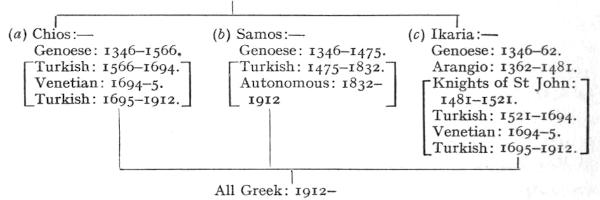
Vignoso completed the conquest of Chios by the annexation of Old and New Phocæa, or Foglia Vecchia and Nuova, as the Italians called them, almost the last Byzantine possessions on the coast of Asia Minor, and celebrated for their valuable alum-mines, whence English ships used to obtain materials for dyeing, and of the neighbouring islands of Psara, or Santa Panagia, Samos, Ikaria, and the Œnoussai[486]. All these places had belonged to the former Genoese lords of Chios, with whose fortunes they were now reunited. The two Foglie, with the exception of a brief Byzantine restoration, remained in Genoese hands till they were conquered by the Turks in 1455; Foglia Vecchia, after about 1402, being administered by the Gattilusj of Lesbos, Foglia Nuova being leased to a member of the maona for life or a term of years. Samos and Psara were abandoned in 1475 from fear of corsairs, and their inhabitants removed to Chios, whilst the harbourless Ikaria, where pirates could not land, was in 1362 granted to the Genoese family of Arangio, which held it with the title of Count until 1481. In that year it was ceded for greater security to the knights of Rhodes, and remained united with that island till it too was conquered by the Turks in 1522. Vignoso desired to add the rich island of Lesbos and the strategic island of Tenedos, which, as we have been lately reminded, commands the mouth of the Dardanelles, to his acquisitions. But his crews had had enough of fighting, and were so mutinous that he returned to Genoa[487].
The Genoese exchequer was unable to repay to Vignoso and his partners their expenses, amounting to 203,000 Genoese pounds (£79,170 of our money) or 7000 for each of the twenty-nine galleys, the Genoese pound being then, according to Desimoni, worth 9 lire 75 centesimi. Accordingly, by an arrangement made on February 26, 1347, it was agreed that the Republic should liquidate this liability within twenty years and thereupon become the direct owner of the conquered places, which in the meanwhile were to be governed—and the civil and criminal administration conducted—in her name. The collection of taxes, however, and the monopoly of the mastic, which was the chief product of the island, were granted to the twenty-nine associates in the company, or mahona, as it was called. The origin of this word is uncertain. In modern Italian maona means a “lighter”; but those vessels of Turkish invention are not mentioned before 1500. On the other hand, we read of a maona, or madona (as it is there written), in connexion with a Genoese expedition to Ceuta in a document of 1236, and it has, therefore, been suggested that maona is a Ligurian contraction of Madonna, and that such trading companies were under the protection of Our Lady, whose image was to be seen on the palace of the Giustiniani at Genoa. At any rate, the name was applied to other Genoese companies, to the Old and New maona of Cyprus, founded in 1374 and 1403, and to the maona of Corsica, founded in 1378. Other derivations are from the Greek word μονάς (“unit”), the Genoese mobba (“union”), and the Arabic me-unet (“subsidy”)[488].
This convention with the maonesi[489] was to be valid only as long as the popular party remained in power at Genoa. The Republic was to be represented in Chios by a podestà, selected annually out of a list of twenty Genoese democrats submitted in February by the Doge and his council to the maonesi; from these twenty the maonesi were to choose four, and one of these four was then appointed podestà by the Doge and council. Should the first list of twenty be rejected by the maonesi, a second list was to be prepared by the home government. The podestà was to swear to govern according to the regulations of Genoa and the convention concluded by Vignoso with the Greeks. Twice a year he went on circuit through the island to hear the complaints of the natives, and no maonese was allowed to accompany him on those journeys. Another officer of the Republic was the castellano, or commander of the castle of Chios, likewise chosen annually, from a list of six names, submitted to the Duke and his council by the maonesi. This officer was bound to find security to the amount of 3000 Genoese pounds (£1170) for his important charge. A podestà and castellano for Foglia Nuova and the castellano of Foglia Vecchia, who had the powers of a podestà, were appointed in the same way. These officials were responsible for their misdeeds to a board of examiners, and the podestà was assisted by six, afterwards twelve, councillors called gubernatores, elected by the maonesi or other nominees, in everything except his judicial work, where their co-operation was at his discretion. Salaries were not high; those of the podestà of Chios and Foglia Nuova were only 1250 (or £560) and 600 hypérpera (or £268 16s.) respectively; those of the three castellani ranged from 400 to 500 (or £179 4s. to £224). Out of these sums they had to keep and clothe a considerable retinue. Local officials called generically rettori, but familiarly known as codespótæ (“joint lords”) or protogérontes (“chief elders”) in the eight northern, and as logariastaí (or “calculators”) in the four southern or mastic districts of Chios, were appointed by the podestà.
The podestà had the right of coining money, provided that his coins bore the effigy of the Doge of Genoa and the inscription “Dux Ianuensium Conradus Rex” in memory of Conrad III, King of the Romans, who in 1138 had conceded to the Republic the privilege of a mint on condition that her coins always bore his name[490]. This condition was not, however, always observed in the Chiote mint. The maonesi between 1382 and 1415 coined base imitations of the Venetian zecchini, a practice likewise adopted by Francesco I Gattilusio of Lesbos, and by Stephen Urosh II of Servia, and which procured for the latter a place among the evil kings in the Paradiso[491] of Dante. From 1415 the name and figure of St Laurence, the patron saint of the cathedral at Genoa, and the initial or name of the Doge began to appear on the Chiote coins; during the Milanese domination of Genoa two Dukes of Milan, Filippo Maria Visconti and Galeazzo Maria Sforza, figured on the currency of the island, and two issued during the French protectorate of Genoa (1458-61) actually bear the kneeling figure of Charles VII[492]. Finally, from 1483 small pieces bear the initials of the podestà. The financial affairs of the company were entrusted to two officials known as massarj, who were obliged to send in annual accounts to the Genoese Audit Office. Lastly, Chios was to be a free port for Genoese ships, which were to stop a day there on the voyage to Greece or between Greece and Syria, but no Genoese outlaws were to be harboured there. Thus, while the nominal suzerainty was vested in the home government, the real usufruct belonged to the company, especially as the former was never able to clear off its liabilities to the latter.
The members of the maona soon began to tire of their bargain and to sell their shares. Vignoso died, most of his partners resided at Genoa, and only eleven years after the constitution of the original company the island was in the possession of eight associates, of whom one alone, Lanfranco Drizzacorne, had been a member of the old maona. These persons, being mainly absentees, had farmed out the revenues to another company, formed in 1349 for the extraction of mastic, and consisting of twelve individuals under the direction of Pasquale Forneto and Giovanni Oliverio. Difficulties arose between the eight partners and their lessees; the Republic intervened, and, by the good offices of the Doge of Genoa, Simone Boccanegra, a fresh arrangement[493] was made on March 8, 1362. The island was farmed out for twelve years to the twelve persons above mentioned or their heirs, who collectively formed an “inn” (or albergo), and, abandoning their family names, called themselves both collectively and individually the Giustiniani—a name assumed three years earlier by the members of the old maona, and perhaps derived from the palace where their office was. One of the twelve partners, Gabriele Adorno, alone declined to merge that illustrious name in a common designation. The members of this new maona were to enjoy the revenues of the island in equal shares; but the Republic reserved to herself the right of purchasing Chios before February 26, 1367, the date fixed by the previous arrangement for the liquidation of her original debt of 203,000 Genoese pounds; if that date were allowed to pass without such payment, the Republic could not exercise the right of purchase for three years more; if no payment were made by February 26, 1374, that right would be forfeited altogether. No member of the new company could sell his twelfth or any fraction of it (for each twelfth was divided into three parts called caratti grossi and each of these three was subsequently subdivided into eight shares, making 288 caratti piccoli in all) to any of his partners, but, with the consent of the Doge, he might substitute a fresh partner in his place, provided always that the number of the partners remained twelve and that they belonged to the popular party at Genoa. The number was not, however, strictly maintained. Thus, while at first the partners were twelve, viz. Nicolò de Caneto, Giovanni Campi, Francesco Arangio, Nicolò di S. Teodoro, Gabriele Adorno, Paolo Banca, Tommaso Longo, Andriolo Campi, Raffaelle di Forneto, Lucchino Negro, Pietro Oliverio, and Francesco Garibaldi, there was soon added a thirteenth in the person of Pietro di S. Teodoro, whose share, however, only consisted of two caratti grossi, or sixteen caratti piccoli, that is to say, two-thirds of the share of each of the other members. In the very next year some of the partners retired to Genoa, selling their shares, and thus two entire twelfths came into the possession of the same individual, Pietro Recanelli, who had succeeded Vignoso as the leading spirit of the company. Later on, the shares became subdivided to such an extent that at the date of the Turkish conquest more than 600 persons held fractions of them. The shareholders were entitled not only to their dividends but also to a proportionate share of the local offices, of which two or three were attached to each share, but no shareholder could hold the more important for two consecutive years.
When the term for the purchase of the island by the Genoese Republic drew near, her treasury, exhausted by the war arising out of her quarrels with the Venetians in Cyprus, was unable to liquidate its debt to the company of 203,000 Genoese pounds, at that time (owing to the change in the value of the pound) equivalent to 152,250. Anxious not to forfeit her right of purchase, the Republic paid to the company collectively this sum, which she had first borrowed from the chief members of it in their individual capacity as bankers. By this financial juggle she became possessed of Chios; but, in order to pay the interest on her new loan, she let the island for twenty years more to the maonesi, who were to deduct from its revenues the amount of the interest and remit the balance, calculated at 2000 gold florins, to the Genoese exchequer. Seven years’ balance was to be paid in advance. But such was the financial distress of Genoa that the government in 1380 was obliged to mortgage this annual balance to the bank of St George for 100,000 Genoese pounds. The company then came to the aid of the mother-country, and voluntarily offered to furnish a loan of 25,000 Genoese pounds. In return, the Republic, by a convention of June 28, 1385, renewed the lease of Chios, which would otherwise have expired in 1394, till 1418. Five years before the latter date it was again renewed, in return for a fresh loan of 18,000 Genoese pounds, till 1447; again, in 1436, in consideration of a further loan of 25,000, it was prolonged till 1476, when it was extended to 1507 and then till 1509. Then, at last, the Republic not only resolved to pay off the maonesi, but even raised the money for the purpose; but the shareholders protested that 152,250 Genoese pounds were no longer sufficient in view of the altered value of the pound (then worth only 3 lire 73 c.) and the large sums which they had advanced. Payment was accordingly postponed till 1513, when it was decided to leave the island in the hands of the Giustiniani till 1542, with some modifications of their charter. In 1528, however, it was finally agreed to lease Chios to them in perpetuity, in return for an annual rent of 2500 Genoese pounds. At that time most of the shareholders were enrolled in the Golden Book of Genoa.
Such were the arrangements between the company and the mother-country, arrangements which worked so well that in 220 years there was only one revolt against her, when Marshal Boucicault occupied Genoa for the King of France. Considering their contract thereby annulled, the Giustiniani deposed the podestà and on December 21, 1408, proclaimed their independence. Venice allowed them to buy provisions and arms; but in June, 1409, a Genoese force under Corrado Doria forced them to yield[494]. Let us now look at their relations with foreign powers. Of these, three were at one time or another a menace to their existence—the Greek Empire, Venice, and the Turks. Both Anne of Savoy[495] and Cantacuzene demanded the restoration of Chios from the Republic, which replied that no official orders had been given for its capture and the government could assume no responsibility for the acts of a private company, nor could it dislodge the latter without great expense; at some future date, however, when circumstances were more favourable, it would undoubtedly be possible to restore it to the Emperor. The latter was not satisfied with this reply, but bade the Genoese envoys, who were sent to pacify him, fix a definite date for the evacuation of Chios. It was then agreed between him and the Republic that the maonesi should retain the city of Chios, and enjoy its revenues, for ten years, on condition that they paid an annual tribute of 12,000 gold pieces to the Emperor, hoisted his flag, mentioned his name in their public prayers, and received their metropolitan from the church of Constantinople. The rest of the island, including the other forts, was to belong to the Emperor, and to be governed by an Imperial official, who was to decide all disputes between the Greeks, while those between a Greek and a Latin were to be referred to the two Byzantine and Genoese authorities sitting together. At the end of the ten years, calculated from Cantacuzene’s occupation of Constantinople, the Genoese were to evacuate Chios altogether. Vignoso and his co-partners, however, declined to be bound by an arrangement made between the Emperor and the Republic, whereupon Cybo attempted to restore Greek rule, and perished in the attempt. The two Foglie were, however, temporarily reoccupied[496], but the Greek peril ceased when the Emperor John V Palaiologos in 1363 granted Chios to Pietro Recanelli and his colleagues in return for an annual payment of 500 hypérpera (or £224)[497]. Eight years earlier the position of the maona had been strengthened by the same Emperor’s gift of Lesbos as his sister’s dowry to another Genoese, Francesco Gattilusio, whose family, as time went on, ruled also over Thasos, Lemnos, Samothrace, Imbros, and the town of Ænos on the mainland, in 1913 the Turkish frontier in Europe. In 1440 John VI renewed the charter of 1363.
Venice was a more obstinate rival. The war which broke out between the two Republics in 1350 involved Chios, for a defeated Genoese squadron took refuge there. But Vignoso, with his usual energy, fitted out a flotilla, sailed to Negroponte, captured the castle of Karystos, ravaged Keos, and hung the keys of Chalkis as a trophy over the castle-gate of Chios—a humiliation avenged by the despatch of a Venetian squadron which carried off many of the islanders[498]. During the struggle of the two Italian commonwealths for the possession of Tenedos (granted to Genoa by Andronikos IV in 1376), Foglia Vecchia was attacked and the suburbs of Chios laid in ashes. For a time the common danger from the Turks united the Venetians and the Genoese company; but in 1431-2 a Venetian fleet bombarded the town. The captain of the Venetian foot-soldiers, who bore the appropriate name of Scaramuccia, was killed while laying a mine, and the admiral, Mocenigo, contented himself with ravaging the mastic-gardens. On his return home he was condemned to ten months’ imprisonment in the Pozzi, while his Genoese rival, Spinola, carried off the keys of Karystos to adorn the castle of Chios, where they were still visible in the sixteenth century[499].
There remained the most serious of all enemies—the Turks. Murad I, who died in 1389, had already levied tribute from Chios[500]; Mohammed I in 1415 fixed this sum at 4000 gold ducats, while the lessee of Foglia Nuova paid 20,000 out of the profits of the alum mines. By this system of Danegeld the maonesi kept on fairly good terms with the Turks till the capture of Constantinople. The active part taken in its defence by one of the Giustiniani, whose name will ever be connected with that of the heroic Constantine XI, exasperated Mohammed II against Chios, whither the chalices and furniture from the Genoese churches of Pera were removed, and many of the survivors fled for safety. An increase of the tribute to 6000 ducats was accepted[501]. But in 1455 the Turks sent two fleets to Chios under the pretext of collecting a debt for alum, alleged to have been supplied to the maona by Francesco Drapperio, former lessee of Foglia Nuova, and then established at Pera[502]. These expeditions cost the company Foglia Nuova, but it gained a further respite by the payment of a lump sum of 30,000 gold pieces and the increase of the annual tribute to 10,000 ducats. In vain it appealed to Genoa and to the Pope; in vain on April 7, 1456, the Republic wrote to our King Henry VI[503], then struggling against the Yorkists, for assistance, reminding him that there had been few wars against the infidels in which the most Christian Kings of England had not borne a great part of the toils and dangers. The extinction of the Lesbian principality of the Gattilusj in 1462, the taking of Caffa in 1475, the capture of the Venetian colony of Negroponte by the Turks in 1479, were signs of what was in store for Chios, now completely isolated. The maonesi in vain wrote to Genoa, threatening to abandon the island, if help were not forthcoming, and offered to cede it to her altogether. “We cannot put our hands,” so ran their letter, “on 100 ducats; we owe 10,000. The Genoese mercenaries sent us were very bad. Send us none from the district between Rapallo and Voltri, for they quarrel daily, steal by day and night, and pay too much attention to the Greek ladies,” whose charms were the theme of every visitor to the island[504]. The only means of maintaining independence was to pay tribute punctually and to propitiate any persons who might be influential at the Porte, notably the French ambassadors, two of whom visited Chios in 1537 and 1550. Finally, in 1558 Genoa disavowed all connexion with the island, and instructed her representative at Constantinople to repudiate her sovereignty over it[505].
Then came the final catastrophe. The company was no longer able to provide the annual tribute, which had risen to 14,000 gold pieces, and to give the usual presents, valued at 2000 ducats, of scarlet cloth to the Turkish viziers, “a race of men full of rapacity and avarice,” as De Thou called them. It was accused of having betrayed the Turkish plans against Malta to the knights and thus helping to stultify the siege of that island in 1565; while the fugitive slaves who found refuge in Chios were a constant source of difficulties. One of them was the property of the grand vizier; the podestà, Vincenzo Giustiniani, called upon either to give him up or pay compensation, confided the latter to an emissary, who absconded with the money. Thereupon Pialì Pasha, a Hungarian renegade in the Turkish service, appeared off Chios with a fleet of from 80 to 300 sail on Easter Monday, April 15, 1566. The pasha told the Chiotes that he would not land, as he did not wish to disturb the Easter ceremonies. Next day he entered the harbour and demanded the tribute. After having landed and studied the strategic position, he invited the podestà and the twelve “governors” on board to confer with him, and clapped them into irons. On April 17, as an inscription[506] in the chief mosque, then a church, still tells us, he took the town, and the flag of St George with the red cross gave way to the crescent almost without resistance.
The fall of Genoese rule was ennobled by the heroism of the bishop, Timoteo Giustiniani, who bade a renegade kill him rather than profane the mass, and by the martyrdom of eighteen boys, who died rather than embrace Islâm—a scene depicted by Carlone in the chapel of the Ducal Palace at Genoa[507]. The other boys between the ages of twelve and sixteen were enrolled in the corps of janissaries, while the leading maonesi were exiled to Caffa, whence some of them, thanks to the intervention of the French ambassador, returned to Chios or Genoa[508]. In vain they demanded from the home government compensation for the loss of their island. As late as 1805 their descendants were still trying to recover a sum of money, deposited with the bank of St George, and in 1815 the bank ceased to exist and with it the last faint hope of repayment. There were, however, some lucky exceptions to these misfortunes. Thus Vincenzo Negri Giustiniani, who was a child of two at the date of the Turkish conquest, came to Rome, was created by Pope Paul V in 1605 first marquess of Bassano, and in 1610 built the Palazzo Giustiniani, now the seat of the Italian Freemasons and of the Prussian Historical Institute. Professor Kehr, the director of that body, informs me, however, that there is no trace there of the Chiote inscription of 1522, which is said to have been removed thither[509]. On the other hand, although the Turks destroyed many churches, Chios still abounds with Latin monuments[510], in which the arms of the Giustiniani—a castle of three towers, surmounted after 1413 by the imperial eagle granted by the Emperor Sigismund[511]—are conspicuous. It may be of interest to mention that when in 1912, an Italian attack upon Chios was contemplated, orders were issued to spare the historical monuments of Chios. That island, however, with the exception of a brief Venetian occupation in 1694-5, remained Turkish till November 24, 1912, when a Greek force landed and on the following day easily captured the capital, which thus, for the first time since 1346, passed from under foreign domination.
We may now ask ourselves whether the rule of the company was successful. Financially, it certainly was. Even in its latter days, when heavy loans had been contracted with the bank of St George and the Turkish tribute was 14,000 gold ducats, a dividend of 2000 ducats was paid on each of the thirteen original shares; while in its best times the small caratto, originally worth some 30 Genoese pounds, was quoted at 4930. Chios during the middle ages was one of the most frequented marts of the Levant, while the alum of Foglia Nuova (which, as long as that factory remained Genoese, covered the annual rent to Genoa) and the mastic of the island (in which a part of the Turkish tribute was paid) were two valuable sources of revenue. The production of mastic was carefully organised. The company leased to each hamlet a certain area of plantation, and the lessees once a year handed in a certain weight of mastic in proportion to the number of the trees. If it were a good year and the yield were greater, they received a fixed price per pound for the excess quantity delivered; but if they failed to deliver the stipulated amount, they had to pay twice that sum[512]. In order to keep up prices in years of over-production, all the mastic over a certain amount was either warehoused or burned. Special officials divided the net profit accruing from its sale among the shareholders; no private person might sell it to foreigners; and thefts or smuggling of the precious gum, if committed on a small scale, cost the delinquent an ear, his nose, or both; if on a large scale, brought him to the gallows. Another curious source of revenue was the tax on widows[513]. The latter must have had ample opportunities of avoiding the penalty, for the courtesy and beauty of the Chiote ladies was the theme of every traveller. Indeed, one impressionable Frenchman[514] proclaimed Chios to be “the most agreeable residence” with which he was acquainted, while another visitor[515] declared their natural charm, the elegance of their attire, and the attraction of their gestures and conversation to be such “that they might rather be judged to be nymphs or goddesses than mortal women or maids.” He then, greatly daring, attempts a detailed description of their costume, upon which I shall not venture. Nor were amusements lacking. The inhabitants were musical; they were wont to dance by the Skaramangkou torrent; the chief religious feasts were kept in state; and Cyriacus of Ancona[516] was a witness of the festivities which accompanied the carnival in what Bartolomeo dalli Sonetti[517], another traveller of the fifteenth century, called the first island of the Archipelago.
There was more intellectual life at Chios than in some of the Latin settlements in the Levant; indeed, the two Genoese colonies of Chios and Lesbos stood higher in that respect than most of the Venetian factories. The list of authors during the period of the maona is considerable. Among them we may specially notice Leonardo Giustiniani, archbishop of Lesbos, but a native of Chios, and author of a curious treatise, De vera nobilitate, intended as a reply to the book De nobilitate of the celebrated scholar, Poggio Bracciolini. But the chief value of the literary divine for us at the present day is the graphic account which he has left us in two letters, addressed respectively to Popes Nicholas V and Pius II, of the Turkish conquest of Constantinople in 1453 and of Lesbos in 1462—accounts of the greatest historical interest, because their author was an eyewitness of what he described. In Gerolamo Garibaldi Giustiniani, born in Chios in 1544, the island found an historian, who wrote in French a work entitled La Description et Histoire de l’Isle de Scios, ou Chios; Vincenzo Banca Giustiniani, another Latin Chiote, edited the works of St Thomas Aquinas; while Alessandro Rocca Giustiniani translated portions of Aristotle and Hippocrates. But the most curious local literary figure of the period was Andriolo Banca Giustiniani (1385-1456), who sang in Italian verse the Venetian siege of Chios[518] of 1431. The poet was a man of taste and had the means to satisfy it; he constructed near the so-called “School of Homer” (who, according to Thucydides, was a native of Chios) an “Homeric villa” in a forest of pines near a crystal well, where he was visited by the well-known antiquary and traveller, Cyriacus of Ancona, his frequent correspondent[519]. This elegant Chiote accumulated a library of 2000 manuscripts, and for him Ambrogio Traversari of Florence translated into Latin the treatise on the Immortality of the Soul by the fifth-century philosopher, Æneas of Gaza. His son, in 1474, entertained at his villa a greater even than the archæologist of Ancona, then, however, only a modest ship’s captain, the future discoverer of America, Christopher Columbus. The culture, however, of the Giustiniani seems to have been mainly Latin—a fact explained by their practice of sending their sons to be educated at Genoa, Pavia, Padua, or Bologna; and it was from Italy that they summoned the architects to build their palaces “of divers kinds of marbles, with great porticoes and magnificent galleries,” and their villas, of which there were more than 100 in the last century of their rule. It was only just before the Turkish conquest that they thought of founding a university[520].
But we must also look at the picture from another point of view—that of the governed. The judgment of Finlay that the rule of the company was “the least oppressive government in the Levant” seems by the light of later research to need qualification. If we are to take as our standard the happiness of the people as a whole, then of all the Latin establishments in the Levant Lesbos comes first. But for that there were special reasons. The first Gattilusio came to Lesbos not as a foreign conqueror, but as brother-in-law of the Greek Emperor; he soon spoke the language of his subjects; his successors wrote in Greek, and as time went on the family became hellenized. But a company is apt to be deficient on the human side; and this would seem to have been the weak point of the maona. Quite early in its career a conspiracy of the Greeks was discovered, which led to the permanent expulsion of the metropolitan and the substitution in his place of a vicar, called Δίκαιος (or “the Just”), elected by the company and confirmed by the patriarch. Moreover, the dominant church, whose bishops were usually Pallavicini or Giustiniani, was partly supported by tithes, which the members of the other creed had also to pay, and which they paid so reluctantly that in 1480 the bishop was glad to abandon all claims to tithe and all the church property to the company[521] in return for a fixed stipend. Moreover, we are told that certain Latins seized property belonging to Νέα Μονή, “one of the most beautiful churches of the Archipelago,” as it was called[522]. To these ecclesiastical disadvantages was added social inferiority. The native nobles, or archontes, sixty in number, although their privileges had been guaranteed at the conquest and although instructions were subsequently given to see that that pledge was respected, ranked not only below the Giustiniani, who formed the apex of the social scale, but below the Genoese bourgeoisie also, from which they suffered most. They lived apart in the old town (much as the Catholics still do at Syra); and if they sold their property and left the island, they forfeited to the company one-quarter of the proceeds of such sale.
Worse still was the position of the Greek peasantry, who were practically serfs, forbidden to emigrate without permission and passports. Liable to perform military service even out of the island, they had to undertake in time of peace various forced labours, of which the lightest was to act as beaters once a year for their masters during the partridge season. So many of them sought to escape from Chios that a local shibboleth was invented for their identification, and they were obliged to pronounce the word fragela (a sort of white bread), which became frangela in the mouth of a native. Still, the Greeks were consulted at least formally before a new tax was imposed; a Greek noble sat in the commercial court and on the commission of public works, and during the administration of Marshal Boucicault in 1409 and down to 1417 four out of the six councillors who assisted the podestà were Greeks. In later times when there was a Turkish element in the population—for after 1484 the Turks paid no dues—the company provided the salary of the Turkish kâdi. Cases were tried in a palace known as the Δικαιότατο (“Most Just”), and a “column of justice” hard by served for the punishment of the guilty. A great hardship was the cost of appeals to the ducal council in Genoa—the counterpart of our judicial committee of the privy council. Worst treated of all classes were the Jews, forced to wear a yellow bonnet, to live in their ghetto, which was hermetically closed at Easter, to present a white banner with the red cross of St George to the podestà once a year, and to make sport for the Genoese at religious festivals[523]. Such, briefly, was the Genoese administration of Chios—an episode which may serve to remind us how very modern in some ways were the methods of Italian mediæval commonwealths.
3. THE GATTILUSJ OF LESBOS (1355-1462)
Me clara Cæsar donat Lesbo ac Mytilene, Cæsar, qui Graio præsidet imperio. Corsi apud Folieta.
The Genoese occupation of Chios, Lesbos, and Phocæa by the families of Zaccaria and Cattaneo was not forgotten in the counting-houses of the Ligurian Republic. In 1346, two years after the capture of Smyrna, Chios once more passed under Genoese control, the two Foglie followed suit, and in 1355 the strife between John Cantacuzene and John V Palaiologos for the throne of Byzantium enabled a daring Genoese, Francesco Gattilusio, to found a dynasty in Lesbos, which gradually extended its branches to the islands of the Thracian sea and to the city of Ænos on the opposite mainland, and which lasted in the original seat for more than a century.
Disappointed in a previous attempt to recover his rights, the young Emperor John V was at this time living in retirement on the island of Tenedos, then a portion of the Greek Empire and from its position at the mouth of the Dardanelles both an excellent post of observation and a good base for a descent upon Constantinople. During his sojourn there, a couple of Genoese galleys arrived, commanded by Francesco Gattilusio, a wealthy freebooter, who had sailed from his native city to carve out for himself, amidst the confusion of the Orient, a petty principality in the Thracian Chersonese, as others of his compatriots had twice done in Chios, as the Venetian nobles had done in the Archipelago 150 years earlier. The Emperor found in this chance visitor an instrument to effect his own restoration; the two men came to terms, and John V promised, that if Gattilusio would help him to recover his throne, he would bestow upon him the hand of his sister Maria—an honour similar to that conferred by Michael VIII upon Benedetto Zaccaria.
The family of Gattilusio, which thus entered the charmed circle of Byzantine royalty, had already for two centuries occupied a prominent position at Genoa. One of the name is mentioned as a member of the Great Council in 1157; a second is found holding civic office in 1212 and 1214; and two others were signatories of the treaty of Nymphæum. Luchetto, grandfather of the first lord of Lesbos, was both a troubadour and a man of affairs, who went as envoy to Pope Boniface VIII to negotiate peace between his native city and Venice, served as podestà of Bologna, Milan, Savona, and Cremona; and founded in 1295 the family church of San Giacomo at Sestri Ponente in memory of his father—a foundation which remained in the possession of the Gattilusj till 1483, and of which the Lesbian branch continued to be patron. Towards the end of the thirteenth century, the family seems to have turned its attention to the Levant trade, for a Gattilusio was among the Genoese who had sustained damage from the subjects of the Greek Emperor at that period, and by 1341 another member of the clan was a resident at Pera. In that year Oberto Gattilusio was one of the Genoese ambassadors, who concluded the treaty between the Republic and the Regent Anne of Savoy at Constantinople, and ten years later the same personage was sent on an important mission to all the Genoese commercial settlements in the East. The future ruler of Lesbos was this man’s nephew[524].
The Genoese of Galata had good reasons to be dissatisfied with the commercial and naval policy of Cantacuzene, and it was no less their interest than that of their ambitious fellow-countryman to see John V replaced on the throne of his ancestors. They accordingly entered into negotiations with him at Tenedos, and thus Gattilusio could rely upon the co-operation of his compatriots at the capital. On a dark and windy night in the late autumn of 1354 he arrived with the young Emperor off the “postern of the Pathfinding Virgin,” where his Ligurian mother-wit at once suggested a device for obtaining admittance. He had on board a number of oil-jars, which he had brought full from Italy—for he combined business with politics—but which were by this time empty. These he ordered the sailors to hurl against the walls one at a time, until the noise awoke the sleeping sentinels. To the summons of the latter voices shouted from the galleys, that they were merchantmen with a cargo of oil, that one of their ships had been wrecked, and that they were willing to share the remains of the cargo with anyone who would help them in their present distress. At this appeal to their love of gain the guards opened the gate, whereupon some 500 of the conspirators entered, slew the sentries on the adjoining tower, and were speedily reinforced by the rest of the ships’ crews and marines. Francesco, who was throughout the soul of the undertaking, mounted a tower in which he placed the young Emperor with a strong guard of Italians and Greeks, and then ran along the wall with a body of soldiers, shouting aloud: “long live the Emperor John Palaiologos!” When dawn broke and the populace realised that their young sovereign was within the walls, their demonstrations convinced Cantacuzene that resistance would be sanguinary, even if successful. He therefore relinquished the diadem which he could not retain, and retired into a monastery, while John V, accompanied by Francesco and the rest of the Italians, marched in triumph into the palace. The restored Emperor was as good as his word; he bestowed the hand of his sister upon his benefactor, and gave to Francesco as her dowry the island of Lesbos. On July 17, 1355, Francesco I began his reign[525].
Connected by marriage with the Greek Imperial house, the Genoese lord of Lesbos seems to have met with no resistance from his Greek subjects, who would naturally regard him not so much in the light of an alien conqueror as in that of a lawful ruler by the grace of the Emperor. He soon learnt to speak their language[526], and continued to assist his Greek brother-in-law with advice and personal service. At the moment of his accession, the Greek Empire was menaced by the Turks, who had lately crossed over into Europe, and occupied Gallipoli, and by Matthew Cantacuzene, the eldest son of the deposed Emperor. In the very next year the capture of the Sultan Orkhan’s son, Halil, by Greek pirates from Foglia Vecchia, at that time a Byzantine fief, enabled John V to divide these two enemies by promising to obtain the release of the Sultan’s son. The promise proved, indeed, to be hard of fulfilment, for John Kalothetos, the Greek governor of Foglia Vecchia, resisted the joint attacks of the Emperor and a Turkish chief, whom John V had summoned to aid him, until he received a large ransom and a high-sounding title. It was during these operations, in the spring of 1357, that the Emperor, on the advice of Francesco Gattilusio, treacherously invited his Turkish ally to visit him on an islet off Foglia and then arrested him[527]. Such reliance, indeed, did John place in his brother-in-law, whose interests coincided with his own, that, when Matthew Cantacuzene was captured by the Serbs and handed over to the Emperor, the latter sent the children of his rival to Lesbos, and even meditated sending thither Matthew himself, because he knew that they would be in safe keeping[528]. In 1366, when the Bulgarian Tsar, John Shishman, had treacherously arrested John V, and the Greeks of Byzantium, hard pressed by the Turks, sought the help of the chivalrous Conte verde, Amedeo VI of Savoy, Francesco Gattilusio was present with one of his nephews at the siege and capture of Gallipoli from the Ottomans and assisted at the taking of Mesembria from the Bulgarians[529]. But fear of Murad I made him refuse to see or speak to his wife’s nephew, Manuel, when the latter, after plotting against the Sultan, sought refuge in Lesbos[530].
Meanwhile, as a Genoese, he naturally had difficulties with the Venetians. Thus, we find him capturing[531] in the Ægean a Venetian colonist from Negroponte, and quite early in his reign he imitated the bad example of his predecessor, Domenico Cattaneo, and coined gold pieces in exact counterfeit of the Venetian ducat, although of different weight. This was so serious an offence, that the Venetian Government made a formal complaint at Genoa, and in 1357 the Doge of his native city wrote to Francesco[532] bidding him discontinue this dishonest practice, which augured badly for the future of his administration, and would entail severe penalties upon him, if he insisted in its continuance. Francesco felt himself strong enough to go on his way, heedless of the ducal thunders alike of Genoa and of Venice, and coins of himself and of at least four out of his five successors have been preserved. The great war, which broke out between the two Republics in 1377 on account of the cession of Tenedos by the usurper Andronikos to Genoa and its seizure by Venice, must have placed Francesco in a difficult position. He was, it is true, a Genoese but he was also brother-in-law of John V, whom Andronikos had deposed and who had promised the disputed island, which he and Francesco knew so well, to Venice. Accordingly, when the treaty of Turin imposed upon Venice the surrender of Tenedos to Amedeo VI of Savoy, who was to raze the castle to the ground at the cost of Genoa, yet the islanders none the less swore that they would retain their independence. Muazzo, the Venetian governor, excused his action in refusing to give up the island by pleading Francesco’s intrigues. An agent of the Lesbian lord, he wrote, one Raffaele of Quarto, had stirred up the inhabitants, some 4000 in number, to resist the cession, by spreading a rumour that, if Tenedos fell into Genoese hands, the Venetian colonists would all be forced to turn Jews or emigrate[533]. When, however, Venice found herself reluctantly compelled to force her recalcitrant officer to carry out the provisions of the treaty, Francesco helped to victual the Venetian fleet, and Tenedos was reduced to be the desert that it long remained.
While such were his relations with the Byzantine Empire and the rival Republics of the West, the Papacy regarded Francesco as one of the factors in the Union of the Churches and thereby as a champion of Christendom against the Turks. When Innocent VI in 1356, despatched St Peter Thomas and another bishop to compass the Union of the Old and the New Rome, he recommended his two envoys to the lord of Lesbos. Thirteen years later, Francesco accompanied his brother-in-law, the Emperor John V, to Rome, and signed as one of the witnesses of that formal confession of the Catholic faith, which the sorely-pressed sovereign made on October 18, 1369, in the palace of the Holy Ghost before Urban V[534]. He was one of the potentates summoned by Gregory XI in 1372 to attend the Congress[535] of Thebes on October 1, 1373, to consider the Turkish peril—a peril which at that time specially menaced his island—and in the following year the Pope recommended Smyrna to his care, and sent two theologians to convince him, a strenuous fighter against the Turks, and defender of Christendom beyond the seas, that the Union of the Churches would be a better defence against them than armed force[536]. The Popes might well have thought that no one could be a better instrument of their favourite plan than this Catholic brother-in-law of the Greek Emperor. But the astute Genoese was too wise to compel his Greek subjects to accept his creed. Throughout his reign, besides a Roman Catholic Archbishop, there was a Greek Metropolitan of Mytilene, and under his successor the Metropolitan throne of Methymna was also occupied[537]. The Armenian colony, settled in Lesbos, preferred, however, to seek shelter in Kos under the Knights of St John rather than remain as his subjects, without proper protection from a hostile raid[538].
The success of their kinsman encouraged other members of the Gattilusio clan to seek a comfortable seigneurie in the Levant. The barony of Ænos, at the mouth of the Maritza, had been assigned in the partition of the Byzantine Empire to the Crusaders, and, although reconquered by the Greeks, the exiled Latin Emperor Baldwin II had been pleased to consider it as still his to bestow, together with the titular kingdom of Salonika, upon Hugues, Duke of Burgundy, in 1266. Besieged by Bulgarians and Tartars in 1265, and invaded by the Catalans in 1308, it had been governed in the middle of the fourteenth century by Nikephoros II Angelos, the dethroned Despot of Epeiros, the son-in-law and nominee of John Cantacuzene. When, however, Cantacuzene fell, the Despot thought it more prudent to surrender the city to John V, who thus, in 1356, became its master. We do not know the precise time or manner of its transference to the Gattilusio family. A later Byzantine historian[539], however, states that the inhabitants, dissatisfied with the Imperial governor, called in a member of the reigning family of Lesbos, who was able to maintain his position owing to the domestic quarrels in the Imperial family, and by payment of an annual tribute to the Sultan, when the Turks became masters of Thrace and Macedonia. Whether the ancient barony became a Genoese possession by the will of the natives or by grant of the Emperor, one fact is certain, that in June, 1384, it was in the possession of Francesco’s brother, Nicolò[540]. Some six weeks later, a great upheaval of nature, prophesied, it was afterwards said, by a Lesbian monk, made the new lord of Ænos regent of his brother’s island also.
The violent end of the first Gattilusio who reigned in Lesbos was long remembered in the island. On August 6, 1384, a terrible earthquake buried him beneath the ruins of the castle which he had built, as an inscription proudly informs us[541], some eleven years before. After a long and painful search, his mutilated body was found and laid to rest in a coffin, which he had already prepared, in the church of St John Baptist, which he had founded. By his side were laid the mangled bodies of two of his sons, Andronico and Domenico, who, with his wife, had also perished in the disaster. A third son, named Jacopo, escaped, however, by a miracle. At the time of the shock, he was sleeping by the side of his brothers in a tower of the castle; next day, however, he was discovered by a good woman in a vineyard near the Windmills at the foot of the fortress. The woman hastened to tell the good news to the chief men of the town, who came and fetched the young survivor. The boy took the oath on the Gospels as lord of Lesbos before the people and the nobles, and, as he was still a minor, his uncle, Nicolò Gattilusio, lord of Ænos, who hastened over to Lesbos on the news of the catastrophe, shared authority with him. In order to perpetuate the name of the popular founder of the dynasty, Jacopo on his accession took the name of Francesco II[542].
The joint government of uncle and nephew lasted for three years, when a dispute arose between them, and Nicolò returned to the direction of his Thracian barony. In November, 1388, Francesco II joined the league of the Knights of Rhodes, Jacques I of Cyprus, the Genoese Chartered Company of Chios, and the Commune of Pera against the designs of the Sultan Murad I. His popularity with his Perote compatriots was such, that, on the occasion of a visit to Constantinople in 1392, they gave him a banquet; but four years later they complained that he had not performed his treaty obligations, made in 1388, against the Turks. In the summer of 1396, Pera was besieged by the forces of Bayezid I, and although Francesco was actually in the port of Constantinople at the time, and his galley was stationed in the Golden Horn near “the Huntsman’s Gate” in the modern district of Aivan Serai the Commune thought it necessary to draw up a formal protest against his inaction and execute it on the stem of his ship. He replied by offering to aid his fellow-Genoese, if they would make a sortie, and his galley subsequently assisted the Venetians in relieving the capital[543]. After the disastrous defeat of the Christians at the battle of Nikopolis later in the same year, both he and Nicolò of Ænos rendered signal services to the Sultan’s noble French prisoners, and Lesbos emerged into prominence throughout the French-speaking world. Thither came the Duke of Burgundy’s chamberlain, Guillaume de l’Aigle, on his preliminary mission to mollify the heart of Bayezid, with whom Francesco had such influence that he was able to obtain leave for his sick cousin, Enguerrand VII de Coucy, to remain behind at Brusa, when the rest of the captives were dragged farther up country by the Sultan[544]. The humane feelings of the lord of Lesbos were doubtless further moved by the fact that de Coucy was, through his mother, an Austrian princess, connected with the reigning family of Constantinople, from which he was himself descended, and by the recent establishment of a French protectorate over Genoa.
Accordingly, he offered bail for his suffering relative, and when Marshal Boucicault, another of the prisoners, was set free to raise the amount necessary for their ransom, Francesco and other rich merchants of Lesbos advanced him the preliminary sum of 30,000 francs. Nicolò of Ænos willingly lent 2000 ducats more, and sent the prisoners a present of fish, bread and sugar, while his wife added a goodly supply of linen, for which they expressed their deep gratitude[545]. Of the total ransom, fixed at 200,000 ducats, Francesco and Nicolò, anxious to please the King of France and the Duke of Burgundy, respectively made themselves liable for 110,000 and 40,000, which the prisoners promised to repay as soon as possible. Half of these two sums was actually paid, and the lord of Ænos further furnished on account of the Comte de Nevers 10,000 ducats to a son of Bayezid and another Turk, who had guarded that nobleman on the day of his capture. Some years later the two Gattilusj of Lesbos and Ænos sent in a claim for what they had advanced and for sundry expenses amounting in all to 108,500 ducats. Another member of the family lent 5075 ducats, and during his stay in Lesbos the Comte de Nevers negotiated another loan from his host for 2500 more[546]. These sums show the wealth and credit of these merchant princes.
When the ransom had been settled, the three French and Burgundian envoys who had been treating with Bayezid, embarked for Lesbos, escorted by Francesco and Nicolò and accompanied by one of the ransomed prisoners, who took with him to Burgundy a natural son of Francesco, destined to become the grandfather of Giuliano Gattilusio, the terrible corsair of the next century[547]. The rest of the prisoners followed early in July, and remained for six weeks the guests of Francesco and his lady, a noble dame of gentle breeding and European accomplishments, acquired at the court of Marie de Bourbon, titular Empress of Constantinople and Princess of Achaia, in whose society she had been educated. Feeling herself highly honoured at the presence of the Comte de Nevers and his companions in the castle of Lesbos, she clothed them with fine linen and cloth of Damascus, according to the fashion of the Levant, not forgetting to replenish the wardrobe of their retainers, while her husband and his uncle rendered them every honour and assisted them in their necessity. The visit terminated in the middle of August, when two galleys, equipped by the Knights of Rhodes, transported them to that island, their next stage on the homeward voyage. Their generous host stood on the shore till the Rhodian galleys had sunk beneath the horizon[548]. A few hours earlier he had obtained the signature of a treaty which might confer a solid advantage upon his own family and give an illusory hope of future glory to his departing guests. His daughter Eugenia had just married John Palaiologos, Despot of Selymbria, the Emperor Manuel II’s nephew and rival. Through the agency of Francesco this potentate ceded his claims to the Empire to King Charles VI of France in return for a French castle and a perpetual annuity of 25,000 gold ducats[549]. Thus in Lesbos, on the morrow of Nikopolis, the French could dream of re-establishing the long extinct Latin Empire of Romania!
Francesco had not seen the last of the French prisoners. In the summer of 1399, Boucicault, sent by Charles VI to assist Manuel II in defending Constantinople from the Turks, arrived at Lesbos, which he had last visited two years before. Francesco received him with outward signs of joy, but told him that he had already informed the Turks of this new expedition, as he was bound to do by the treaties which he had with them. The position of the Lesbian lord was, indeed, of no small difficulty. It was his interest to stand well with Bayezid, while his son-in-law, John Palaiologos, who spent much of his time in the island, had received, as the son of Manuel’s elder brother, Turkish assistance in his blockade of the Imperial city. The diplomatic Levantine did not, however, wish to offend his powerful guest; he therefore offered to accompany him, and ordered a galley to be made ready to join the expedition. But the information which he had supplied to Bayezid had put the Turks upon their guard. A raid in Asia Minor was Boucicault’s sole military success; but he achieved, probably thanks to the influence of Francesco, the reconciliation of Manuel with his nephew, whom the French Marshal fetched from Selymbria to Constantinople. Manuel then departed with Boucicault to seek aid at the courts of Europe, while John acted as his viceroy on the Bosporos and received, in the presence of the Marshal, the promise of Salonika as his future residence[550]. Thus, during the absence of Manuel, Francesco’s daughter Eugenia sat upon the Byzantine throne as the consort of the Emperor’s representative, while her sister Helene married Stephen Lazarevich, Despot of Serbia, who had made her acquaintance during a visit to Lesbos on his return from the stricken field of Angora[551]. Francesco was at that time holding Foglia Vecchia on a lease from the maona of Chios, and his tact and presents saved the place in that crisis from the covetous hands of the victorious Timour and his grandson[552].