III. FRANKISH AND VENETIAN GREECE (continued 6)
Reading edition
Monemvasia fortunately escaped the results of the Catalan expedition, which proved so fatal to the Duchy of Athens and profoundly affected the North and West of the Morea. Indeed, in the early part of the fourteenth century the corsairs of the great rock seemed to have actually seized the classic island of Salamis under the eyes of the Catalan rulers of Athens, whose naval forces in the Saronic Gulf had been purposely crippled by the jealous Venetian Government. At any rate we find Salamis, which had previously belonged to Bonifacio da Verona, the baron of Karystos in Eubœa, and had passed with the hand of his daughter and heiress to Alfonso Fadrique, the head of the terrible Catalan Company in Attica, now paying tribute to the Byzantine governor of Monemvasia[303]. When, however, towards the end of the fourteenth century, the Greeks began to recover most of the Peloponnese, the city which had been so valuable to them in the earlier days of the reconquest of the Morea had to compete with formidable rivals. In 1397, when Theodore I Palaiologos obtained, after a desperate struggle, the great fortress of Corinth, which had been his wife’s dowry from her father, Nerio Acciajuoli, his first act was to restore the Metropolitan see of that ancient city, and the first demand of the restored Metropolitan was for the restitution to him by his brother of Monemvasia of the two suffragan bishoprics of Zemenos and Maina, which had been given to the latter’s predecessor after the Latin conquest of Corinth[304]. This demand was granted, and we are not surprised to hear that the Monemvasiotes were disaffected to the Despot, under whom such a slight had been cast upon their Church. The Moreote archontes at this period were intensely independent of the Despot of Mistra, even though the latter was the brother of the Emperor. The most unruly of them all was Paul Mamonas of Monemvasia, who belonged to the great local family which had been to the fore in the days of Villehardouin. This man held the office of “Grand-Duke” or Lord High Admiral in the Byzantine hierarchy of officials and claimed the hereditary right to rule as an independent princelet over his native city, of which his father had been Imperial governor. When Theodore asserted his authority, and expelled the haughty archon, the latter did not hesitate to arraign him before the supreme authority of those degenerate days—the Sultan Bayezid I who ordered his immediate restoration by Turkish troops—a humiliation alike for the Greek Despot and for the sacred city of Hellenism[305]. Theodore had, indeed, at one time thought of bestowing so unruly a community upon a Venetian of tried merit; and, in 1419, after the death of Paul’s son, the Republic was supposed by Hopf to have come into possession of the coveted rock and its surroundings—then a valuable commercial asset because of the Malmsey which was still produced there[306]. But the three documents, upon which he relies for this statement, merely show that Venetian merchants were engaged in the wine-trade at Monemvasia.
It was at this period that Monemvasia produced two men of letters, George Phrantzes and the Monk Isidore. To the latter we owe a series of letters, one of which, addressed to the Emperor Manuel II on the occasion of his famous visit to the Morea in 1415, describes his pacification of Maina and his abolition of the barbarous custom of cutting off the fingers and toes of the slain, which the Mainates had inherited from the Greeks of Æschylus and Sophocles. He also alludes to the Greek inscriptions which he saw at Vitylo[307]. Of Phrantzes, the historian of the Turkish conquest, the secretary and confidant of the Palaiologoi, the clever if somewhat unscrupulous diplomatist, who, after a busy life, lies buried in the quiet church of Sts Jason and Sosipater at Corfù, it is needless to speak. In the opinion of the writer, Phrantzes should hold a high place in Byzantine history. His style is clear and simple, compared with that of his contemporary Chalkokondyles, the ornate Herodotus of the new Persian Conquest; he knew men and things; he was no mere theologian or rhetorician, but a man of affairs; and he wrote with a naïveté, which is as amusing as it is surprising in one of his profession. Monemvasia may be proud of having produced such a man, who has placed in his history a glowing account of his birthplace. We hear too in 1540 of a certain George, called “Count of Corinth” but a native of Monemvasia, who had a fine library, and among the many Peloponnesian calligraphists, the so-called “Murmures,” found later on in Italy, there were some Monemvasiotes[308].
We next find Monemvasia in the possession of the Despot Theodore II Palaiologos[309], who ratified its ancient privileges. All the Despot’s subjects, whether freemen or serfs, were permitted to enter or leave this important city without let or hindrance, except only the dangerous denizens of Tzakonia and Vatika, whose character had not altered in the two hundred years which had elapsed since the time of Villehardouin. The citizens, their beasts, and their ships were exempt from forced labour; and, at their special request, the Despot confirmed the local custom, by which all the property of a Monemvasiote who died without relatives was devoted to the repair of the castle; while, if he had only distant relatives, one-third of his estate was reserved for that purpose (Plate V, Fig. 1). This system of death duties (τὸ ἀβιωτίκιον, as it was called) was continued by Theodore’s brother and successor, Demetrios, by whom Monemvasia was described as “one of the most useful cities under my rule[310].” Such, indeed, he found it to be, when, in 1458, Mohammed II made his first punitive expedition into the Morea. On the approach of the great Sultan, the Despot fled to the rock of Monemvasia. It was the ardent desire of the Conqueror to capture that famous fortress, “the strongest of all cities that we know,” as the contemporary Athenian historian, Chalkokondyles[311], called it. But his advisers represented to him the difficult nature of the country which he would have to traverse, so he prudently desisted from the enterprise. Two years later, when Mohammed II visited the Morea a second time and finally destroyed Greek rule in that peninsula, Monemvasia again held out successfully. After sheltering Demetrios against an attack from his treacherous brother Thomas, the town gave refuge to the wife and daughter of the former. Demetrios had, however, promised to give his daughter in marriage to the great Sultan; and Isa, son of the Pasha of Üsküb, and Matthew Asan, the Despot’s brother-in-law, were accordingly sent to demand the surrender of the city and of the two princesses, whom it contained. The Monemvasiotes did, indeed, hand over the two Imperial ladies to the envoys of the Sultan and the Despot; but, relying on their immense natural defences, animated by the sturdy spirit of independence which had so long distinguished them, and inspired by the example of their governor, Manuel Palaiologos, they bade them tell Mohammed not to lay sacrilegious hands on a city which God had meant to be invincible. The Sultan is reported to have admired their courage, and wisely refrained from attacking the impregnable fortress of mediæval Hellenism. As Demetrios was the prisoner of the Sultan, the Governor proclaimed Thomas as his liege-lord; but the latter, a fugitive from Greece, was incapable of maintaining his sovereignty and tried to exchange it with the Sultan for another sea-side place[312]. A passing Catalan corsair, one Lope de Baldaja, was then invited to occupy the rock; but the liberty-loving inhabitants soon drove out the petty tyrant whom they had summoned to their aid, and, with the consent of Thomas, placed their city under the protection of his patron, the Pope. Pius II gladly appointed both spiritual and temporal governors of the fortress which had so long been the stronghold of Orthodoxy, and of that nationalism with which Orthodoxy was identical[313].
But the papal flag did not wave long over Monemvasia. The Orthodox Greeks soon grew tired of forming part of the Pope’s temporal dominion, and preferred the rule of Venice, the strongest maritime power interested in the Levant, whose governors were well known to be “first Venetians and then Catholics.” The outbreak of the Turco-Venetian War of 1463, and the appearance of a Venetian fleet in the Ægean, gave the citizens their opportunity. The Pope, as Phrantzes informs us, had no wish to give up the place; but he was far away, his representative was feeble, the flag of Venice was for the moment triumphant in Greek waters, and accordingly in 1463 or 1464, the inhabitants admitted a Venetian garrison. On September 21, 1464, the Senate made provision for the government of this new dependency. A Podestà was to be elected for two years at an annual salary of 500 gold ducats, this salary to be paid every three months out of the revenues of the newly-conquered island of Lemnos. Six months later, it was decreed that in case there was no money available for the purpose at Lemnos, the Podestà should receive his salary from the Cretan treasury[314]. From that time to 1540 Monemvasia remained a Venetian colony. Once, indeed, a plot was organised in the ancient city of the Palaiologoi for the purpose of wresting the place from the claws of the Lion of St Mark. Andrew Palaiologos, the still more degenerate son of the degenerate Thomas, had, in 1494, transferred all his Imperial rights and claims to King Charles VIII of France, then engaged in his expedition to Naples, in the Church of San Pietro in Montorio at Rome. In accordance with this futile arrangement his partisans at Monemvasia, where the Imperial name of Palaiologos was still popular, schemed to deliver the city to his French ally[315]. But the plans of Charles VIII, and with them the plot at Monemvasia, came to nought. Venice remained mistress of the Virgin fortress.
PLATE IV
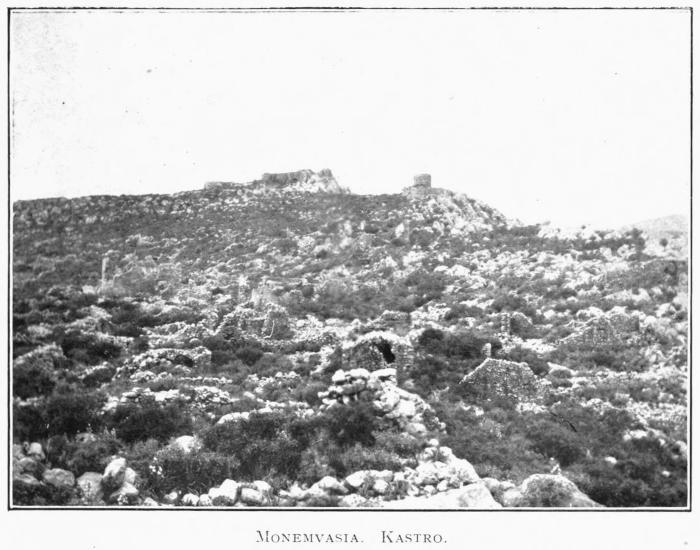
Monemvasia. Kastro.
PLATE V
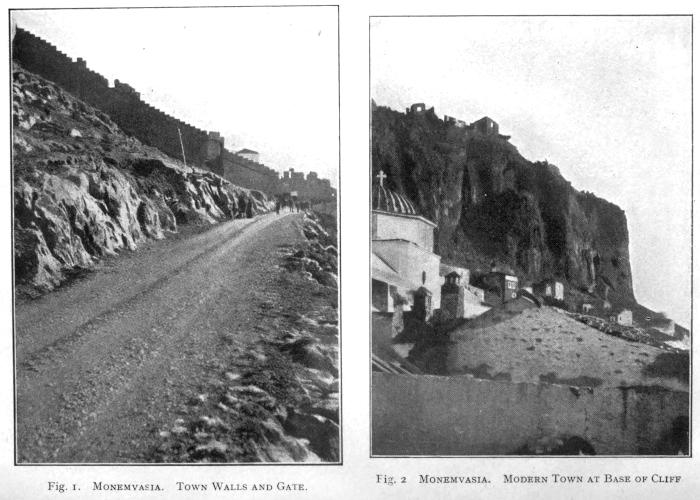
Fig. 1. Monemvasia. Town Walls and Gate.
Fig. 2. Monemvasia. Modern Town at Base of Cliff.
Down to the peace of 1502-3, Monemvasia seems to have been fairly prosperous under Venetian rule. By the Turco-Venetian treaty of 1479 she had been allowed to retain the dependency of Vatika[316] in the neighbourhood of Cape Malea, which had been captured from the Turks in 1463, and where her citizens had long possessed property. But the territories of Monemvasia were terribly restricted after the next Turco-Venetian war: she had then lost her outlying castles of Rampano and Vatika, from which the ecclesiastical authorities derived much of their dues; and we find the inhabitants petitioning the Republic for the redress of their grievances, and pointing out that this last delimitation of their frontiers had deprived them of the lands which they had been wont to sow. The rock itself produced nothing, and accordingly all their supplies of corn had now to be imported through the Turkish possessions[317]. As for the famous vintage, which had been the delight of Western connoisseurs, it was no longer produced at Malvasia, for the Turks did not cultivate the vineyards which were now in their hands, and most of the so-called “Malmsey,” nihil de Malfasia habens sed nomen, as worthy Father Faber says, had for some time come from Crete or Modon[318], till the latter place, too, became Turkish. But, in spite of these losses, Monemvasia still remained what she had been for centuries—an impregnable fortress, the Gibraltar of Greece. The Venetians renewed the system, which had prevailed under the Despots of the Morea, of devoting one of the local imposts to the repair of the walls; the Venetian Podestà, who lived, like the military governor, up in the castle, seems to have been a popular official; and the Republic had wisely confirmed the special privileges granted by the Byzantine Emperors to the Church and community of this favoured city (Plate IV). Both a Greek Metropolitan and a Latin Archbishop continued to take their titles from Monemvasia, and the most famous of these prelates was the eminent Greek scholar, Markos Mousouros. It is interesting to note that in 1521 Pope Leo X had a scheme for founding an academy for the study of the Greek language out of the revenues of whichever of these sees first fell vacant, as Arsenios Apostoles, at that time Metropolitan, was a learned Greek and a Uniate, and in both capacities, a prime favourite of the classically cultured Pontiff. In 1524, however, despite the thunders of the Œcumenical Patriarch, the Greek and the Italian prelates agreed among themselves that the former should retain the see of Monemvasia and that the latter should take a Cretan diocese[319]. The connection between “the great Greek island” and this rocky peninsula was now close. The Greek priests of Crete, who had formerly gone to the Venetian colonies of Modon and Coron for consecration, after the loss of those colonies in 1500 came to Monemvasia; the Cretan exchequer continued to contribute to the expenses of the latter; and judicial appeals from the Podestà of Malmsey lay to the colonial authorities at Candia, instead of being remitted to Venice; for, as a Monemvasiote deputation once plaintively said, the expenses of the long journey had been defrayed by pawning the chalices of the churches. Even now Monemvasia is remote from the world; in those Venetian days she was seldom visited, not only because of her situation, but because of the fear which ships’ captains had of her inhabitants[320].
The humiliating peace of 1540, which closed the Turco-Venetian war of 1537, closed also the history of Venice in the Morea till the brief revival at the close of the seventeenth century. This shameful treaty cost the Republic her two last possessions on the mainland of Greece—Nauplia and Monemvasia, both still uncaptured and the latter scarcely assailed by the Turkish forces[321]. Admiral Mocenigo was sent to break as best he could to her loyal subjects the sad news that the Republic had abandoned their homes to the Turks. The Venetian envoy, if we may believe the speech which Paruta puts into his mouth, repeated to the weeping people the ancient adage, ubi bene, ibi patria, and pointed out to them that they would be better off in a new abode less exposed than their native cities had been to the Turkish peril. In November a Venetian fleet arrived in the beautiful bay of Nauplia and off the sacred rock of Monemvasia to remove the soldiers, the artillery, and all the inhabitants who wished to live under Venetian rule. Then the banner of the Evangelist was lowered, the keys of the two last Venetian fortresses in the Morea were handed to Kassim Pasha, and the receipts for their transfer were sent to Venice[322].
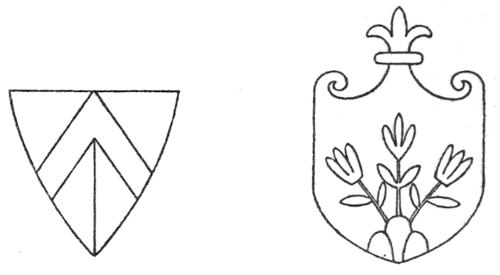
Fig. 2. Arms on Well-Head in the Castle.
The inhabitants of the two cities had been loyal to Venice, and Venice was loyal to them. The first idea of transporting the Monemvasiotes to the rocky island of Cerigo—then partly a Venetian colony and partly under the rule of the great Venetian family of Venier, which boasted its descent from Venus, the fabled goddess of Kythera—was abandoned, in deference to the eloquent protests of the Metropolitan, and lands were assigned to the exiles in the more fertile colonies of the Republic. A commission of five nobles was appointed to consider the claims, and provide for the settlement, of the stradioti, or light horsemen from Nauplia and Monemvasia, who had fought like heroes against the Turks; and this commission sat for several years, for the claimants were numerous and not all genuine[323]. Some, like the ancient local family of Daimonoyannes, formerly lords of Cerigo, received lands in Crete[324], where various members of the Athenian branch of the great Florentine family of the Medici, which had been settled for two hundred years at Nauplia, also found a home. Scions of the clan of Mamonas went to Zante and Crete, and are found later on at Corinth, Nauplia, Athens and Corfù. Others were removed to Corfù, where they soon formed an integral part of the Corfiote population and where the name of these stradioti is still preserved in a locality of the island; while others again were transplanted to Cephalonia, Cyprus, or Dalmatia. Not a few of them were soon, however, smitten with home-sickness; they sold their new lands and returned to be Turkish subjects at Nauplia and Monemvasia[325].
The Venetian fortifications; the old Venetian pictures on the eikonostasis of the Ἑλκόμενος church; the quaint Italian chimneys, and the well-head up in the castle, which bears the winged lion of St Mark, two private coats of arms, the date MDXIV and the initials S R upon it, the latter those of Sebastiano Renier, Podestà from 1510 to 1512 (to whom the first coat belongs, while the second is that of Antonio Garzoni, Podestà in 1526 and again in 1538, when he was the last Podestà before the Turkish conquest), still speak to us of this first Venetian occupation, when the ancient Byzantine city, after the brief vicissitudes of French and Papal government, found shelter for nearly eighty years beneath the flag of the Evangelist (Plate V, Fig. 2 and Text-fig. 2).
APPENDIX TWO VENETIAN DOCUMENTS RELATING TO THE ACQUISITION OF MONEMVASIA IN 1464
I.—Regina fol. 52.
MCCCCLXIIIJ indictione xij.
Die xxi Septembris.
Cum per gratiam omnipotentis Dei acquista sit in partibus grecie insula Staliminis dives et opulenta in qua sunt tres terre cum Castellis viz Cochinum, Mudrum et Paleocastrum que tempore pacis reddere solent ducatos circa xᵐ. Item etiam Civitas Malvasie sita in Amorea. Ad quorum locorum bonam gubernationem et conservationem sub obedientia nostri Dominii providendum est de rectoribus et camerariis e venetiis mittendis tam pro populis regendis et jure reddendo quam pro introitibus earum bene gubernandis et non perdendis sicut hucusque dicitur esse factum....
Eligatur per quattuor manus electionum in maiori consilio unus potestas Malvasie cum salario ducatorum V. auri in anno, sit per duos annos tantum; et habeat salarium liberum cum prerogativis et exemptionibus rectoris Staliminis et similiter in contumacia sua. Debeat habere duos famulos et tres equos et recipiat salarium suum ab insula Staliminis de tribus mensibus in tres menses ante tempus.
†De parte 474
De non 14
Non syncere 9
Die xvij Septembris mcccclxiiij in consilio di xlᵗᵃ.
De parte 26
De non 0
Non sync. 1
II.—Regina fol. 56.
Die iij Marcii 1465.
Captum est in maiori Consilio: Quod Rector monouasie elegendus de tribus in tres menses habere debeat salarium suum a loco nostro stalimnis et quum facile accidere posset per magnas impensas quas idem stalimnis locus habet quod inde salarium ipsum suum habere non posset.... Vadit pars quod in quantum idem rector noster monouasie a Stalimnis insula salarium ipsum suum habere non posset juxta formam presentis electionis sue a camera nostra crete illud percipere debeat sicuti conueniens et honestum est de tribus in tres menses juxta formam presentis ipsius.
†De parte 573
De non 39
Non syncere 42
THREE VENETIAN DOCUMENTS RELATING TO THE WINE-TRADE AT MONEMVASIA
(I have altered the Venetian dates to Modern Style):
Jan. 9, 1420.
Capta.
Attenta humili et devota supplicatione fidelium civium nostrorum mercatorum Monavaxie et Romanie et considerate quod mercantia huiusmodi vinorum hoc anno parvum vel nichil valuit, ob quod ipsi mercatores multa et maxima damna sustinuerunt, ob quibus (sic) nullo modo possunt ad terminum quatuor mensium sibi limitatum solvere eorum datia prout nobis supplicaverunt; Vadit pars quod ultra terminum quatuor mensium sibi concessum per terram ad solvendum datia sua pro suis monavasiis et romaniis, concedatur eisdem et prorogetur dictus terminus usque ad duos menses ultra predictos menses quatuor sibi statuitos per terram ut supra dando plezariam ita bonam et sufficientem pro ista prorogatione termini, quod comune nostrum sit securum de datio suo, solvendo ad terminum debitum.
De parte omnes.
(Archivio di State Venezia—Deliberazioni Senate Misti Reg. 53. c. 21.)
Feb. 19, 1421.
Capta.
Quod audita devota supplicatione fidelium civium nostrorum mercatorum Romanie et Monovasie Venetiis existentium, et intellectis damnis que receperunt iam annis tribus de ipsis vinis et maxime hoc anno quia per piratas accepte sibi fuerunt plures vegetes huiusmodi vinorum, et considerato quod ilia que habent non possunt expedire, propter que damna non possunt solvere sua datia ad terminum sibi limitatum per ordines nostros. Et audita superinde responsione offitialium nostrorum datii vini ex nunc captum sit quod ultra dictum terminum sibi limitatum per ordines nostros elongetur terminus solvendi dicta datia ipsorum vinorum usque duos alios menses.
De parte omnes.
De non 0.
Non sinceri 0.
(Archivio di State Venezia—Deliberazioni Senato Misti Reg. 53. c. 112.)
Feb. 9, 1428.
In Consilio Rogatorum.
Capta.
Quod mercatoribus Monovaxie et Romanie, qui non potuerunt expedire vina sua propter novitates presentes elongetur terminus solvendi datia sua per unum mensem ultra terminum limitatum per ordines nostros.
De parte omnes alii.
De non 2.
Non sinceri 1.
(Archivio di Stato Venezia—Deliberazioni Senato Misti Reg. 56. carte. 76tᵒ.)
10. THE MARQUISATE OF BOUDONITZA (1204-1414)
Of all the feudal lordships, founded in Northern Greece at the time of the Frankish Conquest, the most important and the most enduring was the Marquisate of Boudonitza. Like the Venieri and the Viari in the two islands of Cerigo and Cerigotto at the extreme south, the lords of Boudonitza were Marquesses in the literal sense of the term—wardens of the Greek Marches—and they maintained their responsible position on the outskirts of the Duchy of Athens until after the establishment of the Turks in Thessaly. Apart, too, from its historic importance, the Marquisate of Boudonitza possesses the romantic glamour which is shed over a famous classical site by the chivalry of the middle ages. What stranger accident could there have been than that which made two noble Italian families the successive guardians of the historic pass which is for ever associated with the death of Leonidas!
Among the adventurers who accompanied Boniface of Montferrat, the new King of Salonika, on his march into Greece in the autumn of 1204, was Guido Pallavicini, the youngest son of a nobleman from near Parma who had gone to the East because at home every common man could hale him before the courts[326]. This was the vigorous personality who, in the eyes of his conquering chief, seemed peculiarly suited to watch over the pass of Thermopylæ, whence the Greek archon, Leon Sgouros, had fled at the mere sight of the Latins in their coats of mail. Accordingly, he invested him with the fief of Boudonitza, and ere long, on the Hellenic substructures of Pharygæ, rose the imposing fortress of the Italian Marquesses.
The site was admirably chosen, and is, indeed, one of the finest in Greece. The village of Boudonitza, Bodonitza, or Mendenitza, as it is now called, lies at a distance of three and a half hours on horseback from the baths of Thermopylæ and nearly an hour and a half from the top of the pass which leads across the mountains to Dadi at the foot of Parnassos. The castle, which is visible for more than an hour as we approach from Thermopylæ, stands on a hill which bars the valley and occupies a truly commanding position (Plate VI, Figs. 1 and 2). The Warden of the Marches, in the Frankish times, could watch from its battlements the blue Maliac Gulf with the even then important town of Stylida, the landing-place for Zetounion, or Lamia; his eye could traverse the channel up to, and beyond, the entrance to the Gulf of Almiro, as the Gulf of Volo was then called; in the distance he could descry two of the Northern Sporades—Skiathos and Skopelos—at first in the hands of the friendly Ghisi, then reconquered by the hostile Byzantine forces. The northernmost of the three Lombard baronies of Eubœa with the bright streak which marks the baths of Ædepsos, and the little island of Panaia, or Canaia, between Eubœa and the mainland, which was one of the last remnants of Italian rule in this part of Greece, lay outstretched before him; and no pirate craft could come up the Atalante channel without his knowledge. Landwards, the view is bounded by vast masses of mountains, but the danger was not yet from that quarter, while a rocky gorge, the bed of a dry torrent, isolates one side of the castle. Such was the site where, for more than two centuries, the Marquesses of Boudonitza watched, as advanced sentinels, first of “new France” and then of Christendom.
The extent of the Marquisate cannot be exactly defined. In the early years after the Conquest we find the first Marquess part-owner of Lamia[327]; his territory extended down to the sea, upon which later on his successors had considerable commercial transactions, and the harbour from which they obtained their supplies would seem to have been simply called the skala of Boudonitza. In 1332 Adam, the Archbishop of Antivari, alludes to the “castle and port of Boudonice (sic), through which we shall have in abundance grain of all kinds from Wallachia” (i.e. Thessaly, the “Great Wallachia” of the Byzantine historians and of the “Chronicle of the Morea”)[328]. The Pallavicini’s southern frontier marched with the Athenian seigneurie; but their feudal relations were not with Athens, but with Achaia. Whether or no we accept the story of the “Chronicle of the Morea,” that Boniface of Montferrat conferred the suzerainty of Boudonitza upon Guillaume de Champlitte, or the more probable story of the elder Sanudo, that the Emperor Baldwin II gave it to Geoffroy II de Villehardouin[329], it is certain that later on the Marquess was one of the twelve peers of Achaia[330], and in 1278 Charles I of Naples, in his capacity of Prince of Achaia, accordingly notified the appointment of a bailie of the principality to the Marchioness of that day[331]. It was only during the Catalan period that the Marquess came to be reckoned as a feudatory of Athens[332]. Within his dominions was situated a Roman Catholic episcopal see—that of Thermopylæ, dependent upon the metropolitan see of Athens. At first the bishop resided at the town which bore that name; on its destruction, however, during those troublous times, the bishop and canons built an oratory at Boudonitza. Even there, however, the pirates penetrated and killed the bishop, whereupon in 1209 the then occupant of the see, the third of the series, begged Innocent III to allow him to move to the abbey of “Communio”—perhaps a monastery founded by one of the Comneni—within the same district[333]. Towards the close of the fourteenth century, the bishop was commonly known by the title of “Boudonitza,” because he resided there, and his see was then one of the four within the confines of the Athenian Duchy[334].
PLATE VI
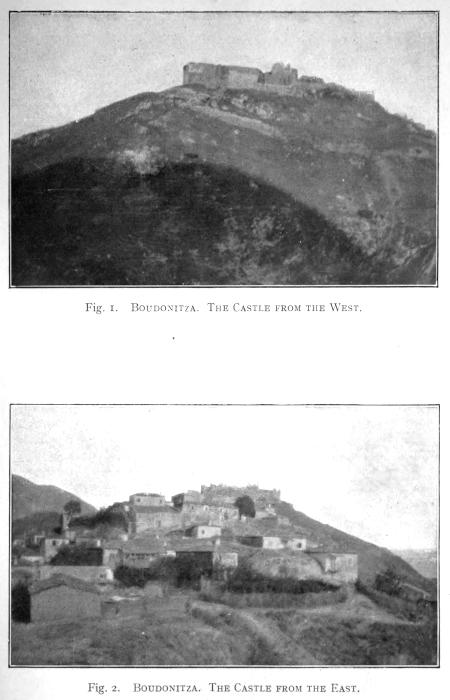
Fig. 1. Boudonitza. The Castle from the West.
Fig. 2. Boudonitza. The Castle from the East.
PLATE VII
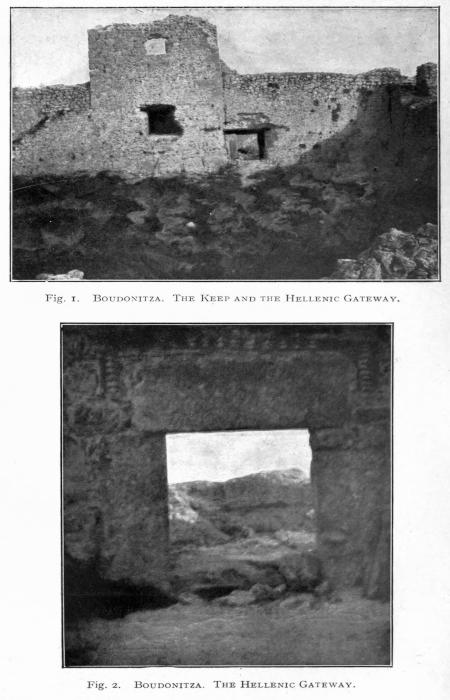
Fig. 1. Boudonitza. The Keep and the Hellenic Gateway.
Fig. 2. Boudonitza. The Hellenic Gateway.
Guido, first Marquess of Boudonitza, the “Marchesopoulo,” as his Greek subjects called him, played a very important part in both the political and ecclesiastical history of his time—just the part which we should have expected from a man of his lawless disposition. The “Chronicle” above quoted represents him as present at the siege of Corinth. He and his brother, whose name may have been Rubino, were among the leaders of the Lombard rebellion against the Latin Emperor Henry in 1209; he obstinately refused to attend the first Parliament of Ravenika in May of that year; and, leaving his castle undefended, he retreated with the still recalcitrant rebels behind the stronger walls of the Kadmeia at Thebes. This incident procured for Boudonitza the honour of its only Imperial visit; for the Emperor Henry lay there one evening—a certain Wednesday—on his way to Thebes, and thence rode, as the present writer has ridden, through the closure, or pass, which leads over the mountains and down to Dadi and the Bœotian plain—then, as now, the shortest route from Boudonitza to the Bœotian capital[335], and at that time the site of a church of our Lady, Sta Maria de Clusurio, the property of the abbot and canons of the Lord’s Temple. Like most of his fellow-nobles, the Marquess was not over-respectful of the rights and property of the Church to which he belonged. If he granted the strong position of Lamia to the Templars, he secularised property belonging to his bishop and displayed a marked unwillingness to pay tithes. We find him, however, with his fellows, signing the concordat which was drawn up to regulate the relations between Church and State at the second Parliament of Ravenika in May, 1210[336].
As one of the leading nobles of the Latin kingdom of Salonika, Guido continued to be associated with its fortunes. In 1221 we find him acting as bailie for the Regent Margaret during the minority of the young King Demetrius, in whose name he ratified a convention with the clergy respecting the property of the Church[337]. His territory became the refuge of the Catholic Archbishop of Larissa, upon whom the bishopric of Thermopylæ was temporarily conferred by Honorius III, when the Greeks of Epeiros drove him from his see. And when the ephemeral kingdom had fallen before them, the same Pope, in 1224, ordered Geoffroy II de Villehardouin of Achaia, Othon de la Roche of Athens, and the three Lombard barons of Eubœa to aid in defending the castle of Boudonitza, and rejoiced that 1300 hyperperi had been subscribed by the prelates and clergy for its defence, so that it could be held by “G. lord of the aforesaid castle,” till the arrival of the Marquess William of Montferrat[338]. Guido was still living on May 2, 1237, when he made his will. Soon after that date he probably died; Hopf[339] states in his genealogy, without citing any authority, that he was killed by the Greeks. He had survived most of his fellow-Crusaders; and, in consequence of the Greek reconquest of Thessaly, his Marquisate was now, with the doubtful exception of Larissa, the northernmost of the Frankish fiefs, the veritable “March” of Latin Hellas.
Guido had married a Burgundian lady named Sibylle, possibly a daughter of the house of Cicon, lately established in Greece, and therefore a cousin of Guy de la Roche of Athens. By her he had two daughters and a son, Ubertino, who succeeded him as second Marquess. Despite the feudal tie which should have bound him to the Prince of Achaia, and which he boldly repudiated, Ubertino assisted his cousin, the “Great Lord” of Athens, in the fratricidal war between those prominent Frankish rulers, which culminated in the defeat of the Athenians at the battle of Karydi in 1258, where the Marquess was present, and whence he accompanied Guy de la Roche in his retreat to Thebes. In the following year, however, he obeyed the summons of the Prince of Achaia to take part in the fatal campaign in aid of the Despot Michael II of Epeiros against the Greek Emperor of Nice, which ended on the plain of Pelagonia; and in 1263, when the Prince, after his return from his Greek prison, made war against the Greeks of the newly established Byzantine province in the Morea, the Marquess of Boudonitza was once more summoned to his aid[340]. The revival of Greek power in Eubœa at this period, and the frequent acts of piracy in the Atalante channel were of considerable detriment to the people of Boudonitza, whose food supplies were at times intercepted by the corsairs[341]. But the Marquess Ubertino profited by the will of his sister Mabilia, who had married Azzo VII d’Este of Ferrara, and bequeathed to her brother in 1264 her property near Parma[342].
After the death of Ubertino, the Marquisate, like so many Frankish baronies, fell into the hands of a woman. The new Marchioness of Boudonitza was his second sister, Isabella, who is included in the above-mentioned circular note, addressed to all the great magnates of Achaia by Charles I of Anjou, the new Prince, and notifying to them the appointment of Galeran d’Ivry as the Angevin vicar-general in the principality. On that occasion, the absence of the Marchioness was one of the reasons alleged by Archbishop Benedict of Patras, in the name of those present at Glarentza, for the refusal of homage to the new bailie[343]. So important was the position of the Marquisate as one of the twelve peerages of Achaia.
The Marchioness Isabella died without children; and, accordingly, in 1286, a disputed succession arose between her husband, a Frank settled in the East, and the nearest male representative of the Pallavicini family, her cousin Tommaso, grandson of the first Marquess’s brother, Rubino. The dispute was referred to Guillaume de la Roche, Duke of Athens, in his capacity of bailie of Achaia, before the feudal court of which a question relating to Boudonitza would legally come. Tommaso, however, settled the matter by seizing the castle, and not only maintained himself there, but transmitted the Marquisate to his son, Alberto[344].
The fifth Marquess is mentioned as among those summoned by Philip of Savoy, Prince of Achaia, to the famous Parliament and tournament on the Isthmus of Corinth in the spring of 1305, and as having been one of the magnates who obeyed the call of Philip’s namesake and successor, Philip of Taranto, in 1307[345]. Four years later he fell, at the great battle of the Kephissos, fighting against the Catalans beneath the lion banner of Walter of Brienne[346], who by his will a few days before had bequeathed 100 hyperperi to the church of Boudonitza[347].
The Marquisate, alone of the Frankish territories north of the Isthmus, escaped conquest by the Catalans, though, as at Athens, a widow and her child were alone left to defend it. Alberto had married a rich Eubœan heiress, Maria dalle Carceri, a scion of the Lombard family which had come from Verona at the time of the Conquest. By this marriage he had become a hexarch, or owner of one-sixth of that great island, and is so officially described in the Venetian list of Greek rulers. Upon his death, in accordance with the rules of succession laid down in the Book of the Customs of the Empire of Romania, the Marquisate was divided in equal shares between his widow and his infant daughter, Guglielma. Maria did not, however, long remain unconsoled; indeed, political considerations counselled an immediate marriage with some one powerful enough to protect her own and her child’s interests from the Catalans of Athens. Hitherto the Wardens of the Northern March had only needed to think of the Greek enemies in front, for all the territory behind them, where Boudonitza was most easily assailable, had been in the hands of Frenchmen and friends. More fortunate than most of the high-born dames of Frankish Greece, the widowed Marchioness had avoided the fate of accepting one of her husband’s conquerors as his successor. Being thus free to choose, she selected as her spouse Andrea Cornaro, a Venetian of good family, a great personage in Crete, and Baron of Skarpanto. Cornaro thus, in 1312, received, by virtue of his marriage, his wife’s moiety of Boudonitza[348], while her daughter conferred the remaining half, by her subsequent union with Bartolommeo Zaccaria, upon a member of that famous Genoese race, which already owned Chios and was about to establish a dynasty in the Morea[349].
Cornaro now came to reside in Eubœa, where self-interest as well as patriotism led him to oppose the claims of Alfonso Fadrique, the new viceroy of the Catalan Duchy of Athens. His opposition and the natural ambition of Fadrique brought down, however, upon the Marquisate the horrors of a Catalan invasion, and it was perhaps on this occasion that Bartolommeo Zaccaria was carried off as a captive and sent to a Sicilian prison, whence he was only released at the intervention of Pope John XXII. It was fortunate for the inhabitants of Boudonitza that Venice included Cornaro in the truce which she made with the Catalans in 1319[350]. Four years later he followed his wife to the grave, and her daughter was thenceforth sole Marchioness.
Guglielma Pallavicini was a true descendant of the first Marquess. Of all the rulers of Boudonitza, with his exception, she was the most self-willed, and she might be included in that by no means small number of strong-minded, unscrupulous, and passionate women, whom Frankish Greece produced and whom classic Greece might have envied as subjects for her tragic stage. On the death of her Genoese husband, she considered that both the proximity of Boudonitza to the Venetian colony of Negroponte and her long-standing claims to the castle of Larmena in that island required that she should marry a Venetian, especially as the decision of her claim and even her right to reside in the island depended upon the Venetian bailie. Accordingly, she begged the Republic to give her one of its nobles as her consort, and promised dutifully to accept whomsoever the Senate might choose. The choice fell upon Nicolò Giorgio, or Zorzi, to give him the Venetian form of the name, who belonged to a distinguished family which had given a Doge to the Republic and had recently assisted young Walter of Brienne in his abortive campaign to recover his father’s lost duchy from the Catalans. A Venetian galley escorted him in 1335 to the haven of Boudonitza, and a Marquess, the founder of a new line, once more ruled over the castle of the Pallavicini[351].
At first there was no cause to regret the alliance. If the Catalans, now established at Neopatras and Lamia, within a few hours of Boudonitza, occupied several villages of the adjacent Marquisate, despite the recommendations of Venice, Nicolò I came to terms with them, probably by agreeing to pay that annual tribute of four fully equipped horses to the Vicar-General of the Duchy of Athens, which we find constituting the feudal bond between that state and Boudonitza in the time of his son[352]. He espoused, too, the Eubœan claims of his wife; but Venice, which had an eye upon the strong castle of Larmena, diplomatically referred the legal question to the bailie of Achaia, of which both Eubœa and Boudonitza were technically still reckoned as dependencies. The bailie, in the name of the suzeraine Princess of Achaia, Catherine of Valois, decided against Guglielma, and the purchase of Larmena by Venice ended her hopes. Furious at her disappointment, the Marchioness accused her Venetian husband of cowardice and of bias towards his native city, while more domestic reasons increased her indignation. Her consort was a widower, while she had had a daughter by her first marriage, and she suspected him of favouring his own offspring at the expense of her child, Marulla, in whose name she had deposited a large sum of money at the Venetian bank in Negroponte. To complete the family tragedy played within the walls of Boudonitza there was only now lacking a sinister ally of the angry wife. He, too, was forthcoming in the person of Manfredo Pallavicini, the relative, business adviser, and perhaps paramour, of the Marchioness. As one of the old conqueror’s stock, he doubtless regarded the Venetian husband as an interloper who had first obtained the family honours and then betrayed his trust. At last a crisis arrived. Pallavicini insulted the Marquess, his feudal superior; the latter threw him into prison, whereupon the prisoner attempted the life of his lord. As a peer of Achaia, the Marquess enjoyed the right of inflicting capital punishment. He now exercised it; Pallavicini was executed, and the assembled burgesses of Boudonitza, if we may believe the Venetian version, approved the act, saying that it was better that a vassal should die rather than inflict an injury on his lord.
The sequel showed, however, that Guglielma was not appeased. She might have given assent with her lips to what the burgesses had said. But she worked upon their feelings of devotion to her family, which had ruled so long over them; they rose against the foreign Marquess at their Lady’s instigation; and Nicolò was forced to flee across to Negroponte, leaving his little son Francesco and all his property behind him. Thence he proceeded to Venice, and laid his case before the Senate. That body warmly espoused his cause, and ordered the Marchioness to receive him back to his former honourable position, or to deliver up his property. In the event of her refusal, the bailie of Negroponte was instructed to break off all communications between Boudonitza and that island and to sequestrate her daughter’s money still lying in the Eubœan bank. In order to isolate her still further, letters were to be sent to the Catalans of Athens, requesting them not to interfere between husband and wife. As the Marchioness remained obdurate, Venice made a last effort for an amicable settlement, begging the Catalan leaders, Queen Joanna I of Naples, as the head of the house of Anjou, to which the principality of Achaia belonged, and the Dauphin Humbert II of Vienne, then commanding the papal fleet against the Turks, to use their influence on behalf of her citizen. When this failed, the bailie carried out his instructions, confiscated the funds deposited in the bank, and paid Nicolò out of them the value of his property. Neither the loss of her daughter’s money nor the spiritual weapons of Pope Clement VI could move the obstinate Lady of Boudonitza, and in her local bishop, Nitardus of Thermopylæ, she could easily find an adviser who dissuaded her from forgiveness[353]. So Nicolò never returned to Boudonitza; he served the Republic as envoy to the Serbian Tsar, Dushan, and as one of the Doge’s Councillors, and died at Venice in 1354. After his death, the Marchioness at once admitted their only son, Francesco, the “Marchesotto,” as he was called, now a youth of seventeen, to rule with her, and, as the Catalans were once more threatening her land, made overtures to the Republic. The latter, glad to know that a Venetian citizen was once more ruling as Marquess at Boudonitza, included him and his mother in its treaties with Athens, and when Guglielma died, in 1358, after a long and varied career, her son received back the confiscated property of his late half-sister[354].
The peaceful reign of Francesco was a great contrast to the stormy career of his mother. His Catalan neighbours, divided by the jealousies of rival chiefs, had no longer the energy for fresh conquests. The establishment of a Serbian kingdom in Thessaly only affected the Marquess in so far as it enabled him to bestow his daughter’s hand upon a Serbian princelet[355]. The Turkish peril, which was destined to swallow up the Marquisate in the next generation, was, however, already threatening Catalans, Serbs, and Italians alike, and accordingly Francesco Giorgio was one of the magnates of Greece whom Pope Gregory XI invited to the Congress on the Eastern question, which was summoned to meet at Thebes[356] on October 1, 1373. But when the Athenian duchy, of which he was a tributary, was distracted by a disputed succession between Maria, Queen of Sicily, and Pedro IV of Aragon, the Venetian Marquess, chafing at his vassalage and thinking that the moment was favourable for severing his connexion with the Catalans, declared for the Queen. He was, in fact, the most important member of the minority which was in her favour, for we are told that “he had a very fine estate,” and we know that he had enriched himself by mercantile ventures. Accordingly he assisted the Navarrese Company in its attack upon the duchy, so that Pedro IV wrote in 1381 to the Venetian bailie of Negroponte, begging him to prevent his fellow-countryman at Boudonitza from helping the King’s enemies. As the Marquess had property in the island, he had given hostages to fortune. The victory of the Aragonese party closed the incident, and the generous policy of the victors was doubtless extended to him. But in 1388 the final overthrow of the Catalan rule by Nerio Acciajuoli made the Marquisate independent of the Duchy of Athens[357]. In feudal lists—such as that of 1391—the Marquess continued to figure as one of the temporal peers of Achaia[358], but his real position was that of a “citizen and friend” of Venice, to whom he now looked for help in trouble.
Francesco may have lived to see this realisation of his hopes, for he seems to have died about 1388, leaving the Marquisate to his elder son, Giacomo, under the regency of his widow Euphrosyne, a daughter of the famous insular family of Sommaripa, which still survives in the Cyclades[359]. But the young Marquess soon found that he had only exchanged his tribute to the Catalan Vicar-General for a tribute to the Sultan. We are not told the exact moment at which Bayezid I imposed this payment, but there can be little doubt that Boudonitza first became tributary to the Turks in the campaign of 1393-4, when “the Thunderbolt” fell upon Northern Greece, when the Marquess’s Serbian brother-in-law was driven from Pharsala and Domoko, when Lamia and Neopatras were surrendered, when the county of Salona, founded at the same time as Boudonitza, ceased to exist. On the way to Salona, the Sultan’s army must have passed within four hours of Boudonitza, and we surmise that it was spared, either because the season was so late—Salona fell in February, 1394—or because the castle was so strong, or because its lord was a Venetian. This respite was prolonged by the fall of Bayezid at Angora and the fratricidal struggle between his sons, while the Marquess was careful to have himself included in the treaties of 1403, 1408, and 1409 between the Sultan Suleyman and Venice; a special clause in the first of these instruments released him from all obligations except that which he had incurred towards the Sultan’s father Bayezid[360]. Still, even in Suleyman’s time, such was his sense of insecurity, that he obtained leave from Venice to send his peasants and cattle over to the strong castle of Karystos in Eubœa, of which his brother Nicolò had become the lessee[361]. He figured, too, in the treaty of 1405, which the Republic concluded with Antonio I Acciajuoli, the new ruler of Athens, and might thus consider himself as safe from attack on the south[362]. Indeed, he was anxious to enlarge his responsibilities, for he was one of those who bid for the two Venetian islands of Tenos and Mykonos, when they were put up to auction in the following year. In this offer, however, he failed[363].
The death of Suleyman and the accession of his brother Musa in 1410 sealed the fate of the Marquess. Early in the spring a very large Turkish army appeared before the old castle. Boudonitza was strong, and its Marquess a resolute man, so that for a long time the siege was in vain. “Giacomo,” says the Venetian document composed by his son, “preferred, like the high-minded and true Christian that he was, to die rather than surrender the place.” But there was treachery within the castle walls; betrayed by one of his servants, the Marquess fell, like another Leonidas, bravely defending the mediæval Thermopylæ against the new Persian invasion. Even then, his sons, “following in their father’s footsteps,” held the castle some time longer in the hope that Venice would remember her distant children in their distress. The Senate did, indeed, order the Captain of the Gulf to make inquiries whether Boudonitza still resisted and in that case to send succour to its gallant defenders—the cautious Government added—“with as little expense as possible.” But before the watchmen on the keep could descry the Captain sailing up the Atalante channel, all was over; both food and ammunition had given out and the Zorzi were constrained to surrender, on condition that their lives and property were spared. The Turks broke their promises, deprived their prisoners of their goods, expelled them from the home of their ancestors, and dragged young Nicolò to the Sultan’s Court at Adrianople[364].
Considerable confusion prevails in this last act of the history of Boudonitza, owing to the fact that the two leading personages, the brother and eldest son of the late Marquess, bore the same name of Nicolò. Hopf has accordingly adopted two different versions in his three accounts of these events. On a review of the documentary evidence, it would seem that the brother, the Baron of Karystos, was not at Boudonitza during the siege, and that, on the capture of his nephew, he proclaimed himself Marquess. Venice recognised his title, and instructed her envoy to Musa to include him in her treaty with the Sultan and to procure at the same time the release of the late Marquess’s son. Accordingly, in the peace of 1411, Musa promised, for love of Venice and seeing that he passed as a Venetian, to harass him no more, on condition that he paid the tribute established. Not only so, but the Marquess’s ships and merchandise were allowed to enter the Turkish dominions on payment of a fixed duty[365]. Thus temporarily restored, the Marquisate remained in the possession of the uncle, from whom the nephew, even after his release, either could not, or cared not to claim it. He withdrew to Venice, and, many years later, received as the reward of his father’s heroic defence of Boudonitza, the post of châtelain of Pteleon, near the mouth of the Gulf of Volo, the last Venetian outpost on the mainland of North-Eastern Greece—a position which he held for eight years[366].
Meanwhile, his uncle, the Marquess, had lost all but his barren title. Though the Turks had evacuated Boudonitza, and the castle had been repaired, he felt so insecure that he sent his bishop as an emissary to Venice, begging for aid in the event of a fresh Turkish invasion and for permission to transport back to Boudonitza the serfs whom he had sent across to Karystos a few years before[367]. His fears proved to be well founded. In vain the Republic gave orders that he should be included in her treaty with the new Sultan, Mohammed I. On June 20, 1414, a large Turkish army attacked and took the castle, and with it many prisoners, the Marquess, so it would seem, among them—for in the following year we find his wife, an adopted daughter of the Duke of Athens, appealing to Venice to obtain his release from his Turkish dungeon[368]. He recovered his freedom, but not his Marquisate. In the treaty of 1416, Boudonitza was, indeed, actually assigned to him in return for the usual tribute; but nine years later we find Venice still vainly endeavouring to obtain its restitution[369]. He continued, however, to hold the title of Marquess of Boudonitza with the castle of Karystos, which descended to his son, the “Marchesotto,” and his son’s son[370], till the Turkish conquest of Eubœa in 1470 put an end to Venetian rule over that great island. Thence the last titular Marquess of Boudonitza, after governing Lepanto, retired to Venice, whence the Zorzi came and where they are still largely represented.
Of the castle, where for two hundred years Pallavicini and Zorzi held sway, much has survived the two Turkish sieges and the silent ravages of five centuries. Originally there must have been a triple enclosure, for several square towers of the third and lowest wall are still standing in the village and outside it. Of the second enceinte the most noticeable fragment is a large tower in ruins, while the innermost wall is strengthened by three more. In the centre of this last enclosure are the imposing remains of the large square donjon (Plate VII, Fig. 1), and adjoining this is the most interesting feature of the castle—the great Hellenic gateway (Plate VII, Fig. 2), which connects one portion of this enclosure with the other, and which Buchon has described so inaccurately[371]. It is not “composed of six stones,” but of three huge blocks, nor do “the two upper stones meet at an acute angle”; a single horizontal block forms the top. Buchon omits to mention the Byzantine decoration in brick above this gateway. Of the brick conduit which he mentions I could find no trace, but the two cisterns remain. The large building near them is presumably the Frankish church of which he speaks; but the window which he found there no longer exists. Possibly, when the new church in the village was erected, the builders took materials from the chapel in the castle for its construction. At any rate, that very modern and commonplace edifice contains several fragments of ancient work. Thus, the stone threshold of the west door bears three large roses, while on the doorway itself are two stars; and the north door is profusely decorated with a rose, two curious creatures like griffins, two circles containing triangles, and a leaf; above this door is a cross, each arm of which forms a smaller cross. As usually happens in the Frankish castles of Greece—with the exception of Geraki—there are no coats of arms at Boudonitza, unless this composite cross is an allusion to the “three crosses,” said to have been originally borne by one branch of the Pallavicini. The “mediæval seal” in the possession of a local family dates from the reign of Otho! But there exists a genuine seal of the monastery of the Holy Virgin of Boudonitza, ascribed by M. Schlumberger[372] to the end of the fourteenth or beginning of the fifteenth century. The Marquesses have left behind them neither their portraits—like the Palatine Counts of Cephalonia of the second dynasty—nor any coins—like the French barons of Salona, to whom they bear the nearest resemblance. One of their line, however, the Marquess Alberto, figures in K. Rhanghaves’s play, The Duchess of Athens, and their castle and their ofttimes stormy lives fill not the least picturesque page of that romance which French and Italian adventurers wrote with their swords in the classic sites of Hellas.
APPENDIX
I 1335 DIE XVI JANUARIJ.
Capta. Quod vir nobilis Ser Nicolaus Georgio, cum sua familia et levibus arnesiis possit ire cum galeis nostris unionis. Et committatur Capitaneo, quod eum conducat Nigropontum, et si poterit eum facere deponi ad Bondenizam, sine sinistro armate faciat inde sicut ei videbitur.—Omnes de parte.
Misti, XVI. f. 97tᵒ.
II 1345 DIE 21 JULIJ.
Capta. Cum dominacio ducalis ex debito teneatur suos cives in eorum iuribus et honoribus cum justicia conservare et dominus Nicolaus Georgio, Marchio Bondanicie, sit iniuriatus ut scitis, et Marchionatu suo per eius uxorem indebite molestatus, et dignum sit, subvenire eidem in eo quod cum honore dominacionis comode fieri potest, ideo visa et examinata petitione ipsius marchionis, et matura et diligenti deliberatione prehabita, consulunt concorditer viri nobiles, domini, Benedictus de Molino et Pangracius Justiniano; quod committatur consiliario ituro Nigropontum, quod postquam illuc applicuerit vadat ad dominam Marchisanam, uxorem dicti domini Nicolay pro ambaxatore, exponendo eidem, quomodo iam diu ipsam ad dominacionem misit suos procuratores et ambaxatores petens sibi per dominacionem de uno nobilium suorum pro marito provideri, et volens dominacio suis beneplacitis complacere, consensit quod ipse dominus Nicolaus carus civis suus ad eam iret, quem ipsa domina receptando, ostendit id habere multum ad bonum. Et quoniam ob hoc semper Ducale Dominium promtum et favorabilem se exhibuit ad omnia que suam et suorum securitatem respicerent et augumentum, treuguas quamplurimas confirmando et opportuna alia faciendo. Sed cum nuperrime per relacionem ipsius domini Nicolay viri sui ad ducalis magnificentie audienciam sit deductus de morte cuiusdam Pallavesini inopinatus casus occursus qui mortuus fuit in culpa sua, sicut postmodum extitit manifestum, quia dum ipse Marchio coram omnibus burgensibus congregatis, de velle et consensu dicte domine exponeret rei geste seriem, ab ipsis habuit in responsum quod ipse Palavesin dignam penam luerat propter foliam suam, et melius erat, quod ipse, qui vaxallus erat mortuus fuisset quam dicto suo domino iniuriam aliquam intulisset, quod ecciam ipsa domina in presencia dictorum burgensium ratificavit. Unde consideratis predictis vellit amore dominij, ipsum dominum Nicolaum honori pristino restituere, quod si fecerit, quamquam sit iustum et honestum nobis plurimum complacebit, et erimus suis comodis stricius obligati. Verum si dicta domina dubitaret de recipiendo ipsum dicat et exponat ambaxator prefatus, quod firmiter dominacio hanc rem super se assumpsit et taliter imposuit civi suo quod minime poterit dubitare. Que omnia si dicta domina acetabit bene quidem, si vero non contentaretur et ipsum recipere non vellet, procuret habere et obtinere omnia bona dicti Marchionis que secum scripta portet antedictus ambaxator et si ipsa ea bona dare neglexerit, dicat quod bona sua et suorum ubicumque intromitti faciemus, et protestetur cum notario, quem secum teneatur ducere, quod tantam iniuriam, quam dominacio suam propriam reputat, non poterit sustinere, sed providebit de remediis opportunis sicuti honori suo et indenitati sui civis viderit convenire, firmiter tenens quod sicut semper dominacio ad sui conservacionem et suorum exhibuit se promtam favorabilem et benignam, sic in omnibus reperiet ipsam mutatam, agravando factum cum hijs et alijs verbis, ut viderit convenire. Et rediens Nigropontum omnia, que gexerit, fecerit et habuerit, studeat velociter dominacioni per suas literas denotare. Verum si dictus consiliarius iturus tardaret ire ad regimen suum, quod baiullus et consiliarij Nigropontis determinent quis consiliariorum de inde ad complendum predicta ire debebit.
Et scribatur baiullo et consiliarijs Nigropontis, quod si habebunt post redditum dicti ambaxatoris, quod ipsa domina stet dura nec vellit ipsum dominum Nicolaum recipere, quod possint si eis videbitur facere et ordinare quod homines Bondanicie non veniant Nigropontum et quod homines Nigropontis non vadant Bondaniciam.
Item prefati baiullus et consiliarij sequestracionem factam de aliqua pecunie quantitate que pecunia est damiselle Marulle filie dicte domine firmam tenere debeant, donec predicta fuerint reformata, pacificata vel diffinita, vel donec aliud sibi mandaretur de hinc.
Et scribantur litere illis de la compagna, quas dominus bayullus et consiliarij presentent vel presentari fatiant, cum eis videbitur, rogando dictos de compagna, quod cum alique discordie venerint inter virum nobilem dominum Nicolam Georgio et eius uxorem Marchisanam se in aliquo facto dicte domine intromittere non vellint quod posset civi nostro contrariare ad veniendum ad suam intentionem.
De non 14—Non sinceri 13.—Alij de parte.
Misti, XXIII. f. 26.
III 1345 DIE V AUGUSTI.
Capta. Quod respondeatur domine Marchisane Bondinicie ad suas litteras substinendo ius civis nostri Nicolai Georgio, cum illis verbis que videbuntur sequendo id quod captum fuit pridie in hoc consilio in favorem civis nostri.
Misti, XXIII. f. 30tᵒ.
IV 1346 DIE XXIV JANUARIJ.
Capta. Quod scribatur nostro Baiulo et Consiliariis Nigropontis quod Ser Moretus Gradonico consiliarius, vel alius sicut videbitur Baiulo et Consiliariis, in nostrum ambaxatorem ire debeat ad dominam Marchionissam Bondenicie, et sibi exponat pro parte nostra quod attenta honesta et rationabili requisitione nostra quam sibi fieri fecimus per virum Nobilem Johannem Justiniano nostrum consiliarium Nigroponti, quem ad eam propterea in nostrum ambaxatorem transmisimus super reformatione scandali orti inter ipsam et virum nobilem Nicolaum Georgio eius virum in reconciliatione ipsius cum dicto viro suo: Et intellecta responsione quam super premissis fecit nostro ambaxatori predicto gravamur et turbamur sicut merito possumus et debemus, de modo quem ipsam servavit et servat erga dictum virum suum. Nam sibi plene poterat et debebat sufficere remissio et reconciliatio cum [eo?] facta coram nobis per dictum eius virum, secundum nostrum mandatum, et nuncio suo in nostra presencia constituto de omni offensa et iniuria sibi facta, et debebat esse certa quod quicquid idem Marchio in nostra presencia et ex nostro mandato promittebat effectualiter observasse. Et quod volentes quod bona dispositio dicti viri sui et paciencia nostra de tanta iniuria facta civi nostro sibi plenius innotescat deliberavimus iterate ad eam mittere ipsum in nostrum ambaxatorem ad requirendum et rogandum ipsam quod debeat reconciliare cum dicto viro suo et eum recipere ad honorem et statum in quo erat antequam inde recederet, nam quamvis hoc sit sibi debitum et conveniat pro honore et bono suo, tamen erit gratissimum menti nostre et ad conservacionem ipsius marchionisse et suorum avidius nos disponet et circa hoc alia dicat que pro bono facto viderit opportuna.
Si vero dicta marchionissa id facere recusaret nec vellet condescendere nostre intentioni et requisitioni predicte, dictus Ser Moretus assignet terminum dicte Marchionisse unius mensis infra quem debeat complevisse cum effectu nostram requisitionem premissam. Et sibi expresse dicat, quod elapso dicto termino nulla alia requisitione sibi facta, cum non intendamus dicto civi nostro in tanto suo iure deficere, faciemus intromitti personas et bona suorum et sua ubicumque in forcio nostro poterunt reperire. Et ultra hoc providebimus in dicto facto de omnibus favoribus et remediis, que pro bono et conservacione dicti civis nostri videbimus opportuna. Et si propter premissa dicta Marchionissa ipsum recipere et reintegrare voluerit bene quidem sin autem scribatur dicto baiulo et consiliariis quod elapso termino dicti mensis et ipsa marchionissa premissa facere recusante mittant ad nos per cambium sine aliquo periculo yperpera octomillia quinquaginta vel circa que sunt apud Thomam Lippomanum et Nicolaum de Gandulfo, qua pecunia Venecias veniente disponetur et providebiter de ipsa sicut dominationi videbitur esse iustum.
Capta. Item quod scribatur domino Delphino Vihennensi et illis de Compagna in favorem dicti civis nostri et recommendando ei iura et iusticiam ipsius in illa forma et cum illis verbis que dominacioni pro bono facti utilia et necessaria videbuntur.
Non sinceri 15—Non 12.—De parte 57.
Misti, XXIII. f. 46tᵒ.
V 1348 DIE XI FEBRUARIJ PRIME INDICTIONIS.
Capta. Quod possint scribi littere domino Pape et aliquibus Cardinalibus in recommendacione iuris domini Nicolai Georgio marchionis Bondinicie nostri civis in forma inferius anotata.
Domino Pape.
Sanctissime pater pro civibus meis contra Deum et iusticiam aggravatis, Sanctitati Vestre supplicationes meas porrigo cum reverentia speciali: Unde cum nobilis vir Nicolaus Georgio Marchio Bondinicie honorabilis civis meus, iam duodecim annis matrimonii iura contraserit cum domina Marchionissa Bondinicie predicte et cum ea affectione maritali permanserit habens ex ea filium legiptimum, qui est annorum undecim, ipsa domina Marchionissa in preiudicium anime sue, Dei timore postposito ipsum virum suum recusat recipere et castrum Bondinicie et alia bona spectantia eidem suo viro tenet iniuste et indebite occupata in grave damnum civis mei predicti et Dei iniuriam manifestam precipientis, ut quos Deus coniunxit homo non separet: Unde Sanctitati Vestre humiliter supplico quatenus Clementie Vestre placeat dictum civem meum habere in suo iure favorabiliter commendatum, ut dicta domina eum tanquam virum legiptimum recipiat et affectione maritali pertractet sicut iura Dei precipiunt, atque volunt, et salus animarum etiam id exposcit. Cum ipse civis meus sit paratus ex sua parte ipsam dominam pro uxore legiptima tractare pacifice et habere.
Misti, XXIV. f. 63.
Note.—The “Misti” are cited throughout from the originals at Venice; I have corrected the dates to the modern style.
11. ITHAKE UNDER THE FRANKS
In works descriptive of Greece it is customary to find the statement that the island of Odysseus was “completely forgotten in the middle ages,” and even so learned a mediæval scholar as the late Antonios Meliarakes, whose loss is a severe blow to Greek historical geography, asserts this proposition in his admirable political and geographical work on the prefecture of Cephalonia[373]. But there are a considerable number of allusions to Ithake during the Frankish period, and it is possible, at least in outline, to make out the fortunes of the famous island under its western lords.
The usual name for Ithake in Italian documents is Val di Compare, the earliest use of which, so far as I can ascertain, occurs in the Genoese historian Caffaro’s Liberatio Orientis, written in the first half of the twelfth century[374]. According to K. Bergotes of Cephalonia this name was given to the island by an Italian captain, who was driven to anchor there one stormy night. Seeing a light shining through the darkness, he landed, and found that it proceeded from a hut in which a child had lately been born. At the request of the parents he accepted the office of godfather, or κουμπάρος at the child’s christening, and named the valley where the hut lay Val di Compare, to commemorate the event. Whether this derivation be correct or not, the name stuck to the island for several centuries, though we shall also find the classical Ithake still surviving contemporaneously with it. The neighbouring islands of Zante and Cephalonia were severed from the Byzantine empire in 1185, at the time of the invasion of Greece by the Normans of Sicily, and were occupied by their admiral, Margaritone of Brindisi. Ithake is not specially mentioned as included among his conquests, but its connection with the other two islands under the rule of his immediate successors makes it very probable. Six years later, in the graphic account of Greece as it was in 1191, ascribed to Benedict of Peterborough, Fale (Valle) de Compar is said to have had a specially evil reputation for piracy, and the channel between it and Cephalonia is described as a favourite lair of those robbers[375]. After Margaritone’s death he was succeeded by a Count Maio, or Matthew, a member of the great Roman family of Orsini, who seems to have been born in Apulia—according to one account he came from Monopoli—and who at the time of the fourth crusade was lord of Cephalonia, Zante, and Theachi, el qual se clamado agora Val de Compare[376], under the suzerainty of the king of Sicily. Although the two larger of those islands had fallen to the share of Venice by the partition treaty he and his descendants continued in possession of them and of Ithake, though he thought it wise, in 1209, to acknowledge the overlordship of the Republic. A Venetian document of 1320, alluding to this transaction, specially mentions Val di Compare as one of the islands, for which he then did homage[377]. In 1236 the count recognised as his suzerain Prince Geoffroy II of Achaia, and he and his successors were henceforth reckoned among the twelve peers of that principality, in whose history they played an important part[378].
The next mention of Ithake occurs in a Greek document of 1264, in which Count Matthew’s son and successor, “the most high and mighty Richard, palatine count and lord of Cephalonia, Zakynthos, and Ithake,” confirms the possessions of the Latin bishopric of Cephalonia[379]. Here Ithake is called by its classical name, which was not confined to Greeks, for we find it used in a Venetian document of 1278, where the island is again mentioned as the scene of piracies[380]. Later on, in 1294, a document in the Angevin archives at Naples mentions the promise of Count Richard to bestow “the castle of Koronos”—a name still given to part of the island of Cephalonia—“or the island of Ithake” (sive vellent castrum Corony de dominio suo, sive vellent insulam Ythace) upon his son John I, on the occasion of the latter’s marriage with the daughter of Nikephoros I, despot of Epeiros[381]. Richard, in spite of the repeated remonstrances of Charles II of Naples, who, in virtue of the treaty of Viterbo, was suzerain of Achaia, and accordingly of Cephalonia, failed to carry out this promise. We next hear of Val di Compare in the above-mentioned Venetian document of 1320, in which Count John I’s son, Nicholas, who had two years earlier murdered his nephew, the last Despot of Epeiros of the house of the Angeloi, and had made himself Despot, is reminded that his ancestor Matthew had done homage, as he was now offering to do, for the three islands of Cephalonia, Zante, and Val di Compare to the Venetian republic.
Although not mentioned by name Ithake doubtless followed the fortunes of Cephalonia and Zante when those islands were conquered from the Orsini by John of Gravina, prince of Achaia, in 1324. The “county of Cephalonia,” of which the island of Odysseus had long formed a part, was thus under the direct authority of the Angevins, and was transferred by John of Gravina, together with the principality of Achaia, to Robert of Taranto in 1333, after which date the same Angevin officials held office in both Achaia and the insular county till Robert bestowed the latter in 1357 upon his friend Leonardo Tocco, a Neapolitan courtier, whose family came from Benevento. In an ecclesiastical document[382] of 1389 the Greek bishop of Methone, writing about the archbishopric of Levkas, mentions “the duchess Franka (Francesca), lady of Levkas, Ithake, Zante and Cephalonia,” the allusion being to the daughter of Nerio I Acciajuoli of Athens, who had in the previous year married Carlo I Tocco, count of Cephalonia and duke of Levkadia. A little earlier, in a Piedmontese document[383] of 1387, we find Amedeo of Savoy, one of the claimants to the principality of Achaia, rewarding the zeal of one of his Greek supporters, Joannes Laskaris Kalopheros, with Cephalonia, Zante, Val di Compare, and other places as hereditary possessions—a gift which was, of course, never carried out, as the islands were not Amedeo’s to bestow. Spandugino[384] specially mentions “Itaca,” or “Val di Compare,” as being part of the insular dominions of the Tocchi, and Carlo II Tocco is described in documents of 1430 and 1433, and by the annalist Stefano Magno, as comes palatinus Cephaloniæ, Ithacæ, et Jacinti—a designation repeated in a document of 1458 after his death[385]. We find an allusion to it under both its classical and its mediæval name in the Liber Insularum of Buondelmonti[386], written in 1422, and the latter also occurs in a Venetian document of 1430, where Val di Compare[387] is stated to belong to Carlo II. Six years later the archæologist Cyriacus of Ancona, visiting the “king of the Epeirotes,” as he calls that prince, mentions Itaci (sic) insulæ as opposite the mainland[388]. After Leonardo III lost practically all his continental possessions to the Turks in 1449 he still retained the islands, Ithake among them, under the protection of Venice, of which both he and his father were honorary citizens, and under the nominal suzerainty of the kings of Naples. From a document of 1558 we learn that it was in his time that the family of Galates—the only Ithakan family which enjoyed the privileges of nobility in the Venetian period, and which is still extant in the island—first received exemptions[389]. It was he too who revived the Orthodox see of Cephalonia and bestowed it, together with spiritual jurisdiction over Ithake, upon Gerasimos Loverdo[390].
When Mohammed II sent Achmet Pasha to conquer all that remained of Leonardo’s dominions in 1479 we are told by Stefano Magno[391] that the Turkish commander “ravaged also the island of Itacha (sic), called Valle di Compare, which belonged to the said lord,” whom he also styles “palatine count of Cephalonia, Itaca (sic) and Zakynthos.” Loredano, the Venetian admiral, thereupon sent some galleys to Ithake and rescued seven or eight persons—an act of which the pasha complained. This devastation of the island will account for the fact that, in 1504, the Venetian government, which then owned Cephalonia and Zante, took steps for repopulating “an island named Val di Compare, situated opposite Cephalonia, at present uninhabited, but reported to have been formerly fertile and fruitful.” Accordingly lands were offered to settlers, free from all taxes for five years, at the end of which time the colonists were to pay to the Treasury of Cephalonia the same dues as the inhabitants of that island[392]. Thenceforth down to 1797 Ithake remained beneath the sway of the Venetian republic. The offer of the senate seems to have been successful; among those who accepted it were the family of Boua Grivas, of Albanian origin, connected with the clan of Boua, which had formerly ruled over Arta and Lepanto and had played a part in the Albanian revolts of 1454 and 1463 in the Morea, that of Petalas, and that of Karavias, which in modern times produced a local historian of Ithake[393]. In 1548 Antonio Calbo, the retiring provveditore of Cephalonia, reported to the Venetian government, that “under the jurisdiction of Cephalonia there is another island, named Thiachi, very mountainous and barren, in which there are different harbours and especially a harbour called Vathi; in the island of Thiachi are three hamlets, in three places, inhabited by about sixty families, who are in great fear of corsairs, because they have no fortress in which to take refuge[394].” The three hamlets mentioned in this report are doubtless those of Paleochora, Anoe, and Exoe, which are regarded as the oldest in the island.
The former counts of Ithake were till lately the only Latin rulers of Greece who still existed in prosperous circumstances. But in the seventeenth century they took the title of “prince of Achaia”—to which they were not entitled, although the counts of Cephalonia had once been peers of Achaia and Leonardo II and Carlo I had for a short time occupied Glarentza. The modern representative of the family was Carlo, Duke of Regina[395], who succeeded his cousin Francesco Tocco in 1894. But he is now dead and his only son was killed in a motor accident.
12. THE LAST VENETIAN ISLANDS IN THE ÆGEAN
It has hitherto been asserted by historians of the Latin Orient that, after the capture of the Cyclades by the Turks in the sixteenth century, the two Venetian islands of Tenos and Mykonos remained in the possession of the Republic down to 1715. As to Tenos, this statement is unimpeachable; as to Mykonos, despite the assertions of Hopf[396] and Hertzberg[397], who quote no authorities for the fact, all the evidence goes to show that it ceased to belong to Venice in the sixteenth century.
The two islands, the only members of the Cyclades group under the direct rule of the Venetian government, were bequeathed to the Republic by George III Ghisi, their ancestral lord, upon whose death in 1390 they passed into its hands. The islanders implored Venice not to dispose of them; and, though there were not failing applicants for them among the Venetian princelets of the Levant, she listened to the petition of the inhabitants. At first an official from Negroponte was sent as an annual governor; then, in 1407, Venetian nobles who would accept the governorship of Tenos and Mykonos, with which Le Sdiles, or Delos, was joined, for a term of four years, paying a certain sum out of the revenues to Venice and keeping the balance for themselves, were invited to send in their names. One of them was appointed, still under the authority of the bailie of Negroponte[398]; and this system continued down to 1430, when a rector was sent out from Venice for two years, and the two islands were thenceforth governed directly by an official of the Republic.
Mykonos remained united with Tenos under the flag of St Mark till the first great raid of the Turkish fleet in the Cyclades under Khaireddîn Barbarossa in 1537. Neither Andrea Morosini nor Paruta, nor yet Hajji Kalifeh, mentions its fate in their accounts of that fatal cruise; but Andrea Cornaro in his Historia di Candia[399] relates that, after taking the two islands of Thermia and Zia, Barbarossa went to Mykonos, many of whose inhabitants escaped to Tenos, while the others became his captives. After the Turkish admiral’s departure the fugitives returned; but in the same year one of Barbarossa’s lieutenants, a corsair named Granvali, with eighteen ships, paid a second visit to Mykonos and carried off many of them. Accordingly the shameful treaty[400] between Venice and the Sultan, concluded in 1540, in both versions mentions Mykonos among the islands ceded to the Sultan, while Tenos was expressly retained. How, in the face of this, Hopf can have asserted that Mykonos still remained Venetian it is difficult to understand. Nor is this all. In a document of 1545 the Republic orders her ambassador at Constantinople to obtain the restoration of the island[401]; in 1548 a certain Zuan Zorzo Muazzo, of Tenos, begs, and receives, from the Venetian government another fief in compensation for that which he had lost in Mykonos[402]. A petition from the inhabitants of Tenos to Venice in 1550 mentions the lack of ships “at the present time when Mykonos has been lost[403].” We have, too, the statement of Sauger[404], who becomes more trustworthy as he approaches his own time, that Duke Giovanni IV Crispo, of Naxos, bestowed the island of Mykonos (apparently in 1541) upon his daughter on her marriage with Giovanfrancesco Sommaripa, lord of Andros. There is nothing improbable in this. The Turks acquiesced at the same time in the action of the duke in turning the Premarini family out of their part of Zia, and bestowing that also upon his son-in-law; they may have had no objection to his dealing in the same manner with the devastated island of Mykonos. At any rate the latter was no longer Venetian. The long and elaborate reports[405] of the Venetian commissioners, who visited Tenos in 1563 and 1584, make no mention whatever of Mykonos, except that in the latter document we hear of a Grimani as Catholic bishop of Tenos and of the sister island; nor does Foscarini allude to it in his report on Cerigo and Tenos in 1577. More conclusive still, while the style of the Venetian governor is “rector of Tenos and Mykonos” down to 1593, from that date onwards the governor is officially described as “rector of Tenos” alone[406]. Hopf[407] is, therefore, wrong in giving us a long list of rettori di Tinos e Myconos from 1407 to 1717. It seems probable that the latter island ceased to belong to Venice in 1537, but that the rector of Tenos continued to bear the name of Mykonos also, as a mere form, for rather more than half a century longer. Possibly it may have belonged to the Sommaripa of Andros from 1541 to 1566, when that dynasty was dethroned.
These conclusions are confirmed by the travellers and geographers who wrote about the Levant between that date and the loss of Tenos. Porcacchi[408], in 1572, mentions Mykonos, without saying to whom it belonged. One of the Argyroi, barons of Santorin, who, in 1581, gave Crusius the information about the Cyclades which he embodied in his Turco-Græcia[409], had nothing to say about Mykonos, except that it contained one castle and some hamlets, while he specially mentioned that Tenos and Cerigo were “under Venice.” Botero[410], in 1605, giving a full list of the Venetian possessions in the Levant, includes the Ionian Islands and Tenos alone. Neither the French ambassador, Louis des Hayes[411], who visited Greece in 1630, nor the sieur du Loir[412], who sailed with him, is more explicit, though both describe Crete, Cerigo, and Tenos as the sole Venetian islands in the Ægean. Thévenot[413], in 1656, and Boschini[414], ten years later, tell us that Mykonos was “almost depopulated” because of corsairs, but are likewise silent as to its ownership. Baudrand, in his Geographia[415], remarked, however, that it had been sub dominio Turcarum à sæculo et ultra, cum antea Venetis pareret, an account which appears to me to coincide with the real facts. But both Spon[416] and Wheler[417] censured the geographer for his statement that it had been Venetian, so completely had the Venetian tradition faded at the time of their visit in 1675. At that period, as they inform us, the Sultan’s galleys never failed to come there every year to collect the capitation tax, and the governor of the island was a Greek sent by the Turks from Constantinople. Both travellers surmised, however, that the island might perhaps have changed hands during the Candian war, when it was neglected. Their surmise is rendered probable by the remark of Sebastiani[418], who visited it in 1666, during that long struggle. For he says that it was then ecclesiastically under the jurisdiction of the Catholic bishop of Tenos, who had begged the Venetian admiral, Comaro, to give his deputy in Mykonos the old Venetian church of San Marco for the use of the twenty Latin inhabitants. Randolph[419] confirms their story of its subjection to the Sultan, for he tells of a visit paid to the island by the Capitan Pasha in 1680. Piacenza[420] reiterates their criticism of Baudrand, and mentions that the atlases of the Mediterranean erroneously described it as insula altera hoc in tractu maritimo Reipublicæ Venetæ obsequium præstans, whereas it was really “under the Turkish yoke.” Dapper[421] takes the same view. After mentioning that Tenos “is the last Venetian island in this quarter of the Levant” he adds that “there are authors who allege that Mykonos is in subjection to Venice.” Finally, in 1700, Tournefort[422] found the island dependent on the Capitan Pasha, to whom it paid the capitation tax, while in the last war it had been subject to the bey of Kos. Although, he says, it was conquered by Barbarossa, the Venetian governor of Tenos still continues to style himself provveditore of Mykonos also. But throughout the period of the Candian war and right down to the end of the Venetian occupation of Tenos the governor of the latter is always called simply Rettor a Tine in the official registers[423]. If further refutation were needed of Hopf’s statement that Mykonos was captured from the Venetians in 1715, it may be added that Ferrari[424], the contemporary authority for the surrender of Tenos, never mentions it, nor does it figure in the peace of Passarovitz.
13. SALONIKA
Salonika, “the Athens of Mediæval Hellenism” and second to Athens alone in contemporary Greece, has been by turns a Macedonian provincial city, a free town under Roman domination, a Greek community second only to Constantinople, the capital of a short-lived Latin kingdom and of a brief Greek empire to which it gave its name, a Venetian colony, and a Turkish town[425]. There, in 1876, the murder of the consuls was one of the phases of the Eastern crisis; there, in 1908, the Young Turkish movement was born; there, in 1913, King George of Greece was assassinated; and there in 1916 M. Venizelos established his Provisional Government, in the city which served as a base for the Allies in their Macedonian campaign.
Nor has Salonika’s contribution to literature been inconsiderable. The historian Petros Patrikios in the sixth century; the essayist Demetrios Kydones, who wrote a “monody over those who fell in Salonika” in 1346, during the civil war between John Cantacuzene and John V Palaiologos; John Kameniates and John the Reader, the historians respectively of the Saracen and the Turkish sieges, and Theodore Gazes, who contributed to spread Greek teaching in the West, were natives of the place. Plotinos and John, hagiographers of the seventh century; Leo, the famous mathematician of the ninth; Niketas, who composed dialogues in favour of the union of the churches; Eustathios, the Homeric commentator, historian of the Norman siege and panegyrist of St Demetrios; Nikephoros Kallistos Xanthopoulos, the ecclesiastical historian; Gregorios Palamas, Neilos, and Nicholas Kabasilas, the polemical theologians of the fourteenth century; and Symeon, the liturgical writer, who died just before the final Turkish capture of the city, were among those who occupied this important metropolitan see; while the rhetoricians, Nikephoros Choumnos and the grammarian Thomas Magistros, addressed to the Thessalonians missives on the blessings of justice and unity in the fourteenth century. And precedents for the exile of Abdul Hamid II at Salonika may be found in the banishment thither of Licinius, the rival of Constantine, of Anastasios II in 716, and of Theodore Studita during the Iconoclast controversy.
Salonika has no very ancient history. It did not exist till after the death of Alexander the Great, when Kassander, who became king of Macedon, founded it in 315 B.C., and gave to it the name of his wife, Thessalonike, who was half-sister of the famous Macedonian conqueror, just as he bestowed his own upon another town, from which the westernmost of the three prongs of the peninsula of Chalkidike still retains the name of Kassandra. When the Romans conquered and organized Macedonia, Thessalonika became the capital of that province, remaining, however, a free city with its own magistrates, the πολιτάρχαι, to whom St Paul and Silas were denounced on their memorable visit. It is a proof of the technical accuracy of the author of the Acts of the Apostles, that this precise word occurs as the name of the local magistracy in the inscription formerly on the Vardar gate, but now in the British Museum. The description in the Acts further shows that the present large Jewish colony of Salonika, which is mostly composed of Spanish Jews, descendants of the fugitives from the persecutions of the end of the fifteenth century, had already a counterpart in the first. We may infer that Salonika was a prosperous town, and its importance in the Roman period is shown by the fact that Cicero, who was not fond of discomfort, selected it in 58 B.C. as his place of exile, and that Piso found it worth plundering during his governorship. But the sojourn of the Roman orator left a less durable mark upon the history of Salonika than that of the Apostle. It was not merely that two of his comrades, Aristarchos and Secundus, were Thessalonian converts, but mediæval Greek writers lay special stress upon the piety of what was called par excellence “the Orthodox City”—probably for its conservative attitude in the Iconoclast controversy. Salonika furnished many names to the list of martyrs, and one of them, St Demetrios, a Thessalonian doctor put to death in 306 by order of Galerius[426] became the patron of his native city, which he is believed to have saved again and again from its foes. The most binding Thessalonian oath was by his name[427]; his tomb, from which a holy oil perpetually exuded, the source of many miraculous cures, is in the beautiful building, now once more a church, which is called after him; it was on his day, October 26 (O.S.), that in 1912 Salonika capitulated to the Greek troops, and there were peasant soldiers at the battle of Sarantaporon who firmly believed that they had seen him fighting against the Turks for the restoration of his church and city to his own people[428], just as their ancestors had beheld him, sword in hand, defending its walls against the Slavs. The story of his miracles forms a voluminous literature, and on the walls of his church his grateful people represented all the warlike episodes in which he had saved them from their foes. Some of these mosaics have survived the conversion of the church into the Kassimié mosque, and the great fire of August 18, 1917, and among them is a portrait of the saint between a bishop and a local magnate. Nor was St Demetrios the only Thessalonian saint. The city also cherished the tomb of St Theodora of Ægina, who had died at Salonika in the ninth century. Its walls contain the name of Pope Hormisdas.
Like Constantinople, Salonika was devoted to the sports of the hippodrome; and, in 390, the imprisonment of a favourite charioteer on the eve of a race, in which he was to have taken part, provoked an insurrection, punished by a massacre. Theodosius I, then on his way to Milan, ordered the Gothic garrison to wreak vengeance upon the inhabitants; the next great race-meeting was selected, when the citizens had come together to witness their favourite pastime, and 15,000 persons were butchered in the hippodrome. St Ambrose, Archbishop of Milan, refused to allow the Emperor to enter the cathedral, and made him repent for eight months his barbarous treatment of a city where he had celebrated his wedding. Of Roman Salonika there still exists a memorial in the arch of Galerius, with its sculptures representing the Emperor’s Asiatic victories; a second arch, the Vardar gate, was sacrificed fifty years ago to build the quay; while a Corinthian colonnade, with eight Karyatides, known to the Jews as Las Incantadas, a part of the Forum, was removed by Napoleon III to France. The pulpit, from which St Paul was believed to have spoken, and which used to stand outside the church of St George, was removed—so I was informed when last at Salonika—by a German in the time of Abdul Hamid.
Salonika had been chiefly important in Roman times, because the Via Egnatia which ran from Durazzo, “the tavern of the Adriatic” (as Catullus calls it), passed through its “Golden” and “Kassandreotic” gates. But in Byzantine days its value was increased owing to its geographical position. As long as the Exarchate of Ravenna existed, it lay on the main artery uniting Constantinople with the Byzantine province in Northern Italy, and it was an outpost against the Slavonic tribes, which had entered the Balkan peninsula, where they have ever since remained, but which, despite many attempts, have never taken Salonika. Of these invaders the most formidable, and the most persistent, were the Bulgarians, whose first war with their natural enemies, the Greeks, was waged for the possession of Salonika, because of the heavy customs dues which they had to pay there, and who, more than a thousand years later, still covet that great Macedonian port, the birthplace of the Slavonic apostles, the brothers Constantine (or Cyril) and Methodios.
The influence of these two natives of Salonika, partly historical and partly legendary, has not only spread over the Slavonic parts of the Balkan peninsula, but forms in the church of San Clemente a link between the Balkans and Rome. The brothers were intended by nature to supplement one another: Constantine was a recluse and an accomplished linguist, Methodios a man of the world and an experienced administrator. Both brothers converted the Slavs of Moravia to Christianity, and it was long believed that a terrifying picture of the Last Judgement from the hand of Methodios had such an effect upon the mind of Boris, the Bulgarian prince, that he embraced the Christian creed. The real fact is, that Boris changed his religion (like his namesake in our own day) for political reasons, as a condition of obtaining peace from the Byzantine Emperor, Michael III, in 864, taking in baptism the name of his imperial sponsor. Tradition likewise attributes to Cyril the invention of the Cyrillic alphabet, which still bears his name and is that of the Russians, Serbs, and Bulgars. But Professor Bury[429], the latest writer on this question, considers that the alphabet invented by Cyril for the use of the Bulgarian and Moravian converts was not the so-called Cyrillic (which is practically the Greek alphabet with the addition of a few letters, and would, therefore, be likely to offend the Slav national feeling), but the much more complicated Glagolitic, which still lingers on in the Slavonic part of Istria, on the Croatian coast, and in Northern Dalmatia. In this language, accordingly, his translation of the Gospels and his brother’s version of the Old Testament were composed, and old Slavonic literature began with these two Thessalonians, whose names form to-day the programme of Bulgarian, just as Dante Alighieri is of Italian expansion. On another mission, to Cherson on the Black Sea, Cyril is said to have discovered the relics of St Clement, who had suffered martyrdom there by being tied to an anchor and flung into the waves. He brought them to Rome, where the frescoes in San Clemente before Monsignor Wilpert’s researches were believed to represent the Slavonic apostles, Cyril before Michael III, and the transference of his remains to that church from the Vatican—for he died in Rome in 869.
Thus sentimental and commercial reasons impelled the Bulgarians to attack Salonika. Both the great Bulgarian Tsars of the tenth century, Symeon and Samuel, strove to obtain it, and during the forty years for which the famous Greek Emperor Basil, “the Bulgar-Slayer,” contended against Samuel for the mastery of Macedonia, Salonika was the headquarters, and the shrine of its patron-saint the inspiration, of the Greeks, as Ochrida was the capital of the Bulgars. We learn from the historian Kedrenos that there was at the time a party which favoured the Bulgarians in some of the Greek cities[430]; but in 1014 the Emperor, like the King of the Hellenes in 1913, and in the same defile, called by the Byzantine historian “Kleidion” (or “the key”)—which has been identified with the gorge of the Struma, not far from the notorious fort Roupel—utterly routed his rival, and took, like King Constantine, the title of “Bulgar-Slayer.” Samuel escaped, only to die of shock at the spectacle of the 15,000 blinded Bulgarian captives, each hundred guided by a one-eyed centurion, whom the victor sent back to their Tsar. Basil celebrated his triumph in the holy of holies of Hellenism, the majestic Parthenon, then the church of Our Lady of Athens, where frescoes executed at his orders still recall his visit and victory over the Bulgarians. Thus the destruction of the first Bulgarian empire was organised at Salonika and celebrated at Athens, just like the defeat of the same enemies 900 years later. But even after the fall of the Bulgarian empire we find a Bulgarian leader besieging Salonika for six days, and only repulsed by the personal intervention of St Demetrios[431], whom the terrified Bulgarian prisoners declared that they had seen on horseback leading the Greeks and breathing fire against the besiegers.
But Salonika was no longer a virgin fortress. An enemy even more formidable than the Bulgarians had captured it, the Saracens, who from 823 to 961 were masters of Crete. Of this, the first of the three conquests of Salonika, we have a description by a priest who was a native of the city and an eye-witness of its capture, John Kameniates, as well as a sermon by the patriarch Nicholas[432]. The “first city of the Macedonians” was indeed a goodly prize for the Saracen corsairs, whose base was “the great Greek island.” Civic patriotism inspired the Thessalonian priest with a charming picture of his home at the moment of this piratical raid, in 904. He praises the natural outer harbour, formed by the projecting elbow of the Ἔμβολον (the “Black Cape,” or Karaburun, of the Turks)[433]; the security of the inner port, protected by an artificial mole; the great city climbing up the hill behind it; the vineyards and hospitable monasteries, whose inmates (unlike their modern successors) take no thought of politics; the two lakes (now St Basil and Beshik), with their ample supply of fish, which stretch almost across the neck of the Chalkidic peninsula; and to the west the great Macedonian plain (treeless then, as now), but watered by the Axios (the modern Vardar) and lesser streams. In times of peace Salonika was the débouché of the Slavonic hinterland; the mart and stopping-place of the cosmopolitan crowd of merchants who travelled along the great highway from West to East that still intersected it; in short, both land and sea conspired to enrich it. Unfortunately, it was almost undefended on the sea side, for no one had ever contemplated any other danger than that from the Slavs of the country, and the population was untrained for war, but more versed in the learning of the schools and in the beautifully melodious hymns of the splendid Thessalonian ritual.
On Sunday, July 29, fifty-four Saracen ships were sighted off Karaburun under the command of Leo, a renegade, who on that account was all the more anxious to display his animosity to his former co-religionists. He at once detected the weak point of the defences—the low sea-wall, which had not been put into a state of proper repair[434],—and ordered his men to scale them. This attempt failed, nor was a second, to burn the “Roma” and the “Kassandreotic” gates on the east—the latter destroyed in 1873—more serviceable. The admiral then fastened his ships together by twos, and on each pair constructed wooden towers, which overtopped the sea-wall. He then steered them to where the water was deep right up to the base of the fortifications, and began to fire with his brazen tubes. The sea-wall was abandoned by its terrified defenders, and an Ethiopian climbing on to the top to see if their flight were merely a ruse, when once he had assured himself that it was genuine, summoned his comrades to follow him. A terrible massacre ensued; some of the inhabitants occupied the Akropolis, then known as “St David’s,” but now called “the Seven Towers,” whence a few Slavs escaped into the country; others fled to the two western gates, “the Golden” and “the Litaian”—the “New gate” of the Turks, destroyed in 1911—where the besiegers butchered them as they were jammed together in the gateways. Our author with his father, uncle, and two brothers took refuge in a bastion of the walls opposite the church of St Andrew. When the Ethiopians approached, he threw himself at the feet of their captain, offering to reveal to him the hidden treasure of the family, if the lives of himself and his relatives were spared. The captain agreed, but the author did not escape two wounds from another band of pillagers, and witnessed the massacre of some 300 of his fellow-citizens in the church of St George. And, if his life had been spared, he was still a captive; 800 prisoners, besides a crew of 200, were herded in the ship which transported him to Crete, and he has described in vivid language the horrors of that passage in the blazing days of August without air or water. Over and above those who perished during the voyage, which lasted a fortnight for fear of the Greek fleet, 22,000 captives were landed to be sold as slaves. Even then his troubles were not over. A hurricane sprang up on the voyage from Crete to Tripoli, and the narrative closes as the author is anxiously awaiting at Tarsus the hour of his liberation. A curious illustration in a manuscript of Skylitzes remains, like his story, to remind us of this siege.