III. FRANKISH AND VENETIAN GREECE (continued 3)
Reading edition
The death of the royal Duke of Athens and Neopatras, Frederick III, in 1377, yet further injured his Greek duchies. The duke had bequeathed them to his young daughter Maria; but the succession was disputed by King Pedro IV of Aragon, brother-in-law of Frederick III, who appealed to the principle of the Salic law as laid down by that monarch’s predecessor, Frederick II. The Catalans of Attica were naturally disinclined to accept the government of a young girl at so critical a moment, when the Turk was at their gates. All the three archbishops and the principal barons and knights at once declared for the King of Aragon; but there was a minority in favour of Maria, headed by the Venetian Marquess of Boudonitza, who was eager to shake off the bond of vassalage to the vicar-general. The burgesses, anxious for security, supported the Aragonese party. At this moment, however, a third competitor appeared in the duchies in the shape of the Navarrese Company, which sought to repeat the exploits of the Catalans seventy years before. The researches of the learned historian of the Catalans and Navarrese, Don Antonio Rubió y Lluch, have thrown a flood of light upon this portion of the Athenian annals, and have explained much that was hitherto obscure. Employed originally by King Charles II of Navarre in his struggle with Charles V of France, the Navarrese mercenaries had found their occupation gone when those two rival sovereigns made peace in 1366. After many vicissitudes they found congenial service, fourteen years later, under the banner of Jacques de Baux, Prince of Achaia and the last titular Emperor of Constantinople, who thought the moment had come to recover his ancestors’ dominions.
Accordingly, early in 1380, they directed their steps towards Attica, under the command of Mahiot de Coquerel, chamberlain of the King of Navarre, and Pedro de Superan, surnamed Bordo, or the bastard[93]. These experienced leaders found valuable assistance in the chiefs of the Sicilian party; in the knights of St John who sallied forth from the Morea to pillage the distracted duchy; in the Count of Conversano, who seems to have now made a second attempt to regain his ancestors’ heritage; and in the mutual jealousies of Thebes and Athens, fomented by the characteristic desire of the Athenians to be independent of Theban supremacy. In Bœotia, one place after another fell before the adventurers from Navarre; the noble castle of Livadia, which still preserves the memory of its Catalan masters, was betrayed by a Greek from Durazzo; and the capital was surrendered by two Spanish traitors. But the fortress of Salona defied their assaults; and the Akropolis, thanks to the bravery of its governor, Romeo de Bellarbe, and to the loyalty of the ever useful notary, Demetrios Rendi, baffled the machinations of a little band of malcontents. These severe checks broke the force of the soldiers of Navarre; their appearance in Greece had alarmed all the petty potentates of the Morea and the islands; and they withdrew to Bœotia, whence, some two years later, they were finally dislodged. Thence they proceeded to the Morea, where they carved out a principality, nominally for Jacques de Baux, really for themselves.
The people of Athens and Salona, whose loyalty to the crown of Aragon had saved the duchies, were well aware of the value of their services, and were resolved to have their reward. Both communities accordingly presented petitions to King Pedro; and these capitulations, drawn up in the Catalan language, have fortunately been preserved in the archives of Barcelona. Both the Athenian capitulations and those of Salona are largely concerned with personal questions—requests that this or that faithful person should receive privileges, lands, and honours, especially his Majesty’s most loyal subject, the Greek, Demetrios Rendi. From the date of the Frankish conquest no member of the conquered race had ever risen to such eminence as this serviceable clerk, who now obtained broad acres, goods, and serfs in both Attica and Bœotia. But there were some clauses in the Athenian petition of a more general character. The Athenians begged the central authorities at Thebes for a continuance of their recently won independence, and for permission to bequeath their property and serfs to the Catholic Church. Both these prayers met with a blank refusal. King Pedro told the petitioners that he intended to treat the duchies as an indivisible whole, and that home-rule for Athens was quite out of the question. He also reminded them that the Catalans were only a small garrison in Greece, and that, if holy Church became possessed of their property, there would be no one left to defend the country. He also observed that there was no hardship in this, for the law of Athens was also that of his kingdoms of Majorca and Valencia. The soundness of his Majesty’s statesmanship was obvious in the peculiar conditions of the Catalan state; but this demand shows the influence of the Church, an influence rarely found in the history of Frankish Greece.
Of all the dukes who had held sway over Athens, Pedro IV was the first to express himself in enthusiastic terms about the Akropolis. The poetic monarch—himself a troubadour and a chronicler—described that sacred rock in eloquent language as “the most precious jewel that exists in the world, and such as all the kings of Christendom together would imitate in vain.” He had doubtless heard from the lips of Bishop Boyl of Megara, who was chaplain in the chapel of St Bartholomew in the governor’s palace on the Akropolis, a description of the ancient buildings, then almost uninjured, which the bishop knew so well. Yet he considered twelve men-at-arms sufficient defence for the brightest jewel in his crown.
Pedro now did his best to repair the ravages of the civil war; he ordered a general amnesty for all the inhabitants of the duchies, and showered rewards on faithful cities and individuals. Livadia, always a privileged town in the Catalan period, not only received a confirmation of its rights, but became the seat of the Order of St George in Greece, an honour due to the fact that the head of the saint was then preserved there. Most important of all for the future history of Greece, the king granted exemption from taxes for two years to all Albanians who would come and settle in the depleted duchies. This was the beginning of that Albanian colonisation of Attica of which so many traces remain in the population and the topography of the present day.
But the Albanian colonists came too late to save the Catalan domination. From the heights of Akrocorinth and from the twin hills of Megara, Nerio Acciajuoli, the Florentine upstart, had been attentively watching the rapid dissolution of the Catalan power. He saw a land weakened by civil war and foreign invasion; he knew that the titular duke was an absentee, engrossed with more important affairs; he found the ducal viceroys summoned away to Spain or Sicily, while the old families of the conquest were almost as extinct as the French whom they had displaced. He was a man of action, without scruples, without fear, and he resolved to strike. Hiring a galley from the Venetian arsenal at Candia, under pretext of sweeping Turkish corsairs from the two seas, he assembled a large force of cavalry, and sought an excuse for intervention. The pride of a noble dame was the occasion of the fall of Athens. Nerio asked the Dowager Countess of Salona to give her daughter’s hand to his brother-in-law, Pietro Saraceno, scion of a Sienese family long settled in Eubœa. The Countess, in whose veins flowed the Imperial blood of the Cantacuzenes, scornfully rejected the offer of the Florentine tradesman, and affianced her daughter to a Serbian princeling of Thessaly. Franks and Greeks at Salona were alike indignant at this alliance with a Slav; Nerio’s horsemen invaded the county and the rest of the duchy, while his galley went straight for the Piræus. In the absence of a guiding hand—for the vicar-general was away in Spain—the Catalans made no serious resistance; only the Akropolis and a few other castles held out. In vain the King of Aragon despatched Pedro de Pau to take the command; that gallant officer, the last Catalan governor of the noblest fortress in Europe, defended the “Castle of Athens” for more than a twelvemonth, till, on May 2, 1388, it too surrendered to the Florentine. In vain, on April 22, as a last resource, it had been offered to the Countess of Salona, if she could save it[94]. The new King of Aragon in vain promised the Sindici of Athens to visit “so famous a portion of his realm,” and announced that he was sending a fleet to “confound his enemies.” We know not whether the fleet ever arrived; if it did, it was unsuccessful. The sovereigns of Aragon might gratify their vanity by appointing a titular vicar-general, or even a duke, of the duchies whose names they still included in their titles; once, indeed, the news of an expedition aroused alarm at Athens. But it proved to be merely the usual tall talk of the Catalans; the flag of Aragon never waved again from the ramparts of the Akropolis; the duchy passed to the Acciajuoli.
The Catalan Grand Company disappeared from the face of Attica as rapidly as rain from its light soil. Like their Burgundian predecessors, these soldiers of fortune conquered but struck no root in the land. Some took ship for Sicily; some, like Ballester, the last Catalan Archbishop of Athens, are heard of in Cataluña; while others, among them the two branches of the Fadrique family, lingered on for a time, the one at Salona, the other at Ægina, where we find their connections, the Catalan family of Caopena, ruling till 1451—a fact which explains the boast of a much later Catalan writer, Peña y Farel, that his countrymen maintained their “ancient splendour” in Greece till the middle of the fifteenth century. Thither the Catalans conveyed the head of St George, and thence it was removed to the Church of San Giorgio Maggiore at Venice, when the Venetians succeeded the Caopena as masters of Ægina. Even to-day a noble family in Zante bears the name of Katalianos; and in the island of Santorin are three families of Spanish origin—those of Da Corogna, De Cigalla, and Delenda, to which last the recent Catholic Archbishop of Athens belonged. Besides the castles of Salona, Livadia, and Lamia, and the row of towers between Livadia and Thebes, the Catalans have left a memorial of their stay in Greece in the curious fresco of the Virgin and Child, now in the Christian Archæological Museum at Athens, which came from the church of the Prophet Elias near the gate of the Agora. Unlike their predecessors, they minted no coins; unlike them, they had no ducal court in their midst to stimulate luxury and refinement. Yet even in the Athens of the Catalans there was some culture. A diligent Athenian priest copied medical works; and we hear of the libraries belonging to the Catholic bishops of Salona and Megara.
The Greeks long remembered with terror the Catalan domination. A Greek girl, in a mediæval ballad, prays that her seducer may “fall into the hands of the Catalans”; even a generation ago the name of Catalan was used as a term of reproach in Attica and in Eubœa, in Akarnania, Messenia, Lakonia, and at Tripolitsa. Yet, as we have seen, the Greeks did not raise a finger to assist a French restoration when they had the chance, while there are several instances of Greeks rendering valuable aid to the Catalans against the men of Navarre. Harsher they may have been than the French, but they probably gained their bad name before they settled down in Attica, and became more staid and more tolerant as they became respectable. In our own time they have found admirers and apologists among their own countrymen, who are justly proud of the fact that the most famous city in the world was for two generations governed by the sons of Cataluña. And in the history of Athens, where nothing can lack interest, they, too, are entitled to a place.
AUTHORITIES
1. I Libri Commemoriali. Vols. I-VI. Ed. by R. Predelli. Venice: Reale Deputazione Veneta di Storia Patria, 1876-1903.
2. Libro de las Fechos et Conquistas del Principado de la Morea. Ed. by A. Morel-Fatio. Geneva, 1885.
3. La Espedición y Dominación de los Catalanes en Oriente; Los Navarros en Grecia. By D. Antonio Rubió y Lluch. Barcelona, 1887.
4. Sul Dominio dei Ducati di Atene e Neopatria dei Re di Sicilia. By F. Guardione. Palermo, 1895.
5. Chronik des Edlen En Ramon Muntaner. Ed. Karl Lanz. Stuttgart, 1844.
6. Οἱ Καταλάνοι ἐν τῇ Ἄνατολῇ (The Catalans in the East). By E. I. Stamatiades. Athens, 1869.
7. Diplomatarium Veneto-Levantinum. Ed. G. M. Thomas and R. Predelli. Venice, 1880-1899.
8. De Historiæ Ducatus Atheniensis Fontibus. By K. Hopf. 1852.
9. Catalunya a Grecia. By D. Antonio Rubió y Lluch. Barcelona, 1906.
10. Ἔγγραφα ἀναφερόμενα εἰς τὴν μεσαιωνικὴν Ἱστορία τῶν Ἀθηνῶν (Documents relating to the Mediæval History of Athens). Ed. Sp. P. Lampros. Athens, 1906.
And other works.
APPENDIX THE FRANKISH INSCRIPTION AT KARDITZA
To students of Frankish Greece the church at Karditza in Bœotia is one of the most interesting in the country, because it contains an inscription referring to an important Frankish personage, Antoine le Flamenc, and dating from the fatal year 1311, which witnessed the overthrow of the Frankish Duchy of Athens in the swamps of the Bœotian Kephissos. Buchon had twice[95] published this inscription; but, as I was anxious to know in what condition it was and to have an exact facsimile of it, I asked Mr D. Steel, the manager of the Lake Copais Company, to have a fresh copy taken. Mr Steel kindly sent his Greek draughtsman to copy the inscription, and at the same time visited the church and took the photographs now published (Plate I, Figs. 1 and 2). Subsequently, in 1912, I visited the church with him and saw the inscription, which is painted on the plaster of the wall. Mr Steel informed me that, when he first saw the church about 1880, “the extension of the west end,” clearly visible in the photographs, “had not yet been made, while at that end there existed a sort of verandah set on pieces of ancient columns.”
On comparing the present copy (Text-fig. 1) with Buchon’s versions, it will be noticed that not only are there several differences of spelling, but that the French scholar omitted one important addition to the year at the end of the inscription—the indiction, which is rightly given as the 9th. This is a further proof that the date of the inscription is 1311, which corresponds with both the year 6819 and the 9th indiction. As the battle of the Kephissos was fought on March 15th of that year, and as Antoine le Flamenc is known to have survived the terrible carnage of that day, we may surmise, as I have elsewhere suggested, that the work commemorated in the inscription was “in pursuance of a vow made before he went into action.”
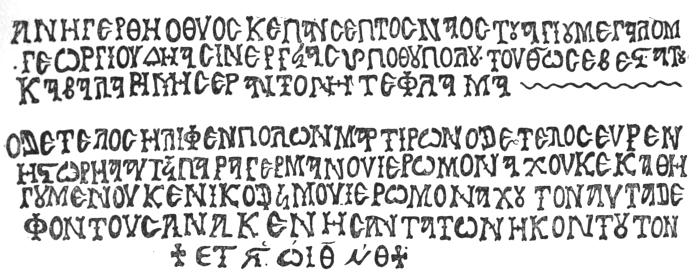
Fig. 1. Inscription on the Church at Karditza.
Antoine le Flamenc, whose ancestors had settled in the Holy Land, is several times mentioned during the first decade of the fourteenth century. The Livre de la Conqueste[96] states that Guy II, Duke of Athens, appointed him his “bailie and lieutenant” in Thessaly in 1303, and describes him as un des plus sages hommes de Romanie and le plus sage dou duchame. The same passage alludes also to Jean le Flamenc, his son, as receiving a post in Thessaly. Doubtless their experience of the Wallachs, who then, as now, wandered as winter approached from the Thessalian to the Bœotian Karditza, would specially commend these two distinguished men for such duties. Two years later we find Antoine as one of the witnesses of a deed[97] regarding the property of the Duchess of Athens, just come of age at Thebes, in her father’s land of Hainault. On April 2nd, 1309, both Antoine and Jean were present at the engagement of the then widowed Duchess with Charles of Taranto at Thebes[98]. On the 23rd of a certain month (? September) of 1308, a Venetian document[99] alludes to the intention of Fiammengo Antonio, together with Guy II, Rocaforte, and Bonifacio da Verona, to tentar l’impresa di Negroponte—in other words, to make an attempt upon that Venetian colony. On August 11th, 1309, another Venetian letter, this time addressed to Egregio militi Antonio Fiammengo, informs us that he had rented the property of Pietro Correr, an absent canon of Thebes, and bids him not to consign the rents to any but the rightful person. A second letter of the same day, addressed to the bailie and councillors of Negroponte, mentions him again in connection with this affair[100]. Finally, the list of Greek dignitaries, with whom the Republic was in correspondence, originally drawn up before the battle of the Kephissos and then corrected in 1313, mentions Ser Antonius Flamengo miles[101]. As his name is not followed by the word decessit or mortuus, added to those who had fallen in the battle, he was one of the very few survivors.
To these certain facts Hopf[102] added the assumption, based on no evidence, that he was the “Frank settled in the East,” whom Isabella, Marchioness of Boudonitza, married, and who, in 1286, disputed the succession to that castle with her cousin.
As Buchon’s books are rare, I append his transcript of the inscription:
ΑΝΗΓΕΡΘΗ Ο ΘΥΙΩΣ ΚΕ ΠΝΣΕΠΤΟΣ ΝΑΟΣ ΤΟΥ ΙΠΟΥ ΜΕΓΑΛΟΜ.Τ ΓΕΩΡΓΙΟΥ ΔΗΑ ΣΙΝΕΡΓΙΑΣ ΚΕ ΠΟΘΟΥ ΠΟΛΛΟΥ ΤΟΥ ΘΕΩΣΕΒΕΣΤΑΤΟΥ ΚΑΒΑΛΑΡΙ ΜΙΣΕΡ ΑΝΤΟΝΙ ΛΕ ΦΛΑΜΑ ΟΔΕ ΤΕΛΟΣ ΗΛΙΦΕΝ ΠΟΛΩΝ ΜΑΡΤΥΡΩΝ ΟΔΕ ΤΕΛΟΣ ΕΥΡΕΝ ΗΣΤΟΡΗΑ ΑΥΤΑ ΠΑΡΑ ΓΕΡΜΑΝΟΥ ΙΕΡΟΜΟΝΑΧΟΥ ΚΕ ΚΑΘΕΓΟΥΜΕΝΟΥ ΚΑΙ ΝΙΚΟΔΕΜΟΥ ΙΕΡΟΜΟΝΑΧΟΥ ΤΟΝ ΑΥΤΑΔΕΛΦΩΝ ΤΟΥΣ ΑΝΑΚΕΝΕΣΑΝΤΑΣ ΤΟΝ ΗΚΟΝ ΤΟΥΤΟΝ. + ΕΤΙ. ϛωΙΘ. +
PLATE I
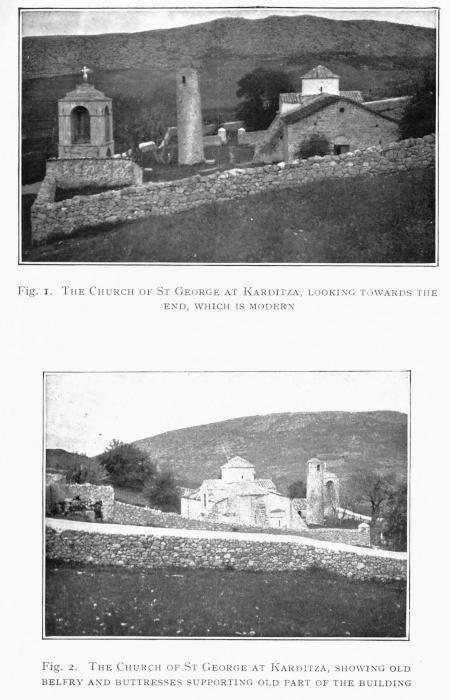
Fig. 1. The Church of St George at Karditza, looking towards the end, which is modern
Fig. 2. The Church of St George at Karditza, showing old belfry and buttresses supporting old part of the building
5. FLORENTINE ATHENS
The history of mediæval Athens is full of surprises. A Burgundian nobleman founding a dynasty in the ancient home of heroes and philosophers; a roving band of mercenaries from the westernmost peninsula of Europe destroying in a single day the brilliant French civilisation of a century; a Florentine upstart, armed with the modern weapons of finance, receiving the keys of the Akropolis from a gallant and chivalrous soldier of Spain—such are the tableaux which inaugurate the three epochs of her Frankish annals. In an earlier paper in the Quarterly Review (January 1907) we dealt with the French and the Catalan periods; we now propose to trace the third and last phase of Latin rule over the most famous of Greek cities.
When, in the spring of 1388, Nerio Acciajuoli found himself master of “the Castle of Setines,” as the Franks called the Akropolis, his first care was to conciliate the Greeks, who formed by far the largest part of his subjects, and who may have aided him to conquer the Athenian duchy. For the first time since the day, nearly two centuries before, when Akominatos had fled from his beloved cathedral to exile at Keos, a Greek Metropolitan of Athens was allowed to reside in his see, not, indeed, on the sacred rock itself, but beneath the shadow of the Areopagos. We may be sure that this remarkable concession was prompted, not by sentiment, but by policy, though the policy was perhaps mistaken. The Greek hierarchy has in all ages been distinguished for its political character; and the presence of a high Greek ecclesiastic at Athens at once provided his fellow-countrymen with a national leader against the rulers, whom they distrusted as foreigners and he hated as schismatics. He was ready to call in the aid of the Turks against his fellow-Christians, just as in modern Macedonia a Greek bishop abhorred the followers of the Bulgarian Exarch far more than those of the Prophet. Thus early in Florentine Athens were sown the seeds of the Turkish domination; thus, in the words of the Holy Synod, “the Athenian Church seemed to have recovered its ancient happiness such as it had enjoyed before the barbarian conquest[103].”
Nor was it the Church alone which profited by the change of dynasty. Greek for the first time became the official language of the Government; Nerio and his accomplished daughter, the Countess of Cephalonia, used it in their public documents; the Countess, the most masterful woman of the Latin Orient, proudly signed herself, in the cinnabar ink of Byzantium, “Empress of the Romans”; even Florentines settled at Athens assumed the Greek translation of their surnames. Thus, a branch of the famous Medici family was transplanted to Athens, became completely Hellenised under the name of Iatros, and has left behind it a progeny which scarcely conceals, beneath that of Iatropoulos, its connection with the mediæval rulers of Florence. There is even evidence that the “elders” of the Greek community were allowed a share in the municipal government of Florentine, no less than in that of Turkish, Athens.
Hitherto the career of Nerio Acciajuoli had been one of unbroken success. His star had guided him from Florence to Akrocorinth, and from Akrocorinth to the Akropolis; his two daughters, one famed as the most beautiful, the other as the most talented woman of her time, were married to the chief Greek and to the leading Latin potentate of Greece—to Theodore Palaiologos, Despot of Mistra, and to Carlo Tocco, the Neapolitan noble who ruled over the County Palatine of Cephalonia. These alliances seemed to guard him against every foe. He was now destined, however, to experience one of those sudden turns of fortune which were peculiarly characteristic of Frankish Greece. He was desirous of rounding off his dominions by the acquisition of the castles of Nauplia and Argos, which had been appendages of the French Duchy of Athens, but which, during the Catalan period, had remained loyal to the family of Brienne and to its heirs, the house of Enghien. In 1388, Marie d’Enghien, the Lady of Argos, left a young and helpless widow, had transferred her Argive estates to Venice, which thus began its long domination over the ancient kingdom of Agamemnon. But, before the Venetian commissioner had had time to take possession, Nerio had instigated his son-in-law, the Despot of Mistra, to seize Argos by a coup de main. For this act of treachery he paid dearly. It was not merely that the indignant Republic broke off all commercial relations between her colonies and Athens, but she also availed herself of the Navarrese Company, which was now established in the Morea, as the fitting instrument of her revenge. The Navarrese commander accordingly invited Nerio to a personal conference on the question of Argos; and the shrewd Florentine, with a childlike simplicity remarkable in one who had lived so many years in the Levant, accepted the invitation, and deliberately placed himself in the power of his enemies. The opportunity was too good to be lost; the law of nations was mere waste-paper to the men of Navarre; Nerio was arrested and imprisoned in a Peloponnesian prison. At once the whole Acciajuoli clan set to work to obtain the release of their distinguished relative; the Archbishop of Florence implored the intervention of the Pope; the Florentine Government offered the most liberal terms to Venice; a message was despatched to Amedeo of Savoy; most efficacious of all, the aid of Genoa was invoked on behalf of one whose daughter was a Genoese citizen. Nerio was released; but his ransom was disastrous to Athens. In order to raise the requisite amount, he stripped the silver plates off the doors of the Parthenon and seized the gold, silver and precious stones which the piety of many generations had given to that venerable cathedral.
Nerio was once more free, but he was not long allowed to remain undisturbed in his palace on the Akropolis. The Sicilian royal family now revived its claims to the Athenian duchy, and even nominated a phantom vicar-general[104]; and, what was far more serious, the Turks, under the redoubtable Evrenos Beg, descended upon Attica. The overthrow of the Serbian Empire on the fatal field of Kossovo had now removed the last barrier between Greece and her future masters; and Bayezid, “the Thunderbolt,” fell upon that unprotected land. The blow struck Nerio’s neighbour, the Dowager Countess of Salona, the proud dame who had so scornfully rejected his suit nine years before. Ecclesiastical treachery and corruption sealed the fate of that ancient fief of the Stromoncourts, the Deslaurs, and the Fadriques, amid tragic surroundings, which a modern Greek drama has endeavoured to depict[105]. The Dowager Countess had allowed her paramour, a priest, to govern in her name; and this petty tyrant had abused his power to wring money from the shepherds of Parnassos and to debauch the damsels of Delphi by his demoniacal incantations in the classic home of the supernatural. At last he cast his eyes on the fair daughter and full money-bags of the Greek bishop; deprived of his child and fearing for his gold, the bishop roused his flock against the monster and begged the Sultan to occupy a land so well adapted for his Majesty’s favourite pastimes of hunting and riding as is the plain at the foot of Parnassos. The Turks accepted the invitation; the priest shut himself up in the noble castle, slew the bishop’s daughter, and prepared to fight. But there was treachery among the garrison; a man of Salona murdered the tyrant and offered his head to the Sultan; and the Dowager Countess and her daughter in vain endeavoured to appease the conqueror with gifts. Bayezid sent the young Countess to his harem; her mother he handed over to the insults of his soldiery, her land he assigned to one of his lieutenants. Her memory still clings to the “pomegranate” cliff (ροιά) at Salona, whence, according to the local legend, repeated to the author on the spot, “the princess” was thrown.
Nerio feared for his own dominions, whence the Greek Metropolitan had fled—so it was alleged—to the Turkish camp, and had promised the infidels the treasures of the Athenian Church in return for their aid. For the moment, however, the offer of tribute saved the Athenian duchy; but its ruler hastened to implore the aid of the Pope and of King Ladislaus of Naples against the enemies of Christendom, and at the same time sought formal recognition of his usurpation from that monarch, at whose predecessors’ court the fortunes of his family had originated, and who still pretended to be the suzerain of Achaia, and therefore of its theoretical dependency, Athens. Ladislaus, nothing loth, in 1394 rewarded the self-seeking Florentine for having recovered the Duchy of Athens “from certain of His Majesty’s rivals,” with the title of duke, with remainder—as Nerio had no legitimate sons—to his brother Donato and the latter’s heirs. Cardinal Angelo Acciajuoli, another brother, was to invest the new duke with a golden ring; and it was expressly provided that Athens should cease to be a vassal state of Achaia, but should thenceforth own no overlord save the King of Naples. The news that one of their clan had obtained the glorious title of Duke of Athens filled the Acciajuoli with pride—such was the fascination which the name of that city exercised in Italy. Boccaccio, half a century before, had familiarised his countrymen with a title which Walter of Brienne, the tyrant of Florence, had borne as of right, and which, as applied to Nerio Acciajuoli, was no empty flourish of the herald’s college.
The first Florentine Duke of Athens did not, however, long survive the realisation of his ambition. On September 25 of the same year he died, laden with honours, the type of a successful statesman. But, as he lay on his sick-bed at Corinth, the dying man seems to have perceived that he had founded his fortunes on the sand. Pope and King might give him honours and promises; they could not render effective aid against the Turks. It was under the shadow of this coming danger that Nerio drew up his remarkable will.
His first care was for the Parthenon, Our Lady of Athens, in which he directed that his body should be laid to rest. He ordered its doors to be replated with silver, its stolen treasures to be bought up and restored to it; he provided that, besides the twelve canons of the cathedral, there should be twenty priests to say masses for the repose of his soul; and he bequeathed to the Athenian minster, for their support and for the maintenance of its noble fabric, the city of Athens, with its dependencies, and all the brood-mares of his valuable stud. Seldom has a church received such a remarkable endowment; the Cathedral of Monaco, built out of the earnings of a gaming-table, is perhaps the closest parallel to the Parthenon maintained by the profits of a stud-farm. Nerio made his favourite daughter, the Countess of Cephalonia, his principal heiress; to her he bequeathed his castles of Megara, Sikyon, and Corinth, while to his natural son, Antonio, he left the government of Thebes, Livadia, and all beyond it. To the bastard’s mother, Maria Rendi, daughter of the ever-serviceable Greek notary who had been so prominent in the last years of the Catalan domination, and had retained his position under the new dynasty, her lover granted the full franchise, with the right to retain all her property, including, perhaps, the spot between Athens and the Piræus which still preserves the name of her family. Finally, he recommended his land to the care of the Venetian Republic, which he begged to protect his heiress and to carry out his dispositions for the benefit of Our Lady of Athens.
Donato Acciajuoli made no claim to succeed his brother in the Duchy of Athens. He was Gonfaloniere of Florence and Senator of Rome; and he preferred those safe and dignified positions in Italy to the glamour of a ducal coronet in Greece, in spite of the natural desire of the family that one of their name should continue to take his title from Athens[106]. But it was obvious that a conflict would arise between the sons-in-law of the late duke, for Nerio had practically disinherited his elder daughter in favour of her younger but abler sister. Carlo Tocco of Cephalonia at once demanded the places bequeathed to his wife, occupied Megara and Corinth, and imprisoned the terrified executors in his island till they had signed a document stating that he had carried out the terms of his father-in-law’s will. Theodore Palaiologos, who contended that Corinth had always been intended to be his after Nerio’s death, besieged it with a large force, till Tocco, calling in a still larger Turkish army, drove his brother-in-law from the Isthmus[107].
Meanwhile, the Greeks of Athens had followed the same fatal policy of invoking the common enemy as arbiter of their affairs. It was not to be expected that the Greek race, which had of late recovered its national consciousness, and which had ever remained deeply attached to its religion, would quietly acquiesce in the extraordinary arrangement by which the city of Athens was made the property of the Catholic cathedral. The professional jealousy and the odium theologicum of the two great ecclesiastics, Makarios, the Greek Metropolitan, and Ludovico da Prato, the Latin archbishop, envenomed the feelings of the people. The Greek divine summoned Timourtash, the Turkish commander, to rid Athens of the filioque clause; and his strange ally occupied the lower town. The castle, however, was bravely defended by Matteo de Montona, one of the late duke’s executors, who despatched a messenger in hot haste to the Venetian colony of Negroponte, offering to hand over Athens to the Republic if the governor would promise in her name to respect the ancient franchises and customs of the Athenians. The bailie of Negroponte agreed, subject to the approval of the home Government, and sent a force which dispersed the Turks, and, at the close of 1394, for the first time in history, hoisted the lion-banner of the Evangelist on the ancient castle of Athens.
The Republic decided, after mature consideration, to accept the offer of the Athenian commander. No sentimental argument, no classical memories, weighed with the sternly practical statesmen of the lagoons. The romantic King of Aragon had waxed enthusiastic over the glories of the Akropolis; and sixty years later the greatest of Turkish Sultans contemplated his conquest with admiration. But the sole reason which decided the Venetian Government to annex Athens was its proximity to the Venetian colonies, and the consequent danger which might ensue to them if it fell into Turkish or other hands. Thus Venice took over the Akropolis in 1395, not because it was a priceless monument, but because it was a strong fortress; she saved the Athenians, not, as Cæsar had done, for the sake of their ancestors, but for that of her own colonies, “the pupil of her eye.” From the financial point of view, indeed, Athens could not have been a valuable asset. The Venetians confessed that they did not know what its revenues and expenses were; and, pending a detailed report from their governor, they ordered that only eight priests should serve “in the Church of St Mary of Athens”—an act of economy due to the fact that some of Nerio’s famous brood-mares had been stolen and the endowment of the cathedral consequently diminished. On such accidents did the maintenance of the Parthenon depend in the Middle Ages.
We are fortunately in a better position than was the Venetian Government to judge of the contemporary state of Athens. At the very time when its fate was under discussion an Italian notary spent two days in that city; and his diary is the first account which any traveller has left us, from personal observation, of its condition during the Frankish period[108]. “The city,” he says, “which nestles at the foot of the castle hill, contains about a thousand hearths” but not a single inn, so that, like the archæologist in some country towns of modern Greece, he had to seek the hospitality of the clergy. He describes “the great hall” of the castle (the Propylaia), with its thirteen columns, and tells how the churchwardens personally conducted him over “the Church of St Mary,” which had sixty columns without and eighty within. On one of the latter he was shown the cross made by Dionysios the Areopagite at the moment of the earthquake which attended our Lord’s passion; four others, which surrounded the high altar, were of jasper and supported a dome, while the doors came—so he was told—from Troy. The pious Capuan was then taken to see the relics of the Athenian cathedral—the figure of the Virgin painted by St Luke, the head of St Makarios, a bone of St Denys of France, an arm of St Justin, and a copy of the Gospels written by the hand of St Elena—relics which the wife of King Pedro IV of Aragon had in vain begged the last Catalan archbishop to send her fifteen years before[109].
He saw, too, in a cleft of the wall, the light which never fails, and outside, beyond the castle ramparts, the two pillars of the choragic monument of Thrasyllos, between which there used to be “a certain idol” in an iron-bound niche, gifted with the strange power of drowning hostile ships as soon as they appeared on the horizon—an allusion to the story of the Gorgon’s head, mentioned by Pausanias, which we find in later mediæval accounts of Athens. In the city below he noticed numbers of fallen columns and fragments of marble; he alludes to the Stadion; and he visited the “house of Hadrian,” as the temple of Olympian Zeus was popularly called. He completed his round by a pilgrimage to the so-called “Study of Aristotle, whence scholars drank to obtain wisdom”—the aqueduct, whose marble beams, commemorating the completion of Hadrian’s work by Antoninus Pius, were then to be seen at the foot of Lykabettos, and, after serving in Turkish times as the lintel of the Boubounistra gate, now lie, half buried by vegetation, in the palace garden. But the fear of the prowling Turks and the feud between Nerio’s two sons-in-law rendered travelling in Attica difficult; the notary traversed the Sacred Way in fear of his life, and was not sorry to find himself in the castle of Corinth, though the houses in that city were few and mean, and the total population did not exceed fifty families.
The Venetian Government next arranged for the future administration of its new colony. The governor of Athens was styled podestà and captain, and was appointed for the usual term of two years at an annual salary of £70, out of which he had to keep a notary, an assistant, four servants, two grooms, and four horses. Four months elapsed before a noble was found ambitious of residing in Athens on these terms, and of facing the difficult situation there. Attica was so poor that he had to ask his Government for a loan; the Turkish corsairs infested the coast; the Greek Metropolitan, though now under lock and key at Venice, still found means of communicating with his former allies. Turkish writers even boast—and a recently published document confirms their statement—that their army captured “the city of the sages” in 1397; and an Athenian dirge represented Athens mourning the enslavement of the husbandmen of her suburb of Sepolia, who will no longer be able to till the fields of Patesia.
The Turkish invaders came and went; but another and more obstinate enemy ever watched the little Venetian garrison on the Akropolis. The bastard Antonio Acciajuoli fretted within the walls of his Theban domain, and was resolved to conquer Athens, as his father had done before him. In vain did Venice, alarmed by the reports of her successive governors, raise the numbers of the garrison to fifty-six men; in vain did she order money to be spent on the defences of the castle; in vain did she attempt to pacify the discontented Athenians, who naturally preferred the rule of an Acciajuoli who was half a Greek to that of a Venetian noble. By the middle of 1402 Antonio was master of the lower city; it seemed that, unless relief came at once, he would plant his banner on the Akropolis. The Senate, at this news, ordered the bailie of Negroponte to offer a reward for the body of the bold bastard, alive or dead, to lay Thebes in ashes, and to save the castle of Athens. That obedient official set out at the head of six thousand men to execute the second of these injunctions, only to fall into an ambush which his cunning enemy had laid in the pass of Anephorites. Venice, now alarmed for the safety of her most valuable colony far more than for that of Athens, hastily sent commissioners to make peace. But Antonio calmly continued the siege of the Akropolis, till at last, seventeen months after his first appearance before the city, when the garrison had eaten the last horse, and had been reduced to devour the plants which grew on the castle rock, its gallant defenders, Vitturi and Montona, surrendered with the honours of war. The half-caste adventurer had beaten the great Republic.
Venice attempted to recover by diplomacy what she had lost by arms. She possessed in Pietro Zeno, the baron of Andros, a diplomatist of unrivalled experience in the tortuous politics of the Levant. Both he and Antonio were well aware that the fate of Athens depended upon the Sultan; and to his Court they both repaired, armed with those pecuniary arguments which have usually proved convincing to Turkish ministers. The diplomatic duel was lengthy; but at last the Venetian gained one of those paper victories so dear to ambassadors and so worthless to practical men. The Sultan promised to see that Athens was restored to the Republic, but he took no steps to perform his promise; while Antonio, backed by the Acciajuoli influence in Italy, by the Pope, and the King of Naples, held his ground. Venice wisely resigned herself to the loss of a colony which it would have been expensive to recover. To save appearances, Antonio was induced to become her vassal for “the land, castle, and place of Athens, in modern times called Sythines[110],” sending every year, in token of his homage, a silk pallium from the Theban manufactories to the church of St Mark—a condition which he was most remiss in fulfilling.
The reign of Antonio Acciajuoli—the longest in the history of Athens save that of the recent King of the Hellenes—was a period of prosperity and comparative tranquillity for that city. While all around him principalities and powers were shaken to their foundations; while that ancient warden of the northern March of Athens, the Marquisate of Boudonitza, was swept away for ever; while Turkish armies invaded the Morea, and annexed the Albanian capital to the Sultan’s empire; while the principality of Achaia disappeared from the map in the throes of a tardy Greek revival, the statesmanlike ruler of Athens skilfully guided the policy of his duchy. At times even his experienced diplomacy failed to avert the horrors of a Turkish raid; on one occasion he was forced to join, as a Turkish vassal, in an invasion of the Morea. But, as a rule, the dreaded Mussulmans spared this half-Oriental, who was a past-master in the art of managing the Sultan’s ministers. From the former masters of Athens, the Catalans and the Venetians, he had nothing to fear. Once, indeed, he received news that Alfonso V of Aragon, who never forgot to sign himself “Duke of Athens and Neopatras,” intended to put one of his Catalan subjects into possession of those duchies. But Venice reassured him with a shrewd remark that the Catalans usually made much ado about nothing. On her part the Republic was friendly to the man who had supplanted her. She gave Antonio permission, in case of danger, to send the valuable Acciajuoli stud—for, like his father, he was a good judge of horse-flesh—to the island of Eubœa; and she ordered her bailie to “observe the ancient commercial treaties between the duchy and the island, which he would find in the chancery of Negroponte.” But when he sought to lay the foundations of a navy, and strove to prevent the fruitful island of Ægina, then the property of the Catalan family of Caopena, from falling into the hands of Venice, he met with a severe rebuff. To the Florentine Duke of Athens Ægina, as a Venetian colony, might well seem, as it had seemed to Aristotle, the “eyesore of the Piræus.”
With his family’s old home, Florence, Antonio maintained the closest relations. In 1422 a Florentine ambassador arrived in Athens with instructions to confer the freedom of the great Tuscan Commonwealth upon the Duke; to inform him that Florence, having now, by the destruction of Pisa and the purchase of Leghorn, become a maritime power, intended to embark in the Levant trade; and to ask him, therefore, for the benefit of the most-favoured-nation clause. Antonio gladly made all Florentine ships free of his harbours, and reduced the usual customs dues in favour of all Florentine merchants throughout his dominions. Visitors from Tuscany, when they landed at Riva d’Ostia, on the Gulf of Corinth, must, indeed, have felt themselves in the land of a friendly prince, though his Court on the Akropolis presented a curious mixture of the Greek and the Florentine elements. Half a Greek himself, Antonio chose both his wives from that race—the first the beautiful daughter of a Greek priest, to whom he had lost his heart in the mazes of a wedding-dance at Thebes; the second an heiress of the great Messenian family of Melissenos, whose bees and bells are not the least picturesque escutcheon in the heraldry of mediæval Greece. As he had no children, numbers of the Acciajuoli clan came to Athens with an eye to the ducal coronet, which had conferred such lustre upon the steel-workers and bankers of Brescia and Florence. One cousin settled down at the castle of Sykaminon, near Oropos, which had belonged to the Knights of the Hospital, and served his kinsman as an ambassador; another became bishop of Cephalonia, the island of that great lady, the Countess Francesca, whom Froissart describes as a mediæval Penelope, whose maids of honour made silken coverings so fine that there was none like them, and whose splendid hospitality delighted the French nobles on their way home from a Turkish prison after the battle of Nikopolis. Two other Acciajuoli were archbishops of Thebes; and towards the close of Antonio’s long reign a second generation of the family had grown up in Greece. With such names as Acciajuoli, Medici, Pitti, and Machiavelli at the Athenian Court, Attica had, indeed, become a Florentine colony.
Antonio and his Florentine relatives must have led a merry life in their delectable duchy. In the family correspondence we find allusions to hawking and partridge shooting; and the ducal stable provided good mounts for the young Italians who scoured the plains of Attica and Bœotia in quest of game. The cultured Florentines were delighted with Athens and the Akropolis. “You have never seen,” wrote Nicolò Machiavelli to one of his cousins, “a fairer land nor yet a fairer fortress than this.” It was there, in the venerable Propylaia, that Antonio had fixed his ducal residence. No great alterations were required to convert the classic work of Mnesikles into a Florentine palace. All that the Acciajuoli seem to have done was to cut the two vestibules in two so as to make four rooms, to fill up the spaces between the pillars with walls—removed so recently as 1835—and to add a second storey, the joist-sockets of which are still visible, to both that building and the Pinakotheke, which either then, or in the Turkish times, was crowned with battlements.
To the Florentine dukes is also usually ascribed the construction of the square “Frankish tower,” which stood opposite the Temple of Nike Apteros till it was pulled down in 1874 by one of those acts of pedantic barbarism which considers one period of history alone worthy of study, instead of regarding every historical monument as a precious landmark in the evolution of a nation. We can well believe that the Florentine watchman from the projecting turret daily swept sea and land in all directions, save where the massive cathedral of Our Lady shut out part of Hymettos from his view; and at night the beacon-fire kindled on the summit warned Akrocorinth of the approach of Turkish horsemen or rakish-looking galleys. Nor did the Italians limit their activity as builders to the castle-crag alone. Chalkokondyles expressly says that Antonio’s long and peaceful administration enabled him to beautify the city. There is evidence that the dukes possessed a beautiful villa at the spring of Kallirrhoe, and that close by they were wont to pray in the church of St Mary’s-on-the-rock, once a temple of Triptolemos. More than two centuries later a French ambassador heard mass in this church; and one of his companions found the lion rampant and the three lilies of the Florentine bankers, which visitors to the famous Certosa know so well, still guarding—auspicium melioris ævi—the entrance of the Turkish bazaar[111].
Of literary culture there are some few traces in Florentine Athens. It was in Antonio’s reign that Athens gave birth to her last historian, Laonikos Chalkokondyles, the Herodotos of mediæval Greece, who told the story of the new Persian invasion, and to his brother Demetrios, who did so much to diffuse Greek learning in Italy. Another of Antonio’s subjects is known to scholars as a copyist of manuscripts at Siena; and it is obvious that the two Italian Courts of Athens and Joannina were regarded as places where professional men might find openings. A young Italian writes from Arezzo to ask if either Antonio Acciajuoli or Carlo Tocco could give him a chair of jurisprudence, logic, medicine, or natural or moral philosophy[112]. Unfortunately, we are not told whether the modest request of this universal genius was granted or not.
Thus, for a long period, the Athenian duchy enjoyed peace and prosperity, broken only by a terrible visitation of the plague and further diminished by emigration—that scourge of modern Greece. But the modern Greeks have not the twin institutions, serfdom and slavery, on which mediæval society rested. Even the enlightened Countess of Cephalonia presented a young female slave to one of her cousins, with full power to sell or otherwise dispose of her as he pleased. Antonio did all in his power to retain the useful Albanians, who had entered his dominions in large numbers after the capture of the Despotat of Epeiros by Carlo Tocco in 1418, and thus rendered a service to Attica, the results of which are felt to this present hour. It is to the wise policy of her last Aragonese and her second Florentine duke that that Albanian colonisation is due which has given “the thin soil” of Attica numbers of sturdy cultivators, who still speak Albanian as well as Greek, and still preserve in such village names as Spata, Liosia, and Liopesi, the memory of the proud Albanian chieftains of Epeiros. Greek influence, too, grew steadily under a dynasty which was now half Hellenised. The notary and chancellor of the city continued to be a Greek; and a Greek archon was, for the first time since the Frankish conquest, to play a leading part in Athenian politics[113].
When one morning in 1435, after a reign of thirty-two years, Antonio’s attendants found him dead in his bed, a Greek as well as an Italian party disputed the succession. The Italian candidate, young Nerio, eldest son of Franco Acciajuoli, baron of Sykaminon, whom the late Duke had adopted as his heir, occupied the city. But the Duchess Maria Melissene and her kinsman, Chalkokondyles, father of the historian and the leading man of Athens, held the castle. Well aware, however, that the Sultan was the real master of the situation, the Greek archon set out for the Turkish Court to obtain Murad II’s consent to this act of usurpation. The Sultan scornfully rejected the bribes of the Athenian diplomatist, threw him into prison, and sent his redoubtable captain, Tourakhan, to occupy Thebes. Even then the Greek Duchess did not abandon all hope of securing Athens for the national cause. Through the historian Phrantzes she made an arrangement with Constantine Palaiologos, the future Emperor, then one of the Despots of the Morea, and the foremost champion of Hellenism, that he should become Duke of Athens, and that she should receive compensation near her old home in the Peloponnese. This scheme would have united nearly all Greece under the Imperial family; but it was doomed to failure. There was a section of Greeks at Athens hostile to Chalkokondyles—for party spirit has always characterised Greek public life—and this section joined the Florentine party, decoyed the Duchess out of the Akropolis, and proclaimed Nerio II. The marriage of the new Duke with the Dowager Duchess[114] and the banishment of the family of Chalkokondyles secured the internal peace of the distracted city; and the Sultan was well content to allow a Florentine princeling to retain the phantom of power so long as he paid his tribute with regularity.
The weak and effeminate Nerio II was exactly suited for the part of a Turkish puppet. But, like many feeble rulers, the “lord of Athens and Thebes” seems to have made himself unpopular by his arrogance; and a few years after his accession he was deprived of his throne by an intrigue of his brother, Antonio II. He then retired to Florence, the home of his family, where he had property, to play the part of a prince in exile, if exile it could be called. There he must have been living at the time of the famous Council, an echo of whose decisions we hear in distant Athens, where a Greek priest, of rather more learning than most of his cloth, wrote to the Œcumenical Patriarch on the proper form of public prayer for the Pope. A bailie—so we learn from one of his letters[115]—was then administering the duchy, for Antonio had died in 1441; his infant son, Franco, was absent at the Turkish Court; and his subjects had recalled their former lord to the Akropolis. There he was seen, three years later, by the first antiquary who ever set foot in Frankish Athens, Cyriacus of Ancona, the Pausanias of mediæval Greece.
That extraordinary man, like Schliemann, a merchant by profession but an archæologist by inclination, had already once visited Athens. In 1436 he had stayed there for a fortnight as the guest of a certain Antonelli Balduini; but on that occasion he was too much occupied copying inscriptions to seek an audience of the Duke. He, too, like the Capuan notary, went to see “Aristotle’s Study”; he describes the “house” or “palace of Hadrian”; he alludes to the statue of the Gorgon on the south of the Akropolis. But of contemporary Athens, apart from the monuments, he tells us little beyond the facts that it possessed four gates and that it had “new walls”—a statement corroborated by that of another traveller thirty years later, which might indicate the so-called wall of Valerian as the work of the Acciajuoli[116]. Of the inhabitants he says nothing; as living Greeks, they had for him no interest; was he not an archæologist?
In February 1444 the worthy Cyriacus revisited Athens; and on this occasion, accompanied by the Duke’s cousin and namesake, he went to pay his respects to “Nerio Acciajuoli of Florence, then prince of Athens,” whom he “found on the Akropolis, the lofty castle of the city[117].” Again, however, the archæological overpowered the human interest; and he hastened away from the ducal presence to inspect the Propylaia and the Parthenon. His original drawing of the west front of the latter building has been preserved in a manuscript, which formerly belonged to the Duke of Hamilton, but is now in the Berlin Museum, and is the earliest known pictorial reproduction of that splendid temple[118]. Other Athenian sketches may be seen in the Barberini manuscript of 1465, now at the Vatican, which contains the diagrams of San Gallo; and it seems that the eminent architect, who took the explanatory text almost verbatim from the note-books of Cyriacus, also copied the latter’s drawings.
The travels of the antiquary of Ancona in Greece demonstrate an interesting fact, which has too often been ignored, that the Latin rulers of the Levant were sometimes men of culture and taste. Crusino Sommaripa, the baron of Paros, took a pride in showing his visitor some marble statues which he had had excavated, and allowed him to send a marble head and leg to his friend Giustiniani-Banca, of Chios, a connoisseur of art who composed Italian verses in his “Homeric” villa. So deeply was Cyriacus moved by Crusino’s culture and kindness that he too burst out into an Italian poem, of which happily only one line has been published. Dorino Gattilusio, the Genoese lord of Lesbos, aided him in his investigation of that island; the Venetian governor of Tenos escorted him in his state-galley to inspect the antiquities of Delos; and Carlo Tocco II, whom he quaintly describes as “King of the Epeirotes,” gave him every facility for visiting the ruins of Dodona, and was graciously pleased to cast his royal eye over the manuscript account of the antiquary’s journey[119]. Another of the Tocchi is known to have employed a Greek priest to copy for him the works of Origen and Chrysostom; and in the remote Peloponnesian town of Kalavryta Cyriacus met a kindred soul, who possessed a large library from which he lent the wandering archæologist a copy of Herodotos. Thus, on the eve of the Turkish conquest, Greece was by no means so devoid of culture as has sometimes been too hastily assumed. It is clear, on the contrary, that her Frankish princes were by no means indifferent to their surroundings, and that the more enlightened of her own sons were conscious of her great past.
The very year of the antiquary’s second visit to Athens witnessed the last attempt of a patriotic and ambitious Greek to recover all Greece for his race. The future Emperor Constantine was now Despot of Mistra, the mediæval Sparta; and he thought that the moment had at last come for renewing the plan for the annexation of the Athenian duchy which had failed nine years before. The Turks, hard pressed by the Hungarians and Poles, defeated by “the white knight of Wallachia” at Nish, defied by Skanderbeg in the mountains of Albania, and threatened by the appearance of a Venetian fleet in the Ægean, could no longer protect their creature at Athens. Ere long the last Constantine entered the gates of Thebes and forced Nerio II to pay him tribute. The Court of Naples heard that he had actually occupied Athens; and Alfonso V of Aragon, who had never forgotten that he was still titular Duke of Athens and Neopatras, wrote at once to Constantine demanding the restitution of the two duchies to himself, and sent the Marquess of Gerace to receive them from the conqueror’s hands. Scarcely, however, had the letter been despatched when the fatal news of the great Turkish victory at Varna reached the writer. We hear nothing more of Gerace’s mission, for all recognised that the fate of Athens now depended upon the will of the victorious Sultan. To Murad II the shadowy claims of the house of Aragon and the efforts of the house of Palaiologos were alike indifferent.
Nerio’s attitude at this crisis was pitiful in the extreme. The Turks punished him for having given way to Constantine. Constantine again threatened him for his obsequiousness in promising to renew his tribute to the Turks. But the Sultan, true to the traditional Turkish policy of supporting the weaker of two rival Christian nationalities, forced the Greek Despot to evacuate the Florentine duchy. Nerio had the petty satisfaction of accompanying his lord and master to the Isthmus and of witnessing the capture of the famous Six-mile Rampart, in which the Greeks had vainly trusted, by the Serbian janissaries. Five years later, in 1451, a Venetian despatch gives us a last and characteristic glimpse of the wretched Nerio, when the Venetian envoy to the new Sultan, Mohammed II, is instructed to ask that potentate if he will compel his vassal, “the lord of Sithines and Stives,” to settle the pecuniary claims of two Venetians[120].
Nerio’s death was followed by one of those tragedies in which the women of Frankish Greece were so often protagonists, and of which a modern dramatist might well avail himself. After the death of his first wife, Nerio II had married a passionate Venetian beauty, Chiara Zorzi, or Giorgio, one of the daughters of the baron of Karystos, or Castel Rosso, in the south of Eubœa, who sprang from the former Marquesses of Boudonitza. The Duchess Chiara bore him a son, Francesco, who was unfortunately still a minor at the time of his father’s death. The child’s mother possessed herself of the regency and persuaded the Porte, by the usual methods, to sanction her usurpation. Soon afterwards, however, there visited Athens on some commercial errand a young Venetian noble, Bartolommeo Contarini, whose father had been governor of the Venetian colony of Nauplia. The Duchess fell in love with her charming visitor, and bade him aspire to her hand and land. Contarini replied that alas! he had left a wife behind him in his palace on the lagoons. To the Lady of the Akropolis, a figure who might have stepped from a play of Æschylus, the Venetian wife was no obstacle. It was the age of great crimes. Contarini realised that Athens was worth a murder, poisoned his spouse, and returned to enjoy the embraces and the authority of the Duchess.
But the Athenians soon grew tired of this Venetian domination. They complained to Mohammed II; the great Sultan demanded explanations; and Contarini was forced to appear with his stepson, whose guardian he pretended to be, at the Turkish Court. There he found a dangerous rival in the person of Franco Acciajuoli, only son of the late Duke Antonio II and cousin of Francesco, a special favourite of Mohammed and a willing candidate for the Athenian throne. When the Sultan heard the tragic story of Chiara’s passion, he ordered the deposition of both herself and her husband, and bade the Athenians accept Franco as their lord. Young Francesco was never heard of again. But the tragedy was not yet over. Franco had no sooner assumed the government of Athens than he ordered the arrest of his aunt Chiara, threw her into the dungeons of Megara, and there had her mysteriously murdered. A picturesque legend current three centuries later at Athens makes Franco throttle her with his own hands as she knelt invoking the aid of the Virgin, and then cut off her head with his sword[121]; so deep was the impression which her fate made upon the popular imagination.
The legend tells us how her husband, “the Admiral,” had come with many ships to the Piræus to rescue her, but arrived too late. Unable to save, he resolved to avenge her, and laid the grim facts before the Sultan. Mohammed II, indignant at the conduct of his protégé, but not sorry, perhaps, of a pretext for destroying the remnants of Frankish rule at Athens, ordered Omar, son of Tourakhan, the governor of Thessaly, to march against the city. The lower town offered no resistance, for its modern walls had but a narrow circumference, and its population and resources were scanty. Nature herself seemed to fight against the Athenians. On May 29, the third anniversary of the capture of Constantinople, a comet appeared in the sky; a dire famine followed, so that the people were reduced to eat roots and grass. On June 4, 1456, the town fell into the hands of the Turks[122]. But the Akropolis, which was reputed impregnable, long held out. In vain the Constable of Athens and some of the citizens offered the castle to Venice through one of the Zorzi family; the Republic ordered the bailie of Negroponte to keep the offer open, but took no steps to save the most famous fortress in Christendom; in vain he summoned one Latin prince after another to his aid. From the presence of an Athenian ambassador at the Neapolitan Court[123] we may infer that Alfonso V of Aragon, the titular “Duke of Athens,” was among their number. The papal fleet, which was despatched to the Ægean, did not even put into the Piræus. Meanwhile Omar, after a vain attempt to seduce the garrison from its allegiance, reminded Franco that sooner or later he must restore Athens to the Sultan who gave it. “Now, therefore,” added the Turkish commander, “if thou wilt surrender the Akropolis, His Majesty offers thee the land of Bœotia, with the city of Thebes, and will allow thee to take away the wealth of the Akropolis and thine own property.” Franco only waited till Mohammed had confirmed the offer of his subordinate, and then quitted the castle of Athens, with his wife and his three sons, for ever. At the same time the last Catholic archbishop, Nicolò Protimo of Eubœa, left the cathedral of Our Lady. It was not till 1875 that a Latin prelate again resided at Athens.
The great Sultan, so his Greek biographer, Kritoboulos, tells us, was filled with a desire to see the city of the philosophers. Mohammed knew Greek, and had heard and read much about the wisdom and marvellous works of the ancient Athenians; we may surmise that Cyriacus of Ancona had told him of the Athenian monuments when he was employed as reader to his Majesty during the siege of Constantinople[124]. This strange “Philhellene”—for so Kritoboulos audaciously describes the conqueror of Hellas—longed to visit the places where the heroes and sages of classic Athens had walked and talked, and at the same time to examine, with a statesman’s eye, the position of the city and the condition of its harbours. In the autumn of 1458, on his return from punishing the Greek Despots of the Morea, he had an opportunity of achieving his wish. When he arrived at the gates (if we may believe a much later tradition[125]), the Abbot of Kaisariane, the monastery which still nestles in one of the folds of Hymettos, handed him the keys of the city. There is nothing improbable in the story, for the Greek Metropolitan, Isidore, had fled to the Venetian Island of Tenos; and the abbot may therefore have been the most important Greek dignitary left at Athens. The Sultan devoted four days to visiting his new possession, “of all the cities in his Empire the dearest to him,” as the Athenian Chalkokondyles proudly says. But of all that he saw he admired most the Akropolis, whose ancient and recent buildings he examined “with the eyes of a scholar, a Philhellene, and a great sovereign.” Like Pedro IV of Aragon before him, he was proud to possess such a jewel, and in his enthusiasm he exclaimed, “How much, indeed, do we not owe to Omar, the son of Tourakhan!”
The conquered Athenians were once again saved by their ancestors. Like his Roman prototype, Mohammed II treated them humanely, granted all their petitions, and gave them many and various privileges. So late as the seventeenth century there were Athenians who could show patents of fiscal exemption, issued to their forebears by the conqueror. If, however, the Greek clergy had hoped that the great cathedral would be restored to the Orthodox church, they were disappointed. The Parthenon, by a third transformation, was converted into a mosque; and soon, from the tapering minaret which rose above it, the muezzin summoned the faithful to the Ismaïdi, or “house of prayer.” A like fate befell the church which had served as the Orthodox cathedral during the Frankish domination, but which received, in honour of the Sultan’s visit, the name of Fethijeh Jamisi, or “Mosque of the Conqueror,” and which still preserves, amid the squalid surroundings of the military bakery, the traces of its former purpose.
The anonymous treatise on “The Theatres and Schools of Athens,” which was probably composed by some Greek at this moment, perhaps to serve as a guide-book for the distinguished visitor, gives us a last glimpse of Frankish Athens. The choragic monument of Lysikrates was still known as “the lantern of Demosthenes”; the Tower of the Winds was supposed to be “the School of Sokrates”; the gate of Athena Archegetis was transformed in common parlance into “the palace of Themistokles”; the Odeion of Perikles was called “the School of Aristophanes”; and that of Herodes Atticus was divided into “the palaces of Kleonides and Miltiades.” The spots where once had stood the houses of Thucydides, Solon, and Alkmaion were well known to the omniscient local antiquary, who unhesitatingly converts the Temple of Wingless Victory into “a small school of musicians, founded by Pythagoras.”
On the fifth day after his arrival the heir of these great men left Athens for Thebes, the abode of his vassal Franco, who must have heaved a sigh of relief when his terrible visitor, after a minute examination of Bœotia, set out for Macedonia. For two years longer he managed to retain his Theban dominions, from which he received a revenue as large as that which he had formerly enjoyed, till, in 1460, Mohammed, after finally destroying the two Greek principalities of the Morea, revisited Athens. There the Sultan heard a rumour that some Athenians had conspired to restore their Florentine lord. This decided Franco’s fate. At the moment he was serving, as the man of the Turk, with a regiment of Bœotian cavalry in Mohammed’s camp. His suzerain ordered him to join in an attack which he meditated upon the surviving fragments of the ancient county of Cephalonia, the domain of the Tocchi. Franco shrank from fighting against his fellow-countryman; and a curious letter has recently been published[126] in which, for this very reason, he offered his services as a condottiere to Francesco Sforza of Milan for the sum of 10,000 ducats a year. But he was forced to obey; he did his pitiable task, and repaired to the headquarters of Zagan Pasha, the governor of the Morea, unconscious that the latter had orders to kill him. The Pasha invited him to his tent, where he detained him in conversation till nightfall; but, as the unsuspecting Frank was on his way back to his own pavilion, the governor’s guards seized and strangled him. Such was the sorry end of the last “Lord of Thebes.” Mohammed annexed all Bœotia, and thus obliterated the last trace of the Duchy of Athens.
Franco’s three sons were enrolled in the corps of janissaries, where one of them showed military and administrative ability of so high an order as to win the favour of his sovereign. Their mother, a Greek of noble lineage and famed for her beauty, became the cause of a terrible tragedy which convulsed alike Court and Church. Amoiroutses, the former minister and betrayer of the Greek Empire of Trebizond, fell desperately in love with the fair widow, to whom he addressed impassioned verses, and swore, though he was already married, to wed her or die. The Œcumenical Patriarch forbade the banns, and lost his beard and his office rather than yield to the Sultan. But swift retribution fell upon the bigamist, for he dropped down dead, a dice-box in his hand.
Though the Acciajuoli dynasty had thus fallen for ever, members of that great family still remained in Greece. An Acciajuoli was made civil governor of the old Venetian colony of Koron, in Messenia, when the Spaniards conquered it from the Turks in 1532. When they abandoned it, he was captured by pirates but eventually ransomed, only to die in poverty at Naples, where his race had first risen to eminence. At the beginning of the last century the French traveller, Pouqueville, was shown at Athens a donkey-driver named Neri, in whose veins flowed the blood of the Florentine Dukes; and the modern historian of Christian Athens, Neroutsos, used to contend that his family was descended from Nerozzo Pitti, lord of Sykaminon and uncle of the last Duke of Athens. In Florence the family became extinct only so recently as 1834; and the Certosa and the Lung’ Arno Acciajuoli still preserve its memory there. In a Florentine gallery are two coloured portraits of the Dukes of Athens, which would seem to be those of Nerio I and the bastard Antonio I. In that case the Florentine Dukes of Athens are the only Frankish rulers of Greece, except the Palatine Counts of Cephalonia, whose likeness has been preserved to posterity[127].
Thus ended the strange connection between Florence and Athens. A titular Duke of Athens had become tyrant of the Florentines, a Florentine merchant had become Duke of Athens; but the age when French and Italian adventurers could find an El Dorado on the poetic soil of Greece was over. The dull uniformity of Turkish rule spread over the land, save where the Dukes of the Archipelago and the Venetian colonies still remained the sole guardians of Western culture, the only rays of light in the once brilliant Latin Orient.
AUTHORITIES
1. Ἔγγραφα ἀναφερόμενα εἰς τὴν μεσαιωνικὴν Ἱστορία τῶν Ἀθηνῶν (Documents relating to the Mediæval History of Athens). Ed. Sp. P. Lampros. Athens, 1906.
2. Briefe aus der “Corrispondenza Acciajoli” in der Laurenziana zu Florenz. By Ferdinand Gregorovius. Munich, 1890.
3. Nicolai de Marthono liber peregrinationis ad loca sancta. In La Revue de l’Orient Latin, vol. III. Paris, 1895.
4. Μνημεῖα τῆς Ἱστορίας τῶν Ἀθηναίων (Memorials of the History of the Athenians). By Demetrios Gr. Kampouroglos. 2nd Edn. Athens, 1891-92.
5. Ἱστορία τῶν Ἀθηναίων (History of the Athenians). By D. Gr. Kampouroglos. Athens, 1889-96.
6. Ἱστορία τῶν Ἀθηνῶν ἐπὶ Τουρκοκρατίας (History of Athens under the Turks). By Th. N. Philadelpheus. Athens, 1902.
7. Μνημεῖα Ἑλληνικῆς Ἱστορίας (Memorials of Greek History). Edited by C. N. Sathas. Paris, 1880-90.
8. Νέος Ἑλληνομνήμων (Greek Remembrancer). New Series. Vols. I-III. Ed. by Sp. P. Lampros. Athens, 1904-17.
9. Nouvelles Recherches historiques sur la principauté française de Morée. By Buchon. Two vols. Paris, 1843.
10. La politica Orientale di Alfonso di Aragona. By F. Cerone. In Archivio Storico per le province Napoletane. Vols. XXVII-XXVIII. Naples, 1902-3.
And other works.
APPENDIX NOTES ON ATHENS UNDER THE FRANKS
Within the last sixteen years a great deal of new material has been published on the subject of Frankish Athens. The late Professor Lampros[128] not only translated into Greek the Geschichte der Stadt Athen im Mittelalter of Gregorovius, but added some most valuable notes, and more than a whole volume of documents, some of which had never seen the light before, while others were known only in the summaries or extracts of Hopf, Gregorovius, or Signor Predelli. He also issued a review, the Νέος Ἑλληνομνήμων, devoted to mediæval Greek history, of which thirteen volumes have appeared. The French have gone on printing the Regesta of the thirteenth-century popes, which contain occasional allusions to Greek affairs. Don Antonio Rubió y Lluch, the Catalan scholar, has issued a valuable pamphlet, Catalunya a Grecia[129], besides contributing a mass of documents from the archives at Palermo to the collection of Professor Lampros; and the essay on the “Eastern Policy of Alfonso of Aragon,” published by Signor Cerone in the Archivio Storico per le province Napoletane[130], contains many hitherto unknown documents dealing with the last two decades of Greek history before the Turkish conquest. I propose in the present article to point out the most important additions to our knowledge of Athens under her western masters which have thus been obtained. Of the condition of the Parthenon—“Our Lady of Athens”—on the eve of the Frankish conquest we have some interesting evidence. We learn from an iambic poem of Michael Akominatos, the Greek Metropolitan of Athens, that he “beautified the church, presented new vessels and furniture for its use, increased the number of the clergy, and added to the estates” of the great cathedral, as well as to the “flocks and herds” which belonged to it. Every year a great festival attracted the Greeks from far and near to the shrine of the “Virgin of Athens[131].”
As was only to be expected, very little fresh light has been thrown on the Burgundian period. We learn however, from a Greek manuscript in the Vatican library, how Leon Sgouros, the archon of Nauplia, who long held out at Akrocorinth against the Frankish conquerors, met his end. Rather than be taken captive “he mounted his horse and leapt from Akrocorinth, so that not a single bone in his body was left unbroken[132].” We find too, in a letter from Honorius III to Othon de la Roche, dated February 12, 1225, the last allusion to the presence of the Megaskyr in his Athenian dominions before his return to France; and we hear of two members of his family, William and Nicholas, both canons of Athens. The former had gravem in litteratura defectum, or else he would have been made archbishop of Athens; the latter is probably the same person whose name has been found on the stoa of Hadrian[133].
The Catalan period receives much more illustration. We know at last the exact date at which it ended, for a letter of Jacopo da Prato (probably a relative of the Ludovico da Prato who was the first Florentine archbishop of Athens), dated Patras, May 9, 1388, announces that Nerio Acciajuoli ebe adi 2 di questo lo chastello di Settino[134]. Thus Don Antonio Rubió y Lluch[135] was right in his surmise that Don Pedro de Pau, who is mentioned as erroneously reported dead in a letter of John I of Aragon, dated November 16, 1387, held out in the Akropolis down to 1388. The Catalan scholar had shown that the brave commander of “the Castle of Athens” had sent an envoy to John I, who received him “in the lesser palace of Barcelona” on March 18, 1387, and who promised the sindici of Athens on April 26 to pay a speedy visit to his distant duchy[136]. Don Antonio Rubió y Lluch also writes to me that Hopf was mistaken in translating Petrus de Puteo of the Sicilian documents—the official whose high-handed proceedings led to a revolution at Thebes in which he, his wife, and his chief followers lost their lives—as Peter de Puig[137]. His name should really be Peter de Pou, and it is obvious from the documents that Hopf’s chronology of his career is also wrong. He is mentioned in a document of August 3, 1366, as already dead[138]; we learn that his official title was “vicar of the duchies”—that is to say, deputy for Matteo de Moncada, the absent vicar-general—and he is spoken of as “having presided in the duchies as vicar-general,” and as “having presided in the office of the vicariate[139].” We find too that the castle of Zeitoun or Lamia (turrim Griffinam) belonged to him[140]. Roger de Lluria, who was at this time marshal of the duchies[141], is already officially styled as vicar-general[142] on August 3, 1366, though the formal commission removing Matteo de Moncada and appointing Roger de Lluria in his place was not made out till May 14 of the following year[143]. The new vicar-general held till his death, which must have taken place before March 31, 1370, when his successor was appointed[144], the two great offices[145], and, I think, the facts above stated enable us to explain the reason why no more marshals were appointed after that date. The office of marshal had been hereditary in the family of De Novelles, and Gregorovius[146] pointed out that Ermengol de Novelles did not (as Hopf imagined) hold it till his death, but that Roger de Lluria was marshal before that event. I should suppose that Ermengol had been deprived of the office as a punishment for his rebellion against his sovereign[147]; that the conflict between Lluria and Pou proved that there was no room in the narrow court of Thebes for two such exalted officials as a vicar and a marshal; and, as Lluria, when he became vicar, combined the two offices in his person, it was thought a happy solution of the difficulty.
Professor Lampros has published three documents[148] from the Vatican archives which refer to a mysterious scheme for the marriage of a Sicilian duchess of Athens. The documents have no date, except the day of the month, and in one case of the week, and one of them is partly in cypher. But I think that I have succeeded in fixing the exact date of the first to January 4, 1369, because in 1368, December 22 was on a Friday. This suits all the historical facts mentioned. The bishop of Cambrai, to whom the second letter is addressed, must be Robert of Geneva (afterwards the anti-pope Clement VII), who occupied that see from October 11, 1368, to June 6, 1371. The dominus Anghia, whose death has so much disturbed the diocese, is Sohier d’Enghien, who was beheaded in 1367; the comes Litii is his brother Jean, count of Lecce, and the latter’s nephew, whose marriage “with the young niece of the king of Sicily, daughter of a former Catalan duke of Athens,” is considered suitable, is Gautier III, titular duke of Athens, who had inherited the claims of the Brienne family. The lady whose marriage is the object of all these negotiations must therefore have been one of the two daughters of John, Marquis of Randazzo and Duke of Athens and Neopatras, who died in 1348, and whose youngest child, Constance, may therefore have been xx annorum et ultra at this period, and is known to have been single. She was the niece of King Peter II and cousin of Frederick III of Sicily, one of whose sisters is described as too old for the titular duke, which would of course have been the case in 1369. The allusions to Philip II of Taranto as still living also fix the date as before the close of 1373, when he died. Moreover Archbishop Simon of Thebes is known to have been in Sicily in 1367, and may have remained there longer. What was apparently an insuperable chronological obstacle, the allusion to obitum domini regis Franciæ, disappeared when I examined the original document in the Vatican library and found that the last two words were regie fameie, that is, familiæ. Possibly the allusion may be to Pedro the Cruel of Castile, who was slain in 1369. The letters then disclose a matrimonial alliance which would have reconciled the Athenian claims of the house of Enghien with the ducal dominion over Catalan Athens exercised by Frederick III of Sicily.
Don Antonio Rubió y Lluch has published two letters[149] of “the queen of Aragon,” wife of Pedro IV (not, as assumed by K. Konstantinides, Maria, queen of Sicily and duchess of Athens), from the former of which, dated 1379 and addressed to Archbishop Ballester of Athens, we glean some curious information about the relics which the cathedral of Santa Maria de Setines (the Parthenon) then contained, and of which the Italian traveller Nicolò da Martoni made out a list sixteen years later[150]. The Catalan scholar has shown too that some years after the Florentine conquest of Athens a certain Bertranet, un dels majors capitans del ducat d’Atenes, recovered a place where was the head of St George, that is to say, Livadia[151]. The personage mentioned is Bertranet Mota, whose name occurs in the treaty with the Navarrese in 1390, as a witness to another document in the same year, in the list of fiefs in 1391, in Nerio Acciajuoli’s will, and in a letter of the bishop of Argos in 1394. He was a friend of Nerio’s bastard, Antonio; he had obviously helped the latter to recover Livadia from the Turks in 1393, and we are thus able to reconcile Chalkokondyles, who says that Bayezid had already annexed Livadia, with the clause in Nerio’s will leaving the important fortress to Antonio[152]. More interesting still, as showing the tenacity with which the kings of Aragon clung to the shadow of their rule over Athens, is the letter of Alfonso V to the despot Constantine Palaiologos (afterwards the last emperor of Constantinople), dated November 27, 1444, in which the king says that he has heard that Constantine has occupied Athens, and therefore requests him to hand over the two duchies of Athens and Neopatras to the Marquess of Gerace, his emissary[153].
Lastly, to our knowledge of the Florentine period Professor Lampros has contributed three letters[154] of the Athenian priest and copyist Kalophrenas, which show that the attempts of the council of Florence for the union of the eastern and western churches found an echo in Florentine Athens. Professor Lampros was puzzled to explain the allusion to τοῦ ἀφεντὸς τοῦ μπαὴλου in one of the letters. He thinks it alludes to the Venetian bailie at Chalkis, who however had no jurisdiction at Athens at that period. If however, as he supposes, the correspondence dates from 1441 the phrase presents no difficulty. In that year Antonio II Acciajuoli had died, leaving an infant son, Franco, then absent at the Turkish court, and Nerio II, the former duke, returned to Athens. We may therefore suppose that “the prince’s baily” was the official who governed Athens till Nerio II came back. Professor Lampros has also published a letter[155] of Franco, the last duke of Athens, to Francesco Sforza of Milan, dated 1460, from Thebes, which Mohammed II had allowed him to retain after the capture of Athens in 1456. In this letter, written not long before his murder, Franco offers his services as a condottiere to the duke of Milan. This was not his only negotiation with western potentates, for only a few days before the loss of Athens an ambassador of his was at the Neapolitan court[156].
One mistake has escaped the notice of Professor Lampros, as of his predecessors. The date of the second visit of Cyriacus of Ancona to Athens, when he found Nerio II on the Akropolis, must have been 1444 and not 1447, because the antiquary’s letter from Chios is dated Kyriaceo die iv. Kal. Ap. Now, March 29 fell on a Sunday in 1444, and we know from another letter of Cyriacus to the emperor John VI, written before June 1444, that he left Chalkis for Chios on v. Kal. Mart. of that year.
THE TURKISH CAPTURE OF ATHENS
The authorities differ as to the exact date of the capture of Athens by the Turks. A contemporary note in Manuscript No. 103 of the Liturgical Section of the National Library at Athens, quoted by Kampouroglos[157], fixes it at “May 4, 1456, Friday”; but in that year June 4, not May 4, was a Friday, which agrees with the date of June 1456, given by Phrantzes[158], the Chronicon Breve[159], and the Historia Patriarchica[160]. But the best evidence in favour of June is the following document of 1458, to which allusion was made by Gaddi[161] in the seventeenth century, but which has never been published. I owe the copy to the courtesy of the Director of the “Archivio di Stato” at Florence.
Item dictis anno et indictione [1458 Ind. 7] et die xxvj octobris.
Magnifici et potentes domini domini priores artium et vexillifer iustitie populi et comunis Florentie Intellecta expositione facta pro parte Loysii Neroczi Loysii de Pictis[162] civis florentini exponentis omnia et singula infrascripta vice et nomine Neroczi eius patris et domine Laudomine eius matris et filie olim Franchi de Acciaiuolis absentium et etiam suo nomine proprio et vice et nomine fratrum ipsius Loysii et dicentis et narrantis quod dictus Neroczus eius pater et domina Laudomina eius mater iam diu et semper cum eorum familia prout notum est multis huius civitatis habitaverunt in Grecia in civitate Athenarum in qua habebant omnia eorum bona mobilia et immobilia excepta tantum infrascripta domo Florentie posita et quod dictus Neroczus iam sunt elapsi triginta quinque anni vel circa cepit in uxorem dictam dominam Laudominam in dicta civitate Athenarum ubi per gratiam Dei satis honorifice vivebant. Et quod postea de mense iunii anni millesimi quadringentesimi quinquagesimi sexti prout fuit voluntas Dei accidit quod ipsa civitas Athenarum fuit capta a Theucris et multi christiani ibi existentes ab eisdem spoliati et depulsi fuerunt inter quos fuit et est ipse Neroczus qui cum dicta eius uxore et undecim filiis videlicet sex masculis et quinque feminis expulsus fuit et omnibus suis bonis privatus et ita se absque ulla substantia reduxit in quoddam castrum prope Thebes in quo ad presens ipse Neroczus cum omni eius familia se reperit in paupertate maxima; et quod sibi super omnia molestum et grave est coram se videre dictas puellas iam nubiles et absque principio alicuius dotis et cum non habeant aliqua bona quibus possint succurrere tot tantisque eorum necessitatibus nisi solum unam domum cum una domuncula iuxta se positam Florentie in loco detto al Poczo Toschanelli quibus a primo, secundo et tertio via a quarto domus que olim fuit domine Nanne Soderini de Soderinis ipsi Nerozus et domina Laudomina et eorum filii predicti optarent posse vendere domos predictas ut de pretio illarum possint partim victui succurrere partim providere dotibus alicuius puellarum predictarum[163].
The petitioners in the document are all well known. Nerozzo Pitti and his wife Laudamia owned the castle of Sykaminon, near Oropos, which had belonged to her father, Franco Acciajuoli[164]. She was the aunt of the last two dukes of Athens. Pitti also possessed the island of Panaia, or Canaia, the ancient Pyrrha, opposite the mouth of the Maliac Gulf, and his “dignified tenure” of those two places is praised by Baphius in his treatise De Felicitate Urbis Florentiæ[165], a century later. According to the contemporary chronicler, Benedetto Dei[166], the Athenian Pitti were compelled to become Mohammedans when Bœotia was annexed; but the late historian Neroutsos used to maintain his descent from Nerozzo.
6. THE DUCHY OF NAXOS
Of all the strange and romantic creations of the Middle Ages none is so curious as the capture of the poetic “Isles of Greece” by a handful of Venetian adventurers, and their organisation as a Latin Duchy for upwards of three centuries. Even to-day the traces of the ducal times may be found in many of the Cyclades, where Latin families, descendants of the conquerors, still preserve the high-sounding names and the Catholic religion of their Italian ancestors, in the midst of ruined palaces and castles, built by the mediæval lords of the Archipelago out of ancient Hellenic temples. But of the Duchy of Naxos little is generally known. Its picturesque history, upon which Finlay touched rather slightly in his great work, has since then been thoroughly explored by a laborious German, the late Dr Hopf; but that lynx-eyed student of archives had no literary gifts; he could not write, he could only read, and his researches lie buried in a ponderous encyclopædia. So this delightful Duchy, whose whole story is one long romance, still awaits the hand of a novelist to make it live again.
The origin of this fantastic State of the blue Ægean is to be found in the overthrow of the Greek Empire at the time of the Fourth Crusade. By the partition treaty made between the Latin conquerors of Constantinople, Venice received the Cyclades among other acquisitions. But the Venetian Government, with its usual commercial astuteness, soon came to the conclusion that the conquest of those islands would too severely tax the resources of the State. It was therefore decided to leave the task of occupying them to private citizens, who would plant Venetian colonies in the Ægean, and live on friendly terms with the Republic. There was no lack of enterprise among the Venetians of that generation, and it so happened that at that very moment the Venetian colony at Constantinople contained the very man for such an undertaking. The old Doge, Dandolo, had taken with him on the crusade his nephew, Marco Sanudo, a bold warrior and a skilful diplomatist, who had signalised himself by negotiating the sale of Crete to the Republic, and was then filling the post of judge in what we should now call the Consular Court at Constantinople. On hearing the decision of his Government, Sanudo quitted the bench, gathered round him a band of adventurous spirits, to whom he promised rich fiefs in the El Dorado of the Ægean, equipped eight galleys at his own cost, and sailed with them to carve out a Duchy for himself in the islands of the Archipelago. Seventeen islands speedily submitted, and at one spot alone did he meet with any real resistance. Naxos has always been the pearl of the Ægean: poets have placed there the beautiful myth of Ariadne and Dionysos; Herodotos describes it as “excelling the other islands in prosperity[167]”; even to-day, when so many of the Cyclades are barren rocks, the orange and lemon groves of Naxos entitle it, far more than Zante, to the proud name of “flower of the Levant.” This was the island which now opposed the Venetian filibuster, as centuries before it had opposed the Persians. A body of Genoese pirates had occupied the Byzantine castle before Sanudo’s arrival; but that shrewd leader, who knew the value of rashness in an emergency, burnt his galleys, and then bade his companions conquer or die. The castle surrendered after a five weeks’ siege, so that by 1207 Sanudo had conquered a duchy which existed for 359 years. His duchy included, besides Naxos, where he fixed his capital, the famous marble island of Paros; Kimolos, celebrated for its fuller’s earth; Melos, whose sad fortunes furnished Thucydides with one of the most curious passages in his history; and Syra, destined at a much later date to be the most important of all the Cyclades. True to his promise, Sanudo divided some of his conquests among his companions; thus, Andros and the volcanic island of Santorin became sub-fiefs of the Duchy. Sanudo himself did homage, not to Venice, but to the Emperor Henry of Romania, who formally bestowed upon him “the Duchy of the Dodekannesos,” or Archipelago, on the freest possible tenure. Having thus arranged the constitution of his little State, he proceeded to restore the ancient city; to build himself a castle, which commanded his capital and which is now in ruins; to erect a Catholic cathedral, on which, in spite of its restoration in the seventeenth century, his arms may still be seen; to improve the harbour by the construction of a mole; and to fortify the town with solid masonry, of which one fragment stands to-day, a monument, like the Santameri tower at Thebes, of Frank rule in Greece.
As we might expect from so shrewd a statesman, the founder of this island-duchy was fully sensible of the advantages to be derived from having the Greeks on his side. Instead of treating them as serfs and schismatics, he allowed all those who did not intrigue against him with the Greek potentates at Trebizond, Nice, or Arta, to retain their property. He guaranteed the free exercise of their religion, nor did he allow the Catholic archbishop, sent him by the Pope, to persecute the Orthodox clergy or their flocks. The former imperial domains were confiscated, in order to provide and maintain a new fleet, so necessary to the existence of islands menaced by pirates. That Marco I was a powerful and wealthy ruler is proved not only by his buildings, but also by the value set upon his aid. When the Cretans had risen, as they so often did, against the Venetians, the Governor sent in hot haste to Naxos for Marco’s assistance. The Duke was still a citizen of the Republic; but the Governor knew his man, and stimulated his patriotism by the offer of lands in Crete. Marco lost no time in appearing upon the scene, defeated the insurgents, and claimed his reward. The Governor was also a Venetian, and not over-desirous of parting with his lands now that the danger seemed to be over. But Marco knew his Greeks by this time, and readily entered into a plot with a Cretan chief for the conquest of the island. Candia was speedily his, while the Governor had to escape in woman’s clothes to the fortress of Temenos. But, just as he seemed likely to annex Crete to his Duchy, Venetian reinforcements arrived. Unable to carry out his design, he yet succeeded by his diplomacy in securing an amnesty and pecuniary compensation, with which he retired to his island domain. But the failure of his Cretan adventure did not in the least damp his ardour. With only eight ships he boldly attacked the squadron of the Emperor of Nice, nearly four times as numerous. Captured and carried as a prisoner to the Nicene Court, he so greatly impressed the Emperor by his courage and manly beauty that the latter ordered his release, and gave him one of the princesses of the imperial house in marriage. In short, his career was that of a typical Venetian adventurer, brave, hard-headed, selfish, and unscrupulous; in fact, just the sort of man to found a dynasty in a part of the world where cleverness counts for more than heroic simplicity of character.