Volume 2 — CHAPTER III. THE CONQUEST OF IRELAND. 795–1172.
Reading edition
Map III.
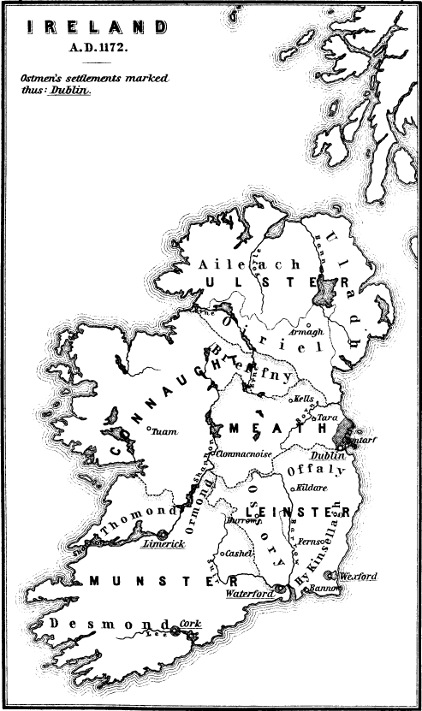
Wagner & Debes’ Geogˡ. Estabᵗ. Leipsic.
London, Macmillan & Co.
It is in the history of the settlements formed on the Irish coast by the northern pirates in the ninth century that we must seek for the origin of those relations between England and Ireland which led to an English invasion of the latter country in the reign of Henry II. The earliest intercourse between the two islands had been of a wholly peaceful character; but it had come utterly to an end when Bishop Colman of Lindisfarne sailed back to his old home at Iona after the synod of Whitby in 664. From the hour when her missionary work was done, Ireland sank more and more into the isolation which was a natural consequence of her geographical position, and from which she was only roused at the opening of the ninth century by the coming of the wikings. In the early days of the northmen’s attack upon the British isles it was the tradition of Ireland’s material prosperity and wealth, and the fame of the treasures stored in her religious houses, that chiefly tempted the “white strangers” from the Norwegian fiords across the unknown perils of the western sea; and the settlement of Thorgils in Ulster and those of his fellow-wikings along the eastern and southern coasts of Ireland formed a chief basis for the operations of the northmen upon Britain itself. The desperate fighting of the Irish succeeded in freeing Ulster after Thorgils’s death; but by the middle of the ninth century the wikings were firmly established at four points on the Irish coast, Dublin, Waterford, Cork and Limerick.[369] Under the leadership of Olaf the Fair, Dublin became the head of a confederacy which served as a starting-point and furnished a constant supply of forces for the Danish conquests in England;[370] and for a hundred years afterwards, throughout the struggle of the house of Ælfred for the recovery of the Danelaw, the support given by the Ostmen or wikings of Ireland to their brethren across the channel was at once the main strength of the Northumbrian Danes and the standing difficulty of the English kings.[371]
To Ireland itself the results of the wiking invasions were far more disastrous than either to Britain or to Gaul. Owing to the peculiar physical character of their country, to their geographical remoteness from the rest of Europe, and to the political and social isolation which was a consequence of these, the Irish people had never advanced beyond the primitive tribal mode of life which had once been common to the whole Aryan race, but which every European branch of that race, except the Irish, had long since outgrown. In the time of Ecgberht and of Charles the Great Ireland was still, as at the very dawn of history, peopled by a number of separate tribes or septs whose sole bond of internal cohesion was formed by community of blood;—whose social and political institutions had remained purely patriarchal in character, unaffected by local and external influences such as had helped to mould the life of England or of Gaul:—who had never yet coalesced into any definite territorial organization, far less risen into national unity under a national sovereign. The provincial kings of Ulster, Connaught, Leinster and Munster were merely the foremost chieftains among the various groups of tribes over whom they exercised an ever-shifting sway; while the supremacy of the Ard-Righ or chief monarch, to whom in theory was assigned the overlordship of the whole island, was practically little more than a sort of honorary pre-eminence attached to certain chosen descendants of an early hero-king, Niall “of the Nine Hostages”; it carried with it little effective authority, and no territorial power; for the monarch’s traditional seat at Tara had long been a heap of ruins, and a tribal under-king had ousted him from the plain of Meath which in legal theory formed his royal domain.[372] Neither in the monarch himself nor in the provincial chieftains of a state thus constituted could there be found, when the storm-cloud from the north burst upon Ireland, a centre of unity even such as the peoples of Gaul found in their Karolingian sovereigns, far less such as the West-Franks found in the dukes of the French, or such as the English found in their kings of the house of Ecgberht. The stress of the northmen’s attack, which elsewhere gave a fresh impulse to the upgrowth of national life, crushed out all hope of its developement in Ireland. The learning and the civilization of ages perished when Columba’s Bangor, Bridget’s Kildare, Ciaran’s Clonmacnoise, Patrick’s own Armagh, shared the fate of Bæda’s Jarrow and Hild’s Streoneshealh, of Cuthbert’s Melrose and Aidan’s Lindisfarne; and in Ireland there was no Wessex and no Ælfred.
On the other hand, the concentration of the wiking forces upon Britain had given to the Irish an advantage which enabled them to check the spread of wiking settlements in their country; and the failure of all attempts to establish a Scandinavian dominion in Britain destroyed all chance of a Scandinavian conquest of Ireland. The Ostmen never even gained such a footing in Ireland as the followers of Hrolf gained in Frankland: their presence never received the sanction of any Ard-Righ; they were not a compact body occupying the whole of an extensive and well-defined territory, but a number of separate groups settled here and there along the coast, and holding their ground only by sheer hard fighting against a ring of implacable foes. The long struggle may be said to have ended in a defeat of both parties. The Irish kings of Munster succeeded in establishing a more or less effective overlordship over the Scandinavian communities of Limerick and Waterford; and in 989 Malachi II., supreme monarch of Ireland, reaped his reward for nine years of desperate fighting in the submission of the Ostmen of Dublin. The city was blockaded and starved into surrender, and a yearly tribute was promised to Malachi and his successors.[373] Six years later “the ring of Tomar and the sword of Carl”—two heathen relics probably of ancient heroes, which seem to have been treasured as sacred emblems of sovereignty by the Ostmen[374]—were carried off by Malachi as trophies of another victory;[375] and in 999 or 1000 a renewal of the strife ended in a rout of the Ostmen and a great slaughter of their leaders, and Dublin was sacked and burnt by the victorious Irish.[376]
Malachi’s triumph, however, was gained at the cost of a disruption of the monarchy. Malachi himself was displaced by a king of the rival house of Munster, his colleague in the sack of Dublin, the famous Brian Boroimhe;[377] Brian’s career of conquest ended in 1014 on the field of Clontarf, where he was slain in battle with the men of Leinster and the Ostmen;[378] and when Malachi, who now resumed his place, died in 1022,[379] the downfall of the Irish monarchy was complete.[380] The tradition which had so long linked it to the house of Niall had been shattered by Brian’s successes; and Brian had not lived to consolidate in his own house the forces which had begun to gather around himself. Thenceforth the Scandinavian colonies simply furnished an additional element to the strife of the Irish chieftains, and to the rivalry between the O’Briens of Munster and the O’Neills of Ulster for the possession of a shadowy supremacy, claimed by the one house as descendants of Brian Boroimhe and by the other as heirs of Malachi II. and of his great ancestor Niall.
The social and political system of Ireland was powerless either to expel or to absorb the foreign element thus introduced within its borders. Not only was such an union of the two peoples as had at last been effected in England simply impossible in Ireland; the Irish Danelaw was parted from its Celtic surroundings by barriers of race and speech, of law and custom and institutions, far more insuperable than those which parted the settlers in the “northman’s land” at the mouth of Seine from their West-Frankish neighbours. Even the Irish Church, which three hundred years before had won half England—one might add half Europe—to the Faith, had as yet failed to convert these pagans seated at her door. At the close of the tenth century the Ostmen were still for the most part heathens in fact if not in name, aliens from whatever culture or civilization might still remain in the nation around them. Meanwhile their relations with England had wholly altered in character. The final submission of the English Danelaw to Eadred carried with it the alliance of the Irish Danelaw; it seems that the Ostmen in their turn endeavoured to strengthen themselves against the attacks of the Irish princes by securing a good understanding with the English king, if not actually by putting themselves under his protection; for the fact that Eadgar coined money in Dublin[381] indicates that his authority must have been in some way or other acknowledged there. The years of the Ostmen’s struggle with Malachi and Brian Boroimhe were the years of England’s struggle with Swein and Cnut; but the two strifes seem to have been wholly unconnected; and throughout the long peace which lasted from Cnut’s final triumph until the coming of the Normans, new ties sprang up between the Ostmen and the sister-isle. Owing to their position on the sea-coast and to the spirit of merchant enterprise which was, quite as much as the spirit of military enterprise, a part of the wiking-heritage of their inhabitants, the towns of the Irish Danelaw rose fast into importance as seats of a flourishing trade with northern Europe, and above all with England through its chief seaports in the west, Bristol and Chester. The traffic was chiefly in slaves, bought or kidnapped in England to be sold to the merchants of Dublin or Waterford, and by these again to their Irish neighbours or to traders from yet more distant lands.[382] Horrible as this traffic was, however, even while filling the Irish coast-towns with English slaves it helped to foster a more frequent intercourse and a closer relation between Ostmen and Englishmen; and the shelter and aid given to Harold and Leofwine in 1151 by Dermot Mac-Maelnambo,[383] a prince of the royal house of Leinster who had acquired the sovereignty over both Leinstermen and Danes, shews that the political alliance established in Eadgar’s day had been carefully renewed by Godwine.
To these commercial and political relations was added soon afterwards an ecclesiastical tie. The conversion of the Ostmen to Christianity, completed in the early years of the eleventh century, was probably due to intercourse with their Christianized brethren in England rather than to the influence of the Irish clergy, whose very speech was strange to them; and their adoption of their neighbours’ creed, instead of drawing together the hostile races, soon introduced a fresh element into their strife. About the year 1040 the Ostmen of Dublin set up a bishopric of their own. Their first bishop, Donatus, was probably Irish by consecration if not by birth.[384] But when he died, in 1074,[385] the Ostmen turned instinctively towards the neighbouring island with which they had long been on peaceful terms, where the fruits of the warfare waged by generation after generation of wikings upon the shores of Britain were being reaped at last by Norman hands, where William of Normandy was entering upon the inheritance alike of Ælfred and of Cnut, and where Lanfranc was infusing a new spirit of discipline and activity into the Church of Odo and Dunstan. The last wiking-fleet that ever sailed from Dublin to attack the English coast—a fleet which Dermot Mac-Maelnambo, true to his alliance with their father, had furnished to the sons of Harold—had been beaten back six years before.[386] Since then Dermot himself was dead;[387] the Ostmen were once more free, subject to no ruler save one of their own choice and their own blood; with the consent of their king, Godred,[388] they chose a priest named Patrick to fill Donatus’s place, and sent him to be consecrated in England by the archbishop of Canterbury.[389] No scruples about infringing the rights of the Irish bishops were likely to make Lanfranc withhold his hand. At the very moment when the Ostmen’s request reached him, he had just been putting forth against the archbishop of York a claim to metropolitical jurisdiction over the whole of the British isles, founded on the words of S. Gregory committing “all the bishops of the Britains” to S. Augustine’s charge.[390] He therefore gladly welcomed an opportunity of securing for the authority of his see a footing in the neighbour-isle. He consecrated Patrick of Dublin and received his profession of obedience;[391] and for the next seventy-eight years the bishops of Dublin were suffragans not of Armagh but of Canterbury. When in 1096 the Ostmen of Waterford also chose for themselves a bishop, they too sought him beyond the sea; an Irishman, or more probably an Ostman by birth, a monk of Winchester by profession, Malchus by name, he was consecrated by S. Anselm and professed obedience to him as metropolitan.[392]
Through the medium of these Irish suffragans the archbishops of Canterbury endeavoured to gain a hold upon the Irish Church by cultivating the friendship of the different Irish princes who from time to time succeeded in winning from the Ostmen an acknowledgement of their overlordship. In the struggles of the provincial kings for the supreme monarchy of Ireland it was always the Ostmen who turned the scale; their submission was the real test of sovereignty. The power which had been wielded by Dermot Mac-Maelnambo passed after his death first to Terence or Turlogh O’Brien, king of Munster,[393] a grandson of Brian Boroimhe, and then to Terence’s son Murtogh.[394] Both were in correspondence with the successive English primates, Lanfranc and Anselm,[395] and both were recognized as protectors and patrons, in ecclesiastical matters at least, by the Ostmen,[396] whose adherence during these years enabled the O’Briens to hold their ground against the advancing power of Donnell O’Lochlainn, king of Aileach or western Ulster,[397] a representative of the old royal house of the O’Neills which had fallen with Malachi II. On Murtogh’s death in 1119[398] a new aspirant to the monarchy appeared in the person of the young king of Connaught, Terence or Turlogh O’Conor. A year before, Terence had won the submission of the Ostmen of Dublin;[399] in 1120 he celebrated the fair of Telltown,[400] a special prerogative of the Irish monarchs; and from the death of Donnell O’Lochlainn next year[401] Terence was undisputed monarch till 1127, when a joint rising of Ostmen and Leinstermen enabled both to throw off his yoke.[402] Meanwhile Murtogh O’Lochlainn, a grandson of Donnell, was again building up a formidable power in Ulster; at last, in 1150, all the provincial kings, including Terence, gave him hostages for peace;[403] and Terence’s throne seems to have been only saved by a sudden change in the policy of the Ostmen, whose independent action enabled them for a moment to hold the balance and act as arbitrators between northern and southern Ireland.[404] Four years later, however, they accepted Murtogh as their king,[405] and two years later still he was left sole monarch by the death of Terence O’Conor.[406]
The anarchy of the Irish state was reflected in that of the Church. If Lanfranc, when he consecrated Patrick of Dublin, knew anything at all of the ecclesiastical condition of Ireland, he may well have thought that it stood in far greater need of his reforming care than England itself. The Irish Church had never felt the organizing hand of a Theodore; its diocesan and parochial system was quite undeveloped; it had in fact scarcely advanced beyond the primitive missionary stage. Six centuries after S. Patrick’s death, the Irish clergy were still nothing but a band of mission-priests scattered over the country or gathered together in vast monastic establishments like Bangor or Durrow or Clonmacnoise; the bishops were for the most part merely heads of ever-shifting mission-stations, to whose number there was no limit; destitute of political rank, they were almost equally destitute of ecclesiastical authority, and differed from the ordinary priesthood by little else than their power of ordination. At the head of the whole hierarchy stood, as successor and representative of S. Patrick, the archbishop of Armagh. But since the death of Archbishop Maelbrigid in 927 the see of Armagh had been in the hands of a family of local chieftains who occupied its estate, usurped its revenues, handed on its title from father to son, and were bishops only in name.[407] The inferior members of the ecclesiastical body could not escape the evil which paralyzed their head. The bishops and priests of the Irish Church furnished a long roll of names to the catalogue of saints; but they contributed little or nothing to the political developement of the nation, and scarcely more to its social developement. The growth of a class of lay-impropriators ousted them from the management and the revenues of their church-lands, reduced them to subsist almost wholly upon the fees which they received for the performance of their spiritual functions, stripped them of all political influence, and left them dependent solely upon their spiritual powers and their personal holiness for whatever share of social influence they might still contrive to retain.[408] The Irish Church, in fact, while stedfastly adhering in doctrinal matters to the rest of the Latin Church, had fallen far behind it in discipline; to the monastic reforms of the tenth century, to the struggle for clerical celibacy and for freedom of investiture in the eleventh, she had remained an utter stranger. The long-continued stress of the northern invasions had cut off the lonely island in the west from all intercourse with the world at large, so completely that even the tie which bound her to Rome had sunk into a mere vague tradition of spiritual loyalty, and Rome herself knew nothing of the actual condition of a Church which had once been her most illustrious daughter.
But it was the northmen, too, who were now to become the means of knitting up again the ties which had been severed by their fathers’ swords. The state of things in Ireland, as reported to Canterbury from Dublin and Waterford, might well seem to reforming churchmen like Lanfranc and Anselm too grievous to be endured. Lanfranc had urged upon Terence O’Brien the removal of two of its worst scandals, the neglect of canonical restraints upon marriage and the existence of a crowd of titular bishops without fixed sees;[409] Anselm used all his influence with Murtogh O’Brien for the same end;[410] at last, finding his efforts unavailing, he seems to have laid his complaints before the Pope. The result was that, for the first time, a papal legate was appointed for Ireland. The person chosen was Gilbert, who some two or three years before Anselm’s death became the first bishop of the Ostmen of Limerick. Gilbert seems, like the first Donatus of Dublin, to have been himself an Irish prelate; he lost no time, however, in putting himself in communication with Canterbury,[411] and displayed an almost exaggerated zeal for the Roman discipline and ritual.[412] In 1118 he presided over a synod held at Rathbreasil, where an attempt was made to map out the dioceses of Ireland on a definite plan.[413] Little, however, could be done till the metropolitan see was delivered from the usurpers who had so long held it in bondage; and it was not until 1134 that the evil tradition was broken by the election of S. Malachi.
Malachi was the wisest and most enlightened as well as the most saintly Irish prelate of his time; he had already been labouring for nearly ten years at the reform of the diocese of Connor; in that of Armagh itself he had earlier still, as vicar to Archbishop Celsus, laid the foundations of a similar work which he now took up again as primate.[414] After a successful pontificate of three years he again retired to the humbler position of a diocesan bishop at Down;[415] but he still continued to watch over the interests of the whole Irish Church; and in 1139 he went to Rome specially to lay its necessities before the Pope, and if possible to obtain from him the gift of a pallium for the archbishop of Armagh, and another for the bishop of Cashel as metropolitan of southern Ireland.[416] The pallium was now generally regarded as an indispensable note of metropolitical rank, but it had never been possessed by the successors of S. Patrick.[417] Innocent II. refused to grant it save at the request of the Irish clergy and people in council assembled; he sanctioned, however, the recognition of Cashel as metropolis of southern Ireland, and moreover he transferred to Malachi himself the legatine commission which Gilbert of Limerick had just resigned.[418] Gilbert seems to have died shortly afterwards: his successor in the see of Limerick went to Theobald of Canterbury for consecration; but his profession of obedience was the last ever made by an Irish bishop to an English metropolitan.[419] In 1148 a synod held at Inispatrick by Archbishop Gelasius of Armagh, with Malachi as papal legate, decided upon sending Malachi himself to the Pope once more, charged with a formal request for the two palls, in the name of the whole Irish Church. Malachi died on the way, at Clairvaux;[420] but he left his commission in safe hands. Nine years before, when on his first journey to Rome he had passed through the “bright valley,” its abbot had recognized in him a kindred spirit.[421] From that moment S. Bernard’s care of all the churches extended itself even to the far-off Church of Ireland; and if it was not he who actually forwarded his dying friend’s petition to Eugene III., there can be little doubt that Eugene’s favourable reception of it was chiefly owing to his influence. The result was the mission of John Paparo as special legate to Ireland. Stephen’s refusal to let John pass through his dominions caused another year’s delay;[422] but at the close of 1151 John made his way through Scotland safe to his destination.[423] In March 1152 he held a synod at Kells, in which the diocesan and provincial system of the Irish Church was organized upon lines which remained unaltered till the sixteenth century. The episcopal sees were definitely fixed, and grouped under not two but four archbishoprics. The primacy of all Ireland, with metropolitical authority over Ulster and Meath, was assigned to Armagh; Tuam became the metropolis of Connaught, Cashel of Munster; while the rivalry of Armagh and Canterbury for the spiritual obedience of the Ostmen was settled by the grant of a fourth pallium, with metropolitical jurisdiction over the whole of Leinster, to Bishop Gregory of Dublin himself.[424]
It is plain that Bernard and Eugene aimed at applying to Ireland’s troubles the same remedy which they were at that very time applying to those of England. They hoped to build up an united nation and a strong national government on the basis of a free and united national Church. But the foundation-stone of their work for Ireland was scarcely laid at Kells when both the wise master-builders were called away. On the other hand, their labours for England were crowned by the accession of the young Angevin king, whose restless temper, before he had been nine months on his throne, was already seeking for another sphere of activity still further beyond the sea; overwhelming the newly-crowned, English-born Pope with suggestions of work and offers of co-operation in every quarter of Christendom,[425] and proposing to begin at once with the reduction of Ireland to political, ecclesiastical and social order after the pattern of England and Normandy.[426] Adrian IV. would have needed a wisdom and a foresight greater than those of S. Bernard himself to enable him to resist the attractions of such an offer. The so-called “Donation of Constantine”—a donation which is now known to be forged, but whose genuineness no one in Adrian’s day had ever thought of doubting—vested the ultimate sovereignty of all islands in the Papacy.[427] The best and greatest Popes, from S. Gregory down to Adrian himself, seem to have interpreted this as making them in a special way responsible for the welfare of such outlying portions of Christendom, and bound to leave no means untried for providing them with a secure and orderly Christian government.[428] The action of Alexander II. in sanctioning the Norman conquest of England was a logical outcome of this principle, applied, however unwisely or unjustly, to a particular case. But there was infinitely greater justification for applying the same principle, in the same manner, to the case of Ireland. Neither the labours of S. Malachi, nor the brief visit of John Paparo, nor the stringent decrees passed at the synod of Kells, could suffice to reform the inveterate evils of Ireland’s ecclesiastical system, the yet more inveterate evils of her political system, or the intellectual and moral decay which was the unavoidable consequence of both. On the Pope, according to the view of the time, lay the responsibility of bringing order out of this chaos—a chaos of whose very existence he had but just become fully conscious, and which no doubt looked to him far more hopeless than it really was. In such circumstances Henry’s proposal must have sounded to Adrian like an offer to relieve him of a great weight of care—to cut at one stroke a knot which he was powerless to untie—to clear a path for him through a jungle-growth of difficulties which he himself saw no way to penetrate or overcome. John of Salisbury set forth the plan at Rome, in Henry’s name, in the summer of 1155; he carried back a bull which satisfied all Henry’s demands. Adrian bade the king go forth to his conquest “for the enlargement of the Church’s borders, for the restraint of vice, the correction of morals and the planting of virtue, the increase of the Christian religion, and whatsoever may tend to God’s glory and the well-being of that land;”[429] and he sent with the bull a gold ring, adorned with an emerald of great price, as a symbol of investiture with the government of Ireland.[430]
This strange crusade was postponed for the moment, as we have seen, in deference to objections made by the Empress Matilda.[431] Adrian’s bull and ring were stored up in the English chancery, and there, long after Adrian was dead, they still lay,[432] unused and, as it seemed, forgotten amid an ever-increasing throng of more urgent cares and labours which even Henry found to be quite as much as he was capable of sustaining. At last, however, the course of political events in Ireland itself took a turn which led almost irresistibly to a revival of his long-forsaken project. Two years before Henry’s accession Dermot Mac-Murrough, king of Leinster, had made a raid upon the district of Breffny in Connaught, on the borders of Ulster and Meath, and carried off Dervorgil, the wife of its chieftain Tighernan O’Ruark.[433] From that hour Tighernan’s vengeance never slept. During the next fourteen years, while Murtogh O’Lochlainn was striving for the mastery first against the veteran Terence O’Conor and after Terence’s death with his son Rory or Roderic, the swords of the men of Breffny were thrown alternately into either scale, as their chieftain saw a hope of securing the aid of either monarch to avenge him of his enemy.[434] In 1166 the crisis came. Murtogh drew upon himself the wrath of his people by blinding the king of Uladh, for whose safety he was pledged to the archbishop of Armagh; Ulster, Meath, Leinster and Dublin rose against him all at once; he was defeated and slain in a great battle at the Fews; the Ostmen of Dublin acknowledged Roderic as their king, and all the princes of southern Ireland followed their example. Dermot’s submission, however, was in vain; the first act of the new monarch was to banish him from the realm.[435] The Leinstermen forsook him at once, for their loyalty had long been alienated by his harsh government and evil deeds.[436] Left alone to the justice of Roderic and the vengeance of O’Ruark, he fled to Cork and thence took ship to Bristol. Here he found shelter for a while in the priory of S. Augustine, under the protection of its founder Robert Fitz-Harding;[437] at the close of the year he made his way to Normandy, and thence, with some difficulty, tracked Henry’s restless movements into the depths of Aquitaine,[438] where he at last laid his appeal for succour at the feet of the English king.
“Bien est, seignurs, ke jo vus die Cum Dermod va par Normandie; Li rei Henri va dunc quere, A munt, à val, avant, arere; Tant ad mandé et enquis Que trové ad li rei Henris, A une cité l’ad trové, Que seignur esteit clamé.”
On the last line the editor (notes, p. 168) remarks: “Seignur (seigñ, MS.)? Is it not: of which he was called lord?” One feels tempted to suggest that it might be meant for the name of the place; but if so, what can it be? Saintes?
At the crisis of his struggles with Thomas of Canterbury, with Louis of France and with the rebel barons of Poitou, all that Henry could do was to accept Dermot’s offer of homage and fealty,[439] promise to send him help as soon as possible,[440] and furnish him with a letter authorizing any loyal English, Norman, Welsh, Scottish or Angevin subjects who might be so disposed to join the standard of the Irish prince, as of a faithful vassal of their sovereign.[441] Another stay of some weeks in Bristol[442] convinced Dermot that his best chance of aid lay beyond the Severn. Wales was still in the main a Celtic land, ruled in primeval Celtic fashion by native princes under little more than nominal subjection to the king of England. The Norman conquest of Wales, so far as Wales could be said to have been conquered at all, had been effected not by the royal power but by the daring and prowess of individual adventurers who did, indeed, seek the royal sanction for their tenure of the lands which they had won, but who were scarcely more amenable to the royal authority than their Welsh neighbours, with whom they not unfrequently made common cause against it. It was Robert of Bellême’s connexion with Wales, through his border-earldom of Shrewsbury and his brother’s lordship of Pembroke, which had made him so formidable to Henry I.; it was Robert of Gloucester’s tenure of the great Welsh lordship of Glamorgan, even more than his English honours, which had enabled him to act as an independent potentate against Stephen. Another border-chieftain who played some part in the civil war was Gilbert de Clare, whose father had received a grant of Cardigan from Henry I. in 1107,[443] and upon whom Stephen in 1138 conferred the title of earl of Pembroke.[444] His son Richard appears under the same title among the witnesses to Stephen’s proclamation of the treaty of Wallingford in 1153;[445] the writers of the time, however, usually describe him as earl of Striguil, a fortress which seems to have occupied the site whence the ruins of Chepstow castle now look down upon the Wye. His earldom of Pembroke, indeed, as one of Stephen’s fictitious creations, must have been forfeited on Henry’s accession; but the lord of Striguil was still a mighty man on the South-Welsh border when in the spring of 1167 he promised to bring all the forces which he could muster to aid in restoring Dermot, who in return offered him his daughter’s hand, together with the succession to his kingdom.[446] A promise of the town of Wexford and its adjoining territory won a like assurance of aid from two half-brothers in whose veins the blood of Norman adventurers was mingled with the ancient royal blood of South-Wales: Maurice Fitz-Gerald, a son of Gerald constable of Pembroke by his marriage with Nest, aunt of the reigning prince Rees Ap-Griffith, and Robert Fitz-Stephen, son of the same Nest by her second husband, Stephen constable of Cardigan.[447] Another Pembrokeshire knight, Richard Fitz-Godoberd, volunteered to accompany Dermot at once with a little band of Norman-Welsh followers.[448] With these Dermot returned to Ireland in August 1167;[449] he was defeated in a pitched battle with Roderic O’Conor and Tighernan O’Ruark;[450] but in his own hereditary principality of Kinsellagh[451] he was safe; there throughout the winter he lay hid at Ferns,[452] and thence, when spring returned, he sent his bard Maurice Regan to claim from his Welsh allies the fulfilment of their promises.[453]
In the first days of May[454] Robert Fitz-Stephen landed at Bannow, between Wexford and Waterford, with thirty picked knights of his own immediate following, and a body of auxiliaries to the number of sixty men-at-arms and three hundred archers.[455] With him came three of his nephews, Meiler Fitz-Henry, Miles Fitz-David[456] and Robert de Barri;[457] and also a ruined knight called Hervey of Mountmorris, uncle of Richard de Clare.[458] Next day an independent adventurer, Maurice de Prendergast, arrived from Milford with ten more knights and a band of archers.[459] Dermot himself came to meet them with some five hundred Irishmen. The united force marched upon Wexford, and took it in two days;[460] they then established their head-quarters at Ferns,[461] and thence made an expedition into Ossory, whose chieftain was specially hostile to Dermot. In spite of overwhelming odds, through all the difficulties of an unknown country full of woods and marshes, and traps laid against them by their skilful foes, the Norman-Welsh knights and archers made their way into the heart of Ossory; and a great battle ended in the rout of the Irish and the bringing of two hundred heads to Dermot’s feet in his camp on the banks of the Barrow.[462] A successful raid upon Offaly was followed by one upon Glendalough, and a third upon Ossory again,[463] till in the following year the state of affairs in Leinster had become threatening enough to drive all the Irish princes and the Ostmen of Dublin into a confederacy under Roderic O’Conor for the expulsion of the intruders.[464] Dermot pledged himself to acknowledge Roderic as monarch of Ireland, and was in his turn acknowledged by Roderic as king of Leinster on condition that he should dismiss his foreign allies.[465] The agreement was however scarcely made when Maurice Fitz-Gerald landed at Wexford with some hundred and forty men;[466] these at once joined Dermot in an expedition against Dublin, and harried the surrounding country till the citizens were reduced to promise obedience.[467] Early in the next year Dermot’s son-in-law Donell O’Brien, king of Limerick or Northern Munster, succeeded by the help of Robert Fitz-Stephen in throwing off the authority of Roderick O’Conor.[468] Encouraged by these successes, Dermot now began to aspire in his turn to the monarchy of all Ireland;[469] but his auxiliaries were numerically insufficient; and the one from whom he had expected most had as yet failed to appear at all.
The history of Richard of Striguil is far from clear. From the number of troops which eventually accompanied him to Ireland it is evident that he had been during these two years actively preparing for his expedition; and it may even be that the extent of his preparations had drawn upon him the suspicions of King Henry. We only know that, for some cause or other, he was now a ruined man; his lands were forfeited to the Crown;[470] and he seems to have lingered on, absorbed in a desperate effort to regain Henry’s favour, and clinging to his lost home with a feeling that if he once turned his back upon it, he would never be allowed to see it again. A letter from Dermot, telling of the successes of his party in Leinster and renewing his former offers, forced him into action.[471] He made a last appeal to the king, intreating either for restoration of his lands or for the royal license to go and repair his fortunes elsewhere. Henry ironically bade him go, and he went.[472] On S. Bartholomew’s eve, 1170, he landed at Waterford with twelve hundred men;[473] next day he was joined by Raymond “the Fat,” a young warrior whom he had sent over three months before[474] with ten knights and seventy archers, and who with this small force had contrived to beat back an assault of three thousand Irishmen of Decies and Ostmen of Waterford upon his camp of wattle and thatch, hastily thrown up on the rocky promontory of Dundonulf.[475] On August 25 Richard and Raymond attacked Waterford; three assaults in one day carried both town and citadel;[476] seven hundred citizens were slaughtered,[477] and the officers of the fortress, whose names tell of northern blood, were made prisoners.[478] A few days later Richard was married at Waterford to Dermot’s daughter Eva.[479] He then joined his father-in-law in a circuitous march across the hills and through Glendalough,[480] whereby they avoided a great host which Roderic had gathered at Clondalkin to intercept them, and arrived in safety on S. Matthew’s day beneath the walls of Dublin.[481] Dermot sent his bard to demand the instant surrender of the town, with thirty hostages for its fidelity. A dispute arose, probably between the Irish and Danish inhabitants, as to the selection of the hostages;[482] Archbishop Laurence was endeavouring to compose the difficulty,[483] and Hasculf Thorgils’ son, a chieftain of northern blood who commanded the citadel, had actually promised to surrender it on the morrow,[484] when a sudden attack made by Raymond the Fat on one side and by a knight called Miles Cogan on the other carried the town before the leaders of either party knew what had happened.[485] A second rush won the citadel; Hasculf escaped by sea and took refuge in the Orkneys;[486] Dublin was sacked,[487] and left throughout the winter under the command of Miles Cogan,[488] while Richard of Striguil was guarding Waterford against the men of Munster,[489] and Dermot, from his old head-quarters at Ferns,[490] was making raid after raid upon Meath and Breffny.[491]
In vain did the Irish clergy meet in synod at Armagh and strive to avert the wrath which seemed to have been revealed against their country by a solemn decree for the liberation of the English slaves with whom, even yet, the houses of the Irish chieftains were filled.[492] One sentence from an Irish record of the next year may serve to illustrate the condition of the country: “Seven predatory excursions were made by the Ui-Maine into Ormond from Palm Sunday till Low Sunday.”[493] It made but little difference when at Whitsuntide Dermot, “by whom a trembling sod was made of all Ireland,” died at Ferns “of an insufferable and unknown disease—without a will, without penance, without the Body of Christ, without unction, as his evil deeds deserved.”[494] At that very moment a wiking fleet gathered from all the lands where the old sea-rovers’ life still lingered—Norway, the Hebrides, Orkney, Man—appeared in Dublin bay under the command of Hasculf, the exiled leader of the Ostmen, and of a northern chief whose desperate valour won him the title of “John the Furious”—in the English speech of that day, John the Wode.[495] Something of the spirit of the old northern sagas breathes again in the story of this, the last wiking-fight ever fought upon the soil of the British isles. Bard and historian alike tell of the mighty strokes dealt by the battle-axes of John and his comrades,[496] and how they had almost hewed their way into Dublin once more, when a well-timed sally of the besieged caught them at unawares in the rear;[497]—how an Irish chief named Gillamocholmog, whom Miles Cogan had posted on a neighbouring hill, chivalrously bidding him watch the course of the battle and join the winning side, rushed down with his followers at the critical moment and helped to complete the rout of the Ostmen;[498]—how John the Wode fell by the hand of Miles Cogan;[499]—how Hasculf was taken prisoner by Miles’s brother Richard and brought back to be reserved for ransom, and how his hot wiking-blood spoke in words of defiance which goaded his captors to strike off his head.[500] Fifteen hundred northmen fell upon the field; five hundred more were drowned in trying to regain their ships.[501] From the shores of Ireland, as from those of England, the last northern fleet was driven away by Norman swords.
The garrison of Dublin fought in truth even more desperately than their assailants; for they were fighting for their all. A remonstrance addressed by some of the Irish princes to the king of England against the aggressions of his subjects[502] can hardly have been needed to open Henry’s eyes to the danger gathering for him and his realm beyond the western sea. This little band of adventurers, almost all bound together by the closest ties of kindred,[503] were conquering Leinster neither for its native sovereign nor for their own, but were setting up a new feudal state independent of all royal control, under the leadership of a disgraced English baron. Such a state, if suffered to grow unhindered, would soon be far more dangerous to England than to Ireland, for it would be certain to play in every struggle of the feudal principle against the royal authority in England the part which the Ostmen had played of old in the struggles of the Danelaw. At the beginning of the year 1171 therefore Henry issued an edict prohibiting all further intermeddling of his subjects in Ireland, and bidding those who were already there either return before Easter or consider themselves banished for life.[504] Not a man went back; Richard of Striguil sent Raymond over to Normandy with a written protest to the king, pleading that his conquests had been undertaken with the royal sanction and that he was ready to place them at the king’s disposal;[505] but the “Geraldines,” as the kindred of Maurice Fitz-Gerald called themselves, seem to have at once accepted their sentence of exile and resolved to hold by their swords alone the lands which those swords had won.[506]
The hostility of the Ostmen had apparently ended with Hasculf’s defeat; thenceforth they seem to have made common cause with the new-comers in whom they were perhaps already beginning to recognize the stirrings of kindred blood. But, on the other hand, the position of Earl Richard and his comrades had been seriously weakened by Dermot’s death. The king of Leinster’s devise of his kingdom to his son-in-law was, like the grants which he had made to the Geraldines and like his own homage to King Henry, void in Irish law. In Irish eyes his death removed the last shadow of excuse for the presence of the strangers on Irish soil; their allies rapidly fell away;[507] and by midsummer the whole country rose against them as one man. Roderic O’Conor mustered the forces of the north; Archbishop Laurence of Dublin, whose family occupied an influential position in Leinster, called up the tribes of the south; while a squadron of thirty ships was hired from Jarl Godred of Man.[508] The aim of the expedition was to blockade Dublin, whither Earl Richard had now returned, and where almost all the leaders of the invasion, except Robert Fitz-Stephen and Hervey of Mountmorris, were now gathered together. The whole Irish land-force amounted to sixty thousand men; half of these were under the immediate command of Roderic, encamped at Castle-Knock;[509] Mac-Dunlevy, the chieftain of Uladh, planted his banner on the old battle-field of Clontarf;[510] Donell O’Brien, the king of North Munster, posted himself at Kilmainham; and Murtogh Mac-Murrough, a brother of Dermot, whom Roderic had set up as king of Leinster in 1167, took up his position at Dalkey.[511] To these were added, for the northern division, the men of Breffny and of East Meath under Tighernan O’Ruark, those of Oiriel or southern Ulster under Murtogh O’Carroll,[512] and those of West Meath under Murtogh O’Melaghlin; while the archbishop’s call had brought up the whole strength of Leinster except the men of Wexford and Kinsellagh;[513] and even these, as the sequel proved, were preparing to fight the same battle on other ground.
For nearly two months[514] the English knights were thus blockaded in Dublin. Their sole hope of relief was in Robert Fitz-Stephen, who had been left in command at Wexford. They were all but starving when Donell Kavanagh, a half-brother of Eva Mac-Murrough and a devoted adherent of her husband, slipped into the city with tidings that Wexford had risen; Robert Fitz-Stephen was blockaded in the little fort of Carrick by the townsfolk and the men of Kinsellagh, to the number of three thousand; unless he could be succoured within three days, all would be over with him and his men.[515] Earl Richard at once called a council of war. It comprised nearly all the leaders of the English and Welsh forces in Ireland:—Richard of Striguil himself; Maurice Fitz-Gerald with three of his gallant nephews, Meiler Fitz-Henry, Miles Fitz-David and Raymond the Fat; Miles Cogan, the captor of Dublin and its chief defender in the recent siege; Maurice de Prendergast,[516] who two years before had thrown up the adventure and gone home in disgust at the faithlessness of his allies,[517] but had returned, it seems, in Earl Richard’s train, and was yet to leave, alone of all the invading band, an honoured memory among the Irish people;[518] and some fourteen others.[519] They decided upon sending Maurice de Prendergast and Archbishop Laurence to Roderic with an offer of surrender on condition that Richard of Striguil should hold the kingdom of Leinster under Roderic as overlord. Roderic rejected the proposal with scorn; the knights might hold what the earlier pirates had held—Dublin, Waterford and Wexford; not another rood of Irish land should be granted to the earl and his company; and if they refused these terms, Dublin should be stormed on the morrow.[520] That afternoon the little garrison—scarce six hundred in all[521]—sallied forth and surprized Roderic’s camp while he and his men were bathing; Roderic himself escaped with great difficulty; fifteen hundred Irishmen were slain, many of them perishing in the water; while at sunset the victors returned, after a long pursuit, with scarcely a man missing, and laden with provisions enough to supply all Dublin for a year.[522] The rest of the besieging army dispersed at once, and the very next morning Earl Richard was free to set out for the relief of Robert Fitz-Stephen.[523]
He was however already too late. Three thousand men of Wexford and Kinsellagh, finding that they could make no impression by fair means upon Robert Fitz-Stephen shut up in the fort of Carrick with five knights and a handful of archers, at length had recourse to fraud. Two bishops and some monks were made to stand under the walls of the fort and swear upon relics brought for the purpose that Dublin was taken, the earl and his comrades slain, and Roderic on the march to Wexford at the head of his victorious host. On a promise of liberty to escape to Wales[524] Robert in his despair surrendered, only to see his little band of humbler followers slaughtered to a man, and himself and his five knights cast into chains. The men of Wexford then fired their town and took refuge with their captives on the neighbouring island of Beg-Erin,[525] whence they sent word to Richard of Striguil that if he dared to approach them he should immediately receive the heads of his six friends.[526] Notwithstanding this disaster at Wexford, and the failure of a plot to entrap the chief of Ossory—a well-deserved failure, due to the loyalty of Maurice de Prendergast[527]—the invaders were rapidly gaining ground. The king of North Munster, who was married to Eva’s sister, again forsook Roderic and made alliance with his English brother-in-law;[528] an attempt made by Tighernan O’Ruark to renew the siege of Dublin ended in failure;[529] and at last Murtogh of Kinsellagh was reduced to make a surrender of his principality into Richard’s hands and accept a re-grant of it from him as overlord, while Donell Kavanagh was invested on like terms with the remaining portion of Leinster.[530]
The earl’s triumphs, however, met with an abrupt check from over sea. His uncle Hervey of Mountmorris, who had gone to plead his cause with the king after the failure of Raymond’s mission, returned to Waterford[531] with tidings that Henry himself was on his way to Ireland and required the self-styled earl of Leinster to go and speak with him without delay. Richard hurried over to Wales,[532] met Henry on the border,[533] and was forgiven on condition that he should surrender Dublin and the other coast towns absolutely into the king’s hands and do him homage and fealty for the rest of Leinster;[534] he then accompanied Henry into Pembrokeshire;[535] where the royal fleet was assembling in Milford Haven. It consisted of four hundred ships,[536] carrying a force of about four thousand men, of whom some five hundred were knights and the rest archers, mounted and unmounted.[537] The king embarked on the evening of Saturday, October 16, and landed next day at Croch, eight miles from Waterford.[538] On the morrow, S. Luke’s day, he entered the town of Waterford;[539] there he was met by his seneschal William Fitz-Aldhelm, his constable Humfrey de Bohun, Hugh de Lacy, Robert Fitz-Bernard, and some other officers of his household whom he had sent over to prepare for his coming.[540] The Irish of the district and the Ostmen of the town, in the person of their chieftain Ragnald, made submission to him as their sovereign;[541] while Richard of Striguil formally surrendered the place into the king’s hands and did homage to him for the earldom of Leinster.[542] The men of Wexford now, according to an agreement which they had made with Henry while he was waiting for a wind at Pembroke,[543] brought their captive Robert Fitz-Stephen to his sovereign’s feet, to be by him dealt with as a rebel and a traitor. Henry loaded him with reproaches and imprisoned him afresh, but his anger was more assumed than real, and the captive was soon released.[544] The submission of the English adventurers was followed by that of the Irish princes. Dermot MacCarthy, king of Cork or South Munster, was the first of them who came to Henry’s feet at Waterford, swore him fealty, gave hostages and promised tribute.[545] On November 1[546] Henry advanced to Lismore, and thence, two days later, to Cashel, where at the passage of the Suir he was met by the king of Limerick or of Northern Munster, Donell O’Brien, with offers of tribute and obedience. The lesser chieftains of southern Ireland followed the example of the two kings; in three weeks from his arrival all Munster was at his feet, and its coast-towns, Wexford, Waterford, Limerick and Cork, were all in the custody of his own officers.[547] At Martinmas he reached Dublin;[548] before Christmas he received hostages from all the princes of Leinster and Meath, from Tighernan O’Ruark of Breffny, from O’Carroll of Oiriel, and from the king of Uladh or eastern Ulster;[549] his new vassals built him a dwelling of wattle or wicker-work, after the manner of their country, outside the walls of Dublin, and there in their midst he held his Christmas court.[550]
Early in November two royal chaplains had been despatched to summon the Irish bishops to a council and claim their submission.[551] We hear not a word of Pope Adrian’s bull; but we can hardly doubt that its existence and its contents were in some way or other certified to the Irish prelates before, in response to the royal mandate, they met in council at Cashel in the first weeks of 1172.[552] The archbishop of Armagh absented himself on the plea of extreme age and infirmity;[553] all his episcopal brethren, however, made full submission to Henry, pledged themselves to conform in all things to the pattern of the English Church,[554] gave written promises to support the English king and his heirs as lawful sovereigns of Ireland,[555] and joined with him in sending to Rome a report of his proceedings and their own.[556]
In all Ireland the king of Connaught was now the only ruler, spiritual or temporal, who had not submitted to Henry.[557] Trusting to the inaccessible nature of his country,[558] Roderic had at first refused all dealings with the invader, declaring that he himself was the sole rightful monarch of Ireland.[559] It seems however that he afterwards came to a meeting with William Fitz-Aldhelm and Hugh de Lacy by the banks of the Shannon, on the frontier of Connaught and Meath, and there promised tribute and fealty like his fellow-kings.[560] The promise was however worthless until confirmed by his personal homage; and this Henry soon perceived was only to be extorted at the sword’s point. The impossibility of fighting to any advantage in the wet Irish winter compelled him to postpone the attempt until the spring;[561] and when spring came he found that his intended campaign must be abandoned altogether. From the day when he left Milford he had received not one word of tidings from any part of his dominions.[562] This total isolation, welcome at first as a relief from the load of cares which indeed he had purposely left behind him,[563] became at the end of nineteen weeks a source of almost unbearable anxiety. On March 1 he removed from Dublin to Wexford;[564] there for nearly a month he remained eagerly watching for a ship from England; none came until after Mid-Lent,[565] and then it was laden with such ill news that he could only take such hasty measures as were possible at the moment for maintaining his hold upon Ireland, and prepare to hurry out of it as soon as the wind would carry him.[566] Richard of Striguil was suffered to remain at Kildare[567] as earl of Leinster; the general direction of government and administration throughout the king’s Irish domains was intrusted to Hugh de Lacy,[568] who had already received a grant of Meath in fee,[569] and who was also left in command of the citadel of Dublin,[570] with a garrison of twenty knights, among whom were Maurice Fitz-Gerald[571] and Robert Fitz-Stephen.[572] The grants of territory made by Dermot to the half-brothers were of course annulled; Waterford and Wexford were both garrisoned and placed in charge of an officer appointed by the king;[573] and in each of these towns a fortress was either erected or repaired by his orders.[574]
A better mode of securing his authority in Dublin was probably suggested to him by the ravages which war and famine had made among its population. Eight years before he had taken the burghers of Bristol, so long the medium of trading intercourse between England and Ireland, under his especial patronage and protection.[575] He now granted to them the city of Dublin, to colonize and to hold of him and his heirs by the same free customs which they enjoyed in their own town of Bristol.[576] It is plain that Henry was already aiming at something far other than a mere military conquest of Ireland; and the long and varied list of English names, from all parts of the country, which is found in a roll of the Dublin citizens only a few years later,[577] shews how willingly his plans were taken up, not only at Bristol but throughout his realm, by the class to which he chiefly and rightly trusted for aid in their execution. Unluckily, they were scarcely formed when he was obliged to leave their developement to other hands; and the consequence was a half success which proved in the end to be far worse than total failure. On Easter night[578] he sailed from Wexford;[579] next day he landed at Portfinnan, hard by S. David’s;[580] before the octave was out he had hurried through South Wales to Newport;[581] in a few days more he was at Portsmouth;[582] and before Rogation-tide he was once more in Normandy, ready to face the bursting of a storm whose consequences were to overshadow all his remaining years and to preclude all chance of his return to complete his conquest of Ireland.