Volume 2 — CHAPTER V. THE ANGEVIN EMPIRE. 1175–1183.
Reading edition
In the seven years which followed the suppression of the barons’ revolt Henry’s prosperity reached its height. The rising in which all his enemies had united for his destruction had ended in leaving him seated more firmly than ever upon the most securely-established throne in Europe. Within the four seas of Britain he was master as no king had ever been master before him. The English people had been with him from the first, and was learning year by year to identify its interests more closely with his; the Church, alienated for nearly ten years, was reconciled by his penance; feudalism was beaten at last, and for ever. The Welsh princes were his obedient and serviceable vassals; the Scot king had been humbled to accept a like position; a new subject-realm was growing up on the coast of Ireland. The great external peril which had dogged Henry’s footsteps through life, the hostility of France, was for a while paralyzed by his success. Other external foes he had none; the kings of Spain and of Sicily, the princes of the Western and even of the Eastern Empire, vied with each other in seeking the friendship, one might almost say the patronage, of the one sovereign in Europe who, safe on his sea-girt throne, could afford to be independent of them all. Within and without, on either side of the sea, all hindrances to the full and free developement of Henry’s policy for the government of his whole dominions were thus completely removed.
In England itself the succeeding period was one of unbroken tranquillity and steady prosperous growth, social, intellectual, political, constitutional. Henry used his opportunity to make a longer stay in the island than he had ever made there before, save at the very beginning of his reign. He was there from May 1175 to August 1177; in the following July he returned, and stayed till April 1180; he came back again in July 1181, and remained till March 1182. Each of these visits was marked by some further step towards the completion of his judicial and administrative reforms. Almost as soon as he set foot in the country, indeed, he took up his work as if it had never been interrupted. The king and his eldest son went to England together on May 9, 1175;[842] on Rogation Sunday they publicly sealed their reconciliation with each other and with the Church in a great council which met at Westminster[843] under the presidence of a new archbishop of Canterbury, Richard, formerly prior of Dover, who after countless troubles and delays had been chosen just before the outbreak of the rebellion to fill S. Thomas’s place,[844] and had come back from Rome in triumph, with his pallium and a commission as legate for all England, just as Henry was returning to Normandy from his success against Hugh Bigod.[845] From the council the two kings and the primate went all together on a pilgrimage to the martyr’s tomb at Canterbury;[846] at Whitsuntide the kings held a court at Reading,[847] and on S. Peter’s day they met the Welsh princes in a great council at Gloucester.[848] Two days later the process, begun two years before, of filling up the vacant bishoprics and abbacies which had been accumulating during Thomas’s exile was completed in another council at Woodstock.[849] Thence, too, was issued an edict for the better securing of order throughout the realm, and particularly around the person of the king; all his opponents in the late war were forbidden, on pain of arrest as traitors, to come to the court without special summons, and, under any circumstances, to come before sunrise or stay over night; and all wearing of arms, knife, bow and arrows, was forbidden on the English side of the Severn. These prohibitions however were only temporary;[850] and they were, with one exception, the only measure of general severity taken by Henry in consequence of the rebellion. That exception was a great forest-visitation, begun by Henry in person during the summer of 1175 and not completed by his ministers, it seems, till Michaelmas 1177, and from which scarcely a man throughout the kingdom, baron or villein, layman or priest, was altogether exempt. In vain did Richard de Lucy, as loyal to the people as to the king, shew Henry his own royal writ authorizing the justiciars to throw open the forests and give up the royal fish-ponds to public use during the war, and protest against the injustice of punishing the people at large for a trespass to which he had himself invited them in the king’s name and in accordance, as he had understood it, with the king’s expressed will. The license had probably been used to a far wider extent than Henry had intended; the general excitement had perhaps vented itself in some such outburst of wanton destructiveness as had occurred after the death of Henry I.; at any rate, the Norman and the Angevin blood in Henry II. was all alike stirred into wrath at sight of damage done to vert and venison; the transgressors were placed, in technical phrase, “at the king’s mercy,” and their fines constituted an important item in the Pipe Roll of 1176.[851]
In the beginning of that year the king assembled a great council at Northampton,[852] and thence issued an Assize which forms another link in the series of legal enactments begun at Clarendon just ten years before. The first three clauses and the twelfth clause of the Assize of Northampton are substantially a re-issue of those articles of the Assize of Clarendon which regulated the presentment, detention and punishment of criminals and the treatment of strangers and vagabonds.[853] The experience of the past ten years had however led to some modifications in the details of the procedure. The recognition by twelve lawful men of every hundred and four of every township, to be followed by ordeal of water, was re-enacted; but the presentment was now to be made not to the sheriff, but direct to the king’s justices. The punishments, too, were more severe than before; the forger, robber, murderer or incendiary who under the former system would have suffered the loss of a foot was now to lose a hand as well, and to quit the realm within forty days.[854] The remaining articles dealt with quite other matters. The fourth declared the legal order of proceeding with regard to the estate of a deceased freeholder, in such a manner as to secure the rights of his heir and of his widow before the usual relief could be exacted by the lord; and it referred all disputes between the lord and the heir touching the latter’s right of inheritance to the decision of the king’s justices, on the recognition of twelve lawful men[855]—a process which, under the name of the assize of mort d’ancester, soon became a regular part of the business transacted before the justices-in-eyre. Some of the other clauses had a more political significance. They directed the justices to take an oath of homage and fealty to the king from every man in the realm, earl, baron, knight, freeholder or villein, before the octave of Whit-Sunday at latest, and to arrest as traitors all who refused it:[856]—to investigate and strictly enforce the demolition of the condemned castles;[857] to ascertain and report by whom, how and where the duty of castle-guard was owed to the king;[858] to inquire what persons had fled from justice and incurred the penalty of outlawry by failing to give themselves up at the appointed time, and to send in a list of all such persons to the Exchequer at Easter and Michaelmas for transmission to the king.[859] The tenth article was aimed at the bailiffs of the royal demesnes, requiring them to give an account of their stewardship before the Exchequer;[860] and two others defined the justices’ authority, as extending, in judicial matters, over all pleas of the Crown, both in criminal causes and in civil actions concerning half a knight’s fee or less; and in fiscal matters, over escheats, wardships, and lands and churches in royal demesne.[861]
The visitations of the justices by whom this assize was carried into effect were arranged upon a new plan, or rather upon a modified form of the plan which had been adopted two years before for the assessment of a tallage upon the royal demesnes, to meet the cost of the expected war. It was at that terrible crisis, when most men in Henry’s place would have had no thought to spare for anything save the military necessities and perils of the moment, that he had first devised and carried into effect the principle of judicial circuits which with some slight changes in detail has remained in force until our own day. This tallage was levied by nineteen barons of the Exchequer, distributed into six companies, each company undertaking the assessment throughout a certain district or group of shires.[862] The abandonment of this scheme in the assizes of the two following years was probably necessitated by the disturbed state of the country. But at the council of Northampton the kingdom was again definitely mapped out into six divisions, to each of which three justices were sent.[863] In the report of their proceedings in the Pipe Roll of the year they are for the first time since the Assize of Clarendon[864] officially described by the title which they had long borne in common speech, “justitiæ itinerantes” (or “errantes”), justices-in-eyre; and it is from this time that the regular institution of itinerant judges is dated by modern legal historians.[865]
This first distribution of circuits however was soon altered. In the very next year the same eighteen officers made, in addition to their judicial circuits, a general visitation of the realm for fiscal purposes, in four companies instead of six;[866] and on Henry’s return to England in the summer of 1178 he made what at first glance looks like a sweeping change in the organization of the Curia Regis. “The king,” we are told, “made inquiry concerning his justices whom he had appointed in England, whether they treated the men of the realm with righteousness and moderation; and when he learned that the country and the people were sore oppressed by the great multitude of justices—for they were eighteen in number—by the counsel of the wise men of the realm he chose out five, two clerks and three laymen, who were all of his private household; and he decreed that those five should hear all the complaints of the realm, and do right, and that they should not depart from the king’s court, but abide there to hear the complaints of his men; so that if any question came up among them which they could not bring to an end, it should be presented to the king’s hearing and determined as might please him and the wise men of the realm.”[867] From the mention of the number eighteen it appears that the persons against whom were primarily directed both the complaint of the people and the action of the king were the justices-in-eyre of the last two years; and this is confirmed by the fact that of all these eighteen, only six were among the judges who went on circuit in 1178 and 1179, while from 1180 onwards only one of them reappears in that capacity, though many of them retained their functions in the Exchequer. In 1178 and 1179 moreover the circuits were reduced from six to two, each being served by four judges.[868] The enactment of 1178, however, evidently touched the central as well as the provincial judicature, and with more important results. It took the exercise of the highest judicial functions out of the hands of the large body of officers who made up the Curia Regis as constituted until that time, and restricted it to a small chosen committee. This was apparently the origin of a limited tribunal which, springing up thus within the Curia Regis, soon afterwards appropriated its name, and in later days grew into the Court of King’s Bench. At the same time the reservation of difficult cases for the hearing of the king in council points to the creation, or rather to the revival, of a yet higher court of justice, that of the king himself in council with his “wise men”—a phrase which, while on the one hand it carries us back to the very earliest form of the Curia Regis, on the other points onward to its later developements in the modern tribunals of equity or of appeal, the courts of Chancery and of the Privy Council in its judicial capacity.[869]
All these changes in the circuits and in the Curia Regis had however another motive. The chief obstacle to Henry’s judicial and legal reforms was the difficulty of getting them administered according to the intention of their author. It was to meet this difficulty that Henry, as a contemporary writer says, “while never changing his mind, was ever changing his ministers.”[870] He had employed men chosen from every available class of society in turn, and none of his experiments had altogether brought him satisfaction. Feudal nobles, court officials, confidential servants and friends, had all alike been tried and, sooner or later, found wanting.[871] There was only one who had never yet failed him in a service of twenty-five years’ duration—Richard de Lucy “the loyal”; but in the summer of 1179 Richard de Lucy, to his master’s great regret, resigned his office of justiciar and retired to end his days a few months later as a brother of an Augustinian house which he had founded at Lesnes in Kent to the honour of S. Thomas of Canterbury.[872] Henry in this extremity fell back once more upon a precedent of his grandfather’s time and determined to place the chief administration, for the moment at least, again in clerical hands. Instead of a single justiciar-bishop, however, he appointed three—the bishops of Winchester, Ely and Norwich;[873] all of whom, under their earlier appellations of Richard of Ilchester, Geoffrey Ridel and John of Oxford, had long ago acquired ample experience and shewn ample capacity for the work of secular administration.[874]
This arrangement was however only provisional. The number of judicial circuits was again raised to four, and to each of the three southern circuits was despatched one of the justiciar-bishops, with a royal clerk and three laymen to act as his subordinate assistants. The fourth circuit, which took in the whole district between the Trent and the Scottish border, was intrusted to six justices, of whom only two were clerks; one of these, Godfrey de Lucy the archdeacon of Richmond, a brother of the late chief justiciar, stood nominally at the head of the commission; but there can be little doubt that its real head was one of his lay colleagues—Ralf de Glanville,[875] the faithful sheriff of Lancashire and castellan of Richmond to whom William the Lion had given up his sword at Alnwick in 1174;[876] and these six were appointed to form the committee for hearing the complaints of the people, apparently in succession to the five who had been selected in the previous year.[877] All four bodies of judges brought up a report of their proceedings to the king at Westminster on August 27,[878] and it seems to have been the most satisfactory which he had yet received. When he went over sea in the following April, he left Ralf de Glanville to represent him in England as chief justiciar.[879] Ralf’s business capacities proved to be at least as great, and his honesty as stainless, as those of his predecessor; and from that time forth the management of the entire legal and judicial administration was left in his hands. Circuits, variously distributed, continued to be made from year to year and for divers purposes by companies of judges, ranging in total numbers from three to twenty-two;[880] while the King’s Court and the Exchequer pursued their work on the lines already laid down, without further interruption, till the end of Henry’s reign.
The last of Henry’s great legal measures, with the exception of a Forest Assize issued in 1184, was an ordinance published in the autumn of 1181 and known as the Assize of Arms. Its object was to define more fully and exactly the military obligations of the people at large in the service of the king and the defence of the country;—in a word, to put once again upon a more definite footing the old institution of the “fyrd,” which was the only effective counterpoise to the military power of the barons, and whose services in 1173 and 1174 had proved it to be well worthy of the royal consideration and encouragement. The Assize of 1181 declared the obligation of bearing arms at the king’s command to be binding upon every free layman in the realm. The character of the arms with which men of various ranks were required to provide themselves was defined according to a graduated scale, from the full equipment of the knight down to the mail-coat, steel-cap and spear of the burgher and the simple freeman.[881] The justices were directed to ascertain, through the “lawful men” of the hundreds and towns, what persons fell under each category, to enroll their names, read out the Assize in their presence, and make them swear to provide themselves with the proper accoutrements before S. Hilary’s day.[882] Every man’s arms were to be carefully kept and used solely for the royal service; they were not to be taken out of the country, or alienated in any way;[883] at their owner’s death they were to pass to his heir;[884] if any man possessed other arms than those required of him by the Assize, he was to dispose of them in such a manner that they might be used in the king’s service;[885] and all this was enforced by a stern threat of corporal punishment upon defaulters.[886]
The freemen who were armed under this Assize had little occasion to use their weapons so long as King Henry lived. Within the four seas of Britain there was almost unbroken peace till the end of his reign. The treaty with Scotland was ratified by the public homage of William the Lion to Henry and his son at York on August 10, 1175;[887] and thenceforth Henry’s sole trouble from that quarter was the necessity of arbitrating between William and his unruly vassals in Galloway,[888] and of advising him in his ecclesiastical difficulties with the Roman see. The western border of England was less secure than the northern; yet even in Wales the authority of the English Crown had made a considerable advance since Henry’s accession. His first Welsh war, directed against the princes of North Wales in 1157, had little practical result. A second expedition marched in 1163 against Rees Ap-Griffith, prince of South Wales, and a lucky incident at the outset insured its success. Directly in the king’s line of march from Shrewsbury into South Wales, between Wenlock and Newport, there ran a streamlet called Pencarn—a mountain-torrent passable only at certain points. One of these was an ancient ford concerning which a prophecy attributed to the enchanter Merlin declared: “When ye shall see a strong man with a freckled face rush in upon the Britons, if he cross the ford of Pencarn, then know ye that the might of Cambria shall perish.” The Welsh guarded this ford with the utmost care to prevent Henry from crossing it; he, ignorant of the prophecy, sent his troops over by another passage, and was about to follow them himself, when a loud blast from their trumpets on the opposite bank caused his horse to rear so violently that he was obliged to turn away and seek a means of crossing elsewhere. He found it at the fatal spot, and as the Welsh saw him dash through the stream their hearts sank in despair.[889] He marched unopposed from one end of South Wales to the other, through Glamorgan and Carmarthen as far as Pencader;[890] here Rees made his submission;[891] and Rees himself, Owen of North Wales, and several other Welsh princes appeared and swore allegiance to King Henry and his heir in that famous council of Woodstock where the first quarrel arose between Henry and Thomas of Canterbury.[892]
Next year Rees, provoked as he alleged by Henry’s non-fulfilment of his promises and also by the shelter given to the slayer of his nephew by Earl Roger of Clare, harried the whole border and roused all Wales to fling off the yoke of the “Frenchmen,” as the Welsh still called their Norman conquerors.[893] Henry was obliged to delay his vengeance till the following summer, when it furnished him with an excellent pretext for escaping from his ecclesiastical and political entanglements on the continent.[894] He set out from Oswestry[895] at the head of a vast army drawn from all parts of his dominions, both insular and continental, and reinforced by Flemish and Scottish allies.[896] All the princes of Wales were arrayed against him, and both parties intended the campaign to be decisive. But the wet climate of the Welsh hills proved a more dangerous foe than the mountaineers themselves; and after remaining for some time encamped at Berwen, Henry was compelled to beat an ignominious retreat, completely defeated by the ceaseless rain,[897] and venting his baffled wrath against the Welsh in a savage mutilation of their hostages.[898] For six years after this, as we have seen, he never had time to visit his island realm at all, and the daring “French” settlers in Wales or on its borders, such as the Geraldines or the De Clares, were free to fight their own battles and make their own alliances with the Welsh just as they chose; it was not till Henry in 1171 followed them to their more distant settlement in Ireland that he again entered South Wales. Then he used his opportunity for a series of personal interviews with Rees,[899] which ended in a lasting agreement. Rees was left, in the phrase of his native chronicler, as the king’s “justice” over all South Wales.[900] How far he maintained, along the border or within his own territories, the peace and order whose preservation formed the main part of an English justiciar’s duty, may be doubted; but in the rebellion of 1174 he shewed his personal loyalty to the king by marching all the way into Staffordshire to besiege Tutbury for him, and some of his followers did equally good service in the suppression of the Norman revolt.[901] David of North Wales, too, if he did nothing to help the king, at least resisted the temptation of joining his enemies; and the war was no sooner fairly over than, anxious that some reflection of the glories of English royalty should be cast over his own house, he became an eager suitor for the hand of Henry’s half-sister Emma—a suit which Henry found it politic to grant.[902] A few months later, in June 1175, the king made an attempt to secure the tranquillity of the border by binding all the barons of the district in a sworn mutual alliance for its defence.[903] The attempt was not very successful; the border-warfare went on in much the same way as of old; but it was not till the summer of 1184 that it grew serious enough to call for Henry’s personal intervention, and then a march to Worcester sufficed to bring Rees of South Wales once more to his feet.[904]
It was the latest-won dependency of the English crown which during these years gave the most trouble to its wearer. If Henry found it hard to secure fit instruments for the work of government and administration in England, he found it harder still to secure them for the same work in Ireland. At the outbreak of the barons’ revolt he had at once guarded against all danger of the rebels finding support in Ireland by recalling the garrisons which he had left in the Irish coast-towns and summoning the chief men of the new vassal state, particularly Richard of Striguil and Hugh de Lacy, to join him personally in Normandy.[905] Richard served him well in the war as commandant of the important border-fortress of Gisors;[906] and it may have been as a reward for these services that he was sent back to Ireland as governor in Hugh’s stead[907] at the close of the year. For the next two years, while the king had his hands full in Normandy and England, matters in Ireland went much as they had gone before his visit there; the Norman-English settlers pursued their strifes and their alliances with their Irish neighbours or with each other, and granted out to their followers the lands which they won, entirely at their own pleasure.[908] But the lesson which Henry was meanwhile teaching their brethren in England was not thrown away upon them; and at the close of 1175 it was brought home to them in another way. Roderic O’Conor, moved as it seems by the fame of Henry’s successes, and also perhaps by two papal bulls—Adrian’s famous “Laudabiliter,” and another from the reigning Pope Alexander—which Henry had lately caused to be published at Waterford,[909] at last bent his stubborn independence to send three envoys to the English king with overtures for a treaty of peace. The treaty was signed at Windsor on October 6. Roderic submitted to become Henry’s liegeman, and to pay him a yearly tribute of one hide “pleasing to the merchants” for every ten head of cattle throughout Ireland; on these conditions he was confirmed in the government and administration of justice over the whole island, except Leinster, Meath and Waterford, and authorized to reckon upon the help of the royal constables in compelling the obedience of his vassals and collecting from them their share of the tribute.[910]
This scheme might perhaps have answered at least as well as a similar plan had answered during a few years in South Wales, had it not been for the disturbed condition of the English settlement. The death of Richard of Striguil in 1176[911] left the command in the hands of his brother-in-law and constable, Raymond the Fat, who for some years had been not only the leader of his forces, but also his chief adviser and most indispensable agent in all matters political and military.[912] A jealous rival, however, had already brought Raymond into ill repute at court,[913] and the king’s seneschal William Fitz-Aldhelm was sent to supersede him.[914] William appears to have been a loyal servant of the king, but his tact and wisdom did not equal his loyalty. At the moment of landing his suspicions were aroused by the imposing display of armed followers with which Raymond came to meet him; the muttered words which he incautiously suffered to escape his lips—“I will soon put an end to all this!”—were enough to set all the Geraldines against him at once; and the impolitic haste and severity with which he acted upon his suspicions, without waiting to prove their justice,[915] drove the whole body of the earlier settlers into such a state of irritation that early in the next year Henry found it necessary to recall him.[916] Meanwhile the aggressive spirit of the English settlers had made Henry’s treaty with Roderic almost a dead letter. In defiance of the rights which that treaty reserved to the Irish monarch, they had profited by the mutual dissensions of the lesser native chieftains to extend their own power far beyond the limits therein laid down. A civil war in Munster had ended in its virtual subjugation by Raymond and his Geraldine kinsfolk;[917] a like pretext had served for an invasion of Connaught itself by Miles Cogan;[918] John de Courcy was in full career of conquest in Ulster.[919] Henry could scarcely have put a stop to all this, even had he really wished to do so; and by this time he was probably more inclined to encourage any extension of English power in Ireland, for he had devised a new scheme for the government of that country.
The bride of John “Lackland,” Alice of Maurienne, had died within a year of her betrothal.[920] The marriage-contract indeed provided that in case of such an event her sister should take her place; but the connexion had begun too inauspiciously for either Henry or Humbert to have any desire of renewing it; and Henry now saw a possibility of more than repairing within his insular dominions the ill-luck which had befallen his plans of advancement on the continent for his favourite child. In the autumn of 1176 John was betrothed to his cousin Avice, the youngest of the three daughters of Earl William of Gloucester, and Avice was made heiress to the whole of the vast estates in the west of England and South Wales which her father had inherited from his parents, Earl Robert of Gloucester and Mabel of Glamorgan.[921] But a mere English earldom, however important, was not enough to satisfy Henry’s ambition for his darling. In his scheme Avice’s wealth was to furnish her bridegroom with the means of supporting a loftier dignity. He had now, it was said, obtained Pope Alexander’s leave to make king of Ireland whichever of his sons he might choose. On the strength of this permission he seems to have reverted to his original scheme of conquering the whole island.[922] In May 1177 he publicly announced his intention of bestowing the realm of Ireland upon his youngest son John, and parcelled out the southern half of the country among a number of feudal tenants, who did homage for their new fiefs to him and John in a great council at Oxford.[923] As however John was too young to undertake the government in person, his father was again compelled to choose a viceroy. He fell back upon his earliest choice and re-appointed Hugh de Lacy;[924] and with the exception of a temporary disgrace in 1181,[925] it was Hugh who occupied this somewhat thankless office during the next seven years. With the internal history of Ireland during his administration and throughout the rest of Henry’s reign we are not called upon to deal here; for important as are its bearings upon the history of England, their importance did not become apparent till a much later time than that of the Angevin kings.
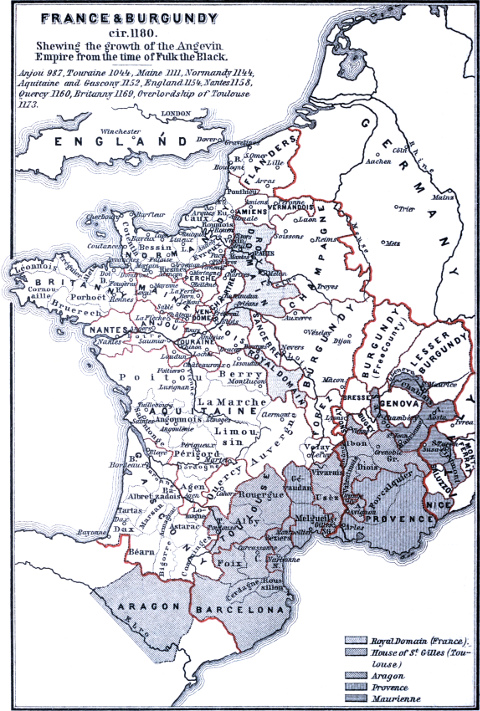
Map V.
Wagner & Debes’ Geogˡ. Estabᵗ. Leipsic.
London, Macmillan & Co.
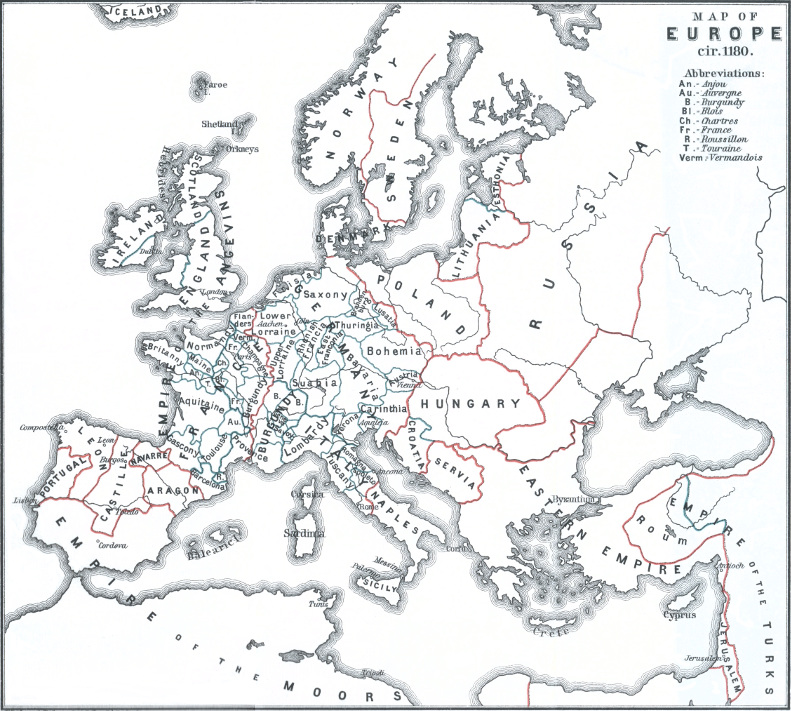
It is during these years of prosperity and peace that we are able to get the clearest view of the scope and aims of Henry’s general scheme of home and foreign policy. That policy, when fully matured in its author’s mind, formed a consistent whole; it was however made up of two distinct parts, originating in the twofold position of Henry himself. His empire extended from the western shores of Ireland to the Cévennes, and from the northernmost point of the mainland of Britain to the Pyrenees. But this empire was composed of a number of separate members over which his authority differed greatly in character and degree. These members, again, fell into two well-marked groups. Over the one group Henry ruled as supreme head; no other sovereign had ever claimed to be his superior, none now claimed to be even his equal, within the British Isles. In the other group, however, he had at least a nominal superior in the king of France. It was impossible to deal with these two groups of states on one and the same principle; and Henry had never attempted to do so. The one group had its centre in England, the other in Anjou. As a necessary consequence, Henry’s policy had also two centres throughout his reign. The key to it as a whole lies in its blending of two characters united in one person, yet essentially distinct: the character of the king of England and supreme lord of the British Isles, and the character of the head of the house of Anjou. Henry himself evidently kept the two characters distinct in his own mind. His policy as king of England, however little it may have been consciously aimed at such a result—and we should surely be doing a great injustice to Henry’s sagacity if we doubted that it was so aimed, at least in some degree—certainly tended to make England a strong and independent national state, with its vassal states, Scotland, Wales and Ireland, standing around it as dependent allies. If he had ever for a moment dreamed of reducing his insular dominions to a mere subject-province of the empire which he was building up in Gaul, when he thought of intrusting their government to his boy-heir under the guardianship of Thomas, that dream had been broken at once and for ever by the quarrel which deprived the child of his guardian and the king of his friend. But, on the other hand, Henry certainly never at any time contemplated making his continental empire a mere dependency of the English crown. It was distinctly an Angevin empire, with its centre in the spot whence an Angevin count had been promised of old that the sway of his descendants should spread to the ends of the earth. Henry in short had another work to carry on besides that of Cnut and William and Henry I. He had to carry on also the work of Fulk the Black and Geoffrey Martel and Fulk V.; and although to us who know how speedy was to be its overthrow that work looks a comparatively small matter, yet at the time it may well have seemed equally important with the other in the eyes both of Henry and of his contemporaries. While what may be called the English thread in the somewhat tangled skein of Henry’s life runs smoothly and uneventfully on from the year 1175 to the end, it is this Angevin thread which forms the clue to the political and personal, as distinguished from the social and constitutional, interest of all the remaining years of his reign. And from this interest, although its centre is at Angers, England is not excluded. For the whole continental relations of Henry were coloured by his position as an English king; and the whole foreign relations of England, from his day to our own, have been coloured by the fact that her second King Henry was also head of the Angevin house when that house was at the height of its continental power and glory.
The prophecy said to have been made to Fulk the Good was now literally fulfilled. The dominions of his posterity reached to the uttermost ends of the known world. In the far east, one grandson of Fulk V. ruled over the little strip of Holy Land which formed the boundary of Christendom against the outer darkness of unexplored heathendom. In the far west, another of Fulk’s grandsons was, formally at least, acknowledged overlord of the island beyond which, in the belief of those days, lay nothing but a sea without a shore. Scarcely less remarkable, however, was the fulfilment of the prediction in a narrower sense. The whole breadth of Europe and the whole length of the Mediterranean sea parted the western from the eastern branch of the Angevin house. But in Gaul itself, the Angevin dominion now stretched without a break from one end of the land to the other. The Good Count’s heir held in his own hands the whole Gaulish coast-line from the mouth of the Somme to that of the Bidassoa, and he could almost touch the Mediterranean Sea through his vassal the count of Toulouse. Step by step the lords of the little Angevin march had enlarged their borders till they enclosed more than two-thirds of the kingdom of France. Fulk Nerra and Geoffrey Martel had doubled their possessions by the conquest of Touraine to the south-east; Fulk V. had tripled them by the annexation of Maine to the northward; Geoffrey Plantagenet’s marriage with the heiress of Normandy had brought him to the shores of the English Channel. The whole series of annexations and conquests whereby his son expanded his continental dominions to the extent which they covered thirty years after Geoffrey’s death resulted simply from a continuation of the same policy which, a century and a half before, had laid the foundations of the Angevin empire. Count Henry Fitz-Empress stood in a figure, like Count Fulk the Black, upon the rock of Angers, looked around over his marchland and its borders, noted every point at which those borders might be strengthened, rounded off or enlarged, and set himself to the pursuit of Fulk Nerra’s work in Fulk Nerra’s own spirit. For such a survey indeed he needed a more wide-reaching vision than even that of the Black Falcon. The work had altered vastly in scale since it left the “great builder’s” hands; but it had not changed in character. Henry’s policy in Gaul was essentially the same as Fulk’s—a policy of consolidation, rather than of conquest. He clearly never dreamed, as a man of less cautious ambition might well have done in his place, of pitting the whole strength of his continental and insular dominions against that of the French Crown in a struggle for the mastery of Gaul; he seems never to have dreamed even of trying to free himself from his feudal obedience to a sovereign far inferior to him in territorial wealth and power; he never, so far as we can see, aspired to stand in any other relation to the French king than that which had been held by his forefathers. He aimed in fact simply at compacting and securing his own territories in Gaul, and maintaining the rank of the head of the Angevin house, as the most influential vassal of the Crown. If he ever saw, on a distant horizon, a vision of something greater than this, he kept his dream to himself and, like Fulk of old, left his successors to attempt its fulfilment.
Map VI.
Wagner & Debes’ Geogˡ. Estabᵗ. Leipsic.
London, Macmillan & Co.
An ambition so moderate as this entailed no very complicated schemes of foreign diplomacy. As a matter of fact, Henry was at some time or other in his reign in diplomatic relations with every state and every ruler in Christendom, from Portugal to Norway, and from the count of Montferrat to the Eastern and Western Emperors. But these relations sprang for the most part from his insular rather than from his continental position; or, more exactly, they arose from his position as a king of England, but a king far mightier than any who had gone before him. It was the knowledge that Henry had at his back all the forces of the island-crown which roused in Louis VII. such a restless jealousy of his power in Gaul; and it was the jealousy of Louis which drove Henry into a labyrinth of diplomacy and of war, neither of which was a natural result of Henry’s own policy. A very brief glance at Henry’s foreign relations will suffice to shew that they concerned England far more than Anjou. A considerable part of them arose directly out of his quarrel with the English primate. Such was the case with his German and Italian alliances, designed to counterbalance the French king’s league with the Pope. The alliances formed through the marriages of his daughters were all strictly alliances made by the English Crown. The immediate occasion of Matilda’s marriage with Henry of Saxony was her father’s quarrel with S. Thomas; in another point of view, this union was only a natural continuation of a policy which may be traced through the wedding of her grandmother with Henry V. and that of Gunhild with Henry III. back to the wedding of Æthelstan’s sister Eadgifu with Charles the Simple. The marriages of Eleanor and Jane were first planned during the same troubled time; in each case the definite proposal came from the bridegroom, and came in the shape of an humble suit to the king of England for his daughter’s hand; and in the case of all three sisters, the proposal was laid before a great council of the bishops and barons of England, and only accepted after formal deliberation upon it with them, as upon a matter which concerned the interests of England as a state.[926] When Jane went to be married to the king of Sicily in 1176, the details of her journey to her new home and of the honours which she received on her arrival there were recorded in England as matters of national interest and national pride.[927] When in the following year her sister Eleanor’s husband, Alfonso of Castille, submitted a quarrel between himself and his kinsman the king of Navarre to his father-in-law’s arbitration, the case was heard in an assembly of the English barons and wise men at Westminster.[928] Henry’s daughters in short were instruments of his regal, his national, his English policy; for the carrying out of his Angevin, his family policy, he looked to his sons.
The arrangement by which he endeavoured to make them carry it out is however not very easy to understand or to account for. He had long since abandoned his early scheme of devoting himself entirely to continental politics and making England over to the hands of his eldest son. That scheme, indeed, had been frustrated in the first instance by his quarrel with Thomas; although it seemed to have been revived in 1170, it was as a mere temporary expedient to meet a temporary need; and the revolt of 1173 put an end to it altogether, by proving clearly to Henry that he must never again venture to delegate his kingly power and authority to any one, even for a season. But, on the other hand, it is not easy at once to see why, during the years which followed, he persistently refused to give to his eldest son as much real, though subordinate, power on the continent as he was willing to give to the younger ones—why young Henry was not suffered to govern Anjou and Normandy as Richard was suffered to govern Aquitaine and Geoffrey to govern Britanny, so soon as they were old enough, under the control of their father as overlord. So far as we can venture to guess at the king’s motives, the most probable reason seems to be that he could not part with any share of authority over his ancestral dominions without parting at the same time with his ancestral dignities. From a strictly Angevin or Cenomannian point of view, Aquitaine and Britanny were both simply appendages, diversely acquired, to the hereditary Angevin and Cenomannian dominions. Nay, from a strictly Norman point of view, England itself was but an addition to the heritage of the Norman ducal house. Henry might make over all these to his sons as under-fiefs to govern in subjection to him, and yet retain intact his position as head of the sovereign houses of Normandy and Anjou. But to place his mother’s duchy and his father’s counties in other hands—to reduce them to the rank of under-fiefs, keeping for himself no closer connexion with them than a mere general overlordship—would have been, in principle, to renounce his birthright; while in practice, it would probably have been equivalent to complete abdication, as far as his continental empire was concerned. Henry would have had as little chance of enforcing his claim to overlordship without a territorial basis on which to rest it, as a German Emperor without his hereditary duchy of Saxony or Franconia or Suabia, or a French king without his royal domain. In short, when Henry found it impossible to give England to his eldest son, he had nothing else to give him, unless he gave him all; and Henry Fitz-Empress was no more inclined than William the Conqueror had been to “take off his clothes before he was ready to go to bed.” All his schemes for the distribution of his territories, therefore, from 1175 onwards, were intended solely to insure a fair partition among his sons after his own death; his general aim being that young Henry should step into exactly his own position as king of England, duke of Normandy and count of Anjou, and overlord of Britanny, Aquitaine, and all other dependencies of the Angevin and Norman coronets or of the English crown.
None of the holders of these dependencies, however, had as yet entered into full enjoyment of their possessions. At the close of their first revolt, in 1175, the young king was but just entering his twentieth year; Richard was in his eighteenth and Geoffrey in his seventeenth year; and although the one had been titular duke of Aquitaine and the other titular duke of Britanny since 1169, the real government of both duchies, as well as that of Normandy and Anjou, had been until now in the hands of their father. For the purposes of our story there is only one part of these continental possessions of our Angevin king into whose internal concerns we need enter at any great length; a very slight sketch may suffice for the others. The part which lay nearest to England, and which politically was most closely connected with it—the duchy of Normandy—was also associated with it in many of Henry’s legal, constitutional and administrative reforms. A comparison of dates indeed would almost suggest that Henry, when contemplating a great legal or administrative experiment in England, usually tried it first in Normandy in order to test its working there upon a small scale before he ventured on applying it to his island realm. An edict issued at Falaise in the Christmas-tide of 1159–1160, ordaining “that no dean should accuse any man without the evidence of neighbours who bore a good character, and that in the treatment of all causes, the magistrates of the several districts at their monthly courts should determine nothing without the witness of the neighbours, should do injustice to no man and inflict nothing to the prejudice of any, should maintain the peace, and should punish all robbers summarily,”[929] seems to contain a foreshadowing at once of some of the Constitutions of Clarendon which created such excitement in England four years afterwards, and of the Assize which followed two years later still. A commission of inquiry into the administration of the Norman episcopal sees and viscounties in 1162[930] was a sort of forerunner of the great inquest into the conduct of the English sheriffs in 1170. This again was followed next year, as we have seen, by an inquiry into the state of the ducal forests and demesnes,[931] which has its English parallels in the great forest assize of 1176 and in an inquest into the condition of the royal demesnes ordered in the spring of 1177.[932] On the other hand, a roll of the Norman tenants-in-chivalry compiled in 1172 seems to have been modelled upon the English “Black Book” of 1168;[933] and when Henry determined to institute a thorough reform in the whole Norman administration, it was at the English exchequer-table that he found his instrument for the work. In 1176 William de Courcy, the seneschal of Normandy, died. In his stead the king appointed Richard of Ilchester. Richard, to judge by his surname, must have been an Englishman by birth; from the second year of Henry’s reign he was employed as a “writer” in the royal treasury;[934] about 1163 he was made archdeacon of Poitiers, but his archidiaconal functions sat as lightly upon him as upon a contemporary whose name is often associated with his, Geoffrey Ridel, archdeacon of Canterbury and vice-chancellor; and throughout the struggle with Archbishop Thomas he was one of the most active agents of Henry’s foreign diplomacy.[935] Unlike his colleagues Geoffrey Ridel and John of Oxford, he contrived, notwithstanding the ecclesiastical disgrace in which he became involved through his dealings with the schismatic Emperor and the antipope, to retain the general respect of all parties among his fellow-countrymen.[936] Throughout the same period, when not absent from England on some diplomatic mission, he frequently appears as an acting justice of the King’s Court and baron of the Exchequer.[937] He continued to fulfil the same duties after his elevation to the see of Winchester in 1174; and the estimation in which he was held is shewn by the fact that on his return from Normandy, where he was replaced at the end of two years by William Fitz-Ralf,[938] a special seat was assigned to him at the exchequer-table between the presiding justiciar and the treasurer, “that he might diligently examine what was written on the roll.”[939] He was evidently invested with far more authority in Normandy than that which usually appertained to a Norman seneschal—authority, in fact, more like that of an English justiciar; indeed, he is actually called justiciar, and not seneschal, by contemporary English writers.[940] His work in the duchy seems to have been moreover specially connected with finance;[941] and we may perhaps venture to see a trace of his hand in the organization of the Norman Court of Exchequer, which first comes distinctly to light in Henry’s latter years, its earliest extant roll being that of the year 1180.[942] The earlier stages of the legal and administrative organization of Normandy are, however, so lost in obscurity that neither constitutional lawyers in Henry’s day nor constitutional historians in our own have been able to determine the exact historical relation of the Norman system to that of England;[943] and the speedy severance of the political connexion between them makes the determination of the question, after all, of little practical moment.
Even more obscure than the internal history of Normandy under Henry II. is that of Anjou and of the two dependencies which may now be reckoned as one with it, Touraine and Maine. There is in his time throughout the whole of his dominions, with the marked exception of England, a dearth of historical records. Normandy cannot boast of a single historian such as those of the preceding generation, Orderic or William of Jumièges; the only Norman chronicle of any importance is that of Robert of Torigny, commonly known as “Robert de Monte,” from the Mont-St.-Michel of which he was abbot; and even his work is nothing more than a tolerably full and accurate chronicle of the old-fashioned type, arranged on the annalistic plan “according to the years of our Lord” which William of Malmesbury had condemned long ago. The Breton chronicles, always meagre, grow more meagre still as the years pass on; the same may be said of the chronicles of Tours; the “Acts of the bishops of Le Mans,” our sole native authority for the history of Maine, cease to record anything save purely ecclesiastical details. In Anjou itself the recent aggrandizement of the Angevin house stirred up in Henry’s early years a spirit of patriotic loyalty which led more than one of his subjects to collect the floating popular traditions of his race, as the ballads and tales of old England had been collected by Henry of Huntingdon and William of Malmesbury, and weave them into a narrative which passed for a history of the Angevin counts; and one of these writers supplemented his work with a special memoir of Henry’s father, Geoffrey duke of the Normans. But the reign of Henry himself found no historian in the Marchland; and indeed the half-blank pages of the few monastic chronicles which still dragged out a lingering existence in one or two of the great Angevin abbeys shew us that under Count Henry Fitz-Empress Anjou was once more, as of old under Count Fulk the Good, happy in having no history.
Yet it is there, and there alone, that we can catch a glimpse of one side of his character which, if we saw him only in England or in Normandy, we should hardly have discerned at all. Strange as it seems to us who know him in his northern realms only as the enterprising and somewhat unscrupulous politician, the stern and vigorous ruler, the hard-headed statesman, the uncompromising opponent of the Church’s claims, Henry is yet the one Angevin count who completely reproduced in his Marchland, as a living reality, the ideal which was represented there by the name of the good count-canon of Tours. Fulk the Black and Fulk the Fifth had both tried to reproduce it, each according to his lights, during those few years when the pressure of external politics and warfare left them free to devote their energies for a while to their country’s internal welfare. But Henry’s whole reign was, for his paternal dominions, a reign of peace. If we drew our ideas of him solely from the traces and traditions which he has left behind him there, we could never have guessed that he was a greater warrior than Fulk Nerra; we should rather have taken him for a quiet prince who, like Fulk the Good, “waged no wars.” These traces and traditions lie scattered over the soil of Anjou, Touraine and Maine as thickly as the traces and the traditions of the Black Count himself. Henry is in fact the only one of the later Angevin counts who made upon the imagination of his people an impression even approaching in vividness to that left by Fulk the Black, and of whose material works there remains anything which can be compared with those of the “great builder” of the preceding century. But the memory which Anjou has retained of Henry differs much in character from that which she has kept of Fulk; and it differs more widely still from that which Henry himself has left in his island-realm. In English popular tradition he appears simply as the hero of a foolish and discreditable romance, or as the man who first caused the murder of S. Thomas and then did penance at his grave; and material traces of him there are literally none, for of his English dwelling-places not one stone is left upon another, and not a single surviving monument of public utility, secular or ecclesiastical, is connected with his name. In the valley of the Loire it was far otherwise. There the two great Angevin builders share between them the credit of well-nigh all the more important monuments which give life to the medieval history of the land—except the military constructions, which belong to Fulk alone. It is not in donjons such as that of Loches or Montrichard, but in palaces and hospitals, bridges and embankments, that we see our Angevin king’s handiwork in his own home-lands. Almost every one of his many local capitals was adorned during his reign with a palace of regal dimensions and magnificence, reared by him in place of the lowlier “halls” which had served for the dwelling of the merely local rulers whom he succeeded. The rebuilding of the ducal palace at Rouen was begun in 1161;[944] that of Caen was nearly finished in 1180; its hall, which still exists, is the traditional seat of the Norman Exchequer.[945] At Tours a round tower which still stands in the barrack-yard is the sole surviving fragment of a castle which Henry is said to have built. His favourite abode in Touraine, however, was not at Tours but at Chinon, where the little fortress above the Vienne which had been the last conquest of Fulk Nerra and the lifelong prison of Geoffrey the Bearded grew under Henry’s hands into a royal retreat of exquisite beauty and splendour—a gem, even now in its ruin, worthy of its setting in the lovely valley of the Vienne, with the background of good greenwood which to Henry was probably its greatest charm. Angers, again, almost put on a new face in the course of Henry’s lifetime. In the year before his birth it had been visited by a fire which reduced to almost total ruin its whole south-western quarter, including the palace of the counts,[946] of which nothing but the great hall seems to have remained. The work of reconstruction, begun no doubt by Geoffrey Plantagenet, was completed on a regal scale by his son, and before the close of Henry’s reign a visitor from England, Ralf de Diceto, could gaze in admiration at the “vast palace,” with its “newly-built apartments, adorned with splendour befitting a king,” which rose at the foot of the vine-clad hills above the purple stream of Mayenne.[947]
But the count-king did not build for himself alone. It was, above all, with works of public usefulness that he delighted to adorn his realms. His beneficence indeed took a different shape from that of his predecessors. Church-building and abbey-founding met with little sympathy from him; throughout his whole dominions, only six religious houses, in the strict sense, could claim him as their founder; and even one of these was as much military as religious, for it was a commandery of knights Templars.[948] But no sovereign was ever more munificent in providing for the sick and needy. Not only do the Norman Exchequer-rolls contain frequent mention of sums set apart out of the ducal revenues for the support of lazar-houses and hospitals in the chief towns of the several bailiwicks;[949] nineteen years before the completion of his own palace at Caen, he had founded an hospital for lepers outside the walls of the town;[950] and a park and hunting-lodge which he had made for himself in the same year, 1161, at Quévilly by Rouen[951] were shortly afterwards given up by him to a colony of monks from Grandmont in Aquitaine, to be converted under their care into another great asylum for victims of the same disease.[952] At his own native Le Mans, the great hall of an almshouse or hospital outside the north-eastern boundary of the city, said to have been reared by him for the reception of its poor and sick folk, is still to be seen, though long since perverted to other uses. At Angers, on the other hand, it is only within the last half-century that the sick and disabled poor have exchanged for a more modern dwelling the shelter provided for them by Henry Fitz-Empress. Some time in the quiet years which followed the barons’ revolt, Stephen,[953] the seneschal of Anjou, bought of the abbess and convent of our Lady of Charity at Angers a plot of ground which lay between their abbey and the river, and on which he designed to build an hospice for the poor. In the last days of 1180 or the first days of 1181 the count-king took under his own care the work which his seneschal had begun, granted to the new hospital a rich endowment in lands and revenues, exempted it from secular charges and imposts, and won from Pope Alexander a confirmation of its spiritual independence.[954] Four priests were appointed to minister to the spiritual needs of its inmates; the care of their bodies was undertaken at first, it seems, by some pious laymen bound by no special rule; some years later, however, the hospital became, like most other establishments of the kind, affiliated to the Order of S. Augustine.[955] The pretty little chapel—dedicated to S. John the Baptist, and still standing,—the cloisters and the domestic offices were all finished before Henry’s death;[956] while of the two great pillared halls which now form the chief architectural glory of the suburb, one, the smaller and simpler, is clearly of his building; and the other, more vast and beautiful, is in all probability the last legacy of his sons to the home which was soon to be theirs no longer.[957]
This Hospice of S. John formed a third with Fulk Nerra’s abbey of S. Nicolas and Hildegard’s nunnery of our Lady of Charity in the group of pious and charitable foundations round which there gathered, on the meadows that bordered the right bank of the Mayenne, the suburb now known as Ronceray or La Doutre,—a suburb which even before the close of Henry’s reign had grown almost as populous as Angers itself, and was actually preferred to it as a residence by Ralf de Diceto.[958] Twice in Henry’s reign the bridge which linked it to the city was destroyed by fire;[959] the present “Grand-Pont” probably owes its erection to him. Fire was, however, by no means the most destructive element in the valleys of the Loire and its tributaries. “Well-nigh disappearing in summer, choked within their sandy beds,” these streams were all too apt, as Ralf de Diceto says of the Mayenne, to “rage and swell in winter like the sea;”[960] and the greatest and most lasting of all Henry’s material benefactions to Anjou was the embankment or “Levée”—a work which he seems characteristically to have planned and executed in the very midst of his struggle with the Church[961]—which stretches along Loire-side, from Ponts-de-Cé, just above the junction of the Mayenne and the Loire, some thirty miles eastward to Bourgueil. Further south, in the valley of the Vienne, the legend of the “Pont de l’Annonain” illustrates the curious but not altogether unaccountable confusion which grew up in popular imagination between the two great builders of Anjou. The “bridge,” a long viaduct which stretched from Chinon across river and meadow south-westward to the village of Rivière, was in reality built by Henry to secure a safe transit from Chinon into Poitou across the low ground on the south bank of the Vienne, which in rainy seasons was an all but impassable swamp. Later ages, however, connected it with a dim tradition, which still lingered in the district, of the wonderful night-ride across Loire and Vienne whereby Fulk Nerra had won Saumur, and in the belief of the peasantry the Pont de l’Annonain became a “devil’s bridge,” built in a single night by the Black Count’s familiar demon[962]—a demon who is but a popular personification of that spirit of dauntless enterprise and ceaseless activity which, alike in their material and in their political workmanship, was the secret of Henry’s success no less than of Fulk’s.
One portion, however, of Henry’s continental dominions has during these years a political and military history of its own, which is not without a bearing upon that of our own land. Geographically remote as it was from England, still more remote in the character of both country and people, Aquitaine yet concerns us more than any other part of Henry’s Gaulish possessions. For not only was it a chief source of the political complications which filled the closing years of his life; it was the only one of those possessions whose connexion with England survived the fall of the Angevin house. The heritages of Geoffrey and Matilda were lost by their grandson; the heritage of Eleanor remained, in part at least, in the hands of her descendants for more than two hundred years.
It was in truth a dower at once valuable and burdensome that Henry had received with his Aquitanian wife. She had made him master of a territory whose extent surpassed that of all his Norman and Angevin dominions put together, and was scarcely equalled by that of England—a territory containing every variety of soil and of natural characteristics, from the flat, rich pastures of Berry and the vineyards of Poitou and Saintonge to the rugged volcanic rocks and dark chestnut-woods of Auvergne, the salt marshes, sandy dunes, barren heaths and gloomy pine-forests of the Gascon coast, and the fertile valleys which open between the feet of the Pyrenees:—a territory whose population differed in blood and speech from their fellow-subjects north of Loire almost as widely as Normans and Angevins differed from Englishmen; while in temper and modes of thought and life they stood so apart from the northern world that in contradistinction to them Angevins and Normans and English might almost be counted, and indeed were almost ready to count themselves, as one people. It was a territory, too, whose political relations varied as much as its physical character, and were full of dangers which all Henry’s vigilance and wisdom were powerless to guard against or overcome. Setting aside, for the moment, the internal difficulties of Aquitaine, its whole eastern frontier, from the banks of the Cher to the Pyrenees, was more or less in dispute throughout his reign. The question of Toulouse, indeed, was settled in 1173; thenceforth the county of Toulouse, with its northern dependencies Rouergue and Alby, became a recognized underfief of the Poitevin duchy of Aquitaine, to which its western dependency, Quercy or the county of Cahors, had been already annexed after the war of 1160. The north-eastern portions of the older Aquitania, Berry and Auvergne, were sources of more lasting trouble. Berry had long ago been split into two unequal portions, of which the larger had remained subject to the dukes of Aquitaine, while the smaller northern division formed the viscounty of Bourges, and was an immediate fief of the French Crown. Naturally, the king was disposed to use every opportunity of thwarting the duke in the exercise of his authority over southern Berry; and Henry was equally desirous to lose no chance of re-asserting his ducal rights over Bourges.[963] The feudal position of Auvergne was a standing puzzle which king and duke, count, clergy and people, all in vain endeavoured to solve. During the struggle for supremacy in southern Gaul between the houses of Poitiers and Toulouse, Auvergne, after fluctuating for nearly a hundred years between the rival dukedoms, had virtually succeeded in freeing itself from the control of both, and in the reign of Louis VI. it seems to have been regarded as an immediate fief of the French Crown, to which however it proved a most unruly and troublesome possession. But the dukes of Aquitaine had never relinquished their claim to its overlordship; and when a quarrel broke out between two rival claimants of the county, it was naturally followed by a quarrel between Henry and Louis VII. as to their respective rights, as overlord and as lord paramount, to act as arbiters in the strife.[964] During five-and-twenty years it was a favourite device of Louis and of his successor, at every adverse crisis in Henry’s fortune, to despatch a body of troops into Auvergne to occupy that country and threaten Aquitaine through its eastern marches,[965] just as they habitually threatened Normandy through the marches of the Vexin.
Such a threat implied a far more serious danger in the south than in the north. The Aquitanian border was guarded by no such chain of strongly-fortified, stoutly-manned ducal castles as girt in the Norman duchy from Gisors to Tillières; and Henry’s hold over his wife’s dominions was very different from his grasp of the heritage of his mother. Twenty years of Angevin rule, which for political purposes had well-nigh bridged over the channel that parted England from Gaul, seem to have done nothing towards bridging over the gulf that parted Aquitaine from France and Anjou. If our Angevin king sometimes looks like a stranger amongst us, he was never anything but a stranger among the fellow-countrymen of his wife. Nowhere throughout his whole dominions was a spirit of revolt and insubordination so rife as among the nobles of Poitou and its dependencies; but it was a spirit utterly unlike the feudal pride of the Norman baronage. The endless strife of the Aquitanian nobles with their foreign duke and with each other sprang less from political motives than from a love of strife for its own sake; and their love of strife was only one phase of the passion for adventure and excitement which ran through every fibre of their nature and coloured every aspect of their social life. The men of the south lived in a world where the most delicate poetry and the fiercest savagery, the wildest moral and political disorder, and the most refined intellectual culture, mingled together in a confusion as picturesque as it was dangerous. The southern warrior was but half a knight if the sword was his only weapon—if he could not sing his battles as well as fight them. From raid and foray and siege he passed to the “Court of Love,” where the fairest and noblest women of the land, from the duchess herself downwards, presided over contests of subtle wit, skilful rime and melodious song, conducted under rules as stringent and with earnestness as deep as if life and death were at stake upon the issue; and in truth they sometimes were at stake, for song, love and war all mingled together in the troubadour’s life in an inextricable coil which the less subtle intellects of the north would have been powerless to unravel or comprehend. The sirvente or poetical satire with which he stung his enemies into fury or roused the slumbering valour of his friends often wrought more deadly mischief than sharp steel or blazing firebrand. The nature of the men of the south was like that of their country: it was made up of the most opposite characteristics—of the lightest fancies, the stormiest passions, the most versatile capabilities of body and mind, the most indolent love of ease and pleasure, the most restless and daring valour, the highest intellectual refinement and the lowest moral degradation. It was a nature which revolted instinctively from constraint in any direction,—whose impetuosity burst all control of law and order imposed from without upon its restless love of action and adventure, just as it overflowed all conventional bounds of thought and language with its exuberant play of feeling and imagination in speech or song.[966] We may see a type of it in the portrait, drawn by almost contemporary hands, of one who played an important part both in the social and in the political history of Aquitaine throughout the closing years of Henry II. and the reign of his successor. “Bertrand de Born was of the Limousin, lord of a castle in the diocese of Périgueux, by name Hautefort. He had at his command near a thousand men. And all his time he was at war with all his neighbours, with the count of Périgord, and the viscount of Limoges, and with his own brother Constantine—whom he would have liked to disinherit, had it not been for the king of England—and with Richard, while he was count of Poitou. He was a good knight, and a good warrior, and a good servant of ladies, and a good troubadour of sirventes; he never made but two songs, and the king of Aragon assigned the songs of Guiraut de Borneil as wives to his sirventes; and the man who sang them for him was named Papiol. And he was a pleasant, courteous man, wise and well-spoken, and knew how to deal with good and evil. And whenever he chose, he was master of King Henry and his sons; but he always wanted them to be at war among themselves, the father and the sons and the brothers one with another; and he always wanted the king of France and King Henry to be at war too. And if they made peace or a truce, he immediately set to work to unmake it with his sirventes, and to shew how they were all dishonoured in peace. And he gained much good by it, and much harm.”[967]
“De Pictavorum dices te gente creatum, Nam licet his linguâ liberiore loqui.”
(Enthet. ad Polycrat., Giles, vol. iii. p. i.)
Until the dukedom of Aquitaine passed to a woman, as were the vassals, so was their sovereign. Eleanor’s grandfather the crusader-duke William VIII. and her father William IX. were simply the boldest knights, the gayest troubadours and the most reckless adventurers in their duchy. There can be no doubt that the submission of Aquitaine to Louis VII., so far as it ever did submit to him, was due to Eleanor’s influence; and it was the same influence which chiefly contributed to preserve its obedience to her second husband during those earlier years of their married life when, at home and abroad, all things had seemed destined to prosper in his hands. But at the first symptom of a turn in the tide of his fortunes, southern Gaul at one rose against its northern master. Eleanor’s tact and firmness, Henry’s wariness and vigour, were all taxed to the uttermost in holding it down throughout the years of his struggle with the Church; and when Eleanor herself turned against him in 1173, the chances of a good understanding between her subjects and her husband became very nearly desperate. Henry himself seems to have long ago perceived that a duke of Aquitaine, to be thoroughly sure of his ground, needed a different apprenticeship from that which might befit a king of England, a duke of Normandy or Britanny, or a count of Anjou. The very first step in his plans for the future of his children—a step taken several years before he seems even to have thought of crowning his eldest son—was the designation of the second as his mother’s destined colleague and ultimate heir. Richard had been trained up ever since he was two years old specially for the office of duke of Aquitaine. After long diplomacy, and at the cost of a betrothal which became the source of endless mischief and trouble, the French king’s sanction to the arrangement had been won; and on Trinity-Sunday 1172 Richard, in his mother’s presence, had been formally enthroned at Poitiers. He was probably intended to govern the duchy under her direction and advice; if so, however, the plan was frustrated by Eleanor’s own conduct and by the suspicions which it aroused in her husband. She was one of the very few captives whom at the restoration of peace in 1175 he still retained in confinement. Richard, on the other hand, had been like his brothers fully and freely forgiven; and while his father and eldest brother went to seal their reconciliation in England, he was sent into Poitou charged with authority to employ its forces at his own discretion, and to take upon himself the suppression of all disturbance and disorder in Aquitaine.[968]
What had been the precise nature of Richard’s training for his appointed work—what proportion of his seventeen years’ life had been actually spent in Aquitaine, what opportunities he had had of growing familiar with the people over whom he was now set to rule—we have no means of determining. By his own natural temper, however, he was probably of all Eleanor’s sons the one least fitted to gain the goodwill of the south. The “Cœur-de-lion” of tradition, indeed—the adventurous crusader, the mirror of knightly prowess and knightly courtesy, the lavish patron of verse and song, the ideal king of troubadours and knights-errant—looks at first glance like the very incarnation of the spirit of the south. But it was only in the intellectual part of his nature that his southern blood made itself felt; the real groundwork of his character was made of sterner stuff. The love of splendour and elegance, the delight in poetry and music,[969] the lavish generosity, the passion for adventure, which contrasted so vividly with his father’s practical businesslike temper, came to him without doubt from his mother. The moral deficiencies and evil tendencies of his nature he himself charged, somewhat too exclusively, upon the demon-blood of the Angevin counts.[970] But we need not look either to an ancestress so shadowy and so remote as the demon-countess, nor to a land so far distant from us as Poitou, for the source of Richard’s strongest characteristics both of body and of mind. In him alone among Henry’s sons can we see a likeness to the Norman forefathers of the Empress Matilda. His outward aspect, his lofty stature, his gigantic strength—held in check though it was by the constantly-recurring ague which “kept him, fearless, in a tremor as continual as the tremor of fear in which he kept the rest of the world”[971]—his blue eyes and golden hair, all proclaimed him a child of the north. And although he spent the chief part of his life elsewhere, the slender share of local and national sympathies which he possessed seems to have lain in the same direction. The “lion-heart” chose its own last earthly resting-place at Rouen, not at Poitiers;[972] and the intimate friend and comrade whose name is inseparably associated with his by a tradition which, whatever its historical value, is as famous as it is beautiful, was no Poitevin or Provençal troubadour, but a trouvère from northern France.[973] The influence of his northman-blood shewed itself more vividly still when on his voyage to Palestine, having lived to be more than thirty years old without possessing a skiff that he could call his own, or—unless indeed in early childhood he had gone a cruise round his father’s island-realm—ever making a longer or more adventurous voyage than that from Southampton to Barfleur or Wissant, he suddenly developed not only a passionate love of the sea, but a consummate seamanship which he certainly had had no opportunity of acquiring in any way, and which can only have been born in him, as an inheritance from his wiking forefathers. When scarcely more than a boy in years, Richard was already one of the most serious and determined of men. His sternness to those who “withstood his will” matched that of the Conqueror himself; and Richard’s will, even at the age of seventeen, was no mere caprice, but a fixed determination which overrode all obstacles between itself and its object as unhesitatingly as the old wiking-keels overrode the billows of the northern sea. He went down into Aquitaine fully resolved that the country should be at once, and once for all, reduced to submission and order. He set himself “to bring the shapeless into shape, to reduce the irregular to rule, to cast down the things that were mighty and level those that were rugged; to restore the dukedom of Aquitaine to its ancient boundaries and its ancient government.”[974] He did the work with all his might, but he did it with a straightforward ruthlessness untempered by southern craft or Angevin caution and tact. He would not conciliate; he could not wait. “He thought nothing done while anything still remained to do; and he cared for no success that was not reached by a path cut by his own sword and stained with his opponent’s blood. Boiling over with zeal for order and justice, he sought to quell the audacity of this ungovernable people and to secure the safety of the innocent amid these workers of mischief by at once proceeding against the evil-doers with the utmost rigour which his ducal authority could enable him to exercise upon them.”[975] In a word, before Richard had been six months in their midst, the Aquitanians discovered that if their Angevin duke had chastised them with whips, the son of their own duchess was minded to chastise them with scorpions.
He set off at once upon a furious campaign against the strongholds of the unruly barons. “No mountain-side however steep and rugged, no tower however lofty and impregnable, availed to check his advance, as skilful as it was daring, as steady and persevering as it was impetuous.”[976] By midsummer the castles of Poitou itself were mostly in his hands, and the young conqueror was busy with the siege of Castillonnes-sur-Agen, which surrendered to him in the middle of August.[977] Before the winter was over he was master of Périgueux, and had, in the phrase of a local writer, well-nigh “disinherited” the barons of Périgord, the Quercy and the Limousin. But in the spring their smouldering resentment was kindled into a blaze by the incitements of Bertrand de Born, whose brother Constantine, expelled by him from the castle of Hautefort which the two brothers had inherited in common, had appealed to Richard for succour; the signal for revolt, given by Bertrand in a vigorous sirvente, was answered by all the malcontents of the district,[978] and at the opposite end of Poitou by the count of Angoulême; and at Easter Richard found his position so difficult that he went to seek advice and reinforcements from his father in England.[979] Geoffrey of Britanny arrived at the same time on a like errand. Henry bade his eldest son go to the help of the younger ones; the young king complied,[980] somewhat unwillingly, and went to collect forces in France while Richard hurried back into Poitou. The peril was urgent; in his absence Count Vulgrin of Angoulême had invaded Poitou at the head of a host of Brabantines. The invaders were however met and defeated with great slaughter at Barbezieux by Richard’s constable Theobald Chabot and Bishop John of Poitiers.[981] By Whitsuntide Richard had gathered a sufficient force of loyal Poitevins and stipendiaries from the neighbouring lands to march against Vulgrin and his Brabantines and defeat them in a battle near the border of the Angoumois and Saintonge. He then turned upon the viscount of Limoges, besieged and took his castle of Aixe, and thence advanced to Limoges itself, which he captured in like manner. At midsummer he was rejoined at Poitiers by his elder brother, and the two led their combined forces against Vulgrin of Angoulême.[982] A fortnight’s siege had however scarcely made them masters of Châteauneuf on the Charente when the young king—seduced, it was said, by some evil counsellor whom we may probably suspect to have been Bertrand de Born[983]—suddenly abandoned the campaign and withdrew again to France. Richard, undaunted by his brother’s desertion, pushed on to Moulin-Neuf and thence to Angoulême itself, where all the leaders of the rebellion were gathered together. A six days’ siege sufficed to make Vulgrin surrender himself, his fellow-rebels, his city and five of his castles to the mercy of the duke and the English king. Richard sent over all his prisoners to his father in England; Henry, however, sent them back again, and Richard put them in prison to await their sentence till the king should return to Gaul.[984]
Northern Aquitaine, or Guyenne, was now for the moment subdued. As soon as Christmas was over Richard proceeded to the reduction of Gascony. Dax, held against him by its viscount Peter and by the count of Bigorre, and Bayonne, defended by its viscount Ernald Bertram, submitted each after a ten days’ siege; S. Pierre-de-Cize, on the Spanish frontier, fell in one day; the Basques and Navarrese were compelled to promise peace; the plunderings habitually inflicted by the border-folk upon pilgrims to the shrine of S. James at Compostella were suppressed; and from his court at Poitiers on Candlemas-day Richard triumphantly reported to his father that he had pacified the whole country.[985] But the peace did not last long. Trouble was already threatening at the opposite end of the duchy. Ralf of Déols, the wealthiest baron in Berry, had lately died leaving as his heir an infant daughter. She was of course, according to feudal law, a ward of her overlord, King Henry; but her relatives seized both her and her estates, and refused to give up either.[986] Henry, probably feeling that the boy-duke of Aquitaine had already more than enough upon his hands, charged his eldest son with the settlement of this affair, bidding him take possession of all Ralf’s lands without delay, and significantly adding: “While I governed my realms alone, I lost none of my rightful possessions; it will be shame to us all if aught of them be lost now that we are several to rule them.” The young king took the hint, marched with all his Norman and Angevin forces into Berry, and laid siege to Châteauroux;[987] but he seems to have had no success;[988] and there was no chance of help from Richard, for not only was the Limousin again plunged in civil war,[989] but all southern Aquitaine was in danger of a like fate—an attempt of Count Raymond of Toulouse to exert his authority as overlord of Narbonne with greater stringency than its high-spirited viscountess Hermengard was disposed to endure having stirred up against him a league of all the princes of Septimania and the Spanish border, under the leadership of Hermengard herself and of Raymond’s hereditary rivals, the king of Aragon and his brothers.[990] The way in which Raymond prepared to meet their attack supplies a vivid illustration of southern character and manners. He sought an ally in Bertrand de Born, and he appealed to him in his character not of knight but of troubadour. He sent a messenger to Hautefort to state his cause and to ask Bertrand, not to fight for it, but simply to publish it to the world in a sirvente. Bertrand answered readily to the appeal; he was only too glad of any excuse for a sirvente which should “cause dints in a thousand shields, and rents in a thousand helms and hauberks.” “I would fain have the great barons ever wroth one with another!” is the characteristic exclamation with which he ends his war-song.[991]
The strife thus begun for the mastery in Septimania was continued at intervals between the houses of Toulouse and Aragon for many years to come. The overlord of Toulouse, however, seems to have taken no part in it as yet; and indeed, it had scarcely more than begun when Richard was summoned away to meet his father in Normandy. Three times in the course of that spring and summer had King Henry collected his host in England for the purpose of going over sea to the help of his sons; twice had he remanded it,[992] for the sake, as it seems, of continuing his legal and administrative work in England. By midsummer however the tidings from Gaul were such that he dared not further prolong his absence. Geoffrey wanted his help in Britanny; Richard wanted it almost as much in Aquitaine; the young king’s unaccountable lack of vigour in their support, and in the prosecution of the war in Berry, was justly raising suspicions of his loyalty to the family cause; and the treaty made with Louis of France at the close of the last war was proving, as such treaties too often did prove, only a source of fresh disputes. Henry summoned Louis to fulfil his part of the agreement by handing over the Vexin to the young king and the viscounty of Bourges to Richard, according to his promise, as the dowries of their brides;[993] Louis insisted that Henry should first complete his share of the engagement by allowing Adela, who had been in his custody ever since the treaty was signed, to be wedded to her promised bridegroom, Richard. At last, in July, he succeeded in bringing the matter to a crisis by extorting from a papal legate who had been sent to deal with a heresy that had arisen in southern Gaul a threat of laying all Henry’s dominions under interdict unless Richard and Adela were married at once.[994] The English bishops appealed against the threat;[995] while Henry hurried over to Normandy,[996] met first his two elder sons,[997] then the legate,[998] then the French king,[999] and once again contrived to stave off the threatening peril. At Nonancourt, on September 25, the two kings made a treaty containing not one word of marriages or dowries, but consisting of an agreement to bury all their differences under the cross. They pledged themselves to go on crusade together, to submit to arbitration the questions in dispute between them about Auvergne and Berry, and to lay aside all their other quarrels at once and for ever.[1000] Such a treaty was in reality a mere temporary expedient; but it served Henry’s purpose by securing him against French interference while he marched against the rebels in Berry. As usual, he carried all before him; Châteauroux surrendered without a struggle; the lord of La Châtre, who had stolen the little heiress of Déols and was keeping her fast in his own castle, hurried to make his peace and give up his prize.[1001] Henry used his opportunity to advance into the Limousin and exert his authority in punishing its turbulent barons;[1002] soon after Martinmas he and Louis met at Graçay and made another ineffectual attempt to settle the vexed question of Auvergne;[1003] a month later he was again in Aquitaine, purchasing the direct ownership of one of its under-fiefs, the county of La Marche, from the childless Count Adalbert who was purposing to end his days in Holy Land;[1004] and at Christmas he was back at Angers, where he kept the feast with his three elder sons amid such a gathering of knights as had never been seen at his court except at his own crowning or that of the young king.[1005]
For six months there was peace, and in July the king ventured to return to England.[1006] He knighted his son Geoffrey at Woodstock on August 6,[1007] and when the lad hurried over sea, eager to flesh his maiden sword and emulate the prowess of his brothers, he could find no more serious field in which to exercise his warlike energies than a succession of tournaments on the borders of France and Normandy.[1008] Richard however was again busy with more earnest fighting. The rivalry between the houses of Aragon and Toulouse had stirred up the petty chieftains of southern Gascony, whom the king of Aragon was seeking to enlist in his service; and Richard was obliged to undertake a campaign against the count of Bigorre in particular, which seems to have occupied him till the end of the year. The defiant attitude of the nobles of Saintonge and the Angoumois, and especially of a powerful baron, Geoffrey of Rancogne, called him back at Christmas to Saintes; as soon as the feast was over he laid siege to Geoffrey’s castle of Pons; after spending more than three months before the place, he left his constables to continue the blockade while he himself went to attack the other rebel castles. Five of them were taken and razed between Easter and Rogation-tide,[1009] and then Richard gathered up all his forces to assault Geoffrey of Rancogne’s mightiest stronghold, Taillebourg. It stood a few miles north of Saintes, on the crest of a lofty rock, three of whose sides were so steep as to defy any attempt to scale them, while the fourth was guarded by a triple ditch and rampart. Three lines of wall, built of hewn stone and strengthened with towers and battlements, encircled the keep, which was stored with provisions and arms offensive and defensive, and crowded with picked men-at-arms who laughed to scorn the rashness of the young duke in attempting to besiege a fortress which all his predecessors had looked upon as well-nigh unapproachable. But he cleared its approaches with a ruthless energy such as they little expected, cutting down vineyards, burning houses, levelling every obstacle before him, till he pitched his tents close to the castle walls under the eyes of the astonished townsfolk. A sally of the latter only resulted in making a way for Richard’s entrance into the town; three days later the castle surrendered, and Geoffrey himself with it.[1010] Ten days’ more fighting brought all the rebels to submission and reduced Vulgrin of Angoulême himself to give up his capital city and his castle of Montignac in Périgord;[1011] and at Whitsuntide Richard went to report his success with his own lips to his delighted father in England.[1012]
He returned shortly before Michaelmas,[1013] to witness the opening of a new phase in the relations between the Angevin house and the French Crown. Philip of France, the only son of Louis VII., was now fourteen years old, and his father was desirous to have him crowned king. Before the appointed day arrived, however, he fell sick almost to death.[1014] Louis, half wild with anxiety, dreamed that the martyr of Canterbury required him to visit his shrine as a condition of the boy’s recovery.[1015] He hurried across the Channel; Henry met him at Dover and conducted him to Canterbury, where they both spent three days in fasting and prayer before the shrine; and on the fourth day after his landing Louis re-entered his own country, to find that his prayers were answered.[1016] His brief visit was long remembered in England, where no king of France had ever been seen before,[1017] or was ever seen again save when John the Good was brought there as a prisoner in the days of Edward III. Scarcely, however, had Philip recovered when Louis himself was stricken down by paralysis.[1018] This calamity made him all the more anxious for his son’s coronation, which took place at Reims on All Saints’ day. The archbishop of the province—a brother of Queen Adela—performed the rite, assisted by nearly all the bishops of Gaul; all the great vassals of the kingdom were present, among them the young King Henry, who in his capacity of duke of Normandy carried the crown before his youthful overlord in the procession to and from the cathedral church, as Count Philip of Flanders carried the sword of state.[1019] Like the crowning of young Henry himself, the crowning of Philip Augustus proved to be a beginning of troubles. His father’s helpless condition left the boy-king to fall under the influence of whatever counsellor could first get at his ear. That one happened to be his godfather, Philip of Flanders; and the policy of Flanders was to get the boy entirely under his own control by setting him against all his father’s old friends,[1020] and even against his mother, whom he tried to rob of her dower-lands and persecuted to such a degree that she was compelled to leave his domains and fly to her brothers for the protection which her husband was powerless to give her.[1021] The united forces of Flanders and of the Crown—for the latter were now wholly at Philip’s command[1022]—were, however, more than a match for those of Champagne and Blois; and the house of Blois was driven to seek help of the only power which seemed capable of giving it—the power of their old rivals of Anjou.[1023]
The days were long gone by when it had been a chief part of the Angevin interest and policy to set the French king and the house of Blois at variance with each other. If Henry had needed any proof that the rivalry of Blois was no longer to be feared, he would have found it in the appeal for succour thus sent to him by Queen Adela and her brothers, and supported by his own eldest son, who at Mid-Lent 1180 went over to England purposely to consult with him on the state of affairs in France. Before Easter father and son both returned to Normandy, and there held a personal meeting with the French queen, her brothers Theobald of Blois and Stephen of Sancerre, and several other victims of young Philip’s tyranny. Pledges of good faith were exchanged, and summons were issued for a general levy of all Henry’s forces, on both sides of the sea, ready to attack Philip after Easter.[1024] Before the attack could be made, however, Philip had got himself into such difficulties as to render it needless. As soon as Lent was over he went into Flanders and there married a niece of its count, Elizabeth, daughter of the count of Hainaut.[1025] He then summoned all the princes of his realm to meet him at Sens on Whit-Sunday for the coronation of himself and his queen. The marriage had, however, given such offence that Philip of Flanders, in dread of opposition to his niece’s crowning, persuaded the young king to anticipate the ceremony and have her crowned together with himself at S. Denis, early in the morning of Ascension-day, by the archbishop of Sens.[1026] The wrath of the great vassals knew no bounds; and the wrath of the archbishop of Reims was almost more formidable still, for the exclusive right to crown the king of France was a special prerogative of his see, and he at once forwarded to Rome an indignant protest against the outrage done to him by his royal nephew.[1027] Philip of France and Guy of Sens had in fact put themselves into a position which might easily have become almost as full of peril as that into which Henry of England and Roger of York had put themselves by a somewhat similar proceeding ten years before. As, however, William of Reims was not a Thomas of Canterbury, the consequences were less tragic; and Henry himself must have been tempted to smile at the turning of the tables which suddenly placed in his hands the task of shielding Philip from the consequences of his rashness, and reconciling him to the outraged Church and the offended people.