VOLUME XVII SLICE VII Mars to Matteawan
Reading edition
Articles in This Slice
MARS MASAI
MARSALA MASANIELLO
MARSDEN, WILLIAM MASAYA
MARSEILLES MASCAGNI, PIETRO
MARSH, ADAM MASCARA
MARSH, GEORGE PERKINS MASCARENE ISLANDS
MARSH, HERBERT MASCARON, JULES
MARSH, NARCISSUS MASCHERONI, LORENZO
MARSH, OTHNIEL CHARLES MASCOT
MARSH MASDEU, JUAN FRANCISCO
MARSHAL MASERU
MARSHALL, ALFRED MASHAM, ABIGAIL
MARSHALL, JOHN (American jurist) MASHAM, SAMUEL CUNLIFFE LISTER
MARSHALL, JOHN (British surgeon) MASHONA
MARSHALL, STEPHEN MASK
MARSHALL (Missouri, U.S.A.) MASKELYNE, NEVIL
MARSHALL (Texas, U.S.A.) MASOLINO DA PANICALE
MARSHALL ISLANDS MASON, FRANCIS
MARSHALLTOWN MASON, GEORGE
MARSHALSEA MASON, GEORGE HEMMING
MARSHBUCK MASON, JAMES MURRAY
MARSHFIELD MASON, SIR JOHN
MARSH GAS MASON, JOHN
MARSHMAN, JOSHUA MASON, JOHN YOUNG
MARSI MASON, SIR JOSIAH
MARSIGLI, LUIGI FERDINANDO MASON, LOWELL
MARSILIUS OF PADUA MASON, WILLIAM
MARSIVAN MASON AND DIXON LINE
MARS-LA-TOUR MASON CITY
MARSTON, JOHN MASONRY
MARSTON, PHILIP BOURKE MASPERO, GASTON CAMILLE CHARLES
MARSTON MOOR, BATTLE OF MASS
MARSUPIALIA MASSA
MARSUPIAL MOLE MASSACHUSETTS
MARSUS, DOMITIUS MASSACRE
MARSYAS MASSAGE
MARTABAN MASSAGETAE
MARTELLO TOWER MASSA MARITTIMA
MARTEN, HENRY MASSAWA
MARTEN MASSÉNA, ANDRÉ
MARTENS, FRÉDÉRIC FROMMHOLD DE MASSENBACH, CHRISTIAN KARL AUGUST LUDWIG VON
MARTENS, GEORG FRIEDRICH VON MASSENET, JULES ÉMILE FRÉDÉRIC
MARTENSEN, HANS LASSEN MASSEREENE, JOHN CLOTWORTHY
MARTHA’S VINEYARD MASSEY, SIR EDWARD
MARTÍ, JUAN JOSÉ MASSEY, GERALD
MARTIAL MASSICUS, MONS
MARTIALIS, QUINTUS GARGILIUS MASSIF
MARTIAL LAW MASSILLON, JEAN BAPTISTE
MARTIGNAC, JEAN BAPTISTE SYLVERE GAY MASSILLON
MARTIGUES MASSIMO
MARTIN, ST MASSINGER, PHILIP
MARTIN (several popes) MASSINISSA
MARTIN, BON LOUIS HENRI MASSON, DAVID
MARTIN, CLAUD MASSON, LOUIS CLAUDE FRÉDÉRIC
MARTIN, FRANÇOIS XAVIER MAST
MARTIN, HOMER DODGE MASTABA
MARTIN, JOHN MASTER
MARTIN, LUTHER MASTER AND SERVANT
MARTIN, SIR THEODORE MASTER OF THE HORSE
MARTIN, WILLIAM MASTER OF THE ROLLS
MARTIN, SIR WILLIAM FANSHAWE MASTIC
MARTIN OF TROPPAU MASTIGOPHORA
MARTIN (bird) MASTODON
MARTINEAU, HARRIET MAS‘ŪDĪ
MARTINEAU, JAMES MASULIPATAM
MARTINET MAT
MARTÍNEZ DE LA ROSA, FRANCISCO DE PAULA MATABELE
MARTINI, GIOVANNI BATTISTA MATACHINES
MARTINI, SIMONE MATADOR
MARTINIQUE MATAMOROS
MARTINSBURG MATANZAS
MARTINS FERRY MATARÓ
MARTINUZZI, GEORGE MATCH
MARTIUS, CARL FRIEDRICH PHILIPP VON MATE (companion)
MARTOS, CHRISTINO MATÉ (shrub)
MARTOS MATERA
MARTYN, HENRY MATERIALISM
MARTYN, JOHN MATER MATUTA
MARTYR MATHEMATICS
MARTYROLOGY MATHER, COTTON
MARULLUS, MICHAEL TARCHANIOTA MATHER, INCREASE
MARUM, MARTIN VAN MATHER, RICHARD
MARUTS MATHERAN
MARVELL, ANDREW MATHESON, GEORGE
MARX, HEINRICH KARL MATHEW, THEOBALD
MARY (the mother of Jesus) MATHEWS, CHARLES
MARY (Magdalene) MATHEWS, THOMAS
MARY I. MATHY, KARL
MARY II. MATILDA (queen of England)
MARY QUEEN OF SCOTS MATILDA (countess of Tuscany)
MARY (duchess of Burgundy) MATINS
MARY (queen of France) MATLOCK
MARY OF LORRAINE MATOS FRAGOSO, JUAN DE
MARY OF MODENA MATRASS
MARY OF ORANGE MATRIARCHATE
MARYBOROUGH (Ireland) MATRIMONY
MARYBOROUGH (Queensland, Australia) MATRIX
MARYBOROUGH (Victoria, Australia) MATROSS
MARYLAND MATSUKATA
MARYPORT MATSYS, QUINTIN
MARZABOTTO MATTEAWAN
MASACCIO

MARS, in astronomy, the fourth planet in the order of distance from the sun, and the next outside the earth. To the naked eye it appears as a bright star of a decidedly reddish or lurid tint, which contrasts strongly with the whiteness of Venus and Jupiter. At opposition it is brighter than a first magnitude star, sometimes outshining even Sirius. It is by virtue of its position the most favourably situated of all the planets for observation from the earth. The eccentricity of its orbit, 0.0933, is greater than that of any other major planet except Mercury. The result is that at an opposition near perihelion Mars is markedly nearer to the earth than at an opposition near aphelion, the one distance being about 35 million miles; the other 63 million. These numbers express only the minimum distances at or near opposition, and not the distance at other times. The time of revolution of Mars is 686.98 days. The mean interval between oppositions is 2 years 49½ days, but, owing to the eccentricity of the orbit, the actual excess over two years ranges from 36 days to more than 2½ months. Its period of rotation is 24 h. 37 m. 22.66 s. (H. G. Bakhuyzen).
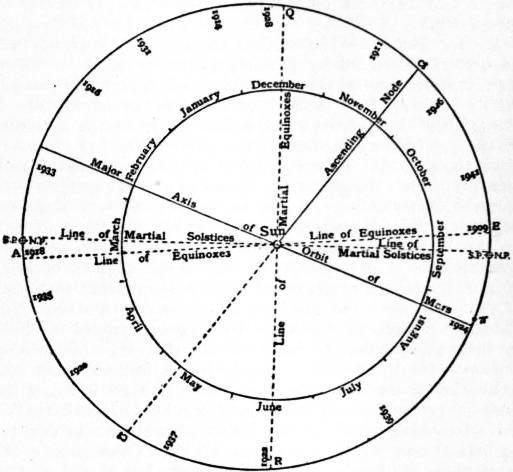
Fig. 1.—Orbits of Mars and the Earth, showing aspects of the planet relative to the earth and sun.
Motions.—The accompanying diagram will convey a notion of the varied aspects presented by the planet, of the cycles of change through which they go, and of the order in which the oppositions follow each other. The outer circle represents the orbit of Mars, the inner one that of the earth. AE is the line of the equinoxes from which longitudes are counted. The perihelion of Mars is in longitude 335° at the point π. The ascending node Ω is in longitude 47°. The line of nodes makes an angle of 74° with the major axis, so that Mars is south of the ecliptic near perihelion, but north of it near aphelion. Around the inner circle, representing the earth’s orbit, are marked the months during which the earth passes through the different parts of the orbit. It will be seen that the distance of Mars at the time of any opposition depends upon the month in which opposition occurs. The least possible distance would occur in an opposition about the end of August, a little before Mars reached the perihelion, because the eccentricity of the earth’s orbit throws our planet a little farther from the sun and nearer the orbit of Mars in July than it does in August. The opposition of 1909 occurred on the 24th of September, at a point marked by the year near the equinox, and the month and years of the oppositions following, up to 1941, are also shown in the same way. Tracing them around, it will be seen that the points of opposition travel around the orbit in about 16 years, so that oppositions near perihelion, when Mars is therefore nearest the earth, occur at intervals of 15 or 17 years.
The axis of rotation of the planet is inclined between 23° and 24° to the orbit, and the equator of the planet has the same inclination to the plane of the orbit. The north pole is directed toward a point in longitude 355°, in consequence of which the projection of the planet’s axis upon the plane of the ecliptic is nearly parallel to the line of our equinoxes. This projection is shown by the dotted line SP-NP, which corresponds closely to the line of the Martian solstices. It will be seen that at a September opposition the north pole of the planet is turned away from the sun, so that only the southern hemisphere is presented to us, and only the south pole can be seen from the earth. The Martian vernal equinox is near Q and the northern solstice near A. Here at the point S.P. the northern hemisphere is turned toward the sun. It will be seen that the aspect of the planet at opposition, especially the hemisphere which is visible, varies with the month of opposition, the general rule being that the northern hemisphere of the planet is entirely seen only near aphelion oppositions, and therefore when farthest from us, while the southern hemisphere is best seen near perihelion oppositions. The distances of the planet from the sun at aphelion and at perihelion are nearly in the ratio 6:5. The intensity of the sun’s radiation on the planet is as the inverse square of this ratio. It is therefore more than 40% greater near perihelion than near aphelion. It follows from all this that the southern hemisphere is subjected to a more intense solar heat than the northern, and must therefore have a warmer summer season. But the length of the seasons is the inverse of this, the summer of the northern hemisphere being longer and the heat of the southern hemisphere shorter in proportion.
Surface Features.—The surface features of the planet will be better understood by first considering what is known of its atmosphere and of the temperature which probably prevails on its surface. One method of detecting an atmosphere is through its absorption of the different rays in the spectrum of the sunlight reflected from the planet. Several observers have thought that they saw fairly distinct evidence of such absorption when the planet was examined with the spectroscope. But the observations were not conclusive; and with the view of setting the question at rest if possible, W. W. Campbell at the Lick Observatory instituted a very careful series of spectroscopic observations.1 To reduce the chances of error to a minimum the spectrum of Mars was compared with that of the moon when the two bodies were near each other. Not the slightest difference could be seen between any of the lines in the two spectra. It being certain that the spectrum of the moon is not affected by absorption, it followed that any absorption produced by the atmosphere of Mars is below the limit of perception. It was considered by Campbell that if the atmosphere of Mars were ¼ that of the earth in density, the absorption would have been visible. Consequently the atmosphere of Mars would be of a density less than ¼ that of the earth.2
Closely related to the question of an atmosphere is that of possible clouds above the surface of the planet, the existence of which, if real, would necessarily imply an atmosphere of a density approaching the limit set by Campbell’s observations. The most favourable opportunity for seeing clouds would be when they are formed above a region of the planet upon which the sun is about to rise, or from which it has just been setting. The cloud will then be illuminated by the sun’s rays while the surface below it is in darkness, and will appear to an observer on the earth as a spot of light outside the terminator, or visible edge of the illuminated part of the disk. It is noticeable that phenomena more or less of this character, though by no means common, have been noted by observers on several occasions. Among these have been the Mt Hamilton and Lowell observers, and W. H. Pickering at Arequipa. Campbell has shown that many of them may be accounted for by supposing the presence of mountains not more than two miles in height, which may well exist on the planet. While this hypothesis will serve to explain several of these appearances, this can scarcely be said of a detached spot observed on the evening of the 26th of May 1903, at the Lowell Observatory.3 Dr Slipher, who first saw it, was so struck by the appearance of the projection from the terminator upon the dark side of the disk that he called the other observers to witness it. Micrometric measures showed that it was some 300 miles in length, and that its highest point stood some 17 miles above the surface of the planet. That a cloud should be formed at such a height in so rare an atmosphere seems difficult to account for except on the principle that the rate of diminution of the density of an atmosphere with its height is proportional to the intensity of gravity, which is smaller on Mars than on the earth. The colour was not white, but tawny, of the tint exhibited by a cloud of dust. Percival Lowell therefore suggests that this and other appearances of the same kind seen from time to time are probably dust clouds, travelling over the desert, as they sometimes do on the earth, and settling slowly again to the ground.
Temperature.—Up to a recent time all that could be said of the probable temperature of Mars was that, being more distant from the sun than the earth, and having a rarer atmosphere, it had a general mean temperature probably below that of the earth. Greater precision can now be given to this theoretical conclusion by recent determination of the law of radiation of heat by bodies at different temperatures. Regarding it as fairly well established that at ordinary temperatures the radiation varies directly as the fourth power of the absolute temperature, it is possible when the “solar constant” is known to compute the temperature of a non-coloured body at the distance of Mars which presents every part of its surface in rapid succession to the sun’s rays in the absence of atmosphere only. This has been elaborately done for the major planets by J. H. Poynting,4 who computes that the mean temperature of Mars is far below the freezing point of water. On the other hand an investigation made by Lowell in 1907,5 taking into account the effect of the rare atmosphere on the heat lost by reflection, and of several other factors in the problem hitherto overlooked, led him to the conclusion that the mean temperature is about 48° Fahr.6 But the temperature may rise much above the mean on those regions of the surface exposed to a nearly vertical noon-day sun. The diurnal changes of temperature, being diminished by an atmosphere, must be greater on Mars than on the earth, so that the vicissitudes of temperature are there very great, but cannot be exactly determined, because they must depend upon the conductivity and thermal capacity of the matter composing the surface of the planet. What we can say with confidence is that, during the Martian winter of between eight and twelve of our months, the regions around either pole must fall to a temperature nearer the absolute zero than any known on this planet. In fact the climatic conditions in all but the equatorial regions are probably of the same nature as those which prevail on the tops of our highest mountains, except that the cold is more intense.7
Having these preliminary considerations in mind, we may now study the features presented to our view by the surface of the planet. These have a permanence and invariability which markedly differentiate them from the ever varying surfaces of Jupiter and Saturn, and show that what we see is a solid surface, like that of our earth. They were observed and delineated by the leading astronomers of the 16th century, especially Huygens, Cassini and Hooke. These observers could only distinguish the different regions upon the planet as bright or dark. Reasoning as they did in the case of the moon, it was naturally supposed that the brighter regions were land and the darker ones seas. The observers of our time find that the darker regions have a slightly blue-green aspect, which might suggest the idea of water, but are variegated in a way to show that they must be composed of a solid crust, like the brighter regions. The latter have a decidedly warm red or ochre tint, which gives the characteristic colour to the planet as seen by the naked eye. The regions in equatorial and middle latitudes, which are those best seen from our planet, show a surface of which the general aspect is not dissimilar to that which would be presented by the deserts of our earth when seen from the moon. With each improvement in the telescope the numerous drawings of the planet show more definiteness and certainty in details. About 1830 a fairly good map was made by W. Beer and J. H. Mädler, a work which has been repeated by a number of observers since that time. The volume of literature on the subject, illustrated by drawings and maps, has become so great that it is impossible here to present even an abstract of it; and it would not be practicable, even were it instructive, to enter upon any detailed description of Martian topography. A few great and well-marked features were depicted by the earliest observers, who saw them so plainly that they may be recognized by their drawings at the present time. There is also a general agreement among nearly all observers with good instruments as to the general features of the planet, but even in the latest drawings there is a marked divergence as to the minuter details. This is especially true of the boundaries of the more ill-defined regions, and of the faint and difficult markings of various kinds which are very numerous on every part of the planet. There is not even a close agreement between the drawings by the same observer at different oppositions; but this may be largely due to seasonal and other changes.
The most striking feature, and one which shows the greatest resemblance to a familiar terrestrial process, is that when either polar region comes into view after being turned nearly a year away from the sun, it is found to be covered with a white cap. This gradually contracts in extent as the sun shines upon it during the remaining half of the Martian year, sometimes nearly disappearing. That this change is due to the precipitation of watery vapour in the form of ice, snow or frost during the winter, and its melting or evaporation when exposed to the sun’s rays, is so obvious a conclusion that it has never been seriously questioned. It has indeed been suggested that the deposit may be frozen carbonic acid. While we cannot pronounce this out of the question, the probabilities seem in favour of the deposit being due to the precipitation of aqueous vapour in a frozen form. At a temperature of −50° C., which is far above what we can suppose to prevail in the polar regions during the winter, the tension of aqueous vapour is 0.034 mm. On the other hand Faraday found the tension of carbonic acid to be still an entire atmosphere at as low a temperature as −80° C. Numerically exact statements are impossible owing to our want of knowledge of the actual temperature, which must depend partly upon air currents between the equator and the poles of Mars. It can, however, be said, in a general way, that a proportion of aqueous vapour in the rare atmosphere of Mars, far smaller than that which prevails on the earth, would suffice to explain the observed formation and disappearances of the polar caps. Since every improvement in the telescope and in the conditions of observation must enable modern observers to see all that their predecessors did and yet more, we shall confine our statements to the latest results. These may be derived from the work of Professor Lowell of Boston, who in 1894 founded an observatory at Flagstaff, Arizona, 7250 ft. above sea-level, and supplied it with a 24″ telescope, of which the main purpose was the study of Mars. This work has been continued with such care and assiduity that its results must take precedence of all others in everything that relates to our present subject.8
Among the more probable conclusions to be drawn from Lowell’s observations, the following are of most interest. The darker areas are all seamed by lines and dots darker than themselves, which are permanent in position, so that there can be no bodies of water on the planet. On the other hand, their colour, blue-green, is that of vegetation. This fades out as vegetation would at certain seasons to faint blue-green, but in some places to a tawny brown. Each hemisphere undergoes these changes in its turn, the changes being opposite in opposite hemispheres. The changes in the dark areas follow some time after the melting of the polar caps. The aspect of these areas suggests old sea bottoms, and when on the terminator appear as depressions, though this may be only apparent and due to the dark colour. The smoothness and soft outline of the terminator shows that there are no mountains on Mars comparable with ours, but that the surface is surprisingly flat. White spots are occasionally visible in the tropical and temperate regions, which are perhaps due to the condensation of frost or snow, or to saline exudation such as seasonally occurs in India (Lowell). Moreover in winter the temperate zones are more or less covered by a whitish veil, which may be either hoar frost or cloud. A spring haze seems to surround the north polar cap during its most extensive melting; otherwise the Martian sky is quite clear, like that of a dry desert land. When either polar cap is melting it is bordered by a bluish area, which Lowell attributes to the water produced by the melting. But the obliquity at which the sun’s rays strike the surface as the cap is melting away is so great that it would seem to preclude the possibility of a temperature high enough to melt the snow into water. Under the low barometric pressure prevailing on the planet, snow would evaporate under the influence of the sun’s rays without changing into water. It is also contended that what looks like such a bluish border may be formed around a bright area by the secondary aberration of a refracting telescope.9
The modern studies of Mars which have aroused so much public interest began with the work of Schiaparelli in 1877. Accepting the term “ocean,” used by the older observers, to designate the widely extended darker regions on the planet, and holding that they were really bodies of water, he found that they were connected by comparatively narrow streaks. (Schiaparelli considered them really water until after the Lowell observations.) In accordance with the adopted system of nomenclature, he termed these streaks canale, a word of which the proper rendering into English would be channels. But the word was actually translated into both English and French as canal, thus connoting artificiality in the supposed waterways, which were attributed to the inhabitants of the planet. The fact that they were many miles in breadth, and that it was therefore absurd to call them canals, did not prevent this term from being so extensively used that it is now scarcely possible to do away with it. A second series of observations was made by Schiaparelli at the opposition of 1879, when the planet was farther away, but was better situated as to altitude above the horizon. He now found a number of additional channels, which were much finer than those he had previously drawn. The great interest attaching to their seemingly artificial character gave an impetus to telescopic study of the planet which has continued to the present time. New canals were added, especially at the Lowell Observatory, until the entire number listed in 1908 amounted to more than 585. The general character of this complex system of lines is described by Lowell as a network covering the whole face of the planet, light and dark regions alike, and connecting at either end with the respective polar caps there. At their junctions are small dark pinheads of spots. The lines vary in size between themselves, but each maintains its own width throughout. But the more difficult of these objects are only seen occasionally and are variable in definiteness. Of two canals equally well situated for seeing, only one may be visible at one time and only the other at other times. If this variability of aspect among different canals is true as they are seen from the Lowell Observatory, we find it true to a much greater extent when we compare descriptions by different observers. At Flagstaff, the most favourably situated of all the points of observation, they are seen as fine sharp lines, sometimes as well marked as if drawn with a pencil. But other observers see them with varying degrees of breadth and diffuseness.
One remarkable feature of these objects is their occasional “gemination,” some of the canals appearing as if doubled. This was first noticed by Schiaparelli, and has been confirmed, so far as observations can confirm it, by other observers. Different explanations of this phenomenon have been suggested, but the descriptions of it are not sufficiently definite to render any explanation worthy of entire confidence possible. Indeed the more cautious astronomers, who have not specially devoted themselves to the particular phenomena, reserve a doubt as to how far the apparent phenomena of the finer canals are real, and what the markings which give rise to their appearance might prove to be if a better and nearer view of the planet than is now possible could be obtained. Of the reality of the better marked ones there can be no doubt, as they have been seen repeatedly by many observers, including those at the Lick Observatory, and have actually been photographed at the Lowell Observatory. The doubt is therefore confined to the vast network of lines so fine that they never certainly have been seen elsewhere than at Flagstaff. The difficulty of pronouncing upon their reality arises from the fact that we have to do mainly with objects not plainly visible (or, as Lowell contends, not plainly visible elsewhere). The question therefore becomes one of psychological optics rather than of astronomy. When the question is considered from this point of view it is found that combinations of light and shaded areas very different from continuous lines, will, under certain conditions, be interpreted by the eye as such lines; and when such is the case, long practice by an observer, however carefully conducted, may confirm him in this interpretation. To give a single example of the principles involved; it is found by experiment that if, through a long line so fine as to approach the limit of visibility, segments not too near each other, or so short that they would not be visible by themselves, be taken out, their absence from the line will not be noticed, and the latter will still seem continuous.10 In other words we do not change the aspect of the line by taking away from it a part which by itself would be invisible. This act of the eye, in interpreting a discontinuous series of very faint patches as a continuous line, is not, properly speaking, an optical illusion, but rather a habit. The arguments for the reality of all the phenomena associated with the canals, while cogent, have not sufficed to bring about a general consensus of opinion among critics beyond the limit already mentioned.
Accepting the view that the dark lines on Mars are objectively real and continuous, and are features as definite in reality as they appear in the telescope, Professor Lowell has put forth an explanation of sufficient interest to be mentioned here. His first proposition is that lines frequently thousands of miles long, each following closely a great circle, must be the product of design rather than of natural causes. His explanation is that they indicate the existence of irrigating canals which carry the water produced annually by the melting of the polar snows to every part of the planet. The actual canals are too minute to be visible to us. What we really see as dark lines are broad strips of vegetation, produced by artificial cultivation extending along each border of the irrigating streams. On the other hand, in the view of his critics, the quantity of ice or snow which the sun’s rays could melt around the poles of Mars, the rate of flow and evaporation as the water is carried toward the equator, and several other of the conditions involved, require investigation before the theory can be established.11
The accompanying illustrations of Mars and its canals are those of Lowell, and represent the planet as seen by the Flagstaff observers.
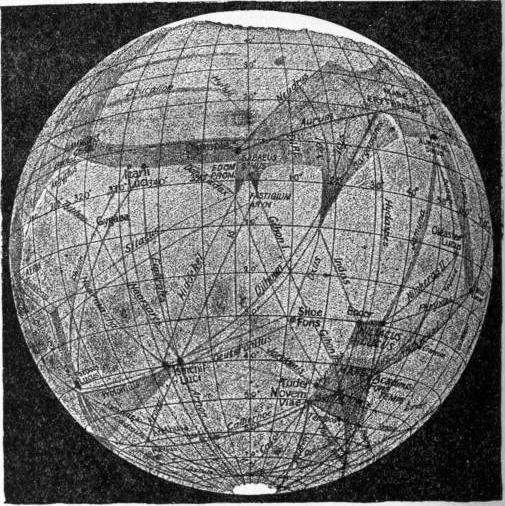
Fig. 2.
Satellites and Pole of Mars.—At the opposition of Mars which occurred in August 1877 the planet was unusually near the earth. Asaph Hall, then in charge of the 26″ telescope at the Naval Observatory in Washington, took advantage of this favourable circumstance to make a careful search for a visible satellite of the planet. On the night of the 11th of August he found a faint object near the planet. Cloudy weather intervened, and the object was not again seen until the 16th, when it was found to be moving with the planet, leaving no doubt as to its being a satellite. On the night following an inner satellite much nearer the planet was observed. This discovery, apart from its intrinsic interest, is also noteworthy as the first of a series of discoveries of satellites of the outer planets. The satellites of Mars are difficult to observe, on account not merely of their faintness, but of their proximity to the planet, the light of which is so bright as to nearly blot out that of the satellite. Intrinsically the inner satellite is brighter than the outer one, but for the reason just mentioned it is more difficult to observe. The names given them by Hall were Deimos for the outer satellite and Phobos for the inner one, derived from the mythological horses that drew the chariot of the god Mars. A remarkable feature of the orbit of Phobos is that it is so near the planet as to perform a revolution in less than one-third that of the diurnal rotation of Mars. The result is that to an inhabitant of Mars this satellite would rise in the west and set in the east, making two apparent diurnal revolutions every day. The period of Deimos is only six days greater than that of a Martian day; consequently its apparent motion around the planet would be so slow that more than two days elapse between rising and setting, and again between setting and rising.
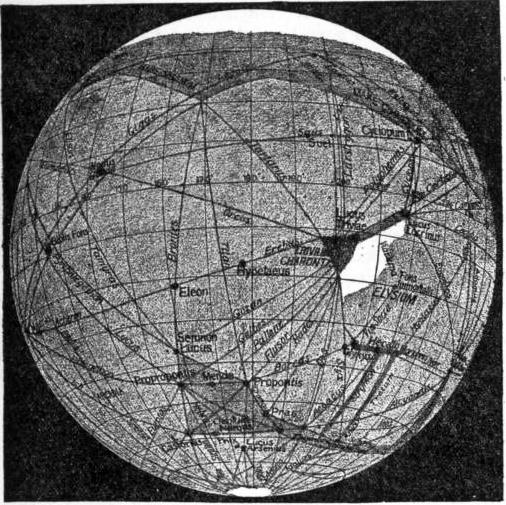
Fig. 3.
Owing to the minuteness of these bodies it is impossible to make any measures of their diameters. These can be inferred only from their brightness. Assuming them to be of the same colour as Mars, Lowell estimates them to be about ten miles for Deimos and somewhat more for Phobos. But these estimates are uncertain, not only from the somewhat hypothetical character of the data on which they rest, but from the difficulty of accurately estimating the brightness of such an object in the glare of the planet.
A long and careful series of observations was made upon these bodies by other observers. Later, especially at the very favourable oppositions of 1892 and 1894, observations were made by Hermann Struve at Poulkova, who subjected all the observations up to 1898 to a very careful discussion. He showed that the inclination of the planes of the orbits to the equator of the planet is quite small, thus making it certain that these two planes can never wander far from each other. In the following statement of the numerical elements of the entire system, Struve’s results are given for the satellites, while those of Lowell are adopted for the position of the plane of the equator.
The relations of the several planes can be best conceived by considering the points at which lines perpendicular to them, or their poles, meet the celestial sphere. By theory, the pole of the orbital plane of each satellite revolves round the pole of a certain fixed plane, differing less from the plane of the equator of Mars the nearer the satellite is to Mars. Lowell from a combination of his own observations with those of Schiaparelli, Lohse and Cerulli, found for the pole of the axis of rotation of Mars12:—
R.A. = 317.5°; Dec. = +54.5°; Epoch, 1905.
Tilt13 of Martian Equator to Martian ecliptic, 23°. 59′. Hermann Struve, from the observations of the satellites, found theoretically the following positions of this pole, and of those of the fixed planes of the satellite orbits for 1900:—
Pole of Mars: R.A. = 317.25° Dec. = 52.63°
Pole of fixed plane for Phobos = 317.24° = 52.64°
Pole of fixed plane for Deimos = 316.20° = 53.37°
Lowell’s position of the pole is that now adopted by the British Nautical Almanac.
The actual positions of the poles of the satellite—orbits revolve around these poles of the two fixed planes in circles. Putting N for the right-ascensions of their nodes on the plane of the terrestrial equator, and J for their angular distance from the north terrestrial pole, N, and J, for the corresponding poles of the fixed planes, and t for the time in years after 1900, Struve’s results are:—
Deimos.
N1 = 46°.12′ + 0.463′ t; J =36°.42′ − 0.24′ t (N − N1) sin J = 97.6′ sin (356.8° − 6.375° t) J − J1 = 97.6 cos (356.8° − 6.375° t)
Phobos.
N1 = 47° 14.3′ + 0.46′ t; J1 = 37° 21.9′ − 0.24′ t (N − N1) sin J = 53.1′ sin (257°.1′ − 158.0° t) J − J1 = 53.1′ cos (257°1′ − 158.0 t)
The other elements are:—
Deimos. Phobos.
Mean long. 1894, Oct. o.o G.M.T 186.25° 296.13°
Mean daily motion (tropical) 285.16198° 1128.84396°
Mean distance (Δ = 1) 32.373″ 12.938″
Long. of pericentre, (π + N) 264° + 6.375°t 14° + 158.0°t
Eccentricity of orbit 0.0031 0.0217
Epoch for t 1900.0 1900.0
Bibliography.—Flammarion, La Planète Mars et ses conditions d’habitilité (Paris, 1892), embodies so copious a résumé of all the publications and drawings relating to Mars up to 1891 that there is little occasion for reference in detail to early publications. Among the principal sources may be mentioned the Monthly Notices and Memoirs of the Royal Astronomical Society, the publications of the Astronomical Society of the Pacific, especially vols. vi., viii. and ix., containing observations and discussions by the Mt Hamilton astronomers, and the journals, Sidereal Messenger, Astronomy and Astrophysics and Astrophysical Journal. Schiaparelli’s extended memoirs appeared under the general title Osservazioni astronomiche e fisiche sull’ asse di rotazione e sulla topografia del pianeta Marte, and were published in different volumes of the Memoirs of the Reale Accademia dei Lincei of Rome. The observations and drawings of Lowell are found in extenso in Annals of the Lowell Observatory. Lowell’s conclusions are summarized in Mars and its Canals, by Percival Lowell (1906), and Mars as the Abode of Life (1909). In connexion with his work may be mentioned Mars and its Mystery, by Edward S. Morse (Boston, 1906), the work of a naturalist who made studies of the planet at the Lowell Observatory in 1905. Brief discussions and notices will also be found in the Lowell Observatory Bulletins. The optical principles involved in the interpretations of the canals are discussed in recent volumes of the Monthly Notices, R.A.S., and in the Astrophysical Journal. In 1907 the veteran A. R. Wallace disputed Lowell’s views vigorously in his Is Mars Habitable? and was briefly answered by Lowell in Nature, who contended that Wallace’s theory was not in accord with celestial mechanics.
(S. N.)
1 Astronomy and Astrophysics, iii. 752, and Astron. Soc. of the Pacific, Publications, vi. 273 and ix. 109.
2 According to Percival Lowell these results were, however, inconclusive because the strong atmospheric lines lie redwards beyond the part of the spectrum then possible to observe. Subsequently, by experimenting with sensitizing dyes, Dr Slipher of the Lowell Observatory succeeded in 1908 in photographing the spectrum far into the red. Comparison spectrograms of Mars and the Moon, taken by him at equal altitudes on such plates, eight in all, show the “a” band, the great band of water-vapour was distinctly stronger in the spectrum of Mars, thus affording what appeared decisive evidence of water vapour in the atmosphere of the planet.
3 Lowell, Mars and its Canals, p. 101.
4 Phil. Trans., vol. 202 A, p. 525.
5 Proc. Amer. Acad. Arts and Sciences, vol. xlii. No. 25.
6 Professor F. W. Very concurs with Lowell (Phil. Mag., 1908).
7 According to Lowell, the climatic conditions are proportionally warm in summer.
8 The great space penetration of the Lowell Observatory is shown in the case of stars. More stars have been mapped there in a given space than at the Lick, and Mr Ritchey of the Yerkes Observatory found stars easily visible there which were only just perceptible at Yerkes.
9 As against this, Lowell’s answer is that the effect is not optical; for the belt surrounds the melting, not the making cap.
10 For limits of this theory and Lowell’s view of its inapplicability to Mars, see Astrophys. Jour., Sept. 1907.
11 Prof. Lowell’s theory is supported by so much evidence of different kinds that his own exposition should be read in extenso in Mars and its canals and Mars as the abode of life. In order, however, that his views may be adequately presented here, he has kindly supplied the following summary in his own words:—
“Owing to inadequate atmospheric advantages generally, much misapprehension exists as to the definiteness with which the surface of Mars is seen under good conditions. In steady air the canals are perfectly distinct lines, not unlike the Fraunhofer ones of the Spectrum, pencil lines or gossamer filaments according to size. All the observers at Flagstaff concur in this. The photographs of them taken there also confirm it up to the limit of their ability. Careful experiments by the same observers on artificial lines show that if the canals had breaks amounting to 16 m. across, such breaks would be visible. None are; while the lines themselves are thousands of miles long and perfectly straight (Astrophys. Journ., Sept. 1907). Between expert observers representing the planet at the same epoch the accordance is striking; differences in drawings are differences of time and are due to seasonal and secular changes in the planet itself. These seasonal changes have been carefully followed at Flagstaff, and the law governing them detected. They are found to depend upon the melting of the polar caps. After the melting is under way the canals next the cap proceed to darken, and the darkening thence progresses regularly down the latitudes. Twice this happens every Martian year, first from one cap and then six Martian months later from the other. The action reminds one of the quickening of the Nile valley after the melting of the snows in Abyssinia; only with planet-wide rhythm. Some of the canals are paired. The phenomenon is peculiar to certain canals, for only about one-tenth of the whole number, 56 out of 585, ever show double and these do so regularly. Each double has its special width; this width between the pair being 400 m. in some cases, only 75 in others. Careful plotting has disclosed the fact that the doubles cluster round the planet’s equator, rarely pass 40° Lat., and never occur at the poles, though the planet’s axial tilt reveals all its latitudes to us in turn. They are thus features of those latitudes where the surface is greatest compared with the area of the polar cap, which is suggestive. Space precludes mention of many other equally striking peculiarities of the canals’ positioning and development. At the junctions of the canals are small, dark round spots, which also wax and wane with the seasons. These facts and a host of others of like significance have led Lowell to the conclusion that the whole canal system is of artificial origin, first because of each appearance and secondly because of the laws governing its development. Every opposition has added to the assurance that the canals are artificial; both by disclosing their peculiarities better and better and by removing generic doubts as to the planet’s habitability. The warmer temperature disclosed from Lowell’s investigation on the subject, and the spectrographic detection by Slipher of water-vapour in the Martian air, are among the latest of these confirmations.”—[Ed.]
12 Bulletin Lowell Obsy., Monthly Notices, R.A.S. (1905), 66, p. 51.
13 St Petersburg Memoirs, series viii., Phys. Mars-classe, vol. viii.
MARSALA, a seaport of Sicily, in the province of Trapani, 19 m. by rail S. of Trapani. Pop. (1881), 19,732; (1901), 57,567. The low coast on which it is situated is the westernmost point of the island. The town is the seat of a bishop, and the cathedral contains 16 grey marble columns, which are said to have been intended for Canterbury Cathedral in England, the vessel conveying them having been wrecked here. The town owes its importance mainly to the trade in Marsala wine.
Marsala occupies the site of Lilybaeum, the principal stronghold of the Carthaginians in Sicily, founded by Himilco after the abandonment of Motya. Neither Pyrrhus nor the Romans were able to reduce it by siege, but it was surrendered to the latter in 241 B.C. at the end of the First Punic War. In the later wars it was a starting point for the Roman expeditions against Carthage; and under Roman rule it enjoyed considerable prosperity (C.I.L. x. p. 742). It obtained municipal rights from Augustus and became a colony under Pertinax or Septimus Severus. The Saracens gave it its present name, Marsa Ali, port of Ali. The harbour, which lay on the north-east, was destroyed by Charles V. to prevent its occupation by pirates. The modern harbour lies to the south-east. In 1860 Garibaldi landed at Marsala with 1000 men and began his campaign in Sicily. Scanty remains of the ancient Lilybaeum (fragments of the city walls, of squared stones, and some foundations of buildings between the walls and the sea) are visible; and the so-called grotto and spring of the Sibyl may be mentioned. To the east of the town is a great fosse which defended it on the land side, and beyond this again are quarries like those of Syracuse on a small scale. The modern town takes the shape of the Roman camp within the earlier city, one of the gates of which still existed in 1887. The main street (the Cassaro) perpetuates the name castrum.
MARSDEN, WILLIAM (1754-1836), English orientalist, the son of a Dublin merchant, was born at Verval, Co. Wicklow on the 16th of November 1754. He was educated in Dublin, and having obtained an appointment in the civil service of the East India Company arrived at Benkulen, Sumatra, in 1771. There he soon rose to the office of principal secretary to the government, and acquired a knowledge of the Malay language and country. Returning to England in 1779 with a pension, he wrote his History of Sumatra, published in 1783. Marsden was appointed in 1795 second secretary and afterwards first secretary to the admiralty. In 1807 he retired and published in 1812 his Grammar and Dictionary of the Malay Language, and in 1818 his translation of the Travels of Marco Polo. He was a member of many learned societies, and treasurer and vice-president of the Royal Society. In 1834 he presented his collection of oriental coins to the British Museum, and his library of books and Oriental MSS. to King’s College, London. He died on the 6th of October 1836.
Marsden’s other works are: Numismata orientalia (London, 1823-1825); Catalogue of Dictionaries, Vocabularies, Grammars and Alphabets (1796); and several papers on Eastern topics in the Philosophical Transactions and the Archaelogia.
MARSEILLES, a city of southern France, chief seaport of France and of the Mediterranean, 219 m. S. by E. of Lyons and 534 m. S.S.E. of Paris, by the Paris-Lyon-Méditerranée railway. Pop. (1906), commune 517,498; town 421,116. Marseilles is situated on the Golfe du Lion on the eastern shore of a bay protected to the south by Cape Croisette but open towards the west; to the east the horizon is bounded by an amphitheatre of hills, those in the foreground clothed with vegetation while the more distant eminences are bare and rugged. The city is built on undulating ground and the south-western and most aristocratic quarter covers the slopes of the ridge crowned by a fort and the church of Notre-Dame de la Garde and projecting westward into the bay to form a protection for the harbour. The newest and most pleasant portion lies on the south-eastern slope of the ridge, between the southern end of the Rue Paradis and the Prado avenues, which is better protected than most other quarters from the mistral that blows down the Rhone valley, and where in summer the temperature is always a little lower than in the centre of the town. The old harbour of Marseilles opens on the west to the Golfe du Lion, the famous Rue Cannebière1 prolonged by the Rue Noailles leading E.N.E. from its inner end. These two streets are the centre of the life of the city. Continued in the Allées de Meilhan and the Boulevard de la Madeleine, they form one of its main arteries. The other, at right angles with the first, connects the Place d’Aix with the spacious and fashionable Promenade du Prado, by way of the Cours Belsunce and the Rue de Rome. Other fine streets—the Rue St Ferréol, the Rue Paradis and the Rue Breteuil are to the south of the Cannebière running parallel with the Rue de Rome. To these must be added the neighbouring avenue of Pierre Puget named after the sculptor whose statue stands in the Borély Park. The Prado, with its avenues of trees and fine houses, runs to within a quarter of a mile of the Huveaune, a stream that borders the city on the south-east, then turns off at right angles and extends to the sea, coming to an end close to the Borély Park and the race-course. From its extremity the Chemin de la Corniche runs northwards along the coast, fringed by villas and bathing establishments, to the Anse des Catalans, a distance of 4½ miles.
The old town of Marseilles is bounded W. by the Joliette basin and the sea, E. by the Cours Belsunce, S. by the northern quay of the old port, and N. by the Boulevard des Dames. It consists of a labyrinth of steep, dark and narrow streets inhabited by a seafaring population. Through its centre runs the broad Rue de la République, extending from the Cannebière to the Place de la Joliette. The entrance to the old harbour is defended by Fort St Jean on the north and Fort St Nicolas on the south. Behind the latter is the Anse (Creek) de la Réserve. Beyond this again, situated in succession along the shore, come the Château du Pharo, given by the empress Eugénie to the town, the Anse du Pharo, the military exercising ground, and the Anse des Catalans. To the old harbour, which covers only 70 acres with a mean depth of 19½ ft. and is now used by sailing vessels, the basin of La Joliette (55 acres) with an entrance harbour was added in 1853. Communicating with the old harbour by a channel which passes behind Fort St Jean, this dock opens on the south into the outer harbour, opposite the palace and the Anse du Pharo. A series of similar basins separated from the roadstead by a jetty 2½ m. long was subsequently added along the shore to the north, viz. the basins of Lazaret and Arenc, bordered by the harbour railway station and the extensive warehouses of the Compagnie des Docks et Entrepôts, the Bassin de la Gare Maritime with the warehouses of the chamber of commerce; the Bassin National with the refitting basin, comprising six dry docks behind it; and the Bassin de la Pinède entered from the northern outer harbour. These new docks have a water area of 414 acres and over 11 m. of quays, and are commodious and deep enough for the largest vessels to manœuvre easily.
In the roads to the south-west of the port lie the islands of Ratonneau and Pomègue, united by a jetty forming a quarantine port. Between them and the mainland is the islet of Château d’If, in which the scene of part of Dumas’ Monte Cristo is laid.
Marseilles possesses few remains of either the Greek or Roman periods of occupation, and is poor in medieval buildings. The old cathedral of la Major (Sainte-Marie-Majeure), dating chiefly from the 12th century and built on the ruins of a temple of Diana, is in bad preservation. The chapel of St Lazare (late 15th century) in the left aisle is in the earliest Renaissance style, and a bas-relief of white porcelain by Lucca della Robbia is of artistic value. Beside this church and alongside the Joliette basin is a modern building begun in 1852, opened for worship in 1893 and recognized as the finest modern cathedral in France. It is a Byzantine basilica, in the form of a Latin cross, 460 ft. long, built in green Florentine stone blended with white stone from the neighbourhood of Arles. The four towers which surmount it—two at the west front, one over the crossing, one at the east end—are roofed with cupolas. Near the cathedral stands the bishop’s palace, and the Place de la Major, which they overlook, is embellished with the statue of Bishop Belsunce, who displayed great devotion during the plague of 1720-1721. The celebrated Notre-Dame de la Garde, the steeple of which, surmounted by a gilded statue of the Virgin, 30 ft. in height, rises 150 ft. above the summit of the hill on which it stands, commands a view of the whole port and town, as well as of the surrounding mountains and the neighbouring sea. The present chapel is modern and occupies the site of one built in 1214.
On the south side of the old harbour near the Fort St Nicolas stands the church of St Victor, built in the 13th century and once attached to an abbey founded early in the 4th century. With its lofty crenellated walls and square towers built of large blocks of uncemented stone, it resembles a fortress. St Victor is built above crypts dating mainly from the 11th century but also embodying architecture of the Carolingian period and of the early centuries of the Christian era. Tradition relates that St Lazarus inhabited the catacombs under St Victor; and the black image of the Virgin, still preserved there, is popularly attributed to St Luke. The spire, which is the only relic of the ancient church of Accoules, marks the centre of Old Marseilles. At its foot are a “calvary” and a curious underground chapel in rock work, both modern. Notre-Dame du Mont Carmel, also in the old town, occupies the place of what was the citadel of the Massaliots when they were besieged by Julius Caesar.
Of the civil buildings of the city, the prefecture, one of the finest in France, the Palais de Justice, in front of which is the statue of the advocate Antoine Berryer (1790-1868) and the Exchange, all date from the latter half of the 19th century. The Exchange, built at the expense of the Chamber of Commerce, includes the spacious hall of that institution with its fine mural paintings and gilding. The hôtel-de-ville (17th century) stands on the northern quay of the old harbour. All these buildings are surpassed by the Palais Longchamp (1862-1870), situated in the north-east of the town at the end of the Boulevard Longchamp. The centre of the building is occupied by a monumental château d’eau (reservoir). Colonnades branch off from this, uniting it on the left to the picture gallery, with a fine collection of ancient and modern works, and on the right to the natural history museum, remarkable for its conchological department and collection of ammonites. In front are ornamental grounds; behind are extensive zoological gardens, with the astronomical observatory. The museum of antiquities is established in the Château Borély (1766-1778) in a fine park at the end of the Prado. It includes a Phoenician collection (containing the remains that support the hypothesis of the Phoenician origin of Marseilles), an Egyptian collection, numerous Greek, Latin, and Christian inscriptions in stone, &c. A special building within the city contains the school of art with a valuable library and a collection of medals and coins annexed to it. The city also has a colonial museum and a laboratory of marine zoology. The triumphal arch of Aix, originally dedicated to the victors of the Trocadéro, was in 1830 appropriated to the conquests of the empire.
The canal de Marseille, constructed from 1837 to 1848, which has metamorphosed the town and its arid surroundings by bringing to them the waters of the Durance, leaves the river opposite Pertuis. It has a length of 97 miles (including its four main branches) of which 13 are underground, and irrigates some 7500 acres. After crossing the valley of the Arc, between Aix and Rognac, by the magnificent aqueduct of Roquefavour, it purifies its waters, charged with ooze, in the basins of Réaltort. It draws about 2200 gallons of water per second from the Durance, supplies 2450 horse-power to works in the vicinity of Marseilles, and ensures a good water-supply and efficient sanitation to the city.
Marseilles is the headquarters of the XV. army corps and the seat of a bishop and a prefect. It has tribunals of first instance and of commerce, a chamber of commerce, a board of trade arbitration, and a branch of the Bank of France. The educational institutions include a faculty of science, a school of medicine and pharmacy, and a faculty (faculté libre) of law, these three forming part of the university of Aix-Marseille; lycées for boys and girls, a conservatoire of music, a school of fine art, a higher school of commerce, a school for ships’ boys, a school of navigation and industrial schools for both sexes.
Trade and Industry.—Marseilles is the western emporium for the Levant trade and the French gate of the Far East. It suffers, however, from the competition of Genoa, which is linked with the Rhine basin by the Simplon and St Gotthard railway routes, and from lack of communication with the inland waterways of France. In January 1902 the chamber of deputies voted £3,656,000 for the construction of a canal from Marseilles to the Rhone at Arles. This scheme was designed to overcome the difficulties of egress from the Rhone and to make the city the natural outlet of the rich Rhone basin. Much of the activity of the port is due to the demand for raw material created by the industries of Marseilles itself. The imports include raw silk, sesame, ground-nuts and other oil-producing fruits and seeds largely used in the soap manufacture, cereals and flour, wool, hides and skins, olive and other oils, raw cotton, sheep and other livestock, woven goods, table fruit, wine, potatoes and dry vegetables, lead, cocoon silk, coffee, coal, timber. The total value of imports was £64,189,000 in 1907, an increase of £18,000,000 in the preceding decade. The exports, of which the total value was £52,901,000 (an increase of £21,000,000 in the decade) included cotton fabrics, silk fabrics, cereals and flour, hides and skins, wool fabrics, worked skins, olive and other oils, chemical products, wine, refined sugar, raw cotton, wool, coal, building-material, machinery and pottery.
The port is the centre for numerous lines of steamers, of which the chief are the Messageries Maritimes, which ply to the eastern Mediterranean, the east coast of Africa, Australia, India, Indo-China, Havre and London, and the Compagnie Générale Transatlantique, whose vessels run to Algiers, Tunis, Malta, Corsica, Morocco and the Antilles. In addition many important foreign lines call at the port, among them being the P. and O., the Orient, the North German Lloyd, and the German East Africa lines.
Marseilles has five chief railway stations, two of which serve the new harbours, while one is alongside the old port; the city is on the main line of the Paris-Lyon-Méditerranée railway from the Riviera and Toulon to Paris via Arles, Avignon and Lyons, another less important line connecting it with Aix.
Soap-making, introduced in antiquity from Savona and Genoa, is carried on in upwards of fifty factories. These utilize the products of the oil-distilleries and of the chemical works, the latter being also an important adjunct to the manufacture of candles, another leading industry. A large quantity of iron, copper and other ores is smelted in the blast-furnaces of Saint Louis in the vicinity and in other foundries, and the Mediterranean Engineering Company and other companies have large workshops for the construction or repair of marine steam-engines and every branch of iron shipbuilding. To these industries must be added flour-milling, the manufacture of semolina and other farinaceous foods and of biscuits, bricks and tiles, rope, casks, capsules for bottles and other tin-goods, tanning, distilling, brewing and sulphur- and sugar-refining. There are state tobacco and match factories.
History.—The Greek colony of Massalia (Lat. Massilia) was founded by the mariners of Phocaea in Asia Minor, about 600 B.C. The settlement of the Greeks in waters which the Carthaginians reserved for their own commerce was not effected without a naval conflict; it is not improbable that the Phoenicians were settled at Marseilles before the Greek period, and that the name of the town is the Phoenician for “settlement.” Whether the judges (sophetim, “suffetes”) of the Phoenician sacrificial tablet of Marseilles were the rulers of a city existing before the advent of the Phocaeans, or were consuls for Punic residents in the Greek period, is disputed. In 542 B.C. the fall of the Phocaean cities before the Persians probably sent new settlers to the Ligurian coast and cut off the remote city of Massalia from close connexion with the mother country. Isolated amid alien populations, the Massaliots made their way by prudence in dealing with the inland tribes, by vigilant administration of their oligarchical government, and by frugality united to remarkable commercial and naval enterprise. Their colonies spread east and west along the coast from Monaco to Cape St Martin in Spain, carrying with them the worship of Artemis; the inland trade, in which wine was an important element, can be traced by finds of Massalian coins across Gaul and through the Alps as far as Tirol. In the 4th century B.C. the Massaliot Pytheas visited the coasts of Gaul, Britain and Germany, and Euthymenes is said to have sailed down the west coast of Africa as far as Senegal. The great rival of Massalian trade was Carthage, and in the Punic Wars the city took the side of Rome, and was rewarded by Roman assistance in the subjugation of the native tribes of Liguria. In the war between Caesar and Pompey Massilia took Pompey’s side and in A.D. 49 offered a vain resistance to Caesar’s lieutenant Trebonius. In memory of its ancient services the city, “without which,” as Cicero says, “Rome had never triumphed over the Transalpine nations,” was left as a civitas libera, but her power was broken and most of her dependencies taken from her. From this time Massilia has little place in Roman history; it became for a time an important school of letters and medicine, but its commercial and intellectual importance declined. The town appears to have been christianized before the end of the 3rd century, and at the beginning of the 4th century was the scene of the martyrdom of St Victor. Its reputation partly revived through the names of Gennadius and Cassian, which give it prominence in the history of Semi-Pelagianism and the foundation of western monachism.
After the ravages of successive invaders, Marseilles was repeopled in the 10th century under the protection of its viscounts. The town gradually bought up their rights, and at the beginning of the 13th century was formed into a republic, governed by a podestat, who was appointed for life, and exercised his office in conjunction with 3 notables, and a municipal council, composed of 80 citizens, 3 clerics, and 6 principal tradesmen. During the rest of the middle ages, however, the higher town was governed by the bishop, and had its harbour at the creek of La Joliette which at that period ran inland to the north of the old town. The southern suburb was governed by the abbot of St Victor, and owned the Port des Catalans. Situated between the two, the lower town, the republic, retained the old harbour, and was the most powerful of the three divisions. The period of the crusades brought prosperity to Marseilles, though throughout the middle ages it suffered from the competition of Pisa, Genoa and Venice. In 1245 and 1256 Charles of Anjou, count of Provence, whose predecessors had left the citizens a large measure of independence, established his authority above that of the republic. In 1423 Alphonso V. of Aragon sacked the town. King René, who had made it his winter residence, however, caused trade, arts and manufactures again to flourish. On the embodiment of Provence in the kingdom of France in 1481, Marseilles preserved a separate administration directed by royal officials. Under Francis I. the disaffected constable Charles de Bourbon vainly besieged the town with the imperial forces in 1524. During the wars of religion, Marseilles took part against the Protestants, and long refused to acknowledge Henry IV. The loss of the ancient liberties of the town brought new disturbances under the Fronde, which Louis XIV. came in person to suppress. He entered the town by a breach in the walls and afterwards had Fort St Nicolas constructed. Marseilles repeatedly suffered from the plague, notably from May 1720 to May 1721.
During the Revolution the people rose against the aristocracy, who up to that time had governed the commune. In the Terror they rebelled against the Convention, but were promptly subdued by General Carteaux. The wars of the empire, by dealing a blow to their maritime commerce, excited the hatred of the inhabitants against Napoleon, and they hailed the return of the Bourbons and the defeat of Waterloo. The news of the latter provoked a bloody reaction in the town against those suspected of imperialism. The prosperity of the city received a considerable impulse from the conquest of Algeria and from the opening of the Suez Canal.
See P. Castanier, Histoire de la Provence dans l’antiquité, vol. ii. (Paris, 1896); E. Caman, Marseille au XXme siècle (Paris, 1905); P. Joanne, Marseille et ses environs.
1 From the Latin cannabis, Provençal cannèbe, “hemp,” in allusion to the rope-walks formerly occupying its site.
MARSH, ADAM (Adam de Marisco) (d. c. 1258), English Franciscan, scholar and theologian, was born about 1200 in the diocese of Bath, and educated at Oxford under the famous Grosseteste. Before 1226 Adam received the benefice of Wearmouth from his uncle, Richard Marsh, bishop of Durham; but between that year and 1230 he entered the Franciscan order. About 1238 he became the lecturer of the Franciscan house at Oxford, and within a few years was regarded by the English province of that order as an intellectual and spiritual leader. Roger Bacon, his pupil, speaks highly of his attainments in theology and mathematics. His fame, however, rests upon the influence which he exercised over the statesmen of his day. Consulted as a friend by Grosseteste, as a spiritual director by Simon de Montfort, the countess of Leicester and the queen, as an expert lawyer and theologian by the primate, Boniface of Savoy, he did much to guide the policy both of the opposition and of the court party in all matters affecting the interests of the Church. He shrank from office, and never became provincial minister of the English Franciscans, though constantly charged with responsible commissions. Henry III. and Archbishop Boniface unsuccessfully endeavoured to secure for him the see of Ely in 1256. In 1257 Adam’s health was failing, and he appears to have died in the following year. To judge from his correspondence he took no interest in secular politics. He sympathized with Montfort as with a friend of the Church and an unjustly treated man; but on the eve of the baronial revolution he was on friendly terms with the king. Faithful to the traditions of his order, he made it his ambition to be a mediator. He rebuked both parties in the state for their shortcomings, but he did not break with either.
See his correspondence, with J. S. Brewer’s introduction, in Monumenta franciscana, vol. i. (Rolls ser., 1858); the biographical notice in A. G. Little’s Grey Friars in Oxford (Oxford, 1892), where all the references are collected. On Marsh’s relations with Grosseteste, see Roberti Grosseteste epistolae, ed. H. R. Luard (Rolls ed., 1861), and F. S. Stevenson, Robert Grosseteste (London, 1809).
(H. W. C. D.)
MARSH, GEORGE PERKINS (1801-1882), American diplomatist and philologist, was born at Woodstock, Vermont, on the 15th of March 1801. He graduated at Dartmouth College in 1820, was admitted to the bar in 1825, and practised law at Burlington, Vermont, devoting himself also with ardour to philological studies. In 1835 he was a member of the Supreme Executive Council of Vermont, and from 1843 to 1849 a Whig representative in Congress. In 1849 he was appointed United States minister resident in Turkey, and in 1852-1853 discharged a mission to Greece in connexion with the imprisonment by the authorities of that country of an American missionary, Dr Jonas King (1792-1869). He returned to Vermont in 1854, and in 1857 was a member of the state railway commission. In 1861 he became the first United States minister to the kingdom of Italy, and died in that office at Vallombrosa on the 23rd of July 1882. He was buried in a Protestant cemetery in Rome. Marsh was an able linguist, writing and speaking with ease the Scandinavian and half a dozen other European languages, a remarkable philologist for his day, and a scholar of great breadth, knowing much of military science, engraving and physics, as well as of Icelandic, which was his specialty. He wrote many articles for Johnson’s Universal Cyclopaedia, and contributed many reviews and letters to the Nation. His chief published works are: A Compendious Grammar of the Old Northern or Icelandic Language (1838), compiled and translated from the grammars of Rask; The Camel, his Organization, Habits, and Uses, with Reference to his Introduction into the United States (1856); Lectures on the English Language (1860); The Origin and History of the English Language (1862; revised ed., 1885); and Man and Nature (1865). The last-named work was translated into Italian in 1872, and, largely rewritten, was issued in 1874 under the title The Earth as Modified by Human Action; a revised edition was published in 1885. He also published a work on Mediaeval and Modern Saints and Miracles (1876). His valuable library was presented in 1883 by Frederick Billings to the university of Vermont. His second wife, Caroline (Crane) Marsh (1816-1901), whom he married in 1839, published Wolfe of the Knoll and other Poems (1860), and the Life and Letters of George Perkins Marsh (New York, 1888). This last work was left incomplete, the second volume never having been published. She also translated from the German of Johann C. Biernatzki (1795-1840), The Hallig; or the Sheepfold in the Waters (1856).
MARSH, HERBERT (1757-1839), English divine, was born at Faversham, Kent, on the 10th of December 1757, and was educated at St John’s College, Cambridge, where he was elected fellow in 1782, having been second wrangler and second Smith’s prizeman. For some years he studied at Leipzig, and between 1793 and 1801 published in four volumes a translation of J. D. Michaelis’s Introduction to the New Testament, with notes of his own, in which he may be said to have introduced German methods of research into English biblical scholarship. His History of the Politics of Great Britain and France (1799) brought him much notice and a pension from William Pitt. In 1807 he was appointed Lady Margaret professor of divinity at Cambridge, and lectured to large audiences on biblical criticism, substituting English for the traditional Latin. Both here, and afterwards as bishop of Llandaff (1816) and of Peterborough (1819), he stoutly opposed hymn-singing, Calvinism, Roman Catholicism, and the Evangelical movement as represented by Charles Simeon and the Bible Society. Among his writings are Lectures on the Criticism and Interpretation of the Bible (1828), A Comparative View of the Churches of England and Rome (1814), and Horae Pelasgicae (1815). He died at Peterborough on the 1st of May 1839.
MARSH, NARCISSUS (1638-1713), archbishop of Dublin and Armagh, was born at Hannington, Wiltshire, and educated at Oxford. He became a fellow of Exeter College, Oxford, in 1658. In 1662 he was ordained, and presented to the living of Swindon, which he resigned in the following year. After acting as chaplain to Seth Ward, bishop of Exeter and Salisbury, and Lord Chancellor Clarendon, he was elected principal of St Alban Hall, Oxford, in 1673. In 1679 he was appointed provost of Trinity College, Dublin, where he did much to encourage the study of the Irish language. He helped to found the Royal Dublin Society, and contributed to it a paper entitled “Introductory Essay to the Doctrine of Sounds” (printed in Philosophical Transactions, No. 156, Oxford, 1684). In 1683 he was consecrated bishop of Ferns and Leighlin, but after the accession of James II. he was compelled by the turbulent soldiery to flee to England (1689), where he became vicar of Gresford, Flint, and canon of St Asaph. Returning to Ireland in 1691 after the battle of the Boyne, he was made archbishop of Cashel, and three years later he became archbishop of Dublin. About this time he founded the Marsh Library in Dublin. He became archbishop of Armagh in 1703. Between 1699 and 1711 he was six times a lord justice of Ireland. He died on the 2nd of November 1713.
MARSH, OTHNIEL CHARLES (1831-1899), American palaeontologist, was born in Lockport, New York, on the 29th of October 1831. He graduated at Yale College in 1860, and studied geology and mineralogy in the Sheffield scientific school, New Haven, and afterwards palaeontology and anatomy in Berlin, Heidelberg and Breslau. Returning to America in 1866 he was appointed professor of vertebrate palaeontology at Yale College, and there began the researches of the fossil vertebrata of the western states, whereby he established his reputation. He was aided by a private fortune from his uncle, George Peabody, whom he induced to establish the Peabody Museum of Natural History (especially devoted to zoology, geology and mineralogy) in the college. In May 1871 he discovered the first pterodactyl remains found in America, and in subsequent years he brought to light from Wyoming and other regions many new genera and families, and some entirely new orders of extinct vertebrata, which he described in monographs or periodical articles. These included remains of the Cretaceous toothed birds Hesperornis and Ichthyornis, the Cretaceous flying-reptiles (Pteranodon), the swimming reptiles or Mosasauria, and the Cretaceous and Jurassic land reptiles (Dinosauria) among which were the Brontosaurus and Atlantosaurus. The remarkable mammals which he termed Brontotheria (now grouped as Titanotheriidae), and the huge Dinocerata, one being the Uintatherium, were also brought to light by him. Among his later discoveries were remains of early ancestors of horses in America. On becoming vice-president of the American Association for the Advancement of Science in 1875 he gave an address on the “Introduction and Succession of Vertebrate Life in America,” summarizing his conclusions to that date. He repeatedly organized and often accompanied scientific exploring expeditions in the Rocky Mountains, and their results tended in an important degree to support the doctrines of natural selection and evolution. He published many papers on these, and found time—besides that necessarily given to the accumulation and care of the most extensive collection of fossils in the world—to write Odontornithes: A Monograph on the Extinct Toothed Birds of North America (1880); Dinocerata: A Monograph on an Extinct Order of Gigantic Mammals (1884); and The Dinosaurs of North America (1896). His work is full of accurately recorded facts of permanent value. He was long in charge of the division of vertebrate palaeontology in the United States Geological Survey, and received many scientific honours, medals and degrees, American and foreign. He died in New Haven on the 18th of March 1899.
See obituary by Dr Henry Woodward (with portrait) in Geol. Mag. (1899), p. 237.
MARSH (O. F. mersc, for merisc, a place full of “meres” or pools; cf. Ger. Meer, sea, Lat. mare), an area of low-lying watery land. The significance of a marsh area is not so much in the manner of its formation as in the peculiar chemical and physical results that accompany it, and its relation to the ecology of plant and animal life. Chemically it is productive of such gases as arise from decomposing vegetation and are transitory in their effects, and in the production of hydrated iron oxide, which may be seen floating as an iridescent scum at the edge of rusty, marshy pools. This sinks into the soil and forms a powerful iron cement to many sandstones, binding them into a hard local mass, while the surrounding sandstones are loose and friable. A curious morphological inversion follows in a later geological period, the marsh area forming the hard cap of a hill (see Mesa) while the surrounding sandstones are weathered away. Salt marshes are a feature of many low-lying sea-coasts and areas of inland drainage.
MARSHAL (med. Lat. marescalcus, from O.H.Ger. marah, horse, and scalc, servant), a title given in various countries to certain military and civil officers, usually of high rank. The origin and development of the meaning of the designation is closely analogous with that of constable (q.v.). Just as the title of constable, in all its medieval and modern uses, is traceable to the style and functions of the Byzantine count of the stable, so that of marshal was evolved from the title of the marescalci, or masters of the horse, of the early Frankish kings. In this original sense the word survived down to the close of the Holy Roman empire in the titular office of Erz-Marschalk (arch-marshal), borne by the electors of Saxony. Elsewhere the meaning of office and title was modified. The importance of cavalry in medieval warfare led to the marshalship being associated with military command; this again led to the duty of keeping order in court and camp, of deciding questions of chivalry, and to the assumption of judicial and executive functions. The marshal, as a military leader, was originally a subordinate officer, the chief command under the king being held by the constable; but in the 12th century, though still nominally second to the constable, the marshal has come to the forefront as commander of the royal forces and a great officer of state. In England after the Conquest the marshalship was hereditary in the family which derived its surname from the office, and the hereditary title of earl-marshal originated in the marriage of William Marshal with the heiress of the earldom of Pembroke (see Earl Marshal). Similarly, in Scotland, the office of marischal (from the French maréchal), probably introduced under David I., became in the 14th century hereditary in the house of Keith. In 1485 the Scottish marischal became an earl under the designation of earl-marischal, the dignity coming to an end by the attainder of George, 10th earl-marischal, in 1716. In France, on the other hand, though under Philip Augustus the marshal of France (marescalcus Franciae) appears as commander-in-chief of the forces, care was taken not to allow the office to become descendible; under Francis I. the number of marshals of France was raised to two, under Henry III. to four, and under Louis XIV. to twenty. Revived by Napoleon, the title fell into abeyance with the downfall of the Second empire.
In England the use of the word marshal in the sense of commander of an army appears very early; so Matthew Paris records that in 1214 King John constituted William, earl of Salisbury, marescalcus of his forces. The modern military title of field marshal, imported from Germany by King George II. in 1736, is derived from the high dignity of the marescalcus in a roundabout way. The marescalcus campi, or maréchal des champs, was originally one of a number of officials to whom the name, with certain of the functions, of the marshal was given. The marshal, being responsible for order in court and camp, had to employ subordinates, who developed into officials often but nominally dependent upon him. On military expeditions it was usual for two such marshals to precede the army, select the site of the camp and assign to the lords and knights their places in it. In time of peace they preceded the king on a journey and arranged for his lodging and maintenance. In France maréchal des logis is the title of superior non-commissioned officers in the cavalry.
Similarly at the king’s court the marescalcus aulae or intrinsecus was responsible for order, the admission or exclusion of those seeking access, ceremonial arrangements, &c. Such “marshals” were maintained, not only by the king, but by great lords and ecclesiastics. The more dignified of their functions, together with the title, survive in the various German courts, where the court marshal (Hofmarschall) is equivalent to the English lord chamberlain. Just as the marescalcus intrinsecus acted as the vicar of the marshal for duties “within” the court, so the marescalcus forinsecus was deputed to perform those acts of serjeanty due from the marshal to the Crown “without.” Similarly there appears in the statute 5 Edw. III. cap. 8, a marescalcus banci regii (maréchal du Banc du Roy), or marshal of the king’s bench, who presided over the Marshalsea Court, and was responsible for the safe custody of prisoners, who were bestowed in the mareschalcia, or Marshalsea prison. The office of marshal of the queen’s bench survived till 1849 (see Lord Steward; and Marshalsea). The official known as a judge’s marshal, whose office is of considerable antiquity, and whose duties consisted of making abstracts of indictments and pleadings for the use of the judge, still survives, but no longer exercises the above functions. He accompanies a judge of assize on circuit and is appointed by him at the beginning of each circuit. His travelling and other expenses are paid by the judge, and he receives an allowance of two guineas a day, which is paid through the Treasury. He introduces the high sheriff of the county to the judge of assize on his arrival, and swears in the grand jury. For the French maréchaussée see France: § Law and Institutions.
In the sense of executive legal officer the title marshal survives in the United States of America in two senses. The United States marshal is the executive officer of the Federal courts, one being appointed for each district, or exceptionally, one for two districts. His duties are to open and close the sessions of the district and circuit courts, serve warrants, and execute throughout the district the orders of the court. There are United States marshals also in Alaska, Hawaii, Porto Rico and the Philippines. They are appointed by the President, with the advice and consent of the Senate, for a term of four years, and, besides their duties in connexion with the courts, are employed in the service of the internal revenue, public lands, post office, &c. The temporary police sworn in to maintain order in times of disturbance, known in England as special constables, are also termed marshals in the United States. In some of the southern and western states of the Union the title marshal has sunk to that of the village policeman, as distinct from the county officers known as sheriffs and those of the justices’ courts called constables.
In England the title of marshal, as applied to an executive officer, survives only in the army, where the provost marshal is chief of the military police in large garrisons and in field forces. Office and title were borrowed from the French prévot des maréchaux, the modern equivalent of the medieval praepositus marescalcorum or guerrarum.
MARSHALL, ALFRED (1842- ), English economist, was born in London on the 26th of July 1842. He was educated at the Merchant Taylors’ School and St John’s College, Cambridge, being second wrangler in 1865, and in the same year becoming fellow of his college. He became principal of University College, Bristol, in 1877, and was lecturer and fellow of Balliol College, Oxford in 1883-1884. He was professor of political economy at Cambridge University from 1885 to 1908, and was a member of the Royal Commission on Labour in 1891. He became a fellow of the British Academy in 1902. He wrote (in conjunction with his wife) Economics of Industry (1879), whilst his Principles of Economics (1st ed., 1890) is a standard English treatise.
MARSHALL, JOHN (1755-1835), American jurist, chief-justice of the U.S. Supreme Court, was born on the 24th of September 1755 at Germantown (now Midland), in what four years later became Fauquier county, Virginia. He was of English descent, the son of Thomas Marshall (1732-1806) and his wife Mary Isham Keith. Marshall served first as lieutenant and after July 1778 as captain in the Continental Army during the War of Independence. He resigned his commission early in 1781; was admitted to the bar after a brief course of study, first practised in Fauquier county; and after two years began to practise in Richmond. In 1786 we find him counsel in a case of great importance, Hite v. Fairfax, involving the original title of Lord Fairfax to that large tract of country between the headwaters of the Potomac and Rappahannock, known as the northern neck of Virginia. Marshall represented tenants of Lord Fairfax and won his case. From this time, as is shown by an examination of Call’s Virginia Reports which cover the period, he maintained the leadership of the bar of Virginia. He was a member of the Virginia Assembly in 1782-1791 and again in 1795-1797; and in 1788, he took a leading part in the Virginia Convention called to act on the proposed constitution for the United States, with Madison ably urging the ratification of that instrument. In 1795 Washington offered him the attorney-generalship, and in 1796, after the retirement of James Monroe, the position of minister to France. Marshall declined both offers because his situation at the bar appeared to him “to be more independent and not less honourable than any other,” and his “preference for it was decided.” He spent the autumn and winter of 1797-1798 in France as one of the three commissioners appointed by President John Adams to adjust the differences between the young republic and the directory. The commission failed, but the course pursued by Marshall was approved in America, and with the resentment felt because of the way in which the commission had been treated in France, made him, on his return, exceedingly popular. To this popularity, as well as to the earnest advocacy of Patrick Henry, he owed his election as a Federalist to the National House of Representatives in the spring of 1799, though the feeling in Richmond was overwhelmingly in favour of the opposition or Republican party. His most notable service in Congress was his speech on the case of Thomas Nash, alias Jonathan Robbins, in which he showed that there is nothing in the constitution of the United States which prevents the Federal government from carrying out an extradition treaty. He was secretary of state under President Adams from the 6th of June 1800 to the 4th of March 1801. In the meantime he had been appointed chief-justice of the Supreme Court, his commission bearing date the 31st of January. Thus while still secretary he presided as chief-justice.
At the time of Marshall’s appointment it was generally considered that the Supreme Court was the one department of the new government which had failed in its purpose. John Jay, the first chief-justice, who had resigned in 1795, had just declined a reappointment to the chief-justiceship on the ground that he had left the bench perfectly convinced that the court would never acquire proper weight and dignity, its organization being fatally defective. The advent of the new chief-justice was marked by a change in the conduct of business in the court. Since its organization, following the prevailing English custom, the judges had pronounced their opinions seriatim. But beginning with the December term 1801, the chief-justice became practically the sole mouthpiece of the court. For eleven years the opinions are almost exclusively his, and there are few recorded dissents. The change was admirably adapted to strengthen the power and dignity of the court. The chief-justice embodied the majesty of the judicial department of the government almost as fully as the president stood for the power of the executive. That this change was acquiesced in by his associates without diminishing their goodwill towards their new chief is testimony to the persuasive force of Marshall’s personality; for his associates were not men of mediocre ability. After the advent of Mr Justice Joseph Story the practice was abandoned. Marshall, however, still delivered the opinion in the great majority of cases, and in practically all cases of any importance involving the interpretation of the Constitution. During the course of his judicial life his associates were as a rule men of learning and ability. During most of the time the majority were the appointees of Democratic presidents, and before their elevation to the bench supposed to be out of sympathy with the federalistic ideas of the chief-justice. Yet in matters pertaining to constitutional construction, they seem to have had hardly any other function than to add the weight of their silent concurrence to the decision of their great chief. Thus the task of expounding the constitution during the most critical period of its history was his, and it was given to him to preside over the Supreme Court when it was called upon to decide four cases of vital importance: Marbury v. Madison, M‘Culloch v. Maryland, Cohens v. Virginia and Gibbons v. Ogden. In each of these cases it is Marshall who writes the opinion of the court; in each the continued existence of the peculiar Federal system established by the Constitution depended on the action of the court, and in each the court adopted a principle which is now generally perceived to be essential to the preservation of the United States as a federal state.
In Marbury v. Madison, which was decided two years after his elevation to the bench, he decided that it was the duty of the court to disregard any act of Congress, and, therefore, a fortiori any act of a legislature of one of the states, which the court thought contrary to the Federal Constitution.
In Cohens v. Virginia, in spite of the contention of Jefferson and the then prevalent school of political thought that it was contrary to the Constitution for a person to bring one of the states of the United States, though only as an appellee, into a court of justice, he held that Congress could lawfully pass an act which permitted a person who was convicted in a state court, to appeal to the Supreme Court of the United States, if he alleged that the state act under which he was convicted conflicted with the Federal Constitution or with an act of Congress.
In M‘Culloch v. Maryland, though admitting that the Federal government is one of delegated powers and cannot exercise any power not expressly given in the Constitution, he laid down the rule that Congress in the exercise of a delegated power has a wide latitude in the choice of means, not being confined in its choice of means to those which must be used if the power is to be exercised at all.
Lastly, in Gibbons v. Ogden, he held that when the power to regulate interstate and foreign commerce was conferred by the Constitution on the Federal government, the word “commerce” included not only the exchange of commodities, but the means by which interstate and foreign intercourse was carried on, and therefore that Congress had the power to license vessels to carry goods and passengers between the states, and an act of one of the states making a regulation which interfered with such regulation of Congress was, pro tanto, of no effect. It will be seen that in the first two cases he established the Supreme Court as the final interpreter of the Constitution.
The decision in M‘Culloch v. Maryland, by leaving Congress unhampered in the choice of means to execute its delegated powers, made it possible for the Federal government to accomplish the ends of its existence. “Let the end be legitimate,” said Marshall in the course of its opinion, “let it be within the scope of the Constitution, and all means which are appropriate, which are plainly adapted to that end, which are not prohibited, but consist with the letter and spirit of the Constitution, are constitutional.”
If the decision in M‘Culloch v. Maryland gave vigour to all Federal power, the decision in Gibbons v. Ogden, by giving the Federal government control over the means by which interstate and foreign commerce is carried on, preserved the material prosperity of the country. The decision recognizes what the framers of the Constitution recognized, namely that the United States is an economic union, and that business which is national should be under national, not state, control.
Though for the reasons stated, the four cases mentioned are the most important of his decisions, the value of his work as an expounder of the Constitution of the United States is not to be measured by these cases alone. In all he decided forty-four cases involving constitutional questions. Nearly every important part of the Constitution of the United States as it existed before the amendments which were adopted after the Civil War, is treated in one or more of them. The Constitution in its most important aspects is the Constitution as he interpreted it. He did not work out completely the position of the states in the Federal system, but he did grasp and establish the position of the Federal legislature and the Federal judiciary. To appreciate his work, however, it is necessary to see that it was the work not of a statesman but of a judge. Had Marshall been merely a far-seeing statesman, while most of his important cases would have been decided as he decided them, his life-work would have been a failure. It was not only necessary that he should decide great constitutional questions properly, but also that the people of the United States should be convinced of the correctness of his interpretation of the Constitution. His opinions, therefore, had to carry to those who studied them a conviction that the constitution as written had been interpreted according to its evident meaning. They fulfilled this prime requisite. Their chief characteristic is the cumulative force of the argument. The ground for the premiss is carefully prepared, the premiss itself is clearly stated; nearly every possible objection is examined and answered; and then comes the conclusion. There is little or no repetition, but there is a wealth of illustration, a completeness of analysis, that convinces the reader, not only that the subject has been adequately treated, but that it has been exhausted. His style, reflecting his character, suits perfectly the subject matter. Simple in the best sense of the word, his intellectual processes were so clear that he never doubted the correctness of the conclusion to which they led him. Apparently from his own point of view, he merely indicated the question at issue, and the inexorable rules of logic did the rest. Thus his opinions are simple, clear, dignified. Intensely interesting, the interest is in the argument, not in its expression. He had, in a wonderful degree, the power of phrase. He expressed important principles of law in language which tersely yet clearly conveyed his exact meaning. Not only is the Constitution interpreted largely as he taught the people of the United States to interpret it, but when they wish to express important constitutional principles which he enunciated they use his exact words. Again, his opinions show that he adhered closely to the words of the Constitution; indeed no one who has attempted to expound that instrument has confined himself more strictly to an examination of the text. In the proper, though not in the historical, sense he was the strictest of strict constructionalists, and as a result his opinions are practically devoid of theories of government, sovereignty and the rights of man.
A single illustration of his avoidance of all theory and his adherence to the words of the Constitution will suffice. In the case of the United States v. Fisher the constitutional question involved was the power of Congress to give to the United States a preference over all other creditors in the distribution of the assets of a bankrupt. Such an act can be upheld on the ground that all governments have necessarily the right to give themselves priority. Not so Marshall. To him the act must be supported, if supported at all, not on any theory of the innate nature of the government, national or otherwise, but as a reasonable means of carrying out one of the express powers conferred by the Constitution on the Federal government. Thus, he upholds the act in question because of the power expressly conferred on the Federal government to pay the debts of the union, and as a necessary consequence of this power the right to make remittances by bills or otherwise and to take precautions which will render the transactions safe.
It is important to emphasize the fact that Marshall adhered in his opinions to the Constitution as written, not only because it is a fact which must be recognized if we are to understand the correct value of his work in the field of constitutional law, but also because there exists to-day a popular impression that by implication he stretched to the utmost the powers of the Federal government. This impression is due primarily to the ignorance of many of those who have undertaken to praise him. During his life he was charged by followers of the States Rights School of political thought with upholding Federal power in cases not warranted by the constitution. Later, however, those who admired a strong national government, without taking the trouble to ascertain whether the old criticism by members of the States Rights Party was just, regarded the assumption on which it was founded as Marshall’s best claim to his country’s gratitude.
As a constitutional lawyer, Marshall stands without a rival. His work on international law and admiralty is of first rank. But though a good, he was not a great, common law or equity lawyer. In these fields he did not make new law nor clarify what was obscure, and his constitutional opinions which to-day are found least satisfactory are those in which the question to be solved necessarily involves the discussion of some common-law conception, especially those cases in which he was required to construe the restriction imposed by the Constitution on any state impairing the obligation of contracts. His decision in the celebrated case of Dartmouth College v. Woodward, in which he held that a state could not repeal a charter of a private corporation, because a charter is a contract which a subsequent act of the state repealing the charter impairs, though of great economic importance, does not touch any fundamental question of constitutional law. The argument which he advances lacks the clearness and finality for which most of his opinions are celebrated. It is not certain with whom he thought the contract was made: with the corporation created by the charter, with the trustees of the corporation, or with those who had contributed money to its objects.
Of the wonderful persuasive force of Marshall’s personality there is abundant evidence. His influence over his associates, already referred to, is but one example though a most impressive one. From the moment he delivered the opinion in Marbury v. Madison the legal profession knew that he was a great judge. Each year added to his reputation and made for a better appreciation of his intellectual and moral qualities. The bar of the Supreme Court during his chief-justiceship was the most brilliant which the United States has ever known. Leaders, not only of legal, but political thought were among its members; one, Webster, was a man of genius and commanding position. To a very great degree Marshall impressed on the members of this bar and on the profession generally his own ideas of the correct interpretation of the Constitution and his own love for the union. He did this, not merely by his arguments but by the influence which was his by right of his strong, sweet nature. Statesmen and politicians, great and small, were at this time, almost without exception, members of the bar. To influence the political thought of the bar was to a great extent to influence the political thought of the people.