VOLUME XVII SLICE VII Mars to Matteawan (continued 3)
Reading edition
(R. L.*)
1 The presence or absence of the corpus callosum has been much disputed; the latest researches, however, indicate its absence.

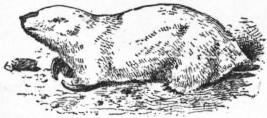
Marsupial Mole (Notoryctes typhlops).
MARSUPIAL MOLE (Noloryctes typhlops), the “Ur-quamata” of the natives, an aberrant polyprotodont from central South Australia, constituting a family (Noloryctidae). This is a small burrowing animal, of a pale golden-yellow colour, with long silky hair, a horny shield on the nose, and a stumpy leathery tail. The feet are five-toed, and the third and fourth toes of the front pair armed with enormous claws adapted for digging. Neither ear-conches nor eyes are visible externally. There are but three pairs of incisor teeth in each jaw, and the upper molars are tricuspid. This animal spends most of its time burrowing in the sand in search of insects and their larvae, but occasionally makes its appearance on the surface.
MARSUS, DOMITIUS, Latin poet, the friend of Virgil and Tibullus, and contemporary of Horace. He survived Tibullus (d. 19 B.C.), but was no longer alive when Ovid wrote (c. A.D. 12) the epistle from Pontus (Ex Ponto, iv. 16) containing a list of poets. He was the author of a collection of epigrams called Cicuta (“hemlock”)1 from their bitter sarcasm, and of a beautiful epitaph on the death of Tibullus; of elegiac poems, probably of an erotic character; of an epic poem Amazonis; and of a prose work on wit (De urbanitate). Martial often alludes to Marsus as one of his predecessors, but he is never mentioned by Horace, although a passage in the Odes (iv. 4, 19) is supposed to be an indirect allusion to the Amazonis (M. Haupt, Opuscula, iii. 332).
See J. A. Weichert, Poetarum latinorum vitae et reliquiae (1830); R. Unger, De Dom. Marsi cicuta (Friedland, 1861).
1 According to others, a reed-pipe made of the stalks of hemlock; the reading scutica (“whip”) has also been proposed.
MARSYAS, in Greek mythology, a Phrygian god or Silenus, son of Hyagnis. He was originally the god of the small river of the same name near Celaenae, an old Phrygian town. He represents the art of playing the flute as opposed to the lyre—the one the accompaniment of the worship of Cybele, the other that of the worship of Apollo. According to the legend, Athena, who had invented the flute, threw it away in disgust, because it distorted the features. Marsyas found it, and having acquired great skill in playing it, challenged Apollo to a contest with his lyre. Midas, king of Phrygia, who had been appointed judge, declared in favour of Marsyas, and Apollo punished Midas by changing his ears into ass’s ears. In another version, the Muses were judges and awarded the victory to Apollo, who tied Marsyas to a tree and flayed him alive. Marsyas, as well as Midas and Silenus, are associated in legend with Dionysus and belong to the cycle of legends of Cybele. A statue of Marsyas was set up in the Roman forum and colonies as a symbol of liberty. The contest and punishment of Marsyas were favourite subjects in Greek art, both painting and sculpture. In Florence there are several statues of Marsyas hanging on the tree as he is going to be flayed (see Greek Art, fig. 54, Pl. II.); Apollo and the executioner complete the group. In the Lateran museum at Rome there is a statue representing Marsyas in the act of picking up the flute, a copy of a masterpiece by Myron (Hyginus, Fab. 167, 191; Apollodorus i. 4, 2; Ovid, Metam. vi. 382-400, xi. 145-193), for which see Greek Art, fig. 64 (Pl. III.).
MARTABAN, a town in the Thaton district of Lower Burma, on the right bank of the Salween, opposite Moulmein. It is said to have been founded in A.D. 573, by the first king of Pegu, and was once the capital of a powerful Talaing kingdom; but it is now little more than a village. Martaban is frequently mentioned by European voyagers of the 16th century; and it has given the name of “Martavans” to a class of large vessels of glazed pottery, also known in India as “Pegu jars.” It was twice captured by the British, in 1824 and 1852. The Bay of Martaban receives the rivers Irrawaddy and Salween.
MARTELLO TOWER, a kind of tower formerly used in English coast defence. The name is a corruption of Mortella. The Martello tower was introduced in consequence of an incident of the French revolutionary wars. In September 1793 a British squadron of three ships of the line and two frigates was ordered to support the Corsican insurgents. It was determined in the first place to take a tower on Cape Mortella which commanded the only secure anchorage in the Gulf of San Fiorenzo. This tower, according to James, was named “after its inventor”; but the real derivation appears to be the name of a wild myrtle which grew thickly around. The tower, which mounted one 24-pounder and two 18-pounders on its top, was bombarded for a short time by the frigates, was then deserted by its little garrison, and occupied by a landing party. The tower was afterwards retaken by the French from the Corsicans. So far it had done nothing to justify its subsequent reputation. In 1794, however, a fresh attempt was made to support the insurgents. On the 7th of February 1400 troops were landed, and the tower was attacked by land and sea on the 8th. The “Fortitude” and “Juno” kept up a cannonade for 2½ hours and then hauled off, the former being on fire and having sixty-two men killed and wounded. The fire from the batteries on shore produced no impression until a hot shot set fire to the “bass junk with which, to the depth of 5 ft., the immensely thick parapet was lined.” The garrison of thirty-three men then surrendered. The armament was found to consist only of two 18-pounders and one 6-pounder. The strong resistance offered by these three guns seems to have led to the conclusion that towers of this description were specially formidable, and Martello towers were built in large numbers, and at heavy expense, along the shores of England, especially on the southern and eastern coasts, which in certain parts are lined with these towers at short intervals. They are structures of solid masonry, containing vaulted rooms for the garrison, and providing a platform at the top for two or three guns, which fire over a low masonry parapet. Access is provided by a ladder, communicating with a door about 20 ft. above the ground. In some cases a deep ditch is provided around the base. The chief defect of the tower was its weakness against vertical fire; its masonry was further liable to be cut through by breaching batteries. The French tours modèles were somewhat similar to the Martello towers; their chief use was to serve as keeps to unrevetted works. While the Martello tower owes its reputation and its widespread adoption in Great Britain to a single incident of modern warfare, the round masonry structure entered by a door raised high above the base is to be found in many lands, and is one of the earliest types of masonry fortification.
MARTEN, HENRY (1602-1680), English regicide, was the elder son of Sir Henry Marten, and was educated at University College, Oxford. As a public man he first became prominent in 1639 when he refused to contribute to a general loan, and in 1640 he entered parliament as one of the members for Berkshire. In the House of Commons he joined the popular party, spoke in favour of the proposed bill of attainder against Strafford, and in 1642 was a member of the committee of safety. Some of his language about the king was so frank that Charles demanded his arrest and his trial for high treason. When the Great Rebellion broke out Marten did not take the field, although he was appointed governor of Reading, but in parliament he was very active. On one occasion his zeal in the parliamentary cause led him to open a letter from the earl of Northumberland to his countess, an impertinence for which, says Clarendon, he was “cudgelled” by the earl; and in 1643, on account of some remark about extirpating the royal family, he was expelled from parliament and was imprisoned for a few days. In the following year, however, he was made governor of Aylesbury, and about this time took some small part in the war. Allowed to return to parliament in January 1646, Marten again advocated extreme views. He spoke of his desire to prepare the king for heaven; he attacked the Presbyterians, and, supporting the army against the parliament, he signed the agreement of August 1647. He was closely associated with John Lilburne and the Levellers, and was one of those who suspected the sincerity of Cromwell, whose murder he is said personally to have contemplated. However, he acted with Cromwell in bringing Charles I. to trial; he was one of the most prominent of the king’s judges and signed the death warrant. He was then energetic in establishing the republic and in destroying the remaining vestiges of the monarchical system. He was chosen a member of the council of state in 1649, and as compensation for his losses and reward for his services during the war, lands valued at £1000 a year were settled upon him. In parliament he spoke often and with effect, but he took no part in public life during the Protectorate, passing part of this time in prison, where he was placed on account of his debts. Having sat among the restored members of the Long Parliament in 1659, Marten surrendered himself to the authorities as a regicide in June 1660, and with some others he was excepted from the act of indemnity, but with a saving clause. He behaved courageously at his trial, which took place in October 1660, but he was found guilty of taking part in the king’s death. Through the action, or rather the inaction of the House of Lords, he was spared the death penalty, but he remained a captive, and was in prison at Chepstow Castle when he died on the 9th of September 1680. Although a leading Puritan, Marten was a man of loose morals. He wrote and published several pamphlets, and in 1662 there appeared Henry Marten’s Familiar Letters to his Lady of Delight, which contained letters to his mistress, Mary Ward.
Marten’s father, Sir Henry Marten (c. 1562-1641), was born in London and was educated at Winchester school and at New College, Oxford, becoming a fellow of the college in 1582. Having become a barrister, he secured a large practice and soon came to the front in public life. He was sent abroad on some royal business, was made chancellor of the diocese of London, was knighted, and in 1617 became a judge of the admiralty court. Later he was appointed a member of the court of high commission and dean of the arches. He became a member of parliament in 1625, and in 1628 represented the university of Oxford, taking part in the debates on the petition of right.
See J. Forster, Statesmen of the Commonwealth (1840); M. Noble, Lives of the English Regicides (1798); the article by C. H. Firth in Dict. Nat. Biog. (1893); and S. R. Gardiner, History of the Great Civil War and History of the Commonwealth and Protectorate.
MARTEN,1 a name originally belonging to the pine-marten (Mustela martes), but now applied to all members of the same genus of carnivorous mammals (see Carnivora). Martens are limited to the northern hemisphere, ranging throughout the greater part of the northern temperate regions of both Old and New Worlds, and southwards in America to 35° N. lat., while in Asia one species is met with in Java.
The species appear to be similar in their habits. They live in woods and rocky places, and spend most of their time in trees, although descending to the ground in quest of prey. They climb with great facility, and are agile and graceful in their movements. Some are said occasionally to resort to berries and other fruit for food, but as a rule they are carnivorous, feeding chiefly on birds and their eggs, small mammals, as squirrels, hares, rabbits and moles, but chiefly mice of various kinds, and occasionally snakes, lizards and frogs. In proportion to their size they are among the most bloodthirsty of animals, though less so than the weasels. The female makes her nest of moss, dried leaves and grass in the hollow of a tree, but sometimes in a hole among rocks or ruined buildings, and produces several young at a birth, usually from four to six. Though wild and untameable to a great degree if captured when fully grown, if taken young they are docile, and have frequently been made pets, not having the strong unpleasant odour of the smaller Mustelidae. The pine-marten appears to have been partially domesticated by the Greeks and Romans, and used to keep houses clear from rats and mice. In the same way, according to Brian Hodgson, the yellow-bellied weasel (Putorius kathia) “is exceedingly prized by the Nepalese for its service in ridding houses of rats. It is easily tamed; and such is the dread of it common to all murine animals that not one will approach a house where it is domiciled.” It is, however, to the great value attached to the pelts of these animals that their importance to man is chiefly due. Though all yield fur of serviceable quality, the commercial value varies immensely, not only according to the species from which it is obtained, but according to individual variation, depending upon age, sex, season, and other circumstances. The skins from northern regions are more full and of a finer colour and gloss than those from more temperate climates, as are those of animals killed in winter compared to the same individuals in summer. Fashion has, moreover, set fictitious values upon slight shades of colour. Enormous numbers of animals are caught, chiefly in traps, to supply the demand of the fur trade, Siberia and North America being the principal localities from which they are obtained.
With the exception of the pekan (M. pennanti), the martens are much alike in size, general colouring and cranial and dental characters. The following description by Dr Elliott Coues of the American marten (M. americana) will apply almost equally well to most of the others. “It is almost impossible to describe the colour of the marten, except in general terms, without going into the details of the endless diversities occasioned by age, sex, season, or other incidents. The animal is ‘brown,’ of a shade from orange or tawny to quite blackish; the tail and feet are ordinarily the darkest, the head lightest, often quite whitish; the ears usually have a whitish rim, while on the throat there is usually a large tawny-yellowish or orange-brown patch, from the chin to the fore legs; sometimes entire, sometimes broken into a number of smaller, irregular blotches, sometimes wanting, sometimes prolonged on the whole under surface, when the animal is bicolor like a stoat in summer. The general ‘brown’ has a greyish cast, as far as the under fur is concerned, and is overlaid with rich lustrous blackish-brown in places where the long bristly hairs prevail. The claws are whitish; the naked nose pad and whiskers are black. The tail occasionally shows interspersed white hairs, or a white tip.”
The following are the best-known species:—
Mustela foina: the beech-marten, stone-marten or white-breasted marten.—Distinguished from the following by the greater breadth of the skull, and some minute but constant dental characters, by the dull greyish-brown colour of the fur of the upper parts and the pure white of the throat and breast. It inhabits the greater part of the continent of Europe, but is more southern than the next in its distribution, not being found in Sweden or Norway.
M. martes, the pine-marten (see figure).—Fur rich dark brown; under fur reddish-grey, with clear yellow tips; breast spot usually yellow, varying from bright orange to pale cream-colour or yellowish-white. Length of head and body 16 to 18 in., of tail (including the hair) 9 to 12 in. This species is extensively distributed throughout northern Europe and Asia, and was formerly common in most parts of Great Britain and Ireland. It is still found in the northern counties of England and North Wales, but in decreasing numbers. In Scotland it is rare, but in Ireland may be found in almost every county occasionally. Though commonly called “pine-marten,” it does not appear to have any special preference for coniferous trees.
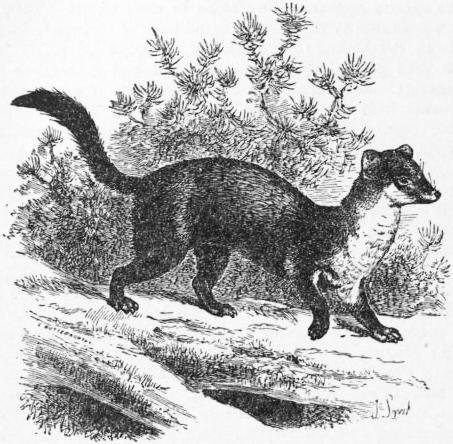
The Pine-Marten (Mustela martes).
Next comes M. zibellina, the sable (German, Zobel and Zebel; Swedish, sabel; Russian, sobel, a word probably of Turanian origin), which closely resembles the last, if indeed it differs except in the quality of the fur—the most highly valued of that of all the group. The sable is found chiefly in eastern Siberia.
Very distinct is the brilliantly coloured orange-and-black Indian marten (M. flavigula), found from the Himalaya and Ceylon to Java.
The North American M. americana is closely allied to the pine-marten and Asiatic sable. The importance of the fur of this animal as an article of commerce may be judged of from the fact that 15,000 skins were sold in one year by the Hudson’s Bay Company as long ago as 1743. It is ordinarily caught in wooden traps of simple construction, being little enclosures of stakes or brush in which the bait is placed upon a trigger, with a short upright stick supporting a log of wood, which falls upon its victim on the slightest disturbance. A line of such traps, several to a mile, often extends many miles. The bait is any kind of meat, a mouse, squirrel, piece of fish or bird’s head. It is principally trapped during the colder months, from October to April, when the fur is in good condition, as it is nearly valueless during the shedding in summer. It maintains its numbers partly in consequence of its shyness, which keeps it away from the abodes of men, and partly because it is so prolific, bringing forth six to eight young at a litter. Its home is sometimes a den under ground or beneath rocks, but oftener the hollow of a tree, and it is said to take possession of a squirrel’s nest, driving off or devouring the rightful proprietor.
The pekan or Pennant’s marten, also called fisher marten, though there appears to be nothing in its habits to justify the appellation, is the largest of the group, the head and body measuring from 24 to 30 in., and the tail 14 to 18 in. It is also more robust in form than the others, its general aspect being more that of a fox than a weasel; in fact its usual name among the American hunters is “black fox.” Its general colour is blackish, lighter by mixture of brown or grey on the head and upper fore part of the body, with no light patch on the throat, and unlike other martens generally darker below than above. It was generally distributed in wooded districts throughout the greater part of North America, as far north as Great Slave Lake, lat. 63° N., and Alaska, and extending south to the parallel of 35°; but at the present time is almost exterminated in the settled parts of the United States east of the Mississippi.
(W. H. F.)
1 By all old authors, as Ray, Pennant, Shaw and Fleming, the word is written “Martin,” but this form of spelling is now generally reserved for the bird (see Martin). The word, as applied to the animal here described, occurs in most Germanic and Romanic languages: German, marder; Dutch, marter; Swedish, mard; Danish, maar; English, marteron, martern, marten, martin and martlett; French, marte and martre; Italian, martora and martorella; Spanish and Portuguese, marta. Its earliest known use is in the form martes (Martial, Ep. x. 37), but it can scarcely be an old Latin word, as it is not found in Pliny or other classical writers, and Martial often introduced foreign words into his Latin. Its etymology has been connected with the German “martern,” to torment. A second Romanic name for the same animal is fuina, in French fouine. The term “Marten Cat” is also used.
MARTENS, FRÉDÉRIC FROMMHOLD DE (1845-1909), Russian jurist, was born at Pernau in Livonia. In 1868 he entered the Russian ministry of foreign affairs, was admitted in 1871 as a Dozent in international law in the university of St Petersburg, and in 1871 became lecturer and then (1872) professor of public law in the Imperial School of Law and the Imperial Alexander Lyceum. In 1874 when Prince Gorchakov, then imperial chancellor, needed assistance for certain kinds of special work, Martens was chosen to afford it. His book on The Right of Private Property in War had appeared in 1869, and had been followed in 1873 by that upon The Office of Consul and Consular Jurisdiction in the East, which had been translated into German and republished at Berlin. These were the first of a long series of studies which won for their author a world-wide reputation, and raised the character of the Russian school of international jurisprudence in all civilized countries. First amongst them must be placed the great Recueil des traités et conventions conclus par la Russie avec les puissances étrangères (13 vols., 1874-1902). This collection, published in Russian and French in parallel columns, contains not only the texts of the treaties but valuable introductions dealing with the diplomatic conditions of which the treaties were the outcome. These introductions are based largely on unpublished documents from the Russian archives. Of Martens’ original works his International Law of Civilized Nations is perhaps the best known; it was written in Russian, a German edition appearing in 1884-1885, and a French edition in 1887-1888. It displays much judgment and acumen, though some of the doctrines which it defends by no means command universal assent. More openly “tendencious” in character are such treatises as Russia and England in Central Asia (1879); Russia’s Conflict with China (1881), The Egyptian Question (1882), and The African Conference of Berlin and the Colonial Policy of Modern States (1887). In the delicate questions raised in some of these works Martens stated his case with learning and ability, even when it was obvious that he was arguing as a special pleader. Martens was repeatedly chosen to act in international arbitrations. Among the controversies which he helped to adjust were that between Mexico and the United States—the first case determined by the permanent tribunal of The Hague—and the difference between Great Britain and France in regard to Newfoundland in 1891. He played an important part in the negotiations between his own country and Japan, which led to the peace of Portsmouth (Aug. 1905) and prepared the way for the Russo-Japanese convention. He was employed in laying the foundations for The Hague Conferences. He was one of the Russian plenipotentiaries at the first conference and president of the fourth committee—that on maritime law—at the second conference. His visits to the chief capitals of Europe in the early part of 1907 were an important preliminary in the preparation of the programme. He was judge of the Russian supreme prize court established to determine cases arising during the war with Japan. He received honorary degrees from the universities of Oxford, Cambridge and Yale; he was also awarded the Nobel Peace Prize in 1902. In April 1907 he addressed a remarkable letter to The Times on the position of the second Duma, in which he argued that the best remedy for the ills of Russia would be the dissolution of that assembly and the election of another on a narrower franchise. He died suddenly on the 20th of June 1909.
See T. E. Holland, in Journal of the Society of Comparative Legislation for October 1909, where a list of the writings of Martens appears.
MARTENS, GEORG FRIEDRICH VON (1756-1821), German jurist and diplomatist, was born at Hamburg on the 22nd of February 1756. Educated at the universities of Göttingen, Regensburg and Vienna, he became professor of jurisprudence at Göttingen in 1783 and was ennobled in 1789. He was made a counsellor of state by the elector of Hanover in 1808, and in 1810 was president of the financial section of the council of state of the kingdom of Westphalia. In 1814 he was appointed privy cabinet-councillor (Geheimer Kabinetsrat) by the king of Hanover, and in 1816 went as representative of the king to the diet of the new German Confederation at Frankfort, where he died on the 21st of February 1821.
Of his works the most important is the great collection of treaties Recueil des traités, &c. from 1761 onwards. Of this the first seven volumes were published at Göttingen (1791-1801), followed by four supplementary volumes partly edited by his nephew Karl von Martens (see below). These were followed by Nouveau recueil, of treaties subsequent to 1808, in 16 vols. (Göttingen, 1817-1842), of which G. F. von Martens edited the first four, the fifth being the work of K. von Martens, the others (6-9) by F. Saalfeld and (10-16) F. Murhard. A Nouveau supplément, in 3 vols., filling gaps in the previous collection, was also published by Murhard (Göttingen, 1839-1842). This was followed by Nouveau recueil ... continuation du grand recueil de Martens, in 20 vols. (Göttingen, 1843-1875), edited in turn by F. Murhard, C. Murhard, J. Pinhas, C. Samwer and J. Hopf, with a general index of treaties from 1494 to 1874 (1876). This was followed by Nouveau recueil, 2me série (Göttingen, 1876-1896; vols. xxii.-xxxv., Leipzig, 1897-1908). From vol. xi. on this series was edited by Felix Stork, professor of public law at Greifswald. In 1909 appeared vol. i. of a further Continuation (troisième série) under the editorship of Professor Heinrich Triepel of Kiel University.
Of Martens’ other works the most important are the Précis du droit des gens modernes de l’Europe (1789; 3rd ed., Göttingen, 1821; new ed., G. S. Pinheiro-Ferreira, 2 vols., 1858, 1864); Erzählungen merkwürdiger Fälle des neueren europäischen Völkerrechts, 2 vols. (Göttingen, 1800-1802); Cours diplomatique ou tableau des relations des puissances de l’Europe, 3 vols. (Berlin, 1801); Grundriss einer diplomatischen Gesch. der europ. Staatshändel u. Friedensschlüsse seit dem Ende des 15. Jahrhunderts (ibid. 1807).
His nephew Karl von Martens (1790-1863), who at his death was minister resident of the grand-duke of Weimar at Dresden, published a Manuel diplomatique (Leipzig, 1823), re-issued as Guide diplomatique in two vols. in 1832 (5th ed. by Geffcken, 1866), a valuable textbook of the rules and customs of the diplomatic service; Causes célèbres du droit des gens (2 vols., ibid., 1827) and Nouvelles causes célèbres (2 vols., ibid., 1843), both republished, in 5 vols. (1858-1861); Recueil manuel et pratique de traités (7 vols., ibid., 1846-1857); continued by Geffcken in 3 vols., (1885-1888).
MARTENSEN, HANS LASSEN (1808-1884), Danish divine, was born at Flensburg on the 19th of August 1808. He studied in Copenhagen, and was ordained in the Danish Church. At Copenhagen he was lektor in theology in 1838, professor extra-ordinarius in 1840, court preacher also in 1845, and professor ordinarius in 1850. In 1854 he was made bishop of Seeland. In his studies he had come under the influence of Schleiermacher, Hegel and Franz Baader; but he was a man of independent mind, and developed a peculiar speculative theology which showed a disposition towards mysticism and theosophy. His contributions to theological literature included treatises on Christian ethics and dogmatics, on moral philosophy, on baptism, and a sketch of the life of Jakob Boehme, who exercised so marked an influence on the mind of the great English theologian of the 18th century, William Law. Martensen was a distinguished preacher, and his works were translated into various languages. The “official” eulogy he pronounced upon Bishop Jakob P. Mynster (1775-1854) in 1854, brought down upon his head the invectives of the philosopher Sören Kierkegaard. He died at Copenhagen on the 3rd of February 1884.
Amongst his works are: Grundriss des Systems der Moralphilosophie (1841; 3rd ed., 1879; German, 1845), Die christl. Taufe und die baptistische Frage (2nd ed., 1847; German, 2nd ed., 1860), Den Christelige Dogmatik (4th ed., 1883; Eng. trans., 1866; German by himself, 4th ed., 1897); Christliche Ethik (1871; Eng. trans., Part I. 1873, Part II. 1881 seq.); Hirtenspiegel (1870-1872); Katholizismus und Protestantismus (1874); Jacob Böhme (1882; Eng. trans., 1885). An autobiography, Aus meinem Leben, appeared in 1883, and after his death the Briefwechsel zwischen Martensen und Dorner (1888).
MARTHA’S VINEYARD, an island including the greater part of Dukes county, Massachusetts, U.S.A., lying about 3 m. off the southern coast of that state. Its extreme length (east to west) is about 20 m., and its extreme width (north to south) about 9½ m. Along its north-west and a portion of its north-east shore lies Vineyard Sound. Its principal bays are Vineyard Haven Harbor, a deep indentation at the northernmost angle of the island; and, on the eastern coast, Edgartown Harbor and Katama Bay, both formed by the juxtaposition of Chappaquiddick Island. The surface is mainly flat, excepting a strip about 2 m. broad along the north-western coast, and the two western townships (Chilmark and Gay Head), which are hilly, with several eminences of 200 to 300 ft.—the highest, Prospect Peak, in Chilmark township, 308 ft. Gay Head Light, a beacon near the western extremity, stands among picturesque cliffs, 145 ft. above the sea. Along the southern coast are many ponds, all shut off from the ocean by a narrow strip of land, excepting Tisbury Great Pond, which has a small outlet to the sea. Others are Sengekontacket Pond on the eastern coast; Lagoon Pond, which is practically an arm of Vineyard Haven Harbor; and, about a mile east of the Harbor, Chappaquonsett Pond. Martha’s Vineyard is divided into the following townships (from east to west): Edgartown (in the south-eastern part of the island), pop. (1910), 1191; area, 29.7 sq. m.; Oak Bluffs (north-eastern portion), pop. (1910), 1084; area, 7.9 sq. m.; Tisbury, pop. (1910), 1196; area, 7.1 sq. m.; West Tisbury, pop. (1910), 437; area, 30.5 sq. m.; Chilmark, pop. (1910), 282; area, 19.4 sq. m.; and Gay Head, pop. (1910), 162; area 5.2 sq. m. The population of the county, including the Elizabeth Ids. (Gosnold town, pop. 152), N. W. of Martha’s Vineyard; Chappaquiddick Island (Edgartown township), and No Man’s Land (a small island south-west of Martha’s Vineyard), was 4561 in 1900 (of whom 645 were foreign-born, including 79 Portuguese and 72 English-Canadians, and 154 Indians), and in 1910, 4504. The principal villages are Oak Bluffs on the north-east coast, facing Vineyard Sound; Vineyard Haven, in Tisbury township, beautifully situated on the west shore of Vineyard Haven Harbor, and Edgartown on Edgartown Harbor—all summer resorts. No Man’s Land, included politically in Chilmark township, lies about 6½ m. south of Gay Head. It is about 1½ m. long (east and west) and about 1 m. wide, is composed of treeless swamps, and is used mainly for sheep-grazing; the neighbouring waters are excellent fishing ground. Martha’s Vineyard is served by steamship lines from Wood’s Hole and New Bedford to Vineyard Haven, Oak Bluffs, and Edgartown. The Martha’s Vineyard railway (from Oak Bluffs to the south-east extremity of the island, by way of Edgartown), opened in 1874, was not a financial success, and had been practically abandoned in 1909, but an electric line from Oak Bluffs to Vineyard Haven provides transit facilities for that part of the island.
For more than a century whale fishing was practically the sole industry of Martha’s Vineyard. It was carried on at first from the shore in small boats; but by the first decade of the 18th century vessels especially built for the purpose were being used, and by 1760 shore fishing had been practically abandoned. The industry, seriously crippled by invasions of British troops during the War of American Independence—especially by a force which landed at Holmes’s Hole (Vineyard Haven) in September 1778—and again during the War of 1812, revived and was at its height in 1840-1850, only to receive another setback during the Civil War. In the last part of the 19th century its decline was rapid, not only because of the increasing scarcity of whales, but because of the introduction of the mineral oils, and by the end of the century whaling had ceased to be of any economic importance. Herring fishing, on both the north and the south shore, occupies a small percentage of the inhabitants, and there is also some deep-sea fishing. Sheep-raising, especially for wool, is an industry of considerable importance, and Dukes county is one of the three most important counties of the state in this industry.
Martha’s Vineyard was discovered in 1602 by Captain Bartholomew Gosnold, who landed (May 21) on the island now called No Man’s Land, and named it Martha’s Vineyard,1 which name was subsequently applied to the larger island. Captain Gosnold rounded Gay Head, which he named Dover Cliff, and established on what is now Cuttyhunk Island, which he called Elizabeth Island, the first (though, as it proved, a temporary) English settlement in New England. The entire line of sixteen islands, of which Cuttyhunk is the westernmost of the larger ones, have since been called the Elizabeth Islands; they form the dividing line between Buzzards Bay and Vineyard Sound, and in 1864 were incorporated as Gosnold township (pop. in 1905, 161) of Dukes county.
The territory within the jurisdiction of the Council for New England was parcelled in 1635 among the patentees in such terms—owing to insufficient knowledge of the geography of the coast—that both William Alexander, earl of Stirling, and Sir Ferdinando Gorges, proprietor of Maine, claimed Martha’s Vineyard. In 1641 Stirling’s agent, Forrett, sold to Thomas Mayhew (1592-1682),2 of Watertown, Massachusetts, for $200, the island of Nantucket, with several smaller neighbouring islands, and also Martha’s Vineyard. It seems probable that Forrett acted without authority, and his successor, Forrester, was arrested by the Dutch in New Amsterdam and sent to Holland before he could confirm the transfer. In 1644 the Commissioners of the United Colonies, apparently at the request of the inhabitants of Martha’s Vineyard, annexed the island to Massachusetts, but ten years later the islanders declared their independence of that colony, and apparently for the next decade managed their own affairs. Meanwhile Mayhew had recognized the jurisdiction of Maine;3 and though the officials of that province showed no disposition to press their claim, it seems that this technical suzerainty continued until 1664, when the Duke of York received from his brother, Charles II., the charter for governing New York, New Jersey, and other territory, including Martha’s Vineyard. In 1671 Governor Francis Lovelace, of New York, appointed Mayhew governor for life of Martha’s Vineyard; in 1683, the island, with Nantucket, the Elizabeth Islands, No Man’s Land, and Chappaquiddick Island were erected into Dukes county, and in 1695 the county was re-incorporated by Massachusetts with Nantucket excluded. Under the new charter of Massachusetts Bay (1691), after some dispute between Massachusetts and New York, Martha’s Vineyard became a part of Massachusetts.
There is a tradition that the first settlement of Martha’s Vineyard was made in 1632, at or near the present site of Edgartown village, by several English families forming part of a company bound for Virginia, their ship having put in at this harbour on account of heavy weather. It is certain, however, that in 1642, the year after Thomas Mayhew bought the island, his son, also named Thomas Mayhew (c. 1616-1657), and several other persons established a plantation on the site of what is now Edgartown village. This settlement was at first called “Great Harbor,” but soon after Mayhew was appointed governor of the island it was named Edgartown, probably in honour of the only surviving son of the Duke of York. The younger Mayhew, soon after removing to Martha’s Vineyard, devoted himself to missionary work among the Indians, his work beginning at about the same time as that of John Eliot; he was lost at sea in 1657 while on his way to secure financial assistance in England, and his work was continued successfully by his father.4 The township of Edgartown was incorporated in 1671, and is the county-seat of Dukes county. In 1783 several Edgartown families joined the association made up of Martha’s Vineyard, Nantucket, Providence and Newport whalers, who founded Hudson, on the Hudson river, in Columbia county, New York. Oak Bluffs had its origin as a settlement in the camp meetings, which were begun here in 1835, and by 1860 had grown to large proportions. As the village expanded it took the name of Cottage City. In 1880 the township was incorporated under that name, which it retained until January 1907, when the name (and that of the village also) was changed to Oak Bluffs. Tisbury township was bought from the Indians in 1669 and was incorporated in 1671. Its principal village, Vineyard Haven, was called “Holmes’s Hole” (in honour of one of the early settlers) until 1871, when the present name was adopted. West Tisbury township was set off from Tisbury, and incorporated in 1892. Chilmark township was incorporated in 1694. Gay Head township was set off from Chilmark, and incorporated in 1870.
See C. Gilbert Hine, The Story of Martha’s Vineyard (New York, 1908); Charles E. Banks, “Martha’s Vineyard and the Province of Maine” in Collections and Proceedings of the Maine Historical Society, 2nd series, vol. ix. p. 123 (Portland, Maine, 1898); and Walter S. Tower, A History of the American Whale Fishery (Philadelphia, 1907).
(G. G.*)
1 In the 17th century both “Martha’s Vineyard” and “Martin’s Vineyard” were used, and the latter appears in a book as early as 1638 and in another as late as 1699, and on a map as late as 1670. It seems probable that the original form was Martin the name of one of Gosnold’s crew; according to some authorities the name Martha’s Vineyard was adopted by Mayhew in honour of his wife or daughter.
2 Mayhew was born at Tisbury, Wiltshire, was a merchant in Southampton, emigrated to Massachusetts about 1633, settled at Watertown, Mass., in 1635; was a member of the Massachusetts General Court in 1636-1644, and after 1644 or 1645 lived on Martha’s Vineyard.
3 It appears from a letter from Mayhew to Governor Andros in 1675 that about 1641 Mayhew obtained a conveyance to Martha’s Vineyard from Richard Vines, agent of Gorges. See F. B. Hough, Papers Relating to the Island of Nantucket, with Documents Relating to the Original Settlement of that Island, Martha’s Vineyard, &c. (Albany, N.Y., 1856).
4 In 1901, a boulder memorial was erected to the younger Mayhew on the West Tisbury road, between the village of that name and Edgartown, marking the spot where the missionary bade farewell to several hundred Indians. The Martha’s Vineyard Indians were subject to the Wampanoag tribe, on the mainland, were expert watermen, and were very numerous when the whites first came. Nearly all of them were converted to Christianity by the Mayhews, and they were friendly to the settlers during King Philip’s war. By 1698 their numbers had been reduced to about 1000, and by 1764 to about 300. Soon after this they began to intermarry with negroes, and now only faint traces of them remain.
MARTÍ, JUAN JOSÉ (1570?-1604), Spanish novelist, was born at Orihuela (Valencia) about 1570. He graduated as bachelor of canon law at Valencia in 1591, and in 1598 took his degree as doctor of canon law; in the latter year he was appointed co-examiner in canon law at Valencia University, and held the post for six years. He died at Valencia, and was buried in the cathedral of that city on the 22nd of December 1604. Martí joined the Valencian Academia de los nocturnos, under the name of “Atrevimiento,” but is best known by another pseudonym, Mateo Luján de Sayavedra, under which he issued an apocryphal continuation (1602) of Alemán’s Guzmán de Alfarache (1599). Marti obtained access to Alemán’s unfinished manuscript, and stole some of his ideas; this dishonesty lends point to the sarcastic congratulations which Alemán, in the genuine sequel (1604) pays to his rival’s sallies: “I greatly envy them, and should be proud that they were mine.” Martí’s book is clever, but the circumstances in which it was produced account for its cold reception and afford presumption that the best scenes are not original.
It has been suggested that Martí is identical with Avellaneda, the writer of a spurious continuation (1614) to Don Quixote; but he died before the first part of Don Quixote was published (1605).
MARTIAL (Marcus Valerius Martialis), Latin epigrammatist, was born, in one of the years A.D. 38-41, for in book x., of which the poems were composed in the years 95-98, he is found celebrating his fifty-seventh birthday (x. 24). Our knowledge of his career is derived almost entirely from himself. Reference to public events enables us approximately to fix the date of the publication of the different books of epigrams, and from these dates to determine those of various important events in his life. The place of his birth was Bilbilis, officially Augusta Bilbilis, in Spain. His name seems to imply that he was born a Roman citizen, but he speaks of himself as “sprung from the Celts and Iberians, and a countryman of the Tagus;” and, in contrasting his own masculine appearance with that of an effeminate Greek, he draws especial attention to “his stiff Spanish hair” (x. 65, 7). His parents, Fronto and Flaccilla, appear to have died in his youth (v. 34). His home was evidently one of rude comfort and plenty, sufficiently in the country to afford him the amusements of hunting and fishing, which he often recalls with keen pleasure, and sufficiently near the town to afford him the companionship of many comrades, the few survivors of whom he looks forward to meeting again after his four-and-thirty years’ absence (x. 104). The memories of this old home, and of other spots, the rough names and local associations which he delights to introduce into his verse, attest the enjoyment which he had in his early life, and were among the influences which kept his spirit alive in the routine of social life in Rome. But his Spanish home could impart, not only the vigorous vitality which was one condition of his success as a wit and poet, but the education which made him so accomplished a writer. The literary distinction obtained by the Senecas, by Lucan, by Quintilian, who belonged to a somewhat older generation, and by his friends and contemporaries, Licinianus of Bilbilis, Decianus of Emerita, and Canius of Gades, proves how eagerly the novel impulse of letters was received in Spain in the first century of the empire. The success of his countrymen may have been the motive which induced Martial to remove to Rome when he had completed his education. This he did in A.D. 64, one year before the fall of Seneca and Lucan, who were probably his earliest patrons.
Of the details of his life for the first twenty years or so after he came to Rome we do not know much. He published some juvenile poems of which he thought very little in his maturer years, and he laughs at a foolish bookseller who would not allow them to die a natural death (i. 113). Martial had neither youthful passion nor youthful enthusiasm to make him precociously a poet. His faculty ripened with experience and with the knowledge of that social life which was both his theme and his inspiration; and many of his best epigrams are among those written in his last years. From many answers which he makes to the remonstrances of friends—among others to those of Quintilian—it may be inferred that he was urged to practise at the bar, but that he preferred his own lazy Bohemian kind of life. He made many influential friends and patrons, and secured the favour both of Titus and Domitian. From them he obtained various privileges, among others the semestris tribunatus, which conferred on him equestrian rank. He failed, however, in his application to the latter for more substantial advantages, although he commemorates the glory of having been invited to dinner by him, and also the fact that he procured the privilege of citizenship for many persons in whose behalf he appealed to him. The earliest of his extant works, that known by the name of Liber spectaculorum, was first published at the opening of the Colosseum in the reign of Titus, and relates to the theatrical performances given by him; but the book as it now stands was given to the world in or about the first year of Domitian, i.e. about A.D. 81. The favour of the emperor procured him the countenance of some of the worst creatures at the imperial court—among them of the notorious Crispinus, and probably of Paris, the supposed author of Juvenal’s exile, for whose monument Martial afterwards wrote a eulogistic epitaph. The two books, numbered by editors xiii. and xiv., and known by the names of Xenia and Apophoreta—inscriptions in two lines each for presents,—were published at the Saturnalia of 84. In 86 he gave to the world the first two of the twelve books on which his reputation rests. From that time till his return to Spain in A.D. 98 he published a volume almost every year. The first nine books and the first edition of book x. appeared in the reign of Domitian; and book xi. at the end of A.D. 96, shortly after the accession of Nerva. A revised edition of book x., that which we now possess, appeared in A.D. 98, about the time of the entrance of Trajan into Rome. The last book was written after three years’ absence in Spain, shortly before his death, which happened about the year A.D. 102 or 103.
These twelve books bring Martial’s ordinary mode of life between the age of five-and-forty and sixty very fully before us. His regular home for five-and-thirty years was Rome. He lived at first up three pairs of stairs, and his “garret” overlooked the laurels in front of the portico of Agrippa. He had a small villa and unproductive farm near Nomentum, in the Sabine territory, to which he occasionally retired from the bores and noises of the city (ii. 38, xii. 57). In his later years he had also a small house on the Quirinal, near the temple of Quirinus. At the time when his third book was brought out he had retired for a short time to Cisalpine Gaul, in weariness, as he tells us, of his unremunerative attendance on the levées of the great. For a time he seems to have felt the charm of the new scenes which he visited, and in a later book (iv. 25) he contemplates the prospect of retiring to the neighbourhood of Aquileia and the Timavus. But the spell exercised over him by Rome and Roman society was too great; even the epigrams sent from Forum Corneli and the Aemilian Way ring much more of the Roman forum, and of the streets, baths, porticos and clubs of Rome, than of the places from which they are dated. So too his motive for his final departure from Rome in A.D. 98 was a weariness of the burdens imposed on him by his social position, and apparently the difficulties of meeting the ordinary expenses of living in the metropolis (x. 96); and he looks forward to a return to the scenes familiar to his youth. The well-known epigram addressed to Juvenal (xii. 18) shows that for a time his ideal was realized; but the more trustworthy evidence of the prose epistle prefixed to book xii. proves that his contentment was of short duration, and that he could not live happily away from the literary and social pleasures of Rome. The one consolation of his exile was the society of a lady, Marcella, of whom he writes rather as if she were his patroness—and it seems to have been a necessity of his being to have always a patron or patroness—than his wife or mistress.
During his life at Rome, although he never rose to a position of real independence, and had always a hard struggle with poverty, he seems to have known everybody, especially every one of any eminence at the bar or in literature. In addition to Lucan and Quintilian, he numbered among his friends or more intimate acquaintances Silius Italicus, Juvenal, the younger Pliny; and there were many others of high position whose society and patronage he enjoyed. The silence which he and Statius, although authors writing at the same time, having common friends and treating often of the same subjects, maintain in regard to one another may be explained by mutual dislike or want of sympathy. Martial in many places shows an undisguised contempt for the artificial kind of epic on which Statius’s reputation chiefly rests; and it seems quite natural that the respectable author of the Thebaid and the Silvae should feel little admiration for either the life or the works of the Bohemian epigrammatist.
Martial’s faults are of the most glaring kind, and are exhibited without the least concealment. Living under perhaps the worst of the many bad emperors who ruled the world in the 1st century, he addresses him and his favourites with the most servile flattery in his lifetime, censures him immediately after his death (xii. 6), and offers incense at the shrine of his successor. He is not ashamed to be dependent on his wealthy friends and patrons for gifts of money, for his dinner, and even for his dress. We cannot feel sure that even what seem his sincerest tributes of regard may not be prompted by the hope of payment. Further, there are in every book epigrams which cannot be read with any other feelings than those of extreme distaste.
These faults are so unmistakable and undeniable that many have formed their whole estimate of Martial from them, and have declined to make any further acquaintance with him. Even those who greatly admire his genius, and find the freshest interest in his representation of Roman life and his sketches of manners and character, do not attempt to palliate his faults, though they may partially account for them by reference to the morals of his age and the circumstances of his life. The age was one when literature had either to be silent or to be servile. Martial was essentially a man of letters: he was bound either to gain favour by his writings or to starve. Even Statius, whose writings are in other respects irreproachable, is nearly as fulsome in his adulation. The relation of client to patron had been recognized as an honourable one by the best Roman traditions. No blame had attached to Virgil or Horace on account of the favours which they received from Augustus and Maecenas, or of the return which they made for these favours in their verse. That old honourable relationship had, however, greatly changed between Augustus and Domitian. Men of good birth and education, and sometimes even of high official position (Juv. i. 117), accepted the dole (sportula). Martial was merely following a general fashion in paying his court to “a lord,” and he made the best of the custom. In his earlier career he used to accompany his patrons to their villas at Baiae or Tibur, and to attend their morning levées. Later on he went to his own small country house, near Nomentum, and sent a poem, or a small volume of his poems, as his representative at the early visit. The fault of grossness Martial shares with nearly all ancient and many modern writers who treat of life from the baser or more ridiculous side. That he offends more than perhaps any of them is not, apparently, to be explained on the ground that he had to amuse a peculiarly corrupt public. Although there is the most cynical effrontery and want of self-respect in Martial’s use of language, there is not much trace of the satyr in him—much less, many readers will think, than in Juvenal.
It remains to ask, What were those qualities of nature and intellect which enable us to read his best work—even the great body of his work—with the freshest sense of pleasure in the present day? He had the keenest capacity for enjoyment, the keenest curiosity and power of observation. He had also a very just discernment. It is rare to find any one endowed with so quick a perception of the ridiculous who is so little of a caricaturist. He was himself singularly free from cant, pedantry or affectation of any kind. Though tolerant of most vices, he had a hearty scorn of hypocrisy. There are few better satirists of social and literary pretenders in ancient or modern times. Living in a very artificial age, he was quite natural, hating pomp and show, and desiring to secure in life only what really gave him pleasure. To live one’s own life heartily from day to day without looking before or after, and to be one’s self without trying to be that for which nature did not intend him, is the sum of his philosophy. Further, while tolerant of much that is bad and base—the characters of Crispinus and Regulus, for instance—he shows himself genuinely grateful for kindness and appreciative of excellence. He has no bitterness, malice or envy in his composition. He professes to avoid personalities in his satire;—“Ludimus innocui” is the character he claims for it. Pliny, in the short tribute which he pays to him on hearing of his death, says, “He had as much good-nature as wit and pungency in his writings” (Ep. iii. 21).
Honour and sincerity (fides and simplicitas) are the qualities which he most admires in his friends. Though many of his epigrams indicate a cynical disbelief in the character of women, yet others prove that he could respect and almost reverence a refined and courteous lady. His own life in Rome afforded him no experience of domestic virtue; but his epigrams show that, even in the age which is known to modern readers chiefly from the Satires of Juvenal, virtue was recognized as the purest source of happiness. The tenderest element in Martial’s nature seems, however, to have been his affection for children and for his dependents.
The permanent literary interest of Martial’s epigrams arises not so much from their verbal brilliancy, though in this they are unsurpassed, as from the amount of human life and character which they contain. He, better than any other writer, enables us to revive the outward spectacle of the imperial Rome. If Juvenal enforces the lesson of that time, and has penetrated more deeply into the heart of society, Martial has sketched its external aspect with a much fairer pencil and from a much more intimate contact with it. Martial was to Rome in the decay of its ancient virtue and patriotism what Menander was to Athens in its decline. They were both men of cosmopolitan rather than of a national type, and had a closer affinity to the life of Paris or London in the 18th century than to that of Rome in the days of the Scipios or of Athens in the age of Pericles. The form of epigram was fitted to the critical temper of Rome as the comedy of manners was fitted to the dramatic genius of Greece. Martial professes to be of the school of Catullus, Pedo, and Marsus, and admits his inferiority only to the first. But, though he is a poet of a less pure and genuine inspiration he is a greater epigrammatist even than his master. Indeed the epigram bears to this day the form impressed upon it by his unrivalled skill.
Authorities.—The MSS. of Martial are divided by editors into three families according to the recension of the text which they offer. Of these the oldest and best is represented by three MSS. which contain only selected extracts. The second family is derived from an inferior source, a MS. which was edited in A.D. 401 by Torquatus Gennadius; it comprises four MSS. and contains the whole of the text. The third family, of which the MSS. are very numerous, also contains the whole of the text in a recension slightly different from that of the other two; the best representative of this family is the MS. preserved in the Advocates’ Library at Edinburgh.
The best separate edition of the text is that of Lindsay (Oxford, 1902); earlier editions of importance are those of Schneidewin (1842 and 1853), and of Gilbert (Leipzig, 1886). The best commentary is that of L. Friedländer (Leipzig, 1886) in two volumes with German notes) and in the same scholar’s Sittengeschichte Roms much will be found that explains and illustrates Martial’s epigrams. There is a large selection from the epigrams with English notes by Paley and Stone (1875), a smaller selection with notes by Stephenson (1880); see also Edwin Post, Selected Epigrams of Martial (1908), with introduction and notes. The translation into English verse by Elphinston (London, 1782) is famous for its absurdity, which drew an epigram from Burns.
(W. Y. S.)
MARTIALIS, QUINTUS GARGILIUS, a Latin writer on horticultural subjects. He has been identified by some with the military commander of the same name, mentioned in a Latin inscription of A.D. 260 (C. I. L. viii. 9047) as having lost his life in the colony of Auzia (Aumale) in Mauretania Caesariensis. Considerable fragments of his work (probably called De hortis), which treated of the cultivation of trees and vegetables, and also of their medicinal properties, have survived, chiefly in the body of and as an appendix to the Medicina Plinii (an anonymous 4th century handbook of medical recipes based upon Pliny, Nat. Hist. xx.-xxxii.). Extant sections treat of apples, peaches, quinces, almonds and chestnuts. Gargilius also wrote a treatise on the tending of cattle (De curis boum), and a biography of the emperor Alexander Severus is attributed by two of the Scriptores historiae Augustae (Aelius Lampridius and Flavius Vopiscus) to a Gargilius Martialis, who may be the same person.
Bibliography.—Gargilii Martialis ... fragmenta, ed. A. Mai (1846); Plinii secundi quae fertur medicina, ed. V. Rose (1876); De curis boum, ed. E. Lommatzsch (1903) with Vegetius Renatus’s Mulomedicina; “Gargilius Martialis und die Maurenkriege,” C. Cichorius in G. Curtius, Leipziger Studien, x. (1887), where the inscription referred to above is fully discussed: see also Teuffel-Schwabe, Hist. of Roman Literature (Eng. trans.), § 380.
MARTIAL LAW. “Martial law” is an unfortunate term and in a sense a misnomer. It describes a suspension of ordinary law, rendered necessary by circumstances of war or rebellion. The confusion arose from the fact that the marshal’s court administered military law before the introduction of articles of war, which were in their turn merged in the Army Act. But martial law is not a law in the proper sense of the term. It is the exercise of the will of the military commander, who takes upon himself the responsibility of suspending ordinary law in order to ensure the safety of the state. It is declared, by a proclamation issued by the executive, that ordinary law is inadequate to cope with the circumstances, and provides exceptional means of arrest and punishment of persons who resist the government or aid the enemy. But such a proclamation, while invariably issued in order to give publicity to the suspension of ordinary law, does not invest the step with the force of law. It is simply military authority exercised in accordance with the laws and usages of war, and is limited by military necessity. Yet in reality it is part of common law which justifies acts done by necessity for the defence of the commonwealth when there is war. H. W. Halleck in his work on International Law (i. 544), says, “Martial law originates either in the prerogative of the crown, as in Great Britain, or from the exigency of the occasion, as in other states: it is one of the rights of sovereignty, and is essential to the existence of a state, as is the right to declare or to carry on war.”
This opinion, however, must be read, as regards the British Empire, with the passage in the Petition of Right which is reproduced in the preamble of each annual Army Act, and asserts the illegality of martial law in time of peace in the following terms:—“No man shall be fore-judged or subjected in time of peace to any kind of punishment within this realm by martial law.” Therefore, whilst martial law is declared illegal in time of peace, it is indirectly declared lawful in time of war and intestinal commotion when the courts are closed, or when there is no time for their cumbrous action. C. M. Clode, in Military Forces of the Crown, argues that the words of the Petition of Right and of the Military Act since the reign of Anne are plain in this respect “that ... the crown possesses the right of issuing commissions in war and rebellion.” But he rightly adds that the military commander may permit the usual courts to continue their jurisdiction upon such subjects as he thinks proper. Legislative enactments have also sanctioned this special jurisdiction at various times, notably in 1798, 1799, 1801, and in 1803. These enactments lay down that exceptional powers may be exercised “whether the ordinary courts shall or shall not be open.” As an invariable rule an act of indemnity has been passed on the withdrawal of martial law, but only to protect any person in charge of the execution of martial law who has exceeded his powers in good faith.
There has been much discussion as to whether, in districts where martial law has not been proclaimed, a person can be sent for trial from such district into a district where martial law was in operation. It is argued that if the ordinary courts were open and at work in the non-proclaimed district recourse should be had to them. The Privy Council in 1902 (re Marais) refused leave to appeal where the Supreme Court of Cape Colony had declined to issue a writ of Habeas Corpus in these circumstances. Mr Justice Blackburn in his charge in R. v. Eyre says, “I have come to the conclusion that, looking at what martial law was, the bringing of a person into the proclaimed district to be tried might, in a proper case, be justified.” The learned judge admits that there should be a power of summary trial, observing all the substantials of justice, in order to stamp out an insurrection by speedy trial.
Whilst martial law is the will of the commanders, and is only limited by the customs of war and the discretion of those who administer it, still, as far as practicable, the procedure of military law is followed, and a military court is held on the same lines as a court-martial. Charges are simply framed without technicalities. The prisoner is present, the evidence of prosecution and prisoner is taken on oath, the proceedings are recorded, and the sentence of the court must be confirmed according to the rules of the Army Act. Sentences of death and penal servitude must be referred to headquarters for confirmation. In the South African War (1899-1902) these limits of procedure were observed, and when possible will always be.
Entering more into detail, the term martial law has been employed in several senses:—(1) As applied to the military forces of the crown, apart from the military law under the old Mutiny Acts, and the present annual Different Applications of Martial Law. Army Acts. (2) As applied to the enemy. (3) As applied to rebels. (4) As applied to civilian subjects who are not in rebellion, but in a district where the ordinary course of civil life cannot be maintained owing to war or rebellion.
1. In regard to the military forces of the crown, the superseding of justice as administered under the Army Act could only occur in a time of great need; e.g. mutiny of five or six regiments in the field, with no time to take the opinion of any executive authority. The officer in command would then be bound to take measures for the purpose of suppressing such mutiny, even to putting soldiers to death if necessary. It would be a case where necessity forced immediate action.
2. Martial law as applied to the enemy or the population of the enemy’s country, is in the words of the duke of Wellington, “the will of the general of the army, though it must be administered in accordance with the customs of war.”
3, 4. But it is as affecting the subjects of the crown in rebellion that the subject of martial law really obtains its chief importance; and it is in this sense that the term is generally used; i.e. the suspension of ordinary law and the temporary government of the country, or parts of it, or all of it, by military tribunals. It has often been laid down that martial law in this sense is unknown to the law of England. A. V. Dicey, for instance, restricts martial law to only another expression for “the common right of the crown and its servants to repel force by force, in the case of invasion, insurrection, or riot, or generally of any violent resistance.” But more than this is understood by the term martial law.
When the proposition was laid down that martial law in this sense is unknown to the law of England, it is to be remembered that fortunately in England there never had been a state at all similar to that prevailing in Cape Colony in 1900-1902, and it may perhaps be questioned whether the statement would have been made with such certainty if similar events had been present to the writers’ minds.
In the charge delivered by Mr Justice Blackburn in the Jamaica case the law as affecting the general question of martial law is well set out.
“By the laws of this country,” said Mr Justice Blackburn, “beginning at Magna Carta and getting more and more established, down to the time of the Revolution, when it was finally and completely established, the general rule was that a subject was not to be tried or punished except by due course of law; all crimes are to be determined by juries subject to the guidance of the judge; that is the general rule, and is established law. But from the earliest times there was this also which was the law, and is the law still, that when there was a foreign invasion or an insurrection, it was the duty of every good subject, in obedience to the officers and magistrates, to resist the rebels, ... in such a case as that of insurrection prevailing so far that the courts of law cannot sit, there must really be anarchy unless there is some power to keep the people in order, ... before that principle the crown claimed the prerogative to exercise summary proceedings by martial law ... in time of war when this disturbance was going on, over others than the army. And further than that, the crown made this further claim against the insurgents, that whilst it existed, pending the insurrection and for a short time afterwards, the crown had ... the power to proclaim martial law in the sense of using summary proceedings, to punish the insurgents and to check and stop the spread of the rebellion by summary proceedings against the insurgents, so as ... to stamp out the rebellion. Now no doubt the extent to which the crown had power to do that has never been yet decided. Our law has been declared from time to time and has always been a practical science, that is, the judges have decided so much as was necessary for the particular case, and that has become part of the law. But it never has come to be decided what this precise power is.”
So far as the United Kingdom is concerned the need has never arisen. It has always been found possible to employ the ordinary courts directly the rebels have been defeated in the field and have been made prisoners or surrendered. “Fortunately in England only three occasions have arisen since the Revolution when the authority of the civil power was for a time, and then only partially, suspended,” 1715, 1745 and 1780. Clode, Military Forces, ii. 163, says: “Upon the threat of invasion followed by rebellion in 1715, the first action of the government was to issue a proclamation authorizing all officers, civil and military, by force of arms (if necessary) to suppress the rebellion.” This, therefore, would only seem to fall within the limited sense in which Dicey understands martial law to be legal, “the right of the crown and its servants to repel force by force.” There was no attempt to bring persons before courts-martial who ought to be tried by the common law, and all the extraordinary acts of the crown were sanctioned by parliament. After the rebellion had been suppressed two statutes were passed, one for indemnity and the other for pardon. Before the revolution of 1745 similar action was adopted, a proclamation charging civil magistrates to do their utmost to prevent and suppress all riots, and acts of parliament suspending Habeas Corpus, providing for speedy trials; and of indemnity. In the Gordon Riots of 1780 a very similar course was pursued, and nothing was done which would not fall within Dicey’s limitation. No prisoners were tried by martial law.
In Ireland the ordinary law was suspended in 1798-1801 and in 1803. In 1798 an order in Council was issued to all general officers commanding H.M. forces to punish all persons acting in, aiding, or in any way assisting the rebellion, according to martial law, either by death or otherwise, as to them should seem expedient for the suppression and punishment of all rebels; but the order was communicated to the Irish houses of parliament, who expressed their approval by addresses to the viceroy. It was during the operation of this order that Wolfe Tone’s case arose. Tone, a subject of the king, was captured on board a French man-of-war, and condemned to death by a court-martial. Curran, his counsel, applied to the king’s bench at Dublin for a Habeas Corpus, on the grounds that only when war was raging could courts-martial be endured, not while the court of king’s bench sat. The court granted his application; but no ultimate decision was ever given, as Tone died before it could be arrived at.
In 1799 application was made to parliament for express sanction to martial law. The preamble of the act declared that “The Rebellion still continues ... and stopped the ordinary course of justice and of the common law; and that many persons ... who had been taken by H.M. forces ... have availed themselves of such partial restoration of the ordinary course of the common law to evade the punishment of their crimes, whereby it had become necessary for parliament to interfere.” The act declared that martial law should prevail and be put in force whether the ordinary courts were or were not open, &c. And nothing in the act could be held to take away, abridge or eliminate the acknowledged prerogative of war, for the public safety to resort to the exercise of martial law against open enemies or traitors, &c.
After the suppression of the rebellion an act of indemnity was passed in 1801.
In 1803 a similar act was passed by the parliament of the United Kingdom as it was after the Act of Union. In introducing it Mr Pitt stated: “The bill is not one to enable the government in Ireland to declare martial law in districts where insurrection exists, for that is a power which His Majesty already possesses—the object will be to enable the lord-lieutenant, when any persons shall be taken in rebellion, to order them to be tried immediately by a court-martial.”
During the 19th century martial law was proclaimed by the British government in the following places:—
1. Barbados, 1805-1816. 6. Cephalonia, 1848.
2. Demerara, 1823. 7. Cape of Good Hope, 1834; 1849-1851.
3. Jamaica, 1831-1832; 1865. 8. St Vincent, 1863.
4. Canada, 1837-1838. 9. South Africa, 1899-1901.
5. Ceylon, 1817 and 1848.
The proclamation was always based on the grounds of necessity, and where any local body of a representative character existed it would seem that its assent was given, and an act of indemnity obtained after the suppression of the rebellion. (Jno. S.)
MARTIGNAC, JEAN BAPTISTE SYLVERE GAY, Vicomte de (1778-1832), French statesman, was born at Bordeaux on the 20th of June 1778. In 1798 he acted as secretary to Sieyès; then after serving for a while in the army, he turned to literature, producing several light plays. Under the Empire he practised with success as an advocate at Bordeaux, where in 1818 he became advocate-general of the cour royale. In 1819 he was appointed procureur-général at Limoges, and in 1821 was returned for Marmande to the Chamber of Deputies, where he supported the policy of Villèle. In 1822 he was appointed councillor of state, in 1823 he accompanied the due d’Angoulême to Spain as civil commissary; in 1824 he was created a viscount and appointed director-general of registration. In contact with practical politics his ultra-royalist views were gradually modified in the direction of the Doctrinaires, and on the fall of Villèle he was selected by Charles X. to carry out the new policy of compromise. On the 4th of January 1828 he was appointed minister of the interior, and, though not bearing the title of president, became the virtual head of the cabinet. He succeeded in passing the act abolishing the press censorship, and in persuading the king to sign the ordinances of the 16th of June 1828 on the Jesuits and the little seminaries. He was exposed to attack from both the extreme Left and the extreme Right, and when in April 1829 a coalition of these groups defeated him in the chamber, Charles X., who had never believed in the policy he represented, replaced him by the prince, de Polignac. In March 1830 Martignac voted with the majority for the address protesting against the famous ordinances; but during the revolution that followed he remained true to his legitimist principles. His last public appearance was in defence of Polignac in the Chamber of Peers in December 1830. He died on the 3rd of April 1832.
Martignac published Bordeaux au mois de Mars 1815 (Paris, 1830), and an Essai historique sur les révolutions d’Espagne et l’intervention française de 1823 (Paris, 1832). See also E. Daudet, Le Ministère de M. de Martignac (Paris, 1875).
MARTIGUES, a port of south-eastern France in the department of Bouches-du-Rhône, on the southern shore of the lagoon of Berre, and at the eastern extremity of that of Caronte, by which the former is connected with the Mediterranean. Pop. (1906), 4,178. Martigues is 23 m. W.N.W. of Marseilles by rail. Divided into three quarters by canals, the place has been called the Venice of Provence. It has a harbour (used by coasting and fishing vessels), marine workshops, oil and soap manufactures and cod-drying works. A special industry consists in the preparation of boutargue from the roes of the grey mullet caught in the salt lagoons, which rivals Russian caviare.
Built in 1232 by Raymond Bérenger, count of Provence, Martigues was made a viscountship by Joanna I., queen of Naples. Henry IV. made it a principality, in favour of a princess of the house of Luxembourg. It afterwards passed into the hands of the duke of Villars.
MARTIN, ST (c. 316-400), bishop of Tours, was born of heathen parents at Sabaria (Stein am Agger) in Pannonia, about the year 316. When ten years old he became a catechumen, and at fifteen he reluctantly entered the army. While stationed at Amiens he divided his cloak with a beggar, and on the following night had the vision of Christ making known to his angels this act of charity to Himself on the part of “Martinus, still a catechumen.” Soon afterwards he received baptism, and two years later, having left the army, he joined Hilary of Poitiers, who wished to make him a deacon, but at his own request ordained him to the humbler office of an exorcist. On a visit home he converted his mother, but his zeal against the Arians roused persecution against him and for some time he lived an ascetic life on the desert island of Gallinaria near Genoa. Between 360 and 370 he was again with Hilary at Poitiers, and founded in the neighbourhood the monasterium locociagense (Licugé). In 371-372 the people of Tours chose him for their bishop. He did much to extirpate idolatry from his diocese and from France, and to extend the monastic system. To obtain privacy for the maintenance of his personal religion, he established the monastery of Marmoutier-les-Tours (Martini monasterium) on the banks of the Loire. At Trèves, in 385, he entreated that the lives of the Priscillianist heretics should be spared, and he ever afterwards refused to hold ecclesiastical fellowship with those bishops who had sanctioned their execution. He died at Candes in the year 400, and is commemorated by the Roman Church on the 11th of November (duplex). He left no writings, the so-called Confessio being spurious. He is the patron saint of France and of the cities of Mainz and Würzburg. The Life by his disciple Sulpicius Severus is practically the only source for his biography, but it is full of legendary matter and chronological errors. Gregory of Tours gives a list of 206 miracles wrought by him after his death; Sidonius Apollinaris composed a metrical biography of him. The Feast of St Martin (Martinmas) took the place of an old pagan festival, and inherited some of its usages (such as the Martinsmännchen, Martinsfeuer, Martinshorn and the like, in various parts of Germany); by this circumstance is probably to be explained the fact that Martin is regarded as the patron of drinking and jovial meetings, as well as of reformed drunkards.
See A. Dupuy, Geschichte des heiligen Martins (Schaffhausen, 1855); J. G. Cazenove in Dict. chr. biog. iii. 838.
MARTIN (Martinus), the name of several popes.
Martin I. succeeded Theodore I. in June or July 649. He had previously acted as papal apocrisiarius at Constantinople, and was held in high repute for learning and virtue. Almost his first official act was to summon a synod (the first Lateran) for dealing with the Monothelite heresy. It met in the Lateran church, was attended by one hundred and five bishops (chiefly from Italy, Sicily and Sardinia, a few being from Africa and other quarters), held five sessions or “secretarii” from the 5th to the 31st of October 649, and in twenty canons condemned the Monothelite heresy, its authors, and the writings by which it had been promulgated. In this condemnation were included, not only the Ecthesis or exposition of faith of the patriarch Sergius for which the emperor Heraclius had stood sponsor, but also the Typus of Paul, the successor of Sergius, which had the support of the reigning emperor (Constans II.). Martin published the decrees of his Lateran synod in an encyclical, and Constans replied by enjoining his exarch to seize the pope and send him prisoner to Constantinople. Martin was arrested in the Lateran (June 15, 653), hurried out of Rome, and conveyed first to Naxos and subsequently to Constantinople (Sept. 17, 654). He was ultimately banished to Cherson, where he arrived on the 26th of March 655, and died on the 16th of September following. His successor was Eugenius I.
(L. D.*)
A full account of the events of his pontificate will be found in Hefele’s Conciliengeschichte, vol. iii. (1877).
Martin II., the name commonly given in error to Marinus I. (q.v.).
Martin III., see Marinus II.
Martin IV. (Simon Mompitié de Brion), pope from the 22nd of February 1281 to the 28th of March 1285, should have been named Martin II. He was born about 1210 in Touraine. He became a priest at Rouen and canon of St Martin’s at Tours, and was made chancellor of France by Louis IX. in 1260 and cardinal-priest of Sta Cecilia by Urban IV. in 1261. As papal legate in France he held several synods for the reformation of the clergy and conducted the negotiations for the assumption of the crown of Sicily by Charles of Anjou. It was through the latter’s influence that he succeeded Nicholas III., after a six-months’ struggle between the French and Italian cardinals. The Romans at first declined to receive him, and he was consecrated at Orvieto on the 23rd of March 1281. Peaceful and unassuming, he relied completely on Charles of Anjou, and showed little ability as pope. His excommunication of the emperor Michael Palaeologus (Nov. 1281), who stood in the way of the French projects against Greece, weakened the union with the Eastern Christians, dating from the Lyons Council of 1274. He unduly favoured his own countrymen, and for three years after the Sicilian Vespers (Mar. 31, 1282) he employed all the spiritual and material resources at his command on behalf of his patron against Peter of Aragon. He was driven from Rome by a popular uprising and died at Perugia. His successor was Honorius IV.
(C. H. Ha.)
His registers have been published in the Bibliothèque des écoles françaises d’Athènes et de Rome (Paris, 1901).
See A. Potthast, Regesta pontif. roman., vol. 2 (Berlin, 1875); K. J. von Hefele, Conciliengeschichte, Bd. 6, 2nd ed.; F. Gregorovius, Rome in the Middle Ages, vol. 5, trans. by Mrs G. W. Hamilton (London, 1900-1902); H. H. Milman, Latin Christianity, vol. 6 (London, 1899); W. Norden, Das Papsttum u. Byzanz (Berlin, 1903); E. Choullier, “Recherches sur la vie du pape Martin IV.,” in Revue de Champagne, vol. 4 (1878); Processo istorico dell’ insurrezione di Sicilia dell’ anno 1282, ed. by G. di Marzo (Palermo, 1882).
Martin V. (Otto Colonna) (1417-1431) was elected at Constance on St Martin’s Day, in a conclave composed of twenty-three cardinals and thirty delegates from the five different “nations” of the council. Son of Agapito Colonna, who had himself become a bishop and cardinal, the new pope belonged to one of the greatest Roman families; to Urban VI. had been due his entry, as referendarius, upon an ecclesiastical career. Having become a cardinal under Innocent VII., he had seceded from Gregory XII. in 1408, and together with the other cardinals at Pisa, had taken part in the election of Alexander V. and afterwards of John XXIII. At Constance, his rôle had been chiefly that of an arbiter; he was a good and gentle man, leading a simple life, free from intrigue. While refraining from making any pronouncement as to the validity of the decrees of the fourth and fifth sessions, which had seemed to proclaim the superiority of the council over the pope, Martin V. nevertheless soon revealed his personal feelings by having a constitution read in consistory which forbade any appeal from the judgment of the sovereign pontiff in matters of faith (May 10, 1418). As to the reform, of which everybody felt the necessity, the fathers in council had not succeeded in arriving at any agreement. Martin V. himself settled a great number of points, and then passed a series of special concordats with Germany, France, Italy, Spain and England. Though this was not the thorough reform of which need was felt, the council itself gave the pope a satisfecit. When the council was dissolved Martin V. made it his task to regain Italy. After staying for long periods at Mantua and Florence, where the deposed pope, Baldassare Cossa (John XXIII.), came and made submission to him, Martin V. was enabled to enter Rome (Sept. 30, 1420) and measure the extent of the ruins left there by the Great Schism of the West. He set to work to restore some of these ruins, to reconstitute and pacify the Papal State, to put an end to the Schism, which showed signs of continuing in Aragon and certain parts of southern France; to enter into negotiations, unfortunately unfruitful, with the Greek Church also with a view to a return to unity, to organize the struggle against heresy in Bohemia; to interpose his pacific mediation between France and England, as well as between the parties which were rending France; and, finally, to welcome and act as patron to saintly reformers like Bernardino of Siena and Francesca Romana, foundress of the nursing sisterhood of the Oblate di Tor de’ Specchi (1425).
In accordance with the decree Frequens, and the promises which he had made, Martin V., after an interval of five years, summoned a new council, which was almost immediately transferred from Pavia to Siena, in consequence of an epidemic (1423). But the small number of fathers who attended at the latter town, and above all, the disquieting tendencies which began to make themselves felt there, induced the pope to force on a dissolution of the synod. Pending the reunion of the new council which had been summoned at Basel for the end of a period of seven years, Martin V. himself endeavoured to effect a reformation in certain points, but he was carried off by apoplexy (Feb. 20, 1431), just as he had designated the young and brilliant Cardinal Giuliano Cesarini to preside in his place over the council of Basel.
See L. Pastor, Geschichte der Päpste (1901), i. 205-279; J. Guiraud, L’État pontifical après le Grand Schisme (1896); Müntz, Les Arts à la cour des papes pendant le xve et le xvie siècle (1878); N. Valois, La Crise religieuse du xve siècle; le pape et le concile (1909), vol. i. p. i.-xxix., 1-93.
(N. V.)
MARTIN, BON LOUIS HENRI (1810-1883), French historian, was born on the 20th of February 1810 at St Quentin (Aisne), where his father was a judge. Trained as a notary, he followed this profession for some time but having achieved success with an historical romance, Wolfthurm (1830), he applied himself to historical research. Becoming associated with Paul Lacroix (“le Bibliophile Jacob”), he planned with him a history of France, to consist of excerpts from the chief chroniclers and historians, with original matter filling up gaps in the continuity. The first volume, which appeared in 1833, encouraged the author to make the work his own, and his Histoire de France, in fifteen volumes (1833-1836), was the result. This magnum opus, rewritten and further elaborated (4th ed., 16 vols. and index, 1861-1865) gained for the author in 1856 the first prize of the Academy, and in 1869 the grand biennial prize of 20,000 francs. A popular abridgment in seven volumes was published in 1867. This, together with the continuation, Histoire de France depuis 1789 jusqu’à nos jours (6 vols. 1878-1883), gives a complete history of France, and superseded Sismondi’s Histoire des Français.
This work is in parts defective; Martin’s descriptions of the Gauls are based rather on romance than on history, and in this respect he was too much under the influence of Jean Reynaud and his cosmogonic philosophy. However he gave a great impetus to Celtic and anthropological studies. His knowledge of the middle ages is inadequate, and his criticisms are not discriminating. As a free-thinking republican, his prejudices often biassed his judgment on the political and religious history of the ancien régime. The last six volumes, devoted to the 17th and 18th centuries, are superior to the earlier ones. Martin sat in the assemblée nationale as deputy for Aisne in 1871, and was elected life senator in 1878, but he left no mark as a politician. He died in Paris on the 14th of December 1883.
Among his minor works may be mentioned:—De la France, de son génie et de ses destinées (1847); Daniel Manin (1860), La Russie et l’Europe (1866); Études d’archéologie celtique (1872); Les Napoléon et les frontières de la France (1874). See his biography by Gabriel Hanotaux, Henri Martin; sa vie, ses œuvres, son temps (1885).
MARTIN, CLAUD (1735-1800), French adventurer and officer in the army of the English East India Company, was born at Lyons on the 4th of January 1735, the son of a cooper. He went out to India in 1751 to serve under Dupleix and Lally in the Carnatic wars. When Pondicherry fell in 1761, he seems, like others of his countrymen, to have accepted service in the Bengal army of the English, obtaining an ensign’s commission in 1763, and steadily rising to the rank of major-general. He was employed on the building of the new Fort William at Calcutta, and afterwards on the survey of Bengal under Rennell. In 1776 he was allowed to accept the appointment of superintendent of the arsenal of the nawab of Oudh at Lucknow, retaining his rank but being ultimately placed on half pay. He acquired a large fortune, and on his death (Sept. 13, 1800) he bequeathed his residuary estate to found institutions for the education of European children at Lucknow, Calcutta and Lyons, all known by the name of “La Martinière.” That at Lucknow is the best known. It was housed in the palace that he had built called Constantia, which, though damaged during the Mutiny, retains many personal memorials of its founder.
See S. C. Hill, The Life of Claud Martin (Calcutta, 1901).
MARTIN, FRANÇOIS XAVIER (1762-1846), American jurist and author, was born in Marseilles, France, on the 17th of March 1762, of Provençal descent. In 1780 he went to Martinique, and before the close of the American war of Independence went to North Carolina, where (in New Bern) he taught French and learnt English, and set up as a printer. He studied law, and was admitted to the North Carolina bar in 1789. He published various legal books, and edited Acts of the North Carolina Assembly from 1715 to 1803 (2nd ed., 1809). He was a member of the lower house of the General Assembly in 1806-1807. In 1809 he was commissioned a judge of the superior court of the territory of Mississippi, and in March 1810 became judge of the superior court of the territory of Orleans. Here the law was in a chaotic condition, what with French law before O’Reilly’s rule, then a Spanish code, and in 1808 the Digest of the Civil Laws, an adaptation by James Brown and Moreau Lislet of the code of Napoleon, which repealed the Spanish fueros, partidas, recopilationes and laws of the Indies only as they conflicted with its provisions. Martin published in 1811 and 1813 reports of cases decided by the superior court of the territory of Orleans. For two years from February 1813 Martin was attorney-general of the newly established state of Louisiana, and then until March 1846 was a judge and (from 1836 to 1846) presiding judge of the supreme court of the state. For the period until 1830 he published reports of the decisions of the supreme court; and in 1816 he published two volumes, one French and one English, of A General Digest of the Acts of Legislatures of the Late Territory of Orleans and of the State of Louisiana. He won the name of the “father of Louisiana jurisprudence” and his work was of great assistance to Edward Livingston, Pierre Derbigny and Moreau Lislet in the Louisiana codification of 1821-1826. Martin’s eyesight had begun to fail when he was seventy, and after 1836 he could no longer write opinions with his own hand.1 He died in New Orleans on the 11th of December 1846.
Martin translated Robert J. Pothier On Obligations (1802), and wrote The History of Louisiana from the Earliest Period (2 vols. 1827-1829) and The History of North Carolina (2 vols., 1829). There is a memoir by Henry A. Bullard in part ii. of B. F. French’s Historical Collections of Louisiana (Philadelphia, 1850), and one by W. W. Howe in John F. Condon’s edition of Martin’s History of Louisiana (New Orleans, 1882).
1 His holographic will in favour of his brother (written in 1844 and devising property worth nearly $400,000) was unsuccessfully contested by the state of Louisiana on the ground that the will was void as being a legal and physical impossibility, or as being an attempted fraud on the state, as under it the state would not receive a 10% tax if the property went to the heirs of Martin (as intestate) in France.
MARTIN, HOMER DODGE (1836-1897), American artist, was born at Albany, New York, on the 28th of October 1836. A pupil for a short time of William Hart, his earlier work followed the lines of the Hudson River School. He was elected as associate of the National Academy of Design, New York, in 1868, and a full academician in 1874. During a trip to Europe in 1876 he was captivated by the Barbizon school, and from 1882 to 1886 he lived in France spending much of the time in Normandy. At Villerville he painted his “Harp of the Winds,” now at the Metropolitan Museum of Art, New York. Among his important canvases are “Westchester Hills,” “Adirondack Scenery,” “The Cinquebœuf Church,” “Sand Dunes,” and “A Newport Landscape.” Martin is generally spoken of as one of the great trio of American landscapists, the other two being Inness and Wyant, and examples of his work are in most of the important American collections. He died at St. Paul, Minnesota, on the 2nd of February 1897.
MARTIN, JOHN (1789-1854), English painter, was born at Haydon Bridge, near Hexham, on the 19th of July 1789. He was apprenticed by his father to a coachbuilder to learn heraldic painting, but owing to a quarrel the indentures were cancelled, and he was placed under Bonifacio Musso, an Italian artist, father of the enamel painter Charles Musso. With his master Martin removed to London in 1806, where he married at the age of nineteen, and supported himself by giving drawing lessons, and by painting in water colours, and on china and glass. His leisure was occupied in the study of perspective and architecture. His first picture, “Sadak in Search of the Waters of Oblivion,” was exhibited in the Royal Academy of 1812, and sold for fifty guineas. It was followed by the “Expulsion” (1813), “Paradise” (1813), “Clytie” (1814), and “Joshua” (1815). In 1821 appeared his “Belshazzar’s Feast,” which excited much favourable and hostile comment, and was awarded a prize of £200 at the British Institution, where the Joshua had previously carried off a premium of £100. Then came the “Destruction of Herculaneum” (1822), the “Creation” (1824), the “Eve of the Deluge” (1841), and a series of other Biblical and imaginative subjects. In 1832-1833 Martin received £2000 for drawing and engraving a fine series of designs to Milton, and with Westall he produced a set of Bible illustrations. He was also occupied with schemes for the improvement of London, and published various pamphlets and plans dealing with the metropolitan water supply, sewage, dock and railway systems. During the last four years of his life he was engaged upon his large subjects of “The Judgment,” the “Day of Wrath,” and the “Plains of Heaven.” He was attacked with paralysis while painting, and died in the Isle of Man on the 17th of February 1854.
MARTIN, LUTHER (1748-1826), American lawyer, was born in New Brunswick, New Jersey, on the 9th of February 1748. He graduated at the college of New Jersey (now Princeton University) at the head of a class of thirty-five in 1766, and immediately afterwards removed to Maryland, teaching at Queenstown in that colony until 1770, and being admitted to the bar in 1771. He practised law for a short time in Virginia, then returned to Maryland, and became recognized as the leader of the Maryland bar and as one of the ablest lawyers in the United States. From 1778 to 1805 he was attorney-general of Maryland; in 1814-1816 he was chief judge of the court of Oyer and Terminer for the city of Baltimore; and in 1818-1822 he was attorney-general of Maryland. He was one of Maryland’s representatives in the Continental Congress in 1784-1785 and in the Constitutional Convention of 1787 at Philadelphia, but opposed the constitution and refused to affix his signature. He subsequently allied himself with the Federalists, and was an opponent of Thomas Jefferson, who in 1807 spoke of him as the “Federal Bull-Dog.” His ability was shown in his famous defence of Judge Samuel Chase (q.v.) in the impeachment trial before the United States Senate in 1804-1805, and in his defence of Aaron Burr (q.v.) against the charge of treason in 1807. He has been described by the historian Henry Adams, writing of the Chase trial, as at that time the “most formidable of American advocates.” Though he received a large income, he was so improvident that he was frequently in want, and on the 22nd of February 1822 the legislature of Maryland passed a remarkable resolution—the only one of the kind in American history—requiring every lawyer in the state to pay an annual licence fee of five dollars, to be handed over to trustees appointed “for the appropriation of the proceeds raised by virtue of this resolution to the use of Luther Martin.” This resolution was rescinded on the 6th of February 1823. Martin died at the home of Aaron Burr in New York on the 10th of July 1826. In 1783 he had married a daughter of the Captain Michael Cresap (1742-1775), who was unjustly charged by Jefferson, in his Notes on Virginia, with the murder of the family of the Indian chief, John Logan, and whom Martin defended in a pamphlet long out of print.