VOLUME XVII SLICE VII Mars to Matteawan (continued 4)
Reading edition
See the biographical sketch by Henry P. Goddard, Luther Martin, the Federal Bull-Dog (Baltimore, 1887), No. 24 of the “Peabody Fund Publications,” of the Maryland Historical Society.

MARTIN, SIR THEODORE (1816-1909), British author and translator, the son of a solicitor, was born at Edinburgh on the 16th of September 1816, and educated at the Royal High School and the University, from which he subsequently received the honorary degree of LL.D. He practised for some time as a solicitor in Edinburgh, but in 1846 went to London, where he became senior partner in the firm of Martin & Leslie, parliamentary agents. He early contributed to Fraser’s Magazine and Tait’s Magazine, under the signature of “Bon Gaultier,” and in 1856, in conjunction with Professor Aytoun, he published the Book of Ballads under the same pseudonym. This work at once obtained popular favour. In 1858 he published a volume of translations of the Poems and Ballads of Goethe, and this was followed by a rendering of the Danish poet Henrik Hertz’s lyric drama, King René’s Daughter. The principal character in this drama, Iolanthe, was sustained by Helena Faucit (q.v.), who in 1851 became the author’s wife. Martin’s translations of Öhlenschläger’s dramas, Correggio (1854) and Aladdin, or the Wonderful Lamp (1857), widened the fame of the Danish poet in England. In 1860 appeared Martin’s metrical translation of the Odes of Horace; and in 1870 he wrote a volume on Horace for the series of “Ancient Classics for English Readers.” In 1882 his Horatian labours were concluded by a translation of the poet’s whole works, with a life and notes, in two volumes. A poetical translation of Catullus was published in 1861, followed by a privately printed volume of Poems, Original and Translated, in 1863. Then came translations of the Vita Nuova of Dante, and the first part of Goethe’s Faust. A metrical translation of the second part of Faust appeared in 1866. Martin wrote a memoir of his friend Aytoun in 1867, and while engaged upon this work he was requested by Queen Victoria, to whom he was introduced by his friend Sir Arthur Helps, to undertake the Life of His Royal Highness the Prince Consort. The first volume of this well-known work was published in 1874. In 1878 Martin’s translation of Heine’s Poems and Ballads appeared. Two years later the Life of the Prince Consort was brought to a successful conclusion by the publication of the fifth volume. A knighthood was then conferred upon him. In the following November he was elected lord rector of the university of St Andrews. Martin’s Life of Lord Lyndhurst, based upon papers furnished by the family, was published in 1883. In 1889 appeared The Song of the Bell, and other Translations from Schiller, Goethe, Uhland, and Others; in 1804 Madonna Pia, a Tragedy, and three Other Dramas; a translation of Leopardi’s poems in 1905; and in 1901 he published a biography of his wife. The kindly relations which subsisted between Queen Victoria and Sir Theodore Martin were continued after the completion of the Life of the prince consort up to the queen’s death. Sir Theodore’s account of these relations was privately printed in 1902, and, with King Edward’s consent, for general publication in 1908. This little book, Queen Victoria as I knew her, throws a good deal of light on the Queen’s character and private life. Sir Theodore Martin died on the 18th of August 1909.
MARTIN, WILLIAM (1767-1810), English naturalist, the son of a hosier, was born at Mansfield, Nottinghamshire, in 1767. He studied drawing at an early age from James Bolton at Halifax, and gained from him a taste for the study of natural history. In 1805 he was appointed drawing master in the grammar school at Macclesfield. Meanwhile he cultivated his taste for natural history, and was in 1796 elected a fellow of the Linnaean Society. He is best known for his early works on British fossils, entitled Petrifacta derbiensia or Figures and Descriptions of Petrifactions collected in Derbyshire (1809); and Outlines of an Attempt to establish a Knowledge of Extraneous Fossils on Scientific Principles (1809). He died at Macclesfield on the 31st of May 1810.
MARTIN, SIR WILLIAM FANSHAWE (1801-1895), British admiral, son of Admiral of the Fleet Sir Thomas Byam Martin, comptroller of the navy, and grandson, on the mother’s side, of Captain Robert Fanshawe, who commanded the “Namur” 90 in Rodney’s victory of the 12th of April 1782, was born on the 5th of December 1801. Entering the navy at the age of twelve, his father’s interest secured his rapid promotion: he was made a lieutenant on the 15th of December 1820; on the 8th of February 1823 he was promoted to be commander of the “Fly” sloop, his good service in which in support of the interests of British merchants at Callao secured his promotion as captain on the 5th of June 1824. He afterwards served in the Mediterranean and on the home station. In 1849-1852 he was commodore commanding the Channel squadron, and gave evidence of a remarkable aptitude for command. He was made rear-admiral in May 1853, and for the next four years was superintendent of Portsmouth dockyard. He was made vice-admiral in February 1858, and after a year as a lord of the admiralty, was appointed commander-in-chief in the Mediterranean. The discipline of the navy was then bad. It was a tradition sprung from the wholesale shipment of gaol-birds during the old war, that the men were to be treated without consideration; moreover the ships had been largely filled up with “bounty men” bought into the service with a £10 note without training. Out of this unpromising material Martin formed the fleet which was at that time the ideal of excellence. He had no war service, and, beyond the Italian disturbance of 1860-61, no opportunity for showing diplomatic ability. But his memory lives as that of the reformer of discipline and the originator of a comprehensive system of steam manœuvres. He became an admiral in November 1863, and on the 4th of December succeeded to the baronetcy which had been conferred on his grandfather. His last appointment was the command at Plymouth, 1866-1869, and in 1870 he was put on the retired list. In 1873 the G.C.B. was conferred on him, and in 1878 he was made rear-admiral. He died at Upton Grey, near Winchfield, on the 24th of March 1895. He was twice married, and left, besides daughters, one son, who succeeded to the baronetcy.
MARTIN OF TROPPAU, or Martin the Pole (d. 1278), chronicler, was born at Troppau, and entered the order of St Dominic at Prague. Afterwards he went to Rome and became papal chaplain under Clement IV. and other popes. In 1278 Pope Nicholas III. appointed him archbishop of Gnesen, but he died at Bologna whilst proceeding to Poland to take up his new duties. Martin wrote some sermons and some commentaries on the canon law; but more important is his Chronicon pontificum et imperatorum, a history of the popes and emperors to 1277. Written at the request of Clement IV. the Chronicon is jejune and untrustworthy, and was mainly responsible for the currency of the legend of Pope Joan, and the one about the institution of seven electors by the pope. Nevertheless it enjoyed an extraordinary popularity and found many continuators; but its value to students arises solely from the fact that it was used by numerous chroniclers during the 14th, 15th and 16th centuries. In the 15th century it was translated into French, and as part of the Chronique martiniane was often quoted by controversialists. It has also been translated into German, Italian and Bohemian.
The Latin text is printed, with introduction by L. Weiland, in Band XXII. of the Monumenta Germaniae historica (Hanover and Berlin, 1826 seq.). See G. Waitz, H. Brosien and others in the Neues Archiv der Geseltschaft für ältere deutsche Geschichtskunde (Hanover, 1876 seq.); W. Wattenbach, Deutschlands Geschichtsquellen, Band II. (Berlin, 1894); and A. Molinier, Les Sources de l’histoire de France, Tome III. (Paris, 1903).
MARTIN1 (Fr. Martinet), the Hirundo urbica of Linnaeus and Chelidon urbica of modern ornithologists, a bird well known throughout Europe, including even Lapland, where it is abundant, retiring in winter to the south of Africa. It also inhabits the western part of Asia, and appears from time to time in large flocks in India. The martin (or house-martin, as it is often called, to distinguish it from the sand-martin) commonly reaches its summer quarters a few days later than the Swallow (q.v.), with which it is often confused in spite of the differences between them, the martin’s white rump and lower parts being conspicuous as it flies or clings to its nest attached to houses. This nest, made of the same material as the swallow’s, is, however, a more difficult structure to rear, and a week or more is often occupied in laying its foundations—the builders clinging to the wall while depositing the mud of which it is composed. The base once fixed, the superstructure is often quickly added, till the whole takes the shape of the half or quarter of a hemisphere, and is finished with a lining of feathers mixed with a few bents or straws. The martin builds soon after its return, and a nest that has outlasted the winter is almost at once reoccupied. The bird usually in the course of the summer raises a second, or rarely a third, brood of offspring—though the latest broods often die in the nest, apparently through failure of food. What seem to be adults are observed in England every year so late as November, and sometimes within a few days of the winter solstice, but these late birds are almost certainly strangers.
The sand-martin, Hirundo riparia of Linnaeus and Cotile riparia of modern writers, differs much in appearance and habits from the former. Its smaller size, mouse-coloured upper surface and jerking flight distinguish it from the other British Hirundinidae; but it is seldom discriminated, and, being the first of the family to return to its northern home, the so-called “early swallow” is nearly always of this species. Instead of the clay-built nest of the house-martin, this bird bores horizontal galleries in an escarpment. When beginning its excavation, it clings to the face of the bank, and with its bill loosens the earth, working from the centre outwards, and often hanging head downwards. The tunnel may extend to 4, 6, or even 9 ft. The gallery seems intended to be straight, but inequalities of the ground, and especially the meeting with stones, often causes it to take a sinuous course. At the end is formed a nest lined with a few grass-stalks and feathers. The sand-martin has several broods in the year, and is more regular than other Hirundinidae in its departure for the south. The kind of soil needed for its nesting habits makes it somewhat local, but no species of the order Passeres has a geographical range that can compare with this. In Europe it is found nearly to the North Cape, and thence to the Sea of Okhotsk. In winter it visits many parts of India and South Africa to the Transvaal. In America its range extends (having due regard to the season) from Melville Island to Caiçara in Brazil, and from Newfoundland to Alaska.
The purple martin of America, Progne purpurea, is a favourite in Canada and the United States. Naturally breeding in hollow trees, it readily adapts itself to the nest-boxes which are commonly set up for it; but its numbers are in some years and places diminished in a manner unexplained. The limits of its range in winter are not determined, chiefly owing to the differences of opinion as to the validity of certain supposed kindred species found in South America; but according to some authorities it reaches the border of Patagonia, while in summer it is known to inhabit lands within the Arctic Circle. The male is almost wholly of a glossy steel-blue, while the female is duller in colour above, and beneath of a brownish-grey.
Birds that may be called martins occur almost all over the world except in New Zealand, which is not regularly inhabited by any member of the family. The ordinary martin of Australia is the Petrochelidon nigricans of most ornithologists, and another and more beautiful form is the ariel or fairy-martin of the same country, Petrochelidon ariel. This last builds a bottle-shaped nest of mud, as does also the rock-martin of Europe, Cotile rupestris. The eggs of martins are from four to seven in number, and generally white, while those of swallows usually have brown, grey or lilac markings.
(A. N.)
1 The older English form, martlet (French, Martelet), is, except in heralds’ language, almost obsolete, and when used is now applied in some places to the Swift (q.v.). The bird called martin by French colonists in the Old World is a mynah (Acridotheres). (See Grackle.)
MARTINEAU, HARRIET (1802-1876), English writer, was born at Norwich, where her father was a manufacturer, on the 12th of June 1802. The family was of Huguenot extraction (see Martineau, James) and professed Unitarian views. The atmosphere of her home was industrious, intellectual and austere; she herself was clever, but weakly and unhappy; she had no sense of taste or smell, and moreover early grew deaf. At the age of fifteen the state of her health and nerves led to a prolonged visit to her father’s sister, Mrs Kentish, who kept a school at Bristol. Here, in the companionship of amiable and talented people, her life became happier. Here, also, she fell under the influence of the Unitarian minister, Dr Lant Carpenter, from whose instructions, she says, she derived “an abominable spiritual rigidity and a truly respectable force of conscience strangely mingled together.” From 1819 to 1830 she again resided chiefly at Norwich. About her twentieth year her deafness became confirmed. In 1821 she began to write anonymously for the Monthly Repository, a Unitarian periodical, and in 1823 she published Devotional Exercises and Addresses, Prayers and Hymns.
In 1826 her father died, leaving a bare maintenance to his wife and daughters. His death had been preceded by that of his eldest son, and was shortly followed by that of a man to whom Harriet was engaged. Mrs Martineau and her daughters soon after lost all their means by the failure of the house where their money was placed. Harriet had to earn her living, and, being precluded by deafness from teaching, took up authorship in earnest. Besides reviewing for the Repository she wrote stories (afterwards collected as Traditions of Palestine), gained in one year (1830) three essay-prizes of the Unitarian Association, and eked out her income by needlework. In 1831 she was seeking a publisher for a series of tales designed as Illustrations of Political Economy. After many failures she accepted disadvantageous terms from Charles Fox, to whom she was introduced by his brother, the editor of the Repository. The sale of the first of the series was immediate and enormous, the demand increased with each new number, and from that time her literary success was secured. In 1832 she moved to London, where she numbered among her acquaintance Hallam, Milman, Malthus, Monckton Milnes, Sydney Smith, Bulwer, and later Carlyle. Till 1834 she continued to be occupied with her political economy series and with a supplemental series of Illustrations of Taxation. Four stories dealing with the poor-law came out about the same time. These tales, direct, lucid, written without any appearance of effort, and yet practically effective, display the characteristics of their author’s style. In 1834, when the series was complete, Miss Martineau paid a long visit to America. Here her open adhesion to the Abolitionist party, then small and very unpopular, gave great offence, which was deepened by the publication, soon after her return, of Society in America (1837) and a Retrospect of Western Travel (1838). An article in the Westminster Review, “The Martyr Age of the United States,” introduced English readers to the struggles of the Abolitionists. The American books were followed by a novel, Deerbrook (1839)—a story of middle-class country life. To the same period belong a few little handbooks, forming parts of a Guide to Service. The veracity of her Maid of All Work led to a widespread belief, which she regarded with some complacency, that she had once been a maid of all work herself.
In 1839, during a visit to the Continent, Miss Martineau’s health broke down. She retired to solitary lodgings in Tynemouth, and remained an invalid till 1844. Besides a novel, The Hour and the Man (1840), Life in the Sickroom (1844), and the Playfellow (1841), she published a series of tales for children containing some of her most popular work: Settlers at Home, The Peasant and the Prince, Feats on the Fiord, &c. During this illness she for a second time declined a pension on the civil list, fearing to compromise her political independence. Her letter on the subject was published, and some of her friends raised a small annuity for her soon after.
In 1844 Miss Martineau underwent a course of mesmerism, and in a few months was restored to health. She eventually published an account of her case, which had caused much discussion, in sixteen Letters on Mesmerism. On her recovery she removed to Ambleside, where she built herself “The Knoll,” the house in which the greater part of her after life was spent. In 1845 she published three volumes of Forest and Game Law Tales. In 1846 she made a tour with some friends in Egypt, Palestine and Syria, and on her return published Eastern Life, Present and Past (1848). This work showed that as humanity passed through one after another of the world’s historic religions, the conception of the Deity and of Divine government became at each step more and more abstract and indefinite. The ultimate goal Miss Martineau believed to be philosophic atheism, but this belief she did not expressly declare. She published about this time Household Education, expounding the theory that freedom and rationality, rather than command and obedience, are the most effectual instruments of education. Her interest in schemes of instruction led her to start a series of lectures, addressed at first to the school children of Ambleside, but afterwards extended, at their own desire, to their elders. The subjects were sanitary principles and practice, the histories of England and North America, and the scenes of her Eastern travels. At the request of Charles Knight she wrote, in 1849, The History of the Thirty Years’ Peace, 1816-1846—an excellent popular history written from the point of view of a “philosophical Radical,” completed in twelve months.
In 1851 Miss Martineau edited a volume of Letters on the Laws of Man’s Nature and Development. Its form is that of a correspondence between herself and H. G. Atkinson, and it expounds that doctrine of philosophical atheism to which Miss Martineau in Eastern Life had depicted the course of human belief as tending. The existence of a first cause is not denied, but is declared unknowable, and the authors, while regarded by others as denying it, certainly considered themselves to be affirming the doctrine of man’s moral obligation. Atkinson was a zealous exponent of mesmerism, and the prominence given to the topics of mesmerism and clairvoyance heightened the general disapprobation of the book, which caused a lasting division between Miss Martineau and some of her friends.
She published a condensed English version of the Philosophie Positive (1853). To the Daily News she contributed regularly from 1852 to 1866. Her Letters from Ireland, written during a visit to that country in the summer of 1852, appeared in that paper. She was for many years a contributor to the Westminster Review, and was one of the little band of supporters whose pecuniary assistance in 1854 prevented its extinction or forced sale. In the early part of 1855 Miss Martineau found herself suffering from heart disease. She now began to write her autobiography, but her life, which she supposed to be so near its close, was prolonged for twenty years. She died at “The Knoll” on the 27th of June 1876.
She cultivated a tiny farm at Ambleside with success, and her poorer neighbours owed much to her. Her busy life bears the consistent impress of two leading characteristics—industry and sincerity. The verdict which she records on herself in the autobiographical sketch left to be published by the Daily News has been endorsed by posterity. She says—“Her original power was nothing more than was due to earnestness and intellectual clearness within a certain range. With small imaginative and suggestive powers, and therefore nothing approaching to genius, she could see clearly what she did see, and give a clear expression to what she had to say. In short, she could popularize while she could neither discover nor invent.” Her judgment on large questions was clear and sound, and was always the judgment of a mind naturally progressive and Protestant.
See her Autobiography, with Memorials by Maria Weston Chapman (1877) and Mrs. Fenwick Miller, Harriet Martineau (1884, “Eminent Women Series”).
MARTINEAU, JAMES (1805-1900), English philosopher and divine, was born at Norwich on the 21st of April 1805, the seventh child of Thomas Martineau and Elizabeth Rankin, the sixth, his senior by almost three years, being his sister Harriet (see above). He was descended from Gaston Martineau, a Huguenot surgeon and refugee, who married in 1693 Marie Pierre, and settled soon afterwards in Norwich. His son and grandson—respectively the great-grandfather and grandfather of James Martineau—were surgeons in the same city, while his father was a manufacturer and merchant. James was educated at Norwich Grammar School under Edward Valpy, as good a scholar as his better-known brother Richard. But the boy proving too sensitive for the life of a public day school, was sent to Bristol to the private academy of Dr Lant Carpenter, under whom he studied for two years. On leaving he was apprenticed to a civil engineer at Derby, where he acquired “a store of exclusively scientific conceptions,”1 but also experienced the hunger of mind which forced him to look to religion for satisfaction. Hence came his “conversion,” and the sense of vocation for the ministry which impelled him in 1822 to enter Manchester College, then lodged at York. Here he “woke up to the interest of moral and metaphysical speculations.” Of his teachers, one, the Rev. Charles Wellbeloved, was, Martineau said, “a master of the true Lardner type, candid and catholic, simple and thorough, humanly fond indeed of the counsels of peace, but piously serving every bidding of sacred truth.” “He never justified a prejudice; he never misdirected our admiration; he never hurt an innocent feeling or overbore a serious judgment; and he set up within us a standard of Christian scholarship to which it must ever exalt us to aspire.”2 The other, the Rev. John Kenrick, he described as a man so learned as to be placed by Dean Stanley “in the same line with Blomfield and Thirlwall,”3 and as “so far above the level of either vanity or dogmatism, that cynicism itself could not think of them in his presence.”4
On leaving the college in 1827 Martineau returned to Bristol to teach in the school of Lant Carpenter; but in the following year he was ordained for a Unitarian church in Dublin, whose senior minister was a relative of his own. But his career there was in 1832 suddenly cut short by difficulties growing out of the “regium donum,” which had on the death of the senior minister fallen to him. He conceived it as “a religious monopoly” to which “the nation at large contributes,” while “Presbyterians alone receive,” and which placed him in “a relation to the state” so “seriously objectionable” as to be “impossible to hold.”5 The invidious distinction it drew between Presbyterians on the one hand, and Catholics, Friends, free-thinking Christians, unbelievers and Jews on the other, who were compelled to support a ministry they “conscientiously disapproved,” offended his always delicate conscience; while possibly the intellectual and ecclesiastical atmosphere of the city proved uncongenial to his liberal magnanimity. From Dublin he was called to Liverpool, and there for a quarter of a century he exercised extraordinary influence as a preacher, and achieved a high reputation as a writer in religious philosophy. In 1840 he was appointed professor of mental and moral philosophy and political economy in Manchester New College, the seminary in which he had himself been educated, and which had now removed from York to the city after which it was named. This position he held for forty-five years. In 1853 the college removed to London, and four years later he followed it thither. In 1858 he was called to occupy the pulpit of Little Portland Street chapel in London, which he did at first for two years in conjunction with the Rev. J. J. Tayler, who was also his colleague in the college, and then for twelve years alone. In 1866 the chair of the philosophy of mind and logic in University College, London, fell vacant, and Martineau became a candidate. But potent opposition was offered to the appointment of a minister of religion, and the chair went to George Croom Robertson—then an untried man—between whom and Martineau a cordial friendship came to exist. In 1885 he retired, full of years and honours, from the principalship of the college he had so long served and adorned. Martineau, who was in his youth denied the benefit of a university education, yet in his age found famous universities eager to confer upon him their highest distinctions. He was made LL.D. of Harvard in 1872, S.T.D. of Leiden in 1874, D.D. of Edinburgh in 1884, D.C.L. of Oxford in 1888 and D.Litt. of Dublin in 1891. He died in London on the 11th of January 1900.
The life of Martineau was so essentially the life of the thinker, and was so typical of the century in which he lived and the society within which he moved, that he can be better understood through his spoken mind than through his outward history. He was a man happy in his ancestry; he inherited the dignity, the reserve, the keen and vivid intellect, and the picturesque imagination of the French Huguenot, though they came to him chastened and purified by generations of Puritan discipline exercised under the gravest ecclesiastical disabilities, and of culture maintained in the face of exclusion from academic privileges. He had the sweet and patient temper which knew how to live, unrepining and unsoured, in the midst of the most watchful persecution, public and private; and it is wonderful how rarely he used his splendid rhetoric for the purposes of invective against the spirit and policy from which he must have suffered deeply, while, it may be added, he never hid an innuendo under a metaphor or a trope. He was fundamentally too much a man of strong convictions to be correctly described as open-minded, for if nature ever determined any man’s faith, it was his; the root of his whole intellectual life, which was too deep to be disturbed by any superficial change in his philosophy, being the feeling for God. He has, indeed, described in graphic terms the greatest of the more superficial changes he underwent; how he had “carried into logical and ethical problems the maxims and postulates of physical knowledge,” and had moved within the narrow lines drawn by the philosophical instructions of the class-room “interpreting human phenomena by the analogy of external nature”; how he served in willing captivity “the ‘empirical’ and ‘necessarian’ mode of thought,” even though “shocked” by the dogmatism and acrid humours “of certain distinguished representatives”;6 and how in a period of “second education” at Berlin, “mainly under the admirable guidance of Professor Trendelenburg,” he experienced “a new intellectual birth” which “was essentially the gift of fresh conceptions, the unsealing of hidden openings of self-consciousness, with unmeasured corridors and sacred halls behind; and, once gained, was more or less available throughout the history of philosophy, and lifted the darkness from the pages of Kant and even Hegel.”7 But though this momentous change of view illuminated his old beliefs and helped him to re-interpret and re-articulate them, yet it made him no more of a theist than he had been before. And as his theism was, so was his religion and his philosophy. Certainly it was true of him, in a far higher degree than of John Henry Newman, that the being of God and himself were to his mind two absolutely self-luminous truths—though both his God and his self were almost infinitely remote from Newman’s. And as these truths were self-evident, so the religion he deduced from them was sufficient, not only for his own moral and intellectual nature, but also for man as he conceived him, for history as he knew it, and for society as he saw it.
We may, alternatively, describe Martineau’s religion as his applied philosophy or his philosophy as his explicated religion, and both as the expression of his singularly fine ethical and reverent nature. But to understand these in their mutual and explanatory relations it will be necessary to exhibit the conditions under which his thought grew into consistency and system. His main function made him in his early life a preacher even more emphatically than a teacher. In all he said and all he thought he had the preacher’s end in view. He was, indeed, no mere orator or speaker to multitudes. He addressed a comparatively small and select circle, a congregation of thoughtful and devout men, who cultivated reverence and loved religion all the more that their own beliefs were limited to the simplest and sublimest truths. He felt the majesty of these truths to be the greater that they so represented to him not only the most fundamental of human beliefs, but also all that man could be reasonably expected to believe, though to believe with his whole reason. Hence the beliefs he preached were never to him mere speculative ideas, but rather the ultimate realities of being and thought, the final truths as to the character and ways of God interpreted into a law for the government of conscience and the regulation of life. And so he became a positive religious teacher by virtue of the very ideas that made the words of the Hebrew prophets so potent and sublime. But he did more than interpret to his age the significance of man’s ultimate theistic beliefs, he gave them vitality by reading them through the consciousness of Jesus Christ. His religion was what he conceived the personal religion of Jesus to have been; and He was to him more a person to be imitated than an authority to be obeyed, rather an ideal to be revered than a being to be worshipped.
Martineau’s mental qualities fitted him to fulfil these high interpretative functions. He had the imagination that invested with personal being and ethical qualities the most abstruse notions. To him space became a mode of divine activity, alive with the presence and illuminated by the vision of God; time was an arena where the divine hand guided and the divine will reigned. And though he did not believe in the Incarnation, yet he held deity to be in a sense manifest in humanity; its saints and heroes became, in spite of innumerable frailties, after a sort divine; man underwent an apotheosis, and all life was touched with the dignity and the grace which it owed to its source. The 19th century had no more reverent thinker than Martineau; the awe of the Eternal was the very atmosphere that he breathed, and he looked at man with the compassion of one whose thoughts were full of God.
To his function as a preacher we owe some of his most characteristic and stimulating works, especially the discourses by which it may be said he won his way to wide and influential recognition—Endeavours after the Christian Life, 1st series, 1843; 2nd series, 1847; Hours of Thought, 1st series, 1876; 2nd series, 1879; the various hymn-books he issued at Dublin in 1831, at Liverpool in 1840, in London in 1873; and the Home Prayers in 1891. But besides the vocation he had freely selected and assiduously laboured to fulfil, two more external influences helped to shape Martineau’s mind and define his problem and his work; the awakening of English thought to the problems which underlie both philosophy and religion, and the new and higher opportunities offered for their discussion in the periodical press. The questions which lived in the earlier and more formative period of his life concerned mainly the idea of the church, the historical interpretation of the documents which described the persons who had created the Christian religion, especially the person and work of its founder; but those most alive in his later and maturer time chiefly related to the philosophy of religion and ethics. In one respect Martineau was singularly happy; he just escaped the active and, on the whole, belittling period of the old Unitarian controversy. When his ministry began its fires were slowly dying down, though the embers still glowed. We feel its presence in his earliest notable work, The Rationale of Religious Enquiry, 1836; and may there see the rigour with which it applied audacious logic to narrow premisses, the tenacity with which it clung to a limited literal supernaturalism which it had no philosophy to justify, and so could not believe without historical and verbal authority. This traditional conservatism survived in the statement, which, while it caused vehement discussion when the book appeared, was yet not so much characteristic of the man as of the school in which he had been trained, that “in no intelligible sense can any one who denies the supernatural origin of the religion of Christ be termed a Christian,” which term, he explained, was used not as “a name of praise,” but simply as “a designation of belief.”8 He censured the German rationalists “for having preferred, by convulsive efforts of interpretation, to compress the memoirs of Christ and His apostles into the dimensions of ordinary life, rather than admit the operation of miracle on the one hand, or proclaim their abandonment of Christianity on the other.”9 The echoes of the dying controversy are thus distinct and not very distant in this book, though it also offers in its larger outlook, in the author’s evident uneasiness under the burden of inherited beliefs, and his inability to reconcile them with his new standpoint and accepted principles, a curious forecast of his later development, while in its positive premisses it presents a still more instructive contrast to the conclusions of his later dialectic. Nor did the sound of the ancient controversy ever cease to be audible to him. In 1839 he sprang to the defence of Unitarian doctrine, which had been assailed by certain Liverpool clergymen, of whom Fielding Ould was the most active and Hugh McNeill the most famous. As his share in the controversy, Martineau published five discourses, in which he discussed “the Bible as the great autobiography of human nature from its infancy to its perfection,” “the Deity of Christ,” “Vicarious Redemption,” “Evil,” and “Christianity without Priest and without Ritual.”10 He remained to the end a keen and vigilant apologist of the school in which he had been nursed. But the questions proper to the new day came swiftly upon his quick and susceptible mind—enlarged, deepened and developed it. Within his own fold new light was breaking. To W. E. Channing (q.v.), whom Martineau had called “the inspirer of his youth,” Theodore Parker had succeeded, introducing more radical ideas as to religion and a more drastic criticism of sacred history. Blanco White, “the rationalist A’Kempis,” who had dared to appear as “a religious sceptic in God’s presence,” had found a biographer and interpreter in Martineau’s friend and colleague, John Hamilton Thom. Within the English Church men with whom he had both personal and religious sympathy rose—Whately, of whom he said, “We know no living writer who has proved so little and disproved so much”;11 and Thomas Arnold, “a man who could be a hero without romance”;12 F. D. Maurice, whose character, marked by “religious realism,” sought in the past “the witness to eternal truths, the manifestation by time-samples of infinite realities and unchanging relations”;13 and Charles Kingsley, “a great teacher,” though one “certain to go astray the moment he becomes didactic.”14 Beside these may be placed men like E. B. Pusey and J. H. Newman, whose mind Martineau said was “critical, not prophetic, since without immediateness of religious vision,” and whose faith is “an escape from an alternative scepticism, which receives the veto not of his reason but of his will,”15 as men for whose teachings and methods he had a potent and stimulating antipathy. The philosophic principles and religious deductions of Dean Mansel he disliked as much as those of Newman, but he respected his arguments more. Apart from the Churches, men like Carlyle and Matthew Arnold—with whom he had much in common—influenced him; while Herbert Spencer in England and Comte in France afforded the antithesis needful to the dialectical development of his own views. He came to know German philosophy and criticism, especially the criticism of Baur and the Tübingen school, which affected profoundly his construction of Christian history. And these were strengthened by French influences, notably those of Renan and the Strassburg theologians. The rise of evolution, and the new scientific way of looking at nature and her creative methods, compelled him to rethink and reformulate his theistic principles and conclusions, especially as to the forms under which the relation of God to the world and His action within it could be conceived. Under the impulses which came from these various sides Martineau’s mind lived and moved, and as they successively rose he promptly, by appreciation or criticism, responded to the dialectical issues which they raised.
In the discussion of these questions the periodical press supplied him with the opportunity of taking an effective part. At first his literary activity was limited to sectional publications, and he addressed his public, now as editor and now as leading contributor, in the Monthly Repository, the Christian Reformer, the Prospective, the Westminster and the National Review. Later, especially when scientific speculation had made the theistic problem urgent, he was a frequent contributor to the literary monthlies. And when in 1890 he began to gather together the miscellaneous essays and papers written during a period of sixty years, he expressed the hope that, though “they could lay no claim to logical consistency,” they might yet show “beneath the varying complexion of their thought some intelligible moral continuity,” “leading in the end to a view of life more coherent and less defective than was presented at the beginning.”16 And though it is a proud as well as a modest hope, no one could call it unjustified. For his essays are fine examples of permanent literature appearing in an ephemeral medium, and represent work which has solid worth for later thought as well as for the speculation of their own time. There is hardly a name or a movement in the religious history of the century which he did not touch and illuminate. It was in this form that he criticized the “atheistic mesmerism” to which his sister Harriet had committed herself, and she never forgave his criticism. But his course was always singularly independent, and, though one of the most affectionate and most sensitive of men, yet it was his fortune to be so fastidious in thought and so conscientious in judgment as often to give offence or create alarm in those he deeply respected or tenderly loved.
The theological and philosophical discussions which thus appeared he later described as “the tentatives which gradually prepared the way for the more systematic expositions of the Types of Ethical Theory and The Study of Religion, and, in some measure, of The Seat of Authority in Religion.”17 These books expressed his mature thought, and may be said to contain, in what he conceived as a final form, the speculative achievements of his life. They appeared respectively in 1885, 1888 and 1890, and were without doubt remarkable feats to be performed by a man who had passed his eightieth year. Their literary and speculative qualities are indeed exceptionally brilliant; they are splendid in diction, elaborate in argument, cogent yet reverent, keen while fearless in criticism. But they have also most obvious defects: they are unquestionably the books of an old man who had thought much as well as spoken and written often on the themes he discusses, yet who had finally put his material together in haste at a time when his mind had lost, if not its dialectic vigour, yet its freshness and its sense of proportion; and who had been so accustomed to amplify the single stages of his argument that he had forgotten how much they needed to be reduced to scale and to be built into an organic whole. In the first of these books his nomenclature is unfortunate; his division of ethical theories into the “unpsychological,” “idiopsychological,” and the “hetero-psychological,” is incapable of historical justification; his exposition of single ethical systems is, though always interesting and suggestive, often arbitrary and inadequate, being governed by dialectical exigencies rather than historical order and perspective. In the second of the above books his idea of religion is somewhat of an anachronism; as he himself confessed, he “used the word in the sense which it invariably bore half a century ago,” as denoting “belief in an ever-living God, a divine mind and will ruling the universe and holding moral relations with mankind.” As thus used, it was a term which governed the problems of speculative theism rather than those connected with the historical origin, the evolution and the organization of religion. And these are the questions which are now to the front. These criticisms mean that his most elaborate discussions came forty years too late, for they were concerned with problems which agitated the middle rather than the end of the 19th century. But if we pass from this criticism of form to the actual contents of the two books, we are bound to confess that they constitute a wonderfully cogent and persuasive theistic argument. That argument may be described as a criticism of man and his world used as a basis for the construction of a reasoned idea of nature and being. Man and nature, thought and being, fitted each other. What was implicit in nature had become explicit in man; the problem of the individual was one with the problem of universal experience. The interpretation of man was therefore the interpretation of his universe. Emphasis was made to fall on the reason, the conscience and the will of the finite personality; and just as these were found to be native in him they were held to be immanent in the cause of his universe. What lived in time belonged to eternity; the microcosm was the epitome of the macrocosm; the reason which reigned in man interpreted the law that was revealed in conscience and the power which governed human destiny, while the freedom which man realized was the direct negation both of necessity and of the operation of any fortuitous cause in the cosmos.
It was not possible, however, that the theistic idea could be discussed in relation to nature only. It was necessary that it should be applied to history and to the forces and personalities active within it. And of these the greatest was of course the Person that had created the Christian religion. What did Jesus signify? What authority belonged to Him and to the books that contain His history and interpret His person? This was the problem which Martineau attempted to deal with in The Seat of Authority in Religion. The workmanship of the book is unequal: historical and literary criticism had never been Martineau’s strongest point, although he had almost continuously maintained an amount of New Testament study, as his note-books show. In its speculative parts the book is quite equal to those that had gone before, but in its literary and historical parts there are indications of a mind in which a long-practised logic had become a rooted habit. While a comparison of his expositions of the Pauline and Johannine Christologies with the earlier Unitarian exegesis in which he had been trained shows how wide is the interval, the work does not represent a mind that had throughout its history lived and worked in the delicate and judicial investigations he here tried to conduct.
Martineau’s theory of the religious society or church was that of an idealist rather than of a statesman or practical politician. He stood equally remote from the old Voluntary principle, that “the State had nothing to do with religion,” and from the sacerdotal position that the clergy stood in an apostolic succession, and either constituted the Church or were the persons into whose hands its guidance had been committed. He hated two things intensely, a sacrosanct priesthood and an enforced uniformity. He may be said to have believed in the sanity and sanctity of the state rather than of the Church. Statesmen he could trust as he would not trust ecclesiastics. And so he even propounded a scheme, which fell still-born, that would have repealed uniformity, taken the church out of the hands of a clerical order, and allowed the coordination of sects or churches under the state. Not that he would have allowed the state to touch doctrine, to determine polity or discipline; but he would have had it to recognize historical achievement, religious character and capacity, and endow out of its ample resources those societies which had vindicated their right to be regarded as making for religion. His ideal may have been academic, but it was the dream of a mind that thought nobly both of religion and of the state.
See Life and Letters by J. Drummond and C. B. Upton (2 vols., 1901); J. E. Carpenter, James Martineau, Theologian and Teacher (1905); J. Crawford, Recollections of James Martineau (1903); A. W. Jackson, James Martineau, a Biography and a Study (Boston, 1900); H. Sidgwick, Lectures on the Ethics of Green, Spencer and Martineau (1902); and J. Hunt, Religious Thought in England in the 19th Century.
(A. M. F.)
1 Types of Ethical Theory, i. 8.
2 Essays, Reviews and Addresses, iv. 54.
3 Ibid. i. 397.
4 Essays, Reviews and Addresses, i. 419.
5 Martineau’s “Letter to the Dissenting Congregation of Eustace Street” (Dublin).
6 Types of Ethical Theory, i. pp. vii.-ix.
7 Ibid. p. xiii.
8 Rationale, 2nd ed., pref., p. vii.
9 Ibid. p. 133.
10 They stand as Lectures ii., v., vi., xi., xii. in the volume Unitarianism Defended, 1839.
11 Essays, Reviews and Addresses, ii. 10.
12 Ibid. i. 46.
13 Ibid. i. 258, 262.
14 Ibid. ii. 285.
15 Ibid. i. 233.
16 Essays, Reviews and Addresses, i., iii.
17 Ibid, iii., pref., p. vi.
MARTINET, a military term (more generally used in a disparaging than in a complimentary sense) implying a strict disciplinarian or drill-master. The term originated in the French army about the middle of Louis XIV.’s reign, and was derived from Jean Martinet (d. 1672), who as lieutenant-colonel of the King’s regiment of foot and inspector-general of infantry drilled and trained that arm in the model regular army created by Louis and Louvois between 1660 and 1670. Martinet seems also to have introduced the copper pontoons with which Louis bridged the Rhine in 1672. He was killed, as a maréchal de camp, at the siege of Duisburg in the same year, being accidentally shot by bis own artillery while leading the infantry assault. His death, and that of the Swiss captain Soury by the same discharge gave rise to a bon mot, typical of the polite ingratitude of the age, that Duisburg had only cost the king a martin and a mouse. The “martin” as a matter of fact shares with Vauban and other professional soldiers of Louis XIV. the glory of having made the French army the first and best regular army in Europe. Great nobles, such as Turenne, Condé and Luxemburg, led this army and inspired it, but their fame has obscured that of the men who made it manageable and efficient. It was about this time that the soldier of fortune, who joined a regiment with his own arms and equipment and had learned his trade by varied experience, began to give place to the soldier regularly enlisted as a recruit in permanent regiments and trained by his own officers. The consequence of this was the introduction of a uniform, or nearly uniform system of drill and training, which in all essentials has endured to the present day. Thus Martinet was the forerunner of Leopold of Dessau and Frederick William, just as Jean Jacques de Fourilles, the organizer of the cavalry, who was forced into an untimely charge at Seneffe (1674) by a brutal taunt of Condé, and there met his death, was the forerunner of Zieten and Seydlitz. These men, while differing from the creators of the Prussian army in that they contributed nothing to the tactics of their arms, at least made tactics possible by the thorough drilling and organization they imparted to the formerly heterogeneous and hardly coherent elements of an army.
MARTÍNEZ DE LA ROSA, FRANCISCO DE PAULA (1789-1862), Spanish statesman and dramatist, was born on the 10th of March 1789 at Granada, and educated at the university there. He won popularity with a series of epigrams on local celebrities published under the title of El Cementerio de momo. During the struggle against Napoleon he took the patriotic side, was elected deputy, and at Cadiz produced his first play, Lo que puede un empleo, a prose comedy in the manner of the younger Moratin. La Viuda de Padilla (1814), a tragedy modelled upon Alfieri, was less acceptable to the Spanish public. Meanwhile the author became more and more engulfed in politics, and in 1814 was banished to Africa, where he remained till 1820, when he was suddenly recalled and appointed prime minister. During the next three years he was the most unpopular man in Spain; denounced as a revolutionist by the Conservatives and as a reactionary by the Liberals, he alienated the sympathies of all parties, and his rhetoric earned for him the contemptuous nickname of Rosita la Pastelera. Exiled in 1823, he took refuge in Paris, where he issued his Obras literarias (1827), including his Arte poética, in which he exaggerated the literary theories already promulgated by Luzán. Returning to Spain in 1831, he became prime minister on the death of Ferdinand VII., but proved incapable of coping with the insurrectionary movement and resigned in 1834. He was ambassador at Paris in 1839-1840 and at Rome in 1842-1843, joined the Conservative party, held many important offices, and was president of congress and director of the Spanish academy at the time of his death, which took place at Madrid on the 7th of February 1862. As a statesman, Martínez de la Rosa never rose above mediocrity. It was his misfortune to be in place without real power, to struggle against a turbulent pseudo-democratic movement promoted by unscrupulous soldiers, and to contend with the intrigues of the king, the court camarilla and the clergy. But circumstances which hampered him in politics favoured his career in literature. He was not a great natural force; his early plays and poems are influenced by Moratin or by Meléndez Valdés; his Espirítu del siglo (1835) is an elegant summary of all the commonplaces concerning the philosophy of history; his Doña Isabel de Solís (1837-1846) is a weak imitation of Walter Scott’s historical novels. Still his place in the history of Spanish literature is secure, if not eminent. Through the happy accident of his exile at Paris he was thrown into relations with the leaders of the French romantic movement, and was so far impressed with the innovations of the new school as to write in French a romantic piece entitled Aben-Humeya (1830), which was played at the Porte Saint-Martin. The experiment was not unsuccessful, and on his return to Madrid Martínez de la Rosa produced La Conjuratión de Venecia (April 23, 1834), which entitles him to be called the pioneer of the romantic drama in Spain. The play is more reminiscent of Casimir Delavigne than of Victor Hugo; but it was unquestionably effective, and smoothed the way for the bolder essays of Rivas, Garcia Gutiérrez and Hartzenbusch.
MARTINI, GIOVANNI BATTISTA (1706-1784), Italian musician, was born at Bologna on the 24th of April 1706. His father, Antonio Maria Martini, a violinist, taught him the elements of music and the violin; later he learned singing and harpsichord playing from Padre Pradieri, and counterpoint from Antonio Riccieri. Having received his education in classics from the fathers of the oratory of San Filippo Neri, he afterwards entered upon a noviciate at the Franciscan monastery at Lago, at the close of which he was received as a Minorite on the 11th of September 1722. In 1725, though only nineteen years old, he received the appointment of chapel-master in the Franciscan church at Bologna, where his compositions attracted attention. At the invitation of amateurs and professional friends he opened a school of composition at which several celebrated musicians were trained; as a teacher he consistently declared his preference for the traditions of the old Roman school of composition. Padre Martini was a zealous collector of musical literature, and possessed an extensive musical library. Burney estimated it at 17,000 volumes; after Martini’s death a portion of it passed to the Imperial library at Vienna, the rest remaining in Bologna, now in the Liceo Rossini. Most contemporary musicians speak of Martini with admiration, and Mozart’s father consulted him with regard to the talents of his son. Abt Vogler, however, makes reservations in his praise, condemning his philosophical principles as too much in sympathy with those of Fox, which had already been expressed by P. Vallotti. He died at Bologna on the 4th of August 1784. His Elogio was published by Pietro della Valle at Bologna in the same year.
The greater number of Martini’s sacred compositions remain unprinted. The Liceo of Bologna possesses the MSS. of two oratorios; and a requiem, with some other pieces of church music, are now in Vienna. Litaniae atque antiphonae finales B. V. Mariae were published at Bologna in 1734, as also twelve Sonate d’intavolatura; six Sonate per l’organo ed il cembalo in 1747; and Duetti da camera in 1763. Martini’s most important works are his Storia della musica (Bologna, 1757-1781) and his Saggio di contrapunto (Bologna, 1774-1775). The former, of which the three published volumes relate wholly to ancient music, and thus represent a mere fragment of the author’s vast plan, exhibits immense reading and industry, but is written in a dry and unattractive style, and is overloaded with matter which cannot be regarded as historical. At the beginning and end of each chapter occur puzzle-canons, wherein the primary part or parts alone are given, and the reader has to discover the canon that fixes the period and the interval at which the response is to enter. Some of these are exceedingly difficult, but Cherubini solved the whole of them. The Saggio is a learned and valuable work, containing an important collection of examples from the best masters of the old Italian and Spanish schools, with excellent explanatory notes. It treats chiefly of the tonalities of the plain chant, and of counterpoints constructed upon them. Besides being the author of several controversial works, Martini drew up a Dictionary of Ancient Musical Terms, which appeared in the second volume of G. B. Doni’s Works; he also published a treatise on The Theory of Numbers as applied to Music. His celebrated canons, published in London, about 1800, edited by Pio Cianchettini, show him to have had a strong sense of musical humour.
MARTINI, SIMONE (1283-1344), Sienese painter, called also Simone di Martino, and more commonly, but not correctly, Simon Memmi,1 was born in 1283. He followed the manner of painting proper to his native Siena, as improved by Duccio, which is essentially different from the style of Giotto and his school, and the idea that Simone was himself a pupil of Giotto is therefore wide of the mark. The Sienese style is less natural, dignified and reserved than the Florentine; it has less unity of impression, has more tendency to pietism, and is marked by exaggerations which are partly related to the obsolescent Byzantine manner, and partly seem to forebode certain peculiarities of the fully developed art which we find prevalent in Michelangelo. Simone, in especial, tended to an excessive and rather affected tenderness in his female figures; he was more successful in single figures and in portraits than in large compositions of incident. He finished with scrupulous minuteness, and was elaborate in decorations of patterning, gilding, &c.
The first known fresco of Simone is the vast one which he executed in the hall of the Palazzo Pubblico in Siena—the “Madonna Enthroned, with the Infant,” and a number of angels and saints; its date is 1315, at which period he was already an artist of repute throughout Italy. In S. Lorenzo Maggiore of Naples he painted a life-sized picture of King Robert crowned by his brother Lewis, bishop of Toulouse; this also is extant, but much damaged. In 1320 he painted for the high altar of the church of S. Caterina in Pisa the Virgin and Child between six saints; above are archangels, apostles and other figures. The compartmented portions of this work are now dispersed, some of them being in the academy of Siena. Towards 1321 he executed for the church of S. Domenico in Orvieto a picture of the bishop of Savona kneeling before the Madonna attended by saints, now in the Fabriceria of the cathedral. Certain frescoes in Assisi in the chapel of San Martino, representing the life of that saint, ascribed by Vasari to Puccio Capanna, are now, upon internal evidence, assigned to Simone. He painted also, in the south transept of the lower church of the same edifice, figures of the Virgin and eight saints. In 1328 he produced for the sala del consilio in Siena a striking equestrian portrait of the victorious general Guidoriccio Fogliani de’ Ricci.
Simone had married in 1324 Giovanna, the daughter of Memmo (Guglielmo) di Filippuccio. Her brother, named Lippo Memmi, was also a painter, and was frequently associated with Simone in his work; and this is the only reason why Simone has come down to us with the family-name Memmi. They painted together in 1333 the “Annunciation” which is now in the Uffizi gallery. Simone kept a bottega (or shop), undertaking any ornamental work, and his gains were large. In 1339 he settled at the papal court in Avignon, where he made the acquaintance of Petrarch and Laura; and he painted for the poet a portrait of his lady, which gave occasion for two of Petrarch’s sonnets, in which Simone is eulogized. He also illuminated for the poet a copy of the commentary of Servius upon Virgil, now preserved in the Ambrosian library of Milan. He was largely employed in the decorations of the papal buildings in Avignon, and several of his works still remain—in the cathedral, in the hall of the consistory, and, in the two chapels of the palace, the stories of the Baptist, and of Stephen and other saints. One of his latest productions (1342) is the picture of “Christ Found by his Parents in the Temple,” now in the Liverpool Gallery. Simone died in Avignon in July 1344.
Some of the works with which Simone’s name and fame have been generally identified are not now regarded as his. Such are the compositions, in the Campo Santo of Pisa, from the legend of S. Ranieri, and the “Assumption of the Virgin”; and the great frescoes in the Cappellone degli Spagnuoli, in S. Maria Novella, Florence, representing the Triumph of Religion through the work of the Dominican order, &c.
(W. M. R.)
1 The ordinary account of Simone is that given by Vasari, and since repeated in a variety of forms. Modern research shows that it is far from correct, the incidents being erroneous, and the paintings attributed to Simone in various principal instances not his. We follow the authority of Crowe and Cavalcaselle.
MARTINIQUE, an island of the West Indies, belonging to the chain of the Lesser Antilles, and constituting a French colony, between the British islands of Dominica and St Lucia, 25 m. S. of the one and 20 m. N. of the other, about 14° 40′ N., 61° W. Its length is 40 m., its greatest width 21 m.; and the area comprises 380 sq. m. A cluster of volcanic mountains in the north, a similar group in the south, and a line of lower heights between them, form the backbone of the island. Its deep ravines and precipitous escarpments are reduced in appearance to gentle undulations by the drapery of the forests. The massif of Mont Pelé in the north is the culminating point of the island (4430 ft.); that of Carbet is little inferior (3963 ft.), but the mountains in the south are much lower. Mont Pelé is notorious for an appalling eruption in May 1902.
Of the numerous streams which traverse the few miles of country between the watershed and the sea (the longest radiating from Mount Carbet), about seventy-five are of considerable size, and in the rainy season become deep and often destructive torrents. On the north-west and north the coast is elevated and bold; and similarly on the south, where a lateral range, branching from the backbone of the island, forms a blunt peninsula bounding the low-shored western bay of Fort de France on the south. Another peninsula, called Caravelle, projects from the middle part of the east coast, and south of this the coast is low and fretted, with many islets and cays lying off it. Coral reefs occur especially in this locality. Plains, most numerous and extensive in the south, occupy about one-third of the total area of the island.
The mean annual temperature is 80° F. in the coast region, the monthly mean for June being 83°, and that for January 77°. Of the annual rainfall of 87 in., August has the heaviest share (11.3 in.), though the rainy season extends from June to October; March, the driest month, has 3.7. Martinique enjoys a marked immunity from hurricanes. The low coastal districts are not very healthy for Europeans in the hotter months, but there are numerous sanatoria in the forest region at an elevation of about 1500 ft., where the average temperature is some 10° F. lower than that already quoted. The north winds which prevail from November to February are comparatively fresh and dry; those from the south (July to October) are damp and warm. From March to June easterly winds are prevalent.
The population increased from 162,861 in 1878 to 175,863 in 1888 and 203,781 in 1901. In 1902 the great eruption of Mont Pelé occurred, and in 1905 the population was only 182,024. The bulk of the population consists of Creole negroes and half-castes of various grades, ranging from the “Saccatra,” who has retained hardly any trace of Caucasian blood, to the so-called “Sangmêlé,” with only a suspicion of negro commixture. The capital of the island is Fort de France, on the west-coast bay of the same name, with a fine harbour defended by three forts, and a population of 18,000. The other principal centres of population are, on the west coast Lamentin, on the same bay as the capital, and on the east coast Le François and Le Robert. The colony is administered by a governor and a general council, and returns a senator and two deputies. There are elective municipal councils. The chief product is sugar, and some coffee, cocoa, tobacco and cotton are grown. The island is served by British, French and American steamship lines, and local communications are carried on by small coasting steamers and by subsidized mail coaches, as there are excellent roads. In 1905 the total value of the exports, consisting mainly of sugar, rum and cocoa, was £725,460, France taking by far the greater part, while imports were valued at £596,294, of which rather more than one-half by value came from France, the United States of America being the next principal importing country. In 1903, the year following the eruption of Mont Pelé, exports were valued at £604,163.
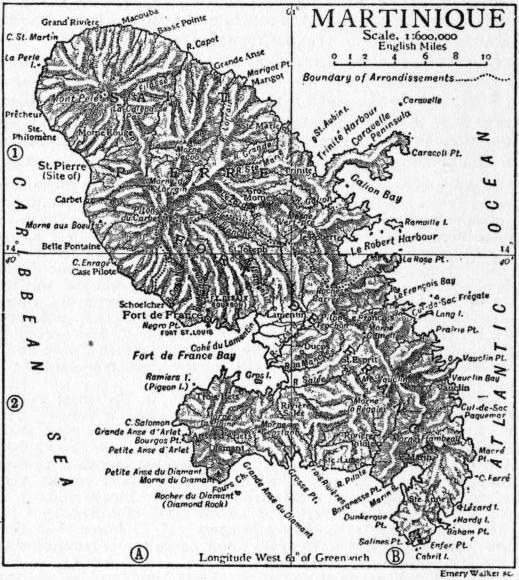
Martinique, the name of which may be derived from a native form Madiana or Mantinino, was probably discovered by Columbus on the 15th of June 1502; although by some authorities its discovery is placed in 1493. It was at that time inhabited by Caribs who had expelled or incorporated an older stock. It was not until the 25th of June 1635 that possession was taken of the island in the name of the French Compagnie des Îles d’Amérique. Actual settlement was carried out in the same year by Pierre Belain, Sieur d’Esnambuc, captain-general of the island of St Christopher. In 1637 his nephew Dyel Duparquet (d. 1658) became captain-general of the colony, now numbering seven hundred men, and subsequently obtained the seigneurie of the island by purchase from the company under the authority of the king of France. In 1654 welcome was given to three hundred Jews expelled from Brazil, and by 1658 there were at least five thousand people exclusive of the Caribs, who were soon after exterminated. Purchased by the French government from Duparquet’s children for 120,000 livres, Martinique was assigned to the West India Company, but in 1674 it became part of the royal domain. The habitants (French landholders) at first devoted themselves to the cultivation of cotton and tobacco; but in 1650 sugar plantations were begun, and in 1723 the coffee plant was introduced. Slave labour having been introduced at an early period of the occupation, there were 60,000 blacks in the island by 1736. This slavery was abolished in 1860. Martinique had a full share of wars. In early days the Caribs were not brought under subjection without severe struggles. In 1666 and 1667 the island was attacked by the British without success, and hostilities were terminated by the treaty of Breda. The Dutch made similar attempts in 1674, and the British again attacked the island in 1693. Captured by Rodney in 1762, Martinique was next year restored to the French; but after the conquest by Sir John Jervis and Sir Charles Grey in 1793 it was retained for eight years; and, seized again in 1809, it was not surrendered till 1814. The island was the birth-place of the Empress Josephine.
Martinique has suffered from occasional severe storms, as in 1767, when 1600 persons perished, and M. de la Pagerie, father of the Empress Josephine, was practically ruined, and in 1839, 1891 and 1903, when much damage was done to the sugar crop. Earthquakes have also been frequent, but the most terrible natural disaster was the eruption of Mont Pelé in 1902, by which the town of St Pierre, formerly the chief commercial centre of the island, was destroyed. During the earlier months of the year various manifestations of volcanic activity had occurred; on the 25th of April there was a heavy fall of ashes, and on the 2nd and 3rd of May a heavy eruption destroyed extensive sugar plantations north of St Pierre, and caused a loss of some 150 lives. A few days later the news that the Souffrière in St Vincent was in eruption reassured the inhabitants of St Pierre, as it was supposed that this outbreak might relieve the volcano of Pelé. But on the 8th of May the final catastrophe came without warning; a mass of fire, compared to a flaming whirlwind, swept over St Pierre, destroying the ships in the harbour, among which, however, one, the “Roddam” of Scrutton, escaped. A fall of molten lava and ashes followed the flames, accompanied by dense gases which asphyxiated those who had thus far escaped. The total loss of life was estimated at 40,000. Consternation was caused not only in the West Indies, but in France and throughout the world, and at first it was seriously suggested that the island should be evacuated, but no countenance was lent to this proposal by the French government. Relief measures were undertaken and voluntary subscriptions raised. The material losses were estimated at £4,000,000; but, besides St Pierre, only one-tenth of the island had been devastated, and although during July there was further volcanic activity, causing more destruction, the economic situation recovered more rapidly than was expected.
See Annuaire de la Martinique (Fort de France); H. Mouet, La Martinique (Paris, 1892); M. J. Guët, Origines de la Martinique (Vannes, 1893); G. Landes, Notice sur la Martinique (with full bibliography), (Paris, 1900); M. Dumoret, Au pays du sucre (Paris, 1902); and on the eruption of 1902, A. Heilprin, Mont Pelée and the Tragedy of Martinique (Philadelphia and London, 1903); A. Lacroix, La Montagne Pelée et ses éruptions (Paris, 1904); and the report of Drs J. S. Flett and T. Anderson (November 20, 1902), who investigated the eruptions on behalf of the Royal Society; cf. T. Anderson, “Recent Volcanic Eruptions in the West Indies,” in Geographical Journal, vol. xxi. (1903).
MARTINSBURG, a town and the county-seat of Berkeley county, West Virginia, U.S.A., about 74 m. W.N.W. of Washington, D.C. Pop. (1890) 7226; (1900) 7564 (678 negroes); (1910) 10,698. It is served by the Baltimore & Ohio and the Cumberland Valley railways; the former has repair shops here. It lies in the Lower Shenandoah Valley at the foot of Little North mountain, in the midst of a fruit-growing region, peaches and apples being the principal crops. Slate and limestone also abound in the vicinity. The town has a fine Federal Building and a King’s Daughters’ hospital. There are grain elevators, and various manufactures, including hosiery, woollen goods, dressed lumber, &c. Martinsburg owns its waterworks, the supply being derived from a neighbouring spring. A town was laid out here a short time before the War of Independence and was named Martinstown in honour of Colonel Thomas Bryan Martin, a nephew of Thomas, Lord Fairfax (1692-1782); in 1778 it was incorporated under its present name. During the Civil War Martinsburg was occupied by several different Union and Confederate forces.
MARTINS FERRY, a city of Belmont county, Ohio, U.S.A., on the Ohio River, nearly opposite Wheeling, West Virginia. Pop. (1890), 6250; (1900), 7760, including 1033 foreign-born and 252 negroes; (1910), 9133. It is served by the Pennsylvania (Cleveland & Pittsburg Division), the Baltimore & Ohio, and the Wheeling & Lake Erie (Wabash System) railways, and by several steamboat lines. The city is situated on two plateaus; the lower is occupied chiefly by factories, the upper by dwellings. Coal mining and manufacturing are the principal industries; among factory products are iron, steel, tin, stoves, machinery and glassware. The municipality owns and operates the waterworks and an electric-lighting plant. A settlement was attempted here in 1785, but was abandoned on account of trouble with the Indians. In 1795 a town was laid out by Absalom Martin and was called Jefferson, but this, too, was abandoned, on account of its not being made the county-seat. The town was laid out again in 1835 by Ebenezer Martin (son of Absalom Martin) and was called Martinsville; the present name was substituted a few years later. The Martins and other pioneers are buried in Walnut Grove Cemetery within the city limits. Martins Ferry was incorporated as a town in 1865 and chartered as a city in 1885.
MARTINUZZI, GEORGE [György Utiešenović] (1482-1551), Hungarian statesman, who, since he usually signed himself “Frater Georgius,” is known in Hungarian history as Frater György or simply The Frater, was born at Kamičic in Croatia, the son of Gregory Utiešenović, a Croatian gentleman. His mother was a Martinuzzi, a Venetian patrician family. From his eighth to his twentieth year he was attached to the court of John Corvinus; subsequently, entering the service of the Zapolya family, he saw something of warfare under John Zapolya but, tiring of a military life, he entered the Paulician Order in his twenty-eighth year. His historical career began when his old patron Zapolya, now king of Hungary, forced to fly before his successful rival Ferdinand, afterwards the emperor Ferdinand I., sent him on a diplomatic mission to Hungary. It was due to his tact and ability that John recovered Buda (1529), and henceforth Frater György became his treasurer and chief counsellor. In 1534 he became bishop of Grosswardein; in 1538 he concluded with Austria the peace of Grosswardein, whereby the royal title and the greater part of Hungary were conceded to Zapolya. King John left the Frater the guardian of his infant son John Sigismund, who was proclaimed and crowned king of Hungary, the Frater acting as regent. He frustrated all the attempts of the queen mother, Isabella, to bring in the Austrians, and when, in 1541, an Austrian army appeared beneath the walls of Buda, he arrested the queen and applied to the Porte for help. On the 28th of August 1541, the Frater did homage to the sultan, but during his absence with the baby king in the Turkish camp, the grand vizier took Buda by subtlety. Then only the Frater recognized the necessity of a composition with both Austria and Turkey. He attained it by the treaty of Gyula (Dec. 29, 1541), whereby western Hungary fell to Ferdinand, while Transylvania, as an independent principality under Turkish suzerainty, reverted to John Sigismund. It included, besides Transylvania proper, many Hungarian counties on both sides of the Theiss, and the important city of Kassa. It was the Frater’s policy to preserve Transylvania neutral and intact by cultivating amicable relations with Austria without offending the Porte. It was a difficult policy, but succeeded brilliantly for a time. In 1545, encouraged by the growing unpopularity of Ferdinand, owing to his incapacity to defend Hungary against the Turks, the Frater was tempted to unite Austrian Hungary to Transylvania and procure the election of John Sigismund as the national king. But recognizing that this was impossible, he aimed at an alliance with Ferdinand on terms of relative equality, and to this system he adhered till his death. Queen Isabella, who hated the Frater and constantly opposed him, complained of him to the sultan, who commanded that either the traitor himself or his head should be sent to Constantinople (1550). A combination was then formed against him of the queen, the hospodars of Moldavia and Wallachia and the Turks; but the Frater shut the queen up in Gyula-Fehérvár, drove the hospodars out of Transylvania, defeated the Turks at Déva, and finally compelled Isabella to accept a composition with Austria very profitable to her family and to Transylvania, at the same time soothing the rage of the sultan by flatteries and gifts. This compact, a masterpiece of statesmanship, was confirmed by the diet of Kolozsvár in August 1551. The Frater retained the governorship of Transylvania, and was subsequently consecrated archbishop of Esztergom and received the red hat. Thus Hungary was once more reunited, but the inability of Ferdinand to defend it against the Turks, as promised, forced the Frater, for the common safety, to resume the payment of tribute to the Porte in December 1551. Unfortunately, the Turks no longer trusted a diplomatist they could not understand, while Ferdinand suspected him of an intention to secure Hungary for himself. When the Turks (in 1551) took Csanád and other places, the Frater and the imperial generals Castaldo and Pallavicini combined their forces against the common foe; but when the Frater privately endeavoured to mediate between the Turks and the Hungarians, Castaldo represented him to Ferdinand as a traitor, and asked permission to kill him if necessary. The Frater’s secretary Marco Aurelio Ferrari was hired, and stabbed his master from behind at the castle of Alvinczy while reading a letter, on the 18th of December 1551; but the cardinal, though in his sixty-ninth year, fought for his life, and was only despatched with the aid of Pallavicini and a band of bravos. Ferdinand took the responsibility of the murder on himself. He sent to Julius III. an accusation of treason against the Frater in eighty-seven articles, and after long hesitation, and hearing one hundred and sixteen witnesses, the pope exonerated Ferdinand of blame.
See A. Bechet, Histoire du ministère du cardinal Martinusius (Paris, 1715); O. M. Utiešenović, Lebensgeschichte des Cardinals Georg Utiešenović (Vienna, 1881); Codex epistolaris Fratris Georgii 1535-1551, ed. A. Károlyi (Budapest, 1881). But the most vivid presentation of Frater is to be found in M. Jókai’s fine historical romance, Brother George (Hung.) (Budapest, 1893).
(R. N. B.)
MARTIUS, CARL FRIEDRICH PHILIPP VON (1794-1868), German botanist and traveller, was born on the 17th of April 1794 at Erlangen, where he graduated M.D. in 1814, publishing as his thesis a critical catalogue of plants in the botanic garden of the university. He afterwards devoted himself to botanical study, and in 1817 he and J. B. von Spix were sent to Brazil by the king of Bavaria. They travelled from Rio de Janeiro through several of the southern and eastern provinces of Brazil, and ascended the river Amazon to Tabatinga, as well as some of its larger affluents. On his return to Europe in 1820 he was appointed conservator of the botanic garden at Munich, and in 1826 professor of botany in the university there, and held both offices till 1864. He devoted his chief attention to the flora of Brazil, and in addition to numerous short papers he published the Nova Genera et Species Plantarum Brasiliensium (1823-1832, 3 vols.) and Icones selectae Plantarum Cryptogamicarum Brasiliensium (1827), both works being finely illustrated. An account of his travels in Brazil appeared in 3 vols. 4to, 1823-1831, with an atlas of plates, but probably the work by which he is best known is his Historia Palmarum (1823-1850) in 3 large folio volumes, of which one describes the palms discovered by himself in Brazil. In 1840 he began the Flora Brasiliensis, with the assistance of the most distinguished European botanists, who undertook monographs of the various orders. Its publication was continued after his death under the editorship of A. W. Eichler (1839-1887) until 1887, and subsequently of Ignaz von Urban. He also edited several works on the zoological collections made in Brazil by Spix, after the death of the latter in 1826. On the outbreak of potato disease in Europe he investigated it and published his observations in 1842. He also published works and short papers on the aborigines of Brazil, on their civil and social condition, on their past and probable future, on their diseases and medicines, and on the languages of the various tribes, especially the Tupi. He died at Munich on the 13th of December 1868.
MARTOS, CHRISTINO (1830-1893), Spanish politician, was born at Granada on the 13th of September 1830. He was educated there and at Madrid University, where his Radicalism soon got him into trouble, and he narrowly escaped being expelled for his share in student riots and other demonstrations against the governments of Queen Isabella. He distinguished himself as a journalist on El Tribuno. He joined O’Donnell and Espartero in 1854 against a revolutionary cabinet, and shortly afterwards turned against O’Donnell to assist the Democrats and Progressists under Prim, Rivero, Castelar, and Sagasta in the unsuccessful movements of 1866, and was obliged to go abroad. His political career had not prevented Martos from rising into note at the bar, where he was successful for forty years. After remaining abroad three years, he returned to Spain to take his seat in the Cortes of 1869 after the revolution of 1868. Throughout the revolutionary period he represented in cabinets with Prim, Serrano and Ruiz Zorilla, and lastly under King Amadeus, the advanced Radical tendencies of the men who wanted to give Spain a democratic monarchy. After the abdication of Amadeus of Savoy, Martos played a prominent part in the proclamation of the federal republic, in the struggle between the executive of that republic and the permanent committee of the Cortes, backed by the generals and militia, who nearly put an end to the executive and republic in April 1873. When the republicans triumphed Martos retired into exile, and soon afterwards into private life. He reappeared for a few months after General Pavia’s coup d’état in January 1874, to join a coalition cabinet formed by Marshal Serrano, with Sagasta and Ulloa. Martos returned to the Bar in May 1874, and quietly looked on when the restoration took place at the end of that year. He stuck to his democratic ideals for some years, even going to Biarritz in 1881 to be present at a republican congress presided over by Ruiz Zorilla. Shortly afterwards Martos joined the dynastic Left organized by Marshal Serrano, General Lopez Dominguez, and Moret, Becerra, Balaguer, and other quondam revolutionaries. He sat in several parliaments of the reign of Alphonso XII. and of the regency of Queen Christina, joined the dynastic Liberals under Sagasta, and gave Sagasta not a little trouble when the latter allowed him to preside over the House of Deputies. Having failed to form a rival party against Sagasta, Martos subsided into political insignificance, despite his great talent as an orator and debater, and died in Madrid on the 16th of January 1893.
MARTOS, a town of southern Spain, in the province of Jaen, 16 m. W.S.W. of Jaen, by the Jaen-Lucena railway. Pop. (1900), 17,078. Martos is situated on an outlying western peak of the Jabalcuz mountains, which is surmounted by a ruined castle and overlooks the plain of Andalusia. In the neighbourhood are two sulphurous springs with bathing establishments. The local trade is almost exclusively agricultural.
Martos perhaps stands on or near the site of the Tucci of Ptolemy, which was fortified and renamed Colonia Augusta Gemella by the Romans. By Ferdinand III. it was taken from the Moors in 1225, and given to the knights of Calatrava; it was here that the brothers Carvajal, commanders of the order, were in 1312 executed by command of Ferdinand IV. Before their death they summoned Ferdinand to meet them within thirty days at the judgment-seat of God. Ferdinand died a month later and thus received the popular name of el Emplazado—“the Summoned.”
MARTYN, HENRY (1781-1812), English missionary to India, was born on the 18th of February 1781, at Truro, Cornwall. His father, John Martyn, was a “captain” or mine-agent at Gwennap. The lad was educated at Truro grammar school under Dr Cardew, entered St John’s College, Cambridge, in the autumn of 1797, and was senior wrangler and first Smith’s prizeman in 1801. In 1802 he was chosen a fellow of his college. He had intended to go to the bar, but in the October term of 1802 he chanced to hear Charles Simeon speaking of the good done in India by a single missionary, William Carey, and some time afterwards he read the life of David Brainerd, the apostle of the Indians of North America. He resolved, accordingly, to become a Christian missionary. On the 22nd of October, 1803, he was ordained deacon at Ely, and afterwards priest, and served as Simeon’s curate at the church of Holy Trinity, taking charge of the neighbouring parish of Lolworth. He was about to offer his services to the Church Missionary Society, when a disaster in Cornwall deprived him and his unmarried sister of the provision their father had made for them, and rendered it necessary that he should obtain a salary that would support her as well as himself. He accordingly obtained a chaplaincy under the East India Company and left for India on the 5th of July 1805. For some months he was stationed at Aldeen, near Serampur; in October 1806 he proceeded to Dinapur, where he was soon able to conduct worship among the natives in the vernacular, and established schools. In April 1809 he was transferred to Cawnpore, where he preached in his own compound, in spite of interruptions and threats. He occupied himself in linguistic study, and had already, during his residence at Dinapur, been engaged in revising the sheets of his Hindostani version of the New Testament. He now translated the whole of the New Testament into Hindi also, and into Persian twice. He translated the Psalms into Persian, the Gospels into Judaeo-Persic, and the Prayer-book into Hindostani, in spite of ill-health and “the pride, pedantry and fury of his chief munshi Sabat.” Ordered by the doctors to take a sea voyage, he obtained leave to go to Persia and correct his Persian New Testament, whence he wished to go to Arabia, and there compose an Arabic version. Accordingly, on the 1st of October 1810, having seen his work at Cawnpore crowned on the previous day by the opening of a church, he left for Calcutta, whence he sailed on the 7th of January 1811, for Bombay, which he reached on his thirtieth birthday. From Bombay he set out for Bushire, bearing letters from Sir John Malcolm to men of position there, as also at Shiraz and Isfahan. After an exhausting journey from the coast he reached Shiraz, and was soon plunged into discussion with the disputants of all classes, “Sufi, Mahommedan, Jew, and Jewish-Mahommedan, even Armenian, all anxious to test their powers of argument with the first English priest who had visited them.” Having made an unsuccessful journey to Tabriz to present the shah with his translation of the New Testament, he was seized with fever, and after a temporary recovery, had to seek a change of climate. On the 12th of September 1812, he started with two Armenian servants, crossed the Araxes, rode from Tabriz to Erivan, from Erivan to Kars, from Kars to Erzerum, from Erzerum to Chiflik, urged on from place to place by a thoughtless Tatar guide, and, though the plague was raging at Tokat (near Eski-Shehr in Asia Minor), he was compelled by prostration to stop there. On the 6th of October he died. Macaulay’s youthful lines, written early in 1813, testify to the impression made by his career.
His Journals and Letters were published by Samuel Wilberforce in 1837. See also Lives by John Sargent (1819; new ed. 1885), and G. Smith (1892); and The Church Quarterly Review (Oct. 1881).
MARTYN, JOHN (1699-1768), English botanist, was born in London on the 12th of September 1699. Originally intended for a business career, he abandoned it in favour of medical and botanical studies. He was one of the founders (with J. J. Dillen and others) and the secretary of a botanical society which met for a few years in the Rainbow Coffee-house, Watling Street; he also started the Grub Street Journal, a weekly satirical review, which lasted from 1730 to 1737. In 1732 he was appointed professor of botany in Cambridge University, but, finding little encouragement and hampered by lack of appliances, he soon discontinued lecturing. He retained his professorship, however, till 1762, when he resigned in favour of his son Thomas (1735-1825), author of Flora rustica (1792-1794). Although he had not taken a medical degree, he long practised as a physician at Chelsea, where he died on the 29th of January 1768. His reputation chiefly rests upon his Historia plantarum rariorum (1728-1737), and his translation, with valuable agricultural and botanical notes, of the Eclogues (1749) and Georgics (1741) of Virgil. On resigning the botanical chair at Cambridge he presented the university with a number of his botanical specimens and books.
See memoir by Thomas Martyn in Memoirs of John Martyn and Thomas Martyn, by G. C. Gorham (1830).
MARTYR (Gr. μάρτυρ or μάρτυς), a word meaning literally “witness” and often used in that sense in the New Testament e.g. Matt, xviii. 16; Mark xiv. 63. During the conflict between Paganism and Christianity when many Christians “testified” to the truth of their convictions by sacrificing their lives, the word assumed its modern technical sense. The beginnings of this use are to be seen in such passages as Acts xxii. 20; Rev. ii. 13, xiii. 6. During the first three centuries the fortitude of these “witnesses” won the admiration of their brethren. Ardent spirits craved the martyr’s crown, and to confess Christ in persecution was to attain a glory inferior only to that won by those who actually died. Confessors were visited in prison, martyrs’ graves were scenes of pilgrimage, and the day on which they suffered was celebrated as the birthday of their glory. Martyrology was the most popular literature in the early Church. While the honour paid to martyrdom was a great support to early champions of the faith, it was attended by serious evils. It was thought that martyrdom would atone for sin, and imprisoned confessors not only issued to the Churches commands which were regarded almost as inspired utterances, but granted pardons in rash profusion to those who had been excommunicated by the regular clergy, a practice which caused Cyprian and his fellow bishops much difficulty. The zeal of Ignatius (c. 115), who begs the Roman Church to do nothing to avert from him the martyr’s death, was natural enough in a spiritual knight-errant, but with others in later days, especially in Phrygia and North Africa, the passion became artificial. Fanatics sought death by insulting the magistrates or by breaking idols, and in their enthusiasm for martyrdom became self-centred and forgetful of their normal duty. None the less it is true that these men and women endured torments, often unthinkable in their cruelty, and death rather than abandon their faith. The same phenomena have been witnessed, not only in the conflicts within the Church that marked the 13th to the 16th centuries, but in the different mission fields, and particularly in Madagascar and China.
See A. J. Mason, The Historic Martyrs of the Primitive Church (London, 1905); H. B. Workman, Persecution in the Early Church (London, 1906); Paul Allard, Ten Lectures on the Martyrs (London, 1907); John Foxe, The Book of Martyrs; Mary I. Bryson, Cross and Crown (London, 1904).
MARTYROLOGY, a catalogue or list of martyrs, or, more exactly, of saints, arranged in the order of their anniversaries. This is the now accepted meaning in the Latin Church. In the Greek Church the nearest equivalent to the martyrology is the Synaxarium (q.v.). As regards form, we should distinguish between simple martyrologies, which consist merely of an enumeration of names, and historical martyrologies, which also include stories or biographical details. As regards documents, the most important distinction is between local and general martyrologies. The former give a list of the festivals of some particular Church; the latter are the result of a combination of several local martyrologies. We may add certain compilations of a factitious character, to which the name of martyrology is given by analogy, e.g. the Martyrologe universel of Châtelain (1709). As types of local martyrologies we may quote that of Rome, formed from the Depositio martyrum and the Depositio episcoporum of the chronograph of 354; the Gothic calendar of Ulfila’s Bible, the calendar of Carthage published by Mabillon, the calendar of fasts and vigils of the Church of Tours, going back as far as Bishop Perpetuus (d. 490), and preserved in the Historia francorum (xi. 31) of Gregory of Tours. The Syriac martyrology discovered by Wright (Journal of Sacred Literature, 1866) gives the idea of a general martyrology. The most important ancient martyrology preserved to the present day is the compilation falsely attributed to St Jerome, which in its present form goes back to the end of the 6th century. It is the result of the combination of a general martyrology of the Eastern Churches, a local martyrology of the Church of Rome, some general martyrologies of Italy and Africa, and a series of local martyrologies of Gaul. The task of critics is to distinguish between its various constituent elements. Unfortunately, this document has reached us in a lamentable condition. The proper names are distorted, repeated or misplaced, and in many places the text is so corrupt that it is impossible to understand it. With the exception of a few traces of borrowings from the Passions of the martyrs, the compilation is in the form of a simple martyrology. Of the best-known historical martyrologies the oldest are those which go under the name of Bede and of Florus (Acta sanctorum Martii, vol. ii.); of Wandelbert, a monk of Prüm (842); of Rhabanus Maurus (c. 845); of Ado (d. 875); of Notker (896); and of Wolfhard (c. 896 v. Analecta bollandiana, xvii. 11). The most famous is that of Usuard (c. 875), on which the Roman martyrology was based. The first edition of the Roman martyrology appeared at Rome in 1583. The third edition, which appeared in 1584, was approved by Gregory XIII., who imposed the Roman martyrology upon the whole Church. In 1586 Baronius published his annotated edition, which in spite of its omissions and inaccuracies is a mine of valuable information.
The chief works on the martyrologies are those of Rosweyde, who in 1613 published at Antwerp the martyrology of Ado (also edition of Giorgi, Rome, 1745); of Sollerius, to whom we owe a learned edition of Usuard (Acta sanctorum Junii, vols. vi. and vii.); and of Fiorentini, who published in 1688 an annotated edition of the Martyrology of St Jerome. The critical edition of the latter by J. B. de Rossi and Mgr. L. Duchesne, was published in 1894, in vol. ii. of the Acta sanctorum Novembris. The historical martyrologies taken as a whole have been studied by Dom Quentin (1908). There are also numerous editions of calendars or martyrologies of less universal interest, and commentaries upon them. Mention ought to be made of the famous calendar of Naples, commented on by Mazocchi (Naples, 1744) and Sabbatini (Naples, 1744).
See C. de Smedt, Introductio generalis ad historiam ecclesiasticam (Gandavi, 1876), pp. 127-156; H. Matagne and V. de Buck in De Backer, Bibliothèque des écrivains de la Compagnie de Jésus, 2nd ed., vol. iii. pp. 369-387; De Rossi-Duchesne, Les Sources du martyrologe hiéronymien (Rome, 1885); H. Achelis, Die Martyrologien, ihre Geschichte und ihr Wert (Berlin, 1900); H. Delehaye, “Le Témoignage des martyrologes,” in Analecta bollandiana, xxvi. 78-99 (1907); H. Quentin, Les Martyrologes historiques du moyen âge (Paris, 1908).
(H. De.)
MARULLUS, MICHAEL TARCHANIOTA (d. 1500), Greek scholar, poet, and soldier, was born at Constantinople. In 1453, when the Turks captured Constantinople, he was taken to Ancona in Italy, where he became the friend and pupil of J. J. Pontanus, with whom his name is associated by Ariosto (Orl. Fur. xxxvii. 8). He received his education at Florence, where he obtained the patronage of Lorenzo de’ Medici. He was the author of epigrams and hymni naturales, in which he happily imitated Lucretius. He took no part in the work of translation, then the favourite exercise of scholars, but he was understood to be planning some great work when he was drowned, on the 10th of April 1500, in the river Cecina near Volterra. He was a bitter enemy of Politian, whose successful rival he had been in the affections of the beautiful and learned Alessandra Scala. He is remembered chiefly for the brilliant emendations on Lucretius which he left unpublished; these were used for the Juntine edition (Munro’s Lucretius, Introduction).
The hymns, some of the epigrams, and a fragment, De Principum institutione, were reprinted in Paris by C. M. Sathas in Documents inédits relatifs à l’histoire de la Grèce au moyen âge, vol. vii. (1888).
MARUM, MARTIN VAN (1750-1837), Dutch man of science, was born on the 20th of March 1750 at Groningen, where he graduated in medicine and philosophy. He began to practise medicine at Haarlem, but devoted himself mainly to lecturing on physical subjects. He became secretary of the scientific society of that city, and under his management the society was advanced to the position of one of the most noted in Europe. He was also entrusted with the care of the collection left to Haarlem by P. Teyler van der Hulst (1702-1778). His name is not associated with any discovery of the first order, but his researches (especially in connexion with electricity) were remarkable for their number and variety. He died at Haarlem on the 26th of December 1837.