VOLUME XVII SLICE VII Mars to Matteawan (continued 11)
Reading edition
A bibliography of his works, including anonymous ones and those under an assumed name, has been published by G. Vicaire (Manuel de l’amateur des livres du XIXe siècle, tome v., 1904). Napoléon et les femmes has been translated into English as Napoleon and the Fair Sex (1894).

MAST (1) (O. Eng. maest; a common Teutonic word, cognate with Lat. malus; from the medieval latinized form mastus comes Fr. mât), in nautical language, the name of the spar, or straight piece of timber, or combination of spars, on which are hung the yards and sails of a vessel of any size. It has been ingeniously supposed that man himself was the first mast. He discovered by standing up in his prehistoric “dugout,” or canoe, that the wind blowing on him would carry his craft along. But the origin of the mast, like that of the ship, is lost in times anterior to all record. The earliest form of mast which prevailed till the close of the middle ages, and is still in use for small vessels, was and is a single spar made of some tough and elastic wood; the conifers supply the best timber for the purpose. In sketching the history of the development of the mast, we must distinguish between the increase in the number erected, and the improvements made in the mast itself. The earliest ships had only one, carrying a single sail. So little is known of the rigging of classical ships that nothing can be affirmed of them with absolute confidence. The Norse vessels carried one mast placed in the middle. The number gradually increased till it reached four or five. All were at first upright, but the mast which stood nearest the bow was by degrees lowered forward till it became the bow-sprit of modern times, and lost the name of mast. The next from the bows became the foremast—called in Mediterranean sea language mizzana, in French misaine. Then came the main-mast—in French grand mât; and then the mizen—in French, which follows the Mediterranean usage, the artimon, i.e. “next the rudder,” timon. A small mast was sometimes erected in the very end of the ship, and called in English a “bonaventure mizen.” It had a close resemblance to the jigger of yawl-rigged yachts. By the close of the 16th century it had become the established rule that a ship proper had three masts—fore, main and mizen. The third takes its name not as the other two do, from its place, but from the lateen sail originally hoisted on it (see Rigging), which was placed fore and aft in the middle (Italian, mizzo) of the ship, and did not lie across like the courses and topsails. With the development of very large sailing clippers in the middle of the 19th century a return was made to the practice of carrying more than three masts. Ships and barques are built with four or five. Some of the large schooners employed in the American coast trade have six or seven, and some steamers have had as many.
The mast was for long made out of a single spar. Thence the Mediterranean name of “palo” (spar) and the Spanish “arbol” (tree). The typical Mediterranean mast of “lateen” (Latin) vessels is short and bends forward. In other classes it is upright, or bends slightly backwards with what is called a “rake.” The mast is grounded, or in technical language “stepped,” on the kelson (or keelson), the solid timber or metal beam lying parallel with, and above the keel. As the 15th century advanced the growth of the ship made it difficult, or even impossible, to find spars large enough to make a mast. The practice of dividing it into lower, and upper or topmast, was introduced. At first the two were fastened firmly, and the topmast could not be lowered. In the 16th century the topmast became movable. No date can be given for the change, which was gradual, and was not simultaneously adopted. When the masting of sailing ships was fully developed, the division was into lower or standing mast, topmast, topgallant mast, and topgallant royal. The topgallant royal is a small spar which is often a continuation of the topgallant mast, and is fixed. Increase of size also made it impossible to construct each of these subdivisions out of single timbers. A distinction was made between “whole” or single-spar masts and “armed” and “made masts.” The first were used for the lighter spars, for small vessels and the Mediterranean craft called “polacras.” Armed masts were composed of two single timbers. Made masts were built of many pieces, bolted and “coaked,” i.e. dovetailed and fitted together, fastened round by iron hoops, and between them by twelve or thirteen close turns of rope, firmly secured. “Made masts” are stronger than those made of a single tree and less liable to be sprung. The general principle of construction is that it is built round a central shaft, called in English the “spindle” or “upper tree,” and in French the mèche or wick. The other pieces—“side trees,” “keel pieces,” “side fishes,” “cant pieces” and “fillings” are “coaked,” i.e. dovetailed and bolted on to and around the “spindle,” which itself is made of two pieces, coaked and bolted. The whole is bound by iron bands, and between the bands, by rope firmly “woulded” or turned round, and nailed tight. The art of constructing made masts, like that of building wooden ships, is in process of dying out. In sailing men-of-war the mizen-mast often did not reach to the kelson, but was stepped on the orlop deck. Hollow metal cylinders are now used as masts. In the case of a masted screw steamer the masts abaft the engines could not be stepped on the kelson because they would interfere with the shaft of the screw. It is therefore necessary to step them on the lower deck, where they are supported by stanchions, or on a horseshoe covering the screw shaft. The size of masts naturally varies very much. In a 110-gun ship of 2164 tons the proportions of the mainmast were: for the lower mast, length 117 ft., diameter 3 ft. 3 in.; topmast, 70 ft., and 20¾ in.; topgallant mast, 35 ft., and 115⁄8 in., 222 ft. in all. At the other end of the scale, a cutter of 200 tons had a lower mast of 88 ft., of 22 in. diameter, and a topgallant mast (there was no topmast between them) of 44 ft., of 9¾ in. in diameter, 132 ft. in all; topgallant mast of 44 ft., and 9¾ in. in diameter. The masts of a warship were more lofty than those of a merchant ship of the same tonnage. At present masts are only used by warships for signalling and military purposes. In sailing merchant ships, the masts are more lofty than they were about a century ago. A merchant ship of 1300 tons, in 1830, had a mainmast 179 ft. in height; a vessel of the same size would have a mast of 198 ft. to-day.
A “jury mast” is a temporary mast put up by the crew when the spars nave been carried away in a storm or in action, or have been cut away to relieve pressure in a storm. The word has been supposed without any foundation to be short for “injury” mast; it may be a mere fanciful sailor adaptation of “jury” in some connexion now lost. Skeat suggests that it is short for O. Fr. ajourie, Lat. adjutare, to aid. There is no reason to connect with jour, day.
See L. Jal, Glossaire Nautique (Paris, 1848); Sir Henry Manwayring, The Seaman’s Dictionary (London, 1644); N. Hutchinson, Treatise on Naval Architecture and Practical Seamanship (Liverpool, 1777); David Steel, Elements and Practice of Rigging, Seamanship and Naval Tactics (London, 1800); William Burney’s Falconer’s Dictionary (London, 1830); Sir Gervais Nares’s Seamanship (Portsmouth, 1882); and John Fincham, On Masting Ships and Mast Making (London, 1829).
(D. H.)
Mast (2) (Anglo-Saxon maest, food, common to some Teutonic languages, and ultimately connected with “meat”), the fruit of the beech, oak, and other forest trees, used as food for swine.
MASTABA (Arab. for “bench”), in Egyptian architecture, the term given to the rectangular tombs in stone with raking sides and a flat roof. There were three chambers inside. In one the walls were sometimes richly decorated with paintings and had a low bench of stone in them on which incense was burnt. The second chamber was either closed, with holes pierced in the wall separating it from the first chamber, or entered through a narrow passage through which the fumes of the incense passed; this chamber contained the serdab or figure of the deceased. A vertical well-hole cut in the rock descended to a third chamber in which the mummy was laid.
MASTER (Lat. magister, related to magis, more, as the corresponding minister is to minus, less; the English form is due partly to the O. Eng. maegister, and partly to O. Fr. maistre, mod. maître; cf. Du. meester, Ger. Meister, Ital. maestro), one holding a position of authority, disposition or control over persons or things. The various applications of the word fall roughly into the following main divisions; as the title of the holder of a position of command or authority; as that of the holder of certain public or private offices, and hence a title of address; and as implying the relationship of a teacher to his pupils or of an employer to the persons he employs. As a title of the holder of an office, the use of the Lat. magister is very ancient. Magister equitum, master of the horse, goes back to the early history of the Roman Republic (see Dictator; and for the British office, Master of the Horse). In medieval times the title was of great frequency. In Du Cange (Glossarium) the article magister contains over 120 sub-headings. In the British royal household most of the offices bearing this title are now obsolete. Of the greater offices, that of master of the buckhounds was abolished by the Civil List Act 1901. The master of the household, master of the ceremonies, master of the king’s music still survive. Since 1870 the office of master of the mint has been held by the chancellor of the exchequer, all the administrative and other duties being exercised by the deputy master.
At sea, a “master” is more properly styled “master mariner.” In the merchant service he is the commander of a ship, and is by courtesy known as the captain. In the British navy he was the officer entrusted with the navigation under the captain. He had no royal commission, but a warrant from the Navy Board. Very often he had been a merchant captain. His duties are now performed by the staff commander or navigating lieutenant. The master-at-arms is the head of the internal police of a ship; the same title is borne by a senior gymnastic instructor in the army. In the United States navy, the master is a commissioned officer below the rank of lieutenant.
“Master” appears as the title of many legal functionaries (for the masters of the supreme court see Chancery; and King’s Bench, Court of; for masters in lunacy see Insanity: § Law, see also Master of the Rolls, below). The “master of the faculties” is the chief officer of the archbishop of Canterbury in his court of faculties. His duties are concerned with the appointment of notaries and the granting of special licences of marriage. The duties are performed ex officio by the judge of the provincial courts of Canterbury and York, who is also dean of Arches, in accordance with § 7 of the Public Worship Regulation Act 1874. The “master of the Temple” is the title of the priest-in-charge of the Temple Church in London. It was formerly the title of the grand master of the Knights Templars. The priest-in-charge of the Templars’ Church was properly styled the custos, and this was preserved by the Knights Hospitallers when they were granted the property of the Templars at the dissolution of that order. The act of 1540 (32 Henry VIII.), which dissolved the order of the Hospitallers, wrongly styled the custos master of the Temple, and the mistake has been continued. The proper title of a bencher of the Inns of Court is “master of the Bench” (see Inns of Court). The title of “Master-General of the Ordnance” was revived in 1904 for the head of the Ordnance Department in the British military administration.
“Master” is the ordinary word for a teacher, very generally used in the compound “schoolmaster.” The word also is used in a sense transferred from this to express the relation between the founder of a school of religion, philosophy, science, art, &c., and his disciples. It is partly in this sense and partly in that of one whose work serves as a model or type of superlative excellence that such terms as “old masters” are used. In medieval universities magister was particularly applied to one who had been granted a degree carrying with it the licentia docendi, the licence to teach. In English usage this survives in the faculty of arts. The degree is that of artium magister, master of arts, abbreviated M.A. In the other faculties the corresponding degree is doctor. Some British universities give a master’s degree in surgery, magister chirurgiae, C.M. or M.Ch., and also in science, magister scientiae, M.Sc. The academic use of “master” as the title of the head of certain colleges at the universities of Oxford and Cambridge is to be referred to the frequent application of the term to the holder of a presiding office in an institution.
Master was the usual prefix of address to a man’s name, though originally confined to people of some social standing. Probably under the influence of “mistress,” it was corrupted in sound to “mister,” and was abbreviated to “Mr.” In the case of the puisne judges of the High Court “Mr Justice” is still used as the proper official form of written address. The Speaker of the House of Commons is also formally addressed as “Mr Speaker.” In some Scottish peerages below the rank of earl, “master” is used in the courtesy title of the heir, e.g. the “Master of Ruthven.”
MASTER AND SERVANT. These are scarcely to be considered as technical terms in English law. The relationship which they imply is created when one man hires the labour of another for a term. Thus it is not constituted by merely contracting with another for the performance of a definite work, or by sending an article to an artificer to be repaired, or engaging a builder to construct a house. Nor would the employment of a man for one definite act of personal service—e.g. the engagement of a messenger for a single occasion—generally make the one master and the other servant. It was held, however, in relation to the offence of embezzlement, that a drover employed on one occasion to drive cattle home from market was a servant within the statute. On the other hand, there are many decisions limiting the meaning of “servants” under wills giving legacies to the class of servants generally. Thus “a person who was not obliged to give his whole time to the master, but was yet in some sense a servant,” was held not entitled to share in a legacy to the servants. These cases are, however, interpretations of wills where the intention obviously is to benefit domestic servants only. And so in other connexions questions may arise as to the exact nature of the relations between the parties—whether they are master and servant, or principal and agent, or landlord and tenant, or partners, &c.
The terms of the contract of service are for the most part such as the parties choose to make them, but in the absence of express stipulations terms will be implied by the law. Thus, “where no time is limited either expressly or by implication for the duration of a contract of hiring and service, the hiring is considered as a general hiring, and in point of law a hiring for a year.” But “in the case of domestic and menial servants there is a well-known rule, founded solely on custom, that their contract of service may be determined at any time by giving a month’s warning or paying a month’s wages, but a domestic or other yearly servant, wrongfully quitting his master’s service, forfeits all claim to wages for that part of the current year during which he has served, and cannot claim the sum to which his wages would have amounted had he kept his contract, merely deducting therefrom one month’s wages. Domestic servants have a right by custom to leave their situations at any time on payment of a calendar month’s wages in advance, just as a master may discharge them in a similar manner” (Manley Smith’s Law of Master and Servant, chs. ii. and iii.). The following are sufficient grounds for discharging a servant: (1) wilful disobedience of any lawful order; (2) gross moral misconduct; (3) habitual negligence; (4) incompetence or permanent disability caused by illness. A master has a right of action against any person who deprives him of the services of his servant, by enticing him away, harbouring or detaining him after notice, confining or disabling him, or by seducing his female servant. Indeed, the ordinary and only available action for seduction in English law is in form of a claim by a parent for the loss of his daughter’s services. The death of either master or servant in general puts an end to the contract. A servant wrongfully discharged may either treat the contract as rescinded and sue for services actually rendered, or he may bring a special action for damages for the breach. The common law liabilities of a master towards his servants have been further regulated by the Workmen’s Compensation Acts (see Employer’s Liability). A master is bound to provide food for a servant living under his roof, and wilful breach of duty in that respect is a misdemeanour under the Offences against the Person Act 1861.
A servant has no right to demand “a character” from an employer, and if a character be given it will be deemed a privileged communication, so that the master will not be liable thereon to the servant unless it be false and malicious. A master by knowingly giving a false character of a servant to an intending employer may render himself liable—should the servant for example rob or injure his new master.
Reference may be made to the articles on Labour Legislation for the cases in which special terms have been introduced into contracts of service by statute (e.g. Truck Acts).
MASTER OF THE HORSE, in England, an important official of the sovereign’s household. The master of the horse is the third dignitary of the court, and is always a member of the ministry (before 1782 the office was of cabinet rank), a peer and a privy councillor. All matters connected with the horses and hounds of the sovereign, as well as the stables and coach-houses, the stud, mews and kennels, are within his jurisdiction. The practical management of the royal stables and stud devolves on the chief or crown equerry, formerly called the gentleman of the horse, who is never in personal attendance on the sovereign and whose appointment is permanent. The clerk marshal has the supervision of the accounts of the department before they are submitted to the Board of Green Cloth, and is in waiting on the sovereign on state occasions only. Exclusive of the crown equerry there are seven regular equerries, besides extra and honorary equerries, one of whom is always in attendance on the sovereign and rides at the side of the royal carriage. They are always officers of the army, and each of them is “on duty” for about the same time as the lords and grooms in waiting. There are also several pages of honour in the master of the horse’s department, who must not be confounded with the pages of various kinds who are in the department of the lord chamberlain. They are youths aged from twelve to sixteen, selected by the sovereign in person, to attend on him at state ceremonies, when two of them, arrayed in an antique costume, assist the groom of the stole in carrying the royal train.
In France the master of the horse (“Grand Écuyer,” or more usually “Monsieur le grand”) was one of the seven great officers of the crown from 1617. As well as the superintendence of the royal stables, he had that of the retinue of the sovereign, also the charge of the funds set aside for the religious functions of the court, coronations, &c. On the death of a sovereign he had the right to all the horses and their equipment in the royal stables. Distinct from this officer and independent of him, was the first equerry (“Premier Écuyer”), who had charge of the horses which the sovereign used personally (“la petite écurie”), and who attended on him when he rode out. The office of master of the horse existed down to the reign of Louis XVI. Under Louis XVIII. and Charles X. the duties were discharged by the first equerry, but under Napoléon I. and Napoléon III. the office was revived with much of its old importance.
In Germany the master of the horse (Oberststallmeister) is a high court dignitary; but his office is merely titular, the superintendence of the king’s stables being carried out by the Oberstallmeister, an official corresponding to the crown equerry in England.
MASTER OF THE ROLLS, the third member of the Supreme Court of Judicature in England, the lord chancellor, president of the chancery division, being the first, and the lord chief justice, president of the king’s bench division, being the second. At first he was the principal clerk of the chancery, and as such had charge of the records of the court, especially of the register of original writs and of all patents and grants under the Great Seal. Until the end of the 15th century he was called either the clerk or the keeper of the rolls, and he is still formally designated as the master or keeper of the rolls. The earliest mention of him as master of the rolls is in an act of 1495; and in another act of the same year he is again described as clerk of the rolls, showing that his official designation still remained unsettled. About the same period, however, the chief clerks of the chancery came to be called masters in chancery, and the clerk, master or keeper of the rolls was always the first among them, whichever name they bore. In course of time, from causes which are not very easy to trace, his original functions as keeper of the records passed away from him and he gradually assumed a jurisdiction in the court of chancery second only to that of the lord chancellor himself. In the beginning he only heard causes in conjunction with the other masters in chancery, and his decrees were invalid until they had been approved and signed by the lord chancellor. Sitting in the Rolls chapel or in the court in Rolls yard, he heard causes without assistance, and his decrees held good until they were reversed on petition either to the lord chancellor or afterwards to the lords justices of appeal. Before any judge with the formal title of vice-chancellor was appointed the master of the rolls was often spoken of as vice-chancellor, and in theory acted as such, sitting only when the lord chancellor was not sitting and holding his court in the evening from six o’clock to ten. Only since 1827 has the master of the rolls sat in the morning hours. By the Public Record Office Act 1838 the custody of the records was restored to him, and he is chairman of the State Papers and Historical Manuscripts Commissions. Under the Judicature Act 1875, and the Appellate Jurisdiction Act 1876, he now always sits with the lords justices in the court of appeal (which usually sits in two divisions of three judges, the master of the rolls presiding over one division), whose decisions can be questioned only in the House of Lords. The master of the rolls was formerly eligible to a seat in the House of Commons—a privilege enjoyed by no other member of the judicial bench;1 but he was deprived of it by the Supreme Court of Judicature Act 1873, which provides that all judges of the High Court of Justice and the court of appeal shall be incapable of being elected to or sitting in the House of Commons. The master of the rolls is always sworn of the privy council. His salary is £6000 a year.
See Lord Hardwicke, Office of the Master of the Rolls.
1 Sir John Romilly, M.P. for Devonport, 1847 to 1852, was the last master of the rolls to sit in Parliament. He was appointed master of the rolls in 1851.
MASTIC, or Mastich (Gr. μαστίχη, probably connected with μασᾶσθαι, to chew, since mastic is used in the East as a chewing gum), a resinous exudation obtained from the lentisk, Pistacia lentiscus, an evergreen shrub of the natural order Anacardiaceae. The lentisk or mastic plant is indigenous to the Mediterranean coast region from Syria to Spain, but grows also in Portugal, Morocco and the Canaries. Although experiments have proved that excellent mastic might be obtained in other islands in the archipelago, the production of the substance has been, since the time of Dioscorides, almost exclusively confined to the island of Chios. The mastic districts of that island are for the most part flat and stony, with little hills and few streams. The shrubs are about 6 ft. high. The resin is contained in the bark and not in the wood, and in order to obtain it numerous vertical incisions are made, during June, July and August, in the stem and chief branches. The resin speedily exudes and hardens into roundish or oval tears, which are collected, after about fifteen days, by women and children, in little baskets lined with white paper or cotton wool. The ground around the trees is kept hard and clean, and flat pieces of stone are often laid beneath them to prevent any droppings of resin from becoming contaminated with dirt. The collection is repeated three or four times between June and September, a fine tree being found to yield about 8 or 10 ℔ of mastic during the season. Besides that obtained from the incisions, mastic of very fine quality spontaneously exudes from the small branches. The harvest is affected by showers of rain during the period of collection, and the trees are much injured by frost, which is, however, of rare occurrence in the districts where they grow. Mastic occurs in commerce in the form of roundish tears about the size of peas. They are transparent, with a glassy fracture, of a pale yellow or faint greenish tinge, which darkens slowly by age. During the 15th, 16th and 17th centuries mastic enjoyed a high reputation as a medicine, and formed an ingredient in a large number of medical compounds; but its use in medicine is now obsolete, and it is chiefly employed for making varnish.
Pistacia Khinjuk and P. cabulica, trees growing throughout Sindh, Baluchistan and Cabul, yield a kind of mastic which is met with in the Indian bazaars under the name of Mustagirūmī, i.e. Roman mastic. This when occurring in the European market is known as East Indian or Bombay mastic. In Algeria P. Atlantica yields a solid resin, which is collected and used by the Arabs as a masticatory. Cape mastic is the produce of Euryops multifidus, the resin bush, or harpuis bosch of the Boers—a plant of the composite order growing abundantly in the Clanwilliam district. Dammar resin is sometimes sold under the name of mastic. The West Indian mastic tree is the Bursera gummifera and the Peruvian mastic is Schinus molle; but neither of these furnishes commercial resins. The name mastic tree is also applied to a timber tree, Sider oxylon mastichodendron, nat. ord. Sapotaceae, which grows in the West Indies and on the coast of Florida.
MASTIGOPHORA, a group of Protozoa, moving and ingesting food by long flagella (Gr. μάστιξ, whip), usually few in number, and multiplying by fission, usually longitudinal, in the active condition. They were separated off from the rest of the old “Infusoria” by K. Düsing, and subdivided by O. Bütschli and E. R. Lankester into (1) Flagellata (q.v.), including Haemoflagellata (q.v.), (2) Dinoflagellata (q.v.) and Rhyncho = Cystoflagellata E. Haeckel (q.v.) = Rhynchoflagellata E. R. Lankester. The Mastigophora are frequently termed Flagellata or Flagellates.
MASTODON (Gr. μαστός, breast, ὀδούς, tooth), a name given by Cuvier to the Pliocene and Miocene forerunners of the elephants, on account of the nipple-like prominences on the molar teeth of some of the species (fig. 2), which are of a much simpler type than those of true elephants. Mastodons, like elephants, always have a pair of upper tusks, while the earlier ones likewise have a short pair in the lower jaw, which is prolonged into a snout-like symphysis for their support. These long-chinned mastodons are now regarded as forming a genus by themselves (Tetrabelodon), well-known examples of this group being Tetrabelodon angustidens from the Miocene and T. longirostris (fig. 1 C.) from the Lower Pliocene of the Continent. In the former the upper tusks are bent down so as to cross the tips of the short and chisel-like lower pair. These long-chinned mastodons must have had an extremely elongated muzzle, formed by the upper lip and nose above and the lower lip below, with which they were able to reach the ground, the neck being probably rather longer than in elephants. On the other hand, in the short-chinned mastodons, as represented by the Pleistocene North American Mastodon americanus and the Pliocene European M. turicensis (fig. 1), the chin had shrunk to the dimensions characteristic of elephants, with the loss of the lower incisors (or with temporary retention of rudimentary ones), while at the same time a true elephant-like trunk must have been developed by the shortening of the lower lip and the prolongation of the combined upper lip and nose.
Mastodons are found in almost all parts of the world. In Asia they gave rise to the elephants, while they themselves originated in Africa from ungulates of more normal type. (See Proboscidea.)
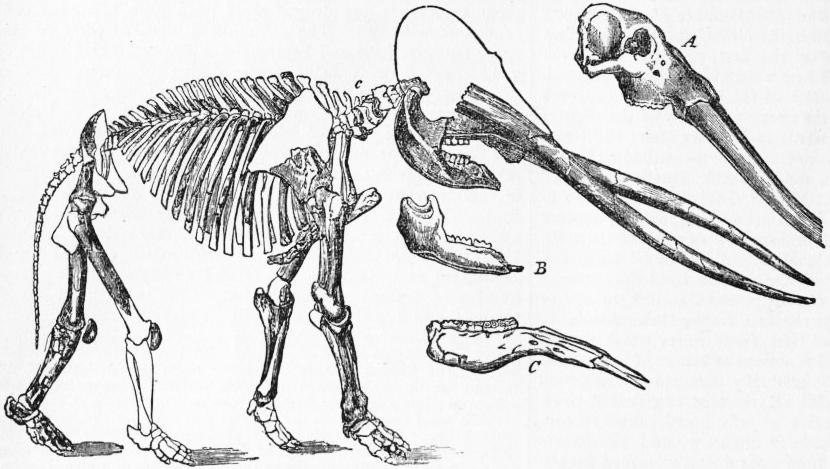
Fig. 1.—Mastodon turicensis (Pliocene). A, B, Skull and Lower Jaw of Mastodon americanus. C, Lower Jaw of Tetrabelodon longirostris.
The upper tusks of the early mastodons differ from those of elephants in retaining longitudinal bands of enamel. The molar teeth are six in number on each side, increasing in size from before backwards, and, as in the elephants, with a horizontal succession, the anterior teeth being lost before the full development of the posterior ones, which gradually move forward, taking the place of those that are destroyed by wear. This process is, however, less fully developed than in elephants, and as many as three teeth may be in place in each jaw at one time. There is, moreover, in many species a vertical succession, affecting either the third, or the third and second, or (in one American species, Tetrabelodon productus) the first, second and third of the six molar teeth. These three are therefore reckoned as milk-molars, and their successors as premolars, while the last three correspond to the true molars of other mammals. The mode of succession of the teeth in the mastodons exhibits so many stages of the process by which the dentition of elephants has been derived from that of more ordinary mammals. It also shows that the anterior molars of elephants do not correspond to the premolars of other ungulates, but to the milk-molars, the early loss of which in consequence of the peculiar process of horizontal forward-moving succession does not require their replacement by premolars. Specialized species like Mastodon americanus have completely lost the rudimentary premolars.
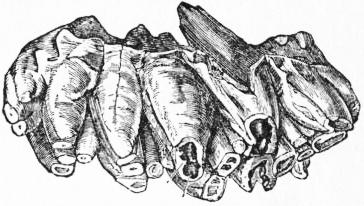
(From Owen.)
Fig. 2.—Upper Molar of Mastodon arvernensis, viewed from below.
Mastodons have fewer ridges on their molar teeth than elephants; the ridges are also less elevated, wider apart, with a thicker enamel covering, and scarcely any cement filling the space between them. Sometimes (as in M. americanus) the ridges are simple transverse wedge-shaped elevations, with straight or concave edges. In other species the summits of the ridges are divided into conical cusps, and may have accessory cusps clustering around them (as in M. arvernensis, fig. 2). When the summits of these are worn by mastication their surfaces present circles of dentine surrounded by a border of enamel, and as attrition proceeds different patterns are produced by the union of the bases of the cusps, a trefoil form being characteristic of some species.
Certain of the molar teeth of the middle of the series in both elephants and mastodons have the same number of principal ridges; those in front having fewer, and those behind a greater number. These teeth are distinguished as “intermediate” molars. In elephants there are only two, the last milk-molar and the first true molar (or the third and fourth of the whole series), which are alike in the number of ridges; whereas in mastodons there are three such teeth, the last milk-molar and the first and second molars (or the third, fourth and fifth of the whole series). In elephants the number of ridges on the intermediate molars always exceeds five, but in mastodons it is nearly always three or four, and the tooth in front has usually one fewer and that behind one more, so that the ridge-formula (i.e. a formula expressing the number of ridges on each of the six molar teeth) of most mastodons can be reduced either to 1, 2, 3, 3, 3, 4, or 2, 3, 4, 4, 4, 5. Three-ridged and four-ridged types occur both in Mastodon and Tetrabelodon.
(R. L.*)
MAS‘ŪDĪ (Abū-l Ḥasan ‘Alī ibn Ḥusain ibn ‘Alī ul-Mas‘ūdī) (d. c. 956), Arabian historian, was born at Bagdad towards the close of the 9th century. Much of his life was spent in travel. After he had been in Persia and Kerman, he visited Istakhr in 915, and went in the following year to Mūltān and Manṣūra, thence to Cambay, Saimur and Ceylon, to Madagascar and back to Oman. He seems about this time to have been as far as China. After a visit to the shores of the Caspian Sea he visited Tiberias in Palestine, examined the Christian church there, and described its relics. In 943 he was in Antioch, studying the ruins, and two years later in Damascus. The last ten years of his life he spent in Syria and Egypt. His great object in life had been to study with his own eyes the peculiarities of every land and to collect whatever was of interest for archaeology, history and manners. Himself a Mo‘tazilite (see Mahommedan Religion: Sects), he was singularly free from bigotry, and took his information, when necessary, from Persians, Jews, Indians, and even the chronicle of a Christian bishop.
His most extensive work was the Kitāb akhbār uz-Zamān or Annals, in 30 volumes with a supplement, the Kitāb ul-Ausaṭ, a chronological sketch of general history. Of these the first part only of the former is extant in MS. in Vienna, while the latter seems to be in the Bodleian Library, also in MS. The substance of the two was united by him in the work by which he is now best known, the Murūj udh-Dhahab wa Ma‘ādin ul-Jawāhir (“Meadows of Gold and Mines of Precious Stones”), an historical work which he completed in 947. In 956 he finished a second edition of this and made it double its former size, but no copy of this seems to be extant. The original edition has been published at Bulāq and Cairo, and with French translation by C. Barbier de Meynard and Pavet de Courteille (9 vols., Paris, 1861-1877). Another work of Mas’ūdī, written in the last year of his life, is the Kitāb ut-Tanbīh wal Ishrāf (the “Book of Indication and Revision”), in which he summarizes the work of his life and corrects and completes his former writings. It has been edited by M. J. de Goeje (Leiden, 1894), and a French translation has been made by Carra de Vaux (Paris, 1896); cf. also the memoir of S. de Sacy published in Meynard’s edition of the Murūj.
An account of Mas‘ūdī’s works is to be found in de Sacy’s memoir and in Goeje’s preface to his edition of the Tanbīh, and of the works extant in C. Brockelmann’s Gesch. der Arabischen Litteratur, i. 144-145 (Weimar, 1898). C. Field’s Tales of the Caliphs (1909) is based on Mas‘ūdī.
(G. W. T.)
MASULIPATAM, or Bandar, a seaport of British India, administrative headquarters of the Kistna district of Madras, on one of the mouths of the river Kistna, 215 m. N. of Madras city. Pop. (1901), 39,507. Masulipatam was the earliest English settlement on the Coromandel coast, its importance being due to the fact that it was the bandar or port of Golconda. An agency was established there in 1611. During the wars of the Carnatic, the English were temporarily expelled from the town, which was held by the French for some years. In 1759 the town and fort were carried by storm by Colonel Forde, an achievement followed by the acquisition of the Northern Circars (q.v.). In 1864 a great storm-wave swept over the entire town and is said to have destroyed 30,000 lives. Weavers form a large portion of the inhabitants, though their trade has greatly declined since the beginning of the 19th century. Their operations, besides weaving, include printing, bleaching, washing and dressing. In former days the chintzes of Masulipatam had a great reputation abroad for the freshness and permanency of their dyes. Masulipatam is a station of the Church Missionary Society. The port is only a roadstead, where vessels anchor 5 m. out. A branch line from Bezwada on the Southern Mahratta railway was opened in 1908. The chief educational institution is the Noble College of the C.M.S.
MAT (O. Eng. meatt, from late Lat. matta, whence Ital. matta, Ger. and Dan. matte, Du. mat, &c.), an article of various sizes and shapes, according to the purpose for which it is intended, and made of plaited or woven materials, such as coir, hemp, coco-nut fibre, straw, rushes, &c., or of rope or coarse twine. The finer fabrics are known as “matting” (q.v.). Mats are mainly used for covering floors, or in horticulture as a protection against cold or exposure for plants and trees. When used near the entrance to a house for people to wipe their boots on “door mats” are usually made of coarse coco-nut fibre, or india-rubber, cork, or of thickly coiled wire. Bags, rolls or sacks made of matting are used to hold coffee, flax, rice and other produce, and the term is often used with reference to the specific quantities of such produce, e.g. so many “mats” of coffee, rice, &c.
To be distinguished from the above is the term “mat” in glass-painting or gilding, meaning dull, unpolished or unburnished. This is the same as Ger. matt, dead, dull, cf. matt-blau, Med. Lat. mattus, adapted from Persian māt, dazed, astonished, at a loss, helpless, and seen in “mate” in chess, from Pers. shāh māt the king is dead.
MATABELE (“vanishing” or “hidden” people, so called from their appearance in battle, hidden behind enormous oxhide shields), a people of Zulu origin who began national life under the chief Mosilikatze. Driven out of the Transvaal by the Boers in 1837, Mosilikatze crossed the Limpopo with a military host which had been recruited from every tribe conquered by him during his ten years’ predominance in the Transvaal. In their new territories the Matabele absorbed into their ranks many members of the conquered Mashona tribes and established a military despotism. Their sole occupation was war, for which their laws and organization were designed to fit them. This system of constant warfare is, since the conquest of Matabeleland by the British in 1893, a thing of the past. The Matabele are now herdsmen and agriculturists. (See Rhodesia.)
MATACHINES (Span. matachin, clown, or masked dancer), bands of mummers or itinerant players in Mexico, especially popular around the Rio Grande, who wander from village to village during Lent, playing in rough-and-ready style a set drama based on the history of Montezuma. Dressed in fantastic Indian costumes and carrying rattles as their orchestra, the chief characters are El Monarca “the monarch” (Montezuma); Malinche, or Malintzin, the Indian mistress of Hernando Cortes; El Toro, “the bull,” the malevolent “comic man” of the play, dressed in buffalo skin with the animal’s horns on his head; Aguelo, the “grandfather,” and Aguela, “grandmother.” With the help of a chorus of dancers they portray the desertion of his people by Montezuma, the luring of him back by the wiles and smiles of Malinche, the final reunion of king and people, and the killing of El Toro, who is supposed to have made all the mischief.
MATADOR, a Spanish word meaning literally “killer,” from matar, Lat. mactare, especially applied to the principal performer in a bull-fight, whose function it is to slay the bull (see Bull-fighting). The word is also used of certain important cards in such games as quadrille, ombre, &c., and more particularly of a special form of the game of dominoes.
MATAMOROS, a town and port of the state of Tamaulipas, Mexico, on the S. bank of the Rio Grande, 28 m. from its mouth, opposite Brownsville, Texas. Pop. (1900), 8347. Matamoros stands in an open plain, the commercial centre for a large district, but its import trade is prejudiced by the bar at the mouth of the Rio Grande, which permits the entrance of small vessels only. The exports include hides, wool and live stock. The importance of the town in the foreign trade of northern Mexico, however, has been largely diminished by the great railways. Formerly it was the centre of a large contraband trade with Brownsville, Texas. Matamoros was founded early in the 19th century, and was named in honour of the Mexican patriot Mariano Matamoros (c. 1770-1814). In the war between the United States and Mexico, Matamoros was easily taken by the Americans on the 18th of May 1846, following General Zachary Taylor’s victories at Palo Alto and Resaca de la Palma. Matamoros was occupied by the Mexican imperialists under Mejia in 1864, and by the French in 1866.
MATANZAS, an important city of Cuba, capital of Matanzas Province, situated on a large deep bay on the N. coast, about 54 m. (by rail) E. of Havana. Pop. (1907), 36,009. There are railway outlets W., S. and E., and Matanzas is served by steamships to New York and by the coast steamers of the Herrera Line. The bay, unlike all the other better harbours of the island, has a broad mouth, 2 m. across, but there is good shelter against all winds except from the N.E. A coral reef lies across the entrance. Three rivers emptying into the bay—the San Juan, Canimar and Yumuri—have deposited much silt, necessitating the use of lighters in loading and unloading large ships. The city is finely placed at the head of the bay, on a low, sloping plain backed by wooded hills, over some of which the city itself has spread. The conical Pan de Matanzas (1277 ft.) is a striking land-mark for sailors. The San Juan and Yumuri rivers divide Matanzas into three districts. The Teatro Esteban, Casino Español and Government House are noteworthy among the buildings. The broad Paseo de Marti (Alameda de Versalles, Paseo de Santa Cristina) extends along the edge of the harbour, and is perhaps the handsomest parkway and boulevard in Cuba. At one end is a statue of Ferdinand VII., at the other a monument to 63 Cubans executed by the Spanish Government as traitors for bearing arms in the cause of independence. A splendid military road continues the Paseo to the Castillo de San Serverino (built in 1694-1695, reconstructed in 1773 and following years). There are two smaller forts, established in the 18th century. Near Matanzas are two of the most noted natural resorts of Cuba: the valley of the Yumuri, and the caves of Bellamar. Commanding the Yumuri Valley is the hill called Cumbre, on which is the Hermitage of Monteserrate (1870), with a famous shrine. Matanzas is the second port of the island in commerce. Sugar and molasses are the chief exports. The city is the chief outlet for the sugar product of the province, which, with the province of Santa Clara, produces two-thirds of the crop of the island. There are many large warehouses, rum distilleries, sugar-mills and railway machine-shops. Matanzas is frequently mentioned in the annals of the 16th and 17th centuries, when its bay was frequented by buccaneers; but the city was not laid out until 1693. In the next year it received an ayuntamiento (council). Its prosperity rapidly increased after the establishment of free commerce early in the 19th century. In 1815 it was made a department capital. The mulatto poet, Gabriel de la Concepción Valdés, known as Plácido (1809-1844), was born in Matanzas, and was executed there for participation in the supposed conspiracy of negroes in 1844, which is one of the most famous episodes in Cuban history. The hurricanes of 1844 and 1846 are the only other prominent local events. American commercial influence has always been particularly strong.
MATARÓ (anc. Iluro), a seaport of north-eastern Spain, in the province of Barcelona, on the Mediterranean Sea and the Barcelona-Perpignan railway. Pop. (1900), 19,704. The streets of the new town, lying next the sea, are wide and regularly built; those of the old town, farther up the hill, still preserve much of their ancient character. The parish church of Santa Maria has some good pictures and wood carvings. The wine of the neighbourhood, which resembles port, is shipped in large quantities from Barcelona; and the district furnishes fine roses and strawberries for the Barcelona market. The leading industries are manufactures of linen and cotton goods, especially canvas and tarpaulin, and of soap, paper, chemicals, starch, glass, leather, spirits and flour. The railway to Barcelona, opened in October 1848, was the first to be constructed in Spain. Outside the town is the much-frequented carbonated mineral spring of Argentona.
MATCH: 1. O. Eng. gemaecca, a cognate form of “make,” meaning originally “fit” or “suitable”; a pair, or one of a pair of objects, persons or animals. As particularly applied to a husband and wife, and hence to a marriage, the word is especially used of two persons or things which correspond exactly to each other. The verb “to match” has also the meaning to “pit one against each other,” and so is applied in sport to an arranged contest between individuals or sides.
2. O. Fr. mesche; apparently from a latinized form of Gr. μύξα, mucus from the nose, applied to the nozzle of a lamp; primarily the wick which conveys oil or molten wax to the flame of a lamp or candle (this use is now obsolete), the word being then applied to various objects having the property of carrying fire. With early firearms a match, consisting of a cord of hemp or similar material treated with nitre and other substances so that it continued to smoulder after it had been ignited, was used for firing the charge, being either held in the gunner’s hand or attached to the cock of the musket or arquebus and brought down by the action of the trigger on the powder priming (“matchlock”); and more or less similar preparations, made to burn more or less rapidly as required (“quick-match” and “slow-match”), are employed as fuses in blasting and demolition work in military operations. The word “match” was further used of a splint of wood, tipped with sulphur so that it would readily ignite, but it now most commonly means a slip of wood or other combustible material, having its end covered with a composition which takes fire when rubbed either on any rough surface or on another specially prepared composition.
The first attempt to make matches in the modern sense may probably be ascribed to Godfrey Haukwitz, who, in 1680, acting under the direction of Robert Boyle, who at that time had just discovered how to prepare phosphorus, employed small pieces of that element, ignited by friction, to light splints of wood dipped in sulphur. This device, however, did not come into extensive use owing to its danger and inconvenience and to the cost of the phosphorus, and till the beginning of the 19th century flint and steel with tinder-box and sulphur-tipped splints of wood—“spunks” or matches—were the common means of obtaining fire for domestic and other purposes. The sparks struck off by the percussion of flint and steel were made to fall among the tinder, which consisted of carbonized fragments of cotton and linen; the entire mass of the tinder was set into a glow, developing sufficient heat to ignite the sulphur with which the matches were tipped, and thereby the splints themselves were set on fire. In 1805 one Chancel, assistant to Professor L. J. Thénard of Paris, introduced an apparatus consisting of a small bottle containing asbestos, saturated with strong sulphuric acid, with splints or matches coated with sulphur, and tipped with a mixture of chlorate of potash and sugar. The matches so prepared, when brought into contact with the sulphuric acid in the bottle, ignited, and thus, by chemical action, fire was produced. In 1823 a decided impetus was given to the artificial production of fire by the introduction of the Döbereiner lamp, so called after its inventor, J. W. Döbereiner of Jena. The first really practical friction matches were made in England in 1827, by John Walker, a druggist of Stockton-on-Tees. These were known as “Congreves” after Sir William Congreve, the inventor of the Congreve rocket, and consisted of wooden splints or sticks of cardboard coated with sulphur and tipped with a mixture of sulphide of antimony, chlorate of potash and gum. With each box which was retailed at a shilling, there was supplied a folded piece of glass paper, the folds of which were to be tightly pressed together, while the match was drawn through between them. The same idea occurred to Sir Isaac Holden independently two and a half years later. The so-called “Prometheans,” patented by S. Jones of London in 1830, consisted of a short roll of paper with a small quantity of a mixture of chlorate of potash and sugar at one end, a thin glass globule of strong sulphuric acid being attached at the same point. When the sulphuric acid was liberated by pinching the glass globule, it acted on the mixed chlorate and sugar, producing fire. The phosphorus friction-match of the present day was first introduced on a commercial scale in 1833. It appears to have been made almost simultaneously in several distinct centres. The name most prominently connected with the early stages of the invention is that of J. Preschel of Vienna, who in 1833 had a factory in operation for making phosphorus matches, fusees, and amadou slips tipped with igniting composition. At the same time also matches were being made by F. Moldenhauer in Darmstadt; and for a long series of years Austria and the South-German states were the principal centres of the new industry.
But the use of ordinary white or yellow phosphorus as a principal ingredient in the igniting mixture of matches was found to be accompanied with very serious disadvantages. It is a deadly poison, and its free dissemination has led to many accidental deaths, and to numerous cases of wilful murder and suicide. Workers also who are exposed to phosphoric vapours are subject to a peculiarly distressing disease which attacks the jaw, and ultimately produces necrosis of the jaw-bone (“phossy jaw”), though with scrupulous attention to ventilation and cleanliness much of the risk of the disease may be avoided. The most serious objections to the use of phosphorus, however, were overcome by the discovery of the modified form of that body known as red or amorphous phosphorus. That substance was utilized for the manufacture of the well-known “safety matches” by J. E. Lundström, of Jönköping, Sweden, in 1852; its employment for this purpose had been patented eight years previously by another Swede, G. E. Pasch, who, however, regarded it as an oxide of phosphorus. Red phosphorus is in itself a perfectly innocuous substance, and no evil effects arise from freely working the compositions of which it forms an ingredient. The fact again that safety matches ignite only in exceptional circumstances on any other than the prepared surfaces which accompany the box—which surfaces and not the matches themselves contain the phosphorus required for ignition—makes them much less liable to cause accidental fires than other kinds.
The processes carried out in a match factory include preparing the splints, dipping them first in molten paraffin wax and then in the igniting composition, and filling the matches into boxes. All these operations are performed by complicated automatic machinery, in the development of which the Diamond Match Company of America has taken a leading part, with the minimum of manual intervention.
The chief element in the igniting mixture of ordinary or “strike anywhere” matches used to be common yellow phosphorus, combined with one or more other bodies which readily part with oxygen under the influence of heat. Chief among these latter substances is chlorate of potash, others being red lead, nitrate of lead, bichromate of potash and peroxide of manganese. But at the beginning of the 20th century many countries took steps to stop the use of yellow phosphorus owing to the danger to health attending its manipulation. In Sweden, matches made with it have been prohibited for home consumption, but not for export, since 1901. In 1905 and 1906 two conferences, attended by representatives of most of the governments of Europe, were held at Berne to consider the question of prohibiting yellow phosphorus, but no general agreement was reached owing to the objections entertained by Sweden, Norway, Spain and Portugal, and also Japan. Germany, France, Italy, Denmark, Holland, Switzerland and Luxemburg, however, agreed to a convention whereby yellow phosphorus was prohibited as from 1912, and to this Great Britain expressed her adherence after the passing of the White Matches Prohibition Act 1908, which forbade the manufacture and importation of such matches from the 1st of January 1910; though to avoid hardship to retailers and others holding large stocks it permitted their sale for a year longer. Phosphorous sulphide (sesquisulphide of phosphorus) is one of the substances widely employed as a substitute for yellow phosphorus in matches which will strike anywhere without the need of a specially prepared surface.
Safety matches contain no phosphorus in the heads; according to one formula that has been published the mixture with which they are tipped consists of chlorate of potash, 32 parts; bichromate of potash, 12; red lead, 32; sulphide of antimony, 24; while the ingredients of a suitable rubbing surface are eight parts of amorphous phosphorus to nine of sulphide of antimony. There is no doubt, however, that there is considerable diversity in the composition of the mixtures actually employed.
“Vestas” are matches in which short pieces of thin “wax taper” are used in place of wooden splints. Fusees or vesuvians consist of large oval heads fixed on a round splint. These heads consist of a porous mixture of charcoal, saltpetre, cascarilla or other scented bark, glass and gum, tipped with common igniting composition. When lighted they form a glowing mass, without flame.
It is calculated that in the principal European countries from six to ten matches are used for each inhabitant daily, and the world’s annual output must reach a total which requires twelve or thirteen figures for its expression. In the United States the manufacture is under the control of the Diamond Match Company, formed in 1881; which company also has an important share in the industry in Great Britain, where it has established large works. Similarly the manufacture of safety matches in Sweden is largely controlled by one big combination. In France matches are a government monopoly, and are both dear in price and inferior in quality, as compared with other countries where the industry is left to private enterprise. The French government formerly leased the manufacture to a company (Société générale des allumettes chimiques), but since 1890 it has been undertaken directly by the state.
MATE (a corruption of make, from O. Eng. gemaca, a “comrade”), a companion. In the language of the sea, the mate is the companion or assistant of the master, or of any officer at the head of a division of the crew. In the merchant service the mates are the officers who serve under the master, commonly called the captain, navigate the vessel under his direction, and replace him if he dies, or is disabled. In a war-ship mates serve under the gunner, boatswain, carpenter, &c. They are officers told off to attend to a particular part of the ship, as for example mate of the upper deck, whose duty is to see that it is kept clean, or mate of the hold, who is employed to serve out the water and other stores, and to keep the weights adjusted so as to preserve the trim—or balance—of the ship. (For “mate” in chess, see Chess.)
MATÉ, or Paraguay Tea, the dried leaves of Ilex paraguariensis,1 an evergreen shrub or small tree belonging to the same genus as the common holly, a plant to which it bears some resemblance in size and habit. The leaves are from 6 to 8 in. long, shortly stalked, with a somewhat acute tip and finely toothed at the margin. The small white flowers grow in forked clusters in the axils of the leaves; the sepals, petals and stamens are four in number, or occasionally five; and the berry is 4-seeded. The plant grows abundantly in Paraguay, and the south of Brazil, forming woods called yerbales. One of the principal centres of the maté industry is the Villa Real, a small town above Asuncion on the Paraguay river; another is the Villa de San Xavier, in the district between the rivers Uruguay and Parana.
Although maté appears to have been used from time immemorial by the Indians, the Jesuits were the first to attempt its cultivation. This was begun at their branch missions in Paraguay and the province of Rio Grande de San Pedro, where some plantations still exist, and yield the best tea that is made. From this circumstance the names Jesuits’ tea, tea of the Missions, St Bartholomew’s tea, &c., are sometimes applied to maté. Under cultivation the quality of the tea improves, but the plant remains a small shrub with numerous stems, instead of forming, as in the wild state, a tree with a rounded head. From cultivated plants the leaves are gathered every two or three years, that interval being necessary for restoration to vigorous growth. The collection of maté is, however, chiefly effected by Indians employed for that purpose by merchants, who pay a money consideration to government for the privilege.
When a yerbal or maté wood is found, the Indians, who usually travel in companies of about twenty-five in number, build wigwams and settle down to the work for about six months. Their first operation is to prepare an open space, called a tatacua, about 6 ft. square, in which the surface of the soil is beaten hard and smooth with mallets. The leafy branches of the maté are then cut down and placed on the tatacua, where they undergo a preliminary roasting from a fire kindled around it. An arch of poles, or of hurdles, is then erected above it, on which the maté is placed, a fire being lighted underneath. This part of the process demands some care, since by it the leaves have to be rendered brittle enough to be easily pulverized, and the aroma has to be developed, the necessary amount of heat being only learned by experience. After drying, the leaves are reduced to coarse powder in mortars formed of pits in the earth well rammed. Maté so prepared is called caa gazu or yerva do polos, and is chiefly used in Brazil. In Paraguay and the vicinity of Parana in the Argentine Republic, the leaves are deprived of the midrib before roasting; this is called caa-míri. A very superior quality, or caa-cuys, is also prepared in Paraguay from the scarcely expanded buds. Another method of drying maté has been adopted, the leaves being heated in large cast-iron pans set in brickwork, in the same way that tea is dried in China; it is afterwards powdered by machinery.
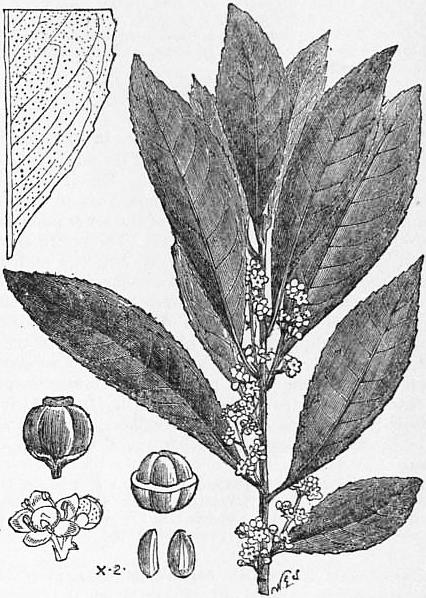
Maté (Ilex paraguariensis).
Portion of plant, half natural size. Flower, drupe and nuts, twice natural size. Part of under-side of leaf showing minute glands, natural size.
The different methods of preparation influence to a certain extent the value of the product, the maté prepared in Paraguay being considered the best, that of Oran and Paranagua very inferior. The leaves when dried are packed tightly in serons or oblong packages made of raw hides, which are then carefully sewed up. These shrink by exposure to the sun, and in a couple of days form compact parcels each containing about 200 ℔ of tea; in this form it keeps well. The tea is generally prepared for use in a small silver-mounted calabash, made of the fruit of Crescentia cujete (Cuca) or of Lagenaria (Cabaço), usually about the size of a large orange, the tapering end of the latter serving for a handle. In the top of the calabash, or maté,2 a circular hole about the size of a florin is made, and through this opening the tea is sucked by means of a bombilla. This instrument consists of a small tube 6 or 7 in. long, formed either of metal or a reed, which has at one end a bulb made either of extremely fine basket-work or of metal perforated with minute holes, so as to prevent the particles of the tea-leaves from being drawn up into the mouth. Some sugar and a little hot water are first placed in the gourd, the yerva is then added, and finally the vessel is filled to the brim with boiling water, or milk previously heated by a spirit lamp. A little burnt sugar or lemon juice is sometimes added instead of milk. The beverage is then handed round to the company, each person being furnished with a bombilla. The leaves will bear steeping about three times. The infusion, if not drunk soon after it is made, rapidly turns black. Persons who are fond of maté drink it before every meal, and consume about 1 oz. of the leaves per day. In the neighbourhood of Parana it is prepared and drunk like Chinese tea. Maté is generally considered disagreeable by those unaccustomed to it, having a somewhat bitter taste; moreover, it is the custom to drink it so hot as to be unpleasant. But in the south-eastern republics it is a much-prized article of luxury, and is the first thing offered to visitors. The gaucho of the plains will travel on horseback for weeks asking no better fare than dried beef washed down with copious draughts of maté, and for it he will forego any other luxury, such as sugar, rice or biscuit. Maté acts as a restorative after great fatigue in the same manner as tea. Since it does not lose its flavour so quickly as tea by exposure to the air and damp it is more valuable to travellers.
Since the beginning of the 17th century maté has been drunk by all classes in Paraguay, and it is now used throughout Brazil and the neighbouring countries.
The virtues of this substance are due to the occurrence in it of caffeine, of which a given quantity of maté, as prepared for drinking, contains definitely less than a similar quantity of tea or coffee. It is less astringent than either of these, and thus is, on all scores, less open to objection.
See Scully, Brazil (London, 1866); Mansfield, Brazil (London, 1856); Christy, New Commercial Plants, No. 3 (London, 1880); Kew Bulletin (1892), p. 132.
1 I. gigantea, I. ovalifolia, I. Humboldtiana, and I. nigropunctata, besides several varieties of these species, are also used for preparing maté.
2 The word caa signified the plant in the native Indian language. The Spaniards gave it a similar name, yerba. Maté comes from the language of the Incas, and originally means a calabash. The Paraguay tea was called at first yerva do maté, and then, the yerva being dropped, the name maté came to signify the same thing.
MATERA, a city of Basilicata, Italy, in the province of Potenza, from which it is 68 m. E. by road (13 m. S. of the station of Altamura), 1312 ft. above sea-level. Pop. (1901), 17,801. Part of it is built on a level plateau and part in deep valleys adjoining, the tops of the campaniles of the lower portions being on a level with the streets of the upper. The principal building is the cathedral of the archbishopric of Acerenza and Matera, formed in 1203 by the union of the two bishoprics, dating respectively from 300 and 398. The western façade of the cathedral is plain, while the utmost richness of decoration is lavished on the south front which faces the piazza. Almost in the centre of this south façade is an exquisitely sculptured window, from which letters from the Greek patriarch at Constantinople used to be read. The campanile is 175 ft. high. In the vicinity are the troglodyte caverns of Monte Scaglioso, still inhabited by some of the lower classes, and other caves with 13th-century frescoes.
Neolithic pottery has been found here, but the origin of the town is uncertain. Under the Normans Matera was a countship for William Bras de Fer and his successors. It was the chief town of the Basilicata from 1664 till 1811, when the French transferred the administration to Potenza.
MATERIALISM (from Lat. materia, matter), in philosophy, the theory which regards all the facts of the universe as explainable in terms of matter and motion, and in particular explains all psychical processes by physical and chemical changes in the nervous system. It is thus opposed both to natural realism and to idealism. For the natural realist stands upon the common-sense position that minds and material objects have equally effective existence; while the idealist explains matter by mind and denies that mind can be explained by matter. The various forms into which materialism may be classified correspond to the various causes which induce men to take up materialistic views. Naïve materialism is due to a cause which still, perhaps, has no small power, the natural difficulty which persons who have had no philosophic training experience in observing and appreciating the importance of the immaterial facts of consciousness. The pre-Socratics may be classed as naïve materialists in this sense; though, as at that early period the contrast between matter and spirit had not been fully realized and matter was credited with properties that belong to life, it is usual to apply the term hylozoism (q.v.) to the earliest stage of Greek metaphysical theory. It is not difficult to discern the influence of naïve materialism in contemporary thinking. We see it in Huxley, and still more in Haeckel, whose materialism (which he chooses to term “monism”) is evidently conditioned by ignorance of the history and present position of speculation. Cosmological materialism is that form of the doctrine in which the dominant motive is the formation of a comprehensive world-scheme: the Stoics and Epicureans were cosmological materialists. In anti-religious materialism the motive is hostility to established dogmas which are connected, in the Christian system especially, with certain forms of spiritual doctrine. Such a motive weighed much with Hobbes and with the French materialists of the 18th century, such as La Mettrie and d’Holbach. The cause of medical materialism is the natural bias of physicians towards explaining the health and disease of mind by the health and disease of body. It has received its greatest support from the study of insanity, which is now fully recognized as conditioned by disease of the brain. To this school belong Drs Maudsley and Mercier. The highest form of the doctrine is scientific materialism, by which term is meant the doctrine so commonly adopted by the physicist, zoologist and biologist.
It may perhaps be fairly said that materialism is at present a necessary methodological postulate of natural-scientific inquiry. The business of the scientist is to explain everything by the physical causes which are comparatively well understood and to exclude the interference of spiritual causes. It was the great work of Descartes to exclude rigorously from science all explanations which were not scientifically verifiable; and the prevalence of materialism at certain epochs, as in the enlightenment of the 18th century and in the German philosophy of the middle 19th, were occasioned by special need to vindicate the scientific position, in the former case against the Church, in the latter case against the pseudo-science of the Hegelian dialectic. The chief definite periods of materialism are the pre-Socratic and the post-Aristotelian in Greece, the 18th century in France, and in Germany the 19th century from about 1850 to 1880. In England materialism has been endemic, so to speak, from Hobbes to the present time, and English materialism is more important perhaps than that of any other country. But, from the national distrust of system, it has not been elaborated into a consistent metaphysic, but is rather traceable as a tendency harmonizing with the spirit of natural science. Hobbes, Locke, Hume, Mill and Herbert Spencer are not systematic materialists, but show tendencies towards materialism.
See Metaphysics; and Lange’s History of Materialism.
MATER MATUTA (connected with Lat. mane, matutinus, “morning”), an old Italian goddess of dawn. The idea of light being closely connected with childbirth, whereby the infant is brought into the light of the world, she came to be regarded as a double of Juno, and was identified by the Greeks with Eilithyia. Matuta had a temple in Rome in the Forum Boarium, where the festival of Matralia was celebrated on the 11th of June. Only married women were admitted, and none who had been married more than once were allowed to crown her image with garlands. Under hellenizing influences, she became a goddess of sea and harbours, the Ino-Leucothea of the Greeks. In this connexion it is noticeable that, as Ino tended her nephew Dionysus, so at the Matralia the participants prayed for the welfare of their nephews and nieces before that of their own children. The transformation was complete in 174 B.C., when Tiberius Sempronius Gracchus, after the conquest of Sardinia, placed in the temple of Matuta a map commemorative of the campaign, containing a plan of the island and the various engagements. The progress of navigation and the association of divinities of the sky with maritime affairs probably also assisted to bring about the change, although the memory of her earlier function as a goddess of childbirth survived till imperial times.
Ovid, Fasti, vi. 475; Livy xli. 28; Plutarch, Quaestiones romanae, 16, 17.
MATHEMATICS (Gr. μαθηματική, sc. τέχνη or ἐπιστήμη; from μάθημα, “learning” or “science”), the general term for the various applications of mathematical thought, the traditional field of which is number and quantity. It has been usual to define mathematics as “the science of discrete and continuous magnitude.” Even Leibnitz,1 who initiated a more modern point of view, follows the tradition in thus confining the scope of mathematics properly so called, while apparently conceiving it as a department of a yet wider science of reasoning. A short consideration of some leading topics of the science will exemplify both the plausibility and inadequacy of the above definition. Arithmetic, algebra, and the infinitesimal calculus, are sciences directly concerned with integral numbers, rational (or fractional) numbers, and real numbers generally, which include incommensurable numbers. It would seem that “the general theory of discrete and continuous quantity” is the exact description of the topics of these sciences. Furthermore, can we not complete the circle of the mathematical sciences by adding geometry? Now geometry deals with points, lines, planes and cubic contents. Of these all except points are quantities: lines involve lengths, planes involve areas, and cubic contents involve volumes. Also, as the Cartesian geometry shows, all the relations between points are expressible in terms of geometric quantities. Accordingly, at first sight it seems reasonable to define geometry in some such way as “the science of dimensional quantity.” Thus every subdivision of mathematical science would appear to deal with quantity, and the definition of mathematics as “the science of quantity” would appear to be justified. We have now to consider the reasons for rejecting this definition as inadequate.
Types of Critical Questions.—What are numbers? We can talk of five apples and ten pears. But what are “five” and “ten” apart from the apples and pears? Also in addition to the cardinal numbers there are the ordinal numbers: the fifth apple and the tenth pear claim thought. What is the relation of “the fifth” and “the tenth” to “five” and “ten”? “The first rose of summer” and “the last rose of summer” are parallel phrases, yet one explicitly introduces an ordinal number and the other does not. Again, “half a foot” and “half a pound” are easily defined. But in what sense is there “a half,” which is the same for “half a foot” as “half a pound”? Furthermore, incommensurable numbers are defined as the limits arrived at as the result of certain procedures with rational numbers. But how do we know that there is anything to reach? We must know that √2 exists before we can prove that any procedure will reach it. An expedition to the North Pole has nothing to reach unless the earth rotates.
Also in geometry, what is a point? The straightness of a straight line and the planeness of a plane require consideration. Furthermore, “congruence” is a difficulty. For when a triangle “moves,” the points do not move with it. So what is it that keeps unaltered in the moving triangle? Thus the whole method of measurement in geometry as described in the elementary textbooks and the older treatises is obscure to the last degree. Lastly, what are “dimensions”? All these topics require thorough discussion before we can rest content with the definition of mathematics as the general science of magnitude; and by the time they are discussed the definition has evaporated. An outline of the modern answers to questions such as the above will now be given. A critical defence of them would require a volume.2
Cardinal Numbers.—A one-one relation between the members of two classes α and β is any method of correlating all the members of α to all the members of β, so that any member of α has one and only one correlate in β, and any member of β has one and only one correlate in α. Two classes between which a one-one relation exists have the same cardinal number and are called cardinally similar; and the cardinal number of the class α is a certain class whose members are themselves classes—namely, it is the class composed of all those classes for which a one-one correlation with α exists. Thus the cardinal number of α is itself a class, and furthermore α is a member of it. For a one-one relation can be established between the members of α and α by the simple process of correlating each member of α with itself. Thus the cardinal number one is the class of unit classes, the cardinal number two is the class of doublets, and so on. Also a unit class is any class with the property that it possesses a member x such that, if y is any member of the class, then x and y are identical. A doublet is any class which possesses a member x such that the modified class formed by all the other members except x is a unit class. And so on for all the finite cardinals, which are thus defined successively. The cardinal number zero is the class of classes with no members; but there is only one such class, namely—the null class. Thus this cardinal number has only one member. The operations of addition and multiplication of two given cardinal numbers can be defined by taking two classes α and β, satisfying the conditions (1) that their cardinal numbers are respectively the given numbers, and (2) that they contain no member in common, and then by defining by reference to α and β two other suitable classes whose cardinal numbers are defined to be respectively the required sum and product of the cardinal numbers in question. We need not here consider the details of this process.
With these definitions it is now possible to prove the following six premisses applying to finite cardinal numbers, from which Peano3 has shown that all arithmetic can be deduced:—
i. Cardinal numbers form a class.
ii. Zero is a cardinal number.
iii. If a is a cardinal number, a + 1 is a cardinal number.
iv. If s is any class and zero is a member of it, also if when x is a cardinal number and a member of s, also x + 1 is a member of s, then the whole class of cardinal numbers is contained in s.
v. If a and b are cardinal numbers, and a + 1 = b + 1, then a = b.
vi. If a is a cardinal number, then a + 1 ≠ 0.
It may be noticed that (iv) is the familar principle of mathematical induction. Peano in an historical note refers its first explicit employment, although without a general enunciation, to Maurolycus in his work, Arithmeticorum libri duo (Venice, 1575).
But now the difficulty of confining mathematics to being the science of number and quantity is immediately apparent. For there is no self-contained science of cardinal numbers. The proof of the six premisses requires an elaborate investigation into the general properties of classes and relations which can be deduced by the strictest reasoning from our ultimate logical principles. Also it is purely arbitrary to erect the consequences of these six principles into a separate science. They are excellent principles of the highest value, but they are in no sense the necessary premisses which must be proved before any other propositions of cardinal numbers can be established. On the contrary, the premisses of arithmetic can be put in other forms, and, furthermore, an indefinite number of propositions of arithmetic can be proved directly from logical principles without mentioning them. Thus, while arithmetic may be defined as that branch of deductive reasoning concerning classes and relations which is concerned with the establishment of propositions concerning cardinal numbers, it must be added that the introduction of cardinal numbers makes no great break in this general science. It is no more than an interesting subdivision in a general theory.
Ordinal Numbers.—We must first understand what is meant by “order,” that is, by “serial arrangement.” An order of a set of things is to be sought in that relation holding between members of the set which constitutes that order. The set viewed as a class has many orders. Thus the telegraph posts along a certain road have a space-order very obvious to our senses; but they have also a time-order according to dates of erection, perhaps more important to the postal authorities who replace them after fixed intervals. A set of cardinal numbers have an order of magnitude, often called the order of the set because of its insistent obviousness to us; but, if they are the numbers drawn in a lottery, their time-order of occurrence in that drawing also ranges them in an order of some importance. Thus the order is defined by the “serial” relation. A relation (R) is serial4 when (1) it implies diversity, so that, if x has the relation R to y, x is diverse from y; (2) it is transitive, so that if x has the relation R to y, and y to z, then x has the relation R to z; (3) it has the property of connexity, so that if x and y are things to which any things bear the relation R, or which bear the relation R to any things, then either x is identical with y, or x has the relation R to y, or y has the relation R to x. These conditions are necessary and sufficient to secure that our ordinary ideas of “preceding” and “succeeding” hold in respect to the relation R. The “field” of the relation R is the class of things ranged in order by it. Two relations R and R′ are said to be ordinally similar, if a one-one relation holds between the members of the two fields of R and R′, such that if x and y are any two members of the field of R, such that x has the relation R to y, and if x′ and y′ are the correlates in the field of R′ of x and y, then in all such cases x′ has the relation R′ to y′, and conversely, interchanging the dashes on the letters, i.e. R and R′, x and x′, &c. It is evident that the ordinal similarity of two relations implies the cardinal similarity of their fields, but not conversely. Also, two relations need not be serial in order to be ordinally similar; but if one is serial, so is the other. The relation-number of a relation is the class whose members are all those relations which are ordinally similar to it. This class will include the original relation itself. The relation-number of a relation should be compared with the cardinal number of a class. When a relation is serial its relation-number is often called its serial type. The addition and multiplication of two relation-numbers is defined by taking two relations R and S, such that (1) their fields have no terms in common; (2) their relation-numbers are the two relation-numbers in question, and then by defining by reference to R and S two other suitable relations whose relation-numbers are defined to be respectively the sum and product of the relation-numbers in question. We need not consider the details of this process. Now if n be any finite cardinal number, it can be proved that the class of those serial relations, which have a field whose cardinal number is n, is a relation-number. This relation-number is the ordinal number corresponding to n; let it be symbolized by ṅ Thus, corresponding to the cardinal numbers 2, 3, 4 ... there are the ordinal numbers 2̇, 3̇, 4̇.... The definition of the ordinal number 1 requires some little ingenuity owing to the fact that no serial relation can have a field whose cardinal number is 1; but we must omit here the explanation of the process. The ordinal number 0̇ is the class whose sole member is the null relation—that is, the relation which never holds between any pair of entities. The definitions of the finite ordinals can be expressed without use of the corresponding cardinals, so there is no essential priority of cardinals to ordinals. Here also it can be seen that the science of the finite ordinals is a particular subdivision of the general theory of classes and relations. Thus the illusory nature of the traditional definition of mathematics is again illustrated.
Cantor’s Infinite Numbers.—Owing to the correspondence between the finite cardinals and the finite ordinals, the propositions of cardinal arithmetic and ordinal arithmetic correspond point by point. But the definition of the cardinal number of a class applies when the class is not finite, and it can be proved that there are different infinite cardinal numbers, and that there is a least infinite cardinal, now usually denoted by א0, where א is the Hebrew letter aleph. Similarly, a class of serial relations, called well-ordered serial relations, can be defined, such that their corresponding relation-numbers include the ordinary finite ordinals, but also include relation-numbers which have many properties like those of the finite ordinals, though the fields of the relations belonging to them are not finite. These relation-numbers are the infinite ordinal numbers. The arithmetic of the infinite cardinals does not correspond to that of the infinite ordinals. The theory of these extensions of the ideas of number is dealt with in the article Number. It will suffice to mention here that Peano’s fourth premiss of arithmetic does not hold for infinite cardinals or for infinite ordinals. Contrasting the above definitions of number, cardinal and ordinals, with the alternative theory that number is an ultimate idea incapable of definition, we notice that our procedure exacts a greater attention, combined with a smaller credulity; for every idea, assumed as ultimate, demands a separate act of faith.
The Data of Analysts.—Rational numbers and real numbers in general can now be defined according to the same general method, If m and n are finite cardinal numbers, the rational number m/n is the relation which any finite cardinal number x bears to any finite cardinal number y when n × x = m × y. Thus the rational number one, which we will denote by 1r, is not the cardinal number 1; for 1r is the relation 1/1 as defined above, and is thus a relation holding between certain pairs of cardinals. Similarly, the other rational integers must be distinguished from the corresponding cardinals. The arithmetic of rational numbers is now established by means of appropriate definitions, which indicate the entities meant by the operations of addition and multiplication. But the desire to obtain general enunciations of theorems without exceptional cases has led mathematicians to employ entities of ever-ascending types of elaboration. These entities are not created by mathematicians, they are employed by them, and their definitions should point out the construction of the new entities in terms of those already on hand. The real numbers, which include irrational numbers, have now to be defined. Consider the serial arrangement of the rationals in their order of magnitude. A real number is a class (α, say) of rational numbers which satisfies the condition that it is the same as the class of those rationals each of which precedes at least one member of α. Thus, consider the class of rationals less than 2r; any member of this class precedes some other members of the class—thus 1/2 precedes 4/3, 3/2 and so on; also the class of predecessors of predecessors of 2r is itself the class of predecessors of 2r. Accordingly this class is a real number; it will be called the real number 2R. Note that the class of rationals less than or equal to 2r is not a real number. For 2r is not a predecessor of some member of the class. In the above example 2R is an integral real number, which is distinct from a rational integer, and from a cardinal number. Similarly, any rational real number is distinct from the corresponding rational number. But now the irrational real numbers have all made their appearance. For example, the class of rationals whose squares are less than 2r satisfies the definition of a real number; it is the real number √2. The arithmetic of real numbers follows from appropriate definitions of the operations of addition and multiplication. Except for the immediate purposes of an explanation, such as the above, it is unnecessary for mathematicians to have separate symbols, such as 2, 2r and 2R, or 2/3 and (2/3)R. Real numbers with signs (+ or −) are now defined. If a is a real number, +a is defined to be the relation which any real number of the form x + a bears to the real number x, and −a is the relation which any real number x bears to the real number x + a. The addition and multiplication of these “signed” real numbers is suitably defined, and it is proved that the usual arithmetic of such numbers follows. Finally, we reach a complex number of the nth order. Such a number is a “one-many” relation which relates n signed real numbers (or n algebraic complex numbers when they are already defined by this procedure) to the n cardinal numbers 1, 2 ... n respectively. If such a complex number is written (as usual) in the form x1e1 + x2e2 + ... + xnen, then this particular complex number relates x1 to 1, x2 to 2, ... xn to n. Also the “unit” e1 (or e2) considered as a number of the system is merely a shortened form for the complex number (+1) e1 + 0e2 + ... + 0en. This last number exemplifies the fact that one signed real number, such as 0, may be correlated to many of the n cardinals, such as 2 ... n in the example, but that each cardinal is only correlated with one signed number. Hence the relation has been called above “one-many.” The sum of two complex numbers x1e1 + x2e2 + ... + xnen and y1e1 + y2e2 + ... + ynen is always defined to be the complex number (x1 + y1)e1 + (x2 + y2)e2 + ... + (xn + yn)en. But an indefinite number of definitions of the product of two complex numbers yield interesting results. Each definition gives rise to a corresponding algebra of higher complex numbers. We will confine ourselves here to algebraic complex numbers—that is, to complex numbers of the second order taken in connexion with that definition of multiplication which leads to ordinary algebra. The product of two complex numbers of the second order—namely, x1e1 + x2e2 and y1e1 + y2e2, is in this case defined to mean the complex (x1y1 - x2y2)e1 + (x1y2 + x2y1)e2. Thus e1 × e1 = e, e2 × e2 = -e1, e1 × e2 = e2 × e1 = e2. With this definition it is usual to omit the first symbol e1, and to write i or √−1 instead of e2. Accordingly, the typical form for such a complex number is x + yi, and then with this notation the above-mentioned definition of multiplication is invariably adopted. The importance of this algebra arises from the fact that in terms of such complex numbers with this definition of multiplication the utmost generality of expression, to the exclusion of exceptional cases, can be obtained for theorems which occur in analogous forms, but complicated with exceptional cases, in the algebras of real numbers and of signed real numbers. This is exactly the same reason as that which has led mathematicians to work with signed real numbers in preference to real numbers, and with real numbers in preference to rational numbers. The evolution of mathematical thought in the invention of the data of analysis has thus been completely traced in outline.
Definition of Mathematics.—It has now become apparent that the traditional field of mathematics in the province of discrete and continuous number can only be separated from the general abstract theory of classes and relations by a wavering and indeterminate line. Of course a discussion as to the mere application of a word easily degenerates into the most fruitless logomachy. It is open to any one to use any word in any sense. But on the assumption that “mathematics” is to denote a science well marked out by its subject matter and its methods from other topics of thought, and that at least it is to include all topics habitually assigned to it, there is now no option but to employ “mathematics” in the general sense5 of the “science concerned with the logical deduction of consequences from the general premisses of all reasoning.”
Geometry.—The typical mathematical proposition is: “If x, y, z ... satisfy such and such conditions, then such and such other conditions hold with respect to them.” By taking fixed conditions for the hypothesis of such a proposition a definite department of mathematics is marked out. For example, geometry is such a department. The “axioms” of geometry are the fixed conditions which occur in the hypotheses of the geometrical propositions. The special nature of the “axioms” which constitute geometry is considered in the article Geometry (Axioms). It is sufficient to observe here that they are concerned with special types of classes of classes and of classes of relations, and that the connexion of geometry with number and magnitude is in no way an essential part of the foundation of the science. In fact, the whole theory of measurement in geometry arises at a comparatively late stage as the result of a variety of complicated considerations.
Classes and Relations.—The foregoing account of the nature of mathematics necessitates a strict deduction of the general properties of classes and relations from the ultimate logical premisses. In the course of this process, undertaken for the first time with the rigour of mathematicians, some contradictions have become apparent. That first discovered is known as Burali-Forti’s contradiction,6 and consists in the proof that there both is and is not a greatest infinite ordinal number. But these contradictions do not depend upon any theory of number, for Russell’s contradiction7 does not involve number in any form. This contradiction arises from considering the class possessing as members all classes which are not members of themselves. Call this class w; then to say that x is a w is equivalent to saying that x is not an x. Accordingly, to say that w is a w is equivalent to saying that w is not a w. An analogous contradiction can be found for relations. It follows that a careful scrutiny of the very idea of classes and relations is required. Note that classes are here required in extension, so that the class of human beings and the class of rational featherless bipeds are identical; similarly for relations, which are to be determined by the entities related. Now a class in respect to its components is many. In what sense then can it be one? This problem of “the one and the many” has been discussed continuously by the philosophers.8 All the contradictions can be avoided, and yet the use of classes and relations can be preserved as required by mathematics, and indeed by common sense, by a theory which denies to a class—or relation—existence or being in any sense in which the entities composing it—or related by it—exist. Thus, to say that a pen is an entity and the class of pens is an entity is merely a play upon the word “entity”; the second sense of “entity” (if any) is indeed derived from the first, but has a more complex signification. Consider an incomplete proposition, incomplete in the sense that some entity which ought to be involved in it is represented by an undetermined x, which may stand for any entity. Call it a propositional function; and, if φx be a propositional function, the undetermined variable x is the argument. Two propositional functions φx and ψx are “extensionally identical” if any determination of x in φx which converts φx into a true proposition also converts ψx into a true proposition, and conversely for ψ and φ. Now consider a propositional function Fχ in which the variable argument χ is itself a propositional function. If Fχ is true when, and only when, χ is determined to be either φ or some other propositional function extensionally equivalent to φ, then the proposition Fφ is of the form which is ordinarily recognized as being about the class determined by φx taken in extension—that is, the class of entities for which φx is a true proposition when x is determined to be any one of them. A similar theory holds for relations which arise from the consideration of propositional functions with two or more variable arguments. It is then possible to define by a parallel elaboration what is meant by classes of classes, classes of relations, relations between classes, and so on. Accordingly, the number of a class of relations can be defined, or of a class of classes, and so on. This theory9 is in effect a theory of the use of classes and relations, and does not decide the philosophic question as to the sense (if any) in which a class in extension is one entity. It does indeed deny that it is an entity in the sense in which one of its members is an entity. Accordingly, it is a fallacy for any determination of x to consider “x is an x” or “x is not an x” as having the meaning of propositions. Note that for any determination of x, “x is an x” and “x is not an x,” are neither of them fallacies but are both meaningless, according to this theory. Thus Russell’s contradiction vanishes, and an examination of the other contradictions shows that they vanish also.