VOLUME XVII SLICE VII Mars to Matteawan (continued 8)
Reading edition

MASERU, the capital of Basutoland, British South Africa. It is pleasantly situated on the left bank of the Caledon river, 90 m. by rail E. by S. of Bloemfontein, and 40 m. N.E. of Wepener. It is in the centre of a fertile grain-growing district. Pop. (1904), 862, of whom 99 were Europeans. The principal buildings are Government House, the church of the Paris Evangelical Missionary Society, the hospital, and the railway station. (See Basutoland.)
MASHAM, ABIGAIL, Lady (d. 1734), favourite of Anne, queen of England, was the daughter of Francis Hill, a London merchant, her mother being an aunt of Sarah Jennings, duchess of Marlborough. The family being reduced to poor circumstances through Hill’s speculations, Lady Churchill (as she then was), lady of the bedchamber to the Princess Anne, befriended her cousin Abigail, whom she took into her own household at St Albans, and for whom after the accession of the princess to the throne she procured an appointment in the queen’s household about the year 1704. It was not long before Abigail Hill began to supplant her powerful and imperious kinswoman in the favour of Queen Anne. Whether she was guilty of the deliberate ingratitude charged against her by the duchess of Marlborough is uncertain. It is not unlikely that, in the first instance at all events, Abigail’s influence over the queen was not so much due to subtle scheming on her part as to the pleasing contrast between her gentle and genial character and the dictatorial temper of the duchess, which after many years of undisputed sway had at last become intolerable to Anne. The first intimation of her protégé’s growing favour with the queen came to the duchess in the summer of 1707, when she learned that Abigail Hill had been privately married to a gentleman of the queen’s household named Samuel Masham, and that the queen herself had been present at the marriage. Inquiry then elicited the information that Abigail had for some time enjoyed considerable intimacy with her royal mistress, no hint of which had previously reached the duchess. Abigail was said to be a cousin of Robert Harley, earl of Oxford, and after the latter’s dismissal from office in February 1708 she assisted him in maintaining confidential relations with the queen. The completeness of her ascendancy was seen in 1710 when the queen compelled Marlborough, much against his will, to give an important command to Colonel John Hill, Abigail’s brother; and when Sunderland, Godolphin, and the other Whig ministers were dismissed from office, largely owing to her influence, to make way for Oxford and Bolingbroke. In the following year the duchess of Marlborough was also dismissed from her appointment at court, Mrs Masham taking her place as keeper of the privy purse. In 1711 the ministers, intent on bringing about the disgrace of Marlborough and arranging the Peace of Utrecht, found it necessary to secure their position in the House of Lords by creating twelve new peers; one of these was Samuel Masham, the favourite’s husband, though Anne showed some reluctance to raise her bedchamber woman to a position in which she might show herself less ready to give her personal services to the queen. Lady Masham soon quarrelled with Oxford, and set herself to foster by all the means in her power the queen’s growing personal distaste for her minister. Oxford’s vacillation between the Jacobites and the adherents of the Hanoverian succession to the Crown probably strengthened the opposition of Lady Masham, who now warmly favoured the Jacobite party led by Bolingbroke and Atterbury. Altercations took place in the queen’s presence between Lady Masham and the minister; and finally, on the 27th of July 1714, Anne dismissed Oxford from his office of lord high treasurer, and three days later gave the staff to the duke of Shrewsbury. Anne died on the 1st of August, and Lady Masham then retired into private life. She died on the 6th of December 1734.
Lady Masham was by no means the vulgar, ill-educated person she was represented to have been by her defeated rival, the duchess of Marlborough; her extant letters, showing not a little refinement of literary style, prove the reverse. Swift, with whom both she and her husband were intimate, describes Lady Masham as “a person of a plain sound understanding, of great truth and sincerity, without the least mixture of falsehood or disguise.” The barony of Masham became extinct when Lady Masham’s son, Samuel, the 2nd baron, died in June 1776.
Authorities.—Gilbert Burnet, History of My Own Time, vol. vi. (2nd ed., 6 vols., Oxford, 1833); F. W. Wyon, History of Great Britain during the Reign of Queen Anne (2 vols., London, 1876); Earl Stanhope, History of England, comprising the Reign of Queen Anne until the Peace of Utrecht (London, 1870), and History of England from the Peace of Utrecht, vol. i. (7 vols., London, 1836-1854); Justin McCarthy, The Reign of Queen Anne (2 vols., London, 1902); An Account of the Conduct of the Dowager Duchess of Marlborough from first coming to Court to 1710, edited by Nathaniel Hooke, with an anonymous reply entitled A Review of a Late Treatise (London, 1842); Private Correspondence of Sarah, Duchess of Marlborough (2 vols., London, 1838); Letters of Sarah, Duchess of Marlborough (London, 1875); Mrs Arthur Colville, Duchess Sarah (London, 1904). Numerous references to Lady Masham will also be found scattered through Swift’s Works (2nd ed., 19 vols., Edinburgh, 1824).
(R. J. M.)
MASHAM, SAMUEL CUNLIFFE LISTER, 1st Baron (1815-1906), English inventor, born at Calverley Hall, near Bradford, on the 1st of January 1815, was the fourth son of Ellis Cunliffe (1774-1853), who successively took the names of Lister and Lister-Kay, and was the first member of parliament elected for Bradford after the Reform Act of 1832. It was at first proposed that he should take orders, but he preferred a business career and became a clerk at Liverpool. In 1838 he and his elder brother John started as worsted spinners and manufacturers in a new mill which their father built for them at Manningham, and about five years later he turned his attention to the problem of mechanical wool-combing, which, in spite of the efforts of E. Cartwright and numerous other inventors, still awaited a satisfactory solution. Two years of hard work spent in modifying and improving existing devices enabled him to produce a machine which worked well, and subsequently he consolidated his position by buying up rival patents, as well as by taking out additional ones of his own. His combing machines came into such demand that though they were made for only £200 apiece he was able to sell them for £1200, and the saving they effected in the cost of production not only brought about a reduction in the price of clothing, but in consequence of the increase in the sales created the necessity for new supplies of wool, and thus contributed to the development of Australian sheep-farming. In 1855 he was sent a sample of silk waste (the refuse left in reeling silk from the cocoons) and asked whether he could find a way of utilizing the fibre it contained. The task occupied his time for many years and brought him to the verge of bankruptcy, but at last he succeeded in perfecting silk-combing appliances which enabled him to make yarn that in one year sold for 23s. a pound, though produced from raw material costing only 6d. or 1s. a pound. Another important and lucrative invention in connexion with silk manufacture was his velvet loom for piled fabrics; and this, with the silk comb worked at his Manningham mill, yielded him an annual income of £200,000 for many years. But the business was seriously affected by the prohibitory duties imposed by America, and this was one reason why he was an early and determined critic of the British policy of free imports. In 1891 he was made a peer; he took his title from the little Yorkshire town of Masham, close to which is Swinton Park, purchased by him in 1888. In 1886 an Albert medal was awarded him for his inventions, which were mostly related to the textile industries, though he occasionally diverged to other subjects, such as an air-brake for railways. He was fond of outdoor sports, especially coursing and shooting, and was a keen patron of the fine arts. He died at Swinton Park on the 2nd of February 1906, and was succeeded in the title by his son.
MASHONA, a Bantu-negro people, inhabitants of Mashonaland, Southern Rhodesia. The name Mashona has been derived from the contemptuous term Amashuina applied by the Matabele to the aborigines owing to the habit of the latter of taking refuge in the rocky hills with which the country abounds. Before the Matabele invasion about 1840 most of Southern Rhodesia was occupied by the Makalanga, the Makorikori and the Banyai, all closely related. Most of them became subject to the Matabele, but although they suffered severely from their attacks, the Mashona preserved a certain national unity. In 1890 the Mashona came under British protection (see Rhodesia). They are in general a peaceful, mild-mannered people, industrious and successful farmers, skilful potters, and weavers of bark cloth.
The crafts, however, in which they excel are the smelting and forging of iron and wood-carving. They are also great hunters; and they are very fond of music, the most usual instrument being the “piano” with iron keys. Bows and arrows, assegais and axes are the native weapons, but all who can get them now use guns. Up to their conquest by the Matabele the Mashona worked the gold diggings which are scattered over their country; indeed as late as 1870 certain Mashona were still extracting gold from quartz (Geog. Jour. April 1906).
For the possible connexion of these people with the builders of the ruins at Zimbabwe and elsewhere, see Rhodesia: Archaeology; and Zimbabwe.
MASK (Fr. masque, apparently from med. Lat. mascus, masca, spectre, through Ital. maschera, Span. mascara), a covering for the face, taking various forms, used either as a protective screen or as a disguise. In the latter sense masks are mostly associated with the artificial faces worn by actors in dramatic representations, or assumed for exciting terror (e.g. in savage rites). The spelling “masque,” representing the same word, is now in English used more specially for certain varieties of drama in which masks were originally worn (see Drama); so also “masquerade,” particularly in the sense of a masked ball or an entertainment where the personages arc disguised. Both “mask” and “masquerade” have naturally passed into figurative and technical meanings, the former especially for various senses of face and head (head of a fox, grotesque faces in sculpture), or as equivalent to “cloak” or “screen” (as in fortification or other military uses, fencing, &c.). And in the case of “death-masks” the term is employed for the portrait-casts, generally of plaster or metallic foil, taken from the face of a dead person (also similarly from the living), an ancient practice of considerable interest in art. An interesting collection made by Laurence Hutton (see his Portraits in Plaster, 1894), is at Princeton University in the United States. (For the historical mystery of the “man in the iron mask,” see Iron Mask.)
The ancient Greek and Roman masks worn by their actors—hollow figures of heads—had the double object of identifying the performers with the characters assumed, and of increasing the power of the voice by means of metallic mouthpieces. They were derived like the drama from the rural religious festivities, the wearing of mock faces or beards being a primitive custom, connected no doubt with many early types of folk-lore and religion. The use of the dramatic mask was evolved in the later theatre through the mimes and the Italian popular comedy into pantomime; and the masquerade similarly came from Italy, where the domino was introduced from Venice. The domino (originally apparently an ecclesiastical garment) was a loose cloak with a small half-mask worn at masquerades and costume-balls by persons not otherwise dressed in character; and the word is applied also to the person wearing it.
See generally Altmann, Die Masken der Schauspieler (1875; new ed., 1896); and Dale, Masks, Labrets and Certain Aboriginal Customs (1885); also Drama.
MASKELYNE, NEVIL (1732-1811), English astronomer-royal, was born in London on the 6th of October 1732. The solar eclipse of 1748 made a deep impression upon him; and having graduated as seventh wrangler from Trinity College, Cambridge, in 1754, he determined to devote himself wholly to astronomy. He became intimate with James Bradley in 1755, and in 1761 was deputed by the Royal Society to make observations of the transit of Venus at St Helena. During the voyage he experimented upon the determination of longitude by lunar distances, and ultimately effected the introduction of the method into navigation (q.v.). In 1765 he succeeded Nathaniel Bliss as astronomer-royal. Having energetically discharged the duties of his office during forty-six years, he died on the 9th of February 1811.
Maskelyne’s first contribution to astronomical literature was “A Proposal for Discovering the Annual Parallax of Sirius,” published in 1760 (Phil. Trans. li. 889). Subsequent volumes of the same series contained his observations of the transits of Venus (1761 and 1769), on the tides at St Helena (1762), and on various astronomical phenomena at St Helena (1764) and at Barbados (1764). In 1763 he published the British Mariner’s Guide, which includes the suggestion that in order to facilitate the finding of longitude at sea lunar distances should be calculated beforehand for each year and published in a form accessible to navigators. This important proposal, the germ of the Nautical Almanac, was approved of by the government, and under the care of Maskelyne the Nautical Almanac for 1767 was published in 1766. He continued during the remainder of his life the superintendence of this invaluable annual. He further induced the government to print his observations annually, thereby securing the prompt dissemination of a large mass of data inestimable from their continuity and accuracy. Maskelyne had but one assistant, yet the work of the observatory was perfectly organized and methodically executed. He introduced several practical improvements, such as the measurement of time to tenths of a second; and he prevailed upon the government to replace Bird’s mural quadrant by a repeating circle 6 ft. in diameter. The new instrument was constructed by E. Troughton; but Maskelyne did not live to see it completed. In 1772 he suggested to the Royal Society the famous Schehallion experiment for the determination of the earth’s density and carried out his plan in 1774 (Phil. Trans. 1. 495), the apparent difference of latitude between two stations on opposite sides of the mountain being compared with the real difference of latitude obtained by triangulation. From Maskelyne’s observations Charles Hutton deduced a density for the earth 4.5 times that of water (ib. lxviii. 782). Maskelyne also took a great interest in various geodetical operations, notably the measurement of the length of a degree of latitude in Maryland and Pennsylvania (ibid. lviii. 323), executed by Mason and Dixon in 1766-1768, and later the determination of the relative longitude of Greenwich and Paris (ib. lxxvii. 151). On the French side the work was conducted by Count Cassini, Legendre, and Méchain; on the English side by General Roy. This triangulation was the beginning of the great trigonometrical survey which has since been extended all over the country. His observations appeared in four large folio volumes (1776-1811). Some of them were reprinted in S. Vince’s Astronomy (vol. iii.).
(A. M. C.)
MASOLINO DA PANICALE (1383-c. 1445), Florentine painter, was said to have been born at Panicale di Valdelsa, near Florence. It is more probable, however, that he was born in Florence itself, his father, Cristoforo Fini, who was an “imbiancatore,” or whitewasher, having been domiciled in the Florentine quarter of S. Croce. There is reason to believe that Tommaso, nicknamed Masolino, was a pupil of the painter Starnina, and was principally influenced in style by Antonio Veneziano; he may probably enough have become in the sequel the master of Masaccio. He was born in 1383; he died later than 1429, perhaps as late as 1440 or even 1447. Towards 1423 he entered the service of Filippo Scolari, the Florentine-born obergespann of Temeswar in Hungary, and stayed some time in that country, returning towards 1427 to Italy. The only works which can with certainty be assigned to him are a series of wall paintings executed towards 1428, commissioned by Cardinal Branda Castiglione, in the church of Castiglione d’Olona, not far from Milan, and another series in the adjoining baptistery. The first set is signed as painted by “Masolinus de Florentia.” It was recovered in 1843 from a coating of whitewash, considerably damaged; its subject matter is taken from the lives of the Virgin and of SS Lawrence and Stephen. The series in the baptistery relates to the life and death of John the Baptist. The reputation of Masolino had previously rested almost entirely upon the considerable share which he was supposed to have had in the celebrated frescoes of the Brancacci Chapel, in the Church of the Carmine in Florence; he was regarded as the precursor of Masaccio, and by many years the predecessor of Filippino Lippi, in the execution of a large proportion of these works. But from a comparison of the Castiglione with the Brancacci frescoes, and from other data, it is very doubtful whether Masolino had any hand at all in the latter series. Possibly he painted in the Brancacci Chapel certain specified subjects which are now either destroyed or worked over. Several paintings assigned to Masolino on the authority of Vasari are now ascribed to Masaccio.
(W. M. R.)
MASON, FRANCIS (1799-1874), American missionary, was born in York, England, on the 2nd of April 1799. His grandfather, Francis Mason, was the founder of the Baptist Society in York, and his father, a shoemaker by trade, was a Baptist lay preacher there. After working with his father as a shoemaker for several years, he emigrated in 1818 to the United States, and in Massachusetts was licensed to preach as a Baptist in 1827. In 1830 he was sent by the American Baptist Missionary Convention to labour among the Karens in Burma. Besides conducting a training college for native preachers and teachers at Tavoy, he translated the Bible into the two principal dialects of the Karens, the Sgaw and the Pwo (his translation being published in 1853), and Matthew, Genesis, and the Psalms into the Bghai dialect. He also published A Pali Grammar on the Basis of Kachchayano, with Chrestomathy and Vocabulary (1868). In 1852 he published a book of great value on the fauna and flora of British Burma, of which an improved edition appeared in 1860 under the title Burmah, its People and Natural Productions, and a third edition (2 vols.) revised and enlarged by W. Theobald in 1882-1883. He died at Rangoon on the 3rd of March 1874.
See his autobiography, The Story of a Working Man’s Life, with Sketches of Travel in Europe, Asia, Africa and America (New York, 1870).
MASON, GEORGE (1725-1792), American statesman, was born in Stafford county (the part which is now Fairfax county), Virginia, in 1725. His family was of Royalist descent and emigrated to America after the execution of Charles I. His colonial ancestors held official positions in the civil and military service of Virginia. Mason was a near neighbour and a lifelong friend of George Washington, though in later years they disagreed in politics. His large estates and high social standing, together with his personal ability, gave Mason great influence among the Virginia planters, and he became identified with many enterprises, such as the organization of the Ohio Company and the founding of Alexandria (1749). He was a member of the Virginia House of Burgesses in 1759-1760. In 1769 he drew up for Washington a series of non-importation resolutions, which were adopted by the Virginia legislature. In July 1774 he wrote for a convention in Fairfax county a series of resolutions known as the Fairfax Resolves, in which he advocated a congress of the colonies and suggested non-intercourse with Great Britain, a policy subsequently adopted by Virginia and later by the Continental Congress. He was a member of the Virginia Committee of Safety from August to December 1775, and of the Virginia Convention in 1775 and 1776; and in 1776 he drew up the Virginia Constitution and the famous Bill of Rights, a radically democratic document which had great influence on American political institutions. In 1780 he outlined the plan which was subsequently adopted by Virginia for ceding to the Federal government her claim to the “back lands,” i.e. to territory north and north-west of the Ohio river. From 1776 to 1788 he represented Fairfax county in the Virginia Assembly. He was a member of the Virginia House of Delegates in 1776-1780 and again in 1787-1788, and in 1787 was a member of the convention that framed the Federal Constitution, and as one of its ablest debaters took an active part in the work. Particularly notable was his opposition to the compromises in regard to slavery and the slave-trade. Indeed, like most of the prominent Virginians of the time, Mason was strongly in favour of the gradual abolition of slavery. He objected to the large and indefinite powers given by the completed Constitution to Congress, so he joined with Patrick Henry in opposing its ratification in the Virginia Convention (1788). Failing in this he suggested amendments, the substance of several of which was afterwards embodied in the present Bill of Rights. Declining an appointment as a United States Senator from Virginia, he retired to his home, Gunston Hall (built by him about 1758 and named after the family home in Staffordshire, England), where he died on the 7th of October 1792. With James Madison and Thomas Jefferson, Mason carried through the Virginia legislature measures disestablishing the Episcopal Church and protecting all forms of worship. In politics he was a radical republican, who believed that local government should be kept strong and central government weak; his democratic theories had much influence in Virginia and other southern and western states.
See Kate Mason Rowland, Life and Writings of George Mason (2 vols., New York, 1892).
MASON, GEORGE HEMMING (1818-1872), English painter, was born at Wetley Abbey, the eldest son of a Staffordshire county gentleman. He was educated at King Edward’s School, Birmingham, and studied for the medical profession for five years under Dr Watt of that city. But all his thoughts being given to art, he abandoned medicine in 1844 and travelled for a time on the Continent, finally settling in Rome, where he remained for some years and sought to make a living as an artist. During this period he underwent many privations which permanently affected his health; but he continued to labour assiduously, making studies of the picturesque scenery that surrounded him, and with hardly any instruction except that received from Nature and from the Italian pictures he gradually acquired the painter’s skill. At least two important works are referable to this period: “Ploughing in the Campagna,” shown in the Royal Academy of 1857, and “In the Salt Marshes, Campagna,” exhibited in the following year. After Mason’s return from the continent, in 1858, when he settled at Wetley Abbey, he continued for a while to paint Italian subjects from studies made during his stay abroad, and then his art began to touch in a wonderfully tender and poetic way the peasant life of England, especially of his native Staffordshire, and the homely landscape in the midst of which that life was set. The first picture of this class was “Wind on the Wold,” and it was followed—along with much else of admirable quality—by the painter’s three greatest works: The “Evening Hymn” (1868), a band of Staffordshire mill-girls returning from their work; “Girls dancing by the Sea” (1869); and the “Harvest Moon” (1872). He left Staffordshire in 1865 and went to live at Hammersmith; and he was elected an associate of the Royal Academy in 1869. By that time he had fully established his position as an artist of unusual power and individuality. Mason died on the 22nd of October 1872. In his work he laboured under the double disadvantage of feeble and uncertain health, and a want of thorough art-training, so that his pictures were never produced easily, or without strenuous and long-continued effort. His art is great in virtue of the solemn pathos which pervades it, of the dignity and beauty in rustic life which it reveals, of its keen perception of noble form and graceful motion, and of rich effects of colour and subdued light. In motif and treatment it has something in common with the art of Millet and Jules Breton, as with that of Frederick Walker among Englishmen; though he had neither the occasional uncouth robustness of Millet nor the firm actuality of Jules Breton. His pictures “Wind on the Wold” and “The Cast Shoe” are in the National Gallery of British Art.
MASON, JAMES MURRAY (1798-1871), American political leader, was born in Fairfax county, Virginia, on the 3rd of November 1798, the grandson of George Mason (1723-1792). Educated at the university of Pennsylvania and the college of William and Mary, he was admitted to the bar in 1820. He was a member of the Virginia House of Delegates in 1826-1827 and 1828-1831, of the state Constitutional Convention of 1829, of the National House of Representatives (1837-1839), of the United States Senate from 1847 until July 1861 (when, with other Southern senators he was formally expelled—he had previously withdrawn), and of the Virginia Secession Convention in April 1861. Entering politics as a Jacksonian Democrat, Mason was throughout his career a consistent strict constructionist, opposing protective tariffs, internal improvements by the national government, and all attempts to restrict or control the spread of slavery, which he sincerely believed to be essential to the social and political welfare of the South. He was the author of the Fugitive Slave Act of 1850, and in 1860 was chairman of the Senate committee which investigated the John Brown raid. After Lincoln’s election as President he was one of the strongest advocates of secession in Virginia. He was appointed in August 1861 commissioner of the Confederate States to Great Britain. The British ship “Trent,” upon which he and John Slidell, the commissioner to France, sailed, was intercepted (Nov. 8, 1861) by a United States ship-of-war (the “San Jacinto,” Captain Charles Wilkes), and the two commissioners were seized and carried as prisoners to Boston. Great Britain immediately demanded their release, and war for a time seemed imminent; but owing mainly to the tactful diplomacy of the prince consort, Lincoln acknowledged that the seizure of Mason and Slidell was a violation of the rights of Great Britain as a neutral, and on the 1st of January 1862 released the commissioners. The incident has become known in history as the “Trent Affair.” Mason at once proceeded to London, where, however, he was unable to secure official recognition, and his commission to Great Britain was withdrawn late in 1863. He remained in Europe, spending most of his time at Paris and holding blank commissions which he was authorized to fill in at his discretion in case the presence of a Confederate commissioner should seem desirable at any particular European court. These commissions, however, he did not use. After the war he lived for several years in Canada, but returned in 1869 to Virginia, and on the 28th of April 1871 died at Alexandria.
See The Public Life and Diplomatic Correspondence of James M. Mason, with some Personal History (Roanoke, Va., 1903), by his daughter, Virginia Mason; Sir Theodore Martin, Life of the Prince Consort.
MASON, SIR JOHN (1503-1566), English diplomatist, was born of humble parentage at Abingdon in 1503, and was educated at Oxford, where he became Fellow of All Souls in 1521. He was ordained before 1531. Most of his early years were spent on the Continent, where he witnessed the meeting between Henry VIII. and Francis I. at Calais in 1532, and where he was employed in collecting information for the English government, gaining in this work the reputation of a capable diplomatist. By his never-failing caution, moderation and pliancy, Mason succeeded in keeping himself in favour with four successive sovereigns of the Tudor monarchy. In 1537 he became secretary to the English ambassador at Madrid, Sir Thomas Wyat; but when the latter was put on his trial for treason in 1541 Mason was unmolested, and soon afterwards was appointed clerk of the privy council, and procured for himself sundry other posts and privileges. Mason was knighted and made dean of Winchester by Edward VI. He was one of the commissioners to negotiate the treaty by which Boulogne was restored to France in 1550, and in the same year he became English ambassador in Paris, where he helped to arrange the bethrothal of Edward VI. to the princess Elizabeth of France. He returned to England at the end of 1551, became clerk of parliament, received extensive grants of land, and in 1552 was made chancellor of Oxford University. He was elected member of parliament in the same year. On the death of Edward VI., he at first joined the party of Northumberland and the Lady Jane Grey; but quickly perceiving his mistake he took an active part in procuring the proclamation of Mary as queen. Mason now received fresh tokens of royal favour, being confirmed in all his secular, though not in his ecclesiastical, offices; and in 1553 he was appointed English ambassador at the court of the emperor Charles V., of whose abdication at Brussels in October 1555 he wrote a vivid account. He took a prominent share in the administrative business of the government in the first years of Elizabeth’s reign, and largely influenced her foreign policy until his death, which occurred on the 20th of April 1566. Sir John Mason married Elizabeth, daughter of Sir Thomas Isley of Sundridge, Kent, and widow of Richard Hill. He had no children, and his heir was Anthony Wyckes, whom he had adopted, and who assumed the name of Mason and left a large family.
See J. A. Froude, History of England (12 vols., London, 1856-1870); Charles Wriothesley, Chronicle of England during the Reigns of the Tudors, edited by W. D. Hamilton (Camden Soc., 2 vols., London, 1875); P. F. Tytler, England under the Reigns of Edward VI. and Mary (2 vols., London, 1839); John Strype, Ecclesiastical Memorials (3 vols., Oxford, 1824) and Memorials of Thomas Cranmer (3 vols., Oxford, 1848); Acts of the Privy Council of England (new series), edited by J. R. Dasent, vols. i.-vii.
MASON, JOHN (1586-1635), founder of New Hampshire, U.S.A., was born in King’s Lynn, Norfolk, England. In 1610 he commanded a small naval force sent by James I. to assist in subduing the Hebrides Islands. From 1615 to 1621 he was governor of the English colony on the north side of Conception Bay in Newfoundland; he explored the island, made the first English map of it (published in 1625), and wrote a descriptive tract entitled A Briefe Discourse of the Newfoundland (Edinburgh, 1620) to promote the colonization of the island by Scotsmen. Here he was brought into official relations with Sir Ferdinando Gorges, then a commissioner to regulate the Newfoundland fisheries. In March 1622 Mason obtained from the Council for New England, of which Gorges was the most influential member, a grant of the territory (which he named Mariana) between the Naumkeag or Salem river and the Merrimac, and in the following August he and Gorges together received a grant of the region between the Merrimac and Kennebec rivers, and extending 60 m. inland. From 1625 to 1629 Mason was engaged as treasurer and paymaster of the English army in the wars which England was waging against Spain and France. Towards the close of 1629 Mason and Gorges agreed upon a division of the territory held jointly by them, and on the 7th of November 1629 Mason received from the Council a separate grant of the tract between the Merrimac and the Piscataqua, which he now named New Hampshire. Thinking that the Piscataqua river had its source in Lake Champlain, Mason with Gorges and a few other associates secured, on the 17th of November 1629, a grant of a region which was named Laconia (apparently from the number of lakes it was supposed to contain), and was described as bordering on Lake Champlain, extending 10 m. east and south from it and far to the west and north-west, together with 1000 acres to be located along some convenient harbour, presumably near the mouth of the Piscataqua. In November 1631 Mason and his associates obtained, under the name of the Pescataway Grant, a tract on both sides of the Piscataqua river, extending 30 m. inland and including also the Isles of Shoals. Mason became a member of the Council for New England in June 1632, and its vice-president in the following November; and in 1635, when the members decided to divide their territory among themselves and surrender their charter, he was allotted as his share all the region between the Naumkeag and Piscataqua rivers extending 60 m. inland, the southern half of the Isles of Shoals, and a ten-thousand acre tract, called Masonia, on the west side of the Kennebec river. In October 1635 he was appointed vice-admiral of New England, but he died early in December, before crossing the Atlantic. He was buried in Westminster Abbey. Forty-four years after his death New Hampshire was made a royal province.
See Captain John Mason, the Founder of New Hampshire (Boston, 1887; published by the Prince Society), which contains a memoir by C. W. Tuttle and historical papers relating to Mason’s career, edited by J. W. Dean.
MASON, JOHN YOUNG (1799-1859), American political leader and diplomatist, was born in Greenesville county, Virginia, on the 18th of April 1799. Graduating at the university of North Carolina in 1816, he studied law in the famous Litchfield (Connecticut) law school, and in 1819 was admitted to practice in Southampton county, Virginia. He served in the Virginia house of delegates in 1823-1827, in the state constitutional convention of 1829-1830, and from 1831 to 1837 in the National House of Representatives, being chairman of the committee on foreign affairs in 1835-1836. He was secretary of the navy in President Tyler’s cabinet (1844-1845), and was attorney-general (1845-1846) and secretary of the navy (1846-1849), succeeding George Bancroft, under President Polk. He was president of the Virginia constitutional convention of 1851, and from 1853 until his death at Paris on the 3rd of October 1859, was United States minister to France. In this capacity he attracted attention by wearing at the court of Napoleon III. a simple diplomatic uniform (for this he was rebuked by Secretary of State W. L. Marcy, who had ordered American ministers to wear a plain civilian costume), and by joining with James Buchanan and Pierre Soulé, ministers to Great Britain and Spain respectively, in drawing up (Oct. 1854) the famous Ostend Manifesto. Hawthorne called him a “fat-brained, good-hearted, sensible old man”; and in politics he was a typical Virginian of the old school, a state’s rights Democrat, upholding slavery and hating abolitionism.
MASON, SIR JOSIAH (1795-1881), English pen-manufacturer, was born in Kidderminster on the 23rd of February 1795, the son of a carpet-weaver. He began life as a street hawker of cakes, fruits and vegetables. After trying his hand in his native town at shoemaking, baking, carpentering, blacksmithing, house-painting and carpet-weaving, he moved in 1814 to Birmingham. Here he found employment in the gilt-toy trade. In 1824 he set up on his own account as a manufacturer of split-rings by machinery, to which he subsequently added the making of steel pens. Owing to the circumstance of his pens being supplied through James Perry, the London stationer whose name they bore, he was less well known than Joseph Gillott and other makers, although he was really the largest producer in England. In 1874 the business was converted into a limited liability company. Besides his steel-pen trade Mason carried on for many years the business of electro-plating, copper-smelting, and india-rubber ring making, in conjunction with George R. Elkington. Mason was almost entirely self-educated, having taught himself to write when a shoemaker’s apprentice, and in later life he felt his deficiencies keenly. It was this which led him in 1860 to establish his great orphanage at Erdington, near Birmingham. Upon it he expended about £300,000, and for this munificent endowment he was knighted in 1872. He had previously given a dispensary to his native town and an almshouse to Erdington. In 1880 Mason College, since incorporated in the university of Birmingham, was opened, the total value of the endowment being about £250,000. Mason died on the 16th of June 1881.
See J. T. Bunce, Josiah Mason (1882).
MASON, LOWELL (1792-1872), American musician, was born at Medfield, Massachusetts. For some years he led a business life, but was always studying music; and in 1827, as the result of his work in forming the collection of church music published in 1821 at Boston by the Handel and Haydn Society, he moved to Boston and there first became president of the society and then founder of the Boston Academy of Music (1832). He published some successful educational books, and was a pioneer of musical instruction in the public schools, adopted in 1838. He received the degree of doctor of music from New York University in 1855. He died at Orange, New Jersey, on the 11th of August 1872.
His son William Mason (1829-1908), an accomplished pianist and composer, published an interesting volume of reminiscences, Memoirs of a Musical Life, in 1901.
MASON, WILLIAM (1725-1797), English poet, son of William Mason, vicar of Holy Trinity, Hull, was born on the 12th of February 1725, was educated at St John’s College, Cambridge, and took holy orders. In 1744 he wrote Musaeus, a lament for Pope in imitation of Lycidas, and in 1749 through the influence of Thomas Gray he was elected a fellow of Pembroke College. He became a devoted friend and admirer of Gray, who addressed him as “Skroddles,” and corrected the worst solecisms in his verses. In 1748 he published Isis, a poem directed against the supposed Jacobitism of the university of Oxford, which provoked Thomas Warton’s Triumph of Isis. Mason conceived the ambition of reconciling modern drama with ancient forms by strict observance of the unities and the restoration of the chorus. These ideas were exemplified in Elfrida (1752) and Caractacus (1759), two frigid performances no doubt intended to be read rather than acted, but produced with some alterations at Covent Garden in 1772 and 1776 respectively. Horace Walpole described Caractacus as “laboured, uninteresting, and no more resembling the manners of Britons than of Japanese”; while Gray declared he had read the manuscript “not with pleasure only, but with emotion.” In 1754 Mason was presented to the rectory of Aston, near Rotherham, Yorkshire, and in 1757 through the influence of the duke of Devonshire he became one of the king’s chaplains. He also received the prebend of Holme in York Minster (1756), was made canon residentiary in 1762, and in 1763 became precentor and prebendary of Driffield. He married in 1764 Mary Sherman, who died three years later. When Gray died in 1771 he made Mason his literary executor. In the preparation of the Life and Letters of Gray, which appeared in 1774, he had much help from Horace Walpole, with whom he corresponded regularly until 1784 when Mason opposed Fox’s India Bill, and offended Walpole by thrusting on him political advice unasked. Twelve years of silence followed, but in the year before his death the correspondence was renewed on friendly terms. Mason died at Aston on the 7th of April 1797.
His correspondence with Gray and Walpole shows him to have been a man of cultivated tastes. He was something of an antiquarian, a good musician, and an amateur of painting. He is said to have invented an instrument called the celestina, a modified pianoforte. Gray rewarded his faithful admiration with good-humoured kindness. He warned him against confounding Mona with the Isle of Man, or the Goths with the Celts, corrected his grammar, pointed out his plagiarisms, and laughed gently at his superficial learning. His powers show to better advantage in the unacknowledged satirical poems which he produced under the pseudonym of Malcolm Macgregor. In editing Gray’s letters he took considerable liberties with his originals, and did not print all that related to himself.
Mason’s other works included Odes (1756); The English Garden, a didactic poem in blank verse, the four books of which appeared in 1772, 1777, 1779 and 1782; An Heroic Epistle to Sir William Chambers (1774); an Ode to Mr Pinchbeck (1776) and an Epistle to Dr Shebbeare (1777)—all these by “Malcolm Macgregor”; Essay, Historical and Critical, of Church Music (1795), and a lyrical drama, Sappho (1797).
His poems were collected in 1764 and 1774, and an edition of his Works appeared in 1811. His poems with a Life are included in Alexander Chalmers’s English Poets. His correspondence with Walpole was edited by J. Mitford in 1851; and his correspondence with Gray by the same editor in 1853. See also the standard editions of the letters of Gray and of Walpole. There is a very pleasant picture of Mason’s character in Southey’s Doctor (ch. cxxvi.).
MASON AND DIXON LINE, in America, the boundary line (lat. 39° 43′ 26.3″ N.) between Maryland and Pennsylvania, U.S.A.; popularly the line separating “free” states and “slave” states before the Civil War. The line derives its name from Charles Mason (1730-1787) and Jeremiah Dixon, two English astronomers, whose survey of it to a point about 244 m. west of the Delaware between 1763 and 17671 marked the close of the protracted boundary dispute (arising upon the grant of Pennsylvania to William Penn in 1681) between the Baltimores and Penns, proprietors respectively of Maryland and Pennsylvania. The dispute arose from the designation, in the grant to Penn, of the southern boundary of Pennsylvania mainly as the parallel marking the “beginning of the fortieth degree of Northerne Latitude,” after the northern boundary of Maryland had been defined as a line “which lieth under the fortieth degree of north latitude from the equinoctial.” The eastern part of the line as far as Sideling Hill in the western part of the present Washington county, was originally marked with milestones brought from England, every fifth of which bore on one side the arms of Baltimore and on the opposite side those of Penn; but the difficulties in transporting them to the westward were so great that many of them were not set up. Owing to the removal of the stone marking the north-east corner of Maryland, this point was again determined and marked in 1849-1850 by Lieut.-Colonel J. D. Graham of the U.S. topographical engineers; and as the western part of the boundary was not marked by stones, and local disputes arose, the line was again surveyed between 1901 and 1903 under the direction of a commission appointed by Pennsylvania and Maryland.
The use of the term “Mason and Dixon Line” to designate the boundary between the free and the slave states (and in general between the North and the South) dates from the debates in Congress over the Missouri Compromise in 1819-1820. As so used it may be defined as not only the Mason and Dixon Line proper, but also the line formed by the Ohio River from its intersection with the Pennsylvania boundary to its mouth, thence the eastern, northern and western boundaries of Missouri, and thence westward the parallel 36° 30′—the line established by the Missouri Compromise to separate free and slave territory in the “Louisiana Purchase,” except as regards Missouri. It is to be noted, however, that the Missouri Compromise did not affect the territory later acquired from Mexico.
1 These surveyors also surveyed and marked the boundary between Maryland and Delaware.
MASON CITY, a city and the county-seat of Cerro Gordo county, Iowa, U.S.A., on Lime Creek, in the northern part of the state. Pop. (1905, state census), 8357 (929 foreign-born); (1910) 11,230. It is served by the Chicago Milwaukee & St Paul, the Chicago & North-Western, the Chicago Great Western, the Iowa Central and the St Paul & Des Moines railways, and also by the Mason City & Clear Lake (electric) railway, which connects Mason City with Clear Lake, a pleasure resort, 10 m. west of the city. At Mason City is Memorial University (co-educational; founded in 1900 by the National Encampment of the Sons of Veterans, and opened in 1902), dedicated to the Grand Army of the Republic, the special aim of which is to teach American history. The city is situated in a good agricultural region, and there are valuable stone quarries in the vicinity. The manufactures include lime, Portland cement, brick and tile. Mason City was settled in 1853, laid out in 1855, incorporated as a town in 1870 and chartered as a city in 1881.
MASONRY,1 the art of building in stone. The earliest remains (apart from the primitive work in rude stone—see Stone Monuments; Archaeology, &c.) are those of the ancient temples of India and Egypt. Many of these early works were constructed of stones of huge size, and it still remains a mystery how the ancients were able to quarry and raise to a considerable height above the ground blocks seven or eight hundred tons in weight. Many of the early buildings of the middle ages were entirely constructed of masses of concrete, often faced with a species of rough cast. The early masonry seems to have been for the most part worked with the axe and not with the chisel. A very excellent example of the contrast between the earlier and later Norman masonry may be seen in the choir of Canterbury Cathedral. In those times the groining was frequently filled in with a light tufa stone, said by some to have been brought from Italy, but more probably from the Rhine. The Normans imported a great quantity of stone from Caen, it being easily worked, and particularly fit for carving. The freestones of England were also much used; and in the first Pointed period, Purbeck and Bethersden marbles were employed for column shafts, &c. The methods of working and setting stone were much the same as at present, except that owing to difficulties of conveyance the stones were used in much smaller sizes. As time went on the art of masonry advanced till in England, in point of execution, it at length rivalled that of any country.
Tools.—The mason’s tools may be grouped under five heads—hammers and mallets, saws, chisels, setting-out and setting tools, and hoisting appliances.
There are several different kinds of iron hammers used by the stone worker; the mash hammer has a short handle and heavy head for use with chisels; the iron hammer, used in carving, in shape resembles a carpenter’s mallet but is smaller; Hammers and Mallets. the waller’s hammer is used for roughly shaping stones in rubble work; the spalling hammer for roughly dressing stones in the quarry; the scabbling-hammer, for the same purpose, has one end pointed for use on hard stone; the pick has a long head pointed at both ends, weighs from 14 to 20 ℔, and is used for rough dressing and splitting; the axe has a double wedge-shaped head and is used to bring stones to a fairly level face preparatory to their being worked smooth; the patent axe, or patent hammer, is formed with a number of plates with sharpened edges bolted together to form a head; the mallet of hard wood is used for the finishing chisel work and carving; and the dummy is of similar shape but smaller.
A hand saw similar to that used by the carpenter is used for cutting small soft stones. Larger blocks are cut with the two-handed Saws. saw worked by two men. For the largest blocks the frame saw is used, and is slung by a rope and pulleys fitted with balance weights to relieve the operator of its weight. The blade is of plain steel, the cutting action being supplied by sand with water as a lubricant constantly applied.
There are perhaps even more varieties of chisels than of hammers. The point and the punch have very small cutting edges, a quarter of an inch or less in width. The former is used on the harder and the latter on the softer varieties of stone Chisels. after the rough hammer dressing. The pitching tool has a wide thick edge and is used in rough dressing. Jumpers are shafts of steel having a widened edge, and are used for boring holes in hard stone. Chisels are made with edges from a quarter-inch to one and a half inches wide; those that exceed this width are termed boasters. The claw chisel has a number of teeth from one-eighth to three-eighths wide, and is used on the surface of hard stones after the point has been used. The drag is a semi-circular steel plate, the straight edge having teeth cut on it. It is used to level down the surfaces of soft stones. Cockscombs are used for the same purpose on mouldings and are shaped to various curves. Wedges of various sizes are used in splitting stones and are inserted either in holes made with the jumper or in chases cut with the stone-pick.
The implements for setting out the work are similar to those used, by the bricklayer and other tradesmen, comprising the Setting-out and Setting Tools. rule, square, set square, the bevel capable of being set to any required angle, compasses, spirit level, plumb-rule and bob and mortar trowels. Gauges and moulds are required in sinking moulds to the proper section.
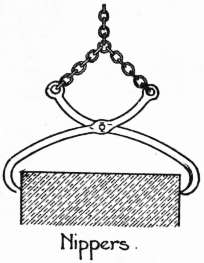
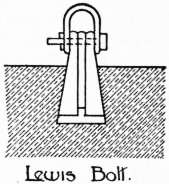
Fig. 1.—(½ in. = 1 ft.) Fig. 2.—(1 in. = 1 ft.)
The nippers (fig. 1), or scissors, as they are sometimes termed, have two hooked arms fitting into notches in the opposite sides of the block to be lifted. These arms are riveted together in the same way as a pair of scissors, the upper ends Hoisting Appliances. having rings attached for the insertion of a rope or chain which when pulled tight in the operation of lifting causes the hooked ends to grip the stone. Lewises (fig. 2.) are wedge-shaped pieces of steel which are fitted into a dovetailed mortise in the stone to be hoisted. They are also used for setting blocks too large to be set by hand, and are made in several forms. These are the usual methods of securing the stone to the hoisting rope or chain, the hoisting being effected by a pulley and fall, by a crane, or by other means.
Scaffolding.—For rubble walls single scaffolds, resting partly on the walls, similar to those used for brickwork (q.v.), are employed; for ashlar and other gauged stonework (see below) self-supporting scaffolds are used with a second set of standards and ledgers erected close to the wall, the whole standing entirely independent. The reason for the use of this double scaffold is that otherwise holes for the putlogs to rest in would have to be left in the wall, and obviously in an ashlar stone wall it would be impossible properly to make these good on the removal of the scaffold (see further Scaffold).
Seasoning Stone.—Stone freshly quarried is full of sap, and thus admits of being easily worked. On being exposed to the air the sap dries out, and the stone becomes much harder in consequence. For this reason, and because carriage charges are lessened by the smaller bulk of the worked stone as compared with the rough block, the stone for a building is often specified to be quarry-worked. Vitruvius recommended that stone should be quarried in summer when driest, and that it should be seasoned by being allowed to lie two years before being used, so as to allow the natural sap to evaporate. In the erection of St Paul’s Cathedral, Sir Christopher Wren required that the stone after being quarried should be exposed for three years on the sea-beach before its introduction into the building.
The regular and determined form of bricks makes it to a large extent a matter of practice to enable a man to become a good bricklayer, but beyond these a continual exercise of judgment is required of the workman in stone, who has for the most part to deal with masses of all forms and of all sizes.
Setting Stones.—All beds and joints should be truly worked and perfectly level. If the surface be convex it will give rise to wide unsightly joints; if concave the weight thrown on the stone will rest on the edges and probably cause them to “flush” or break off and disfigure the work. Large stones are placed in position with the aid of hoisting appliances and should be tried in position before being finally set. Great care should be taken to avoid fracturing or chipping the stone in the process of handling, as it is impossible to make good such damage. All stratified stones—and this includes by far the largest proportion of building stones—when set in a level position should be laid on their natural bed, i.e. with their laminae horizontal. The greatest strength of a stone is obtained when the laminae lie at right angles to the pressure placed upon it. In the case of arches these layers should be parallel with the centre line of the voussoirs and at right angles to the face of the arch. For cornices (except the corner-stones) and work of a like nature, the stone is set with the laminae on edge and perpendicular to the face of the work. With many stones it is easy to determine the bed by moistening with water, when the laminae will become apparent. Some stones, however, it is impossible to read in this way, and it is therefore advisable to have them marked in the quarry. A horizontal line in a quarry does not in all cases give the proper bed of the stone, for since the deposits were made ages ago natural upheavals have possibly occurred to alter the “lie” of the material.
For the shafts of columns especially it is necessary to have the layers horizontally placed, and a stone should be selected from a quarry with a bed of the required depth. An example of the omission of this precaution is visible in the arcading of the Royal Courts of Justice, London, where the small shafts of the front arcade in red sandstone have been turned with the laminae in a vertical position, with the result that nearly every shaft is flaking away or is cracked.
Use of Mortar.—See Brickwork. Of whatever quality the stone may be of which a wall is built, it should consist as much of stone and as little of mortar as possible. Only fine mortar is admissible if we are to obtain as thin joints as possible. The joints should be well raked out and pointed in Portland cement mortar. This applies only to some sandstones, as marbles and many limestones are stained by the use of Portland cement. For these a special cement must be employed, composed of plaster of Paris, lime, and marble or stone-dust.
Bonding.—Bond (see Brickwork) is of not less importance in stone walling than in brickwork. In ashlar-work the work is bonded uniformly, the joints being kept perpendicularly one over the other; but in rubble-work, instead of making the joints recur one over the other in alternate courses they should be carefully made to lock, so as to give the strength of two or three courses or layers between a joint in one course and the joint that next occurs vertically above it in another course. In the through or transverse bonding of a wall a good proportion of header stones running about two-thirds of the distance through the width of the wall should be provided to bind the whole structure together. The use of through stones, i.e. stones running through the whole thickness of the wall from front to back, is not to be recommended. Such stones are liable to fracture and convey damp to the internal face.
Slip Joints.—As with brickwork so in masonry great care must be exercised to prevent the different parts of a building settling unequally. When two portions of a building differing considerably in height come together, it is usual to employ a slip or housed joint instead of bonding the walls into each other. This arrangement allows the heavier work to settle to a greater extent than the low portion without causing any defect in the stones.
Footings.—The footings of stone walls should consist of large stones of even thickness proportionate to their length; if possible they should be the full breadth in one piece. Each course should be well bedded and levelled.
Walling.—There are broadly speaking two classes of stone walling: rubble and ashlar. Rubble walls are built of stones more or less irregular in shape and size and coarsely jointed. Ashlar walls are constructed of carefully worked blocks of regular dimensions and set with fine joints.
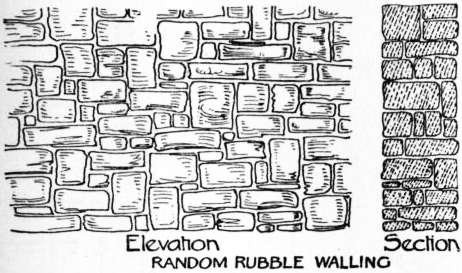
Fig. 3.—(¼ in. = 1 ft.)
Random Rubble (fig. 3) is the roughest form of stonework. It is built with irregular pieces of stone usually less than 9 in. thick, loosely packed without much regard to courses, the interstices between the large stones being occupied by small ones, the remaining crevices filled up with mortar. Bond stones or headers should be used frequently in every course. This form of walling is much used in stone districts for boundary walls and is often set dry without mortar. For this work the mason uses no tool but the trowel to lay on the mortar, the scabbling hammer to break off the most repulsive irregularities from the stone, and the plumb-rule to keep his work perpendicular.
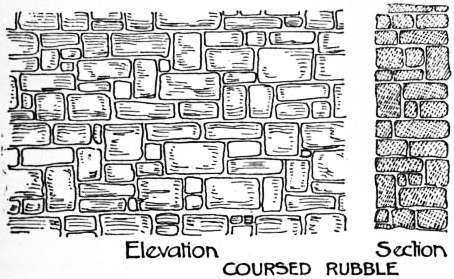
Fig. 4.—(¼ in. = 1 ft.)
Coursed Rubble (fig. 4) is levelled up in courses 12 or 18 in. deep, the depth varying in different courses according to the sizes of the stones. The stones are dressed by the workman before he begins building, to obtain a fairly level bed and perpendicular face.
Irregularly Coursed Squared Rubble is a development of uncoursed random rubble, the stones in this case being squared with the hammer and roughly faced up with the axe. The courses jump abruptly from one level to another as the sizes of the blocks demand; the interstices are filled in with small pieces of stone called “snecks.”
For Coursed Squared Rubble the stone is faced in a similar manner and set in courses, the depth of each course being made up of one or more stones.
In Regular Coursed Rubble all the stones in one course are of the same height.
Block-in-course is the name applied to a form of stone walling that has some of the characteristics of ashlar but the execution of which is much rougher. The courses are usually less than 12 in. high. It is much used by engineers for waterside and railway work where a good appearance is desired.
The Angles or Quoins of rubble-work are always carefully and precisely worked and serve as a gauge for the rest of the walling. Frequently the quoins and jambs are executed in ashlar, which gives a neat and finished appearance and adds strength to the work.
The name Ashlar is given, without regard to the finish of the face of the stone, to walling composed of stones carefully dressed, from 12 to 18 in. deep, the mortar joints being about an eighth of an inch or less in thickness. No stone except the hardest should exceed in length three times its depth when required to resist a heavy load and its breadth should be from one and a half to three times its depth. The hardest stone may have a length equal to four or perhaps five times its depth and a width three times its depth. The face of ashlar-work may be plain and level, or have rebated, chamfered, or moulded joints.
The great cost of this form of stonework renders the employment of a backing of an inferior nature very general. This backing varies according to the district in which the building operations are being carried on, being rubble stonework in stone Backing to Stonework. districts and brick or concrete elsewhere, the whole being thoroughly tied together both transversely and longitudinally with bondstones. In England a stone much used for backing ashlar and Kentish rag rubble-work is a soft sandstone called “hassock.” In the districts where it is quarried it is much cheaper than brickwork. (For brickbacking see Brickwork.) Ashlar facing usually varies from 4 to 9 in. in thickness. The work must not be all of one thickness, but should vary in order that effective bond with the backing may be obtained. If the work is in courses of uneven depth the narrow courses are made of the greater thickness and the deep courses are narrow. It is sometimes necessary to secure the stone facing back with iron ties, but this should be avoided wherever possible, as they are liable to rust and split the stonework. When it is necessary to use them they should be covered with some protective coating. The use of a backing to a stone wall, besides lessening the cost, gives a more equable temperature inside the building and prevents the transmission of wet by capillary attraction to the interior, which would take place if single stones were used for the entire thickness.
All work of this description must be executed in Portland cement, mortar of good strength, to avoid as much as possible the unequal settlement of the deep courses of stone facing and the narrower courses of the brick or rough stone backing. If the backing is of brick it should never be less than 9 in. thick, and whether of stone or brick it should be levelled up in courses of the same thickness as the ashlar.
There are many different sorts of walling, or modes of structure, arising from the nature of the materials available in various localities. That is perhaps of most frequent occurrence in which Walling. either squared, broken, or round flints are used. This, when executed with care, has a distinctly decorative appearance. To give stability to the structure, lacing courses of tiles, bricks or dressed stones are introduced, and brick or stone piers are built at intervals, thus forming a flint panelled wall. The quoins, too, in this type of wall are formed in dressed stone or brick work.
Uncoursed rubble built with irregular blocks of ragstone, an unstratified rock quarried in Kent, is in great favour for facing the external walls of churches and similar works (fig. 5).
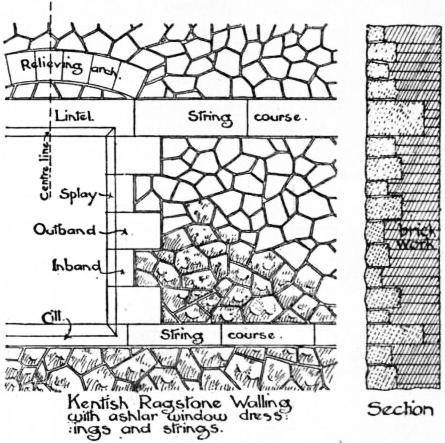
Fig. 5.—(¼ in. = 1 ft.)
Pointing.—As with brickwork this is generally done when the work is completed and before the scaffolding is removed. Suitable weather should be chosen, for if the weather be either frosty or too hot the pointing will suffer. The joints are raked out to a depth of half an inch or more, well wetted, and then refilled with a fine mortar composed specially to resist the action of the weather. This is finished flat or compressed with a special tool to a shaped joint, the usual forms of which are shown in fig. 6.
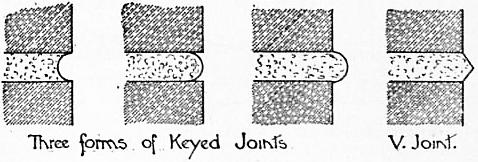
Fig. 6.—(¾ full size).
Stonewash.—To give a uniform appearance to the stonework and preserve the finished face until a hardened skin has formed, it is usual to coat the surface of exposed masonry with a protective compound of ordinary limewhite with a little size mixed in it, or a special mixture of stone-dust, lime, salt, whiting and size with a little ochre to tone it down. After six months or more the work is cleaned down with water and stiff bristle or wire brushes. Sometimes muriatic acid much diluted with water is used.
Technical Terms.—Of the following technical terms, many will be found embodied in the drawing of a gable wall (fig. 7), which shows the manner and position in which many different members are used.
Apex Stone.—The topmost stone of a gable forming a finial for the two sloping sides; it is sometimes termed a “saddle” (fig. 7).
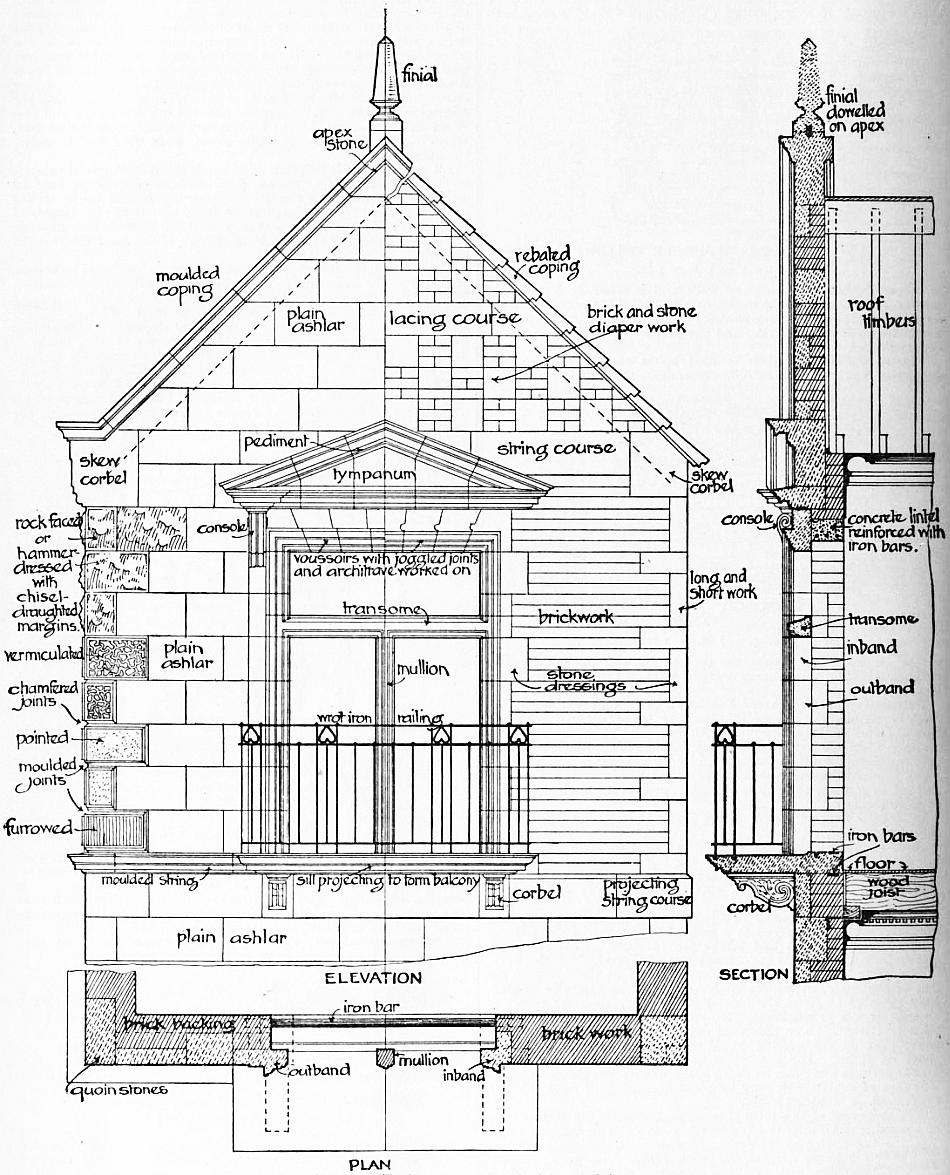
Fig. 7.—(Scale—approximately ½ in. = 1 ft.)
Blocking Course, a heavy course of stone above a cornice to form a parapet and weigh down the back of the cornice (fig. 8).
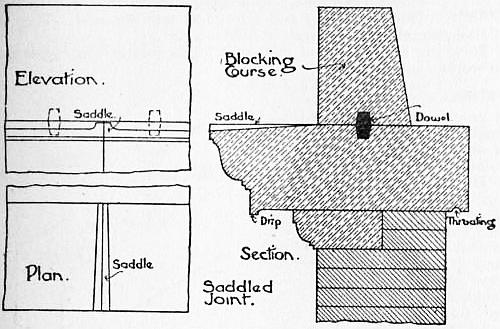
Fig. 8.—(½ in. = 1 ft.)
Bed.—The bed surface upon which a stone is set or bedded should be worked truly level in every part. Many workmen to form a neat thin joint with a minimum amount of labour hollow the bed and thus when the stone is set all weight is thrown upon the edges with the frequent result that these are crushed.
Coping.—The coping or capping stones are placed on the top of walls not covered by a roof, spanning their entire width and throwing off the rain and snow, thus keeping the interior of the wall dry. The fewer the number of joints the better the security, and for this reason it is well to form copings with as long stones as possible. To throw water off clear, and prevent it from running down the face of the wall, the coping should project an inch or two on each side and have a throat worked on the under-side of the projections (fig. 7).
Cornice, a projecting course of moulded stone crowning a structure, forming a cap or finish and serving to throw any wet clear of the walls. A deep drip should always be worked in the upper members of a cornice to prevent the rain trickling down and disfiguring the face of the moulding and the wall below (fig. 8).
Corbel, a stone built into a wall and projecting to form a cantilever, supporting a load beyond the face of the wall. It is frequently richly ornamented by carving (fig. 7).
Skew Corbel, a stone placed at the base of the sloping side of a gable wall to resist any sliding tendency of the sloping coping. Stones placed for a similar purpose at intervals along the sloping side, tailing into the wall, are termed “kneelers” and have the section of the coping worked upon them (fig. 7).
Corbel Table, a lino of small corbels placed at short distances apart supporting a parapet or arcade. This forms an ornamental feature which was much employed in early Gothic times. It probably originates from the machicolations of ancient fortresses.
Dressings, the finished stones of window and door jambs and quoins. For example, a “brick building with stone dressings” would have brick walls with stone door and window jambs, heads and sills, and perhaps also stone quoins (fig. 7).
Diaper, a square pattern formed on the face of the stonework by means of stones of different colours and varieties or by patterns carved on the surface (fig. 7).
Finial, a finishing ornament applied usually to a gable end (fig. 7).
Gablet, small gable-shaped carved panels frequently used in Gothic stonework for apex stones, and in spires, &c.
Gargoyle, a detail, not often met with in modern work, which consists of a waterspout projecting so as to throw the rain-water from the gutters clear of the walls. In early work it was often carved into grotesque shapes of animal and other forms.
Galleting.—The joints of rubble are sometimes enriched by having small pebbles or chips of flint pressed into the mortar whilst green. The joints are then said to be “galleted.”
Jamb.—Window and door jambs should always be of dressed stone, both on account of the extra strength thus gained and in order to give a finish to the work. The stones are laid alternately as stretchers and headers; the former are called outbands, the latter inbands (fig. 7).
Label Moulding, a projecting course of stone running round an arch. When not very large it is sometimes cut on the voussoirs, but is usually made a separate course of stone. Often, and especially in the case of door openings, a small sinking is worked on the top surface of the moulding to form a gutter which leads to the sides any water that trickles down the face of the wall.
Lacing Stone.—This is placed as a voussoir in brick arches of wide span, and serves to bond or lace several courses together (see Brickwork).
Lacing Course, a course of dressed stone, bricks or tiles, run at intervals in a wall of rubble or flint masonry to impart strength and tie the whole together (fig. 7).
Long and Short Work, a typical Saxon method of arranging quoin stones, flat slabs and long narrow vertical stones being placed alternately. Earls Barton church in Northamptonshire is an example of their use in old work. In modern work long and short work, sometimes termed “block and start,” is little used (fig. 7).
Parapet, a fence wall at the top of a wall at the eaves of the roof. The gutter lies behind, and waterways are formed through the parapet wall for the escape of the rain-water.
Plinth, a projecting base to a wall serving to give an appearance of stability to the work.
Quoin, the angle at the junction of two walls. Quoins are often executed in dressed stone (fig. 7).
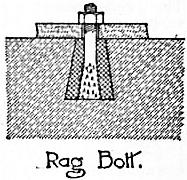
Fig. 9.—(1 in. = 1 ft.)
Rag-bolt, the end of an iron bolt when required to be let into stone is roughed or ragged. A dovetailed mortise is prepared in the stone and the ragged end of the bolt placed in this, and the mortise filled in with molten lead or sand and sulphur (fig. 9).
Sill, the stone which forms a finish to the wall at the bottom of an opening. Sills should always be weathered, slightly in the case of door sills, more sharply for windows, and throated on the under side to throw off the wet. The weathering is not carried through the whole length of the sill, but a stool is left on at each end to form a square end for building in (fig. 7).
String Courses, horizontal bands of stone, either projecting beyond or flush with the face of the wall and often moulded or carved. They are frequently continuations of the sills or head lines of windows (figs. 5 and 7).
Scontion.—In a thick wall the dressed stones forming the inside angles of the jamb of a window or door opening are termed scontions.
Spalls, small pieces chipped off whilst working a stone.
Templates, slabs of hard stone set in a wall to take the ends of a beam or girder so as to distribute the load over a larger area of the wall.
Tympanum, the triangular filling of masonry in a pediment between the cornices, or between the horizontal head of a window or door and the under-side of the relieving arch above it. It is often panelled or enriched with carved ornament (fig. 7).
Throat, a groove worked on the under-side of projecting external members to intercept rain-water and cause it to drop off the member clear of the work beneath (fig. 8).
Weathering.—The surface of an exposed stone is weathered when it is worked to a slope so as to throw off the water. Cornices, copings, sills and string courses should all be so weathered.
Voussoirs, the wedge-shaped blocks of which an arch is built up.
Methods of finishing Face of Stones.—The self face or quarry face is the natural surface formed when the stone is detached from the mass in the quarry or when a stone is split.
Saw-face, the surface formed by sawing.
Hammer-dressed, Rock-faced, or Pitch-faced.—This face is used for ashlar-work, usually with a chisel-draughted margin around each block. It gives a very massive and solid appearance to the lower storeys of masonry buildings, and is formed with little labour, and is therefore the cheapest face to adopt for ashlar-work (fig. 7).
Broached and Pointed Work.—This face is also generally used with a chisel-draughted margin. The stone as left from the scabbling hammer at the quarry has its rocky face worked down to an approximate level by the point. In broached work the grooves made by the tool are continuous, often running obliquely across the face of the block. In pointed work the lines are not continuous; the surface is rough or fine pointed according as the point is used over every inch or half-inch of the stone. The point is used more upon hard stones than soft ones (fig. 7).
Tooth-chiselled Work.—The cheapest method of dressing soft stones is by the toothed chisel which gives a surface very much like the pointed work of hard stones.
Droved Work.—This surface is obtained with a chisel about two and a half inches wide, no attempt being made to keep the cuts in continuous lines.
Tooled Work is somewhat similar to droved work and is done with a flat chisel, the edge of which is about four inches wide, care being taken to make the cuts in continuous lines across the width of the stone.
Combed or Dragged Work.—For soft stones the steel comb or drag is often employed to remove all irregularities from the face and thus form a fine surface. These tools are specially useful for moulded work, as they are formed to fit a variety of curves.
Rubbed Work.—For this finish the surface of the stone is previously brought with the chisel to a level and approximately smooth face, and then the surface is rubbed until it is quite smooth with a piece of grit stone aided by fine sand and water as a lubricant. Marbles are polished by being rubbed with gritstone, then with pumice, and lastly with emery powder.
Besides these, the most usual methods of finishing the faces of stonework, there are several kinds of surface formed with hammers or axes of various descriptions. These types of hammers are more used on the continent of Europe and in America perhaps than in England, but they deserve notice here.
The toothed axe has its edges divided into teeth, fine or coarse according to the work to be done. It is used to reduce the face of limestones and sandstones to a condition ready for the chisel. The bush hammer has a heavy square-shaped double-faced head, upon which are cut projecting pyramidal points. It is used to form a surface full of little holes, and with it the face of sand and limestones may be brought to a somewhat ornamental finish. The patent hammer is used on granite and other hard rocks, which have been first dressed to a medium surface with the point. The fineness of the result is determined by the number of blades in the hammer, and the work is said to be “six,” “eight” or “ten-cut” work according to the number of blades inserted or bolted in the hammer head. The crandall has an iron handle slotted at one end with a hole 3⁄8 in. wide and 3 in. long. In this slot are fixed by a key ten or eleven double-headed points of ¼ in. square steel about 9 in. long. It is used for finishing sandstone and soft stones after the surface has been levelled down with the axe or chisel. It gives a fine pebbly sparkling appearance.
There are several methods of finishing stone which involve a great deal of labour and are therefore expensive to work, but which result in imparting a very stiff and unnatural appearance to the masonry.
Vermiculated Work.—This is formed by carving a number of curling worm-like lines over the face of the block, sinking in between the worms to a depth of a fourth of an inch. The surface of the strings is worked smooth, and the sinkings are pock-marked with a pointed tool (fig. 7).
Furrowed Work.—In this face the stone is cut with a chisel into a number of small parallel grooves or furrows (fig. 7).
Reticulated Face is a finish somewhat similar to vermiculated work, but the divisions are more nearly squares.
Face Joints of Ashlar.—The face joints of ashlar stonework are often sunk or rebated to form what are termed rusticated joints; sometimes the angles of each block are moulded or chamfered to give relief to the surface or to show a massive effect (fig. 7).
Joints in Stonework.—The joints between one block of stone and another are formed in many ways by cramps, dowels and joggles of various descriptions.
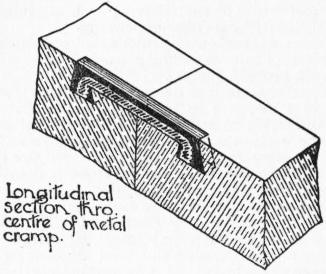
Fig. 10.—(1 in. = 1 ft.)
The stones of copings, cornices and works of a similar nature, are often tied together with metal cramps to check any tendency for the stones to separate under the force of the wind (figs. 10 and 11). Cramps are made of iron (plain or galvanized), Cramps. copper or gun-metal, of varying sections and lengths to suit the work. A typical cramp would be about 9 in. long, 1 or 1½ in. wide, and from ¼ to ½ in. thick, and turned down about 1½ in. at each end. A dovetailed mortise is formed at a suitable point in each of the stones to be joined and connected by a chase. The cramp is placed in this channel with its turned-down ends in the mortises, and it is then fixed with molten lead, sulphur and sand, or Portland cement. Lead shrinks on cooling, and if used at all should be well caulked when cold. Double dovetailed slate cramps bedded in Portland cement are occasionally used (fig. 11).
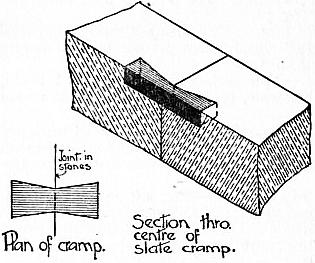
Fig. 11.—(¾ in. = 1 ft.)
Dowels are used for connecting stones where the use of cramps Dowels. would be impracticable, as in the joints of window mullions, the shafts of small columns, and in similar works (figs. 7, 8 and 20). Dowels for bed and side joints may be used. They are of slate, metal, or sometimes of hard wood.
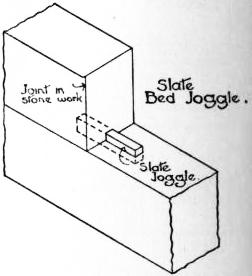
Fig. 12.—(½ in. = 1 ft.)
There are many ways of making a joggle joint. The joggle may be worked on one of the stones so as to fit into a groove in the adjoining stone, or grooves may be cut in both the stones and an independent joggle Joggles. of slate, pebbles, or Portland cement fitted, the joggle being really a kind of dowel. The pebble joggle joint is formed with the aid of pebbles as small dowels fitted into mortises in the jointing faces of two stones and set with Portland cement; but joggles of slate have generally taken the place of pebbles. Portland cement joggles are formed by pouring cement grout into a vertical or oblique mortise formed by cutting a groove in each of the joining surfaces of the stones. What is known as a he-and-she joggle, worked on the edges of the stones themselves, is shown in fig. 13.
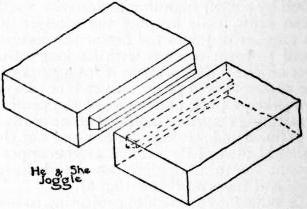
Fig. 13.—(½ in. = 1 ft.)
Plugs or dowels of lead are formed by pouring molten lead through a channel into dovetailed mortises in each stone (figs. 14 and 15). When cold the metal is caulked to compress it tightly into the holes.
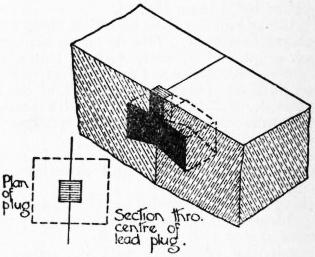
Fig. 14.—(¾ in. = 1 ft.)
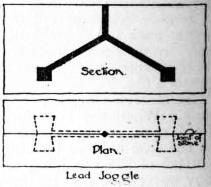
Fig. 15.—(1 in. = 1 ft.)
The saddle joint is used for cornices, and is formed when a portion of the stone next the joint is left raised so as to guide rain-water away from the joint (fig. 8).
Two forms of rebated joints for stone copings and roofs are common. In one form (shown in fig. 7) the stones forming the coping are thicker at their lower and rebated edge than at the top plain edge, giving a stepped surface. The other form has a level surface and the stone is of the same thickness throughout and worked to a rebate on top and bottom edges. In laying stone roofs the joints are usually lapped over with an upper slab of stone.
Joints in Spires.—Four forms of jointing for the battering stonework of spires are shown in fig. 16. A is a plain horizontal joint. B is a similar joint formed at right angles to the face of the work. This is the most economical form of joint, the stone being cut with its sides square with each other; but if the mortar in the joint decay moisture is allowed to penetrate. With these forms dowelling is frequently necessary for greater stability. The joints C and D are more elaborate and much more expensive on account of the extra labour involved in working and fitting.
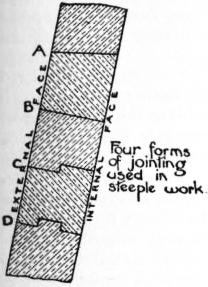
Fig. 16.—(½ in. = 1 ft.)
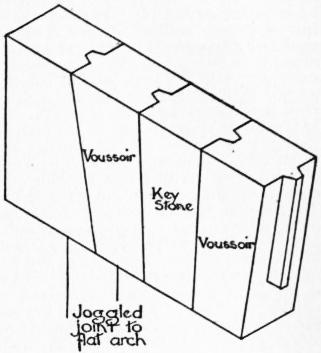
Fig. 17.—(1 in. = 1 ft.)
Where a concentrated weight is carried by piers or columns the bed joints are in many cases formed without the use of mortar, a thin sheet of milled lead being placed between the blocks of stone to fill up any slight inequalities.
Moulded Work.—The working of mouldings in stone is an important part of the mason’s craft, and forms a costly item in the erection of a stone structure. Much skill and care is required to retain the arrises sharp and the curved members of accurate and proportionate outline. As in the case of wood mouldings, machinery now plays an important part in the preparation of stone moulded work. The process of working a stone by hand labour is as follows: The profile of the moulding is marked on to a zinc template on opposite ends of the stone to be worked; a short portion, an inch or two in length termed a “draught,” is at each end worked to the required section. The remaining portion is then proceeded with, the craftsman continually checking the accuracy of his work with a straight-edge and zinc templates. A stone to be moulded by machinery is fixed to a moving table placed under a shaped tool which is fixed in an immovable portion of the machine, and is so adjusted as to cut or chip off a small layer of stone. Each time the stone passes under the cutter it is automatically moved a trifle nearer, and thus it gradually reduces the stone until the required shape is attained.
Iron in Stonework.—The use of iron dowels or cramps in stonework, unless entirely and permanently protected from oxidation is attended by the gravest risks; for upon the expansion of the iron by rusting the stone may split, and perhaps bring about a more or less serious failure in that portion of the building. A case in point is that of the church of St Mary-le-Strand, London, where the ashlar facing was secured to the backing with iron cramps; these were inefficiently protected from damp, with the result that many of the blocks have been split in consequence of rusting. John Smeaton in his Eddystone Lighthouse used dowels of Purbeck marble.
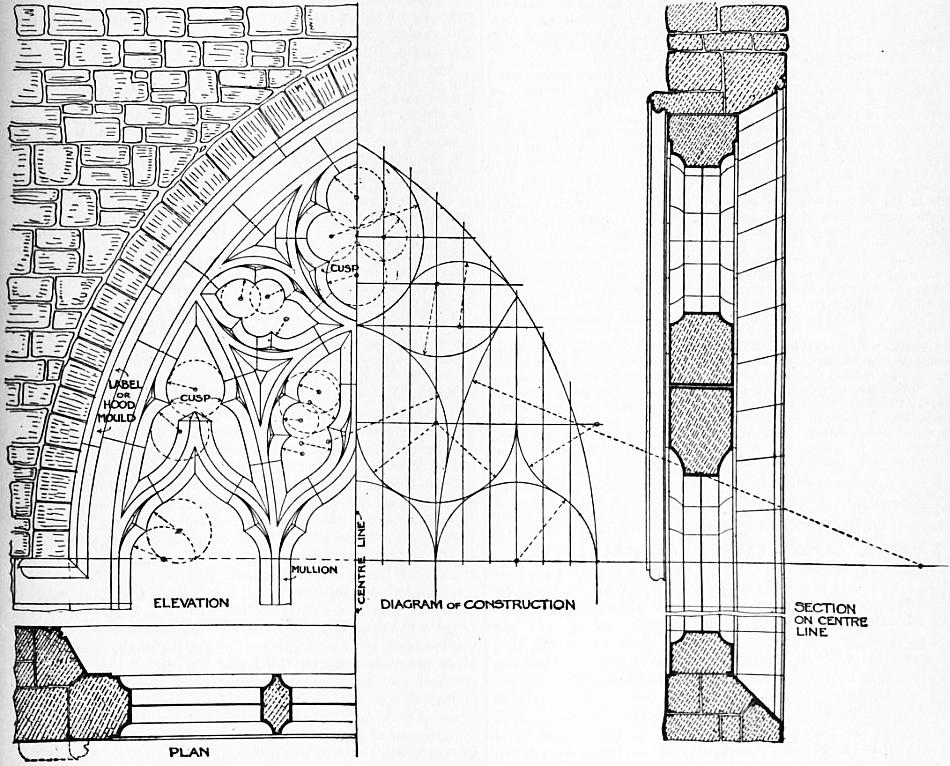
Fig. 18.—(½ in. = 1 ft.)
Stone Arches.—Stone arches are very frequently used both in stone and brick buildings. (For general definitions and terms see Brickwork.) They may be built in a great variety of styles, either flat, segmental, circular, elliptical or pointed. Each block or voussoir should be cut to fit exactly in its appointed place, the joints being made as fine as possible. The joints should radiate from the centre from which the soffit or intrados is struck, or in the case of an elliptical arch they should be at right angles to a tangent drawn to the intrados at that point. The extrados or back of the arch is usually concentric with the intrados, but is sometimes made thicker in one portion than in another; thus the arch may be deeper at the crown than at the sides, or at the sides than in the centre. In some cases two or more voussoirs are of one stone, having a false joint cut in the centre; this is economical, and in some cases adds to the stability of the arch. Generally the arch is divided into an uneven number of voussoirs so as to give a keystone, the voussoirs being laid from each side of the keystone and fitting exactly in the centre of the arch. The keystone is not a necessity, arches being frequently formed with an even number of voussoirs; some architects hold that the danger of the voussoirs cracking is thereby lessened. Where lintels are used in a stone wall over openings of small span it is usual to build a relieving arch above to take the superincumbent weight of masonry; or the same purpose may be effected in walls of ashlar by a flat relieving or “save” arch, formed in the next course of three stones above the lintel, the tapering keystone resting between the two side stones which are tailed well into the wall.
In very many cases it is desired to form square heads to openings of greater span than it is convenient to obtain lintels for in one piece, and some form of flat arch must therefore be adopted. The voussoirs are connected by joggles worked on their joints, as in fig. 17. The weight of the superimposed wall is taken by a lintel with relieving arch above at the back of the arch.
Arches built to an elliptical form when used for large spans (if of flat curve they should bridge over 8 ft. or 10 ft.) are liable if heavily loaded to fail by the voussoirs at the centre being forced down, or else to burst up at the haunches. With arches of this description there is a large amount of outward thrust, and abutments of ample strength must be placed to receive the springers.
Stone Tracery.—The designs of Gothic and other tracery stonework are almost infinite, and there are many methods, ingenious and otherwise, of setting out such work. Nearly all diagrams of construction are planned on the principle of geometrical intersections. In the example illustrated in fig. 18 the method of setting out and finishing the design is very clearly shown, together with the best positions for the joints of the various parts. The jointing is a matter which must be carefully considered in order to avoid any waste of stone and labour. It will be observed that the right-hand side of the elevation shows the method of setting out the tracery by the centre lines of the various intersecting branches, the other half giving the completed design with the cusping drawn in and the positions of joints. All the upper construction of windows and doors and of aisle arches should be protected from superincumbent pressure by strong relieving arches above the labels, as shown in the figure, which should be worked with the ordinary masonry, and so set that the weight above should avoid pressure on the fair work, which would be liable to flush or otherwise destroy the joints of the tracery.
Carving.—Stone carving is a craft quite apart from the work of the ordinary stonemason, and like carving in wood needs an artistic feeling and special training. Carving-stone should be of fine grain and sufficiently soft to admit of easy working. The Bath stones in England and the Caen stone of France are largely used for internal work, but if for the exterior they should be treated with some chemical preservative. Carving is frequently done after the stone is built into position, the face being left rough—“boasted”—and projecting sufficiently for the intended design.
See E. Viollet-le-Duc, Dictionnaire raisonné de l’architecture française; W. R. Purchase, Practical Masonry; J. O. Baker, A Treatise on Masonry Construction; C. F. Mitchell, Brickwork and Masonry; W. Diack, The Art of Masonry in Britain.
(J. Bt.)
1 The English word “mason” is from the French, which appears in the two forms, machun and masson (from the last comes the modern Fr. form maçon, which means indifferently a bricklayer or mason). In O. H. Ger. the word is mezzo, which survives in the German for a stone-mason, Steinmetz. The med. Lat. form, machio, was connected with machina—obviously a guess. The Low Lat., macheria or maceria (see Du Cange, Glossarium, s.v. macio), a wall, has been suggested as showing some connexion. Some popular Lat. form as macio or mattio is probably the origin. No Teut. word, according to the New English Dictionary, except that which appears in “mattock,” seems to have any bearing on the ultimate origin.
MASPERO, GASTON CAMILLE CHARLES (1846- ), French Egyptologist, was born in Paris on the 23rd of June 1846, his parents being of Lombard origin. While at school he showed a special taste for history, and when fourteen years old was already interested in hieroglyphic writing. It was not until his second year at the École Normale in 1867 that Maspero met with an Egyptologist in the person of Mariette, who was then in Paris as commissioner for the Egyptian section of the exhibition. Mariette gave him two newly discovered hieroglyphic texts of considerable difficulty to study, and, self-taught, the young scholar produced translations of them in less than a fortnight, a great feat in those days when Egyptology was still almost in its infancy. The publication of these in the same year established his reputation. A short time was spent in assisting a gentleman in Peru, who was seeking to prove an Aryan affinity for the dialects spoken by the Indians of that country, to publish his researches; but in 1868 Maspero was back in France at more profitable work. In 1869 he became a teacher (répétiteur) of Egyptian language and archaeology at the École des Hautes Études; in 1874 he was appointed to the chair of Champollion at the Collège de France.
In November 1880 Professor Maspero went to Egypt as head of an archaeological mission despatched thither by the French government, which ultimately developed into the well-equipped Institut Français de l’Archéologie Oriental. This was but a few months before the death of Mariette, whom Maspero then succeeded as director-general of excavations and of the antiquities of Egypt. He held this post till June 1886; in these five years he had organized the mission, and his labours for the Bulak museum and for archaeology had been early rewarded by the discovery of the great cache of royal mummies at Deir el-Bahri in July 1881. Maspero now resumed his professorial duties in Paris until 1899, when he returned to Egypt in his old capacity as director-general of the department of antiquities. He found the collections in the Cairo Museum enormously increased, and he superintended their removal from Gizeh to the new quarters at Kasr en-Nil in 1902. The vast catalogue of the collections made rapid progress under Maspero’s direction. Twenty-four volumes or sections were already published in 1909. The repairs and clearances at the temple of Karnak, begun in his previous tenure of office, led to the most remarkable discoveries in later years (see Karnak), during which a vast amount of excavation and exploration has been carried on also by unofficial but authorized explorers of many nationalities.
Among his best-known publications are the large Histoire ancienne des peuples de l’Orient classique (3 vols., Paris, 1895-1897, translated into English by Mrs McClure for the S.P.C.K.), displaying the history of the whole of the nearer East from the beginnings to the conquest by Alexander; a smaller Histoire des peuples de l’Orient, 1 vol., of the same scope, which has passed through six editions from 1875 to 1904; Études de mythologie et d’archéologie égyptiennes (Paris, 1893, &c.), a collection of reviews and essays originally published in various journals, and especially important as contributions to the study of Egyptian religion; L’Archéologie égyptienne (latest ed., 1907), of which several editions have been published in English. He also established the journal Recueil de travaux relatifs à la philologie et à l’archéologie égyptiennes et assyriennes; the Bibliothèque égyptologique, in which the scattered essays of the French Egyptologists are collected, with biographies, &c.; and the Annales du service des antiquités de l’Égypte, a repository for reports on official excavations, &c.
Maspero also wrote: Les Inscriptions des pyramides de Saqqaroh (Paris, 1894); Les Momies royales de Deir el-Baharî (Paris, 1889); Les Contes populaires de l’Égypte ancienne (3rd ed., Paris, 1906); Causeries d’Égypte (1907), translated by Elizabeth Lee as New Light on Ancient Egypt (1908).
MASS (O.E. maesse; Fr. messe; Ger. Messe; Ital. messa; from eccl. Lat. missa), a name for the Christian eucharistic service, practically confined since the Reformation to that of the Roman Catholic Church. The various orders for the celebration of Mass are dealt with under Liturgy; a detailed account of the Roman order is given under Missal; and the general development of the eucharistic service, including the Mass, is described in the article Eucharist. The present article is confined (1) to the consideration of certain special meanings which have become attached to the word Mass and are the subject of somewhat acute controversy, (2) to the Mass in music.
The origin of the word missa, as applied to the Eucharist, is obscure. The first to discuss the matter is Isidore of Seville (Etym. vi. 19), who mentions an “evening office” (officium vespertinum), a “morning office” (officium matutinum), and an office called missa. Of the latter he says: “Missa tempore sacrificii est, quando catechumeni foras mittuntur, clamante levita ‘si quis catechumenus remansit, exeat foras.’ Et inde ‘missa,’ quia sacramentis altaris interesse non possunt, qui nondum regenerati sunt” (“The missa is at the time of the sacrifice, when the catechumens are sent out, the deacon crying, ‘If any catechumen remain, let him go forth.’” Hence missa, because those who are as yet unregenerate—i.e. unbaptized—may not be present at the sacraments of the altar). This derivation of the word Mass, which would connect it with the special formula of dismissal still preserved in the Roman liturgy—Ite, missa est—once generally accepted, is now disputed. It is pointed out that the word missa long continued to be applied to any church service, and more particularly to the lections (see Du Cange for numerous examples), and it is held that such services received their name of missal from the solemn form of dismissal with which it was customary to conclude them; thus, in the 4th century Pilgrimage of Etheria (Silvia) the word missa is used indiscriminately of the Eucharist, other services, and the ceremony of dismissal. F. Kattenbusch (Herzog-Hauck, Realencyklop. s. “Messe”) ingeniously, but with little evidence, suggests that the word may have had a double origin and meaning: (1) in the sense of dimissio, “dismissal”; (2) in that of commissio, “commission,” “official duty,” i.e. the exact Latin equivalent of the Greek λειτουργία (see Liturgy), and hence the conflicting use of the term. It is, however, far more probable that it was a general term that gradually became crystallized as applying to that service in which the dismissal represented a more solemn function. In the narrower sense of “Mass” it is first found in St Ambrose (Ep. 20, 4, ed. Ballerini): “Missam facere coepi. Dum offero ...” which evidently identifies the missa with the sacrifice. It continued, however, to be used loosely, though its tendency to become proper only to the principal Christian service is clear from a passage in the 12th homily of Caesarius, bishop of Arles (d. 542): “If you will diligently attend, you will recognize that missae are not celebrated when the divine readings are recited in the church, but when gifts are offered and the Body and Blood of the Lord are consecrated.” The complete service (missa ad integrum), the bishop goes on to say, cannot be had at home by reading and prayer, but only in the house of God, where, besides the Eucharist, “the divine word is preached and the blessing is given to the people.”
Whatever its origin, the word Mass had by the time of the Reformation been long applied only to the Eucharist; and, though in itself a perfectly colourless term, and used as such during the earlier stages of the 16th century controversies concerning the Eucharist, it soon became identified with that sacrificial aspect of the sacrament of the altar which it was the chief object of the Reformers to overthrow. In England, so late as the first Prayer-book of Edward VI., it remained one of the official designations of the Eucharist, which is there described as “The Supper of the Lorde and holy Communion, commonly called the Masse.” This, however, like the service itself, represented a compromise which the more extreme reformers would not tolerate, and in the second Prayer-book, together with such language in the canon as might imply the doctrine of transubstantiation and of the sacrifice, the word Mass also disappears. That this abolition of the word Mass, as implying the offering of Christ’s Body and Blood by the priest for the living and the dead was deliberate is clear from the language of those who were chiefly responsible for the change. Bishops Ridley and Latimer, the two most conspicuous champions of “the new religion,” denounced “the Mass” with unmeasured violence; Latimer said of “Mistress Missa” that “the devil hath brought her in again”; Ridley said: “I do not take the Mass as it is at this day for the communion of the Church, but for a popish device,” &c. (Works, ed. Parker Soc., pp. 121, 120), and again: “In the stead of the Lord’s holy table they give the people, with much solemn disguising, a thing which they call their mass; but in deed and in truth it is a very masking and mockery of the true Supper of the Lord, or rather I may call it a crafty juggling, whereby these false thieves and jugglers have bewitched the minds of the simple people ... unto pernicious idolatory” (ib. p. 409). This language is reflected in the 31st of the Articles of Religion of the Church of England: “Wherefore the sacrifices of Masses, in which it was commonly said that the Priest did offer Christ for the quick and the dead, to have remission of pain and guilt, were blasphemous fables and dangerous deceits.” Clearly the word Mass had ceased to be a colourless term generally applicable to the eucharistic service; it was, in fact, not only proscribed officially, but in the common language of English people it passed entirely out of use except in the sense in which it is defined in Johnson’s Dictionary, i.e. that of the “Service of the Romish Church at the celebration of the Eucharist.” In connexion with the Catholic reaction in the Church of England, which had its origin in the “Oxford Movement” of the 19th century, efforts have been made by some of the clergy to reintroduce the term “Mass” for the Holy Communion in the English Church.