VOLUME XVII SLICE VI Map to Mars (continued 6)
Reading edition
See A. Thomas, Les États provinciaux de la France centrale (1879).

MARCHE, a town of Belgium in the province of Luxemburg, 33 m. S.W. of Liége and about 28 m. S.E. of Namur. Pop. (1904), 3540. It dates from the 7th century, when it was the chief town of the pagus falmiensis, as it still is of the same district now called Famène. Formerly it was fortified, and a treaty was signed there in 1577 between Philip II. and the United Provinces. In 1792 Lafayette was taken prisoner by the Austrians in a skirmish near it.
MARCHENA, a town of southern Spain, in the province of Seville, on the Cordova-Utrera and Marchena-La Roda railways. Pop. (1900), 12,468. Marchena occupies a sandy valley near the river Corbones, a left-hand territory of the Guadalquivir. Formerly it was surrounded with walls and towers, a large portion of which still remains. Among the principal buildings is the palace of the dukes of Arcos, within the enclosure of which is an ancient Moorish building, now the church of Santa Maria de la Mota. At the eastern end of the town is a sulphur spring. There is some trade in wheat, barley, olives, oil and wine. Marchena (perhaps the Castra Gemina of Pliny) was taken from the Moors by St Ferdinand in 1240.
MARCHENA RUIZ DE CASTRO, JOSÉ (1768-1821?), Spanish author, was born at Utrera on the 18th of November 1768 and studied with distinction at the university of Seville. He took minor orders and was for some time professor at the seminary of Vergara, but he became a convert to the doctrines of the French philosophes, scandalizing his acquaintances by his professions of materialism and his denunciations of celibacy. His writings being brought before the Inquisition in 1792, Marchena escaped to Paris, where he is said to have collaborated with Marat in L’Ami du peuple; at a later date he organized a revolutionary movement at Bayonne, returned to Paris, avowed his sympathies with the Girondists, and refused the advances of Robespierre. He acted as editor of L’Ami des lois and other French journals till 1799, when he was expelled from France; he succeeded, however, in obtaining employment under Moreau, upon whose fall in 1804 he declared himself a Bonapartist. In 1808 he accompanied Murat to Spain as private secretary; in this same year he was imprisoned by the Inquisition, but was released by Joseph Bonaparte, who appointed him editor of the official Gaceta. In 1813 Marchena retired to Valencia, and thence to France, where he supported himself by translating into Spanish the works of Montesquieu, Rousseau, Voltaire and Volney. The Liberal triumph of 1820 opened Spain to him once more, but he was coldly received by the revolutionary party. He died at Madrid shortly before the 26th of February 1821. The interest of his voluminous writings is almost wholly ephemeral, but they are excellent specimens of trenchant journalism. His Fragmentum Petronii (Basel, 1802), which purports to reconstruct missing passages in the current text of Petronius, is a testimony to Marchena’s fine scholarship; but, by the irony of fate, Marchena is best known by his ode to Christ Crucified, which breathes a spirit of profound and tender piety.
MARCHES, THE (It. Le Marche), a territorial division of Italy, embracing the provinces of Pesaro and Urbino, Ancona, Macerata, and Ascoli Piceno, with an area of 3763 sq. m., and a population of 1,088,763 in 1901. It is bounded by the Emilia on the N., the Adriatic on the E., the Abruzzi on the S., and Umbria and Tuscany on the W. The four provinces follow one another in the order given from north to south and have a certain amount of coast-line. The chief rivers, all of which run into the Adriatic eastwards and north-eastwards, are the Metauro (anc. Metaurus, q.v.) and the Tronto (anc. Truentus), the latter forming the southern boundary of the compartimento for some distance. Except for the river valleys and the often very narrow coast strip, the general level is more than 500 ft. above the sea. The lower hills are very largely composed of loose, clayey, unstable earth, while the Apennines are of limestone. The province of Pesaro and Urbino falls within the boundaries of the ancient Umbria (q.v.), while the territory of the other three belonged to Picenum (q.v.). The railway from Bologna to Brindisi runs along the coast-line of the entire territory. At Ancona it is joined by the main line from Foligno and Rome; at Porto Civitanova is a branch to Macerata, San Severino and Fabriano (a station on the line from Ancona to Rome and the junction for Urbino); at Porto S. Giorgio is a branch to Fermo and, at Porto d’Ascoli, a branch to Ascoli Piceno. But, with the exception of the railway along the coast, there is no communication north and south, owing to the mountainous nature of the country, except by somewhat devious roads.
Owing largely to the mezzadria or métayer system, under which products are equally divided between the owners and the cultivators of the land, the soil is fairly highly cultivated, though naturally poor in quality. The silk industries, making of straw-plait and straw hats, rearing of silkworms and cocoons, with some sugar-refining, tobacco, terra-cotta manufacture, brickworks and ironworks, furnish the chief occupations of the people next after agriculture and pastoral pursuits. Another important branch of activity is the paper industry, especially at Fabriano. Chiaravalle possesses one of the largest tobacco factories of the Italian régie. Limestone quarries and sulphur mines supply building stone and sulphur to the regions of central Italy; chalk and petroleum are also found. As regards maritime trade the province possesses facilities in the port of Ancona (the only really good harbour, where are also important shipbuilding works), the canal ports of Senegallia (Sinigaglia), Pesaro, Fano and other smaller harbours chiefly used by fishing boats. Fishing is carried on by the entire coast population, which furnishes a large contingent of sailors to the Italian navy.
For the early history of the territory of the Marches see Picenum. From the Carolingian period onwards the name Marca begins to appear—first the Marca Fermana for the mountainous part of Picenum, the Marca Camerinese for the district farther north, including a part of Umbria, and the Marca Anconitana for the former Pentapolis. In 1080 the Marca Anconitana was given in investiture to Robert Guiscard by Gregory VII., to whom the countess Matilda ceded the Marches of Camerino and of Fermo. In 1105 we find the emperor Henry IV. investing Werner with the whole territory of the three marches under the name of March of Ancona. It was afterwards once more recovered by the Church and governed by papal legates. It became part of the kingdom of Italy in 1860.
The pictorial art of the Marches from the 13th century onwards has become the object of considerable interest since the important exhibition held at Macerata in 1905, when many interesting works, scattered all over the district in small towns and villages, were brought together. The result was something of a revelation, for, though the influence of Umbria was always considerable, there were many independent elements (see F. M. Perkins in Rassegna d’ Arte, 1906, 49 sqq.).
(T. As.)
MARCHMONT, EARLS OF. The 1st earl of Marchmont was Sir Patrick Hume or Home (1641-1724), son of Sir Patrick Hume, bart. (d. 1648), of Polwarth, Berwickshire, and a descendant of another Sir Patrick Hume, a supporter of the Reformation in Scotland. A member of the same family was Alexander Hume (c. 1560-1609), the Scottish poet, whose Hymns and Sacred Songs were published in 1599 (new ed. 1832). Polwarth, as Patrick Hume was usually called, became a member of the Scottish parliament in 1665. Here he was active in opposing the harsh policy of the earl of Lauderdale towards the Covenanters, and for his contumacy he was imprisoned. After his release he went to London, where he associated himself with the duke of Monmouth. Suspected of complicity in the Rye House plot, he remained for a time in hiding and then crossed over to the Netherlands, where he took part in the deliberations of Monmouth, the earl of Argyll and other exiles about the projected invasion of Great Britain. Although he appeared to distrust Argyll, Polwarth sailed to Scotland with him in 1685, and after the failure of the rising he escaped to Utrecht, where he lived in great poverty until 1688. He accompanied William of Orange to England, and in 1689 he was again a member of the Scottish parliament. In 1690 he was made a peer as Lord Polwarth; in 1696 he became lord high chancellor of Scotland, and in 1697 was created earl of Marchmont. When Anne became queen in 1702 he was deprived of the chancellorship. He died on the 2nd of August 1724. His son Alexander, the 2nd earl (1676-1740), took the name of Campbell instead of Hume after his marriage in 1697 with Margaret, daughter and heiress of Sir George Campbell of Cessnock, Ayrshire. He was a lord of session from 1704 to 1714; ambassador to Denmark from 1715 to 1721, and lord clerk register from 1716 to 1733. His son Hugh Hume, 3rd earl (1708-1794), who entered parliament in 1734 at the same time as his twin brother Alexander (d. 1756), afterwards lord clerk register of Scotland, was keeper of the great seal of Scotland, one of Bolingbroke’s most intimate friends and one of Pope’s executors. His two sons having predeceased their father, the earldom became dormant, Marchmont House, Berwickshire, and the estates passing to Sir Hugh Purves, bart., a descendant of the 2nd earl, who took the name of Hume-Campbell. The 3rd earl had, however, three daughters, one of whom, Diana (d. 1827), married Walter Scott of Harden, Berwickshire; and in 1835 her son Hugh Hepburne-Scott (1758-1841) successfully claimed the Scottish barony of Polwarth. In 1867 his grandson, Walter Hugh (b. 1838), became 6th Lord Polwarth.
See The Marchmont Papers, ed. Sir G. H. Rose (1831).
MARCHPANE, or Marzipan, a sweetmeat made of sweet almonds and sugar pounded and worked into a paste, and moulded into various shapes, or used in the icing of cakes, &c. The best marchpane comes from Germany, that from Königsberg being celebrated. The origin of the word has been much discussed. It is common in various forms in most European languages, Romanic or Teutonic; Italian has marzapane, French massepain, and German marzipan, which has in English to some extent superseded the true English form “marchpane.” Italian seems to have been the source from which the word passed into other languages. In Johann Burchard’s Diarium curiae romanae (1483-1492) the Latin form appears as martiapanis (Du Cange, Glossarium s.v.), and Minshseu explains the word as Martius Panis, bread of Mars, from the “towers, castles and such like” that appeared on elaborate works of the confectioner’s art made of this sweatmeat. Another derivation is that from Gr. μάζα, barley cake, and Lat. panis. A connexion has been sought with the name of a Venetian coin, matapanus (Du Cange, s.v.), on which was a figure of Christ enthroned, struck by Enrico Dandolo, doge of Venice (1192-1205). From the coin the word was applied to a small box, and hence apparently to the sweetmeat contained in it.
MARCIAN (c. 390-457), emperor of the East (450-457), was born in Thrace or Illyria, and spent his early life as an obscure soldier. He subsequently served for nineteen years under Ardaburius and Aspar, and took part in the wars against the Persians and Vandals. Through the influence of these generals he became a captain of the guards, and was later raised to the rank of tribune and senator. On the death of Theodosius II. he was chosen as consort by the latter’s sister and successor, Pulcheria, and called upon to govern an empire greatly humbled and impoverished by the ravages of the Huns. Marcian repudiated the payment of tribute to Attila; he reformed the finances, checked extravagance, and repeopled the devastated districts. He repelled attacks upon Syria and Egypt (452), and quelled disturbances on the Armenian frontier (456). The other notable event of his reign is the Council of Chalcedon (451), in which Marcian endeavoured to mediate between the rival schools of theology.
See Gibbon, The Decline and Fall of the Roman Empire (ed. Bury, London, 1896), iii. 384, iv. 444-445; J. Bury, The Later Roman Empire (London, 1889), i. 135-136.
MARCIANUS (c. A.D. 400), Greek geographer, was born at Heraclea in Pontus. Two of his works have been preserved in a more or less mutilated condition. In the first, the Periplus of the Outer Sea, in two books, in which he proposed to give a complete description of the coasts of the eastern and western oceans, his chief authority is Ptolemy; the distances from one point to another are given in stades, with the object of rendering the work easier for the ordinary student. In this he follows Protagoras, who, according to Photius (cod. 188), wrote a sketch of geography in six books. The work contains nothing that cannot be learned from Ptolemy, whom he follows in calling the promontory of the Novantae (Mull of Galloway) the most northern point of Britain. Improving on Ptolemy, he makes the island of Taprobane (Ceylon) twenty times as large as it is in reality. The second, the Periplus of the Inner Sea (the Mediterranean), is a meagre epitome of a similar work by Menippus of Pergamum, who lived during the times of Augustus and Tiberius. It contains a description of the southern coast of the Euxine from the Thracian Bosporus to the river Iris in Pontus. A few fragments remain of an epitome by Marcianus of the eleven books of the Geographumena of Artemidorus of Ephesus.
See J. Hudson, Geographiae veteris scriptores graeci minores, vol. i. (1698), with Dodwell’s dissertation; C. W. Müller, Geographici graeci minores, vol. i. pp. cxxix., 515-573; E. Miller, Périple de Marcien d’Héraclée (1839); S. F. G. Hoffmann, Marciani Periplus (1841); E. H. Bunbury, Hist. of Ancient Geography (1879), ii. 660; A. Forbiger, Handbuch der alten Geographie, vol. i. (1842).
MARCION and THE MARCIONITE CHURCHES. In the period between 130 and 180 A.D. the varied and complicated Christian fellowships in the Roman Empire crystallized into close and mutually exclusive societies—churches with fixed constitutions and creeds, schools with distinctive esoteric doctrines, associations for worship with peculiar mysteries, and ascetic sects with special rules of conduct. Of ecclesiastical organizations the most important, next to Catholicism, was the Marcionite community. Like the Catholic Church, this body professed to comprehend everything belonging to Christianity. It admitted all believers without distinction of age, sex, rank or culture. It was no mere school for the learned, disclosed no mysteries for the privileged, but sought to lay the foundation of the Christian community on the pure gospel, the authentic institutes of Christ. The pure gospel, however, Marcion found to be everywhere more or less corrupted and mutilated in the Christian circles of his time. His undertaking thus resolved itself into a reformation of Christendom. This reformation was to deliver Christendom from false Jewish doctrines by restoring the Pauline conception of the gospel,—Paul being, according to Marcion, the only apostle who had rightly understood the new message of salvation as delivered by Christ. In Marcion’s own view, therefore, the founding of his church—to which he was first driven by opposition—amounts to a reformation of Christendom through a return to the gospel of Christ and to Paul; nothing was to be accepted beyond that. This of itself shows that it is a mistake to reckon Marcion among the Gnostics. A dualist he certainly was, but he was not a Gnostic. For he ascribed salvation, not to “knowledge” but to “faith”; he appealed openly to the whole Christian world; and he nowhere consciously added foreign elements to the revelation given through Christ. It is true that in many features his Christian system—if we may use the expression—resembles the so-called Gnostic systems; but the first duty of the historian is to point out what Marcion plainly aimed at; only in the second place have we to inquire how far the result corresponded with those purposes.
The doctrines of Marcion and the history of his churches from the 2nd to the 7th century are known to us from the controversial works of the Catholic fathers. From Justin onwards, almost every eminent Church teacher takes some notice of Marcion, while very many write extensive treatises against him. The most important of those which have come down to us are the controversial pieces of Irenaeus (in his great work against heretics), Tertullian (Adv. Marc. i.-v.), Hippolytus, Pseudo-Origen Adamantius, Epiphanius, and the Armenian Esnik.1 From these works the contents of the Marcionite Gospel, and also the text of Paul’s epistles in Marcion’s recension, can be settled with tolerable accuracy. His opponents, moreover, have preserved some expressions of his, with extracts from his principal work; so that our knowledge of Marcion’s views is in part derived from the best sources.
Marcion was a wealthy shipowner, belonging to Sinope in Pontus. He appears to have been a convert from Paganism to Christianity, although it was asserted in later times that his father had been a bishop. That report is probably as untrustworthy as another, that he was excommunicated from the Church for seducing a virgin. What we know for certain is that after the death of Hyginus, bishop of Rome (or c. 139 A.D.), he arrived, in the course of his travels, at Rome, and made a handsome donation of money to the local church. Even then, however, the leading features of his peculiar system must have been already thought out. At Rome he tried to gain acceptance for them in the college of presbyters and in the church; indeed he had previously made similar attempts in Asia Minor. But he now encountered such determined opposition from the majority of the congregation that he found it necessary to withdraw from the great church and establish in Rome a community of his own. This was about the year 144. The new society increased in the two following decades; and very soon numerous sister-churches were flourishing in the east and west of the empire. Marcion took up his residence permanently in Rome, but still undertook journeys for the propagation of his opinions. In Rome he became acquainted with the Syrian Gnostic Cerdo, whose speculations influenced the development of the Marcionite theology. Still Marcion seems never to have abandoned his design of gaining over the whole Church to his gospel. The proof of this is found, partly in the fact that he tried to establish relations with Polycarp of Smyrna, from whom he got a sharp rebuff, partly in a legend to the effect that towards the end of his life he sought readmission to the Church. Such, presumably, was the construction put in after times on his earnest endeavour to unite Christians on the footing of the “pure gospel.” When he died is not known, but his death can scarcely have been much later than the year 165.
The distinctive teaching of Marcion originated in a comparison of the Old Testament with the gospel of Christ and the theology of the apostle Paul. Its motive was not cosmological or metaphysical, but religious and historical. In the gospel he found a God revealed who is goodness and love, and who desires faith and love from men. This God he could not discover in the Old Testament; on the contrary, he saw there the revelation of a just, stern, jealous, wrathful and variable God, who requires from his servants blind obedience, fear and outward righteousness. Overpowered by the majesty and novelty of the Christian message of salvation, too conscientious to rest satisfied with the ordinary attempts at the solution of difficulties, while prevented by the limitations of his time from reaching an historical insight into the relation of Christianity to the Old Testament and to Judaism, he believed that he expressed Paul’s view by the hypothesis of two Gods: the just God of the law (the God of the Jews, who is also the Creator of the world), and the good God, the Father of Jesus Christ. Paradoxes in the history of religion and revelation which Paul draws out, and which Marcion’s contemporaries passed by as utterly incomprehensible, are here made the foundation of an ethico-dualistic conception of history and of religion. It may be said that in the 2nd century only one Christian—Marcion—took the trouble to understand Paul; but it must be added that he misunderstood him. The profound reflections of the apostle on the radical antithesis of law and gospel, works and faith, were not appreciated in the 2nd century. Marcion alone perceived their decisive religious importance, and with them confronted the legalizing, and in this sense judaizing, tendencies of his Christian contemporaries. But the Pauline ideas lost their truth under his treatment; for, when it is denied that the God of redemption is at the same time the almighty Lord of heaven and earth, the gospel is turned upside down.
The assumption of two Gods necessarily led to cosmological speculations. Under the influence of Cerdo, Marcion carried out his ethical dualism in the sphere of cosmology; but the fact that his system is not free from contradictions is the best proof that all along religious knowledge, and not philosophical, had the chief values in his eyes. The main outlines of his teaching are as follows. Man is, in spirit, soul and body, a creature of the just and wrathful god. This god created man from ὔλη (matter),2 and imposed on him a strict law. Since no one could keep this law, the whole human race fell under the curse, temporal and eternal, of the Demiurge. Then a higher God, hitherto unknown, and concealed even from the Demiurge, took pity on the wretched, condemned race of men. He sent his Son (whom Marcion probably regarded as a manifestation of the supreme God Himself)3 down to this earth in order to redeem men. Clothed in a visionary body, in the likeness of a man of thirty years old, the Son made his appearance in the fifteenth year of Tiberius, and preached in the synagogue at Capernaum. But none of the Jewish people understood him. Even the disciples whom he chose did not recognize his true nature, but mistook him for the Messiah promised by the Demiurge through the prophets, who as warrior and king was to come and set up the Jewish empire. The Demiurge himself did not suspect who the stranger was; nevertheless he became angry with him, and, although Jesus had punctually fulfilled his law, caused him to be nailed to the cross. By that act, however, he pronounced his own doom. For the risen Christ appeared before him in his glory, and charged him with having acted contrary to his own law. To make amends for this crime, the Demiurge had now to deliver up to the good God the souls of those who were to be redeemed; they are, as it were, purchased from him by the death of Christ. Christ then proceeded to the underworld to deliver the spirits of the departed. It was not the Old Testament saints, however, but only sinners and malefactors like Cain, Esau and Saul, who obeyed his summons. The prophets and patriarchs, having been often deceived by the Demiurge, suspected a trick and would not avail themselves of the promised salvation, remaining content with the bliss of being in Abraham’s bosom. Then, to gain the living, Christ raised up Paul as his apostle. He alone understood the gospel, and recognized the difference between the just God and the good. Accordingly, he opposed the original apostles with their Judaistic doctrines, and founded small congregations of true Christians. But the preaching of the false Jewish Christians gained the upper hand; nay, they even falsified the evangelical oracles and the letters of Paul. Marcion himself was the next raised up by the good God, to proclaim once more the true gospel. This he did by setting aside the spurious gospels, purging the real gospel (the Gospel of Luke) from supposed judaizing interpolations, and restoring the true text of the Pauline epistles.4 He likewise composed a book, called the Antitheses,5 in which he proved the disparity of the two Gods, from a comparison of the Old Testament with the evangelical writings.
On the basis of these writings Marcion proclaimed the true Christianity, and founded churches. He taught that all who put their trust in the good God, and his crucified Son, renounce their allegiance to the Demiurge, and approve themselves by good works of love, shall be saved. But he taught further—and here we trace the influence of the current gnosticism on Marcion—that only the spirit of man is saved by the good God; the body, because material, perishes. Accordingly his ethics also were thoroughly dualistic. By the “works of the Demiurge,” which the Christian is to flee, he meant the whole “service of the perishable.” The Christian must shun everything sensual, and especially marriage, and free himself from the body by strict asceticism. The original ethical contrast of “good” and “just” is thus transformed into the cosmological contrast of “spirit” and “matter.” The good God appears as the god of spirit, the Old Testament God as the god of matter. That is Gnosticism; but it is at the same time illogical. For, since, according to Marcion, the spirit of man is derived, not from the good, but from the just God, it is impossible to see why the spiritual should yet be more closely related to the good God than the material. There is yet another direction in which the system ends with a contradiction. According to Marcion, the good God never judges, but everywhere manifests His goodness—is, therefore, not to be feared, but simply to be loved, as a father. But here the question occurs, What becomes of the men who do not believe the gospel? Marcion answers, The good God does not judge them, but merely removes them from His presence. Then they fall under the power of the Demiurge, who—rewards them for their fidelity? No, says Marcion, but on the contrary—punishes them in his hell! The contradiction here is palpable; and at the same time the antithesis of “just” and “good” ultimately vanishes. For the Demiurge now appears as an inferior being, who in reality executes the purposes of the good God. It is plain that dualism here terminates in the idea of the sole supremacy of the good God.
It is not surprising, therefore, that even in the 2nd century the disciples of Marcion diverged in several directions. Rigorous asceticism, the rejection of the Old Testament, and the recognition of the “new God” remained common to all Marcionites, who, moreover, like the Catholics, lived together in close communities ruled by bishops and presbyters (although their constitution was originally very loose, and sought to avoid every appearance of “legality”). Some, however, accepted three first principles (the evil, the just, the good); others held by two, but regarded the Demiurge as the god of evil, i.e. the devil; while a third party, like Apelles, the most distinguished of Marcion’s pupils, saw in the Demiurge only an apostate angel of the good God—thus returning to monotheism. The golden age of the Marcionite churches falls between the years 150 and 250. During that time they were really dangerous to the great Church; for in fact they maintained certain genuine Christian ideas, which the Catholic Church had forgotten. The earliest inscription (A.D. 318) on a Christian place of worship is Marcionite, and was found on a stone which had stood over the doorway of a house in a Syrian village. From the beginning of the 4th century they began to die out in the West, or rather they fell a prey to Manichaeism. In the East also many Marcionites went over to the Manichaeans; but there they survived much longer. They can be traced down to the 7th century, and then they seem to vanish. But it was unquestionably from Marcionite impulses that the new sects of the Paulicians and Bogomils arose; and in so far as the western Cathari, and the antinomian and anticlerical sects of the 13th century are connected with these, they also may be included in the history of Marcionitism.
See A. Harnack, History of Dogma, i. 266, 286; F. Loofs, Dogmengeschichte pp. 111-114; G. Krüger, Early Christian Literature, and art. in Hauck-Herzog’s Realencyklopädie für prot. Theol. und Kirche, xii.; F. J. Foakes Jackson’s Christian Difficulties of the Second and Twentieth Centuries, is a study of Marcion and his relation to modern thought.
(A. Ha.)
1 Esnik’s presentation of the Marcionite system is a late production, and contains many speculations that cannot be charged upon Marcion himself.
2 On the relation of matter to the Creator, Marcion himself seems not to have speculated, though his followers may have done so.
3 Marcion’s teaching at this point forestalls the patripassian christology of Noetus and Praxeas (see Neander, Church Hist. ii. 143).—[Ed.]
4 Marcion was the earliest critical student of the New Testament canon and text. It is noteworthy that he refused to admit the genuineness of the Pastoral Epistles and said that the letter to the Ephesians was really addressed to the Laodiceans (Tertullian, Adv. Marc. v. 11, 21).—(Ed.)
5 Some have seen a reference to this work in 1 Tim. vi. 20.—(Ed.)
MARCOMANNI (i.e. men of the mark, or border), the name of a Suevic tribe. With kindred peoples they were often in conflict with the Roman Empire, and gave their name to the Marcomannic War, a struggle waged by the emperor Marcus Aurelius against them and the Quadi. The Marcomanni disappeared from history during the 4th century, being probably merged in the Baiouarii, the later Bavarians.
See Suebi; also F. M. Wittmann, Die älteste Geschichte der Markomannen (Munich, 1855), and E. Devrient, “Hermunduren und Markomannen” in Neues Jahrb. f. das klassische Altertum (1901), 51.
MARCOS DE NIZA (c. 1495-1558), a Franciscan friar born in Nice about 1495. He went to America in 1531, and after serving his order zealously in Peru, Guatemala and Mexico, was chosen to explore the country north of Sonora, whose wealth was pictured in the hearsay stories of Alvar Nuñez Cabeza de Vaca. Preceded by Estevanico, the negro companion of Cabeza de Vaca in his wanderings and the “Black Mexican” of Zuñi traditions, Fray Marcos left Culiacan in March 1539, crossed south-eastern Arizona, penetrated to Zuñi or the “Seven Cities of Cibola,” and in September returned to Culiacan. He saw Zuñi only from a distance, and his description of it as equal in size to the city of Mexico was probably exact; but he embodied much mere hearsay in his report, the Descubrimiento de las siete ciudades, which led F. V. de Coronado to make his famous expedition next year to Zuñi, of which Fray Marcos was the guide; and the realities proved a great disappointment. Fray Marcos was made Provincial of his order for Mexico before the second trip to Zuñi, and returned in 1541 to the capital, where he died on the 25th of March 1558.
The Descubrimiento is one of the world’s famous narratives of travel. It may be found in J. F. Pacheco’s Documentos (vol. iii.) and Hakluyt’s Voyages (vol. iii.); also in G. Ramusio, Navigazione (vol. iii.) and H. Ternaux-Compans, Voyages (vol. iii.). See A. F. A. Bandelier, The Gilded Man (El Dorado), (New York, 1893); H. H. Bancroft, Arizona and New Mexico (San Francisco, 1888), and, for critical opinions, G. P. Winship, “The Coronado Expedition,” in U.S. Bureau of Ethnology, Fourteenth Annual Report (for 1892-1893), (Washington, 1896).
MARCOU, JULES (1824-1898), Swiss-American geologist, was born at Salins, in the department of Jura, in France, on the 20th of April 1824. He was educated at Besançon and at the college of St Louis, Paris. He worked in early years with J. Thurmann (1804-1855) on the geology of the Jura mountains. In 1847 he went to North America as travelling geologist for the Jardin des Plantes, and in the following year in Boston he joined Agassiz, whom he had met in Switzerland, and accompanied him to the Lake Superior region. Marcou spent two years in studying the geology of various parts of the United States and Canada, and returned to Europe for a short time in 1850. In 1853 he published a Geological Map of the United States, and the British Provinces of North America. In 1855 he became professor of geology and palaeontology at the polytechnic school of Zurich, but relinquished this office in 1859, and in 1861 again returned to the United States, when he assisted Agassiz in founding the Museum of Comparative Zoology. In 1861 he published his Geological Map of the World (2nd ed. 1875). Of his published papers the more noteworthy are those on the Jura-Cretaceous formations of the Jura, on the “Dyas” (Permian) of Nebraska, and on the Taconic rocks of Vermont and Canada. His other works include Lettres sur les roches du Jura et leur distribution géographique dans les deux hémisphères (1857-1860) and Geology of North America (1858). Marcou died at Cambridge, Mass., on the 17th of April 1898.
MARCUS AURELIUS ANTONINUS (121-180), Roman emperor and Stoic philosopher, was born in Rome A.D. 121, the date of his birth being variously stated as the 6th, 21st and 26th of April. His original name was Marcus Annius Verus.1 His mother Domitia Calvilla (or Lucilla) was a lady of consular rank, and the family of his father Annius Verus (prefect of the city and thrice consul), originally Spanish, had received patrician rank from Vespasian. Marcus was three months old when his father died, and was thereupon adopted by his grandfather. The moral training which he received from his grandfather and his mother must have been all but perfect. The noble qualities of the child attracted the attention of Hadrian, who, playing upon the name “Verus,” said that it should be changed to “Verissimus” (BHPICCIMOC on medals). Hadrian adopted, as his successor, Titus Antoninus Pius (uncle of Marcus), on condition that he in turn adopted both Marcus (then seventeen) and Lucius Ceionius Commodus, the son of Aelius Caesar, who had originally been intended by Hadrian as his successor, but had died before him. Marcus had been, at the age of fifteen, betrothed to Fabia, the sister of Commodus; the engagement was broken off by Antoninus Pius, and he was betrothed to Faustina, the daughter of the latter. In 139 the title of Caesar was conferred upon him and he dropped the name of Verus. The full name he then bore was Marcus Aelius Aurelius Antoninus, Aelius coming from Hadrian’s family, and Aurelius being the original name of Antoninus Pius. In 140 he was made consul.
The education of Aurelius in his youth was minute (see Medit. i. 1-16). A better guardian than Antoninus Pius could not be conceived. Marcus himself says, “To the gods I am indebted for having good grandfathers, good parents, a good sister, good teachers, good associates, good kinsmen and friends, nearly everything good.” He was educated, not at school, but by tutors, Herodes Atticus and M. Cornelius Fronto (q.v.) in the usual curriculum of rhetoric and poetry; but at the age of eleven he became acquainted with Diognetus the painter and Stoic philosopher (Hist. script. aug. i. 305, notes), was fascinated by the philosophy he taught, assumed the dress of his sect, and ultimately abandoned rhetoric and poetry for philosophy and law, having among his teachers of the one Sextus of Chaeronea, grandson of Plutarch, and later Q. Junius Rusticus, and of the other L. Volusius Maecianus (or Metianus), a distinguished jurist. He went thoroughly into the practice as well as the theory of Stoicism, and lived so abstemious and laborious a life that he injured his health. From his Stoic teachers he learned to work hard, to deny himself, to avoid listening to slander, to endure misfortunes, never to deviate from his purpose, to be grave without affectation, delicate in correcting others, “not frequently to say to any one, nor to write in a letter, that I have no leisure,” nor to excuse the neglect of duties by alleging urgent occupations. Through all his Stoical training Aurelius preserved the natural sweetness of his nature.
During the reign of Antoninus Pius (138 to 161), the concord between him and Aurelius was complete; Capitolinus (c. 7) says “nec praeter duas noctes per tot annos mansit diversis vicibus.” The two were associated in the administration and in the simple country occupations of the seaside villa of Lorium, the birthplace of Pius, to which he loved to retire. It has been assumed on the strength of a passage in Capitolinus that Aurelius married Faustina in 146, but the passage is not clear, and other evidence points strongly to 140; at all events it seems certain that a daughter was born to him in 140. Antoninus Pius died in 161, having recommended as his successor Aurelius, then forty years of age, without mentioning Commodus, his other adopted son, commonly called Lucius Verus. It is believed that the senate urged Aurelius to take the sole administration. But he showed the magnanimity of his nature by at once admitting Verus as his partner, giving him the tribunician and proconsular powers, and the titles Caesar and Augustus. This was the first time that Rome had two emperors as colleagues. Verus, a weak, self-indulgent man, had a high respect for his adoptive brother, and deferred uniformly to his judgment. In the first year of his reign Faustina gave birth to twins, one of whom became the emperor Commodus.
The early part of the reign of Aurelius was clouded by national misfortunes. An inundation of the Tiber swept away a large part of Rome, destroying fields, drowning cattle, and causing a famine (162); then came earthquakes, fires and plagues of insects; the soldiers in Britain tried to induce their general Statius Priscus to proclaim himself emperor; finally, the Parthians under Vologaeses III. resumed hostilities, annihilated the Roman forces under Severianus at Elegia in Cappadocia, and devastated Syria. Verus, originally a man of considerable courage and ability, was sent to oppose the Parthians, but gave himself up to sensual excesses, and the Roman cause in Armenia would have been lost, and the empire itself, perhaps, imperilled, had not Verus had under him able generals,2 the chief of whom was Avidius Cassius (see Cassius, Avidius). By them the Parthian War was brought to a conclusion in 165, but Verus and his army brought back with them a terrible pestilence, which spread through the whole empire. The people seem to have thought that the last days of the empire had come. The Parthians had at the best been beaten, not subdued; the Britons threatened revolt; there were signs that various tribes beyond the Alps intended to break into Italy. Indeed, the bulk of the reign of Aurelius was spent in efforts to ward off the attacks of the barbarians. He went himself to the wars with Verus in 167, first to Aquileia and then on into Pannonia and Noricum, wintering at Sirmium in Pannonia. Ultimately the Marcomanni, the fiercest of the tribes that inhabited the country between Illyria and the sources of the Danube, sued for peace in 168. In January or February 160 Verus died at Altinum, apparently of apoplexy, though some ventured to say that he was poisoned by Aurelius.
Aurelius was thenceforth indisputed master of the empire, during one of the most troubled periods of its history. His reign is well described by F. W. Farrar (Seekers after God): “He regarded himself as being, in fact, the servant of all. The registry of the citizens, the suppression of litigation, the elevation of public morals, the care of minors, the retrenchment of public expenses, the limitation of gladiatorial games and shows, the care of roads, the restoration of senatorial privileges, the appointment of none but worthy magistrates, even the regulation of street traffic, these and numberless other duties so completely absorbed his attention that, in spite of indifferent health, they often kept him at severe labour from early morning till long after midnight. His position, indeed, often necessitated his presence at games and shows, but on these occasions he occupied himself either in reading, in being read to, or in writing notes. He was one of those who held that nothing should be done hastily, and that few crimes were worse than the waste of time.” The comprehensiveness of his legal and judicial reforms is very striking. Slaves, heirs, women and children, were benefited, and he made serious attempts to deal with the steady fall in the birth-rate of legitimate children.
In the autumn of 169 two of the German tribes, the Quadi and the Marcomanni, with their allies the Vandals, Iazyges and Sarmatians, renewed hostilities and, for three years, Aurelius resided almost constantly at Carnuntum. In the end the Marcomanni were driven out of Pannonia, and were almost destroyed in their retreat across the Danube. In 174 Aurelius gained over the Quadi a decisive victory, which is commemorated by one of the sculptures on the column of Antonine. The story is that the Romans, entangled in a defile, were suffering from thirst. A sudden storm gave abundance of rain, while hail and thunder confounded their enemies, and enabled the Romans to gain an easy and complete victory. This triumph was universally considered at the time, and for long afterwards, to have been a miracle, and bore the title of “The Miracle of the Thundering Legion.” The pagan writers (e.g. Dio Cassius, lxx. 8-10) ascribed the victory to the magic arts of an Egyptian named Arnuphis who prevailed on Mercury and other gods to give relief, while the Christians attributed it to the prayers of their brethren in a legion to which, they affirmed, the emperor then gave the name of “The Thundering.” Dacier, however, and others who adhere to the Christian view of the miracle, admit that the appellation of “Thundering” or “Lightning” (κεραυνοβόλος, or κεραυνοφόρος) was given to the legion because there was a figure of lightning on their shields. It has also been virtually proved that it had the title even in the reign of Augustus.
Aurelius next marched to Germany. There news reached him that Avidius Cassius, the commander of the Roman troops in Asia, had revolted and proclaimed himself emperor (175). But after three months Cassius was assassinated, and his head was brought to Aurelius, who with characteristic magnanimity, persuaded the senate to pardon all the family of Cassius. It is a proof of the wisdom of Aurelius’s clemency that he had little or no trouble in pacifying the provinces which had been the scene of rebellion. He treated them all with forbearance, and it is said that when the correspondence of Cassius was brought him he burnt it without reading it. During his journey of pacification, Faustina, who had borne him eleven children, died. Dio Cassius and Capitolinus charge Faustina with the most shameless infidelity to her husband, who is even blamed for not paying heed to her crimes. But none of these stories rests on trustworthy evidence; on the other hand, there can be no doubt that Aurelius trusted her while she lived, and mourned her loss.
After the death of Faustina and the pacification of Syria, Aurelius proceeded, on his return to Italy, through Athens, and was initiated in the Eleusinian mysteries, the reason assigned for his doing so being that it was his custom to conform to the established rites of the countries he visited. He gave large sums of money for the endowment of chairs in philosophy and rhetoric, with a view to making the schools the resort of students from all parts of the empire. Along with his son Commodus he entered Rome in 176, and obtained a triumph for victories in Germany. In 177 occurred that persecution of Christians, the share of Aurelius in which has been the subject of so much controversy. Meanwhile the German War continued, and the two Quintilii, who had been left in command, begged Aurelius once more to take the field. In this campaign Aurelius, after a series of successes, was attacked, according to some authorities, by an infectious disease, of which he died after a seven days’ illness, either in his camp at Sirmium (Mitrovitz), on the Save, in Lower Pannonia, or at Vindobona (Vienna), on the 17th of March 180, in the fifty-ninth year of his age. Other accounts are: (1) that he was poisoned in the interests of Commodus (Dio. Cass. lxxi. 33, 4), (2) that he died of a chronic stomachic disease; the latter is perhaps the most likely. His ashes (according to some authorities, his body) were taken to Rome. By common consent he was deified and all those who could afford the cost obtained his statue or bust; for a long time his statues held a place among the penates of the Romans. Commodus, who was with his father when he died, erected to his memory the Antonine column (now in the Piazza Colonna at Rome), round the shaft of which are sculptures in relief commemorating the miracle of the Thundering Legion and the various victories of Aurelius over the Quadi and the Marcomanni. A bronze equestrian statue was set up in the Forum, now on the Capitol.
Aurelius throughout his reign was hostile to Christianity. The Christians suffered from systematic persecution, and many historians, with a strange lack of historical insight, have poured denunciation upon him for an attitude which was the natural outcome of his convictions. During his reign the atmosphere of Roman society was heavily charged with the popular Greek philosophy to which, ethics apart, Christianity was diametrically opposed. Under Antoninus the “pursuit” of Christians was unknown; under Trajan and Hadrian it was forbidden (cf. Keim, Aus dem Urchrist, p. 99). But Aurelius was an eager patriot and a man of logical mind. From his earliest youth he had learned to identify the ritual of the Roman religion with the very essence of the imperial idea. He became a Salian priest at the age of eight, and soon knew by heart all the forms and liturgical order of the official worship, and even the sacred music. In the earliest statue we have he is a youth offering incense; he is a priest at the sacrificial altar in the latest triumphal reliefs. Naturally he felt that the prevalence of Christianity was incompatible with his ideal of Roman prosperity, and therefore that the policy of the Flavian emperors was the only logical solution of an important problem. Neumann argued that the recrudescence of active persecution was initiated by a deliberate ad hoc rescript issued probably in A.D. 176. Sir W. M. Ramsay, however, doubts this (The Church in the Roman Empire, London, 1893), and argues that it was due to a long series of instructions to provincial governors (mandata, not decreta) who interpreted their duty largely in conformity with the attitude of the reigning emperor. In other words the governors were ordered merely to punish sacrilege, and, under Aurelius, Christianity was regarded as such. In the second place, though it is true that the persecutions indicated by Celsus (Origen, Celsus, viii. 69), Justin, Melito (in Eusebius, H.E., iv. 26), Athenagoras (Libellus pro Christianis) and the Acts of Martyrs, were greatly in excess of those recorded in previous reigns, it must not be forgotten that it was only in this period that the Christians began to keep records. Thirdly, there can be no doubt that the Christians had recently assumed a much bolder attitude, and thus segregated themselves from the mass of those unorthodox sects which the Roman could afford to despise. Like the Druids in Gaul (cf. T. Mommsen, Prov. Rom. Emp., Eng. trans. i. 105, and V. Duruy, Rev. archéol., Apr. 1880), the Christians were particularly dangerous, inasmuch as they taught a unity which transcended that of the Roman Empire, and must, therefore, have been regarded as antagonistic to the existing political and social organism.
When, therefore, we remember that Aurelius knew little of the Christians, that the only mention of them in the Meditations is a contemptuous reference to certain fanatics of their number whom even Clement of Alexandria compares for their thirst for martyrdom to the Indian gymnosophists, and finally that the least worthy of them were doubtless the most prominent, we cannot doubt that Aurelius was acting unquestionably in the best interests of a perfectly intelligible ideal. He was “Roman in resolution and repression, Roman in civic nobility and pride, Roman in tenacity of imperial aim, Roman in respect for law, Roman in self-effacement for the service of the State” (G. H. Rendall).
Philosophy.—The book which contains the philosophy of Aurelius is known by the title of his Reflections, or Meditations, although that is not the name which he gave to it himself (Τὰ εἰς ἑαυτόν). Of the genuineness of the work no doubts are now entertained. It is believed that he wrote also an autobiography, which has perished. The Meditations were written, it is evident, as occasion offered—in the midst of public business, and on the eve of battles on which the fate of the empire depended—hence their fragmentary appearance, but hence also much of their practical value and even of their charm. It is believed by many critics that they were intended for the guidance of Aurelius’s son, Commodus (q.v.); at all events they are generally considered as one of the most precious of the legacies of antiquity. Renan even called them “the most human of all books,” and they are described by J. S. Mill in his Utility of Religion as almost equal in ethical elevation to the Sermon on the Mount.
Aurelius throughout his life adhered to the Stoical philosophy. But, as Tenneman says, he imparted to it “a character of gentleness and benevolence, by making it subordinate to a love of mankind, allied to religion.” His thoughts represent a transitional movement, and it is difficult to discover in them anything like a systematic philosophy. From the manner, however, in which he seeks to distinguish between matter and cause or reason, and from the earnestness with which he advises men to examine all the impressions on their minds, it may be inferred that he held the view of Anaxagoras—that God and matter exist independently, but that God governs matter. There can be no doubt that Aurelius believed in a deity, although Schultz is probably right in maintaining that all his theology amounts to this—the soul of man is most intimately united to his body, and together they make one animal which we call man; and so the deity is most intimately united to the world or the material universe, and together they form one whole. We find in the Meditations no speculations on the absolute nature of the deity, and no clear expressions of opinion as to a future state. We may also observe here that, like Epictetus, he is by no means so decided on the subject of suicide as the older Stoics. Aurelius is, above all things, a practical moralist. The goal in life to be aimed at, according to him, is not happiness, but tranquillity, or equanimity. This condition of mind can be obtained only by “living conformably to nature,” that is to say, one’s whole nature, and as a means to that man must cultivate the four chief virtues, each of which has its distinct sphere—wisdom, or the knowledge of good and evil; justice, or the giving to every man his due; fortitude, or the enduring of labour and pain; and temperance, or moderation in all things. It is no “fugitive and cloistered virtue” that Aurelius seeks to encourage; on the contrary, man must lead the “life of the social animal,” must “live as on a mountain”; and “he is an abscess on the universe who withdraws and separates himself from the reason of our common nature through being displeased with the things which happen.” While the prime principle in man is the social, “the next in order is not to yield to the persuasions of the body, when they are not conformable to the rational principle which must govern.” This divinity “within a man,” this “legislating faculty,” which, looked at from one point of view, is conscience, and from another is reason, must be implicitly obeyed. He who thus obeys it will attain tranquillity of mind; nothing can irritate him, for everything is according to nature, and death itself “is such as generation is, a mystery of nature, a composition out of the same elements, and a decomposition into the same, and altogether not a thing of which any man should be ashamed, for it is not contrary to the nature of a reasonable animal, and not contrary to the reason of our constitution.”
The morality of Marcus Aurelius cannot be said to have been new when it was given to the world. Its charm lies in its exquisite accent and its infinite tenderness. But above all, what gives the sentences of Marcus Aurelius their enduring value and fascination, and renders them superior to the utterances of Epictetus and Seneca, is that they are the gospel of his life. His precepts are simply the records of his practice. To the saintliness of the cloister he added the wisdom of the man of the world; he was constant in misfortune, not elated by prosperity, never “carrying things to the sweating-point,” but preserving, in a time of universal corruption, unreality and self-indulgence, a nature sweet, pure, self-denying, unaffected.
Bibliography.—P. B. Watson’s M. Aurelius Antoninus (1884) contains a general account—life, character, philosophy, relations with Christianity—as well as a bibliography; see also art. in Pauly-Wissowa, Realencyclopädie, s.v. “Annius” (No. 94), col. 2279. For special points see: (1) Historical: Authorities under Rome: Ancient History; S. Dill, Roman Society from Nero to M. Aurelius (London, 1904). (2) Relations to Christianity: Sir W. M. Ramsay, op. cit.; W. Moeller, History of the Christian Church, A.D. 1-600 (Eng. trans., A. Rutherford, 1892); W. E. Addis, Christianity and the Roman Empire (1893); E. G. Hardy, Christianity and the Roman Government (1894), pp. 145 sqq., which criticizes both Neumann and Ramsay; Leonard Alston, Stoic and Christian of the 2nd century (1906); J. Dartigue-Peyrou, Marc-Aurèle dans ses rapports avec le christianisme (Paris, 1897). (3) Philosophical: Besides article Stoics, E. Renan, Marc. Antoninus et la fin du monde antique (Paris, 1882; Eng. trans., W. Hutchinson, 1904); W. Pater, Marius the Epicurean (London, 1888); Matthew Arnold’s Essays; C. H. W. Davis, Greek and Roman Stoicism (1903); editions of the Meditations (5, below). (4) Military: E. Napp, De rebus imperat. M. Aurel. Anton, in oriente gestis (Bonn, 1879); Conrad, Mark Aurels Markomannenkrieg (1889); Th. Mommsen, Provinces of the Roman Empire (Eng. trans., W. P. Dickson, London, 1886); for the Aurelius column, E. Petersen, A. von Domaszewski, and G. Calderini, Die Marcussäule (Munich, 1896), with historical introduction by Th. Mommsen. (5) The Meditations were published by Xylander in 1558; the best critical edition is that of J. Stich in the Teubner series (Leipzig, 1882; 2nd ed., 1903); textual emendations also in Journal of Philology, xxiii. 116-160 (G. H. Rendall); Classical Review, xix. (1905), pp. 18 sqq. (Herbert Richards), ibid., pp. 301 sqq. (A. J. Kronenberg). Translations exist in almost every language; that of George Long (London, 1862, re-edited 1900) has been superseded by those of G. H. Rendall (London, 1898, with valuable introduction) and J. Jackson (Oxford, 1906, with introduction by Charles Bigg). (6) For a full account of the correspondence of Aurelius and Fronto, see Robinson Ellis, Correspondence of Fronto and M. Aurelius (Oxford, 1904).
(J. M. M.)
1 Capitolinus states that he was originally called Catilius Severus after his mother’s grandfather; if so the name was early discarded.
2 Aurelius has been severely criticized for sending Verus. Among various reasons, the most convincing is that the presence of Aurelius was required in Rome; moreover, the real leader was evidently Cassius.
MARCY, WILLIAM LEARNED (1786-1857), American statesman, was born in Southbridge (then part of Sturbridge), Massachusetts, on the 12th of December 1786. He graduated at Brown University in 1808, studied law, was admitted to the bar in Troy, New York, and began practice there in 1810. During the War of 1812 he served first as a lieutenant and afterwards as a captain of volunteers, and on the 22nd of October 1812 took part in the storming of the British post at St Regis, Canada. In 1816 he became recorder of Troy, but as he sided with the Anti-Clinton faction of the Democratic-Republican Party, known as the “Bucktails,” he was removed from office in 1818 by his political opponents. As editor of the Troy Budget (daily) he was a vigorous supporter of Martin Van Buren, and when Van Buren’s followers acquired control of the legislature in 1821 Marcy was made adjutant-general of the New York militia. From 1823 to 1829 Marcy was comptroller of the state, an office then especially important on account of the large expenditures for internal improvements, and during this period he became the leading member of the famous “Albany Regency,” a group of able Democratic politicians who exerted a powerful influence throughout the state by their control of the party patronage and machinery. He was one of the associate justices of the New York Supreme Court from 1829 to 1831, presiding over the trial of the alleged murderers of William Morgan and in other important cases; and was a member of the United States Senate from December 1831 to July 1832, when he resigned to become governor of New York. In a speech in the Senate defending Van Buren against an attack by Henry Clay, Marcy made the unfortunate remark that “to the victors belong the spoils of the enemy,” and thereby became widely known as a champion of the proscription of political opponents. He served as governor of New York for six years (Jan. 1, 1833 to Dec. 31, 1838), but was defeated in 1838 by the Whig candidate, William H. Seward. As governor he checked the issue of bank charters by the legislature and secured the enactment, in 1838, of a general banking law, which abolished the monopoly features incident to the old banking system. In 1839-1842 Marcy was a member of a commission appointed by President Van Buren, in accordance with the treaty of 1839 between the United States and Mexico to “examine and decide upon” certain claims of citizens of the United States against Mexico. In 1843 he presided over the Democratic state convention at Syracuse, and in 1844-1845 he was recognized as one of the leaders of the “Hunkers,” or regular Democrats in New York, and an active opponent of the “Barnburners.” He was secretary of war under President Polk from 1845 to 1849, and as such, discharged with ability the especially onerous duties incident to the conduct of the Mexican War; he became involved, however, in controversies with Generals Scott and Taylor, who accused him, it seems very unjustly, of seeking to embarrass their operations in the field because they were political opponents of the administration. In the Democratic convention at Baltimore, in 1852, Marcy was a prominent candidate for the presidential nomination, and from 1853 to 1857 he was secretary of state in the cabinet of President Pierce. Few cabinet officers in time of peace have had more engrossing duties. His circular of the 1st of June 1853 to American diplomatic agents abroad, recommending that, whenever practicable, they should “appear in the simple dress of an American citizen,” created much discussion in Europe; in 1867 his recommendation was enacted into a law of Congress. One of the most important matters with which he was called upon to deal was the “Koszta Affair”;1 his “Hülsemann letter” (1853), is an important state paper, and the principles it enunciates have been approved by leading authorities on international law. In the same year he secured the negotiation of the Gadsden Treaty (see Gadsden, James), by which the boundary dispute between Mexico and the United States was adjusted and a large area was added to the Federal domain; and in June 1854 he concluded with Lord Elgin, governor-general of Canada, acting for the British Government, a treaty designed to settle the fisheries question and providing for tariff reciprocity (as regards certain enumerated commodities) between Canada and the United States. In 1854 Marcy had to deal with the complications growing out of the bombardment of San Juan del Norte (Greytown), Nicaragua, by the United States sloop-of-war “Cyane” for insults offered the American minister by its inhabitants and for their refusal to make restitution for damages to American property. The expedition of William Walker (q.v.) to Nicaragua in 1855 further complicated the Central American question. The Crimean War, on account of the extensive recruiting therefor by British consuls in several American cities, in violation of American neutrality, led to a diplomatic controversy with Great Britain, and in May 1856 the British minister, John F. T. Crampton (1805-1886), received his passports, and the exequaturs of the British consuls at New York, Philadelphia and Cincinnati were revoked. The incident created great excitement in England, but in 1857 the British government sent Sir Francis Napier to Washington to take Crampton’s place. To the Declaration of Paris of 1856, prescribing certain rules of naval warfare, Marcy on behalf of his government refused to subscribe, because Great Britain had rejected his proposed amendment exempting from seizure in time of war all private property not contraband. The diplomatic relations of the United States and Spain furnished, perhaps, the most perplexing of Marcy’s problems. Upon the seizure (on Feb. 28, 1854) of the American vessel “Black Warrior,” the confiscation of her cargo, and the fining of her captain by the Cuban authorities, on the ground that this vessel had violated the customs regulations of the port of Havana, slavery propagandists sought to force the administration into an attitude that would lead to war with Spain and make possible the seizure of Cuba; and it was largely due to Marcy’s influence that war was averted, Spain restoring the confiscated cargo and remitting the captain’s fine.2 The secretary, however, was not averse to increasing his popularity and his chances for the presidency by obtaining Cuba in an honourable manner, and it was at his suggestion that James Buchanan, J. Y. Mason and Pierre Soulé, the ministers respectively to Great Britain, France and Spain, met at Ostend and Aix-la-Chapelle in October 1854 to discuss the Cuban question. But the remarkable “Ostend Manifesto” (see Buchanan, James), the outcome of their conference, was quite unexpected, and Marcy promptly disavowed the document. Marcy died at Ballston Spa, New York, on the 4th of July 1857, a short time after the close of Pierce’s administration. In domestic affairs Marcy was a shrewd, but honest partisan; in diplomacy he exhibited the qualities of a broad-minded, patriotic statesman, endowed, however, with vigour, rather than brilliancy, of intellect.
For his early career, consult J. S. Jenkins, Lives of the Governors of New York (Auburn, New York, 1851), and for his work as secretary of state, see James Ford Rhodes, History of the United States (vols. i. and ii., New York, 1892), and an article by Sidney Webster, “Mr Marcy, the Cuban Question, and the Ostend Manifesto,” in vol. viii. of the Political Science Quarterly (New York, 1893).
1 The “Koszta Affair” involved an interesting question of international law—i.e. the right of an alien domiciled in any country to the protection of that country—and has served as a precedent for the American government in somewhat similar cases that have arisen. Martin Koszta, a Hungarian revolutionist of 1848, had emigrated to the United States and had there taken the preliminary step for naturalization by formally declaring his intention to become a citizen of the United States. In 1853 he went on personal business to Smyrna, where he secured a passport from the American consul; the Austrian consul, however, caused him to be seized and detained on an Austrian brig-of-war. Soon afterward Captain Duncan N. Ingraham (1802-1891), in command of a United States sloop-of-war, arrived at Smyrna, and threatened to attack the Austrian vessel unless Koszta were released; and as a compromise Koszta was placed in the custody of the French consul. To Chevalier Hülsemann, then representing Austria at Washington, who had demanded from the United States the disavowal of the acts of its agents, the complete surrender of Koszta, and “satisfaction proportionate to the magnitude of the outrage,” Marcy wrote on the 26th of September 1853, that Koszta “when seized and imprisoned was invested with the nationality of the United States” and had a right to the protection of the United States government, and added: “Whenever by the law of nations an individual becomes clothed with our national character—he can claim the protection of this government, and it may respond to that claim without being obliged to explain its conduct to any foreign power; for it is its duty to make its nationality respected by other nations and respectable in every quarter of the globe.” Eventually Koszta was released and returned to the United States. The Hülsemann letter was published and greatly increased Marcy’s popularity.
2 See Henry L. James, “The Black Warrior Affair” in the American Historical Review, vol. xii. (1907).
MARDIN, the chief town of a sanjak of the Diarbekr vilayet of Asiatic Turkey. It is a military station on the Diarbekr-Mosul road. It occupies a remarkable site on the south side of a conical hill of soft limestone, and the houses rise tier above tier. The streets are narrow and paved in steps, while often the roadway runs along the roof of the house in the tier below. The hill is almost surrounded by old walls, while on the summit are the remains of the famous castle of the Kaleh Shubha (Lat. Maride or Marde,) which from Roman times has played an important part in history. The Arab geographers considered it impregnable, and from its steep approaches and well-arranged defences it was able to offer a protracted resistance to the Mongolian conqueror Hulagu and to the armies of Timur. It was also for several centuries the residence of more or less independent princes of the Ortokid Turkoman dynasty. The climate is healthy and dry, and fruit grows well, but water is sometimes scanty in the summer. Mardin is the centre of a good corn-growing district, and is important chiefly as a border town for the Kurds on the north and the Arab tribes to the south. It is the chief centre of the Jacobite Christians, who have many villages in the Tor Abdin hills to the north-east, and whose patriarch lives at Deir Zaferan, a Syrian monastery of the 9th century not far off in the same direction. The population is estimated at 27,000, of whom about one-half are Christians of the Armenian, Chaldean, Jacobite, Protestant and Roman Catholic communities. Besides many mosques and churches there are three monasteries (Syrian, Franciscan and Capuchin), and an important American Mission station, with church, schools and a medical officer.
MARDUK (Bibl. Merodach1), the name of the patron deity of the city of Babylon, who, when Babylon permanently became the political centre of the united states of the Euphrates valley under Khammurabi (c. 2250 B.C.), rose to the position of the head of the Babylonian pantheon. His original character was that of a solar deity, and he personifies more specifically the sun of the spring-time who conquers the storms of the winter season. He was thus fitted to become the god who triumphs over chaos that reigned in the beginning of time. This earlier Marduk, however, was effaced by the reflex of the political development through which the Euphrates valley passed and which led to imbuing him with traits belonging to gods who at an earlier period were recognized as the heads of the pantheon. There are more particularly two gods—Ea and Bel—whose powers and attributes pass over to Marduk. In the case of Ea the transfer proceeds pacifically and without involving the effacement of the older god. Marduk is viewed as the son of Ea. The father voluntarily recognizes the superiority of the son and hands over to him the control of humanity. This association of Marduk and Ea, while indicating primarily the passing of the supremacy once enjoyed by Eridu to Babylon as a religious and political centre, may also reflect an early dependence of Babylon upon Eridu, not necessarily of a political character but, in view of the spread of culture in the Euphrates valley from the south to the north, the recognition of Eridu as the older centre on the part of the younger one. At all events, traces of a cult of Marduk at Eridu are to be noted in the religious literature, and the most reasonable explanation for the existence of a god Marduk in Eridu is to assume that Babylon in this way paid its homage to the old settlement at the head of the Persian Gulf.
While the relationship between Ea (q.v.) and Marduk is thus marked by harmony and an amicable abdication on the part of the father in favour of his son, Marduk’s absorption of the power and prerogatives of Bel of Nippur was at the expense of the latter’s prestige. After the days of Khammurabi, the cult of Marduk eclipses that of Bel (q.v.), and although during the five centuries of Cassite control in Babylonia (c. 1750-1200 B.C.), Nippur and the cult of the older Bel enjoy a period of renaissance, when the reaction ensued it marked the definite and permanent triumph of Marduk over Bel until the end of the Babylonian empire. The only serious rival to Marduk after 1200 B.C. is Assur (q.v.) in Assyria. In the south Marduk reigns supreme, and his supremacy is indicated most significantly by making him the Bel, “the lord,” par excellence.
The old myths in which Bel of Nippur was celebrated as the hero were transformed by the priests of Babylon in the interest of the Marduk cult with the chief rôle assigned to their favourite. The hymns once sung in the temple of Bel were re-edited and adapted to the cult of Babylon. In this process the older Bel was deliberately set aside, and the climax was reached when the conquest of the monster Tiamat, symbolizing the chaos prevailing in primeval days, was ascribed to Marduk instead of, as in the older form of the epic, to Bel. With this stroke Marduk became the creator of the world, including mankind—again setting aside the far older claims of Bel to this distinction.
Besides absorbing the prerogatives of Ea and Bel, Marduk was also imbued with the attributes of other of the great gods, such as Adad, Shamash, Nergal and Ninib, so that, more particularly as we approach the days of the Neo-Babylonian Empire, the impression is created that Marduk was the only real deity recognized, and that the other gods were merely the various forms under which he manifested himself. So far as one can speak of a monotheistic tendency in Babylonia it connects itself with this conception that was gradually crystallized in regard to the old solar deity of Babylon.
The history of the city of Babylon can now be traced back to the days of Sargon of Agade (before 3000 B.C.) who appears to have given the city its name. There is every reason to assume, therefore, that the cult of Marduk existed already at this early period, though it must always be borne in mind that, until the days of Khammurabi, his jurisdiction was limited to the city of which he was the patron and that he was viewed solely as a solar deity.
On monuments and cylinders he is represented as armed with the weapon with which he despatched the monster Tiamat. At times this monster is also depicted lying vanquished at his feet, and occasionally the monster with the lance or the lance alone is reproduced instead of the god himself.
In the astral-theological system, Marduk is identified with the planet Jupiter. As the creator of the world, the New Year’s festival, known as Zagmuk and celebrated at the time of the vernal equinox, was sacred to him. The festival, which lasted for eleven days, symbolized the new birth of nature—a reproduction therefore of the creation of the world. The arbiter of all fates, Marduk, was pictured as holding an assembly of the gods during the New Year’s festival for the purpose of deciding the lot of each individual for the year to come. The epic reciting his wonderful deed in despatching the monster Tiamat and in establishing law and order in the world in the place of chaos was recited in his temple at Babylon known as E-Saggila, “the lofty house,” and there are some reasons for believing that the recital was accompanied by a dramatical representation of the epic.
The meaning of the name Marduk is unknown. By a species of word-play the name was interpreted as “the son of the chamber,” with reference perhaps to the sacred chamber of fate in which he sat in judgment on the New Year’s festival. Ideographically he is represented by two signs signifying “child of the day” (or “of the sun”) which is a distinct allusion to his original solar character. Other ideographic signs describe him as the “strong and universal ruler.” The name of his consort was Sarpanit, i.e. the shining or brilliant one—again an allusion to Marduk’s solar traits—and this name was playfully twisted by the Babylonian priests to mean “the seed-producing” (as though compounded of zēr, seed, and bānit, producing), which was regarded as an appropriate appellation for the female counterpart of the creator of mankind and of life in general. The punning etymology betrays the evident desire of the priests to see in Marduk’s consort a form or manifestation of the great mother-goddess Ishtar (q.v.), just as in Assyria Ishtar frequently appears as the consort of the chief god of Assyria, known as Assur (q.v.).
(M. JA.)
1 The name Mordecai denotes “belonging to Marduk.”
MARE, the English term for the female of any animal of the family Equidae, of the ass, or zebra, but particularly of the horse. It is also used of the camel. To find a “mare’s nest” is an old proverbial saying for a purely imaginary discovery. In “night-mare,” an oppressive or terrifying dream, the termination is a word appearing as mar, maer and mara in various Teutonic languages for a goblin, supposed to sit on a sleeper’s chest and cause these dreams: cf. elf. This Teutonic word also appears in the French cauchemar, the first part being from caucher, to tread or trample upon, Lat. calcare.
MARE CLAUSUM and MARE LIBERUM (Lat. for “closed sea” and “free sea”), in international law, terms associated with the historic controversy which arose out of demands on the part of different states to assert exclusive dominion over areas of the open or high sea. Thus Spain laid claim to exclusive dominion over whole oceans, Great Britain to all her environing narrow seas and so on. These claims gave rise to vigorous opposition by other powers and led to the publication of Grotius’s work (1609) called Mare liberum. In Mare clausum (1635) John Selden endeavoured to prove that the sea was practically as capable of appropriation as territory. Owing to the conflict of claims which grew out of the controversy, maritime states had to moderate their demands and base their pretensions to maritime dominion on the principle that it extended seawards from land.
A formula was found by Bynkershoek in his De dominio maris (1702) for the restriction of dominion over the sea to the actual distance to which cannon range could protect it. This became universally adopted and developed into the three-mile belt (see Territorial Waters). In recent times controversies have arisen in connexion with the Baltic, the Black Sea and more especially the Bering Sea. In the latter case the United States, after the purchase of Alaska, vainly attempted to assert dominion beyond the three-mile limit. Still more recently the hardship of treating the greater part of Moray Firth as open sea to the exclusion of British and to the advantage of foreign fishermen has been raised (see North Sea Fisheries Convention; Territorial Waters).
Conventions for the suppression of the slave trade, including the Brussels General Act of 1885, and the North Sea Fisheries Convention, have placed restrictions on the freedom of the high sea, and possibly, in the general interest, other agreements will bring it further under control, on the principle that what is the property of all nations must be used without detriment to its use by others (see High Seas).
(T. Ba.)
MAREE, LOCH, a fresh-water lake in the county of Ross and Cromarty, Scotland. Its name—of which Maroy and Mourie are older variants—does not, as is often supposed, commemorate the Virgin, but St Maelrubha, who came from Bangor in Ireland in 671 and founded a monastery at Applecross and a chapel (now in ruins) on Isle Maree. Trending in a south-easterly to north-westerly direction, the lake has a length of 131⁄2 m. from Kinlochewe at the head of the dam erected in the 16th century (or earlier) by the iron-smelters of the Cheardach Ruardh, or Red Smiddy, on the short but impetuous river Ewe by which it drains to the sea. It lies at a height of 32 ft. above sea-level; the greatest breadth is just over 2 m. at Slattadale, the mean breadth being 9⁄10 of a mile; and the greatest depth, 367 ft., occurs in the upper basin, the mean depth being 125 ft. Its waters cover an area of fully 11 sq. m., and its islands nearly 1 sq. m., while the drainage area is 171 sq. m. A remarkable feature is the large number (more than 30) and considerable area of the islands. Excepting Loch Cròcach, a small lake in the Assynt district of Sutherlandshire, its insularity (i.e. the ratio of the total area of the islands to that of the water surface) is higher than that of any other lake in Great Britain, Loch Lomond coming next. Nearly all the islands lie north and east of Slattadale, the largest being Eilean Subhainn, or St Swithin’s Isle, which contains a small lake 750 ft. long, 300 ft. broad and 64 ft. deep. For two-thirds of its length the loch is flanked by magnificent mountains. On the north-east the principal heights are Ben Slioch (3217 ft.), whose sugar-loaf form dominates the landscape, Ben Lair (2817) and Ben Airidh-a-Char (2593), and, on the south-west, the peaks of Ben Eay, four of which exceed 3000 ft.
MAREMMA (a corruption of Marittima, “situated on the sea”), a marshy region of Tuscany, Italy, extending from the mouth of the Cecina to Orbetello and varying in breadth from 15 to 20 m. In Etruscan and Roman times the Maremma was a populous and fertile coast plain, with considerable towns situated on the hills—Populonia, Russellae, Cosa, &c., and was drained by a complete system of subterranean canals which were brought to light by the excavations made in connexion with the railways passing through the district. But the decline of agriculture at the end of the Republic led to a conversion of the land to pasture, and later the unsettled state of affairs consequent on the fall of the Roman Empire resulted in neglect of the watercourses. Leopold II. of Tuscany (1822-1844) made the first successful efforts to counteract the malaria which has affected the district, by drainage, the filling up of swamps, and the establishment of new farms, and since his time continuous efforts have been made with considerable success.
MARENGO, a village of north Italy, on the road between Alessandria and Tortona, and 43⁄4 m. E.S.E. of the gates of the former. It is situated on the Fontanone brook, a small affluent of the Tanaro which marks the western edge of the plain of Marengo, the scene of the great victory won by Napoleon over the Austrians under Baron Melas (1729-1806) on the 14th of June 1800. (The antecedents of the battle are described under French Revolutionary Wars).
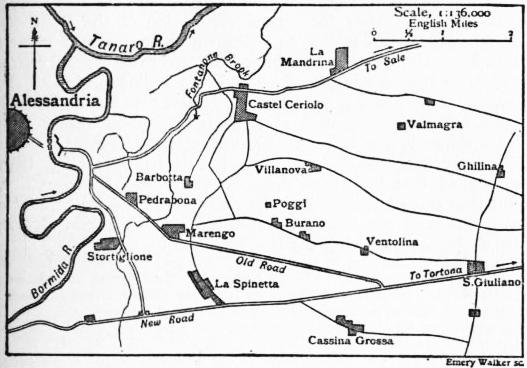
The French army, in ignorance of its opponent’s position, had advanced westward from the Scrivia towards Alessandria on the 12th, and its outposts had reached the Bormida on the evening of the 13th. But contact with the main Austrian army was not obtained, and on the assumption that it was moving towards either Valenza or Genoa Napoleon weakened his army by considerable detachments sent out right and left to find the enemy and to delay his progress. Unknown, however, to Napoleon Melas’s army was still at Alessandria, and on the morning of the 14th of June it filed out of the fortress and began its advance into the great plain of Marengo, one of the few favourable cavalry battle-grounds in north Italy.
The dispersion of the French army allowed only a fragmentary, though most energetic, resistance to be offered to the Austrian onset. The latter, considerably delayed at first by the crossing of the river Bormida, broke up into two columns,1 which advanced, the right by the main road on Marengo, the left on Castel Ceriolo. The former, personally commanded by Melas, was 20,000 strong, and General Victor, its immediate opponent, about 10,000, or including some 5000 of Lannes’ corps who fought on his right, about 15,000 strong; the Austrians were, moreover, greatly superior in guns and cavalry. The French disputed every yard of ground, holding their first line until they had by fire and counter-attack forced practically the whole of the Austrian right to deploy, and two hours passed before the Austrians managed to reach the Fontanone brook. But Victor’s troops, being disorganized and short of ammunition, had then to retire more rapidly across the plain. The retreat was orderly, according to Victor’s report, and made in échelon from the centre, and it is certain that at any rate the regiments held together, for the 6000 Austrian sabres found no opportunity to charge home. Many guns and wagons were, however, abandoned.
On the French right, opposed to the column of Lieut.-Field-Marshal Ott, was Lannes, with some 4000 men (excluding Watrin’s division which was with Victor) against 7500. He too was after a time forced to retire, with heavy losses. Thus, about 11 a.m. the First Consul, who was at some distance from the field, was at last convinced that he had to deal with Melas’s army. At once he sent out his staff officers to bring back his detachments, and pushed forward his only reserve, Monnier’s division, to support Lannes and Victor. But before this help arrived Lannes had been driven out of Castel Ceriolo, and Victor and Watrin forced back almost to San Giuliano. A little after 2 p.m. Monnier’s division (3500) came into action, and its impetuous advance drove the Austrians out of Castel Ceriolo. But after an hour it was forced back in its turn, and by 3 p.m. therefore, the 20,000 French troops, disordered and exhausted, and in one line without reserves,2 held a ragged line of battle to the right and left of San Giuliano. The best that could be expected was a prolongation of the struggle till nightfall and a fairly orderly retreat. The Austrian general, believing that the battle was won, returned to Alessandria, leaving a younger man, his chief of staff Zach, to organize the pursuit.
Then followed one of the most dramatic events in military history. Of the two detachments sent away by Napoleon in search of the enemy, one only received its orders of recall. This was Boudet’s division of Desaix’s corps, away to the south at Rivalta and at noon heading for Pozzolo-Formigaro on the Alessandria-Genoa road. At 1 p.m. a brief message, “Revenez, au nom de Díeu!” altered the direction of the column, and between 4 and 5, after a forced march, the division, headed by Desaix, came on to the battle-field. It was deployed as a unit and moved forward at the word of command along the main road Alessandria-Tortona, the sight of their closed line giving fresh courage to the men of Lannes and Victor. Then, while on the other side Zach was arraying a deep column of troops to pursue along the main road, Napoleon and Desaix, themselves under fire, hastily framed a plan of attack. All arms were combined. First, Marmont with eight of Boudet’s guns and ten others (the rest had been abandoned in the retirement) came into action on the right of the road, replying to the fire of the Austrian guns and checking their advanced infantry; close in rear of the artillery was Desaix’s infantry with the remnants of Lannes’ and Victor’s troops rallying on its right and left; on Lannes’ right, still facing Ott’s column, was Monnier, supported by the Consular Guard of horse and foot; lastly 400 sabres of Kellermann’s cavalry brigade, which had already been engaged several times and had lost heavily, formed up on the right of Desaix. About 5 p.m. Desaix advanced against the head of the Austrian main column formed by Zach. He himself fell in the attack, but the onset of his intact troops drove back the leading Austrians upon their supports, and at the critical moment when the attack of Boudet’s single weak division had almost spent its force, Kellermann with his 400 sabres sallied out of the French line. Marmont had brought up two guns to assist the infantry, and as he fired his last round of case-shot the cavalry raced past him to the front, wheeled inwards against the flank of the great column, and rode through and through it. Zach was taken prisoner with more than 2000 men, and Kellermann, rallying some of his troopers, flung himself upon the astonished Austrian cavalry and with the assistance of the Consular Guard cavalry defeated it. The “will to conquer” spread along the whole French line, while the surprise of the Austrians suddenly and strangely became mere panic. Lannes, Victor and Monnier advanced afresh, pushing the Austrians back on Marengo. A few Austrian battalions made a gallant stand at that place, while Melas himself, as night came on, rallied the fugitives beyond. Next day the completely exhausted, but victorious, French army extorted from the dazed Austrians a convention by which all Italy up to the Mincio was evacuated by them. The respective losses were: French about 4000, Austrians 9500.
See the French official Campagne de l’armée de réserve, vol. ii., by C. de Cugnac.
1 A third column was sent out to the extreme right (3000 under O’Reilly). This destroyed a small French detachment on the extreme left, but took little or no part in the main battle.
2 The Austrians, too, fighting in “linear” formation had few reserves. About one-third only of the imperial forces in Italy was actually engaged in the battle.
MAREOTIS (Arabic Mariut), the most westerly of the lakes in the Delta of Egypt. On the narrow strip of land separating the lake from the Mediterranean the city of Alexandria is built. (See Egypt; and Alexandria.)
MARE’S-TAIL, in botany, the popular name for an aquatic herb known botanically as Hippuris vulgaris (natural order Haloragaceae). It grows on margins of lakes, ponds and similar localities, and has a submerged stout creeping rootstock from which spring many-jointed cylindrical stems bearing numerous narrow leaves close-set in whorls. The minute greenish flowers are borne in the leaf-axils. Like many fresh-water plants it has a wide distribution, occurring in arctic and temperate regions in the northern hemisphere and reappearing in antarctic South America.
MARET, HUGUES-BERNARD, Duc de Bassano (1763-1839), French statesman and publicist, was born at Dijon. After receiving a sound education, he entered the legal profession and became advocate at the King’s Council at Paris. The ideas of the French Revolution profoundly influenced him, and wholly altered his career. The interest aroused by the debates of the first National Assembly suggested to him the idea of publishing them, conjointly with Méjean, in the Bulletin de l’Assemblée. The publicist Charles Joseph Panckoucke (1736-1798), owner of the Mercure de France and publisher of the famous Encyclopédie (1781), persuaded him to merge this in a larger paper, the Moniteur universel, which gained a wide repute for correctness and impartiality. He was a member of the moderate club, the Feuillants; but after the overthrow of the monarchy on the 10th of August 1792 he accepted an office in the ministry of foreign affairs, where he sometimes exercised a steadying influence. On the withdrawal of the British legation from Paris Maret went on a mission to London, where he had a favourable interview with Pitt on the 2nd of December 1792. All hope of an accommodation was, however, in vain. After the execution of Louis XVI. (Jan. 21, 1793), the chief French diplomatic agent, Chauvelin, was ordered to leave England, while the French Convention declared war (Feb. 1, 1793). These events precluded the possibility of success attending a second mission of Maret to London in January. After a space, in which he held no diplomatic post, he became ambassador of the French Republic at Naples; but, while repairing thither with De Sémonville he was captured by the Austrians and was kept in durance by them for some thirty months, until, at the close of 1795, the two were set free in return for the liberation of the daughter of Louis XVI. For a time Maret betook himself to journalism; but he played a useful part in the negotiations for a peace with Great Britain which went on at Lille during the summer of 1797, until the victory of the Jacobins at Paris in the coup d’état of Fructidor (Sept. 1797) frustrated the hopes of Pitt for peace and inflicted on Maret another reverse of fortune. On the return of Bonaparte from Egypt in 1799 Maret joined the general’s party which came to power with the coup d’état of Brumaire (Nov. 9-10, 1799).
Maret now became one of the First Consul’s secretaries and shortly afterwards secretary of state. In this position his moderation, industry, good sense, knowledge of men and of affairs, made his services of great value. The Moniteur, which became the official journal of the state in 1800, was placed under his control. He sometimes succeeded in toning down the hard, abrupt language of Napoleon’s communications, and in every way proved a useful intermediary. It is known that he had a share in the drawing up of the new constitutions for the Batavian and Italian Republics. In 1804 he became Minister; in 1807 he was named count, and in 1809 he received the title of duc de Bassano, an honour which marked the sense entertained by Napoleon of his strenuous toil, especially in connexion with the diplomatic negotiations and treaties of this period. His personal devotion to the emperor was of that absolute unwavering kind which Napoleon highly valued; it is seen in the attempt to defend the unworthy artifices adopted by the great man in April-May 1808 in order to make himself master of the destinies of Spain. Maret also assisted in drawing up the constitution destined for Spain, which the Spaniards at once rejected.
Maret accompanied Napoleon through most of his campaigns, including that of 1809; and at its close he expressed himself in favour of the marriage alliance with the archduchess Marie Louise of Austria, which took place in 1810. In the spring of 1811, the duc de Bassano replaced Champagny, duc de Cadore, as minister of Foreign Affairs. In this capacity he showed his usual industry and devotion, concluding the treaties between France and Austria and France and Prussia, which preceded the French invasion of Russia in 1812. He was with Napoleon through the greater part of that campaign; and after its disastrous conclusion helped to prepare the new forces with which Napoleon waged the equally disastrous campaign of 1813. But in November 1813 Napoleon replaced him by Caulaincourt, duc de Vicence, who was thought to be more devoted to the cause of peace and personally grateful to the emperor Alexander I. of Russia. Maret, however, as private secretary of the emperor, remained with his master through the campaign of 1814, as also during that of 1815. After the second restoration of the Bourbons he was exiled, and retired to Grätz where he occupied himself with literary work. In 1820 he was allowed to return to France, and after the Revolution of 1830, Louis Philippe, king of the French, made him a peer of France; he also held two high offices for a few days. He died at Paris in 1839. He shares with Daru the honour of being the hardest worker and most devoted supporter in Napoleon’s service; but it has generally been considered that he carried devotion to the length of servility, and thus often compromised the real interests of France. This view has been contested by Baron Ernouf in his work Maret, duc de Bassano, which is the best biography.
For Maret’s mission to England in 1792 and his work at Lille in 1797, see Augustus W. Miles, Letters on the French Revolution; J. H. Rose, The Life and Times of William Pitt, and for other incidents of Maret’s career, the memoirs of Bourrienne, Pasquier, Méneval and Savary (duc de Rovigo), may be consulted. Thiers’s account of Maret is in general hostile to him.
(J. Hl. R.)
MARGARET (Fr. Marguerite, It. Margherita, Ger. Margareta, and Margarete, with dim. Grete, Gretchen, Meta, fr. Lat. margarita, Gr. μαργαρίτης, a pearl), a female proper name, which became very popular in all Christian countries as that of the saint noticed below. Biographies of some who have borne it are arranged below in the following order: saints, queens of Scotland, queens of other countries, princesses and duchesses.
MARGARET, ST (Sancta Margarita), virgin and martyr, is celebrated by the Church of Rome on the 20th of July. According to the legend, she was a native of Antioch, daughter of a pagan priest named Aedesius. She was scorned by her father for her Christian faith, and lived in the country with a foster mother keeping sheep. Olybrius, the “praeses orientis,” offered her marriage as the price of her renunciation of Christianity. Her refusal led to her being cruelly tortured, and after various miraculous incidents, she was put to death. Among the Greeks she is known as Marina, and her festival is on the 17th of July. She has been identified with St Pelagia (q.v.)—Marina being the Latin equivalent of Pelagia—who, according to a legend, was also called Margarito. We possess no historical documents on St Margaret as distinct from St Pelagia. An attempt has been made, but without success, to prove that the group of legends with which that of St Margaret is connected is derived from a transformation of the pagan divinity Aphrodite into a Christian saint. The problem of her identity is a purely literary question. The cult of St Margaret was very widespread in England, where more than 250 churches are dedicated to her.
See Acta sanctorum, July, v. 24-45; Bibliotheca hagiographica. Latina (Brussels, 1899), n. 5303-5313; Frances Arnold-Forster, Studies in Church Dedications (London, 1899), i. 131-133 and iii. 19.
(H. De.)
MARGARET, ST (c. 1045-1093), the queen of Malcolm III. Canmore king of Scotland, was the daughter of the English prince Edward, son of Edmund Ironside, and sister of Edgar Ætheling, and was probably born in Hungary. In 1067 the widow and children of Edward fled from Northumberland with a large number of followers and sought the protection of the Scottish king. The marriage of Malcolm and Margaret soon took place and was followed by several invasions of Northumberland by the Scottish king, probably in support of the claims of his brother-in-law Edgar. These, however, had little result beyond the devastation of the province. Far more important were the effects of this alliance upon the history of Scotland. A considerable portion of the old Northumbrian kingdom had been reduced by the Scottish kings in the previous century, but up to this time the English population had little influence upon the ruling element of the kingdom. Malcolm’s marriage undoubtedly improved the condition of the English to a great extent, and under Margaret’s sons, Edgar, Alexander I. and David I., the Scottish court practically became anglicized. Margaret died on the 17th of November 1093, four days after her husband and her eldest son Edward, who were slain in an invasion of Northumberland. She rebuilt the monastery of Iona, and was canonized in 1251 on account of her great benefactions to the Church.