VOLUME XVII SLICE VI Map to Mars (continued 11)
Reading edition
The place and the value of Christopher Marlowe as a leader among English poets it would be almost impossible for historical criticism to over-estimate. To none of them all, perhaps, have so many of the greatest among them been so deeply and so directly indebted. Nor was ever any great writer’s influence upon his fellows more utterly and unmixedly an influence for good. He first, and he alone, guided Shakespeare into the right way of work; his music, in which there is no echo of any man’s before him, found its own echo in the more prolonged but hardly more exalted harmony of Milton’s. He is the greatest discoverer, the most daring and inspired pioneer, in all our poetic literature. Before him there was neither genuine blank verse nor a genuine tragedy in our language. After his arrival the way was prepared, the paths were made straight, for Shakespeare.
(A. C. S.)
Marlowe’s fame, so finely appreciated by Shakespeare and Drayton, was in obscuration from the fall of the theatres until the generation of Lamb and Hazlitt. A collected edition was brought out by Pickering in 1826. This was greatly improved upon by A. Dyce (1858, 1865, 1876). A one-volume edition was prepared by Colonel Francis Cunningham in 1871. The standard edition of Mr A. H. Bullen in 3 vols. appeared in 1884-1885 and is now under revision. The “Best Plays” were edited for the Mermaid series by Havelock Ellis with an Introduction by J. A. Symonds (1887-1889). The best modern text is that edited by C. F. Tucker Brooke (Oxf. Univ. Press, 1910). A sketch in outline of Marlowe’s Life was essayed by J. G. Lewis (Canterbury, 1891). A not very conclusive monograph on Christopher Marlowe and his Associates by J. H. Ingram, followed in 1904. For further information the reader should consult the histories of the stage by Collier, Ward, Fleay, Schelling, and the studies of Shakespeare’s Predecessors by Symonds, Mezières, Boas, Manley, Churton Collins, Feuillerat and J. M. Robertson. See also Verity’s Essay on Marlowe’s Influence (1886); Mod. Lang. Rev. iv. 167 (M. at Cambridge); Swinburne, Study of Shakespeare (1880); Elze, Notes, and Hazlitt Dramatic Lit. of the Age of Elizabeth; Fortnightly Review, xiii., lxxi., and Sept.-Oct., 1905; Jusserand, Hist. of English Lit.; the Cambridge Hist. of English Lit.; Seccombe and Allen, Age of Shakespeare (vol. ii. 3rd ed., 1909), and the separate editions of Dr Faustus, Edward II., &c. The main sources of Marlowe were as follows: for Tamburlaine, Pedro Mexia’s Life of Timur in his Silva (Madrid, 1543), anglicized by Fortescue in his Foreste (1571) and Petrus Perondinus Vita Magni Tamerlanis (1551); for Faustus: a contemporary English version of the Faust-buch or Historia von D. Johann Fausten (Frankfort, 1587), and for Edward II., the Chronicles of Fabyan (1516), Holinshed (1577) and Stow (1580).
(T. Se.)

MARLOWE, JULIA [Sarah Frances Frost] (1870- ), American actress, was born near Keswick, England, on the 17th of August 1870, and went with her family to America in 1875. Her first formal appearance on the stage was in New York in 1887, although she had before that travelled with a juvenile opera company in H.M.S. Pinafore, and afterwards was given such parts as Maria in Twelfth Night in Miss Josephine Riley’s travelling company. Her first great success was as Parthenia in Ingomar, and her subsequent presentations of Rosalind, Viola, and Julia in The Hunchback confirmed her position as a “star.” In 1894 she married Robert Taber, an actor, with whom she played until their divorce in 1900. Subsequently she had great success as Barbara Frietchie in Clyde Fitch’s play of that name, and other dramas; and from 1904 to 1907 she acted with E. H. Sothern in a notable series of Shakespeare plays, as well as in modern drama.
MARLY-LE-ROI, a village of northern France in the department of Seine-et-Oise, 5 m. N. by W. of Versailles by road. Pop. (1906), 1409. Notwithstanding some fine country houses, Marly is dull and unattractive, and owes all its celebrity to the sumptuous château built towards the end of the 17th century by Louis XIV., and now destroyed. It was originally designed as a simple hermitage to which the king could occasionally retire with a few of his more intimate friends from the pomp of Versailles, but gradually it grew until it became one of the most ruinous extravagances of the Grand Monarque. The central pavilion (inhabited by the king himself) and its twelve subsidiary pavilions were intended to suggest the sun surrounded by the signs of the zodiac. Seldom visited by Louis XV., and wholly abandoned by Louis XVI., it was demolished after the Revolution, its art treasures having previously been dispersed, and the remains now consist of a large basin, the Abreuvoir, a few mouldering ivy-grown walls, some traces of parterres with magnificent trees, the park, and the forest of 81⁄2 sq. m., one of the most pleasant promenades of the neighbourhood of Paris, containing the shooting preserves of the President of the Republic.
Close to the Seine, half-way between Marly-le-Roi and St Germain, is the village of Port-Marly, and one mile farther up is the hamlet of Marly-la-Machine. Here, in 1684, an immense hydraulic engine, driven by the current of the river, was erected; it raised the water to a high tower, where the aqueduct of Marly began (700 yds. in length, 75 in height, with 36 arches, still well-preserved), carrying the waters of the Seine to Versailles.
MARMALADE (adopted from Fr. marmelade, from marmelo, a quince, derived through the Lat. melimelum, from Gr. μέλι, honey, and μῆλον, an apple, an apple grafted on a quince), a preserve originally made of quinces, but now commonly of Seville oranges. The “marmalade-tree” (Lucuma mammosa) bears a fruit whose thick pulp resembles marmalade and is called natural marmalade. “Marmalade box” is the name of the fruit of the Genipa Americana, which opens in the same manner as a walnut, the nut being replaced by a soft pulp.
MARMANDE, a town of south-western France, capital of an arrondissement in the department of Lot-et-Garonne, 35 m. N.W. of Agen, on the Southern railway from Bordeaux to Cette. Pop. (1906), town 6373; commune, 9748. Marmande is situated at the confluence of the Trec with the Garonne on the right bank of the latter river, which is here crossed by a suspension bridge. Public institutions include the sub-prefecture, the tribunals of first instance and commerce, the communal college and schools of commerce and industry and of agriculture. Apart from the administrative offices, the only building of importance is the church of Nôtre-Dame, which dates from the 13th, 14th and 15th centuries. The graceful windows of the nave, the altarpiece of the 18th century, and in particular, the Renaissance cloister adjoining the south side, are its most interesting features. Among the industries are iron-founding, steam sawing, the manufacture of woollens, carriage-making, cooperage and brandy-distilling. There is a large trade in wine, plums, cattle, grain and other agricultural produce.
Marmande was a bastide founded about 1195 on the site of a more ancient town by Richard Cœur de Lion, who granted it a liberal measure of self-government. Its position on the banks of the Garonne made it an important place of toll. It soon passed into the hands of the counts of Toulouse, and was three times besieged and taken during the Albigensian crusade, its capture by Amaury de Montfort in 1219 being followed by a massacre of the inhabitants. It was united to the French crown under Louis IX. A short occupation by the English in 1447, an unsuccessful siege by Henry IV. in 1577 and its resistance of a month to a division of Wellington’s army in 1814, are the chief events in its subsequent history.
MARMIER, XAVIER (1809-1892), French author, was born at Pontarlier, in Doubs, on the 24th of June 1809. He had a passion for travelling, and this he combined throughout his life with the production of literature. After journeying in Switzerland, Belgium and Holland, he was attached in 1835 to the Arctic expedition of the “Recherche”; and after a couple of years at Rennes as professor of foreign literature, he visited (1842) Russia, (1845) Syria, (1846) Algeria, (1848-1849) North and South America, and numerous volumes from his pen were the result. In 1870 he was elected to the Academy, and he was for many years prominently identified with the Sainte-Geneviève library. He did much to encourage the study of Scandinavian literature in France, publishing translations of Holberg, Oehlenschläger and others. He died in Paris on the 11th of October 1892.
MARMONT, AUGUSTE FRÉDÉRIC LOUIS VIESSE DE, Duke of Ragusa (1774-1852), marshal of France, was born at Châtillon-sur-Seine, on the 20th of July 1774. He was the son of an ex-officer in the army who belonged to the petite noblesse and adopted the principles of the Revolution. His love of soldiering soon showing itself, his father took him to Dijon to learn mathematics prior to entering the artillery, and there he made the acquaintance of Bonaparte, which he renewed after obtaining his commission when he served in Toulon. The acquaintance ripened into intimacy; Marmont became General Bonaparte’s aide-de-camp, remained with him during his disgrace and accompanied him to Italy and Egypt, winning distinction and promotion to general of brigade. In 1799 he returned to Europe with his chief; he was present at the coup d’état of the 18th Brumaire, and organized the artillery for the expedition to Italy, which he commanded with great effect at Marengo. For this he was at once made general of division. In 1801 he became inspector-general of artillery, and in 1804 grand officer of the Legion of Honour, but was greatly disappointed at being omitted from the list of officers who were made marshals. In 1805 he received the command of a corps, with which he did good service at Ulm. He was then directed to take possession of Dalmatia with his army, and occupied Ragusa. For the next five years he was military and civil governor of Dalmatia, and traces of his beneficent régime still survive both in great public works and in the memories of the people. In 1808 he was made duke of Ragusa, and in 1809, being summoned by Napoleon to take part in the Austrian War, he marched to Vienna and bore a share in the closing operations of the campaign. Napoleon now made him a marshal and governor-general of all the Illyrian provinces of the empire. In July 1810 Marmont was hastily summoned to succeed Masséna in the command of the French army in the north of Spain. The skill with which he manœuvred his army during the year he commanded it has been always acknowledged. His relief of Ciudad Rodrigo in the autumn of 1811 in spite of the presence of the English army was a great feat, and in the manœuvring which preceded the battle of Salamanca he had the best of it. But Wellington more than retrieved his position in the battle (see Salamanca), and inflicted a severe defeat on the French, Marmont himself being gravely wounded in the right arm and side. He retired to France to recover, and was still hardly cured when in April 1813 Napoleon, who soon forgot his fleeting resentment for the defeat, gave him the command of a corps. With it he served at the battles of Lützen, Bautzen and Dresden, and throughout the great defensive campaign of 1814 until the last battle before Paris, from which he drew back his forces to the commanding position of Essonne. Here he had 20,000 men in hand, and was the pivot of all thoughts. Napoleon said of this camp of Essonne, “C’est là que viendront s’addresser toutes les intrigues, toutes les trahisons; aussi y ai-je placé Marmont, mon enfant élevé sous ma tente.” Marmont then took upon himself a political rôle which has, no doubt justly, been stigmatized as ungrateful and treasonable. A secret convention was concluded, and Marmont’s corps was surrounded by the enemy. Napoleon, who still hoped to retain the crown for his infant son, was prostrated, and said with a sadness deeper than violent words, “Marmont me porte le dernier coup.”
This act was never forgiven by Marmont’s countrymen. On the restoration of the Bourbons he was indeed made a peer of France and a major-general of the royal guard, and in 1820 a knight of the Saint Esprit and a grand officer of the order of St Louis; but he was never trusted. He was the major-general of the guard on duty in July 1830, and was ordered to put down with a strong hand any opposition to the ordinances (see France). Himself opposed to the court policy, he yet tried to do his duty, and only gave up the attempt to suppress the revolution when it became clear that his troops were outmatched. This brought more obloquy upon him, and the duc d’Angoulême even ordered him under arrest, saying, “Will you betray us, as you betrayed him?” Marmont did not betray them; he accompanied the king into exile and forfeited his marshalate thereby. His desire to return to France was never gratified and he wandered in central and eastern Europe, settling finally in Vienna, where he was well received by the Austrian government, and strange to say made tutor to the duke of Reichstadt, the young man who had once for a few weeks been styled Napoleon II. He died at Venice on the 22nd of March 1852.
Much of his time in his last years was spent upon his Mémoires, which are of great value for the military history of his time, though they must be read as a personal defence of himself in various junctures rather than as an unbiased account of his times. They show Marmont, as he really was, an embittered man, who never thought his services sufficiently requited, and above all, a man too much in love with himself and his own glory to be a true friend or a faithful servant. His strategy indeed tended to become pure virtuosity, and his tactics, though neat, appear frigid and antiquated when contrasted with those of the instinctive leaders, the fighting generals whom the theorists affect to despise. But his military genius is undeniable, and he was as far superior to the mere theorist as Lannes and Davout were to the pure divisionnaire or “fighting” general.
His works are Voyage en Hongrie, &c. (4 vols., 1837); Voyage en Sicile (1838); Esprit des institutions militaires (1845); César; Xenophon; and Mémoires (8 vols., published after his death in 1856). See the long and careful notice by Sainte-Beuve, Causeries du Lundi, vol. vi.
MARMONTEL, JEAN FRANÇOIS (1723-1799), French writer, was born of poor parents at Bort, in Cantal, on the 11th of July 1723. After studying with the Jesuits at Mauriac, he taught in their colleges at Clermont and Toulouse; and in 1745, acting on the advice of Voltaire, he set out for Paris to try for literary honours. From 1748 to 1753 he wrote a succession of tragedies which,1 though only moderately successful on the stage, secured the admission of the author to literary and fashionable circles. He wrote for the Encyclopédie a series of articles evincing considerable critical power and insight, which in their collected form, under the title Éléments de Littérature, still rank among the French classics. He also wrote several comic operas, the two best of which probably are Sylvain (1770) and Zémire et Azore (1771). In the Gluck-Piccini controversy he was an eager partisan of Piccini with whom he collaborated in Didon (1783) and Pénélope (1785). In 1758 he gained the patronage of Madame de Pompadour, who obtained for him a place as a civil servant, and the management of the official journal Le Mercure, in which he had already begun the famous series of Contes moraux. The merit of these tales lies partly in the delicate finish of the style, but mainly in the graphic and charming pictures of French society under Louis XV. The author was elected to the French Academy in 1763. In 1767 he published a romance, Bélisaire, now remarkable only on account of a chapter on religious toleration which incurred the censure of the Sorbonne and the archbishop of Paris. Marmontel retorted in Les Incas (1778) by tracing the cruelties in Spanish America to the religious fanaticism of the invaders.
He was appointed historiographer of France (1771), secretary to the Academy (1783), and professor of history in the Lycée (1786). In his character of historiographer Marmontel wrote a history of the regency (1788) which is of little value. Reduced to poverty by the Revolution, Marmontel in 1792 retired during the Terror to Evreux, and soon after to a cottage at Abloville in the department of Eure. To that retreat we owe his Mémoires d’un père (4 vols., 1804) giving a picturesque review of his whole life, a literary history of two important reigns, a great gallery of portraits extending from the venerable Massillon, whom more than half a century previously he had seen at Clermont, to Mirabeau. The book was nominally written for the instruction of his children. It contains an exquisitely drawn picture of his own childhood in the Limousin; its value for the literary historian is very great. Marmontel lived for some time under the roof of Mme Geoffrin, and was present at her famous dinners given to artists; he was, indeed, an habitué of most of the houses where the encyclopaedists met. He had thus at his command the best material for his portraits, and made good use of his opportunities. After a short stay in Paris when elected in 1797 to the Conseil des Anciens, he died on the 31st of December 1799 at Abloville.
See Sainte-Beuve, Causeries du lundi, iv.; Morellet, Éloge (1805).
1 Denys le Tyran (1748); Aristomène (1749); Cléopâtre (1750); Héraclides (1752); Egyptus (1753).
MARMORA (anc. Proconnesus), an island in the sea of the same name. Originally settled by Greeks from Miletus in the 8th century B.C., Proconnesus was annexed by its powerful neighbour Cyzicus in 362. The island has at all times been noted for its quarries of white marble which supplied the material for several famous buildings of antiquity (e.g. the palace of Mausolus at Halicarnassus).
See C. Texier, Asie mineure (Paris, 1839-1849); M. I. Gedeon, Προικόννησος (Constantinople, 1895); an exhaustive monograph by F. W. Hasluek in Journ. Hell. Stud., xxix., 1909.
MARMORA, SEA OF (anc. Propontis; Turk. Mermer Denisi), the small inland sea which (in part) separates the Turkish dominions in Europe from those in Asia, and is connected through the Bosporus with the Black Sea (q.v.) and through the Dardanelles with the Aegean. It is 170 m. long (E. to W.) and nearly 50 m. in extreme width, and has an area of 4500 sq. m. Its greatest depth is about 700 fathoms, the deepest parts (over 500 fathoms) occurring in three depressions in the northern portion—one close under the European shore to the south of Rodosto, another near the centre of the sea, and a third at the mouth of the Gulf of Ismid. There are several considerable islands, of which the largest, Marmora, lies in the west, off the peninsula of Kapu Dagh, along with Afsia, Aloni and smaller islands. In the east, off the Asiatic shore between the Bosporus and the Gulf of Ismid, are the Princes’ Islands.
MARMOSET, a name derived from Fr. marmouset (meaning “of a gross figure”), and used to designate the small tropical American monkeys classed by naturalists in the family Hapalidae (or Chrysothricidae). Marmosets are not larger than squirrels, and present great variation in colour; all have long tails, and many have the ears tufted. They differ from the other American monkeys in having one pair less of molar teeth in each jaw. The common marmoset, Hapale (or Chrysothrix) jacchus, is locally known as the oustiti, while the name piriché is applied to another species (see Primates).
MARMOT, the vernacular name of a large, thickly built, burrowing Alpine rodent mammal, allied to the squirrels, and typifying the genus Arctomys, of which there are numerous species ranging from the Alps through Asia north of (but including the inner ranges of) the Himalaya, and recurring in North America. All these may be included under the name marmot. In addition to their stout build and long thickly haired tails, marmots are characterized by the absence of cheek-pouches, and the rudimentary first front-toe, which is furnished with a flat nail, as well as by certain features of the skull and cheek-teeth. Europe possesses two species, the Alpine or true marmot (A. marmotta), and the more eastern bobac (A. bobac); and there are numerous kinds in Central Asia, one of which, the red marmot (A. caudata), is a much larger animal, with a longer tail. Marmots inhabit open country, either among mountains, or, more to the north, in the plains; and associate in large colonies, forming burrows, each tenanted by a single family. During the daytime the hillock at the entrance to the burrow is frequently occupied by one or more members of the family, which at the approach of strangers sit up on their hind-legs in order to get a better view. If alarmed they utter a shrill loud whistle, and rush down the burrow, but reappear after a few minutes to see if the danger is past. In the winter when the ground is deep in snow, marmots retire to the depths of their burrows, where as many as ten or fifteen may occupy the same chamber. No store of food is accumulated, and the winter sleep is probably unbroken. From two to four is the usual number of young in a litter. In America marmots are known as “wood-chucks” (q.v.), the commonest species being A. monax. The so-called prairie-dogs, which are smaller and more slender North American rodents with small cheek-pouches, form a separate genus, Cynomys; while the term pouched-marmots denotes the various species of souslik (q.v.), Spermophilus (or Citillus), which are common to both hemispheres, and distinguished by the presence of large cheek-pouches (see Rodentia).
(R. L.*)
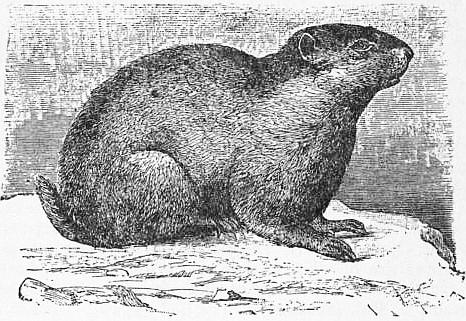
The Alpine Marmot (Arctomys marmotta).
MARNE, a river of northern France, rising on the Plateau of Langres, 3 m. S. by E. of Langres, and uniting with the Seine at Charenton, an eastern suburb of Paris. Leaving Langres on the left the river flows northward, passing Chaumont, as far as a point a little above St Dizier. Here it turns west and enters the department of Marne, where it waters the Perthois and the wide plain of Champagne-Pouilleuse. Soon after its entrance into this department it receives the Blaise; and turning north-west passes Vitry-le-François where it receives the Saulx, Châlons, below which it resumes a westerly course, and Epernay, where it enters picturesque and undulating country. Its subsequent course lies through the departments of Aisne, where it flows through Chateau-Thierry; Seine-et-Marne, where it drives the picturesque mills of Meaux; Seine-et-Oise and Seine. Its chief tributaries in those departments are the Petit-Morin, the Ourcq and the Grand-Morin. The length of the Marne is 328 m., the area of its basin 4894 sq. m. It is joined a mile from its source of the Marne-Saône canal which is continued at Rouvroy by the Haute-Marne canal as far as Vitry-le-François. From that town, which is the starting-point of the canal between the Marne and the Rhine, it is accompanied by the lateral canal of the Marne to Dizy where its own channel is canalized. At Condé, above Epernay, the river is joined by the canal connecting it with the Aisne. From Lizy, above Meaux, it is accompanied on the right bank, though at some distance, by the Ourcq canal.
MARNE, a department of north-eastern France, made up from Champagne-Pouilleuse, Rémois, Haute-Champagne, Perthois, Tardenois, Bocage and Brie-Pouilleuse, districts formerly belonging to Champagne, and bounded W. by Seine-et-Marne and Aisne, N. by Aisne and Ardennes, E. by Meuse, and S. by Haute-Marne and Aube. Pop. (1906), 434,157. Area 3167 sq. m.
About one-half consists of Champagne-Pouilleuse, a monotonous and barren plain covering a bed of chalk 1300 ft. in thickness. On the west and on the east it is commanded by two ranges of hills. The highest point in the department (920 ft.) is in the hill district of Reims, which rises to the south-west of the town of the same name, between the Vesle and the Marne. The lowest level (164 ft.) where the Aisne leaves the department, is not far distant. To the south of the Marne the hills of Reims are continued by the heights of Brie (700 to 800 ft.). All these belong geologically to the basin of Paris. They slope gently towards the west, but command the plain of Champagne-Pouilleuse by a steep descent on the east. On the farther side of the plain are the heights of Argonne (860 ft.) formed of beds of the Lower Chalk, and covered by forests; they unite the calcareous formations of Langres to the schists of Ardennes, and a continuation of them stretches southward into Perthois and the marshy Bocage. The department belongs entirely to the Seine basin, but includes only 13 miles of that river, in the south-west; it there receives the Aube, which flows for 10 miles within the department. The principal river is the Marne, which runs through the department for 105 miles in a great sweep concave to the south-west. The Aisne enters the department at a point 12 miles from its source, and traverses it for 37 miles. Two of its affluents on the left, the Suippes and the Vesle, on which stands Reims, have a longer course from south-east to north-west across the department.
Marne has the temperate climate of the region of the Seine; the annual mean temperature is 50° F., the rainfall about 24 in. Oats, wheat, rye and barley among the cereals, lucerne, sainfoin and clover, and potatoes, mangold-wurzels and sugar-beet are the principal agricultural crops. The raising of sheep of a mixed merino breed and of other stock together with bee-farming are profitable. The vineyards, concentrated chiefly round Reims and Épernay, are of high value; the manufacture of the sparkling Champagne wines being a highly important industry, of which Épernay, Reims and Châlons are the chief centres. Several communes supply the more valuable vegetables, such as asparagus, onions, &c. The principal orchard fruits are the apple, plum and cherry. Pine woods are largely planted in Champagne-Pouilleuse. The department produces peat, millstones and chalk.
The woollen industry has brought together in the neighbourhood of Reims establishments for spinning, carding, dyeing and weaving. The materials wrought are flannels, merinoes, tartans, shawls, rugs and fancy articles; the manufacture of woollen and cotton hosiery must also be mentioned. The manufacture of wine-cases, corks, casks and other goods for the wine trade is actively carried on. Marne contains blast-furnaces, iron and copper foundries, and manufactories of agricultural implements. Besides these there are tan-yards, currying and leather-dressing establishments and glassworks, which, with sugar, chemical, whiting and oil works, potteries, flour-mills and breweries, complete the list of the most important industries. Biscuits and gingerbread are a speciality of Reims. The chief imports are wool and coal; the exports are wine, grain, live-stock, stone, whiting, pit-props and woollen stuffs. Communication is afforded chiefly by the river Marne with its canal connexions, and by the Eastern railway. There are five arrondissements—those of Châlons (the capital), Épernay, Reims, Ste Ménehould and Vitry-le-François—with 33 cantons and 662 communes. The department belongs partly to the archbishopric of Reims and partly to the see of Châlons. Châlons is the headquarters of the VI. army corps. Its educational centre and court of appeal are at Paris. The principal towns—Châlons-sur-Marne, Reims, Épernay and Vitry-le-François—are separately treated. The towns next in population are Ay (4994) and Sézanne (4504). Other places of interest are Ste Ménehould (3348), formerly an important fortress and capital of the Argonne; Montmort with a Renaissance château once the property of Sully; Trois-Fontaines with a ruined church of the 12th century and the remains of a Cistercian abbey founded in 1115; and Orbais with an abbey church dating from about 1200.
MARNIAN EPOCH, the name given by G. de Mortillet to the period usually called in France the Gallic, which extends from about five centuries before the Christian era to the conquest of Gaul by Caesar. M. de Mortillet objects to the term “Gallic,” as the civilization characteristic of the epoch was not peculiar to the ancient Gauls, but was common to nearly all Europe at the same date. The name is derived from the fact that the French department of Marne has afforded the richest “finds.”
MAROCHETTI, CARLO, Baron (1805-1867), Italian sculptor, was born at Turin. Most of his early life was spent in France, his first systematic instruction being given him by Bosio and Gros in Paris. Here his statue of “A Young Girl playing with a Dog” won a medal in 1829. But between 1822 and 1830 he studied chiefly in Rome. From 1832 to 1848 he lived in France. His “Fallen Angel” was exhibited in 1831. In 1848 Marochetti removed to London, and there he lived for the greater part of his time till his death in 1867. Among his chief works were statues of Queen Victoria, Lord Clyde (the obelisk in Waterloo Place), Richard Cœur-de-Lion (Westminster), Emmanuel Philibert (1833, Turin), the tomb of Bellini (Père-la-Chaise), and the altar in the Madeleine. His style was vigorous and effective, but rather popular than artistic. Marochetti, who was created a baron by the king of Sardinia, was also a chevalier of the Legion of Honour.
MARONITES (Arab. Mawarina), a Christian people of the Ottoman Empire in communion with the Papal Church, but forming a distinct denomination. The original seat and present home of the nucleus of the Maronites is Mt Lebanon; but they are also to be found in considerable force in Anti-Lebanon and Hermon, and more sporadically in and near Antioch, in Galilee, and on the Syrian coast. Colonies exist in Cyprus (with a large convent near Cape Kormakiti), in Alexandria, and in the United States of America. These began to be formed during the troubles of 1860. The Lebanon community numbers about 300,000, and the total of the whole denomination cannot be much under half a million.
The origin of Maronism has been much obscured by the efforts of learned Maronites like Yusuf as-Simani (Assemanus), Vatican librarian under Clement XII., Faustus Nairon, Gabriel Sionita and Abraham Ecchellensis to clear its history from all taint of heresy. We are told of an early Antiochene, Mar Marun or Maro, who died about A.D. 400 in the odour of sanctity in a convent at Ribla on the Orontes, whence orthodoxy spread over mid-Syria. But nothing sure is known of him, and not much more about a more historical personage, Yuhanna Marun (John Sirimensis of Suedia), said to have been patriarch of Antioch, to have converted Lebanon from Monothelism, and to have died in A.D. 707. It is, however, certain that the Lebanon Christians as a whole were not orthodox in the time of Justinian II., against whose supporters, the Melkites, they ranged themselves after having co-operated awhile with the emperor against the Moslems. They were then called Mardaites or rebels, and were mainly Monothelite in the 12th century, and remained largely so even a century later. The last two facts are attested by William of Tyre and Barhebraeus. It seems most probable that the Lebanon offered refuge to Antiochene Monothelites flying from the ban of the Constantinopolitan Council of A.D. 680; that these converted part of the old mountain folk, who already held some kind of Incarnationist creed; and that their first patriarch and his successors, for about 500 years at any rate, were Monothelite, and perhaps also Monophysite. It is worth noting that even as late as the close of the 16th century the Maronite patriarch found it necessary to protest by anathema against imputations of heresy. In 1182 it is said that Amaury, patriarch of Antioch, induced some Maronite bishops, who had fallen under crusading influences, to rally to Rome; and a definite acceptance of the Maronite Church into the Roman communion took place at the Council of Florence in 1445. But it is evident that the local particularism of the Lebanon was adverse to this union, and that even Gregory XIII., who sent the pallium to the patriarch Michael, and Clement VII. who in 1596 dispatched a mission to a synod convoked at Kannobin, the old patriarchal residence, did not prevail on the lower clergy or the mass of the Maronites. A century and a half later Clement XII. was more successful. He sent to Syria, Assemanus, a Maronite educated at the Roman college of Gregory XIII.; and at last, at a council held at the monastery of Lowaizi on the 30th of September 1736, the Maronite Church accepted from Rome a constitution which is still in force, and agreed to abandon some of its more incongruous usages such as mixed convents of monks and nuns. It retained, however, its Syriac liturgy and a non-celibate priesthood. The former still persists unchanged, while the Bible is read and exhortations are given in Arabic; and priests may still be ordained after marriage. But marriage is not permitted subsequent to ordination, nor does it any longer usually precede it. The tendency to a celibate clergy increases, together with other romanizing usages, promoted by the papal legate in Beirut, the Catholic missioners, and the higher native clergy who are usually educated in Rome or at St Sulpice. The legate exercises growing influence on patriarchal and other elections, and on Church government and discipline. The patriarch receives confirmation from Rome, and the political representation of the Maronites at Constantinople is in the hands of the vicar apostolic. Rome has incorporated most of the Maronite saints in her calendar, while refusing (despite their apologists) to canonize either of the reputed eponymous founders of Maronism.
While retaining many local usages, the Maronite Church does not differ now in anything essential from the Papal, either in dogma or practice. It has, like the Greek Church, two kinds of clergy—parochial and monastic. The former are supported by their parishes; the latter by the revenues of the monasteries, which own about one-sixth of the Lebanon lands. There are some 1400 monks in about 120 monastic establishments (many of these being mere farms in charge of one or two monks). All are of the order of St Anthony, but divided into three congregations, the Ishaya, the Halebiyeh (Aleppine) and the Beladiyeh or Libnaniyeh (local). The distinction of the last named dates only from the early 18th century. The lower clergy are educated at the theological college of Ain Warka. There are five archbishoprics and five bishoprics under the patriarch, who alone can consecrate. The sees are Aleppo, Baalbek, Tripoli, Ehden, Damascus, Beirut, Tyre, Cyprus and Jebeil (held by the patriarch himself ex officio). There are also four prelates in partibus.
The Maronites are most numerous and unmixed in the north of Lebanon (districts of Bsherreh and Kesrawan). Formerly they were wholly organized on a clan system under feudal chiefs, of whom those of the house of Khazin were the most powerful; and these fought among themselves rather than with the Druses or other denominations down to the 18th century, when the Arab family of Shehab for its own purposes began to stir up strife between Maronites and Druses (see Druses). Feudalism died hard, but since 1860 has been practically extinct; and so far as the Maronites own a chief of their own people it is the “Patriarch of Antioch and the whole East,” who resides at Bkerkeh near Beirut in winter, and at a hill station (Bdiman or Raifun) in summer. The latter, however, has no recognized jurisdiction except over his clergy. The Maronites have four members on the provincial council, two of whom are the sole representatives of the two mudirats of Kesrawan; and they have derived benefit from the fact that so far the governor of the privileged province has always been a Catholic (see Lebanon). The French protection of them, which dates from Louis XIV., is no longer operative but to French official representatives is still accorded a courteous precedence. The Maronite population has greatly increased at the expense of the Druses, and is now obliged to emigrate in considerable numbers. Increase of wealth and the influence of returned emigrants tend to soften Maronite character, and the last remnants of the barbarous state of the community—even the obstinate blood-feud—are disappearing.
See C. F. Schnurrer, De ecclesia Maronitica (1810); F. J. Bliss in Pal. Expl. Fund Quarterly Statement (1892); and authorities for Druses and Lebanon.
(D. G. H.)
MAROONS. A nègre marron is defined by Littré as a fugitive slave who betakes himself to the woods; a similar definition of cimarron (apparently from cima, a mountain top) is given in the Dictionary of the Spanish Academy. The old English form of the word is symaron (see Hawkins’s Voyage, § 68). The term “Maroons” is applied almost as a proper name to the descendants of those negroes in Jamaica who at the first English occupation in the 17th century fled to the mountains. (See Jamaica.)
MAROS-VÁSÁRHELY, a town of Hungary in Transylvania, capital of the county of Maros-Torda, 79 m. E. of Kolozsvár by rail. Pop. (1900), 19,522. It is situated on the left bank of the Maros, and is a well-built town; once the capital of the territory of the Szeklers. On a hill dominating the town stands the old fortress, which contains a beautiful church in Gothic style built about 1446, where in 1571 the diet was held which proclaimed the equality of the Unitarian Church with the Roman Catholic, the Lutheran, and Calvinistic Churches. The Teleki palace contains the Teleki collections, which include a library of 70,000 volumes and several valuable manuscripts (e.g. the Teleki Codex), a collection of old Hungarian poems, and a manuscript of Tacitus, besides a collection of antiquities and another of minerals. Maros-Vásárhely has also an interesting Szekler industrial museum. The trade is chiefly in timber, grain, wine, tobacco, fruit and other products of the neighbourhood. There are manufactures of sugar, spirits and beer.
MAROT, CLÉMENT (1496-1544), French poet, was born at Cahors, the capital of the province of Quercy, some time during the winter of the year 1496-1497. His father, Jean Marot (c. 1463-1523), whose more correct name appears to have been des Mares, Marais or Marets, was a Norman of the neighbourhood of Caen. Jean was himself a poet of considerable merit, and held the post of escripvain (apparently uniting the duties of poet laureate and historiographer) to Anne of Brittany. He had however resided in Cahors for a considerable time, and was twice married there, his second wife being the mother of Clément. The boy was “brought into France”—it is his own expression, and is not unnoteworthy as showing the strict sense in which that term was still used at the beginning of the 16th century—in 1506, and he appears to have been educated at the university of Paris, and to have then begun the study of law. But, whereas most other poets have had to cultivate poetry against their father’s will, Jean Marot took great pains to instruct his son in the fashionable forms of verse-making, which indeed required not a little instruction. It was the palmy time of the rhétoriqueurs, poets who combined stilted and pedantic language with an obstinate adherence to the allegorical manner of the 15th century and to the most complicated and artificial forms of the ballade and the rondeau. Clément himself practised with diligence this poetry (which he was to do more than any other man to overthrow), and he has left panegyrics of its coryphaeus Guillaume Crétin, the supposed original of the Raminagrobis of Rabelais, while he translated Virgil’s first eclogue in 1512. Nor did he long continue even a nominal devotion to law. He became page to Nicolas de Neuville, seigneur de Villeroy, and this opened to him the way to court life. Besides this, his father’s interest must have been not inconsiderable, and the house of Valois, which was about to hold the throne of France for the greater part of a century, was devoted to letters.
As early as 1514, before the accession of Francis I., Clément presented to him his Judgment of Minos, and shortly afterwards he was either styled or styled himself facteur (poet) de la reine to Queen Claude. In 1519 he was attached to the suite of Marguerite d’Angoulême, the king’s sister, who was for many years to be the mainstay not only of him but of almost all French men of letters. He was also a great favourite of Francis himself, attended the Field of the Cloth of Gold in 1520, and duly celebrated it in verse. Next year he was at the camp in Flanders, and writes of the horrors of war. It is certain that Marot, like most of Marguerite’s literary court, and perhaps more than most of them, was greatly attracted by her gracious ways, her unfailing kindness, and her admirable intellectual accomplishments, but there is not the slightest ground for thinking that his attachment was other than platonic. It is, however, evident that at this time either sentiment or matured critical judgment effected a great change in his style, a change which was wholly for the better. At the same time he celebrates a certain Diane, whom it has been sought to identify with Diane de Poitiers. There is nothing to support this idea and much against it, for it was an almost invariable habit of the poets of the 16th century, when the mistresses whom they celebrated were flesh and blood at all (which was not always the case), to celebrate them under pseudonyms. In the same year, 1524, Marot accompanied Francis on his disastrous Italian campaign. He was wounded and taken at Pavia, but soon released, and he was back again at Paris by the beginning of 1525. His luck had, however, turned. Marguerite for intellectual reasons, and her brother for political, had hitherto favoured the double movement of Aufklärung, partly humanist, partly Reforming, which distinguished the beginning of the century. Formidable opposition to both forms of innovation, however, now began to be manifested, and Marot, who was at no time particularly prudent, was arrested on a charge of heresy and lodged in the Châtelet, February 1526. But this was only a foretaste of the coming trouble, and a friendly prelate, acting for Marguerite, extricated him from his durance before Easter. The imprisonment gave him occasion to write a vigorous poem on it entitled Enfer, which was afterwards imitated by his luckless friend Étienne Dolet. His father died about this time, and Marot seems to have been appointed to the place which Jean had latterly enjoyed, that of valet de chambre to the king. He was certainly a member of the royal household in 1528 with a stipend of 250 livres, besides which he had inherited property in Quercy. In 1530, probably, he married. Next year he was again in trouble, not it is said for heresy, but for attempting to rescue a prisoner, and was again delivered; this time the king and queen of Navarre seem to have bailed him themselves.
In 1532 he published (it had perhaps appeared three years earlier), under the title of Adolescence Clémentine, a title the characteristic grace of which excuses its slight savour of affectation, the first printed collection of his works, which was very popular and was frequently reprinted with additions. Dolet’s edition of 1538 is believed to be the most authoritative. Unfortunately, however, the poet’s enemies were by no means discouraged by their previous ill-success, and the political situation was very unfavourable to the Reforming party. In 1535 Marot was implicated in the affair of “The Placards,”1 and this time he was advised or thought it best to fly. He passed through Béarn, and then made his way to Renée, duchess of Ferrara, a supporter of the French reformers as steadfast as her aunt Marguerite, and even more efficacious, because her dominions were out of France. At Ferrara he wrote a good deal, his work there including his celebrated Blasons (a descriptive poem, improved upon medieval models2), which set all the verse-writers of France imitating them. But the duchess Renée was not able to persuade her husband, Ercole d’Este, to share her views, and Marot had to quit the city. He then went to Venice, but before very long the pope Paul III. remonstrated with Francis I. on the severity with which the Protestants were treated, and they were allowed to return to Paris on condition of recanting their errors. Marot returned with the rest, and abjured his heresy at Lyons. In 1539 Francis gave him a house and grounds in the suburbs.
It was at this time that his famous translations of the Psalms appeared. The merit of these has been sometimes denied, it is, however, considerable, and the powerful influence which the book exercised on contemporaries is not denied by anyone. The great persons of the court chose different pieces, each as his or her favourite. They were sung in court and city, and they are said, with exaggeration doubtless, but still with a basis of truth, to have done more than anything else to advance the cause of the Reformation in France. Indeed, the vernacular prose translations of the Scriptures were in that country of little merit or power, and the form of poetry was still preferred to prose, even for the most incongruous subjects. At the same time Marot engaged in a curious literary quarrel characteristic of the time, with a bad poet named Sagon, who represented the reactionary Sorbonne. Half the verse-writers of France ranged themselves among the Marotiques or the Sagontiques, and a great deal of versified abuse was exchanged. The victory, as far as wit was concerned, naturally rested with Marot, but his biographers are probably not fanciful in supposing that a certain amount of odium was created against him by the squabble, and that, as in Dolet’s case, his subsequent misfortunes were not altogether unconnected with a too little governed tongue and pen.
The publication of the Psalms gave the Sorbonne a handle, and the book was condemned by that body. In 1543 it was evident that he could not rely on the protection of Francis. Marot accordingly fled to Geneva; but the stars were now decidedly against him. He had, like most of his friends, been at least as much of a freethinker as of a Protestant, and this was fatal to his reputation in the austere city of Calvin. He had again to fly, and made his way into Piedmont, and he died at Turin in the autumn of 1544.
In character Marot seems to have been a typical Frenchman of the old stamp, cheerful, good-humoured and amiable enough, but probably not very much disposed to elaborately moral life and conversation or to serious reflection. He has sometimes been charged with a want of independence of character; but it is fair to remember that in the middle ages men of letters naturally attached themselves as dependants to the great. Such scanty knowledge as we have of his relations with his equals is favourable to him. He certainly at one time quarrelled with Dolet, or at least wrote a violent epigram against him, for which there is no known cause. But, as Dolet quarrelled with almost every friend he ever had, and in two or three cases played them the shabbiest of tricks, the presumption is not against Marot in this matter. With other poets like Mellin de Saint Gelais and Brodeau, with prose writers like Rabelais and Bonaventure Desperiers, he was always on excellent terms. And whatever may have been his personal weaknesses, his importance in the history of French literature is very great, and was long rather under than over-valued. Coming immediately before a great literary reform—that of the Pléiade—Marot suffered the drawbacks of his position; he was both eclipsed and decried by the partakers in that reform. In the reaction against the Pléiade he recovered honour; but its restoration to virtual favour, a perfectly just restoration, again unjustly depressed him. Yet Marot is in no sense one of those writers of transition who are rightly obscured by those who come after them. He himself was a reformer, and a reformer on perfectly independent lines, and he carried his own reform as far as it would go. His early work was couched in the rhétoriqueur style, the distinguishing characteristics of which are elaborate metre and rhyme, allegoric matter and pedantic language. In his second stage he entirely emancipated himself from this, and became one of the easiest, least affected and most vernacular poets of France. In these points indeed he has, with the exception of La Fontaine, no rival, and the lighter verse-writers ever since have taken one or the other or both as model. In his third period he lost a little of this flowing grace and ease, but acquired something in stateliness, while he certainly lost nothing in wit. Marot is the first poet who strikes readers of French as being distinctively modern. He is not so great a poet as Villon nor as some of his successors of the Pléiade, but he is much less antiquated than the first (whose works, as well as the Roman de la rose, it may be well to mention that he edited) and not so elaborately artificial as the second. Indeed if there be a fault to find with Marot, it is undoubtedly that in his gallant and successful effort to break up, supple, and liquefy the stiff forms and stiffer language of the 15th century, he made his poetry almost too vernacular and pedestrian. He has passion, and picturesqueness, but rarely; in his hands, and while the style Marotique was supreme, French poetry ran some risk of finding itself unequal to anything but graceful vers de société. But it is only fair to remember that for a century and more its best achievements, with rare exceptions, had been vers de société which were not graceful.
The most important early editions of Marot’s Œuvres are those published at Lyons in 1538 and 1544. In the second of these the arrangement of his poems which has been accepted in later issues was first adopted. In 1596 an enlarged edition was edited by François Mizière. Others of later date are those of N. Lenglet du Fresnoy (the Hague, 1731) and P. Jannet (1868-1872; new ed., 1873-1876), on the whole the best, but there is a very good selection with a still better introduction by Charles d’Héricault, the joint editor of the Jannet edition in the larger Collection Garnier (no date). An elaborate edition by G. Guiffrey remained incomplete, only vols. ii. and iii. (1875-1881) having been issued. For information about Marot himself see Notices biographiques des trois Marot, edited from the MS. of Guillaume Colletet by G. Guiffrey (1871); H. Morley, Clément Marot, a study of Marot as a reformer; O. Douen, Clément Marot et le psautier huguenot; the section concerning him in G. Saintsburys The Early Renaissance (1901); and A. Tilley, Literature of the French Renaissance, vol. i., ch. iv. (1904).
(G. Sa.)
1 These “placards” were the work of the extreme Protestants. Pasted up in the principal streets of Paris on the night of the 17th of October 1534, they vilified the Mass and its celebrants, and thus led to a renewal of the religious persecution.
2 The blason was defined by Thomas Sibilet as a perpetual praise or continuous vituperation of its subject. The blasons of Marot’s followers were printed in 1543 with the title of Blasons anatomiques du corps féminin.
MAROT, DANIEL (seventeenth century), French architect, furniture designer and engraver, and pupil of Jean le Pautre (q.v.), was the son of Jean Marot (1620-1679), who was also an architect and engraver. He was a Huguenot, and was compelled by the Revocation of the Edict of Nantes in 1685 to settle in Holland. His earlier work is characteristic of the second period of Louis XIV., but eventually it became tinged with Dutch influence, and in the end the English style which is loosely called “Queen Anne” owed much to his manner. In Holland he was taken almost immediately into the service of the Stadtholder, who, when he shortly afterwards became William III. of England, appointed him one of his architects and master of the works. Comparatively little is known of his architectural achievements, and his name cannot be attached to any English building, although we know from his own engraving that he designed the great hall of audience for the States-General at the Hague. He also decorated many Dutch country-houses. In England his activities appear to have been concentrated upon the adornment of Hampton Court Palace. Among his plans for gardens is one inscribed: “Parterre d’Amton-court inventé par D. Marot.” Much of the furniture—especially the mirrors, guéridons and beds—at Hampton Court bears unmistakable traces of his authorship; the tall and monumental beds, with their plumes of ostrich feathers, their elaborate valances and chantournes in crimson velvet or other rich stuffs agree very closely with his published designs. As befits an artist of the time of Louis XIV. splendour and elaboration are the outstanding characteristics of Marot’s style, and he appears even to have been responsible for some of the curious and rather barbaric silver furniture which was introduced into England from France in the latter part of the 17th century. At Windsor Castle there is a silver table, attributed to him, supported by caryatid legs and gadrooned feet, with a foot-rail supporting the pine-apple which is so familiar a motive in work of this type. The slab is engraved with the arms of William III. and with the British national emblems with crowns and cherubs. Unquestionably it is an exceedingly fine example of its type. During his life in France Marot made many designs for André Charles Boulle (q.v.), more especially for long case and bracket clocks. The bracket clocks were intended to be mounted in chased and gilded bronze, and with their garlands and masquerons and elegant dials are far superior artistically to those of the “grandfather” variety. It is impossible to examine the designs for Marot’s long clocks without suspecting that Chippendale derived from them some at least of the inspiration which made him a master of that kind of furniture. Marot’s range was extraordinarily wide. He designed practically every detail in the internal ornamentation of the house—carved chimney-pieces, ceilings, panels for walls, girandoles and wall brackets, and even tea urns and cream jugs—he was indeed a prolific designer of gold and silver plate. Many of his interiors are very rich and harmonious although commonly over-elaborated. The craze for collecting china which was at its height in his time is illustrated in his lavish designs for receptacles for porcelain—in one of his plates there are more than 300 pieces of china on the chimney-piece alone. Marot was still living in 1718, and the date of his death is unknown.
We owe much of our knowledge of his work to the volume of his designs published at Amsterdam in 1712: Œuvres du Sieur D. Marot, architecte de Guillaume III. Roi de la Grande Bretagne, and to Receuil des planches des sieurs Marot, père et fils. In addition to decorative work these books contain prints of scenes in Dutch history, and engravings of the statues and vases, produced by Marot, at the Palace of Loo.
MARPLE, an urban district in the Hyde parliamentary division of Cheshire, England, 12 m. S.E. of Manchester, served by the Great Central, Midland & Sheffield and Midland railways, and the Cheshire lines. Pop. (1901), 5595. It lies on and above the valley of the Goyt, and its situation has brought the town into favour as a residential centre for those whose business lies in Manchester, Stockport, and the great manufacturing district to the west. Marple Hall, a beautiful Elizabethan mansion, is connected with the youth, and sometimes stated to be the birthplace, of John Bradshaw the regicide (1602-1659).
MARPRELATE CONTROVERSY, a war of pamphlets waged in 1588 and 1589 between a puritan writer who employed the pseudonym “Martin Marprelate” and defenders of the Established Church. Martin’s tracts are characterized by violent and personal invective against the Anglican dignitaries, by the assumption that the writer had numerous and powerful adherents and was able to enforce his demands for reform, and by a plain and homely style combined with pungent wit. While he maintained the puritan doctrines as a whole, the special point of his attack was the Episcopacy. The pamphlets were printed at a secret press established by John Penry, a Welsh puritan, with the help of the printer Robert Waldegrave, about midsummer 1588, for the issue of puritan literature forbidden by the authorities. The first tract by “Martin Marprelate,” known as the Epistle, appeared at Molesey in November 1588. It is in answer to A Defence of the Government established in the Church of Englande, by Dr. John Bridges, dean of Salisbury, itself a reply to earlier puritan works, and besides attacking the episcopal office in general assails certain prelates with much personal abuse. The Epistle attracted considerable notice, and a reply was written by Thomas Cooper, bishop of Winchester, under the title An Admonition to the People of England, but this was too long and too dull to appeal to the same class of readers as the Marprelate pamphlets, and produced little effect. Penry’s press, now removed to Fawsley, near Northampton, produced a second tract by Martin, the Epitome, which contains more serious argument than the Epistle but is otherwise similar, and shortly afterwards, at Coventry, Martin’s reply to the Admonition, entitled Hay any Worke for Cooper (March 1589). It now appeared to some of the ecclesiastical authorities that the only way to silence Martin was to have him attacked in his own railing style, and accordingly certain writers of ready wit, among them John Lyly, Thomas Nashe and Robert Greene, were secretly commissioned to answer the pamphlets. Among the productions of this group were Pappe with an Hatchet (Sept. 1589), probably by Lyly, and An Almond for a Parrat (1590), which, with certain tracts under the pseudonym of Pasquil, has been attributed to Nashe (q.v.). Some anti-Martinist plays or shows (now lost) performed in 1589 were perhaps also their work. Meanwhile, in July 1589, Penry’s press, now at Wolston, near Coventry, produced two tracts purporting to be by “sons” of Martin, but probably by Martin himself, namely, Theses Martinianae by Martin Junior, and The Just Censure of Martin Junior by Martin Senior. Shortly after this, More Work for Cooper, a sequel to Hay any Worke, was begun at Manchester, but while it was in progress the press was seized. Penry however was not found, and in September issued from Wolston or Haseley The Protestation of Martin Marprelate, the last work of the series, though several of the anti-Martinist pamphlets appeared after this date. He then fled to Scotland, but was later apprehended in London, charged with inciting rebellion, and hanged (May 1593). The authorship of the tracts has been attributed to several persons: to Penry himself, who however emphatically denied it and whose acknowledged works have little resemblance in style to those of Martin, to Job Throckmorton, and to Henry Barrow.
See, for list and full titles of the tracts, related documents, and discussion of the authorship, E. Arber’s Introductory Sketch to the Martin Marprelate Controversy (1880), which, however, gives no connected account of the matter. A good summary, with quotations from the pamphlets, will be found in H. M. Dexter’s Congregationalism (New York, 1880), pp. 129-202. See also articles on John Penry and Job Throckmorton in Dict. of Nat. Biography; and for the history of the press, Bibliographica, ii. 172-180. Maskell’s Martin Marprelate Controversy (1845) is of little service. The more important tracts have been reprinted by Petheram in his series of Puritan Discipline Tracts (1842-1860), in Arber’s English Scholar’s Library (1879-1880), in R. W. Bond’s edition of Lyly and in the editions of Nashe.
(R. B. McK.)
MARQUAND, HENRY GURDON (1819-1902), American philanthropist and collector, was born in New York City on the 11th of April 1819. In 1839, upon the retirement from the jewelry business of his brother Frederick (1799-1882), who was a liberal benefactor of Yale College and of the Union Theological Seminary, he became his brother’s agent. He was one of the purchasers in 1868 of the Iron Mountain railroad, afterwards its president, and a director of the Missouri-Pacific system. He was the first honorary member of the American Institute of Architects, and president (1889-1902) of the Metropolitan Museum of Art, to which he made valuable presents and loans from his collection of paintings. He died in New York City, on the 26th of February 1902. His varied and valuable art collection and rare books were sold in 1903. He was a benefactor of Princeton University and other institutions. His son, Allan Marquand (b. 1853), graduated at Princeton in 1874, and in 1883 became professor of archaeology and art.
MARQUARDT, JOACHIM (1812-1882), German historian and writer on Roman antiquities, was born at Danzig on the 19th of April 1812. He studied at Berlin and Leipzig, held various educational appointments from 1833 onwards at Berlin, Danzig and Posen, and became in 1859 head of the gymnasium in Gotha, where he died on the 30th of November 1882. The dedication of his treatise Historiae equitum romanorum libri quatuor (1841) to Lachmann led to his being recommended to the publisher of W. A. Becker’s Handbuch der römischen Alterthümer to continue the work on the death of the author in 1846. It took twenty years to complete, and met with such success that a new edition was soon called for. Finding himself unequal to the task single-handed, Marquardt left the preparation of the first three volumes (Römisches Staatsrecht) to Theodor Mommsen, while he himself contributed vols. iv.-vi. (Römische Staatsverwaltung, 1873-1878; 2nd ed., 1881-1885, vol. v. by H. Dessau and A. von Domaszewski, vol. vi. by G. Wissowa) and vol. vii. (Das Privatleben der Römer, 1879-1882; 2nd ed., by A. Mau, 1886). Its clearness of style, systematic arrangement and abundant references to authorities ancient and modern, will always render it valuable to the student.
See E. Förstemann in Allgemeine deutsche Biographie, Bd. XX; R. Ehwald, Gedächtnisrede (progr. Gotha, 1883).
MARQUESAS or Mendaña Islands (Fr. Les Marquises), an archipelago of the Pacific Ocean lying between 7° 50′ and 10° 35′ S. and 138° 50′ and 140° 50′ W., and belonging to France. It extends over 250 m. from S.E. to N.W., and has a total area of 490 sq. m. The southern or Mendaña group consists of the islands Fatuhiva or Magdalena, Motane or San Pedro, Tahuata or Santa Christina and Hivaoa or Dominica, the last with a coast-line of more than 60 m. With these is often included the rocky islet of Fatuhuku or Hood, lying in mid-channel to the north of Hivaoa. The north-western or Washington group is formed of seven islands, the four largest being Huapu or Adams, Huahuna or Washington, Nukuhiva (70 m. in circumference) and Eiao.1 Along the centre of each island is a ridge of mountains, attaining an altitude of 4042 ft in Huapu, whence rugged spurs forming deep valleys stretch towards the sea. The volcanic origin of the whole archipelago is proved by the principal rocks being of basalt, trachyte and lava. Vegetation is luxuriant in the valleys, which are well watered with streams and, from their seaward termination in small bays, are themselves known as “bays.” The flora includes about four hundred known species, many of them identical with those belonging to the Society Islands. The vegetable products comprise bananas, breadfruit, yams, plantains, wild cotton, bamboos, sugarcane, coconut and dwarf palms, and several kinds of timber trees. The land fauna however is very poor; there are few mammals with the exception of dogs, rats and pigs; and amphibia and insects are also generally scarce. Of twenty species of birds more than half belong to the sea, where animal life is as abundant as about other sub-tropical Polynesian groups. The climate, although hot and damp, is not unhealthy. During the greater part of the year moderate easterly trade-winds prevail, and at the larger islands there are often both land and sea breezes. The rainy season accompanied by variable winds sets in at the end of November, and lasts for about six months. During this period the thermometer varies from 84° to 91° F.; in the dry season its average range is from 77° to 86°. The archipelago, which has some small trade in copra, cotton and cotton seeds, is administered by a French resident, and has a total population of about 4300, nearly all natives.
The natives, a pure Polynesian race, are usually described as physically the finest of all South Sea Islanders. Their traditions point to Samoa as the colonizing centre from which they sprang. Their complexion is a healthy bronze. Until the introduction of civilization they were remarkable for their elaborate tattooing. Their cannibalism seems to have been dictated by taste, for it was never associated with their religion, the sacrifices to their gods being always swine. Of these and fowls they rear a great quantity. Their native drink is kava. Their houses are unlike those usual in Polynesia in being built on platforms raised from the ground. In disposition the islanders are friendly and hospitable, brave and somewhat bloodthirsty; and, although naturally indolent and morose, they have proved industrious and keen traders. As among their kinsfolk the Tahitians, debauchery was systematized and infanticide an organized institution. A population which at the time of the annexation by France (1842) was 20,000 has been reduced to little over 4000. Latterly the natives have for the most part outwardly adopted Christianity.
The Marquesas Islands were discovered on the 21st of July 1595 by Alvaro Mendaña, who, however, only knew of the south-eastern group, to which he gave the name by which they are generally known (although they also bear his own), in honour of Don Garcia Hurtado de Mendoza, marquis of Cañete, viceroy of Peru, and patron of the voyage. Captain Cook pursuing the same track rediscovered this group, with the addition of Fatuhuku, in 1774. The north-western islands were first sighted by the American Captain Ingraham in 1791, and given the name of Washington by him; the French Captain Marchand followed in the same year, and Lieut. Hergest in 1792. The Russian explorer, Adam Ivan Krusenstern, made an extensive investigation of the archipelago in 1804. In 1813 the American Commodore David Porter failed to establish a colony here; and in May 1842, after French Roman Catholic missionaries had prepared the way, Rear-admiral Dupetit-Thouars took formal possession of the archipelago for France. A complete settlement was not effected without bloodshed and about 1860-1870 the colony was practically abandoned.
See Vincendon-Dumoulin Îles Marquises (Paris, 1843); E. Jardin, Essai sur l’histoire naturelle de l’archipel de Mendaña (Paris, 1860); Clavel, Les Marquisiens (Paris, 1885); Dordillon, Grammaire et dictionnaire de la langue des Îles Marquises (Paris, 1904).
1 Most of the islands have each three or four alternative names.
MARQUESS, or Marquis (Fr. marquis, Ital. marchese; from med. Lat. marchio, marchisus, i.e. comes marchiae, “count of the March”), a title and rank of nobility. In the British peerage it is the second in order and therefore next to duke. In this sense the word was a reintroduction from abroad; but lords of the Welsh and Scottish “marches” are occasionally termed marchiones from an early date. The first marquess in England was Robert de Vere, the 9th earl of Oxford, who was created marquess of Dublin by Richard II. on the 1st of December 1385 and assigned precedence between dukes and earls. On the 13th of October following the patent of this marquessate was recalled, Robert de Vere then having been raised to a dukedom. John de Beaufort, earl of Somerset, the second legitimate son of John of Gaunt, was raised to the second marquessate as marquess of Dorset on the 29th of September 1397, but degraded again to earl in 1399. The Commons petitioned for the restoration of his marquessate in 1402, but he himself objected because “le noun de Marquys feust estraunge noun en cest Roialme.” From that period this title appears to have been dormant till the reign of Henry VI., when it was revived (1442), and thenceforward it maintained its place in the British peerage. Anne Boleyn was created marchioness of Pembroke in 1532. A marquess is “most honourable,” and is styled “my lord marquess.” His wife, who is also “most honourable,” is a marchioness, and is styled “my lady marchioness.” The coronet is a circlet of gold on which rest four leaves and as many large pearls, all of them of equal height and connected. The cap and lining, if worn, are the same as in the other coronets (see Crown and Coronet). The mantle of parliament is scarlet, and has three and a half doublings of ermine.
In France, so early as the 9th century, counts who held several counties and had succeeded in making themselves quasi-independent began to describe themselves as marchiones, this use of the word being due to the fact that originally none but the margraves, or counts of the marches, had been allowed to hold more than one county. The marchio or marquess thus came to be no more than a count of exceptional power and dignity, the original significance of the title being lost. In course of time the title was recognized as ranking between those of duke and count; but with the decay of feudalism it lost much of its dignity, and by the 17th century the savour of pretentiousness attached to it had made it a favourite subject of satire for Molière and other dramatists of the classical comedy. Abolished at the Revolution, the title of marquess was not restored by Napoleon, but it was again revived by Louis XVIII., who created many of Napoleon’s counts marquesses. This again tended to cheapen the title, a process hastened under the republic by its frequent assumption on very slender grounds in the absence of any authority to prevent its abuse. In Italy too the title of marchese, once borne only by the powerful margraves of Verona, has shared the fate of most other titles of nobility in becoming common and of no great social significance. (See also Margrave.)
(J. H. R.)
MARQUETRY (Fr. marqueterie, from marqueter, to inlay, literally to mark, marquer), an inlay of ornamental woods, ivory, bone, brass and other metals, tortoise-shell, mother-of-pearl, &c., in which shaped pieces of different materials or tints are combined to form a design. It is a later development of the ornamental inlays of wood known by the name of Intarsia, and though in the main the latter was a true inlay of one or more colours upon a darker or lighter ground, while marquetry is composed of pieces of quite thin wood or other material of equal thickness laid down upon a matrix with glue, there are examples of Intarsia in which this mode of manufacture was evidently followed. For instance, the backs of the stalls in the cathedral of Ferrara show the perspective lines of some of the subjects traced upon the ground where the marquetry has fallen off, but none of the sinkings in the surface which would be there if the panels had been executed as true inlays. In the endeavour to gain greater relief, shading and tinting the wood were resorted to, the shading being generally produced by scorching, either with a hot iron or hot sand, and the tinting by chemical washes and even by the use of actual colour, but the result is usually hardly commensurate with the labour expended. A combination of tortoise-shell and metal, the one forming the ground and the other the pattern upon it, which may be classed as marquetry also appears in the 17th century. The subjects of the intarsiatori are generally arabesques or panels with elaborate perspectives, either of buildings or cupboards with different articles upon the shelves seen through half-open doors, which themselves are frequently of lattice-work delineated with extraordinary perfection, though figure subjects occur also. The later marqueteurs used a freer form of design for the most part, and scrolls and bunches of flowers appear in profusion, while if architectural forms occur they are generally in the shape of ruins amid landscape. The greater portion of the examples in England are importations, either from Holland (in which country very fine work was produced during the latter half of the 16th and 17th centuries) or from France. The reputation of the Dutch marqueteurs was so great that Colbert engaged two, named Pierre Gole and Vordt, for the Gobelins at the beginning of the 17th century. Jean Macé of Blois, the first Frenchman known to have practised the art, who was at work in Paris from 1644 (when he was lodged in the Louvre), or earlier, till 1672, as a sculptor and painter, learnt it in the Netherlands. His title was “menuisier et faiseur de cabinets et tableaux en marqueterie de bois”; but as early as 1576 a certain Hans Kraus had been called “marqueteur du roi.” Jean Macé’s daughter married Pierre Boulle, and the greatest of the family, André Charles Boulle (q.v.), succeeded to his lodging in the Louvre on his death in 1672. The members of this family are perhaps the best known of the French marqueteurs. Their greatest triumphs were gained in the marquetry of metal and tortoise-shell combined with beautifully chiselled ormulu mountings; but many foreign workmen found employment in France from the time of Colbert, and some of them rose to the highest eminence. The names of Roentgen, under whom the later German marquetry perhaps reached its highest point, Riesener and Oeben, testify to their nationality. A good deal of marquetry was executed in England in the later Stuart period, mainly upon long-case clocks, cabinets and chests of drawers, and it is often of real excellence. Marquetry in a shallower form was also extensively used in the latter part of the 18th century. The most beautiful examples of the art in Italy are mainly panels of choir stalls or sacristy cupboards, though marriage coffers were also often sumptuously decorated in this manner. With the increase in luxury and display in the 17th and 18th centuries in France and Germany cabinets and escritoires became objects upon which extraordinary talent and expenditure were lavished. In South Germany musical instruments, weapons and bride chests were often lavishly decorated with marquetry. The cabinets are of elaborate architectural design with inlays of ebony and ivory or with veneers of black and white, the design counterchanging so that one cutting produced several repeats of the same pattern in one colour or the other. In modern practice as many as four or even six thicknesses are put together and so cut. When all the parts have been cut and fitted together face downwards paper is glued over them to keep them in place and the ground and the veneer are carefully levelled and toothed so as to obtain a freshly worked surface. The ground is then well wetted with glue at a high temperature and the surfaces squeezed tightly together between frames called “cauls” till the glue is hard. There are several modes of ensuring the accurate fitting of the various parts, which is a matter of the first importance.
MARQUETTE, JACQUES (1637-1675), French Jesuit missionary and explorer, re-discoverer (with Louis Joliet) of the Mississippi. He was born at Laon, went to Canada in 1666, and was sent in 1668 to the upper lakes of the St Lawrence. Here he worked at Sault Ste Marie, St Esprit (near the western extremity of Lake Superior) and St Ignace (near Michilimackinac or Mackinaw, on the strait between Huron and Michigan). In 1673 he was chosen with Joliet for the exploration of the Mississippi, of which the French had begun to gain knowledge from Indians of the central prairies. The route taken lay up the north-west side of Lake Michigan, up Green Bay and Fox river, across Lake Winnebago, over the portage to the Wisconsin river, and down the latter into the Mississippi, which was descended to within 700 m. of the sea, at the confluence of the Arkansas river. Entering the Mississippi on the 17th of May, Joliet and his companion turned back on the 17th of July, and returned to Green Bay and Michigan (by way of the Illinois river) at the end of September 1673. On the journey Marquette fell ill of dysentery; and a fresh excursion which he undertook to plant a mission among the Indians of the Illinois river in the winter of 1674-1675 proved fatal. He died on his way home to St Ignace on the banks of a small stream (the lesser and older Marquette River) which enters the east side of Lake Michigan in Marquette Bay (May 18, 1675). His name is now borne by a larger watercourse which flows some distance from the scene of his death.
See Marquette’s Journal, first published in Melchissédech Thévenot’s Recueil de Voyages (Paris, 1681), and fully given in Martin’s Relations inédites, and in Shea’s Discovery and Exploration of the Mississippi Valley (New York, 1852); cf. also Pierre Margry’s Découvertes ... des Français dans l’ouest et dans le sud de l’Amérique septentrionale (1614-1754); Mémoires et documents originaux (Paris, 1875), containing Joliet’s Détails and Relations; Francis Parkman, La Salle and the Discovery of the Great West (Boston 1869-1878), esp. pp. x., 20, 32-33, 49-72.
MARQUETTE, a city, a port of entry and the county seat of Marquette county, Michigan U.S.A., on the south shore of Lake Superior. Pop. (1900), 10,058 (3460 foreign-born); (1910), 11,503. It is served by the Duluth, South Shore & Atlantic, the Marquette & South-Eastern, the Chicago, Milwaukee & St Paul, the Chicago & North-Western, and the Lake Superior & Ishpeming railways. The city, which is situated on a bluff 100 ft. above the lake, in a region characterized by rounded hills and picturesque irregularities, has a delightful climate, and is a popular summer resort. Presque Isle park (400 acres), a headland north of the city, is one of its principal attractions. Marquette is the seat of the Northern State Normal School (established 1899) and of the state house of correction and branch prison (established 1885). A county-court-house, the Peter White library, and the Federal building are the most prominent public buildings. Marquette is the seat of Roman Catholic and Protestant Episcopal bishoprics. The city is best known as a shipping centre of one of the richest iron-ore districts in the world, and its large and well-equipped ore docks are among its most prominent features. Marquette is the port of entry of the customs district of Superior. In 1896 its imports were valued at $358,505 and its exports at $4,708,302; in 1908, imports $1,845,724 and exports $7,040,473. Foundries, railway machine-shops, lumber and planing-mills, brewery and bottling works, and quarries of brownish-red sandstone contribute largely to the city’s economic importance. The charcoal iron blast-furnaces of the city manufacture pig-iron, and, as by-products, wood alcohol and acetic acid, recovered from the smoke of the charcoal pits. The value of the city’s factory products increased from $1,585,083 in 1900 to $2,364,081 in 1905, or 49.1%. The first settlement was made about 1845, and in 1849 it was named Worcester; but “Marquette” was soon substituted in honour of Jacques Marquette. It was incorporated as a village in 1859, and chartered as a city in 1871.
MARR, CARL (1858- ), American artist, was born at Milwaukee, Wisconsin, on the 14th of February 1858, the son of an engraver. He was a pupil of Henry Vianden in Milwaukee, of Schauss in Weimar, of Gussow in Berlin, and subsequently of Otto Seitz, Gabriel and Max Lindenschmitt in Munich. His first work, “Ahasuerus, the Wandering Jew,” received a medal in Munich. One of his pictures, “Episode of 1813,” is in the Royal Hanover Gallery, and his “Germany in 1806” received a gold medal in Munich and is in the Royal Academy of Koenigsberg. A large canvas “The Flagellants,” now in the Milwaukee public library, received a gold medal at the Munich Exposition in 1889. Another canvas, “Summer Afternoon,” in the Phoebe Hearst collection, received a gold medal in Berlin, in 1892. Marr became a professor in the Munich Academy in 1893, and in 1895 a member of the Berlin Academy of Arts.
MARRADI, GIOVANNI (1852- ), Italian poet, was born at Leghorn, and educated at Pisa and Florence. At the latter place he started with others a short-lived review, the Nuovi Goliardi, which made some literary sensation. He became a teacher at various colleges, and eventually an educational inspector in Massa Carrara. He was much influenced by Carducci, and became known not only as a critic but as a charming descriptive poet, his principal volumes of verse being Canzone moderne (1870), Fantasie marnie (1881), Canzoni e fantasie (1853), Ricordi lirici (1884), Poesie (1887), Nuovi canti (1891) and Ballate moderne (1895).
MARRĀKESH (erroneously Morocco or Marocco City), one of the quasi-capitals of the sultanate of Morocco, Fez and Mequinez being the other two. It lies in a spacious plain—Blad el Hamra, “The Red”—about 15 m. from the northern underfalls of the Atlas, and 96 m. E.S.E. of Saffi, at a height variously estimated at 1639 ft. (Hooker and Ball) and 1410 ft. (Beaumier). Ranking during the early centuries of its existence as one of the greatest cities of Islām, Marrākesh has long been in a state of grievous decay, but it is rendered attractive by the exceptional beauty of its situation, the luxuriant groves and gardens by which it is encompassed and interspersed, and the magnificent outlook which it enjoys towards the mountains. The wall, 25 or 30 ft. high, and relieved at intervals of 360 ft. by square towers, is so dilapidated that foot-passengers, and in places even horsemen, can find their way through the breaches. Open spaces of great extent are numerous within the walls, but for the most part they are defaced by mounds of rubbish and putrid refuse. With the exception of the tower of the Kutubia Mosque and a certain archway which was brought in pieces from Spain, there is not, it is asserted, a single stone building in the city; and even bricks (although the local manufacture is of excellent quality) are sparingly employed. Tabiya or rammed concrete of red earth and stone is the almost universal building material, and the houses are consequently seldom more than two storeys in height. The palace of the sultan covers an extensive area, and beyond it lie the imperial parks of Agudal, the inner one reserved for the sultan’s exclusive use. The tower of the Kutubia is a memorial of the constructive genius of the early Moors; both it and the similar Hasan tower at Rabat are after the type of the contemporary Giralda at Seville, and if tradition may be trusted, all three were designed by the same architect, Jabir. The mosque to which the tower belongs is a large brick building erected by ‘Abd el Mumin; the interior is adorned with marble pillars, and the whole of the crypt is occupied by a vast cistern excavated by Yakūb el Mansur. Other mosques of some note are those of Ibn Yusef, El Mansur and El Mo’izz; the chapel of Sidi Bel Abbas, in the extreme north of the city, possesses property of great value, and serves as an almshouse and asylum. There is a special Jews’ quarter walled off from the rest. The general population is of a very mixed and turbulent kind; crimes of violence are common, and there are many professional thieves. The murder of a Frenchman, Dr Mauchamp, in March 1907, by the rabble of Marrākesh was the immediate cause of the occupation of Udja by France (see Morocco: History). Almost the only manufacture extensively prosecuted is that of Morocco leather, mainly red and yellow, about 1,500 men being employed as tanners and shoemakers. Scottish missionaries and a few European traders have become established here. The city was founded in 1062 by Yusef bin Tashfin. Before it was a hundred years old it is said to have had 700,000 inhabitants, but the population in 1906 probably did not exceed 50,000 to 60,000.
See Leo Africanus, and Paul Lambert’s detailed description in Notice sur la ville de Maroc (Paris, 1868). Lambert’s plan of Marrākesh is reproduced with some additions by Dr A. Leared, and another may be found in Gatell.
MARRI, a Baluch tribe on the Dera Ghazi Khan border of Baluchistan. In the census of 1901 they numbered 19,161 and their fighting strength is about 3000. Their relations with the British commenced in 1840 with attacks made on the communications of Sir John Keane’s army, after it had passed through the Bolan. An attempt was made to punish the tribe, which ended in disastrous failure. Major Clibborn was repulsed in an attempt to storm the Naffusak Pass, losing 179 killed and 92 wounded out of 650. Many of his force died of heat and thirst. The fort of Kahan, which he was trying to relieve at the time, was forced to capitulate with the honours of war. The Marris, however, joined the British against the Bugtis in 1845. After the annexation of Sind in 1843 the Marris gave much trouble, but were pacified by the policy of General John Jacob and Sir Robert Sandeman. In 1880 during the second Afghan War they made frequent raids on the British line of communications, ending with the plunder of a treasure convoy. A force of 3070 British troops under Brigadier-General Macgregor marched through the country, and the tribe submitted and paid 11⁄4 lakh (£12,500) out of a fine of 2 lakhs (£20,000); they also gave hostages for their future good behaviour. Since then they have given little trouble.
The Marri-Bugti country is classed as a tribal area in Baluchistan, politically controlled from Sibi, but enjoying a large measure of autonomy under its own chieftains. Total area, 7129 sq. m.; total pop. (1901), 38,919, almost equally divided between the two tribes of Marris and Bugtis.
MARRIAGE. Marriage (Fr. mariage, from marier, to marry; Lat. maritare, from mas, maris, a male), or “matrimony” (Lat. matrimonium, from mater, a mother), may be defined either (a) as the act, ceremony, or process by which the legal relationship of husband and wife is constituted; or (b) as a physical, legal and moral union between man and woman in complete community of life for the establishment of a family.1 It is possible to discriminate between three stages, taking marriage in the latter sense as an institution—the animal or physical stage, the proprietary or legal stage, and the personal or moral stage. In the first or physical stage the relation of the sexes was unregulated, and in many cases of brief duration. In the second or legal stage greater permanence was secured in marriage by assigning the husband a property right in his wife or wives. In the last stage the proprietary relation falls more and more into the background, and the relation of husband and wife approximates that of two individuals entirely equal before the law. Although in the history of marriage these three stages have been roughly successive, the order of their entering the conscious experience of the individual is usually the reverse of their order in the development of the race; and in the solemnization of a marriage based upon affection and choice the growth of the relation begins with the moral, advances to the legal and culminates in the physical union, each one of these deriving its meaning and its worth from the preceding. In most legal systems marriage, in the sense of a ceremony, takes the form of a contract—the mutual assent of the parties being the prominent and indispensable feature. Whether it is really a contract or not, and if so to what class of contracts it belongs, are questions which have been much discussed, but into which it is not necessary to enter. While the consent of parties is universally deemed one of the conditions of a legal marriage, all the incidents of the relationship constituted by the act are absolutely fixed by law. The jurist has to deal with marriage in so far as it creates the legal status of husband and wife. It should be added that, while marriage is generally spoken of by lawyers as a contract, its complete isolation from all other contracts is invariably recognized. Its peculiar position may be seen at once by comparing it with other contracts giving rise to continuous relationships with more or less indefinite obligations, like those of landlord and tenant, master and servant, &c. In these the parties may in general make their rights and duties what they please, the law only intervening when they are silent. In marriage every resulting right and duty is fixed by the law.
Besides true marriage, inferior forms of union have from time to time been recognized, and may be briefly noticed here. These have all but disappeared from modern society, depending as they do on matrimonial restrictions now obsolete.
The institution of slavery is a fruitful source of this kind of debased matrimony. In Roman law no slave could contract marriage whether with another slave or a free person. The union of male and female slaves (contubernium) was recognized for various purposes; a free woman entering into a union with a slave incurred under the S.C. Claudianum the forfeiture of her own liberty; but the bondwoman might be the concubine of a freeman. In the United States, where slavery was said to be regulated by the principle of the civil law, the marriage of slaves was so far recognized that on emancipation complete matrimony took effect and the children became legitimate without any new ceremony.
In Roman law no legal marriage could be contracted unless there was connubium between the parties. Originally there was no connubium between plebs and patricians, and the privilege was conceded after a long struggle by the Lex Canuleia. In later times Latini and Peregrini were excluded from connubium except where the right had been expressly conferred. The great matrimonial law of the early empire (Lex Julia et Papia Poppaea) introduced restrictions depending on the condition of the parties which later legislation extended and perpetuated. Senators under that law were forbidden to marry freedwomen or women of inferior rank, and the husband of a freedwoman becoming a senator was set free from his marriage. In the canon law2 new restrictions were developed. Persons who bound themselves not to marry were deemed incapable of marrying. The order of the clergy were forbidden to marry. And disparity of faith was recognized by the early church as a bar to matrimony, e.g. between Christians and pagans and between orthodox and heretics (see Dictionary of Christian Antiquities, art. “Marriage”).
Concubinage, which such restrictions tended to develop, is noticed under a separate heading (q.v.). It might be described as marriage which has no consequences, or only slight and peculiar consequences, in legal status. In the left-handed or “morganatic” marriages of the German royal families we have the nearest approach ever made by concubinage to true marriage, the children being legitimate, but neither they nor the wife acquiring any right to the rank or fortune of the husband. The marriage of persons of different religions frequently requires the intervention of the law as to the faith of the children, more particularly in Europe as between Roman Catholics and Protestants. English law gives the father, except under special circumstances, the right to dictate the faith of his children (see Infant). The practice on this point varies in Europe—the question being ignored in French law, Germany following in some parts the same rule as England, in others giving effect to ante-nuptial stipulations. In Ireland mixed marriages (i.e. between Roman Catholic and Protestant) were by 19 Geo. II. c. 13 null and void if celebrated by a Roman Catholic priest. This act was repealed by 33 & 34 Vict. c. 110, which permits mixed marriages to be validly celebrated by an Episcopalian or Roman Catholic clergyman, subject to conditions set forth in § 38.
Roman law.—The three primitive modes of marriage were confarreatio, coemptio in manum, and usus, all of which had the effect of placing the woman in the “power” (manus) of her husband, and on the same footing as the children. The first was a religious ceremony before ten witnesses, in which an ox was sacrificed and a wheaten cake broken and divided between the spouses by the priest. Coemptio was a conveyance of the woman by mancipatio, and might be described as a fictitious sale per aes et libram, like that employed in emancipation and testamentary disposition and other processes. Usus was the acquisition of the wife by prescription, through her cohabiting with the husband for one year, without having been absent from his house three continuous nights. But a true marriage might be concluded without adopting any of these modes, and they all fell into desuetude and with them the subjection of the wife to the manus. Marriage without manus was contracted by the interchange of consent, without writing or formality of any kind. By some jurists it is regarded as incomplete until consummated by delivery of the woman, and is accordingly referred to the class of real contracts. The restrictions as to age, relationship by consanguinity and affinity, previous marriage, &c., were in the main those which have continued to prevail in modern Europe with one important exception. The consent of the paterfamilias to the marriage of the children under his power was essential.
Canon law.—The canon law of marriage is based partly on the Roman law, the validity of which the Church from the first recognized, partly on the Jewish law as modified by the new principles introduced by Christ and his apostles, developed by the fathers of the Church and medieval schoolmen, and regulated and defined by popes and councils. The most important of these principles was that of the indissolubility of marriage, proclaimed by Christ without qualification according to Mark x. 11, 12, and with the qualifying clause “saving for the cause of fornication” according to Matt. v. 32. This lofty view of marriage, according to which man and wife are made “one flesh” by the act of God (“What therefore God hath joined together, let no man put asunder,” Mark x. 9) was, however, modified by the idea of the consummating act of marriage as in itself something unholy, a result of the Fall. Christ himself, indeed, did not teach this; but for St Paul marriage is clearly a concession to the weakness of the flesh (1 Cor. vii.). “The time is short,” and in view of the imminent coming of the Lord the procreation of children a matter of no importance (v. 29), but “it is better to marry than to burn” (v. 9). He is, however, obviously not clear on the point, and at the end of his argument strikes a note of doubt (v. 40); elsewhere he defends marriage, against those who would have forbidden it altogether, as a gift of God (1 Tit. iv. 3-5) and even, in seeming contradiction to 1 Cor. vii. 29, commands the bearing of children (1 Tit. v. 14). Finally it is to St Paul that the idea of marriage as a sacrament is to be traced, in the mystic comparison of the relations of husband and wife to those of Christ and his Church (Eph. v. 23-32). These are the main foundations in Scripture on which the Christian law of marriage is built up, and they are obviously principles which admit of a large amount of variety of interpretation and of practice. They were developed in the early Church under the influence of the rapidly growing passion for the celibate life, partly an outcome of the same dualistic principle which produced the asceticism of the Jewish Essenes and of the Gnostics, partly perhaps a natural reaction from the appalling moral corruption of the decaying empire. Marriage, it is true, from being no more than a terminable civil contract, became a thing holy, a mystic union of souls and bodies never to be divided; valid, indeed, but not spiritually complete, without the public blessing of the Church (Tertullian, Ad uxorem, lib. ii. cap. 9); and from Augustine’s time onward it was reckoned as a sacrament. But at the same time there was a tendency to restrict its rights and its range. So far as marriage was a physical union, this had for its object solely the perpetuation of the race and the avoidance of fornication; the most that was conceded was that the intention of having offspring not only made the conjugal act blameless, but even gave to the desire that inspired it an element of good (Augustine, de nupt. et conc. 3). But the ideal married life was that attributed to Mary and Joseph. Thus Augustine cited this as an example that a true marriage may exist where there is a mutual vow of chastity (op. cit. 12), and held that the sooner this relation was established the better (de bono conjug. 22). Marriage being then an inferior state, to be discouraged rather than the reverse, the tendency was rapidly to narrow the field within which it might be contracted. Remarriage (bigamy) was only allowed after many struggles, and then only to the laity; St Paul had laid down that a “bishop” must be “the husband of one wife,” and to this day the priests of the Orthodox Eastern Church may not remarry. Clerical celibacy, at first a counsel of perfection, was soon to become the rule of the Church, though it was long before it was universally enforced in the West; in the East it still applies only to monks, nuns and bishops (see Celibacy). The marriage of the laity was hampered by the creation of a number of impediments. The few and definite prohibitions of the Roman and of the Jewish law (Lev. xviii. 6-18; xx.) in the matter of marriage between kindred, were indefinitely extended; until in 506 the council of Agde laid it down that any consanguinity or affinity whatever constituted an impediment.3 Moreover, man and wife being “one flesh,” the Church exaggerated relationship by affinity into equal importance with that of consanguinity as an impediment to matrimony; and, finally, to all this added the impediments created by “spiritual affinity,” i.e. the relations established between baptizer and baptized, confirmer and confirmed, and between godparents, their godchildren and their godchildren’s relatives.