VOLUME XVII SLICE VI Map to Mars (continued 5)
Reading edition
The origin of the game is concealed in the mists of antiquity. Marbles used by Egyptian and Roman children before the Christian era are to be seen in the British Museum. Probably some of the small stone spheres found among neolithic remains, which Evans (Ancient Stone Implements, 2nd ed., p. 420) admits to be too small for projectiles, are prehistoric marbles. It is commonly assumed that the game which the youthful Augustus, like other Roman children, played with nuts was a form of marbles, and that the Latin phrase of relinquere nuces, in the sense of putting away childish things, referred to this game. Strutt believed that nuts of the roundest sort were the original “marbles.” The earliest unmistakable reference to marbles in literature seems to be in a French poem of the 12th century, quoted by Littré s.v. Bille.
The marbles with which various games are nowadays played are small spheres of stone, glass or baked clay. In the 18th century they were mostly made from chips of marble (whence the name) or other stone, which were ground into a roughly spherical shape by attrition in a special iron mill. Nuremberg was then the centre of the trade in marbles, though some were made in Derbyshire, and indeed wherever there was a stonemason’s yard to afford raw material. The “alley taw,” as its name indicates, was made of alabaster. In the first decade of the 20th century English marbles were all imported from central Germany, and the alleys, or most valuable marbles, used for shooting, were mostly made of coloured glass, sold retail from ten a penny to a penny each. Coloured stone marbles and so-called china marbles—really of baked clay—were sold at prices varying from forty to a hundred a penny, though even the cheapest of these were painted by hand with concentric rings. The well-made and highly valued alleys of earlier times were no longer procurable, owing to the decline in popularity of the sport. In the United States, however, much more expensive and accurately rounded marbles were still manufactured, the latest being of hollow steel.
There has never been any recognized authority on the game of marbles, and it is probable that, in the past as in the present, every parish and school and set of boys made its own rules. There are, however, three or four distinct games which are traditional, and may be found, with trifling variations, wherever the game is played. Strutt, writing at the end of the 18th century, describes these as follows: (1) “Taw, wherein a number of boys put each of them one or two marbles in a ring and shoot at them alternately with other marbles, and he who obtains the most of them by beating them out of the ring is the conqueror.” The marbles placed in the ring—whence the game is often known as “ring-taw”—are usually of the cheaper kind known as “commoneys,” “stoneys” or “potteys,” and the marble with which the player shoots is a more valuable one, known as an “alley,” or “alley taw,” sometimes spelt “tor,” as by Dickens. Usually it is necessary that the alley should emerge from the ring as well as drive out another marble; under other rules the ring is smaller, not more than a foot in diameter, and the player must be skilful enough to leave his alley inside it, whilst driving the object marble outside. (2) “Nine holes: which consists in bowling of marbles at a wooden bridge with nine arches.” Each arch bears a number, and the owner of the bridge pays that number of marbles to the player who shoots through it, making his profit from the missing marbles, which he confiscates; or the game may simply be played so many up—usually 100. (3) “There is also another game of marbles where four, five or six holes, and sometimes more, are made in the ground at a distance from each other; and the business of every one of the players is to bowl a marble by a regular succession into all the holes, which he who completes in the fewest bowls obtains the victory.” This primitive form of golf is played by Zulu adults with great enthusiasm, and is still popular among the car-drivers of Belfast. (4) “Boss out, or boss and span, also called hit and span, wherein one bowls a marble to any distance that he pleases, which serves as a mark for his antagonist to bowl at, whose business it is to hit the marble first bowled, or lay his own near enough to it for him to span the space between them and touch both marbles; in either case he wins, if not, his marble remains where it lay and becomes a mark for the first player, and so alternately until the game be won.” In rural parts of England this was known as a “going-to-school game,” because it helped the players along the road.
Mr F. W. Hackwood states that, in the middle of the 19th century, taverns in the Black Country had regular marble alleys, consisting of a cement bed 20 ft. long by 12 ft. wide and 18 in. from the ground, with a raised wooden rim to prevent the marbles from running off. Players knelt down to shoot, and had to “knuckle down” fairly—i.e. to place the knuckle of the shooting hand on the ground, so that the flip of the thumb was not aided by a jerk of the wrist. The game was usually ring-taw. But marbles is now obsolete in England as a game for adults (Old English Sports, London, 1907).
A writer in Notes and Queries (IX. ii. 314) thus describes the marbles used by English boys in the middle of the 19th century: “In ring-taw the player put only commoneys in the ring, and shot with the taws, which included stoneys, alleys and blood-alleys. Commoneys were unglazed; potteys glazed in the kiln. Stoneys were made from common pebbles such as were used for road-mending; alleys and blood-alleys out of marble. The blood-alleys were highly prized, and were called by this name because of the spots or streaks of red in them. In Derbyshire, where large numbers were made, they had relative values. The stoney was worth three commoneys or two potteys. An alley was worth six commoneys or four potteys. Blood-alleys were worth more, according to the depth and arrangement of colour—from twelve to fifty commoneys and stoneys in proportion.” “A taw with a history was prized above rubies,” another correspondent observes (IX. ii. 76). “All the best-made marbles were taws, and no commoneys or potteys were used for shooting with, either in ring-taw or the various hole-games.” In Belfast, 1854-1858, the marble season extended from Easter to June, when the ground was usually dry and hard. The marbles were stoneys, of composition painted; crockeries, of slightly glazed stone-ware, dark brown and yellow; clayeys, of red brick clay baked in the fire; marbles, of white marble; china alleys, with white glaze and painted rings; and glass marbles. The two chief games were ring-taw and hole and taw; in the latter three holes were made in a line, 6 ft. to 12 ft. apart, and the player had to go three times up and down according to somewhat elaborate rules (Notes and Queries, IX. iii. 65). The stoneys and crockeries were sold at twenty a penny; the clayeys were cheaper and were not used as stakes; the marbles proper and china alleys, used as taws for shooting, cost a halfpenny and a farthing respectively. In other parts of the country the phraseology of marbles affords some interesting problems for the philologist. We hear of “alleys, barios, poppos and stoneys”; of “marididdles,” home-made marbles of rolled and baked clay; in Scotland of “bools, whinnies, glassies, jauries”; of “Dutch alleys,” and so forth. “Dubs, trebs and fobs,” stand for twos, threes and fours. To be “mucked” is to lose all one’s “mivvies” or marbles. When the taw stayed in the ring it was a “chuck.” “Phobbo slips” was a phrase used to forbid the correction of an error.
The fullest account of the various games of marbles played by English children is to be found in Mrs Gomme’s Traditional Games of England, Scotland and Ireland (London, 1898), under the headings Boss-out, Bridgeboard, Bun-hole, Cob, Ho-go, Holy Bang, Hundreds, Lag, Long-Tawl, Marbles, Nine-Holes, Ring-taw, Three-Holes. Other games are known as Plum-pudding, or Picking the Plums, in which one shoots at marbles in a row; Pyramids, in which the marbles are arranged in a pyramid; Bounce About, Bounce Eye, Conqueror, Die Shot, Fortifications, Handers, Increase Pound, Knock Out, Rising Taw, Spanners, Tip-shears; Strutt’s Sports and Pastimes, ed. J. C. Cox (London, 1902). Much information will also be found in Notes and Queries, passim—especially the 9th series. For marbles in France see Larousse, s.v. Billes. See also Solitaire.
(W. E. G. F.)

MARBOT, JEAN BAPTISTE ANTOINE MARCELIN, Baron de (1782-1854), French soldier, son of General Jean Antoine de Marbot (1754-1800), who died in the defence of Genoa under Masséna, was born at La Rivière (Corrèze), on the 18th of August 1782. He joined the republican army as a volunteer in 1799, rose rapidly to commissioned rank, and was aide-de-camp to Marshal Augereau, commanding the VII. corps, in the war against Prussia and Russia in 1806-7. After this he served with great distinction in the Peninsular War under Lannes and Masséna, and showed himself to be a dashing leader of light cavalry in the Russian War of 1812 and the German campaign of the following year. After a slow recovery from the wounds he had received at Leipzig and Hanau, he was promoted general of brigade by Napoleon during the Hundred Days, and took part in, and was wounded at, the battle of Waterloo. He was exiled at the second restoration and only returned to France in 1819, after which, however, his intimacy with the duke of Orleans secured him important military positions. After the July restoration he was made maréchal-de-camp, and in this rank he was present at the siege of Antwerp in 1832. He was promoted lieutenant-general in 1836. From 1835 to 1840 he served in various Algerian expeditions, and in 1845 he was made a member of the Chamber of Peers. Three years later, at the fall of Louis Philippe, he retired into private life. He died at Paris on the 16th of November 1854. Marbot wrote two pamphlets, Remarques critiques sur l’ouvrage de M. le général Roguet, intitulé Considérations sur l’art de la guerre (1820), and La Nécessité d’augmenter les forces militaires de la France (1825), but his fame rests chiefly, if not indeed wholly, on the fascinating Memoirs of his Life and Campaigns which were published in Paris in 1891 (Eng. trans., 1902). To ordinary readers and to students of history alike these give a picture of the Napoleonic age of warfare which for vividness and romantic interest has never been surpassed.
His elder brother, Antoine Adolphe Marcelin de Marbot (1781-1844), was born at La Rivière, on the 22nd of March 1781, entered the army at an early age, obtained commissioned rank in the revolutionary wars and became aide-de-camp to Bernadotte. In 1802 he was arrested on the ground of being concerned in a plot of the Republicans against the Consulate, but he was released, though Napoleon continued to regard him as an opponent of the established régime. After a term of duty with the army in Santo Domingo he participated in the campaigns of 1806-7, and from 1808 to 1811 he was employed in the Peninsular War. In the Russian War of 1812 he was wounded and made prisoner. At the end of two years of captivity he returned to France at the general peace, was aide-de-camp to Marshal Davout during the Hundred Days, and thereafter passed into retirement, from which he did not emerge till 1830. He attained the rank of maréchal-de-camp under Louis Philippe, and died at Bra, near Tulle, on the 2nd of June 1844.
MARBURG, a town of Austria, in Styria, 41 m. S. of Graz by rail. Pop. (1900), 24,501. It is very picturesquely situated on the left bank of the river Drave, on a plain called the Pettauer-Feld, at the base of the well-wooded Bachergebirge. To the north of the town the train passes through the Leitersberg tunnel (725 yds. long), opened in 1846, while the Drave, which has here a width of 200 yds., is spanned by a magnificent iron bridge, built in 1845. The principal buildings are the cathedral, dating from the 16th century, the tower of which, erected in 1623, is 136 ft. high, and the old castle. Its situation in the midst of a fertile vine and fruit-growing district, connected by the navigable Drave with Hungary, and by railway with Vienna, Trieste, Tirol and Carinthia, makes it the centre of a considerable traffic in wine and grain. Its industrial products are leather, boots and shoes, iron and tin wares, liqueurs and sparkling wine, and it also contains the extensive workshops of the South Austrian railway. Marburg is the seat of the bishop of Lavant, and is the native town of the famous Austrian admiral, Baron Wilhelm of Tegetthoff (1827-1871). Near Marburg is the village of Mariarast, the church of which is a popular place of pilgrimage.
MARBURG, an ancient university town of Germany, in the Prussian province of Hesse-Nassau, situated on the slope of a hill on the right bank of the Lahn, 60 m. by rail N. of Frankfort-on-Main, on the main line to Cassel. Pop. (1905), 20,137. On the opposite bank of the river, here spanned by two bridges, lie the suburb of Weidenhausen and the railway station of the Prussian state railway. The hill on which the town lies is crowned by the extensive old Schloss, a fine Gothic building, the most noteworthy parts of which are the Rittersaal, dating from 1277-1312, and the beautiful little chapel. This Schloss was formerly the residence of the landgraves of Hesse, served afterwards as a prison, and is now the repository of the historically interesting and valuable archives of Hesse. The chief architectural ornament of Marburg is, however, the Elisabethenkirche, a veritable gem of the purest Early Gothic style, erected by the grand master of the Teutonic Order in 1235-1283, to contain the tomb of St Elizabeth of Hungary. The remains of the saint were deposited in a rich silver-gilt sarcophagus, which may still be seen, and were afterwards visited by myriads of pilgrims, until the Protestant zeal of Landgrave Philip the Generous caused him to remove the body to some unknown spot in the church. The church also contains the tombs of numerous Hessian landgraves and knights of the Teutonic Order. The Lutheran church is another good Gothic edifice, dating mainly from the 15th century. The town-hall, built in 1512, and several fine houses in the Renaissance style, also deserve mention. The university of Marburg, founded by Philip the Magnanimous in 1527, was the first university established without papal privileges, and speedily acquired a great reputation throughout Protestant Europe. It has a library of 140,000 volumes, is admirably equipped with medical and other institutes, which form some of the finest modern buildings in the town, and was attended, in 1905, by 1576 students. Marburg also possesses a gymnasium, a “Realschule,” an agricultural school, a society of naturalists, a hospital, and an extensive lunatic asylum. It is the seat of a district court, and of superintendents of the Lutheran and Reformed Churches. Marburg pottery is renowned; and leather, iron wares and surgical instruments are also manufactured there. The environs are very picturesque.
Marburg is first historically mentioned in a document of the beginning of the 13th century, and received its municipal charter from the landgrave Louis of Thuringia in 1227. On his death it became the residence of his wife, Elizabeth of Hungary, who built a hospital there, and died in 1231, at the age of twenty-four, worn out with works of religion and charity. She was canonized in 1235 at the instance of the Teutonic Knights, who had settled in Marburg in 1233 and were zealous in promoting her cult. By 1247 Marburg had already become the second town of Hesse, and in the 15th and 16th centuries it alternated with Cassel as the seat of the landgraves. In 1529 the famous conference between Luther and Zwingli on the subject of Transubstantiation took place there in the Rittersaal of the Schloss (see Marburg, Colloquy of). During the Thirty Years’ and Seven Years’ Wars Marburg suffered considerably from sieges and famine. In 1806, and again in 1810, it was the centre of an abortive rising against the French, in consequence of which the fortifications of the castle were destroyed.
See Kolbe, Marburg im Mittelalter (Marb., 1879); Bücking, Mittheilungen aus Marburgs Vorzeit (Marb., 1886); Schoof, Marburg die Perle des Hessenlandes (2nd ed., 1903).
MARBURG, COLLOQUY OF (Marburger Religionsgespräch), the name given to a conference of divines held in 1529 in the interests of the unity of Protestant Germany. The circumstances in which it was held, the influence of the men who conducted its deliberations, and the result of its proceedings, combine to render it of no small importance for the history of the Reformation in Germany.
After the Imperial Diet of Spires in 1526 had decreed that all states of the empire should observe the Edict of Worms (1521), banning Luther and his adherents, in such a manner that they should not be afraid to answer it before God and the emperor, the reform movement had received such an access of strength that the Catholic party felt itself menaced in earnest, and in 1529 again passed a resolution at Spires, deigned not merely to preclude any further expansion of the Reformation, but even to prevent it from maintaining the ground already won. This decision was at once challenged, on the 19th of April, by the protest of the Evangelical states (whence the name Protestants); and the effect of this disclaimer was not small. Still, it was devoid of political significance, unless backed by the united force of all the princes and states subscribing to the Evangelical teaching; and this unity was wanting. The feud which raged round the doctrine of the Lord’s Supper had already broken out before the first diet of Spires, and had aroused great and immediate excitement. At a very early period, however, efforts were made to allay the dissension. Strassburg pronounced for conciliation: but the most powerful and zealous champion of peace was to be found in the landgrave Philip of Hesse, who recognized the absolute necessity—from a political standpoint—of the union of all German Protestants. It is probable that he had invited Luther to a religious conference as early as the year 1527; but on that occasion he met with a refusal. True, the impression conveyed by the attitude of the Catholic party at the second Diet of Spires had served to awaken the feeling for solidarity among the Evangelicals there assembled; and on the 22nd of April they had even secured the basis for a provisional alliance in the shape of a formula drawn up by Bucer and dealing with the Lord’s Supper. But it was obvious that a permanent coalition could not be expected unless some definite understanding on the debated point could be attained; and on the very same day the landgrave despatched to Zwingli an invitation to a colloquy, and received his prompt acquiescence. Melanchthon, who in the tension which prevailed at the synod had shown himself inclined to negotiation, became suspicious on his return, and endeavoured to influence the elector of Saxony and Luther in accordance with his views. The landgrave, however, was so far successful that the beginning of October (1529) saw the colloquy opened in the castle at Marburg. With Zwingli, who had arrived on the 27th of September, he had several interviews of considerable political importance before the Wittenberg divines made their appearance. These interviews settled the preliminaries of an alliance; but they rested on the assumption that the theological feud between Wittenberg and Zürich could be removed, or its violence at least abated.
The proceedings opened on the 1st of October with conferences between Luther and Oecolampadius, and Melanchthon and Zwingli: then on the two following days the discussion proper—confined almost entirely to Luther and Zwingli—was held before the landgrave and his guest Duke Ulrich of Württemberg, in the presence of more than fifty persons. As regards the main point of contention, i.e. the doctrine of the Lord’s Supper, no agreement was found practicable; and the private conversations on the 4th of October, which formed the sequel of the debate, carried matters no farther. “You have another spirit,” said Luther. Since the landgrave, however, was reluctant to see the colloquy brought to an absolutely fruitless close, he requested Luther to draw up a list of the most important points of doctrine on which it might yet be possible to arrive at some degree of unanimity. This was done on the 4th of October; and a few alterations were introduced to meet the wishes of the Swiss deputies. The Articles of Marburg, which thus came into being, contain the doctrine of the Trinity, of the personality of Christ, of faith and justification, of the Scriptures, of baptism, of good works, of confession, of government, of tradition, and of infant baptism. The fifteenth article, treating of the Lord’s Supper, defines the ground common to both parties even in this debateable region, recognizing the necessity of participation in both kinds, and rejecting the sacrifice of the Mass. It then proceeds to fix the point of difference in the fact that no agreement had been reached on the question “whether the true body and blood of Christ are corporeally present in the bread and wine” (“Nit vergleicht haben wir uns, ob der war leib und plut Christi leiblich im brot und wein sey”). Nevertheless, the adherents of each doctrine are recommended to display Christian charity to those of the other. These articles were signed by the ten official members of the colloquy: Luther, Jonas, Melanchthon, Osiander, Agricola, Brenz, Oecolampadius, Bucer, Hedio and Zwingli. The personal contact between Luther and Zwingli led to no mental rapprochement between the two; but in the following year the Articles of Marburg did good service as one of the preliminaries to the Augsburg Confession, and remain a valuable document for the fundamental principles common to the Lutheran and Reformed Churches.
See T. Kolde, s.v. “Marburger Religionsgespräch,” in Realencyklopädie f. protestant. Theologie, 3rd ed. xii. 248 seq.
(C. M.)
MARCA, PIERRE DE (1594-1662), French prelate and historian, was born at Gan, near Pau, on the 24th of January 1594. His family was known among judicial circles in the 16th century, and maintained the Roman Catholic faith after the official introduction of the Reformed religion into Navarre. After having studied law at the university of Toulouse he practised successfully at Pau. But he was ambitious, and turned to a larger sphere. He ardently called for the armed intervention of King Louis XIII. in Béarn, and on this occasion published his first writing, Discours d’un Béarnais, très fidèle sujet du roi, sur l’édit du rétablissement de l’exercice de la religion catholique dans tout le Béarn (1618). After the easy campaign of 1620, the possessions which had been taken by the Protestants were given back to the Roman Catholic church; this task was performed, under his supervision, with judgment and moderation. During the siege of La Rochelle he performed a mission which brought him in touch with Richelieu, who shortly afterwards nominated him intendant de justice in Béarn (1631), and in 1639 summoned him to Paris with the title of counsellor of state. The following year, the question of the intervention of kings in the election of bishops having been raised in a pamphlet by Charles Hersent (Optalus Gallus de cavendo schismate, 1640), Marca defended what were then called the liberties of the Gallican Church, in his celebrated treatise De concordia sacerdotii et imperii, seu de libertalibus ecclesiae gallicanae (1641). He was soon rewarded for this service. Although he had not yet taken even the minor holy orders, he was nominated bishop of Couserans by the king on the 28th of December 1641, but the pope refused to give his sanction. It was only after Marca had formally denied those propositions contained in De concordia which were displeasing to Rome that he was proclaimed in the consistory (Jan. 13, 1648). During this time, and until 1651, he was governor of the province of Catalonia, then occupied by the French. After the Treaty of the Pyrenees, he was sent to direct the conference which had been formed to fix the limits of Roussillon, which had just been ceded to France (1660). Marca now interested himself in the fortunes of Mazarin, and remained faithful to him even during the Fronde. As a recompense, he was nominated archbishop of Toulouse (May 28, 1652), but had to wait for the bulls of investiture till the 23rd of March 1654. It was difficult for him to please both pope and king. In the struggle against the Jansenists he used all the influence he had with the clergy to secure the passage of the apostolic constitution of the 31st of March 1653 (Relation de ce qui s’est fait depuis 1653 dans les assemblées des évêques au sujet des cinq propositions, 1657); but in the rebellion raised by Retz, archbishop of Paris, against the king, he took the part of the king against the pope. Michel Le Tellier having ordered him to refute a thesis of the college of Clermont on the infallibility of the pope, Marca wrote a treatise which was most Gallican in its ideas, but refused to publish it for fear of drawing down “the indignation of Rome.” These tactics were successful, and when Retz, weary of a struggle without definite results, resigned the archbishopric, Marca became his successor (Feb. 26, 1662). He did not derive much profit from this new favour, as he died on the 29th of June following, without his nomination having been sanctioned by the pope.
Marca, clever and covetous, was also an historian of note. When very young he showed his interest in the past history of his native land, and in 1617, at the age of twenty-three, he had set to work looking through archives, copying charters, and corresponding with the principal men of learning of his time, the brothers Dupuy, André Duchesne and Jean Besly, whom he visited in Poitou. His Histoire de Béarn was published at Paris in 1640. It was not so well received as his De concordia, but is more appreciated by posterity. If Marca’s criticism is too often undecided, both in the ancient epochs, where he supports the text by a certain amount of guesswork and in certain points where he touches on religion, yet he always gives the text correctly. A number of chapters end with an interesting collection of charters. It is to be regretted that this incomplete work does not go beyond 1300. During his long stay in Catalonia he made preparations for a geographical and historical description of this province, which was bound to France by so many political and literary associations. Baluze, who became his secretary in 1656, helped him with the work and finished it, adding clever appendices and publishing the whole in 1688 under the title Marca hispanica.
Marca married Marguerite de Forgues on the 4th of June 1618, and had one son and three daughters. His son, Galactoire, who was president of the parlement of Navarre, died on the 10th of February 1689.
Marca’s biography was written in Latin by two of his intimate friends, Étienne Baluze, his secretary (Epistola ad Samuelem Sorbierium, de vita, gestis et scriptis Petri de Marca, Paris, 1663), and his cousin, Paul de Faget (at the beginning of a collection of Marca’s theological pamphlets, first published by Paul de Faget in 1668). This contained four treatises on the Eucharist, the sacrifice of the Mass, the erection of the patriarchate of Constantinople (in Latin), and the sacrament of the Eucharist (in French). It was supposed to contain heretical propositions and caused a good deal of scandal, inciting Baluze against Faget, both of whom abused the other, to defend the memory of the prelate.
See Bayle’s article in the Dictionnaire historique et critique (s.v. “Marca”), and the Vie de Marca in the Histoire de Béarn (vol. i., 1894) of V. Dubarat.
MARCANTONIO [Marcantonio Raimondi], the chief Italian master of the art of engraving in the age of the Renaissance, and the first who practised it in order to reproduce, not designs of his own invention, as earlier craftsmen had commonly done, but those of other artists almost exclusively. The date of his birth is uncertain, nor is there any good authority for assigning it, as is commonly done, approximately to the year 1488. He was probably born some years at least earlier than this, inasmuch as he is mentioned by a contemporary writer, Achillini, as being an artist of repute in 1504. His earliest dated plate, illustrating the story of Pyramus and Thisbe, belongs to the following year, 1505. Marcantonio received his training in the workshop of the famous goldsmith and painter of Bologna, Francesco Raibolini, usually called Francia. “Having more aptitude in design,” says Vasari, “than his master, and managing the graver with facility and grace, he made waist-buckles and many other things in niello, such being then greatly in fashion, and made them most beautifully, as being in truth most excellent in that craft.” The real fame, however, of Marcantonio was destined to be founded on his attainments, not in the goldsmith’s art generally, but in that particular development of it which consists of engraving designs on metal plates for the purpose of reproduction by the printing press. This art was not new in Italy in the days of Marcantonio’s apprenticeship. It had been practised, in a more or less elementary form, for not less than forty or fifty years in the workshops alike of Venetia, the Emilia, Tuscany and Lombardy. But the technical aim of the Italian engravers had not hitherto been directed, like that of Schongauer or Dürer north of the Alps, towards securing such freedom and precision in the use of the burin as should impart to the impressions taken from their engraved plates both a striking decorative effect and a power of suggesting to the eye a complex variety of natural objects and surfaces in light and shade. The Italian masters had been satisfied with much more rudimentary effects. The Florentine primitives had been content either with very simple cloudy patches of cross-hatching in fine straight lines, or with broad open shadings in the manner of a bold pen-drawing. Mantegna and Pollaiuolo, the two chief original masters who practised the art, had used the latter method with great power but at the same time great simplicity.
By the beginning of the 16th century a desire for a more complicated kind of effects was already arising among the followers of the art in Italy. Both backgrounds and passages of foreground detail were often imitated, inartificially enough, from the works of the northern masters. Marcantonio himself was among the foremost in this movement. About eighty engravings can be referred to the first five or six years of his career (1505-1511). Their subjects are very various, including many of pagan mythology, and some of obscure allegory, along with those of Christian devotion. The types of figures and drapery, and the general character of the compositions, bespeak for the most part the inspiration, and sometimes the direct authorship, of Francia. But the influence of German example is very perceptible also, particularly in the landscape backgrounds, and in the endeavour to express form by means of light and shadow with greater freedom than had been hitherto the practice of the southern schools. In a few subjects also the figures themselves correspond to a coarse Teutonic, instead of to the refined Italian, ideal. But so far we find Marcantonio only indirectly leaning on the north for the sake of self-improvement. It must have been for the sake of commercial profit that he by-and-by produced a series of direct counterfeits on copper from Albert Dürer’s woodcuts. These facsimiles are sixty-nine in number, including seventeen of Dürer’s “Life of the Virgin,” thirty-seven of his “Little Passion,” on wood, and a number of single pieces. According to Vasari, Dürer’s indignation over those counterfeits was the cause of his journey to Venice, where he is said to have lodged a complaint against Marcantonio, and induced the Senate to prohibit the counterfeiting of his monogram, at any rate, upon any future imitations of the kind. Vasari’s account must certainly be mistaken, inasmuch as Dürer’s journey to Venice took place in 1506, and neither of the two series of woodcuts imitated by Marcantonio was published until 1511. The greater part of the designs for the “Life of the Virgin” had, it is true, been made and engraved seven years earlier than the date of their publication; and it is to be remarked that, whereas Marcantonio’s copies of the “Little Passion” leave out the monogram of Dürer, it is inserted in his copies of the “Life of the Virgin”; whence it would, after all, seem possible that he had seen and counterfeited a set of impressions of this series at the time when they were originally executed, and before their publication. But the real nature of the transaction, if transaction there was, which took place between Dürer and Marcantonio we cannot now hope to recover. Enough that the Bolognese engraver evidently profited, both in money and in education of the hand, by his work in imitating in a finer material the energetic characters of these northern woodcuts. He was soon to come under a totally different influence, and to turn the experience he had gained to account in interpreting the work of a master of a quite other stamp. Up till the year 1510 Marcantonio had lived entirely at Bologna, with the exception, it would appear, of a visit or visits to Venice. (A few of his early engravings are from drawings of the school of Giorgione.) Very soon afterwards he was attracted, for good and all, into the circle which surrounded Raphael at Rome. Where or when he had first made Raphael’s acquaintance is uncertain. His passage to Rome by way of Florence has been supposed to be marked by an engraving, dated 1510, and known as “The Climbers,” Les Grimpeurs (Bartsch, 487), in which he has reproduced a portion of the design of Michelangelo’s cartoon of the Soldiers surprised bathing, and has added behind the figures a landscape imitated from the then young Dutch engraver Lucas of Leiden. Contemporary or somewhat earlier than this is a large engraving done by him from a design by Baldassare Peruzzi, a Sienese artist drawn about the same time into the Raphael circle. The piece in which he is recorded to have first tried his hand after Raphael himself is the Lucretia (Bartsch 192). From that time until he disappears in the catastrophe of 1527, Marcantonio was almost exclusively engaged in reproducing by means of engraving the designs of Raphael or of his immediate pupils. Raphael, the story goes, was so delighted with the print of the Lucretia that he personally trained and helped Marcantonio afterwards. A printing establishment was set up under the charge of Raphael’s colour-grinder, Il Baviera, and the profits, in the early stage of the business, were shared between the engraver and the printer. The sale soon became very great; pupils gathered round about Marcantonio, of whom the two most distinguished were Marco Dente, known as Marco da Ravenna, and Agostino de’ Musi, known as Agostino Veneziano; and he and they, during the last ten years of Raphael’s life, and for several years following his death, gave forth a great profusion of engravings after the master’s work—not copying, in most instances, his finished paintings, but working up, with the addition of simple backgrounds and accessories, his first sketches and trials, which often give the composition in a different form from the finished work, and are all the more interesting on that account.
The best of these engravings produced in the workshop of Marcantonio—those, namely, done by his own hand, and especially those done during the first few years after he had attached himself to Raphael—count among the most prized and coveted examples of the art. In them he enters into the genius of his master, and loses little of the chastened science and rhythmical purity of Raphael’s contours, or of the inspired and winning sentiment of his faces; while in the parts where he is left to himself—the rounding and shading, the background and landscape—he manages his burin with all the skill and freedom which he had gained by the imitation of northern models, but puts away the northern emphasis and redundance of detail. His work, however, does not long remain at the height marked by pieces like the Lucretia, the Dido, the Judgment of Paris, the Poetry, the Philosophy, or the first Massacre of the Innocents. Marcantonio’s engravings after the works of Raphael’s later years are cold, ostentatious, and soulless by comparison. Still more so, as is natural, were those which he and his pupils produced after the designs of the degenerate scholars of Raphael and Michelangelo, of a Giulio Romano, a Polidoro, or a Bandinelli. Marcantonio’s association with Giulio Romano was the cause of his first great disaster in life. He engraved a series of obscene designs by that painter in illustration of the Sonnetti lussuriosi of Pietro Aretino, and thereby incurred the anger of pope Clement VII., at whose order he was thrown into prison. Marcantonio’s ruin was completed by the calamities attendant on the sack of Rome in 1527. He had to pay a heavy ransom in order to escape from the hands of the Spaniards, and fled from Rome, in the words of Vasari, “all but a beggar.” It is said that he took refuge in his native city, Bologna; but he never again emerges from obscurity, and all we know with certainty is that in 1534 he was dead.
(S. C.)
MARCASITE, a mineral with the same chemical composition as pyrites, being iron disulphide FeS2, but crystallizing in the orthorhombic instead of in the cubic system. The name is of Arabic origin and was long applied to crystallized pyrites (q.v.); it was restricted to the present species by W. Haidinger in 1845. The mineral was known to G. Agricola in 1546 under the names Wasserkies or Weisserkies and Leberkies, and it has been variously known as white pyrites, hepatic pyrites, lamellar pyrites, radiated pyrites (German Strahlkies) and prismatic pyrites. The orthorhombic form of the crystals, as distinct from the cubic form of pyrites, was recognized by Romé de l’Isle in 1772, though later R. J. Haüy considered the crystals to be only distorted cubic forms.
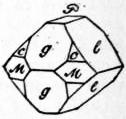
The crystals are isomorphous with mispickel (q.v.), but only rarely are they distinctly developed and simple (fig.). Usually they are twinned on a prism plane, M, producing pentagonal stellate groups of five crystals; twinning on the plain g, in which the crystals intercross at angles of nearly 60°, is less common. This frequent twinning gives rise to characteristic forms, with many re-entrant angles, to which the names “spear pyrites” and “cockscomb pyrites” are applied. The commonest state of aggregation is that of radially arranged fibres, the external surface of the mass being globular, nodular or stalactitic in form.
Apart from crystalline form, the external characters of marcasite are very similar to those of pyrites, and when distinct crystals are not available the two species cannot always be easily distinguished. The colour is usually pale bronze-yellow, often rather lighter than that of pyrites; on freshly fractured surfaces of pure marcasite the colour is tin-white, but this rapidly tarnishes on exposure to air. The lustre is metallic and brilliant. The streak is greyish or brownish-black. The hardness (6-61⁄2) is the same as that of pyrites, and the specific gravity (4.8-4.9) as a rule rather less. Arsenical varieties of marcasite, containing up to 5% of arsenic, are known as lonchidite and kyrosite.
Marcasite readily oxidizes on exposure to moist air, with the production of sulphuric acid and a white fibrous efflorescence of ferrous sulphate, and in course of time specimens in collections often became completely disintegrated. In nature it is frequently altered to limonite with the separation of native sulphur. Marcasite is thus the less stable of the two modifications of iron disulphide. Many experiments have been made with a view to determining the difference in chemical constitution of marcasite and pyrites, but with no very definite results. It is a noteworthy fact that whilst pyrites has been prepared artificially, marcasite has not.
Marcasite occurs under the same conditions as pyrites, but is much less common. Whilst pyrites is found abundantly in the older crystalline rocks and slates, marcasite is more abundant in clays, and has often been formed as a concretion around organic remains. It is abundant, for example, in the plastic clay of the Brown Coal formation at Littmitz, near Carlsbad, in Bohemia, at which place it has been extensively mined for the manufacture of sulphur and ferrous sulphate. In the Chalk of the south-east of England nodules of marcasite with a fibrous radiated structure are abundant, and in the Chalk Marl between Dover and Folkestone fine twinned groups of “spear pyrites” are common. The mineral is also met with in metalliferous veins, though much less frequently than pyrites; for example the “cockscomb pyrites” of the lead mines of Derbyshire and Cumberland.
(L. J. S.)
MARCEAU-DESGRAVIERS, FRANÇOIS SÉVERIN (1769-1796), French general, was born at Chartres on the 1st of March 1769. His father was a law officer, and he was educated for a legal career, but at the age of sixteen he enlisted in the regiment of Savoy-Carignan. Whilst on furlough in Paris Marceau joined in the attack on the Bastille (July 14, 1789); after that event he took his discharge from the regular army and returned to Chartres, but the embarrassments of his family soon compelled him to seek fresh military employment. He became drill instructor, and afterwards captain in the departmental (Eure-et-Loire) regiment of the National Guard. Early in March 1792 he was elected lieutenant-colonel of one of the battalions of the Eure-et-Loire; he took part in the defence of Verdun in 1792, and it fell to his lot to bear the proposals of capitulation to the Prussian camp. The spiritless conduct of the defenders excited the wrath of the revolutionary authorities, and Marceau was fortunate in escaping arrest and finding re-employment as a captain in the regular service. Early in 1793 he became with other officers “suspect,” and was for some time imprisoned. On his release he hurried to take part in the defence of Saumur against the Vendéan royalists, and distinguished himself at the combat of Saumur (June 10, 1793) by gallantly rescuing the representative Bourbotte from the hands of the insurgents. The Convention voted him the thanks of the country, and thenceforward his rise was rapid. His conduct at Chantonnay (Sept. 5) won him the provisional rank of general of brigade. On the 17th of October he bore a great part in the victory of Cholet, and on the field of this battle began his friendship with Kléber. For the victory of Cholet Kléber was made general of division and Marceau confirmed as general of brigade. Their advice was of the greatest value to the generals in command, and the military talents of each were the complement of the other’s. Marceau, who became general of division (Nov. 10), succeeded to the chief command ad interim, and with his friend won important victories near Le Mans (Dec 12-13) and Savenay (Dec. 23). After the battle of Le Mans, Marceau rescued and protected a young Royalist lady, Angélique des Mesliers. It is often supposed that he was in love with his prisoner; but the help even of the commander-in-chief did not avail to save her from the guillotine (Jan. 22, 1794). Marceau had already retired from the war, exhausted by the fatigues of the campaign, and he and Kléber were saved from arrest and execution only by the intervention of Bourbotte. Marceau became affianced about this time to Agathe Leprêtre de Châteaugiron, but his constant military employment, his broken health, and the opposition of the comte de Châteaugiron on the one hand and of Marceau’s devoted half-sister “Emira,” wife of the Republican politician Sergent, on the other, prevented the realization of his hopes. After spending the winter of 1793-1794 in Paris he took a command in the army under Jourdan, in which Kléber also served. He took part in the various battles about Charleroi, and at the final victory of Fleurus (June 26, 1794) he had a horse shot under him. He distinguished himself again at Jülich and at Aldenhoven, and stormed the fines of Coblenz on the 23rd of October. With the Army of the Sambre and Meuse he took his share in the campaign of 1795 on the Rhine and the Lahn, distinguishing himself particularly with Kléber in the fighting about Neuwied on the 18th and 19th of October, and at Sulzbach on the 17th of December. In the campaign of 1796 the famous invasion of Germany by the armies of Jourdan and Moreau ended in disaster, and Marceau’s men covered Jourdan’s retreat over the Rhine. He fought the desperate actions on the Lahn (Sept. 16 and 18), and at Altenkirchen on the 19th received a mortal wound, of which he died on the 21st, at the early age of twenty-seven. The Austrians vied with his own countrymen in doing honour to the dead general. His body was burned, and his ashes, which at the time were placed under a pyramid designed by Kléber, were transferred in 1889 to the Pantheon at Paris.
See Maze, Le Général Marceau (1889); Parfait, Le Général Marceau (1892); and T. C. Johnson, Marceau (London, 1896).
MARCEL, ÉTIENNE (d. 1358), provost of the merchants of Paris under King John II., belonged by birth to the wealthy Parisian bourgeoisie, being the son of a clothier named Simon Marcel and of Isabelle Barbou. He is mentioned as provost of the Grande-Confrérie of Notre Dame in 1350, and in 1354 he succeeded Jean de Pacy as provost of the Parisian merchants. His political career began in 1356, when John was made prisoner after the battle of Poitiers. In conjunction with Robert le Coq, bishop of Laon, he played a leading part in the states-general called together by the dauphin Charles on the 17th of October. A committee of eighty members, constituted on their initiative, pressed their demands with such insistence that the dauphin prorogued the states-general; but financial straits obliged him to summon them once more on the 3rd of February 1357, and the promulgation of a great edict of reform was the consequence. John the Good forbade its being put into effect, whereupon a conflict began between Marcel and the dauphin, Marcel endeavouring to set up Charles the Bad, king of Navarre, in opposition to him. The states-general assembled again on the 13th of January 1358, and on the 22nd of February the populace of Paris, led by Marcel, invaded the palace and murdered the marshals of Champagne and Normandy before the prince’s eyes. Thenceforward Marcel was in open hostility to the throne. After vainly hoping that the insurrection of the Jacquerie might turn to his advantage, he next supported the king of Navarre, whose armed bands infested the neighbourhood of Paris. On the night of the 31st of July Marcel was about to open the gates of the capital to them, but Jean Maillart prevented the execution of this design, and killed him before the Porte Saint-Antoine. During the following days his adherents were likewise put to death, and the dauphin was enabled to re-enter Paris. Étienne Marcel married first Jeanne de Dammartin, and secondly Marguerite des Essars, who survived him.
See F. T. Perrens, Étienne Marcel et le gouvernement de la bourgeoisie au xive siècle (Paris, 1860); P. Frémaux, La Famille d’Étienne Marcel, in the Mémoires of the Société de l’histoire de Paris et de l’Île de France (1903), vol. xxx.; and Hon. R. D. Denman, Étienne Marcel (1898).
(J. V.*)
MARCELLINUS, ST, according to the Liberian catalogue, became bishop of Rome on the 30th of June, 296; his predecessor was Caius or Gaius. He is not mentioned in the Martyrologium hieronymianum, or in the Depositio episcoporum, or in the Depositio martyrum. The Liber pontificalis, basing itself on the Acts of St Marcellinus, the text of which is lost, relates that during Diocletian’s persecution Marcellinus was called upon to sacrifice, and offered incense to idols, but that, repenting shortly afterwards, he confessed the faith of Christ and suffered martyrdom with several companions. Other documents speak of his defection, and it is probably this lapse that explains the silence of the ancient liturgical calendars. In the beginning of the 5th century Petilianus, the Donatist bishop of Constantine, affirmed that Marcellinus and his priests had given up the holy books to the pagans during the persecution and offered incense to false gods. St Augustine contents himself with denying the affair (Contra litt. Petiliani, ii. 202; De unico baptismo, 27). The records of the pseudo-council of Sinuessa, which were fabricated at the beginning of the 6th century, state that Marcellinus after his fall presented himself before a council, which refused to try him on the ground that prima sedes a nemine iudicatur. According to the Liber pontificalis, Marcellinus was buried, on the 26th of April 304, in the cemetery of Priscilla, on the Via Salaria, 25 days after his martyrdom; the Liberian catalogue gives as the date the 25th of October. The fact of the martyrdom, too, is not established with certainty. After a considerable interregnum he was succeeded by Marcellus, with whom he has sometimes been confounded.
See L. Duchesne, Liber pontificalis, I. lxxiii.-lxxiv. 162-163, and II. 563.
(H. De.)
MARCELLO, BENEDETTO (1686-1739), Italian musical composer, was born in 1686, either on the 31st of July or on the 1st of August. He was of noble family (in his compositions he is frequently described as “Patrizio Veneto”), and although a pupil of Lotti and Gasparini, was intended by his father to devote himself to the law. In 1711 he was a member of the Council of Forty, and in 1730 went to Pola as Provveditore. His health having been impaired by the climate of Istria, he retired after eight years to Brescia in the capacity of Camerlengo, and died there on the 24th of July 1739.
Marcello is best remembered by his Estro poetico-armonico (Venice, 1724-1727), a musical setting for voices and strings of the first fifty Psalms, as paraphrased in Italian by G. Giustiniani. They were much admired by Charles Avison, who with John Garth brought out an edition with English words (London, 1757). Some extracts are to be found in Hawkins’s History of Music. His other works are chiefly cantatas, either for one voice or several; the library of the Brussels conservatoire possesses some interesting volumes of chamber-cantatas composed for his mistress. Although he produced an opera, La Fede riconosciuta, at Vicenza in 1702, he had little sympathy with this form of composition, and vented his opinions on the state of musical drama at the time in the satirical pamphlet Il Teatro alla moda, published anonymously in Venice in 1720. This little work, which was frequently reprinted, is not only extremely amusing, but is also most valuable as a contribution to the history of opera.
A catalogue of his works is given in Monatshefte für Musikgeschichte, vol. xxiii. (1891).
MARCELLUS, the name of two popes.
Marcellus I. succeeded Marcellinus, after a considerable interval, most probably in May 308, under Maxentius. He was banished from Rome in 309 on account of the tumult caused by the severity of the penances he had imposed on Christians who had lapsed under the recent persecution. He died the same year, being succeeded by Eusebius. He is commemorated on the 16th of January.
Marcellus II. (Marcello Cervini), the successor of Julius III., was born on the 6th of May 1501, and was elected pope on the 9th of April 1555. He had long been identified with the rigorist party in the church, and as president of the Council of Trent had incurred the anger of the emperor by his jealous defence of papal prerogative. His motives were lofty, his life blameless, his plans for reform nobly conceived. But death removed him (April 30, 1555) before he could do more than give an earnest of his intentions. He was followed by Paul IV.
Contemporary lives are to be found in Panvinio, continuator of Platina, De vitis pontiff, rom.; and Ciaconius, Vitae et res gestae summorum pontiff. rom. (Rome, 1601-1602). P. Polidoro, De gestis, vita et moribus Marcelli II. (Rome, 1744), makes use of an unpublished biography of the pope by his brother, Alessandro Cervini. See also Brilli, Intorno alla vita e alle azioni di Marcello II. (Montepulciano, 1846); Ranke, Popes (Eng. trans., Austin), i. 284 seq.; A. von Reumont, Gesch. der Stadt Rom, iii. 2, 512, seq.
(T. F. C.)
MARCELLUS, a Roman plebeian family belonging to the Claudian gens. Its most distinguished members were the following:—
1. Marcus Claudius Marcellus (c. 268-208 B.C.), one of the Roman generals during the Second Punic War and conqueror of Syracuse. He first served against Hamilcar in Sicily. In his first consulship (222) he was engaged, with Cn. Cornelius Scipio as colleague, in war against the Insubrian Gauls, and won the spolia opima for the third and last time in Roman history by slaying their chief Viridomarus or Virdumarus (Polybius ii. 34; Propertius v. 10, 39). In 216, after the defeat at Cannae, he took command of the remnant of the army at Canusium, and although he was unable to prevent Capua going over to Hannibal, he saved Nola and southern Campania. In 214 he was in Sicily as consul at the time of the revolt of Syracuse; he stormed Leontini and besieged Syracuse, but the skill of Archimedes repelled his attacks. After a two years’ siege he gradually forced his way into the city and took it in the face of strong Punic reinforcements. He spared the lives of the inhabitants, but carried off their art treasures to Rome, the first instance of a practice afterwards common. Consul again in 210, he took Salapia in Apulia, which had revolted to Hannibal, by help of the Roman party there, and put to death the Numidian garrison. Proconsul in 209, he attacked Hannibal near Venusia, and after a desperate battle retired to that town; he was accused of bad generalship, and had to leave the army to defend himself in Rome. In his last consulship (208), he and his colleague, while reconnoitring near Venusia, were unexpectedly attacked, and Marcellus was killed. His successes have been exaggerated by Livy, but the name often given to him, the “sword of Rome,” was well deserved.
Livy xxiii. 14-17, 41-46; xxiv. 27-32, 35-39; xxv. 5-7, 23-31; xxvi. 26, 29-32; xxvii. 1-5, 21-28; Polybius viii. 5-9, x. 32; Appian, Hannib. 50; Florus ii. 6.
2. M. Claudius Marcellus, an inveterate opponent of Julius Caesar. During his consulship (51 B.C.) he proposed to remove Caesar from his army in March 49, but this decision was delayed by Pompey’s irresolution and the skilful opposition of the tribune C. Curio (see Caesar, Julius). In January 49 he tried to put off declaring war against Caesar till an army could be got ready, but his advice was not taken. When Pompey left Italy, Marcus and his brother Gaius followed, while his cousin withdrew to Liternum. After Pharsalus M. Marcellus retired to Mytilene, where he practised rhetoric and studied philosophy. In 46 his cousin and the senate successfully appealed to Caesar to pardon him, and Marcellus reluctantly consented to return. On this occasion Cicero’s1 speech Pro Marcello was delivered. Marcellus left for Italy, but was murdered in May by one of his own attendants, P. Magius Chilo, in the Peiraeus. Marcellus was a thorough aristocrat. He was an eloquent speaker (Cicero, Brutus, 71), and a man of firm character, although not free from avarice.
See Cicero, Ad fam. iv. 4, 7, 10, and Ad Att. v. 11 (ed. Tyrrell and Purser); Caesar, B. C. i. 2; Suetonius, Caesar, 29; G. Boissier, Cicero and his Friends (Eng. trans., 1897).
3. M. Claudius Marcellus (c. 43-23 B.C.), son of C. Marcellus and Octavia, sister of Augustus. In 25 he was adopted by the emperor and married to his daughter Julia. This seemed to mark him out as the heir to the throne, but Augustus, when attacked by a serious illness, gave his signet to M. Vipsanius Agrippa. In 23 Marcellus, then curule aedile, died at Baiae. Livia was suspected of having poisoned him to get the empire for her son Tiberius. Great hopes had been built on the youth, and he was celebrated by many writers, especially by Virgil in a famous passage (Aeneid, vi. 860). He was buried in the Campus Martius, and Augustus himself pronounced the funeral oration. The Theatrum Marcelli (remains of which can still be seen) was afterwards dedicated in his honour.
Horace, Odes, i. 12; Propertius iii. 18; Dio Cassius liii. 28, 30; Tacitus, Annals, ii. 41; Suetonius, Augustus, 63; Vell. Pat. ii. 93.
1 The authorship of this speech has been disputed.
MARCESCENT (Lat. marcescens, withering), a botanical term for withering without falling off.
MARCH, EARLS OF, title derived from the “marches” or boundaries (1) between England and Wales, and (2) England and Scotland, and held severally by great feudal families possessed of lands in those border districts. The earls of March on the Welsh borders were descended from Roger de Mortemer (so called from his castle of Mortemer in Normandy), who was connected by marriage with the dukes of Normandy. His son Ralph (d. c. 1104) figures in Domesday as the holder of vast estates in Shropshire, Herefordshire and other parts of England, especially in the west; and his grandson Hugh de Mortimer, founder of the priory of Wigmore in Herefordshire, was one of the most powerful of the barons reduced to submission by Henry II., who compelled him to surrender his castles of Cleobury and Wigmore. The Mortimers, however, continued to exercise almost undisputed sway, as lords of Wigmore, over the western counties and the Welsh marches.
I. Welsh Marches.—Roger de Mortimer (c. 1286-1330), 8th baron of Wigmore and 1st earl of March, being an infant at the death of his father, Edmund, was placed by Edward I. under the guardianship of Piers Gaveston, and was knighted by Edward in 1306; Mortimer’s mother being a relative of Edward’s consort, Eleanor of Castile. Through his marriage with Joan de Joinville, or Genevill, Roger not only acquired increased possessions on the Welsh marches, including the important castle of Ludlow, which became the chief stronghold of the Mortimers, but also extensive estates and influence in Ireland, whither he went in 1308 to enforce his authority. This brought him into conflict with the De Lacys, who turned for support to Edward Bruce, brother of Robert Bruce, king of Scotland. Mortimer was appointed lord-lieutenant of Ireland by Edward II. in 1316, and at the head of a large army drove Bruce to Carrickfergus, and the De Lacys into Connaught, wreaking vengeance on their adherents whenever they were to be found. He was then occupied for some years with baronial disputes on the Welsh border until about 1318, when he began to interest himself in the growing opposition to Edward II. and his favourites, the Despensers; and he supported Humphrey de Bohun, earl of Hereford, in refusing to obey the king’s summons to appear before him in 1321. Forced to surrender to the king at Shrewsbury in January 1322, Mortimer was consigned to the Tower of London, whence he escaped to France in August 1324. In the following year Isabella, wife of Edward II., anxious to escape from her husband, obtained his consent to her going to France to use her influence with her brother, Charles IV., in favour of peace. At the French court the queen found Roger Mortimer; she became his mistress soon afterwards, and at his instigation refused to return to England so long as the Despensers retained power as the king’s favourites. The scandal of Isabella’s relations with Mortimer compelled them both to withdraw from the French court to Flanders, where they obtained assistance for an invasion of England. Landing in England in September 1326, they were joined by Henry, earl of Lancaster; London rose in support of the queen; and Edward took flight to the west, whither he was pursued by Mortimer and Isabella. After wandering helplessly for some weeks in Wales, the king was taken on the 16th of November, and was compelled to abdicate in favour of his son. But though the latter was crowned as Edward III. in January 1327, the country was ruled by Mortimer and Isabella, who procured the murder of Edward II. in the following September. Rich estates and offices of profit and power were now heaped on Mortimer, and in September 1328 he was created earl of March. Greedy and grasping, he was no more competent than the Despensers to conduct the government of the country. The jealousy and anger of Lancaster having been excited by March’s arrogance, Lancaster prevailed upon the young king, Edward III., to throw off the yoke of his mother’s paramour. At a parliament held at Nottingham in October 1330 a plot was successfully carried out by which March was arrested in the castle, and, in spite of Isabella’s entreaty to her son to “have pity on the gentle Mortimer,” was conveyed to the Tower. Accused of assuming royal power and of various other high misdemeanours, he was condemned without trial and hanged at Tyburn on the 29th of November 1330, his vast estates being forfeited to the crown. March’s wife, by whom he had four sons and eleven daughters, survived till 1356. The daughters all married into powerful families, chiefly of Marcher houses. His eldest son, Edmund, was father of Roger Mortimer (c. 1328-1360), who was knighted by Edward III. in 1346, and restored to his grandfather’s title as 2nd earl of March.
Edmund de Mortimer (1351-1381), 3rd earl of March, was son of Roger, 2nd earl of March, by his wife Philippa, daughter of William Montacute, 1st earl of Salisbury. Being an infant at the death of his father, Edmund, as a ward of the crown, was placed by Edward III. under the care of William of Wykeham and Richard Fitzalan, earl of Arundel. The position of the young earl, powerful on account of his possessions and hereditary influence in the Welsh marches, was rendered still more important by his marriage in 1368 to Philippa, only daughter of Lionel, duke of Clarence, third son of Edward III. Lionel’s wife was Elizabeth, daughter and heiress of William de Burgh, 6th Lord of Connaught and 3rd earl of Ulster, and Lionel had himself been created earl of Ulster before his marriage. The earl of March, therefore, not only became the representative of one of the chief Anglo-Norman lordships in Ireland in right of his wife Philippa, but the latter, on the death of her father shortly after her marriage, stood next in succession to the crown after the Black Prince and his sickly son Richard, afterwards king Richard II. This marriage had, therefore, far-reaching consequences in the history of England, giving rise to the claim of the house of York to the crown of England, contested in the War of the Roses; Edward IV. being descended from the third son of Edward III. as great-great-grandson of Philippa, countess of March, and in the male line from Edmund, duke of York, fifth son of Edward III.
Mortimer, now styled earl of March and Ulster, became marshal of England in 1369, and was employed in various diplomatic missions during the next following years. He was a member of the committee appointed by the Peers to confer with the Commons in 1373—the first instance of such a joint conference since the institution of representative parliaments—on the question of granting supplies for John of Gaunt’s war in France; and in the opposition to Edward III. and the court party, which grew in strength towards the end of the reign, March took the popular side, being prominent in the Good Parliament of 1376 among the lords who, encouraged by the Prince of Wales, concerted an attack upon the court party led by John of Gaunt. The Speaker of the Commons in this parliament was March’s steward, Peter de la Mare; he firmly withstood John of Gaunt in stating the grievances of the Commons, in supporting the impeachment of several high court officials, and in procuring the banishment of the king’s mistress, Alice Perrers. March was a member of the administrative council appointed by the same parliament after the death of the Black Prince to attend the king and advise him in all public affairs. On the accession of Richard II., a minor, in 1377, the earl became a member of the standing council of government; though as father of the heir-presumptive to the crown he wisely abstained from claiming any actually administrative office. The most powerful person in the realm was, however, John of Gaunt, duke of Lancaster, whose jealousy of March led to the acceptance by the latter of the lieutenancy of Ireland in 1379. March succeeded in asserting his authority in eastern Ulster, but failed to subdue the O’Neills farther west. Proceeding to Munster to put down the turbulency of the chieftains of the south, March died at Cork on the 27th of December 1381. He was buried in Wigmore Abbey, of which he had been a benefactor, and where his wife Philippa who died about the same time was also interred. The earl had two sons and two daughters, the elder of whom, Elizabeth, married Henry Percy (Hotspur), son of the earl of Northumberland. His eldest son Roger succeeded him as 4th earl of March and Ulster. His second son Edmund (1376-1409) played an important part in conjunction with his brother-in-law Hotspur against Owen Glendower; but afterwards joined the latter, whose daughter he married about 1402.
Roger de Mortimer, 4th earl of March and Ulster (1374-1398), son of the 3rd earl, succeeded to the titles and estates of his family when a child of seven, and a month afterwards he was appointed lord-lieutenant of Ireland, his uncle Sir Thomas Mortimer acting as his deputy. Being a ward of the Crown, his guardian was the earl of Kent, half-brother to Richard II.; and in 1388 he married Kent’s daughter, Eleanor. The importance which he owed to his hereditary influence and possessions, and especially to his descent from Edward III., was immensely increased when Richard II. publicly acknowledged him as heir-presumptive to the crown in 1385. In 1394 he accompanied Richard to Ireland, but notwithstanding a commission from the king as lieutenant of the districts over which he exercised nominal authority by hereditary right, he made little headway against the native Irish chieftains. March enjoyed great popularity in England though he took no active part in opposing the despotic measures of the king; in Ireland he illegally assumed the native Irish costume. In August 1398 he was killed in fight with an Irish clan, and was buried in Wigmore Abbey. March’s daughter Anne married Richard earl of Cambridge, son of Edmund duke of York, fifth son of Edward III.; their son Richard, duke of York, was father of King Edward IV., who thus derived his title to the crown and acquired the estates of the house of Mortimer.
Edmund de Mortimer (1391-1425), 5th earl of March and Ulster, son of the 4th earl, succeeded to his father’s claim to the crown as well as to his title and estates on the death of the latter in Ireland in 1398. In the following year Richard II. was deposed and the crown seized by Henry of Lancaster. The young earl of March and his brother Roger were then kept in custody by Henry IV., who, however, treated them honourably, until March 1405, when they were carried off from Windsor Castle by the opponents of the Lancastrian dynasty, of whom their uncle Sir Edmund Mortimer (see above) and his brother-in-law Henry Percy (Hotspur) were leaders in league with Owen Glendower. The boys were recaptured, and in 1409 were committed to the care of the prince of Wales. On the accession of the latter as Henry V., in 1413, the earl of March was set at liberty and restored to his estates, his brother Roger having died some years previously; and he continued to enjoy the favour of the king in spite of a conspiracy in 1415 to place him on the throne, in which his brother-in-law, the earl of Cambridge, played the leading part. March accompanied Henry V. throughout his wars in France, and on the king’s death in 1422 became a member of the council of regency. He died in Ireland in 1425, and as he left no issue the earldom of March in the house of Mortimer became extinct, the estates passing to the last earl’s nephew Richard, who in 1435 was officially styled duke of York, earl of March and Ulster, and baron of Wigmore. Richard’s son Edward having ascended the throne in 1461 as Edward IV., the earldom of March became merged in the crown.
See Thomas Rymer, Foedera, &c. (London, 1704-1732); T. F. Tout, The Political History of England, vol. iii., ed. by William Hunt and R. L. Poole (London, 1905); Sir William Dugdale, Monasticon anglicanum (3 vols., London, 1655-1673); William Stubbs, Constitutional History of England, vol. ii.
II. Scottish Marches.—The Scottish earls of March were descended from Crinan, whose son Maldred married Algitha, daughter of Ughtred, earl of Northumberland, by Elgiva, daughter of the Saxon king Æthelred. Maldred’s son Cospatrick, or Gospatrick, was made earl of Northumberland by William the Conqueror; but being soon afterwards deprived of this position he fled to Scotland, where Malcolm Canmore, king of Scotland, welcomed him and granted him Dunbar and the adjoining lands. Two generations of Cospatricks followed in lineal succession, bearing the title of earl, but without territorial designation. Cospatrick II. witnessed the charter of Alexander I. founding the abbey of Scone in 1115. The 3rd earl, also named Cospatrick, a liberal benefactor of Melrose Abbey, died in 1166, leaving two sons, the younger of whom was the ancestor of the earls of Home. The elder son, Waltheof, was the first of the family to be styled “Comes de Dunbar,” about the year 1174. His importance is proved by the fact that he was one of the hostages for the performance of the Treaty of Falaise for the liberation of William the Lion in 1175. Waltheof’s son Patrick Dunbar (the name Dunbar, derived from the family estates, now becoming an hereditary surname), styled 5th earl of Dunbar, although his father had been the first to adopt the territorial designation, was keeper of Berwick Castle, and married Ada, natural daughter of William the Lion. His grandson Patrick, 7th earl, headed the party that liberated King Alexander III. in 1255 from the Comyns, and in the same year was nominated guardian of the king and queen by the Treaty of Roxburgh. He signed the Treaty of Perth (July 6, 1266) by which Magnus VI. of Norway ceded the Isle of Man and the Hebrides to Scotland. His wife was Christian, daughter of Robert Bruce, the competitor for the crown of Scotland.
Patrick Dunbar, 8th earl of Dunbar and 1st earl of March, claimed the crown of Scotland in 1291 as descendant of Ada, daughter of William the Lion. He was one of the “seven earls of Scotland,” a distinct body separate from the other estates of the realm, who claimed the right to elect a king in cases of disputed succession, and whose authority was, perhaps, to be traced to the seven provinces of the Pictish kingdom. He was the first of the earls of Dunbar to appear in the records as “comes de Marchia,” or earl of March. Like most of his family in later times, he was favourable to the English interest in Scottish affairs, and he did homage to Edward I. of England. His wife Marjory, daughter of Alexander Comyn, earl of Buchan, took the other side and held the castle of Dunbar for Baliol, but was forced to surrender it to Edward in 1296. In 1298 he was appointed the English king’s lieutenant in Scotland.
Patrick Dunbar (1285-1369), 9th earl of Dunbar and 2nd earl of March, son of the preceding, gave refuge to Edward II. of England after Bannockburn, and contrived his escape by sea to England. Later, he made peace with Robert Bruce, and by him was appointed governor of Berwick Castle, which he held against Edward III. until the defeat of the Scots at Halidon Hill (July 19, 1333) made it no longer tenable. His countess, known in Scottish history and romance as “Black Agnes,” daughter of Thomas Randolph, earl of Moray (Murray), and grandniece of Robert Bruce, is famous for her defence of Dunbar Castle against the English under the earl of Salisbury in 1338, Salisbury being forced to abandon the attempt after a fierce siege lasting nineteen weeks. This lady succeeded to the estates and titles of her brother, John Randolph, 3rd earl of Moray. The earldom of Moray passed after her death to her second son, John Dunbar, who married Marjory, daughter of King Robert II. Black Agnes also bore to the earl of March two daughters, the elder of whom, Agnes, after being the mistress of King David II., married Sir James Douglas, lord of Dalkeith, from whom were descended the first three earls of Morton; the younger, Elizabeth, married John Maitland of Lethington, ancestor of the duke of Lauderdale, whose second title was marquess of March.
George Dunbar (d. 1420), 10th earl of Dunbar and 3rd earl of March, great-nephew of the 8th earl and warden of the marches, accompanied Douglas in his foray into England in 1388, and commanded the Scots after Otterburn. He afterwards quarrelled with the Douglases, because his daughter was passed over in favour of a daughter of Archibald, “the Grim Earl of Douglas,” as wife for David, duke of Rothesay, son of Robert III. When Douglas seized March’s lands the latter fled to England, where he was welcomed by Henry IV., to whom he was related. He fought on the English side at Homildon Hill; and, having revealed to Henry the defection of the Percies, who were in league with Douglas and Owen Glendower, he fought against those allies at the battle of Shrewsbury (July 23, 1403). Becoming reconciled with Douglas, he returned to Scotland in 1409, and was restored to his earldom by the regent Albany. He died in 1420.
George Dunbar, 11th earl of Dunbar and 4th earl of March, was one of the negotiators for the release of James I. of Scotland in 1423 from his captivity in England, and was knighted at that king’s coronation. In 1434, however, on the ground that the regent had had no power to reverse his father’s forfeiture for treason, March was imprisoned and his castle of Dunbar seized by the king; and the parliament at Perth declared his lands and titles forfeited to the crown. The earl, being released, retired to England with his son Patrick, whose daughter and heiress Margaret was ancestress of Patrick, 5th earl of Dumfries, now represented by the marquess of Bute.
The earldom of March in the house of Dunbar having thus been forfeited to the crown, James II. in 1455 conferred the title, together with that of warden of the marches, on his second son Alexander, duke of Albany; but this prince entered into treasonable correspondence with Edward IV. of England, and in 1487 the earldom of March and the barony and castle of Dunbar were again declared forfeited and annexed to the crown of Scotland.
The title of earl of March was next held by the house of Lennox. In 1576 the earldom of Lennox became extinct on the death without male issue of Charles (father of Lady Arabella Stuart), 5th earl of Lennox; and it was then revived in favour of Robert Stuart, a grand-uncle of King James VI., second son of John, 3rd earl of Lennox. But in 1579 Esmé Stuart, a member of a collateral branch which in 1508 had inherited the lordship of Aubigny in France, came to Scotland and obtained much favour with James VI. The earldom of Lennox (soon afterwards raised to a dukedom) was taken from Robert and conferred upon Esmé; and Robert was compensated by being created earl of March and baron of Dunbar (1582). Robert died without legitimate issue in 1586, when the earldom of March again reverted to the crown. In 1619 Esmé, 3rd duke of Lennox, was created earl of March; and his son James was created duke of Richmond in 1641. On the death without issue of Charles, 6th duke of Lennox and 3rd duke of Richmond, in 1672, his titles devolved upon King Charles II. as nearest collateral heir-male. In 1675 Charles conferred the titles of duke of Richmond and Lennox and earl of March on Charles Lennox, his natural son by Louise de Keroualle, duchess of Portsmouth, from whom the earldom of March has descended to its present holder the duke of Richmond and Gordon. (See Richmond, Earls and Dukes of; and Lennox.)
The title of earl of March in the peerage of Scotland, by another creation, was conferred in 1697 on William Douglas, second son of William, 1st duke of Queensberry. His grandson William, 3rd earl of March, became 4th duke of Queensberry on the death without surviving male issue of his cousin Charles, 3rd duke of Queensberry, in 1778. Dying unmarried in 1810, the several titles of the duke passed to different branches of the house of Douglas. The earldom of March is stated by Sir Bernard Burke and other authorities to have devolved upon Francis, 8th earl of Wemyss, great-great-grandson of David, 3rd earl of Wemyss, whose wife was Anne, daughter of the 1st duke of Queensberry and sister of the 1st earl of March; and the title is now assumed by the earl of Wemyss. On the other hand, Francis, 8th earl of Wemyss, not having been an heir of the body of the 1st earl of March, Sir Robert Douglas says in The Peerage of Scotland that on the death of the 4th duke of Queensberry in 1810 “the earldom of March, it is supposed, became extinct.”
See Andrew Lang, History of Scotland (4 vols., London, 1900-1907); Sir Bernard Burke, A Genealogical History of Dormant and Extinct Peerages (London, 1866); Sir Robert Douglas, The Peerage of Scotland (2 vols., Edinburgh 1813); Lady Elizabeth Cust, Some Account of the Stuarts of Aubigny in France (London, 1891).
(R. J. M.)
MARCH, AUZIAS (c. 1395-1458), Catalan poet, was born at Valencia towards the end of the 14th century. Little is known of his career except that he was twice married—first to Na Ysabel Martorell, and second to Na Johanna Scorna—that he died on the 4th of November 1458, and that he left several natural children. Inheriting an easy fortune from his father, the treasurer to the duke of Gandia, and enjoying the powerful patronage of Prince Carlos de Viana of Aragon, March was enabled to devote himself to poetical composition. He is an undisguised follower of Petrarch, carrying the imitation to such a point that he addresses his Cants d’amor to a lady whom he professes to have seen first in church on Good Friday; so far as the difference of language allows, he reproduces the rhythmical cadences of his model, and in the Cants de mort touches a note of brooding sentiment peculiar to himself. Though his poems are disfigured by obscurity and a monotonous morbidity, he was fully entitled to the supremacy which he enjoyed among his contemporaries, and the success of his innovation no doubt encouraged Boscán to introduce the Italian metres into Castilian.
His verses were first printed in Catalan in 1543, but they had already become known through the Castilian translation published by Baltasar de Romani in 1539.
MARCH, FRANCIS ANDREW (1825- ), American philologist and educationalist, was born on the 25th of October 1825 in Millbury, Massachusetts. He graduated in 1845 at Amherst, where his attention was turned to the study of Anglo-Saxon by Noah Webster. He was a teacher at Swanzey, New Hampshire, and at the Leicester Academy, Massachusetts, in 1845-1847, and attempted the philological method of teaching English “like Latin and Greek,” later described in his Method of Philological Study of the English Language (1865); at Amherst in 1847-1849; at Fredericksburg, Virginia, in 1852-1855; and in 1855 became a tutor at Lafayette College, where he became adjunct professor of belles-lettres and English literature in 1856, and professor of English language and comparative philology—the first chair of the kind established—in 1857. He lectured on constitutional and public law and Roman law in 1875-1877, and also taught subjects as diverse as botany and political economy. In 1907 he became professor emeritus. At Lafayette he introduced the first carefully scientific study of English in any American college, and in 1870 published A Comparative Grammar of the Anglo-Saxon Language, in which its Forms are Illustrated by Those of the Sanskrit, Greek, Latin, Gothic, Old Saxon, Old Friesic, Old Norse and Old High German, and An Anglo-Saxon Reader; he was editor of the “Douglass Series of Christian Greek and Latin Classics,” to which he contributed Latin Hymns (1874); he was chairman of the Commission of the State of Pennsylvania on Amended Orthography; and was consulting editor of the Standard Dictionary, and in 1879-1882 was director of the American readers for the Philological Society’s (New Oxford) Dictionary. He was president of the American Philological Association in 1873-1874 and in 1895-1896, of the Spelling Reform Association after 1876, and of the Modern Language Association in 1891-1893. Among American linguistic scholars March ranks with Whitney, Child and Gildersleeve; and his studies in English, though practically pioneer work in America, are of undoubted value. His article “On Recent Discussions of Grimm’s Law” in the Transactions and Proceedings of the American Philological Association for 1873 in large part anticipated Verner’s law. With his son, Francis Andrew March, jun. (b. 1863), adjunct-professor of modern languages in 1884-1891 and subsequently professor of English literature at Lafayette, he edited A Thesaurus Dictionary of the English Language (1903).
See Addresses in Honor of Professor Francis A. March, LL.D., L.H.D., delivered at Easton, Pennsylvania, on the 24th of October 1895.
MARCH, a market town in the Wisbech parliamentary division of Cambridgeshire, England, 30 m. N. by W. of Cambridge. Pop. of urban district (1901), 7565. It lies in the midst of the flat fen country, on the old course of the river Nene. It is an important junction on the Great Eastern railway and the starting-point of a line worked by that company jointly with the Great Northern to Lincoln and Doncaster. The church of St Wendreda, in Early English and later styles, is remarkable for a magnificent Perpendicular timber roof, beautifully carved. There are agricultural implement and engineering works, and corn mills.
MARCH, the third month of the modern calendar, containing thirty-one days. It was the Romans’ first month until the adoption of the Julian calendar, 46 B.C., and it continued to be the beginning of the legal year in England until the 18th century. In France it was reckoned the first month of the year until 1564, when, by an edict of Charles IX., January was decreed to be thenceforth the first month. Scotland followed the example of France in 1599; but in England the change did not take place before 1752. The Romans called the month Martius, a name supposed to have been conferred on it by Romulus in honour of his putative father, Mars, the god of war; but Ovid declares the month to have existed before the time of Romulus, though in a different position in the calendar. The Anglo-Saxons called March Hlyd-monath, “loud or stormy month,” or Lencten-monath, “lengthening month,” in allusion to the fact that the days then rapidly become longer. There is an old saying, common to both England and Scotland—which has its equivalent among the Basques and many European peoples—representing March as borrowing three days from April; the last three days of March being called the “borrowing” or the “borrowed days.” As late as the end of the 18th century the first three days of March were known in Devonshire as “Blind Days,” and were deemed so unlucky that no farmer would sow seed then.
The chief festival days of March are the 1st, St David; the 12th, St Gregory; the 17th, St Patrick; and the 25th, Lady Day, one of the quarter days in England.
MARCH (1) (from Fr. marcher, to walk; the earliest sense in French appears to be “to trample,” and the origin has usually been found in the Lat. marcus, hammer; Low Lat. marcare, to hammer; hence to beat the road with the regular tread of a soldier: cf. “beat,” of a policeman’s round), the movement of military troops with regular rhythmical steps, often with the time marked by the beat of drum, the sound of pipes or bugles or the music of a military band; hence the advance or movement of a body of troops from one point to another, and the distance covered in so doing. The word is also naturally applied to the music composed for marching to, and to the steady regular advance or progress of non-military bodies or persons, or of events, &c. In the military sense, “marching” is walking in formed bodies of troops, either during drill evolutions on parade or on the “line of march” from one place to another. In both senses the word is used with mounted troops as well as with dismounted men. Formerly all evolutions were carried out at the so-called “parade-march” pace of about 75-80 paces to the minute, and in one or two armies of the 18th century the parade step cadence was as slow as 60. These cadences are now, however, reserved in all armies for ceremonial occasions, and the usual manœuvre and marching pace (“quick march”) is about 120, the “double” march pace (pas gymnastique) about 180. The “quick” march, translated into miles and hours, is about 31⁄2 or 35⁄8 miles an hour in all armies, though a few special bodies of light troops such as the Italian Bersaglieri are trained to move at a much faster rate for hours together, either by alternate “quick” and “double” marching or by an unvarying “jog-trot.” The paces recognized for cavalry are the walk, the trot, the canter and the gallop; the usual practice on the line of march being to alternate the walk and the trot, which combination gives a speed of about 5 miles an hour for many hours together. A “day’s march,” or more simply a “march,” is usually reckoned to be 15-16 miles for a large body of troops, a “forced” march being one of 20 miles or over, or one in which, from whatever cause, the troops are on foot for more than about seven hours. For large bodies of troops the rate of movement on the line of march rarely exceeds 3 miles an hour. The immense assistance afforded by music to marching troops has been recognized from the earliest times of organized armies, and a great deal of special march-music has been written for military bands, formerly often in 3⁄4 or 6⁄8 time (one bar representing one pace with the foot), but now almost invariably in common or 2⁄4 time, which is more suitable for the “quick march.” The music itself is usually a combination of simple, lively melody and well-marked accents for the drums, with little attempt at contrapuntal writing. The fife or piccolo, the natural bugle (in Italy and elsewhere the chromatic key-bugle is used), and the drum are the principal instruments, the “band,” as distinct from the “drums” and “bugles,” having in addition to drum and fifes clarinets (saxophones in France and Belgium) and saxhorns of all types. In Scottish regiments, and in a few isolated cases elsewhere, bagpipes provide the marching music. The importance of music on the march is attested further by the almost universal practice of singing or whistling marching songs, and even playing them on concertinas, &c., in the absence of the band and drums.
2. From marche, the French form of a common Teutonic word represented in English by “mark” (q.v.), a boundary or frontier region between two countries or districts. The word appears to have been first used in this sense in the 8th century, and the earliest “mark” or “march” districts were tracts of land on the borders of the Carolingian Empire. Wherever Charlemagne pushed forward the frontiers of the Frankish realm he provided for the security of his lands, new and old alike, by establishing mark districts on the borders. The defence and oversight of these were entrusted to special officers, afterwards called margraves, or counts of the mark, who usually enjoyed more extensive powers than fell to the lot of an ordinary count. It is at this time that we hear first of the Spanish mark (marca hispanica) and the Bavarian mark (marca bajoariae). These mark districts were practically obliterated during the reigns of the feeble sovereigns who succeeded Charlemagne, but the system was revived with the accession of Henry the Fowler to the German throne early in the 10th century and with a renewal of the work of conquering and colonizing the regions east of the Elbe, and in eastern Germany generally. Under Henry and his son, Otto the Great, marks were again set upon the borders of Germany, and this time the organization was more lasting. The mark districts increased in size and strength, especially those which fell under the dominion of an able and energetic ruler, and some of them became powerful states, retaining the name mark long after the original significance of the word had been forgotten. It is interesting to note that the two most important of the modern German states, Austria and Prussia, both had their origin in mark districts, the mark of Brandenburg, the nucleus of the kingdom of Prussia, being at first a border district to the east of the duchy of Saxony, and the east mark, or mark of Austria, being a border district of the duchy of Bavaria. In Italy march districts made their appearance about the same time as in other parts of the Frankish Empire. The best known of these is the march of Ancona, which with other marches and adjoining districts, was known later as the Marches, a province lying about the centre of Italy between the Apennines and the Adriatic Sea. After forming part of the states of the Church the Marches were united with the kingdom of Italy in 1860 (see Marches, The).
In England in the same connexion the plural word “marches” was the form commonly adopted, and soon after the Norman Conquest the disturbed districts on the borders of Wales began to be known as the Welsh marches. Lands therein were granted to powerful nobles on condition that they undertook the defence of the neighbouring counties of England. These lords of the marches, or lords marcher, as they were often called, had special privileges, but they were generally so fully occupied in fighting against each other and in seeking to increase their own wealth and power that the original object of their appointment was entirely forgotten. The condition of the marches grew worse and worse, and during disturbed reigns, like those of Henry III. and Edward II., lawlessness was rampant and rebellion was centred therein. A more satisfactory condition of affairs, however, prevailed after the conclusion of the Wars of the Roses; and the establishment by Henry VIII. in 1542 of a council of Wales and the marches was followed by a notable diminution of disorder in this region. About the time of Elizabeth the Welsh marches ceased to have any but an historical importance. In 1328 Roger Mortimer, a member of one of the most powerful of the marcher families, was created earl of March (comes de marchia Waliae), and in the reign of Edward III. (1354) the marches were declared to be no part of the principality, but directly subject to the English crown. It is difficult to define the boundaries of the Welsh marches, as their extent varied considerably from time to time, but under Edward I. and again under the Lancastrian kings the marcher lordships included more than half of the area of Wales; they embraced practically the whole of the principality except the counties of Anglesea, Carnarvon and Merioneth in the north and Carmarthen and Cardigan in the south, together with parts of the English border counties, Monmouth, Hereford and Shropshire.
The debateable ground between England and Scotland was also known as the marches, although its condition began to attract the attention of the southern kingdom somewhat later than was the case with Wales. Arrangements were made for garrisoning them and at one time they were divided into three sections: the east, the west, and the middle marches, the oversight of each being entrusted to a warden. Roughly speaking, they embraced the modern counties of Northumberland and Cumberland, together with a tract on the Scottish side of the border. The need for protecting them ceased soon after the accession of James VI. of Scotland to the English throne, and they have now only an historical and legendary significance. About 1200 Patrick de Dunbar, earl of Dunbar, called himself earl of March, taking the name from the merse, or march, a tract of land in Berwickshire.
In France under the ancien régime there was a county of La Marche, and in north-east Germany there was the county of La Marck, now part of the kingdom of Prussia.
MARCHE, or La Marche, one of the former provinces of France. It owes its name to its position, it having been in the 10th century a march or border district between the duchy of Aquitaine and the domains of the Frankish kings in central France. Sometimes it was called the Marche Limousine, and originally it was a small district cut partly from Limousin and partly from Poitou. Its area was increased during the 13th century, after which, however, it remained unaltered until the time of the Revolution. It was bounded on the N. by Berry; on the E. by Bourbonnais and Auvergne; on the S. by Limousin; and on the W. by Poitou. It embraced the greater part of the modern department of Creuse, a considerable part of Haute Vienne, and a fragment of Indre. Its area was about 1900 sq. m.; its capital was Charroux and later Guéret, and among its other principal towns were Dorat, Bellac and Confolens.
Marche first appears as a separate fief about the middle of the 10th century when William III., duke of Aquitaine, gave it to one of his vassals named Boso, who took the title of count. In the 12th century it passed to the counts of Limousin, and this house retained it until the death of the childless Count Hugh in 1303, when it was seized by the French king, Philip IV. In 1316 it was made a duchy for Prince Charles, afterwards King Charles IV., and a few years later (1327) it passed into the hands of the family of Bourbon. The family of Armagnac held it from 1435 to 1477, when it reverted to the Bourbons, and in 1527 it was seized by Francis I. and became part of the domains of the French crown. It was divided into Haute Marche and Basse Marche, the estates of the former being in existence until the 17th century. From 1470 until the Revolution the province was under the jurisdiction of the parlement of Paris.