VOLUME XVI SLICE VII Liquid Gases to Logar (continued 9)
Reading edition
Four miles lower down the Irfon valley, at the junction of the Cammarch and Irfon, and with a station on the London & North Western railway, is the village of Llangammarch, noted for its barium springs. The ancient parish of Llangammarch consists of the townships of Penbuallt and Treflis, the wells being in the former, which comprises 11,152 acres and had in 1901 a population of only 433. John Penry, the Puritan martyr, was born at Cefn-brith in this parish. Charles Wesley’s wife, Sarah Gwynne, was of Garth, an old residence just outside the parish.

LLEWELYN, the name of two Welsh princes.
Llewelyn I., Ab Iorwerth (d. 1240), prince of North Wales, was born after the expulsion of his father, Iorwerth, from the principality. In 1194, while still a youth, Llewelyn recovered the paternal inheritance. In 1201 he was the greatest prince in Wales. At first he was a friend of King John, whose illegitimate daughter, Joanna, he took to wife (1201); but the alliance soon fell through, and in 1211 John reduced Llewelyn to submission. In the next year Llewelyn recovered all his losses in North Wales. In 1215 he took Shrewsbury. His rising had been encouraged by the pope, by France, and by the English barons. His rights were secured by special clauses in Magna Carta. But he never desisted from his wars with the Marchers of South Wales, and in the early years of Henry III. he was several times attacked by English armies. In 1239 he was struck with paralysis and retired from the active work of government in favour of his son David. He retired into a Cistercian monastery.
See the lists of English chronicles for the reigns of John and Henry III.; also the Welsh chronicle Brut y Tywysogion (ed. Rolls Series); O. M. Edwards, History of Wales (1901); T. F. Tout in the Political History of England, iii. (1905).
Llewelyn II., Ab Gruffydd (d. 1282), prince of North Wales, succeeded his uncle David in 1246, but was compelled by Henry III. to confine himself to Snowdon and Anglesey. In 1254 Henry granted Prince Edward the royal lands in Wales. The steady encroachment of royal officers on Llewelyn’s land began immediately, and in 1256 Llewelyn declared war. The Barons’ War engaged all the forces of England, and he was able to make himself lord of south and north Wales. Llewelyn also assisted the barons. By the treaty of Shrewsbury (1265) he was recognized as overlord of Wales; and in return Simon de Montfort was supplied with Welsh troops for his last campaign. Llewelyn refused to do homage to Edward I., who therefore attacked him in 1276. He was besieged in the Snowdon mountains till hunger made him surrender, and conclude the humiliating treaty of Conway (1277). He was released, but in 1282 he revolted again, and was killed in a skirmish with the Mortimers, near Builth in central Wales.
See C. Bémont, Simon de Montfort (Paris, 1884); T. F. Tout in the Political History of England, iii. (1905); J. E. Morris in The Welsh Wars of Edward I. (1901).
LLORENTE, JUAN ANTONIO (1756-1823), Spanish historian, was born on the 30th of March 1756 at Rincon de Soto in Aragon. He studied at the university of Saragossa, and, having been ordained priest, became vicar-general to the bishop of Calahorra in 1782. In 1785 he became commissary of the Holy Office at Logroño, and in 1789 its general secretary at Madrid. In the crisis of 1808 Llorente identified himself with the Bonapartists, and was engaged for a few years in superintending the execution of the decree for the suppression of the monastic orders, and in examining the archives of the Inquisition. On the return of King Ferdinand VII. to Spain in 1814 he withdrew to France, where he published his great work, Historia critica de la inquisicion de España (Paris, 1815-1817). Translated into English, French, German, Dutch and Italian, it attracted much attention in Europe, and involved its author in considerable persecution, which, on the publication of his Portraits politiques des papes in 1822, culminated in a peremptory order to quit France. He died at Madrid on the 5th of February 1823. Both the personal character and the literary accuracy of Llorente have been assailed, but although he was not an exact historian there is no doubt that he made an honest use of documents relating to the Inquisition which are no longer extant.
The English translation of the Historia (London, 1826) is abridged. Llorente also wrote Memorias para la historia de la revolucion española (Paris, 1814-1816), translated into French (Paris, 1815-1819); Noticias historicas sobre las tres provincias vacongadas (Madrid, 1806-1808); an autobiography, Noticia biografica (Paris, 1818), and other works.
LLOYD, EDWARD (1845- ), English tenor vocalist, was born in London on the 7th of March 1845, his father, Richard Lloyd, being vicar choralist at Westminster Abbey. From 1852 to 1860 he sang in the abbey choir, and was thoroughly trained in music, eventually becoming solo tenor at the Chapel Royal. He began singing at concerts in 1867, and in 1871 appeared at the Gloucester Musical Festival. His fine evenly-produced voice and pure style at once brought him into notice, and he gradually took the place of Sims Reeves as the leading English tenor of the day, his singing of classical music, and especially of Handel, being particularly admired. At the Handel Festivals after 1888 he was the principal tenor, and even in the vast auditorium at the Crystal Palace he triumphed over acoustic difficulties. In 1888, 1890 and 1892 he paid successful visits to the United States; but by degrees he appeared less frequently in public, and in 1900 he formally retired from the platform.
LLOYD, WILLIAM (1627-1717), English divine, successively bishop of St Asaph, of Lichfield and Coventry, and of Worcester, was born at Tilehurst, Berkshire, in 1627, and was educated at Oriel and Jesus Colleges, Oxford. He graduated M.A. in 1646. In 1663 he was prebendary of Ripon, in 1667 prebendary of Salisbury, in 1668 archdeacon of Merioneth, in 1672 dean of Bangor and prebendary of St Paul’s, London, in 1680 bishop of St Asaph, in 1689 lord-almoner, in 1692 bishop of Lichfield and Coventry, and in 1699 bishop of Worcester. Lloyd was an indefatigable opponent of the Roman Catholic tendencies of James II., and was one of the seven bishops who for refusing to have the Declaration of Indulgence read in his diocese was charged with publishing a seditious libel against the king and acquitted (1688). He engaged Gilbert Burnet to write The History of the Reformation of the Church of England and provided him with much material. He was a good scholar and a keen student of biblical apocalyptic literature and himself “prophesied” to Queen Anne, Robert Harley, earl of Oxford, William Whiston, and John Evelyn the diarist. Lloyd was a stanch supporter of the revolution. His chief publication was An Historical Account of Church Government as it was in Great Britain and Ireland when they first received the Christian Religion (London, 1684, reprinted Oxford, 1842). He died at Hartlebury castle on the 30th of August 1717.
LLOYD, WILLIAM WATKISS (1813-1893), English man of letters, was born at Homerton, Middlesex, on the 11th of March 1813. He received his early education at Newcastle-under-Lyme grammar school, and at the age of fifteen entered a family business in London, with which he was connected for thirty-five years. He devoted his leisure to the study of art, architecture, archaeology, Shakespeare, classical and modern languages and literature. He died in London on the 22nd of December 1893. The work by which he is best known is The Age of Pericles (1875), characterized by soundness of scholarship, great learning, and a thorough appreciation of the period with which it deals, but rendered unattractive by a difficult and at times obscure style. He wrote also: Xanthian Marbles (1845); Critical Essays upon Shakespeare’s Plays (1875); Christianity in the Cartoons [of Raphael] (1865), which excited considerable attention from the manner in which theological questions were discussed; The History of Sicily to the Athenian War (1872); Panics and their Panaceas (1869); an edition of Much Ado about Nothing, “now first published in fully recovered metrical form” (1884; the author held that all the plays were originally written in blank verse). A number of manuscripts still remain unpublished, the most important of which have been bequeathed to the British Museum, amongst them being: A Further History of Greece; The Century of Michael Angelo; The Neo-Platonists.
See Memoir by Sophia Beale prefixed to Lloyd’s (posthumously published) Elijah Fenton: his Poetry and Friends (1894), containing a list of published and unpublished works.
LLOYD GEORGE, DAVID (1863- ), British statesman, was born at Manchester on the 17th of January 1863. His father, William George, a Welshman of yeoman stock, had left Pembrokeshire for London at an early age and became a school teacher there, and afterwards in Liverpool and Haverfordwest, and then headmaster of an elementary school at Pwllheli, Carnarvonshire, where he married the daughter of David Lloyd, a neighbouring Baptist minister. Soon afterwards William George became headmaster of an elementary school in Manchester, but after the birth of his eldest son David his health failed, and he gave up his post and took a small farm near Haverfordwest. Two years later he died, leaving his widow in poor circumstances; a second child, another son, was posthumously born. Mrs George’s brother, Richard Lloyd, a shoemaker at Llanystumdwy, and pastor of the Campbellite Baptists there, now became her chief support; it was from him that young David obtained his earliest views of practical and political life, and also the means of starting, at the age of fourteen, on the career of a solicitor.
Having passed his law preliminary, he was articled to a firm in Portmadoc, and in 1884 obtained his final qualifications. In 1888 he married Margaret, daughter of Richard Owen of Criccieth. From the first he managed to combine his solicitor’s work with politics, becoming secretary of the South Carnarvonshire Anti-tithe League; and his local reputation was made by a successful fight, carried to the High Court, in defence of the right of Nonconformists to burial in the parish churchyard. In the first county council elections for Carnarvonshire he played a strenuous part on the Radical side, and was chosen an alderman; and in 1890, at a by-election for Carnarvon Boroughs, he was returned to parliament by a majority of 18 over a strong Conservative opponent. He held his seat successfully at the contests in 1892, 1895 and 1900, his reputation as a champion of Welsh nationalism, Welsh nonconformity and extreme Radicalism becoming thoroughly established both in parliament and in the country. In the House of Commons he was one of the most prominent guerrilla fighters, conspicuous for his audacity and pungency of utterance, and his capacity for obstruction while the Conservatives were in office. During the South African crisis of 1899-1902 he was specially vehement in opposition to Mr Chamberlain, and took the “pro-Boer” side so bitterly that he was mobbed in Birmingham during the 1900 election when he attempted to address a meeting at the Town Hall. But he was again returned for Carnarvon Boroughs; and in the ensuing parliament he came still more to the front by his resistance to the Education Act of 1902.
As the leader of the Welsh party, and one of the most dashing parliamentarians on the Radical side, his appointment to office when Sir H. Campbell-Bannerman became premier at the end of 1905 was generally expected; but his elevation direct to the cabinet as president of the Board of Trade was somewhat of a surprise. The responsibilities of administration have, however, often converted a political free-lance into a steady-going official, and the Unionist press did its best to encourage such a tendency by continual praise of the departmental action of the new minister. His settlement of the railway dispute in 1906 was universally applauded; and the bills he introduced and passed for reorganizing the port of London, dealing with Merchant Shipping, and enforcing the working in England of patents granted there, and so increasing the employment of British labour, were greeted with satisfaction by the tariff-reformers, who congratulated themselves that a Radical free-trader should thus throw over the policy of laisser faire. The president of the Board of Trade was the chief success of the ministry, and when Mr Asquith became premier in 1908 and promoted Mr Lloyd George to the chancellorship of the exchequer, the appointment was well received even in the City of London. For that year the budget was already settled, and it was introduced by Mr Asquith himself, the ex-chancellor; but Mr Lloyd George earned golden opinions, both at the Treasury and in parliament, by his industry and his handling of the Finance Bill, especially important for its inclusion of Old Age Pensions, in the later stages.
It was not till the time came nearer for the introduction of the budget for 1909-1910 that opinion in financial circles showed the change which was afterwards to become so marked. A considerable deficit, of about £16,000,000, was in prospect, and the chancellor of the exchequer aroused misgivings by alluding in a speech to the difficulty he had in deciding what “hen roost” to “rob.” The government had been losing ground in the country, and Mr Lloyd George and Mr Winston Churchill were conspicuously in alliance in advocating the use of the budget for introducing drastic reforms in regard to licensing and land, which the resistance of the House of Lords prevented the Radical party from effecting by ordinary legislation. The well-established doctrine that the House of Lords could not amend, though it might reject, a money-bill, coupled with the fact that it never had gone so far as to reject a budget, was relied on by the extremists as dictating the obvious party tactics; and before the year 1909 opened, the possibility of the Lords being driven to compel a dissolution by standing on their extreme rights as regards the financial provision for the year was already canvassed in political circles, though it was hardly credited that the government would precipitate a constitutional crisis of such magnitude. When Mr Lloyd George, on the 29th of April, introduced his budget, its revolutionary character, however, created widespread dismay in the City and among the propertied classes. In a very lengthy speech, which had to be interrupted for half an hour while he recovered his voice, he ended by describing it as a “war budget” against poverty, which he hoped, in the result, would become “as remote to the people of this country as the wolves which once infested its forests.” Some of the original proposals, which were much criticized, were subsequently dropped, including the permanent diversion of the Old Sinking Fund to a National Development Fund (created by a separate bill), and a tax on “ungotten minerals,” for which was substituted a tax on mineral rights. But the main features of the budget were adhered to, and eventually passed the House of Commons on the 4th of November, in spite of the persistent opposition of the scanty Unionist minority. Apart from certain non-contentious provisions, such as a tax on motorcars, the main features of the measure were large increases in the spirit and tobacco duties, license duties, estate, legacy and succession duties, and income tax, and an elaborate and novel system of duties on land-values (“increment duty,” “reversion duty,” “undeveloped land duty”), depending on the setting up of arrangements for valuation of a highly complicated kind. The discussions on the budget entirely monopolized public attention for the year, and while the measure was defended by Mr Lloyd George in parliament with much suavity, and by Mr Asquith, Sir Edward Grey and Mr Haldane outside the House of Commons with tact and moderation, the feelings of its opponents were exasperated by a series of inflammatory public speeches at Limehouse and elsewhere from the chancellor of the exchequer, who took these opportunities to rouse the passions of the working-classes against the landed classes and the peers. When the Finance Bill went up to the House of Lords, Lord Lansdowne gave notice that on the second reading he would move “that this House is not justified in giving its consent to this bill until it has been submitted to the judgment of the country,” and on the last day of November this motion was carried by an overwhelming majority of peers. The government passed a solemn resolution of protest in the House of Commons and appealed to the country; and the general election of January 1910 took place amid unexampled excitement. The Unionists gained a hundred seats over their previous numbers, but the constitutional issue undoubtedly helped the government to win a victory, depending indeed solely on the votes of the Labour members and Irish Nationalists, which a year before had seemed improbable.
Events had now made Mr Lloyd George and his financial policy the centre of the Liberal party programme; but party tactics for the moment prevented the ministry, who remained in office, from simply sending the budget up again to the Lords and allowing them to pass it. There was no majority in the Commons for the budget as such, since the Irish Nationalists only supported it as an engine for destroying the veto of the Lords and thus preparing the way for Irish Home Rule. Instead, therefore, of proceeding with the budget, the government allowed the financial year to end without one, and brought forward resolutions for curtailing the powers of the Lords, on which, if rejected by them, another appeal could be made to the people (see Parliament). Hardly, however, had the battle been arrayed when the King’s death in May upset all calculations. An immediate continuance of hostilities between the two Houses was impossible. A truce was called, and a conference arranged between four leaders from each side—Mr Lloyd George being one—to consider whether compromise on the constitutional question was not feasible. The budget for 1909-10 went quietly through, and before the August adjournment the chancellor introduced his budget for 1910-11, discussion being postponed till the autumn. It imposed no new taxation, and left matters precisely as they were.
(H. Ch.)
LLOYD’S, an association of merchants, shipowners, underwriters, and ship and insurance brokers, having its headquarters in a suite of rooms in the north-east corner of the Royal Exchange, London. Originally a mere gathering of merchants for business or gossip in a coffee-house kept by one Edward Lloyd in Tower Street, London, the earliest notice of which occurs in the London Gazette of the 18th of February 1688, this institution has gradually become one of the greatest organizations in the world in connexion with commerce. The establishment existed in Tower Street up to 1692, in which year it was removed by the proprietor to Lombard Street, in the centre of that portion of the city most frequented by merchants of the highest class. Shortly after this event Mr Lloyd established a weekly newspaper furnishing commercial and shipping news, in those days an undertaking of no small difficulty. This paper took the name of Lloyd’s News, and, though its life was not long, it was the precursor of the now ubiquitous Lloyd’s List, the oldest existing paper, the London Gazette excepted. In Lombard Street the business transacted at Lloyd’s coffee-house steadily grew, but it does not appear that throughout the greater part of the 18th century the merchants and underwriters frequenting the rooms were bound together by any rules, or acted under any organization. By and by, however, the increase of marine insurance business made a change of system and improved accommodation necessary, and after finding a temporary resting-place in Pope’s Head Alley, the underwriters and brokers settled in the Royal Exchange in March 1774. One of the first improvements in the mode of effecting marine insurance was the introduction of a printed form of policy. Hitherto various forms had been in use; and, to avoid numerous disputes the committee of Lloyd’s proposed a general form, which was adopted by the members on the 12th of January 1779, and remains in use, with a few slight alterations, to this day. The two most important events in the history of Lloyd’s during the 19th century were the reorganization of the association in 1811, and the passing of an act in 1871 granting to Lloyd’s all the rights and privileges of a corporation sanctioned by parliament. According to this act of incorporation, the three main objects for which the society exists are—first, the carrying out of the business of marine insurance; secondly, the protection of the interests of the members of the association; and thirdly, the collection, publication and diffusion of intelligence and information with respect to shipping. In the promotion of the last-named object an intelligence department has been developed which for wideness of range and efficient working has no parallel among private enterprises. By Lloyd’s Signal Station Act 1888, powers were conferred on Lloyd’s to establish signal stations with telegraphic communications, and by the Derelict Vessels (Report) Act 1896, masters of British ships are required to give notice to Lloyd’s agents of derelict vessels, which information is published by Lloyd’s.
The rooms at Lloyd’s are available only to subscribers and members. The former pay an annual subscription of five guineas without entrance fee, but have no voice in the management of the institution. The latter consist of non-underwriting members, who pay an entrance fee of twelve guineas, and of underwriting members who pay a fee of £100. Underwriting members are also required to deposit securities to the value of £5000 to £10,000, according to circumstances, as a guarantee for their engagements. The management of the establishment is delegated by the members to certain of their number selected as a “committee for managing the affairs of Lloyd’s.” With this body lies the appointment of all the officials and agents of the institution, the daily routine of duty being entrusted to a secretary and a large staff of clerks and other assistants. The mode employed in effecting an insurance at Lloyd’s is simple. The business is done entirely by brokers, who write upon a slip of paper the name of the ship and shipmaster, the nature of the voyage, the subject to be insured, and the amount at which it is valued. If the risk is accepted, each underwriter subscribes his name and the amount he agrees to take or underwrite, the insurance being effected as soon as the total value is made up.
See F. Martin, History of Lloyd’s and of Marine Insurance in Great Britain (1876).
LLWYD, EDWARD (1660-1709), British naturalist and antiquary, was born in Cardiganshire in 1660. He was educated at Jesus College, Oxford, but did not graduate; he received the degree of M.A. however in 1701. In 1690, after serving for six years as assistant, he succeeded R. Plot as keeper of the Ashmolean museum, a position which he retained until 1709. In 1699 he published Lithophylacii Britannici Ichnographia, in which he described and figured various fossils, personally collected or received from his friends, and these were arranged in cabinets in the museum. They were obtained from many parts of England, but mostly from the neighbourhood of Oxford. A second edition was prepared by Llwyd, but not published until 1760. He issued in 1707 the first volume of Archaeologia Britannica (afterwards discontinued). He was elected F.R.S. in 1708. He died at Oxford on the 30th of June 1709.
LOACH. The fish known as loaches (Cobitinae) form a very distinct subfamily of the Cyprinidae, and are even regarded by some authors as constituting a family. Characters: Barbels, three to six pairs; pharyngeal teeth in one row, in moderate number; anterior part of the air-bladder divided into a right and left chamber, separated by a constriction, and enclosed in a bony capsule, the posterior part free or absent. They are more or less elongate in form, often eel-shaped, and naked or covered with minute scales. Most of the species are small, the largest known measuring 12 (the European Misgurnus fossilis), 13 (the Chinese Botia variegata), or 14 in. (the Central Asian Nemachilus siluroides). They mostly live in small streams and ponds, and many are mountain forms. They are almost entirely confined to Europe and Asia, but one species (Nemachilus abyssinicus) has recently been discovered in Abyssinia. About 120 species are known, mostly from Central and South-Eastern Asia. Only two species occur in Great Britain: the common Nemachilus barbatulus and the rarer and more local Cobitis taenia. The latter extends across Europe and Asia to Japan. Many of these fishes delight in the mud at the bottom of ponds, in which they move like eels. In some cases the branchial respiration appears to be insufficient, and the intestinal tract acts as an accessory breathing organ. The air-bladder may be so reduced as to lose its hydrostatic function and become subservient to a sensory organ, its outer exposed surface being connected with the skin by a meatus between the bands of muscle, and conveying the thermo-barometrical impressions to the auditory nerves. Loaches are known in some parts of Germany as “Wetterfisch.”
LOAD; LODE. The O.E. lád, from which both these words are derived, meant “way,” “journey,” “conveyance,” and is cognate with Ger. Leite. The Teutonic root is also seen in the O. Teut. laidjan, Ger. leiten, from which comes “to lead.” The meanings of the word have been influenced by a supposed connexion with “lade,” O.E. hladan, a word common to many old branches of Teutonic languages in the sense of “to place,” but used in English principally of the placing of cargo in a ship, hence “bill of lading,” and of emptying liquor or fluid out of one vessel into another; it is from the word in this sense that is derived “ladle,” a large spoon or cup-like pan with a long handle. The two words, though etymologically one, have been differentiated in meaning, the influence of the connexion with “lade” being more marked in “load” than in “lode,” a vein of metal ore, in which the original meaning of “way” is clearly marked. A “load” was originally a “carriage,” and its Latin equivalent in the Promptorium Parvulorum is vectura. From that it passed to that which is laid on an animal or vehicle, and so, as an amount usually carried, the word was used of a specific quantity of anything, a unit of weight, varying with the locality and the commodity. A “load” of wheat = 40 bushels, of hay = 36 trusses. Other meanings of “load” are: in electricity, the power which an engine or dynamo has to furnish; and in engineering, the weight to be supported by a structure, the “permanent load” being the weight of the structure itself, the “external load” that of anything which may be placed upon it.
LOAF, properly the mass of bread made at one baking, hence the smaller portions into which the bread is divided for retailing. These are of uniform size (see Baking) and are named according to shape (“tin loaf,” “cottage loaf,” &c.), weight (“quartern loaf,” &c.), or quality of flour (“brown loaf,” &c.). “Loaf,” O.E. hláf, is a word common to Teutonic languages; cf. Ger. Laib, or Leib, Dan. lev, Goth, hlaifs; similar words with the same meaning are found in Russian, Finnish and Lettish, but these may have been adapted from Teutonic. The ultimate origin is unknown, and it is uncertain whether “bread” (q.v.) or “loaf” is the earlier in usage. The O.E. hláf is seen in “Lammas” and in “lord,” i.e. hlaford for hlafweard, the loaf-keeper, or “bread-warder”; cf. the O.E. word for a household servant hláf-æta, loaf-eater. The Late Lat. companio, one who shares, panis, bread, Eng. “companion,” was probably an adaptation of the Goth, gahlaiba, O.H. Ger. gileipo, messmate, comrade. The word “loaf” is also used in sugar manufacture, and is applied to sugar shaped in a mass like a cone, a “sugar-loaf,” and to the small knobs into which refined sugar is cut, or “loaf-sugar.”
The etymology of the verb “to loaf,” i.e. to idle, lounge about, and the substantive “loafer,” an idler, a lazy vagabond, has been much discussed. R. H. Dana (Two Years before the Mast, 1840) called the word “a newly invented Yankee word.” J. R. Lowell (Biglow Papers, 2nd series, Introd.) explains it as German in origin, and connects it with laufen, to run, and states that the dialectical form lofen is used in the sense of “saunter up and down.” This explanation has been generally accepted. The New English Dictionary rejects it, however, and states that laufen is not used in this sense, but points out that the German Landläufer, the English obsolete word “landlouper,” or “landloper,” one who wanders about the country, a vagrant or vagabond, has a resemblance in meaning. J. S. Farmer and W. E. Henley’s Dictionary of Slang and its Analogues gives as French synonyms of “loafer,” chevalier de la loupe and loupeur.
LOAM (O.E. lám; the word appears in Dut. leem and Ger. Lehm; the ultimate origin is the root lai-, meaning “to be sticky,” which is seen in the cognate “lime,” Lat. limus, mud, clay), a fertile soil composed of a mixture of sand, clay, and decomposed vegetable matter, the quantity of sand being sufficient to prevent the clay massing together. The word is also used of a mixture of sand, clay and straw, used for making casting-moulds and bricks, and for plastering walls, &c. (see Soil).
LOAN (adapted from the Scandinavian form of a word common to Teutonic languages, cf. Swed. lån, Icel. lán, Dut. leen; the O.E. laén appears in “lend,” the ultimate source is seen in the root of Gr. λείπειν and Lat. linquere, to leave), that which is lent; a sum of money or something of value lent for a specific or indefinite period when it or its equivalent is to be repaid or returned, usually at a specified rate of interest (see Usury and Money-Lending). For public loans see Finance, National Debt, and the various sections on finance under the names of the various countries.
LOANDA (São Paulo de Loanda), a seaport of West Africa, capital of the Portuguese province of Angola, situated in 8° 48′ S., 13° 7′ E., on a bay between the rivers Bango and Kwanza. The bay, protected from the surf by a long narrow island of sand, is backed by a low sandy cliff which at its southern end sweeps out with a sharp curve and terminates in a bold point crowned by Fort San Miguel. The depth of water at the entrance to the bay is 20 fathoms or more. The bay has silted up considerably, but there is a good anchorage about 1½ m. from the shore in 7 to 14 fathoms, besides cranage accommodation and a floating dock. Vessels discharge into lighters, and are rarely delayed on account of the weather. A part of the town lies on the foreshore, but the more important buildings—the government offices, the governor’s residence, the palace of the bishop of Angola, and the hospital—are situated on higher ground. Most of the European houses are large stone buildings of one storey with red tile roofs. Loanda possesses a meteorological observatory, public garden, tramways, gas-works, statues to Salvador Correia de Sá, who wrested Angola from the Dutch, and to Pedro Alexandrino, a former governor, and is the starting-point of the railway to Ambaca and Malanje.
Loanda was founded in 1576, and except between 1640 and 1648, when it was occupied by the Dutch, has always been in Portuguese possession. It was for over two centuries the chief centre of the slave trade between Portuguese West Africa and Brazil. During that time the traffic of the port was of no small account, and after a period of great depression consequent on the suppression of that trade, more legitimate commerce was developed. There is a regular service of steamers between the port and Lisbon, Liverpool and Hamburg. The town has some 15,000 inhabitants, including a larger European population than any other place on the west coast of Africa. It is connected by submarine cables with Europe and South Africa. Fully half the imports and export trade of Angola (q.v.) passes through Loanda.
LOANGO, a region on the west coast of Africa, extending from the mouth of the Congo river in 6° S. northwards through about two degrees. At one time included in the “kingdom of Congo” (see Angola, History), Loango became independent about the close of the 16th century, and was still of considerable importance in the middle of the 18th century. Buali, the capital, was situated on the banks of a small river not far from the port of Loango, where were several European “factories.” The country afterwards became divided into a large number of petty states, while Portugal and France exercised an intermittent sovereignty over the coast. Here the slave trade was longer maintained than anywhere else on the West African seaboard; since its extirpation, palm oil and india-rubber have been the main objects of commerce. The Loango coast is now divided between French Congo and the Portuguese district of Kabinda (see those articles). The natives, mainly members of the Ba-Kongo group of Bantu negroes, and often called Ba-Fiot, are in general well-built, strongly dolichocephalous and very thick of skull, the skin of various shades of warm brown with the faintest suggestion of purple. Baldness is unknown, and many of the men wear beards. Physical deformity is extremely rare. In religious beliefs and in the use of fetishes they resemble the negroes of Upper Guinea.
LOBACHEVSKIY, NICOLAS IVANOVICH (1793-1856), Russian mathematician, was born at Makariev, Nizhniy-Novgorod, on the 2nd of November (N.S.) 1793. His father died about 1800, and his mother, who was left in poor circumstances, removed to Kazan with her three sons. In 1807 Nicolas, the second boy, entered as a student in the University of Kazan, then recently established. Five years later, having completed the curriculum, he began to take part in the teaching, becoming assistant professor in 1814 and extraordinary professor two years afterwards. In 1823 he succeeded to the ordinary professorship of mathematics, and retained the chair until about 1846, when he seems to have fallen into official disfavour. At that time his connexion with the university to which he had devoted his life practically came to an end, except that in 1855, at the celebration of his jubilee, he brought it as a last tribute his Pangéométrie, in which he summarized the results of his geometrical studies. This work was translated into German by H. Liebmann in 1902. He died at Kazan on the 24th of February (N.S.) 1856. Lobachevskiy was one of the first thinkers to apply a critical treatment to the fundamental axioms of geometry, and he thus became a pioneer of the modern geometries which deal with space other than as treated by Euclid. His first contribution to non-Euclidian geometry is believed to have been given in a lecture at Kazan in 1826, but the subject is treated in many of his subsequent memoirs, among which may be mentioned the Geometrische Untersuchungen zur Theorie der Parallellinien (Berlin, 1840, and a new edition in 1887), and the Pangéométrie already referred to, which in the subtitle is described as a précis of geometry founded on a general and rigorous theory of parallels. (See Geometry, § Non-Euclidean, and Geometry, § Axioms of.) In addition to his geometrical studies, he made various contributions to other branches of mathematical science, among them being an elaborate treatise on algebra (Kazan, 1834). Besides being a geometer of power and originality, Lobachevskiy was an excellent man of business. Under his administration the University of Kazan prospered as it had never done before; and he not only organized the teaching staff to a high degree of efficiency, but arranged and enriched its library, furnished instruments for its observatory, collected specimens for its museums and provided it with proper buildings. In order to be able to supervise the erection of the last, he studied architecture, with such effect, it is said, that he was able to carry out the plans at a cost considerably below the original estimates.
See F. Engel, N. I. Lobatchewsky (Leipzig, 1899).
LOBANOV-ROSTOVSKI, ALEXIS BORISOVICH, Prince (1824-1896), Russian statesman, was born on the 30th of December 1824, and educated, like Prince Gorchakov and so many other eminent Russians, at the lyceum of Tsarskoe Selo. At the age of twenty he entered the diplomatic service, and became minister at Constantinople in 1859. In 1863 a regrettable incident in his private life made him retire temporarily from the public service, but four years later he re-entered it and served for ten years as adlatus to the minister of the interior. At the close of the Russo-Turkish war in 1878 he was selected by the emperor to fill the post of ambassador at Constantinople, and for more than a year he carried out with great ability the policy of his government, which aimed at re-establishing tranquillity in the Eastern Question, after the disturbances produced by the reckless action of his predecessor, Count Ignatiev. In 1879 he was transferred to London, and in 1882 to Vienna; and in March 1895 he was appointed minister of foreign affairs in succession to M. de Giers. In this position he displayed much of the caution of his predecessor, but adopted a more energetic policy in European affairs generally and especially in the Balkan Peninsula. At the time of his appointment the attitude of the Russian government towards the Slav nationalities had been for several years one of extreme reserve, and he had seemed as ambassador to sympathize with this attitude. But as soon as he became minister of foreign affairs, Russian influence in the Balkan Peninsula suddenly revived. Servia received financial assistance; a large consignment of arms was sent openly from St Petersburg to the prince of Montenegro; Prince Ferdinand of Bulgaria became ostensibly reconciled with the Russian emperor, and his son Boris was received into the Eastern Orthodox Church; the Russian embassy at Constantinople tried to bring about a reconciliation between the Bulgarian exarch and the oecumenical patriarch; Bulgarians and Servians professed, at the bidding of Russia, to lay aside their mutual hostility. All this seemed to foreshadow the creation of a Balkan confederation hostile to Turkey, and the sultan had reason to feel alarmed. In reality Prince Lobanov was merely trying to establish a strong Russian hegemony among these nationalities, and he had not the slightest intention of provoking a new crisis in the Eastern Question so long as the general European situation did not afford Russia a convenient opportunity for solving it in her own interest without serious intervention from other powers. Meanwhile he considered that the integrity and independence of the Ottoman empire must be maintained so far as these other powers were concerned. Accordingly, when Lord Salisbury proposed energetic action to protect the Armenians, the cabinet of St Petersburg suddenly assumed the rôle of protector of the sultan and vetoed the proposal. At the same time efforts were made to weaken the Triple Alliance, the principal instrument employed being the entente with France, which Prince Lobanov helped to convert into a formal alliance between the two powers. In the Far East he was not less active, and became the protector of China in the same sense as he had shown himself the protector of Turkey. Japan was compelled to give up her conquests on the Chinese mainland, so as not to interfere with the future action of Russia in Manchuria, and the financial and other schemes for increasing Russian influence in that part of the world were vigorously supported. All this activity, though combined with a haughty tone towards foreign governments and diplomatists, did not produce much general apprehension, probably because there was a widespread conviction that he desired to maintain peace, and that his great ability and strength of character would enable him to control the dangerous forces which he boldly set in motion. However this may be, before he had time to mature his schemes, and when he had been the director of Russian policy for only eighteen months, he died suddenly of heart disease when travelling with the emperor on the 30th of August 1896. Personally Prince Lobanov was a grand seigneur of the Russian type, proud of being descended from the independent princes of Rostov, and at the same time an amiable man of wide culture, deeply versed in Russian history and genealogy, and perhaps the first authority of his time in all that related to the reign of the emperor Paul.
(D. M. W.)
LÖBAU, a town of Germany, in the kingdom of Saxony, on the Löbau water, 12 m. S.E. of the town of Bautzen, on the Dresden-Görlitz railway. Pop. (1905) 10,683. There is a spa, König Albert-Bad, largely frequented during the summer season. The town has agricultural implement, pianoforte, sugar, machine-building and button works, and trade in grain, yarn, linen and stockings. Other industries are spinning, weaving, dyeing, bleaching and brewing.
Löbau is first mentioned as a town in 1221; it received civic rights early in the 14th century and, in 1346, became one of the six allied towns of Lusatia. It suffered severely during the Hussite war and was deprived of its rights in 1547.
See Bergmann, Geschichte der Oberlausitzer Sechsstadt Löbau (Bischofswerda, 1896); and Kretschmer, Die Stadl Löbau (Chemnitz, 1904).
LOBBY, a corridor or passage, also any apartment serving as an ante-room, waiting room or entrance hall in a building. The Med. Lat. lobia, laubia or lobium, from which the word was directly adapted, was used in the sense of a cloister, gallery or covered place for walking attached to a house, as defined by Du Cange (Gloss. Med. et Inf. Lat., s.v. Lobia), porticus operta ad spatiandum idonea, aedibus adjuncta. The French form of lobia was loge, cf. Ital. loggia, and this gave the Eng. “lodge,” which is thus a doublet of “lobby.” The ultimate derivation is given under Lodge. Other familiar uses of the term “lobby” are its application (1) to the entrance hall of a parliament house, and (2) to the two corridors known as “division-lobbies,” into which the members of the House of Commons and other legislative bodies pass on a division, their votes being recorded according to which “lobby,” “aye” or “no,” they enter. The entrance lobby to a legislative building is open to the public, and thus is a convenient place for interviews between members and their constituents or with representatives of public bodies, associations and interests, and the press. The influence and pressure thus brought to bear upon members of legislative bodies has given rise to the use of “to lobby,” “lobbying,” “lobbyist,” &c., with this special significance. The practice, though not unknown in the British parliament, is most prevalent in the United States of America, where the use of the term first arose (see below).
LOBBYING, in America, a general term used to designate the efforts of persons who are not members of a legislative body to influence the course of legislation. In addition to the large number of American private bills which are constantly being introduced in Congress and the various state legislatures, there are many general measures, such as proposed changes in the tariff or in the railway or banking laws, which seriously affect special interests. The people who are most intimately concerned naturally have a right to appear before the legislature or its representative, the committee in charge of the bill, and present their side of the case. Lobbying in this sense is legitimate, and may almost be regarded as a necessity. Unfortunately, however, all lobbying is not of this innocent character. The great industrial corporations, insurance companies, and railway and traction monopolies which have developed in comparatively recent years are constantly in need of legislative favours; they are also compelled to protect themselves against legislation which is unreasonably severe, and against what are known in the slang of politics as strikes or hold-ups.1 In order that these objects may be accomplished there are kept at Washington and at the various state capitals paid agents whose influence is so well recognized that they are popularly called “the third house.” Methods of the most reprehensible kind have often been employed by them.
Attempts have been made to remedy the evil by constitutional prohibition, by statute law and by the action of the governor of the state supported by public opinion. Improper lobbying has been declared a felony in California, Georgia, Utah, Tennessee, Oregon, Montana and Arizona, and the constitutions of practically all of the states impose restrictions upon the enactment of special and private legislation. The Massachusetts anti-lobbying act of 1890, which has served as a model for the legislation of Maryland (1900), Wisconsin (1905) and a few of the other states, is based upon the publicity principle. Counsel and other legislative agents must register with the sergeant-at-arms giving the names and addresses of their employers and the date, term and character of their employment. In 1907 alone laws regulating lobbying were passed in nine states—Alabama, Connecticut, Florida, Idaho, Missouri, Nebraska, North Dakota, South Dakota and Texas.
See James Bryce, American Commonwealth (New York, ed. 1889), i. 673-678; Paul S. Reinsch, American Legislatures and Legislative Methods (New York, 1907), chaps. viii., ix.; Margaret A. Schaffner, “Lobbying,” in Wisconsin Comparative Legislation Bulletins, No. 2; and G. M. Gregory, The Corrupt Use of Money in Politics and Laws for its Prevention (Madison, Wis., 1893).
1 Bills introduced for purposes of blackmail.
LOBE, any round projecting part, specifically the lower part of the external ear, one of the parts into which the liver is divided, also one of several parts of the brain, divided by marked fissures (see Liver and Brain). The Greek λοβός, from which “lobe” is derived, was applied to the lobe of the ear and of the liver, and to the pod of a leguminous plant.
LOBECK, CHRISTIAN AUGUST (1781-1860), German classical scholar, was born at Naumburg on the 5th of June 1781. After having studied at Jena and Leipzig, he settled at Wittenberg in 1802 as privat-docent, and in 1810 was appointed to a professorship in the university. Four years later, he accepted the chair of rhetoric and ancient literature at Königsberg, which he occupied till within two years of his death (25th of August 1860). His literary activities were devoted to the history of Greek religion and to the Greek language and literature. His greatest work, Aglaophamus (1829), is still valuable to students. In this he maintains, against the views put forward by G. F. Creuzer in his Symbolik (1810-1823), that the religion of the Greek mysteries (especially those of Eleusis) did not essentially differ from the national religion; that it was not esoteric; that the priests as such neither taught nor possessed any higher knowledge of God; that the Oriental elements were a later importation. His edition of the Ajax of Sophocles (1809) had gained him the reputation of a sound scholar and critic; his Phrynichus (1820) and Paralipomena grammaticae graecae (1837) exhibit the widest acquaintance with Greek literature. He had little sympathy with comparative philology, holding that it needed a lifetime to acquire a thorough knowledge of a single language.
See the article by L. Friedländer in Allgemeine deutsche Biographie; C. Bursian’s Geschichte der klassischen Philologie in Deutschland (1883); Lehrs, Populäre Aufsätze aus dem Altertum (2nd ed., Leipzig, 1875); Ludwich, Ausgewählte Briefe von und an Chr. Aug. Lobeck und K. Lehrs (1894); also J. E. Sandys, History of Classical Scholarship, i. (1908), 103.
LOBEIRA, JOÃO (c. 1233-1285), a Portuguese troubadour of the time of King Alphonso III., who is supposed to have been the first to reduce into prose the story of Amadis de Gaula (q.v.). D. Carolina Michaelis de Vasconcellos, in her masterly edition of the Cancioneiro de Ajuda (Halle, 1904, vol. i. pp. 523-524), gives some biographical notes on João Lobeira, who is represented in the Colocci Brancuti Canzoniere (Halle, 1880) by five poems (Nos. 230-235). In number 230, João Lobeira uses the same ritournelle that Oriana sings in Amadis de Gaula, and this has led to his being generally considered by modern supporters of the Portuguese case to have been the author of the romance, in preference to Vasco de Lobeira, to whom the prose original was formerly ascribed. The folklorist A. Thomas Pires (in his Vasco de Lobeira, Elvas, 1905), following the old tradition, would identify the novelist with a man of that name who flourished in Elvas at the close of the 14th and beginning of the 15th century, but the documents he publishes contain no reference to this Lobeira being a man of letters.
LOBELIA, the typical genus of the tribe Lobelieae, of the order Campanulaceae, named after Matthias de Lobel, a native of Lille, botanist and physician to James I. It numbers about two hundred species, natives of nearly all the temperate and warmer regions of the world, excepting central and eastern Europe as well as western Asia. They are annual or perennial herbs or under-shrubs, rarely shrubby; remarkable arborescent forms are the tree-lobelias found at high elevations on the mountains of tropical Africa. Two species are British, L. Dortmanna (named by Linnaeus after Dortmann, a Dutch druggist), which occurs in gravelly mountain lakes; and L. urens, which is only found on heaths, &c., in Dorset and Cornwall. The genus is distinguished from Campanula by the irregular corona and completely united anthers, and by the excessive acridity of the milky juice. The species earliest described and figured appears to be L. cardinalis, under the name Trachelium americanum sive cardinalis planta, “the rich crimson cardinal’s flower”; Parkinson (Paradisus, 1629, p. 357) says, “it groweth neere the riuer of Canada, where the French plantation in America is seated.” It is a native of the eastern United States. This and several other species are in cultivation as ornamental garden plants, e.g. the dwarf blue L. Erinus, from the Cape, which, with its numerous varieties, forms a familiar bedding plant. L. splendens and L. fulgens, growing from 1 to 2 ft. high, from Mexico, have scarlet flowers; L. Tupa, a Chilean perennial 6 to 8 ft. high, has reddish or scarlet flowers; L. tenuior with blue flowers is a recent acquisition to the greenhouse section, while L. amaena, from North America, as well as L. syphilitica and its hybrids, from Virginia, have also blue flowers. The last-named was introduced in 1665. The hybrids raised by crossing cardinalis, fulgens, splendens and syphilitica, constitute a fine group of fairly hardy and showy garden plants. Queen Victoria is a well-known variety, but there are now many others.
The Lobelia is familiar in gardens under two very different forms, that of the dwarf-tufted plants used for summer bedding, and that of the tall showy perennials. Of the former the best type is L. Erinus, growing from 4 to 6 in. high, with many slender stems, bearing through a long period a profusion of small but bright blue two-lipped flowers. The variety speciosa offers the best strain of the dwarf lobelias; but the varieties are being constantly superseded by new sorts. A good variety will reproduce itself sufficiently true from seed for ordinary flower borders, but to secure exact uniformity it is necessary to propagate from cuttings.
The herbaceous lobelias, of which L. fulgens may be taken as the type, may be called hardy except in so far as they suffer from damp in winter; they throw up a series of short rosette-like suckers round the base of the old flowering stem, and these sometimes, despite all the care taken of them, rot off during winter. The roots should either be taken up in autumn, and planted closely side by side in boxes of dry earth or ashes, these being set for the time they are dormant either in a cold frame or in any airy place in the greenhouse; or they may be left in the ground, in which case a brick or two should be put beside the plants, some coal ashes being first placed round them, and slates to protect the plants being laid over the bricks, one end resting on the earth beyond. About February they should be placed in a warm pit, and after a few days shaken out and the suckers parted, and potted singly into small pots of light rich earth. After being kept in the forcing pit until well established, they should be moved to a more airy greenhouse pit, and eventually to a cold frame preparatory to planting out. In the more favoured parts of the United Kingdom it is unnecessary to go to this trouble, as the plants are perfectly hardy; even in the suburbs of London they live for several years without protection except in very severe winters. They should have a loamy soil, well enriched with manure; and require copious waterings when they start into free growth. They may be raised from seeds, which, being very fine, require to be sown carefully; but they do not flower usually till the second year unless they are sown very early in heat.
The species Lobelia inflata, the “Indian tobacco” of North America, is used in medicine, the entire herb, dried and in flower, being employed. The species derives its specific name from its characteristic inflated capsules. It is somewhat irritant to the nostrils, and is possessed of a burning, acrid taste. The chief constituent is a volatile liquid alkaloid (cf. nicotine) named lobeline, which occurs to the extent of about 30 %. This is a very pungent body, with a tobacco-like odour. It occurs in combination with lobelic acid and forms solid crystalline salts. The single preparation of this plant in the British Pharmacopeia is the Tinctura Lobeliae Ethereae, composed of five parts of spirits of ether to one of lobelia. The dose is 5 to 15 minims. The ether is employed in order to add to the efficacy of the drug in asthma, but a simple alcoholic tincture would be really preferable.
Lobelia has certain pharmacological resemblances to tobacco. It has no action upon the unbroken skin, but may be absorbed by it under suitable conditions. Taken internally in small doses, e.g. 5 minims of the tincture, it stimulates the peristaltic movements of the coecum and colon. In large doses it is a powerful gastrointestinal irritant, closely resembling tobacco, and causing giddiness, headache, nausea, vomiting, purging and extreme prostration, with clammy sweats and faltering rapid pulse. Its action on the circulation is very decided. The cardiac terminals of the vagus nerves are paralysed, the pulse being thus accelerated by loss of the normal inhibitory influence, and the blood-vessels being relaxed owing to paresis of the vasomotor centre. The blood-pressure thus falls very markedly. The respiratory centre is similarly depressed, death ensuing from this action. Lobelia is thus a typical respiratory poison. In less than toxic doses the motor terminals of the vagi in the bronchi and bronchioles are paralysed, thus causing relaxation of the bronchial muscles. It is doubtful whether lobelia affects the cerebrum directly. It is excreted by the kidneys and the skin, both of which it stimulates in its passage. In general terms the drug may be said to stimulate non-striped muscular fibres in small, and paralyse them in toxic doses.
Five minims of the tincture may be usefully prescribed to be taken night and morning in chronic constipation due to inertia of the lower part of the alimentary canal. In spasmodic (neurotic) asthma, and also in bronchitis accompanied by asthmatic spasm of the bronchioles, the tincture may be given in comparatively large doses (e.g. one drachm) every fifteen minutes until nausea is produced. Thereafter, whether successful or not in relieving the spasm, the administration of the drug must be stopped.
LOBENSTEIN, a town of Germany, in the principality of Reuss, on the Lemnitz, situated in a pleasant and fertile country, 25 m. N.W. from Hof by railway. Pop. (1905) 2990. The town, grouped round a rock, upon which stand the ruins of the old castle, is exceedingly picturesque. It contains a spacious parish church, a palace, until 1824 the residence of the princes of Reuss-Lobenstein-Elersdorf, and a hydropathic establishment. The manufactures include dyeing, brewing and cigar-making.
See Zedler and Schott, Führer durch Lobenstein und Umgebung (2nd ed., Lobenstein, 1903).
LOBO, FRANCISCO RODRIGUES (?1575-?1627), Portuguese bucolic writer, a lineal descendant in the family of letters of Bernardim Ribeiro and Christovam Falcão. All we know of his life is that he was born of rich and noble parents at Leiria, and lived at ease in its picturesque neighbourhood, reading philosophy and poetry and writing of shepherds and shepherdesses by the rivers Liz and Lena. He studied at the university of Coimbra and took the degree of licentiate about 1600. He visited Lisbon from time to time, and tradition has it that he died by drowning on his way thither as he was descending the Tagus from Santarem. Though his first book, a little volume of verses (Romances) published in 1596, and his last, a rhymed welcome to King Philip III., published in 1623, are written in Spanish, he composed his eclogues and prose pastorals entirely in Portuguese, and thereby did a rare service to his country at a time when, owing to the Spanish domination, Castilian was the language preferred by polite society and by men of letters. His Primavera, a book that may be compared to the Diana of Jorge de Montemôr (Montemayor), appeared in 1601, its second part, the Pastor Peregrino, in 1608, and its third, the Desenganado, in 1614. The dullness of these lengthy collections of episodes without plan, thread or ideas, is relieved by charming and ingenious pastoral songs named serranilhas. His eclogues in endecasyllables are an echo of those of Camoens, but like his other verses they are inferior to his redondilhas, which show the traditional fount of his inspiration. In his Corte na Aldeia (1619), a man of letters, a young nobleman, a student and an old man of easy means, beguile the winter evenings at Cintra by a series of philosophic and literary discussions in dialogue which may still be read with pleasure. Lobo is also the author of an insipid epic in twenty cantos in ottava rima on the Constable D. Nuno Alvares Pereira, the hero of the war of independence against Spain at the end of the 14th century. The characteristics of his prose style are harmony, purity and elegance, and he ranks as one of Portugal’s leading writers. A disciple of the Italian school, his verses are yet free from imitations of classical models, his descriptions of natural scenery are unsurpassed in the Portuguese language, and generally his writings strike a true note and show a sincerity that was rare at the time. Their popularity may be seen by the fact that the Primavera went through seven editions in the 17th century and nine in all, a large number for so limited a market as that of Portugal, while six editions exist of the Pastor Peregrino and four of the epic poem. An edition of his collected works was published in one volume in Lisbon in 1723, and another in four volumes, but less complete, appeared there in 1774.
See Costa e Silva, Ensaio biographico critico, v. 5-112, for a critical examination of Lobo’s writings; also Bouterwek’s History of Portuguese Literature.
(E. Pr.)
LOBO, JERONIMO (1593-1678), Jesuit missionary, was born in Lisbon, and entered the Order of Jesus at the age of sixteen. In 1621 he was ordered as a missionary to India, and in 1622 he arrived at Goa. With the intention of proceeding to Abyssinia, whose Negus (emperor) Segued had been converted to Roman Catholicism by Pedro Paez, he left India in 1624. He disembarked on the coast of Mombasa, and attempted to reach his destination through the Galla country, but was forced to return. In 1625 he set out again, accompanied by Mendez, the patriarch of Ethiopia, and eight missionaries. The party landed on the coast of the Red Sea, and Lobo settled in Abyssinia as superintendent of the missions in Tigré. He remained there until death deprived the Catholics of their protector, the emperor Segued. Forced by persecution to leave the kingdom, in 1634 Lobo and his companions fell into the hands of the Turks at Massawa, who sent him to India to procure a ransom for his imprisoned fellow-missionaries. In this he was successful, but could not induce the Portuguese viceroy to send an armament against Abyssinia. Intent upon accomplishing this cherished project, he embarked for Portugal, and after he had been shipwrecked on the coast of Natal, and captured by pirates, arrived at Lisbon. Neither at this city, however, nor at Madrid and Rome, was any countenance given to Lobo’s plan. He accordingly returned to India in 1640, and was elected rector, and afterwards provincial, of the Jesuits at Goa. After some years he returned to his native city, and died there on the 29th of January 1678.
Lobo wrote an account of his travels in Portuguese, which appears never to have been printed, but is deposited in the monastery of St Roque, Lisbon. Balthazar Telles made large use of the information therein in his Historia geral da Ethiopia a Alta (Coimbra, 1660), often erroneously attributed to Lobo (see Machado’s Bibliotheca Lusitana). Lobo’s own narrative was translated from a MS. copy into French in 1728 by the Abbé Joachim le Grand, under the title of Voyage historique d’Abissinie. In 1669 a translation by Sir Peter Wyche of several passages from a MS. account of Lobo’s travels was published by the Royal Society (translated in M. Thévenot’s Relation des voyages in 1673). An English abridgment of Le Grand’s edition by Dr Johnson was published in 1735 (reprinted 1789). In a Mémoire justificatif en réhabilitation des pères Pierre Paez et Jérôme Lobo, Dr C. T. Beke maintains against Bruce the accuracy of Lobo’s statements as to the source of the Abai branch of the Nile. See A. de Backer, Bibliothèque de la Compagnie de Jésus (ed. C. Sommervogel, iv., 1893).
LOBSTER (O.E. lopustre, lopystre, a corruption of Lat. locusta, lobster or other marine shell-fish; also a locust), an edible crustacean found on the coasts of the North Atlantic and Mediterranean. The name is sometimes loosely applied to any of the larger Crustacea of the order Macrura, especially to such as are used for food.
The true lobsters, forming the family Homaridae, are distinguished from the other Macrura by having the first three pairs of legs terminating in chelae or pincers. The first pair are large and massive and are composed of six segments, while the remaining legs are each composed of seven segments. The sternum of the last thoracic somite is immovably united with the preceding. This last character, together with some peculiarities of the branchial system, distinguish the lobsters from the freshwater crayfishes. The common lobster (Homarus gammarus or vulgaris) is found on the European coasts from Norway to the Mediterranean. The American lobster (Homarus americanus), which should perhaps be ranked as a variety rather than as a distinct species, is found on the Atlantic coast of North America from Labrador to Cape Hatteras. A third species, found at the Cape of Good Hope, is of small size and of no economic importance.
Both in Europe and in America the lobster is the object of an important fishery. It lives in shallow water, in rocky places, and is usually captured in traps known as lobster-pots, or creels, made of wickerwork or of hoops covered with netting, and having funnel-shaped openings permitting entrance but preventing escape. These traps are baited with pieces of fish, preferably stale, and are sunk on ground frequented by lobsters, the place of each being marked by a buoy. In Europe the lobsters are generally sent to market in the fresh state, but in America, especially in the northern New England states and in the maritime provinces of Canada, the canning of lobsters is an important industry. The European lobster rarely reaches 10 pounds in weight, though individuals of 14 pounds have been found, and in America there are authentic records of lobsters weighing 20 to 23 pounds.
The effects of over-fishing have become apparent, especially in America, rather in the reduced average size of the lobsters caught than in any diminution of the total yield. The imposition of a close time to protect the spawning lobsters has been often tried, but as the female carries the spawn attached to her body for nearly twelve months after spawning it is impossible to give any effective protection by this means. The prohibition of the capture of females carrying spawn, or, as it is termed, “in berry,” is difficult to enforce. A minimum size, below which it is illegal to sell lobsters, is fixed by law in most lobster-fishing districts, but the value of the protection so given has also been questioned.
The Norway lobster (Nephrops norvegicus) is found, like the common lobster, from Norway to the Mediterranean. It is a smaller species, with long and slender claws and is of an orange colour, often beautifully marked with red and blue. It is found in deeper water and is generally captured by trawling. It is a curious and unexplained fact that nearly all the individuals so captured are males. It is less esteemed for food than the common species. In London it is sold under the name of “Dublin prawn.”
The rock lobster, spiny lobster, or sea-crawfish (Palinurus vulgaris) belongs to the family Palinuridae, distinguished from the Homaridae by the fact that the first legs are not provided with chelae or pincers, and that all the legs possess only six segments. The antennae are very long and thick. It is found on the southern and western coasts of the British, Islands and extends to the Mediterranean. It is highly esteemed for the table, especially in France, where it goes by the name of Langouste. Other species of the same family are used for food in various parts of the world, especially on the Pacific coast of North America and in Australia and New Zealand.
In Melbourne and Sydney the name of “Murray lobster” is given to a large species of crayfish (Astacopsis spinifer, formerly known as Astacus, or Potamobius serratus) which is much used for food.
(W. T. Ca.)
LOCAL GOVERNMENT, a phrase specially adopted in English usage for the decentralized or deconcentrated administration, within a state or national and central government, of local affairs by local authorities. It is restricted not only in respect of area but also in respect of the character and extent of the duties assigned to them. It is not to be confused with local self-government in the wider sense in which the words are sometimes employed, e.g. for the granting by the crown of self-government to a colony; the expression, in a general way, may mean this, but “local government” as technically used in England refers more narrowly to the system of county or municipal administration, and English usage transfers it to denote the similar institutions in other countries. The growth and persistence of this kind of subordinate government is due practically to the need of relieving the central authority in the state, and to experience of the failure of a completely centralized bureaucracy. The degree to which local government is adopted varies considerably in different countries, and those which are the best examples of it in modern times—the United Kingdom, the United States, France and Germany—differ very much in their local institutions, partly through historical, partly through temperamental, causes. A certain shifting of ideas from time to time, as to what is local and what is central, is inevitable, and the same view is not possible in countries of different configuration, history or political system. The history and present state of the local government in the various countries are dealt with in the separate articles on them (England, Germany, &c.), in the sections dealing with government and administration, or political institutions.
The best recent comparative study of local government is Percy Ashley’s Local and Central Government (Murray, 1906), an admirable account of the evolution and working of the systems in England, France, Prussia and United States. Other important works, in addition to general works on constitutional law, are J. A. Fairlie’s Municipal Administration, Shaw’s Municipal Government in Continental Europe, Redlich and Hirst’s Local Government in England, Mr and Mrs Sidney Webb’s elaborate historical inquiry into English local government (1906), and for Germany, Bornhak’s Geschichte des preussischen Verwaltungsrechts.
LOCAL GOVERNMENT BOARD, a department of the administration of the United Kingdom, constituted in 1871. It is the successor of the General Board of Health, established in 1848 pursuant to the Public Health Act of that year. The General Board of Health continued in existence until 1854, when it was reconstituted. Its existence under its new constitution was originally limited to one year, but was extended from year to year until 1858, when it was allowed to expire, its powers under the various acts for the prevention of diseases being transferred to the privy council, while those which related to the control of local authorities passed to the secretary of state for the home department, to whose department the staff of officers and clerks belonging to the board was transferred. This state of affairs continued until 1871, when the Local Government Board was created by the Local Government Board Act 1871. It consists of the lord president of the council, the five principal secretaries of state, the lord privy seal, the chancellor of the exchequer and a president appointed by the sovereign. The board itself seldom meets, and the duties of the department are discharged by the president assisted by a parliamentary and a permanent secretary and a permanent staff. The president and one of the secretaries usually have seats in parliament, and the president is generally a member of the cabinet. The salary of the president, formerly £2000, was raised in 1910 to £5000 a year. The board has all the powers of the secretary of state under the Public Health Act 1848, and the numerous subsequent acts relating to sanitary matters and the government of sanitary districts; together with all the powers and duties of the privy council under the acts relating to the prevention of epidemic disease and to vaccination. The powers and duties of the board have been largely added to by legislation since its creation; it may be said that the board exercises a general supervision over the numerous authorities to whom local government has been entrusted (see England: Local Government). A committee presided over by Lord Jersey in 1904 inquired into the constitution and duties of the board, but made no recommendation as to any change therein. It recommended, however, an increase in the salaries of the president and of the parliamentary and permanent secretaries.
LOCARNO (Ger. Luggarus), a small town of Italian appearance in the Swiss canton of Tessin or Ticino, of which till 1881 it was one of the three capitals (the others being Bellinzona, q.v., and Lugano, q.v.). It is built at the north or Swiss end of the Lago Maggiore, not far from the point at which the Maggia enters that lake, and is by rail 14 m. S.W. of Bellinzona. Its height above the sea-level is only 682 ft., so that it is said to be the lowest spot in Switzerland. In 1900 its population was 3603, mainly Italian-speaking and Romanists. It was taken from the Milanese in 1512 by the Swiss who ruled it till 1798, when it became part of the canton of Lugano in the Helvetic Republic, and in 1803 part of that of Tessin or Ticino, then first erected. In 1555 a number of Protestant inhabitants were expelled for religious reasons, and going to Zürich founded the silk industry there. Above Locarno is the romantically situated sanctuary of the Madonna del Sasso (now rendered easily accessible by a funicular railway) that commands a glorious view over the lake and the surrounding country.
(W. A. B. C.)
LOCH, HENRY BROUGHAM LOCH, 1st Baron (1827-1900), British colonial administrator, son of James Loch, M.P., of Drylaw, Midlothian, was born on the 23rd of May 1827. He entered the navy, but at the end of two years quitted it for the East India Company’s military service, and in 1842 obtained a commission in the Bengal Light Cavalry. In the Sikh war in 1845 he was given an appointment on the staff of Sir Hugh Gough, and served throughout the Sutlej campaign. In 1852 he became second in command of Skinner’s Horse. At the outbreak of the Crimean war in 1854, Loch severed his connexion with India, and obtained leave to raise a body of irregular Bulgarian cavalry, which he commanded throughout the war. In 1857 he was appointed attaché to Lord Elgin’s mission to the East, was present at the taking of Canton, and in 1858 brought home the treaty of Yedo. In April 1860 he again accompanied Lord Elgin to China, as secretary of the new embassy sent to secure the execution by China of her treaty engagements. The embassy was backed up by an allied Anglo-French force. With Harry S. Parkes he negotiated the surrender of the Taku forts. During the advance on Peking Loch was chosen with Parkes to complete the preliminary negotiations for peace at Tungchow. They were accompanied by a small party of officers and Sikhs. It having been discovered that the Chinese were planning a treacherous attack on the British force, Loch rode back and warned the outposts. He then returned to Parkes and his party under a flag of truce hoping to secure their safety. They were all, however, made prisoners and taken to Peking, where the majority died from torture or disease. Parkes and Loch, after enduring irons and all the horrors of a Chinese prison, were afterwards more leniently treated. After three weeks’ time the negotiations for their release were successful, but they had only been liberated ten minutes when orders were received from the Chinese emperor, then a fugitive in Mongolia, for their immediate execution. Loch never entirely recovered his health after this experience in a Chinese dungeon. Returning home he was made C.B., and for a while was private secretary to Sir George Grey, then at the Home Office. In 1863 he was appointed lieutenant-governor of the Isle of Man. During his governorship the House of Keys was transformed into an elective assembly, the first line of railway was opened, and the influx of tourists began to bring fresh prosperity to the island. In 1882 Loch, who had become K.C.B. in 1880, accepted a commissionership of woods and forests, and two years later was made governor of Victoria, where he won the esteem of all classes. In June 1889 he succeeded Sir Hercules Robinson as governor of Cape Colony and high commissioner of South Africa.
As high commissioner his duties called for the exercise of great judgment and firmness. The Boers were at the same time striving to frustrate Cecil Rhodes’s schemes of northern expansion and planning to occupy Mashonaland, to secure control of Swaziland and Zululand and to acquire the adjacent lands up to the ocean. Loch firmly supported Rhodes, and, by informing President Kruger that troops would be sent to prevent any invasion of territory under British protection, he effectually crushed the “Banyailand trek” across the Limpopo (1890-91). Loch, however, with the approval of the imperial government, concluded in July-August 1890 a convention with President Kruger respecting Swaziland, by which, while the Boers withdrew all claims to territory north of the Transvaal, they were granted an outlet to the sea at Kosi Bay on condition that the republic entered the South African Customs Union. This convention was concluded after negotiations conducted with President Kruger by J. H. Hofmeyr on behalf of the high commissioner, and was made at a time when the British and Bond parties in Cape Colony were working in harmony. The Transvaal did not, however, fulfil the necessary condition, and in view of the increasingly hostile attitude of the Pretoria administration to Great Britain Loch became a strong advocate of the annexation by Britain of the territory east of Swaziland, through which the Boer railway to the sea would have passed. He at length induced the British government to adopt his view and on the 15th of March 1895 it was announced that these territories (Amatongaland, &c.), would be annexed by Britain, an announcement received by Mr Kruger “with the greatest astonishment and regret.” Meantime Loch had been forced to intervene in another matter. When the commandeering difficulty of 1894 had roused the Uitlanders in the Transvaal to a dangerous pitch of excitement, he travelled to Pretoria to use his personal influence with President Kruger, and obtained the withdrawal of the obnoxious commandeering regulations. In the following year he entered a strong protest against the new Transvaal franchise law. Meanwhile, however, the general situation in South Africa was assuming year by year a more threatening aspect. Cecil Rhodes, then prime minister of Cape Colony, was strongly in favour of a more energetic policy than was supported by the Imperial government, and at the end of March 1895 the high commissioner, finding himself, it is believed, out of touch with his ministers, returned home a few months before the expiry of his term of office. In the same year he was raised to the peerage. When the Anglo-Boer war broke out in 1899 Loch took a leading part in raising and equipping a body of mounted men, named after him “Loch’s Horse.” He died in London on the 20th of June 1900, and was succeeded as 2nd baron by his son Edward (b. 1873).
LOCHABER, a district of southern Inverness-shire, Scotland, bounded W. by Loch Linnhe, the river and loch Lochy, N. by the Corryarrick range and adjoining hills, N.E. and E. by the district of Badenoch, S.E. by the district of Rannoch and S. by the river and loch Leven. It measures 32 m. from N.E. to S.W. and 25 m. from E. to W., and is remarkable for wild and romantic scenery, Ben Nevis being the chief mountain. The district has given its name to a celebrated type of axe, consisting of a long shaft with a blade like a scythe and a large hook behind it, which, according to Sir Walter Scott, was introduced into the Highlands and Ireland from Scandinavia. It was the weapon of the old City Guard of Edinburgh. The pathetic song of “Lochaber no more” was written by Allan Ramsay.
LOCHES, a town in France, capital of an arrondissement in the department of Indre-et-Loire, 29 m. S.E. of Tours by rail, on the left bank of the Indre. Pop. (1906) 3751. The town, one of the most picturesque in central France, lies at the foot of the rocky eminence on which stands the castle of the Anjou family, surrounded by an outer wall 1¼ m. in circumference, and consisting of the old collegiate church of St Ours, the royal lodge and the donjon. The church of St Ours dates from the 10th to the 12th centuries; among its distinguishing features are the huge stone pyramids surmounting the nave and the beautiful carving of the west door. The royal lodge, built by Charles VII. and used as the subprefecture, contains the tomb of Agnes Sorel and the oratory of Anne of Brittany. The donjon includes, besides the ruined keep (12th century), the Martelet, celebrated as the prison of Lodovico Sforza, duke of Milan, who died there in 1508, and the Tour Ronde, built by Louis XI. and containing the famous iron cages in which state prisoners, including—according to a story now discredited—their inventor Cardinal Balue, were confined. Loches has an hôtel-de-ville and several houses of the Renaissance period. It has a tribunal of first instance, a communal college and a training college. Liqueur-distilling and tanning are carried on together with trade in farm-produce, wine, wood and live-stock.
On the right bank of the Loire, opposite the town and practically its suburb, is the village of Beaulieu-lès-Loches, once the seat of a barony. Besides the parish church of St Laurent, a beautiful specimen of 12th-century architecture, it contains the remains of the great abbey church of the Holy Sepulchre founded in the 11th century by Fulk Nerra, count of Anjou, who is buried in the chancel. This chancel, which with one of the older transepts now constitutes the church, dates from the 15th century. The Romanesque nave is in ruins, but of the two towers one survives intact; it is square, crowned with an octagonal steeple of stone, and is one of the finest extant monuments of Romanesque architecture.
Loches (the Roman Leucae) grew up round a monastery founded about 500 by St Ours and belonged to the counts of Anjou from 886 till 1205. In the latter year it was seized from King John of England by Philip Augustus, and from the middle of the 13th century till after the time of Charles IX. the castle was a residence of the kings of France.
LOCHGELLY, a police burgh of Fifeshire, Scotland, 7½ m. N.E. of Dunfermline by the North British railway. Pop. (1901) 5472. The town is modern and owes its prosperity to the iron-works and collieries in its immediate vicinity. Loch Gelly, from which the town takes its name, situated ½ m. S.E., measures ½ m. in length by ¾ m. in breadth, contains some trout and pike, and has on its west banks Lochgelly House, a seat of the earl of Minto. The Romans are said to have had a station at Loch Ore in the parish of Ballingry, 2¼ m. N. by W., which was drained about the end of the 18th century and then cultivated. To the N.E. rises the hill of Benarty (1131 ft.). Hallyards, about 2 m. S.E. of Lochgelly, is a ruined house that once belonged to Sir William Kirkaldy of Grange, who held Edinburgh Castle for Queen Mary. Here James V. was received after his defeat at Solway Moss in 1542, and here a few Jacobites used to meet in 1715.
LOCHGILPHEAD, a municipal and police burgh of Argyllshire, Scotland, at the head of Loch Gilp, a small arm on the western side of Loch Fyne. Pop. (1901) 1313. The herring-fishery is the chief industry, but there is some weaving of woollens and, in summer, a considerable influx of visitors. Ardrishaig (pop. 1285), a seaport on the west of the mouth of Loch Gilp, is the east terminus of the Crinan Canal. It is the place of transhipment from the large Glasgow passenger steamers to the small craft built for the navigation of the canal. It is an important harbour in connexion with the Loch Fyne herring-fishery, and there is also a distillery. During the summer there is a coach service to Ford at the lower end of Loch Awe.
LOCHMABEN, a royal and police burgh of Dumfriesshire, Scotland, 8 m. N.E. of Dumfries, with a station on the Caledonian railway company’s branch from Dumfries to Locherbie. Pop. (1901) 1328. It is delightfully situated, there being eight lakes in the immediate neighbourhood, while the river Annan, and the Waters of Ae, Kinnel and Dryfe are in the vicinity. The town hall is a handsome edifice with clock tower. At the south end of Castle Loch, the chief lake, stand the ruins, a mere shell, of Lochmaben Castle, dating from the 13th century, where local tradition declares that Robert Bruce was born—an honour which is also claimed, however, for Turnberry Castle on the coast of Ayrshire. In the parish church is a bell said to have been presented to King Robert by the pope after reconciliation with him. A statue of the king stands in front of the town hall. Whether it were his birthplace or not, the associations of Bruce with Lochmaben were intimate. He exempted his followers in the district from feudal service and their descendants—the “kindly tenants of Lochmaben”—were confirmed in their tenure by the court of session in 1824. The Castle Loch is the only fresh water in Scotland, and possibly in the British Isles, where the vendace (coregonus vandesius) occurs. This fish, which is believed to be growing scarcer, is alleged on doubtful authority to have been introduced by Queen Mary. It is captured by the sweep-net in August, and is esteemed as a delicacy. The lakes adjoining the town afford the inhabitants exceptional advantages for the game of curling. There was once a team of Lochmaben Curlers entirely composed of shoemakers (souters) who held their own against all comers, and their prowess added the phrase “to souter” to the vocabulary of the sport, the word indicating a match in which the winners scored “game” to their opponents’ “love.” Lochmaben unites with Annan, Dumfries, Kirkcudbright and Sanquhar (the Dumfries burghs) in returning one member to parliament.
LOCK, MATTHIAS, English 18th-century furniture designer and cabinet-maker. The dates of his birth and death are unknown; but he was a disciple of Chippendale, and subsequently of the Adams, and was possibly in partnership with Henry Copeland (q.v.). During the greater part of his life he belonged to that flamboyant school which derived its inspiration from Louis XV. models; but when he fell under the influence of Robert Adam he absorbed his manner so completely that it is often difficult to distinguish between them, just as it is sometimes easy to confound Lock’s work with the weaker efforts of Chippendale. Thus from being extravagantly rococo he progressed to a simple ordered classicism. His published designs are not equal to his original drawings, many of which are preserved in the Victoria and Albert Museum, South Kensington, while the pieces themselves are often bolder and more solid than is suggested by the author’s representations of them. He was a clever craftsman and holds a distinct place among the minor furniture designers of the second half of the 18th century.
Among his works, some of which were issued in conjunction with Copeland, are: A New Drawing Book of Ornaments (n. d.); A New Book of Ornaments (1768); A New Book of Pier Frames, Ovals, Girandoles, Tables, &c. (1769); and A New Book of Foliage (1769).
LOCK (from the O. Eng. loc.; the word appears, in different forms, in many Teutonic languages, but with such various meanings as “hole,” Ger. Loch, “lid,” Swed. lock, &c.; probably the original was a root meaning “to enclose”), a fastening, particularly one which consists of a bolt held in a certain position by one or more movable parts which require to be placed in definite positions by the aid of a key or of a secret arrangement of letters, figures or signs, before the bolt can be moved. It is with such fastenings that the present article chiefly deals.
The word is also used, in the original sense of an enclosure or barrier, for a length of water in a river or canal, or at the entrance of a dock, enclosed at both ends by gates, the “lock-gates,” and fitted with sluices, to enable vessels to be raised from a lower to a higher level or vice versa (see Canal and Dock). In guns and rifles the lock is the mechanism which effects the firing of the charge; it thus appears in the names of old types of weapons, such as wheel-lock, match-lock, flint-lock (see Arms and Armour, § Firearms; also Gun and Rifle). Lock (Ger. Locke) in the sense of a curl or tuft of hair, the separate groups in which the hair naturally grows, may be, in ultimate origin, connected with the root of the main word. Lockjaw is the popular name of the disease known as tetanus (q.v.). The name “Lock Hospital” is frequently used in English for a hospital for patients suffering from venereal diseases. According to the New English Dictionary there was in Southwark as early as 1453 a leper-hospital, known as the Lock Lazar House, which later was used for the treatment of venereal diseases. The name appears to have become used in the present sense as early as the end of the 17th century. Lock hospitals were established in London in 1745-1747 and in Dublin in 1754-1755.
Fig. 1.
The forms in which locks are manufactured, such as padlock, rim-lock, mortise-lock, one-sided or two-sided, &c., are necessarily extremely numerous; and the variations in the details of construction of any one of these forms are still more numerous, so that it is impossible to do more here than describe the main types which have been or are in common use. Probably the earliest locks were of Chinese origin. Specimens of these still extant are quite as secure as any locks manufactured in Europe up to the 18th century, but it is impossible to ascertain the date of their manufacture. With the exception, in all probability, of these Chinese examples, the earliest lock of which the construction is known is the Egyptian, which was used four thousand years ago. In fig. 1, aa is the body of the lock, bb the bolt and cc the key. The three pins p, p, p drop into three holes in the bolt when it is pushed in, and so hold it fast; and they are raised again by putting in the key through the large hole in the bolt and raising it a little, so that the pins in the key push the locking pins up out of the way of the bolt. It was evidently to locks and keys of this nature that the prophet alluded: “And the key of the house of David will I lay upon his shoulder” (Isaiah xxii. 22), the word muftah used in this passage being the common word for key to this day.

Fig. 2. Fig. 3.
In the 18th century the European lock was nothing better than a mere bolt, held in its place, either shut or open, by a spring b (fig. 2), which pressed it down, and so held it at either one end or the other of the convex notch aa; and the only impediment to opening it was the wards which the key had to pass before it could turn in the keyhole. But it was always possible to find the shape of the wards by merely putting in a blank key covered with wax, and pressing it against them; and when this had been done it was unnecessary to cut out the key into the complicated form of the wards (such as fig. 3), because no part of that key does any work except the edge bc farthest from the pipe a; and so a key of the form fig. 4 would do just as well. Thus a small collection of skeleton keys, as they are called, of a few different patterns, was all the stock in trade that a lock-picker required.
Fig. 4. Fig. 5.
The common single-tumbler lock (fig. 5) requires two operations instead of one to open it. The tumbler at turns on a pivot at t, and has a square pin at a, which drops into a notch in the bolt bb, when it is either quite open or quite shut, and the tumbler Lever locks. must be lifted by the key before the bolt can be moved again. The tumbler offered little resistance to picking, as the height to which it might be lifted was not limited and the bolt would operate provided only that this height was sufficient; the improvement which formed the foundation of the modern key lock was the substitution of what is known as the “lever” for the tumbler, the difference being that the lever must be lifted to exactly the right height to allow the bolt to pass. This improvement, together with the obvious one of using more than one lever, was introduced in 1778 by Robert Barron, and is illustrated in figs. 6 and 7. Unless the square pin a (fig. 6) is lifted by the key to the proper height and no higher, the bolt cannot move. Fig. 8 illustrates the key of such a lock with four levers, the different distances between the centre of the key barrel and the edge of the bit being adapted to lift the levers to the respective heights required. This lock differs from the modern lever lock only in the fact that Barron made his gating in the bolt and carried stumps on his levers, instead of having the main stump riveted into the bolt and the gatings in the levers as is the modern practice.
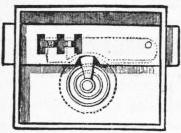
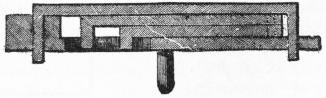
Fig. 6. Fig. 7.
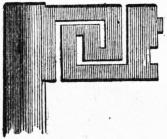
Fig. 8.
A lock operating on exactly the same principle but entirely different in construction (fig. 9) was invented by Joseph Bramah in 1784. It consists of an outer barrel aaaa, within which is a revolving barrel, cccc, held in place by a steel disk, dd, and provided with a pin b fixed eccentrically for operating the bolt; the barrel is prevented from turning by sheet metal sliders ss, which slide axially in radial grooves in the barrel and project into slots cut into the steel disk which is fastened to the case of the lock. Each slider has a gating cut in its outer edge sufficiently deep to allow it to embrace the inwardly projecting steel plate and turn on it with the barrel. The key is of tubular form having slots cut in its end, each of a depth corresponding to the position of the gating in one of the sliders; so that, on inserting the key, each slider is pushed in—against a spring—exactly far enough to bring its slot opposite the steel disk; in this position the barrel carrying the sliders is turned by the key and actuates the bolt.
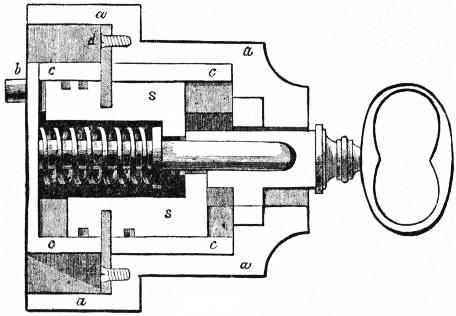
Fig. 9.
Up to 1851 it was generally believed that well-made lever locks of all types were practically unpickable, but at this time Alfred Charles Hobbs—an American—demonstrated, by picking the locks of Barron, Chubb, Bramah and others, that this belief was a fallacy. The method of Hobbs became widely known as the “tickling” or “tentative” method. In the modern lever lock the bolt carries a projecting piece—the “main stump”—which, when the levers are all raised to the proper height, enters the slots—“gatings”—in their faces. If, when the levers are not in this position, pressure is applied to the bolt, the main stump will press against the face of the levers; but owing to inaccuracies of workmanship and other causes the pressure will not be equal on all the levers. If now, the pressure on the bolt being maintained, each lever in turn is carefully raised a little, one will be found on which the pressure of the stump is greatest; this one is lifted till it becomes easy and then carefully lowered till it is sustained by the pressure of the stump in a new position. Another lever now bears the greatest pressure, and this in its turn is similarly treated. By this gradual or “tentative” process the levers will in time all be raised to the correct height and the bolt will slip back without, if sufficient care has been exercised, any of the levers having been raised above its correct position. Although this method of picking only became generally known in 1851, it is evident that it was not novel, since in 1817 one of Bramah’s workmen, named Russell, invented the use of false notches or gatings, which were slots similar to the true gating but of small depth cut in the face of the levers. Similar false gatings were used in Anthony Radford Strutt’s lock in 1819. The only possible object of these gatings—two of which are shown in each of the sliders of Bramah’s lock—was to prevent the tentative method of picking. They are, however, not efficient for their purpose although they render the operation more difficult and tedious.