VOLUME XVI SLICE VII Liquid Gases to Logar (continued 11)
Reading edition

LOCKERBIE, a municipal and police burgh of Dumfriesshire, Scotland, in the district of Annandale, 14½ m. E.N.E. of Dumfries by the Caledonian railway. Pop. (1901) 2358. It has long been famous for its cattle and sheep sales, but more particularly for the great August lamb fair, the largest in Scotland, at which as many as 126,000 lambs have been sold. The town hall and Easton institute are in the Scottish Baronial style. The police station is partly accommodated in an ancient square tower, once the stronghold of the Johnstones, for a long period the ruling family under whose protection the town gradually grew up. At Dryfe Sands, about 2 m. to the W., a bloody encounter took place in 1593 between the Johnstones and Maxwells. The Maxwells were pursued into Lockerbie and almost exterminated; hence “Lockerbie Lick” became a proverbial expression, signifying an overwhelming defeat.
LOCKER-LAMPSON, FREDERICK (1821-1895), English man of letters, was born, on the 29th of May 1821, at Greenwich Hospital. His father, who was Civil Commissioner of the Hospital, was Edward Hawke Locker, youngest son of that Captain William Locker who gave Nelson the memorable advice “to lay a Frenchman close, and beat him.” His mother, Eleanor Mary Elizabeth Boucher, was a daughter of the Rev. Jonathan Boucher, vicar of Epsom and friend of George Washington. After a desultory education, Frederick Locker began life in a colonial broker’s office. Soon deserting this uncongenial calling, he obtained a clerkship in Somerset House, whence he was transferred to Lord Haddington’s private office at the Admiralty. Here he became deputy-reader and précis writer. In 1850 he married Lady Charlotte Bruce, daughter of the Lord Elgin who brought the famous marbles to England, and sister of Lady Augusta Stanley. After his marriage he left the Civil Service, in consequence of ill-health. In 1857 he published London Lyrics, a slender volume of 90 pages, which, with subsequent extensions, constitutes his poetical legacy. Lyra Elegantiarum (1867), an anthology of light and familiar verse, and Patchwork (1879), a book of extracts, were his only other publications. In 1872 Lady Charlotte Locker died. Two years later Locker married Miss Hannah Jane Lampson, the only daughter of Sir Curtis Miranda Lampson, Bart., of Rowfant, Sussex, and in 1885 took his wife’s surname. At Rowfant he died on the 30th of May 1895. Chronic ill-health debarred Locker from any active part in life, but it did not prevent his delighting a wide circle of friends by his gifts as a host and raconteur, and from accumulating many treasures as a connoisseur. His books are catalogued in the volume called the Rowfant Library (1886), to which an appendix (1900) was added, after his death, under the superintendence of his eldest son. As a poet, Locker belongs to the choir who deal with the gay rather than the grave in verse—with the polished and witty rather than the lofty or emotional. His good taste kept him as far from the broadly comic on the one side as his kind heart saved him from the purely cynical on the other. To something of Prior, of Praed and of Hood he added qualities of his own which lent his work distinction—a distinction in no wise diminished by his unwearied endeavour after directness and simplicity.
A posthumous volume of Memoirs, entitled My Confidences (1896), and edited by his son-in-law, Mr Augustine Birrell, gives an interesting idea of his personality and a too modest estimate of his gifts as a poet.
(A. D.)
LOCKHART, GEORGE (1673-1731), of Carnwath, Scottish writer and politician, was a member of a Lanarkshire family tracing descent from Sir Simon Locard (the name being originally territorial, de Loch Ard), who is said to have accompanied Sir James Douglas on his expedition to the East with the heart of Bruce, which relic, according to Froissart, Locard brought home from Spain when Douglas fell in battle against the Moors, and buried in Melrose Abbey; this incident was the origin of the “man’s heart within a fetterlock” borne on the Lockhart shield, which in turn perhaps led to the altered spelling of the surname. George Lockhart’s grandfather was Sir James Lockhart of Lee (d. 1674), a lord of the court of session with the title of Lord Lee, who commanded a regiment at the battle of Preston. Lord Lee’s eldest son, Sir William Lockhart of Lee (1621-1675), after fighting on the king’s side in the Civil War, attached himself to Oliver Cromwell, whose niece he married, and by whom he was appointed commissioner for the administration of justice in Scotland in 1652, and English ambassador at the French court in 1656, where he greatly distinguished himself by his successful diplomacy. Lord Lee’s second son, Sir George Lockhart (c. 1630-1689), was lord-advocate in Cromwell’s time, and was celebrated for his persuasive eloquence; in 1674, when he was disbarred for alleged disrespect to the court of session in advising an appeal to parliament, fifty barristers showed their sympathy for him by withdrawing from practice. Lockhart was readmitted in 1676, and became the leading advocate in political trials, in which he usually appeared for the defence. He was appointed lord-president of the court of session in 1685; and was shot in the streets of Edinburgh on the 31st of March 1689 by John Chiesley, against whom the lord-president had adjudicated a cause. Sir George Lockhart purchased the extensive estates of the earls of Carnwath in Lanarkshire, which were inherited by his eldest son, George, whose mother was Philadelphia, daughter of Lord Wharton.
George Lockhart, who was member for the city of Edinburgh in the Scottish parliament, was appointed a commissioner for arranging the union with England in 1705. After the union he continued to represent Edinburgh, and later the Wigton burghs. His sympathies were with the Jacobites, whom he kept informed of all the negotiations for the union; in 1713 he took part in an abortive movement aiming at the repeal of the union. He was deeply implicated in the rising of 1715, the preparations for which he assisted at Carnwath and at Dryden, his Edinburgh residence. He was imprisoned in Edinburgh castle, but probably, through the favour of the duke of Argyll, he was released without being brought to trial; but his brother Philip was taken prisoner at the battle of Preston and condemned to be shot, the sentence being executed on the 2nd of December 1715. After his liberation Lockhart became a secret agent of the Pretender; but his correspondence with the prince fell into the hands of the government in 1727, compelling him to go into concealment at Durham until he was able to escape abroad. Argyll’s influence was again exerted in Lockhart’s behalf, and in 1728 he was permitted to return to Scotland, where he lived in retirement till his death in a duel on the 17th of December 1731. Lockhart was the author of Memoirs of the Affairs of Scotland, dealing with the reign of Queen Anne till the union with England, first published in 1714. These Memoirs, together with Lockhart’s correspondence with the Pretender, and one or two papers of minor importance, were published in two volumes in 1817, forming the well-known “Lockhart Papers,” which are a valuable authority for the history of the Jacobites.
Lockhart married Eupheme Montgomerie, daughter of Alexander, 9th earl of Eglinton, by whom he had a large family. His grandson James, who assumed his mother’s name of Wishart in addition to that of Lockhart, was in the Austrian service during the Seven Years’ War, and was created a baron and count of the Holy Roman Empire. He succeeded to the estates of Lee as well as of Carnwath, both of which properties passed, on the death of his son Charles without issue in 1802, to his nephew Alexander, who was created a baronet in 1806.
See The Lockhart Papers (2 vols., London, 1817); Andrew Lang, History of Scotland (4 vols., London, 1900). For the story of Sir Simon Lockhart’s adventures with the heart of the Bruce, see Sir Walter Scott’s The Talisman.
(R. J. M.)
LOCKHART, JOHN GIBSON (1794-1854), Scottish writer and editor, was born on the 14th of July 1794 in the manse of Cambusnethan in Lanarkshire, where his father, Dr John Lockhart, transferred in 1796 to Glasgow, was minister. His mother, who was the daughter of the Rev. John Gibson, of Edinburgh, was a woman of considerable intellectual gifts. He was sent to the Glasgow high school, where he showed himself clever rather than industrious. He fell into ill-health, and had to be removed from school before he was twelve; but on his recovery he was sent at this early age to Glasgow University, and displayed so much precocious learning, especially in Greek, that he was offered a Snell exhibition at Oxford. He was not fourteen when he entered Balliol College, where he acquired a great store of knowledge outside the regular curriculum. He read French, Italian, German and Spanish, was interested in classical and British antiquities, and became versed in heraldic and genealogical lore. In 1813 he took a first class in classics in the final schools. For two years after leaving Oxford he lived chiefly in Glasgow before settling to the study of Scottish law in Edinburgh, where he was called to the bar in 1816. A tour on the continent in 1817, when he visited Goethe at Weimar, was made possible by the kindness of the publisher Blackwood, who advanced money for a promised translation of Schlegel’s Lectures on the History of Literature, which was not published until 1838. Edinburgh was then the stronghold of the Whig party, whose organ was the Edinburgh Review, and it was not till 1817 that the Scottish Tories found a means of expression in Blackwood’s Magazine. After a somewhat hum-drum opening, Blackwood suddenly electrified the Edinburgh world by an outburst of brilliant criticism. John Wilson (Christopher North) and Lockhart had joined its staff in 1817. Lockhart no doubt took his share in the caustic and aggressive articles which marked the early years of Blackwood; but his biographer, Mr Andrew Lang, brings evidence to show that he was not responsible for the virulent articles on Coleridge and on “The Cockney School of Poetry,” that is on Leigh Hunt, Keats and their friends. He has been persistently accused of the later Blackwood article (August 1818) on Keats, but he showed at any rate a real appreciation of Coleridge and Wordsworth. He contributed to Blackwood many spirited translations of Spanish ballads, which in 1823 were published separately. In 1818 the brilliant and handsome young man attracted the notice of Sir Walter Scott, and the acquaintance soon ripened into an intimacy which resulted in a marriage between Lockhart and Scott’s eldest daughter Sophia, in April 1820. Five years of domestic happiness followed, with winters spent in Edinburgh and summers at a cottage at Chiefswood, near Abbotsford, where Lockhart’s two eldest children, John Hugh and Charlotte, were born; a second son, Walter, was born later at Brighton. In 1820 John Scott, the editor of the London Magazine, wrote a series of articles attacking the conduct of Blackwood’s Magazine, and making Lockhart chiefly responsible for its extravagances. A correspondence followed, in which a meeting between Lockhart and John Scott was proposed, with Jonathan Henry Christie and Horace Smith as seconds. A series of delays and complicated negotiations resulted early in 1821 in a duel between Christie and John Scott, in which Scott was killed. This unhappy affair, which has been the subject of much misrepresentation, is fully discussed in Mr Lang’s book on Lockhart.
Between 1818 and 1825 Lockhart worked indefatigably. In 1819 Peter’s Letters to his Kinsfolk appeared, and in 1822 he edited Peter Motteux’s edition of Don Quixote, to which he prefixed a life of Cervantes. Four novels followed: Valerius in 1821, Some Passages in the Life of Adam Blair, Minister of Gospel at Cross Meikle in 1822, Reginald Dalton in 1823 and Matthew Wald in 1824. But his strength did not lie in novel writing, although the vigorous quality of Adam Blair has been recognized by modern critics. In 1825 Lockhart accepted the editorship of the Quarterly Review, which had been in the hands of Sir John Taylor Coleridge since Gifford’s resignation in 1824. He had now established his literary position, and, as the next heir to his unmarried half-brother’s property in Scotland, Milton Lockhart, he was sufficiently independent, though he had abandoned the legal profession. In London he had great social success, and was recognized as a brilliant editor. He contributed largely to the Quarterly Review himself, his biographical articles being especially admirable. He showed the old railing spirit in an amusing but violent article in the Quarterly on Tennyson’s Poems of 1833, in which he failed to discover the mark of genius. He continued to write for Blackwood; he produced for Constable’s Miscellany in 1828 what remains the most charming of the biographies of Burns; and he undertook the superintendence of the series called “Murray’s Family Library,” which he opened in 1829 with a History of Napoleon. But his chief work was the Life of Sir Walter Scott (7 vols., 1837-1838; 2nd ed., 10 vols., 1839). There were not wanting those in Scotland who taxed Lockhart with ungenerous exposure of his subject, but to most healthy minds the impression conveyed by the biography was, and is, quite the opposite. Carlyle did justice to many of its excellencies in a criticism contributed to the London and Westminster Review (1837). Lockhart’s account of the transactions between Scott and the Ballantynes and Constable caused great outcry; and in the discussion that followed he showed unfortunate bitterness by his pamphlet, “The Ballantyne Humbug handled.” The Life of Scott has been called, after Boswell’s Johnson, the most admirable biography in the English language. The proceeds, which were considerable, Lockhart resigned for the benefit of Scott’s creditors.
The close of Lockhart’s life was saddened by family bereavement, resulting in his own breakdown in health and spirits. His eldest boy (the suffering “Hugh Littlejohn” of Scott’s Tales of a Grandfather) died in 1831; Scott himself in 1832; Mrs Lockhart in 1837; and the surviving son, Walter Lockhart, in 1852. Resigning the editorship of the Quarterly Review in 1853, he spent the next winter in Rome, but returned to England without recovering his health; and being taken to Abbotsford by his daughter Charlotte, who had become Mrs James Robert Hope-Scott, he died there on the 25th of November 1854. He was buried in Dryburgh Abbey, near Sir Walter Scott.
Lockhart’s Life (2 vols., London and New York, 1897) was written by Andrew Lang. A. W. Pollard’s edition of the Life of Scott (1900) is the best.
LOCKHART, SIR WILLIAM STEPHEN ALEXANDER (1841-1900), British general, was born in Scotland on the 2nd of September 1841, his father being a Lanarkshire clergyman. He entered the Indian army in 1858, in the Bengal native infantry. He served in the Indian Mutiny, the Bhutan campaign (1864-66), the Abyssinian expedition (1867-68; mentioned in despatches), the Hazara Black Mountain expedition (1868-69; mentioned in despatches). From 1869 to 1879 he acted as deputy-assistant and assistant quartermaster-general in Bengal. In 1877 he was military attaché with the Dutch army in Acheen. He served in the Afghan War of 1878-80, was mentioned in despatches and made a C.B., and from 1880 to 1885 was D.Q.G. in the intelligence branch at headquarters. He commanded a brigade in the Third Burmese War (1886-87), and was made K.C.B., C.S.I., and received the thanks of the government. An attack of fever brought him to England, where he was employed as assistant military secretary for Indian affairs; but in 1890 he returned to India to take command of the Punjab frontier force, and for five years was engaged in various expeditions against the hill tribes. After the Waziristan campaign in 1894-95 he was made K.C.S.I. He became full general in 1896, and in 1897 he was given the command against the Afridis and Mohmands, and conducted the difficult Tirah campaign with great skill. He was made G.C.B., and in 1898 became commander-in-chief in India. He died on the 18th of March 1900. Sir William Lockhart was not only a first-rate soldier, but also had a great gift for dealing with the native tribesmen. Among the latter he had the sobriquet of Amir Sahib, on account of their respect and affection for him.
LOCK HAVEN, a city and the county-seat of Clinton county, Pennsylvania, U.S.A., on the west branch of the Susquehanna river, near the mouth of Bald Eagle Creek, about 70 m. N.N.W. of Harrisburg. Pop. (1900) 7210 (618 foreign-born and 122 negroes); (1910) 7772. It is served by branches of the Pennsylvania and the New York Central & Hudson River railways and by electric interurban railways. The city is pleasantly situated in an agricultural region, and there are large deposits of cement and of fire-brick clay in the vicinity. Lock Haven is the seat of the Central State Normal School (opened 1877), and has a public library and a hospital. There are various manufactures. The municipality owns and operates the water-works. The locality was settled in 1769. A town was founded in 1833, the Pennsylvania Canal (no longer in use here) was completed to this point in 1834, and the name of the place was suggested by two canal locks and the harbour, or haven, for rafts in the river. Lock Haven was made the county-seat immediately after the erection of Clinton county in 1839, was incorporated as a borough in 1840, and first chartered as a city in 1870.
LOCKPORT, a city of Will county, Illinois, U.S.A., on the Des Plaines river and the Illinois & Michigan Canal, and the terminus of the Chicago Sanitary District Drainage Canal, about 33 m. S.W. of Chicago and 4 m. N.N.E. of Joliet. Pop. (1900) 2659 (552 being foreign-born and 130 negroes); (1910) 2555. Lockport is served by the Chicago & Alton, and the Atchison, Topeka & Santa Fé railways, and by the Chicago & Joliet Electric railway. It is in a picturesque farming country, and there are good limestone quarries in the valley of the Des Plaines river. It has manufactures and a considerable trade, especially in grain. A settlement was made here about 1827; in 1837 the site was chosen as headquarters for the Illinois & Michigan Canal and a village was laid out; it was incorporated in 1853, and was chartered as a city in 1904. In 1892 work was begun on the Chicago Drainage Canal, whose controlling works are here and whose plant, developing 40,000 h.p. from the 40 ft. fall between Joliet and Lockport, supplies Lockport with cheap power and has made it a manufacturing rather than a commercial city.
LOCKPORT, a city and the county-seat of Niagara county, New York, U.S.A., on the Erie Canal, 26 m. by rail N. by E. of Buffalo and 56 m. W. of Rochester. Pop. (1900) 16,581, of whom 2036 were foreign-born and 160 were negroes; (1910 census) 17,970. It is served by the New York Central & Hudson River and the Erie railways, by the International railway (electric interurban), and by the Erie Canal. The city owes its name to the five double locks of the canal, which here falls 66 ft. (over a continuation of the Niagara escarpment locally known as “Mountain Ridge”) from the level of Lake Erie to that of the Genesee river. In 1909 a scheme was on foot to replace these five locks by a huge lift lock and to construct a large harbour immediately W. of the city. The surplus water from Tonawanda Creek, long claimed both by the Canal and by the Lockport manufacturers, after supplying the canal furnishes water-power, and electric power is derived from Niagara. The factory products, mostly paper and wood-pulp, flour and cereal foods, and foundry and machine-shop products, were valued in 1905 at $5,807,980. Lockport lies in a rich farming and fruit (especially apple and pear) country, containing extensive sandstone and Niagara limestone quarries, and is a shipping point for the fruits and grains and the limestone and sandstone of the surrounding country. Many buildings in the business part of the city are heated by the Holly distributing system, which pipes steam from a central station or plant, and originated in Lockport. The city owns and operates the water-works, long operated under the Holly system, which, as well as the Holly distributing system, was devised by Birdsill Holly, a civil engineer of Lockport. In 1909 a new system was virtually completed, water being taken from the Niagara river at Tonawanda and pumped thence to a stand-pipe in Lockport.
The site, that of the most easterly village in New York state held by the Neutral Nation of Indians, was part of the tract bought by the Holland Company in 1792-1793. Subsequently most of the land on which the city stands was bought from the Holland Company by Esek Brown, the proprietor of a local tavern, and fourteen others, but there were few settlers until after 1820. In 1822 the place was made the county-seat, and in 1823 it was much enlarged by the settlement here of workmen on the Erie Canal, and was the headquarters for a time of the canal contractors. It was incorporated as a village in 1829, was reached by the Erie railway in 1852, and in 1865 was chartered as a city.
LOCKROY, ÉDOUARD (1838- ), French politician, son of Joseph Philippe Simon (1803-1891), an actor and dramatist who took the name of Lockroy, was born in Paris on the 18th of July 1838. He had begun by studying art, but in 1860 enlisted as a volunteer under Garibaldi. The next three years were spent in Syria as secretary to Ernest Renan, and on his return to Paris he embarked in militant journalism against the second empire in the Figaro, the Diable à quatre, and eventually in the Rappel, with which his name was thenceforward intimately connected. He commanded a battalion during the siege of Paris, and in February 1871 was elected deputy to the National Assembly where he sat on the extreme left and protested against the preliminaries of peace. In March he signed the proclamation for the election of the Commune, and resigned his seat as deputy. Arrested at Vanves he remained a prisoner at Versailles and Chartres until June when he was released without being tried. He was more than once imprisoned for violent articles in the press, and in 1872 for a duel with Paul de Cassagnac. He was returned to the Chamber in 1873 as Radical deputy for Bouches-du-Rhône in 1876, 1877 and 1881 for Aix, and in 1881 he was also elected in the 11th arrondissement of Paris. He elected to sit for Paris, and was repeatedly re-elected. During the elections of 1893 he was shot at by a cab-driver poet named Moore, but was not seriously injured. For the first ten years of his parliamentary life he voted consistently with the extreme left, but then adopted a more opportunist policy, and gave his unreserved support to the Brisson ministry of 1885. In the new Freycinet cabinet formed in January he held the portfolio of commerce and industry, which he retained in the Goblet ministry of 1886-1887. In 1885 he had been returned at the head of the poll for Paris, and his inclusion in the Freycinet ministry was taken to indicate a prospect of reconciliation between Parisian Radicalism and official Republicanism. During his tenure of the portfolio of commerce and industry he made the preliminary arrangements for the Exposition of 1889, and in a witty letter he defended the erection of the Tour Eiffel against artistic Paris. After the Panama and Boulangist scandals he became one of the leading politicians of the Radical party. He was vice-president of the Chamber in 1894 and in 1895, when he became minister of marine under Léon Bourgeois. His drastic measures of reform alarmed moderate politicians, but he had the confidence of the country, and held the same portfolio under Henri Brisson (1898) and Charles Dupuy (1898-1899). He gave his support to the Waldeck-Rousseau Administration, but actively criticized the marine policy of Camille Pelletan in the Combes ministry of 1902-1905, during which period he was again vice-president of the Chamber. M. Lockroy was a persistent and successful advocate of a strong naval policy, in defence of which he published La Marine de Guerre (1890), Six mois rue Royale (1897), La Défense navale (1900), Du Weser à la Vistula (1901), Les Marines française et allemande (1904), Le Programme naval (1906). His other works include M. de Moltke et la guerre future (1891) and Journal d’une bourgeoise pendant la Révolution (1881) derived from the letters of his great-grandmother. M. Lockroy married in 1877 Madame Charles Hugo, the daughter-in-law of the poet.
LOCKWOOD, SIR FRANK (1846-1897), English lawyer, was born at Doncaster. His grandfather and great-grandfather were mayors of Doncaster, and the former for some years filled the office of judge on the racecourse. He was educated at a private school, at Manchester grammar school, and Caius College, Cambridge. Called to the bar at Lincoln’s Inn in 1872, he joined the old midland circuit, afterwards going to the north-eastern, making in his first year 120 guineas and in the next 265 guineas. From that time he had a career of uninterrupted success. In 1882 he was made a queen’s counsel, in 1884 he was made recorder of Sheffield, and in 1894 he became solicitor-general in Lord Rosebery’s ministry, and was knighted, having first entered parliament as Liberal member for York in 1885, after two unsuccessful attempts, the one at King’s Lynn in 1880, the other at York in 1883. He was solicitor-general for less than a year. In 1896 Lord Chief Justice Coleridge, Mr Montague Crackanthorpe and Sir Frank Lockwood went to the United States to attend, as specially invited representatives of the English bar, the nineteenth meeting of the American Bar Association. On this trip Sir Frank Lockwood sustained the reputation which he enjoyed in England as a humorous after-dinner speaker, and helped to strengthen the bond of friendship which unites the bench and bar of the United States with the bench and bar of England. He died in London on the 18th of December 1897. Lockwood had considerable talent for drawing, inherited from his father, which he employed, chiefly for the amusement of himself and his friends, in the making of admirable caricatures in pen and ink, and of sketches of humorous incidents, real or imaginary, relating to the topic nearest at hand. An exhibition of them was held soon after his death.
See Augustine Birrell’s biography of Lockwood and The Frank Lockwood Sketch-Book (1898).
LOCKWOOD, WILTON (1861- ), American artist, was born at Wilton, Connecticut, on the 12th of September 1861. He was a pupil and an assistant of John La Farge, and also studied in Paris, becoming a well-known portrait and flower painter. He became a member of the Society of American Artists (1898), and of the Copley Society, Boston, and an associate of the National Academy of Design, New York.
LOCKYER, SIR JOSEPH NORMAN (1836- ), English astronomer, was born at Rugby on the 17th of May 1836. After completing his education on the Continent of Europe, he obtained a clerkship in the War Office in 1857. His leisure was devoted to the study of astronomy, and he was appointed in 1870 secretary to the duke of Devonshire’s royal commission on science. In 1875 he was transferred to the Science and Art Department at South Kensington, and on the foundation of the Royal College of Science he became director of the solar physics observatory and professor of astronomical physics. Eight British government expeditions for observing total solar eclipses were conducted by him between 1870 and 1905. On the 26th of October 1868 he communicated to the Paris Academy of Sciences, almost simultaneously with Dr P. J. C. Janssen, a spectroscopic method for observing the solar prominences in daylight, and the names of both astronomers appear on a medal which was struck by the French government in 1872 to commemorate the discovery. Lockyer was elected a fellow of the Royal Society in 1869, and received the Rumford medal in 1874. He initiated in 1866 the spectroscopic observation of sunspots; applied Doppler’s principle in 1869 to determine the radial velocities of the chromospheric gases; and successfully investigated the chemistry of the sun from 1872 onward. Besides numerous contributions to the Proceedings of the Royal and the Royal Astronomical Societies, he published several books, both explanatory and speculative. The Chemistry of the Sun (1887) is an elaborate treatise on solar spectroscopy based on the hypothesis of elemental dissociation through the intensity of solar heat. The Meteoritic Hypothesis (1890) propounds a comprehensive scheme of cosmical evolution, which has evoked more dissent than approval, while the Sun’s Place in Nature (1897) lays down the lines of a classification of the stars, depending upon their supposed temperature-relations. Among Lockyer’s other works are—The Dawn of Astronomy (1894), to which Stonehenge and other British Stone Monuments astronomically considered (1906) may be considered a sequel; Recent and coming Eclipses (1897); and Inorganic Evolution (1900). He was created K.C.B. in 1897, and acted as president of the British Association in 1903-1904. His fifth son, William James Stewart Lockyer (b. 1868), devoted himself to solar research, and became chief assistant in the Solar Physics Observatory, South Kensington.
LOCLE, LE, a town in the Swiss canton of Neuchâtel, 24 m. by rail N. of Neuchâtel, and 5 m. S.W. of La Chaux de Fonds. It is built (3035 ft. above the sea-level) on the Bied stream in a valley of the Jura, and is about 1 m. from the French frontier. In 1681 Daniel Jean Richard introduced watch-making here, which soon drove out all other industries. In 1900 the population was 12,559, mainly Protestants and French-speaking. The church tower dates from 1521, but the old town was destroyed by fire in 1833. The valley in which the town is situated used to be subject to inundations, but in 1805 a tunnel was constructed by means of which the surplus waters of the Bied are carried into the Doubs. About 1 m. W. of the town the Bied plunged into a deep chasm, on the steep rock face of which were formerly the subterranean mills of the Col des Roches, situated one above another; but the stream is now diverted by the above-mentioned tunnel, while another serves the railway line from Le Locle to Morteau in France (8 m.).
(W. A. B. C.)
LOCMARIAQUER, a village of western France, on the W. shore of the Gulf of Morbihan, in the department of Morbihan, 8½ m. S. of Auray by road. Pop. (1906) 756. Locmariaquer has a small port, and oyster culture is carried on close to it. Roman remains are to be seen, but the place owes its celebrity to the megalithic monuments in the vicinity, some of which are among the largest extant. The menhir of Men-er-H‘roeck (Fairy stone), which was broken into four pieces by lightning in the 18th century, previously measured about 67 ft. in height, and from 9 to 13 ft. in thickness.
LOCOMOTOR ATAXIA (Gr. ἀ, priv., and τάξις, order; synonyms, Tabes dorsalis, posterior spinal sclerosis), a progressive degeneration of the nervous system, involving the posterior columns of the spinal cord with other structures, and causing muscular incoordination and disorder of gait and station. The essential symptoms of the disease—stamping gait, and swaying with the eyes shut, the occurrence of blindness and of small fixed pupils—were recognized by Romberg (1851), but it was the clinical genius of Duchenne and his masterly description of the symptoms which led to its acceptance as a definite disease (1858), and he named it locomotor ataxia after its most striking symptom. In 1869 Argyll Robertson discovered that the eye-pupil is inactive to light but acts upon accommodation in the great majority of cases. This most important sign is named the “Argyll Robertson pupil.” With an ever-increasing knowledge of the widespread character of this disease and its manifold variations in the complex of symptoms, the tendency among neurologists is to revert to the term employed by Romberg—tabes dorsalis. “Locomotor ataxia,” although it expresses a very characteristic feature of the disease, has this objection: it is a symptom which does not occur in the first (preataxic) stage of the disease; indeed a great number of years may elapse before ataxy comes on, and sometimes the patient, after suffering a very long time from the disease, may die from some intercurrent complication, having never been ataxic.
It is generally recognized by neurologists that persons who are not the subjects of acquired or hereditary syphilis do not suffer from this disease; and the average time of onset after infection is ten years (see Neuropathology). There are three stages: (1) The preataxic, (2) the ataxic, (3) the bed-ridden paralytic. The duration of the first stage may be from one or two years, up to twenty years or even longer. In this stage various symptoms may arise. The patient usually complains of shooting, lightning-like pains in the legs, which he may attribute to rheumatism. If a physician examines him he will almost certainly find the knee-jerks absent and Argyll Robertson pupils present; probably on inquiry he will ascertain that the patient has had some difficulty in starting urination, or that he is unable to retain his water or to empty his bladder completely. In other cases, temporary or permanent paralysis of one or more muscles of the eyeball (which causes squint and double vision), a failure of sight ending in blindness, attacks of vomiting (or gastric crises), painless spontaneous fractures of bones and dislocations of joints, failing sexual power and impotence, may lead the patient to consult a physician, when this disease will be diagnosed, although the patient may not as yet have had locomotor ataxy. All cases, however, if they live long enough, pass into the second ataxic stage. The sufferer complains now of difficulty of walking in the dark; he sways with his eyes shut and feels as if he would fall (Romberg’s symptom); he has the sensation of walking on wool, numbness and formication of the skin, and many sensory disturbances in the form of partial or complete loss of sensibility to pain, touch and temperature. These disturbances affect especially the feet and legs, and around the trunk at the level of the fourth to the seventh ribs, giving rise to a “girdle sensation.” There may be a numbed feeling on the inner side of the arm, and muscular incoordination may affect the upper limb as well as the lower, although there is no wasting or any electrical change. The ataxic gait is very characteristic, owing to the loss of reflex tonus in the muscles, and the absence of guiding sensations from all the deep structures of the limbs, muscles, joints, bones, tendons and ligaments, as well as from the skin of the soles of the feet; therefore the sufferer has to be guided by vision as to where and how to place his feet. This necessitates the bending forward of the body, extension of the knees and broadening of the basis of support; he generally uses a walking stick or even two, and he jerks the leg forward as if he were on wires, bringing the sole of the foot down on the ground with a wide stamping action. If the arm be affected, he is unable to touch the tip of his nose with the eyes shut. Sooner or later he passes into the third bed-ridden stage, with muscles wasted and their tonus so much lost that he is in a perfectly helpless condition.
The complications which may arise in this disease are intercurrent affections due to septic conditions of the bladder, bedsores, pneumonia, vascular and heart affections. About 10% of the cases, at least, develop general paralysis of the insane. This is not surprising seeing that it is due to the same cause, and the etiology of the two diseases is such as to lead many neurologists to consider them one and the same disease affecting different parts of the nervous system. Tabes dorsalis occurs with much greater frequency in men than in women (see Neuropathology).
The avoidance of all stress of the nervous system, whether physical, emotional or intellectual, is indicated, and a simple regular life, without stimulants or indulgence of the sexual passion, is the best means of delaying the progress of the disease. Great attention should be paid to micturition, so as to avoid retention and infection of the bladder. Drugs, even anti-syphilitic remedies, appear to have but little influence upon the course of the disease.
LOCO-WEEDS, or Crazy-Weeds, leguminous plants, chiefly species of Astragalus and Lupinus, which produce a disease in cattle known as “loco-disease.” The name is apparently taken from the Spanish loco, mad. The disease affects the nervous system of the animals eating the plants, and is accompanied by exhaustion and wasting.
LOCRI, a people of ancient Greece, inhabiting two distinct districts, one extending from the north-east of Parnassus to the northern half of the Euboean channel, between Boeotia and Malis, the other south-west of Parnassus, on the north shore of the Corinthian Gulf, between Phocis and Aetolia. The former were divided into the northern Locri Epicnemidii, situated on the spurs of Mount Cnemis, and the southern Locri Opuntii, so named from their chief town Opus (q.v.): and the name Opuntia is often applied to the whole of this easterly district. Homer mentions only these eastern Locrians: their national hero in the Trojan war is Ajax Oileus, who often appears afterwards on Locrian coins. From Hesiod’s time onwards, the Opuntians were thought by some to be of “Lelegian” origin (see Leleges), but they were Hellenized early (though matriarchal customs survived among them)—, and Deucalion, the father of Hellen himself, is described as the first king of Opus. The westerly Locri “in Ozolae” on the Corinthian Gulf, a rude and barbarous people, make no appearance in Greek history till the Peloponnesian war. It was believed that they had separated from the eastern Locrians four generations before the Trojan war; yet Homer has no hint of their existence. Probably the Locrians were once a single people, extending from sea to sea, till subsequent immigrations forced them apart into two separate districts. The Locrian dialect of Greek is little known, but resembles that of Elis: it has στ for σθ; uses α; and has οις in dat. plur. 3rd decl. A colony of Locrians (whether from Opus or Ozolae was disputed in antiquity) settled, about the end of the 8th century B.C., at the south-west extremity of Italy. They are often called Locri Epizephyrii from Cape Zephyrion 15 m. S. of the city. Their founder’s name was Euanthes. Their social organization resembled that of the Opuntian Locri, and like them they venerated Ajax Oileus and Persephone. Aristotle (ap. Polyb. xii. 5 sqq.) records a tradition that these western Locrians were base-born, like the Parthenians of Tarentum; but this was disputed by his contemporary Timaeus. See Locri (town) below.
(J. L. M.)
LOCRI, an ancient city of Magna Graecia, Italy. The original settlers took possession of the Zephyrian promontory (Capo Bruzzano some 12 m. N. of Capo Spartivento), and though after three or four years they transplanted themselves to a site 12 m. farther north, still near the coast, 2 m. S. of Gerace Marina below the modern Gerace, they still retained the name of Locri Epizephyrii (Λοκροὶ οἱ ἐπιζεφύριοι), which served to distinguish them from the Ozolian and Opuntian Locri of Greece itself (see preceding article). The foundation of Locri goes back to about 683 B.C. It was the first of all Greek communities to have a written code of laws given by Zaleucus in 664 B.C. From Locri were founded the colonies of Meisma and Heiponium (Hipponium). It succeeded in repelling the attacks of Croton (battle on the river Sagras, perhaps sometime in the 6th century), and found in Syracuse a support against Rhegium: it was thus an active adversary of Athenian aggrandisement in the west. Pindar extolls its uprightness and love of the heroic muse of beauty, of wisdom, and of war, in the 10th and 11th Olympian Odes. Stesichorus (q.v.) was indeed of Locrian origin. But it owed its greatest external prosperity to the fact that Dionysius I. of Syracuse selected his wife from Locri: its territory was then increased, and the circuit of its walls was doubled, but it lost its freedom. In 356 B.C. it was ruled by Dionysius II. From the battle of Heraclea to the year 205 (when it was captured by P. Cornelius Scipio Africanus Maior, and placed under the control of his legate Q. Pleminius), Locri was continually changing its allegiance between Rome and her enemies; but it remained an ally, and was only obliged like other Greek coast towns to furnish ships. In later Roman times it is often mentioned, but was apparently of no great importance. It is mentioned incidentally until the 6th century A.D., but was destroyed by the Saracens in 915.
Excavations in 1889-1890 led to the discovery of an Ionic temple (the Doric style being usual in Magna Graecia) at the north-west angle of the town—originally a cella with two naves, a closed pronaos on the E. and an adytum at the back (W.), later converted into a hexastyle peripheral temple with 34 painted terra-cotta columns. This was then destroyed about 400 B.C. and a new temple built on the ruins, heptastyle peripteral, with no intermediate columns in the cella and opisthodomos, and with 44 columns in all. The figures from the pediment of the twin Dioscuri, who according to the legend assisted Locri against Crotona, are in the Naples museum (see R. Koldewey and O. Puchstein, Griechische Tempel in Unteritalien und Sicilien, Berlin, 1899, pp. l sqq.). Subsequent excavations in 1890-1891 were of the greatest importance, but the results remained unpublished up to 1908. From a short account by P. Orsi in Atti del Congresso Storico, vol. v. (Archeologia) Rome, 1904, p. 201, we learn that the exploration of the environs of the temple led to the discovery of a large number of archaic terra-cottas, and of some large trenches, covered with tiles, containing some 14,000 scyphoi arranged in rows. The plan of the city was also traced; the walls, the length of which was nearly 5 m., consisted of three parts—the fortified castles (φρούρια) with large towers, on three different hills, the city proper, and the lower town—the latter enclosed by long walls running down to the sea. In the Roman period the city was restricted to the plain near the sea. Since these excavations, a certain amount of unauthorized work has gone on, and some of the remains have been destroyed. In the course of these excavations some prehistoric objects have been discovered, which confirm the accounts of Thucydides and Polybius that the Greek settlers found the Siculi here before them.
(T. As.)
LÖCSE (Ger. Leutschau), the capital of the county of Szepes, in Hungary, 230 m. N.E. of Budapest by rail. Pop. (1900) 6845, mostly Germans and Slovaks. The county of Szepes is the highest part of Hungary, and its north-western portion is occupied by the Tátra Mountains. Löcse lies in an elevated position surrounded by mountains, and is one of the oldest towns of Hungary. The church of St James is a Gothic structure of the 13th century, with richly carved altar, several monuments, and a celebrated organ erected in 1623, and long reputed the largest in Hungary. The old town-hall, restored in 1894, contains a Protestant upper gymnasium, founded in 1544, and one of the oldest printing establishments in Hungary, founded in 1585. Bee-keeping and the raising of garden produce are the chief industries.
Founded by Saxon colonists in 1245, Löcse had by the early part of the 16th century attained a position of great relative importance. In 1599 a fire destroyed the greater part of the town, and during the 17th century it suffered repeatedly at the hands of the Transylvanian princes and leaders.
LOCUS (Lat. for “place”; in Gr. τόπος), a geometrical term, the invention of the notion of which is attributed to Plato. It occurs in such statements as these: the locus of the points which are at the same distance from a fixed point, or of a point which moves so as to be always at the same distance from a fixed point, is a circle; conversely a circle is the locus of the points at the same distance from a fixed point, or of a point moving so as to be always at the same distance from a fixed point; and so in general a curve of any given kind is the locus of the points which satisfy, or of a point moving so as always to satisfy, a given condition. The theory of loci is thus identical with that of curves (see Curve and Geometry: § Analytical). The notion of a locus applies also to solid geometry. Here the locus of the points satisfying a single (or onefold) condition is a surface; the locus of the points satisfying two conditions (or a twofold condition) is a curve in space, which is in general a twisted curve or curve of double curvature.
LOCUST.1 In its general acceptation this term is applied only to certain insects of the order Orthoptera, family Acridiidae. The family Locustidae is now viewed zoologically in a sense that does not admit of the species best known as “locusts” being included therein. The idea of a very destructive insect is universally associated with the term; therefore many orthopterous species that cannot be considered true locusts have been so-called; in North America it has even embraced certain Hemiptera-Homoptera, belonging to the Cicadidae, and in some parts of England cockchafers are so designated. In a more narrow definition the attribute of migration is associated with the destructive propensities, and it therefore becomes necessary that a true locust should be a migratory species of the family Acridiidae. Moreover, the term has yet a slightly different signification as viewed from the Old or New World. In Europe by a locust is meant an insect of large size, the smaller allied species being ordinarily known as “grasshoppers,” hence the “Rocky Mountain locust” of North America is to Eastern ideas rather a grasshopper than a locust.
In Europe, and a greater part of the Old World, the best known migratory locust is that which is scientifically termed Pachytylus cinerascens with which an allied species P. migratorius has been often confounded. Another locust found in Europe and neighbouring districts is Caloptenus italicus, and still another, Acridium peregrinum, has once or twice occurred in Europe, though its home (even in a migratory sense) is more properly Africa and Asia. These practically include all the locusts of the Old World, though a migratory species of South Africa known as Pachytylus pardalinus (presumed to be distinct from P. migratorius) should be mentioned. The Rocky Mountain locust of North America is Caloptenus spretus, and in that continent there occurs an Acridium (A. americanum) so closely allied to A. peregrinum as to be scarcely distinct therefrom, though there it does not manifest migratory tendencies. In the West Indies and Central America A. peregrinum is also reported to occur.
The females excavate holes in the earth in which the eggs are deposited in a long cylindrical mass enveloped in a glutinous secretion. The young larvae hatch and immediately commence their destructive career. As these insects are “hemimetabolic” there is no quiescent stage; they go on increasing rapidly in size, and as they approach the perfect state the rudiments of the wings begin to appear. Even in this stage their locomotive powers are extensive and their voracity great. Once winged and perfect these powers become infinitely more disastrous, redoubled by the development of the migratory instinct. The laws regulating this instinct are not perfectly understood. Food and temperature have a great deal to do with it, and there is a tendency for the flights to take a particular direction, varied by the physical circumstances of the breeding districts. So likewise each species has its area of constant location, and its area of extraordinary migration. Perhaps the most feasible of the suggestions as to the causes of the migratory impulse is that locusts naturally breed in dry sandy districts in which food is scarce, and are impelled to wander to procure the necessaries of life; but against this it has been argued that swarms bred in a highly productive district in which they have temporarily settled will seek the barren home of their ancestors. Another ingenious suggestion is that migration is intimately connected with a dry condition of the atmosphere, urging them to move on until compelled to stop for food or procreative purposes. Swarms travel considerable distances, though probably generally fewer than 1000 m., though sometimes very much more. As a rule the progress is only gradual, and this adds vastly to the devastating effects. When an extensive swarm temporarily settles in a district, all vegetation rapidly disappears, and then hunger urges it on another stage. The large Old World species, although undoubtedly phytophagous, when compelled by hunger sometimes attack at least dry animal substances, and even cannibalism has been asserted as an outcome of the failure of all other kinds of food. The length of a single flight must depend upon circumstances. From peculiarities in the examples of Acridium peregrinum taken in England in 1869, it has been asserted that they must have come direct by sea from the west coast of Africa; and what is probably the same species has been seen in the Atlantic at least 1200 m. from land, in swarms completely covering the ship; thus, in certain cases flight must be sustained for several days and nights together. The height at which swarms fly, when their horizontal course is not liable to be altered by mountains, has been very variously estimated at from 40 to 200 ft., or even in a particular case to 500 ft. The extent of swarms and the number of individuals in a swarm cannot be accurately ascertained. They come sometimes in such numbers as to completely obscure the sun, when the noise made by the rustling of the wings is deafening. Nevertheless some idea on this point may be formed from the ascertained fact that in Cyprus in 1881, at the close of the season, 1,600,000,000 egg-cases, each containing a considerable number of eggs, had been destroyed; the estimated weight exceeding 1300 tons. Yet two years later, it is believed that not fewer than 5,076,000,000 egg-cases were again deposited in the island.
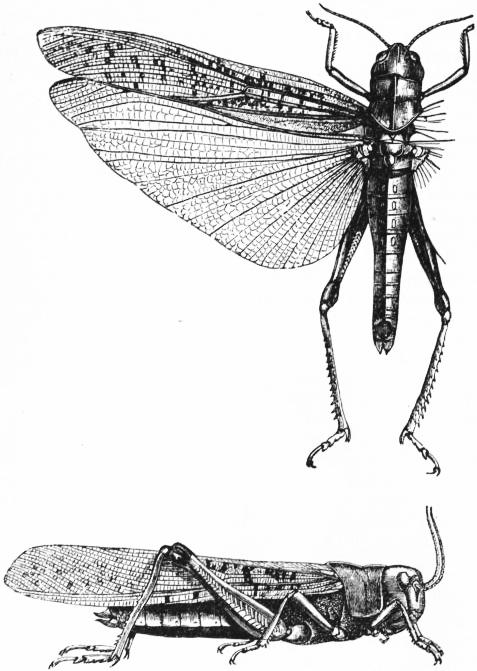
Fig. 1.—Pachytylus migratorius. This and the other figures are all natural size.
In Europe the best known and ordinarily most destructive species is Pachytylus cinerascens, and it is to it that most of the numerous records of devastations in Europe mainly refer, but it is probably not less destructive in many parts of Africa and Asia. That the arid steppes of central Asia are the home of this insect appears probable; still much on this point is enveloped in uncertainty. In any case the area of permanent distribution is enormous, and that of occasional distribution is still greater. The former area extends from the parallel of 40° N. in Portugal, rising to 48° in France and Switzerland, and passing into Russia at 55°, thence continuing across the middle of Siberia, north of China to Japan; thence south to the Fiji Islands, to New Zealand and North Australia; thence again to Mauritius and over all Africa to Madeira. The southern distribution is uncertain and obscure. Taking exceptional distribution, it is well known that it occasionally appears in the British Isles, and has in them apparently been noticed as far north as Edinburgh; so also does it occasionally appear in Scandinavia, and it has probably been seen up to 63° N. in Finland. Looking at this vast area, it is easy to conceive that an element of uncertainty must always exist with regard to the exact determination of the species, and in Europe especially is this the case, because there exists a distinct species, known as P. migratorius, the migratory area of which appears to be confined to Turkestan and eastern Europe.
P. cinerascens is certainly the most common of the “locusts” occasionally found in the British Isles, and E. de Selys-Longchamps is of opinion that it breeds regularly in Belgium, whereas the true P. migratorius is only accidental in that country.
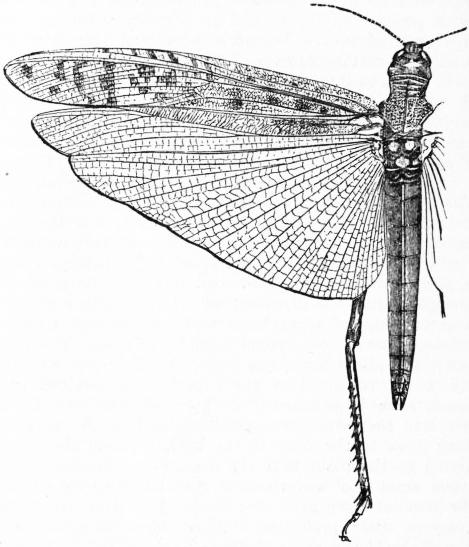
Fig. 2.—Acridium peregrinum.
A South African species allied to the preceding and provisionally identified as Pachytylus salcicollis is noteworthy from the manifestation of the migratory instinct in immature wingless individuals. The families of young, after destroying the vegetation of a district, unite in a vast army and move away in search of fresh pastures, devastating the country as they go and proceeding of necessity on foot, hence they are known to the Dutch as “voetgangers.” Travelling northwards towards the centre of the continent, the home of their parents before migration, they are diverted from their course by no obstacles. Upon reaching a river or stream they search the bank for a likely spot to cross, then fearlessly cast themselves upon the water where they form floating islands of insects, most of which usually succeed in gaining the opposite bank, though many perish in the attempt.
Acridium peregrinum (fig. 2) can scarcely be considered even an accidental visitor to Europe; yet it has been seen in the south of Spain, and in many examples spread over a large part of England in the year 1869. It is a larger insect than P. migratorius. There is every reason to believe that it is the most destructive locust throughout Africa and in India and other parts of tropical Asia, and its ravages are as great as those of P. migratorius. Presumably it is the species occasionally noticed in a vast swarm in the Atlantic, very far from land, and presumably also it occurs in the West Indies and some parts of Central America. In the Argentine Republic a (possibly) distinct species (A. paranense) is the migratory locust.
Caloptenus italicus (fig. 3) is a smaller insect, with a less extended area of migration; the destruction occasioned in the districts to which it is limited is often scarce less than that of its more terrible allies. It is essentially a species of the Mediterranean district, and especially of the European side of that sea, yet it is also found in North Africa, and appears to extend far into southern Russia.
Caloptenus spretus (fig. 4) is the “Rocky Mountain locust” or “hateful grasshopper” of the North American continent. Though a comparatively small insect, not so large as some of the grasshoppers of English fields, its destructiveness has procured for it great notoriety. By early travellers and settlers the species was not recognized as distinct from some of its non-migratory congeners. But in 1877, Congress appointed a United States Entomological Commission to investigate the subject. The report of the commissioners (C. V. Riley, A. S. Packard and C. Thomas) deals with the whole subject of locusts both in America and the Old world. C. spretus has its home or permanent area in the arid plains of the central region east of the Rocky Mountains, extending slightly into the southern portion of Canada; outside this is a wide fringe to which the term sub-permanent is applied, and this is again bounded by the limits of only occasional distribution, the whole occupying a large portion of the North American continent; but it is not known to have crossed the Rocky Mountains westward, or to have extended into the eastern states.
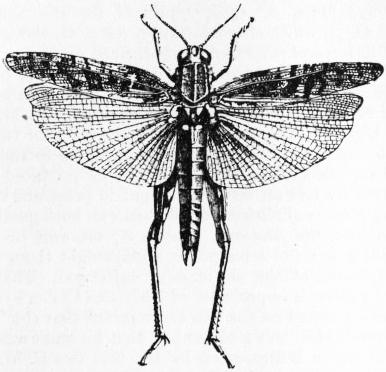
Fig. 3.—Caloptenus italicus.
As to remedial or preventive measures tending to check the ravages of locusts, little unfortunately can be said; but anything that will apply to one species may be used with practically all. Something can be done (as is now done in Cyprus) by offering a price for all the egg-tubes collected, which is the most direct manner of attacking them. Some little can be done by destroying the larvae while in an unwinged condition, and by digging trenches in the line of march into which they can fall and be drowned or otherwise put an end to. Little can be done with the winged hordes; starvation, the outcome of their own work, probably here does much. In South Africa some success has attended the spraying of the swarms with arsenic. It has been shown that with all migratory locusts the breeding-places, or true homes, are comparatively barren districts (mostly elevated plateaus); hence the progress of colonization, and the conversion of those heretofore barren plains into areas of fertility, may (and probably will) gradually lessen the evil.
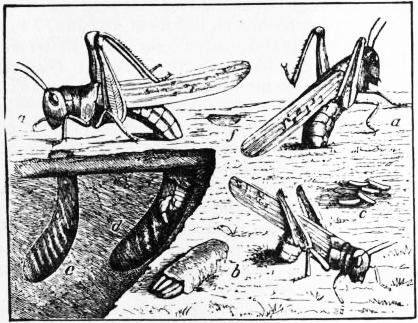
Fig. 4.—Rocky Mountain Locust (Caloptenus spretus). (After Riley.)
a, a, a, Female in different positions, ovipositing. b, Egg-pod extracted from ground, with the end broken open. c, A few eggs lying loose on the ground. d, e show the earth partially removed, to illustrate an egg-mass already in place, and one being placed. f, shows where such a mass has been covered up.
Locusts have many enemies besides man. Many birds greedily devour them, and it has many times been remarked that migratory swarms of the insects were closely followed by myriads of birds. Predatory insects of other orders also attack them, especially when they are in the unwinged condition. Moreover, they have still more deadly insect foes as parasites. Some attack the fully developed winged insect. But the greater part attack the eggs. To such belong certain beetles, chiefly of the family Cantharidae, and especially certain two-winged flies of the family Bombyliidae. These latter, both in the Old and New World, must prevent vast quantities of eggs from producing larvae.
The larger Old World species form articles of food with certain semi-civilized and savage races, by whom they are considered as delicacies, or as part of ordinary diet, according to the race and the method of preparation.
(R. M‘L.; R. I. P.)
1 The Lat. locusta was first applied to a lobster or other marine shell-fish and then, from its resemblance, to the insect.
LOCUST-TREE, or Carob-Tree (Ceratonia siliqua), a member of the tribe Cassieae of the order Leguminosae, the sole species of its genus, and widely diffused spontaneously and by cultivation from Spain to the eastern Mediterranean regions. The name of the genus is derived from the often curved pod (Gr. κεράτιον, a little horn). The flowers have no petals and are polygamous or dioecious (male, female and hermaphrodite flowers occur). The seed-pod is compressed, often curved, indehiscent and coriaceous, but with sweet pulpy divisions between the seeds, which, as in other genera of the Cassieae, are albuminous. The pods are eaten by men and animals, and in Sicily a spirit and a syrup are made from them. These husks being often used for swine are called swine’s bread, and are probably referred to in the parable of the Prodigal Son. It is also called St John’s bread, from a misunderstanding of Matt. iii. 4. The carob-tree was regarded by Sprengel as the tree with which Moses sweetened the bitter waters of Marah (Exod. xv. 25), as the kharrúb, according to Avicenna (p. 205), has the property of sweetening salt and bitter waters. Gerard (Herball, p. 1241) cultivated it in 1597, it having been introduced in 1570.
LODÈVE, a town of southern France, capital of an arrondissement of the department of Hérault, 36 m. W.N.W. of Montpellier by rail. Pop. (1906), 6142. It is situated in the southern Cévennes at the foot of steep hills in a small valley where the Soulondres joins the Lergue, a tributary of the Hérault. Two bridges over the Lergue connect the town with the faubourg of Carmes on the left bank of the river, and two others over the Soulondres lead to the extensive ruins of the château de Montbrun (13th century). The old fortified cathedral of St Fulcran, founded by him in 950, dates in its present condition from the 13th, 14th and 16th centuries; the cloister, dating from the 15th and 17th centuries, is in ruins. In the picturesque environs of the town stands the well-preserved monastery of St Michel de Grammont, dating from the 12th century and now used as farm buildings. In the neighbourhood are three fine dolmens. The manufacture of woollens for army clothing is the chief industry. Wool is imported in large quantities from the neighbouring departments, and from Morocco; the exports are cloth to Italy and the Levant, wine, brandy and wood. The town has tribunals of first instance and of commerce, a board of trade-arbitrators, a chamber of arts and manufactures, and a communal college.
Lodève (Luteva) existed before the invasion of the Romans, who for some time called it Forum Neronis. The inhabitants were converted to Christianity by St Flour, first bishop of the city, about 323. After passing successively into the hands of the Visigoths, the Franks, the Ostrogoths, the Arabs and the Carolingians, it became in the 9th century a separate countship, and afterwards the domain of its bishops. During the religious wars it suffered much, especially in 1573, when it was sacked. It ceased to be an episcopal see at the Revolution.
LODGE, EDMUND (1756-1839), English writer on heraldry, was born in London on the 13th of June 1756, son of Edmund Lodge, rector of Carshalton, Surrey. He held a cornet’s commission in the army, which he resigned in 1773. In 1782 he became Bluemantle pursuivant-at-arms in the College of Arms. He subsequently became Lancaster herald, Norroy king-at-arms, Clarencieux king-at-arms, and, in 1832, knight of the order of the Guelphs of Hanover. He died in London on the 16th of January 1839. He wrote Illustrations of British History, Biography and Manners in the reigns of Henry VIII., Edward VI., Mary, Elizabeth and James I. ... (3 vols., 1791), consisting of selections from the MSS. of the Howard, Talbot and Cecil families preserved at the College of Arms; Life of Sir Julius Caesar ... (2nd ed., 1827). He contributed the literary matter to Portraits of Illustrious Personages of Great Britain (1814, &c.), an elaborate work of which a popular edition is included in Bohn’s “Illustrated Library.” His most important work on heraldry was The Genealogy of the existing British Peerage ... (1832; enlarged edition, 1859). In The Annual Peerage and Baronetage (1827-1829), reissued after 1832 as Peerage of the British Empire, and generally known as Lodge’s Peerage, his share did not go beyond the title-page.
LODGE, HENRY CABOT (1850- ), American political leader and author, was born in Boston, Massachusetts, on the 12th of May 1850. He graduated at Harvard College in 1871 and at the Harvard Law School in 1875; was admitted to the Suffolk (Massachusetts) bar in 1876; and in 1876-1879 was instructor in American history at Harvard. He was a member of the Massachusetts House of Representatives in 1880-1881, and of the National House of Representatives in 1887-1893; succeeded Henry L. Dawes as United States Senator from Massachusetts in 1893; and in 1899 and in 1905 was re-elected to the Senate, where he became one of the most prominent of the Republican leaders, and an influential supporter of President Roosevelt. He was a member of the Alaskan Boundary Commission of 1903, and of the United States Immigration Commission of 1907. In the National Republican Convention of 1896 his influence did much to secure the adoption of the gold standard “plank” of the party’s platform. He was the permanent chairman of the National Republican Convention of 1900, and of that of 1908. In 1874-1876 he edited the North American Review with Henry Adams; and in 1879-1882, with John T. Morse, Jr., he edited the International Review. In 1884-1890 he was an overseer of Harvard College. His doctoral thesis at Harvard was published with essays by Henry Adams, J. L. Laughlin and Ernest Young, under the title Essays on Anglo-Saxon Land Law (1876). He wrote: Life and Letters of George Cabot (1877); Alexander Hamilton (1882), Daniel Webster (1883) and George Washington (2 vols., 1889), in the “American Statesmen” series; A Short History of the English Colonies in America (1881); Studies in History (1884); Boston (1891), in the “Historic Towns” series; Historical and Political Essays (1892); with Theodore Roosevelt, Hero Tales from American History (1895); Certain Accepted Heroes (1897); The Story of the American Revolution (2 vols., 1898); The War with Spain (1899); A Fighting Frigate (1902); A Frontier Town (1906); and, with J. W. Garner, A History of the United States (4 vols., 1906). He edited The Works of Alexander Hamilton (9 vols., 1885-1886) and The Federalist (1891).
His son, George Cabot Lodge (1873-1909), also became known as an author, with The Song of the Wave (1898), Poems, 1899-1902 (1902), The Great Adventure (1905), Cain: a Drama (1904), Herakles (1908) and other verse.
LODGE, SIR OLIVER JOSEPH (1851- ), English physicist, was born at Penkhull, Staffordshire, on the 12th of June 1851, and was educated at Newport (Salop) grammar school. He was intended for a business career, but being attracted to science he entered University College, London, in 1872, graduating D.Sc. at London University in 1877. In 1875 he was appointed reader in natural philosophy at Bedford College for Women, and in 1879 he became assistant professor of applied mathematics at University College, London. Two years later he was called to the chair of physics in University College, Liverpool, where he remained till in 1900 he was chosen first principal of the new Birmingham University. He was knighted in 1902. His original work includes investigations on lightning, the seat of the electromotive force in the voltaic cell, the phenomena of electrolysis and the speed of the ion, electromagnetic waves and wireless telegraphy, the motion of the aether near the earth, and the application of electricity to the dispersal of fog and smoke. He presided over the mathematical and physical section of the British Association in 1891, and served as president of the Physical Society in 1899-1900 and of the Society for Psychical Research in 1901-1904. In addition to numerous scientific memoirs he wrote, among other works, Lightning Conductors and Lightning Guards, Signalling without Wires, Modern Views of Electricity, Electrons and The Ether of Space, together with various books and papers of a metaphysical and theological character.
LODGE, THOMAS (c. 1558-1625), English dramatist and miscellaneous writer, was born about 1558 at West Ham. He was the second son of Sir Thomas Lodge, who was lord mayor of London in 1562-1563. He was educated at Merchant Taylors’ School and Trinity College, Oxford; taking his B.A. degree in 1577 and that of M.A. in 1581. In 1578 he entered Lincoln’s Inn, where, as in the other Inns of Court, a love of letters and a crop of debts and difficulties were alike wont to spring up in a kindly soil. Lodge, apparently in disregard of the wishes of his family, speedily showed his inclination towards the looser ways of life and the lighter aspects of literature. When the penitent Stephen Gosson had (in 1579) published his Schoole of Abuse, Lodge took up the glove in his Defence of Poetry, Music and Stage Plays (1579 or 1580; reprinted for the Shakespeare Society, 1853), which shows a certain restraint, though neither deficient in force of invective nor backward in display of erudition. The pamphlet was prohibited, but appears to have been circulated privately. It was answered by Gosson in his Playes Confuted in Five Actions; and Lodge retorted with his Alarum Against Usurers (1584, reprinted ib.)—a “tract for the times” which no doubt was in some measure indebted to the author’s personal experience. In the same year he produced the first tale written by him on his own account in prose and verse, The Delectable History of Forbonius and Prisceria, both published and reprinted with the Alarum. From 1587 onwards he seems to have made a series of attempts as a playwright, though most of those attributed to him are mainly conjectural. That he ever became an actor is improbable in itself, and Collier’s conclusion to that effect rested on the two assumptions that the “Lodge” of Henslowe’s M.S. was a player and that his name was Thomas, neither of which is supported by the text (see C. M. Ingleby, Was Thomas Lodge an Actor? 1868). Having, in the spirit of his age, “tried the waves” with Captain Clarke in his expedition to Terceira and the Canaries, Lodge in 1591 made a voyage with Thomas Cavendish to Brazil and the Straits of Magellan, returning home by 1593. During the Canaries expedition, to beguile the tedium of his voyage, he composed his prose tale of Rosalynde, Euphues’ Golden Legacie, which, printed in 1590, afterwards furnished the story of Shakespeare’s As You Like It. The novel, which in its turn owes some, though no very considerable, debt to the medieval Tale of Gamelyn (unwarrantably appended to the fragmentary Cookes Tale in certain MSS. of Chaucer’s works), is written in the euphuistic manner, but decidedly attractive both by its plot and by the situations arising from it. It has been frequently reprinted. Before starting on his second expedition he had published an historical romance, The History of Robert, Second Duke of Normandy, surnamed Robert the Divell; and he left behind him for publication Catharos, Diogenes in his Singularity, a discourse on the immorality of Athens (London). Both appeared in 1591. Another romance in the manner of Lyly, Euphues Shadow, the Battaile of the Sences (1592), appeared while Lodge was still on his travels. His second historical romance, the Life and Death of William Longbeard (1593), was more successful than the first. Lodge also brought back with him from the new world A Margarite of America (published 1596), a romance of the same description interspersed with many lyrics. Already in 1589 Lodge had given to the world a volume of poems bearing the title of the chief among them, Scillaes Metamorphosis, Enterlaced with the Unfortunate Love of Glaucus, more briefly known as Glaucus and Scilla (reprinted with preface by S. W. Singer in 1819). To this tale Shakespeare was possibly indebted for the idea of Venus and Adonis. Some readers would perhaps be prepared to give up this and much else of Lodge’s sugared verse, fine though much of it is in quality, largely borrowed from other writers, French and Italian in particular, in exchange for the lost Sailor’s Kalendar, in which he must in one way or another have recounted his sea adventures. If Lodge, as has been supposed, was the Alcon in Colin Clout’s come Home Again, it may have been the influence of Spenser which led to the composition of Phillis, a volume of sonnets, in which the voice of nature seems only now and then to become audible, published with the narrative poem, The Complaynte of Elstred, in 1593. A Fig for Momus, on the strength of which he has been called the earliest English satirist, and which contains eclogues addressed to Daniel and others, an epistle addressed to Drayton, and other pieces, appeared in 1595. Lodge’s ascertained dramatic work is small in quantity. In conjunction with Greene he, probably in 1590, produced in a popular vein the odd but far from feeble play of A Looking Glasse for London and England (printed in 1594). He had already written The Wounds of Civile War. Lively set forth in the Tragedies of Marius and Scilla (produced perhaps as early as 1587, and published in 1594), a good second-rate piece in the half-chronicle fashion of its age. Mr F. G. Fleay thinks there were grounds for assigning to Lodge Mucedorus and Amadine, played by the Queen’s Men about 1588, a share with Robert Greene in George a Greene, the Pinner of Wakefield, and in Shakespeare’s 2nd part of Henry VI.; he also regards him as at least part-author of The True Chronicle of King Leir and his three Daughters (1594); and The Troublesome Raigne of John, King of England (c. 1588); in the case of two other plays he allowed the assignation to Lodge to be purely conjectural. That Lodge is the “Young Juvenal” of Greene’s Groatsworth of Wit is no longer a generally accepted hypothesis. In the latter part of his life—possibly about 1596, when he published his Wits Miserie and the World’s Madnesse, which is dated from Low Leyton in Essex, and the religious tract Prosopopeia (if, as seems probable, it was his), in which he repents him of his “lewd lines” of other days—he became a Catholic and engaged in the practice of medicine, for which Wood says he qualified himself by a degree at Avignon in 1600. Two years afterwards he received the degree of M.D. from Oxford University. His works henceforth have a sober cast, comprising translations of Josephus (1602), of Seneca (1614), a Learned Summary of Du Bartas’s Divine Sepmaine (1625 and 1637), besides a Treatise of the Plague (1603), and a popular manual, which remained unpublished, on Domestic Medicine. Early in 1606 he seems to have left England, to escape the persecution then directed against the Catholics; and a letter from him dated 1610 thanks the English ambassador in Paris for enabling him to return in safety. He was abroad on urgent private affairs of one kind and another in 1616. From this time to his death in 1625 nothing further concerning him remains to be noted.
Lodge’s works, with the exception of his translations, have been reprinted for the Hunterian Club with an introductory essay by Mr Edmund Gosse. This preface was reprinted in Mr Gosse’s Seventeenth Century Studies (1883). Of Rosalynde there are numerous modern editions. See also J. J. Jusserand, English Novel in the Time of Shakespeare (Eng. trans., 1890); F. G. Fleay, Biographical Chronicle of the English Drama (vol. ii., 1891).
(A. W. W.)
LODGE, a dwelling-place, small and usually temporary, a hut, booth or tent. The word was in M. Eng. logge, from Fr. loge, arbour, in modern French a hut; also box in a theatre; the French word, like the Italian loggia, came from the Med. Lat. laubia or lobia, the sheltered promenade in a cloister, from which English “lobby” is derived. The Latin is of Teutonic origin from the word which survives in the Mod. Ger. Laube, an arbour, but which earlier was used for any hut, booth, &c. The word is probably ultimately from the root which appears in “leaf,” meaning a rough shelter of foliage or boughs. The word is especially used of a house built either in a forest or away from habitation, where people stay for the purpose of sport, as a “hunting lodge,” “shooting lodge,” &c. The most frequent use of the word is of a small building, usually placed at the entrance to an estate or park and inhabited by a dependant of the owner. In the same sense the word means the room or box inhabited by the porter of a college, factory or public institution. Among Freemasons and other societies the “lodge” is the name given to the meeting-place of the members of the branch or district, and is applied to the members collectively as “a meeting of the lodge.” The governing body of the Freemasons presided over by the grand master is called the “Grand Lodge.” At the university of Cambridge the house where the head of a college lives is called the “lodge.” Formerly the word was used of the den or lair of an animal, but is now only applied to that of the beaver and the otter. It is also applied to the tent of a North American Indian, a wigwam or tepee, and to the number of inhabitants of such a tent. In mining the term is used of a subterraneous reservoir made at the bottom of the pit, or at different levels in the shaft for the purpose of draining the mine. It is used also of a room or landing-place next to the shaft, for discharging ore, &c.
LODGER AND LODGINGS. The term “lodger” (Fr. loger, to lodge) is used in English law in several slightly different senses. It is applied (i.) most frequently and properly to a person who takes furnished rooms in a house, the landlord also residing on the premises, and supplying him with attendance; (ii.) sometimes to a person, who takes unfurnished rooms in a house finding his own attendance; (iii.) to a boarder in a boarding-house (q.v.). It is with (i.) and (ii.) alone that this article is concerned.
Where furnished apartments are let for immediate use, the law implies an undertaking on the part of the landlord that they are fit for habitation, and, if this condition is broken, the tenant may refuse to occupy the premises or to pay any rent. But there is no implied contract that the apartments shall continue fit for habitation; and the rule has no application in the case of unfurnished lodgings. In the absence of express agreement to the contrary, a lodger has a right to the use of everything necessary to the enjoyment of the premises, such as the door bell and knocker and the skylight of a staircase, whether the rent of apartments can be distrained for by the immediate landlord where he resides on the premises and supplies attendance is a question the answer to which is involved in some uncertainty. The weight of authority seems to support the negative view (see Foa, Landlord and Tenant, 3rd ed. p. 434). To make good a right to distrain it is necessary to show that the terms of the letting create a tenancy or exclusive occupation and not a mere licence, where the owner, although residing on the premises, does not supply attendance, the question depends on whether there is a real tenancy, giving the lodger an exclusive right of occupation as against the owner. The ordinary test is whether the lodger has the control of the outer door. But the whole circumstances of each case have to be taken account of. A lodger is rateable to the poor-rate where he is in exclusive occupation of the apartments let to him, and the landlord does not retain the control and dominion of the whole structure. As to distress on a lodger’s goods for rent due by an immediate to a superior landlord, see Rent. As to the termination of short tenancies, as of apartments, see Landlord and Tenant. The landlord has no lien on the goods of the lodger for rent or charges. Overcrowding lodging-houses may be dealt with as a nuisance under the Public Health Acts 1875 and 1891 and the Housing of the Working Classes Acts. As to the lodger franchise, see Registration of Voters. It has been held in England that keepers of lodging-houses do not come within the category of those persons (see Carrier; Innkeeper) who hold themselves out to the public generally as trustworthy in certain employments; but that they are under an obligation to take reasonable care for the safety of their lodgers’ goods; see Scarborough v. Cosgrove, 1905, 2 K.B. 805. As to Scots Law see Bell’s Prin. s. 236 (4).
In the United States, the English doctrine of an implied warranty of fitness for habitation on a letting of furnished apartments has only met with partial acceptance; it was repudiated, e.g. in the District of Columbia, but has been accepted in Massachusetts. In the French Code Civil, there are some special rules with regard to furnished apartments. The letting is reputed to be made for a year, a month or a day, according as the rent is so much per year, per month or per day; if that test is inapplicable, the letting is deemed to be made according to the custom of the place (art. 1758). There are similar provisions in the Civil Codes of Belgium (art. 1758), Holland (art. 1622) and Spain (Civil Code, art. 1581).
See also the articles, Boarding House, and Flat; and the bibliographies to Flat and Landlord and Tenant.
(A. W. R.)
LODI, a town and episcopal see of Piedmont, Italy, in the province of Milan, 20½ m. by rail S.E. of that city, on a hill above the right bank of the Adda, 230 ft. above sea-level. Pop. (1901) 19,970 (town), 26,827 (commune). The site of the city is an eminence rising very gradually from the Lombard plain, and the surrounding country is one of the richest dairy districts in Italy. The cathedral (1158), with a Gothic façade and a 16th-century lateral tower, has a restored interior. The church of the Incoronata was erected by Battaggio (1488) in the Bramantesque style. It is an elegant octagonal domed structure, and is decorated with frescoes by the Piazza family, natives of the town, and four large altar-pieces by Calisto Piazza (died after 1561). There is a fine organ of 1507. The 13th-century Gothic church of San Francesco, restored in 1889, with 14th-century paintings, is also noticeable. The Palazzo Modegnani has a fine gateway in the style of Bramante, and the hospital a cloistered quadrangle. In the Via Pompeia is an early Renaissance house with fine decorations in marble and terra-cotta. Besides an extensive trade in cheese (Lodi producing more Parmesan than Parma itself) and other dairy produce, there are manufactures of linen, silk, majolica and chemicals.
The ancient Laus Pompeia lay 3½ m. W. of the present city, and the site is still occupied by a considerable village, Lodi Vecchio, with the old cathedral of S. Bassiano, now a brick building, which contains 15th-century frescoes. It was the point where the roads from Mediolanum to Placentia and Cremona diverged, and there was also a road to Ticinum turning off from the former, but it is hardly mentioned by classical writers. It appears to have been a municipium. No ruins exist above ground, but various antiquities have been found here. From which Pompeius, whether Cn. Pompeius Strabo, who gave citizenship to the Transpadani, or his son, the more famous Pompey, it took its name is not certain. In the middle ages Lodi was second to Milan among the cities of northern Italy. A dispute with the archbishop of Milan about the investiture of the bishop of Lodi (1024) proved the beginning of a protracted feud between the two cities. In 1111 the Milanese laid the whole place in ruins and forbade their rivals to restore what they had destroyed, and in 1158, when in spite of this prohibition a fairly flourishing settlement had again been formed, they repeated their work in a more thorough manner. A number of the Lodigians had settled on Colle Eghezzone; and their village, the Borgo d’Isella, on the site of a temple of Hercules, soon grew up under the patronage of Frederick Barbarossa into a new city of Lodi (1162). At first subservient to the emperor, Lodi was before long compelled to enter the Lombard League, and in 1198 it formed alliance offensive and defensive with Milan. The strife between the Sommariva or aristocratic party and the Overgnaghi or democratic party was so severe that the city divided into two distinct communes. The Overgnaghi, expelled in 1236, were restored by Frederick II. who took the city after three months’ siege. Lodi was actively concerned in the rest of the Guelph and Ghibelline struggle. In 1416 its ruler, Giovanni Vignati, was treacherously taken prisoner by Filippo Maria Visconti, and after that time it became dependent on Milan. The duke of Brunswick captured it in 1625, in the interests of Spain; and it was occupied by the French (1701), by the Austrians (1706), by the king of Sardinia (1733), by the Austrians (1736), by the Spaniards (1745), and again by the Austrians (1746). On the 10th of May 1796 was fought the battle of Lodi between the Austrians and Napoleon, which made the latter master of Lombardy.
LODZ (Lódẑ; more correctly Lodzia), a town of Russian Poland, in the government of Piotrków, 82 m. by rail S.W. of Warsaw. It is situated on the Lodz plateau, which at the beginning of the 19th century was covered with impenetrable forests. Now it is the centre of a group of industrial towns—Zgerź, Lḙczyca, Pabianice, Konstantinov and Aleksandrov. Chiefly owing to a considerable immigration of German capitalists and workers, Lodz has grown with American-like rapidity. It consists principally of one main street, 7 m. long, and is a sort of Polish Manchester, manufacturing cottons, woollens and mixed stuffs, with chemicals, beer, machinery and silk. One of the very few educational institutions is a professional industrial school. The population, which was only 50,000 in 1872, reached 351,570 in 1900; the Poles numbering about 37%, Germans 40% and Jews 22½%.
LOESS (Ger. Löss), in geology, a variety of loam. Typical loess is a soft, porous rock, pale yellowish or buff in colour; one characteristic property is its capacity to retain vertical, or even over-hanging, walls in the banks of streams. These vertical walls have been well described by von Richthofen (Führer für Forschungsreisende, Berlin, 1886) in China, where they stand in some places 500 ft. high and contain innumerable cave dwellings; ancient roads too have worn their way vertically downwards deep into the deposit, forming trench-like ways. This character in the loess of the Mississippi region gave rise to the name “Bluff formation.” A coarse columnar structure is often exhibited on the vertical weathered faces of the rock. Another characteristic is the presence throughout the rock of small capillary tubules, which appear to have been occupied by rootlets; these are often lined with calcite. Typical loess is usually calcareous; some geologists regard this as an essential property, and when the rock has become decalcified, as it frequently is on the surface by weathering, they call it “loess-loam” (lösslehm). In the lower portions of a loess deposit the calcium carbonate tends to form concretions, which on account of their mimetic forms have received such names as lösskindchen, lösspuppen, poupées du loess, “loess dolls.” In deposits of this nature in South America these concretionary masses form distinct beds. Bedding is absent from typical loess. The mineral composition of loess varies somewhat in different regions, but the particles are always small; they consist of angular grains of quartz, fine particles of hydrated silicates of alumina, mica scales and undecomposed fragments of felspar, hornblende and other rock-forming silicates.
In Europe and America loess deposits are associated with the margins of the great ice sheets of the glacial period; thus in Europe they stretch irregularly through the centre eastwards from the north-west of France, and are not found north of the 57th parallel. In both regions loess deposits are found within and upon glacial deposits. For this reason the loess is very commonly assigned to the Pleistocene period; but some of the loess deposits of northern Europe have been in process of formation intermittently from the Miocene period onward, and in South America the great loess formations known as the Pampean or Patagonian belong to the Eocene, Oligocene and Pleistocene periods. Most geologists are agreed that the loess is an aeolian or wind-borne rock, formed most probably during periods of tundra or steppe conditions. The capillary tubules are supposed to have been caused by the roots of grass and herbage which kept growing upon the surface even while the deposit was slowly increasing. Others contend that loess is of the nature of alluvial loam; this may be true of certain deposits classed as loess, but it cannot be true of most of the typical loess formations, for they lie upon older rocks quite independently of altitude, from near sea level up to 5000 ft. in Europe and to 11,500 ft. in China; they are often developed on one side of a mountain range and not upon the other, and in a series of approximately parallel valleys the loess is frequently found lying upon one side and that the same in each case, facts pointing to the agency of prevalent winds.
The thickness of loess deposits is usually not more than 33 ft., but in China it reaches 1000 ft. or more; it also attains a great thickness in South America. Numerous proboscidian and other mammalian fossils have been found in the loess of Europe; the tapir, mastodon and giant sloths occur in South America, but the most common fossils are small land shells and such amphibious pond forms as Succinea. Certain loess deposits in Turkestan have been attributed to rain-wash, this is the so-called “lake-loess” (see-löss); according to Tukowski the difference between sub-aerial and lake loess is that the former is porous, dry and pervious, while the latter is laminated, plastic and impervious. Two types of loess have been recognized in Russia, the Hill- or Terrace-loess and the Low-level-loess, a product of the weathering of underlying rocks. In South Germany the following order has been recognized: (1) an upper unbedded, non-calcareous loess, (2) the gehanglöss, mixed with subsoil rocks, and (3) the sand or thal-löss, with some gravel. The effect of vegetation on the upper layers of loess is to produce soils of great fertility, such as the black earth (Tschernozom) of southern Russia, the dark Bordelöss of the Magdeburg district, and the black “cotton soil” (regur) of the Deccan.
LOFFT, CAPEL (1751-1824), English miscellaneous writer, was born in London on the 14th of November 1751. He was educated at Eton, and Peterhouse, Cambridge, which he left to become a member of Lincoln’s Inn. He was called to the bar in 1775, and left by his father’s and uncle’s deaths with a handsome property and the family estates. He was a prolific writer on a variety of topics, and a vigorous contentious advocate of parliamentary and other reforms, and carried on a voluminous correspondence with all the literary men of his time. He became the patron of Robert Bloomfield, the author of The Farmer’s Boy, and secured for him the very successful publication of that work. Byron, in a note to his English Bards and Scotch Reviewers, ridiculed Lofft as “the Maecenas of shoemakers and preface-writer general to distressed versemen; a kind of gratis accoucheur to those who wish to be delivered of rhyme, but do not know how to bring forth.” He died at Montcalieri, near Turin, on the 26th of May 1824.
His fourth son Capel Lofft, the younger (1806-1873), also a writer on various topics, inherited his father’s liberal ideas and principles, and carried them in youth to greater extremes. In his old age he abandoned these theories, which had brought him into the company of some of the leading political agitators of the day. He died in America, where he had a Virginia estate.
LOFOTEN AND VESTERAALEN, a large and picturesque group of islands lying N.E. and S.W. off the N.W. coast of Norway, between 67° 30′ and 69° 20′ N., and between 12° and 16° 35′ E. forming part of the amt (county) of Nordland. The extreme length of the group from Andenaes, at the north of Andö, to Röst, is about 150 m.; the aggregate area about 1560 sq. m. It is separated from the mainland by the Vestfjord, Tjaeldsund and Vaagsfjord, and is divided into two sections by the Raftsund between Hindö and Öst-Vaagö. To the W. and S. of the Raftsund lie the Lofoten Islands proper, of which the most important are Öst-Vaagö, Gimsö, Vest-Vaagö, Flakstadö, Moskenaesö, Mosken, Värö and Röst; E. and N. of the Raftsund are the islands of Vesteraalen, the chief being Hindö, Ulvö, Langö, Skogsö and Andö. The islands, which are all of granite or metamorphic gneiss, are precipitous and lofty. The highest points and finest scenery are found on Öst-Vaagö, in the neighbourhood of the narrow, cliff-bound Raftsund and Troldfjord. The principal peaks are Higrafstind (3811 ft.), Gjeitgaljartind (3555), Rulten (3483), the Noldtinder (3467), Svartsundtind (3506). The long line of jagged and fantastic peaks seen from the Vestfjord forms one of the most striking prospects on the Norwegian coast, but still finer is the panorama from the Digermuler (1150 ft.), embracing the islands, the Vestfjord, and the mountains of the mainland. The channels which separate the islands are narrow and tortuous, and generally of great depth; they are remarkable for the strength of their tidal currents, particularly the Raftsund and the famous Maelström or Moskenström between Moskenaes and Mosken. The violent tempests which sweep over the Vestfjord, which is exposed to the S.W., are graphically described in Jonas Lie’s Den Fremsynte (1870) and in H. Schultze’s Udvalgte Skrifter (1883), as the Maelström is imaginatively by Edgar Allan Poe. Though situated wholly within the Arctic circle, the climate of the Lofoten and Vesteraalen group is not rigorous when compared with that of the rest of Norway. The isothermal line which marks a mean January temperature of 32° F. runs south from the Lofotens, passing a little to the east of Bergen onward to Gothenburg and Copenhagen. The prevailing winds are from the S. and W., the mean temperature for the year is 38.5° F., and the annual rainfall is 43.34 in. In summer the hills have only patches of snow, the snow limit being about 3000 ft. The natural pasture produced in favourable localities permits the rearing of cattle to some extent; but the growth of cereals (chiefly barley, which here matures in ninety days) is insignificant. The islands yield no wood. The characteristic industry, and an important source of the national wealth, is the cod fishery carried on along the east coast of the Lofotens in the Vestfjord in spring. This employs about 40,000 men during the season from all parts of Norway, the population being then about doubled, and the surplus accommodated in temporary huts. The average yield is valued at about £35,000. The fish are taken in nets let down during the night, or on lines upwards of a mile in length, or on ordinary hand-lines. The fishermen are paid in cash, and large sums of money are sent to the islands by the Norwegian banks each February. Great loss of life is frequent during the sudden local storms. The fish, which is dried during early summer, is exported to Spain (where it is known as bacalao), Holland, Great Britain, Belgium, &c. Industries arising out of the fishery are the manufacture of cod-liver oil and of artificial manure. The summer cod fisheries and the lobster fishery are also valuable. The herring is taken in large quantities off the west coasts of Vesteraalen, but is a somewhat capricious visitant. The islands contain no towns properly so called, but Kabelvaag on Öst-Vaagö and Svolvaer on a few rocky islets off that island are considerable centres of trade and (in the fishing season) of population; Lödingen also, at the head of the Vestfjord on Hindö, is much frequented as a port of call. A church existed at Vaagen (Kabelvaag) in the 12th century, and here Hans Egede, the missionary of Greenland, was pastor. There are factories for fish guano at Henningvaer (Öst-Vaagö), Kabelvaag, Svolvaer, Lödingen, and at Bretesnäs on Store Molla. Regular means of communication are afforded by the steamers which trade between Hamburg or Christiania and Hammerfest, and also by local vessels; less accessible spots can be visited by small boats, in the management of which the natives are adepts. There are some roads on Hindö, Langö, and Andö. The largest island in the group, and indeed in Norway, is Hindö, with an area of 860 sq. m. The south-eastern portion of it belongs to the amt of Tromsö. In the island of Andö there is a bed of coal at the mouth of Ramsaa.
LOFT (connected with “lift,” i.e. raised in the air; O. Eng. lyft; cf. Ger. Luft; the French term is grenier and Ger. Boden), the term given in architecture to an upper room in the roof, sometimes called “cockloft”; when applied over stabling it is known as a hay-loft; the gallery over a chancel screen, carrying a cross, is called a rood-loft (see Rood). The term is also given to a gallery provided in the choir-aisle of a cathedral or church, and used as a watching-loft at night.