VOLUME XVI SLICE VII Liquid Gases to Logar (continued 6)
Reading edition
Service-books.—The Eucharistie service was contained in the volume called the Missal (q.v.), as the ordinary choir offices were contained in the volume known as the Breviary (q.v.). But besides these two volumes there were a large number of other service-books. Mr W. Maskell has enumerated and described ninety-one such volumes employed by the Western Church only. It must be understood, however, that many of these ninety-one names are synonyms (Mon. Rit. Eccles. Anglic. 1882, vol. i. p. ccxxx.). The list might be increased, but it will be possible here only to name and briefly describe a few of the more important of them. (1) The Agenda is the same as the Manual, for which see below. (2) The Antiphonary contained the antiphons or anthems, sung at the canonical hours, and certain other minor parts of the service. (3) The Benedictional contained those triple episcopal benedictions previously described as used on Sundays and on the chief festivals throughout the year. (4) The Collectarium contained the collects for the season, together with a few other parts of the day offices. It was an inchoate breviary. (5) The Epistolarium contained the epistles, and the Evangelistarium the gospels for the year. (7) The Gradual contained the introit, gradual, sequences, and the other portions of the communion service which were sung by the choir at nigh mass. (8) The Legenda contained the lections which were read at matins and at other times, and may be taken as a generic term to include the Homiliarium, Passional and other volumes. (9) The Manual was the name usually employed in England to denote the Ritual, which contained the baptismal, matrimonial and other offices which might be performed by the parish priest. (10) The Pontifical contained the orders of consecration, ordination, and such other rites as could, ordinarily, only be performed by a bishop. To these we must add a book which was not strictly a church office book, but a handy book for the use of the laity, and which was in very popular use and often very highly embellished from the 14th to the 16th century, the Book of Hours, or Horae Beatae Mariae Virginis, also known as the Prymer or Primer. It contained portions of the canonical hours, litanies, the penitential Psalms, and other devotions of a miscellaneous and private character. Detailed information about all these and other books is to be found in C. Wordsworth and H. Littlehales’, The Old Service Books of the English Church.
The Eastern Church too possessed and still possesses numerous and voluminous service-books, of which the chief are the following: (1) The Euchologian, containing the liturgy itself with the remaining sacramental offices bound up in the same volume. (2) The Horologion, containing the unvarying portion of the Breviary. (3) The Menaea, being equivalent to a complete Breviary. (4) The Menologion or Martyrology. (5) The Octoechus and (6) The Paracletice, containing Troparia and answering to the Western antiphonary. (7) The Pentecostarion, containing the services from Easter Day to All Saints’ Sunday. (8) The Triodion, containing those from Septuagesima Sunday to Easter Even. (9) The Typicum is a general book of rubrics corresponding to the Ordinale or the Pie of Western Christendom.
Period IV. The Reformed Church.—The Anglican liturgy of Reformation and post-Reformation times is described under the heading of Prayer, Book of Common, but a brief description may be added here of the liturgies of other reformed churches.
The Liturgy of the Scottish Episcopal Church.—This liturgy in nearly its present form was compiled by Scottish bishops in 1636 and imposed—or, to speak more accurately, attempted to be imposed—upon the Scottish people by the royal authority of Charles I. in 1637. The prelates chiefly concerned in it were Spottiswood, bishop of Glasgow; Maxwell, bishop of Ross; Wedderburn, bishop of Dunblane; and Forbes, bishop of Edinburgh. Their work was approved and revised by certain members of the English episcopate, especially Laud, archbishop of Canterbury; Juxon, bishop of London; and Wren, bishop of Ely. This liturgy has met with varied fortune and has passed through several editions. The present Scottish office dates from 1764. It is now used as an alternative form with the English communion office in the Scottish Episcopal Church.
The general arrangements of its parts approximates more closely to that of the first book of Edward VI. than to the present Anglican Book of Common Prayer. Among its noteworthy features are (a) the retention in its integrity and in its primitive position after the words of institution of the invocation of the Holy Spirit. That invocation runs thus: “And we most humbly beseech thee, O merciful Father, to hear us and of thy almighty goodness vouchsafe to bless and sanctify with thy word and Holy Spirit these thy gifts and creatures of bread and wine that they may become the body and blood of thy most dearly beloved Son” (edit. 1764). This kind of petition thus placed is found in the Eastern but not in the Roman or Anglican liturgies. (b) The reservation of the sacrament is permitted, by traditional usage, for the purpose of communicating the absent or the sick. (c) The minimum number of communicants is fixed at one or two instead of three or four.
For fuller information see Bishop J. Dowden, The Annotated Scottish Communion Service (Edinburgh, 1884).
American Liturgy.—The Prayer Book of “the Protestant Episcopal Church” in America was adopted by the general convention of the American church in 1789. It is substantially the same as the English Book of Common Prayer, but among important variations we may name the following: (a) The arrangement and wording of the order for Holy Communion rather resembles that of the Scottish than that of the English liturgy, especially in the position of the oblation and invocation immediately after the words of institution. (b) The Magnificat, Nunc dimittis and greater part of Benedictus were disused; but these were reinstated among the changes made in the Prayer Book in 1892. (c) Ten selections of Psalms are appointed for use as alternatives for the Psalms of the day. (d) Gloria in excelsis is allowed as a substitute for Gloria Patri at the end of the Psalms at morning and evening prayer. In addition to these there are many more both important and unimportant variations from the English Book of Common Prayer.
The Irish Prayer Book.—The Prayer Book in use in the Irish portion of the United Church of England and Ireland was the Anglican Book of Common Prayer, but after the disestablishment of the Irish church several changes were introduced into it by a synod held at Dublin in 1870. These changes included such important points as: (a) the excision of all lessons from the Apocrypha, (b) of the rubric ordering the recitation of the Athanasian Creed, (c) of the rubric ordering the vestments of the second year of Edward VI., (d) of the form of absolution in the office for the visitation of the sick, (e) the addition to the Catechism of a question and answer bringing out more clearly the spiritual character of the real presence.
The Presbyterian Church.—The Presbyterian churches of Scotland at present possess no liturgy properly so called. Certain general rules for the conduct of divine service are contained in the “Directory for the Public Worship of God” agreed upon by the assembly of divines at Westminster, with the assistance of commissioners from the Church of Scotland, approved and established by an act of the general assembly, and by an act of parliament, both in 1645. In 1554 John Knox had drawn up an order of liturgy closely modelled on the Genevan pattern for the use of the English congregation to which he was then ministering at Frankfort. On his return to Scotland this form of liturgy was adopted by an act of the general assembly in 1560 and became the established form of worship in the Presbyterian church until the year 1645, when the Directory of Public Worship took its place. Herein regulations are laid down for the conduct of public worship, for the reading of Scripture and for extempore prayer before and after the sermon, and in the administration of the sacrament of baptism and the Lord’s Supper, for the solemnization of marriage, visitation of the sick and burial of the dead, for the observance of days of public fasting and public thanksgiving, together with a form of ordination and a directory for family worship. In all these cases, though the general terms of the prayer are frequently indicated, the wording of it is left to the discretion of the minister, with these exceptions: At the act of baptism this formula must be used—“I baptize thee in the name of the Father, and of the Son, and of the Holy Ghost”; and for the Lord’s Supper these forms are suggested, but with liberty to the minister to use “other the like, used by Christ or his apostles upon this occasion”—“According to the holy institution, command, and example of our blessed Saviour, Jesus Christ, I take this bread, and having given thanks, break it, and give it unto you. Take ye, eat ye; this is the body of Christ which is broken for you; do this in remembrance of him.” And again “According to the institution, command and example of our Lord Jesus Christ, I take this cup and give it unto you; this cup is the New Testament in the blood of Christ, which is shed for the remission of the sins of many; drink ye all of it.”
There is also an unvarying form of words directed to be used before the minister by the man to the woman, and by the woman to the man in the case of the solemnization of matrimony. The form of words on all other occasions, including ordination, is left to the discretion of the officiating minister or of the presbytery.
European Protestant Churches. The Calvinistic Churches.—Rather more of the liturgical element in the shape of a set form of words enters into the service of the French and German Calvinistic Protestants. The Sunday morning service as drawn up by Calvin was to open with a portion of Holy Scripture and the recitation of the ten commandments. Afterwards the minister, inviting the people to accompany him, proceeded to a confession of sins and supplication for grace. Then one of the Psalms of David was sung. Then came the sermon, prefaced by an extempore prayer and concluding with the Lord’s Prayer, creed and benediction. The communion service began with an exhortation leading up to the apostles’ creed; then followed a long exhortation, after which the bread and wine were distributed to the people, who advanced in reverence and order, while a Psalm was being sung, or a suitable passage of Scripture was being read. After all had communicated a set form of thanksgiving was said by the minister. Then the Song of Simeon was sung by the congregation, who were then dismissed with the blessing. This form of service has been modified in various ways from time to time, but it remains substantially the type of service in use among the reformed Calvinistic churches of Germany, Switzerland and France.
The Lutheran Church.—Luther was far more conservative than the rest of the Protestant reformers and his conservatism appeared nowhere more than in the service-books which he drew up for the use of the church which bears his name. In 1523 he published a treatise Of the Order of the Service in the Congregation and in 1526 he published the German Mass. Except that the vernacular was substituted for the Latin language, the old framework and order of the Roman missal were closely followed, beginning with the Confiteor, Introit, Kyrie eleison, still always sung in Greek, Gloria in excelsis, &c. The text of this and other Lutheran services is given in Agende für christliche Gemeinden des Lutherischen Bekenntnisses (Nördlingen, 1853). At the same time Luther was tolerant and expressed a hope that different portions of the Lutheran church would from time to time make such changes or adaptations in the order of service as might be found convenient. The Lutheran churches of northern Europe have not been slow to avail themselves of this advice and permission. Most of them have drawn up liturgies for themselves, sometimes following very closely, sometimes differing considerably from the original service composed by Luther himself. In 1822, on the union of the Lutheran and Reformed (Calvinistic) churches of Prussia, a new liturgy was published at Berlin. It is used in its entirety in the chapel royal, but great liberty as to its use was allowed to the parochical clergy, and considerable variations of text appear in the more recent editions of this service-book.
The Church of the New Jerusalem (Swedenborgians) and the Catholic Apostolic Church (Irvingites) and other Protestant bodies have drawn up liturgies for themselves, but they are hardly of sufficient historical importance to be described at length here.
The Old Catholics, lastly, published a Rituale in 1875 containing the occasional offices for baptism, matrimony, burial, &c., and a form for reception of Holy Communion, in the German language. This latter is for use in the otherwise unaltered service of the mass, corresponding in purpose to the order of Communion in English published the 8th of March 1548 and in use till Whitsunday 1549.
(F. E. W.)

LITUUS, the cavalry trumpet of the Romans, said by Macrobius (Saturn. lib. vi.) to have resembled the crooked staff borne by the Augurs. The lituus consisted of a cylindrical tube 4 or 5 ft. long, having a narrow bore, and terminating in a conical bell joint turned up in such a manner as to give the instrument the outline of the letter “J.” Unlike the buccina, cornu and tuba, the other military service instruments of the Romans, the lituus has not been traced during the middle ages, the medieval instrument most nearly resembling it being the cromorne or tournebout, which, however, had lateral holes and was played by means of a reed mouthpiece. A lituus found in a Roman warrior’s tomb at Cervetri (Etruria) in 1827 is preserved in the Vatican. Victor Mahillon gives its length as 1 m. 60, and its scale as in unison with that of the trumpet in G (Catalogue descriptif, 1896, pp. 29-30).
(K. S.)
LIUDPRAND (Liutprand, Luitprand) (c. 922-972), Italian historian and author, bishop of Cremona, was born towards the beginning of the 10th century, of a good Lombard family. In 931 he entered the service of King Hugo of Italy as page; he afterwards rose to a high position at the court of Hugo’s successor Berengar, having become chancellor, and having been sent (949) on an embassy to the Byzantine court. Falling into disgrace with Berengar on his return, he attached himself to the emperor Otto I., whom in 961 he accompanied into Italy, and by whom in 962 he was made bishop of Cremona. He was frequently employed in missions to the pope, and in 968 to Constantinople to demand for the younger Otto (afterwards Otto II.) the hand of Theophano, daughter of the emperor Nicephorus Phocas. His account of this embassy in the Relatio de Legatione Constantinopolitana is perhaps the most graphic and lively piece of writing which has come down to us from the 10th century. The detailed description of Constantinople and the Byzantine court is a document of rare value—though highly coloured by his ill reception and offended dignity. Whether he returned in 971 with the embassy to bring Theophano or not is uncertain. Liudprand died in 972.
He wrote (1) Antapodoseos, seu rerum per Europam gestarum, Libri VI, an historical narrative, relating to the events from 887 to 949, compiled with the object of avenging himself upon Berengar and Willa his queen; (2) Historia Ottonis, a work of greater impartiality and merit, unfortunately covering only the years from 960 to 964; and (3) the Relatio de Legatione Constantinopolitana (968-969). All are to be found in the Monum. Germ. Hist. of Pertz, and in the Rer. Ital. Script. of Muratori; there is an edition by E. Dümmler (1877), and a partial translation into German, with an introduction by W. Wattenbach, is given in the second volume of the Geschichtsschreiber der deutschen Vorzeit (1853). Compare Wattenbach, Deutschlands Geschichtsquellen im Mittelalter. Three other works, entitled Adversaria, Chronicon, 606-960, and Opusculum de vitis Romanorum pontificum, are usually, but wrongly, assigned to Liudprand. An English translation of the embassy to Constantinople is in Ernest Henderson’s Select Documents of the Middle Ages (Bohn series, 1896). A complete bibliography is in A. Potthast’s Bibl. Hist. Medii Aevi (Berlin, 1896).
LIVE OAK, a city and the county-seat of Suwannee county, Florida, U.S.A., 81 m. by rail W. of Jacksonville. Pop. (1890) 687; (1900) 1659; (1905) 7200; (1910) 3450. Live Oak is served by the Atlantic Coast Line, the Seaboard Air Line, the Live Oak, Perry & Gulf and the Florida railways. There are extensive areas of pine lands in the vicinity, and large quantities of sea-island cotton are produced in the county. Lumber and naval stores are also important products. The first settlement on the site of the city was made in 1865 by John Parshley, of Massachusetts, who erected a large saw-mill here. Live Oak was first incorporated as a town in 1874, and in 1903 was chartered as a city.
LIVER (O. Eng. lifer; cf. cognate forms, Dutch lever, Ger. Leber, Swed. lefver, &c.; the O. H. Ger. forms are libara, lipora, &c.; the Teut. word has been connected with Gr. ἧπαρ and Lat. jecur), in anatomy, a large reddish-brown digestive gland situated in the upper and right part of the abdominal cavity. When hardened in situ its shape is that of a right-angled, triangular prism showing five surfaces—superior, anterior, inferior, posterior and right lateral which represents the base of the prism. It weighs about three pounds or one-fortieth of the body Weight.
Although the liver is a fairly solid organ, it is plastic, and moulds itself to even hollow neighbouring viscera rather than they to it. The superior surface is in contact with the diaphragm, but has peritoneum between (see Coelom and Serous Membranes). At its posterior margin the peritoneum of the great sac is reflected on to the diaphragm to form the anterior layer of the coronary ligament. Near the mid line of the body, and at right angles to the last, another reflection, the falciform ligament, runs forward, and the line of attachment of this indicates the junction of the right and left lobes of the liver. The anterior surface is in contact with the diaphragm and the anterior abdominal wall. The attachment of the falciform ligament is continued down it. The posterior surface is more complicated (see fig. 1); starting from the right and working toward the left, a large triangular area, uncovered by peritoneum and in direct contact with the diaphragm, is seen. This is bounded on the left by the inferior vena cava, which is sunk into a deep groove in the liver, and into the upper part of this the hepatic veins open. Just to the right of this and at the lower part of the bare area is a triangular depression for the right suprarenal body. To the left of the vena cava is the Spigelian lobe, which lies in front of the bodies of the tenth and eleventh thoracic vertebrae, the lesser sac of peritoneum, diaphragm and thoracic aorta intervening. To the left of this is the fissure for the ductus venosus, and to the left of this again, the left lobe, in which a broad shallow groove for the oesophagus may usually be seen. Sometimes the left lobe stretches as far as the left abdominal wall, but more often it ends below the apex of the heart, which is 3½ in. to the left of the mid line of the body. The relations of the lower surface can only be understood if it is realized that it looks backward and to the left as well as downward (see fig. 1). Again starting from the right side, two impressions are seen; the anterior one is for the hepatic flexure of the colon, and the posterior for the upper part of the right kidney. To the left of the colic impression is a smaller one for the second part of the duodenum. Next comes the gall bladder, a pear-shaped bag, the fundus of which is in front and below, the neck behind and above. From the neck passes the cystic duct, which is often twisted into the form of an S. To the left of the gall bladder is the quadrate lobe, which is in contact with the pylorus of the stomach. To the left of this is the left lobe of the liver, separated from the quadrate lobe by the umbilical fissure in which lies the round ligament of the liver, the remains of the umbilical vein of the foetus. Sometimes this fissure is partly turned into a tunnel by a bridge of liver substance known as the pons hepatis. The under surface of the left lobe is concave for the interior surface of the stomach (see Alimentary Canal: Stomach Chamber), while a convexity, known as the tuber omentale, fits into the lesser curvature of that organ. The posterior boundary of the quadrate lobe is the transverse fissure, which is little more than an inch long and more than half an inch wide. This fissure represents the hilum of the liver, and contains the right and left hepatic ducts and the right and left branches of the hepatic artery and portal vein, together with nerves and lymphatics, the whole being enclosed in some condensed subperitoneal tissue known as Glisson’s capsule. Behind the transverse fissure the lower end of the Spigelian lobe is seen as a knob called the tuber papillare, and from the right of this a narrow bridge runs forward and to the right to join the Spigelian lobe to the right lobe and to shut off the transverse fissure from that for the vena cava. This is the caudate lobe. The right surface of the liver is covered with peritoneum and is in contact with the diaphragm, outside which are the pleura and lower ribs. From its lower margin the right lateral ligament is reflected on to the diaphragm. A similar fold passes from the tip of the left lobe as the left lateral ligament, and both these are the lateral margins of the coronary ligament. Sometimes, especially in women, a tongue-shaped projection downward of the right lobe is found, known as Riedel’s lobe; it is of clinical interest as it may be mistaken for a tumour or floating kidney (see C. H. Leaf, Proc. Anat. Soc., February 1899; Journ. Anat. and Phys. vol. 33, p. ix.). The right and left hepatic ducts, while still in the transverse fissure, unite into a single duct which joins the cystic duct from the gall bladder at an acute angle. When these have united the duct is known as the common bile duct, and runs down to the second part of the duodenum (see Alimentary Canal).
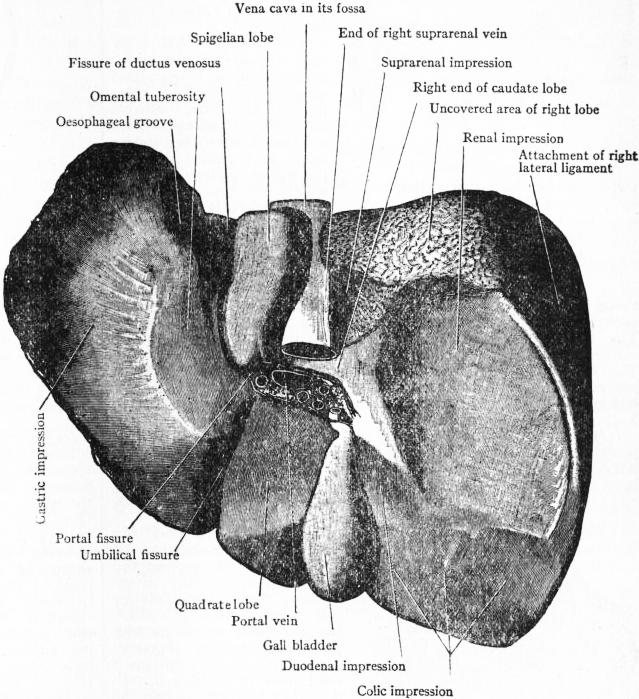
From A. Birmingham Cunningham’s Text-book of Anatomy.
Fig. 1.—The Liver from below and behind, showing the whole of the visceral surface and the posterior area of the parietal surface. The portal fissure has been slightly opened up to show the vessels passing through it; the other fissures are represented in their natural condition—closed. In this liver, which was hardened in situ, the impressions of the sacculations of the colon are distinctly visible at the colic impression. The round ligament and the remains of the ductus venosus are hidden in the depths of their fissures.
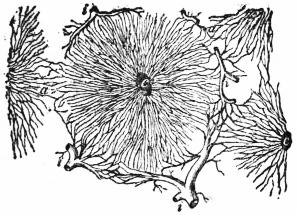
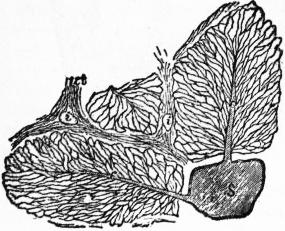
Fig. 2.—Transverse section through the hepatic lobules. Fig. 3.—Vertical section through two hepatic lobules of a pig.
i, i, i, Interlobular veins ending in the intralobular capillaries. c, c, Central veins joined by the intralobular capillaries. At a, a the capillaries of one lobule communicate with those adjacent to it. c, c, Central veins receiving the intralobular capillaries. s, Sublobular vein. ct, Interlobular connective tissue forming the capsules of the lobules. i,i, Interlobular veins.
Minute Structure of the Liver.—The liver is made up of an enormous number of lobules of a conical form (see fig. 3). If the portal vein is followed from the transverse fissure, it will be seen to branch and rebranch until minute twigs called interlobular veins (fig. 2, i) ramify around the lobules. From these intralobular capillaries run toward the centre of the lobule, forming a network among the polygonal hepatic cells. On reaching the core of the conical lobule they are collected into a central or intralobular vein (fig. 2, c) which unites with other similar ones to form a sublobular vein (fig. 3, s). These eventually reach the hepatic radicles, and so the blood is conducted into the vena cava. In man the lobules are not distinctly separated one from the other, but in some animals, e.g. the pig, each one has a fibrous sheath derived from Glisson’s capsule (fig. 3, ct.).
Embryology.—The liver first appears as an entodermal hollow longitudinal outgrowth from the duodenum into the ventral mesentery. The upper part of this forms the future liver, and grows up into the septum transversum from which the central part of the diaphragm is formed (see Diaphragm). From the cephalic part of this primary diverticulum solid rods of cells called the hepatic cylinders grow out, and these branch again and again until a cellular network is formed surrounding and breaking up the umbilical and vitelline veins. The liver cells, therefore, are entodermal, but the supporting connective tissue mesodermal from the septum transversum. The lower (caudal) part of the furrow-like outgrowth remains hollow and forms the gall bladder. At first the liver is embedded in the septum transversum, but later the diaphragm and it are constricted off one from the other, and soon the liver becomes very large and fills the greater part of the abdomen. At birth it is proportionately much larger than in the adult, and forms one-eighteenth instead of one-fortieth of the body weight, the right and left lobes being nearly equal in size.
Comparative Anatomy.—In the Acrania (Amphioxus) the liver is probably represented by a single ventral diverticulum from the anterior end of the intestine, which has a hepatic portal circulation and secretes digestive fluid. In all the Craniata a solid liver is developed. In the adult lamprey among the Cyclostomata the liver undergoes retrogression, and the bile ducts and gall bladder disappear, though they are present in the larval form (Ammocoetes). In fishes and amphibians the organ consists of right and left lobes, and a gall-bladder is present. The same description applies to the reptiles, but a curious network of cystic ducts is found in snakes and to a less extent in crocodiles. In the Varanidae (Monitors) the hepatic duct is also retiform (see F. E. Beddard, Proc. Zool. Soc., 1888, p. 105). In birds two lobes are also present, but in some of them, e.g. the pigeon, there is no gall-bladder.
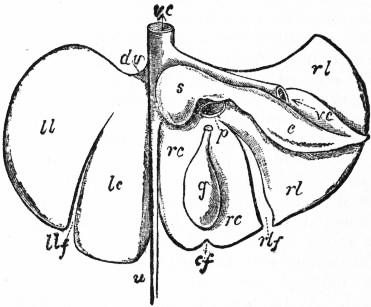
Fig. 4.—Diagrammatic Plan of the Inferior Surface of a Multi-lobed Liver of a Mammal. The posterior or attached border is uppermost.
u, Umbilical vein of the foetus, represented by the round ligament in the adult, lying in the umbilical fissure. dv, The ductus venosus. vc, The inferior vena cava. p, The vena portae entering the transverse fissure. llf, The left lateral fissure. rlf, The right lateral fissure. cf, The cystic fissure. ll, The left lateral lobe. lc, The left central lobe. rc, The right central lobe. rl, The right lateral lobe. s, The Spigelian lobe. c, The caudate lobe. g, The gall bladder.
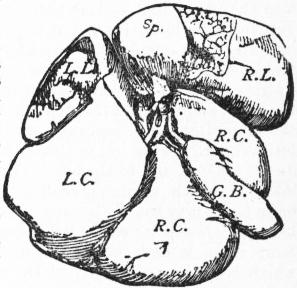
Fig. 5.—Human Liver showing a reversion to the generalised mammalian type.
In mammals Sir William Flower pointed out that a generalized type of liver exists, from which that of any mammal may be derived by suppression or fusion of lobes. The accompanying diagram of Flower (fig. 4) represents an ideal mammalian liver. It will be seen that the umbilical fissure (u) divides the organ into right and left halves, as in the lower vertebrates, but that the ventral part of each half is divided into a central and lateral lobe. Passing from right to left there are therefore: right lateral (rl), right central (rc), left central (lc), and left lateral (ll) lobes. The gall-bladder (g), when it is present, is always situated on the caudal surface or in the substance of the right central lobe. The Spigelian (s) and caudate lobes (c) belong to the right half of the liver, the latter being usually a leaf-shaped lobe attached by its stalk to the Spigelian, and having its blade flattened between the right lateral lobe and the right kidney. The vena cava (vc) is always found to the right of the Spigelian lobe and dorsal to the stalk of the caudate. In tracing the lobulation of man’s liver back to this generalized type, it is evident at once that his quadrate lobe does not correspond to any one generalized lobe, but is merely that part of the right central which lies between the gall bladder and the umbilical fissure. From a careful study of human variations (see A. Thomson, Journ. Anat. and Phys. vol. 33, p. 546) compared with an Anthropoid liver, such as that of the gorilla, depicted by W. H. L. Duckworth (Morphology and Anthropology, Cambridge, 1904, p. 98), it is fairly clear that the human liver is formed, not by a suppression of any of the lobes of the generalized type, but by a fusion of those lobes and obliteration of certain fissures. This fusion is, probably correctly, attributed by Keith to the effect of pressure following the assumption of the erect position (Keith, Proc. Anat. Soc. of Gt. Britain, Journ. Anat. and Phys. vol. 33, p. xii.). The accompanying diagram (fig. 5) shows an abnormal human liver in the Anatomical Department of St Thomas’s Hospital which reproduces the generalized type. In its lobulation it is singularly like, in many details, that of the baboon (Papio maimon) figured by G. Ruge (Morph. Jahrb., Bd. 35, p. 197); see F. G. Parsons, Proc. Anat. Soc., Feb. 1904, Journ. Anat. and Phys. vol. 33, p. xxiii. Georg Ruge “Die äusseren Formverhältnisse der Leber bei den Primaten,” (Morph. Jahrb., Bd. 29 and 35) gives a critical study of the primate liver, and among other things suggests the recognition of the Spigelian and caudate lobes as parts of a single lobe, for which he proposes the name of lobus venae cavae. This doubtless would be an advantage morphologically, though for human descriptive anatomy the present nomenclature is not likely to be altered.
The gall-bladder is usually present in mammals, but is wanting in the odd-toed ungulates (Perissodactyla) and Procavia (Hyrax). In the giraffe it may be absent or present. The cetacea and a few rodents are also without it. In the otter the same curious network of bile ducts already recorded in the reptiles is seen (see P. H. Burne, Proc. Anat. Soc., Journ. Anat. and Phys. vol. 33, p. xi.).
(F. G. P.)
Surgery of Liver and Gall-bladder.—Exposed as it is in the upper part of the abdomen, and being somewhat friable, the human liver is often torn or ruptured by blows or kicks, and, the large blood-vessels being thus laid open, fatal haemorrhage into the belly-cavity may take place. The individual becomes faint, and the faintness keeps on increasing; and there are pain and tenderness in the liver-region. The right thing to do is to open the belly in the middle line, search for a wound in the liver and treat it by deep sutures, or by plugging it with gauze.
Cirrhosis of the Liver.—As the result of chronic irritation of the liver increased supplies of blood pass to it, and if the irritation is unduly prolonged inflammation is the result. The commonest causes of this chronic hepatitis are alcoholism and syphilis. The new fibrous tissue which is developed throughout the liver, as the result of the chronic inflammation, causes general enlargement of the liver with, perhaps, nausea, vomiting and jaundice. Later the new fibrous tissue undergoes contraction and the liver becomes smaller than natural. Blood then finds difficulty in passing through it, and, as a result, dropsy occurs in the belly (ascites). This may be relieved by tapping the cavity with a small hollow needle (Southey’s trocar), or by passing into it a large sharp-pointed tube. This relieves the dropsy, but it does not cure the condition on which the dropsy depends. A surgical operation is sometimes undertaken with success for enabling the engorged veins to empty themselves into the blood-stream in a manner so as to avoid the liver-route.
Inflammation of the Liver (hepatitis) may also be caused by an attack of micro-organisms which have reached it through the veins coming from the large intestine, or through the main arteries. There are, of course, as the result, pain and tenderness, and there is often jaundice. The case should be treated by rest in bed, fomentations, calomel and saline aperients. But when the hepatitis is of septic origin, suppuration is likely to occur, the result being an hepatic abscess.
Hepatic Abscess is especially common in persons from the East who have recently undergone an attack of dysentery. In addition to the local pain and tenderness, there is a high temperature accompanied with shiverings or occasional rigors, the patient becoming daily more thin and miserable. Sometimes the abscess declares itself by a bulging at the surface, but if not an incision should be made through the belly-wall over the most tender spot, and a direct examination of the surface of the liver made. A bulging having been found, that part of the liver which apparently overlies the abscess should be stitched up to the sides of the opening made in belly-wall, and should then be explored by a hollow needle. Pus being found, the abscess should be freely opened and drained. It is inadvisable to explore for a suspected abscess with a hollow needle without first opening the abdomen, as septic fluid might thus be enabled to leak out, and infect the general peritoneal cavity. If an hepatic abscess is injudiciously left to itself it may eventually discharge into the chest, lungs or belly, or it may establish a communication with a piece of intestine. The only safe way for an abscess to evacuate itself is on to the surface of the body.
Hydatic Cysts are often met with in the liver. They are due to a peculiar development of the eggs of the tape-worm of the dog, which have been received into the alimentary canal with infected water or uncooked vegetables, such as watercress. The embryo of the taenia echinococcus finds its way from the stomach or intestine into a vein passing to the liver, and, settling itself in the liver, causes so much disturbance there that a capsule of inflammatory material forms around it. Inside this wall is the special covering of the embryo which shortly becomes distended with clear hydatid fluid. The cyst should be treated like a liver-abscess, by incision through the abdominal or thoracic wall, by circumferential suturing and by exploration and drainage.
Tumours of the Liver may be innocent or malignant. The most important of the former is the gumma of tertiary syphilis; this may steadily and completely disappear under the influence of iodide of potassium. The commonest form of malignant tumour is the result of the growth of cancerous elements which have been brought to the liver by the veins coming up from a primary focus of the large intestine. Active surgical treatment of such a tumour is out of the question. Fortunately it is, as a rule, painless.
The Gall-bladder may be ruptured by external violence, and if bile escapes from the rent in considerable quantities peritonitis will be set up, whether the bile contains septic germs or not. If, on opening the abdomen to find out what serious effects some severe injury has caused, the gall-bladder be found torn, the rent may be sewn up, or, if thought better, the gall-bladder may be removed. The peritoneal surfaces in the region of the liver should then be wiped clean, and the abdominal wound closed, except for the passage through it of a gauze drain.
Biliary concretions, known as gall stones, are apt to form in the gall-bladder. They are composed of crystals of bile-fat, cholesterine. Sometimes in the course of a post-mortem examination a gall-bladder is found packed full of gall-stones which during life had caused no inconvenience and had given rise to no suspicion of their presence. In other cases gall-stones set up irritation in the gall-bladder which runs on to inflammation, and the gall-bladder being infected by septic germs from the intestine (bacilli coli) an abscess forms.
Abscess of the Gall-bladder gives rise to a painful, tender swelling near the cartilage of the ninth rib of the right side. If the abscess is allowed to take its course, adhesions may form around it and it may burst into the intestine or on to the surface of the abdomen, a biliary fistula remaining. Abscess in the gall-bladder being suspected, an incision should be made down to it, and, its covering having been stitched to the abdominal wall, the gall-bladder should be opened and drained. The presence of concretions in the gall-bladder may not only lead to the formation of abscess but also to invasion of the gall-bladder by cancer.
Stones in the gall-bladder should be removed by operation, as, if left, there is a great risk of their trying to escape with the bile into the intestine and thus causing a blockage of the common bile-duct, and perhaps a fatal leakage of bile into the peritoneum through a perforating ulcer of the duct. If before opening the gall-bladder the surface is stitched to the deepest part of the abdominal wound, the biliary fistula left as the result of the opening of the abscess will close in due course.
“Biliary colic” is the name given to the distressing symptoms associated with the passage of a stone through the narrow bile-duct. The individual is doubled up with acute pains which, starting from the hepatic region, spread through the abdomen and radiate to the right shoulder blade. Inasmuch as the stone is blocking the duct, the bile is unable to flow into the intestine; so, being absorbed by the blood-vessels, it gives rise to jaundice. The distress is due to spasmodic muscular contraction, and it comes on at intervals, each attack increasing the patient’s misery. He breaks out into profuse sweats and may vomit. If the stone happily finds its way into the intestine the distress suddenly ceases. In the meanwhile relief may be afforded by fomentations, and by morphia or chloroform, but if no prospect of the stone escaping into the intestine appears likely, the surgeon will be called upon to remove it by an incision through the gall-bladder, or the bile-duct, or through the intestine at the spot where it is trying to make its escape. Sometimes a gall-stone which has found its way into the intestine is large enough to block the bowel and give rise to intestinal obstruction which demands abdominal section.
A person who is of what used to be called a “biliary nature” should live sparingly and take plenty of exercise. He should avoid fat and rich food, butter, pastry and sauces, and should drink no beer or wine—unless it be some very light French wine or Moselle. He should keep his bowels regular, or even loose, taking every morning a dose of sulphate of soda in a glass of hot water. A course at Carlsbad, Vichy or Contrexéville, may be helpful. It is doubtful if drugs have any direct influence upon gall-stones, such as sulphate of soda, olive oil or oleate of soda. No reliance can be placed upon massage in producing the onward passage of a gall-stone from the gall-bladder towards the intestine. Indeed this treatment might be not only distressing but harmful.
(E. O.*)
LIVERMORE, MARY ASHTON [RICE] (1821-1905), American reformer, was born in Boston, Massachusetts, on the 19th of December 1821. She studied at the female seminary at Charlestown, Mass.; taught French and Latin there, taught in a plantation school in southern Virginia; and for three years conducted a school of her own in Duxbury, Mass. Upon returning from Virginia she had joined the abolitionists, and she took an active part in the Washingtonian temperance movement.1 In 1845 she married Daniel Parker Livermore (1819-1899), a Universalist clergyman. In 1857 they removed to Chicago, Illinois, where she assisted her husband in editing the religious weekly, The New Covenant (1857-1869). During the Civil War, as an associate member of the United States Sanitary Commission, and as an agent of its North-western branch, she organized many aid societies, contributed to the success of the North-western Sanitary Fair in Chicago in 1863, and visited army posts and hospitals. After the war she devoted herself to the promotion of woman’s suffrage and to temperance reform, founding in Chicago in 1869 The Agitator, which in 1870 was merged into the Woman’s Journal (Boston), of which she was an associate editor until 1872. She died in Melrose, Mass. on the 23rd of May 1905. She had been president of the Illinois, the Massachusetts and the American woman’s suffrage associations, the Massachusetts Woman’s Christian Temperance Union and the Woman’s Congress, and a member of many other societies. She lectured in the United States, England and Scotland, contributed to magazines and wrote: The Children’s Army (1844), temperance stories; Thirty Years Too Late (1848), a temperance story; A Mental Transformation (1848); Pen Pictures (1863), short stories; What Shall We Do With Our Daughters? and Other Lectures (1883); My Story of the War (1888); and The Story of My Life (1897). With Frances E. Willard, she edited A Woman of the Century: Biographical Sketches of Leading American Women (1893).
1 This movement was started in 1840 by habitués of a Baltimore (Md.) tavern, who then founded the Washington Temperance Society (named in honour of George Washington). The movement spread rapidly in 1841-1843, but by the close of 1843 it had nearly spent its force. The members of the Society made a pledge not to drink spirituous or malt liquors, wine or cider. Women organized Martha Washington Societies as auxiliary organizations.
LIVERPOOL, EARLS OF. Charles Jenkinson, 1st earl of Liverpool (1729-1808), English statesman, eldest son of Colonel Charles Jenkinson (d. 1750) and grandson of Sir Robert Jenkinson, Bart., of Walcot, Oxfordshire, was born at Winchester on the 16th of May 1729. The family was descended from Anthony Jenkinson (d. 1611), sea-captain, merchant and traveller, the first Englishman to penetrate into Central Asia. Charles was educated at Charterhouse school and University College, Oxford, where he graduated M.A. in 1752. In 1761 he entered parliament as member for Cockermouth and was made under-secretary of state by Lord Bute; he won the favour of George III., and when Bute retired Jenkinson became the leader of the “king’s friends” in the House of Commons. In 1763 George Grenville appointed him joint secretary to the treasury; in 1766, after a short retirement, he became a lord of the admiralty and then a lord of the treasury in the Grafton administration; and from 1778 until the close of Lord North’s ministry in 1782 he was secretary-at-war. From 1786 to 1801 he was president of the board of trade and chancellor of the duchy of Lancaster, and he was popularly regarded as enjoying the confidence of the king to a special degree. In 1772 Jenkinson became a privy councillor and vice-treasurer of Ireland, and in 1775 he purchased the lucrative sinecure of clerk of the pells in Ireland and became master of the mint. In 1786 he was created Baron Hawkesbury, and ten years later earl of Liverpool. He died in London on the 17th of December 1808. Liverpool was twice married: firstly to Amelia (d. 1770), daughter of William Watts, governor of Fort William, Bengal, and secondly to Catherine, daughter of Sir Cecil Bisshoff, Bart., and widow of Sir Charles Cope, Bart.; he had a son by each marriage. He wrote several political works, but except his Treatise on the Coins of the Realm (1805) these are without striking merits. They are, Dissertation on the establishment of a national and constitutional force in England independent of a standing army (1756); Discourse on the conduct of the government of Great Britain respecting neutral nations (1758, new ed., 1837); and Collection of Treaties between Great Britain and other Powers 1648-1783 (1785). His Coins of the Realm was reprinted by the Bank of England in 1880.
His son, Robert Banks Jenkinson, 2nd earl (1770-1828), was educated at Charterhouse and at Christ Church, Oxford, where he had George Canning, afterwards his close political associate, for a contemporary. In 1790 he entered parliament as member for Appleby; he became master of the mint in 1799 and foreign secretary in Addington’s administration in 1801, when he conducted the negotiations for the abortive treaty of Amiens. On the accession of Pitt to power in 1804, he obtained the home office, having in the previous year been elevated as Baron Hawkesbury to the House of Lords, where he acted as leader of the government. He declined the premiership on the death of Pitt in 1806, and remained out of office until Portland became prime minister in 1807, when he again became secretary of state for home affairs. In 1808 he succeeded his father as earl of Liverpool. In the ministry of Spencer Perceval (1809-1812) he was secretary for war and the colonies. After the assassination of Perceval in May 1812 he became prime minister, and retained office till compelled in February 1827 to resign by the illness (paralysis) which terminated his life on the 4th of December 1828.
The political career of the 2nd Lord Liverpool was of a negative character so far as legislation was concerned; but he held office in years of great danger and depression, during which he “kept order among his colleagues, composed their quarrels, and oiled the wheels to make it possible for the machinery of government to work” (Spencer Walpole). The energy of Castlereagh and Canning secured the success of the foreign policy of his cabinet, but in his home policy he was always retrograde. The introduction of the bill of pains and penalties against Queen Caroline greatly increased his unpopularity, originated by the severe measures of repression employed to quell the general distress, which had been created by the excessive taxation which followed the Napoleonic wars. Lord Liverpool was destitute of wide sympathies and of true political insight, and his resignation of office was followed almost immediately by the complete and permanent reversal of his domestic policy. He was twice married but had no children, and he was succeeded by his half-brother Charles Cecil Cope Jenkinson, 3rd earl (1784-1851), who left three daughters. The baronetcy then passed to a cousin, and the peerage became extinct. But in 1905 the earldom was revived in the person of the 3rd earl’s grandson, Cecil George Savile Foljambe (1846-1907), who had been a Liberal member of parliament from 1880 to 1892, and in 1893 was created Baron Hawkesbury. He was succeeded in 1907 by his son, Arthur (b. 1870).
For the life of the 2nd earl see the anonymous Memoirs of the Public Life and Administration of Liverpool (1827); C. D. Yonge, Life and Administration of the 2nd Earl of Liverpool (1868); T. E. Kebbel, History of Toryism (1886); and Sir S. Walpole, History of England, vol. ii. (1890).
LIVERPOOL, a city, municipal, county and parliamentary borough, and seaport of Lancashire, England, 201 m. N.W. of London by rail, situated on the right bank of the estuary of the Mersey, the centre of the city being about 3 m. from the open sea. The form of the city is that of an irregular semicircle, having the base line formed by the docks and quays extending about 9 m. along the east bank of the estuary, which here runs nearly north and south, and varies in breadth from 1 to 2 m. On the north the city is partly bounded by the borough of Bootle, along the shore of which the line of docks is continued. The area of the city is 16,619 acres exclusive of water area. The population at the census of 1901 was 684,958; the estimated population in 1908 was 753,203; the birth-rate for 1907 was 31.7 and the death-rate 18.3; in 1908 the rateable value was £4,679,520.
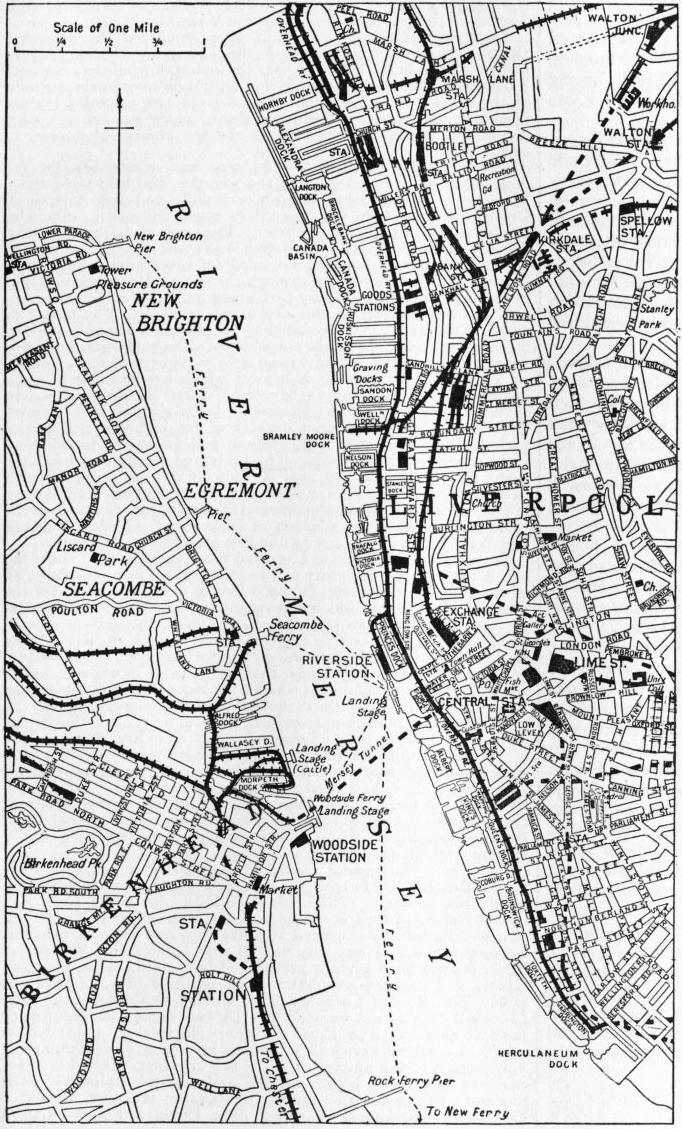
The city lies on a continuous slope varying in gradient, but in some districts very steep. Exposed to the western sea breezes, with a dry subsoil and excellent natural drainage, the site is naturally healthy. The old borough, lying between the pool, now completely obliterated, and the river, was a conglomeration of narrow alleys without any regard to sanitary provisions; and during the 16th and 17th centuries it was several times visited by plague. When the town expanded beyond its original limits, and spread up the slopes beyond the pool, a better state of things began to exist. The older parts of the town have at successive periods been entirely taken down and renovated. The commercial part of the city is remarkable for the number of palatial piles of offices, built chiefly of stone, among which the banks and insurance offices stand pre-eminent. The demand for cottages about the beginning of the 19th century led to the construction of what are called “courts,” being narrow culs de sac, close packed, with no through ventilation. This resulted in a high rate of mortality, to contend with which enormous sums have been expended in sanitary reforms of various kinds. The more modern cottages and blocks of artisan dwellings have tended to reduce the rate of mortality.
Parks.—The earliest public park, the Prince’s Park, was laid out in 1843 by private enterprise, and is owned by trustees, but the reversion has been acquired by the corporation. Sefton Park, the most extensive, containing 269 acres, was opened in 1872. A large portion of the land round the margin has been leased for the erection of villas. Wavertree, Newsham, Sheil and Stanley Parks have also been constructed at the public expense. Connected with Wavertree Park are the botanic gardens. A palm house in Sefton Park was opened in 1896 and a conservatory in Stanley Park in 1900. Since 1882 several of the city churchyards and burial grounds and many open spaces have been laid out as gardens and recreation grounds. A playground containing 108 acres in Wavertree was presented to the city in 1895 by an anonymous donor, and in 1902 the grounds of a private residence outside the city boundaries containing 94 acres were acquired and are now known as Calderstones Park. In 1906 about 100 acres of land in Roby, also outside the boundaries, was presented to the city. The total area of the parks and gardens of the city, not including the two last named, is 881½ acres. A boulevard about 1 m. in length, planted with trees in the centre, leads to the entrance of Prince’s Park.
Public Buildings.—Scarcely any of the public buildings date from an earlier period than the 19th century. One of the earliest, and in many respects the most interesting, is the town-hall in Castle Street. This was erected from the designs of John Wood of Bath, and was opened in 1754. The building has since undergone considerable alterations and extensions, but the main features remain. It is a rectangular stone building in the Corinthian style, with an advanced portico added to the original building in 1811, and crowned with a lofty dome surmounted by a seated statue of Britannia, added in 1802. The interior was destroyed by fire in 1795, and was entirely remodelled in the restoration. In 1900 considerable alterations in the internal structure were made, and the council chamber extended so as to afford accommodation for the enlarged council. It contains a splendid suite of apartments, including a ball-room approached by a noble staircase. The building is occupied by the mayor as the municipal mansion house. A range of municipal offices was erected in Dale Street in 1860. The building is in the Palladian style, with a dominating tower and square pyramidal spire.
The crowning architectural feature of Liverpool is St George’s Hall, completed in 1854. The original intention was to erect a hall suited for the triennial music festivals which had been held in the town. About the same time the corporation proposed to erect law-courts for the assizes, which had been transferred to Liverpool and Manchester. In the competitive designs, the first prize was gained in both cases by Harvey Lonsdale Elmes. He was employed to combine the two objects in a new design, of which the present building is the outcome. It is fortunate in its situation, occupying the most central position in the town, and surrounded by an area sufficiently extensive to exhibit its proportions, an advantage which was accentuated in 1898 by the removal of St John’s church, which previously prevented an uninterrupted view of the west side. The plan is simple. The centre is occupied by the great hall, 169 ft. in length, and, with the galleries, 87 ft. wide and 74 ft. high, covered with a solid vault in masonry. Attached to each end, and opening therefrom, are the law-courts. A corridor runs round the hall and the courts, communicating with the various accessory rooms. Externally the east front is faced with a fine portico of sixteen Corinthian columns about 60 ft. in height. An advanced portico of similar columns fronts the south end crowned with a pediment filled with sculpture. The style is Roman, but the refinement of the details is suggestive of the best period of Grecian art. The great hall is finished with polished granite columns, marble balustrades and pavements, polished brass doors with foliated tracery. The fine organ was built by Messrs Willis of London, from the specification of Dr Samuel Wesley. Elmes having died in 1847 during the progress of the work, the building was completed by C. R. Cockerell, R.A.
Next to the public buildings belonging to the city, the most important is the exchange, forming three sides of a quadrangle on the north side of the town-hall. The town-hall was originally built to combine a mercantile exchange with municipal offices, but the merchants preferred to meet in the open street adjoining. This, with other circumstances, led to the erection of a new exchange, a building of considerable merit, which was begun in 1803 and opened in 1808. It had scarcely been in use for more than fifty years when it was found that the wants of commerce had outstripped the accommodation, and the structure was taken down to make room for the present building.
The revenue buildings, begun in 1828 on the site of the original Liverpool dock, formerly combined the customs, inland revenue, post-office and dock board departments but are now only used by the two first named. It is a heavy structure, with three advanced porticoes in the Ilyssus Ionic style. Near by stands the sailors’ home, a large building in the Elizabethan style. The Philharmonic Hall in Hope Street, with not much pretension externally, is one of the finest music rooms in the kingdom; it accommodates an audience of about 2500.
The group of buildings forming the county sessions house, the free public library, museum, central technical school and gallery of art are finely situated on the slope to the north of St George’s Hall. The library and gallery of art are separate buildings, connected by the circular reading-room in the middle. The latter possesses some features in construction worthy of note, having a circular floor 100 ft. in diameter without columns or any intermediate support, and a lecture-room underneath, amphitheatrical in form, with grades or benches hewn out of the solid rock. In 1884 the county sessions house just mentioned, adjoining the art gallery was opened for public business. In 1899 new post-office buildings in Victoria Street were completed. In 1907 two important additions were made to the buildings of Liverpool, the new offices of the dock board, built on the site of a portion of the Old George’s dock, and the new cotton exchange in Oldhall street. The fine mass of buildings which constitute the university and the Royal Infirmary, lying between Brownlow Hill and Pembroke Place, both groups designed by Alfred Waterhouse, was begun in 1885.
Liverpool cathedral, intended when completed to be the largest in the country, from designs by G. F. Bodley and G. Gilbert Scott, was begun in 1904, when the foundation stone was laid by King Edward VII. The foundations were completed in 1906 and the superstructure begun. The foundation of the chapter-house was laid in that year by the duke of Connaught, and work was then begun on the Lady chapel, the vestries and the choir.
Railways.—There are three terminal passenger stations in Liverpool, the London & North Western at Lime Street, the Lancashire & Yorkshire at Exchange and the combined station of the Midland, Great Northern & Great Central at Central. By the Mersey tunnel (opened in 1886) connexion is made with the Wirral railway, the Great Central, the Great Western and the London & North Western, on the Cheshire side of the river. The Liverpool electric overhead railway running along the line of docks from Seaforth to Dingle was opened in 1893, and in 1905 a junction was made with the Lancashire and Yorkshire railway by which through passenger traffic between Southport and the Dingle has been established. In 1895 the Riverside station at the Prince’s dock was completed, giving direct access from the landing stage to the London and North Western system.
Water Supply.—The original supply of water was from wells in the sandstone rock, but in 1847 an act was passed, under which extensive works were constructed at Rivington, about 25 m. distant, and a much larger supply was obtained. The vast increase of population led to further requirements, and in 1880 another act gave power to impound the waters of the Vyrnwy, one of the affluents of the Severn. These works were completed in 1892, a temporary supply having been obtained a year earlier. The corporation had also, however, obtained power to impound the waters of the Conwy and Marchnant rivers, and to bring them into Lake Vyrnwy, the main reservoir, by means of tunnels. This work was completed and opened by the prince of Wales (George V.) in March 1910.
Tramways.—The corporation in 1896 purchased the property, rights, powers and privileges of the Liverpool Electric Supply Company, and in the following year the undertaking of the Liverpool Tramway Company, which they formally took over in the autumn of the same year. Since that date a large and extended system of electric tramways has been laid down, which has led to a very remarkable increase in the receipts and the number of passengers carried.
Administration of Justice.—The city has quarter-sessions for criminal cases, presided over by the recorder, and held eight times in the year. At least two police courts sit daily, and more if required. One is presided over by the stipendiary magistrate and the others by the lay magistrates and the coroner. The court of passage is a very ancient institution, possibly dating from the foundation of the borough by King John, and intended for cases arising out of the imports and exports passing through the town. Its jurisdiction has been confirmed and settled by parliament and it is competent to try civil cases arising within the city to any amount. The mayor is ex-officio the judge, but the presiding judge is an assessor appointed by the crown and paid by the corporation. The court sits about five times a year. There is a Liverpool district registry of the chancery of the County Palatine of Lancaster which has concurrent jurisdiction with the high court (chancery division) within the hundred of West Derby. The vice-chancellor holds sittings in Liverpool. There is a Liverpool district registry of the high court of justice with common law, chancery, probate and admiralty jurisdiction, under two district registrars. The Liverpool county court has the usual limited jurisdiction over a wide local area, together with bankruptcy jurisdiction over the county court districts of St Helens, Widnes, Ormskirk and Southport, and admiralty jurisdiction over the same districts with the addition of Birkenhead, Chester, Runcorn and Warrington. There are two judges attached to the court.
Ecclesiastical.—The see of Liverpool was created in 1880 under the act of 1879, by the authority of the ecclesiastical commissioners, an endowment fund of about £100,000 having been subscribed for the purpose. The parish, which was separated from Walton-on-the-Hill in 1699, contained two churches, St Nicholas, the ancient chapel, and St Peter’s, then built. There were two rectors, the living being held in medieties. Of recent years changes have been sanctioned by parliament. The living is now held by a single incumbent, and a large number of the churches which have since been built have been formed into parishes by the ecclesiastical commissioners. St Peter’s has been constituted the pro-cathedral, pending the erection of the cathedral. Besides the two original parish churches, there are 103 others belonging to the establishment. The Roman Catholics form a very numerous and powerful body in the city, and it is estimated that from a third to a fourth of the entire population are Roman Catholics. A large part of these are Irish settlers or their descendants, but this district of Lancashire has always been a stronghold of Roman Catholicism, many of the landed gentry belonging to old Roman Catholic families.
Charities.—The earliest charitable foundation is the Blue Coat hospital, established in 1708, for orphans and fatherless children born within the borough. The original building, opened in 1718, is a quaint and characteristic specimen of the architecture of the period. It now maintains two hundred and fifty boys and one hundred girls. In 1906 the school was removed to new buildings at Wavertree. There is an orphan asylum, established in 1840, for boys, girls and infants, and a seamen’s orphan asylum, begun in 1869, for boys and girls. The Roman Catholics have similar establishments. The Liverpool dispensaries founded in 1778 were among the pioneers of medical charity. The Royal Infirmary (opened in 1749) had a school of medicine attached, which has been very successful, and is now merged in the university. The sailors’ home, opened in 1852, designed to provide board, lodging and medical attendance at a moderate charge for the seamen frequenting the port, is one of Liverpool’s best-known charities. The David Lewis Workmen’s Hostel is an effort to solve the difficulty of providing accommodation for unmarried men of the artizan class.
Literature, Art and Science.—The free library, museum and gallery of arts, established and managed by the city council, was originated in 1850. The first library building was erected by Sir William Brown. The Derby museum, containing the collections of Edward, the 13th earl, was presented by his son. The Mayer museum of historical antiquities and art was contributed by Mr Joseph Mayer, F.S.A. Sir Andrew Walker (d. 1893) erected in 1877 the art gallery which bears his name. Large additions were made in 1884, the cost being again defrayed by Sir Andrew Walker. An annual exhibition of painting is held in the autumn and a permanent collection has been formed, which was augmented in 1894 when the examples of early Italian art numbering altogether about 180 pictures, collected at the beginning of the 19th century by William Roscoe, were deposited in the gallery. The Picton circular reading-room, and the rotunda lecture-room were built by the corporation and opened in 1879. Alterations in the museum were completed in 1902 by which its size was practically doubled. The literary and philosophical society was established in 1812. The Royal Institution, established mainly through the efforts of Roscoe in 1817, possessed a fine gallery of early art in the Walker Art Gallery, and is the centre of the literary institutions of the town.
Education.—Sunday schools were founded for poor children in 1784, as the result of a town’s meeting. These were soon followed by day-schools supplied by the various denominations. The first were the Old Church schools in Moorfields (1789), the Unitarian schools in Mount Pleasant (1790) and Manesty Lane (1792) and the Wesleyan Brunswick school (1790). In 1826 the corporation founded two elementary schools, one of which, the North Corporation school, was erected in part substitution for the grammar school founded by John Crosse, rector of St Nicholas Fleshshambles, London, a native of Liverpool, in 1515, and carried on by the Corporation until 1815. From this date onward the number rapidly increased until the beginning of the School Board in 1870, and afterwards. Mention should be made of the training ship “Indefatigable” moored in the Mersey for the sons and orphans of sailors, and the reformatory institution at Heswall, Co. Chester, which has recently replaced the training ship “Akbar” formerly moored in the Mersey. Semi-private schools were founded by public subscription—the Royal Institution school (1819), the Liverpool Institute (1825) and the Liverpool College (1840). The first has ceased to exist. The Institute was a development of the Mechanics’ Institute and was managed by a council of subscribers. It was divided into a high school and a commercial school. Under a scheme of the Board of Education under the Charitable Trusts Act this school, together with the Blackburne House high school for girls, became a public secondary school and was handed over to the corporation in 1905. Liverpool College was formerly divided into three schools, upper, middle and lower, for different classes of the community. The middle and lower schools passed into the control of the corporation in 1907. The Sefton Park elementary school and the Pupil Teachers’ College in Clarence Street were transformed into municipal secondary schools for boys and girls in 1907; the corporation has also a secondary school for girls at Aigburth. There are several schools maintained by the Roman Catholics, two schools of the Girls’ Public Day School Company and a large number of private schools. A cadet ship, the “Conway,” for the training of boys intending to become officers in the mercantile marine, is moored in the Mersey. There are two training colleges for women, one undenominational, and the other conducted by the sisters of Notre Dame for Roman Catholic women. The central municipal technical school is in the Museum Buildings, and there are three branch technical schools. There are also a nautical college, a school of cookery and a school of art controlled by the Education Committee.
Liverpool University, as University College, received its charter of incorporation in 1881, and in 1884 was admitted as a college of the Victoria University. In the same year the medical school of the Royal Infirmary became part of the University College. In 1900 a supplemental charter extended the powers of self-government and brought the college into closer relations with the authorities of the city and with local institutions by providing for their fuller representation on the court of governors. In 1903 the charter of incorporation of the university of Liverpool was received, thus constituting it an independent university. The university is governed by the king as visitor, by a chancellor, two pro-chancellors, a vice-chancellor and a treasurer, by a court of over 300 members representing donors and public bodies, a council, senate, faculties and convocation. The fine group of buildings is situated on Brownlow Hill.
Trade and Commerce.—In 1800 the tonnage of ships entering the port was 490,060; in 1908 it reached 17,111,814 tons. In 1800 4746 vessels entered, averaging 94 tons; in 1908 there were 25,739, averaging 665 tons. The commerce of Liverpool extends to every part of the world, but probably the intercourse with North America stands pre-eminent, there being lines of steamers to New York, Philadelphia, Boston, Baltimore, Galveston, New Orleans and the Canadian ports. Cotton is the great staple import. Grain comes next, American (North and South) and Australian wheat and oats occupying a large proportion of the market. An enormous trade in American provisions, including live cattle, is carried on. Tobacco has always been a leading article of import into Liverpool, along with the sugar and rum from the West Indies. Timber forms an important part of the imports, the stacking yards extending for miles along the northern docks. In regard to exports, Liverpool possesses decided advantages; lying so near the great manufacturing districts of Lancashire and the West Riding of Yorkshire, this port is the natural channel of transmission for their goods, although the Manchester ship canal diverts a certain proportion of the traffic, while coal and salt are also largely exported.
Manufactures.—The manufactures of Liverpool are not extensive. Attempts have been repeatedly made to establish cotton mills in and near the city, but have resulted in failure. Engineering works, especially connected with marine navigation, have grown up on a large scale. Shipbuilding, in the early part of the 19th century, was active and prosperous, but has practically ceased. During the latter half of the 18th century and the beginning of the 19th, pottery and china manufacture flourished in Liverpool. John Sadler, a Liverpool manufacturer, was the inventor of printing on pottery, and during the early period of Josiah Wedgwood’s career all his goods which required printing had to be sent to Liverpool. A large establishment, called the Herculaneum Pottery, was founded in a suburb on the bank of the Mersey, but the trade has long disappeared. Litherland, the inventor of the lever watch, was a Liverpool manufacturer, and Liverpool-made watches have always been held in high estimation. There are several extensive sugar refineries and corn mills. The confectionery trade has developed during recent years, several large works having been built, induced by the prospect of obtaining cheap sugar directly from the Liverpool quays. The cutting, blending and preparing of crude tobacco have led to the erection of factories employing some thousands of hands. There are also large mills for oil-pressing and making cattle-cake.
Docks.—The docks of the port of Liverpool on both sides of the Mersey are owned and managed by the same public trust, the Mersey Docks and Harbour Board. On the Liverpool side they extend along the margin of the estuary 61⁄2 m., of which 11⁄4 m. is in the borough of Bootle. The Birkenhead docks have not such a frontage, but they extend a long way backward. The water area of the Liverpool docks and basins is 418 acres, with a lineal quayage of 27 m. The Birkenhead docks, including the great float of 120 acres, contain a water area of 165 acres, with a lineal quayage of 91⁄2 m. The system of enclosed docks was begun by the corporation in 1709. They constituted from the first a public trust, the corporation never having derived any direct revenue from them, though the common council of the borough were the trustees, and in the first instance formed the committee of management. Gradually the payers of dock rates on ships and goods acquired influence, and were introduced into the governing body, and ultimately, by an act of 1857, the corporation was superseded. The management is vested in the Mersey Docks and Harbour Board, consisting of twenty-eight members, four of whom are nominated by the Mersey Conservancy commissioners, who consist of the first lord of the Admiralty, the chancellor of the duchy of Lancaster and the president of the Board of Trade, and the rest elected by the payers of rates on ships and goods, of whom a register is kept and annually revised. The revenue is derived from tonnage rates on ships, dock rates on goods, town dues on goods, with various minor sources of income.
Down to 1843 the docks were confined to the Liverpool side of the Mersey. Several attempts made to establish docks in Cheshire had been frustrated by the Liverpool corporation, who bought up the land and kept it in their own hands. In 1843, however, a scheme for docks in Birkenhead was carried through which ultimately proved unsuccessful, and the enterprise was acquired in 1855 by Liverpool. The Birkenhead docks were for many years only partially used, but are now an important centre for corn-milling, the importation of foreign cattle and export trade to the East. In addition to the wet docks, there are in Liverpool fourteen graving docks and three in Birkenhead, besides a gridiron on the Liverpool side.
The first portion of the great landing stage, known as the Georges’ stage, was constructed in 1847, from the plans of Mr (afterwards Sir) William Cubitt, F.R.S. This was 500 ft. long. In 1857 the Prince’s stage, 1000 ft. long, was built to the north of the Georges’ stage and distant from it 500 ft. In 1874 the intervening space was filled up and the Georges’ stage reconstructed. The fabric had just been completed, and was waiting to be inaugurated, when on the 28th of July 1874 it was destroyed by fire. It was again constructed with improvements. In 1896 it was farther extended to the north, and its length is now 2478 ft. and its breadth 80 ft. It is supported on floating pontoons about 200 in number, connected with the river wall by eight bridges, besides a floating bridge for heavy traffic 550 ft. in length and 35 ft. in width. The southern half is devoted to the traffic of the Mersey ferries, of which there are seven—New Brighton, Egremont, Seacombe, Birkenhead, Rock Ferry, New Ferry and Eastham. The northern half is used by ocean-going steamers and their tenders. The warehouses for storing produce form a prominent feature in the commercial part of the city. Down to 1841 these were entirely in private hands, distributed as chance might direct, but in that year a determined effort was made to construct docks with warehouses on the margin of the quays. This met with considerable opposition from those interested, and led to a municipal revolution, but the project was ultimately carried out in the construction of the Albert dock and warehouses, which were opened by Prince Albert in 1845. For general produce these warehouses are falling somewhat into disuse, but grain warehouses have been constructed by the dock board at Liverpool and Birkenhead, with machinery for discharging, elevating, distributing, drying and delivering. Warehouses for the storage of tobacco and wool have also been built by the board. The Stanley tobacco warehouse is the largest of its kind in the world, the area of its fourteen floors being some 36 acres.
Dredging operations at the bar of the Queen’s channel, in the channel itself and at the landing stage enables the largest ocean liners to enter the river and approach the stage at practically all states of the tide. The dredging at the bar was begun as an experiment in September 1890 by two of the board’s ordinary hopper barges of 500 tons capacity each fitted with centrifugal pumps. The result was favourable, and larger vessels have been introduced. Before dredging was begun the depth of water at dead low water of spring tides on the bar was only 11 ft.; now there is about 28 ft. under the same conditions. The space over which dredging has been carried on at the bar measures about 7000 ft. by 1250 ft., the latter being the average width of the buoyed cut or channel through the bar. Dredging has also taken place on shoals and projections of sand-banks in the main sea channels.
Municipality.—Under the Municipal Reform Act of 1835, the boundaries of the original borough were extended by the annexation of portions of the surrounding district, while further additions were made in 1895, 1902 and 1905. The city is divided into thirty-five wards with 103 councillors and 34 aldermen. In 1893 the title of mayor was raised to that of lord mayor. In 1885 the number of members of parliament was increased to nine by the creation of six new wards. The corporation of Liverpool has possessed from a very early period considerable landed property, the first grant having been made by Thomas, earl of Lancaster, in 1309. This land was originally of value only as a source of supply of turf for firing, but in modern times its capacity as building land has been a fruitful source of profit to the town. A large proportion of the southern district is held in freehold by the corporation and leased to tenants for terms of seventy-five years, renewable from time to time on a fixed scale of fines. There was formerly another source of income now cut off. The fee farm rents and town dues originally belonging to the crown were purchased from the Molyneux family in 1672 on a long lease, and subsequently in 1777 converted into a perpetuity. With the growth of the commerce of the port these dues enormously increased, and became a cause of great complaint by the shipping interest. In 1856 a bill was introduced into parliament, and passed, by which the town dues were transferred to the Mersey Docks and Harbour Board on payment of £1,500,000, which was applied in part to the liquidation of the bonded debt of the corporation, amounting to £1,150,000.
History.—During the Norse irruption of the 8th century colonies of Norsemen settled on both sides of the Mersey, as is indicated by some of the place-names. After the Conquest, the site of Liverpool formed part of the fief (inter Ripam et Mersham) granted by the Conqueror to Roger de Poictou, one of the great family of Montgomery. Although Liverpool is not named in Domesday it is believed to have been one of the six berewicks dependent on the manor of West Derby therein mentioned. After various forfeitures and regrants from the crown, it was handed over by Henry II. to his falconer Warine. In a deed executed by King John, then earl of Mortain, about 1191, confirming the grant of this with other manors to Henry Fitzwarine, son of the former grantee, the name of Liverpool first occurs. Probably its most plausible derivation is from the Norse Hlithar-pollr, “the pool of the slopes,” the pool or inlet at the mouth of which the village grew up being surrounded by gently rising slopes. Another possible derivation is from the Prov. E. lever, the yellow flag or rush, A.S. laefer.
After the partial conquest of Ireland by Strongbow, earl of Pembroke, under Henry II., the principal ports of communication were Bristol for the south and Chester for the north. The gradual silting up of the river Dee soon so obstructed the navigation as to render Chester unsuitable. A quay was then constructed at Shotwick, about 8 m. below Chester, with a castle to protect it from the incursions of the neighbouring Welsh; but a better site was sought and soon found. Into the tidal waters of the Mersey a small stream, fed by a peat moss on the elevated land to the eastward, ran from north-east to south-west, forming at its mouth an open pool or sea lake, of which many existed on both sides of the river. The triangular piece of land thus separated formed a promontory of red sandstone rock, rising in the centre about 50 ft. above the sea-level, sloping on three sides to the water. The pool was admirably adapted as a harbour for the vessels of that period, being well protected, and the tide rising from 15 to 21 ft. King John repurchased the manor from Henry Fitzwarine, giving him other lands in exchange. Here he founded a borough, and by letters patent dated at Winchester, 28th of August 1207, invited his subjects to take up burgages.
From the patent rolls and the sheriff’s accounts it appears that considerable use was made of Liverpool in the 13th century for shipping stores and reinforcements to Ireland and Wales.
In 1229 a charter was granted by Henry III., authorizing the formation of a merchants’ gild, with hanse and other liberties and free customs, with freedom from toll throughout the kingdom. Charters were subsequently granted by successive monarchs down to the reign of William and Mary, which last was the governing charter to the date of the Municipal Reform Act (1835). In 1880 when the diocese of Liverpool was created, the borough was transformed into a city by royal charter.
The crown revenues from the burgage rents and the royal customs were leased in fee-farm from time to time, sometimes to the corporation, at other times to private persons. The first lease was from Henry III., in 1229, at £10 per annum. In the same year the borough, with all its appurtenances, was bestowed with other lands on Ranulf, earl of Chester, from whom it passed to his brother-in-law William de Ferrers, earl of Derby, who seems to have built Liverpool castle between 1232 and 1237. His grandson, Robert de Ferrers, was implicated in the rising of Simon de Montfort and his lands were confiscated in 1266 when Liverpool passed into the hands of Edmund, earl of Lancaster. Ultimately Liverpool again became the property of the crown, when Henry IV. inherited it from his father John of Gaunt, duke of Lancaster. In 1628 Charles I., in great straits for means which were refused by parliament, offered for sale about a thousand manors, among which Liverpool was included. The portion containing Liverpool was purchased by certain merchants of London, who, in 1635, reconveyed the crown rights, including the fee-farm rent of £14, 6s. 8d., to Sir Richard Molyneux, then recently created Viscount Molyneux of Maryborough, for the sum of £450. In 1672 all these rights and interests were acquired by the corporation.
Apart from the national objects for which Liverpool was founded, its trade developed slowly. From £10 per annum, in the beginning of the 13th century, the crown revenues had increased towards the end of the 14th century, to £38; but then they underwent a decline. The black death passed over Liverpool about 1360, and carried off a large part of the population. The Wars of the Roses in the 15th century unsettled the north-western districts and retarded progress for at least a century. The crown revenues diminished from £38 to less than half that sum, and were finally leased at £14, 6s. 8d., at which they continued until the sale by Charles I. It is, however, not safe to conclude that the reduced fee-farm rent represents an equivalent decline in prosperity; the privileges conferred by the various leases differed widely and may account for much of the apparent discrepancy.
Liverpool sent no representatives to Simon de Montfort’s parliament in 1264, but to the first royal parliament, summoned in 1295, the borough sent two members, and again in 1307. The writs of summons were then suspended for two centuries and a half. In 1547 Liverpool resumed the privilege of returning members. In 1588 the borough was represented by Francis Bacon, the philosopher and statesman. During the Civil War the town was fortified and garrisoned by the parliament. It sustained three sieges, and in 1644 was escaladed and taken by Prince Rupert with considerable slaughter.
The true rise of the commerce of Liverpool dates from the Restoration. Down to that period its population had been either stationary or retrogressive, probably never exceeding about 1000. Its trade was chiefly with Ireland, France and Spain, exporting fish and wool to the continent, and importing wines, iron and other commodities. The rise of the manufacturing industry of south Lancashire, and the opening of the American and West Indian trade, gave the first impulse to the progress which has since continued. By the end of the century the population had increased to 5000. In 1699 the borough was constituted a parish distinct from Walton, to which it had previously appertained. In 1709, the small existing harbour being found insufficient to accommodate the shipping, several schemes were propounded for its enlargement, which resulted in the construction of a wet dock closed with flood-gates impounding the water, so as to keep the vessels floating during the recess of the tide. This dock was the first of its kind. The name of the engineer was Thomas Steers.
About this date the merchants of Liverpool entered upon the slave trade, into which they were led by their connexion with the West Indies. In 1709 a single vessel of 30 tons burden made a venture from Liverpool and carried fifteen slaves across the Atlantic. In 1730, encouraged by parliament, Liverpool went heartily into the new trade. In 1751, fifty-three ships sailed from Liverpool for Africa, of 5334 tons in the aggregate. The ships sailed first to the west coast of Africa, where they shipped the slaves, and thence to the West India Islands, where the slaves were sold and the proceeds brought home in cargoes of sugar and rum. In 1765 the number of Liverpool slavers had increased to eighty-six, carrying 24,200 slaves. By the end of the century five-sixths of the African trade centred in Liverpool. Just before its abolition in 1807 the number of Liverpool ships engaged in the traffic was 185, carrying 49,213 slaves in the year.
Another branch of maritime enterprise which attracted the attention of the merchants of Liverpool was privateering, which, during the latter half of the 18th century, was a favourite investment. After the outbreak of the Seven Years’ War with France and Spain, in 1756, the commerce of Liverpool suffered severely, the French having overrun the narrow seas with privateers, and the premiums for insurance against sea risks rose to an amount almost prohibitive. The Liverpool merchants took a lesson from the enemy, and armed and sent out their ships as privateers. Some of the early expeditions proving very successful, almost the whole community rushed into privateering, with results of a very chequered character. When the War of Independence broke out in 1775 American privateers swarmed about the West India Islands, and crossing the Atlantic intercepted British commerce in the narrow seas. The Liverpool merchants again turned their attention to retaliation. Between August 1778 and April 1779, 120 privateers were fitted out in Liverpool, carrying 1986 guns and 8745 men.
See W. Enfield, Hist. of Leverpool (1773); J. Aikin, Forty Miles round Manchester (1795); T. Troughton, Hist. of Liverpool (1810); M. Gregson, Portfolio of Fragments relating to Hist. of Lancashire (1817); H. Smithers, Liverpool, its Commerce, &c. (1825); R. Syers, Hist. of Everton (1830); E. Baines, Hist. of County Palatine of Lancaster, vol. iv. (1836); T. Baines, Hist. of Commerce and Town of Liverpool (1852); R. Brooke, Liverpool during the last quarter of 18th Century (1853); J. A. Picton, Memorials of Liverpool (2 vols., 1873); Ramsay Muir and Edith M. Platt, A History of Municipal Government in Liverpool (1906); Ramsay Muir, A History of Liverpool (1907).
(W. F. I.)
LIVERSEDGE, an urban district in the Spen Valley parliamentary division of the West Riding of Yorkshire, England, 7 m. S.S.E. of Bradford, on the Lancashire & Yorkshire, Great Northern, and London & North Western railways. Pop. (1901) 13,980. The industries are chiefly the manufacture of woollen goods, the making of machinery, chemical manufactures and coal mining.
LIVERY, originally the provision of food, clothing, &c., to household servants. The word is an adaptation of the Anglo-French livrée, from livrer, to deliver (Late Lat. liberare, to set free, to serve, to give freely), in the special sense of distributing. In the sense of a fixed allowance of provender for horses, it survives now only in “livery-stable,” i.e. an establishment where horses and carriages are kept or let out for hire. From the meaning of provision of food and clothing the word is applied to a uniform worn by the retainers and servants of a household. In the 15th century in England a badge, collar or other insignia, the “livery,” was worn by all those who pledged themselves to support one of the great barons in return for his promise of “maintenance,” i.e. of protection against enemies; thus arose the custom of “livery and maintenance,” suppressed by Henry VII. The members of the London city companies wore a distinctive costume or “livery,” whence the term “livery companies.” In law, the term “livery” means “delivery,” the legal handing of property into the possession of another; for “livery of seisin” see Feoffment.
LIVERY COMPANIES, the name given to particular companies or societies in the city of London. They belong to a class of institutions which at one time were universal in Europe. In most other countries they have disappeared; in England, while their functions have wholly changed, the organization remains. The origin of the city companies is to be found in the craftgilds of the middle ages. The absence of a strong central authority accounts for the tendency of confederation in the beginning of modern societies. Artificial groups, formed in imitation of the family, discharged the duties which the family was no longer able, and the state was not yet able, to undertake. The inhabitants of towns were forced into the societies known as gild-merchants, which in course of time monopolized the municipal government, became exclusive, and so caused the growth of similar societies among excluded citizens. The craftgilds were such societies, composed of handicraftsmen, which entered upon a struggle with the earlier gilds and finally defeated them. The circumstances and results of the struggle were of much the same character in England and on the continent. In London the victory of the crafts is decisively marked by the ordinance of the time of Edward II., which required every citizen to be a member of some trade or mystery, and by another ordinance in 1375 which transferred the right of election of corporate officers (including members of parliament) from the ward-representatives to the trading companies. Henceforward, and for many years, the companies engrossed political and municipal power in the city of London.
The trading fraternities assumed generally the character of corporations in the reign of Edward III. Many of them had been chartered before, but their privileges, hitherto exercised only on sufferance and by payment of their terms, were now confirmed by letters patent. Edward III. himself became a member of the fraternity of Linen Armourers, or Merchant Taylors, and other distinguished persons followed his example. From this time they are called livery companies, “from now generally assuming a distinctive dress or livery.” The origin of the Grocers’ Company is thus described: “Twenty-two persons, carrying on the business of pepperers in Soper’s Lane, Cheapside, agree to meet together, to a dinner, at the Abbot of Bury’s, St Mary Axe, and commit the particulars of their formation into a trading society to writing. They elect after dinner two persons of the company so assembled—Roger Osekyn and Lawrence de Haliwell—as their first governors or wardens, appointing, at the same time, in conformity with the pious custom of the age, a priest or chaplain to celebrate divine offices for their souls” (Heath’s “Account of the Grocers’ Company,” quoted in Herbert’s Twelve Great Livery Companies, 1836, i. 43). The religious observances and the common feasts were characteristic features of those institutions. They were therefore not merely trade unions in the current meaning of that phrase, but may rather be described as forms of industrial self-government, the basis of union being the membership of a common trade, and the authority of the society extending to the general welfare, spiritual and temporal, of its members. It must be remembered that they flourished at a time when the separate interests of master and servant had not yet been created; and, indeed, when that fundamental division of interests arose, the companies gradually lost their functions in the regulation of industry. The fact that the craftsmen were a homogeneous order will account for the wide authority claimed by their societies, and the important public powers which were conceded to them. In the regulation of trade they possessed extensive powers. They required every one carrying on the trade to join the company. In 1363, in answer to a remonstrance against the mischief caused by “the merchants called grocers who engrossed all manner of merchandize vendable, and who suddenly raised the prices of such merchandize within the realm,” it was enacted “that all artificers and people of mysteries shall each choose his own mystery1 before next Candlemas, and that, having so chosen it, he shall henceforth use no other.” L. Brentano (On Gilds) holds that it is wrong to represent such regulations as monopolistic, inasmuch as there was no question whatever of a monopoly in that time nor until the degeneration of the craftgilds into limited corporations of capitalists. In the regulation of trade the right of search was an important instrument. The wardens of the grocers are to “assayen weights, powders, confeccions, platers, oyntments and all other things belonging to the same crafte.” The goldsmiths had the assay of metals, the fishmongers the oversight of fish, the vintners of the tasting of wine, &c. The companies enforced their regulations on their members by force. Many of their ordinances looked to the domestic affairs and private conduct of the members. The grocers ordain “that no man of the fraternite take his neyghbor’s house yt is of the same fraternite, or enhaunce the rent against the will of the foresaid neyghbor.” Perjury is to be punished by the wardens and society with such correction as that other men of the fellowship may be warned thereby. Members reduced to poverty by adventures on the sea, increased price of goods, borrowing and pledging, or any other misfortune, are to be assisted “out of the common money, according to his situation, if he could not do without.”
Following what appears to be the natural law of their being, the companies gradually lost their industrial character. The course of decay would seem to have been the following. The capitalists gradually assumed the lead in the various societies, the richer members engrossed the power and the companies tended to become hereditary and exclusive. Persons might be members who had nothing to do with the craft, and the rise of great capitalists and the development of competition in trade made the regulation of industry by means of companies no longer possible. For an account of the “degeneration of craftgilds” a general reference may be made to Brentano, On Gilds (1870), and C. Gross, The Gild Merchant (2 vols., 1890). The usurpation of power on the part of the richer members was not always effected without opposition. Brentano refers to a pamphlet on the Clothworkers’ Company, published in 1649, which asserts that “the commonalty” in the old charters meant, not the whole gild, but only the masters, wardens and assistants. Herbert records a dispute in the Goldsmiths’ Company in 1529. The mode of electing officers, and the system of management generally, was challenged by three members who called themselves “artificers, poor men of the craft of goldsmiths.” The company, or rather, the wardens, the assistants and livery presented a petition to the lord mayor, which was answered by the discontented craftsmen. The dispute was carried into the court of chancery and the star chamber. The artificers accused the company of subverting their grants, misappropriating the funds and changing the constitution of the society, and they complain of this being done by the usurpation of persons who “were but merchant goldsmiths, and had but little knowledge in the science.” In 1531 the three complainants were expelled from the company, and then the dispute seems to have ended. In the last stage of the companies the members have ceased to have any connexion with the trades, and in most cases their regulative functions have disappeared. The one characteristic which has clung to them throughout is that of owners of property and managers of charitable trusts. The connexion between the companies and the municipality is shortly as follows. The ordinance of Edward II. required freemen of the city to be members of one or other of the companies. By the ordinance of 49 Edw. III. (1375), the trading companies were to nominate the members of common council, and the persons so nominated alone were to attend both at common councils and at elections. An ordinance in 7 Richard II. (1383) restored the elections of common councilmen to the wards, but corporate officers and representatives in parliament were elected by a convention summoned by the lord mayor from the nominees of the companies. An act of common council in 7 Edw. IV. (1467) appointed the election of mayor, sheriffs, &c., to be in the common council, together with the masters and wardens of the companies. By 15 Edw. IV. masters and wardens were ordered to associate with themselves the honest men of their mysteries, and come in their best liveries to the elections; that is to say, the franchise was restricted to the “liverymen” of the companies. At this time the corporation exercised supreme control over the companies, and the companies were still genuine associations of the traders and householders of the city. The delegation of the franchise to the liverymen was thus, in point of fact, the selection of a superior class of householders to represent the rest. When the corporation lost its control over the companies, and the members of the companies ceased to be traders and householders, the liverymen were no longer a representative class, and some change in the system became necessary. The Reform Acts of 1832 and 1867 reformed the representation in several particulars. The liverymen of the companies, being freemen of the city, have still, however, the exclusive power of electing the lord mayor, sheriffs, chamberlain and other corporate officers.