VOLUME XVI SLICE VII Liquid Gases to Logar (continued 2)
Reading edition
Table XII.—Breaking Stress in Pounds of Metallic Wires 0.098 inch in diameter.
+15° C. −182° C.
Steel (soft) 420 700
Iron 320 670
Copper 200 300
Brass 310 440
German silver 470 600
Gold 255 340
Silver 330 420
Table XIII.—Breaking Stress in Pounds of Cast Metallic Testpieces; diameter of rod-0.2 inch.
+15° C. −182° C.
Tin 200 390
Lead 77 170
Zinc 35 26
Mercury 0 31
Bismuth 60 30
Antimony 61 30
Solder 300 645
Fusible, metal (Wood) 140 450
In the second series of experiments the test-pieces were 2 in. long and were all cast in the same mould. It will be noticed that in the cases of zinc, bismuth and antimony the results appear to be abnormal, but it may be pointed out that it is difficult to get uniform castings of crystalline bodies, and it is probable that by cooling such stresses are set up in some set of cleavage planes as to render rupture comparatively easy. In the case of strong steel springs the rigidity modulus does not appear to be greatly affected by cold, for although a number were examined, no measurable differences could be detected in their elongation under repeated additions of the same load. No quantitative experiments have been made on the cohesive properties of the metals at the temperature of boiling hydrogen (−252°), owing to the serious cost that would be involved. A lead wire cooled in liquid hydrogen did not become brittle, as it could be bent backwards and forwards in the liquid.
Electrical Resistivity.—The first experiments on the conductivity of metals at low temperatures appear to have been made by Wroblewski (Comptes rendus, ci. 160), and by Cailletet and Bouty (Journ. de phys. 1885, p. 297). The former’s experiments were undertaken to test the suggestion made by Clausius that the resistivity of pure metals is sensibly proportional to the absolute temperature; he worked with copper having a conductibility of 98%, and carried out measurements at various temperatures, the lowest of which was that given by liquid nitrogen boiling under reduced pressure. His general conclusion was that the resistivity decreases much more quickly than the absolute temperature, so as to approach zero at a point not far below the temperature of nitrogen evaporating in vacuo. Cailletet and Bouty, using ethylene as the refrigerant, and experimenting at temperatures ranging from 0° C. to −100° C. and −123° C., constructed formulae intended to give the coefficients of variation in electrical resistance for mercury, tin, silver, magnesium, aluminium, copper, iron and platinum. Between 1892 and 1896 Dewar and Fleming carried out a large number of experiments to ascertain the changes of conductivity that occur in metals and alloys cooled in liquid air or oxygen to −200° C. The method employed was to obtain the material under investigation in the form of a fine regular wire and to wind it in a small coil; this was then plunged in the liquid and its resistance determined. The accompanying chart (fig. 14) gives the results in a compendious form, the temperatures being expressed not in degrees of the ordinary air-thermometer scale, but in platinum degrees as given by one particular platinum resistance thermometer which was used throughout the investigation. A table showing the value of these degrees in degrees centigrade according to Dickson will be found in the Phil. Mag. for June 1898, p. 527; to give some idea of the relationship, it may be stated here that −100° of the platinum thermometer = −94°.2 C., −150° plat. = −140°.78 C., and −200° plat. = −185°.53 C. In general, the resistance of perfectly pure metals was greatly decreased by cold—so much so that, to judge by the course of the curves on the chart, it appeared probable that at the zero of absolute temperature resistance would vanish altogether and all pure metals become perfect conductors of electricity. This conclusion, however, has been rendered very doubtful by subsequent observations by Dewar, who found that with the still lower temperatures attainable with liquid hydrogen the increases of conductivity became less for each decrease of temperature, until a point was reached where the curves bent sharply round and any further diminution of resistance became very small; that is, the conductivity remained finite. The reduction in resistance of some of the metals at the boiling point of hydrogen is very remarkable. Thus copper has only 1⁄105th, gold 1⁄30th, platinum 1⁄35th to 1⁄17th, silver 1⁄24th the resistance at melting ice, but iron is only reduced to 1⁄8th part of the same initial resistance. Table XIV. shows the progressive decrease of resistance for certain metals and one alloy as the temperature is lowered from that of boiling water down to that of liquid hydrogen boiling under reduced pressure; it also gives the “vanishing temperature,” at which the conductivity would become perfect if the resistance continued to decrease in the same ratio with still lower temperatures, the values being derived from the extrapolation curves of the relation between resistance and temperature, according to Callendar and Dickson. It will be seen that many of the substances have actually been cooled to a lower temperature than that at which their resistance ought to vanish.
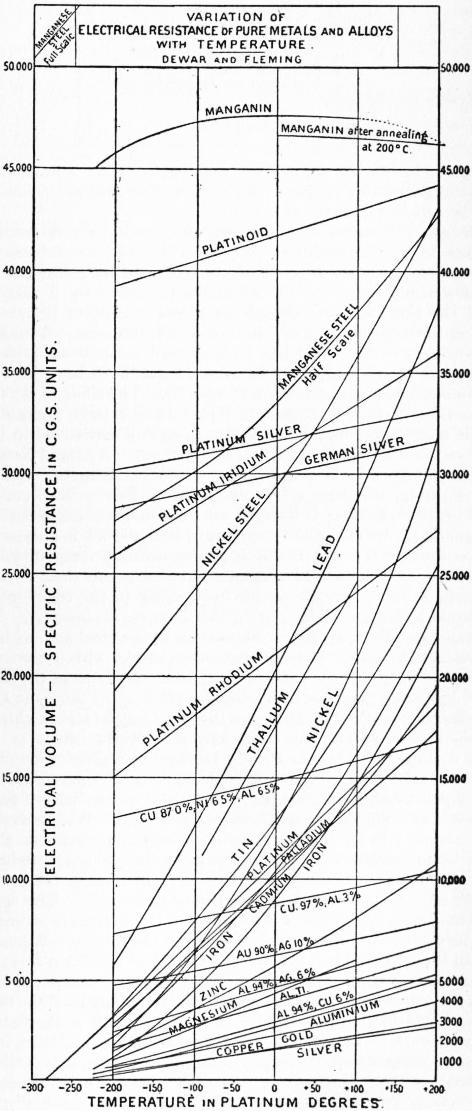
Fig. 14.—Chart of the Variation of Electrical Resistance of Pure Metals and Alloys with Temperature. (Dewar and Fleming.)
In the case of alloys and impure metals, cold brings about a much smaller decrease in resistivity, and the continuations of the curves at no time show any sign of passing through the zero point. The influence of the presence of impurities in minute quantities is strikingly shown in the case of bismuth. Various specimens of the metal, prepared with great care by purely chemical methods, gave in the hands of Dewar and Fleming some very anomalous results, appearing to reach at −80° C. a maximum of conductivity, and thereafter to increase in resistivity with decrease of temperature. But when the determinations were carried out on a sample of really pure bismuth prepared electrolytically, a normal curve was obtained corresponding to that given by other pure metals. As to alloys, there is usually some definite mixture of two pure metals which has a maximum resistivity, often greater than that of either of the constituents. It appears too that high, if not the highest, resistivity corresponds to possible chemical compounds of the two metals employed, e.g. platinum 33 parts with silver 66 parts = PtAg4; iron 80 with nickel 20 = Fe4Ni; platinum 80 with iridium 20 = IrPt4; and copper 70 with manganese 30 = Cu2Mn. The product obtained by adding a small quantity of one metal to another has a higher specific resistance than the predominant constituent, but the curve is parallel to, and therefore the same in shape as, that of the latter (cf. the curves for various mixtures of Al and Cu on the chart). The behaviour of carbon and of insulators like gutta-percha, glass, ebonite, &c., is in complete contrast to the metals, for their resistivity steadily increases with cold. The thermo-electric properties of metals at low temperatures are discussed in the article Thermoelectricity.
Table XIV.
Metals. Platinum. Platinum- rhodium Alloy. Gold. Silver. Copper. Iron.
Resistance at 100° 39.655 36.87 16.10 8.336 11.572 4.290
Resistance at 0° C 28.851 31.93 11.58 5.990 8.117 2.765
Resistance at carbonic acid 19.620 .. .. .. .. ..
Resistance at liquid oxygen 7.662 22.17 3.380 1.669 1.589 0.633
Resistance at liquid nitrogen .. .. .. .. 1.149 ..
Resistance at liquid oxygen under exhaustion 4.634 20.73 .. .. .. ..
Resistance at liquid hydrogen 0.826 18.96 0.381 0.244 0.077 0.356
Resistance at liquid hydrogen under exhaustion 0.705 18.90 0.298 0.226 0.071 ..
Resistance coefficients 0.003745 0.003607 0.003903 0.003917 0.004257 0.005515
Vanishing temperatures (Centigrade) −244.50° −543.39° −257.90° −252.26° −225.62° −258.40°C.
−244.15° −530.32° −257.8° −252.25° −226.04° −246.80°D.
Magnetic Phenomena.—Low temperatures have very marked effects upon the magnetic properties of various substances. Oxygen, long known to be slightly magnetic in the gaseous state, is powerfully attracted in the liquid condition by a magnet, and the same is true, though to a less extent, of liquid air, owing to the proportion of liquid oxygen it contains. A magnet of ordinary carbon steel has its magnetic moment temporarily increased by cooling, that is, after it has been brought to a permanent magnetic condition (“aged”). The effect of the first immersion of such a magnet in liquid air is a large diminution in its magnetic moment, which decreases still further when it is allowed to warm up to ordinary temperatures. A second cooling, however, increases the magnetic moment, which is again decreased by warming, and after a few repetitions of this cycle of cooling and heating the steel is brought into a condition such that its magnetic moment at the temperature of liquid air is greater by a constant percentage than it is at the ordinary temperature of the air. The increase of magnetic moment seems then to have reached a limit, because on further cooling to the temperature of liquid hydrogen hardly any further increase is observed. The percentage differs with the composition of the steel and with its physical condition. It is greater, for example, with a specimen tempered very soft than it is with another specimen of the same steel tempered glass hard. Aluminium steels show the same kind of phenomena as carbon ones, and the same may be said of chrome steels in the permanent condition, though the effect of the first cooling with them is a slight increase of magnetic moment. Nickel steels present some curious phenomena. When containing small percentages of nickel (e.g. 0.84 or 3.82), they behave under changes of temperature much like carbon steel. With a sample containing 7.65%, the phenomena after the permanent state had been reached were similar, but the first cooling produced a slight increase in magnetic moment. But steels containing 18.64 and 29% of nickel behaved very differently. The result of the first cooling was a reduction of the magnetic moment, to the extent of nearly 50% in the case of the former. Warming again brought about an increase, and the final condition was that at the temperature of liquid air the magnetic moment was always less than at ordinary temperatures. This anomaly is all the more remarkable in that the behaviour of pure nickel is normal, as also appears to be generally the case with soft and hard iron. Silicon, tungsten and manganese steels are also substantially normal in their behaviour, although there are considerable differences in the magnitudes of the variations they display (Proc. Roy. Soc. lx. 57 et seq.; also “The Effect of Liquid Air Temperatures on the Mechanical and other Properties of Iron and its Alloys,” by Sir James Dewar and Sir Robert Hadfield, Id. lxxiv. 326-336).
Low temperatures also affect the permeability of iron, i.e. the degree of magnetization it is capable of acquiring under the influence of a certain magnetic force. With fine Swedish iron, carefully annealed, the permeability is slightly reduced by cooling to −185° C. Hard iron, however, in the same circumstances suffers a large increase of permeability. Unhardened steel pianoforte wire, again, behaves like soft annealed iron. As to hysteresis, low temperatures appear to produce no appreciable effect in soft iron; for hard iron the observations are undecisive.
Biological Research.—The effect of cold upon the life of living organisms is a matter of great intrinsic interest as well as of wide theoretical importance. Experiment indicates that moderately high temperatures are much more fatal, at least to the lower forms of life, than are exceedingly low ones. Professor M‘Kendrick froze for an hour at a temperature of −182° C. samples of meat, milk, &c., in sealed tubes; when these were opened, after being kept at blood-heat for a few days, their contents were found to be quite putrid. More recently some more elaborate tests were carried out at the Jenner (now Lister) Institute of Preventive Medicine on a series of typical bacteria. These were exposed to the temperature of liquid air for twenty hours, but their vitality was not affected, their functional activities remained unimpaired and the cultures which they yielded were normal in every respect. The same result was obtained when liquid hydrogen was substituted for air. A similar persistence of life has been demonstrated in seeds, even at the lowest temperatures; they were frozen for over 100 hours in liquid air at the instance of Messrs Brown and Escombe, with no other effect than to afflict their protoplasm with a certain inertness, from which it recovered with warmth. Subsequently commercial samples of barley, peas and vegetable-marrow and mustard seeds were literally steeped for six hours in liquid hydrogen at the Royal Institution, yet when they were sown by Sir W. T. Thiselton Dyer at Kew in the ordinary way, the proportion in which germination occurred was no smaller than with other batches of the same seeds which had suffered no abnormal treatment. Mr Harold Swithinbank has found that exposure to liquid air has little or no effect on the vitality of the tubercle bacillus, although by very prolonged exposures its virulence is modified to some extent; but alternate exposures to normal and very cold temperatures do have a decided effect both upon its vitality and its virulence. The suggestion once put forward by Lord Kelvin, that life may in the first instance have been conveyed to this planet on a meteorite, has been objected to on the ground that any living organism would have been killed before reaching the earth by its passage through the intense cold of interstellar space; the above experiments on the resistance to cold offered by seeds and bacteria show that this objection at least is not fatal to Lord Kelvin’s idea.
At the Lister Institute of Preventive Medicine liquid air has been brought into use as an agent in biological research. An inquiry into the intracellular constituents of the typhoid bacillus, initiated under the direction of Dr Allan Macfadyen, necessitated the separation of the cell-plasma of the organism. The method at first adopted for the disintegration of the bacteria was to mix them with silver-sand and churn the whole up in a closed vessel in which a series of horizontal vanes revolved at a high speed. But certain disadvantages attached to this procedure, and accordingly some means was sought to do away with the sand and triturate the bacilli per se. This was found in liquid air, which, as had long before been shown at the Royal Institution, has the power of reducing materials like grass or the leaves of plants to such a state of brittleness that they can easily be powdered in a mortar. By its aid a complete trituration of the typhoid bacilli has been accomplished at the Jenner Institute, and the same process, already applied with success also to yeast cells and animal cells, is being extended in other directions.
Industrial Applications.—While liquid air and liquid hydrogen are being used in scientific research to an extent which increases every day, their applications to industrial purposes are not so numerous. The temperatures they give used as simple refrigerants are much lower than are generally required industrially, and such cooling as is needed can be obtained quite satisfactorily, and far more cheaply, by refrigerating machinery employing more easily condensable gases. Their use as a source of motive power, again, is impracticable for any ordinary purposes, on the score of inconvenience and expense. Cases may be conceived of in which for special reasons it might prove advantageous to use liquid air, vaporized by heat derived from the surrounding atmosphere, to drive compressed-air engines, but any advantage so gained would certainly not be one of cheapness. No doubt the power of a waterfall running to waste might be temporarily conserved in the shape of liquid air, and thereby turned to useful effect. But the reduction of air to the liquid state is a process which involves the expenditure of a very large amount of energy, and it is not possible even to recover all that expended energy during the transition of the material back to the gaseous state. Hence to suggest that by using liquid air in a motor more power can be developed than was expended in producing the liquid air by which the motor is worked, is to propound a fallacy worse than perpetual motion, since such a process would have an efficiency of more than 100%. Still, in conditions where economy is of no account, liquid air might perhaps, with effectively isolated storage, be utilized as a motive power, e.g. to drive the engines of submarine boats and at the same time provide a supply of oxygen for the crew; even without being used in the engines, liquid air or oxygen might be found a convenient form in which to store the air necessary for respiration in such vessels. But a use to which liquid air machines have already been put to a large extent is for obtaining oxygen from the atmosphere. Although when air is liquefied the oxygen and nitrogen are condensed simultaneously, yet owing to its greater volatility the latter boils off the more quickly of the two, so that the remaining liquid becomes gradually richer and richer in oxygen. The fractional distillation of liquid air is the method now universally adopted for the preparation of oxygen on a commercial scale, while the nitrogen simultaneously obtained is used for the production of cyanamide, by its action on carbide of calcium. An interesting though minor application of liquid oxygen, or liquid air from which most of the nitrogen has evaporated, depends on the fact that if it be mixed with powdered charcoal, or finely divided organic bodies, it can be made by the aid of a detonator to explode with a violence comparable to that of dynamite. This explosive, which might properly be called an emergency one, has the disadvantage that it must be prepared on the spot where it is to be used and must be fired without delay, since the liquid evaporates in a short time and the explosive power is lost; but, on the other hand, if a charge fails to go off it has only to be left a few minutes, when it can be withdrawn without any danger of accidental explosion.
For further information the reader may consult W. L. Hardin, Rise and Development of the Liquefaction of Gases (New York, 1899), and Lefèvre, La Liquéfaction des gaz et ses applications; also the article Condensation of Gases. But the literature of liquid gases is mostly contained in scientific periodicals and the proceedings of learned societies. Papers by Wroblewski and Olszewski on the liquefaction of oxygen and nitrogen may be found in the Comptes rendus, vols, xcvi.-cii., and there are important memoirs by the former on the relations between the gaseous and liquid states and on the compressibility of hydrogen in Wien. Akad. Sitzber. vols. xciv. and xcvii.; his pamphlet Comme l’air a été liquéfié (Paris, 1885) should also be referred to. For Dewar’s work, see Proc. Roy. Inst. from 1878 onwards, including “Solid Hydrogen” (1900); “Liquid Hydrogen Calorimetry” (1904); “New Low Temperature Phenomena” (1905); “Liquid Air and Charcoal at Low Temperatures” (1906); “Studies in High Vacua and Helium at Low Temperatures” (1907); also “The Nadir of Temperature and Allied Problems” (Bakerian Lecture), Proc. Roy. Soc. (1901), and the Presidential Address to the British Association (1902). The researches of Fleming and Dewar on the electrical and magnetic properties of substances at low temperatures are described in Proc. Roy. Soc. vol. lx., and Proc. Roy. Inst. (1896); see also “Electrical Resistance of Pure Metals, Alloys and Non-Metals at the Boiling-point of Oxygen,” Phil. Mag. vol. xxxiv. (1892); “Electrical Resistance of Metals and Alloys at Temperatures approaching the Absolute Zero,” ibid. vol. xxxvi. (1893); “Thermoelectric Powers of Metals and Alloys between the Temperatures of the Boiling-point of Water and the Boiling-point of Liquid Air,” ibid. vol. xl. (1895); and papers on the dielectric constants of various substances at low temperatures in Proc. Roy. Soc. vols. lxi. and lxii. Optical and spectroscopic work by Liveing and Dewar on liquid gases is described in Phil. Mag. vols. xxxiv. (1892), xxxvi. (1893), xxxviii. (1894) and xl. (1895); for papers by the same authors on the separation and spectroscopic examination of the most volatile and least volatile constituents of atmospheric air, see Proc. Roy. Soc. vols. lxiv., lxvii. and lxviii. An account of the influence of very low temperatures on the germinative power of seeds is given by H. T. Brown and F. Escombe in Proc. Roy. Soc. vol. lxii., and by Sir W. Thiselton Dyer, ibid. vol. lxv., and their effect on bacteria is discussed by A. Macfadyen, ibid. vols. lxvi. and lxxi.
(J. Dr.)
1 Figs. 1, 5, 6, 7, 10, 11, 12, 13 in this article are from Proc. Roy. Inst., by permission.
2 It may be noted that now that the commercial production of oxygen is effected by the liquefaction of air, with separation of its constituents in what is essentially a Coffey still, the chemist has at his command large quantities not only of the less volatile constituents, krypton and xenon, but also of the more volatile ones, neon and helium. Roughly a million volumes of air contain 20 volumes of neon and helium, about 15 of the former to 5 of the latter, approximately 1 volume of hydrogen being associated with them, so that in view of the enormous amounts of oxygen that are produced, helium can be obtained in practically any quantity directly from the atmosphere.

LIQUORICE. The hard and semi-vitreous sticks of paste, black in colour and possessed of a sweet somewhat astringent taste, known as liquorice paste or black sugar, are the inspissated juice of the roots of a leguminous plant, Glycyrrhiza glabra, the radix glycyrrhizae of the pharmacopoeia. The plant is cultivated throughout the warmer parts of Europe, especially on the Mediterranean shores, and to some extent in Louisiana and California. The roots for use are obtained in lengths of 3 or 4 ft., varying in diameter from 1/4 to 1 in.; they are soft, flexible and fibrous, and internally of a bright yellow colour, with a characteristic, sweet pleasant taste. To this sweet taste of its root the plant owes its generic name Glycyrrhiza (γλυκύῤῥιζα, the sweet-root), of which the word liquorice is a corruption. The roots contain grape-sugar, starch, resin, asparagine, malic acid and the glucoside glycyrrhizin, C24H36O9, a yellow amorphous powder with an acid reaction and a distinctive bitter-sweet taste. On hydrolysis, glycyrrhizin yields glucose and glycyrrhetin.
Stick liquorice is made by crushing and grinding the roots to a pulp, which is boiled in water over an open fire, and the decoction separated from the solid residue of the root is evaporated till a sufficient degree of concentration is attained, after which, on cooling, it is rolled into the form of sticks or other shapes for the market. The preparation of the juice is a widely extended industry along the Mediterranean coasts; but the quality best appreciated in the United Kingdom is made in Calabria, and sold under the names of Solazzi and Corigliano juice. Liquorice enters into the composition of many cough lozenges and other demulcent preparations; and in the form of aromatic syrups and elixirs it has a remarkable effect in masking the taste of nauseous medicines.
LIQUOR LAWS. In most Western countries the sale of alcoholic liquor is regulated by law. The original and principal object is to check the evils arising from the immoderate use of such liquor, in the interest of public order, morality and health; a secondary object is to raise revenue from the traffic. The form and the stringency of the laws passed for these purposes vary very widely in different countries according to the habits of the people and the state of public opinion. The evils which it is desired to check are much greater in some countries than in others. Generally speaking they are greater in northern countries and cold and damp climates than in southern and more sunny ones. Climate has a marked influence on diet for physiological reasons over which we have no control. The fact is attested by universal experience and is perfectly natural and inevitable, though usually ignored in those international comparisons of economic conditions and popular customs which have become so common. It holds good both of food and drink. The inhabitants of south Europe are much less given to alcoholic excess than those of central Europe, who again are more temperate than those of the north. There is even a difference between localities so near together as the east and west of Scotland. The chairman of the Prison Commissioners pointed out before a British royal commission in the year 1897 the greater prevalence of drunkenness in the western half, and attributed it in part to the dampness of the climate on the western coast. But race also has an influence. The British carry the habit of drinking wherever they go, and their colonial descendants retain it even in hot and dry climates. The Slav peoples and the Magyars in central Europe are much more intemperate than the Teutonic and Latin peoples living under similar climatic conditions. These natural differences lead, in accordance with the principle discerned and enunciated by Montesquieu, to the adoption of different laws, which vary with the local conditions. But social laws of this character also vary with the state of public opinion, not only in different countries but in the same country at different times. The result is that the subject is in a state of incessant flux. There are not only many varieties of liquor laws, but also frequent changes in them, and new experiments are constantly being tried. The general tendency is towards increased stringency, not so much because the evils increase, though that happens in particular places at particular times, as because public opinion moves broadly towards increasing condemnation of excess and increasing reliance on legislative interference. The first is due partly to a general process of refining manners, partly to medical influence and the growing attention paid to health; the second to a universal tendency which seems inherent in democracy.
Liquor laws may be classified in several ways, but the most useful way for the present purpose will be to take the principal methods of conducting the traffic as they exist, under four main headings, and after a brief explanation give some account of the laws in the principal countries which have adopted them. The four methods are: (1) licensing or commercial sale for private profit under a legal permit; (2) sale by authorized bodies not for private profit, commonly known as the Scandinavian or company system; (3) state monopoly; (4) prohibition. It is not a scientific classification, because the company system is a form of licensing and prohibition is no sale at all; but it follows the lines of popular discussion and is more intelligible than one of a more technical character would be. All forms of liquor legislation deal mainly with retail sale, and particularly with the sale for immediate consumption on the spot.
1. Licensing.—This is by far the oldest and the most widely adopted method; it is the one which first suggests itself in the natural course of things. Men begin by making and selling a thing without let or hindrance to please themselves. Then objections are raised, and when they are strong or general enough the law interferes in the public interest, at first mildly; it says in effect—This must not go on in this way or to this extent; there must be some control, and permission will only be given to duly authorized persons. Such persons are licensed or permitted to carry on the traffic under conditions, and there is obviously room for infinite gradations of strictness in granting permission and infinite variety in the conditions imposed. The procedure may vary from mere notification of the intention to open an establishment up to a rigid and minutely detailed system of annual licensing laid down by the law. But in all cases, even when mere notification is required, the governing authority has the right to refuse permission or to withdraw it for reasons given, and so it retains the power of control. At the same time holders of the permission may be compelled to pay for the privilege and so contribute to the public revenue. The great merit of the licensing system is its perfect elasticity, which permits adjustment to all sorts of conditions and to the varying demands of public opinion. It is in force in the United Kingdom, which first adopted it, in most European countries, in the greater part of North America, including both the United States and Canada, in the other British dominions and elsewhere.
2. The Scandinavian or Company System.—The principle of this method is the elimination of private profit on the ground that it removes an incentive to the encouragement of excessive drinking. A monopoly of the sale of liquor is entrusted to a body of citizens who have, or are supposed to have, no personal interest in it, and the profits are applied to public purposes. The system, which is also called “disinterested management,” is adopted in Sweden and Norway; and the principle has been applied in a modified form in England and Finland by the operation of philanthropic societies which, however, have no monopoly but are on the same legal footing as ordinary traders.
3. State Monopoly.—As the name implies, this system consists in retaining the liquor trade in the hands of the state, which thus secures all the profit and is at the same time able to exercise complete control. It is adopted in Russia, in certain parts of the United States and, in regard to the wholesale trade, in Switzerland.
4. Prohibition.—This may be general or local; in the latter case it is called “local option” or “local veto.” The sale of liquor is made illegal in the hope of preventing drinking altogether or of diminishing it by making it more difficult. General prohibition has been tried in some American states, and is still in force in a few; it is also applied to native races, under civilized rule, both in Africa and North America. Local prohibition is widely in force in the United States, Canada and Australasia, Sweden and Norway. In certain areas in other countries, including the United Kingdom, the sale of liquor is in a sense prohibited, not by the law, but by the owners of the property who refuse to allow any public-houses. Such cases have nothing to do with the law, but they are mentioned here because reference is often made to them by advocates of legal prohibition.
THE UNITED KINGDOM
England has had a very much longer experience of liquor legislation than any other country, and the story forms an introduction necessary to the intelligent comprehension of liquor legislation in general. England adopted a licensing system in 1551, and has retained it, with innumerable modifications, ever since. The English were notorious for hard drinking for centuries before licensing was adopted, and from time to time sundry efforts had been made to check it, but what eventually compelled the interference of the law was the growth of crime and disorder associated with the public-houses towards the end of the 15th century. Numbers of men who had previously been engaged in the civil wars or on the establishment of feudal houses were thrown on the world and betook themselves to the towns, particularly London, where they frequented the ale-houses, “dicing and drinking,” and lived largely on violence and crime. An act was passed in 1495 against vagabonds and unlawful games, whereby justices of the peace were empowered to “put away common ale-selling in towns and places where they should think convenient and to take sureties of keepers of ale-houses in their good behaviour.” That was the beginning of statutory control of the trade. The act clearly recognized a connexion between public disorder and public-houses. The latter were ale-houses, for at that time ale was the drink of the people; spirits had not yet come into common use, and wine, the consumption of which on the premises was prohibited in 1552, was only drunk by the wealthier classes.
Early History of Licensing.—The act of 1551-1552, which introduced licensing, was on the same lines but went further. It confirmed the power of suppressing common ale-selling, and enacted that no one should be allowed to keep a common ale-house or “tippling” house without obtaining the permission of the justices in open session or of two of their number. It further “directed that the justices should take from the persons whom they licensed such bond and surety by recognisance as they should think convenient, and empowered them in quarter session to inquire into and try breaches by licensed persons of the conditions of their recognisances and cases of persons keeping ale-houses without licences and to punish the offenders” (Bonham Carter, Royal Commission on Liquor Licensing Laws, vol. iii.). This act embodied the whole principle of licensing, and the object was clearly stated in the preamble: “For as much as intolerable hurts and troubles to the commonwealth of this realm doth daily grow and increase through such abuses and disorders as are had and used in common ale-houses and other places called tippling houses.” The evil was not due merely to the use of alcoholic liquor but to the fact that these houses, being public-houses, were the resort of idle and disorderly characters. The distinction should be borne in mind.
The act seems to have been of some effect, for no further legislation was attempted for half a century, though there is abundant evidence of the intemperate habits of all classes. Mr Bonham Carter (loc. cit.) observes:—
“The recognisances referred to in the act were valuable instruments for controlling the conduct of ale-house keepers. The justices, in exercise of their discretion, required the recognisances to contain such conditions for the management and good order of the business as they thought suitable. In this way a set of regulations came into existence, many of which were subsequently embodied in acts of Parliament. In some counties general rules were drawn up, which every ale-house keeper was bound to observe.”
It is interesting to note that among the conditions laid down about this time were the following: Closing at 9 P.M. and during divine service on Sunday; in some cases complete closing on Sunday except to travellers; the licence-holder to notify to the constable all strangers staying for more than a night and not to permit persons to continue drinking or tippling; prohibition of unlawful games, receiving stolen goods and harbouring bad characters; the use of standard measures and prices fixed by law. There was, however, no uniformity of practice in these respects until the 17th century, when an attempt was made to establish stricter and more uniform control by a whole series of acts passed between 1603 and 1627. The evils which it was sought to remedy by these measures were the existence of unlicensed houses, the use of ale-houses for mere drinking and the prevalence of disorder. It was declared that the ancient and proper use of inns and ale-houses was the refreshment and lodging of travellers, and that they were not meant for “entertainment and harbouring of lewd and idle people to spend and consume their money and their time in lewd and drunken manner.” Regulations were strengthened for the suppression of unlicensed houses, licences were made annual, and the justices were directed to hold a special licensing meeting once a year (1618). Penalties were imposed on innkeepers for permitting tippling, and also on tipplers and drunkards (1625). In 1634 licensing was first applied to Ireland. Later in the century heavy penalties were imposed for adulteration.
The next chapter in the history of licensing has to do with spirits, and is very instructive. Spirits were not a native product like beer; brandy was introduced from France, gin from the Netherlands and whisky from Ireland; but down to the year 1690 the consumption was small. The home manufacture was strictly limited, and high duties on imported spirits rendered them too dear for the general public unless smuggled. Consequently the people had not acquired the taste for them. But in 1690 distilling was thrown open to any one on the payment of very trifling duties, spirits became extremely cheap and the consumption increased with great rapidity. Regulation of the retail traffic was soon found to be necessary, and by an act passed in 1700-1701, the licensing requirements already existing for ale-house keepers were extended to persons selling distilled liquors for consumption on the premises. A new class of public-houses in the shape of spirit bars grew up. In the year 1732 a complete and detailed survey of all the streets and houses in London was carried out by William Maitland, F.R.S. Out of a total of 95,968 houses he found the following: brew-houses 171, inns 207, taverns 447, ale-houses 5975, brandy-shops 8659; total number of licensed houses for the retail sale of liquor 15,288, of which considerably more than one-half were spirit bars. The population was about three-quarters of a million. About one house in every six was licensed at this time, and that in spite of attempts made to check the traffic by restrictive acts passed in 1728-1729. The physical and moral evils caused by the excessive consumption of spirits were fully recognized; an additional duty of 5s. a gallon was placed on the distiller, and retailers were compelled to take out an excise licence of £20 per annum. The object was to make spirits dearer and therefore less accessible. At the same time, with a view to lessening the number of houses, the licensing procedure of the justices was amended by the provision that licences should only be granted at a general meeting of the justices acting in the division where the applicant resided, thus abolishing the power conferred by the original licensing act, of any two justices to grant a licence. This change, effected in 1729, was a permanent improvement, though it did not prevent the existence of the prodigious numbers of houses recorded by Maitland in 1732. The attempt to make spirits dearer by high excise duties, on the other hand, was adjudged a failure because it led to illicit trade, and the act of 1728 was repealed in 1732. But the evil was so glaring that another and more drastic attempt in the same direction was made in 1736, when the famous Gin Act was passed in response to a petition presented to parliament by the Middlesex magistrates, declaring “that the drinking of geneva and other distilled waters had for some years past greatly increased; that the constant and excessive use thereof had destroyed thousands of His Majesty’s subjects; that great numbers of others were by its use rendered unfit for useful labour, debauched in morals and drawn into all manner of vice and wickedness....” The retailing of spirits in quantities of less than 2 gallons was made subject to a licence costing £50 and the retailer had also to pay a duty of 20s. on every gallon sold. This experiment in “high licensing” was a disastrous failure, though energetic attempts were made to enforce it by wholesale prosecutions and by strengthening the regulations against evasion. Public opinion was inflamed against it, and the only results were corruptions of the executive and an enormous increase of consumption through illicit channels. The consumption of spirits in England and Wales nearly doubled between 1733 and 1742, and the state of things was so intolerable that after much controversy the high duties were repealed in 1742 with the object of bringing the trade back into authorized channels; the cost of a licence was reduced from £50 to £1 and the retail duty from 20s. to 1d. a gallon.
This period witnessed the high-water mark of intemperance in England. From various contemporary descriptions it is abundantly clear that the state of things was incomparably worse than anything in modern times, and that women, whose participation in the practice of drinking and frequenting public-houses is recorded by writers in the previous century, were affected as well as men. The experience is particularly instructive because it includes examples of excess and deficiency of opportunities and the ill effects of both on a people naturally inclined to indulgence in drink. It was followed by more judicious action, which showed the adaptability of the licensing system and the advantages of a mean between laxity and severity. Between 1743 and 1753 acts were passed which increased control in a moderate way and proved much more successful than the previous measures. The retail licence duty was moderately raised and the regulations were amended and made stricter. The class of houses eligible for licensing was for the first time taken into account, and the retailing of spirits was only permitted on premises assessed for rates and, in London, of the annual value of £10; justices having an interest in the trade were excluded from licensing functions. Another measure which had an excellent effect made “tippling” debts—that is, small public-houses debts incurred for spirits—irrecoverable at law. The result of these measures was that consumption diminished and the class of houses improved. At the same time (1753) the general licensing provisions were strengthened and extended. The distinction between new licences and the renewal of old ones was for the first time recognized; applicants for new licences in country districts were required to produce a certificate of character from the clergy, overseers and church-wardens or from three or four householders. The annual licensing sessions were made statutory, and the consent of a justice was required for the transfer of a licence from one person to another during the term for which it was granted. Penalties for infringing the law were increased, and the licensing system was extended to Scotland (1755-1756). With regard to wine, it has already been stated that consumption on the premises was forbidden in 1552, and at the same time the retail sale was restricted to towns of some importance and the number of retailers, who had to obtain an appointment from the corporation or the justices, was strictly limited. In 1660 consumption on the premises was permitted under a Crown (excise) licence, good for a variable term of years; in 1756 this was changed to an annual excise licence of fixed amount, and in 1792 wine was brought under the same jurisdiction of the justices as other liquors.
It is clear from the foregoing that a great deal of legislation occurred during the 18th century, and that by successive enactments, particularly about the middle of the century, the licensing system gradually became adjusted to the requirements of the time and took a settled shape. The acts then passed still form the basis of the law. In the early part of the 19th century another period of legislative activity set in. A parliamentary inquiry into illicit trade in spirits took place in 1821, and in 1828 important acts were passed amending and consolidating the laws for England and for Scotland; in 1833 a general Licensing Act was passed for Ireland. These are still the principal acts, though they have undergone innumerable amendments and additions. The English act of 1828 introduced certain important changes. A licence from the justices was no longer required for the sale of liquor for consumption off the premises, and the power of the justices to suppress public-houses at their discretion (apart from the annual licensing), which they had possessed since 1495, was taken away. The removal of this power, which had long been obsolete, was the natural corollary of the development of the licensing system, its greater stringency and efficiency and the increase of duties imposed on the trade. Men on whom these obligations were laid, and who were freshly authorized to carry on the business every year, could not remain liable to summary deprivation of the privileges thus granted and paid for. The justices had absolute discretion to withhold licences from an applicant whether new or old; but an appeal was allowed to quarter sessions against refusal and also against conviction for offences under the act. The main points in the law at this time were the following. The sale of alcoholic liquors for consumption on the premises was forbidden under penalties except to persons authorized according to law by the justices. Licences were granted for one year and had to be renewed annually. The justices held a general meeting each year at a specified time for the purpose of granting licences; those peculiarly interested in the liquor trade were disqualified. The licence contained various provisions for regulating the conduct of the house and maintaining order, but closing was only required during the hours of divine service on Sunday. Applicants for new licences and for the transfer of old ones (granted at a special sessions of the justices) were required to give notice to the local authorities and to post up notices at the parish church and on the house concerned.
Excise Licences.—It will be convenient at this point to explain the relation between that part of the licensing system which is concerned with the conduct of the traffic and lies in the jurisdiction of the justices and that part which has to do with taxation or revenue. The former is the earlier and more important branch of legislative interference; we have traced its history from 1495 down to 1828. Its object from the beginning was the maintenance of public order and good conduct, which were impaired by the misuse of public-houses; and all the successive enactments were directed to that end. They were attempts to suppress or moderate the evils arising from the traffic by regulating it. The excise licensing system has nothing to do with public order or the conduct of the traffic; its object is simply to obtain revenue, and for a long time the two systems were quite independent. But time and change gradually brought them into contact and eventually they came to form two aspects of one unified system. Licensing for revenue was first introduced in 1660 at the same time as duties on the manufacture of beer and spirits: but it was of an irregular character and was only applied to wine, which was not then under the jurisdiction of the justices at all (see above). In 1710 a small annual tax was imposed on the retailers of beer and ale and collected by means of a stamp on the justices’ licence. In 1728 an annual excise licence of £20 was imposed on retailers of spirits, and in 1736 this was raised to £50 (see above). The object of these particular imposts, however, was rather to check the sale, as previously explained, than to secure revenue. In 1756 the previous tax on the retail sale of wine for consumption on the premises was changed to an annual excise licence, which was in the next year extended to “made wines” and “sweets” (British wines). Similar licences, in place of the previous stamps, were temporarily required for beer and ale between 1725 and 1742 and permanently imposed in 1808. Thus the system of annual excise licences became gradually applied to all kinds of liquor. In 1825 the laws relating to them were consolidated and brought into direct relation with the other licensing laws. It was enacted that excise licences for the retail of liquor should only be granted to persons holding a justices’ licence or—to use the more correct term—certificate. The actual permission to sell was obtained on payment of the proper dues from the excise authorities, but they had no power to withhold it from persons authorized by the justices. And that was still the system in 1910.
Licensing since 1828.—There was no change in the form of the British licensing system between the consolidation of the law in 1825-1828 and the time (1910) at which we write; but there were a great many changes in administrative detail and some changes in principle. Only the most important can be mentioned. In 1830 a bold experiment was tried in exempting the sale of beer from the requirement of a justice’s licence. Any householder rated to the parish was entitled, under a bond with sureties, to take out an excise licence for the sale of beer for consumption on or off the premises. This measure, which applied to England and was commonly known as the Duke of Wellington’s Act, had two objects; one was to encourage the consumption of beer in the hope of weaning the people from spirits; the other was to counteract the practice of “tieing” public-houses to breweries by creating free ones. With regard to the first, it was believed that spirit-drinking was increasing again at the time and was doing a great deal of harm. The reason appears to have been a great rise in the returns of consumption, which followed a lowering of the duty on spirits from 11s. 8¼d. to 7s. a gallon in 1825. The latter step was taken because of the prevalence of illicit distillation. In 1823 the duty had been lowered for the same reason in Scotland from 6s. 2d. and in Ireland from 5s. 7d. to a uniform rate of 2s. 4¾d. a gallon, with so much success in turning the trade from illegal to legal channels that a similar change was thought advisable in England, as stated. The legal or apparent consumption rose at once from 7 to nearly 13 million gallons; but it is doubtful if there was much or any real increase. According to an official statement, more than half the spirits consumed in 1820 were illicit. The facts are of much interest in showing what had already been shown in the 18th century, that the liquor trade will not bear unlimited taxation; the traffic is driven underground. It is highly probable that this accounts for part of the great fall in consumption which followed the raising of the spirit duty from 11s. to 14s. 9d. under Mr Lloyd George’s Budget in 1909. With regard to “tied” houses, this is the original form of public-house. When beer was first brewed for sale a “tap” for retail purposes was attached to the brewery, and public-houses may still be found bearing the name “The Brewery Tap.” At the beginning of the 19th century complaints were made of the increasing number of houses owned or controlled by breweries and of the dependence of the licence-holders, and in 1817 a Select Committee inquired into the subject. The Beerhouse Act does not appear to have checked the practice or to have diminished the consumption of spirits; but it led to a great increase in the number of beer-houses. It was modified in 1834 and 1840, but not repealed until 1869, when beer-houses were again brought under the justices.
Most of the other very numerous changes in the law were concerned with conditions imposed on licence-holders. The hours of closing are the most important of these. Apart from the ancient regulations of closing during divine service on Sunday, there were no restrictions in 1828; but after that at least a dozen successive acts dealt with the point. The first important measure was applied in London under a Police Act in 1839; it ordered licensed houses to be closed from midnight on Saturday to mid-day on Sunday, and produced a wonderful effect on public order. In 1853 a very important act (Forbes Mackenzie) was passed for Scotland, by which sale on Sunday was wholly forbidden, except to travellers and lodgers, and was restricted on week days to the hours between 8 A.M. and 11 P.M. This act also introduced a distinction between hotels, public-houses and grocers licensed to sell liquor, and forbade the sale to children under 14 years, except as messengers, and to intoxicated persons. In England, after a series of enactments in the direction of progressive restriction, uniform regulations as to the hours of opening and closing for licensed premises were applied in 1874, and are still in force (see below). In 1878 complete Sunday closing, as in Scotland, was applied in Ireland, with the exemption of the five largest towns, Dublin, Belfast, Cork, Limerick and Waterford; and in 1881 the same provision was extended to Wales.
Other changes worthy of note are the following. In 1860 the free sale of wine for consumption off the premises was introduced by the Wine and Refreshment Houses Act, which authorized any shopkeeper to take out an excise licence for this purpose; the licences so created were subsequently known as grocers’ licences. By the same act refreshment houses were placed under certain restrictions, but were permitted to sell wine for consumption on the premises under an excise licence. In 1861 spirit dealers were similarly authorized to sell spirits by the bottle. The effect of these measures was to exempt a good deal of the wine and spirit trade from the control of the justices, and the idea was to wean people from public-house drinking by encouraging them to take what they wanted at home and in eating-houses.
In 1869 this policy of directing the habits of the people into channels thought to be preferable, which had been inaugurated in 1830, was abandoned for one of greater stringency all round, which has since been maintained. All the beer and wine retail licences were brought under the discretion of the justices, but they might only refuse “off” licences and the renewal of previously existing beer-house “on” licences upon specified grounds, namely (1) unsatisfactory character, (2) disorder, (3) previous misconduct, (4) insufficient qualification of applicant or premises. In 1872 an important act further extended the policy of restriction; new licences had to be confirmed, and the right of appeal in case of refusal was taken away; penalties for offences were increased and extended, particularly for public drunkenness, and for permitting drunkenness; the sale of spirits to persons under 16 was prohibited. In 1876 many of these provisions were extended to Scotland. In 1886 the sale of liquor for consumption on the premises was forbidden to persons under 13 years. In 1901 the sale for “off” consumption was prohibited to persons under 14, except in sealed vessels; this is known as the Child Messenger Act. These measures for the protection of children were extended in 1908 by an act which came into operation in April 1909, excluding children under 14 from the public-house bars altogether. The progressive protection of children by the law well illustrates the influence of changing public opinion. The successive measures enumerated were not due to increasing contamination of children caused by their frequenting the public-house, but to recognition of the harm they sustain thereby. The practice of taking and sending children to the public-house, and of serving them with drink, is an old one in England. A great deal of evidence on the subject was given before a Select Committee of the House of Commons in 1834; but it is only in recent years, when the general concern for children has undergone a remarkable development in all directions, that attempts have been made to stop it. In 1902 clubs, which had been increasing, and habitual drunkards, were brought under the law.
In 1904 a new principle was introduced into the licensing system in England, and this, too, was due to change in public opinion. Between 1830 and 1869, under the influence of the legislation described above, a continuous increase in the number of public-houses took place in England; but after 1869 they began to diminish through stricter control, and this process has gone on continuously ever since. Reduction of numbers became a prime object with many licensing benches; they were reluctant to grant new licences, and made a point of extinguishing old ones year by year. At first this was easily effected under the new and stringent provisions of the legislation of 1869-1872, but it gradually became more difficult as the worst houses disappeared and the remaining ones were better conducted, and gave less and less excuse for interference. But the desire for reduction still gained ground, and a new principle was adopted. Houses against which no ill-conduct was alleged were said to be “superfluous,” and on that ground licences were taken away. But this, again, offended the general sense of justice; it was felt that to take away a man’s living or a valuable property for no fault of his own was to inflict a great hardship. To meet the difficulty the principle of compensation was introduced by the act of 1904. It provides that compensation shall be paid to a licence-holder (also to the owner of the premises) whose licence is withdrawn on grounds other than misconduct of the house or unsuitability of premises or of character. The compensation is paid out of a fund raised by an annual charge on the remaining licensed houses. This act has been followed by a large reduction of licences.
State of the Law in 1910.—In consequence of the long history and evolution of legislation in the United Kingdom and of the innumerable minor changes introduced, only a few of which have been mentioned above, the law has become excessively complicated. The differences between the English, Scottish and Irish codes, the distinction between the several kinds of liquor, between consumption on and off the premises, between new licences and the renewal of old ones, between premises licensed before 1869 and those licensed since, between excise and justices’ licences—all these and many other points make the subject exceedingly intricate; and it is further complicated by the uncertainty of the courts and a vast body of case-made law. Only a summary of the chief provisions can be given here.
1. The open sale of intoxicating liquor (spirits, wine, sweets, beer, cider) by retail is confined to persons holding an excise licence, with a few unimportant exceptions, including medicine.
2. A condition precedent to obtaining such a licence is permission granted by the justices who are the licensing authority and called a justices’ licence or certificate. Theatres, passenger boats and canteens are exempted from this condition; also certain dealers in spirits and wine.
3. Justices’ licences are granted at special annual meetings of the local justices, called Brewster Sessions. Justices having a pecuniary interest in the liquor trade of the district, except as railway shareholders, are disqualified from acting; “bias” due to other interests may also be a disqualification.
4. Justices’ licences are only granted for one year and must be renewed annually, with the exception of a particular class, created by the act of 1904 and valid for a term of years. Distinctions are made between granting a new licence and renewing an old one. The proceedings are stricter and more summary in the case of a new licence; notice of application must be given to the local authorities; the premises must be of a certain annual value; a plan of the premises must be deposited beforehand in the case of an “on” licence; the justices may impose conditions and have full discretion to refuse without any right of appeal; the licence, if granted, must be confirmed by a higher authority. In the case of old licences on the other hand, no notice is required; they are renewed to the former holders on application, as a matter of right; unless there is opposition or objection, which may come from the police or from outside parties or from the justices themselves. If there is objection the renewal may be refused, but only on specified grounds—namely misconduct, unfitness of premises or character, disqualification; otherwise compensation is payable on the plan explained above. There is a right of appeal to a higher court against refusal. In all cases, whether the justices have full discretion or not, they must exercise their discretion in a judicial manner and not arbitrarily.
5. Licences may be transferred from one person to another in case of death, sickness, bankruptcy, change of tenancy, wilful omission to apply for renewal, forfeiture or disqualification. Licences may also be transferred from one house to another in certain circumstances.
6. A licence may be forfeited through the conviction of the holder of certain specified serious offences.
7. Persons may similarly be disqualified from holding a licence.
8. Liquor may only be sold on the premises specified in the licence and during the following hours:—week-days; London, 5 A.M. to 12.30 P.M. (Saturday, midnight); large towns 6 A.M. to 11 P.M.; other places 6 A.M. to 10 P.M.—Sundays; London, 1 P.M. to 3 P.M., 6 P.M. to 11 P.M.; other places 12.30 P.M. (or 1 P.M.) to 2.30 P.M. (or 3 P.M.), 6 P.M. to 10 P.M.; Christmas Day and Good Friday are counted as Sunday. In Scotland, Wales and Ireland (except the five chief towns) no sale is permitted on Sunday. Licence holders may sell during prohibited hours to lodgers staying in the house and to bona-fide travellers, who must be not less than 3 m. from the place they slept in on the previous night. Extension of hours of sale may be granted for special occasions and for special localities (e.g. early markets).
9. The following proceedings are prohibited in licensed premises: permitting children under 14 to be in a bar, selling any liquor to children under 14 for consumption on the premises, selling liquor to children under 14 as messengers except in corked and sealed vessels, selling spirits for consumption on the premises to persons under 16; selling to drunken persons and to habitual drunkards; permitting drunkenness, permitting disorder, harbouring prostitutes, harbouring constables, supplying liquor to constables on duty, bribing constables, permitting betting (persistent) or gaming, permitting premises to be used as a brothel, harbouring thieves, permitting seditious meetings; permitting the payment of wagers on premises; permitting premises to be used for election committee rooms. In and within 20 m. of London music and dancing are prohibited on licensed premises except under special licences.
10. The police have the right of entry to licensed premises at any time for the purpose of preventing or detecting offences.
11. The injurious adulteration of any liquor is prohibited; also the dilution of beer; but dilution of spirits is not unlawful if the customer’s attention is drawn to the fact.
12. All clubs in which intoxicating liquor is sold must be registered. If the liquor is the collective property of the members no licence is required for retail sale, but no liquor can be sold for consumption off the premises. Clubs run for profit, known as proprietory clubs, are on the same legal footing as public-houses.
13. Penalties incurred by licence-holders for offences under the foregoing provisions. For selling any other kind of liquor than that authorized—first offence, fine not exceeding £50 or one month’s imprisonment; second offence, fine not exceeding £100 or 3 months’ imprisonment with forfeiture of licence and, if ordered, confiscation of liquor and disqualification for five years; third offence, fine not exceeding £100 or six months’ imprisonment with forfeiture of licence and, if ordered, confiscation of liquor and unlimited disqualification. Under the Excise Acts the penalty for selling without a licence is—for spirits, a fine of £100, confiscation of liquor, forfeiture of licence and perpetual disqualification; for wine, a fine of £20; for beer or cider “on” consumption £20, “off” consumption £10. For sale to children; first offence, fine up to £2, second offence, fine up to £5. Permitting premises to be used as a brothel, fine of £20, forfeiture of licence and perpetual disqualification. Other offences, fine up to £10 for first conviction, up to £20 for second.
14. The following are offences on the part of the public. Being found drunk on any highway or other public place or on licensed premises; penalty, fine up to 10s. for first conviction, up to 20s. for second, and up to 40s. for third. Riotous or disorderly conduct while drunk; fine up to 40s. Falsely pretending to be a traveller or lodger; fine up to £5. Causing children to be in a bar or sending them for liquor contrary to the law; fine up to £2 for first and up to £5 for second offence. Attempt to obtain liquor by a person notified to the police as an habitual drunkard; fine up to 20s. for first offence, up to 40s. for subsequent ones. Giving drunken persons liquor or helping them to get it on licensed premises; fine up to 40s. or imprisonment for a month. Causing children under 11 to sing or otherwise perform on licensed premises, and causing boys under 14 or girls under 16 to do so between 9 P.M. and 6 A.M.; fine up to £25 or three months’ imprisonment.
The foregoing statement of the law does not in all respects apply to Scotland and Ireland, where the administration differs somewhat from that of England. In Scotland the provost and bailies are the licensing authority in royal and parliamentary burghs, and elsewhere the justices. They hold two sessions annually for granting licences and have considerably more power in some respects than in England. The hours of opening are from 8 A.M. to 11 P.M. (week days only), but there is a discretionary power to close at 10 P.M. In Ireland the licensing authority is divided between quarter sessions and petty sessions. Public-house licences are granted and transferred at quarter sessions; renewals and other licences are dealt with at petty sessions. In Dublin, Belfast, Cork, Londonderry and Galway the licensing jurisdiction of quarter sessions is exercised by the recorder, elsewhere by the justices assembled and presided over by the county court judge. The licensing jurisdiction of petty sessions is exercised by two or more justices, but in Dublin by one divisional justice.
Licence. Old Duty. New Duty 1909-1910.
Manufacturers’ Licences—
Distiller (spirits) £10, 10s. £10 for first 50,000 gallons, £10 for every additional 25,000 gallons.
Rectifier (spirits) £10, 10s. £15, 15s.
Brewer £1 £1 for first 100 barrels, 12s. for every additional 50 barrels.
Sweets (British wines) £1 £5, 5s.
Wholesale Dealers’ Licences—
Spirits £10, 10s. £15, 15s.
Beer £3, 6s. 1d. £10, 10s.
Wine £10, 10s. No change.
Sweets £5, 5s. No change.
Retail Licences On—
Full or Publican’s (spirits, beer, wine and cider) £4, 10s. to £60 according to annual value of premises. Half the annual value of premises, with a fixed minimum ranging from £5 in places with less than 2000 inhabitants to £35 in towns having over 100,000 inhabitants.
Beer-house £3, 10s. One-third of annual value of premises, with a minimum as above ranging from £3, 10s. to £23, 10s.
Wine (confectioners’) £3, 10s. From £4, 10s. to £12 according to annual value.
Cider £1, 5s. From £2, 5s. to £6.
Sweets £1, 5s. From £2, 5s. to £6.
Retail Licences Off—
Spirits £3, 3s. From £10 to £50 according to annual value.
Spirits (grocers’, Scotland) £4, 4s. to £13, 13s. 6d.
Spirits (grocers’, Ireland) £9, 18s. 5d. to £14, 6s. 7d.
Beer (England) £1, 5s. £1, 10s. to £10.
Beer (grocers’, Scotland) £2, 10s. and £4, 4s. £1, 10s. to £10.
Wine (grocers’) £2, 10s. 0d. £2, 10s. to £10.
Excise Licences and Taxation.—The excise licences may be divided into four classes, (1) manufacturers’, (2) wholesale dealers’, (3) retail dealers’ for “on” consumption, (4) retail dealers’ for “off” consumption. Only the two last classes come under the jurisdiction of the justices, as explained above. The total number of different excise licences is between 30 and 40, but several of them are subvarieties and unimportant or are peculiar to Scotland or Ireland. The duties charged on them were greatly changed and increased by the Finance Act of 1909-1910, and it seems desirable to state the changes thus introduced. The table on the previous page gives the principal kinds of licence with the old and the new duties.
There are in addition “occasional” licences valid for one or more days, which come under the jurisdiction of the justices; the duty is 2s. 6d. a day for the full licence (raised to 10s.) and 1s. for beer or wine only (raised to 5s.).
The total amount raised by the excise licences in the United Kingdom for the financial year ending 31st March 1909 was £2,209,928. Of this amount £1,712,160, or nearly four-fifths, was derived from the full or publicans’ licence, £126,053 from the wholesale spirit licence and £88,167 from the beer-house licence; the rest are comparatively unimportant. But the licences only represent a small part of the revenue derived from liquor. The great bulk of it is collected by means of duties on manufacture and importation. The total amount for the year ending March 1909 was £37,428,189, or nearly 30% of the total taxation revenue of the country. The excise duties on the manufacture of spirits yielded £17,456,366 and those on beer £12,691,332; customs duties on importation yielded £5,046,949. The excise duty on spirits was at the rate of 11s. a gallon, raised at the end of April 1909 to 14s. 9d.; the corresponding duty on beer is 7s. 9d. a barrel (36 gallons). The relative taxation of the liquor trade in the United States, which has become important as a political argument, is discussed below.
Effects of Legislation.—The only effects which can be stated with precision and ascribed with certainty to legislation are the increase or diminution of the number of licences or licensed premises; secondary effects, such as increase or diminution of consumption and of drunkenness, are affected by so many causes that only by a very careful, well-informed and dispassionate examination of the facts can positive conclusions be drawn with regard to the influence of legislation (see Temperance). There is no more prolific ground for fallacious statements and arguments, whether unconscious or deliberate. The course of legislation traced above, however, does permit the broad conclusion that great laxity and the multiplication of facilities tend to increase drinking and disorder in a country like the United Kingdom, and that extreme severity produces the same or worse effects by driving the trade into illicit channels, which escape control, and thus really increasing facilities while apparently diminishing them. The most successful course has always been a mean between these extremes in the form of restraint judiciously applied and adjusted to circumstances. The most salient feature of the situation as influenced by the law in recent years is the progressive reduction in the number of licensed houses since 1869. Previously they had been increasing in England.
The number of public-houses, including beer-houses for “on” consumption, in 1831 was 82,466; in 1869 it had risen to 118,602; in 1909 it had fallen again to 94,794. But if the proportion of public-houses to population be taken there has been a continuous fall since 1831, as the following table shows:—
England and Wales.
Year. No. of “on” Licences. Proportion per 10,000 of Population.
1831 82,466 59
1871 112,886 49
1901 101,940 31
1909 94,794 26
The change may be put in another way. In 1831 there was one public-house to 168 persons; in 1909 the proportion was 1 to 375. The proportional reduction goes back to the 18th century. In 1732 there was in London one public-house to every 50 persons (see above).
In Scotland the number of public-houses has been diminishing since 1829, when there were 17,713; in 1909 there were only 7065, while the population had more than doubled. The number in proportion to population has therefore fallen far more rapidly than in England, thus—1831, 1 to 134 persons; 1909, 1 to 690 persons. In Ireland the story is different. There has been a fall in the number of public-houses since 1829, when there were 20,548; but it has not been large or continuous and the population has been steadily diminishing during the time, so that the proportion to population has actually increased, thus—1831, 1 to 395 persons; 1909, 1 to 249 persons. As a whole, however, the United Kingdom shows a large and progressive diminution of public-houses to population; nor is this counterbalanced by an increase of “off” licences. If we take the whole number of licences we get the following movement in recent years:—
No. of Retail Licences (“on” and “off”) per 10,000 of Population.
1893. 1903. 1909.
England and Wales 46 42 37
Scotland 37 33 30
Ireland 41 46 45
United Kingdom 45 42 37
The diminution in the number of public-houses in England was markedly accelerated by the act of 1904, which introduced the principle of compensation. The average annual rate of reduction in the ten years 1894-1904 before the act was 359; in the four years 1905-1908; after the act it rose to 1388. The average annual number of licences suppressed with compensation was 1137, and the average annual amount of compensation paid was £1,096,946, contributed by the trade as explained above.
The reduction of public-houses has been accompanied in recent years by a constant increase in the number of clubs. By the act of 1902, which imposed registration, they were brought under some control and the number of legal clubs was accurately ascertained. Previously the number was only estimated from certain data with approximate accuracy. The following table gives the official figures:—
Clubs: England and Wales.
1887. 1896. 1904. 1905. 1906. 1907. 1908. 1909.
Number 1982 3655 6371 6589 6721 6907 7133 7353
Proportion per 10,000 0.7 1.1 1.89 1.93 1.95 1.98 2.02 2.08
Clubs represent alternative channels to the licensed trade and they are under much less stringent control; they have no prohibited hours and the police have not the same right of entry. In so far, therefore, as clubs replace public-houses the reduction of the latter does not mean diminished facilities for drinking, but the contrary. In the years 1903-1908 the average number of clubs proceeded against for offences was 74 and the average number struck off the register was 52. The increase of clubs and the large proportion struck off the register suggest the need of caution in dealing with the licensed trade; over-stringent measures defeat their own end.
Persistent attempts have for many years been made to effect radical changes in the British system of licensing by the introduction of some of the methods adopted in other countries, and particularly those in the United States. But it is difficult to engraft new and alien methods, involving violent change, upon an ancient system consolidated by successive statutory enactments and confirmed by time and usage. The course of the law and administration since 1869 has made it particularly difficult. The stringent conditions imposed on licence-holders have given those who fulfil them a claim to consideration, and the reduction of licences, by limiting the market, has enhanced their value. An expectation of renewal, in the absence of misconduct, has grown up by usage and been confirmed by the law, which recognizes the distinction between granting a new licence and renewing an old one, by the treasury which levies death duties on the assumption that a licence is an enduring property, by local authorities which assess upon the same assumption, and by the High Courts of Justice, whose decisions have repeatedly turned on this point. The consequence of all this is that very large sums have been invested in licensed property, which has become part of the settled order of society; and to destroy it by some sudden innovation would cause a great shock. The position is entirely different in other countries where no such control has ever been exercised. It is possible to impose a new system where previously there was none, but not to replace suddenly an old and settled one for something entirely different. Only the most convincing proof of the need and the advantages of the change would justify it; and such proof has not been forthcoming. The British system has the great merit of combining adaptability to different circumstances and to changing customs with continuity and steadiness of administration. The advantages of abandoning it for some other are more than doubtful, the difficulties are real and serious. Over a very long period it has been repeatedly readjusted in conformity with the movement of public opinion and of national habits; while under it the executive have gradually got the traffic well in hand, and a great and progressive improvement in order and conduct has taken place. The process is gradual but sure, and the record will compare favourably with that of any other comparable country. Further readjustment will follow and is desirable. The great defect of the law is its extreme complexity; it needs recasting and simplification. There are too many kinds of licence, and the classification does not correspond with the actual conditions of the traffic. Some licences are obsolete and superfluous; others make no distinction between branches of the trade which fulfil entirely different functions and require different treatment. The full or publican’s licence, which is incomparably the most important, places on the same legal footing hotels, restaurants, village inns and mere drinking bars, and the lack of distinction is a great stumbling-block. In the attempt made in 1908 to introduce new legislation it was found necessary to incorporate distinctions between different classes of establishment, although that was not contemplated in the original bill. It will always be found necessary whenever the subject is seriously approached, because the law has to deal with things as they actually are. It does not fall within the scope of this article to discuss the numerous controversial questions which arise in connexion with various legislative proposals for dealing with the liquor traffic; but an account of the methods which it has been proposed to adopt from other countries will be found below.
The United States
The liquor legislation of the United States presents a great contrast to that of the United Kingdom, but it is not less interesting in an entirely different way. In place of a single homogeneous system gradually evolved in the course of centuries it embraces a whole series of different ones based on the most diverse principles and subject to sudden changes and frequent experiments. It is not sufficiently understood in Europe that the legislatures of the several states are sovereign in regard to internal affairs and make what laws they please subject to the proviso that they cannot over-ride the Federal law. There is therefore no uniformity in regard to such matters as liquor legislation, and it is a mistake to speak of any particular system as representing the whole country. The United States government only interferes with the traffic to tax it for revenue, and to regulate the sale of liquor to Indians, to soldiers, etc. The liquor traffic is subject—whether in the form of manufacture, wholesale or retail trade—to a uniform tax of 25 dollars (£5) per annum imposed on every one engaged in it. Congress, under the constitution, controls interstate commerce, and the Supreme Court has decided that without its consent no state can prevent a railway or other carrying agency from bringing liquor to any point within its borders from outside. Thus no state can keep out liquor or prevent its consumption, but any state legislature may make what internal regulations it pleases and may prohibit the manufacture and sale altogether within its own borders. It may go further. In 1887 a judgment was delivered by the Supreme Court of the United States that it is within the discretionary power of a state to protect public health, safety and morals even by the destruction of property without compensation, and that the constitution of the United States is not thereby violated. Use has been made of this power in Kansas, and it appears therefore that persons who engage in the liquor trade do so at their own risk. There is in fact no stability at all except in a few states which have incorporated some principle in their constitutions, and even that does not ensure continuity of practice, as means are easily found for evading the law or substituting some other system which amounts to the same thing. As a whole the control of the liquor traffic oscillates violently between attempted suppression and great freedom combined with heavy taxation of licensed houses.
In the great majority of the states some form of licensing exists; it is the prevailing system and was adopted, no doubt from England, at an early period. It is exercised in various ways. The licensing authority may be the municipality or a specially constituted body or the police or a judicial body. The last, which is the method in Pennsylvania, seems to be exceptional. According to Mr Fanshawe there is a general tendency, due to the prevailing corruption, to withdraw from municipal authorities power over the licensing, and to place this function in the hands of commissioners, who may be elected or nominated. In New York state the licensing commissioners used to be nominated in cities by the mayors and elected elsewhere; but by the Raines law of 1896 the whole administration was placed under a state commissioner appointed by the governor with the consent of the Senate. A similar plan is in force in some important cities in other states. In Boston the licensing is in the hands of a police board appointed by the governor; in Baltimore and St Louis the authority is vested in commissioners similarly appointed; and in Washington the licensing commissioners are appointed by the president. In Pennsylvania, where the court of quarter sessions is the authority, the vesting of licensing in a judicial body dates back to 1676 and bears the stamp of English influence. It is noteworthy that in Philadelphia and Pittsburg (Allegheny county) the judicial court was for a time given up in favour of commissioners, but the change was a great failure and abandoned in 1888. The powers of the licensing authority vary widely; in some cases the only grounds of refusal are conduct and character, and licences are virtually granted to every applicant; in others the discretion to refuse is absolute. In Massachusetts the number of licences allowed bears a fixed ratio to the population, namely 1 to 1000, except in Boston, where it is 1 to 500, but as a rule where licences are given they are given freely. They are valid for a year and granted on conditions. The first and most general condition is the payment of a fee or tax, which varies in amount in different states. Under the “high licence” system (see below) it generally varies according to the size of the locality and the class of licence where different classes are recognized. In Massachusetts there are six licences; three for consumption on the premises—namely (1) full licence for all liquors, (2) beer, cider, and light wine, (3) beer and cider; two for consumption off the premises—namely (1) spirits, (2) other liquors; the sixth is for druggists. In New York state also there are six classes of licence, though they are not quite the same; but in many states there appears to be only one licence, and no distinction between on and off sale, wholesale or retail. Another condition generally imposed in addition to the tax is a heavy bond with sureties; it varies in amount but is usually not less than 2000 dollars (£400) and may be as high as 6000 dollars (£1200). A condition precedent to the granting of a licence imposed in some states is the deposit of a petition or application some time beforehand, which may have to be backed by a certain number of local residents or tax-payers. In Pennsylvania the required number is 12, and this is the common practice elsewhere; in Missouri a majority of tax-payers is required, and the licence may even then be refused, but if the petition is signed by two-thirds of the tax-payers the licensing authority is bound to grant it. This seems to be a sort of genuine local option. Provision is also generally made for hearing objectors. Another condition sometimes required (Massachusetts and Iowa) is the consent of owners of adjoining property. In some states no licences are permitted within a stated distance of certain institutions; e.g. public parks (Missouri) and schools (Massachusetts). Regulations imposed on the licensed trade nearly always include prohibition of sale to minors under 18 and to drunkards, on Sundays, public holidays and election days, and prohibition of the employment of barmaids. Sunday closing, which is universal, dates at least from 1816 (Indiana) and is probably much older. The hours of closing on week days vary considerably but are usually 10 P.M. or 11 P.M. Other things are often prohibited including indecent pictures, games and music.
State Prohibition.—In a few states no licences are allowed. State prohibition was first introduced in 1846 under the influence of a strong agitation in Maine, and within a few years the example was followed by the other New England states; by Vermont in 1852, Connecticut in 1854, New Hampshire in 1855 and later by Massachusetts and Rhode Island. They have all now after a more or less prolonged trial given it up except Maine. Other states which have tried and abandoned it are Illinois (1851-1853), Indiana (1855-1858), Michigan, Iowa, Nebraska, South Dakota. The great Middle states have either never tried it, as in the case of New York (where it was enacted in 1855 but declared unconstitutional), Pennsylvania and New Jersey, or only gave it a nominal trial, as with Illinois and Indiana. A curious position came about in Ohio,1 one of the great industrial states. It did not adopt prohibition, which forbids the manufacture and sale of liquor; but in 1851 it abandoned licensing, which had been in force since 1792, and incorporated a provision in the constitution declaring that no licence should thereafter be granted in the state. The position then was that retail sale without a licence was illegal and that no licence could be granted. This singular state of things was changed in 1886 by the “Dow law,” which authorized a tax on the trade and rendered it legal without expressly sanctioning or licensing it. There were therefore no licences and no licensing machinery, but the traffic was taxed and conditions imposed. In effect the Dow law amounted to repeal of prohibition and its replacement by the freest possible form of licensing. In Iowa, which early adopted a prohibitory law, still nominally in force, a law, known as the “mulct law,” was passed in 1894 for taxing the trade and practically legalizing it under conditions. The story of the forty years’ struggle in this state between the prohibition agitation and the natural appetites of mankind is exceedingly instructive; it is an extraordinary revelation of political intrigue and tortuous proceedings, and an impressive warning against the folly of trying to coerce the personal habits of a large section of the population against their will. It ended in a sort of compromise, in which the coercive principle is preserved in one law and personal liberty vindicated by another contradictory one. The result may be satisfactory, but it might be attained in a less expensive manner. What suffers is the principle of law itself, which is brought into disrepute.
State prohibition, abandoned by the populous New England and central states, has in recent years found a home in more remote regions. In 1907 it was in force in five states—Maine, Kansas, North Dakota, Georgia and Oklahoma; in January, 1909, it came into operation in Alabama, Mississippi, and North Carolina; and in July 1909 in Tennessee.
Local Prohibition.—The limited form of prohibition known as local veto is much more extensively applied. It is an older plan than state prohibition, having been adopted by the legislature of Indiana in 1832. Georgia followed in the next year, and then other states took it up for several years until the rise of state prohibition in the middle of the century caused it to fall into neglect for a time. But the states which adopted and then abandoned general prohibition fell back on the local form, and a great many others have also adopted it. In 1907 it was in force in over 30 states, including all the most populous and important, with one or two exceptions. But the extent to which it is applied varies very widely and is constantly changing, as different places take it up and drop it again. Some alternate in an almost regular manner every two or three years, or even every year; and periodical oscillations of a general character occur in favour of the plan or against it as the result of organized agitation followed by reaction. The wide discrepancies between the practice of different states are shown by some statistics collected in 1907, when the movement was running favourably to the adoption of no licence. In Tennessee the whole state was under prohibition with the exception of 5 municipalities; Arkansas, 56 out of 75 counties; Florida, 35 out of 46 counties; Mississippi, 56 out of 77 counties; North Carolina, 70 out of 97 counties; Vermont, 3 out of 6 cities and 208 out of 241 towns. These appear to be the most prohibitive states, and they are all of a rural character. At the other end of the scale were Pennsylvania with 1 county and a few towns (“town” in America is generally equivalent to “village” in England); Michigan, 1 county and a few towns; California, parts of 8 or 10 counties. New York had 308 out of 933 towns, Ohio, 480 out of 768 towns, Massachusetts, 19 out of 33 cities and 249 out of 321 towns. At the end of 1909 a strong reaction against the prohibition policy set in, notably in Massachusetts.
There is no more uniformity in the mode of procedure than in the extent of application. At least five methods are distinguished. In the most complete and regular form a vote is taken every year in all localities whether there shall be licences or not in the ensuing year and is decided by a bare majority. A second method of applying the general vote is to take it at any time, but not oftener than once in four years, on the demand of one-tenth of the electorate. A third plan is to apply this principle locally and put the question to the vote, when demanded, in any locality. A fourth and entirely different system is to invest the local authority with powers to decide whether there shall be licences or not; and a fifth is to give residents power to prevent licences by means of protest or petition. The first two methods are those most widely in force; but the third plan of taking a local vote by itself is adopted in some important states, including New York, Ohio and Illinois. Opinions differ widely with regard to the success of local veto, but all independent observers agree that it is more successful than state prohibition, and the preference accorded to it by so many states after prolonged experience proves that public opinion broadly endorses that view. Its advantage lies in its adaptability to local circumstances and local opinion. It prevails mainly in rural districts and small towns; in the larger towns it is best tolerated where they are in close proximity to “safety valves” or licensed areas in which liquor can be obtained; the large cities do not adopt it. On the other hand, it has some serious disadvantages. The perpetually renewed struggle between the advocates and opponents of prohibition is a constant cause of social and political strife; and the alternate shutting up and opening of public houses in many places makes continuity of administration impossible, prevents the executive from getting the traffic properly in hand, upsets the habits of the people, demoralizes the trade and stands in the way of steady improvement.
Public Dispensaries.—This entirely different system of controlling the traffic has been in general operation in one state only, South Carolina; but it was also applied to certain areas in the neighbouring states of North Carolina, Georgia and Alabama. The coloured element is very strong in these states, especially in South Carolina, where the coloured far exceeds the white population. The dispensary system was inaugurated there in 1893. It had been preceded by a licensing system with local veto (adopted in 1882), but a strong agitation for state prohibition brought matters to a crisis in 1891. The usual violent political struggle, which is the only constant feature of liquor legislation in the United States, took place, partly on temperance and partly on economic grounds; and a way out was found by adopting an idea from the town of Athens in Georgia, where the liquor trade was run by the municipality through a public dispensary. A law was passed in 1892 embodying this principle but applying it to the whole state. The measure was fiercely contested in the courts and the legislature for years and it underwent numerous amendments, but it survived. Under it the state became the sole purveyor of liquor, buying wholesale from the manufacturers and selling retail through dispensaries under public management and only for consumption off the premises. Many changes were introduced from time to time without abandoning the principle, but in 1907 the system of state control was replaced by one of county administration. Local veto is also in force, and thus the localities have the choice of a dispensary or no sale at all. The regulations are very strict. The dispensaries are few and only open on week-days and during the day-time; they close at sunset. Liquor is only sold in bottles and in not less quantities than half a pint of spirits and a pint of beer, and it must be taken away; bars are abolished. There is a general consensus of testimony to the effect of the system in improving public order especially among the coloured population, who are very susceptible to drink. The law seems to be well carried out in general, but Charleston and Columbia, the only two considerable towns, are honeycombed with illicit drink-shops, as the writer has proved by personal experience. Columbia is the capital and the seat of cotton manufactures, as are all the larger towns, with the exception of Charleston, which is the port and business centre. The population of the state is predominantly rural, and local prohibition obtains in 18 out of 41 counties.
The following statistical comparison, extracted from the United States Census of 1900 and the Inland Revenue Returns by Mr W. O. Tatum (New Encyclopedia of Social Reform) and here presented in tabular form, is highly instructive. It shows the population and number of liquor dealers paying the United States tax in two prohibition states, one state under what is considered the best licensing system, and South Carolina.
State. Population. Wholesale Liquor Dealers. Retail Liquor Dealers.
Maine (Prohibition) 694,466 51 1366
Kansas (Prohibition) 1,470,495 129 3125
Massachusetts (Licence) 2,805,346 617 5092
S. Carolina (Dispensary) 1,340,316 13 534
This table may be said to epitomize the results of the United States restrictive liquor laws. It presents examples of three different systems; the proportion of retail liquor sellers to population is—under complete prohibition, 1 to 508 and 1 to 475; under licence and local prohibition, 1 to 530; under dispensary and local prohibition, 1 to 2509. But the remarkable thing is the enormous amount of illicit traffic existing under all three systems. It is incomparably greatest under complete prohibition because the whole of the traffic in these states is illicit. In South Carolina one of the wholesale dealers and 388 of the 534 retailers were illicit. In Massachusetts the number cannot be stated, but it is very large. If the whole state were under licence the total legal number of licences, which is limited in proportion to population (see above), would be 3400; and in that case there would be some 1700 illicit retailers. But a large part of the state, probably more than half, is under local prohibition, so that the majority of the 5000 retail dealers must be illicit. These facts, which are typical and not exceptional, reveal the failure of the laws to control the traffic; only partial or spasmodic attempts are made to enforce them and to a great extent they are ignored by common consent. The illegal trade is carried on so openly that the United States revenue officers have no difficulty in collecting the federal tax. It is not a satisfactory state of things, or one which countries where law is respected would care to imitate. The example is a good lesson in what to avoid.